They Moved My Fence Six Feet So I Moved Their Entire Entrance.
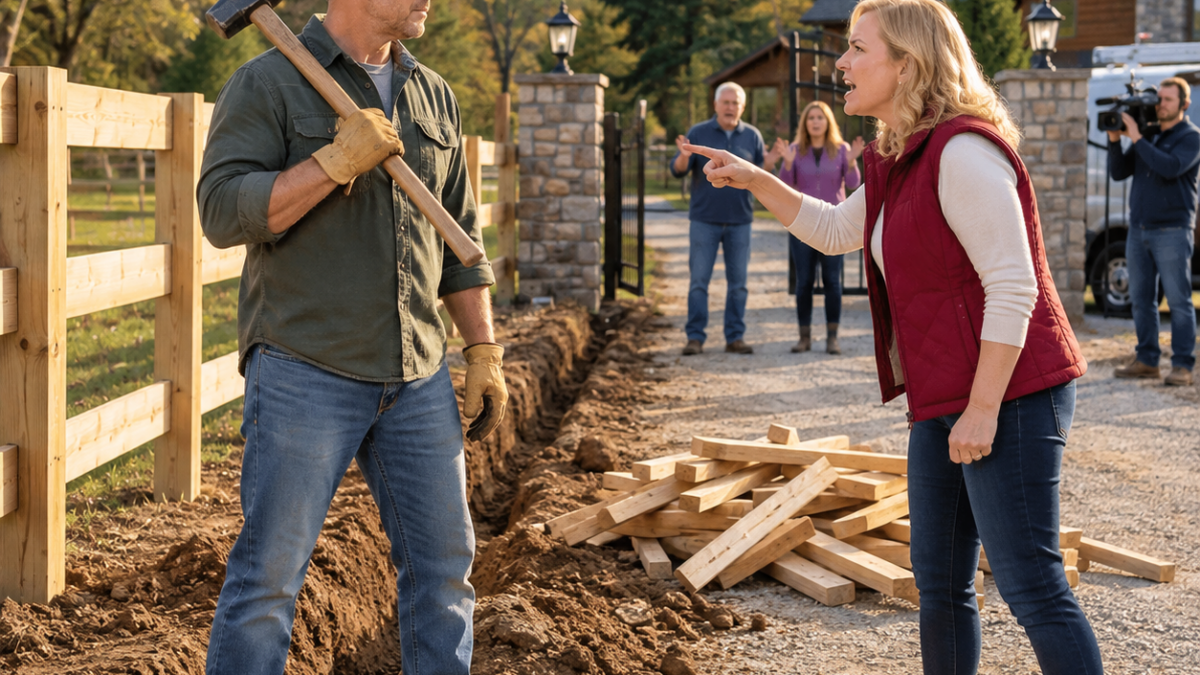
Grant looked from me to the orange flags.
Then back to the monument.
For the first time since I had met him, he didn’t have an answer ready.
The surveyor, Tom Reyes, drove the fourth flag into the grass with two short strikes.
It landed just inside a bed of ornamental grasses beneath the western stone wall.
Grant’s face changed.
Not dramatically.
He simply stopped performing.
The polished HOA-president expression disappeared, and what remained was a man doing math in his head.
“How certain are you?” he asked Tom.
Tom rested the hammer against his thigh.
“I don’t put flags in the ground for entertainment.”
“I mean about the line.”
“I know what you meant.”
Tom had been surveying property in Millbrook County for twenty-seven years.
He was the sort of man who could make silence feel like testimony.
My attorney, Marcus Bell, opened the folder he had brought with him.
Inside were copies of my deed, the original recorded plat, several later plats, and Tom’s preliminary boundary work.
Marcus handed Grant the first page.
“We’re not here to create a spectacle,” he said.
Grant glanced toward the road.
Cars were already slowing.
Pine Hollow’s entrance was designed to attract attention even when nothing was happening.
Two limestone walls curved inward from the roadside, framing the subdivision name in bronze letters.
Behind the western wall was a shallow waterfall basin faced in stacked stone.
At night, warm lights washed the monument from below.
It had appeared in every Pine Hollow brochure I had ever seen.
It was on the development website.
It was printed on the HOA newsletters.
And according to Tom’s flags, part of it was sitting on my land.
Grant scanned the documents.
“This can’t be right.”
Tom bent down, pulled another marker from his vest, and continued working.
“That’s usually why people hire surveyors.”
Grant ignored him.
He turned to Marcus.
“We have approved plans.”
“Approved plans don’t transfer ownership.”
“The county approved the entrance.”
“The county approving construction isn’t the same as Daniel granting property rights.”
Grant looked at me.
“I told you yesterday we could review the fence.”
“No,” I said. “You told me six feet didn’t matter.”
His jaw tightened.
“That isn’t what I said.”
“It’s close enough.”
Marcus shot me a look that said not to enjoy myself too much.
That was useful.
Because I was enjoying myself.
A little.
More than I probably should have.
The previous evening, when I had spread photographs of my father’s old fence across the kitchen table, I had been furious.
The more I thought about somebody pulling those posts from the ground, the angrier I became.
Dad and I had installed most of that fence during one miserable July when I was nineteen.
The temperature stayed above ninety for a week.
We rented an auger that worked properly for maybe twenty minutes at a time.
Dad insisted on checking every post with a level even though I kept telling him cattle couldn’t tell whether cedar leaned half an inch.
He had laughed.
“It’s not for the cows.”
“What’s it for?”
“So you don’t spend the next thirty years looking at a crooked fence.”
He had been right.
I had looked at that line almost every day since.
That was what Grant didn’t understand when he called it six feet.
Land is acreage on a computer screen until somebody has buried a dog there.
Planted trees there.
Fixed a tractor there.
Watched his father grow old there.
Then it becomes something else.
Grant folded the survey copy.
“This entrance has been here for years.”
Marcus nodded.
“That will be part of the discussion.”
“So Daniel suddenly owns it?”
“No. Daniel owns the land beneath part of it. That’s different.”
Grant looked toward the monument again.
“How much?”
Tom finally stood.
“Enough that you should stop assuming.”
That answer irritated Grant.
“How much, exactly?”
Tom walked toward us.
“The preliminary evidence puts the property line through the west landscaping bed, across the back edge of the monument footing, and through part of the water-feature installation. I’m finishing field verification today. You’ll get a stamped survey when the work is complete.”
Grant stared at him.
“And the road?”
“Mostly inside the subdivision parcel.”
“Mostly?”
Tom nodded toward the curb.
“There’s a small corner worth checking.”
Grant closed his eyes for half a second.
Marcus took the documents back.
“We’re giving the HOA and management company written notice today. Daniel is also disputing the fence relocation and demanding restoration.”
Grant shoved his hands into his pockets.
“You could have called me.”
I actually laughed.
“I sat in your office yesterday.”
“You came in angry.”
“I came in after you removed my fence.”
“You were confrontational.”
“I asked you to put it back.”
Grant glanced at Marcus as if expecting a neutral adult to rescue him.
Marcus merely said, “That does sound like a fairly predictable conversation.”
A black crossover rolled to a stop behind Grant’s SUV.
A woman stepped out wearing running clothes and sunglasses.
She looked from the flags to Tom.
Then at me.
“Is something happening with the entrance?”
Grant answered before anyone else could.
“Routine property review.”
She nodded slowly.
People who live under HOAs develop excellent instincts for phrases that mean absolutely nothing.
“Okay.”
She jogged away.
Grant waited until she was out of earshot.
“What do you want?”
There was something different in the question now.
Yesterday, he had asked what I could possibly do.
That morning, he wanted to know what it would take to prevent me from doing it.
“I want my fence restored on the recorded line,” I said.
“Fine.”
“By your contractor. At your expense.”
“Fine.”
“I want the old posts returned unless they’re damaged.”
He hesitated.
“Fine.”
“And I want every structure on my land addressed.”
His expression hardened again.
“That entrance has nothing to do with your fence.”
“It has everything to do with your fence.”
“No, it doesn’t.”
“It does to me.”
Marcus stepped in.
“Daniel isn’t saying the HOA has to knock anything down today.”
Grant turned toward him.
“Good.”
“He’s saying the current arrangement has to be formalized or corrected.”
Grant looked at me.
“And corrected means?”
Marcus answered.
“That depends on the final survey.”
For another minute, nobody spoke.
Water continued falling behind us.
Cars rolled beneath the monument.
Sprinklers hissed across a nearby strip of lawn.
Everything looked exactly as it had the day before.
But the orange flags changed it.
Once you know where a boundary is, you can’t unsee it.
Grant handed me his business card.
“You already have my number.”
“I know.”
“Then use it before you do anything stupid.”
Marcus’s head came up.
I said nothing.
Grant apparently realized how that sounded.
“I mean expensive,” he corrected. “For everyone.”
He walked back to his SUV.
Tom waited until the vehicle disappeared inside Pine Hollow.
Then he looked at me.
“He seems pleasant.”
Marcus laughed.
I didn’t.
Because beneath the satisfaction, another feeling had started creeping in.
This was bigger than I expected.
I had wanted my fence back.
Now I had an HOA entrance sitting partly on my land, three professionals involved, and a growing suspicion that Grant had known more than he admitted.
Tom finished the fieldwork shortly before noon.
He found two old iron pins that matched the recorded plat.
One was buried beneath several inches of soil near my roadside ditch.
The other sat farther back near an old walnut tree.
Neither had moved.
Neither supported Pine Hollow’s new fence.
The six-foot shift was not a surveying disagreement.
Somebody had simply placed the fence in the wrong location.
When Tom finished measuring, he came over to my truck.
“I’ll run everything against the records tonight.”
“But?”
He looked toward the subdivision.
“But I’d be surprised if anything meaningful changes.”
“And the entrance?”
“Part of it is yours.”
“How much?”
“Enough.”
I smiled despite myself.
He pointed at me.
“Don’t.”
“Don’t what?”
“Get creative before your lawyer tells you what you can actually do.”
“I wasn’t getting creative.”
“You have the face.”
“What face?”
“The one property owners get when they discover somebody else built something expensive in the wrong place.”
Marcus, standing behind him, said, “He absolutely has the face.”
I went home.
For the rest of the day, I did what Marcus told me to do.
Nothing.
That was harder than it sounds.
By three in the afternoon, photographs of the orange flags had already appeared in the neighborhood Facebook group.
I knew because my neighbor, Ed Harmon, texted me a screenshot.
WHAT’S GOING ON AT THE PINE HOLLOW SIGN?
Below it were twenty-seven comments.
Landscaping?
Water leak?
Road widening?
HOA project?
One person had written:
Maybe they finally realized that ridiculous waterfall costs a fortune to maintain.
Ed sent another message.
Please tell me this is you.
I wrote back:
No comment.
He replied:
That means yes.
Ed owned five acres across County Road 18 and had disliked Pine Hollow since the developer installed uplighting bright enough to make his bedroom look like sunrise at midnight.
He appeared at my house twenty minutes later carrying two coffees.
“You found something.”
“I found my property line.”
“That sounds less fun than I hoped.”
I showed him the survey sketch.
He whistled.
“Oh.”
“Yeah.”
“That’s their monument.”
“Partly.”
“And their waterfall.”
“Partly.”
He looked toward Pine Hollow, though the trees blocked most of the entrance from my porch.
“What are you going to do?”
“I don’t know.”
“That doesn’t sound like you.”
“I’m trying something new.”
“Thinking?”
“Apparently.”
Ed handed me the coffee.
“Terrible habit.”
We sat on the porch where my father had once agreed to let the original developer use the corner.
That memory bothered me more now.
The man Dad had spoken with back then wasn’t Grant.
Grant would have been a teenager.
Pine Hollow had changed developers twice before construction truly accelerated.
The first company optioned the land.
The second completed the initial engineering.
The current developer built most of the houses and transferred increasing control to the HOA as lots sold.
That complicated the history.
It also meant Grant might not have known the entrance had begun as a temporary courtesy.
Or he might have discovered it later.
I wasn’t sure which possibility irritated me more.
“You remember Dad talking to those developers?” I asked Ed.
“Your father talked to everybody.”
“About the entrance.”
Ed leaned back.
“Actually, yeah.”
I turned toward him.
“What do you remember?”
“Not much. Some guy wanted to move a sign or widen something.”
“Did Dad agree?”
“He agreed to everything until somebody gave him a reason not to.”
That sounded right.
Ed thought for a moment.
“I remember him saying they were using your corner while they figured out utilities.”
“Utilities?”
“Maybe drainage. Maybe power. This was twenty-something years ago, Dan.”
“Did he sign anything?”
“Your father?”
We both laughed.
Dad considered paperwork evidence that humanity had lost its way.
Ed sipped his coffee.
“He might have a letter somewhere.”
“What letter?”
“I don’t know. Your dad saved everything people mailed him. Remember those metal file cabinets in the workshop?”
I looked toward the building.
The cabinets were still there.
Gray steel.
Four drawers each.
One had not opened properly since Clinton was president.
I hadn’t gone through them since Dad died.
Ed saw my expression.
“You forgot about them.”
“I was hoping they contained socket sets.”
“They probably contain twenty years of Farm Bureau newsletters.”
He was right about that.
They also contained something much more useful.
It took two hours.
I found tax receipts.
Equipment warranties.
Old insurance policies.
A handwritten diagram of irrigation lines we stopped using in 2004.
And near the back of a folder marked EAST ROAD, I found a white envelope with a faded development-company logo.
Inside was a one-page letter dated June 12, 1998.
It thanked my father for allowing temporary access to a small corner of his parcel during “entrance landscaping and monument placement.”
Temporary access.
The letter said the final boundary and permanent site improvements would be adjusted once engineering plans were complete.
At the bottom was my father’s handwriting.
Okay until final layout.
Nothing more.
I sat on the workshop floor reading that sentence over and over.
He had understood exactly what the arrangement was supposed to be.
Temporary.
Not a gift.
Not a transfer.
Not a permanent easement.
I called Marcus.
He answered on the fourth ring.
“What did you find?”
“How did you know I found something?”
“You don’t call me after business hours to discuss your feelings.”
I read the letter aloud.
There was silence.
“Send me a photograph.”
I did.
A minute passed.
Then two.
Finally he called back.
“This helps.”
“How much?”
“It helps establish the historical context. It isn’t magic. It doesn’t resolve every legal question. But it strongly supports the idea that the original use was permissive rather than an agreed permanent property right.”
“So we can make them move it.”
“Slow down.”
“There it is.”
“What?”
“The lawyer phrase.”
“I’m serious. Depending on the history, there may be arguments about reliance, long-term use, notice, statutes, boundary doctrines, all sorts of things we’re not going to settle from your workshop tonight.”
“You know how to ruin a good document.”
“That’s why people pay me.”
I leaned against the cabinet.
“So what do we do?”
“We send it with the notice. Then we see what they claim.”
The HOA responded the next morning.
Not Grant.
Their attorney.
Her name was Rebecca Sloan, and unlike Grant, she did not treat me like a confused neighbor complaining about landscaping.
Her email to Marcus was short.
The association disputed any unauthorized encroachment, requested the completed survey, reserved all rights, and asked that nobody alter the entrance pending review.
Marcus forwarded it to me with one sentence.
This is what reasonable lawyers write before everybody has all the facts.
I called him.
“So I don’t touch anything.”
“You touch nothing.”
“What if their sprinklers hit my truck?”
“Move the truck.”
“What if the waterfall offends me?”
“Develop resilience.”
“What if—”
“Daniel.”
“Fine.”
Three days later, Tom completed the survey.
There was no ambiguity.
The relocated fence sat between five feet eight inches and six feet four inches inside my parcel depending on the point.
The western Pine Hollow monument wall encroached onto my land.
So did a section of its footing.
The outer edge of the waterfall basin crossed the line.
Several electrical fixtures and irrigation components serving the entrance also occupied my parcel.
The road itself, fortunately, remained within the development’s right-of-way except for a small landscaped curb transition.
That mattered.
I did not own Pine Hollow’s road.
I could not simply shut down access.
I did, however, own enough of the decorative entrance to make everybody uncomfortable.
Marcus called a meeting.
Not at the HOA office.
At his law office.
Grant came with Rebecca Sloan and a representative from the management company named Laura Chen.
I brought Tom.
The conference room was so small that every folder felt oversized.
Rebecca began.
“We’ve reviewed the survey.”
Marcus nodded.
“And?”
“We agree there appears to be an encroachment.”
Grant shifted in his chair.
That sentence probably cost him more emotionally than it cost the HOA legally.
Rebecca continued.
“The association is investigating the construction history and any potential agreements with prior owners.”
“There were none recorded,” Marcus said.
“We’re aware.”
Marcus slid a copy of my father’s 1998 letter across the table.
Rebecca read it.
Then read it again.
Grant leaned toward her.
“What is that?”
She handed it to him.
His mouth tightened.
Laura Chen took notes without looking up.
Rebecca said, “This certainly provides context.”
Marcus smiled.
That was lawyer language for bad news.
I looked at Grant.
“Still a minor adjustment?”
Rebecca raised a hand slightly.
“Mr. Mercer—”
“No. I’m asking him.”
Grant met my eyes.
“We didn’t have this information when the fence was moved.”
“You had my deed.”
“The contractor worked from development drawings.”
“Then why did you tell me updated survey data supported it?”
His expression froze.
Rebecca turned toward him.
So did Laura.
That was the first moment I realized Grant had not told his own attorney everything.
Rebecca spoke carefully.
“What updated survey?”
Grant leaned back.
“The site plan.”
“That isn’t what he asked.”
“I was referring generally to the plans.”
I could almost hear the air conditioner.
Marcus asked, “Was there a new boundary survey before Daniel’s fence was relocated?”
Grant looked at Rebecca.
Then at me.
“No.”
Laura stopped writing.
Marcus folded his hands.
“Who authorized the relocation?”
“The landscape committee discussed correcting the entrance alignment.”
“That wasn’t my question.”
Grant’s patience cracked.
“I approved the contractor.”
There it was.
Not the developer.
Not a surveyor.
Not some faceless regional office.
Grant.
He had approved moving my fence because it conflicted with landscaping.
Rebecca removed her glasses.
“Grant, were you aware the fence belonged to Mr. Mercer?”
“It was along the edge of the development.”
“That also wasn’t my question.”
“Yes.”
“And did anyone contact him?”
“We believed the line was incorrect.”
“Based on what?”
“The site plan.”
Tom finally spoke.
“Site plans show proposed improvements. They don’t magically rewrite deeds.”
Grant turned toward him.
“I understand that.”
Tom shrugged.
“Apparently.”
Rebecca gave Tom a look.
Tom appeared delighted.
Marcus redirected the conversation before it became childish.
“We can solve this.”
Rebecca nodded.
“I agree.”
“Fence restored on Daniel’s surveyed line, association pays survey costs and reasonable restoration expenses.”
“Potentially.”
“Not potentially.”
“We need contractor estimates.”
“Fine.”
“Regarding the monument, the association would prefer to formalize continued use.”
I had expected that.
“What does that mean?” I asked.
Rebecca answered.
“An easement or lease arrangement, properly documented.”
“And compensation?”
“That can be discussed.”
Grant spoke.
“We’re not paying rent forever because of a technicality.”
Rebecca’s eyes closed briefly.
It was the expression of a professional whose client had just kicked over a bucket she was carrying.
Marcus said, “It isn’t a technicality.”
Grant crossed his arms.
“That entrance has been there for more than twenty years.”
“And Daniel’s family has owned the land for more than thirty.”
“So?”
“So if you want permanent use, you negotiate permanent use.”
Grant looked directly at me.
“What do you want?”
The answer I had rehearsed the night before suddenly felt wrong.
I had imagined saying something dramatic.
Ten thousand dollars.
Move the whole thing.
Tear it down.
Make it hurt.
But sitting in that little conference room, watching Rebecca organize documents and Laura calculate expenses, I understood that revenge was easier to fantasize about than manage.
I didn’t want to own a legal war.
I wanted my boundary respected.
“I want my fence back,” I said.
“Agreed.”
“I want the entrance either moved completely off my land or covered by an agreement that makes clear exactly what you’re allowed to use.”
Rebecca nodded.
“Reasonable.”
“I want the HOA to pay all costs caused by moving my fence.”
“Subject to documentation.”
“And I want the agreement to prevent any future landscaping, fencing, drainage, signs, electrical work, or expansion outside the defined area without written approval.”
Rebecca wrote that down.
Grant stared at me.
“Anything else?”
“Yes.”
He waited.
“I want you to stop acting like the amount of land determines whether you have to ask.”
Nobody spoke.
Even Marcus didn’t interrupt.
Grant’s face hardened.
“This feels personal.”
“It became personal when you had my fence pulled out.”
“I was trying to fix an entrance problem.”
“On somebody else’s property.”
“You’re making this sound like theft.”
“I’m describing what you did.”
Rebecca intervened.
“I think we’ve reached the point where the lawyers should work through proposed terms.”
That was probably correct.
We left without an agreement.
For the next week, Pine Hollow lived in a strange state of suspended normalcy.
My temporary survey stakes remained in place.
The entrance remained untouched.
My fence remained six feet wrong because Marcus advised me not to complicate negotiations by moving it myself before the HOA’s contractor could correct it.
Residents noticed.
Some stopped me at the grocery store.
Some waved from their cars.
Some pretended they didn’t know anything and then asked strangely detailed questions.
Pine Hollow’s Facebook group became a rumor factory.
One post claimed I was suing for two million dollars.
Another said the county was forcing the entire subdivision entrance to be demolished.
Someone else claimed the waterfall violated federal wetland rules.
That one was impressive because the nearest protected wetland was miles away.
Ed began reading me the worst theories over coffee.
“You’re apparently a retired federal judge.”
“I’m forty-eight.”
“They say early retirement.”
“From what court?”
“Unclear.”
Another morning, he arrived laughing so hard he nearly spilled his coffee.
“You own the road now.”
“I don’t.”
“You do online.”
“Fantastic.”
“Someone says you’re installing a toll booth.”
“That one has potential.”
Marcus would not have appreciated the joke.
The funny part ended when I received a letter from the HOA.
Not from Rebecca.
An official violation notice.
It accused me of placing unauthorized markers within the Pine Hollow common entrance area.
The orange survey flags.
On my land.
I called Marcus.
He stared at the scanned notice for several seconds.
Then said, very softly, “That is unfortunate.”
“You sound happy.”
“I’m not happy.”
“You sound extremely happy.”
“I’m professionally interested.”
The notice had been generated through the management company’s standard enforcement system.
Laura Chen called Marcus within an hour and apologized.
According to her, someone had manually entered the complaint.
Marcus asked who.
She would not say.
She didn’t need to.
Grant’s name was listed in the metadata attached to the internal work order that appeared later in document production.
That was when the dispute stopped being just an old mistake followed by bad judgment.
Grant had moved the fence without a boundary survey.
Then, after learning the actual line, he had tried to use HOA enforcement against the survey markers proving it.
Rebecca withdrew the violation notice the same day.
Marcus added it to our file.
The negotiations became less friendly.
Then came the setback.
Pine Hollow’s attorney found an old set of engineering plans from 1999.
On one drawing, the entrance monument was shown almost exactly where it had ultimately been built.
Next to the western edge was a handwritten notation:
OWNER APPROVAL RECEIVED.
There was no signature.
No attached agreement.
No legal description.
No easement.
But Grant treated it like victory.
He called me himself.
“You see? Your father approved it.”
“He allowed temporary use.”
“He approved the entrance.”
“He didn’t give away the land.”
“You’re splitting hairs.”
“No. Property lines are pretty much made of hairs.”
Grant exhaled.
“You know what I mean.”
“I do.”
“Then why are we doing this?”
“You moved my fence.”
“We’ve agreed to put it back.”
“After I proved you were wrong.”
“What do you want from me, Daniel? An apology?”
I thought about that.
“Yes.”
Silence.
He clearly had not expected the answer.
“What?”
“You asked. Yes. I want you to say you shouldn’t have moved it without talking to me.”
“That doesn’t solve the entrance.”
“No. But it would solve one thing.”
Grant was silent again.
Then he said, “I’m not admitting liability in a dispute.”
“You called me.”
“This conversation was a mistake.”
He hung up.
The next morning, Marcus phoned.
“Grant wants formal mediation.”
“Fine.”
“He also wants the entrance left where it is.”
“That costs them.”
“I told them that.”
“How much?”
“We should decide what makes sense instead of what feels satisfying.”
There went my fun again.
Marcus hired an appraiser familiar with access rights and small easement valuations.
That surprised me.
I had imagined choosing a number based on irritation.
Apparently irritation is not a recognized appraisal method.
The appraiser considered the square footage, the location, the impact on my parcel, the permanent nature of the improvements, maintenance access, utilities, and the benefit to the subdivision.
His number was not enormous.
It was meaningful.
More importantly, he recommended a one-time easement payment rather than monthly rent because perpetual monthly payments would create accounting and enforcement problems for everyone.
I had originally liked the idea of Pine Hollow sending me a check every month.
It felt poetic.
Then Marcus asked me one question.
“Do you want Grant Caldwell in your mailbox forever?”
I chose the lump sum.
Mediation happened three weeks after I discovered the fence.
It lasted six hours.
We met at a neutral office downtown.
The mediator was a retired judge named Ellen Price.
She had silver hair, no visible patience for nonsense, and the ability to make five adults stop talking simply by removing her glasses.
Grant came.
Rebecca came.
Laura came for the management company.
Two HOA board members attended as well: Susan Park and Harold Greene.
I had never met either.
Within the first hour, I learned something important.
Grant had not told the board the full story before moving my fence.
He had presented it as correcting a misplaced boundary fence during entrance landscaping.
Susan discovered the truth only after Tom’s survey.
Harold had assumed I had agreed to the change.
That changed the shape of my anger.
Not all of Pine Hollow had decided my land didn’t matter.
One man had.
And several people had trusted him.
Judge Price asked Grant to explain why the fence had been relocated.
He spoke for almost ten minutes.
Sight lines.
Landscaping symmetry.
Entrance aesthetics.
Maintenance access.
Consistency with old development drawings.
When he finished, Judge Price asked one question.
“Did you have a current survey establishing that the fence was on association property?”
“No.”
“Did you have Mr. Mercer’s permission?”
“No.”
“Did you contact him?”
“No.”
She looked down at her notes.
“Then I understand all the landscaping words, but I don’t understand the decision.”
Grant stared at the table.
For once, nobody rescued him.
The board members requested a private session with their attorney.
I sat in another room with Marcus eating vending-machine pretzels.
“This is less dramatic than television,” I said.
“Real disputes mostly involve bad coffee.”
“I expected somebody to slam a folder.”
“You can if it helps.”
“It might.”
“Please don’t.”
After forty minutes, Judge Price returned.
The HOA offered to restore my fence immediately.
They would pay Tom’s survey bill.
They would reimburse reasonable legal expenses up to an agreed amount.
They would pay for a permanent easement covering only the existing monument footprint, utilities, irrigation, and maintenance strip.
No expansion without written permission.
No relocation of any boundary improvement without a survey and written notice.
The HOA would also record a formal acknowledgment of the surveyed property line.
It was close.
Very close.
But there was one problem.
They wanted the existing monument left exactly where it was.
I looked at Marcus.
Then at the map.
The easement shape wrapped awkwardly around the corner of my parcel.
A maintenance strip extended farther toward my driveway than I liked.
It would preserve the same visual pinch point that had apparently bothered Grant enough to move my fence.
“What if I don’t want people maintaining a waterfall six feet from my fence forever?” I asked.
Rebecca replied, “Then the association would need to redesign the entrance.”
“How much would that cost?”
Grant laughed without humor.
“Significantly more than this settlement.”
Judge Price looked at him.
“That is not Mr. Mercer’s problem.”
Grant pressed his lips together.
I studied the survey again.
“What if you move the western half?”
Susan Park leaned forward.
“What do you mean?”
“The monument doesn’t need to disappear. Shift the west wall and water feature east so everything permanent sits on Pine Hollow property. Keep only a small landscaping easement if necessary.”
Grant shook his head.
“That would destroy the symmetry.”
I looked at him.
There it was again.
Symmetry.
The word that had cost everybody a month of lawyers.
Susan turned toward Grant.
“Is symmetry why we’re here?”
He didn’t answer.
Harold Greene asked the architect, who had joined by video, what a redesign would involve.
The architect pulled up the original site plan.
Then something unexpected happened.
She said moving the western wall might actually improve vehicle sight distance near the county road.
Grant stared at the screen.
“That’s not what we were told.”
“The landscaping has matured since construction,” she said. “The current west wall and plantings are tighter than the original visibility envelope.”
Tom leaned toward me.
I whispered, “Did she just say their fancy entrance is badly designed?”
He whispered back, “In architect.”
The conversation changed.
Within thirty minutes, the HOA’s position shifted from preserving the entrance to evaluating a redesign.
Judge Price sent us home without a final settlement but with a framework.
My fence would be restored immediately.
The HOA would commission a redesign moving all permanent entrance structures off my parcel.
If the redesign proved impractical, we would return to the easement proposal.
Two days later, contractors arrived at my property.
This time, someone knocked first.
That mattered more than I expected.
The foreman introduced himself as Miguel Santos.
He showed me the survey.
He showed me the work order.
He asked whether I wanted the old cedar reused.
I walked over to the stack.
Several posts had cracked during removal.
Others were still sound.
“Use what you can.”
He nodded.
“We’ll replace the damaged ones.”
My father’s fence went back where it belonged.
Not approximately.
Not according to an aesthetic plan.
Exactly on Tom’s line.
I stood beside the walnut tree while Miguel set the final post.
He checked it with a level.
I almost laughed.
“What?”
“Nothing.”
He looked at the post.
“You want it adjusted?”
“No. My dad used to do the same thing.”
Miguel checked it again.
“Your dad was right.”
By sunset, the line looked familiar again.
The driveway looked wide enough.
The mailbox looked where it belonged.
The strange feeling I had experienced that first evening disappeared.
I walked the fence slowly.
At one section, Miguel had reused a post with an old gouge near the bottom.
I remembered making that mark with the bucket of Dad’s tractor.
He had complained about it for fifteen years.
Seeing it back in place did something to me that winning an argument never could.
The next week, Pine Hollow held an emergency board meeting.
Grant resigned as HOA president before the meeting began.
He did not leave the board immediately.
His resignation letter cited “personal reasons and excessive conflict surrounding current property matters.”
Ed obtained a copy within approximately seven minutes.
I did not ask how.
Susan Park became interim president.
Unlike Grant, she called before coming to my house.
She stood on my porch holding a folder.
“I owe you an apology.”
“You didn’t move the fence.”
“I was on the board that allowed one person to approve too much without review.”
That surprised me.
Most apologies contain an escape hatch.
Hers didn’t.
She explained that the board had adopted temporary controls requiring two board signatures and management review before contractors performed work near external property boundaries.
They were also reviewing older common-area improvements for documentation problems.
“That sounds expensive,” I said.
“It is.”
“Sorry.”
“No, you’re not.”
“No.”
She smiled.
Then she opened the folder.
Inside were three concept drawings for a redesigned entrance.
The first simply shifted the western wall.
The second removed the waterfall.
The third changed everything.
It moved both monument walls inward, shortened them, replaced the waterfall with native landscaping, and created a wider, cleaner shoulder near the county road.
Ironically, it looked better.
“You’re moving the whole entrance,” I said.
“Not the road.”
“I know.”
“The monument, lighting, landscaping, irrigation, everything decorative.”
I looked at the third drawing.
“How far?”
“Between eleven and seventeen feet depending on the feature.”
“Entirely onto Pine Hollow property?”
“Entirely.”
I laughed.
Susan smiled.
“I had a feeling you might enjoy that.”
“Grant moved my fence six feet.”
“And now we’re moving our entrance farther than that.”
“I’m trying not to appreciate the symmetry.”
She raised an eyebrow.
“Bad word around here.”
That became the plan.
Because Pine Hollow’s entrance work touched utilities and the county-road edge, nothing happened overnight.
There were permits.
Utility markings.
Contractor bids.
A revised landscape plan.
Electrical review.
Traffic-control requirements for the work nearest the road.
It took nearly two months before the first machine arrived.
I was glad.
The delay made the whole thing feel less like revenge and more like what it actually was.
Correction.
The crew started with the western monument.
They removed the bronze letters.
Disconnected the lights.
Drained the shallow waterfall basin.
Lifted stone carefully instead of smashing it.
Most material was reused.
For three days, Pine Hollow’s entrance looked half-finished.
Residents drove past temporary barriers and orange cones.
Nobody lost access.
Nobody’s house became worthless.
Civilization survived.
Grant appeared on the second day.
I was standing near my fence talking with Miguel, whose company had also won part of the entrance project.
Grant parked across the road and walked over.
He looked tired.
Not defeated.
Not humiliated.
Just tired.
We stood side by side watching a skid steer carry a section of limestone toward the new foundation.
“So,” he said.
“So.”
“You got what you wanted.”
I thought about the sentence.
“My fence is where it belongs.”
“That’s not what I meant.”
“I know.”
He watched the crew.
“I spent three years getting that entrance the way I wanted it.”
There was no anger in his voice.
That surprised me.
“Why did it matter so much?”
He laughed once.
“You’re really asking?”
“Yeah.”
Grant put his hands in his pockets.
For a while, I thought he wouldn’t answer.
Then he said Pine Hollow had struggled after the first developer failed.
Home sales stalled.
Common areas were unfinished.
Residents complained constantly.
Property values lagged behind competing subdivisions.
Grant bought one of the first completed homes there.
He joined the HOA board.
Then he became obsessed with fixing what looked unfinished.
The entrance was his biggest project.
He raised money.
Found contractors.
Pushed for better landscaping.
Got the monument rebuilt after an early design started cracking.
For years, people praised him for it.
“It became proof the place wasn’t failing,” he said.
I looked at the stone being moved.
“So when my fence made it look uneven—”
“I saw a problem.”
“You saw my property as landscaping.”
He nodded slowly.
“Yeah.”
That admission mattered.
Maybe because I hadn’t expected it.
Grant kicked a pebble off the shoulder.
“I should have called you.”
“Yes.”
“I should have had it surveyed.”
“Yes.”
“You don’t have to enjoy this so much.”
“I’m working on that.”
He almost smiled.
Then his expression changed.
“I got carried away.”
“That violation notice didn’t help.”
“No.”
“Why did you do that?”
He rubbed the back of his neck.
“I was angry.”
“That’s a terrible reason to use HOA enforcement.”
“I know.”
We watched the crew for another minute.
Then he said something I had waited weeks to hear.
“I’m sorry, Daniel.”
No lawyer language.
No qualification.
No “if you were offended.”
Just that.
I nodded.
“Thank you.”
It didn’t make us friends.
It didn’t erase the cost.
But it closed something.
Grant left.
The entrance project continued.
By the end of the third week, Pine Hollow had a new monument.
Both walls sat farther east.
The waterfall was gone.
In its place were native grasses, two small trees, low stonework, and lighting mounted entirely within HOA property.
The bronze letters remained.
PINE HOLLOW RESERVE.
Tom returned for a final verification.
He checked the fence.
Checked the monument.
Checked the electrical cabinets.
Checked the curb transition.
Then he walked over carrying his equipment.
“Well?”
I asked.
He removed his sunglasses.
“They managed to build an entire entrance without stealing any land.”
“Remarkable.”
“Technology.”
The final settlement was signed a week later.
Because the entrance had been moved entirely off my parcel, the proposed permanent monument easement was no longer necessary.
The HOA paid for the survey.
They paid my documented legal expenses within the negotiated amount.
They paid the full cost of restoring the fence.
They also compensated me for temporary use and damage associated with the unauthorized relocation.
It was not a fortune.
Nobody went bankrupt.
Nobody went to jail.
No judge slammed a gavel while the neighborhood applauded.
I received enough to cover what the dispute had cost me and a little more.
More importantly, the agreement recorded the boundary clearly and required notice before any future work near it.
Pine Hollow updated its contractor procedures.
Boundary-related work now required current survey information.
The management company added an approval step for projects bordering non-HOA parcels.
Susan later told me the changes were boring.
“Good,” I said.
Property rules should be boring.
Ed disagreed.
He had enjoyed the entire event immensely.
For months afterward, whenever we drove past the new entrance, he would announce,
“There’s Daniel’s monument.”
“It isn’t mine.”
“You moved it.”
“They moved it.”
“Because of you.”
“That doesn’t make it mine.”
He would look at me.
“You’ve lost your appreciation for legend.”
A year passed.
Then another.
Pine Hollow filled most of its remaining lots.
The native landscaping at the entrance grew in.
The new trees got taller.
The shorter stone walls actually aged better than the old oversized monument.
The entrance became less like a resort gate and more like part of the road.
Nobody complained.
At least not to me.
Grant sold his house about eighteen months later.
I heard he moved closer to his daughter in another county.
Before leaving, he stopped by once.
Not at the entrance.
At my workshop.
He had an envelope in his hand.
Inside was an old photograph.
It showed Pine Hollow during early construction.
Bare dirt.
Wood stakes.
Temporary signage.
And in the background, my father stood beside the original fence talking to one of the developers.
Grant had found it in a box of HOA records.
I stared at it longer than I expected.
Dad looked younger than I remembered him.
Baseball cap.
Work shirt.
Hands on his hips.
The original cedar fence ran straight behind him.
“You should have this,” Grant said.
“Thanks.”
He looked around the workshop.
“So this is where you found the letter.”
“Yeah.”
“Your father kept everything.”
“You have no idea.”
Grant nodded toward the photograph.
“He knew where the line was.”
“He usually did.”
Grant smiled faintly.
Then he left.
I framed the picture.
It hangs inside the workshop now above the old metal cabinets.
Sometimes I notice it when I’m looking for a wrench.
Sometimes I stop.
Most days I don’t.
That’s probably the best ending I could have asked for.
The property line stopped being a battle.
It went back to being a property line.
The fence still runs beside my driveway exactly where Tom’s survey says it belongs.
A few of the posts are new.
A few are the same ones Dad and I set decades ago.
One still carries the gouge from his tractor.
Across the way, Pine Hollow’s entrance sits completely on Pine Hollow land.
Its stone walls are smaller now.
Its landscaping is simpler.
There is no waterfall.
No one seems to miss it.
Every so often, somebody hears a shortened version of the story and says I “made the HOA tear down its entrance.”
That isn’t quite true.
I didn’t storm into their neighborhood with a bulldozer.
I didn’t block their road.
I didn’t destroy anything in the night.
I showed them a survey.
I showed them a letter.
I made them confront the same boundary they had expected me to ignore.
Then their own board decided the cleanest solution was to move what should never have crossed that line in the first place.
And yes, there is a part of me that still appreciates the irony.
Grant moved my fence six feet because he thought the entrance would look better.
In the end, Pine Hollow moved its entrance much farther because six feet of somebody else’s land turned out to matter after all.
Years later, the fence is still straight.
The entrance is still there.
And whenever I pull into my driveway, nothing feels even an inch out of place.