PART 2: I Refused to Open My Gate for HOA Officers — Then Told Them, “My Ranch, My Rules”
My name is Daniel Hayes.
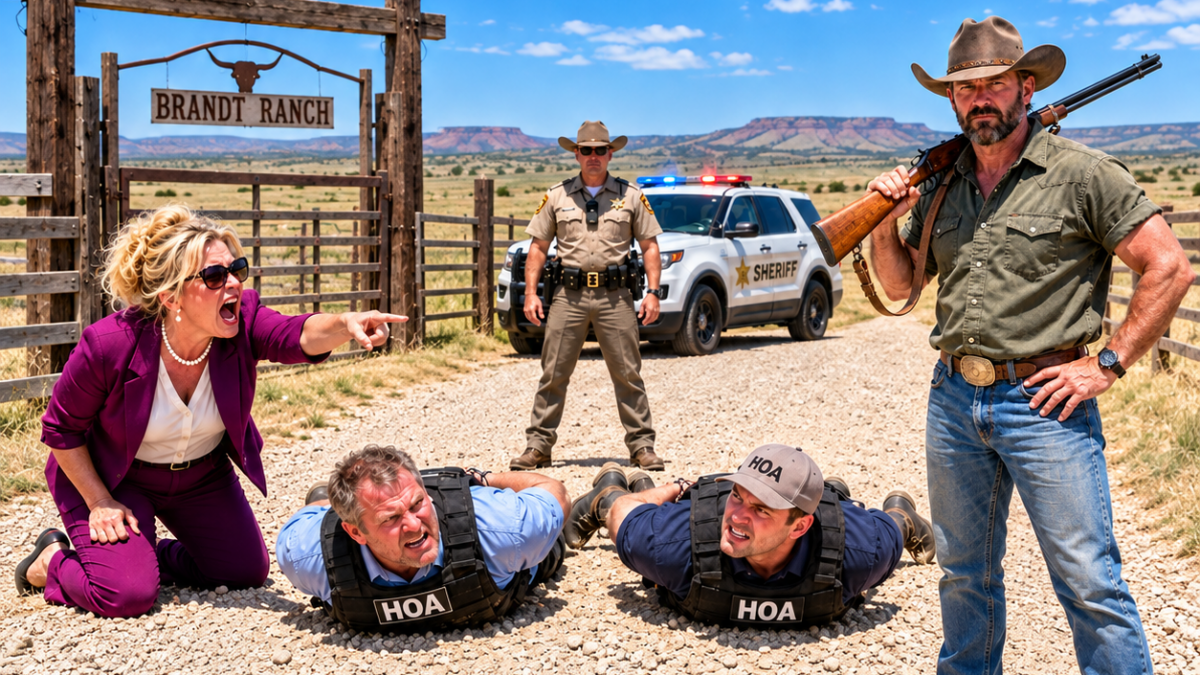
I was fifty-four when Brenda Crawford brought six private “officers” to my front gate.
My wife Sarah and I lived on seven hundred acres in eastern Kansas called Broken Creek Ranch.
My grandfather bought the first two hundred acres in the 1960s.
My father added parcels whenever cattle prices were good and the bank was feeling generous.
By the time Sarah and I took over, Broken Creek had three barns, two ponds, several pastures, a creek long enough to cause trouble after heavy rain, an equipment shed, cattle pens, miles of fence, and enough old machinery to guarantee that something always needed fixing.
The farmhouse was nearly eighty years old.
One barn leaned east.
Nathan claimed it was straight.
Nathan was wrong.
The cattle did not care.
Neither did I.
Broken Creek was a working ranch.
Mud happened.
Hay happened.
Tractors occasionally spent the night outside because tractors have never once worried about neighborhood aesthetics.
For most of my life, none of that mattered.
Then Ridge View Estates arrived along our western boundary.
The land had belonged to the Carson family.
After Mr. Carson died, his children sold nearly four hundred acres to a developer.
Pasture became streets.
Streets became three hundred homes.
Then came the clubhouse.
Pool.
Tennis courts.
Decorative ponds.
Walking trails.
Stone entrance monuments.
And, naturally, an HOA.
I had no objection.
Their land was theirs.
My land was mine.
That arrangement seemed simple enough to survive anything.
For years, it did.
Most Ridge View residents were decent people.
Frank Dawson, a retired mechanic, once stopped beside the county road because he saw me fighting a hay wagon bearing.
He spent two hours helping and refused payment.
Linda Price bought beef from us every year.
Families attended our fall pumpkin weekend.
After a tornado damaged Ridge View fencing, Nathan and I helped clear limbs before county crews reached the area.
Nobody asked about HOA rules.
Nobody measured my hay bales.
Then Brenda Crawford became president.
Brenda was sixty.
Organized.
Confident.
Not stupid.
That is important.
It would be easy to tell this story as though she were simply ridiculous.
She wasn’t.
She had done useful things for Ridge View.
She had fought the original developer over drainage problems.
Organized help after a resident’s house burned.
Pushed contractors to repair sidewalks.
People trusted her because sometimes she deserved that trust.
The problem was that eventually Brenda stopped recognizing where her authority ended.
Our first argument involved cows.
Ridge View built a walking trail near my western pasture.
My fence sat about twenty feet inside Broken Creek.
One afternoon, Ridge View’s property manager called.
His name was Scott Palmer.
“Daniel, the board has a request.”
“That sounds dangerous.”
He laughed nervously.
“Would you consider keeping cattle away from the western pasture on weekends?”
“Why?”
“Some residents are uncomfortable.”
“With cows?”
“They’re large.”
“Are they leaving my property?”
“No.”
“Fence damaged?”
“No.”
“Residents entering the pasture?”
“They shouldn’t be.”
“Then I’m confused.”
Scott sighed.
“I’m just passing along the request.”
“Our grazing rotation stays the same.”
“I understand.”
That should have ended it.
Two weeks later, Brenda came personally.
She stayed outside my front gate.
Back then, she still understood gates.
She said parents were uncomfortable because children could see large cattle close to the walking trail.
“They’re behind a fence.”
“I know.”
“Then what’s the safety problem?”
“Perception matters.”
“To cows?”
Brenda did not laugh.
Her solution was a privacy hedge.
Nearly half a mile.
Thick enough that Ridge View residents would no longer see the livestock.
“Who pays?”
She looked surprised.
“I assumed you.”
That time I laughed.
“No.”
“Daniel, your ranch affects our property values.”
“Your houses were built beside my cattle ranch.”
“That doesn’t mean conditions can’t improve.”
“They’re cows, Brenda.”
“We’re creating a safe community environment.”
“So am I.”
I pointed toward the fence.
“That’s why that exists.”
She left unhappy.
Then violation notices began arriving.
First:
My red equipment shed.
Visible from HOA property.
Noncompliant exterior color.
Required:
Neutral repaint within thirty days.
I called Scott.
“Why am I receiving this?”
He sounded embarrassed.
“You shouldn’t.”
“I know.”
“Brenda added several boundary properties to inspection.”
“Why?”
“She believes anything visible from Ridge View can influence appearance standards.”
“That is not jurisdiction.”
“I agree.”
Notice canceled.
I repainted nothing.
Then:
Hay bales.
Unsightly outdoor storage.
Canceled.
Horse trailer.
Commercial-vehicle restriction.
Canceled.
Barn lighting.
Too bright.
Canceled.
Every time, Scott apologized.
Every time, Brenda found another rule.
Sarah eventually asked:
“Does this woman have hobbies?”
“Apparently we’re the hobby.”
We tried to ignore it.
Then Ridge View residents started appearing at Broken Creek.
The creek ran across our northern acreage.
One bend had flat rocks beneath cottonwoods.
Beautiful spot.
Our kids had played there.
Friends sometimes picnicked with permission.
One Saturday I found fifteen strangers.
Coolers.
Blankets.
Dogs.
Children.
Nobody had asked.
I walked over calmly.
A man smiled.
“Beautiful place.”
“It is.”
“You own it?”
“Yes.”
Confusion.
“The Ridge View newsletter says this is Western Nature Area.”
“What?”
He showed me.
A map.
RIDGE VIEW COMMUNITY NATURE CONNECTIONS.
A dotted line left the neighborhood.
Crossed my fence.
Followed my ranch road.
Ended at Broken Creek.
Beside the creek:
FUTURE RESIDENT RECREATION AREA.
Future.
Interesting word.
I explained they were on private property.
Nobody argued.
One woman apologized immediately.
They packed everything.
They had been misled.
I called Brenda.
“You sent residents onto my ranch.”
“We showed a future connection.”
“They thought it was open.”
“That sounds like a communication problem.”
“It’s a property problem.”
“We’re discussing trail connectivity.”
“With me?”
“With the board.”
“You forgot the landowner.”
Brenda became defensive.
She claimed historical-access questions existed along the creek.
Old maps.
Old wagon path.
Possible public route.
So I hired Jennifer Wallace.
Property attorney.
She went through deeds.
Surveys.
Title records.
Old easements.
County maps.
Nothing gave Ridge View recreational access.
One utility easement.
One drainage agreement near the south edge.
That was it.
Jennifer wrote the HOA.
No recreational rights.
No jurisdiction.
No inspection.
No entry without permission.
For several weeks, everything went quiet.
Nathan helped repair the cattle chute.
Our daughter Clare brought lunch.
Sarah planted tomatoes.
I fixed a tractor.
Normal.
Then Frank Dawson called.
“They’re talking about your gate.”
“What about it?”
“They say it blocks emergency access.”
“Emergency access to where?”
“The proposed creek trail.”
“There is no creek trail.”
“I know.”
Frank lowered his voice.
“Brenda says the county may require an emergency corridor.”
Jennifer checked.
No county requirement existed.
Ridge View had submitted a concept question.
Could emergency and recreational access someday cross Broken Creek?
That was all.
A question.
Not permission.
Not an easement.
Not an order.
Jennifer sent another letter.
Then men wearing uniforms appeared near my western fence.
RIDGE VIEW COMMUNITY ENFORCEMENT.
Three of them.
Cameras.
Tablets.
I drove over.
Their supervisor introduced himself.
William Grant.
Polite.
Professional.
“We’re documenting boundary conditions.”
“From where?”
“Ridge View land.”
“Then document whatever you want.”
That distinction mattered.
You can photograph a fence from property where you have permission to stand.
I did not try to control Ridge View.
I expected the same courtesy.
Before leaving, William handed me a card.
His company handled HOA compliance.
Parking.
Private patrols.
Event security.
Not police.
Not county.
Not government.
Calling them officers made them sound more powerful than they were.
A week later, William called.
“Mr. Hayes.”
“Yes?”
“Mrs. Crawford wants us to conduct an on-site inspection.”
“On Broken Creek?”
“Yes.”
“No.”
“That’s what I told her you’d probably say.”
“Court order?”
“No.”
“County authority?”
“No.”
“Recorded right?”
“Not that I’ve seen.”
“Then nobody enters.”
“Understood.”
Two days later, Ridge View mailed a formal property-access notice.
Their “officers” would enter Monday between nine and eleven.
Jennifer responded immediately.
No consent.
No authority.
Entry prohibited.
Officially, the notice was withdrawn.
Unofficially, Monday at 8:45 a.m., Sarah called.
“There are people at the gate.”
“How many?”
“A lot.”
That was how the opening confrontation began.
By the time I reached the west pasture after Nathan’s call, the situation had moved beyond stupid letters.
Fence posts were down.
Wire rolled aside.
A skid steer sat inside Broken Creek.
Workers carried orange barricades.
One hammered in a sign:
TEMPORARY HOA SAFETY ACCESS.
Nathan stood thirty feet away.
Angry.
But smart enough not to touch anybody.
The crew supervisor introduced himself as Jason Miller.
Ridge View Maintenance.
He looked more confused than hostile.
“We were told this section was authorized.”
“By whom?”
He showed me the work order.
Thirty-foot emergency corridor.
County authorization.
Same fake document.
“That authorization is fraudulent.”
Jason lowered the tablet.
“What?”
“The county never issued it.”
“I was told planning approved this.”
“They didn’t.”
Jason turned toward his workers.
“Stop.”
The skid steer shut down.
No screaming.
No threats.
That response would matter later.
“Do you want us to repair the fence?” Jason asked.
My first instinct was yes.
Jennifer’s voice was already living in my head.
Preserve the scene.
Photograph first.
“Leave everything until the sheriff sees it.”
Jason nodded.
Nathan looked at me.
“You’re calmer than I’d be.”
“I’m not calm.”
“You sound calm.”
“Yelling doesn’t put fence posts back.”
“Fair.”
Jennifer told me the fake authorization had now been used to enter land and damage property.
Different situation.
Two deputies arrived.
I opened my front gate for them.
That detail pleased me.
Brenda had spent an hour claiming my locked gate obstructed authority.
Then the sheriff arrived with actual authority.
I opened it.
Deputy Aaron Cole photographed everything.
Fence.
Tracks.
Skid steer.
Signs.
Jason’s work order.
Then:
“Did Mr. Hayes give permission?”
“No.”
“Who told you this was authorized?”
“HOA President Brenda Crawford.”
“Did you confirm with the county?”
“No.”
“We thought the paperwork was official.”
Aaron wrote.
Then Brenda was escorted onto the ranch because he wanted to interview her.
Not because she had authority.
Because he did.
She approached as though still chairing an HOA meeting.
“This proves why inspection access is necessary.”
I stared at her.
“You already entered.”
“We had authority.”
“No.”
“The planning office is confused.”
Aaron stepped between us.
“Ms. Crawford, let me ask the questions.”
She looked offended.
“I am the HOA president.”
“And I’m investigating unauthorized entry.”
That quieted her.
Aaron asked where she obtained the county authorization.
For the first time we heard:
Civic Boundary Solutions.
Consulting company.
Mark Delaney.
Brenda claimed Mark told her the county had approved temporary safety access.
“Did you verify it?”
“That’s what consultants are for.”
Aaron kept writing.
Jennifer arrived.
Compared the fake paper to a genuine letter bearing Rebecca Sloan’s real signature.
Similar.
Not identical.
Jennifer said:
“Fake documents don’t have to survive forever.”
I looked at her.
“What?”
“They only need to look real long enough for somebody to act.”
That was exactly what happened.
Jason acted.
Fence came down.
The workers believed the document.
Nobody contacted the person whose name was supposedly on it until afterward.
Aaron finally reached Rebecca Sloan.
Speakerphone.
“I did not sign any temporary safety authorization involving Broken Creek Ranch.”
“Any inspection authority?”
“No.”
“Emergency corridor?”
“No.”
“Fence removal?”
“Absolutely not.”
Brenda’s face changed.
Rebecca continued.
Her office had communicated with Civic Boundary Solutions.
Mark Delaney had asked general questions about future emergency access.
County response:
Any new access across private property required owner consent, a recorded easement, or formal public process.
Mark already knew.
Three weeks before the confrontation, the county had told him exactly what was required.
Yet now a paper existed saying the opposite.
That afternoon, workers repaired my fence.
Nathan made them replace damaged materials.
Jason apologized.
“We were given bad information.”
“Yes.”
“We should’ve checked.”
“Yes.”
Then he showed us something else.
A project map.
The western edge of Broken Creek was shaded light blue.
RIDGE VIEW COMMUNITY SAFETY BUFFER.
Almost two hundred feet into my property.
Jennifer leaned closer.
“Who created this?”
“Civic Boundary Solutions.”
A buffer.
That sounded official.
It wasn’t.
Jennifer obtained the project file.
The original map called it:
CONCEPT ONLY.
OWNER COORDINATION REQUIRED.
A later version did not.
The warning had been removed.
Email history told us why.
Brenda to Mark:
The concept label makes enforcement difficult.
We need a working map our officers can use.
Mark:
It is not an enforcement map.
Rights are not established.
Brenda:
Prepare a clean version without the disclaimers for field use.
Mark warned it could be misunderstood.
Brenda replied she would handle the explanation.
I sat with Jennifer reading that exchange.
“She knew.”
“Yes.”
“She knew it created no rights.”
“Yes.”
Yet at my gate she had claimed county authority.
Workers had been told authority existed.
The private security team had been presented as officers.
Then Jennifer found the real county response.
Proposed access requires voluntary owner agreement or formal public process.
County planning has not authorized entry, inspection, or construction.
The fake authorization borrowed language from the real letter.
Then reversed it.
HAS NOT AUTHORIZED ENTRY became AUTHORIZES TEMPORARY ENTRY.
Owner-consent language vanished.
County logo stayed.
Rebecca’s name stayed.
A copied-looking signature stayed.
That wasn’t confusion.
Somebody had taken “no” and rebuilt it into “yes.”
The sheriff referred the document issue to prosecutors.
The HOA board finally started separating itself from Brenda.
Their attorney suspended all Broken Creek activity.
The board froze the Civic Boundary Solutions contract.
Brenda voted against.
Six to one.
Then William Grant asked to meet Jennifer and me.
The private enforcement supervisor.
He brought company emails.
“We were hired as private security.”
“I know.”
“She kept calling us community officers.”
“I noticed.”
“We specifically told her not to imply government authority.”
He showed us an email.
William:
Please do not refer to our staff as county-authorized officers.
We are private contract personnel.
Brenda:
Residents respond better to officer language.
Keep uniforms professional.
That sentence explained a lot.
Make it look official.
Make it feel official.
Hope nobody asks what authority actually exists.
William’s company had refused to cut my gate because they had decided independently not to enter private land without verification.
I shook his hand.
“You did the right thing.”
Then he handed us the morning assignment plan.
Six men:
FRONT GATE.
Task:
OWNER ENGAGEMENT / ACCESS DELAY.
Jennifer pointed.
“Delay?”
William frowned.
“I questioned that too.”
Next line:
SOUTH TEAM TO ESTABLISH BUFFER ENTRY DURING FRONT CONTACT.
I read it twice.
The distraction was written down.
Not improvised.
The front confrontation existed to keep me occupied while the south crew entered.
“Did you know?”
William shook his head.
“Our company wasn’t told about the south team.”
“Who prepared this?”
Header:
CIVIC BOUNDARY SOLUTIONS.
Prepared by:
MARK DELANEY.
Approved:
BRENDA CRAWFORD.
Jennifer asked why Brenda requested so many private officers.
William showed another email.
Original request:
Eight.
He reduced it to six.
Brenda’s explanation:
VISIBLE PRESENCE MAY ENCOURAGE OWNER COMPLIANCE.
I laughed once.
Not because anything was funny.
Because suddenly the strategy was obvious.
Look official.
Look overwhelming.
Look inevitable.
Make the owner believe resistance is pointless.
Then maybe he opens the gate before he asks whether any of it is lawful.
That evening, Ridge View suspended Brenda as president.
Karen Mitchell became acting president.
The board moved to terminate Civic Boundary Solutions.
I thought we were nearing the end.
We weren’t.
Frank called.
“There’s another project.”
“Of course there is.”
“Western Access Expansion.”
Jennifer received the file.
Proposed second entrance to Ridge View.
County road.
Across Broken Creek.
Along my internal ranch lane.
Past cattle pens.
Past equipment shed.
Across one pasture.
Nearly three-quarters of a mile of my property.
Budget:
$1.8 million.
Purpose:
Traffic.
Emergency access.
Future expansion.
Studying a route was not illegal.
The property-rights page was.
BROKEN CREEK CORRIDOR ACCESS SECURED THROUGH COUNTY SAFETY AUTHORIZATION.
The fake document.
It had become the foundation of a $1.8 million capital project.
Then Jennifer turned the page.
LANDOWNER CONSENT FOR ROAD ACCESS.
Owner:
Daniel Hayes.
Signature:
Mine.
Except I had never signed it.
Sarah leaned over my shoulder.
“Daniel.”
“What?”
She pointed lower.
Sarah Hayes.
Her signature.
She had never signed either.
The document claimed we voluntarily granted survey access.
Clearing.
Drainage work.
Utility relocation.
Grading.
Future roadway use.
Almost three-quarters of a mile.
I stared at my own signature.
It looked perfect.
That was worse.
Jennifer told us to contact nobody.
No Brenda.
No Mark.
No contractors.
Preserve electronic evidence first.
Sarah studied her copied signature.
“That’s old.”
“What?”
“I don’t sign the S that way anymore.”
She had arthritis in one finger.
Years earlier, her signature had been larger.
Now she shortened it.
Jennifer asked:
“What old document contains both signatures?”
We searched.
Closing documents.
Taxes.
Utility papers.
Then Sarah remembered.
Five years earlier, Ridge View’s original developer needed temporary access to repair a drainage pipe near our southern line.
Thirty-day agreement.
One small area.
Both signatures.
Jennifer pulled it.
There they were.
The road-consent signatures were copies.
Same angle.
Same imperfections.
Same scanner artifacts.
Someone had lifted our signatures from an old drainage agreement and placed them onto a new road document.
Sarah stared.
“I would prefer less useful evidence.”
Jennifer almost smiled.
“So would I.”
Acting President Karen Mitchell authorized immediate preservation of Ridge View’s project system.
Outside forensic technicians copied files before anyone could alter them.
They found the road consent.
First draft:
No signatures.
Three days later:
My signature added.
Then Sarah’s.
User account:
Mark Delaney.
That alone did not prove who physically used the computer.
Then came an autosaved note.
USE HAYES DRAINAGE ACCESS SIGNATURE PAGE TO COMPLETE OWNER CONSENT.
Harder to explain.
Then email.
Mark to Brenda:
I can build owner authorization from the prior drainage file, but we need to be careful how it’s used.
Brenda:
The county document already establishes safety authority.
This just confirms owner cooperation for the contractor.
Mark:
The Hayeses have not actually signed the road consent.
Brenda:
They signed access before.
Same corridor issue.
Mark:
Not the same thing.
That should have ended it.
Instead Brenda sent:
We need the road moving before Daniel creates another delay.
Once physical work starts, negotiations will be easier.
Facts on the ground.
Start first.
Negotiate later.
Jennifer stared at that sentence.
“That’s the whole case.”
It was.
They believed if enough work started, stopping it would become financially and politically difficult.
A few fence posts.
Then survey.
Then road clearing.
Then utility work.
Then someone eventually tells me:
Look how much money has already been spent.
Surely you can’t stop it now.
That thinking offended me more than the violation notices ever had.
My “no” was being treated as an obstacle to engineer around.
Not an answer.
State investigators became involved.
Mark’s files were preserved.
County prosecutors reviewed the fake county document.
Then Karen called.
“We’re canceling Western Access.”
“Good.”
“Contractor notified.”
“Good.”
“We are formally acknowledging Ridge View has no road rights through Broken Creek.”
“Very good.”
She paused.
“We’d also like to pay for an independent survey of the entire shared boundary.”
Sarah answered before I could.
“Put giant red lines on the map.”
Karen laughed.
“I was thinking professional markers.”
“Big red lines are professional enough.”
That survey was one of the best things Ridge View ever did.
Nearly four miles of boundary.
Most pins where expected.
Some fences wandered a little because fences follow terrain.
Near the clubhouse, Ridge View landscapers had accidentally mowed twelve feet into our land.
The old marker was hidden.
They had followed decorative stone.
Karen’s response:
“We’ll move it.”
No legal threats.
No adverse-possession nonsense.
No safety-buffer theory.
Crew moved the landscaping.
Replanted disturbed area.
Finished.
That simple correction showed how unnecessary the entire war had been.
Mistakes happen.
Good neighbors fix them.
Bad leaders turn confusion into opportunity.
The survey also confirmed the southern drainage easement was narrow.
Ridge View could use the lane for one specific drainage system.
Nothing else.
No ranch inspection.
No road.
No recreation.
No construction corridor.
Karen installed permanent signs:
DRAINAGE ACCESS ENDS HERE.
I approved.
Then Ridge View held an open meeting.
Karen put the accurate survey on a screen.
Explained Broken Creek Ranch was not:
HOA property.
Future HOA property.
Community recreation land.
Subject to Ridge View covenants.
Frank called me afterward.
“You should’ve seen everybody’s faces.”
“Angry?”
“Embarrassed.”
“Why?”
“Half thought the creek was ours.”
“Not their fault.”
“One guy asked whether you’d still let families come to pumpkin weekend.”
That mattered.
“Of course.”
Private did not mean hostile.
Private meant ask.
That weekend, Clare helped Sarah run a roadside farm stand.
Eggs.
Preserves.
Early pumpkins.
Several Ridge View families stopped.
A little boy asked whether he could pet Daisy, one of our horses.
Clare asked me.
I said yes.
She showed him how to hold his hand.
His mother thanked us.
Simple.
Normal.
Then Nathan found fresh blue survey paint near the creek.
Not ours.
Not Ridge View’s new survey.
Markers extended east across Broken Creek.
Stake:
BC14.
PROJECT WEST LINK.
Jennifer checked with Karen.
No knowledge.
HOA attorney:
No knowledge.
County:
Nothing.
Surveyor:
Not his stakes.
We followed them.
Nearly a mile.
Wider than the canceled road.
Toward County Route 18.
One stake carried a metal tag.
MIDWEST INFRASTRUCTURE GROUP.
New company.
Their project manager called Jennifer back.
“Yes, we surveyed the corridor for Ridge View.”
“For the HOA?”
Pause.
Contract said:
RIDGE VIEW DEVELOPMENT HOLDINGS LLC.
Not the HOA.
A private development entity.
Formed eight months earlier.
Registered agent:
Mark Delaney.
Purpose:
Real estate acquisition.
Infrastructure planning.
Development.
Nathan looked at me.
“That sounds bad.”
It did.
The work order described:
Twelve-inch water main.
Sewer extension.
Fiber conduit.
Future access road.
Why?
Land west of Ridge View was being considered for hundreds of new homes.
Utilities needed to reach it.
The easiest path crossed Broken Creek.
Again.
The survey company had been told owner permission existed.
Attached consent:
Daniel Hayes.
Sarah Hayes.
Same stolen signatures.
But this document added something new.
PAYMENT ACKNOWLEDGEMENT.
It claimed we had received $25,000 for survey and preliminary utility rights.
Sarah looked at me.
“Did we?”
“No.”
Attached cashier’s check.
Payable to:
Daniel Hayes and Sarah Hayes.
$25,000.
Stamped paid.
Jennifer traced it.
The check was real.
The money had been deposited.
Not into our account.
Into:
Hayes Land Consulting LLC.
Sarah said:
“What is that?”
“Not us.”
Company created six months earlier.
Registered address:
Mailbox.
Organizer:
Mark Delaney.
He had created a business name close enough to ours that someone reviewing paperwork could assume it represented the landowners.
The payment went from Ridge View Development Holdings to Hayes Land Consulting.
Memo:
BROKEN CREEK SURVEY RIGHTS.
Most funds moved out quickly.
Now somebody had created not just fake permission.
A fake financial history.
A paper trail designed to make it appear we had accepted money.
State investigators dug deeper.
$25,000 split several directions.
Some back to Civic Boundary Solutions.
Some toward survey costs.
Then:
$7,500 to Brenda Crawford’s consulting business.
That did not automatically prove Brenda knew the payment came from a fake land agreement.
Investigators treated that carefully.
Then they found Brenda’s invoice.
WESTERN CORRIDOR OWNER PRESSURE AND ACCESS COORDINATION.
Bad wording.
Then emails.
Brenda:
If we establish temporary access first, Daniel will have a harder time saying the corridor is impossible.
Mark:
That only works if county access holds up.
Brenda:
Then make it hold up long enough to get crews on site.
Another:
The more physical work that exists, the more expensive it becomes for him to fight the route.
I read that one three times.
That was it.
Make resistance expensive.
Not convince me.
Not negotiate.
Not offer fair market value.
Make resistance expensive.
And yet their strategy failed repeatedly for one reason.
William Grant refused to cut my chain.
Jason Miller stopped his skid steer when he learned the authorization might be fake.
James Porter—the drilling foreman I would meet later—would stop his crew too.
Ordinary workers kept asking the question Brenda’s plan depended on nobody asking:
Does the landowner actually agree?
Karen called one evening.
“We found something else.”
I closed my eyes.
“What?”
“A proposal in Brenda’s old files.”
“Expansion?”
“Yes.”
“How much?”
“About four hundred homes.”
Land west of Broken Creek.
Roads.
Utilities.
Drainage.
Emergency access.
Almost every practical corridor crossed us.
Then Karen read the recommendation.
LAND ACQUISITION AT BROKEN CREEK UNLIKELY.
ALTERNATIVE STRATEGY:
ESTABLISH REGULATORY SAFETY AND ACCESS PRESSURE TO SUPPORT NEGOTIATED CORRIDOR RIGHTS.
Everything clicked.
Cattle complaints.
Visual notices.
Creek trail.
Gate questions.
Emergency corridor.
Safety buffer.
Fake officers.
South crew.
County document.
Road plan.
It was pressure.
The plan even had phases.
Phase One:
Establish HOA boundary influence.
Phase Two:
Create emergency-access basis.
Phase Three:
Open temporary corridor.
Phase Four:
Convert temporary access to permanent road and utility rights.
Phase Five:
Development connection.
Beside Phase Three:
IF OWNER REFUSES FRONT ACCESS, USE SOUTH EASEMENT AND ESTABLISH PHYSICAL PRESENCE.
Exactly what happened.
Then another handwritten note beside my name.
HAYES WILL FIGHT.
BETTER TO CREATE FACTS ON THE GROUND BEFORE HE UNDERSTANDS FULL PROJECT.
For months, I had thought Brenda was simply an HOA president who could not tolerate a neighboring ranch she didn’t control.
Now I understood.
Broken Creek was the missing piece in a development puzzle.
My gate wasn’t just irritating.
It was blocking millions of dollars in future infrastructure.
Then Nathan called.
“Dad.”
“What now?”
“Trucks at the east boundary.”
“Ridge View?”
“No.”
“What company?”
“Midwest Infrastructure.”
The survey company.
“What are they doing?”
Pause.
“Not surveying.”
I heard diesel through his phone.
“They have a directional drilling rig.”
I ran for my truck.
The utility crew had a work order for test drilling.
Not full water and sewer installation yet.
Preliminary boring.
But once again the paperwork said preliminary access had already been purchased from Daniel and Sarah Hayes through Hayes Land Consulting LLC.
Nathan had parked his truck across our private entrance.
He did not threaten anyone.
He told the foreman permission was disputed.
When I arrived, the rig was still on its trailer.
Foreman:
James Porter.
He showed me everything.
Fake consent.
Cashier’s-check record.
Corporate intermediary.
“You were told Hayes Land represents us?”
“Yes.”
“It doesn’t.”
“You didn’t receive twenty-five thousand?”
“No.”
James turned to his crew.
“Unload nothing.”
That was responsibility.
No shouting.
No dramatic confrontation.
He called his lawyer.
Jennifer asked for digital copies.
Everyone preserved records.
The crew left within an hour.
Not one drill bit touched Broken Creek.
That became one of my favorite moments in the entire story.
Not the gate.
Not the fake papers being exposed.
A contractor simply learning the truth and saying:
Then we stop.
Property conflicts do not have to become war.
Responsible people stop before damage.
Investigators were less relaxed.
Hayes Land Consulting had been created specifically to receive the fake payment.
Bank account identification tied back to Mark Delaney.
He admitted creating the company.
Admitted receiving the $25,000.
Claimed it was an “access facilitation vehicle” while negotiations were completed.
Jennifer laughed when she read that explanation.
“What negotiations?”
None.
Nobody had offered us money.
Nobody had shown us the project.
Nobody had asked.
Investigators asked Mark the obvious question.
Why copy the signatures?
His attorney ended the interview.
Bank records continued answering.
Brenda’s $7,500 payment carried the description:
DEVELOPMENT COORDINATION.
Her attorney said she provided legitimate planning work and did not know the payment involved false consent.
Investigators did not simply assume guilt.
Then her invoice appeared.
OWNER PRESSURE AND ACCESS COORDINATION.
Then emails.
Physical-work strategy.
Temporary access.
Get crews on site.
Make resistance expensive.
Ridge View residents were furious when Karen disclosed what she legally could.
Their HOA had paid Civic Boundary Solutions more than $60,000 over eighteen months.
Some work was legitimate.
Emergency planning.
Boundary review.
Drainage.
Other work was tied to access pressure.
The outside accounting firm discovered Mark had billed the HOA for community safety planning while billing the private development company for corridor acquisition strategy.
Sometimes the same map.
Same route.
Two different labels.
HOA file:
EMERGENCY CORRIDOR.
Development file:
FUTURE INFRASTRUCTURE ROUTE.
Same line across Broken Creek.
My land.
The current Ridge View HOA had not even approved the proposed four-hundred-home expansion.
Many residents opposed it.
The original developer still controlled options on land outside the neighborhood.
But Brenda had treated expansion as inevitable.
Then used HOA safety concerns to help create infrastructure that could benefit private development.
That was what residents hated.
Not that an emergency route might be useful.
It might have been.
Not that growth might happen.
Growth happens.
They hated being used.
Karen put it well.
“Some of the concerns were real.”
Traffic really did back up when Ridge View’s main entrance closed.
The creek really created drainage issues.
Emergency planners really did prefer more than one access route.
The county really had discussed long-term trail connections.
True facts made the false authority easier to hide.
Bad schemes rarely consist entirely of nonsense.
They hide inside legitimate needs.
Jennifer filed a civil action.
We asked the court to declare every false Broken Creek access document invalid.
Ridge View’s new board joined us.
That mattered.
The HOA formally acknowledged:
No inspection right.
No recreation right.
No road right.
No utility corridor.
No safety buffer.
Only the recorded southern drainage easement.
Ridge View Development Holdings also froze its route.
Its lawyers said they had relied on Mark’s representations and documents.
For our civil case, one thing became simple.
Nobody defended the stolen signatures.
Six weeks later, Judge Helen Whitaker reviewed:
Our original drainage agreement.
Our real signatures.
The fake road consent.
Fake utility consent.
Fake county authorization.
Real county rejection.
Bank records.
Hayes Land Consulting.
Contractor files.
Jennifer did not give a dramatic speech.
She showed sequence.
Real signature.
Copied image.
New document.
Fake authority.
Contractor reliance.
Entry.
Same pattern.
Judge Whitaker ruled the supposed Broken Creek consents invalid.
Hayes Land Consulting could not represent us.
No road easement existed.
No utility corridor.
No recreational corridor.
No HOA safety buffer.
The fake county authorization created nothing.
The only Ridge View right remained the narrow drainage easement recorded years before.
I looked at Sarah.
She smiled.
Quietly.
That was enough.
Settlements came after.
I made no claim against Midwest Infrastructure.
They had stopped before drilling.
Survey contractors cooperated once they learned the paperwork was disputed.
I did not want money from people who acted responsibly after discovering the truth.
Ridge View paid for the fence repairs caused by its maintenance crew.
Its insurer covered part of our legal and survey costs.
Permanent markers went up at the end of the real drainage easement.
Everything beyond them required owner approval.
Clear.
Recorded.
Simple.
The criminal side took longer.
Mark Delaney faced charges related to false documents, business records, and copied signatures used in access agreements.
Brenda’s case was narrower.
Investigators could not prove she personally manufactured every document.
They did not pretend otherwise.
They focused on what they could establish.
Her emails.
The split-entry approval.
Consulting payments.
Instructions about physical work.
Use of supposed county authority despite warnings that the concept map created no legal rights.
Brenda eventually entered a plea connected to knowing participation in false access representations and unauthorized entry planning.
Restitution.
Probation.
Financial penalties.
Community service.
Restrictions on HOA leadership and property-access consulting during supervision.
Mark received a harsher outcome.
He had created and used several of the documents and financial structures.
His resolution included confinement, supervision, restitution, and restrictions on similar real-estate and access consulting.
Remaining funds connected to Hayes Land Consulting went through proper restitution proceedings.
The fake $25,000 never became ours.
I didn’t want it.
What mattered was correcting the record.
Sarah and I had never sold anything.
Ridge View Development Holdings abandoned the Broken Creek route.
Eventually they found another corridor along a county road almost two miles north.
Longer.
More expensive.
Legal.
Funny how supposedly impossible alternatives become possible after you stop treating somebody else’s property as free.
The future development shrank too.
Drainage and traffic review reduced the scale.
None of it crossed my ranch.
Ridge View changed.
Karen Mitchell remained acting president until residents formally elected her.
She made several reforms.
Any HOA project touching nonmember property required outside legal review.
Private security could not be described as “HOA officers” unless clearly identified as private personnel.
William Grant liked that.
His company rewrote its contract.
Private compliance personnel.
No implication of county authority.
Scott Palmer remained property manager.
He admitted he should have pushed back when Brenda created separate project channels outside ordinary management review.
That loophole closed.
Future property projects required:
Management review.
Legal review.
Recorded board vote.
Shared files.
No secret president folders.
No hidden contractor portals.
No private access teams.
Broken Creek changed too.
Sarah wanted cameras at the south drainage lane.
I installed them.
Not because I wanted to watch neighbors.
Because the next contractor might arrive holding another convincing document.
We replaced the old front gate.
Nathan welded it.
Heavy steel.
He added a plate.
BROKEN CREEK RANCH.
PRIVATE PROPERTY.
PLEASE CALL BEFORE ENTRY.
Clare wanted another line.
MY RANCH, MY RULES.
Sarah vetoed it.
I secretly thought it would have looked excellent.
The strange part was that relations with Ridge View improved.
Once everybody knew where the boundary actually sat, people stopped crossing it accidentally.
They called.
Asked.
Frank still visited.
Linda still bought beef.
One spring, flooding left limbs and trash along the county ditch.
Karen called.
“Could Ridge View volunteers help clean the section beside your property?”
“Yes.”
They came.
Asked before entering.
Worked two hours.
Sarah made sandwiches.
That was cooperation.
Permission did not weaken my ownership.
Permission made neighborliness possible.
About a year after the confrontation, Ridge View asked again about emergency access.
This time:
Karen came to my house.
County fire chief.
Jennifer.
Surveyor.
No uniforms.
No fake seals.
No surprise crew.
The fire chief explained the problem.
If Ridge View’s primary entrance became blocked by a wreck, fire, or storm, response times increased.
A narrow emergency lane near the existing drainage easement could help.
No resident traffic.
No public shortcut.
Locked gate.
County-controlled emergency access.
Ridge View pays construction.
Ridge View maintains it.
Defined width.
Defined purpose.
I listened.
Sarah asked questions.
Jennifer reviewed.
Nathan studied drainage.
We negotiated for two months.
Then we said yes.
Voluntarily.
Recorded agreement.
Explicit limitations:
Emergency services only.
No recreation.
No general HOA access.
No future road rights.
No utility rights.
No inspections.
No covenant jurisdiction.
Karen signed.
Sarah and I signed.
Fire chief signed.
Real signatures.
Nobody copied them.
Nobody invented a county seal.
That legitimate agreement helped Ridge View more than Brenda’s entire pressure campaign.
Frank stood beside the new emergency gate one afternoon.
“You finally gave them access.”
“I gave firefighters access.”
“Still access.”
“Because they asked.”
He laughed.
“You’re stubborn.”
“Yes.”
“I mean that kindly.”
“I know.”
Pumpkin weekend returned that fall.
More Ridge View families came than ever.
Clare ran the pumpkin table.
Nathan gave tractor rides.
Sarah sold pies.
Kids watched cattle from behind a safe rail.
Nobody climbed fences.
Nobody called Broken Creek a community recreation zone.
One boy pointed toward the camera near the southern lane.
“Why is that there?”
“Sometimes adults forget to ask permission.”
His mother nearly choked trying not to laugh.
By then, I could laugh too.
Brenda moved away the following spring.
Before she left, she requested a meeting through Jennifer.
I almost refused.
Sarah said:
“Go.”
“Why?”
“Because you’ve been arguing with that woman in your head for two years.”
“I have not.”
Sarah looked at me.
I went.
Public coffee shop.
Brenda looked different.
Tired.
No folder.
No private security.
No radio.
No Ridge View presidency.
She began with an apology.
“I convinced myself Broken Creek was blocking Ridge View’s future.”
“It was blocking a route.”
“Yes.”
“Different.”
“I understand that now.”
She admitted she thought expansion would improve values and emergency access.
She believed I would reject every proposal because I disliked the HOA.
“You never asked.”
“I know.”
“That was your biggest mistake.”
She looked down.
“No.”
“What was?”
“Deciding your no would not matter.”
That answer surprised me.
She said Mark persuaded her that temporary access would make permanent negotiations easier.
At first she thought it would be emergency planning.
Then road.
Utilities.
Expansion.
Money accumulated.
Consultants.
Maps.
Engineering.
The more everyone invested, the harder it became for her to admit the foundation was wrong.
“So you kept pushing.”
“Yes.”
“You knew the county authorization was questionable by the gate confrontation.”
Pause.
“Yes.”
“And you still brought six officers.”
“Private officers.”
I gave her a look.
She sighed.
“Private security.”
“Better.”
For the first time, we both almost smiled.
Then I asked the one question I still cared about.
“Did you know the south crew was entering while you argued with me at the gate?”
She did not hesitate.
“Yes.”
Even after everything else, that hurt.
“The front gate was a distraction.”
“Yes.”
I nodded.
“That’s the part I’ll remember.”
“I know.”
We sat quietly.
Then Brenda said:
“When you said ‘my ranch, my rules,’ I thought you were being arrogant.”
“And now?”
“I understand you were telling me where my authority ended.”
Exactly.
That sentence had never meant I stood above county law.
I still had environmental laws.
Animal-welfare requirements.
Taxes.
Recorded easements.
Building rules.
Water rules.
Fire rules.
Ownership did not make me king.
It made me responsible for the land within legal limits.
“My ranch, my rules” meant Ridge View covenants stopped at Ridge View’s line.
Brenda could govern:
Their clubhouse.
Their pool.
Their landscaping.
Their streets where authorized.
Their members under valid covenants.
She could not govern seven hundred acres because she could see my barn from a walking trail.
The gate was not an insult.
It was a boundary.
We left without becoming friends.
That was fine.
Some endings do not need friendship.
They need understanding.
Today, Broken Creek looks mostly the same.
The barn still leans east.
Nathan still claims it doesn’t.
Cattle gather in the west pasture when the grass is good.
Sarah still grows too many tomatoes.
Clare still brings groceries as though we live ninety miles from civilization.
Nathan still complains about tractors for twenty minutes before fixing them.
Ridge View still sits on the other side of our western fence.
Most days, that is all it is.
A neighborhood next door.
The front gate is usually closed.
Sometimes locked.
Sometimes not.
People who belong know how to call.
Neighbors know how to ask.
Emergency responders have a recorded agreement.
Drainage crews know exactly where their easement ends.
Nobody arrives holding fake county papers.
Nobody calls private guards government officers.
Nobody uses the south lane as a secret entrance.
Nobody removes a fence because someone colored part of my ranch blue on a planning map.
When people hear the story, they focus on the gate.
Six uniformed men.
Two SUVs.
Brenda shouting.
Me holding the chain.
“My ranch, my rules.”
It sounds like that was the victory.
It wasn’t.
That was the first five minutes.
The real victory was slower.
The concept map getting corrected.
The fake county authorization losing its power.
Our stolen signatures being exposed.
The drilling crew leaving before damaging the land.
The road disappearing.
The utility corridor disappearing.
The development route moving elsewhere.
The HOA admitting publicly where its property ended.
The contractors learning they had been misled.
The residents learning what had been done in the name of “community safety.”
And finally, years later, a real emergency-access agreement being reached the way Brenda should have tried from the beginning.
Ask.
Explain.
Negotiate.
Write it clearly.
Allow the owner to say no.
And if the answer eventually becomes yes, make sure it is because the owner actually agreed.
Not because somebody copied his signature.
Not because a consultant created a company that looked like his.
Not because six uniforms made refusal uncomfortable.
Not because somebody tore down enough fence to make resistance expensive.
That is what Brenda had forgotten.
A locked gate is not automatically hostility.
Sometimes a locked gate is simply a sentence written in steel.
It says:
Someone else’s authority ends here.
And if the person standing outside that gate forgets the difference between asking permission and inventing permission, the answer can be very simple.
My ranch.
My rules.