PART 2: I Bought an Old Lake Ranch—Within Hours, Three HOA Trucks Blocked My Gate
My name is William Hayes.
I was fifty-four when Sarah and I bought Willow Bend Ranch in eastern Oklahoma.
Before that, I spent nearly thirty years running a commercial roofing company with my younger brother.
We started small.
Three men.
Two trucks.
One leaking warehouse roof at a time.
By the time I sold my share, we had crews across several counties and enough contracts to keep me answering calls before sunrise and after dinner.
People kept calling what came next retirement.
I did not.
Retirement implies sitting down.
Willow Bend had two barns with roof problems, leaning cattle fence, an old boathouse, broken dock boards, an equipment shed full of things nobody had moved in twelve years, and roughly six hundred acres of grass, trees, shoreline, creek bottom, and deferred maintenance.
I had simply changed jobs.
Sarah had been campaigning for that change for years.
She liked gardens.
Horses.
Old houses.
Furniture other people described as ruined.
If a chair had three layers of paint, one missing spindle, and evidence that mice had lived inside it during the Carter administration, Sarah saw potential.
Our first visit to Willow Bend proved we were doomed.
We drove through a weathered wooden gate.
WILLOW BEND RANCH.
EST. 1931.
The main house sat beyond cottonwoods, stone and timber darkened by decades of Oklahoma weather.
Pasture rolled toward Lake Brier.
The water caught afternoon light in long blue bands.
Sarah stepped onto the porch.
Looked toward the lake.
Then back at the house.
“This place needs us.”
That was apparently the entire financial analysis.
I bought a ranch.
The property had belonged to the Cooper family for generations.
Raymond Cooper was eighty-two.
His grandparents had started the place.
He had grown up there, worked cattle with his father, taken over the ranch, raised children there, and stayed long after the kind of physical work required to maintain six hundred acres stopped being sensible for one aging man.
He did not want to sell.
His body made the decision.
His children lived elsewhere.
Missouri.
Texas.
Colorado.
Good careers.
Families.
None wanted to take over an old cattle operation.
Raymond finally listed Willow Bend.
The neglect was visible.
That was not the same as abandonment.
The distinction mattered to me later.
Barn roof sagging?
Yes.
Fence wire loose?
Yes.
Dock weathered?
Definitely.
But Raymond had not stopped caring.
He had simply gotten old.
There is a difference between a property nobody loves and one somebody can no longer physically keep ahead of.
You could see the history everywhere.
Truck marks on gateposts.
Handwritten cattle notes in the feed room.
Measurements scratched into a barn wall showing children getting taller year after year.
Sarah found those on our second visit.
She touched the marks.
Names beside some.
She cried.
Raymond pretended not to notice.
Our daughter Grace was twenty-nine and worked as a physical therapist in Tulsa.
Our son Austin was thirty-two and owned a small excavation company.
Both believed buying Willow Bend was either wonderful or proof that selling my business had left me psychologically unstable.
Austin came to the inspection.
Stood in the north barn.
Looked up.
Rain stains everywhere.
“People usually retire to avoid projects.”
“I am not retired.”
“You sold your company.”
“I changed industries.”
“To ranch repair?”
“Correct.”
“Salary?”
“Negative.”
He nodded.
“Excellent business model.”
Sarah handed him a list.
Family has a way of turning sarcasm into unpaid labor.
Willow Bend had one unusual neighbor.
Lake View Shores.
A newer development along our eastern boundary.
About two hundred sixty homes.
Clubhouse.
Pool.
Tennis courts.
Private marina.
Expensive lake-view houses.
Landscaping.
Streetlights.
Architectural standards.
The usual combination of amenities and paperwork.
It had been developed roughly fifteen years earlier on land that once belonged to another cattle operation.
Willow Bend had never been part of it.
That was not an assumption.
It was part of our due diligence.
Jennifer Collins, our closing attorney, reviewed everything.
Deed.
Title chain.
Survey.
Easements.
Mineral interests.
Shoreline rights.
Utility lines.
Drainage agreements.
Emergency access.
Lake View appeared because its property touched ours.
But no HOA declaration encumbered Willow Bend.
No annexation.
No Lake View covenants.
No dues.
No architectural restrictions.
Nothing.
The ranch did have some old agreements.
A utility crossing.
Shared drainage maintenance.
A narrow emergency-access lane at the south end.
Rural land accumulates documents like old barns accumulate nails.
None made us HOA members.
I asked Jennifer specifically.
“What about the lake?”
“Your shoreline remains private down to the regulated boundary, subject to state and reservoir rules.”
“Lake View has its marina.”
“Yes.”
“Can residents cross the ranch to reach it?”
“Not through any right I found.”
“Can they tell me what color to paint the barn?”
“No.”
“Can they tell me how many cattle I can have?”
“No.”
“Good.”
Raymond warned me anyway.
We sat at his kitchen table about two weeks before closing.
Coffee between us.
He said:
“That neighborhood likes my land.”
“What does that mean?”
“They ask for pieces.”
“Which pieces?”
“Shore.”
“Road.”
“Trail.”
“Views.”
“Did you sell them anything?”
“No.”
“Did you ever join the HOA?”
Raymond laughed.
“Once told them my cows would vote next election.”
I liked him before that.
I loved him after.
Then he got serious.
“Keep your papers.”
“I will.”
“No.”
He pointed at me.
“Keep all of them.”
That sentence came back to me on closing day.
We signed at nine in the morning.
By ten-thirty, Sarah and I were at Willow Bend.
Raymond met us at the house one last time.
He handed me a ridiculous ring of keys.
Brass.
Steel.
Rust.
Tags nobody could read.
“This one’s boathouse.”
He held up another.
“North barn.”
Another.
“Feed room.”
Then a rusty one.
“No idea.”
“Comforting.”
“Half those probably don’t fit anything.”
Sarah hugged him.
Raymond tried to act as though leaving did not hurt.
It did.
He stood beside his pickup and looked at the house for a long time.
I said:
“You’re welcome here anytime.”
He nodded.
Then looked over my shoulder at the ranch.
“Take care of her.”
Not the house.
The ranch.
“I will.”
He drove away.
For the next hour, Sarah and I wandered.
Old horseshoes.
Cracked canoe.
Cattle magazines from the 1970s.
A wooden bench overlooking Lake Brier.
We sat.
Wind moved through cottonwoods.
Sarah asked:
“You happy?”
“Yes.”
“Even with the barn?”
“Yes.”
“Fence?”
“Yes.”
“Mouse in the pantry?”
I turned.
“What mouse?”
She smiled.
Then we heard engines.
Three trucks.
They stopped outside the gate.
One turned sideways.
Then another.
Then the third.
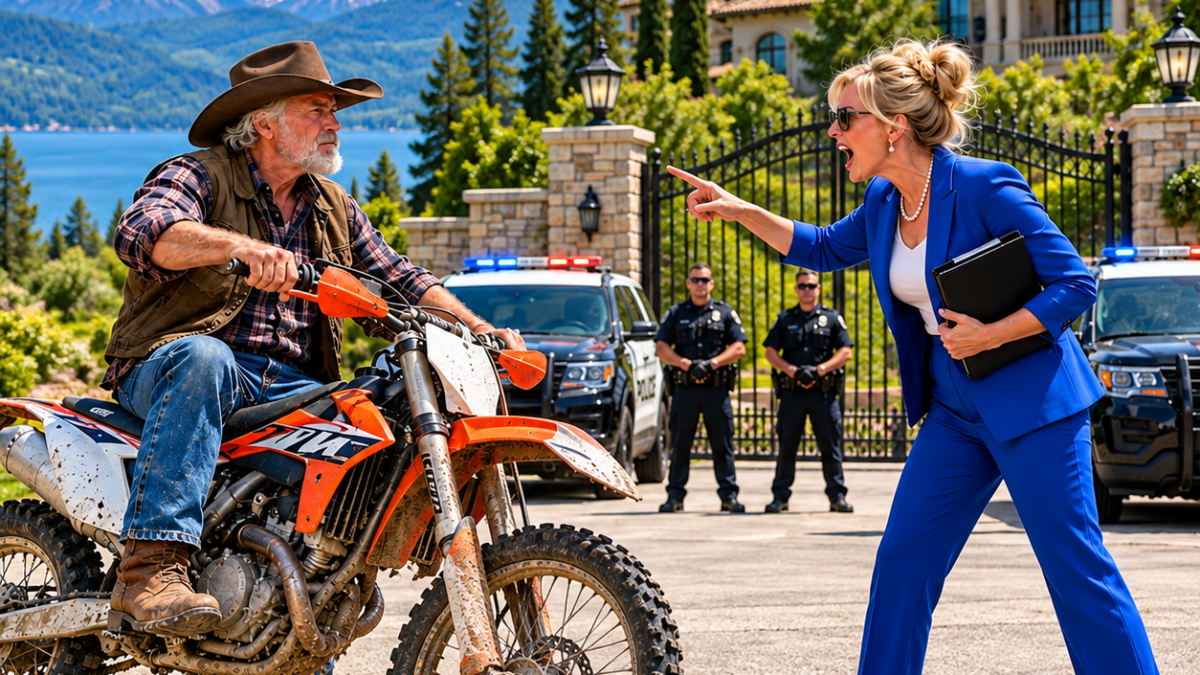
By the time I walked up, Willow Bend’s entrance was blocked.
Kathleen Parker stood between them.
Late fifties.
Gray-blonde hair.
Sunglasses.
Cream jacket.
Clipboard.
Two women beside her were photographing everything.
Gate.
Fence.
Sign.
Pasture.
Kathleen introduced them.
Diane Reynolds.
Architectural committee.
Melissa Grant.
Property standards.
I remember thinking it was impressive that a ranch I had owned three hours already needed an architectural committee.
Kathleen shook my hand.
“Welcome to Lake View.”
“Willow Bend.”
“Of course.”
Then handed me twelve pages of HOA rules.
Fence standards.
Exterior colors.
Dock design.
Boat storage.
Livestock restrictions.
Tree removal.
Lighting.
Parking.
I looked at the packet.
“What is this?”
“Your compliance material.”
“I’m not in your HOA.”
Kathleen smiled.
“Every property along this shoreline follows Lake View standards.”
“Mine doesn’t.”
“That’s a common misunderstanding.”
“My attorney checked.”
“Your attorney probably reviewed the residential declaration.”
“She reviewed my deed.”
Kathleen folded her arms.
“Willow Bend falls within the Lake View Lakeside Overlay District.”
That sounded official.
It was also something Jennifer had never mentioned because, as I soon learned, no recorded document used that term against our property.
“Where is that recorded?”
Diane stepped forward.
“We’re not here to debate legal language.”
“Then why are you blocking my gate?”
“To make sure you understand expectations before improvements begin.”
I looked past them at six hundred acres.
“What improvements?”
Kathleen pointed toward the old ranch sign.
“That sign is oversized.”
“It predates your subdivision.”
“That doesn’t make it compliant.”
Melissa pointed toward the equipment shed.
“Metal roofing.”
Diane pointed toward the pasture.
“Agricultural fencing visible from residential areas.”
Kathleen added:
“Livestock use near protected shoreline.”
I laughed.
Couldn’t help it.
Kathleen did not.
“Something funny?”
“I bought a cattle ranch.”
“We know.”
“You are objecting to cattle fencing.”
“The area has evolved.”
“My deed hasn’t.”
Then the security SUV arrived.
LAKE VIEW COMMUNITY SECURITY.
Robert Mills got out.
Polo shirt.
No fake badge.
Good start.
Kathleen handed him a document.
“Serve the restriction.”
Robert looked uncomfortable.
He handed it to me.
Temporary Property Access Restriction.
It supposedly barred heavy equipment, construction vehicles, livestock transport, and unapproved deliveries until Lake View completed a compliance review.
I looked at Robert.
“Are you enforcing this?”
He shook his head.
“I’m private security.”
“Can you stop me entering my ranch?”
“No, sir.”
I liked him immediately.
Kathleen didn’t.
“The restriction was approved.”
Robert stayed calm.
“I cannot physically block a property owner without verified authority.”
Kathleen looked at me.
“We’re trying to avoid conflict.”
“Move the trucks.”
“Sign acknowledgment first.”
“No.”
“You haven’t read it.”
“I don’t need to sign HOA paperwork when I don’t belong to your HOA.”
Then Kathleen said:
“Raymond understood the arrangement.”
“Did he?”
“Yes.”
“Show me what he signed.”
“It’s in the historical file.”
“Not here?”
“No.”
“Move the trucks.”
“No.”
That was when I called Jennifer.
She answered quickly.
“I bought the ranch.”
“Congratulations.”
“Three HOA trucks are blocking my gate.”
Silence.
“How long have you owned it?”
“About three hours.”
“That may be a record.”
I explained.
Overlay district.
Compliance review.
Raymond agreement.
Jennifer became very calm.
That is what lawyers do when something becomes expensive.
“Do not sign anything.”
“I wasn’t planning to.”
“I’m coming.”
Austin arrived before she did.
Skid steer on trailer.
Could not enter.
He climbed down.
“Dad.”
“Yes?”
“You already have enemies.”
“I left you alone for three hours.”
Kathleen approached him.
“Construction equipment cannot enter until the review is completed.”
Austin looked at me.
Then her.
Then me.
“Who is she?”
“HOA president.”
“We don’t have an HOA.”
“I know.”
Kathleen said:
“That issue is under review.”
Austin laughed.
I told him to park safely and wait.
No squeezing equipment through gaps.
No confrontation.
If I had learned anything from thirty years dealing with commercial contracts, it was this:
When somebody creates a paperwork problem, do not hand them a physical problem too.
Then Charles Bennett arrived.
Older man.
Golf cart.
Lake View resident from the earliest years.
He stopped.
“Kathleen, what are you doing?”
“Compliance review.”
Charles looked at me.
“You bought Willow Bend?”
“Yes.”
He shook my hand.
“Raymond’s a good man.”
“He is.”
Then Charles looked at Kathleen.
“Willow Bend isn’t in Lake View.”
Kathleen mentioned the overlay.
Charles frowned.
“What overlay?”
Diane said:
“It was clarified recently.”
There was that word.
Recently.
“When?”
Nobody answered.
Jennifer arrived.
Thin document case.
No wasted motion.
She introduced herself.
Then:
“My client’s title report shows no Lake View Shores declaration, annexation, covenant, or architectural agreement affecting Willow Bend.”
Kathleen said:
“We have historical authority.”
Jennifer replied:
“That isn’t a legal instrument.”
Diane mentioned a master map.
“Recorded where?”
Silence.
Jennifer looked at the trucks.
“Who owns these?”
“Lake View.”
“Move them.”
Kathleen called the HOA attorney.
While she talked, Jennifer read the temporary access restriction.
Then stopped.
“What?”
She showed me the bottom.
WILLOW BEND RANCH.
PARCEL 7.
LAKE VIEW WESTERN RECREATION RESERVE.
I stared.
“Recreation reserve?”
Kathleen finished her call.
“Historical designation.”
“This is a cattle ranch.”
“It was identified for future integration.”
Future.
Not current.
Jennifer asked for the map.
Kathleen finally produced it.
Color site plan.
Lake View streets.
Marina.
Trails.
Lake.
Our ranch shaded green.
Across it:
FUTURE LAKE VIEW RECREATION / CONSERVATION AREA.
Trails crossed our pasture.
Future boat ramp.
Picnic areas.
Shoreline route.
Road through our front gate.
None of it on our deed.
Jennifer checked the revision box.
“Eight months ago.”
Kathleen’s expression moved barely at all.
But enough.
The “historical” map had been revised eight months before I bought the ranch.
Charles stepped closer.
“You told residents the western trail plan was conceptual.”
“It is.”
“That map goes across Raymond’s ranch.”
“Let the board handle it.”
Then the survey crew arrived.
Preliminary staking.
Western trail.
Shoreline access.
Authorized by Lake View HOA.
I refused entry.
The crew chief immediately stopped.
Professional.
He showed us his work order.
Attached landowner consent.
Raymond Cooper.
Dated six months earlier.
Raymond denied signing.
Then sent the real document he had signed around that time.
Two-week permission to trim dead branches along an emergency lane.
Jennifer compared them.
Same signature image.
Apparently reused.
Then the fencing truck arrived.
That was when everything stopped feeling like a bizarre HOA misunderstanding.
Temporary barriers.
Property-control fencing.
For Willow Bend’s western shoreline.
“You planned to fence my land?”
Kathleen said:
“Only sensitive areas while ownership is clarified.”
“What ownership?”
She opened the map.
Sixty-four acres.
Lakefront.
The HOA claimed Raymond had transferred it eleven years earlier.
There was a recorded instrument.
Signature.
Notary.
County number.
For the first time that afternoon, I felt genuine fear.
Not fear of Kathleen.
Fear that I might have purchased a ranch with a title problem nobody understood.
Raymond’s voice came from my phone.
“I never sold that shoreline.”
Jennifer believed him.
Belief and title are different things.
She told everyone exactly that.
The fencing company stayed outside.
Survey crew stopped.
Robert Mills told Kathleen the gate blockade had no verified legal basis.
Finally the trucks moved.
White first.
Silver.
Red.
Three hours after buying Willow Bend, I could enter my own property again.
The next morning Jennifer and I went to the county recorder.
The shoreline transfer existed in the digital file.
SHORELINE CONSERVATION AND RECREATIONAL TRANSFER AGREEMENT.
Sixty-four acres.
In exchange for:
Drainage improvements.
Fence maintenance.
Shoreline stabilization.
Eighty-five thousand dollars.
Raymond supposedly retained agricultural access during his lifetime.
That last phrase was clever.
If genuine, it explained why he had continued using shoreline that technically no longer belonged to him.
His lifetime access would vanish once I bought the ranch.
Kathleen’s timing suddenly made sense.
She believed the sale activated full HOA control.
Except Raymond insisted he never signed the deal.
Jennifer requested the complete recording packet.
Then noticed something.
The legal description referenced precise survey monuments.
She called Thomas Green, a surveyor familiar with the area.
Thomas examined it.
“This description is based on the 2018 resurvey.”
“When was the transfer signed?”
“2015.”
He looked up.
“That’s impossible.”
Some monuments described in the supposed 2015 transfer did not exist until three years later.
I felt relief.
Jennifer stopped me.
“Not yet.”
“Why?”
“Descriptions can sometimes be corrected.”
“Was this corrected?”
“We check.”
The index showed no correction.
One filing.
But a legal description apparently written from a 2018 survey.
That suggested the digital document had changed after recording.
The county pulled the original microfilm.
That took time.
Meanwhile, Sarah reminded me we had bought a ranch, not a lawsuit.
Austin brought the skid steer.
Cleared fallen limbs.
Grace drove from Tulsa with sandwiches.
Sarah cleaned cabinets.
Found dead mice.
Old bolts.
Fishing licenses.
And a mug that said WORLD’S BEST GRANDPA.
Grace held it up.
“Mom, this thing is older than me.”
“Exactly.”
“It’s stained.”
“History.”
“Bacteria.”
“History.”
The mug stayed.
Raymond visited.
He looked relieved we were repairing instead of bulldozing.
I asked again about Lake View.
“They always wanted the shore.”
“How badly?”
“Offered money.”
“How much?”
“First hundred thousand.”
“Then more.”
“Two hundred eventually.”
“You refused?”
“Yes.”
“Did they ever pay you eighty-five thousand?”
Raymond frowned.
“No.”
Then paused.
“Wait.”
Jennifer looked up.
“They paid me eighty-five once.”
“For land?”
“No.”
“Drainage.”
Years earlier, Lake View runoff had damaged Willow Bend fencing, pasture, and shoreline.
Raymond threatened legal action.
The developer and HOA settled.
Amount:
Eighty-five thousand dollars.
Same amount shown as “consideration” in the fake shoreline transfer.
“What did you sign?”
“Settlement.”
“Do you have it?”
Raymond smiled.
“Probably.”
He kept records.
Two days later his daughter sent them.
Real document.
Drainage Damage Settlement and Access Agreement.
Eighty-five thousand dollars.
Temporary access for erosion repair.
No land transfer.
No permanent recreation rights.
No shoreline ownership.
But the last page looked familiar.
Raymond’s signature.
Same notary.
Same date.
Same payment.
Jennifer placed the genuine drainage settlement beside the supposed shoreline transfer.
The signature pages matched.
Someone had taken a genuine signed closing page from one agreement and attached it to another.
Then the microfilm arrived.
The original county recording did not contain a shoreline transfer.
It contained the drainage settlement.
Same recording number.
Same date.
Same signature page.
Different agreement.
The current digital image had replaced the real document sometime later.
County metadata showed the replacement occurred during a digitization project years afterward.
Who supplied it?
That took longer.
The HOA called an emergency meeting.
Their attorney, David Mercer, finally entered the story.
He had not been at my gate.
That probably saved him several headaches.
He told the board:
“If the original microfilm shows a drainage settlement, Lake View should stop representing itself as shoreline owner until this is resolved.”
Kathleen objected.
“Our records have shown the transfer for years.”
“Internal reliance does not establish ownership.”
Charles asked:
“So William owns it?”
David answered carefully.
“It appears likely.”
Good lawyer.
No victory speeches before final title work.
Then a board member asked:
“Why was our master map revised eight months ago to show recreational trails across Willow Bend?”
Silence.
Kathleen finally said:
“It reflected historic planning rights.”
David asked:
“Show me those rights.”
More silence.
Property manager Daniel Webb produced committee emails.
One was from Kathleen.
SUBJECT: WESTERN SHORE CONTROL.
New owner may be more receptive than Cooper.
Prepare access position before closing.
Before closing.
I looked at Jennifer.
The gate blockade had been planned before I had the keys.
Another email:
If sale closes, move quickly on gate control, trail survey, and shoreline notice before new owner begins work.
There it was.
Three trucks.
Survey crew.
Fencing delivery.
None were reaction.
They were deployment.
Kathleen defended herself.
She believed Lake View owned the shoreline.
David asked:
“Then why block the front gate?”
“To prevent unauthorized work.”
“The gate is not on the disputed shoreline.”
“It controls access.”
“That does not make it HOA property.”
Then Daniel disclosed something else.
Lake View had already spent roughly ninety-six thousand dollars planning western recreation improvements.
Trail design.
Shoreline studies.
Kayak launch.
Picnic pavilion.
Parking.
Residents started murmuring.
Kathleen said those plans had been approved in principle.
Charles asked:
“Were homeowners told the land was disputed?”
“We believed it wasn’t.”
That might have protected her somewhat.
Except another email existed.
Six months earlier, Lake View’s prior lawyer requested a certified copy of the original shoreline transfer before permanent work moved forward.
Kathleen replied:
Digital county record is sufficient.
Do not reopen Cooper history unless required.
She had been warned.
She chose not to verify.
The board suspended all Willow Bend projects.
No trail.
No survey.
No fences.
No work.
No enforcement.
Kathleen voted against suspension.
Everyone else voted for it.
Sarah and I sat beside the lake that evening.
Boathouse leaning slightly.
Dock creaking.
Heron in the reeds.
Sarah said:
“I don’t want this ranch becoming a monument to an HOA fight.”
“Neither do I.”
“I mean it.”
“So do I.”
“Even if we win.”
“Especially if we win.”
That mattered.
Willow Bend had existed nearly a century without Kathleen Parker.
I did not want her name becoming the most important thing about it.
So we worked.
Barn roof.
Guest cabin.
Fence.
Equipment shed.
Raymond visited.
We found old photographs.
His father.
Mother.
Sisters.
Raymond as a boy holding fish beside the same boathouse.
Black-and-white cattle along shoreline decades before Lake View existed.
For one afternoon, Lake Brier became family history again instead of evidence.
Then Jennifer called.
The paper trail was moving toward Kathleen’s husband.
Walter Parker.
Seventy-one.
Retired land-planning consultant.
His former company, Evergreen Land Strategies, had worked with Lake View during early development.
Walter admitted he had tried to negotiate with Raymond for shoreline access.
Denied fabricating a transfer.
Some old planning notes were ugly.
COOPER RESISTS DIRECT TRANSFER.
Another:
SIGNATURE OPPORTUNITY VIA DRAINAGE RELEASE.
That made my stomach turn.
But Jennifer stayed disciplined.
“Ugly is not proof.”
“What does ‘signature opportunity’ sound like to you?”
“What it sounds like is not the same as what we can establish.”
Walter claimed his company had been trying to structure a legitimate shoreline transaction while Raymond was already at the table over drainage damage.
Maybe.
Then an old employee was located.
Nancy Fields.
She remembered the Cooper file because it caused an argument.
According to her account, Walter had asked staff to combine a draft shoreline agreement with existing signed Cooper closing pages.
Nancy refused.
Another employee assembled the packet.
She could not say whether Walter intended it as final legal transfer or internal negotiation material.
But she remembered warning that the signature came from another agreement.
Walter allegedly responded:
“We’ll get the substance confirmed later.”
Later never came.
The false packet entered Lake View’s permanent property file.
Years later, during county digitization, former HOA president Thomas Harland submitted what he believed was the official property document to replace a difficult older scan.
He said he had no idea it was false.
The document became stronger each time someone trusted the person before them.
Planning draft.
HOA file.
Digitization replacement.
Master map.
Capital plan.
By the time Kathleen became president, the fiction looked institutional.
That distinction mattered.
Kathleen did not necessarily create the original fake transfer.
Jennifer repeated that until I stopped trying to merge every bad decision into one conspiracy.
But Kathleen had done something else.
She had been told to verify the original.
She chose not to.
Then she updated planning maps.
Prepared gate control.
Scheduled surveyors.
Ordered fencing.
And after the board suspended her, things escalated again.
At 6:40 one morning, Austin called.
“Dad.”
“What?”
“You need to come to the south pasture.”
The emergency gate was open.
Chain cut.
That lane existed for real emergencies.
Fire.
Ambulance.
Rescue.
Nothing else.
Fresh tire tracks crossed Willow Bend.
Several vehicles.
We followed them.
Two flatbeds.
Skid steer.
Excavator.
Drilling rig.
Workers unloading near the old boathouse.
I stopped well back.
No yelling.
No charging toward machinery.
Foreman walked over.
“We’re here for shoreline soil testing.”
“Who authorized you?”
“Lake View Shores.”
“They do not own this land.”
He showed me the work order.
Owner consent attached.
This time the signature was not Raymond’s.
It was mine.
WILLIAM HAYES.
I had owned the ranch less than two weeks.
I had never signed an HOA access agreement.
Jennifer arrived.
Compared the image.
It matched my signature from closing paperwork.
Exact digital copy.
The contractor stopped immediately.
Good man.
Then Austin found three stakes near the lake.
PAVILION CORNER.
BOAT LAUNCH.
UTILITY TRENCH.
The suspended project.
Somebody had restarted it.
Daniel Webb checked Lake View systems.
No board authorization.
The order came through an older capital-project account still tied to Kathleen’s credentials.
Login activity traced to her home internet connection.
The fake owner-consent PDF had been generated through the same project system.
Jennifer asked the foreman for the complete packet.
Behind the work order was another notice.
NOTICE OF SHORELINE POSSESSION.
Lake View Shores had supposedly resumed physical control of sixty-four acres pending title resolution.
A handwritten instruction:
ESTABLISH SITE PRESENCE BEFORE TITLE HEARING.
That sentence changed the atmosphere.
This was not just bad HOA management.
Someone wanted machinery physically present on disputed land before a judge ruled.
Sheriff’s vehicles arrived.
Lieutenant Mark Sullivan took charge.
Calm man.
Important skill when half a dozen workers, heavy equipment, lawyers, and angry property owners are standing in a pasture.
He did not pretend to decide title on the spot.
He said:
“Nobody is deciding sixty-four acres today.”
Then:
“But nobody is doing more work until authority is clear.”
The contractor agreed.
Equipment stayed folded.
No digging.
No soil disturbance.
Their legal office told them to leave.
Kathleen arrived later with counsel.
She denied ordering anyone to cut the emergency-gate chain.
She also said Lake View’s technology had not fully removed her account access after suspension.
Her lawyer wisely stopped the conversation.
Jennifer asked:
“Did you authorize shoreline work last night?”
Kathleen replied:
“I authorized protection of Lake View’s interests.”
Not exactly yes.
Not exactly no.
Daniel produced board records.
No vote.
No project authorization.
No emergency.
Official board instruction:
Suspend Willow Bend activity.
The sheriff documented everything.
Cut chain.
Tracks.
Work orders.
Fake owner consent.
Locations.
Contractors left.
Sarah and I stood near the boathouse after the last truck disappeared.
Grass flattened.
No permanent damage.
Three stakes in the ground.
I pulled one.
BOAT LAUNCH.
Austin turned it over.
“You keeping this?”
“Yes.”
Sarah groaned.
“Great.”
“What?”
“Evidence museum.”
She was right.
Our kitchen table had become a museum of paper nobody wanted.
Maps.
Surveys.
Copies of signatures.
Emails.
Court filings.
Raymond agreements.
I wanted a ranch.
I had accidentally purchased an archive.
Three weeks later, the title hearing arrived.
By then the county had corrected its digital public record.
The original drainage settlement appeared under the recording number.
The false shoreline document was preserved separately for investigation.
Lake View’s current board declined to defend ownership unless authentic evidence appeared.
Kathleen opposed that through counsel.
Walter did too.
Neither produced what mattered.
No original wet-ink shoreline transfer.
No purchase closing file.
No separate payment for land.
No deed-tax record.
No title policy showing Lake View acquired sixty-four acres.
No legitimate survey package from 2015.
No authentic conveyance.
The judge did not need much time.
The original recorded document was a drainage settlement.
The later digital replacement had no independent foundation establishing a transfer.
The fake shoreline claim was invalid.
Willow Bend’s title included the disputed lakefront.
All sixty-four acres.
Boathouse.
Pasture.
Road.
Shore.
Ours.
Sarah squeezed my hand.
I thought of Raymond.
Eighty-two years old.
Everyone had treated his memory like the questionable part.
Maybe he forgot.
Maybe he signed something.
Maybe he did not understand.
He had been right from the beginning.
Lake View had never bought his shore.
Outside court, Charles called.
“So does this mean you’re fencing off the whole lake?”
“No.”
“Can I still fish if you invite me?”
“Yes.”
“Good.”
He paused.
“Just checking.”
I laughed.
That was what I wanted.
Normal questions.
Neighbor questions.
Not trucks.
Not control notices.
Not mystery overlays.
Lake View removed Kathleen from office.
Susan became president.
The Western Trail project was canceled.
Survey and legal expenses were partly reimbursed.
Daniel ordered a full audit of every property file.
The emergency lane remained exactly what the recorded agreement said.
Emergency use.
Nothing more.
Nothing less.
Raymond came for dinner.
Austin grilled steaks.
Grace brought cake.
WELCOME HOME, WILLOW BEND.
Raymond sat beside Lake Brier after sunset.
“You know what I worried about?”
“What?”
“That whoever bought this place would turn it into a resort.”
I looked offended.
“We’re still fixing the barn.”
“Same thing at your age.”
He laughed.
I looked across the water toward Lake View’s marina lights.
“Did you hate them?”
“Who?”
“The HOA.”
Raymond shook his head.
“No.”
“After all this?”
“Most people over there never did anything to me.”
“What about the ones who did?”
“I hated what they tried.”
Then he looked at me.
“Don’t confuse people with the worst thing done in their name.”
That sentence stayed.
Two hundred sixty households had not forged Raymond’s signature.
They had not blocked my gate.
They had not ordered surveyors.
Most believed their maps.
Most assumed lawyers had checked old documents.
Most lived their lives.
Worked.
Raised kids.
Used the marina.
Walked dogs.
Paid HOA dues.
I wanted accountability.
Not revenge against an entire neighborhood.
That mattered again when another problem appeared.
Lake View’s marina.
The title ruling clarified that a portion of land supporting marina access was part of Willow Bend.
Parking.
Service road.
Utility area.
Docks themselves extended over regulated water under a state permit.
The state reservoir office asked Lake View to prove lawful upland access.
Their old paperwork relied partly on the false shoreline ownership record.
Suddenly residents worried they could lose marina access.
Susan called me.
“William.”
“Yes?”
“I’m going to ask something.”
“Already better than Kathleen.”
Weak laugh.
“Would you consider discussing an easement while this gets sorted out?”
I looked across the lake.
Families had boats there.
Retired couples.
Parents taking children fishing.
None had created the fake file.
“I’ll discuss it.”
“Thank you.”
“Discussing is not agreeing.”
“I understand.”
That sentence mattered too.
We met at the marina.
Jennifer.
Lake View counsel.
State representative.
Susan.
Daniel.
Surveyor.
Me.
The true boundary was marked.
Once you saw it, the mess became practical.
Part of parking area sat on Willow Bend.
Narrow service access.
Electrical cabinet.
A strip beside the fuel shed.
Nobody needed to move the lake.
Nobody needed to destroy docks.
We needed honest property rights.
Susan asked properly.
We granted a temporary sixty-day license while negotiations continued.
Clear language.
Willow Bend remained ours.
No new property rights.
No construction.
No expansion.
Existing marina access only.
The state kept the permit active temporarily.
Nobody woke to chains across their boat ramp.
That mattered to me.
For the first time since three HOA trucks blocked my gate, Lake View entered Willow Bend by asking permission.
Amazing concept.
The permanent negotiation took time.
Good.
We had learned what rushing did.
Survey showed Lake View needed just over eleven acres for the full existing marina footprint and access.
I did not want to sell all of it.
Part included trees buffering the ranch.
Shoreline Sarah and I valued.
So we worked out something narrower.
Lake View bought roughly four acres containing the marina parking area and utility equipment.
Received a permanent easement over a defined strip for the boat-launch road.
Everything else stayed mine.
Lake View installed fencing.
Improved drainage.
Planted native screening trees.
And Jennifer inserted the paragraph Sarah loved most:
The remaining Willow Bend Ranch would not become subject to Lake View Shores HOA governance by reason of the transaction.
No dues.
No architectural authority.
No future trail rights.
No recreational rights over the ranch.
No annexation.
Nothing.
Sarah read that paragraph three times.
Then:
“Frame it.”
The fair market numbers were reviewed.
Marina parcel.
Road easement.
Utility rights.
Survey and legal costs.
Lake View offered two hundred eighty-five thousand dollars total.
I accepted.
Not because I needed some giant victory payment.
Because the number was fair.
Residents kept their marina.
I kept nearly all the shoreline.
The maps finally matched reality.
The state corrected the permit.
Nobody spent half a million dollars relocating utilities because an old paperwork scheme had poisoned the boundary.
That should have been the end.
It wasn’t quite.
Investigators continued tracing the fake documents.
Archived Evergreen Land Strategies files finally showed how the shoreline packet evolved.
Early draft:
Raymond’s name.
No signature.
Later draft:
Copied signature page from the drainage settlement.
Still later:
Sixty-four-acre legal description added from newer survey data.
Different people edited pieces at different times.
The document had evolved.
Walter admitted his firm sometimes prepared draft agreements during negotiations.
That was not inherently wrong.
The problem came when staff combined a proposed shoreline agreement with the signature page of an entirely different signed settlement.
Walter approved the combined packet for internal planning.
He later claimed he never intended it to be treated as a completed conveyance.
But someone labeled the file:
FINAL SHORELINE AGREEMENT.
Then investigators found old emails.
KEEP COOPER TRANSFER IN PERMANENT LAND FILE.
DO NOT SEPARATE SIGNATURE PAGE.
Another referred to the real eighty-five-thousand-dollar drainage payment as support for “consideration.”
That looked far worse.
Eventually Walter faced legal consequences related to the false document.
His resolution included admissions that he knowingly approved a packet combining a proposed shoreline transaction with a signature page from another agreement and allowed it into permanent property records.
He disputed responsibility for every later use.
Fair distinction.
By then, though, the damage was clear.
One bad packet had been passed forward for years.
Kathleen’s situation was different.
Evidence did not establish that she created the original false transfer.
That mattered.
She inherited it.
But investigators also established she knew enough to question it.
Walter had discussed its origin with her.
Lake View counsel told her to verify the original record.
She refused.
Then she used the disputed document to support gate control.
Survey work.
Fencing.
Shoreline planning.
And after suspension, the project account linked to her credentials sent contractors back using an owner-consent form copied from my closing signature.
Her case ultimately resolved separately.
Restitution for specific costs.
Probation.
Community service.
Restrictions on HOA or property-management roles during the supervision period.
Lake View removed her permanently from committees.
She sold her home about a year later.
Some residents celebrated.
I didn’t.
I was tired.
By then I had what I wanted.
Willow Bend secure.
False shoreline claim dead.
Marina legal.
Boundaries clear.
Everything beyond that belonged to courts and Kathleen’s choices.
The investigation cleared people too.
Robert Mills.
The private security officer who refused to pretend he could legally stop me entering my property.
Survey crew.
Stopped immediately when I denied access.
Fencing company.
Never crossed the gate.
Marina contractor.
Stopped when I challenged the work order.
Daniel Webb.
Preserved records and helped expose the bad files.
That mattered.
It would have been easy to tell the story as:
HOA corrupt.
Everyone corrupt.
Not true.
Most people were working from information somebody else handed them.
The revealing moment came when they learned that information might be wrong.
Some stopped.
Kathleen pushed harder.
That difference matters in almost every dispute.
Lake View changed management.
Conducted a boundary audit.
Matched easements to recorded documents.
Loaded actual parcel data instead of relying on old planning maps.
Found a few other minor errors.
Nothing like sixty-four acres.
But useful.
One landscaping strip was county land.
One drainage easement narrower than believed.
One walking path crossing a private corner under an expired license.
They fixed them.
Quietly.
No trucks.
No clipboards at dawn.
No invented districts.
Just paperwork done properly.
Sarah and I finally got our ranch.
Really got it.
Barn repaired.
Austin replaced rotten roof sections with metal chosen to preserve the old look.
He won that argument.
Water does ruin tractors.
Grace helped Sarah restore the guest cabin.
We kept the WORLD’S BEST GRANDPA mug.
Raymond’s family photographs were scanned.
Originals went with him.
Copies stayed at Willow Bend.
History belonged to both places.
We rebuilt part of the dock.
Fixed fences.
Cleaned the cattle-loading area.
Cut only the trees Raymond said we could cut without offending his mother’s memory.
Raymond still visited.
Not every week.
Enough.
Once he sat on the porch and said:
“You improved the place.”
Sarah smiled.
William said nothing.
I said:
“Thank you.”
Raymond looked at Austin’s new barn roof.
“Too shiny.”
I knew perfection was impossible.
Charles Bennett and his wife started coming for lunch occasionally.
No HOA business.
Sandwiches.
Fishing.
Normal neighbor behavior.
One afternoon Charles looked along the shoreline.
“I always wondered why we never had that western trail.”
“Now you know.”
“Most of us never asked.”
That may have been the larger lesson.
People benefit from plans they never examine.
Marina?
Somebody checked.
Property map?
Somebody checked.
Trail rights?
Somebody checked.
Until you discover nobody did.
Months later, Susan sent me a letter.
A letter.
Not a demand.
Lake View wanted to discuss a short shoreline walking connection from the marina toward an existing public trail.
Less than half an acre.
No pasture crossing.
No house access.
Fence.
Maintenance.
Small easement payment.
We met.
Reviewed it.
Jennifer drafted it.
Recorded it.
Done.
Lake View finally received something it had wanted for years:
Legal shoreline access.
All it required was asking the owner.
Raymond laughed when I told him.
“They learned?”
“Eventually.”
“Expensive education.”
Very.
Lake View spent far more cleaning up old shortcuts than honest negotiation would have cost decades earlier.
Legal fees.
Surveys.
Restitution.
Insurance.
Delayed projects.
Records review.
Management changes.
The money was one thing.
Trust cost more.
Eighteen months after buying Willow Bend, I replaced the front gate.
Not because an HOA demanded it.
Because the hinges were actually worn out.
Austin built heavy stone posts from ranch rock.
We restored the original wooden sign.
WILLOW BEND RANCH.
EST. 1931.
Sarah added a small brass plate.
PRIVATE RANCH.
PLEASE ASK BEFORE ENTERING.
Austin wanted another one:
NO HOA.
Sarah vetoed it.
“Too petty.”
“I like petty.”
“I know.”
The new gate swung beautifully.
First time we closed it, Sarah stood beside me.
“Remember the three trucks?”
“Yes.”
“Feels longer than eighteen months.”
“Feels like eighteen years.”
We walked toward the house.
Lake Brier was bright beyond the pasture.
The ranch looked like a ranch.
Not a court exhibit.
That was the biggest victory.
One autumn Saturday, we invited several Lake View families over.
Charles.
Susan.
Daniel.
Others.
No board meeting.
No official agenda.
Sarah cooked enough food for a football team.
Austin brought his children.
Grace came down.
Raymond attended.
People sat on Willow Bend land because we invited them.
That distinction was the whole story.
Private property is not hostility.
A gate is not hatred.
A boundary does not mean nobody may cross.
It means the owner decides how.
Kathleen’s first mistake was not believing a bad file.
People can inherit bad information.
Her bigger mistake was believing uncertainty gave her more authority instead of less.
When Jennifer asked for proof, Kathleen pushed.
When Charles questioned the overlay, Kathleen pushed.
When Raymond denied the signature, Kathleen pushed.
When the board suspended projects, the project moved anyway.
Every moment offered a chance to stop.
Other people took those chances.
Surveyor stopped.
Security stopped.
Contractor stopped.
Board stopped.
Kathleen kept going.
That was what separated error from misconduct.
Not making the first mistake.
Refusing to change after evidence appears.
I think about that more than the court ruling.
Because Willow Bend’s title was always what Raymond said it was.
The land did not move.
Shoreline did not move.
Boathouse did not move.
The truth sat exactly where it had always sat.
Paper around it became distorted.
People believed the paper.
Then more paper copied the distortion.
One error became planning assumption.
Assumption became map.
Map became project budget.
Project budget became survey order.
Survey order became three trucks blocking my gate.
That is how institutional mistakes grow.
Not always one grand conspiracy.
Sometimes shortcut after shortcut.
Nobody checks the source.
That was the most disturbing thing about the fake transfer.
Walter’s actions were serious.
Kathleen’s choices later were serious.
But the document survived because too many people treated the previous file as proof.
Permanent land file.
County digital image.
HOA master map.
Grant attachment.
Every layer made it feel more official.
Until someone pulled microfilm.
Old technology.
Original record.
Drainage settlement.
Not shoreline transfer.
Sarah loved that irony.
“All this digital sophistication defeated by microfilm.”
“Old things still work.”
“That is exactly what you say about the ranch.”
“Because I’m right.”
“Careful.”
“What?”
“You’re becoming Raymond.”
I considered that compliment.
Our marina agreement eventually became a model of what should have happened from the beginning.
Clear survey.
Defined acreage.
Recorded access.
Real payment.
Real signatures.
State review.
Actual owner.
No implication that Willow Bend joined Lake View.
Everybody knew exactly what they owned.
The first time I saw a Lake View family drive legally over the marina access easement after recording, I felt almost nothing.
Which was perfect.
Property arrangements should be boring.
If everyone understands them, nothing dramatic happens.
Drama is often paperwork screaming because somebody ignored it.
Raymond died several years later.
Peacefully.
Closer to his daughter.
Sarah and I attended the funeral.
His children thanked us for keeping Willow Bend recognizable.
I didn’t know how to answer.
The ranch had given us more than we gave it.
Back home, I walked to the barn wall with the height marks.
Raymond’s childhood name.
His siblings.
Later his children.
Sarah stood beside me.
“We should add our grandchildren.”
“Not our wall.”
She looked at me.
“Raymond said history belongs with the ranch.”
Fair.
Austin’s kids now have pencil marks there.
A different family.
Same wall.
That is how property becomes more than ownership.
Ownership means legal authority.
Stewardship means responsibility across time.
Kathleen confused those things in reverse.
She wanted authority without ownership.
Raymond had ownership and treated it like stewardship.
I know which one I want to imitate.
The old boathouse remains.
We straightened it.
Did not replace it.
Austin complains every year.
“It still leans.”
“It has character.”
“It has gravity.”
“Same thing at that age.”
He hates when I use Raymond’s logic against him.
The western trail never became the giant recreation corridor shown on Kathleen’s map.
A small legal path exists near the marina now.
Nothing more.
Cattle still graze where picnic areas had been drawn.
Trees screen the shoreline.
People fish where invited.
The emergency lane stays locked except for actual emergency access.
Lake View residents know that.
Nobody tests it.
Susan eventually stepped down from the board.
She came over first.
“I want you to know before rumors start.”
“Why?”
“Three years is enough.”
“Smart.”
“I also want to apologize.”
“For what?”
“The board.”
“You didn’t block my gate.”
“No.”
“But I benefited from documents I never checked.”
“So did two hundred sixty families.”
“I still should have asked more questions.”
“Now you do.”
She smiled.
“That may be your fault.”
“I apologize.”
“No, you don’t.”
“No.”
She brought pie.
That became the new diplomacy.
No compliance packets.
Pie.
Much more effective.
Every so often, someone asks what I would have done if Kathleen had simply arrived differently that first morning.
Easy answer.
If she had parked one truck properly beside the gate, walked up, introduced herself, and said:
“Our records show a possible shoreline interest that conflicts with your closing documents.”
“I think we should compare files before anyone starts work.”
I would have called Jennifer.
We would have compared documents.
Pulled microfilm.
Found the fake transfer.
No blockade.
No fencing delivery.
No survey crew.
No cut gate.
No unauthorized contractors.
Maybe Kathleen still would have lost her position eventually because of decisions tied to the records.
Maybe not.
But the conflict would have been a title problem.
Not a war.
The fastest way to turn a paperwork dispute into a personal fight is to act as though disputed authority is already settled in your favor.
Kathleen blocked my only gate before proving she controlled anything.
That told me who she thought should bear uncertainty.
Me.
If the HOA was wrong, I was supposed to wait.
If I was right, I was still supposed to obey while they checked.
That is not due process.
That is dominance dressed as procedure.
Robert Mills understood that within minutes.
“I cannot physically block a property owner without confirmed authority.”
Simple sentence.
Professional.
He probably saved Lake View from an even worse first day.
I sent him a thank-you note later.
He called.
“Mr. Hayes, I just did my job.”
“Apparently that was rare that week.”
He laughed.
The survey crew chief also received a letter.
So did the marina contractor.
People deserve credit for stopping when facts change.
Sarah insisted.
She was right.
It is easy to tell stories with heroes and villains because they are clean.
Real conflicts have people making different choices inside the same mess.
Daniel preserved records.
David Mercer challenged his own client’s assumptions.
Charles spoke up at the gate.
Susan negotiated.
Residents accepted audit findings.
None of them needed to become my enemy because Kathleen had.
That lesson changed how I viewed Lake View Shores.
At first, all I saw were three branded trucks blocking my ranch.
Later, I saw families.
Boats.
Retirees.
Children.
Neighbors.
Some clueless.
Some helpful.
Some embarrassed.
Mostly ordinary.
Raymond had been right.
Do not confuse people with the worst thing done in their name.
The gate gets photographed a lot now.
Visitors like the stonework Austin built.
The restored sign looks good.
Sarah’s brass plate catches sunlight.
PRIVATE RANCH.
PLEASE ASK BEFORE ENTERING.
Occasionally someone actually gets out and asks.
“Hiking?”
“Not today.”
“Fishing?”
“Where are you from?”
“Lake View.”
“Charles send you?”
“Yes.”
“Then okay.”
Simple.
Permission does not have to be complicated.
One afternoon, a young couple from Lake View came by.
New owners.
They had heard pieces of the story.
The husband pointed toward the western pasture.
“Was that really supposed to become a trail system?”
“According to one map.”
“Across cattle pasture?”
“Yes.”
“Picnic area?”
“Yes.”
“Boat ramp?”
“Yes.”
His wife looked at the cows.
“One of those cows is staring at me.”
“She opposes recreation.”
They laughed.
Then the husband asked:
“Did the HOA really think it owned sixty-four acres?”
“Some people did.”
“Because of one fake document?”
“Not one.”
“What do you mean?”
“One false document repeated for years.”
He nodded.
“That’s worse.”
Exactly.
A lie written once can be corrected.
A lie copied into systems becomes infrastructure.
People build plans on it.
Spend money on it.
Make promises.
Defend it.
Then anyone challenging the original feels like they are attacking everything built afterward.
That is why source documents matter.
Raymond’s old file box mattered.
Microfilm mattered.
Closing title mattered.
Dates mattered.
A legal description referencing monuments that did not yet exist mattered.
Details are not boring when somebody wants sixty-four acres.
I eventually framed one document.
Not the judgment.
Not Kathleen’s notice.
Not the fake transfer.
Sarah’s favorite paragraph from our marina settlement.
THE REMAINING WILLOW BEND RANCH SHALL NOT BE SUBJECT TO LAKE VIEW SHORES HOA GOVERNING DOCUMENTS BY REASON OF THIS TRANSACTION.
It hangs in my office.
Austin saw it.
“You really framed HOA language?”
“Your mother requested it.”
“Romantic.”
“You’ll understand someday.”
“I hope not.”
Fair.
The ranch still needs work.
That is the secret of old property.
There is no finished.
Fence repaired?
Another section leans.
Dock rebuilt?
Boathouse roof leaks.
Barn dry?
Gate hinge squeaks.
Pasture good?
Culvert needs clearing.
Sarah’s garden became enormous.
Grace says we have become the people who bring vegetables to everyone because we planted too many.
Correct.
Austin keeps equipment in the shed and pretends it is temporary.
It is not.
Grandchildren fish.
Lake Brier still turns silver at sunset.
The old bench where Sarah asked whether I was happy still faces the water.
Sometimes we sit there.
“You happy?”
She still asks occasionally.
“Yes.”
“Even with the lawsuit museum?”
“Mostly archived.”
“The barn?”
“Dry.”
“Fence?”
“Standing.”
“Mice?”
“Negotiations ongoing.”
She smiles.
I am.
Not because we defeated an HOA.
Because Willow Bend feels like home.
That difference matters.
A victory built around an enemy disappears when the enemy leaves.
A home remains.
Kathleen left.
Walter’s professional life changed.
The old false documents were corrected.
Lake View rebuilt trust slowly.
None of that wakes me up in the morning anymore.
Birds do.
Cattle.
Wind.
Occasionally Austin’s excavator when he ignores reasonable hours.
The first day I owned Willow Bend, three HOA trucks told me I had bought a problem.
They were wrong.
I bought a ranch.
The problem simply got there first.
And maybe that is the best way to remember the whole thing.
Kathleen came armed with a clipboard.
A fake overlay.
A revised map.
A property-control plan.
Surveyors.
Fencing.
Years of inherited paperwork.
She assumed all of it added up to authority.
Raymond had something much simpler.
He had said no.
The original records backed him.
The land backed him.
Eventually the court did too.
When that happened, I had a choice.
I could build a fortress.
Fence every shoreline foot.
Lock everybody out.
Spend the rest of my life treating Lake View as hostile territory.
I didn’t.
We sold the small marina parcel they truly needed.
Granted defined access.
Later granted a tiny trail easement because they asked honestly.
Protected the rest.
That was never surrender.
It was ownership working the way ownership should.
Mine means I decide.
Sometimes the answer is no.
Sometimes yes.
Sometimes not yet.
Sometimes let’s write it down properly.
What it never means is three strangers get to park trucks across my gate and decide before I arrive.
The old Willow Bend sign remains above the entrance.
Weathered wood.
Restored letters.
Stone posts.
Small brass plate underneath.
I like Sarah’s wording more every year.
PRIVATE RANCH.
PLEASE ASK BEFORE ENTERING.
Because the entire seventy-five-minute legal nightmare that followed our closing day could have been avoided by those four words.
Please ask before entering.