PART 2: HOA Demanded I Remove My Boat From My Own Driveway—I Wasn’t Even a Member
Thomas Green traced the property line with one finger.
The line did not wiggle.
It did not vaguely brush the HOA boundary.
It cut through it.
Part of Harbor Ridge’s landscaped entrance sat on my parcel.
A section of sidewalk crossed it.
A narrow paved service road used by HOA maintenance trucks crossed it for almost two hundred feet.
And behind a row of cedar trees, part of the maintenance building itself sat over the line.
Not the whole building.
Enough.
The tow driver stared at the map.
Then at Cheryl.
Then at the building hidden behind the trees.
“Ma’am.”
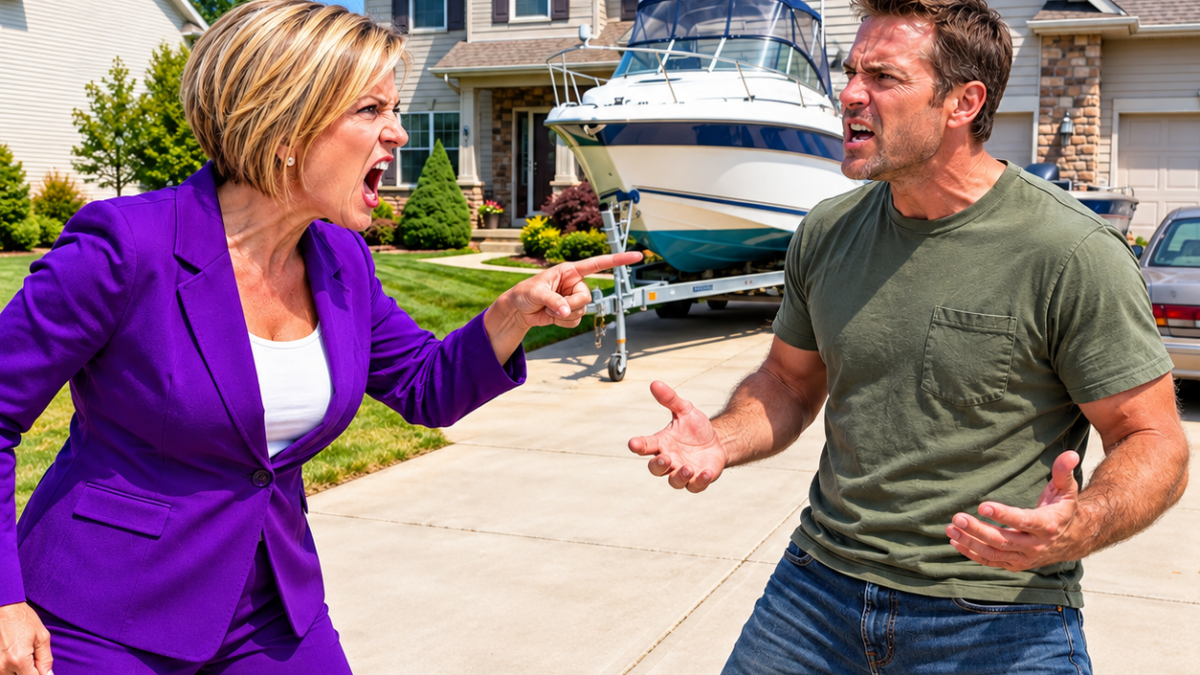
Cheryl folded her arms.
“That survey is wrong.”
Thomas did not argue.
Professionals with good evidence rarely need to.
“These measurements tie back to recorded monuments, the original Foster deed, and the Harbor Ridge subdivision plat.”
Cheryl pointed toward her altered planning map.
“We have a developer map.”
Thomas nodded.
“A developer planning map is not a deed.”
The tow supervisor raised both hands.
“I’m done.”
Cheryl turned toward him.
“You have an authorized work order.”
“I also have a property owner telling me no and a licensed surveyor showing me your maintenance building sitting partly on his land.”
He started removing his equipment.
“I’m not getting in the middle of this.”
Smart man.
Ten minutes later, Jennifer arrived.
Her first request was simple.
She asked the towing company to put in writing that it would not touch my boat while ownership and enforcement authority were disputed.
They agreed immediately.
The truck left.
No shouting.
No chains breaking.
No dramatic standoff.
Just a company recognizing that paperwork had become radioactive.
Cheryl stayed.
Two board members had come with her.
One of them, Susan Monroe, looked increasingly uncomfortable.
“Cheryl.”
“What?”
“Did the board authorize this tow?”
“The board already authorized enforcement.”
“We canceled Daniel’s fines.”
“We canceled the balance.”
Susan frowned.
“That sounds like canceling enforcement.”
Cheryl pointed toward the altered map.
“The corridor still gives us access.”
Jennifer looked at the document.
“Who added that corridor?”
Silence.
That became the question.
Jennifer compared Cheryl’s map with the copy previously found in old Harbor Ridge development files.
Same base drawing.
Same faded blue shading.
Same notes.
But the new version had darker shading over my land.
A thick line ran through my driveway.
And the phrase HOA ACCESS / ENFORCEMENT CORRIDOR appeared beside it.
No recording stamp.
No survey seal.
No approval date.
No county reference.
Nothing showing those additions were official.
Cheryl said the map came from old HOA archives.
Jennifer did not accuse her of creating it.
Not yet.
She requested the digital file history.
Metadata.
Emails.
Computer access records.
Every copy.
Harbor Ridge’s own attorney supported the request.
That surprised Cheryl.
“You represent the association.”
“I do.”
“Then act like it.”
“I am.”
He paused.
“I represent Harbor Ridge, not one director.”
That sentence changed the room.
The board members looked at each other.
Cheryl’s control was slipping.
I should have felt good.
I didn’t.
Because my boat was still sitting exactly where it had always sat.
But somewhere behind those cedar trees, an HOA building had apparently been standing partly on my property for eight years.
That was a bigger problem.
Lisa and I sat on our porch that night.
She put the BOAT FAN MAIL folder between us.
“Need a new label?”
“For what?”
She smiled.
“HOA BUILDING FAN MAIL.”
I laughed.
Then looked toward the trees.
“What would you do if it’s really ours?”
“I don’t want their lawnmowers.”
“That wasn’t the question.”
“I know.”
Her expression changed.
“Daniel.”
“Yeah?”
“Don’t become Cheryl.”
That landed exactly where it needed to.
It would have been easy to start fantasizing.
Make them tear the building down.
Block the service road.
Fence off the sidewalk.
Charge them some ridiculous amount because they had spent months harassing me.
But hundreds of Harbor Ridge families had never sent me a fine.
They had not built the maintenance garage.
Most did not know where the line sat.
Punishing them because their president annoyed me would have been satisfying for approximately five minutes.
Then stupid for years.
Harbor Ridge hired its own independent surveyor.
I respected that.
Rebecca Stone.
No prior association relationship.
She spent two days checking deeds, monuments, plats, construction records, and field measurements.
Her results matched Thomas within inches.
The maintenance building crossed my boundary.
So did part of its service yard.
The service road crossed a narrow corner.
Part of the sidewalk.
Part of the entrance monument.
Lisa laughed at that last one.
“The sign saying PRIVATE COMMUNITY is partly outside the community.”
“Apparently.”
“That is art.”
Rebecca then discovered how the maintenance building had moved.
The approved Harbor Ridge plans originally placed it farther east.
During construction, workers found an underground stormwater structure.
Instead of redesigning everything, someone moved the maintenance building west.
A field-adjustment drawing had one handwritten note.
WEST LOCATION CONFIRMED WITH ADJACENT OWNER.
My uncle.
I called him.
“Did you give Harbor Ridge permission to move a maintenance building onto your land?”
“No.”
“Anything permanent?”
“No.”
“Anything temporary?”
He thought.
“They stored gravel.”
“How long?”
“Maybe a month.”
He still had the paperwork.
Of course he did.
My uncle saved documents the way squirrels save acorns.
The letter granted the developer thirty days of temporary storage near the southern fence.
Gravel.
Drainage pipe.
Construction materials.
Nothing permanent.
No building.
No future access rights.
No conveyance of land.
Then Harbor Ridge’s archive produced another page.
OWNER CONSENT.
Supposedly signed by my uncle.
Permanent use of a twenty-foot strip.
Maintenance access.
Facilities.
His signature sat at the bottom.
He looked at it.
“That’s my name.”
“You sign it?”
“No.”
“You sure?”
He glared at me.
“I remember letting somebody store gravel for thirty days.”
“I would remember giving away land.”
Fair.
Jennifer placed the real temporary-storage letter beside the alleged permanent consent.
The signatures were not merely similar.
They were identical.
Same angle.
Same tiny break in the ink.
Same underline.
Same microscopic dot.
It appeared somebody had copied the genuine signature onto another document.
Thomas noticed something else.
The legal description in the supposed permanent consent referenced a survey monument.
That monument had not been installed until six months after the date printed on the consent.
The document described a marker that did not yet exist.
That was difficult to explain.
The Harbor Ridge board suspended Cheryl from all property-enforcement activity while the files were reviewed.
She remained nominally president for routine matters.
Susan took over compliance.
My fines stayed canceled.
Tow stickers disappeared.
And the next Saturday, Tyler and I took the boat out fishing.
Six hours.
Almost no fish.
At noon, Tyler opened a sandwich.
“You realize this boat has produced more legal paperwork than fish.”
“That is accurate.”
“How much did the boat cost?”
“Don’t ask.”
“How much have the lawyers cost?”
“Eat your sandwich.”
He laughed.
So did I.
For a few hours, Harbor Ridge vanished.
Monday morning, Jennifer called.
“We got the metadata.”
“On the altered map?”
“Yes.”
“When was it created?”
“Six weeks ago.”
I stopped.
“Not twelve years ago?”
“No.”
“Not during development?”
“No.”
Six weeks.
Someone had recently opened the old planning map.
Darkened the shading.
Added the line through my driveway.
Added the enforcement-corridor language.
Then saved it.
The computer used was inside the Harbor Ridge clubhouse office.
User account:
C. MONROE.
Cheryl.
Her lawyer correctly pointed out that a user account did not prove which hands used the keyboard.
Fair.
So the board checked access logs.
The file was created at 8:14 on a Tuesday night.
Cheryl’s key card opened the office at 7:58.
No other board member entered before morning.
Still circumstantial.
Then management found the email.
Sent the next morning.
Cheryl to Valley Recovery.
Attached:
the altered map.
Her message stated that the corridor confirmed HOA authority to remove my noncompliant boat.
Now the issue was not only who edited the map.
It was who used it.
Harbor Ridge called an emergency meeting.
Standing room only.
Most residents had only recently learned the most basic fact.
The man being fined by the HOA did not belong to the HOA.
People were angry.
Then Susan explained the boundary issue.
Part of the maintenance property might sit outside the subdivision.
A resident raised his hand.
“Are you going to make them tear the building down?”
He was asking me.
“I don’t know.”
Another:
“Will you close the sidewalk?”
“No.”
“What about the service road?”
“No immediate plans.”
Margaret Lewis stood.
Margaret was the retired teacher who sometimes bought tomatoes from Lisa.
“He shouldn’t have to promise us anything.”
The room went quiet.
“We’re the ones sitting on his land.”
She was right.
Still, I wanted everybody to hear this.
“I am not interested in punishing residents for mistakes they did not make.”
You could feel shoulders lower.
Cheryl’s did not.
She argued Harbor Ridge might possess rights from long use even if the original paperwork was defective.
The HOA attorney answered carefully.
“There may be legal issues worth reviewing.”
Then:
“But continued use does not automatically erase ownership.”
Cheryl said:
“We should defend the association.”
The attorney replied:
“We should defend what is legally defensible.”
Important difference.
The board hired independent land-use counsel.
Laura Benton.
She started over from the beginning.
No assumptions.
That review revealed the maintenance building was not the only encroachment.
The service road ran almost two hundred feet across my land.
Maintenance trucks used it weekly.
Snow crews.
Landscapers.
Utility carts.
No recorded easement.
No purchase.
No valid permanent consent.
Then Laura found something that explained why my little three-acre parcel had suddenly become so important.
Harbor Ridge wanted to expand its clubhouse.
Larger pool area.
Fitness room.
Additional parking.
Another maintenance yard.
The cheapest layout required control of the western strip beside my property.
An internal planning memo called it:
ANTICIPATED ASSOCIATION-CONTROLLED LAND.
Anticipated.
Not owned.
Not purchased.
Anticipated.
One older strategy memo was worse.
It referred to increasing “integration pressure” on the west parcel owner.
Me.
Draft complaints existed.
Boat storage.
Fence appearance.
Workshop noise.
Tree trimming.
Most had never been sent.
But someone had been preparing ways to make living beside Harbor Ridge irritating.
Then they found Cheryl’s email to a development consultant.
WEST PARCEL OWNER IS RESISTANT.
BOAT ISSUE MAY HELP ESTABLISH NEED FOR CONSISTENT HOA CONTROL.
IF HE GETS TIRED OF EXCEPTIONS, WE MAY HAVE A BETTER PURCHASE DISCUSSION.
Lisa read it twice.
“She could have just asked whether we’d sell.”
“What would you have said?”
“No.”
“Exactly.”
She pointed at the screen.
“But no is allowed.”
That was the entire problem.
No had stopped being an answer Cheryl recognized.
The board removed her as president the following week.
Four to one.
Cheryl voted against her own removal.
Lisa enjoyed that fact more than she should have.
Susan became acting president.
Her first formal letter to me said something no Harbor Ridge document had managed in six months.
We acknowledge the Foster parcel is not a member of Harbor Ridge Estates and is not subject to association architectural control.
I framed it.
Lisa objected.
“You didn’t even invent the fan-mail folder.”
“You can choose the frame.”
“Deal.”
Then came the land negotiation.
Laura Benton proposed a reasonable solution.
Independent appraisal.
Harbor Ridge pays my documented survey and legal costs tied to correcting the encroachments.
Then we decide whether to sell, lease, grant easements, or require relocation.
A real negotiation.
What Cheryl should have done from the beginning.
The raw land itself was not worth a fortune.
But relocating a maintenance building, service road, sidewalk, and entrance monument would cost Harbor Ridge substantially more than simply purchasing limited rights.
That gave me leverage.
Lisa reminded me not to confuse leverage with revenge.
So our family walked the western strip.
Tyler.
Brooke.
Lisa.
Me.
Thomas marked the line.
The maintenance building occupied land we barely used.
The service road ran behind thick trees.
The sidewalk kept kids safely away from vehicle traffic.
The entrance monument did not bother anyone.
Tyler pointed at the garage corner.
“You could make them cut that off.”
“I could.”
“Would it help us?”
“No.”
“Would it hurt them?”
“Yes.”
He nodded.
“Then why?”
Good question.
Brooke pointed toward the sidewalk.
“Families use that.”
Kids rode bicycles past us while we talked.
One waved.
I waved back.
Lisa looked at me.
“There’s your answer.”
We agreed to negotiate.
Harbor Ridge could buy a precisely surveyed parcel containing the maintenance building and immediate service area.
The sidewalk could remain under a pedestrian easement.
The monument could remain under a narrow recorded easement.
The service road could stay at a fixed width.
No expansion into the rest of my property without written permission.
One condition was nonnegotiable.
Nothing in the deal would make our remaining land part of Harbor Ridge.
No dues.
No voting rights.
No architectural rules.
No boat restrictions.
No future automatic annexation.
Susan agreed immediately.
Laura drafted it in language impossible to misunderstand.
Lisa found her favorite paragraph.
She read it out loud.
“Nothing herein shall subject the Foster residence, driveway, garage, boat storage area, or remaining parcel to Harbor Ridge covenants or architectural control.”
She lowered the paper.
“I want this engraved somewhere.”
Susan smiled.
“I think the boat is safe.”
“Never underestimate paperwork.”
The sale involved roughly 1.8 acres around the existing maintenance facility and service area.
Independent appraisal.
Modest premium because relocation would otherwise be expensive.
Documented costs.
Fair.
Not a fantasy payoff.
At closing, the deed matched the deal.
The easements matched the uses.
Everybody signed the documents they actually agreed to.
For the first time, Harbor Ridge legally owned the ground under the building it had been using for years.
Amazing concept.
I thought that was the end.
Then Rebecca from the management company called.
“Daniel.”
“Please don’t say boat.”
“It’s not the boat.”
“Worse opening.”
She hesitated.
“Your non-member account wasn’t the only one.”
I sat down.
“How many?”
“Seven.”
Seven outside parcels had been entered into Harbor Ridge’s compliance system.
Some older homes.
Some tiny excluded tracts.
Four had received enforcement notices.
One widow named Carol Benson had paid thousands in fines because she assumed her late husband must have joined Harbor Ridge before his death.
He hadn’t.
Her deed showed no membership.
That made me angrier than my boat ever had.
Susan froze every non-member account immediately.
Laura reviewed deeds one by one.
Carol was refunded.
Others received refunds where appropriate.
One property that looked outside the HOA actually had been voluntarily annexed years earlier.
So its status was different.
Details mattered.
Not every house near the line was the same.
The internal accounts traced back to a perimeter-mapping project Cheryl had begun years earlier while serving on the architectural committee.
The original purpose sounded harmless.
Understand neighboring parcels.
But observation became enforcement.
Account numbers were created.
Violation categories assigned.
Inspectors photographed properties outside Harbor Ridge.
One committee memo said:
NON-MEMBER STATUS SHOULD NOT PREVENT APPEARANCE PRESSURE WHERE COMMUNITY VALUE IS AFFECTED.
Laura read that line.
Then rubbed her forehead.
“Appearance pressure is not a legal category.”
“No?”
“No, Daniel.”
“Sounded official.”
“That was probably the point.”
Another proposal called it perimeter consolidation.
Encourage excluded owners to sell strips.
Join the association.
Sign appearance agreements.
Nothing inherently wrong with asking.
The problem was the strategy.
Use compliance contact to create negotiation opportunities.
Carol’s fence.
Another man’s shed.
My boat.
Pressure first.
Permission later.
Susan formally ended the program.
Harbor Ridge mailed notices to every affected property owner explaining their actual membership status.
That should have closed the final door.
Then Tyler called me one Thursday afternoon.
“Dad?”
“What?”
“You expecting surveyors?”
“No.”
“There are three guys behind the garage.”
I stood.
“On our property?”
“Yep.”
“Company?”
He walked closer.
“Crestline Communities.”
Crestline was the developer connected to Harbor Ridge’s planned clubhouse expansion.
I called Laura Benton.
She sounded confused.
“They have no authority to enter your remaining parcel.”
“Apparently somebody thinks they do.”
I drove home.
Three surveyors were setting orange stakes near the western tree line.
Their crew chief introduced himself as Benjamin Clark.
Professional.
Polite.
“What are you surveying?”
“Future access alignment.”
“For what?”
“Harbor Ridge expansion.”
“Who gave you permission?”
Benjamin checked his tablet.
“We have an owner access license.”
“No.”
He stopped.
“Sir?”
“I did not give you permission.”
He turned the tablet around.
Temporary survey access license.
Owner:
Daniel Foster.
My address.
My supposed signature.
It looked real.
Because it was real.
Just not on that document.
Jennifer Walsh arrived.
She compared the signature against the legitimate settlement I had recently signed.
Exact copy.
Someone had taken my signature from a real land transaction and placed it onto a new access license.
Benjamin immediately told his crew to stop.
“We were told the owner approved the route.”
“Who told you?”
Franklin Development Advisory.
Same consulting company that had worked with Harbor Ridge during earlier expansion planning.
We called their project manager.
He sounded stunned.
The email had apparently come through an old Harbor Ridge project portal.
That portal should have been shut down when Cheryl was removed.
It wasn’t.
One administrator account remained active.
A Monroe account.
Again, that alone proved very little.
Then IT pulled login data.
The account had been accessed from an internet connection tied to a rental house.
The rental company was connected to Cheryl’s sister.
Still not enough.
Then Crestline showed us the proposed road.
It did not stay on the 1.8 acres I had sold.
It crossed the land I specifically kept.
Past my garage.
Across the place where the boat sat.
Then west toward a county road.
A second access route.
My phone rang.
Rebecca.
“Daniel, are contractors there?”
“Survey crew.”
“Get them completely off.”
“They’ve stopped.”
“I mean everyone.”
“Why?”
“Because a clearing contractor is on the way.”
My stomach dropped.
“Clearing what?”
“The proposed corridor.”
Minutes later, heavy equipment appeared at the road.
A forestry machine.
Excavator.
Trailers.
I had no interest in standing in front of machinery.
Jennifer contacted the contractor.
Laura contacted Harbor Ridge.
Crestline told everyone the owner had not actually authorized access.
The clearing company stopped before touching trees.
No heroic blockade.
No movie scene.
Just phone calls, documentation, and a contractor smart enough to verify disputed authority before starting work.
The only physical damage was tire marks and survey stakes.
That was enough.
Someone had taken my signature from a real settlement and used it to create permission across the very property that settlement said remained mine.
The clearing contractor preserved its work order.
One employee had also received a phone call from a woman identifying herself as a Harbor Ridge project representative.
She allegedly told him the owner might complain but that the access issue was already settled.
He had written down the name.
Cheryl Monroe.
At that point, law enforcement became involved.
Not because I wanted her arrested.
Because a document carrying my copied signature had been used to send contractors onto my land.
Investigators collected records.
Portal logs.
Emails.
Contractor statements.
Source documents.
Security footage.
They compared the fake license to my real closing signature.
The slow part began.
The correct part.
Meanwhile, Harbor Ridge froze the entire expansion.
Some residents were angry.
They wanted the larger pool.
Fitness room.
More parking.
Susan said something at the meeting that I respected.
“If the project cannot survive checking the deed, we should not build it.”
Simple.
That was all I had been saying for months.
Check the deed.
The IT investigation eventually traced the disputed portal activity more tightly.
Files uploaded during one session included the fake access license, another questionable owner-consent document, and a revised access map.
The connection originated from the rental property tied to Cheryl’s family.
Security footage placed Cheryl at the property with a laptop bag during the relevant time window.
A deleted draft recovered from the portal contained a message:
CURRENT BOARD WILL NOT MOVE FAST ENOUGH.
ACCESS MUST BE ESTABLISHED BEFORE OWNER CAN BLOCK EXPANSION AGAIN.
Again, investigators determined what those facts meant.
Not me.
But I recognized the pattern immediately.
Create reality first.
Ask permission later.
That had been the maintenance building.
The service road.
The boat enforcement.
The altered map.
The purchase option.
Now the expansion corridor.
Every problem came from the same idea.
Consent was treated as optional if pressure could produce the desired result.
Once Harbor Ridge realized the western road had no valid approval, Crestline did something radically different.
They called me.
Not fined me.
Not surveyed secretly.
Not sent a contractor.
Called.
Meeting.
My attorney present.
Their lawyer present.
Maps on the table.
“What would make this route workable for you?”
I almost laughed.
“That question would have saved everybody a year.”
They wanted access because the route improved the expansion plan.
I did not owe it to them.
They understood that.
So they negotiated.
Tyler thought their initial offer was strong.
Brooke worried about noise.
Crestline commissioned traffic and sound analysis.
The road could be lowered and landscaped.
Trees could be replanted.
Construction hours limited.
Drainage protected.
They increased the compensation substantially and agreed to build a replacement detached workshop farther east because construction would temporarily affect access near my old garage.
Now the deal improved my property rather than simply taking from it.
Jennifer wrote the conditions.
Exact corridor.
No future widening without new consent.
No HOA authority outside the corridor.
No annexation.
No architectural restrictions.
No boat rules.
Construction limits.
Restoration requirements.
Crestline accepted them.
Then I signed.
Voluntarily.
That word mattered.
Cheryl tried to create rights by exhausting me.
Crestline got what it needed by asking and paying fairly.
One resident later asked:
“Why help Harbor Ridge expand after what happened?”
“The project was never the problem.”
“What was?”
“The method.”
That was the whole story.
Growth was not the enemy.
The HOA was not even inherently the enemy.
Entitlement was.
Harbor Ridge eventually completed the legal cleanup of the existing encroachments.
Maintenance parcel purchased.
Sidewalk easement recorded.
Monument easement recorded.
Service-road limits recorded.
Boundary monuments reset.
Maps corrected.
Our remaining property stayed outside Harbor Ridge.
The compliance account tied to my house was not “paused.”
It was closed.
Rebecca sent confirmation.
Balance:
$0.
Membership:
NONE.
Boat violation:
CLOSED.
Jurisdiction:
NONE.
Lisa printed it.
Framed it.
Put it beside the first apology letter.
“You’re building a shrine.”
“I suffered emotionally.”
“From letters?”
“So many letters.”
The criminal investigation took longer.
Months.
That did not bother me.
Fast justice sounds appealing until you are the person accused.
Investigators separated what could be proven from what could not.
Some questionable documents involving my uncle existed before Cheryl became president.
They could not simply blame her for everything in the old development file.
That mattered.
But investigators did establish evidence connecting her to newer false-document activity and unauthorized property-access efforts after the ownership dispute was already known.
Eventually, Cheryl reached a plea agreement involving false-document conduct and property-access activity.
Financial consequences.
Restitution for certain costs.
Probation.
Community service.
Restrictions on association leadership and property transactions during supervision.
Some Harbor Ridge residents thought that was too light.
Others remembered what Cheryl had done before all this.
Pool repairs.
Cleanup programs.
Meal deliveries.
Security improvements.
I stayed out of the debate.
People are rarely one thing.
Cheryl had been useful to her neighborhood.
Then she became convinced that being useful gave her the right to decide for everyone.
Both facts could exist at once.
Before she moved away, she came to my house.
I was washing the boat.
Of course.
She stopped at the bottom of the driveway.
“Daniel.”
I turned off the hose.
“Cheryl.”
“I wanted to apologize.”
I waited.
She looked at the boat.
“I really did hate that thing.”
I laughed once.
“That part was clear.”
She almost smiled.
Then looked toward the western trees.
“I thought this property was always supposed to become part of Harbor Ridge.”
“That’s what the developer wanted.”
“I treated that like a plan.”
“Yes.”
“And eventually I treated the plan like ownership.”
That surprised me.
“Yes.”
She nodded.
“You gave Crestline access.”
“I did.”
“You wouldn’t sell it to us.”
“You never asked properly.”
“We made offers.”
“You fined me first.”
She looked down.
“That was wrong.”
“Yes.”
Long silence.
Then:
“I thought if the boat became expensive enough, you’d either comply or sell.”
“I know.”
“I convinced myself it was for the neighborhood.”
“That doesn’t make it good for me.”
“No.”
She looked back at the boat.
“I understand that now.”
I believed her.
Too late.
But I believed her.
She left.
No hug.
No reconciliation.
No friendship.
Just acknowledgment.
That was enough.
The boat stayed.
Same gravel beside the garage.
Same trailer.
Same green hull.
Tyler and I still fish.
Brooke still brings too many snacks.
One Sunday, Nathan Reed from Harbor Ridge came with his ten-year-old son Caleb.
The boy had never caught a fish.
For almost two hours, he continued that streak.
Then his rod bent.
Hard.
He screamed.
Tyler grabbed the back of his life jacket before he could lean too far over.
Five minutes later, Caleb pulled in a bass big enough that he stared at it like he had discovered a new species.
We took pictures.
Released it.
On the ride back, Brooke looked around the boat.
Then toward me.
“Imagine all this.”
“What?”
“Because Cheryl didn’t want to see a boat in your driveway.”
I laughed.
“That is one way to summarize it.”
Months of fines.
Lawyers.
Surveys.
Altered maps.
A tow truck.
A maintenance building.
A fake purchase option.
Contractors.
An expansion road.
All because someone decided a boat visible from an HOA street gave the HOA authority over property it did not own.
There is a temptation to make the ending about revenge.
I could have forced difficult choices around the maintenance building.
I could have demanded an absurd price.
I could have tried to close roads people relied on.
I didn’t.
Because property rights mean very little if you only respect them when they belong to you.
Harbor Ridge crossed my line.
That did not give me the right to become unreasonable once I discovered leverage.
The settlement worked because everybody finally did what should have happened at the beginning.
Look at the deed.
Confirm the survey.
Ask.
Negotiate.
Write the agreement.
Sign the agreement.
Record it where appropriate.
Then follow it.
Boring.
Beautifully boring.
Lisa still calls the boat-folder era the strangest six months of our marriage.
Technically, it lasted longer.
She refuses to accept that.
“I stopped counting when the boat was safe.”
“That is not how timelines work.”
“It is in marriage.”
Fair enough.
The framed Harbor Ridge letter hangs inside my garage.
Not because I need proof anymore.
Because I enjoy the wording.
The Foster residence, driveway, garage, boat storage area, and remaining land are not subject to Harbor Ridge architectural control.
Sometimes Tyler reads it when he visits.
“Dad.”
“What?”
“You framed a paragraph about boat storage.”
“Yes.”
“You need hobbies.”
“I have a boat.”
“Right.”
The Harbor Ridge entrance monument still stands.
Part of its land situation has now been corrected through proper recorded rights.
The sidewalk still carries children toward the reservoir trail.
The maintenance building still stores lawn equipment.
Nobody lost a useful facility because one president made bad choices.
And Harbor Ridge residents finally know exactly where their property ends.
So do I.
That matters more than winning.
Boundaries are not insults.
No is not hostility.
Permission is not weakness.
And being close to someone else’s land does not make you entitled to control it.
The funniest part is that I never hated Harbor Ridge.
Not before.
Not during.
Not after.
Most people there were good neighbors.
Margaret still brings pies.
James still helps when storms knock branches down.
Nathan and Caleb still ask about fishing.
Susan ran the HOA more cautiously after Cheryl.
Meetings became boring.
Lisa said that was progress.
She was right.
One afternoon, Susan stopped at the end of my driveway.
She pointed at the boat.
“You know, I think Harbor Ridge property values survived.”
“Barely.”
“We’re monitoring the situation.”
“Careful.”
She laughed.
“Different administration.”
She started to leave.
Then turned.
“Daniel?”
“Yeah?”
“Seriously.”
“What?”
“Thank you for not making us tear down the maintenance building.”
I looked toward the trees.
“You paid for the land.”
“Yes.”
“You asked.”
“Yes.”
“There’s your answer.”
She nodded.
Then walked home.
That became my favorite part of the story.
Not the tow truck.
Not Cheryl’s face when the survey opened.
Not finding the maintenance building over the line.
Not the court ruling against the purchase option.
Just that.
You asked.
Because that is what the entire fight had been missing.
Years later, my boat still sits beside the garage.
Sometimes muddy.
Sometimes clean.
Sometimes hooked to the truck before sunrise.
Nobody sends letters.
Nobody photographs it.
Nobody calls it abandoned.
And every time I back it down the driveway toward the reservoir, I pass land that Harbor Ridge once tried to control through pressure and paperwork.
Now the paperwork tells the truth.
Their land is theirs.
Mine is mine.
And the old green fishing boat that started everything?
It never moved an inch because the HOA told me to.
Not because I beat them.
Because they were never my HOA in the first place.