PART 2: HOA Karen Called the C0ps on Me Because I Refused to Lend her my ATV..
My name is Daniel Parker.
I was fifty-two when Linda Crawford called the sheriff because I would not loan her my ATV.
My wife Jennifer and I had lived at Parker Ridge Ranch for twenty-eight years.
Six hundred acres outside a growing Montana town.
Cattle.
Hay.
Horses.
Creek through the northern pasture.
Old red barn.
Equipment sheds.
Mud when it rained.
Dust when it did not.
My grandfather bought the original acreage in the 1950s.
Dad expanded it.
Jennifer and I stayed.
Our daughter Rachel was twenty-five and working as a physical therapist in Billings.
Cody was twenty-two, studying agricultural mechanics while helping me keep ranch equipment alive through equal parts skill, profanity, and used parts.
The ATV mattered because Parker Ridge was not flat decorative land.
It worked.
Fence lines ran through places a pickup could not easily reach.
Calving season meant carrying tools and supplies quickly.
Mud turned roads into suggestions.
I pulled a small trailer behind the ATV.
Fence posts.
Mineral.
Feed.
Wire.
Veterinary supplies.
It was transportation and equipment, not recreation.
I bought it four years before the police visit.
Used.
Licensed dealer in Helena.
Clean title.
Registered immediately.
Insured.
Nothing unusual.
Jennifer joked that I washed it more often than my pickup.
Probably true.
Then Cedar Hills Estates grew along our southern boundary.
Around 240 houses.
Clubhouse.
Pool.
Playground.
Walking trails.
Good neighborhood, mostly.
George Bennett lived there.
Retired firefighter.
Bought hay from me.
Susan Porter brought Jennifer homemade bread often enough that I suspected they were secretly competing over who could feed more people.
Families waved.
Kids watched calves through the fence.
Parker Ridge was not part of Cedar Hills.
No dues.
No covenants.
No board authority.
That had never caused conflict.
Then Linda Crawford became president.
Linda was organized.
Confident.
Persistent.
She also got things done.
That mattered.
Under her leadership, Cedar Hills replaced broken trail lights.
Fixed playground equipment.
Challenged a landscaping contractor that had been billing for work it was not completing.
Residents liked that.
I probably would have too if I lived there.
Her problem was not competence.
Her problem was that once she decided something would benefit Cedar Hills, she began treating other people’s consent as a technical detail.
Our first disagreement was a cattle gate.
Metal.
Rust on one corner.
Worked perfectly.
Linda came to the fence with a maintenance employee.
“This needs replacing.”
“Why?”
“It’s rusted.”
“It opens.”
“It looks terrible from the walking trail.”
“Then look at the mountains.”
The maintenance guy almost laughed.
Linda did not.
She explained Cedar Hills was upgrading its trail corridor with matching black ranch-style fencing.
Their HOA would pay for the subdivision side.
“And we’d like yours replaced too.”
“Are you buying mine?”
“No.”
“Then I hope you enjoy disappointment.”
Jennifer told me later I could have said it more politely.
She was right.
The gate stayed.
Then Linda planned a family trail weekend.
Honestly, it sounded good.
Scavenger hunt for kids.
Trail cleanup.
Trash collection.
Volunteers.
George mentioned it while buying hay.
“Linda says you hate HOA events.”
“I hate being told what to do on my ranch.”
“That’s different.”
“Very.”
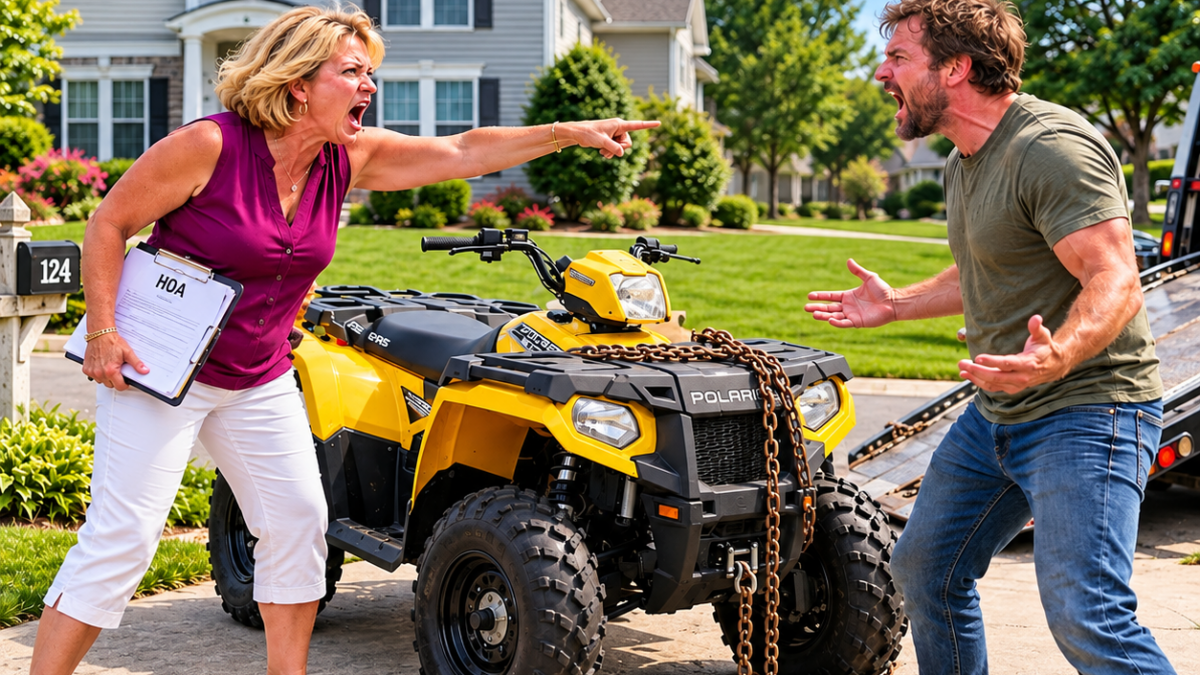
Thursday afternoon before the event, Linda drove straight through my open ranch gate and stopped beside the workshop.
I was changing oil in the ATV.
She got out.
Saw the machine.
“Perfect.”
I already disliked where that was going.
“For what?”
“The trail event.”
“What about it?”
“We need an ATV.”
“No.”
She blinked.
“I haven’t explained.”
“You want mine?”
“Yes.”
“No.”
“We only need it Saturday.”
“I need it Saturday.”
“For what?”
“My ranch.”
“We’re talking about a community safety event.”
“You said trail cleanup.”
“We need to carry first aid equipment, water, trash bags, and tools.”
“Rent one.”
She stared at me as if the word rent had personally insulted the HOA treasury.
“Why would we spend money when yours is sitting right here?”
“Because mine belongs to me.”
“We’ve always tried to maintain a cooperative relationship with Parker Ridge.”
“That sounds like a threat disguised as a compliment.”
“It’s not a threat.”
“Good.”
“Then rent an ATV.”
She said the budget was tight.
Trail repairs.
Maintenance.
I suggested borrowing from a Cedar Hills resident.
Apparently their rules made ATV storage inconvenient and very few residents owned one.
Still not my problem.
Then she tried money.
“Fifty dollars.”
“No.”
“One hundred.”
“No.”
“Daniel, you’re being difficult for no reason.”
That irritated me.
“I have a reason.”
“What?”
“You walked onto my ranch and decided my equipment should solve your budget problem.”
“It’s one day.”
“One day is enough to roll it.”
“Break it.”
“Put somebody in the hospital.”
“We have insurance.”
“Does your insurance cover my ATV?”
Silence.
There was my answer.
I also genuinely needed it Saturday to move fencing supplies.
But even if I planned to park it all weekend and stare at it, I was allowed to say no.
Linda left angry.
Friday afternoon, Cody found an envelope tied to the handlebars.
He came into the kitchen laughing.
“Dad.”
“What?”
“Your ATV got mail.”
Jennifer read it first.
“You are going to enjoy this.”
CEDAR HILLS COMMUNITY COOPERATION NOTICE.
According to the letter, Parker Ridge Ranch had refused to provide “reasonable emergency support equipment” for a community safety event.
Emergency support equipment.
Twenty-four hours earlier, it had been hauling trash bags.
Now apparently FEMA was involved.
The letter also mentioned “historic mutual-use expectations” with neighboring properties.
I called Cedar Hills management.
Robert Hayes answered.
I explained.
Long pause.
“Mr. Parker, there is no HOA rule requiring you to provide equipment.”
“I was hoping you knew that.”
“This should not have been sent.”
“Who issued it?”
Keyboard.
Then:
“President account.”
Of course.
Robert withdrew it.
I asked for confirmation in writing.
He emailed me.
I printed it.
Dad taught me that.
When people start becoming creative with rules, save paper.
Saturday came.
Cedar Hills held its event without my ATV.
Civilization survived.
They rented a utility vehicle.
Used carts.
Picked up trash.
Kids had fun.
George stopped by afterward.
“Good event.”
“Glad.”
“Linda’s still mad.”
“Less glad.”
“She’s telling people you refused help during an emergency.”
“What emergency?”
He shrugged.
That bothered me.
Not enough for war.
Enough to remember.
Two days later, Linda returned.
This time she stayed outside the ranch gate.
Progress.
She called.
I walked down.
Folder in hand.
“We need to clear up the ATV issue.”
“I thought Robert did.”
“This goes beyond Robert.”
“That sounds encouraging.”
She ignored me.
Cedar Hills, she said, had historical records showing Parker Ridge shared equipment responsibilities with the HOA along the southern trail corridor.
“Show me.”
She opened the folder but held it close.
“First I need to confirm something.”
“What?”
“When did you buy the ATV?”
“Four years ago.”
“New?”
“Used.”
“From whom?”
“Dealer in Helena.”
Her expression changed slightly.
“Do you have the original title?”
“Yes.”
“Can I see it?”
“No.”
“Why?”
“Because you asked to borrow my ATV, then invented an emergency notice when I refused, and now you’re asking for my title.”
“It was not invented.”
“It has no authority over me.”
“That’s different.”
“Not enough.”
I told her if her attorney had a legitimate agreement, my attorney could review it.
Then she said:
“The HOA paid toward the purchase of that ATV.”
I laughed.
“No.”
“Our accounting records say otherwise.”
“I paid for it.”
“We have an equipment invoice.”
“Then you have a bad invoice.”
She looked straight at me.
“You should be careful.”
I stopped smiling.
“Careful about what?”
“Property ownership disputes can become complicated.”
“My ATV is not a property dispute.”
She walked away.
That night I pulled everything.
Dealer receipt.
Title.
Bank statement.
Registration.
Insurance.
VIN matched across all records.
No HOA.
Jennifer sat beside me.
“Maybe their paperwork is for another ATV.”
“That would make sense.”
“Then why does Linda think it’s yours?”
“I don’t know.”
Cody walked through.
“What color was theirs?”
“What?”
“The HOA ATV.”
Good question.
George remembered Cedar Hills once had a red ATV.
Maintenance vehicle.
Same general type.
Robert confirmed Cedar Hills bought one roughly five years earlier.
Then removed it from inventory around three years before after an insurance claim.
I asked:
“Stolen?”
Robert went quiet.
That was enough.
Timeline made no sense.
I bought mine four years earlier.
Cedar Hills reported theirs stolen three years earlier.
Their stolen machine could not magically become an ATV I already legally owned before their theft happened.
Unless somebody was mixing paperwork.
I did not assume that.
Then came the cruisers.
Linda had called law enforcement.
Deputy Jason Miller handled it professionally.
He did not arrive acting like I was guilty.
Asked for ownership.
Checked VIN.
Verified my ATV was mine.
Then checked Linda’s invoice.
Different VIN.
Dispatch confirmed:
Cedar Hills ATV.
Reported stolen.
Three years earlier.
Then came the supposed mutual-use agreement.
My forged-looking signature.
Steven Grant as notary.
Jason knew Steven because Grant already had unrelated legal trouble involving equipment.
Then Linda’s phone call from Robert.
Old trail storage building.
Stolen ATV found inside.
Stripped.
We went there under Jason’s direction because he wanted me available if anything tied to Parker Ridge appeared.
Old building looked like a forgotten maintenance shed.
Robert stood outside with the expression of a man regretting every career decision that led to opening one door.
Inside:
Cedar Hills ATV on blocks.
Wheels gone.
Battery gone.
Winch gone.
Front rack removed.
Lights missing.
Engine parts gone.
Dust everywhere.
VIN plate remained.
Jason checked.
Match.
Behind it:
Two chainsaws listed stolen in the same insurance claim.
Generator under tarp.
Power tools with Cedar Hills stickers.
Utility trailer missing identification plate.
Nobody touched anything.
Deputies photographed.
Linda kept saying:
“I didn’t know this was here.”
I believed her.
At that point she had been president only about a year.
Insurance claim predated her.
Mutual-use document predated her.
Whatever happened began before Linda had authority to create it.
That did not excuse her calling cops because I refused to loan her something.
But it changed the story.
Robert pulled old inventory.
More than $30,000 in equipment had been reported stolen after an alleged break-in at the trail garage.
Insurance had paid.
HOA replaced equipment.
How had nobody found the old machines?
Building was abandoned after Cedar Hills built a new maintenance garage.
Who had keys?
Former maintenance supervisor Paul Reynolds.
Former board president Cynthia Lawson.
Trail committee chairman Steven Grant.
Same Steven whose notary seal appeared beneath my supposed signature.
Jason asked Robert for every Steven Grant document.
Pile grew.
Steven had served on the board for years.
Trail projects.
Equipment purchases.
Contractor coordination.
Emergency planning.
He was also a notary for part of that period.
Then old board minutes showed something interesting.
Four years earlier:
Cedar Hills discussed purchasing an ATV for “shared southern corridor emergency support.”
Next month:
Parker Ridge participation pending.
Following month:
Mutual-use agreement completed.
No attached signed copy.
No record of me attending.
No vote documenting terms.
Nothing.
Jennifer read the minutes.
“So they planned something.”
“Yes.”
“Never asked you.”
“No.”
“Then paperwork suddenly says you agreed.”
“Yes.”
“Why?”
That was the real question.
Our attorney Laura Mitchell found an answer.
Cedar Hills received a rural safety grant that year.
$25,000.
Grant required cooperation with adjoining landowners because portions of Cedar Hills trails bordered rural properties.
Parker Ridge.
The grant packet contained the mutual-use agreement.
My forged signature had helped Cedar Hills qualify for public money.
Now the document mattered beyond one ATV.
Most grant money apparently funded actual trail improvements.
Lights.
Radios.
First-aid stations.
The ATV.
So this was not obviously somebody pocketing $25,000.
It looked more like false supporting documents had been used to qualify for funds.
Then came insurance.
One year later, ATV and tools reported stolen.
Broken lock.
Open building.
Claim paid.
Where had the equipment actually gone?
Old photos showed the front storage bay empty.
That did not prove whether someone removed the machines, hid them elsewhere, returned them later, or staged the whole thing.
Important distinction.
I did not want to decide the mystery first and force facts to fit.
Investigators interviewed former maintenance supervisor Paul Reynolds.
Retired.
Wyoming.
He remembered the ATV.
Steven Grant controlled a lot of trail-equipment spending despite Paul handling everyday maintenance.
Steven borrowed the ATV often for weekend trail inspections.
Then one Monday:
Gone.
Paul reported it to Cynthia.
Cynthia called police.
Insurance process followed.
Jason asked:
“Did you ever see the ATV again?”
Paul hesitated.
“Something like it.”
“Where?”
“Behind Steven’s workshop.”
That changed the room.
“Why didn’t you report it?”
“I wasn’t sure.”
“Same color?”
“Yes.”
“Model?”
“Yes.”
“VIN?”
“Never checked.”
“Why?”
“Steven said Cedar Hills had replaced the stolen ATV with a used one.”
At the time, maybe believable.
Years later:
Not so much.
Investigators contacted Steven.
Attorney said he would cooperate.
Steven denied involvement in false paperwork and insurance issues.
He claimed he remembered the mutual-use agreement.
Said he had personally watched me sign it.
Laura called.
“Where were you June seventeenth four years ago?”
“Why?”
“That’s the date on the agreement.”
Cody remembered before I did.
“Rachel’s graduation.”
Right.
We were in Bozeman.
Thursday through Sunday.
Hotel receipt.
Photos.
Credit-card charges.
Rachel in cap and gown.
Dinner reservation.
I had not been at Parker Ridge.
Steven supposedly notarized my signature on June seventeenth.
I was hours away.
When investigators confronted him, his lawyer suggested Steven might have remembered the date wrong.
Problem:
The document itself carried that exact date.
Notary journal?
Steven said lost during a move.
Convenient.
Not proof by itself.
Then Laura found the likely signature source.
Two years before the fake ATV agreement, I had signed a legitimate temporary gate-access permission.
Cedar Hills contractors needed access near the boundary to replace fencing.
Steven signed as HOA witness.
My signature was large and clean.
A document examiner compared it with the mutual-use agreement.
Same angle.
Same odd pressure gap.
Same upward tail.
Too exact.
Likely scanned.
That made me angrier than the ATV.
A legitimate moment of cooperation had been used to manufacture future authority.
Jennifer noticed.
“Don’t let this make you stop helping good neighbors.”
“I’m considering it.”
“That punishes the wrong people.”
As usual, she was right.
A few days later, George’s truck broke down.
Needed help moving a trailer.
I helped.
No paperwork.
No agreement.
No threat.
He said:
“I voted for that grant.”
“You didn’t forge anything.”
“I supported Steven.”
“You supported trail safety.”
“I feel stupid.”
“Then stop.”
He looked at me.
“You know more now.”
“What you do next matters more.”
That conversation helped me too.
Most Cedar Hills residents had done nothing wrong.
Many old board members likely approved purchases honestly.
Even Linda had inherited official-looking records.
Her decision to call the sheriff instead of verifying them was reckless.
But she did not invent the entire history.
Then Linda returned.
No folder.
No notice.
She stopped outside the gate.
Waited.
I walked over.
“I owe you an apology.”
I said nothing.
“I called the sheriff because I believed you were withholding equipment partly owned by Cedar Hills.”
“You asked to borrow it before you believed that.”
“Yes.”
“When I refused, you started searching records.”
“Yes.”
“That timing does not help you.”
“I know.”
At least honest.
She said she discovered the mutual-use agreement while trying to find authority to force cooperation during trail events.
She believed it showed Cedar Hills had funded my ATV.
“So you decided my no didn’t count.”
She looked down.
“Yes.”
That answer mattered.
Not enough to erase things.
Enough to make the apology real.
She also admitted telling residents I was refusing to return HOA property.
That rumor had spread.
She issued a written correction.
Clear.
My ATV belonged privately to Parker Ridge.
No connection established between my vehicle and Cedar Hills’ missing ATV.
No excuses.
That helped.
Cedar Hills suspended every historical agreement prepared or notarized by Steven Grant pending independent review.
Most files were boring.
Expired contractor agreements.
Old trail permissions.
Maintenance documents.
Then another one appeared.
EMERGENCY ACCESS AND EQUIPMENT CORRIDOR AGREEMENT.
Supposedly signed by my father William nine years earlier.
Permanent Cedar Hills access across part of Parker Ridge for emergency trail patrol, equipment storage, and maintenance vehicles.
Dad had been alive then.
Could be real.
That worried me more than an obvious fake.
Laura checked county records.
Never recorded.
Signature looked plausible.
Jennifer had never seen it.
Neither had I.
Dad never mentioned it.
We searched old filing cabinets.
Two days.
Cody found a folder.
CEDAR HILLS TRAIL.
Inside:
Correspondence between Dad and Steven.
Draft agreement.
Dad had considered it.
Then written across the top in red ink:
TOO BROAD.
WILL NOT SIGN.
There it was.
He rejected it.
Yet a later “final” version in HOA files somehow carried his signature.
Now we had two questionable Parker family agreements connected to Steven.
One sharing an ATV.
One granting permanent ranch access.
Why would he need both?
Map answered.
The proposed corridor led to twenty-seven undeveloped acres owned by Cedar Hills.
Old project:
TRAIL ADVENTURE CENTER.
Mountain-bike course.
Outdoor pavilion.
Maintenance building.
Parking.
ATV trails.
Parts crossed the claimed corridor through Parker Ridge.
If Cedar Hills could show years of shared ATV use and permanent maintenance access, repeated traffic across our land might look historic.
Normal.
Expected.
Maybe harder to challenge later.
Then investigators reopened files from Steven’s earlier equipment-fraud case.
A seized computer still existed.
Proper authorization obtained.
Folder:
PARKER.
Inside:
My legitimate temporary-access agreement.
Dad’s rejected draft.
Fake mutual-use agreement.
Grant applications.
Maps.
ATV records.
Then:
ASSET TRANSFER spreadsheet.
Cedar Hills ATV.
Chainsaws.
Generator.
Trailer.
Estimated resale values.
Next to the ATV:
Mountain Trail Outfitters.
Investigators called them.
Owner remembered Steven.
Four years earlier, Steven tried selling him a red ATV without proper title.
Claimed paperwork was lost.
Shop refused.
Then Steven apparently took it away.
That might explain the Cedar Hills machine later being found stripped.
But the owner remembered something else.
A few months after that attempt, Steven offered another ATV.
Newer red model.
Photographs.
Old email still existed.
When Jason showed me the image, I stopped breathing for a second.
It looked exactly like mine.
Same model.
Same color.
Black rack.
Cody zoomed.
“Dad.”
“What?”
“Rear fender.”
Long silver scratch.
My ATV had the same scratch.
I always assumed previous owner caused it.
Email date:
Three weeks before I purchased my machine from the Helena dealer.
Jason contacted dealer.
They had bought the ATV at auction.
Auction got it from a repossession and surplus reseller.
Reseller records listed previous owner:
Grant Outdoor Services.
Steven Grant’s side business.
That was the first moment I became uncertain about my own machine.
My title was legal.
Purchase legal.
Registration legal.
But before reaching me, the ATV had passed through Steven.
Manufacturer records complicated things further.
Cedar Hills’ stolen ATV and mine:
Different VINs.
Definitely different machines.
Both originally sold through same regional distributor within months of each other.
Then investigators found Steven had once ordered a VIN-plate assembly.
VIN plates can legitimately be replaced after damage if proper process is followed.
But there was no state reissue.
No inspection.
No repair record.
Jason said:
“Nobody is saying your title is bad.”
“What are you saying?”
“We need the vehicle-theft specialist to inspect deeper identification points.”
Next morning:
Specialist arrived.
Visible VIN matched my title.
Then he checked hidden frame identifiers.
One did not.
He checked again.
“Frame identity has been altered.”
Jennifer gripped my arm.
I stared at a machine I had owned four years.
Bought openly.
Registered.
Insured.
Worked nearly daily.
Jason exhaled slowly.
“We may have multiple vehicle identities in one machine.”
“What does that mean?”
“Parts or frame components may have been mixed.”
Specialist exposed another hidden identification number beneath a reinforced area.
Cleaned it.
Read.
Stopped.
Jason asked:
“What?”
He read again.
Compared database.
My ATV did not match Cedar Hills’ reported-stolen vehicle.
That was good.
For about two seconds.
It matched a second ATV stolen from a ranch-equipment dealer five years earlier.
One year before I bought mine.
Suspect noted in that old investigation:
Steven Grant.
I stared at Jason.
“My title is real.”
“Yes.”
“My registration is real.”
“Yes.”
“And the frame was stolen.”
“It appears the hidden frame identity traces to stolen property.”
That is a strange thing to hear about equipment you use every day.
Like discovering your kitchen table belonged in an evidence room before it belonged in your house.
Jason asked me not to use it.
Of course I agreed.
If part of that machine belonged to a theft victim, I wanted the truth.
Sheriff’s office moved it for inspection.
Jason was careful.
“You’re not a suspect.”
Purchase chain supported good-faith acquisition.
Licensed dealer.
Open registration.
Insurance.
No concealment.
Problem predated me.
That helped intellectually.
Emotionally, watching the ATV loaded onto a trailer still hurt.
Jennifer watched me afterward.
“You look like they took your dog.”
“That’s ridiculous.”
“You’ve stared at the empty dirt patch for five minutes.”
I stopped staring.
Cody offered his dirt bike.
I told him I still enjoyed having vertebrae.
Specialists examined the ATV component by component.
Frame:
Stolen dealer machine.
Engine:
Legal salvage ATV.
Body panels:
Another machine.
Steering components:
Mixed.
Some clean.
Some uncertain.
The vehicle had been built from at least three sources.
Jason explained the likely method.
Damaged legal machine supplies paperwork.
Stolen frame or valuable components get mixed in.
Visible identifiers altered.
Finished unit appears legitimate.
Dealer later buys from reseller with paperwork that seems clean.
No ordinary buyer notices hidden manufacturer marks.
My dealership apparently did not know.
That did not automatically clear everyone upstream.
Investigators traced each transaction.
But one fact became definite:
I had never possessed Cedar Hills’ missing ATV.
Linda’s original accusation was false.
My machine and theirs were different.
The link was Steven.
Howard Briggs owned the dealership from which the hidden frame had been stolen.
He remembered.
Two ATVs vanished from fenced storage over a weekend.
One recovered.
One never returned.
Steven had been questioned because his truck was seen nearby earlier that week.
Insufficient evidence then.
Howard also remembered Steven offering him used ATV parts months later.
He refused.
“Price was too good.”
Sometimes instinct saves paperwork later.
Steven’s old business records showed Grant Outdoor Services legitimately handled wrecked ATVs.
Auction purchases.
Repairs.
Used parts.
None inherently illegal.
Problem:
Certain documents did not match certain equipment.
One clean-title damaged ATV had a destroyed frame.
Steven ordered replacement components.
No corresponding inspection record.
Photographs showed my current ATV half-built in his workshop months before the reseller received it.
Same scratch.
Same rack.
Same red body.
“Your machine definitely passed through his hands,” Jason said.
“What about the stolen frame?”
“Still building that case.”
Linda visited again once Cedar Hills heard.
“I cannot believe this.”
“Which part?”
“All of it.”
“That’s a lot.”
She almost smiled.
Then apologized again.
More importantly:
She admitted why she had wanted the old agreement to be real.
“If Cedar Hills had paid for your ATV, then your refusal wasn’t really a refusal.”
“Meaning?”
“We could treat the machine as shared equipment.”
“So once I said no, you went looking for paperwork that made no irrelevant.”
She nodded.
“Yes.”
Honest.
Ugly.
Useful.
Then she surprised me.
Cedar Hills had contracted with a rental company for trail events.
Discounted utility vehicles.
Insurance.
Written agreement.
No need for my ATV.
“I hope you keep a trail safety program,” I told her.
She frowned.
“You do?”
“Of course.”
“I just don’t want you borrowing mine by force.”
She laughed quietly.
“That seems fair.”
Amazing what happens when everyone finally states the real need.
Cedar Hills needed equipment.
I needed my property respected.
Not opposing goals.
George loaned me his old side-by-side while investigators held my ATV.
Refused money.
“Help me during hay season.”
Deal.
That was cooperation.
Freely offered.
Then Jason called.
“We found the frame transfer.”
Records showed the stolen Howard Briggs frame entered Steven’s workshop inventory under a false salvage number.
Spreadsheet linked that real hidden identifier to another damaged ATV Steven legally owned.
Someone intentionally changed identity.
Could they prove Steven personally did every modification?
Not yet.
He had mechanics.
One had died.
The other:
Wesley Hart.
Idaho.
Wesley agreed to speak.
His first description stuck with me.
“Steven liked building clean machines from dirty parts.”
At first, repair business was normal.
Later, “off-book suppliers.”
Bad-number frames.
Identification areas covered or altered.
Paperwork shifted from one machine to another.
Wesley quit because he did not like what he was seeing.
Jason showed him my ATV photo.
Wesley recognized it.
“What did you work on?”
“Engine swap.”
“Steering.”
“Plastics.”
“Did you know the frame was stolen?”
“No.”
“Did Steven?”
Pause.
“I think so.”
“Why?”
“He told me not to touch the number under the reinforcement plate.”
That was strong.
Then Wesley connected Cedar Hills.
Grant Outdoor Services had permission to store trail-equipment parts in the old HOA building.
Steven sometimes mixed components between Cedar Hills equipment and private equipment while doing repairs.
That explained why the HOA ATV ended up disassembled there.
Then Jason asked about the stolen-equipment claim.
Wesley laughed once.
Not amusement.
“Steven said insurance would replace it.”
“Did you know where the ATV was?”
“In pieces.”
“Where?”
“Mostly the trail building.”
There it was.
First direct account suggesting the “theft” may have been staged while much of the equipment remained under Cedar Hills control.
Investigators interviewed former president Cynthia Lawson.
She denied knowing.
Steven told her thieves had entered.
She saw broken lock.
Called police.
Old report matched.
Could have been deceived.
Again:
Not everybody touching a bad event is automatically part of it.
Insurance payout had been about $23,000 for tools and ATV.
Money went to Cedar Hills maintenance account.
Replacement equipment purchased.
So why would Steven orchestrate anything if HOA got the money?
Invoices answered.
After payout, Cedar Hills bought replacement equipment through Grant Outdoor Services.
Steven’s company.
Utility vehicle.
Chainsaws.
Generator.
Almost $18,000 in sales.
Then more repair work.
There was motive.
Old equipment “disappears.”
Insurance pays HOA.
HOA buys replacements from Steven.
Some supposedly stolen parts remain available for reuse or resale.
Not a movie-villain fortune.
Just greed.
Enough.
Prosecutor reopened old insurance investigation.
Steven’s attorney stopped talking publicly.
Current Cedar Hills board cooperated fully.
Linda did something responsible too.
She asked residents not to accuse every former board volunteer.
Most had done nothing wrong.
They approved purchases in good faith.
Trusted records.
That message surprised me.
Linda was learning.
So was I.
Then came news about my ATV ownership.
Because the stolen frame had entered the machine before my good-faith purchase, ownership became complicated.
Howard had already been reimbursed years earlier.
His insurer held recovery rights.
Dealer had unknowingly sold me a machine with altered identity.
Insurer, dealer, investigators, and state worked out a resolution.
I would eventually be allowed to keep the ATV after inspection, settlement of the frame claim, and issuance of a new state identification number.
Relief.
Cody was happier than I was.
“When do we get it?”
“After inspection.”
“How long?”
“Soon.”
“That isn’t a number.”
“You sound like your mother.”
Jennifer yelled from inside:
“I heard that.”
Normal life returning.
Then Robert called.
Auditor had traced the rural safety grant.
My forged agreement was not the only questionable one.
Another neighboring property:
Miller family horse farm.
Owners denied participation.
Third:
St. Andrew Community Church.
Pastor had no memory of signing.
Three adjacent properties.
Three cooperation agreements.
All notarized by Steven Grant.
All used in one grant application.
Document examiner found indicators signatures had been copied from earlier legitimate documents.
County review concluded the old grant packet contained false supporting records.
Current Cedar Hills board had not created them.
Residents did not know.
But the grant still should not have been awarded on false qualification.
The board chose to repay the affected grant amount.
$25,000.
That hurt.
Reserve funds.
Cosmetic projects postponed.
No emergency special assessment.
At community meeting, interim leadership said:
“We benefited from money we should not have received under those documents.”
“Repaying it is the right thing.”
Some residents complained.
Most accepted it.
That was when I started respecting Cedar Hills again.
Fairness is easy when somebody else pays.
The real test is accepting a rule when it costs your side.
Steven’s criminal problems expanded.
False grant documents.
Equipment transactions.
Insurance claim.
Altered ATV identities.
Forged signatures.
Not every suspicion became a charge.
Some evidence was old.
Some incomplete.
Enough remained for serious consequences.
Eventually he entered a plea involving fraud-related conduct, stolen-property transactions, falsified documents, and the Cedar Hills insurance matter.
Restitution.
Restrictions on future equipment business.
Other penalties.
No courtroom screaming.
No suitcase of money.
Mostly records.
Property.
Invoices.
Signatures.
Years of false paperwork treated as normal because nobody stopped to verify it.
That felt more realistic than a dramatic conspiracy.
And more dangerous.
Big fraud often starts small.
One copied signature.
One convenient assumption.
One board minute nobody checks.
Linda’s situation was different.
Investigators found no evidence she created Steven’s old forged agreements.
She did not stage the original equipment claim.
Did not alter my ATV.
But then Jason came to Parker Ridge one evening holding an evidence folder.
“We searched Steven’s old equipment warehouse.”
“What did you find?”
“Records.”
Photographs showed shelves of VIN plates.
Old invoices.
Titles.
Equipment stickers.
Keys.
Parts tags.
Some could have legitimate explanations.
Some did not.
Then lockbox.
Copies of neighboring deeds.
Parker Ridge.
Horse farm.
Church.
Cedar Hills common property.
Notes:
Potential access.
Equipment storage.
Trail expansion.
Temporary control.
Then old Trail Adventure Center map.
Larger than any version we had seen.
Bike trails.
Camping.
Parking.
Maintenance route.
Across my south pasture:
ATV OPERATIONS BASE.
My workshop area.
Beside it:
PROPOSED ACQUISITION.
I looked at Jason.
“I never offered to sell.”
“We know.”
Behind the map was a draft purchase package.
Appraisal.
Offer calculations.
Unsigned agreement.
Internal note from Steven:
PARKER UNLIKELY TO SELL.
BUILD MUTUAL USE HISTORY FIRST.
There it was.
Fake ATV-sharing agreement.
Dad’s access corridor.
Years of supposed cooperation.
Potentially all designed to build a record making Cedar Hills use of my land appear established before somebody pursued a larger project.
Then Jason turned one more page.
Newer.
Only two months old.
Long after Steven left Cedar Hills.
Someone had accessed the old development files recently.
Current HOA login:
PRESIDENT LC.
Linda Crawford.
I looked at Jason.
“What did she open?”
“Everything.”
“Map?”
“Yes.”
“Acquisition notes?”
“Yes.”
“Mutual-use agreement?”
“Yes.”
“Dad’s corridor document?”
“Yes.”
“When?”
“Three days before she asked to borrow your ATV.”
That changed everything again.
Linda had told me she found the mutual-use agreement only after my refusal.
System logs suggested she had already reviewed the old project.
Then Jason handed me an email.
From Linda.
Night before she called the sheriff.
To a private land-development consultant.
Subject:
PARKER CORRIDOR.
Message:
HE REFUSED EQUIPMENT COOPERATION.
MOVING TO OWNERSHIP ENFORCEMENT MAY CREATE THE LEVERAGE WE NEED.
I read it three times.
Jason said:
“Do not contact her.”
I wanted to.
Did not.
Rules apply when you are angry too.
Investigators needed full context.
Private consultant was Peter Collins.
Cedar Hills hired him two months earlier to study new recreation options for its unused western acreage.
Peter cooperated.
Contracts.
Notes.
Emails.
Maps.
Linda wanted a smaller revival of the old Trail Adventure Center idea.
Walking trails.
Picnic shelters.
Equipment station.
Nothing illegal.
Problem:
Access.
Cedar Hills’ internal road stopped before its western land.
Old plans relied on Parker Ridge corridor.
Linda showed Peter documents saying Cedar Hills already shared an ATV with us and held historical access.
Peter assumed official HOA files were valid.
Jason asked:
“Did Mrs. Crawford say Daniel had agreed recently?”
“No.”
“Did she tell you he refused to lend an ATV?”
“Yes.”
“What did that have to do with access?”
Peter looked uncomfortable.
“She said the relationship had deteriorated.”
“And ownership enforcement?”
“She said Cedar Hills might need to formally enforce existing historical rights before investing more money.”
That did not prove Linda knew documents were forged.
But it proved my ATV request was not simply about one cleanup event.
Investigators interviewed her.
At first, she said “ownership enforcement” meant asking counsel to verify existing rights.
Then Jason showed her the timeline.
Computer access.
Three days before she came to Parker Ridge.
Eventually Linda stopped arguing around it.
“You knew about the Trail Adventure Center before asking for the ATV?”
“Yes.”
“You knew it required access across Parker Ridge?”
“Yes.”
“You believed the mutual-use agreement helped support that?”
“Yes.”
“Did you know it was forged?”
“No.”
That became central.
Linda said she trusted the old files because they had existed for years.
When she saw shared-ATV paperwork, she decided borrowing my machine during a current event could help demonstrate that the historical relationship was still active.
In other words:
She did not just need an ATV.
She wanted present behavior matching old documents.
If I lent it:
Current shared use.
Maybe future argument that cooperation continued.
When I refused, she went looking for authority to make my refusal irrelevant.
That was why the “cooperation notice” appeared.
Why she dug into ownership.
Why she called the sheriff after convincing herself Cedar Hills had financial rights in the machine.
Her pressure campaign opened the exact records she hoped would strengthen Cedar Hills.
Instead, those records collapsed.
Missing ATV.
Fake agreement.
Grant application.
Dad’s forged corridor.
Equipment scheme.
Development plan.
Linda wanted leverage.
She got an audit.
Cedar Hills suspended her.
Not because she forged my name.
No proof she did.
Not because she stole equipment.
Those events predated her.
She was suspended because she tried using unverified historical documents to pressure a neighboring property owner after he said no.
Susan Porter became interim president.
First decision:
Trail Adventure Center proposal canceled.
Not postponed.
Canceled.
Susan called me.
“We are withdrawing every claim to the Parker corridor.”
“Good.”
“We’re withdrawing any claim to shared ownership of your ATV.”
“Very good.”
“We want to apologize formally.”
“That matters.”
Letter arrived.
Cedar Hills recognized Parker Ridge as separate private property.
Recognized my ATV as privately owned.
Acknowledged no valid permanent access agreement had been proven.
And promised:
Cedar Hills would not enter, use, or regulate Parker Ridge without permission.
I read that sentence twice.
Filed it in Dad’s cabinet.
Cody laughed.
“More paperwork?”
“This one stays.”
“Why?”
“It actually says something useful.”
Then came Linda’s removal vote.
Nearly two hundred residents.
She attended.
So did I.
I wanted to hear her.
No folder.
No legal phrases.
No excuses hidden behind Robert.
Linda stood.
“I wanted to bring back a project I believed would benefit Cedar Hills.”
Quiet.
“I found historical records indicating Parker Ridge had cooperated with the HOA.”
She looked toward me.
“I wanted those records to be true.”
That was honest.
Then:
“When Daniel refused to lend the ATV, I didn’t treat his answer like a property owner saying no.”
“I treated it like an obstacle.”
Exactly.
“I thought if I proved Cedar Hills had existing rights, his refusal would stop mattering.”
Her voice tightened.
“And because I wanted that result, I stopped asking whether the records deserved to be trusted.”
Best thing she said all year.
Members removed her from the board.
Not unanimous.
Some remembered good things she had done.
They were right.
Human beings do not become fictional villains because they make serious mistakes.
Linda repaired trail lights.
Improved playgrounds.
Challenged waste.
She also liked control enough to treat someone else’s no as a problem to solve.
Both could be true.
Outside afterward, she approached.
No title now.
Just Linda.
“I’m sorry.”
This time I believed she understood the sentence.
“I know that doesn’t mean you forgive me.”
“Not yet.”
She nodded.
“Fair.”
Then she said:
“I really did need an ATV that Saturday.”
I laughed.
“You still should’ve rented one.”
“Yes.”
Last argument we ever had.
About a month later, my ATV finally came home.
Full inspection.
Insurer settlement.
Dealer contribution.
New state-issued identification number.
Clean paperwork.
Legal.
Mine.
Jason delivered final release.
Cody stood beside me like a soldier returning from deployment.
ATV rolled down trailer ramp.
Jennifer watched from porch.
“Are you going to hug it?”
“No.”
Cody said:
“He wants to.”
I ignored both.
Jason handed me the new title.
“Keep this somewhere safe.”
“I plan to.”
“And maybe don’t loan it to HOA presidents.”
“That part is guaranteed.”
Two weeks later Cedar Hills held another trail cleanup.
Susan Porter called.
She did not ask for my ATV.
She asked:
“Do you know a good rental company?”
I gave her the number.
They rented two side-by-sides.
Insurance.
Signed rental contracts.
Clear responsibility.
Event went perfectly.
George texted a photo of volunteers hauling trash.
Caption:
SOMEHOW WE SURVIVED WITHOUT STEALING YOUR ATV.
Jennifer laughed for five minutes.
Near the end of the event, one rented side-by-side got a flat near my south fence.
Susan called.
“We have a problem.”
“What?”
“Flat tire.”
“Need help?”
Pause.
“Are we allowed to ask?”
That made me smile.
“Yes.”
Cody and I rode over.
Plug kit.
Compressor.
Twenty minutes.
Fixed.
Nobody demanded equipment.
Nobody produced a fake agreement.
Nobody called law enforcement.
Susan thanked us.
That was cooperation.
Not because a document said Parker Ridge owed Cedar Hills something.
Because they asked.
I chose yes.
That difference was the entire story.
Cedar Hills changed its procedures.
Outside-property agreements required legal verification.
No board president could enforce any claim against neighboring land without recorded documentation or written owner consent.
Equipment inventory annually.
Photographed VINs.
Two-person review for insurance claims.
Old storage building cleaned out completely.
Stripped Cedar Hills ATV eventually sold as salvage after legal release.
Money returned to HOA maintenance reserves.
No mystery.
No side deals.
Boring.
Boring systems are underrated.
The Trail Adventure Center never returned.
Cedar Hills developed its twenty-seven acres differently.
Simple walking area.
Picnic field.
No ranch corridor.
No ATV base.
No road through Parker Ridge.
They built an internal connection across their own drainage feature.
Cost more.
Their responsibility.
One afternoon George and I watched families using it from the south fence.
Kids.
Dogs.
Picnic tables.
Nobody crossing onto Parker Ridge.
He said:
“Steven’s version would’ve been bigger.”
“Probably.”
“More exciting.”
“Probably.”
“This is better.”
I watched a family stop near the boundary sign and turn back toward the Cedar Hills trail.
“Yes.”
“Sometimes smaller plans work because they respect bigger boundaries.”
A year after Linda called the cops, Cedar Hills invited Jennifer and me to its summer picnic.
I almost declined.
George mentioned barbecue.
I reconsidered.
Susan greeted us.
Handed me paper wristband.
“No equipment-sharing agreement.”
“Good.”
Linda was there.
No longer board member.
Helping at dessert table.
We saw each other.
Half-second awkwardness.
Then she smiled.
“Did you bring the ATV?”
“No.”
“Excellent.”
Enough.
We did not become friends.
Did not need to.
Peace does not require friendship.
It requires respect.
Cody tells the story better than I do.
“Linda called the cops because Dad wouldn’t lend her his ATV.”
“Then the cops found the HOA’s stolen ATV in their own building.”
“Then they found Dad’s fake signature.”
“Then a fake grant.”
“Then another fake signature.”
“Then Dad’s ATV turned out to have a stolen frame.”
“Then everybody needed lawyers.”
He leaves out details.
Basic shape is right.
Linda wanted pressure.
She invited investigation.
She wanted the sheriff to confirm I was withholding HOA property.
Instead, Jason confirmed my ATV was legally registered to me.
Then discovered Cedar Hills’ real missing ATV sitting inside Cedar Hills.
That led backward through years of records.
Forward into a project Linda hoped to revive.
Her call was the worst possible move if your paperwork cannot survive outside scrutiny.
The ranch returned to normal.
ATV returned to work.
Feed.
Fence posts.
Tools.
Mud.
Calving.
Exactly what it was built for.
I still have that first “community cooperation notice.”
Not framed.
Cody wanted to.
It stays folded with the new title.
Whenever I see it, I remember something Dad understood.
Helping neighbors is good.
Very good.
Ranch life depends on it.
George needs a trailer pulled?
Help.
Susan needs a tire plug?
Help.
Family needs cattle moved during a storm?
Help.
But help has meaning only when you have a choice.
When someone says your equipment must become theirs because their event matters more than your answer, cooperation stops being cooperation.
It becomes control.
Linda asked.
I answered no.
That should have ended it.
Instead, she searched for paperwork that could make my no disappear.
And because she could not accept one simple answer, her police call eventually exposed a stolen-equipment scheme, false grant documents, forged land-access agreements, altered ATV identities, and an old development plan built around rights Cedar Hills had never actually received.
All of it started with one red ATV beside my workshop.
And one sentence Linda Crawford should have accepted the first time she heard it.
No.
You cannot borrow my ATV.