They Poured a Concrete Patio Over My Septic Drain While I Was Out of Town—So I Hired an Excavator to Take It Back.
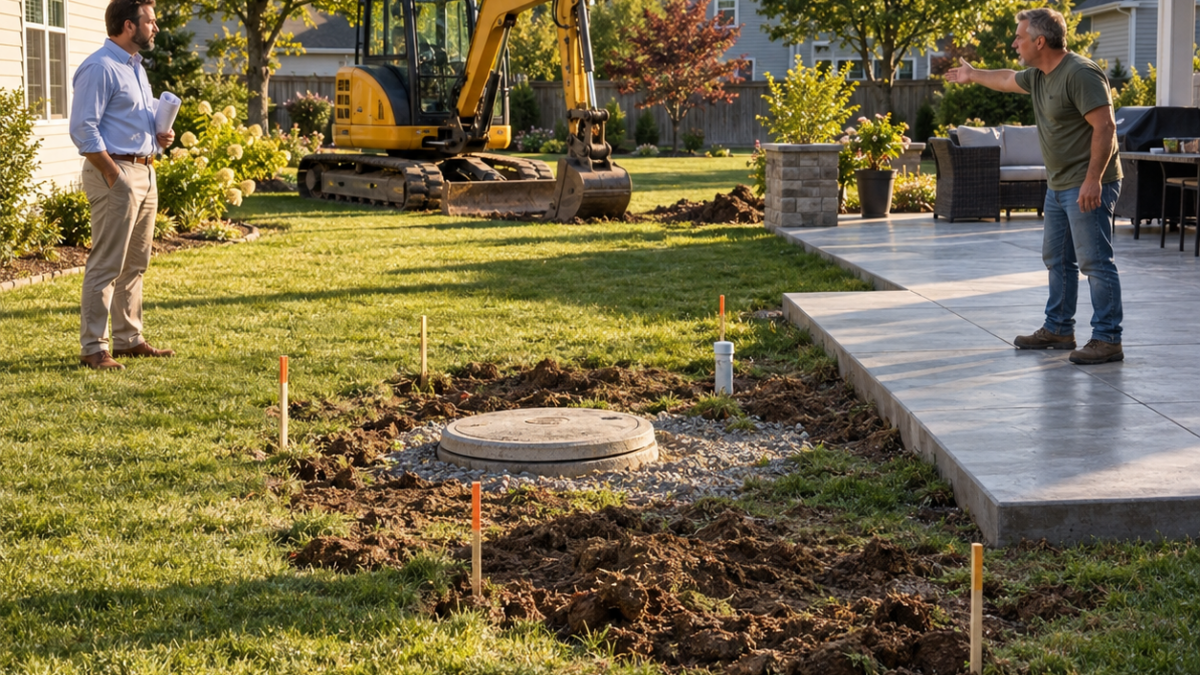
“Why?” I asked.
Daniel kept looking at the photograph.
“Because there’s a difference between a contractor accidentally crossing a boundary and a contractor being directed to disregard one.”
He turned his computer monitor toward me.
On the screen, Rick’s photograph filled nearly the entire display.
Victor stood with one hand in his pocket and the other pointing toward a paper plan. Beside him was a man wearing a fluorescent yellow vest, work boots, and a white hard hat.
Behind them, an orange survey stake projected several inches above the grass.
The stake was close to where the new patio now stood.
“That looks like a boundary marker,” I said.
“It might be. I want the surveyor to confirm what we’re looking at.”
“Victor knew it was there.”
“Possibly. But we’re not going to rely on a photograph to establish what was in his head.”
Daniel leaned back.
“First we establish the boundary. Then we establish who approved the layout. Then we determine what happened to your septic field.”
He paused.
“And Thomas, don’t hire anyone to start breaking concrete yet.”
I looked at him.
“Why would I do that?”
He raised an eyebrow.
We both knew the answer.
Because every time I looked out my kitchen window, I wanted that patio gone.
Because Victor had looked me in the eye and told me land that had belonged to me for almost twenty years was somehow available for him to improve.
Because the decorative concrete now covering my yard looked less like construction and more like a monument to someone else’s arrogance.
“I wasn’t planning on doing anything stupid,” I said.
Daniel closed the photograph.
“Good. Let’s keep it that way.”
—
The first time I met Victor and Elaine Carrington, they seemed like ordinary people who had done well for themselves.
They had bought the house next door from an elderly couple named the Millers.
The Millers had lived there for thirty-one years, and we’d never had a serious disagreement.
They borrowed my ladder occasionally.
I borrowed their leaf blower once.
When Mrs. Miller had knee surgery, I cleared snow from their driveway without asking.
That was how the neighborhood worked.
Nobody was particularly close, but everybody understood that living beside someone meant making life easier when possible.
Victor and Elaine arrived in early spring with two luxury SUVs, a moving company, and a landscaping consultant.
Within three days, contractors were removing shrubs from their front yard.
Within a week, a dumpster sat beside their garage.
Their house was already one of the nicest on the road, but apparently it wasn’t nice enough.
Victor told me he worked in financial consulting and had recently sold his interest in a business.
Elaine had worked in commercial interior design.
They wanted to turn the property into what Victor called “a proper entertaining space.”
I had no objection.
It was their house.
Their money.
Their business.
The trouble began when Victor started measuring the rear boundary.
One afternoon, I was repairing a gate when he walked over with a laser measuring tool.
“Hey, Thomas. Quick question.”
“Sure.”
“Anything underground along this side?”
I pointed toward the grass behind my garage.
“Septic drain field. Installed in 2008.”
He looked toward the yard.
“All the way back there?”
“Yes. The distribution lines spread through that section.”
“Interesting.”
“Why?”
“We’re thinking about putting in an outdoor kitchen and patio.”
I wiped my hands on a rag.
“Just make sure your contractor checks the property line. The drain field is closer to the boundary than it looks.”
He nodded.
“Appreciate it.”
Then he went back to measuring.
That conversation lasted less than two minutes.
I remembered it because it was unusually specific.
Victor hadn’t asked about the weather or introduced his wife.
He’d asked about buried infrastructure.
And I’d told him.
—
Two weeks after the survey, Daniel sent Victor a formal letter.
It included the boundary survey, copies of my septic permits, photographs of the patio, and a request that he arrange for the encroaching concrete to be removed and any damage to the system evaluated.
We gave him an opportunity to respond through counsel and propose a safe remedy.
Victor’s attorney responded six days later.
His name was Charles Benton, and his letter was polite enough to make the underlying message even more irritating.
The Carringtons disputed the accuracy of my understanding of the boundary.
They questioned whether the concrete had affected a functioning septic component.
They suggested that removal of the patio would cause substantial economic waste.
And they proposed a meeting to discuss an amicable resolution.
I read the letter at Daniel’s office.
“Economic waste?”
Daniel nodded.
“That’s their phrase.”
“He built on my land.”
“According to the survey, yes.”
“And now tearing it out would be wasteful?”
“That’s one of the arguments they’re making.”
I slid the letter across his desk.
“What’s the alternative? I sell him my drain field?”
Daniel folded his hands.
“We need to know whether your septic system can continue operating safely. If it can’t, the discussion changes considerably.”
I stared at him.
“The drain field isn’t optional.”
“Exactly.”
That afternoon, we arranged for a licensed septic professional to inspect the accessible portions of the system.
The contractor’s name was Michael Alvarez.
Everyone called him Mike.
He had installed my system back in 2008.
When I called him, he remembered the house immediately.
“Thomas Bennett? Two-acre place with the maple trees?”
“That’s me.”
“What’s going on?”
“Someone poured a patio over your drain field.”
There was a long silence.
Then Mike said, “You’re kidding.”
“I wish I was.”
—
Mike arrived the following morning in an old white service truck.
He stepped out wearing faded jeans, work boots, and a sun-bleached baseball cap.
He carried the original system layout in a plastic folder.
When he saw the patio, he stopped walking.
“Oh, man.”
I nodded.
“Yeah.”
He walked along the slab without touching anything.
Then he opened the folder and compared the approved layout with the survey stakes.
“These lines should be right through here,” he said.
He pointed toward the middle section of the concrete.
“The inspection riser was approximately there.”
“Can you tell if the pipes are crushed?”
“Not just by looking.”
“Could the concrete have damaged the system?”
“Possibly. You’ve got the weight of the slab, construction traffic, the base preparation, and reduced access. But we need to examine it properly.”
He looked toward my house.
“Any slow drains?”
“Not that I’ve noticed.”
“Any odors outside?”
“No.”
“That’s good, but it doesn’t prove the field is undamaged.”
He explained that the drain field depended on properly prepared soil and the movement of wastewater through its designed distribution area.
Compaction from heavy equipment could affect soil performance.
An impermeable slab over part of the field could interfere with the system’s intended design.
And covering inspection access made maintenance difficult.
But he wasn’t willing to declare the entire system destroyed without testing.
“I don’t sell people repairs they don’t need,” Mike said. “And I don’t tell them everything’s fine when I haven’t looked.”
That was why I trusted him.
He’d been the same way in 2008.
Back then, I’d complained about the cost of a larger drain field.
Mike had explained the soil conditions and the approved design until I understood what I was paying for.
It had been expensive.
But it had worked for years.
Now the most expensive part of my home’s infrastructure was trapped beneath someone else’s patio.
—
The county environmental health inspector arrived several days later.
Her name was Janet Foster.
She had short gray hair, sturdy work boots, and the calm manner of someone accustomed to telling homeowners things they didn’t want to hear.
Mike met her at the property.
Daniel attended as well.
Victor stood on his side of the yard watching.
Janet reviewed the permitted septic layout, the survey stakes, and photographs from before construction.
Then she walked the edge of the slab.
“Do you know whether any fill was imported before the concrete was poured?” she asked.
“I don’t,” I said.
Mike pointed toward the patio edge.
“They’ve got a compacted stone base beneath it. We don’t know how deep.”
Janet made a note.
She asked about the system’s age and my recent maintenance history.
I showed her pumping receipts and earlier inspection records.
Then she photographed the covered access locations.
Her preliminary assessment did not declare the entire septic system failed.
Instead, she documented an unauthorized alteration over part of an approved drain-field area, with buried inspection access and potential damage requiring further evaluation.
She explained that any corrective work would need to follow the appropriate local permitting and inspection process.
That was enough to make me nervous.
Because the problem wasn’t merely whose yard the patio occupied.
It was whether my house could continue using its wastewater system safely.
After the inspection, Victor finally walked over.
He stopped several feet from the nearest survey stake.
“Looks like you’ve got quite a production going,” he said.
I looked at him.
“County inspector. Septic contractor. Surveyor. All because of your patio.”
He glanced at Janet.
“Nobody has proven the system is damaged.”
Janet answered before I could.
“We’ve documented concerns that require evaluation. That’s what the inspection process is for.”
Victor turned toward me.
“You really intend to tear up a twenty-thousand-dollar improvement?”
I felt my jaw tighten.
“Victor, it’s covering part of my septic system.”
“You keep saying that.”
“Because it keeps being true.”
He shook his head.
“We could work something out financially.”
“What exactly are you offering?”
“A fair amount for the affected strip. We have an appraisal contact.”
I stared at him.
“You want to buy the land beneath your patio?”
“If that’s the most efficient solution.”
“And where would my septic field go?”
He opened his mouth.
Then stopped.
For the first time, he seemed to consider the question.
I continued.
“I can’t just sell you part of a functioning septic drain field and pretend the pipes disappear.”
“Systems can be relocated.”
“At whose expense?”
“We haven’t discussed numbers.”
“Then there’s nothing to discuss.”
Victor’s expression hardened.
“You’re being emotional.”
I looked at the concrete.
“No. I’m being very specific.”
—
The following week, Rick called me over to his garage.
Rick was sixty-eight, a retired electrician who had lived beside me for more than fifteen years.
He kept his tools organized, his grass short, and his opinions mostly to himself.
When he wanted to talk privately, something usually mattered.
He had spread several printed photographs across his workbench.
“I found more pictures,” he said.
“From the pour?”
“From the day before.”
He explained that he had been photographing repairs to his own rear fence when he noticed the Carrington contractors working near our shared corner.
In one picture, a compact loader sat beside a pile of crushed stone.
In another, a worker held a measuring tape stretched across the yard.
Then Rick showed me the photograph that changed the case.
Victor was standing beside the construction supervisor.
Between them was a bright orange survey flag.
And behind the flag stood a white septic inspection riser.
The riser was plainly visible.
Nobody could have mistaken it for a decorative garden ornament.
I leaned closer.
“That’s my port.”
Rick nodded.
“And here’s the interesting part.”
He slid another photograph toward me.
It showed the same area later that afternoon.
The inspection riser was no longer visible.
The soil around it had been disturbed.
And the orange flag lay on the ground.
I stared at the sequence.
“Did you see them remove it?”
“No.”
“Did you see Victor tell them to?”
“No.”
Rick pointed to the pictures.
“I’m not saying what happened between photographs. I’m saying what the photographs show.”
He was right.
I looked at him.
“Can Daniel have copies?”
“He can have the originals.”
Rick hesitated.
“Thomas, I probably should’ve called you sooner.”
“You called me during the pour.”
“I know. But I saw them working near the flags the day before. I assumed they’d sorted things out.”
I looked at him.
“You couldn’t have known.”
He nodded, but his expression remained troubled.
“I just hate seeing this happen between neighbors.”
“So do I.”
—
Daniel used the new photographs to request records from the patio contractor.
The company was called Stonebridge Outdoor Living.
Its owner, Eric Dalton, had operated locally for eleven years.
Eric wasn’t a large commercial developer.
He ran a small crew building patios, retaining walls, and outdoor kitchens.
I knew of the company by reputation, though I’d never worked with him.
When Daniel first contacted Stonebridge, Eric referred the matter to his insurance representative and attorney.
That was reasonable.
The patio was now the center of a serious property dispute, and everybody involved had potential exposure.
Eventually, records were exchanged through the legal process.
They included an estimate, a work order, photographs, a draft layout, and correspondence about the patio dimensions.
The estimate showed approximately six hundred square feet of decorative concrete.
The work order identified Victor as the customer.
The site plan was more interesting.
It showed the proposed patio extending behind the Carrington residence.
But the drawing was not a boundary survey.
It contained measurements from the house and existing fence features, not a verified legal property line.
And in the notes was a sentence that immediately caught Daniel’s attention.
“Customer to verify property boundaries and underground utilities prior to installation.”
I read it twice.
“Victor was responsible for confirming the boundary?”
“According to this contract language, the customer acknowledged that responsibility. We still need to examine the contractor’s obligations and what each party actually knew.”
Daniel wasn’t going to let me turn one sentence into an entire legal conclusion.
I appreciated that, even when it frustrated me.
Then we reached an email from Eric to Victor.
It was dated four days before the pour.
Eric wrote that his crew had identified what appeared to be an old boundary marker and a utility or septic access pipe near the proposed patio edge.
He requested confirmation before proceeding with the layout.
Victor responded that evening.
“Proceed with the approved footprint. The adjacent strip has been unused for years, and I am handling the property matter.”
I looked at Daniel.
“He knew.”
Daniel studied the email.
“It shows he received a warning and instructed the contractor to proceed. That’s significant.”
“He told the contractor the land was unused.”
“Yes.”
“He knew I’d told him about my septic field.”
“You can testify to that conversation.”
“And he still did it.”
Daniel folded the papers.
“Now we have a much clearer record of how this happened.”
—
When the documents were presented to Victor’s attorney, his position began to change.
Not overnight.
Not dramatically.
But the letters became less aggressive.
The claim that the boundary was uncertain gradually disappeared.
The suggestion that there was no evidence of a septic system beneath the patio became harder to maintain.
Instead, Victor’s counsel proposed a negotiated remedy involving partial removal of the encroaching slab and an engineering review of the affected drain-field area.
Daniel and I discussed it carefully.
I wasn’t opposed to a reasonable settlement.
I had no desire to spend months in court if the problem could be fixed safely.
But partial removal raised questions.
Would a portion of the concrete remain above any septic components?
Could heavy equipment be used without further compaction?
Would the soil need rehabilitation?
Could the existing field be certified for continued use, or would part of it need replacement?
And who would pay for the inspections, repairs, and additional design work?
Mike reviewed the proposal.
He shook his head.
“Not until we know exactly what they disturbed.”
Victor’s attorney suggested obtaining a joint engineering evaluation.
That was sensible.
But the parties couldn’t agree on the scope or schedule, and Victor continued using the patio while the septic questions remained unresolved.
Daniel warned me that negotiations could continue for months without preventing further deterioration of the site.
We needed a more reliable path.
Eventually, we filed a civil action seeking appropriate relief for the encroachment and the potential damage to the septic system.
We also sought temporary restrictions to prevent additional construction or alteration while the dispute was being evaluated.
I signed the papers at Daniel’s office.
He walked me through them line by line.
At one point, he stopped.
“Thomas, I want you to understand something.”
“What?”
“Filing a lawsuit doesn’t guarantee the judge will order exactly what we request.”
“I know.”
“And even with a strong survey, the remedy may require expert evidence.”
“I understand.”
He leaned back.
“Then we’re ready.”
I looked down at the documents.
For the first time in my life, I was taking a neighbor to court.
And all I had wanted was for him to leave my septic field alone.
—
The first hearing was held several weeks later.
The courtroom was smaller than I’d imagined.
There were wooden benches, beige walls, and a clock that ticked loudly whenever nobody spoke.
Victor sat beside his attorney.
Elaine sat behind them.
I hadn’t seen much of her since the patio was poured.
She wore a dark sweater and looked exhausted.
When our eyes met, she looked away.
Daniel presented the survey and described the encroachment.
He explained that the patio extended roughly fifteen feet onto my property at its deepest point and overlapped part of the approved septic drain-field area.
He introduced the septic installation records and the county inspector’s findings.
Victor’s attorney acknowledged that the current survey showed an encroachment but argued that the scope of the remedy should be determined through further technical evaluation.
The judge, Margaret Holbrook, listened without interruption.
She was a woman in her early sixties with silver-framed glasses and an expression that revealed almost nothing.
After reviewing the material, she asked Victor’s attorney a question.
“Is your client disputing that portions of the patio are on Mr. Bennett’s titled property?”
His attorney paused.
“Not under the current survey, Your Honor. We dispute certain aspects of the requested relief.”
Judge Holbrook nodded.
“Then the boundary question appears narrower than it was when this dispute began.”
She turned to Daniel.
“What is the immediate risk to the septic system?”
Daniel referred to the inspector’s report and explained that further investigation was needed to determine whether the covered components and compacted area required repair.
The judge asked whether my house remained occupied.
“Yes,” Daniel said.
“And the septic system is still being used?”
“Yes.”
“Has there been a documented backup or discharge?”
“Not at this time.”
She made a note.
Then she looked toward Victor.
“Mr. Carrington, I understand you’ve invested money in this patio.”
Victor sat straighter.
“Yes, Your Honor.”
“Did you obtain your neighbor’s written permission to build on his land?”
“No, but I believed the area was—”
“Did you obtain written permission?”
“No.”
The judge waited.
Victor lowered his eyes.
Judge Holbrook continued.
“This matter involves more than an ordinary landscaping disagreement. There is a documented encroachment and a potential issue affecting an approved wastewater system. I expect the parties to cooperate in determining an appropriate remedy.”
She issued temporary directions intended to preserve the site and prevent further work or alteration while the technical evaluation and litigation proceeded.
She also established deadlines for the necessary evidence and subsequent proceedings.
It wasn’t the immediate demolition order I’d privately imagined.
But it was a serious step.
Outside the courthouse, Victor walked past me without speaking.
Elaine stopped.
“Thomas?”
I turned.
She glanced toward her husband, who was already approaching the parking lot.
“I’m sorry this has become such a mess.”
I didn’t know what to say.
She continued.
“I asked him about the boundary before the patio was poured.”
That caught me off guard.
“What did he tell you?”
“He said everything had been checked.”
I looked toward Victor.
Elaine’s expression tightened.
“I believed him.”
Then she walked away.
—
The technical evaluation took longer than anybody wanted.
A qualified septic professional and a consulting engineer reviewed the installation plans, inspected accessible components, and developed a plan to investigate the covered area safely.
Some questions couldn’t be answered until portions of the concrete were removed.
That created an obvious problem.
The very structure causing concern prevented a complete inspection of the system beneath it.
Meanwhile, my daily life had changed.
Every shower, every washing-machine cycle, every slow-draining sink made me uneasy.
The system hadn’t failed.
But I knew there was uncertainty beneath the ground, and uncertainty has a way of spreading into everything else.
I stopped inviting people over.
I avoided using the pool, even though the pool itself wasn’t connected to the septic issue.
I found myself standing at the kitchen window after dinner, staring at the concrete.
Once, I caught myself measuring its edge with my eyes.
Again.
As though looking at it often enough might make it disappear.
Rick noticed.
One evening, he walked over while I was sitting on the back steps.
“You’re wearing a path in that grass,” he said.
I looked down.
He was right.
A narrow strip between my porch and the boundary had been flattened by weeks of pacing.
Rick sat beside me.
“You remember when the Millers put up that ugly birdhouse?”
I frowned.
“What?”
“Big purple thing. Looked like an apartment building for pigeons.”
I laughed.
“I remember.”
“You hated it.”
“It was terrible.”
“But you didn’t do anything.”
“Because it was on their land.”
Rick nodded.
“Exactly.”
We sat quietly.
Then he said, “That’s what this is about. Not the color of the patio, not whether it’s expensive. It’s that he never believed you had the right to tell him no.”
I looked across the yard.
“He’s costing me a fortune.”
“Then make him answer for the cost.”
Rick stood.
“But don’t let him take the rest of your life while you’re at it.”
—
The next major development came from the septic evaluation.
Preliminary observations suggested that construction activity had disturbed and compacted portions of the drain-field area.
The exact repairs required would depend on what was found during carefully controlled removal and inspection.
The engineer recommended removing the encroaching concrete under a plan designed to avoid additional damage, exposing the affected access points, and evaluating the underlying distribution components and soil.
The county would need to review the appropriate repair or restoration work.
For the first time, we had a concrete technical plan.
Not a threat.
Not an argument.
A plan specifying how the offending structure could be removed and how the wastewater system would be protected.
Daniel sent it to Victor’s attorney.
The proposal gave Victor an opportunity to arrange the work using qualified contractors, subject to appropriate oversight and agreed safeguards.
I was willing to let him correct the mistake.
I told Daniel that plainly.
“I don’t care who hires the excavation crew. I just want it done right.”
Daniel nodded.
“That’s a reasonable position.”
But Victor objected to the scope of removal.
He argued that the slab could be cut along the boundary, leaving the portion on his own property intact.
The engineer disagreed with making that decision before the covered septic area was exposed and assessed.
There were also concerns about equipment access and the support of any remaining concrete.
Those were legitimate technical questions, but Victor treated them as evidence that everyone was conspiring to destroy his investment.
He sent another letter proposing that I accept a cash payment in exchange for a permanent property arrangement.
I turned it down.
Not because I wanted to punish him.
Because nobody had shown me a safe, approved way to surrender the affected land without compromising the septic system.
The patio had created a problem money alone couldn’t solve.
—
One afternoon, I came home from work and found Elaine standing near the boundary stakes.
She was holding a piece of paper.
I parked and walked over.
“Everything okay?”
She looked at me.
“I wanted to ask you something.”
“Sure.”
She held out the paper.
It was a contractor’s revised proposal showing a smaller patio footprint.
The new drawing kept the concrete within the surveyed boundary.
I recognized it immediately.
It was the design Victor should have approved before construction began.
“Where did you get this?”
“Eric sent it to us before the original pour.”
I stared at her.
“Before?”
She nodded.
“Victor asked him to revise it because he wanted more room for an outdoor dining area.”
I looked at the drawing.
The smaller patio would have left the boundary undisturbed.
It would have avoided my septic field entirely.
“Why are you showing me this?”
Elaine’s eyes glistened.
“Because I want you to understand that not everybody in our house agreed with what happened.”
I said nothing.
She looked toward their home.
“Victor kept saying the property line was probably wrong. He said the survey would sort itself out later. I didn’t like it, but I trusted him.”
She swallowed.
“Then we spent all that money. And once the concrete was there, he couldn’t admit we’d made a mistake.”
I looked down at the revised drawing.
“Elaine, I don’t want your house destroyed.”
“I know.”
“I don’t want to bankrupt you.”
“I know.”
“But I can’t leave concrete over my septic system.”
She nodded.
“Neither would I.”
That surprised me.
She wiped her cheek.
“I’ve been married to Victor for twenty-four years. He’s not a monster. But he’s always believed he can solve a problem by being more stubborn than the person across from him.”
I glanced toward their deck.
“Sometimes that works in business.”
“Yes,” she said quietly. “Sometimes it ruins everything else.”
Before leaving, she asked whether Daniel could contact her attorney directly about the smaller design.
I said yes.
She thanked me and walked home.
I stood there holding the drawing long after she’d gone inside.
It showed a perfectly good patio.
Smaller.
Less expensive.
Entirely on the Carrington property.
All Victor had needed to do was accept a boundary.
—
The final court proceedings focused on the permanent remedy and responsibility for the costs.
By then, the evidence was substantial.
The survey established the encroachment.
The permitted septic plans identified the affected area.
The inspector and technical reports explained the need for controlled removal and evaluation.
The contractor records showed Victor had been warned about a boundary marker and underground infrastructure before construction proceeded.
And the alternative patio design showed that a workable plan had existed without using my land.
Judge Holbrook reviewed the evidence carefully.
Victor’s attorney argued that demolition should be limited to what was reasonably necessary and that the court should consider less burdensome alternatives.
Daniel did not oppose that principle.
He explained that I wanted the work limited to what was necessary to restore my property and protect the septic system.
But he emphasized that Victor’s preferences couldn’t override the technical requirements.
The judge ultimately entered an order requiring the encroachment to be corrected in accordance with an approved removal and restoration plan, subject to the appropriate permits and inspections.
The order established responsibilities and deadlines for compliance.
It also provided a means to seek further court authorization if Victor failed to complete the required work.
When Daniel explained the outcome, I asked the question I’d been holding inside for months.
“Can we finally hire an excavator?”
“Not by simply driving one into his yard tomorrow,” Daniel said.
I almost smiled.
“Of course not.”
“We need to follow the order and the approved plan. If they don’t comply, we’ll seek the additional authorization provided for.”
I looked across the office at the survey map.
“But eventually?”
“Yes. The patio can’t remain as it is.”
For the first time since the wedding, I felt the weight in my chest loosen.
—
Victor did not meet the initial compliance deadline.
His attorney requested additional time, citing contractor scheduling issues and disagreements over the proposed scope.
Some of those concerns might have been legitimate.
But the deadlines continued passing without an acceptable plan being carried out.
Daniel returned to court.
This time, the requested relief was narrow.
We asked for authorization to proceed with the approved removal and restoration work through qualified contractors, with the necessary access arrangements and safeguards, and to seek recovery of properly documented costs.
Judge Holbrook reviewed the compliance history and the technical plan.
She granted the requested enforcement relief under specified conditions.
That was the moment everything changed.
Not because someone announced Victor was finished.
Not because the sheriff arrived to punish him.
Because I finally had a lawful path to remove the encroaching concrete without creating another property dispute.
I called Mike.
“How soon can you get an excavator?”
He paused.
“Tell me you’ve got the paperwork.”
“I do.”
“Send me the approved plan.”
I smiled.
“Already on its way.”
—
The morning the excavation began was cool and clear.
I arrived in the backyard before seven.
Mike was already there with a crew.
A compact excavator sat on a transport trailer beside the access route.
A concrete-cutting contractor had brought saws, dust-control equipment, and protective barriers.
A hauling truck waited nearby.
The work wasn’t going to be one dramatic swing of a steel bucket.
That would have risked damaging the very system we were trying to protect.
Instead, the crew would cut and remove the slab in manageable sections, control equipment movement, and expose the covered area carefully enough for inspection.
The county had been notified as required for the permitted work.
The relevant access conditions and contractor responsibilities had been arranged through counsel.
Daniel attended during the initial work to document compliance with the order.
Rick stood near his fence with a cup of coffee.
He looked at the excavator.
“Never thought I’d see that thing in your backyard.”
“Neither did I.”
He took a sip.
“Long time coming.”
I nodded.
“Long time.”
Mike approached us with a marked copy of the site plan.
“Thomas, before we start, I want to show you where the cuts are going.”
He explained the sequence.
First, the crew would isolate the encroaching portion and establish safe working boundaries.
Then they would remove the concrete and underlying material in sections.
Once the affected septic components were accessible, the system specialist and inspector would determine what needed repair or replacement.
“We’re not guessing once we get below the slab,” Mike said.
“If something doesn’t look right, we stop and reassess.”
“Understood.”
He folded the plan.
“And you’re staying behind the barriers.”
I laughed.
“Yes, sir.”
—
At 7:42, the first concrete saw started.
The sound cut across the yard.
Sharp.
Mechanical.
Unmistakable.
Dust rose behind the controlled water spray as the worker guided the blade along a marked line.
I watched from the patio outside my house.
The slab looked different with a saw cutting through it.
For months, it had seemed permanent.
A heavy, expensive object placed exactly where I didn’t want it.
Now a narrow line was opening across the decorative surface.
One section at a time, that permanence was coming apart.
The crew made several cuts before shutting down the saw.
Mike inspected the first section.
Then the excavator moved into position along the designated access path.
The operator used the machine carefully, working with the crew to lift the separated concrete.
There was no wild swinging.
No dramatic smashing.
Just slow, coordinated construction work.
A section came free.
Then another.
The truck filled gradually with gray slabs and broken pieces.
By midmorning, the encroaching patio had been reduced to several remaining sections.
And then the crew exposed the area around the first buried inspection riser.
Mike crouched beside it.
I watched his expression change.
He held up a hand.
The operator stopped.
Everyone nearby went quiet.
Mike cleared a little more material.
Then he called the inspector over.
I stepped toward the barrier.
“What is it?”
Mike looked up.
“Thomas, the riser’s been damaged.”
My stomach tightened.
“How badly?”
“We need to expose the connection before I can tell you.”
For several minutes, I could only watch.
The crew removed more material by hand around the fragile components.
Then Mike stood.
“The upper section’s crushed, and we’re going to need to evaluate the connected piping.”
I looked toward the remaining concrete.
“Can it be repaired?”
He nodded cautiously.
“Very likely. But let’s finish the inspection before we promise anything.”
I took a breath.
“Okay.”
The work continued.
As more of the covered area became accessible, the crew documented damaged access components and disturbed soil.
The evaluation also identified sections requiring repair and restoration because of the construction impact.
It was frustrating.
But it could have been worse.
We weren’t looking at an uncontrolled sewage discharge.
We weren’t dealing with an immediate evacuation.
We had a documented repair plan, qualified people on site, and a clear process for completing the work.
That mattered.
—
Victor arrived just before noon.
I heard his vehicle before I saw him.
He pulled into his driveway and stopped beside the construction access area.
For several seconds, he remained in the driver’s seat.
Then he climbed out.
He looked toward the excavator.
Toward the hauling truck.
Toward the jagged remains of the patio.
His face tightened.
“What the hell is going on?”
I stepped away from the barrier.
“Victor.”
He pointed at the equipment.
“You’re tearing up my patio!”
“The court authorized the removal work.”
“I never agreed to this!”
Daniel approached before I could answer.
“Mr. Carrington, your attorney received notice of the enforcement order and the scheduled work. The contractors are proceeding under the approved plan.”
Victor stared at him.
“Do you have any idea what that concrete cost?”
Daniel answered calmly.
“That issue has been addressed in the litigation. The work is being documented.”
Victor turned toward me.
“You couldn’t just leave it alone?”
I looked at him.
For months, I’d imagined this conversation.
I’d pictured myself giving him some perfect line.
Something clever.
Something that would make him understand exactly how unreasonable he’d been.
But standing there beside the excavator, with a damaged septic riser exposed behind us, I didn’t feel clever.
I felt exhausted.
“Victor, you built over my drain field.”
He looked toward the workers.
“I offered to buy the land.”
“And I told you why that wouldn’t solve it.”
He shook his head.
“This is ridiculous.”
I took one step closer.
“Your own contractor warned you about the boundary. You had a smaller design that stayed on your property. You chose the bigger one.”
His eyes narrowed.
“You don’t know everything that happened.”
“Then tell me.”
He opened his mouth.
Nothing came out.
For a few seconds, we stood facing each other.
Then Elaine appeared on their back deck.
“Victor.”
He didn’t look at her.
“Go inside.”
She stayed where she was.
“Victor, enough.”
He turned.
“What?”
She looked toward the construction equipment.
“Let them finish.”
He stared at her.
“Elaine—”
“No.”
Her voice was quiet but firm.
“We’ve spent months fighting this. The survey is clear. The court has ruled. Let them finish.”
Victor’s shoulders dropped slightly.
I watched him look from his wife to the work crew.
Then he turned and walked back toward the house.
He didn’t apologize.
He didn’t shake my hand.
He didn’t have a sudden revelation.
He simply stopped interfering.
And for that day, that was enough.
—
The removal and initial excavation work continued into the afternoon.
By the time the crew finished hauling away the designated concrete, the disputed portion of the patio was gone.
Where there had been decorative stamped concrete, there was exposed soil, gravel, and carefully marked septic components.
It wasn’t pretty.
But it was accessible.
The following days were devoted to inspection, repair, and restoration.
Mike coordinated the work with the appropriate professionals.
Damaged access components were replaced.
Affected piping was evaluated and repaired where necessary.
Disturbed and compacted material was addressed according to the approved restoration plan.
The work required patience.
Some portions couldn’t be completed until inspections were scheduled.
Other steps depended on verifying conditions exposed during excavation.
I spent a lot of time standing in my backyard, trying not to hover over the workers.
Mike noticed.
“Thomas, go find something else to do.”
“This is my yard.”
“I know. And you’ve hired people who know what they’re doing.”
I sighed.
He grinned.
“I’ll call you if we find buried treasure.”
I went inside.
Ten minutes later, I was back at the window.
—
The financial dispute took additional time to resolve.
There were invoices for concrete removal, hauling, septic evaluation, repairs, and site restoration.
There were survey costs and legal expenses.
Each category required documentation.
Not every expense was automatically recoverable merely because I had paid it.
Daniel explained the relevant standards and what our claims could reasonably support.
Victor’s side contested some amounts.
The parties negotiated others.
Eventually, the court proceedings and settlement of the remaining financial issues produced a resolution addressing the substantiated costs and responsibilities.
It wasn’t an instant jackpot.
There was no miraculous six-figure punishment for being arrogant.
There were bills, receipts, expert reports, and a long series of decisions about what damage had actually been caused and what it reasonably cost to correct.
My priority was getting the property restored without being left responsible for expenses created by my neighbor’s decision.
That took longer than the original excavation.
But eventually, the important financial matters were resolved.
And I could stop organizing my life around attorneys’ letters.
—
One evening, after the restoration work was complete, Elaine came to my door.
She held a small envelope.
“Thomas, do you have a minute?”
“Sure.”
She looked tired.
Not the tiredness of someone who’d had a bad night’s sleep.
The kind that settles into a person’s face after months of arguments.
“I wanted to apologize,” she said.
I waited.
“Not for Victor. He has to speak for himself. But for my part in this.”
“You didn’t pour the patio.”
“No. But I knew there was a problem before the concrete arrived. I could have pushed harder.”
I looked at her.
“Elaine, you showed me the smaller design. That helped.”
She nodded.
“I should’ve shown it sooner.”
“Maybe.”
She glanced toward the yard.
“That patio was supposed to be something nice.”
I said nothing.
“We’d planned to have our children visit more often. Our oldest lives in Chicago. Our daughter is in North Carolina. We wanted a place where everybody could come for holidays.”
Her eyes filled slightly.
“Victor got obsessed with making everything perfect.”
I thought about the smaller patio design.
The one that would have worked.
“You could have had a beautiful space without crossing the line,” I said.
“I know.”
She looked down at the envelope.
“This is a note from me. You don’t have to respond.”
I accepted it.
She started to leave, then stopped.
“I hope things can be peaceful again.”
I looked across the driveway toward the Carrington house.
“I’d like that.”
After she left, I opened the envelope.
Inside was a handwritten card.
It was brief.
She apologized for the disruption, acknowledged that my property should have been respected, and wished me well.
No excuses.
No talk about misunderstandings.
No suggestion that I’d overreacted.
I put the card in the blue folder with the other documents.
Not because I needed it as evidence.
Because after months of legal letters, it was nice to read something that sounded human.
—
The yard didn’t recover overnight.
For several weeks, the restored section looked like a construction site.
Fresh soil settled.
New grass seed needed watering.
The repaired septic components were inspected as required.
I kept records of the completed work and the approvals.
Mike stopped by for a final visit after the major work was finished.
He stood beside the restored area with his hands on his hips.
“Looks a lot better.”
“That’s one way to put it.”
He laughed.
“Remember when we installed this thing?”
“Unfortunately.”
“You complained about every invoice.”
“I remember.”
“And I told you septic work wasn’t the place to get creative.”
I smiled.
“You did.”
He pointed toward the grass.
“Same advice now. Leave it alone, maintain it properly, and don’t let anybody park heavy equipment over the field.”
I looked toward the Carrington property.
“Don’t think that’ll be a problem again.”
Mike grinned.
“Let’s hope not.”
After he left, I stood outside for a while.
There was still a faint rectangular outline where the concrete had been.
But the patio was gone.
The inspection access had been restored.
The property boundary was clearly marked.
And the repairs had been completed through the proper process.
I could finally see my yard without immediately thinking about the lawsuit.
—
Winter arrived early that year.
The first snow settled across both properties in a thin white layer.
I was carrying firewood toward the back porch when I noticed Victor standing near his fence.
He looked at me.
I looked at him.
For a moment, neither of us moved.
Then he raised one hand.
Not a friendly wave exactly.
More an acknowledgment.
I nodded.
He went inside.
That was our entire interaction.
I didn’t need anything else.
Over the following months, Victor and Elaine began working on a smaller patio entirely within their property.
A different contractor handled the project.
Before construction started, I noticed a survey crew marking the boundary.
The crew installed clear temporary markers.
The new design stopped well short of my septic drain field.
One afternoon, Eric Dalton from Stonebridge appeared at my door.
He wasn’t doing the new patio work.
He had come to return an old photograph he’d found among his company’s records during the dispute.
It showed the original boundary area before any excavation began.
The grass was green.
The septic riser stood upright.
The yard looked exactly as it had before the trouble.
Eric handed it to me.
“Thought you might want this.”
I studied the picture.
“Thanks.”
He shifted his weight.
“That job was a nightmare.”
“For both of us.”
He nodded.
“I should’ve stopped when I saw that marker.”
I looked at him.
“Yes. You should have.”
He accepted that.
Then he said, “I changed how we verify boundaries. We don’t pour anything near a disputed line without proper documentation anymore.”
“Good.”
He looked toward the yard.
“Sorry it took this to make that happen.”
Then he left.
I put the photograph inside the blue folder.
Another piece of paper.
Another reminder of how much trouble could have been avoided by respecting a line that had already existed.
—
About eight months after the excavation, Rick told me the Carringtons were preparing to sell their house.
I didn’t ask why.
Maybe they wanted a fresh start.
Maybe the expenses and stress had worn them down.
Maybe their family plans had changed.
I had no way of knowing.
I did notice a moving truck several weeks later.
Then a real estate sign appeared near their driveway.
When the house sold, the new owners introduced themselves on a sunny Saturday afternoon.
Their names were Daniel and Susan Whitaker.
They had two teenage sons and an old golden retriever that moved like every joint required advance approval.
Daniel walked over while I was trimming bushes.
“Hi. We’re the new neighbors.”
I shook his hand.
“Thomas Bennett. Welcome.”
He glanced toward the boundary.
“We had a survey done before closing.”
I smiled.
“Glad to hear it.”
He laughed.
“Apparently there was some history here.”
“A little.”
He looked uncomfortable.
“We just wanted to make sure everything was clear.”
“It is.”
He nodded.
“Good.”
Then he pointed toward my workshop.
“Is that a table saw I hear?”
“Sure is.”
He grinned.
“I’ve been trying to build some shelves for the garage. Might have to ask your advice sometime.”
I looked at him.
“Happy to help.”
And just like that, we were neighbors.
No attorneys.
No demands.
No construction equipment.
Just two men talking about shelves.
—
The following spring, the grass over the restored area finally blended with the rest of the yard.
You could still identify the section if you knew where to look.
The soil was slightly different in color.
A few patches grew faster after rain.
But the rectangular scar left by the concrete had mostly disappeared.
I was sitting on the back porch one evening when Rick walked over.
He carried two bottles of soda and handed me one.
“Looks like nature finally covered the evidence,” he said.
I laughed.
“Most of it.”
He sat down.
We watched the evening light settle across the grass.
After a while, he said, “You ever regret hiring the excavator?”
I thought about the question.
The legal fees.
The missed work.
The months of uncertainty.
The strain of looking toward my own backyard and feeling angry.
“I regret needing one,” I said.
Rick nodded.
“That’s different.”
“Very.”
He leaned back.
“Funny thing. When Victor first moved in, I thought you two might become friends.”
“Why?”
“Both stubborn. Both good with projects.”
I laughed.
“That’s not always a winning combination.”
“No kidding.”
We sat quietly for a while.
Then Rick raised his bottle toward the restored patch of ground.
“To your grass.”
I tapped my bottle against his.
“To my grass.”
—
It was almost two years after the original concrete pour when I opened the blue folder for the last time.
I had kept everything.
The original 2008 septic permit.
The survey.
The contractor emails.
Rick’s photographs.
Inspection reports.
Legal correspondence.
Excavation invoices.
Repair records.
The final documentation.
And Elaine’s handwritten apology.
The folder had become thick enough that its metal fastener barely closed.
I spread the contents across my kitchen table.
For a moment, I considered throwing away everything except the essential property and system records.
But then I found the first photograph Rick had taken while I was at the wedding.
It showed the concrete truck backed toward my yard.
Workers standing around the forms.
Victor near the boundary.
And the maple trees behind my house.
I’d seen that photograph hundreds of times during the dispute.
Back then, every time I looked at it, I felt a fresh surge of anger.
Now I felt something different.
Distance.
Not because what happened was acceptable.
It wasn’t.
But because it was over.
The patio had been removed.
The septic system had been repaired and inspected.
The property line was no longer in dispute.
And I had no reason to spend another evening thinking about what Victor Carrington believed he was entitled to do.
I placed the important records in a new waterproof storage box.
Then I put the box on the shelf above my desk.
Outside, the evening was warm.
I walked into the backyard.
The restored grass moved slightly in the breeze.
Beyond the fence, I could hear the Whitaker boys laughing while their dog barked at something near the porch.
My house stood quiet behind me.
My septic system was doing the ordinary, invisible work it had been built to do.
And the fifteen feet of land Victor had tried to turn into his patio looked like fifteen feet of ordinary yard again.
I stood there remembering the words he’d said when I first confronted him.
“If it’s yours, prove it.”
He’d made that sound like a threat.
As though ownership only mattered if I was willing to fight for it.
In the end, I had proved it.
With a survey.
With permits.
With photographs.
With qualified professionals.
With a court order.
And finally, with an excavator that removed a structure that should never have existed on my property.
But the part I appreciated most wasn’t watching the concrete disappear.
It was standing on that same patch of ground afterward and seeing nothing remarkable at all.
No expensive stamped surface.
No argument.
No construction equipment.
Just grass.
The kind of grass people walk past without a second thought.
I bent down, pulled a small weed from the soil, and tossed it into the bucket beside me.
Then I went inside to make dinner.
For almost twenty years, that part of my yard had quietly supported my home.
After everything that happened, I was grateful it could finally go back to being something nobody noticed.
Tighten the full story’s middle sectionsClarify the patio removal legal timeline