PART 2: HOA Security Kept Harassing Us — Then My Grandfather Sealed the Bridge and Trapped Them Overnight
My grandfather bought those thirty-four acres in 1951.
Wendell Drexel.
Twenty-two years old.
Recently out of the Army.
Not much money.
More determination than was probably medically advisable.
The property was mostly walnut trees, rough ground, and a cold creek called Sallow Run.
A gravel county road approached the creek and ended at the water.
Grandpa cleared land himself.
Built the farmhouse board by board.
Planted more walnuts.
Added sheds.
Cut drainage.
Fenced pasture.
Fixed everything until it either worked or became ashamed of itself and started working.
I grew up believing certain smells belonged only to that place.
Machine oil.
Pine tar.
Cold creek water.
Wood smoke.
Wet leaves.
Coffee that had been sitting on a burner too long.
Home.
In 1987, a county culvert washed out during a flood.
That created a problem.
Grandpa had spent much of his working life around structural projects and the Army Corps of Engineers.
So he solved problems the way he always did.
He built something.
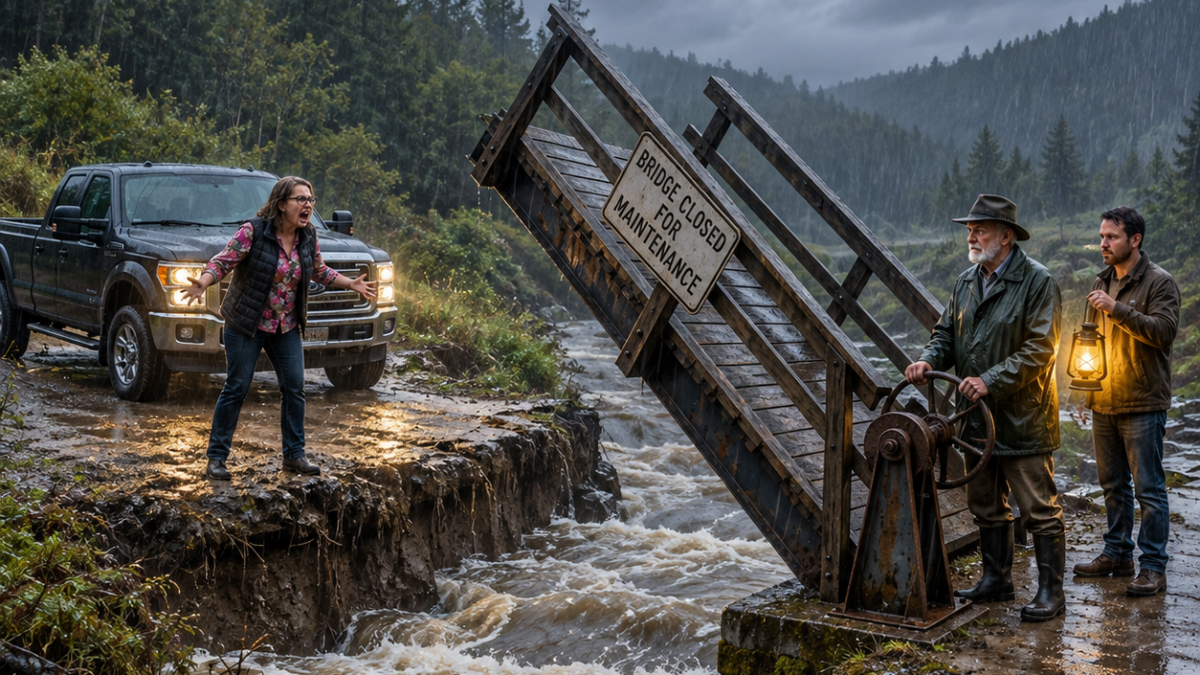
The bridge across Sallow Run was not decorative.
Steel I-beams.
Heavy timber decking.
Hand-fabricated components.
A hydraulic lifting mechanism operated by a removable crank handle.
Twenty-eight feet of deck.
Strong enough for ordinary road use.
Simple enough that Grandpa could inspect almost every critical part himself.
The county already held an old passage easement through the property.
So the public could use the road and cross the bridge.
That arrangement worked for decades.
Nobody cared who technically owned what.
Neighbors crossed.
Delivery drivers crossed.
We crossed.
Occasionally somebody stopped near the creek to fish.
Grandpa never behaved like the bridge was a toll booth.
That mattered later.
Because when this story spread, people sometimes reduced it to:
Old man traps HOA by lifting bridge.
That makes a better sentence than the truth.
But the truth was more interesting.
Grandpa had shared that bridge freely for decades.
The conflict did not begin because he hated people using it.
It began when people who had always been allowed to cross started acting like permission had become ownership.
Harwick Pines changed the traffic.
Stonebrook Properties began developing farmland north of us in 2018.
By 2020:
Two hundred forty homes.
Landscaped entrances.
Clubhouse.
Architectural committee.
HOA.
Private security service.
Harwick Pines Community Security.
HPCS.
Their vehicles were black Ford F-250s polished so thoroughly they looked offended by mud.
Harwick Pines had multiple routes in and out.
But one western route was convenient.
Very convenient.
It came down the county road.
Past our mailbox.
Past our fence.
Past Grandpa’s equipment shed.
Across Sallow Run.
Then out toward the highway.
Once the subdivision filled up, hundreds of vehicle movements began using that road.
Commuters.
Delivery vans.
School traffic.
Residents.
Visitors.
Nobody asked because technically they did not have to ask to use the county-road easement.
Fine.
Grandpa did not care.
What he did care about was people confusing a right of passage with authority over everything beside that passage.
Then Ranata Fain became the face of that confusion.
She ran HPCS.
Fifty-one.
Sharp.
Controlled.
Always looked like she was performing an inspection.
Even standing still.
Ranata had memorized the Harwick Pines community standards with religious devotion.
Mulch colors.
Trash containers.
Wind chimes.
Parking.
Landscaping.
Temporary decorations.
Residents said she issued more than a hundred warnings in her first months.
Some people appreciated that.
Others avoided eye contact when they saw the black F-250.
At first, none of that involved us.
Then came the lumber notice.
Corkran was our farmhand.
Sixty.
Vietnam veteran.
Had worked around Grandpa long enough that they communicated using approximately eight total words.
Corkran stacked lumber near our fence.
Ranata stopped.
Got out.
Attached the warning.
Corkran told her:
“Private farm.”
She said:
“This entire corridor is part of our community footprint now.”
That phrase became a family joke eventually.
Not then.
Grandpa read the notice twice.
Called me.
By the time I arrived, there were three.
The tool shed notice was my favorite.
The shed had stood on that spot for approximately thirty years.
Harwick Pines had existed for approximately five minutes by comparison.
Still:
NON-CONFORMING STRUCTURE.
The dog notice was better.
Our two dogs were behind a fence.
On our land.
Yet according to Ranata, they were “unrestrained within the community aesthetic zone.”
I searched every Harwick Pines document I could find later.
No “community aesthetic zone.”
It existed entirely in Ranata’s imagination.
She also began driving past the farm repeatedly.
Three times a day.
Sometimes four.
Slow.
Pause.
Photograph.
Gate.
Fence.
Shed.
Trees.
Truck.
Corkran.
The walnut trees were apparently suspicious.
Grandpa installed a trail camera.
Weatherproof hunting model.
Timestamp.
License plates.
Motion triggered.
Every stop recorded.
Then he called the county clerk and requested the old easement.
Document dated back to the early 1950s.
Manual typewriter.
Four pages.
Precise.
The county had rights over the road surface for passage.
It did not receive ownership of the adjacent land.
Did not receive rights over fences.
Buildings.
Banks.
Farm operations.
The bridge did not exist when the original easement was written.
That detail would become important.
Grandpa filed his first complaint with the sheriff’s office.
He spoke with Deputy Mabry.
Young deputy.
Patient.
She logged dates.
Times.
Camera footage.
Ranata answered by filing her own complaint.
Fence encroachment.
She claimed Grandpa’s posts extended fourteen inches into the county easement.
That could have mattered.
So Grandpa did not guess.
He hired a surveyor.
Thad Grimshaw.
Old Army friend.
Licensed.
Thad arrived Saturday morning with a thermos that smelled powerful enough to remove paint and spent four hours working the boundary.
He shot lines.
Checked monuments.
Matched records.
Then came inside.
Grandpa asked:
“Well?”
“Your fence isn’t fourteen inches into the easement.”
Grandpa nodded.
Thad continued.
“It’s fourteen inches inside your property.”
I laughed.
Grandpa did not.
He just said:
“Good.”
Ranata’s complaint had forced us to prove we owned slightly more roadside land than anyone had been using.
Survey cost six hundred dollars.
Grandpa got his money’s worth.
Then he asked Thad one more thing.
“Check the bridge.”
Thad looked at him.
“The whole thing?”
“Every corner.”
He did.
Result:
Bridge entirely inside the surveyed Drexel parcel.
Every beam.
Every abutment.
Every deck section.
County passage easement crossed it.
County did not own it.
HOA certainly did not.
Thad’s report went into the folder.
Grandpa added a new tab.
BRIDGE.
I told him:
“Don’t do anything with that yet.”
He said:
“I’m not.”
“What are you doing?”
“Reading.”
That was Grandpa’s version of loading a weapon.
Except his weapon was paperwork.
Spring became summer.
Ranata escalated differently.
She began talking.
Residents heard that our farm was an eyesore corridor.
That we had unresolved code violations.
That we refused community cooperation.
That our property was lowering neighborhood values.
Whisper campaigns are difficult because they rarely provide one clean statement to answer.
Mostly:
Someone told someone.
Ranata also started following Corkran.
Twice he drove down the county road making deliveries.
Twice her F-250 pulled alongside.
Same speed.
She stared.
Corkran stared back.
Corkran had survived two tours in Vietnam.
Ranata in a clean pickup did not make his list of frightening experiences.
He told me later:
“She quit before I did.”
Sounded disappointed.
Complaints from Harwick Pines residents began reaching their own board.
Their chair was Winifred Hollis.
Retired pediatric nurse.
Practical.
Not interested in unnecessary drama.
She called Ranata into a closed meeting.
Residents had complained that her patrol truck was blocking traffic near our property.
Winifred asked for documentation supporting Ranata’s enforcement outside the plat.
Ranata called our area a “liability corridor.”
Winifred said:
“Either document your authority or stop.”
Ranata chose document.
Her next document:
Noise complaint.
Grandpa’s 1978 John Deere tractor.
She alleged it violated residential noise restrictions.
Grandpa had to appear at code compliance.
He wore his good shirt.
Brought equipment records.
Tractor manual.
Serial number.
Maintenance history.
And a decibel chart I prepared.
The compliance officer looked tired before Grandpa entered.
Eleven minutes later, complaint dismissed.
Tractor was not violating the applicable standard.
Ranata did not attend.
She filed and moved on.
Grandpa thanked the officer.
Went home.
Started the tractor.
Probably enjoyed it more than usual.
I was meanwhile in Richmond reading Harwick Pines governing documents.
That is my answer to stress.
Some people run.
Some drink.
Some meditate.
I highlight charters.
The HOA security authority was defined geographically.
That language mattered.
Enforcement inside the recorded Harwick Pines plat.
Not one inch beyond.
Once Ranata crossed beyond that plat and began trying to impose HOA rules on neighboring property, her HOA enforcement authority vanished.
I called Grandpa.
“Pop.”
“Yes?”
“Every notice is outside her HOA authority.”
“I know.”
“You knew?”
“I suspected.”
“You could have told me.”
“I was waiting for you to confirm it.”
I laughed.
He said:
“What else?”
I had also found older civil complaints from Ranata’s previous private-security employment.
I treated them carefully.
Complaints are allegations.
Settlements do not necessarily establish every claim.
But the pattern was worth noting.
Older property owners.
Road-access conflicts.
Developer interests.
Targeted enforcement.
I printed the case references.
New folder tab:
HISTORY.
Grandpa continued documenting.
By midsummer, residents were getting angry at Ranata for a reason that had nothing to do with us.
Traffic.
When she stopped her truck along the western route, vehicles backed up.
Ten minutes.
Twenty.
Sometimes longer.
People late for work.
School pickup delayed.
Deliveries blocked.
Four residents filed written complaints against HPCS.
Winifred Hollis called another meeting.
She asked Ranata to justify the roadside operations.
Ranata presented:
Noise complaint.
Dismissed.
Fence complaint.
Backfired.
And one handwritten page:
ONGOING LIABILITY ASSESSMENT IN PROGRESS.
Winifred reportedly stared at it.
“Ranata.”
“This is a note you wrote to yourself.”
Ranata insisted the board did not understand the risk.
That was when she proposed a gate.
Retractable security gate at Harwick Pines’ western entrance.
Inside the HOA boundary.
Where the community road met the county corridor.
She called it a safety upgrade.
To us, it looked like an attempt to control the choke point.
One sympathetic board member sponsored the proposal.
Word reached Grandpa quickly.
Small counties are efficient rumor machines.
He called me.
No anger.
Thinking voice.
I could hear Sallow Run through his open shop.
“Petra.”
“They want a gate.”
“I heard.”
“What does that change?”
“Maybe nothing.”
Then my mother got involved.
Priscilla Drexel.
Grandpa’s daughter.
Retired county planning commissioner.
Mom read the old easement again.
Carefully.
She found language conditioning passage on the bridge remaining operable as maintained by the property owner.
That phrase:
Maintained by the property owner.
Grandpa.
The document recognized that whoever owned and maintained the structure had to be able to repair it.
Reasonable maintenance closures were part of owning a bridge.
That did not mean Grandpa could raise it randomly every time somebody annoyed him.
That would have been different.
But real maintenance?
Documented?
Necessary?
Allowed.
I asked:
“Does the bridge actually need anything?”
Grandpa looked toward the mechanism.
Thirty-seven-year-old hydraulics.
Pins.
Seals.
Pressure valve.
Crank assembly.
He said:
“Any thirty-seven-year-old mechanical bridge needs something.”
“Real something?”
“Of course.”
That distinction mattered to him.
He would not fake maintenance.
Would not break a working component to manufacture an excuse.
Would not create danger.
Instead:
Inspection.
Service.
Replacement.
Legitimate temporary closure.
Mom found another problem for the HOA gate.
The proposed location fell within a designated scenic corridor.
Permanent access-control structure required additional county review.
Public comment.
Permit process.
The gate would not appear overnight.
Ranata was running low on leverage.
I spent a day in the county records room.
Old courthouse basement.
Dust.
Paper.
Fluorescent lights.
The smell of documents no one had opened since before I finished high school.
I requested the Stonebrook Properties development file.
Three hours.
First discovery:
Before construction.
Stonebrook had applied for a formal easement to use Sallow Run Bridge as a permanent secondary exit for Harwick Pines.
County reviewed.
Denied.
In writing.
The file said the bridge was private and the development needed an alternate secondary route.
Stonebrook revised its plans.
Eastern route.
Development proceeded.
That changed everything.
Harwick Pines residents could still use the county road like members of the public.
But Stonebrook had already been told it did not possess a dedicated development easement over the bridge.
There was no basis for the HOA to act like the bridge was part of its infrastructure.
They had tried to secure that right.
They failed.
The record was still sitting in the basement.
I called Grandpa.
“Pop.”
“Found it?”
“How did you know?”
“You only call me from the courthouse sounding like that when you find something.”
I told him.
2017 application.
Denial.
Alternate exit.
He went quiet.
Then:
“So they already asked.”
“Yes.”
“And got told no.”
“Yes.”
“And nobody told the homeowners.”
“Apparently not.”
He made a low sound.
Half laugh.
Half disappointment.
I kept digging.
There was also a financial irregularity in the HOA’s filed documents involving reserve money redirected to unexpected legal costs.
I did not treat that as automatic criminal conduct.
But it was something the board and their attorney would want explained.
And it meant the association was already in a position where additional regulatory scrutiny would be unpleasant.
I drove home through the Shenandoah Valley.
Leaves starting to turn.
Called Grandpa from the road.
Laid it out.
Boundary.
Security charter.
Survey.
2017 denial.
Gate permitting.
Reserve issue.
Older complaints.
Bridge maintenance clause.
When I finished:
“The bridge,” Grandpa said.
“The bridge.”
“If I close it for legitimate maintenance?”
“They have the east exit.”
“And no dedicated easement.”
“Correct.”
“How long?”
“Only as long as reasonably necessary for the work.”
Pause.
Then:
“I should order parts.”
“Real parts.”
“Petra.”
“I know.”
“Don’t insult me.”
He ordered a rebuild kit.
Hydraulic seals.
Pivot service components.
Crank housing parts.
Pressure-release items.
Total around three hundred forty dollars.
Then he did what Wendell Drexel had always done.
Documented everything.
Receipts.
Photographs.
Dates.
Inspection checklist.
Maintenance journal.
Initial condition.
Service planned.
Closure window.
No tricks.
He had maintained bridges professionally.
His log looked like it.
The mechanism genuinely needed servicing.
The fact that performing that service would also make the bridge unavailable for one scheduled overnight period was what Grandpa called:
“Good timing.”
We did not need eighteen hours.
We did need enough time for the seal work and inspection.
And enough time that nobody could accuse him of raising and lowering the deck for amusement.
Grandpa contacted Deputy Mabry.
Did not tell her about any revenge scheme.
Because there was no revenge scheme in any legal sense.
He said:
“I’m scheduling bridge maintenance late October.”
“Temporary closure.”
“Expect complaints from Harwick Pines.”
She had his harassment file.
She told him to call if the situation became disorderly.
We also kept Thad the surveyor available if anyone challenged the boundary.
Corkran volunteered to help with lanterns and tools.
My idea was Sylvia Ortega.
Reporter for the Harwick County Courier.
She had covered HOA disputes.
I told her:
“There may be something worth seeing at the Drexel property Saturday night.”
“What?”
“Property rights.”
“And a bridge.”
“Should I bring a camera?”
“And waterproof boots.”
Grandpa made sure the county maintenance notice was filed in advance under the procedure he and his attorney had been advised to follow.
Posted laminated notice at the bridge.
Closure:
Saturday 9:00 p.m.
Through Sunday midday.
The notice was visible days beforehand.
This was not:
Surprise, I trapped you.
Anyone who read the sign could use the east exit.
Harwick Pines’ attorney learned of the closure.
Sprig.
Expensive.
Professional.
He called me.
Asked whether we intended to proceed.
“Yes.”
I offered to send him:
Survey.
Maintenance filing.
2017 easement denial.
Long pause.
“I’ll call you back.”
He never did.
He called Ranata instead.
Later we learned his advice was simple:
Closure appeared valid.
Use the east exit.
Tell the board.
Ranata did not tell the board.
Thursday evening, she drove to Grandpa’s farm.
Photographed the maintenance notice.
Grandpa stood on his porch with coffee.
She approached the gate.
“This won’t hold up.”
“Evening, Ranata.”
“The HOA will seek emergency legal relief.”
“You’re welcome to.”
“This is deliberate obstruction of a community access route.”
Grandpa said:
“I’ll be happy to give any judge the survey, my maintenance records, and Stonebrook’s denied 2017 easement application.”
That landed.
“What application?”
“County records.”
“You can get a copy.”
Ranata’s confidence shifted.
Only slightly.
But Grandpa heard it in her voice.
She drove away.
I was on the phone with him.
“She sounds rattled.”
“Yes.”
“Do you think she’ll warn everyone?”
“No.”
“Why?”
“Because warning them requires admitting she knew.”
Friday, Ranata posted in the Harwick Pines social group.
She called the maintenance closure hostile.
Suggested residents document interference.
Mentioned unresolved code concerns.
Did not mention:
The old easement.
The survey.
The 2017 denial.
Her attorney’s advice.
Residents responded.
One bought hay from us.
One had helped repair Grandpa’s shed.
One woman named Dorsey drove that route daily.
She wrote that she had never seen our farm create a traffic hazard.
She had, however, repeatedly seen Ranata’s security truck blocking the road.
The comments turned.
Meanwhile Mom emailed Winifred Hollis.
Attachments:
Gate permit requirements.
HOA complaint procedure.
Letter from Grandpa’s attorney regarding the reserve-fund question.
Winifred called the board member sponsoring Ranata’s gate.
Proposal tabled.
Before the annual fall assessment meeting even began.
Ranata arrived already losing.
She just did not know it.
Saturday.
October.
Cold rain forecast for after nine.
It started at 8:47.
Thirteen minutes early.
I sat inside Grandpa’s shop with coffee and the document folder.
Rain hit the metal roof so hard conversation became optional.
Grandpa wore work clothes.
All afternoon he had performed the service exactly as logged.
Cleaned.
Inspected.
Lubricated.
Checked seals.
Pivot points.
Crank mechanism.
Pressure valve.
Nothing theatrical.
At 8:30, he performed a controlled function test.
Bridge lifted.
Lowered.
Mechanism worked.
He recorded it.
Then shut down for the planned seal service and final overnight curing/inspection interval.
At 8:55 he put on his waxed canvas raincoat.
Brown.
Ancient.
Possibly waterproof through stubbornness alone.
I stood in the doorway.
“Need help?”
“No.”
“Corkran?”
“Meeting me out there.”
Grandpa walked toward Sallow Run.
Rain angled across his lantern beam.
Creek rising.
Dark water carrying yellow walnut leaves.
The smell came through even in the storm.
Iron.
Mud.
Wet stone.
I followed far enough to watch.
The crank handle fit into the recessed control.
Grandpa worked the mechanism.
Slow.
Measured.
Steel groaned.
Hydraulic cylinder extended.
Deck began to rise.
Not fast.
Not dramatic.
Twenty-eight feet of timber and steel tilting upward.
Thirty degrees.
Forty.
Forty-five.
Then locked.
Safety pin.
Pressure checked.
Handle removed.
Maintenance position secured.
Corkran appeared with a lantern.
“She up?”
“Yep.”
“Good.”
That was their entire conversation.
They came back.
Grandpa hung his raincoat.
Poured coffee.
I looked at my watch.
9:04.
Nothing happened.
Rain.
9:15.
Nothing.
9:22.
Headlights passed somewhere far off.
9:31.
Then:
Light across the trees.
9:34.
Black F-250.
Ranata.
Her headlights swept the road.
Then illuminated the raised bridge.
Truck stopped.
From the shop window, we could see only portions through the rain.
Ranata sat inside several seconds.
Then door opened.
She stepped out.
Walked to the edge.
Stared.
Bridge deck rose into the dark sky between us.
Grandpa drank coffee.
I said:
“She’s here.”
“Yes.”
“You want to go out?”
“Not yet.”
Ranata got back into the truck.
Her first call was apparently Sprig.
Her attorney.
He told her there was no emergency legal solution on a Saturday night to a properly noticed maintenance closure where an alternate development exit remained available.
Use the east exit.
She called the county road after-hours number.
No immediate action.
She called the sheriff non-emergency line.
Dispatcher confirmed the closure had been reported.
Not a law-enforcement emergency.
Then more headlights appeared.
Second vehicle.
Third.
Ranata had not warned residents.
One driver was Borland.
Retired civil engineer.
He got out.
Flashlight.
Read the notice.
Looked at the bridge.
Said loudly enough for everyone to hear:
“Paperwork looks in order.”
“East exit is open.”
Then he got back in his car and turned around.
That should have been the end.
Ranata tried to turn her F-250 around on the narrow wet shoulder.
Bad angle.
Soft ground.
Rear wheels slipped.
Mud.
Truck slid sideways.
Now she was partially stuck and partially blocking the road.
That was the part people later called “trapped overnight.”
Grandpa did not chain her vehicle.
Did not block the eastern entrance.
Did not put barriers behind her.
Ranata trapped herself by:
Taking a route posted for closure.
Refusing initially to turn around.
Then putting a heavy truck into a rain-softened shoulder.
Important distinction.
Other residents eventually reversed or used alternate routes once traffic cleared.
Ranata’s truck did not.
At 10:15, the scene became absurd.
Black F-250 tilted into mud.
Hazards blinking.
Two residents waiting behind.
Rain.
Raised bridge.
Corkran with a lantern looking like a nineteenth-century witness.
Then Sylvia Ortega arrived from our side.
Waterproof camera.
Boots.
Reporter expression that said:
This is better than I was promised.
She photographed the bridge.
Maintenance notice.
Rain.
Ranata’s truck.
Grandpa and I walked toward the bank.
Across the creek, Ranata shouted:
“Lower this bridge.”
Grandpa put his hands in his jacket pockets.
“It’s under maintenance.”
“I am not asking you.”
“I can’t lower it yet.”
“Why not?”
“Hydraulic service.”
“The seals need the scheduled interval.”
“It’s in the log.”
“This is illegal.”
“No.”
“You did this to trap us.”
“I did this to maintain my bridge.”
“You are obstructing a public road.”
“The closure notice was filed.”
She raised her voice.
“I will have you arrested.”
Grandpa stayed calm.
“Deputy Mabry knows about the closure.”
Then he said the sentence that finally changed her posture.
“Your developer applied for a permanent easement over this bridge in 2017.”
“They were denied.”
Silence.
Even through the rain, I could feel it.
Ranata shouted:
“What did you say?”
“Stonebrook Properties.”
“2017.”
“County records room.”
“They asked.”
“County said no.”
“Your development revised its access plan.”
“Public file.”
She stood motionless.
That was the moment she understood the fight had never been about who could sound more official.
There was a document.
Years old.
Created before she arrived.
Sitting in a county basement.
And it contradicted the entire assumption she had been operating under.
Sylvia’s camera clicked.
Deputy Mabry arrived around 10:40.
She parked on our side.
Read the maintenance notice.
Reviewed Grandpa’s copy of the filing.
Looked at the bridge.
Talked briefly with us.
Then made her way to speak with people on the opposite side using the safer available access route along the bank rather than crossing the raised deck.
She spoke with Ranata.
We could not hear.
Four minutes.
Maybe five.
When the deputy returned, Ranata looked smaller.
Not physically.
Just less certain.
Mabry told Grandpa:
“Your closure paperwork is in order.”
He nodded.
“Coffee?”
“No, thank you.”
Then she smiled slightly.
“Your documentation is excellent.”
Grandpa said:
“I had good training.”
A courtesy tow was contacted for Ranata’s truck.
Conditions delayed everything.
Eventually the other residents found their way back through the east exit.
By midnight, the county road was mostly empty.
Ranata remained with her truck.
Hazard lights pulsing.
Orange.
Dark.
Orange.
Dark.
The maintenance continued.
Grandpa did not lower the bridge early to humiliate her.
Also did not lower it because she demanded it.
He followed the maintenance schedule.
That was the whole point.
If he had turned the work into punishment, he would have undermined the very thing protecting him:
Legitimacy.
The rain slowed near dawn.
I slept for maybe forty minutes in a shop chair.
Grandpa did not appear to sleep.
Old people can possess supernatural abilities when spite and coffee are involved.
Sunday morning broke cold and clear.
Washed sky.
Creek high.
Copper water.
Walnut leaves stuck to everything.
Grandpa completed final checks.
Hydraulic pressure.
Pins.
Seals.
Operating movement.
Log entries.
The bridge was ready ahead of the originally posted end time.
So he reopened early.
Not late.
That mattered too.
He lowered the deck.
Steel settled.
Planks level.
Safety system checked.
Road restored.
Then he signed the maintenance log.
Work complete.
If Grandpa’s goal had been to maximize inconvenience, he would have held it until the last possible minute.
He did not.
The work was complete.
Bridge reopened.
Corkran made eggs.
Mom arrived.
I brought pastries.
We sat on the porch.
For the first time in months, nobody talked much about Ranata.
The bridge sat flat over the creek.
Exactly as it had for decades.
Something Grandpa built.
Something he maintained.
Something he had freely let everyone cross.
Still there.
Still useful.
Just no longer confused with somebody else’s property.
Sylvia’s story appeared Thursday.
Harwick County Courier.
Three photographs.
Raised bridge against dark rain.
Laminated maintenance notice.
Black security F-250 stuck in the shoulder with hazards flashing.
Headline centered on the limit of HOA security authority rather than some revenge fantasy.
Good journalism.
The article laid out:
Private ownership.
Public passage easement.
2017 denied development request.
Harwick Pines security jurisdiction.
Maintenance filing.
Survey.
Resident complaints.
Earlier civil disputes involving Ranata.
Reserve-fund concerns.
Quotes from people on both sides.
Borland said the maintenance notice was straightforward.
Grandpa’s attorney said the dispute showed the difference between using a route and owning a route.
The article spread.
State HOA forums picked it up.
Other homeowners contacted Sylvia.
Harwick Pines’ board announced a formal review of the HPCS contract.
Ranata did not report to work Monday.
Early November:
She resigned from the security contract.
“Personal reasons.”
Board accepted.
Gate proposal withdrawn.
Outside counsel reviewed the security team’s scope.
Conclusion:
Security enforcement needed explicit boundaries matching the recorded subdivision plat.
Which was another way of saying:
Do not patrol your neighbor’s farm like it belongs to you.
I filed the state compliance complaint concerning the reserve issue.
Not because I wanted Harwick Pines destroyed.
Because if an association expects homeowners to follow its governing documents, the board should follow them too.
Review took months.
Outcome was not cinematic.
No SWAT team.
No executive dragged from the clubhouse.
Harwick Pines entered a compliance arrangement.
Reserve money restored over time.
Charter amended.
Security authority expressly limited to HOA property and the recorded plat unless some separate legal authority existed.
Residents approved the amendment.
Nobody fought it.
Once an obvious boundary is written clearly enough, decent people usually stop arguing about it.
Then something happened the following spring that I did not expect.
Winifred Hollis called Grandpa.
Not through an attorney.
No certified letter.
No gold logo.
Just:
“Mr. Drexel.”
“Yes?”
“Can we talk?”
She came to the farm.
Sat at the kitchen table.
Same table where we had stacked Ranata’s notices.
She said:
“Harwick Pines still benefits from western access.”
Grandpa nodded.
“We know the 2017 development easement was denied.”
“Yes.”
“We also know people have used that road for years under the public passage arrangement.”
“Yes.”
“We want something more reliable.”
Grandpa waited.
Winifred continued.
“But properly.”
That word mattered.
Properly.
She did not say:
Community need gives us rights.
She did not say:
You owe us.
She said:
“Would you be willing to discuss a limited agreement?”
Grandpa looked at me.
Then back at her.
“I’ll talk.”
That was all it had ever required.
Talk.
Over spring, attorneys drafted a limited easement arrangement.
Clear scope.
Defined route.
Defined purpose.
Maintenance contributions.
Liability language.
No expansion beyond what was written.
No authority over adjacent farm property.
No HOA enforcement on Drexel land.
Grandpa read every line.
Suggested three changes.
Harwick Pines accepted all three.
No war.
No threats.
No security truck.
They agreed to make a modest annual contribution toward bridge maintenance because their residents benefited disproportionately from the route.
That seemed fair.
Grandpa did something extra.
Winter storms had brought down two walnut trees.
Good wood.
He donated timber.
Harwick Pines used it for picnic benches near a small creek-access area on their own side of the property line.
By summer:
Families sitting there.
Kids catching crawdads.
Dogs splashing.
Sallow Run smelling like warm mud and stone.
Nothing about those families bothered Grandpa.
Never had.
The dispute had never been:
Our family versus Harwick Pines residents.
It was:
Authority versus assumption.
Ranata had looked at a useful road and decided usefulness created jurisdiction.
It did not.
Winifred looked at the same road and asked whether an agreement could be negotiated.
It could.
Huge difference.
That fall, Grandpa and I helped establish a small local scholarship connected to property-law and community-planning studies.
Drexel Property Rights Education Fund.
Two thousand dollars annually.
Not life-changing money.
Enough to help somebody buy books or cover part of tuition.
First recipient was a young woman whose parents had gone through their own property dispute with a developer.
Grandpa spoke for three minutes at the announcement.
Good shirt.
Coffee nearby.
He said:
“Read the documents.”
That was his entire philosophy condensed.
Then he elaborated.
“Old ones too.”
“Especially the ones nobody’s looked at in years.”
“The people who wrote those easements knew somebody would argue eventually.”
“They didn’t know who.”
“They didn’t know when.”
“So they wrote things down.”
“Go find what they wrote.”
I thought about that afterward.
Because people loved the bridge part.
Of course they did.
It was visual.
Rain.
Raised deck.
Security truck.
Woman who had spent eighteen months issuing notices suddenly unable to cross.
Good story.
But the bridge was only the visible ending.
Grandpa had been winning quietly for months.
Trail-camera timestamps.
Certified easement.
Survey.
Complaint records.
Maintenance log.
Bridge coordinates.
Security charter.
Development application.
2017 denial.
Permit rules.
Attorney review.
County notice.
Every boring piece of paper moved one brick out of Ranata’s wall.
By the time the bridge rose, the wall was already hollow.
Ranata believed authority came from appearing official.
Vest.
Logo.
Truck.
Clipboard.
Notice.
Patrol.
Grandpa believed authority came from what the documents actually said.
Only one of those survived scrutiny.
I asked him once:
“When did you know we were going to win?”
He frowned.
“I didn’t.”
“Really?”
“No.”
“When did you think we had the stronger case?”
“Different question.”
“Fine.”
“When?”
He thought.
“Survey.”
“Why?”
“Before that, I believed I knew where my land was.”
“After the survey, I could prove it.”
That was Grandpa.
Proof mattered more than confidence.
I asked:
“What about the bridge?”
He smiled.
“That was useful.”
“Useful?”
“Ranata needed to learn something.”
“What?”
“Going somewhere every day doesn’t make it yours.”
Years passed.
Harwick Pines western traffic became normal again.
Except now the relationship was documented.
Maintenance contributions arrived.
When the bridge needed service, the HOA got notice and routed people east.
No drama.
Security vehicles stayed inside their authority.
Corkran continued working until his knees convinced him retirement was less insulting than he previously believed.
Thad still surveyed.
Mom still corrected planning documents nobody asked her to read.
Winifred completed her board term.
People joked she deserved hazard pay.
Grandpa kept a copy of the Courier article in the FAIN folder.
Not framed.
Just folded.
Behind it:
First yellow lumber notice.
I found that poetic.
First page:
Your lumber violates our standards.
Last page:
Security chief resigns after authority review.
Everything in between:
Paper.
Once, a Harwick Pines resident named Dorsey came to the farm.
The soccer carpool mother who had defended us online.
She brought pie.
“Peace offering.”
Grandpa looked confused.
“For what?”
“For the neighborhood being ridiculous.”
He shook his head.
“Neighborhood wasn’t ridiculous.”
“Some people were.”
She smiled.
“Fair.”
Then:
“My kids love the creek benches.”
“Good.”
“Thank you for the walnut wood.”
“Trees fell down.”
“Still.”
Grandpa accepted the pie.
Because pie is one of the oldest forms of property dispute resolution in Virginia.
I eventually asked Ranata’s old colleague something too.
Months after her resignation, I ran into a former HPCS guard at a grocery store.
He recognized me.
Looked uncomfortable.
“I never liked those farm patrols.”
“Then why do them?”
“She was my supervisor.”
“That doesn’t answer the question.”
He nodded.
“No.”
“It doesn’t.”
He said Ranata had gradually expanded what she considered the security team’s responsibility.
First subdivision property.
Then entrances.
Then approaches.
Then county road.
Then “community impact corridor.”
No one stopped her early because each step was small.
That interested me.
Most overreach does not announce itself as overreach.
It arrives one inch at a time.
Check this.
Photograph that.
Issue a courtesy warning.
Monitor the edge.
Then one day somebody stands beside a farm that predates their neighborhood by seventy years and says:
“This entire corridor is under our jurisdiction.”
That is why boundaries matter before conflict.
Not after.
Physical boundaries.
Legal boundaries.
Professional boundaries.
Grandpa never objected to security keeping Harwick Pines safe.
He objected when security confused safety with sovereignty.
That distinction seems obvious.
It was not obvious to Ranata.
The farm changed slowly.
The bridge aged.
We replaced planks.
Serviced hydraulics.
Repainted steel.
Every maintenance cycle got better records after the dispute.
Grandpa joked:
“Never know when another clipboard might come along.”
One autumn, years after everything, I stood with him on the bridge.
Leaves floating below.
He rested both hands on the railing.
“You know what people get wrong about that night?”
“What?”
“They think I wanted her stuck.”
“You didn’t?”
He looked at me.
I smiled.
“Okay.”
“Maybe a little.”
He laughed.
Then got serious.
“No.”
“I wanted the bridge maintained.”
“I wanted the harassment stopped.”
“And I wanted them to understand that sharing something does not erase ownership.”
He looked toward Harwick Pines.
“Her truck getting stuck?”
“That was her contribution.”
Fair.
The overnight part became legend.
People exaggerated.
Some said Grandpa locked fifty HOA residents behind the creek.
No.
Some said he cut chains.
No.
Some said he raised the bridge without warning while cars were approaching.
Absolutely not.
Notice had been posted.
Alternate route existed.
Other drivers turned around.
Ranata’s own bad maneuver put her truck in the shoulder.
The truth was enough.
Better, actually.
Because he did not beat her by becoming reckless.
He beat her by refusing to.
Every step she took outside her authority made her weaker.
Every step Grandpa took inside his made him stronger.
That is a more satisfying kind of victory.
No smashed vehicles.
No dangerous standoff.
No sabotage.
No screaming match.
Just a bridge in maintenance position.
An old man with a logbook.
A reporter in waterproof boots.
And a security chief discovering that a logo does not change a deed.
I still have the FAIN folder.
Grandpa eventually gave it to me.
Yellow notice.
Trail-camera summary.
Survey.
Easement.
Bridge records.
Code dismissal.
Security charter.
2017 application.
County denial.
Maintenance receipts.
Courier article.
And one photograph Sylvia gave us later.
Grandpa standing near the bridge the morning after.
Blue sky.
Wet walnuts.
Creek high.
Bridge lowered.
Hands in jacket pockets.
Looking not triumphant.
Just tired.
That is the photo I like.
The rain picture is dramatic.
The raised bridge is memorable.
Ranata’s black truck with blinking hazards is funny.
But the Sunday picture is the actual ending.
Bridge open again.
Public crossing restored.
Farm intact.
Nothing stolen.
Nothing destroyed.
Nothing gained except clarity.
That spring agreement with Harwick Pines proved something else.
Grandpa was not defending property because he wanted isolation.
He was defending the right to choose cooperation.
Those are different.
Forced generosity is not generosity.
Assumed access is not an agreement.
A neighbor asking is not the same as a security officer ordering.
Winifred asked.
Grandpa negotiated.
Everyone benefited.
That western route became more secure legally than it had ever been before.
Harwick Pines contributed toward maintenance.
Grandpa knew the scope.
Residents knew their route.
The HOA knew where its authority ended.
Everybody won something.
Except maybe Sprig, the HOA attorney.
He probably lost several billable emergencies.
I suspect he survived.
When Grandpa talked to the scholarship students, he never told them to hate HOAs.
Never told them developers were evil.
Never told them to lift bridges.
He said:
“Read.”
“Measure.”
“Document.”
“Ask questions before you get angry.”
“And if somebody claims authority over your land, make them show where that authority comes from.”
I thought that was better advice than revenge.
Because revenge depends on the other person.
Preparation belongs to you.
Eighteen months.
That is how long Ranata harassed the family.
Eighteen months of notices.
Drive-bys.
Complaints.
Following Corkran.
Photos.
Noise allegations.
Boundary claims.
Gate proposals.
Whispers.
She wanted Grandpa exhausted.
Confused.
Defensive.
Instead, every new complaint gave him another reason to gather another document.
The fence complaint gave us the survey.
The survey clarified the bridge.
The security notices made me read the charter.
The gate proposal made Mom study corridor rules.
The bridge dispute sent me into the 2017 development file.
The maintenance challenge forced the HOA attorney to confront the denied easement.
Ranata kept applying pressure.
Pressure kept revealing facts.
By October, she had accidentally financed most of our education.
Six hundred dollars for the survey.
Three hundred forty for the bridge kit.
A few filing fees.
Countless cups of coffee.
Worth it.
Grandpa died years later with the farm still in the family.
Not because one bridge saved it.
Because for his entire life, he understood something simple.
Ownership is responsibility before it is power.
He maintained the land.
Paid taxes.
Fixed fences.
Serviced the bridge.
Shared passage.
Kept records.
And when somebody tried to turn his generosity into their jurisdiction, he finally required them to prove it.
They could not.
Harwick Pines still exists.
People still drive through.
Kids still use the creek park.
The walnut benches have weathered gray.
The bridge still crosses Sallow Run.
On wet autumn mornings, the deck smells exactly as I remember from childhood.
Timber.
Cold water.
Leaves.
Steel.
Somewhere in the county records room, Stonebrook’s denied 2017 easement application still sits in a file.
The document that Ranata never bothered to find.
The document that changed everything.
And on my shelf sits Grandpa’s maintenance journal.
One entry from that Saturday night.
Time.
Weather.
Service performed.
Bridge secured in raised maintenance position.
No drama.
No insults.
No mention of Ranata.
Just work.
That feels right.
Because the night everyone remembers as Grandpa “trapping the HOA” was never really about trapping anyone.
It was about a man maintaining what he owned.
A woman discovering what she did not.
And one old bridge making the boundary impossible to ignore.