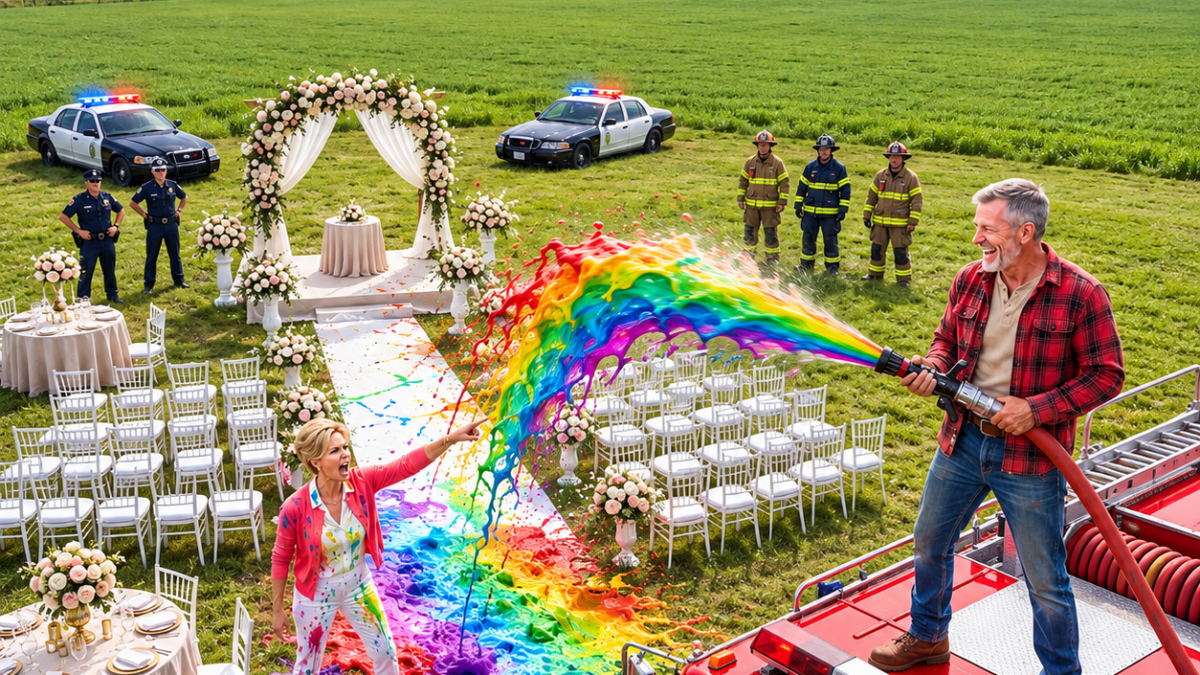
PART 2: HOA Karen Held a Wedding on My Farm Without Permission—Then My Scheduled 2,000-Gallon Manure Spread Began
My family had been farming Caldwell land since the nineteenth century.
I was not sentimental about every acre.
Farmers cannot afford that.
Land has jobs.
Some grows hay.
Some holds cattle.
Some drains badly.
Some grows weeds with ambitions.
Some exists mostly so a neighbor’s bull has somewhere inconvenient to stand after breaking through fence.
But the West Field was different.
Maggie and I bought it together in 1995.
It had belonged to another family.
Thirty-some acres of bluegrass ground along the western edge of our home place.
We could barely afford it.
Maggie was teaching second grade then.
I was running cattle and doing custom hay work for anybody who paid on time.
We used almost every dollar she had saved.
The first year, I apologized to her about once a month.
“We should have kept the money.”
She would look across the field.
“No.”
“You sure?”
“Yes.”
“Because our checking account looks like it has been shot.”
“We bought dirt.”
“Expensive dirt.”
“Our dirt.”
That settled it for her.
We paid the note off eight years later.
Maggie celebrated by buying those blue boots.
Bright rubber.
Ugly as homemade sin.
She wore them the first evening she walked the entire perimeter after we made the final payment.
Pearl followed.
I watched from the porch.
The sun dropped behind the sycamores.
Maggie came back forty minutes later.
“You coming tomorrow?”
“No.”
“Why?”
“I already own the field.”
She looked at me.
“Men are strange.”
“I know.”
Then she walked it nearly every evening for sixteen years.
Eventually I understood.
She was not checking fences.
She was not exercising.
She was belonging to something.
That is different.
Maggie taught children all day.
Second graders can extract every piece of patience from an adult before lunch.
She came home.
Changed clothes.
Put on the boots.
Walked.
By the time she returned, she was herself again.
Pearl aged beside her.
Black-and-white border collie.
Too smart for everyone except Maggie.
When Pearl died, Maggie buried her under an oak at the north edge of the field.
That winter, Maggie still walked.
Alone.
Then came the diagnosis.
Breast cancer.
Eighteen months from the first phone call to the morning I held her hand and knew before the nurse came in.
Forty-nine years old.
There is no fair version of that.
People try to find language.
Battle.
Journey.
Brave.
Peace.
Some of it helps.
Some does not.
Mostly I remember small things.
Her asking whether I had fed the barn cat while she was receiving chemotherapy.
Her getting irritated because people kept bringing lasagna.
The blue boots beside the mudroom door.
The first Sunday after the funeral, I put them on.
Two sizes too small.
Walked the West Field.
My toes hurt after ten minutes.
I kept going.
Everybody in Bourbon County seemed to know without me telling them.
Sheriff Earl Vans would sometimes drive past on Sunday evening.
Never stop.
Just slow enough to see me.
Pastor Calvin Hatfield started appearing near the church parking lot when I arrived late.
Hollis Mortonson, my attorney, somehow forgot to bill me for most of a year.
People cared quietly.
That was exactly what I needed.
Then the Meadows at Whitestone arrived across the road.
Developer Doug Howerin bought the old dairy farm in 2020.
Luxury houses went up fast.
Stone facades.
Three-car garages.
Decorative gates.
Landscaping that required more water than my cattle.
The subdivision was beautiful.
I had no complaint about that.
People are allowed to like nice houses.
The problem came when some residents wanted the appearance of rural Kentucky without the agriculture responsible for the rural part.
Cattle smell.
Hay equipment makes noise.
Dust exists.
Flies are democratically distributed.
Bridget Howerin became HOA president.
Doug’s wife.
She liked control.
Maybe too much.
Her first health complaint was manure odor.
Dismissed.
Then more complaints followed.
Cattle activity.
Well water.
Barn appearance.
Dust.
Farm traffic.
Each time, agencies checked.
Each time, the farm remained a farm.
I did not gloat.
Government inspectors were doing their jobs.
Bridget was allowed to complain.
I was allowed to keep farming.
That should have been the relationship.
Then March came.
She drove up in her white Range Rover.
Pink blazer.
Expensive shoes entirely wrong for gravel.
I was drinking coffee near the barn.
“Mr. Caldwell.”
“Mrs. Howerin.”
“I have a proposal.”
I already disliked the sentence.
She explained Madison’s wedding.
October.
Rustic.
Elegant.
Outdoor.
Two hundred guests.
West Field.
My gazebo.
View toward the ridge.
Five thousand dollars.
I said:
“No.”
She blinked.
Maybe she thought I was negotiating.
“Seven.”
“No.”
“Ten.”
“No.”
“What is your number?”
“I don’t have one.”
“Everyone has a number.”
“My answer is no.”
Her face changed.
Not much.
The polished smile remained.
But something underneath became rigid.
“Why?”
“The field is active agricultural ground.”
“We can work around that.”
“I have fall operations.”
“We can compensate.”
“And it was my wife’s field.”
That should have ended it.
For most people, it would have.
Instead she said:
“A field does not know who walked on it.”
I looked at her.
“No.”
“But I do.”
Silence.
Then she said:
“You’ll regret this.”
She left.
I called Hollis.
Not because I feared a wedding appearing overnight.
Because Bridget had spent years filing complaints.
People who build paper trails usually intend to drive something across them.
Hollis told me to document everything.
We did.
Bridget and a wedding planner began walking my fence line.
No permission.
Nothing dramatic enough to justify a confrontation.
Photographs.
Dates.
Times.
Then a tourism-office venue application appeared.
Denied because the applicant could not establish site authority.
That should have ended it again.
It didn’t.
September came.
I drove to Louisville for livestock business.
Had dinner with my daughter Eliza.
She was talking about a man named Andrew.
I tried not to make my father face.
Apparently failed.
“Daddy.”
“What?”
“You are interrogating me with your eyebrows.”
“I haven’t asked anything.”
“Your eyebrows have.”
“Do I like him?”
“You haven’t met him.”
“Then I remain undecided.”
She laughed.
I drove home Sunday evening.
Turned onto Caldwell Lane.
Saw trailers.
At first, I thought somebody had pulled over.
Then I saw tents.
Workers.
Generator.
Florist.
Dance-floor framing.
Maggie’s gazebo surrounded by people running electrical cable.
For several seconds, I simply sat in my truck.
Anger can make a man stupid.
Grief can make him worse.
Combine them and you better wait.
The foreman approached.
Friendly.
Young.
Had no idea.
“Sir, lane is closed for event setup.”
“Whose event?”
“Howerin wedding.”
“Where?”
He gestured.
“My field?”
He laughed uncertainly.
“Venue is permitted.”
Then showed me the paper.
My name.
Caldwell Family Farm.
County logo.
Approval stamp.
I did not argue with him.
He was a contractor.
He believed what he had been given.
I went home.
Called Hollis.
He came.
Photographed everything.
He looked at the permit.
Then looked at me.
“You didn’t sign this.”
“No.”
“Never authorized anybody?”
“No.”
“Never took money?”
“No.”
He nodded slowly.
“Then nobody touches their equipment.”
“I want it gone.”
“I know.”
“But?”
“But now we preserve evidence first.”
That was Hollis.
He had practiced rural property law longer than I had been farming.
He knew anger feels productive.
Documentation usually is.
The next morning we went to the HOA office.
Bridget sat behind a polished desk.
Flowers.
Marble.
Association logo.
Hollis served written notice.
No consent.
No lease.
No access.
Remove all wedding equipment.
Bridget barely read it.
She pushed a permit toward us.
“The county authorized the event.”
I said:
“That signature isn’t mine.”
“The county has it.”
“That doesn’t make it mine.”
“You may challenge it afterward.”
“After what?”
“The wedding.”
Hollis touched my arm before I answered.
Bridget smiled.
“You should have taken my offer.”
We left.
Outside, Hollis said:
“You did well.”
“I didn’t say anything.”
“Exactly.”
Then I asked the question that would later become the part everybody remembered.
“What about Saturday’s field work?”
He stopped.
“What field work?”
“Fall nutrient application.”
His eyebrows went up.
“It’s already scheduled?”
“Long before this.”
“Documented?”
“Yes.”
“Routine?”
“Yes.”
“Normal farm rate?”
“Yes.”
He stared toward the HOA office.
Then:
“We verify everything before you do anything.”
That was important.
This was never:
How can I destroy a wedding?
It was:
Do I have to cancel an ordinary, documented farm operation because somebody put an unauthorized wedding on my ground?
Those are not the same question.
Hollis checked.
Agricultural extension checked.
County officials checked.
We made sure the operation was ordinary.
Not increased.
Not altered for revenge.
Not aimed at people.
Not performed outside standard practice.
The schedule had existed before the wedding setup.
That distinction mattered legally.
It mattered morally more.
Meanwhile, Hollis challenged the event permit.
The county could not produce a legitimate application from me.
No authentic signature.
No normal payment trail.
Questions moved toward the employee whose stamp appeared on the document.
Then toward financial relationships around Doug Howerin’s development business.
I am deliberately not pretending I understood the whole investigation as it happened.
I didn’t.
I knew only what Hollis told me.
The permit was not validly authorized by me.
Investigators were looking at how it had been produced.
Bridget continued setup anyway.
That part astonished me.
By Wednesday, white tents covered the field.
Two hundred chairs.
Tables.
Dance floor.
Lighting.
Bar.
Flowers arriving.
Every evening I watched from my kitchen.
Maggie’s gazebo sat in the middle.
That was the part that hurt.
She had turned fifty there.
We decorated it with paper streamers.
Pearl stole half a hamburger.
Maggie laughed so hard she nearly fell off the bench.
Now strangers had wrapped white fabric around the posts.
I wanted to tear it down.
I didn’t.
Eliza called.
“Daddy, people are posting about the wedding venue.”
“I know.”
“Did you rent it?”
“No.”
Silence.
Then:
“What?”
I explained.
Forgery investigation.
Trespass notice.
Routine Saturday field work.
Eliza went quiet.
“What are you going to do?”
“The farm operation stays scheduled unless Hollis tells me otherwise.”
“You mean…”
“Yes.”
Another silence.
Then she laughed.
I had not heard that laugh since Maggie died.
“Daddy.”
“What?”
“Mama would have loved the part where you didn’t raise your voice.”
“She would have told me not to.”
“And then?”
“She would have made coffee.”
Eliza said:
“She would have loved the rest too.”
Maybe.
But before Saturday, I had something more important to do.
The bride.
Madison Howerin.
Twenty-four.
I had never spoken to her.
She had not filed complaints.
She had not walked my property.
She had not shown me a fake permit.
I refused to punish somebody because of who her mother was.
I got her number.
Called.
“Miss Howerin, my name is Wyatt Caldwell.”
Long pause.
“I know who you are.”
“I’d like to buy you coffee.”
Another pause.
“Why?”
“Because there are things about your wedding venue you need to know before Saturday.”
She agreed.
Friday morning.
Coffee shop in Paris.
Madison arrived early.
Yellow dress.
Hair braided.
Nervous.
She sat across from me.
“My mother said you approved everything.”
“I didn’t.”
She went pale.
“She said you rented it.”
“No.”
“She said she had been working with you for months.”
“No.”
Then Madison said something that hurt worse than the tents.
“She told me your wife and her had been friends.”
I looked at her.
“What name did she give you?”
Madison hesitated.
“Susan.”
Maggie’s name was Margaret.
Everybody called her Maggie.
Bridget did not even know that.
I opened the folder.
Trespass notice.
Permit challenge.
My affidavit.
Property records.
Madison read.
Then read again.
She started crying.
Quietly.
Not dramatic.
She looked like a young woman whose wedding had just become evidence in a fight she never knew existed.
“I’m sorry.”
“You didn’t do it.”
“I should have checked.”
“Why would you?”
“My mother said—”
“I know.”
She wiped her face.
“What happens tomorrow?”
“Your wedding should happen.”
She stared.
“Not there.”
“No.”
I gave her Ned Garrison’s number.
Ned had an old stone barn outside Versailles.
Beautiful place.
His family had used it for gatherings.
He knew Maggie.
When I told him the story, he said:
“The girl didn’t do anything?”
“Not that I know.”
“Then she can get married here.”
“What’s it cost?”
“Wyatt.”
“What?”
“Don’t insult me.”
So Madison had a venue.
By midmorning, she called Ned.
The caterer moved.
Flowers moved.
Minister moved.
Most guests were notified.
Her uncle agreed to walk her down the aisle.
Bridget still believed the West Field wedding was happening.
Madison asked me:
“Are you going to tell her?”
“No.”
“Why?”
“She has received written notice.”
Madison nodded.
“She won’t listen.”
“I know.”
Then:
“Mr. Caldwell?”
“Yes?”
“What happens to all that setup?”
“Whatever the contractors decide after authorities explain the situation.”
“And the field?”
“It goes back to being a field.”
She looked down.
“Is the farm operation really happening?”
“It was scheduled before your mother ever set up a chair.”
She gave a strange little laugh.
“I understand.”
I did not tell Madison to watch.
I did not invite her.
I did not want her Saturday morning memory to be humiliation.
Her memory should be getting married.
Friday night, Bridget drove to my house.
Late.
I was on the porch.
She carried a black briefcase.
That alone felt absurd enough to belong in a television show.
She opened it.
Cash.
A lot.
“I want to reach an accommodation.”
“There is no accommodation.”
“Cancel tomorrow.”
“No.”
“My daughter’s wedding is at stake.”
“Your daughter knows the truth.”
That stopped her.
“What?”
“She knows.”
Her face changed.
“You contacted Madison?”
“Yes.”
“How dare you?”
“She believed I rented you the field.”
“You had no right—”
“It’s my name on the permit.”
She stopped.
I told her the porch cameras were recording.
I told her our conversation would be preserved.
I told her to close the briefcase.
Then Bridget tried to say Maggie’s name.
She did not know it.
Not really.
I stood.
“You don’t say her name on my porch.”
Her face lost color.
“Wyatt—”
“Go home.”
She did.
That was the only time I raised my voice during the entire dispute.
Saturday came clear and cold.
I woke before dawn.
Made coffee in Maggie’s percolator.
Wore the flannel shirt she had given me.
I walked to the equipment barn.
The tractor was ready.
The manure tank held the amount scheduled for the normal field application.
I am not going to turn this story into a technical guide for spraying manure onto an event site.
The important facts are simple.
The application had been planned in advance.
It was standard farm work.
Agricultural officials had verified it was within ordinary practice.
Law enforcement knew what was happening.
My attorney was present.
The bride and actual wedding were somewhere else.
Nobody was supposed to be standing in the field.
That is the version I can live with.
Hollis arrived before sunrise.
Sixty-eight years old.
Climbed into the cab.
“You’re riding?”
“Yes.”
“You haven’t ridden a tractor in forty years.”
“I’ve ridden in worse things with worse clients.”
Sheriff Earl Vans arrived too.
Not to help me “get revenge.”
To keep people from turning a property dispute into a physical confrontation.
Two deputies remained nearby.
Investigators handling the permit matter were working separately.
The timing belonged to them, not me.
I drove toward the West Field.
The wedding setup looked surreal in morning light.
White chairs.
White tent.
Flowers.
Fancy bar.
Cake delivery area.
Workers.
Some guests had apparently not received the venue change yet.
Cars were beginning to appear.
I stopped outside.
The planner, Selene, came toward us.
“This area is closed.”
Hollis almost smiled.
I said:
“Ma’am, this is Caldwell Farm.”
She looked at the sheriff.
Then Hollis.
Then my field documentation.
By that point, she already knew the permit was under investigation.
Her lawyer had apparently advised her not to obstruct us.
She stepped away.
Workers began moving people back toward the roadside.
That is another detail I want clear.
I did not drive a tractor into a crowd.
The area was being cleared.
My goal was a field operation.
Not injuring anybody.
At the scheduled time, I entered.
The equipment began doing what farm equipment does.
The West Field stopped looking like a wedding venue very quickly.
The first reaction was smell.
Then panic among contractors trying to save whatever they could move without entering the active area.
Table linens.
Instrument cases.
Flowers.
Boxes.
A decorative cake that should never have been placed in a hayfield without the owner’s permission in the first place.
Bridget came running from one of the tents.
Silk robe.
Hair partly done.
She screamed:
“Stop him!”
Sheriff Vans stepped forward.
“Mrs. Howerin, stay back.”
“He’s destroying everything!”
“This is private agricultural property.”
“My daughter’s wedding—”
“Your daughter is not here.”
Bridget stopped.
“What?”
“Madison’s wedding has moved.”
For perhaps three seconds, Bridget could not process the sentence.
Then she looked across the field.
Empty bridal chairs.
Catering staff pulling away.
Planner retreating.
No Madison.
No groom.
No minister.
No ceremony.
The thing she had been fighting to control was already gone.
She sat down.
Not because of anything I said.
I said nothing.
The field work continued.
Methodically.
Slowly.
Exactly as documented.
That is less theatrical than the version people later told in bars.
Nobody needed to chase Bridget through manure.
Nobody needed to aim anything at her.
The farm work simply reclaimed the space.
Tents that should not have been there became unusable for a formal event.
The wedding equipment had to be removed and cleaned.
The West Field returned to its actual purpose.
Then investigators arrived regarding the permit case.
I am not going to repeat every dramatic criminal charge from the version people told afterward because real investigations do not work like television.
What mattered was this:
The event permit was not legitimately authorized by me.
The paperwork had been manipulated.
Investigators had found financial relationships that required serious review.
Bridget, Doug, and the county employee connected to the permit faced legal consequences through the normal process.
The planner cooperated once she learned she had been given false authority.
Nobody needed a cinematic federal takedown in the middle of a manure cloud.
The paperwork was enough.
Bridget was escorted away from the field.
Hollis stood beside my tractor afterward.
He looked across the West Field.
“Wyatt.”
“Yes?”
“I have practiced law a long time.”
“I know.”
“I have never had a morning quite like this.”
“Good?”
He considered.
“Memorable.”
That was enough.
At two that afternoon, Madison married Bryce at Ned Garrison’s stone barn.
I did not attend.
That was intentional.
Her wedding was hers.
Not mine.
Ned’s wife served fried chicken and sweet tea.
Wildflowers replaced the expensive arrangements that could not be moved in time.
String lights went up that morning.
Pastor Calvin officiated.
Madison’s uncle walked her down the aisle.
The groom reportedly had one stain on his tuxedo cuff from helping move things.
Madison laughed about it.
Good.
A wedding should have something imperfect.
Otherwise nobody remembers it correctly.
I sat on my porch until evening.
Then put on Maggie’s blue boots.
Walked the West Field.
Yes, it smelled.
Strongly.
It was a farm.
Grass would recover.
Nutrients would do what nutrients do.
What surprised me was how the field looked after the white tents had begun disappearing.
Normal.
Just normal.
I walked past the gazebo.
Touched the post.
Four years of grief had turned Maggie’s memory into something fragile in my mind.
I had treated that field almost like a museum.
Do not change it.
Do not disturb it.
Walk the same way.
Wear the boots.
Repeat the ritual.
Then strangers came and tried to use it without permission.
I thought I was defending Maggie.
Maybe I was.
But standing there that evening, I realized the field had never needed to be frozen.
Maggie loved it because it was alive.
Grass grew.
Hay got cut.
Cattle grazed sometimes.
Rain came.
Mud came.
Seasons changed.
She was the one who taught me land is supposed to be used.
That was when I cried.
First time in four years.
Not at the funeral.
Not at the hospital.
Not when Pearl died.
Not when I first wore the boots.
That evening.
I sat beside the gazebo.
Blue boots hurting.
Sun dropping.
And cried until I was tired.
Then went inside.
Cleanup took time.
Contractors removed the structures.
Insurance companies argued among themselves.
Lawyers handled reimbursement.
The HOA was forced to confront how its president had used association authority.
County officials reviewed the permitting failure.
The criminal cases moved slowly.
As they should.
Eventually there were pleas, fines, professional consequences, restitution, and restrictions tied to the falsified paperwork and improper payments.
The exact punishments mattered less to me than the public correction.
The permit was invalid.
I had never approved the wedding.
My property remained mine.
The HOA had no authority over Caldwell Farm.
The new Meadows board sent an apology.
Every member signed it.
Three people who had previously supported Bridget signed too.
That impressed me.
It is easier to oppose someone after they fall than admit you helped keep them standing.
The new president was Linda Petticoat.
Retired schoolteacher.
She called before coming over.
Already an improvement.
“Mr. Caldwell, may I visit?”
“Yes.”
“What day works?”
“Thursday.”
“What time?”
“Ten.”
Imagine.
Permission.
She arrived.
Stayed outside the gate until I opened it.
Another improvement.
She brought a fruit basket and letter.
“We’re sorry.”
“I appreciate that.”
“We also amended our association guidance.”
“About?”
“Adjoining farms.”
She looked embarrassed.
“It now states explicitly that Meadow Hills residents and board members have no authority over lawful agricultural operations on neighboring property.”
“That seems obvious.”
“It is.”
“Then why write it?”
“Because apparently obvious needed minutes.”
I liked Linda.
I gave the fruit basket to the church pantry.
Kept the letter.
Framed it in my office.
Not as a trophy.
As a reminder that institutions can correct themselves.
Madison sent a photograph.
Her and Bryce outside Ned’s barn.
She was smiling.
Really smiling.
On the back:
Mr. Caldwell,
Thank you for telling me the truth before I walked down the aisle believing a lie.
I hope someday I become the kind of person who deserves what you did for me.
Madison.
I put the photograph on the mantle next to Maggie.
Eliza saw it the following Sunday.
“She looks happy.”
“She was.”
“You should’ve gone.”
“No.”
“Why?”
“Wasn’t my wedding.”
“You moved it.”
“Ned moved it.”
“You saved it.”
“She saved it when she believed the evidence instead of her mother.”
Eliza looked at Maggie’s photograph.
“Mama would like her.”
“Yes.”
Then we walked the West Field together.
Eliza wore my work boots.
Maggie’s still belonged to me.
At the rise behind the gazebo, wind moved through dry grass.
For one second, I thought I heard Pearl bark.
Probably another dog.
Probably memory.
I did not mention it.
Neither did Eliza.
When we returned, she hugged me.
“Daddy?”
“Yes?”
“You did good.”
Maggie used to say that.
Not:
Good job.
Not:
I’m proud of you.
Just:
You did good.
I held onto Eliza longer than she expected.
She let me.
The following spring, Hollis came up with another idea.
Legal-defense fund for small farms.
“Absolutely not.”
“Why?”
“Because I already have a job.”
“You own cows.”
“Exactly.”
“We could help farmers facing the same kind of thing.”
“Hire somebody.”
“I am.”
“Who?”
“You.”
“No.”
He smiled.
“You sound like Maggie.”
“That is manipulation.”
“Yes.”
We started small.
Farm families facing nuisance complaints.
Bad development pressure.
Boundary disputes.
Questionable permits.
Cases where people simply needed a lawyer to tell a larger organization:
Stop.
Show the deed.
Show the easement.
Show the signature.
Show the actual authority.
We named the fund for Margaret Caldwell.
Maggie would have hated that.
Which is why Eliza insisted.
Our logo showed a woman in rubber boots walking across a field with a border collie.
Simple.
The first year, we helped several farms.
Then more.
Hollis recruited retired attorneys.
An extension specialist joined.
Local donors contributed.
I stayed mostly out of the office.
I was good at explaining one thing.
“Do not get creative.”
Farmers would stare.
“What does that mean?”
“It means being angry does not give you permission to make your position worse.”
Document.
Notify.
Use lawyers.
Use surveys.
Use normal farm practices normally.
Do not create traps.
Do not threaten.
Do not change an operation purely to harm somebody.
Do not put yourself in a position where a good property-rights case becomes a bad conduct case.
That advice came from experience.
People heard the story of my manure spread and thought the lesson was revenge.
It wasn’t.
The difference between what I did and a revenge stunt was everything surrounding it.
The work was scheduled before the wedding appeared.
The operation was routine.
The amount was ordinary.
Officials reviewed it.
The innocent bride was warned and relocated.
People were cleared from the field.
I did not modify equipment to target anybody.
I did not chase anyone.
I did not spray a crowd.
I did not use farming as a weapon.
I refused to surrender farming because somebody else had illegally converted a hayfield into a venue.
That distinction is why I can walk the West Field without regretting that morning.
Hollis calls that my “sermon.”
I call it the part internet versions leave out.
People love a simple story.
Entitled HOA woman steals field.
Farmer covers wedding in manure.
Justice.
Real life was less clean.
Madison was innocent.
Contractors were mostly innocent.
Some HOA homeowners had no idea.
Even the wedding planner began cooperating once she understood the permit was not what she had been told.
Punishing everybody would have been easy emotionally.
It would also have been wrong.
Bridget had made choices.
Doug had made choices.
The permit employee had made choices.
Responsibility belongs where evidence puts it.
Not where anger wants it.
The West Field came back beautifully.
The following spring, grass stood thicker than it had in years.
Sunny Albrittain, who had worked with me since the late 1990s, said:
“Best hay we’ve pulled off that ground.”
“Good year.”
“No.”
He pointed.
“Good nutrients.”
Hollis heard him.
“Maggie laughing.”
Sunny rolled his eyes.
I didn’t argue with either.
We cut twice that summer.
Sold part of the second cutting to Ned Garrison.
He tried to pay full price.
“No.”
“Wyatt.”
“You saved a wedding.”
“I loaned a barn.”
“You saved a wedding.”
“You sent me the bride.”
“We can argue all day.”
“We probably will.”
I discounted the hay.
Later bought him equipment he insisted he did not need.
Some debts are not about dollars.
Madison and Bryce moved away.
Cincinnati.
Jobs.
House.
Then a baby.
Two years after the wedding, they drove down.
Madison called first.
Another person who had learned to ask.
“Mr. Caldwell?”
“Yes.”
“We’ll be in Kentucky.”
“Good.”
“Could we visit?”
“Yes.”
“There is something I want to do.”
She arrived with Bryce and their infant son.
The baby slept in a carrier against Bryce’s chest.
We walked the West Field near sunset.
Madison stopped by the gazebo.
“Can I ask something?”
“Yes.”
“What was Maggie’s favorite flower?”
“Black-eyed Susans.”
Madison reached into a paper cup she had carried from the car.
Small plant.
She looked at me.
“May I?”
I nodded.
She planted it near the gazebo post.
Not in some dramatic memorial bed.
One flower.
I stood there.
Did not cry.
Came close.
She brushed dirt from her hands.
“I think about that Friday coffee sometimes.”
“So do I.”
“I was so angry at my mother.”
“I know.”
“For a long time.”
“That gets heavy.”
She nodded.
“We speak again.”
“Good.”
“Not the same.”
“Doesn’t have to be.”
Bryce looked toward the field.
“Hard to believe there was supposed to be a wedding here.”
“There was never supposed to be a wedding here.”
He smiled.
“Fair.”
The baby woke.
Started crying.
Maggie would have loved that.
She believed every sentimental moment should be interrupted by something requiring a diaper.
After they left, I walked once more.
Sun low.
Grass strong.
Black-eyed Susan tiny beside the gazebo.
I thought about ownership.
People misunderstand it.
Ownership is not:
I can do anything.
It is responsibility.
Taxes.
Maintenance.
Fence.
Drainage.
Knowing where boundaries sit.
Knowing when to say yes.
Knowing when to say no.
Knowing that no is still a complete answer even when the person asking has more money than you.
Bridget heard no and treated it like the beginning of negotiations.
Then the beginning of paperwork.
Then something to route around.
That was her mistake before any permit was forged.
She believed persistence created entitlement.
It doesn’t.
Five thousand dollars did not make the field hers.
A county-looking document did not make it hers.
Two hundred chairs did not make it hers.
Contractors did not make it hers.
An HOA title did not make it hers.
A wedding date did not make it hers.
My silence certainly did not make it hers.
I had learned that from Maggie too.
She was gentle.
Not weak.
Those are frequently confused.
Maggie once had a parent scream at her in the school hallway because their son received a poor reading assessment.
The parent talked for ten minutes.
Maggie listened.
Then said:
“I understand you are upset.”
Pause.
“The score is still the score.”
That was her.
Kindness without surrender.
I wish I had been better at it while she was alive.
I got better after.
The Meadows changed.
Complaints against farms dropped.
New residents received a disclosure explaining they were moving next to active agricultural land.
They were told there might be cattle sounds.
Farm machinery.
Seasonal odor.
Dust.
Early morning work.
Normal rural life.
Amazing what happens when expectations are honest.
Linda once asked whether I wanted to speak at an HOA meeting.
“No.”
“Why not?”
“I have cattle.”
“Evening meeting.”
“I have evening cattle.”
She laughed.
“Are those different?”
“Extremely.”
I never attended.
The relationship worked anyway.
Occasionally a Meadows resident bought hay.
One family boarded a horse with us.
Another volunteered with the legal-defense fund.
Somebody even repainted the Meadows entrance sign.
I resisted making a comment.
Personal growth.
Bridget eventually sent me a letter.
Not through lawyers.
Her handwriting.
I left it unopened for two weeks.
Then read.
She apologized.
Not perfectly.
People rarely do.
There were explanations.
Pressure.
Pride.
Fear her daughter’s wedding would fail.
Belief she could “fix” the permit later.
Bad advice.
Doug’s influence.
Then one honest sentence:
I became more concerned with winning than with whether I had the right to win.
I read that twice.
That was the real thing.
I did not write back immediately.
Eventually I sent three sentences.
I accept that you are sorry.
I hope you rebuild your relationship with Madison.
Do not come onto my farm without permission.
Hollis reviewed it.
“Warm.”
“Thank you.”
“Practically poetry.”
“Bill me.”
“I will.”
He didn’t.
He still forgets when emotion is involved.
The legal fund eventually became more organized than I ever wanted.
Board.
Accounting.
Actual office.
Newsletter.
Eliza helped with it.
Her husband Andrew—yes, the eyebrow interrogation failed—designed the website.
I tolerated him.
Which is father language for:
He is good to my daughter and I love him.
We added one rule to every initial farmer consultation.
Before strategy, we ask:
“What outcome do you actually want?”
People say:
Win.
We ask again.
Often the answer is:
Keep my land.
Stop the harassment.
Protect access.
Save the farm.
Get quiet.
Then strategy becomes clearer.
Revenge is not an outcome.
It is an emotion.
Temporary one.
Expensive if mistaken for a plan.
My outcome had been simple.
Get the wedding off Maggie’s field.
Keep my routine farm operation.
Correct the false permit.
Protect ownership.
Let Madison get married somewhere she actually had permission to be.
Everything else became consequence.
That is why the ending satisfied me.
Not because Bridget’s silk robe met farm odor.
Not because expensive decorations were ruined.
Those are funny details in other people’s retellings.
My ending was Sunday sunset.
Blue boots.
West Field.
No strangers.
Just grass.
The county eventually improved its permit system.
Owner verification became stricter for large temporary events on private land.
Digital confirmation.
Cross-checking.
Harder for one employee to move something through alone.
That was better than any headline.
Systems should become harder to misuse after somebody misuses them.
Otherwise consequence is only theater.
The Meadows did something similar.
Major board actions involving neighboring property required documented authority and independent review.
Again:
Obvious.
Again:
Apparently worth writing.
New President Linda visited once after the changes.
“We’ve become boring.”
“Congratulations.”
“You mean that?”
“Yes.”
“HOA people hate being called boring.”
“HOAs should aspire to boring.”
She considered.
“Budgets.”
“Boring.”
“Roof reserve.”
“Excellent.”
“Pool maintenance.”
“Beautiful.”
“Property-rights war with a fourth-generation farmer.”
“Bad.”
She laughed.
Boring is underrated.
Especially in property management.
Hollis retired officially.
Then continued working.
Lawyers apparently define retirement the way farmers do.
He came over one Sunday.
We walked the West Field.
He wore normal boots.
“Coward,” I said.
“What?”
“Maggie’s boots are available.”
“I prefer circulation.”
We reached the gazebo.
Black-eyed Susan had spread.
Not one flower anymore.
Several.
Hollis looked.
“Madison?”
“Yes.”
“Good girl.”
“Yes.”
Then:
“You ever wish you had just let them hold the wedding?”
“No.”
“Not once?”
“No.”
“Why?”
I stopped.
“Because Maggie mattered.”
“That’s not law.”
“I know.”
“And because consent mattered.”
“That is law.”
“Better?”
“Much.”
Then Hollis said:
“You know, if Bridget had asked you differently—”
“She did ask.”
“I mean if she had accepted no.”
“Then there’d be no story.”
“Exactly.”
A lot of disasters are simply someone refusing to accept the first honest answer.
No.
Not for sale.
Not available.
Not yours.
Stop.
People hear those words and think a clever enough document can turn them into yes.
Sometimes they can negotiate.
Sometimes circumstances change.
But nobody gets to forge consent.
That is the line.
One October morning years later, I saw a white wedding tent across the road.
Meadows clubhouse.
Different family.
Legitimate event.
Music.
Flowers.
Cars.
I stood by my fence drinking coffee.
A woman from the neighborhood waved.
I waved back.
That was all.
No resentment.
Their land.
Their permission.
Their wedding.
Beautiful.
At sunset, I put on Maggie’s boots.
Walked.
They still hurt.
Eliza keeps telling me to stop wearing them.
“You’re going to ruin your feet.”
“Probably.”
“Mama would think this is stupid.”
“Probably.”
“She would buy you boots that fit.”
“Yes.”
“So why?”
Because grief is not rational.
Because love leaves rituals.
Because those boots still have dried mud in the seams from when Maggie wore them.
Because some things are allowed to hurt.
I did not explain all that.
I said:
“They’re already broken in.”
Eliza said:
“For a smaller woman.”
“Details.”
The legal-defense fund logo still has the boots.
Young farmers sometimes ask who the woman is.
“Maggie.”
“What did she do?”
“Walked.”
They wait for more.
That is all.
She walked.
Loved children.
Loved land.
Loved Pearl.
Loved me despite evidence.
Sometimes legacy is not a grand achievement.
Sometimes it is the path someone took often enough that another person keeps walking after they are gone.
Bridget thought she was stealing a wedding venue.
What she actually stepped into was a memory she could not see.
That does not give memory greater legal rights than any other private field.
The deed would have been enough.
But it explains why I did not sell.
Money measures property badly when the owner is counting something else.
Five thousand.
Ten thousand.
Fifty thousand.
None mattered.
Maggie mattered.
I sometimes wonder whether I would have rented another field.
Maybe.
For the right family.
Right time.
If they asked.
If operations allowed.
If cattle were elsewhere.
I am not against weddings.
I am against strangers deciding where theirs happens.
Madison understood.
That is why I never blamed her.
She sent Christmas cards for years.
Baby pictures.
Then second child.
One year she wrote:
The black-eyed Susans blooming yet?
I mailed back a photograph.
Entire patch.
No note.
She understood.
Doug Howerin eventually disappeared from local development circles.
Bridget never held HOA office again.
The county employee involved in the permit lost his position.
Financial and legal consequences followed.
I do not keep track anymore.
At some point, watching punishment becomes another form of letting people occupy your land.
Not physical land.
Mental.
They had enough.
The West Field has hay.
That is better.
Sunny retired.
Tyler Albrittain, his nephew, works part time now.
He heard the story from his uncle.
First week, he asked:
“Is this the manure wedding field?”
“No.”
He looked confused.
“This is the West Field.”
“But—”
“The story happened here.”
“So yes.”
“No.”
He laughed.
“Okay, Mr. Caldwell.”
Important distinction.
A place should not be named forever by the worst thing somebody tried to do there.
Maggie walked that field for sixteen years.
Bridget occupied it less than a week.
Why would I give Bridget naming rights?
That would be ridiculous.
So it remains West Field.
Sometimes:
Maggie’s field.
Never:
Wedding field.
That may be the final victory.
Memory outlasting spectacle.
A few months ago, a young couple from the Meadows knocked on my door.
Actual knocking.
Permission already improving.
They wanted engagement pictures near the stone fence overlooking the field.
The woman said:
“We heard the sunset is beautiful.”
“It is.”
“Would you mind?”
I looked at their clean shoes.
“You’ll get mud on those.”
“We brought boots.”
Smart.
“Yes.”
They took photographs for an hour.
Paid nothing.
I did not ask.
Before leaving, the young man said:
“Thank you.”
That was worth more than Bridget’s first offer.
Not financially.
Obviously.
Farmers still understand money.
But humanly.
They asked.
I said yes.
Everybody left happy.
That is how property can create community instead of conflict.
Permission.
No complicated philosophy.
Hollis would insist that I mention writing.
If the arrangement matters, put it in writing.
Fine.
But first:
Ask.
The black-eyed Susans at the gazebo returned this year.
Bright yellow.
The grass is thick.
Cattle sometimes graze the edge after second cutting.
I still walk Sundays.
Less often in Maggie’s boots now.
Age has begun negotiating with sentiment.
Some evenings I carry them.
Eliza says that counts.
I disagree.
We compromise by not discussing it.
At the gazebo, I sometimes think about that Saturday morning.
Not the smell.
Not Bridget screaming.
Not the investigators.
Madison.
Sitting in a coffee shop.
Hands shaking around a vanilla latte.
She could have refused to believe me.
Could have called me a liar.
Could have sided with her mother automatically.
Instead, she read.
Asked questions.
Changed her wedding within twenty-four hours.
That took courage.
More than people give her credit for.
She lost the venue she thought she had.
Lost trust in her mother.
Moved two hundred people.
Changed flowers.
Changed plans.
Still got married.
Still laughed.
Still built a family.
That is strength.
Bridget tried to control everything so nothing would go wrong.
Everything went wrong because of control.
Madison accepted reality and adapted.
Her day survived.
There is probably a lesson there beyond property disputes.
I am a farmer.
I will let somebody smarter name it.
What I know is land.
Land teaches patience.
You cannot threaten October into becoming June.
You cannot file a complaint against rain.
You cannot argue hay into drying.
You can prepare.
Document.
Wait.
Act when conditions are right.
Bridget mistook patience for weakness.
People do that.
Quiet people often appear easy to push because they are not constantly proving resistance.
But farmers learn something from fences.
A fence does not need to shout.
It only needs to be where it belongs.
My boundary was always there.
The deed knew it.
The survey knew it.
The county eventually knew it.
Bridget simply decided her event was more important.
She was wrong.
Years later, when people ask what happened, they usually phrase it like this:
“Are you the farmer who sprayed two thousand gallons of manure on an HOA wedding?”
I say:
“No.”
They look disappointed.
“I’m the farmer whose routine field work went forward after an unauthorized wedding setup was placed on his property.”
“That’s not as funny.”
“No.”
“Is the manure part true?”
“Yes.”
Then they smile.
Humans like manure stories.
I cannot fix that.
But I can fix the meaning.
I did not win because I had a bigger tractor.
I won because the field was mine.
I had records.
I gave notice.
I had an attorney.
I let investigators investigate.
I warned the innocent bride.
I kept ordinary farm work ordinary.
I never needed to invent a right.
Bridget did.
That difference mattered.
The last time Madison visited, her son was old enough to walk.
He ran ahead toward the gazebo.
She shouted:
“Stay where Mr. Caldwell can see you.”
I said:
“He’s fine.”
She smiled.
“I know.”
Then:
“I’m teaching him to ask.”
Good.
At sunset, we all walked back.
Bryce carrying their daughter.
Madison holding the boy’s hand.
Me moving slower than I used to.
Near the fence, she looked toward the field.
“I finally understand why you said no.”
“I told you why.”
“I heard the words.”
“Different?”
“Yes.”
I nodded.
Age teaches that too.
Hearing is not always understanding.
The sun went down behind the same ridge.
The gazebo cast a long shadow.
Black-eyed Susans moved in the wind.
I thought of Maggie.
Blue boots.
Pearl.
Sixteen years of evenings.
The field will outlast me.
It outlasted her.
It will probably outlast Madison.
Her children.
Bridget.
Doug.
Hollis.
Everybody.
That used to make me sad.
Now it comforts me.
Ownership is temporary.
Stewardship is what we do with the temporary part.
Maggie left walking paths.
Madison left a flower.
I left some repaired fence and maybe a legal-defense fund that will help somebody keep their farm.
Bridget left a cautionary story.
Everybody leaves something.
The land keeps the useful parts longest.
I still have the fake permit.
Hollis wanted it for the fund’s office.
“No.”
“Why?”
“Mine.”
“Evidence has sentimental value now?”
“No.”
“Then why keep it?”
I looked at the framed original farm survey.
Then the fake permit.
“Contrast.”
He smiled.
“That is the first lawyerly answer you’ve ever given.”
The forged-looking document sits in a file now.
Not displayed.
The Meadows apology is framed.
Madison’s wedding photo is displayed.
Maggie’s photo is beside it.
Those are the things worth seeing.
One woman in blue boots.
One young bride who chose truth before walking down the aisle.
That is how I prefer the story arranged.
Not offender in the center.
People who did right in the center.
Maggie.
Madison.
Eliza.
Hollis.
Earl.
Ned.
The contractors who stopped when they learned the authorization was disputed.
The officials who corrected the permit system.
The new HOA board that apologized.
There were far more decent people in the story than bad ones.
You would never know it from the headline.
Headlines are like manure.
Strong smell.
Useful in limited amounts.
Hollis hates that joke.
I keep using it.
This October, I walked the West Field alone.
No blue boots.
My knees won the argument.
I carried them over one shoulder.
At the gazebo, I set them beside the black-eyed Susans.
Sunlight caught the cracked rubber.
For a moment, I could see Maggie the way she looked before cancer.
Hair tied back.
Pearl circling.
Hands in the pockets of her jacket.
She would have laughed at the entire wedding disaster.
Not the pain.
The absurdity.
Bridget Howerin believing two hundred white chairs could establish property rights.
That would have amused Maggie deeply.
Then she would have asked whether Madison was okay.
That was Maggie.
Always find the person who did not deserve the mess.
Make sure they are okay first.
I think we did that.
Madison got married.
The West Field stayed ours.
The farm kept farming.
The law eventually caught up to the paperwork.
The Meadows learned a boundary.
I finally cried.
Grass grew back.
Flowers grew beside the gazebo.
There are worse endings.
As the sun dropped, I picked up Maggie’s boots.
Walked home.
Halfway to the house, I turned.
The West Field was empty.
No tents.
No chairs.
No Range Rover.
No signs.
Nothing but grass moving under an October wind.
Exactly the way Maggie loved it.
And I realized the most satisfying part had never been the two thousand gallons.
It was the word Bridget refused to hear six months earlier.
No.
Not because I was richer.
Not because I knew the sheriff.
Not because my attorney had been practicing forever.
Not because the farm had been there longer than the HOA.
No mattered because the land was mine to say yes or no about.
That was all.
That had always been all.
The manure was just farming.