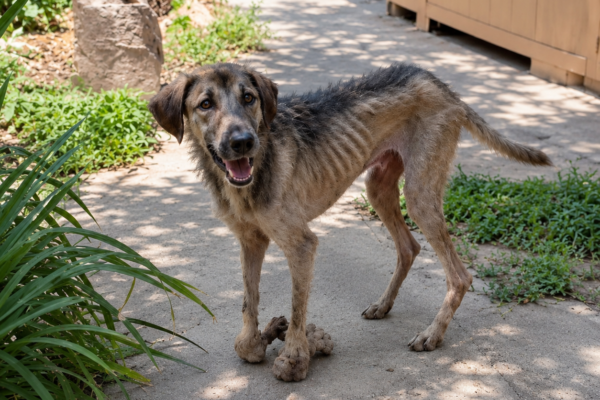
After a Lifetime in a Cage, Nizar Was Dragged Outside and Left Begging at His Owner’s Gate
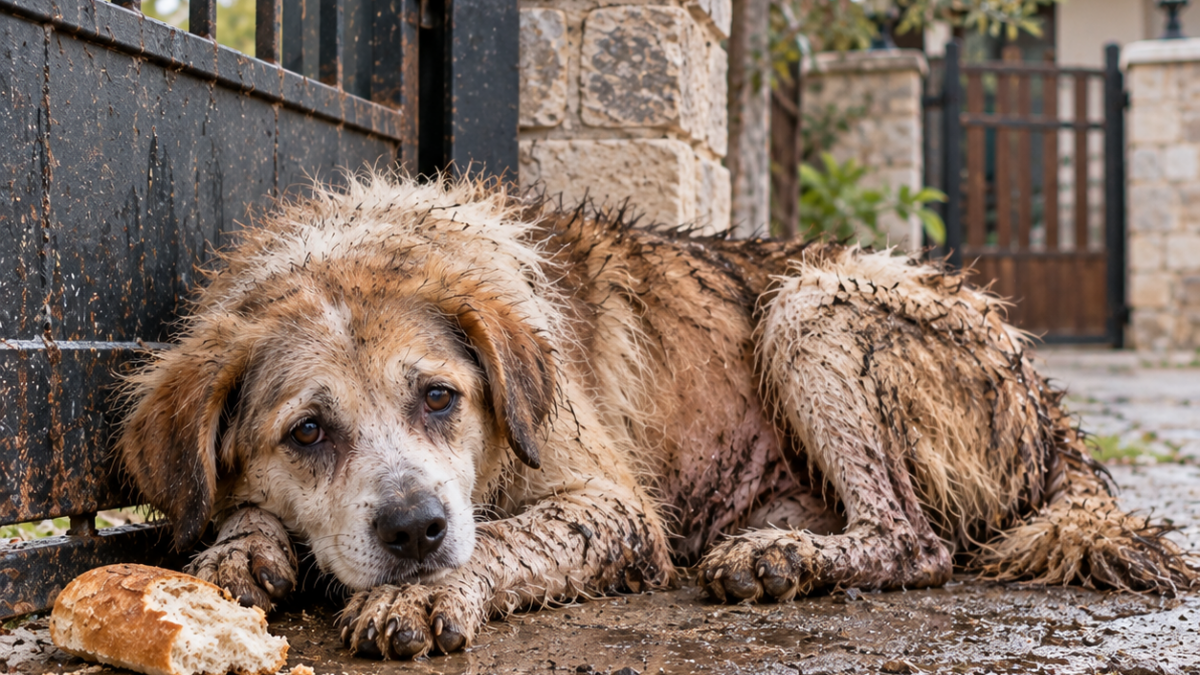
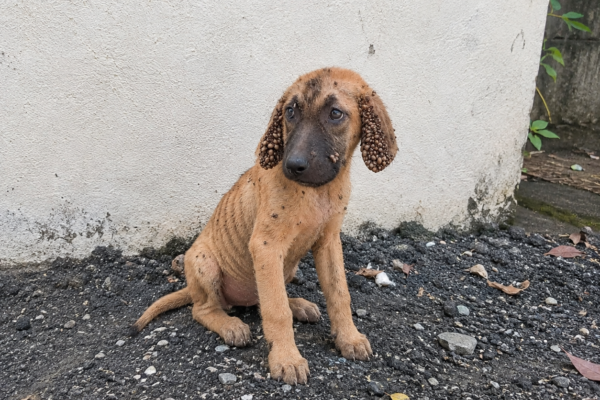
The image that stayed with me longest from that first day was not the mud.
It was not the ticks.
It was not even the frightening condition of his skin.
It was the way he kept looking toward the gate.
There was something painful in that waiting because the dog did not appear to understand the decision that had already been made for him.
His owner had dragged him outside.
He had been physically removed from the place he knew.
Yet he remained nearby, as though being left there could only be temporary.
Maybe the gate would open.
Maybe the familiar person would call him.
Maybe this strange moment would end and he would be allowed to return to the only life he understood.
I could not know exactly what he thought, and I did not want to place human words inside his mind.
But his behavior was clear.
He waited.
He did not leave.
Even while exhausted, he stayed close to the house.
That was why the sight of the bread beside him felt so sad.
Food should have mattered enormously to a dog in his condition.
He was malnourished.
His body needed calories.
Yet fear and confusion seemed to compete with hunger.
The bread sat there while he trembled near the gate.
I kept wondering how long a dog could spend waiting for someone who had already decided not to let him back inside.
The neighbor had been the one who refused to ignore him.
Without that call, I do not know how long he would have remained there.
He was not physically capable of traveling far.
He could barely support himself.
Even if he had wanted to leave, his body gave him very few options.
That made the abandonment even more difficult to accept.
An old, weak dog had not simply been allowed to walk away.
He had been dragged outside and left near the property in a condition where he could not properly stand.
He was dependent even in abandonment.
That contradiction stayed with me.
Someone no longer wanted the responsibility of caring for him, yet the dog had been left with no physical ability to create another life for himself.
He needed help simply to survive the next stage.
When we lifted him, his weakness was immediately obvious.
There is a difference between an animal who is tired and an animal whose body has lost the strength required for basic movement.
This dog was beyond ordinary fatigue.
His muscles felt diminished.
His limbs did not respond the way they should.
He seemed to have forgotten what it felt like to place weight confidently through all four legs.
At that point, though, we did not know why.
The first priority was not solving the mystery.
It was getting him stable.
The clinic gave us our first real look at how many problems his body was carrying at once.
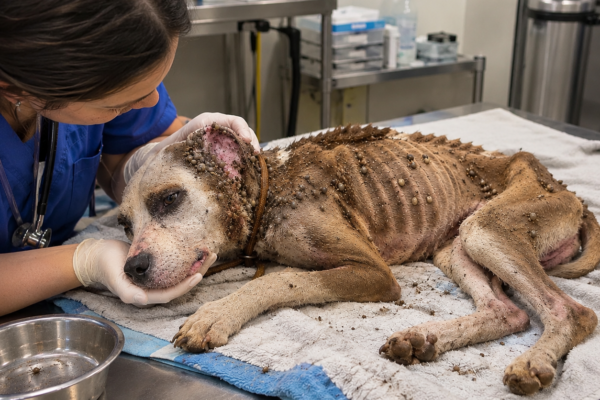
The odor reached us before some of the damage could be fully seen.
It filled the room.
That smell was not simply because he had been outside in mud.
His skin was unhealthy.
His coat trapped dirt.
Neglect had accumulated on him layer by layer.
When an animal is cared for regularly, many small problems never become large ones.
Ticks are noticed.
Skin changes are treated.
Weight loss raises concern.
Weakness leads to examination.
With him, nothing seemed to have been interrupted early.
Problems had been allowed to grow together until his entire body reflected them.
The bloodwork frightened us.
His blood count was poor.
Then the leishmaniasis test came back positive.
That diagnosis added another serious concern at a moment when we already felt overwhelmed by what we could see.
The doctors were honest.
They were not certain how much they could do for him yet.
Before anyone could think about rehabilitation or a future, they needed to help his body survive the present.
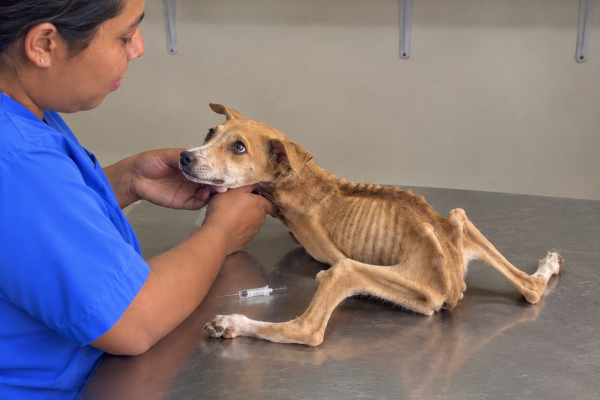
Fluids were started.
We watched his condition closely.
Every minute felt valuable.
There are cases where treatment begins with a clear plan and a reasonable expectation.
This did not feel like one of them.
He had arrived carrying too many signs of long-term neglect.
We did not know how deeply each problem had affected him.
We did not know how much strength remained.
All we could do was respond to the needs we could identify.
One of those needs was simple cleanliness.
The mud covering him had to come off.
Bathing an animal in such poor condition is not about appearance.
You need to see the skin.
You need to remove what may be worsening irritation.
You need to understand what is hidden beneath the coat.
As we washed him, the water changed.
Mud loosened.
Dirt ran away.
Then ticks began washing off too.
I remember watching them disappear with the dirty water and feeling a mixture of relief and anger.
Each tick was small.
Together, they were another burden his already weakened body had been carrying.
He did not have the strength to scratch or protect himself normally.
He simply endured.
The bath slowly revealed the animal underneath the neglect.
But what it revealed did not make us feel better.
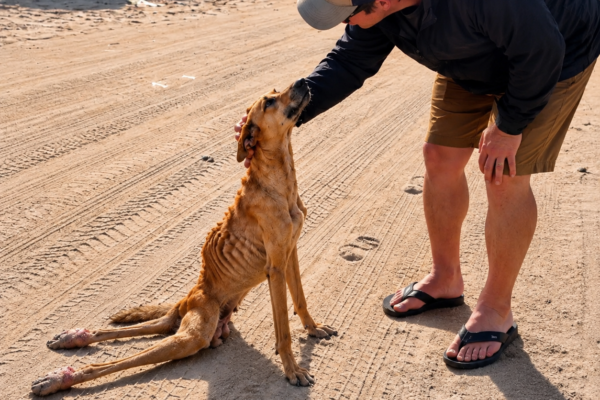
The dog was thin.
The skin was irritated.
The itching seemed relentless.
He scratched whenever he had enough energy.
We eventually shaved him because the coat was hiding the full extent of the problem.
When the fur came away, we were stunned.
It was one of those moments when you see something and instinctively wish you had misunderstood.
The areas of mange were severe enough that we immediately began treating them topically.
His skin must have been uncomfortable for a long time.
Itching can sound like a minor problem until you watch an animal unable to escape it.
There is no rest when the skin constantly demands attention.
He scratched.
Then rested.
Then scratched again.
Even sleep could be interrupted by discomfort.
And on top of all that, his body was undernourished.
The lack of sufficient food had weakened him from the inside.
Malnutrition does not only make an animal thin.
It changes how much strength is available for healing.
It affects muscle.
It affects energy.
It can turn simple movement into work.
At the clinic, every part of his condition seemed to connect with another.
Poor nutrition made recovery harder.
Disease placed additional strain on him.
Skin problems stole comfort.
Weak muscles prevented normal movement.
Fear affected the way he ate.
And the inability to stand left us with the most troubling question of all.
What had happened to his legs?
When the doctors first examined him, we considered the possibility of a serious injury.
An old dog who cannot stand might have suffered a fracture or another physical trauma.
Perhaps being dragged had caused something.
Perhaps something had happened earlier.
The X-rays were supposed to help us understand.
We waited.
When the images showed no broken bones, relief came with confusion.
There was no fracture explaining why he could not support himself.
The bones were not giving us the answer.
So we began looking at the rest of the picture.
Was he simply too exhausted?
Had disease weakened him this severely?
Was malnutrition responsible?
Was something neurological happening?
At that point, we did not have enough history to know.
The dog could not tell us how he had lived.
His owner had not volunteered a complete explanation.
All we had was the body in front of us.
Sometimes a body becomes a kind of record.
You read muscle loss.
You read skin.
You read weight.
You read the way an animal reacts to food or touch.
This dog’s body was telling us that the problem had not begun yesterday.
Nothing about him looked sudden.
His weakness had the appearance of something built over time.
The legs especially looked as though they had not been used properly for a long period.
That thought frightened me.
Muscles need work.
They need regular movement.
When movement disappears, muscle does too.
At first, we could only observe.
His front and back legs were weak, but the rear seemed especially uncertain.
He could not bring himself upright.
If we helped position him, his body could not maintain the stance.
His limbs trembled.
The effort seemed enormous.
He would sink back down.
Watching him, I kept thinking about the gate.
He had been lying there because he physically could not go anywhere else.
The owner had left an animal who did not possess even the strength required to walk away.
We focused on food.
His body needed fuel before rehabilitation could ask anything from him.
We offered meals more than once, carefully watching how he responded.
That was when I noticed the strange way he looked at me before eating.
It happened repeatedly.
Food would be placed in front of him.
He would look at the food.
Then he would look at me.
He seemed to wait.
I would give him a reassuring signal or simply remain calm.
Only after that did he dare to eat.
I cannot know what rule he believed he was following.
Maybe he had been punished around food.
Maybe he had simply learned that meals were controlled strictly.
Maybe his fear had nothing to do with food specifically and everything to do with uncertainty around people.
I did not know.
So I did not invent an explanation.
I only knew what I saw.
A hungry dog hesitating until he felt some kind of permission.
That behavior affected me almost as deeply as the physical injuries.
Hunger should create urgency.
His hunger was obvious.
Yet fear still made him cautious.
So we made meals gentle.
No sudden movement.
No pressure.
No taking food away.
We wanted him to learn that once a bowl was placed in front of him, it was his.
He did not have to earn each bite through obedience.
He did not need to watch us constantly.
He could eat.
That sounds like an incredibly basic lesson.
For him, it seemed necessary.
The first days were built from these small acts.
Fluids.
Food.
Rest.
Skin treatment.
Observation.
More food.
More rest.
A little interaction.
Then more waiting.
We hoped strength would return simply because his body was finally receiving what it needed.
Some improvement did appear.
The topical medication began working.
His skin gradually looked less angry.
The constant itching began to ease.
He ate well.
He rested.
There was an important difference in him after meals.
His eyes seemed less empty.
His breathing felt calmer when he slept.
Those changes gave us hope.
But the biggest problem remained.
He still could not stand.
That became harder to explain as other parts of him stabilized.
A dog who eats and rests should begin showing more energy.
He did.
But energy alone did not translate into standing.
The legs did not know how to do what we expected.
That was when we started moving beyond simple supportive care.
We reported his condition.
We hoped someone could provide information about his past.
The circumstances were serious enough that we needed to understand how a dog had reached such a state while living with an owner.
We also began rehabilitation.
Acupuncture was one part of the effort.
Massage was another.
Then there were exercises designed to stimulate and rebuild weakened muscles.
At the beginning, even small movements required help.
We supported his body.
We positioned his limbs.
We encouraged weight bearing for brief moments.
The goal was not dramatic.
We were not trying to make him walk across the room on the first day.
We were trying to remind muscles and joints what work felt like.
That alone was difficult.
When a dog has not used his legs normally for a long time, standing is no longer automatic.
The body may understand the movement in principle, but the muscles cannot provide enough support.
Balance becomes unreliable.
Weight shifts unpredictably.
One weak limb forces another to compensate.
Then the entire body collapses.
That was what we saw.
His muscles, especially in the legs, were severely atrophied.
There was simply not enough strength.
The front legs were weak but seemed to have more stability than the back.
The rear legs had an especially difficult time supporting him.
We massaged them.
We moved them gently through exercises.
We tried to stimulate circulation and muscle use.
Each session was modest.
His body had already been through enough.
Pushing too hard could create another problem.
So recovery had to begin almost painfully slowly.
I remember thinking that if he ever walked again, no one would understand how many small efforts had come before the first independent step.
People see a dog standing and think the moment happened suddenly.
They do not see the repeated attempts.
The hands holding the chest.
The adjustments of the paws.
The trembling legs.
The collapse.
The pause.
The second attempt.
That was the reality for him.
At that point, we still did not know whether all the work would be enough.
We asked ourselves the question quietly.
Did he actually have a chance to walk again?
Hope is complicated when the answer is uncertain.
You do not want to create false expectations.
At the same time, you cannot ask an animal to work through rehabilitation if everyone around him has already emotionally surrendered.
So we tried to hold a careful kind of hope.
His bones were not broken.
That mattered.
His body responded to touch.
That mattered.
He was eating.
That mattered.
The skin treatment was helping.
That mattered.
He was still alive despite leishmaniasis, poor blood values, malnutrition, mange, ticks, and extreme weakness.
That mattered.
Perhaps the legs were not permanently lost.
Perhaps they were simply unused.
If that was true, time and work could change something.
Then the missing history finally began to come together.
What we learned explained almost everything.
The dog had been kept in a cage.
Not temporarily.
Not for a short period while recovering from something.
He had spent most of his life confined there.
As he grew older and larger, the cage became more restrictive.
The space that might once have contained a younger dog became increasingly inadequate for his adult body.
He had less and less room.
The owner did not appear to care what that was doing to him.
The dog lived within those physical limits for years.
That truth changed the way we looked at every symptom.
The muscle atrophy was no longer mysterious.
Of course his muscles had wasted.
How could a body build normal strength without normal movement?
The malnutrition made more sense too.
We learned that he had not even been fed adequately.
The mange reflected the lack of care surrounding him.
The weakness, the poor physical condition, the inability to stand—all of it fit the life he had been forced to live.
I remember feeling shocked even though part of me had already suspected long confinement from his muscle loss.
Knowing it as fact was different.
Most dogs take movement for granted.
They stand.
Stretch.
Turn around.
Walk from one side of a room to another.
Go outside.
Change position when uncomfortable.
Shift into the sunlight.
Move into shade.
Even a dog living a quiet life uses muscles continuously through ordinary existence.
This dog had been denied those ordinary repetitions.
His world had been measured by the size of a cage.
As he aged, he did not receive more room.
The cage simply became tighter around the life inside it.
A growing body adapts to what it is allowed to do.
If movement is limited for long enough, weakness becomes normal.
The dog’s muscles had learned inactivity.
Then one day, after spending most of his life that way, he had been dragged outside and left near the home.
The cruelty of that sequence was difficult to process.
First, restrict an animal until his body loses the ability to move normally.
Then abandon him when age and weakness make him inconvenient.
That was the truth we eventually understood.
He had not become weak because he was simply old.
Age may have been part of his condition, but age was not the whole story.
His body had been deprived of the movement and nutrition required to remain strong.
The owner had watched him grow older inside the same confinement.
Then, rather than care for the consequences, the owner had dragged him outside.
That knowledge changed the meaning of the gate.
The dog had been waiting for the person responsible for much of his suffering to let him back inside the place where the suffering happened.
That is one of the most heartbreaking contradictions in neglected animals.
They do not evaluate owners through human ideas of justice.
Familiarity can still feel like belonging.
A person can fail an animal terribly and still be the person the animal waits for.
The dog at the gate did not know that a better life might exist somewhere else.
He only knew that the gate belonged to his known world.
So he waited for it to open.
Once we understood that, I felt both sadness and determination.
We could not rewrite most of his life.
We could not return the years spent in confinement.
We could not give his muscles the exercise they should have received all along.
But we could decide that his remaining life would not continue the same way.
The owner would have to face what had been done.
We had reported the case.
The evidence of neglect was visible in the dog’s body.
But I did not want the story to become only about punishment.
Our most urgent responsibility remained the dog.
He had spent enough time being shaped by the choices of someone who did not care properly for him.
Now every choice around him needed to focus on healing.
We began thinking of him not as a hopeless old dog but as a patient whose body had forgotten strength.
The distinction mattered.
Hopelessness makes people passive.
Rehabilitation requires patience.
We chose patience.
He was brave from the beginning.
That word can become exaggerated in rescue stories, but with him it felt accurate.
Being brave did not mean he never looked frightened.
He did.
He watched us carefully.
Sudden changes made him uncertain.
Even eating had required reassurance.
His body trembled during effort.
But he did not stop trying.
When the trainer positioned him, he cooperated.
When we supported his body upright, he attempted to hold the posture.
When the legs shook, he stayed engaged.
When he fell, he did not respond by refusing the next attempt.
That willingness became one of the most important things he had.
Muscle can be rebuilt only if the body keeps receiving a reason to use it.
He gave us that chance.
The early rehabilitation sessions were almost entirely about foundations.
We did not expect walking.
We wanted activation.
A paw placed correctly.
A leg accepting a little weight.
A joint moving through a controlled range.
The muscles needed stimulation.
The nervous system needed repetition.
His body had spent so long in confinement that even the idea of supporting itself seemed unfamiliar.
The trainer worked gently.
We helped.
Massage loosened stiffness and encouraged circulation.
Acupuncture was added as part of the effort.
Then exercises followed.
Each technique by itself looked modest.
Together, they created a daily structure around recovery.
Wake.
Eat.
Rest.
Treatment.
Exercise.
Rest again.
Another meal.
More gentle work.
The days became predictable.
That predictability seemed to calm him.
He no longer had to look toward a gate waiting for someone who would not come.
The people around him came reliably.
Food came reliably.
Hands touched him for care.
When he looked at us before eating, we reassured him.
Over time, the pause became smaller.
He still looked sometimes, but less desperately.
I began to hope that one day he would simply eat without checking.
The skin continued improving too.
The topical medicine worked.
Areas of mange slowly became less inflamed.
The itching reduced.
That mattered more to rehabilitation than it might seem.
A dog cannot focus on rebuilding strength if he is constantly distressed by his skin.
Comfort gave him more energy for other work.
The baths had removed the mud and ticks.
Medicine addressed what we could see underneath.
Food began addressing the emptiness inside.
Fluids had helped stabilize him.
Each problem we reduced gave the body more resources for the next.
Still, standing remained difficult.
Sometimes we supported him under the chest and abdomen.
His paws touched the ground.
For a moment, the front legs could hold.
The back legs trembled.
Then his weight shifted.
He sank.
We reset.
Tried again.
There was no frustration toward him.
How could there be?
He was being asked to perform something his body had been prevented from practicing for most of his life.
The remarkable thing was not that he fell.
The remarkable thing was that he tried again.
Every fall became part of the process.
I began noticing small changes before any true walking appeared.
The front legs stayed straight a little longer.
He pressed through the paws with more intention.
His shoulders seemed to engage.
The rear legs remained much weaker, but even there we sometimes saw a stronger response.
Muscle does not return in one dramatic wave.
It rebuilds fiber by fiber, effort by effort.
You can stare at the same leg every day and think nothing is changing.
Then suddenly you compare it with the first day and realize the shape is different.
That started happening with him.
The legs looked less empty.
The front limbs especially began showing a little more substance and stability.
That was encouraging because the front could become an anchor while the hindquarters caught up.
When he tried to stand, the front half of his body now contributed more.
He could raise his chest.
He could stay upright a little longer.
The hind legs still wobbled.
But the whole effort no longer looked impossible.
I remember one session when he managed to remain standing for a few moments longer than usual.
No one celebrated loudly.
We did not want to startle him.
But the look between us said everything.
We had seen progress.
He had not walked.
He had not even taken a proper step.
But he had stayed up.
For a dog who had arrived unable to stand at all, that mattered.
The trainer kept working.
Each session required judgment.
Push enough to stimulate improvement.
Stop before exhaustion became harmful.
The dog was still recovering from serious overall neglect.
Leishmaniasis remained part of his medical picture.
His blood values had been poor.
We could not pretend rehabilitation existed separately from the rest of his health.
Some days he had more energy.
Other days, less.
We adjusted.
This was not a race.
He had already spent most of his life losing strength slowly.
Rebuilding could not be rushed because our emotions wanted a faster result.
That was difficult for me.
Whenever I saw him fall, I wanted to help him up immediately.
Sometimes that was appropriate.
Other times, the trainer needed to give him a moment to attempt the movement himself.
There is a delicate balance between assistance and dependence.
If we did everything for him, the muscles would not learn.
If we gave too little support, he could become frightened or exhausted.
So we learned to help just enough.
His bravery emerged most clearly in those moments.
The dog would shift forward.
Place the front paws.
Try to bring the rear legs beneath him.
Tremble.
Lose balance.
Fall.
Then, with encouragement and support, rise again.
Over and over.
It was exhausting to watch because I knew how much effort he was making.
His body seemed to pour everything into a movement most dogs perform without thinking.
At times, his eyes watered.
We were emotional too.
The source of those tears could not be reduced to one human interpretation, but the struggle was undeniable.
There was effort.
There was fatigue.
And there was persistence.
We came to think of every attempt as another step toward a line we could finally see in the distance.
Not victory yet.
But the possibility of victory.
His front legs developed faster.
That made sense from what we observed.
They had been used more even when he could not stand normally, perhaps to shift himself or support the upper body inside confinement.
The rear legs were slower.
Their muscles had atrophied severely.
When he tried to stand, the front end often looked ready before the back.
That mismatch created many falls.
He would raise himself, the front legs steady enough to hold for a moment, then the hindquarters would fail.
Down he went.
At first, every fall frightened me.
Then I learned that falling itself was not failure.
It was information.
The body had reached its current limit.
We would rest.
Then try again.
That idea changed how I saw rehabilitation.
Progress is not the absence of falling.
Progress is what happens between falls.
A little more control.
A better foot position.
A stronger attempt.
A faster recovery.
He showed us all of those things.
The trainer became one of the most important people in his new routine.
The dog seemed to understand the rhythm of the sessions.
He did not know the goal the way we did.
He could not imagine himself walking independently in the future.
But he responded to encouragement.
He responded to touch.
He learned what positions we were asking for.
His body began anticipating certain movements.
That gave us hope because learning was happening alongside muscle growth.
The cage had taught his body one way of existing.
Rehabilitation was teaching another.
Stand.
Balance.
Shift.
Step.
Rest.
Repeat.
These are simple verbs until you have to teach them to a body that has forgotten how.
We also continued feeding him generously enough to support recovery.
His appetite was one of the encouraging signs.
He ate and rested well.
Those two things became the foundation beneath every exercise.
Without nutrition, muscle cannot rebuild.
Without rest, training cannot become strength.
So meals were not separate from rehabilitation.
They were part of it.
I loved watching the change in the way he approached food.
At the beginning, he would look at me before eating.
He seemed uncertain.
Later, he began eating with more confidence.
The hesitation did not disappear instantly, but trust slowly replaced some of it.
That change felt emotional because it suggested he was learning that food here did not come with a condition he needed to guess.
The bowl belonged to him.
He did not need to beg at a gate for scraps.
He did not need to wonder whether he had permission.
He could simply eat.
That ordinary certainty was new.
While his body improved, I kept thinking about the old cage.
We now knew it had contained him for most of his life.
I imagined what that meant not as a dramatic scene but as repetition.
The same limited movement every day.
The same small space.
The same inability to walk normally.
Years of muscles receiving almost no challenge.
Years of joints operating within restricted ranges.
Years of a dog aging without experiencing the ordinary physical life of a dog.
That repetition was what had caused the damage.
Not one single terrible afternoon.
An entire pattern.
Neglect can be quiet like that.
No dramatic event appears necessary.
You simply fail an animal every day.
Fail to provide space.
Fail to provide enough food.
Fail to treat disease.
Fail to notice skin problems.
Fail to allow movement.
Each individual failure may seem smaller than obvious violence.
Together, they can destroy a body.
That was what we were trying to reverse.
And just as neglect had accumulated slowly, care needed to accumulate slowly too.
One meal would not repair malnutrition.
One massage would not rebuild muscle.
One rehabilitation session would not restore walking.
One bath would not erase years of poor skin care.
One reassuring touch would not erase fear.
We had to repeat the opposite of everything he had known.
Feed him again.
Treat him again.
Help him stand again.
Encourage him again.
Let him rest again.
Then return the next day.
Consistency became our answer to a life built on deprivation.
That was why I began believing we might actually change his future.
Not because of one miracle.
Because we were willing to keep doing ordinary things long enough.
The first major improvement came gradually enough that it almost surprised us.
His front legs became more reliable.
When we lifted him into position, they no longer collapsed immediately.
He could hold his upper body.
The rear legs remained unstable, but now there was something for them to work against.
The trainer encouraged small weight shifts.
Left.
Right.
Forward.
Back.
Those movements forced different muscle groups to engage.
At first, even a slight shift could send him down.
Then he began correcting.
A paw moved.
The body adjusted.
Balance returned for another second.
These were the moments that made us believe walking might not be impossible.
We still refused to promise it.
The dog had too many unknowns.
But possibility was becoming visible.
I remembered the question I had asked mentally when the X-rays showed no fractures.
If the bones were intact, what was preventing him from standing?
Now we had the answer.
His legs had not been destroyed by a single break.
They had been weakened by a life without movement.
The muscles had wasted from confinement.
That was devastating because it revealed how preventable the condition had been.
But it was also the one part of the truth that offered hope.
Muscles can sometimes be rebuilt.
Not instantly.
Not completely in every case.
But through use, nutrition, and persistence, they can become stronger.
That gave us something to work toward.
The owner’s neglect had taken strength away slowly.
We would try to return it slowly.
One day, he managed to support himself long enough that the trainer loosened assistance slightly.
Not completely.
Just enough to see what he could do.
His front legs held.
The rear shook.
His whole body trembled.
He remained upright.
Then he fell.
I felt the familiar ache in my chest.
But before I could turn the fall into disappointment, the trainer repositioned him.
Another attempt.
Again, he rose.
That was Nizar.
By then, the name had become attached to the dog in front of us, not the suffering behind him.
Nizar was not simply the dog left at a gate.
He was the dog who kept standing back up.
That became the way I thought about him.
Every fall revealed weakness.
Every new attempt revealed character.
I know dogs do not frame perseverance in philosophical terms.
Nizar did not tell himself inspirational sentences.
He responded to the people around him and to the immediate challenge.
But from my human perspective, the pattern was impossible to miss.
He kept trying.
The body failed.
He tried again.
The hind legs slipped.
He tried again.
The front legs shook.
He tried again.
Sometimes we needed to give him a longer break.
Sometimes fatigue won for the day.
That was not defeat.
Rest was part of the work.
Then the next session came.
Nizar would participate again.
I began seeing more life in his face too.
The dog we had found looked defeated by physical exhaustion.
As the fluids, food, skin treatment, and rehabilitation helped, his expression changed.
He remained gentle.
He still watched people closely.
But there was more attention in his eyes.
More interest.
He was not simply enduring the environment.
He was beginning to participate in it.
That mattered emotionally.
Recovery is not only what the legs do.
It is how an animal begins responding to the world around him.
Nizar started responding.
He noticed food sooner.
He relaxed during rest.
He tolerated treatment.
He worked with the trainer.
These were all signs that he had enough energy to be present.
His skin improvement helped too.
The topical treatment had done its job.
The terrible itching reduced.
Areas affected by mange began healing.
Without constant skin discomfort, he could lie down more peacefully.
The odor that had filled the clinic on the first day was no longer the thing that defined being near him.
Mud was gone.
Ticks were gone.
Underneath all of that was simply an old dog whose body needed time.
I found myself touching him differently as the days passed.
At first, every touch had a medical purpose.
Check.
Clean.
Position.
Treat.
Support.
Later, touch could also be affection.
A hand resting on him without asking anything.
A gentle stroke when he was tired.
That change felt important.
He had spent most of his life confined by human decisions.
I wanted him to experience human contact that did not control or demand.
Sometimes he would simply lie there and let us stay near.
Those quiet moments probably did not contribute directly to muscle growth.
But they contributed to the life we were trying to build.
A dog is more than a rehabilitation project.
Nizar deserved comfort even if he never walked.
That was something I had to remind myself.
We wanted walking so badly that it could have become the only measure of success.
But even before that happened, his life had already improved.
He was clean.
Fed.
Treated.
No longer covered in ticks.
No longer lying beside a closed gate.
No longer depending on an owner who had discarded him.
He had people around him every day.
Those things mattered regardless of the final physical outcome.
Keeping that perspective protected us from turning rehabilitation into pressure.
Nizar did not owe us a miracle.
We owed him care.
If walking came, it would be something we celebrated.
If it did not, we would still continue caring for him.
Perhaps because that pressure was absent, the work remained gentle.
We could celebrate tiny victories.
A stronger front leg.
A rear paw bearing weight for a second.
A slightly longer stand.
A more controlled fall.
Yes, even falling could improve.
At first, he simply collapsed.
Later, he sometimes lowered himself with a little more control.
That meant muscles were participating.
The body was no longer completely passive.
I learned to recognize progress in places I had never considered before.
Rehabilitation teaches you patience by changing what you consider important.
Before Nizar, I might have thought a step was the smallest meaningful unit of walking.
With him, I learned that before a step comes standing.
Before standing comes weight bearing.
Before weight bearing comes muscle activation.
Before that comes nutrition, stabilization, and enough trust to participate.
The visible miracle is built on invisible preparation.
Nizar’s first independent movement would eventually carry all of those earlier moments inside it.
We kept working.
Days accumulated.
His legs began showing more muscle.
The shape around the thighs changed slightly.
The front legs became noticeably stronger.
When supported, he stood more squarely.
The hind legs still lagged behind, but even they responded.
The trainer could feel more resistance.
Nizar could push.
A dog who once seemed almost boneless in weakness was beginning to push back against gravity.
That felt extraordinary.
Gravity had been winning for so long.
Now he could challenge it.
Sometimes he stood for several seconds.
Sometimes longer.
Then came attempts to move.
The first were barely steps.
A front paw shifted.
The other followed.
The rear legs tried to catch up.
Balance disappeared.
Down he went.
Again.
Again.
Every session contained repetitions that would look almost identical to someone outside the room.
To us, they were different.
One attempt had better alignment.
Another had stronger rear engagement.
Another lasted longer.
Another required less lifting.
Progress hid in details.
Nizar did not know any of this.
He only knew that we kept asking him to try.
And he did.
I often thought about the years in the cage during those sessions.
The injustice became sharper the stronger he grew.
His body was showing us what had always been possible if he had been allowed to move.
The weakness had never been inevitable.
It was created.
That realization made me angry.
But anger had nowhere useful to go during rehabilitation.
So I redirected it into patience.
If years of neglect had created the problem, then every extra minute of care was a small answer to those years.
Massage longer.
Prepare another meal.
Support another stand.
Repeat another exercise.
That was something we could control.
The owner’s future consequences were not ours to invent.
We had reported what happened.
The facts would have to speak.
Nizar’s body itself was evidence enough of serious neglect.
For us, the meaningful consequence was that the dog would not return to that life.
The gate he had waited beside was no longer the center of his world.
He had another place now.
The shift was emotional even before he could walk.
At first, he watched doors carefully.
He seemed attentive to whether people were leaving or returning.
Over time, routine made that less urgent.
People came back.
Meals arrived.
Training happened.
Rest happened.
Nothing disappeared simply because a door closed.
That kind of predictability can be healing for an animal who has been abandoned.
Again, I could not know exactly how he understood it.
I only saw that his behavior became calmer.
The dog who had trembled beside bread began eating more naturally.
The dog who had waited outside a gate began looking at the people in front of him instead of only toward somewhere else.
That change felt like the beginning of belonging.
Then we reached the point when standing became less exceptional.
It was still difficult.
His body still trembled.
But it happened often enough that we could begin asking for controlled forward movement.
The front legs led.
They were stronger.
The rear followed awkwardly.
Sometimes one hind paw failed to place correctly.
Sometimes the hips shifted.
Sometimes he lost balance immediately.
We supported him.
The trainer adjusted.
Then he tried again.
There was sweat in the room—not in the literal human way from the dog, but in the effort surrounding every session.
We were working.
He was working.
Everyone involved was physically and emotionally invested.
And there were tears too.
Ours, mostly, because watching an animal fight for a movement most creatures take for granted can make the smallest success overwhelming.
The source described his tears as well, and I remember his eyes watering during some of the difficult moments.
I could not say what emotion caused it.
But I could say the effort was real.
We felt close to something.
Not there yet.
Close.
The line of victory, as I thought of it, no longer felt imaginary.
Two weeks became an important point in the process.
By then, his hind legs had improved noticeably.
The difference was not subtle anymore.
Before, we had to lift and support him extensively.
After those two weeks of focused work, he no longer needed us to raise him in the same way every time.
He could contribute much more of the movement himself.
The rear feet responded.
The legs supported more weight.
His body still trembled.
He still moved slowly.
But slow movement was still movement.
I remember watching him take those careful steps and thinking he looked like a child learning to walk.
Not because he had become childlike, but because every part of the process had the same concentration and uncertainty.
Place one foot.
Find balance.
Move another.
Pause.
Tremble.
Continue.
There was no elegance yet.
There did not need to be.
The goal was not beauty.
The goal was independence.
Nizar was moving toward it.
The first time he crossed a short distance without being lifted, everyone around him seemed to become silent.
We did not want to disturb him.
The front paws moved first.
The hind legs followed.
His body shook.
He looked fragile.
But he stayed upright.
One step.
Then another.
The distance itself was small.
Emotionally, it felt enormous.
This was the dog who had been found unable to stand.
The dog whose X-rays showed no fractures and left us asking what had happened.
The dog whose legs had wasted because most of his life had been spent inside a cage.
The dog who had been dragged outside by the owner and left waiting.
Now he was walking.
Slowly.
Imperfectly.
But under his own power.
I felt tears come before I could stop them.
There are moments when you understand that a body remembers effort.
Every massage.
Every exercise.
Every meal.
Every supported stand.
Every fall.
Every attempt to rise again.
They had accumulated into these steps.
That was the miracle.
Not magic.
Accumulation.
His difficulties had made the process long, but they had also revealed how much determination he possessed.
Each time he fell, he had learned something.
Each time he stood, the muscles had worked a little more.
Each day of adequate food had given those muscles material to rebuild.
Each rest period had allowed recovery.
Each treatment had removed another obstacle.
Nothing had been wasted.
Even the failed attempts were part of the successful one.
Nizar walked farther as the days continued.
We never rushed him simply because he had demonstrated the ability once.
A first success can be fragile.
The muscles still fatigued easily.
Balance could disappear when he became tired.
So we kept the same patient structure.
Short attempts.
Rest.
Food.
Massage.
Rehabilitation.
Acupuncture when appropriate.
More rest.
The difference now was psychological for us.
We had seen him walk.
The question had changed from “Is it possible?” to “How much stronger can he become?”
That is a wonderful question to earn.
The early days had been filled with uncertainty about survival.
Then uncertainty about standing.
Now we were thinking about improvement.
Every stage opened the next.
Nizar seemed to sense our excitement, even if he could not understand its reason.
When he completed a movement and looked at us, we praised him gently.
His tail sometimes responded.
Those small moments built a new relationship between effort and reward.
The cage had offered no reason to move.
Movement there could not take him anywhere.
Now movement brought him closer to people, food, open space, and encouragement.
That gave walking meaning.
I often wondered what it must feel like physically for an old dog to discover strength he had not used in years.
Muscles can burn with effort.
Joints can feel unfamiliar.
Balance can be disorienting.
Nizar could not describe any of it.
But his trembling showed us that movement was hard.
His willingness to repeat it showed us that hard did not mean impossible.
That distinction became the center of his recovery.
Hard.
Not impossible.
The trainers treated him as capable without pretending he was strong before he was.
That balance helped him.
We never laughed at awkward steps.
We never treated falls as failures.
We simply reset.
Again.
That word became part of our life.
Again.
Stand again.
Try again.
Place the paw again.
Shift weight again.
Rest.
Then again.
Maybe resilience is simply the willingness to tolerate that word.
Nizar did.
Over time, the front and back of his body began working more like one unit.
The front legs no longer raced ahead while the rear collapsed.
The hindquarters started following the rhythm.
His steps remained slow, but the motion looked more coordinated.
That was when I began to see the dog he might have been if confinement had not stolen so much physical development from him.
Not a different dog.
The same Nizar, finally allowed to use himself.
That thought was bittersweet.
We could never know how he would have moved if he had spent his life outside the cage.
There was no value in imagining a perfect alternate history for too long.
The dog in front of us was real.
He was improving.
That was enough.
We focused on him.
His old age no longer felt like a reason to give up.
If anything, it made every new skill more meaningful.
He had spent most of his life without freedom of movement.
Now, late in that life, he was learning what his legs could do.
There is no rule saying change only matters when it comes early.
Late freedom is still freedom.
Late care is still care.
Late strength is still strength.
Nizar proved that.
The more he walked, the more his personality emerged beyond illness.
When we first met him, every detail was swallowed by suffering.
Mud.
Smell.
Ticks.
Weakness.
Fear.
Leishmaniasis.
Bad blood values.
Mange.
Malnutrition.
Inability to stand.
Those facts were so overwhelming that there was little space to see who the dog was.
Recovery created that space.
He was gentle.
Observant.
Cautious around food.
Responsive to encouragement.
Persistent.
Those traits became clearer as his physical suffering reduced.
That is one reason rescue matters even when an animal is old.
You are not only treating a body.
You are creating enough comfort for personality to reappear.
Nizar had been hidden under neglect.
We were meeting him slowly.
He began enjoying attention more openly.
Massage, once purely therapeutic, could also be relaxing.
Food became something he approached with less fear.
Standing became part of daily life instead of an impossible task.
The world expanded.
I thought about the cage again.
For most of his life, physical distance had meant almost nothing.
A few inches one way.
A few inches another.
Now every step created new distance.
One meter could be an adventure.
A short path could represent more space than he had ever controlled for himself.
That gave walking an emotional meaning beyond rehabilitation.
It was freedom translated into movement.
When Nizar took a step, he was doing something the old cage had prevented.
When he took another, he extended his world.
There was no need to create a dramatic destination.
The act itself mattered.
I remember watching him cross an area slowly and thinking about the owner dragging him outside.
That day, his body had been moved by someone else’s force.
Now he moved himself.
The contrast could not have been clearer.
Dragged before.
Walking now.
Dependent before.
Increasingly independent now.
Waiting at a gate before.
Moving toward a future now.
That was the transformation.
We did not need to embellish it.
The truth already carried everything.
The medical problems did not vanish from our awareness.
Leishmaniasis remained something requiring appropriate care.
His blood values had needed attention.
The skin had needed treatment.
We continued monitoring him.
Walking did not mean every diagnosis disappeared.
That is an important distinction.
A dramatic milestone can make people forget that recovery is broader than one ability.
Nizar was still an older dog who had endured long neglect.
He needed ongoing care.
But walking changed what that care could include.
More movement could help maintain muscle.
More independence could improve comfort.
He could change positions more easily.
He could approach food.
He could follow people.
He could participate.
Function creates options.
Nizar was gaining options.
That is what we wanted most.
The trainers kept building on the progress.
A little farther.
A little more controlled.
More emphasis on the weaker rear legs.
The front legs already showed good improvement.
The hind legs needed time.
We did not compare them unfairly.
Each part of the body had a different starting point.
The rear muscles had been especially atrophied.
So we gave them the repetition they needed.
Nizar continued cooperating.
Sometimes he fell.
Even after he learned to walk independently, falls did not disappear instantly.
That would have been unrealistic.
His balance remained developing.
His muscles tired.
But the meaning of falling had changed.
Before, a fall ended movement because he could not rise.
Later, he could gather himself and try again.
That difference felt huge.
A body that can recover from imbalance possesses a new kind of independence.
We watched him discover it.
Every time he got back up, the old image at the gate faded slightly in my mind.
Not erased.
Never erased.
But joined by something stronger.
Nizar standing.
Nizar stepping.
Nizar continuing.
The neighbor who had called us had seen him at his lowest.
I often thought about how different the story would have been if no one had made that call.
Neglect can become invisible when people assume it is not their place to interfere.
A dog lies near a house.
Maybe someone thinks the owner will come.
Maybe someone believes the animal simply prefers being outside.
Maybe everyone waits for someone else to act.
In this case, the neighbor did not.
That decision gave Nizar access to an entirely different outcome.
The neighbor could not rebuild his muscles personally.
Could not diagnose leishmaniasis.
Could not perform rehabilitation.
But the neighbor could notice and call.
Sometimes rescue depends on one person doing exactly the part available to them.
That was enough to start everything.
From there, many hands became involved.
Veterinarians stabilized him.
Someone bathed him.
Ticks were removed.
Medicine was applied.
Fluids were given.
Food was offered.
Trainers worked his legs.
Massage was performed.
Acupuncture was used.
Rehabilitation continued.
No single person created the entire result.
Nizar’s recovery was a chain.
And Nizar himself was the center of it.
If he had stopped responding, the outcome could have been different.
But he kept participating.
That was why I called him brave.
Not because bravery meant smiling through pain.
Because he repeatedly engaged with a process that was difficult and unfamiliar.
He had lived most of his life without being asked to use his body normally.
Then suddenly people were encouraging him to stand, balance, and walk.
He could have shut down.
Instead, he tried.
I admired that deeply.
Sometimes I thought about how little expectation he seemed to have when we first offered kindness.
The hesitant eating suggested that even food came with uncertainty.
The gate waiting suggested that abandonment had confused him more than angered him.
There was no dramatic resistance.
He did not appear to expect rescue.
That made the change in him even more moving.
As routine became safe, his expectations changed.
A hand approaching might mean massage.
A bowl might mean a meal that belonged to him.
A trainer might mean difficult work followed by praise and rest.
A doorway might lead to another part of his day, not to abandonment.
Experience rewrote expectation slowly.
That is how trust works when words are unavailable.
We could not tell him, “You are safe now,” and assume the sentence solved anything.
We had to show it repeatedly.
Every day.
The same way we rebuilt muscle.
Trust and strength followed similar rules.
Use.
Repetition.
Rest.
More repetition.
Both grew.
By the time Nizar could walk without help, the dog we saw was physically still marked by his past.
No one would look at him and imagine he had lived an easy life.
But he no longer looked powerless.
That was the difference.
He had agency in his own movement.
He could choose to stand.
Choose to step.
Choose to approach.
After a lifetime in a cage, choice was perhaps the greatest gift walking gave him.
The beautiful life waiting ahead did not need to be defined by extraordinary adventures.
For Nizar, ordinary movement was extraordinary enough.
A dog who can walk can decide where to lie down.
He can move toward sunlight.
Move toward food.
Move toward a person he trusts.
Step away if uncomfortable.
Explore.
These are basic freedoms.
The cage had removed them.
Rehabilitation returned them.
That was why the first independent walking felt like more than a medical success.
It was a restoration of control.
I thought of the old owner again, but I tried not to let anger dominate.
The facts were clear.
Nizar had been confined for most of his life.
As he aged, the cage became tighter.
The owner had not cared enough to change the situation.
He had not fed the dog adequately.
Nizar developed muscle atrophy, malnutrition, and severe skin problems.
Then he was dragged outside and abandoned near the home.
Those actions would have to be faced.
We had reported what we knew.
That was the responsible step.
Beyond that, our role was Nizar.
I refused to let the person who failed him occupy more emotional space than the dog who survived.
That became important to me.
Rescue stories can become stories about villains if we are not careful.
Then the animal becomes secondary.
Nizar deserved better than that.
His life was not valuable because someone had been cruel.
His life was valuable because he was Nizar.
A living dog who still wanted food, rest, comfort, and movement.
A dog who looked at us before eating.
A dog who stood after falling.
A dog who walked after years of confinement had taken the strength from his legs.
That was where the story belonged.
With him.
The first time I saw him move without direct physical support for more than a few steps, I felt the full distance between the beginning and that moment.
I remembered the bread.
The mud.
The smell.
The ticks washing away.
The clinic full of uncertainty.
The doctors saying they did not know whether they could help.
The poor blood results.
The positive leishmaniasis test.
The fluids.
The shaving.
The shock of seeing his skin.
The topical medicine.
The X-rays.
No fractures.
The confusion.
The report.
The discovery of the cage.
The realization that the muscles had wasted from a lifetime without movement.
Then the trainer.
Massage.
Acupuncture.
Exercises.
Falling.
Standing again.
And now this.
Walking.
Nothing had been wasted.
Every part of the journey had brought him here.
I almost wanted to tell him what he had accomplished.
Of course, he would not understand the story in words.
But perhaps he understood our happiness.
Our voices changed.
Our faces changed.
Our touch changed when we were proud.
Dogs notice those things.
Nizar looked toward us.
Then continued slowly.
That was enough.
His walk still trembled.
The legs were not perfectly strong.
But perfection had never been our requirement.
Independence was.
He had reached it.
From there, the future felt different.
Earlier, the future had been a question mark hanging over survival.
Now it felt open.
He could continue gaining muscle.
He could continue receiving treatment.
He could continue learning what life outside confinement felt like.
There was no need to invent a faraway epilogue.
The present already contained hope.
Nizar was walking.
That was where the source left us.
And that was enough.
Still, I found myself reflecting on what walking meant in emotional terms.
Most of us move without thinking.
We stand up because we want something.
We cross a room.
We turn toward a sound.
Dogs do the same.
Nizar had spent most of his life without that freedom.
The cage reduced movement until the muscles no longer possessed the strength to perform ordinary actions.
For him, walking had to be learned as if it were a new skill.
That made every step almost painfully meaningful.
It was not just rehabilitation.
It was delayed development.
A basic ability arriving after years of deprivation.
I sometimes compared him to a child learning to walk because the concentration looked similar.
The uncertainty.
The trembling.
The balance corrections.
The joy around him.
But there was one major difference.
A child learning to walk is building a skill at the expected time.
Nizar was rebuilding something his life should never have taken away.
That knowledge made the process both joyful and sad.
I tried to focus on the joy.
He could not change what should have happened.
Neither could we.
We could only work with what remained.
And what remained was enough.
Enough nerve function.
Enough muscle potential.
Enough appetite.
Enough trust.
Enough persistence.
Piece by piece, those things became walking.
That word still sounds too simple.
Walking.
It does not carry the weight of everything behind it.
Perhaps no single word could.
For Nizar, walking meant survival plus medicine plus nutrition plus care plus training plus courage.
A whole history compressed into one movement.
When I saw him walking without help, I understood why people use the word miracle even when every step of the process has a practical explanation.
The miracle is sometimes not that science was broken.
It is that enough things went right after so many things had gone wrong.
A neighbor noticed.
We arrived.
The veterinarians tried.
Nizar stabilized.
The fractures we feared were not there.
Food helped.
Skin medicine helped.
Rehabilitation worked.
His muscles responded.
He kept trying.
Two weeks brought visible improvement in the hind legs.
Then he walked.
That chain could easily have broken at many points.
It did not.
To me, that was extraordinary.
I also understood that the people around him had been changed.
We had started from shock.
The clinic itself had been overwhelmed by the smell and condition of his body.
The doctors were unsure whether they could help.
That uncertainty had affected all of us.
Then each improvement taught us to expect a little more.
Not recklessly.
Carefully.
First we hoped he would stabilize.
Then eat.
Then rest.
Then improve medically.
Then stand.
Then move.
Eventually, walk.
Hope had grown with him.
That made the final independent steps feel earned.
We had not begun by promising ourselves an impossible ending.
We had let Nizar’s body show us what was possible.
That was important.
Rescue should respond to the animal in front of you, not to the story you want to tell.
Nizar’s body set the pace.
When it was weak, we supported.
When it strengthened, we challenged.
When he fell, we reset.
When he succeeded, we increased carefully.
That respect for his pace protected him.
It also made the recovery truthful.
There was no sudden leap from helplessness to health.
There was work in between.
A lot of it.
And that work was where Nizar’s bravery became visible.
By the end, the gate from the first day felt like a symbol of a life that no longer controlled him.
I could still picture him lying there.
Trembling.
Waiting.
Mud covering his body.
Bread beside him.
No strength to walk.
No understanding that he had been discarded.
That image hurt.
But another image now stood beside it.
Nizar upright.
His front legs steady.
His hind legs trembling but functioning.
One careful step.
Then another.
No one dragging him.
No one lifting him.
No cage restricting the direction.
He moved because he chose to move.
That was the image I wanted to keep.
The difficulties had made him stronger, not because suffering is inherently good, but because he had been given the chance to respond to those difficulties with care around him.
That distinction mattered.
I would never say the cage made him better.
The cage damaged him.
Neglect weakened him.
Abandonment nearly ended him.
What made him stronger was everything that came afterward.
Nutrition.
Medicine.
Rehabilitation.
Gentle handling.
Persistence.
His own repeated effort.
Those were the things worth honoring.
Sometimes people romanticize suffering by saying it creates strength.
Nizar did not need suffering in order to become worthy.
He was worthy before any of it happened.
The strength we saw was simply what remained when cruelty stopped controlling his days.
Once given support, he showed us what had been inside him all along.
A willingness to keep trying.
That was Nizar.
By the time he could walk without assistance, he still moved carefully.
His steps were not fast.
His body sometimes trembled.
But speed no longer mattered.
The old owner had once dragged him.
Now nobody had to drag him anywhere.
That difference was enough to bring tears to my eyes.
He could move under his own power.
He could decide where to go.
For a dog who had been locked away for most of his life, that was freedom in its most physical form.
We had done what we could.
The doctors had done what they could.
The trainer had worked tirelessly.
Nizar had done the hardest part.
He had used a body that had almost forgotten movement and taught it to stand again.
The future ahead of him finally looked beautiful.
Not because we knew every detail of what would happen next.
We did not need to.
The source of his story did not tell us years of future events, and I would not invent them.
What mattered was where he stood now.
Alive.
Clean.
Fed.
Receiving treatment.
No longer trapped inside the cage that had consumed most of his life.
No longer lying beside a closed gate waiting for someone who had abandoned him.
And, most importantly, able to walk without being lifted.
That was enough future for me to believe in.
Nizar’s story began for us with a dog who could not leave.
It ended with a dog who could move forward.
The difference between those two images contained everything.
The cage.
The neglect.
The mud.
The disease.
The fear.
The discovery.
The rehabilitation.
The falls.
The repeated attempts.
The two weeks of progress.
The trembling steps.
And finally, the moment when support was no longer necessary.
A beautiful life waited in front of Nizar.
This time, he would be able to walk toward it himself.