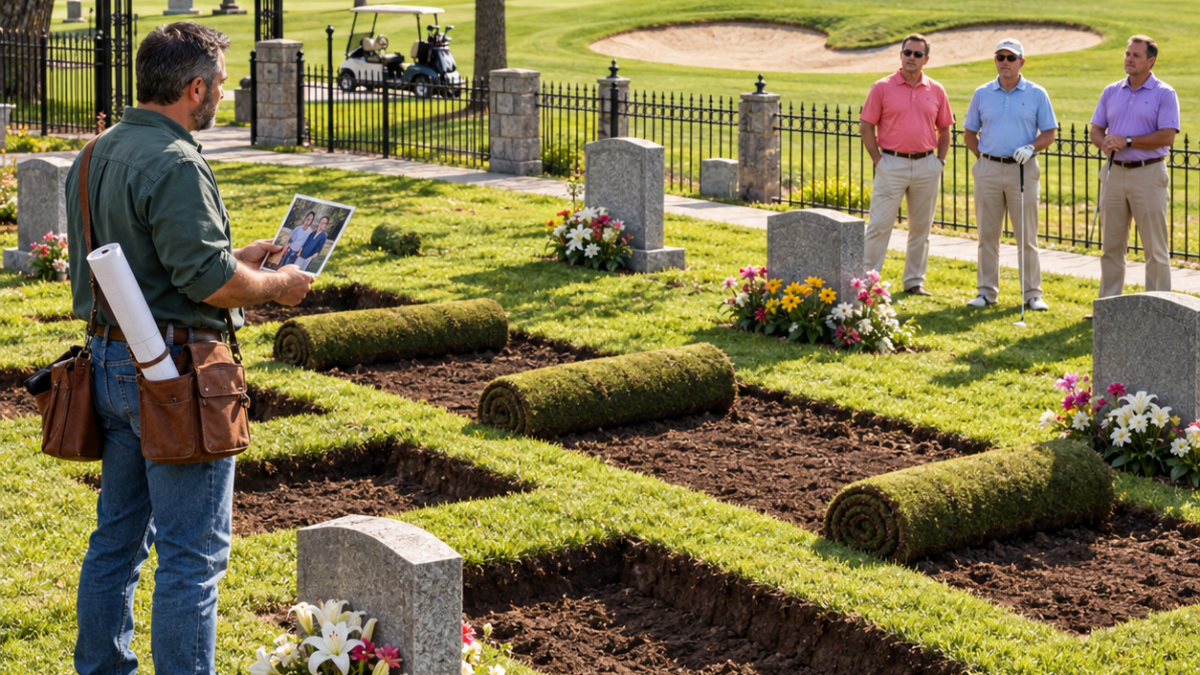
They destroyed 12 graves to expand their golf course, and fourteen months later I refused to renew the land agreement that kept every family in their neighborhood there. t
The signature belonged to the man who had originally developed Brook Hollow.
Above it was a paragraph Preston had apparently never seen.
The cemetery wasn’t merely excluded from development.
It had been specifically protected.
The developer had acknowledged the Harper family burial ground, guaranteed permanent access through the master parcel, and agreed that no road, utility work, recreational improvement, landscaping project, or other construction could disturb the cemetery without written permission from the Harper family and whatever governmental approvals might be required.
Karen turned the document toward Preston.
“You have either a very serious records problem,” she said, “or a very serious governance problem.”
Preston didn’t answer.
He stared at the page.
For the first time since I had met him, he didn’t look like a man trying to win a conversation.
He looked like a man replaying one.
Finally he said, “I’ve never seen this.”
Karen folded her hands.
“That may be true.”
He glanced at me.
“So what happens now?”
I wanted to tell him exactly what I thought should happen.
I wanted twelve stones put back before sunset.
I wanted every truck that had crossed those graves dragged back off the property.
I wanted the golf course ripped apart with the same casual efficiency they had used on my cemetery.
But anger and power are a dangerous combination.
Karen had warned me about that the night before.
“You are going to have leverage,” she’d said. “More leverage than most people ever get in a property dispute. The important question is whether you use it to solve the problem or to become part of another one.”
I hadn’t liked hearing that.
Mostly because I knew she was right.
So I said nothing.
Karen spoke instead.
“First, nobody touches the cemetery or the golf-course expansion.”
Preston started to object.
She raised one finger.
“Second, every project file relating to the excavation gets preserved. Emails. Texts. Contractor proposals. Board minutes. invoices. photographs. Survey documents. Everything.”
“What exactly are you accusing us of?”
“Nothing yet.”
That answer bothered him more than an accusation would have.
Karen slid a business card across the table.
“I’m telling you what needs to happen while we determine what actually occurred.”
Preston looked at the card but didn’t pick it up.
Then he looked at me.
“Daniel, people live there.”
I almost laughed.
It was the first time anyone from Brook Hollow had mentioned people while standing on my porch.
“They lived there yesterday too,” I said. “When your contractors drove over twelve graves.”
His jaw tightened.
“You think I personally operated a bulldozer?”
“No.”
“Then don’t make this into something it isn’t.”
I leaned back in my chair.
“What is it?”
He opened his mouth.
Nothing came out.
Karen finally stood.
“Have your attorney call me.”
Preston picked up his folder.
He left the lease copy on the table.
Halfway down the porch steps, he stopped.
“I meant what I said,” he told me. “I never saw that document.”
I believed him.
That surprised me.
It didn’t make him innocent.
But I believed him.
And that turned out to matter.
The first thing Karen did was get a court order preserving the site.
Nothing dramatic happened.
No deputies surrounded the clubhouse.
Nobody was arrested on the golf course.
There was simply paperwork, a hearing, several lawyers, and an order saying the cemetery and the altered section of hole nine could not be disturbed while the dispute was being investigated.
To me, that piece of paper felt more powerful than shouting ever could.
The next step was figuring out what had happened to the twelve graves.
That was harder.
The headstones had definitely been removed.
At least some had been crushed.
Whether the burial plots themselves had been disturbed below the surface wasn’t something Karen wanted anyone guessing about.
She brought in a cemetery-restoration specialist, a surveyor, and an archaeologist experienced in historic family burial grounds.
They mapped the original grave locations using old photographs, family records, surviving fence lines, depressions in the soil, and a 1978 survey my father had saved.
Then they used ground-penetrating equipment.
I stood outside the fence while they worked.
I didn’t want to watch the screen.
I watched the oak trees instead.
My father used to lean against the largest one when he took breaks from mowing.
He would drink coffee from a green thermos and tell me stories about people whose names I only knew from granite.
Samuel Harper had lost three fingers in a sawmill accident.
Evelyn Harper had run the town’s first boardinghouse.
My grandmother Ruth could bake biscuits without measuring anything and somehow knew when every grandchild was lying.
Those stories had sounded ordinary when I was a boy.
Standing outside a cemetery that had been scraped by construction equipment, ordinary suddenly felt precious.
The specialist came over after nearly two hours.
“We have some disturbance,” she said carefully.
My stomach tightened.
“How bad?”
“We need to expose limited areas by hand before I tell you anything definite.”
Karen was beside me.
She asked the questions I couldn’t.
Were remains visible?
No.
Could the graves be restored?
Probably.
Had heavy equipment crossed burial areas?
Almost certainly.
That was enough for that day.
I went home.
I didn’t sleep.
The next morning brought the first real piece of evidence.
Not from the HOA.
From the contractor.
The company that had redesigned hole nine was based two counties away.
Karen sent a preservation notice to them too.
Their owner, a man named Travis McCord, called within an hour.
He sounded terrified.
Not guilty.
Terrified.
“There was supposed to be a relocation,” he kept saying. “We were told it was cleared.”
Karen put the call on speaker.
“Who told you?”
“The property manager.”
“Name?”
He gave it.
“Who gave you the cemetery boundaries?”
“The board packet.”
“And who instructed your crew to remove the markers?”
Silence.
Then Travis said, “I need my lawyer.”
Karen nodded even though he couldn’t see her.
“That’s probably wise.”
Two days later, through counsel, the contractor produced its project records.
That’s when the story changed.
The golf-course expansion had started as a financial problem.
Brook Hollow’s small course had never made much money.
For years it survived because residents paid maintenance costs through HOA dues while a local golf company operated it under contract.
Then membership fell.
Drainage repairs became expensive.
Insurance went up.
The HOA had delayed resurfacing two private roads because reserves were thinner than homeowners realized.
Preston had been elected president after campaigning on one promise: stabilize property values without a massive dues increase.
The remodeled ninth hole was part of his plan.
A landscape consultant had proposed a more attractive finishing hole with a larger green, new drainage, and a decorative bunker visible from the clubhouse patio.
The problem was space.
The original course boundary ran awkwardly around our cemetery.
Moving the green ten yards would solve almost everything.
The first proposal clearly labeled the cemetery.
DO NOT DISTURB.
The second proposal did too.
Then there was an email.
It was from Preston to the property manager.
What is the status of the old burial parcel? Is anyone maintaining it or claiming it?
The manager replied that she believed it was inactive private property but would check.
Three days later she sent another email.
County GIS is unclear. Developer file calls it Harper Cemetery. Recommend title review before work.
That should have ended it.
Instead, Preston wrote back:
We don’t have six months for title archaeology. Get me what we need to treat the edge as landscape area. We are not moving remains. We are cleaning up neglected markers and improving the course.
When I read that, I had to stand up.
Karen watched me walk to the window.
“He knew there were markers,” I said.
“Yes.”
“He called them neglected.”
“Yes.”
“He was standing ten feet from my grandmother when he wrote that.”
Karen didn’t answer.
There were more emails.
None said, Destroy the cemetery.
Real life is rarely generous enough to hand you a sentence like that.
What they showed was worse in another way.
They showed ordinary people making increasingly reckless decisions because admitting the first decision was wrong had become more expensive than continuing.
The property manager had asked for a formal title opinion.
Preston delayed it.
A board member named Linda Carrow objected to any work near the cemetery.
Preston told her the redesign remained within common area.
The contractor requested written authorization before removing stones.
The property manager forwarded a one-page “site clearance notice” that appeared to refer to county approval.
Except the county had never issued it.
Where the document came from became the next question.
Preston denied creating it.
The property manager denied creating it.
The contractor said it had received the document electronically in a board packet.
Nobody seemed willing to claim it.
Karen studied the page for several minutes.
“People think forged documents are always sophisticated,” she said. “Usually they’re not.”
The county seal was outdated.
The department name was wrong.
And the permit number belonged to an unrelated drainage project from four years earlier.
That was when the sheriff’s office became involved.
Not because Karen demanded arrests.
She didn’t.
She sent the records to the county and let them decide what warranted investigation.
A detective interviewed me first.
Then Preston.
Then the property manager.
Then several board members and the contractor.
The district attorney’s office said nothing publicly about charges.
Karen told me not to speculate.
So I didn’t.
That disappointed half the town.
By then, everybody knew something had happened.
Brook Hollow wasn’t large enough to hide a torn-up cemetery behind landscaping.
The story moved through diners, church parking lots, hardware stores, and Facebook groups faster than any lawyer could control it.
Unfortunately, the version residents first heard was Preston’s.
According to an email the HOA sent to all forty-nine households, a neighboring landowner was attempting to “exploit a historical boundary discrepancy” to threaten the community over an unfortunate landscaping error.
Landscaping error.
I printed the email.
Folded it once.
Then again.
By the third fold, my hands were shaking.
Karen took it from me before I tore it.
“Don’t respond tonight.”
“They’re telling people I planned this.”
“They’re scared.”
“They should be.”
“Daniel.”
Something in her voice stopped me.
She pushed my coffee toward me.
I hadn’t touched it.
“Most of those homeowners didn’t vote to remove a grave marker,” she said. “Some may have known nothing about it. If you decide they’re all your enemies because they live behind the same sign, you’ll make worse decisions.”
I looked at her.
“Are you representing me or them?”
“You.”
“Then why does it sound like you’re defending them?”
“Because I want you to win the part of this that will still matter five years from now.”
I hated that sentence too.
Karen had a gift for saying useful things in ways that irritated me.
The homeowners called an emergency meeting that Thursday.
This time I attended.
Not because I wanted to.
Because Linda Carrow called me personally.
She was the board member who had objected in the emails.
Her voice trembled when she introduced herself.
“I should have pushed harder,” she said.
“You should have.”
“I know.”
That silence lasted several seconds.
Then she said, “People need to hear what the board didn’t tell them.”
So I went.
The Brook Hollow clubhouse looked exactly like the kind of room where people normally argued about pool hours.
Beige walls.
Stackable chairs.
A framed photograph of the golf course at sunset.
Coffee in cardboard boxes.
Almost every household had sent somebody.
When I entered with Karen, conversation died one row at a time.
Some people looked angry.
Some looked frightened.
One man near the back shook his head like my presence confirmed something he already believed.
Preston sat at the board table.
He looked exhausted.
The expensive certainty was gone.
He hadn’t shaved.
Linda sat two chairs away from him with a binder open in front of her.
The management company’s attorney opened the meeting.
He spent ten minutes explaining that legal matters limited what could be discussed.
Then residents started asking questions anyway.
“Do we own our lots?”
“Is the cemetery actually his?”
“Are we being sued?”
“Can he take our houses?”
“Was there a permit?”
“Why weren’t we told about the lease?”
That last question changed the room.
Because the answer wasn’t that the lease was secret.
It had been recorded.
Every homeowner’s title package referenced it.
Some older closing documents even used the phrase leasehold estate.
But over the years, real estate marketing had softened the language.
“Ground arrangement.”
“Master property agreement.”
“Long-term renewable land structure.”
One brochure promised homeowners “the security of generational renewal.”
That was not the same thing as a guaranteed renewal.
A woman in the second row stood.
She was maybe sixty.
Gray hair pulled into a loose knot.
“My husband and I paid cash for our house.”
Nobody answered.
She looked directly at Preston.
“Are you telling me we paid cash for a house sitting on somebody else’s land?”
The management attorney spoke carefully.
“You own the improvements.”
“What does that mean?”
“It means the residence.”
“And the dirt?”
He hesitated.
“You hold rights through the ground lease.”
The woman sat down very slowly.
I remember that more clearly than any shouting.
Her hand searched for the back of the chair before she lowered herself.
That was the first moment I understood what the old lease could actually do.
Not to Preston.
To people.
Karen gave a short presentation after that.
She didn’t dramatize anything.
She displayed the deed.
The ground lease.
The cemetery protection agreement.
The expiration date.
Then photographs of the cemetery before and after the golf-course work.
When a picture of my grandmother’s missing marker appeared on the screen, somebody whispered, “Oh my God.”
Karen didn’t show the crushed stone.
I had asked her not to.
I couldn’t explain why.
Maybe because I didn’t want my grandmother turned into evidence for strangers.
When Karen finished, the room stayed quiet.
Then the man in the back who had been shaking his head stood up.
“You knew about the lease.”
He was looking at me.
I said, “My family did.”
“And you waited until now.”
“No.”
“You expect us to believe that?”
“I expect you to believe county records.”
His voice rose.
“You could destroy forty-nine families over a cemetery none of us touched.”
That sentence landed hard.
Before I could answer, Linda spoke.
“Robert.”
He turned.
She closed her binder.
“We touched it.”
He frowned.
“The HOA is us,” she said. “That’s the part nobody wants to say.”
“We didn’t authorize that.”
“I voted against the project because the title work wasn’t finished. The board proceeded anyway.”
Every face turned toward Preston.
He finally spoke.
“The project was approved under our existing authority.”
Linda looked at him.
“No, Preston. The redesign was approved. Removing grave markers wasn’t.”
“I was told the parcel was inactive.”
“You were told to get a title review.”
A murmur moved through the room.
Preston’s hands flattened against the table.
“You think I wanted this?”
Linda didn’t answer.
He looked around the clubhouse.
“I was trying to keep this place solvent.”
That quieted people.
For the first time, he explained the finances.
The golf-course contract was losing money.
The private roads needed major repairs.
The pool mechanical system was nearing replacement.
The association’s reserves were far below what an updated study recommended.
A substantial dues increase was coming.
Preston had believed the course renovation could improve memberships, boost resale values, and delay the worst assessment.
He had pushed too hard.
Skipped steps.
Relied on assumptions.
And when warnings appeared, he treated them as obstacles instead of information.
It wasn’t a good excuse.
But it was a human one.
A man in the first row asked, “Did you fake the county notice?”
Preston’s head snapped toward him.
“No.”
“Do you know who did?”
“No.”
That, at least, sounded true.
The property manager wasn’t there.
Two days later, she resigned.
Her lawyer eventually acknowledged that she had created the fake notice by modifying an old county form.
According to the explanation later given in the civil case, she had believed no actual burial relocation was occurring because contractors were supposedly only moving surface markers from an “inactive” cemetery edge.
She wanted something that would keep the project on schedule until title questions were resolved.
Instead, she created a document that made everybody downstream believe government approval existed when it did not.
That decision followed her for years.
Whether prosecutors could prove criminal intent was something I left to them.
There was an investigation.
There were charges related to records and property damage against more than one person months later.
There were plea negotiations.
There were civil claims.
There were insurance disputes.
It was slow, technical, and far less cinematic than people later made it sound.
Nobody was marched out of an HOA meeting in handcuffs.
Nobody went from golf polo to prison uniform by Friday.
Real consequences took paperwork.
And time.
My lawsuit moved the same way.
First came the cemetery.
The court allowed supervised restoration work.
The excavation showed that several burial plots had been physically disturbed by grading equipment, though not all to the same degree.
I won’t describe that process.
There are some things that don’t become more meaningful because you make them graphic.
What mattered was that specialists documented everything, and the affected remains were handled with care.
I stood there during the reinterment.
So did Linda.
No cameras.
No reporters.
No HOA representatives except her.
At one point she handed me a thermos of coffee.
Green.
Almost the same shade as my father’s old one.
I stared at it.
She noticed.
“What?”
“Nothing.”
She looked toward the cemetery.
“I’m sorry.”
I had heard that phrase from lawyers by then.
From contractors.
From residents.
From people online who had never met me.
Linda was the first person who said it without adding anything after it.
No explanation.
No qualification.
No request.
Just I’m sorry.
I nodded.
“Thank you.”
We replaced the twelve markers using photographs, cemetery records, old rubbings, and a stone company that specialized in historic work.
Some inscriptions couldn’t be perfectly reconstructed.
Time had already erased parts of them before Brook Hollow ever existed.
We didn’t invent words.
Blank spaces remained where history had gone silent.
My grandmother’s marker was different.
I had photographs.
Measurements.
Even the small repair receipt from 1996 when a storm-damaged corner had been stabilized.
The stone company recreated it almost exactly.
Almost.
When they installed it, I ran my fingers along the new pink granite and felt nothing familiar.
That bothered me.
Karen found me sitting beside it later.
“You hate it,” she said.
“It’s beautiful.”
“That’s not what I said.”
I looked at the stone.
“It’s not hers.”
“No.”
I appreciated that she didn’t argue.
People think restoration means putting everything back.
Sometimes it means admitting something cannot be put back and choosing what deserves to remain anyway.
By winter, the cemetery looked whole from the road.
I knew better.
So did Preston.
He had resigned from the board three weeks after the emergency meeting.
We didn’t speak for months.
Then he asked to meet.
Karen advised against going alone.
We met in a diner outside Raleigh, halfway between our attorneys’ offices.
Preston arrived early.
He was already sitting in a booth with coffee when I walked in.
No golf shirt.
No Range Rover confidence.
Just a gray sweater and a man who looked older than forty-three.
He stood.
I didn’t shake his hand.
He sat again.
For a while neither of us spoke.
Then he said, “I sold my house.”
I didn’t know what response he expected.
So I gave none.
“My wife left.”
That made me look at him.
He stared into his coffee.
“Not because of you.”
“I wasn’t going to assume it was.”
“She’d been unhappy for a while.”
I waited.
He rubbed his thumb against the handle of the mug.
“I kept telling myself the cemetery wasn’t really being used.”
“It was.”
“I know.”
“You knew then.”
“I knew someone was maintaining it.”
“That’s different from abandoned.”
“I know.”
His eyes lifted.
“I was trying to solve five problems at once. Every person in that neighborhood had an opinion about dues, roads, golf, landscaping, resale values. Nobody wanted to pay for anything. Everybody wanted everything perfect.”
“So you erased the thing that didn’t vote.”
He flinched.
I hadn’t planned that sentence.
It just came out.
After a moment he nodded.
“Yeah.”
The waitress refilled his coffee.
Neither of us spoke until she left.
Then Preston reached into a messenger bag.
My body tensed automatically.
He pulled out an envelope.
Inside were printed photographs.
Construction photos.
I had seen most of them in discovery.
But one was new.
It showed hole nine before the grading.
My grandmother’s headstone stood behind temporary orange fencing.
A yellow excavator waited ten yards away.
Someone had written on the photograph with a marker:
CONFIRM CLEARANCE BEFORE CROSSING.
“Where did you get this?”
“One of the contractor’s foremen sent it to me.”
“When?”
“Two days before they started.”
I looked at Preston.
He didn’t look away.
“What did you do?”
“I forwarded it to the property manager.”
“And?”
“She sent me the county page.”
The fake approval.
“Did you call the county?”
“No.”
“Did you call me?”
“No.”
“Did you stop the work?”
He stared down at the table.
“No.”
There it was.
Not murder.
Not some grand conspiracy.
Something more ordinary and, in its own way, more infuriating.
He had received a warning.
He had wanted a convenient answer.
Someone gave him one.
So he stopped asking questions.
“Why are you showing me this?”
“Because my attorney told me not to.”
That almost made me smile.
Almost.
“He said it only makes me look worse.”
“It does.”
“I know.”
Preston pushed the photograph toward me.
“I spent months telling myself I was deceived. And I was. That permit was fake.”
He swallowed.
“But I wanted it to be real so badly that I’m not sure the difference matters.”
For the first time, I understood why he had asked to meet.
Not to negotiate.
Not to repair his reputation.
He needed to say something true where it could hurt.
I put the photograph back into the envelope.
“I don’t forgive you.”
He nodded.
“I didn’t ask.”
“Good.”
Another silence.
Then he said, “What are you going to do about the lease?”
That was the question everyone eventually asked.
The fourteen-month clock had become the shadow over Brook Hollow.
The ground lease expired the following spring.
The original agreement allowed renewal only by written consent from the Harper family trust, which by then meant me and my sister, Caroline.
Caroline lived in Richmond.
She wanted nothing to do with the cemetery dispute at first.
Then she saw the photographs.
After that, she wanted to burn the development to the ground.
Not literally.
Usually.
We met with Karen four times to discuss the lease.
There were options.
We could renew at a much higher ground rent.
We could require the HOA to purchase the land at an appraised value.
We could negotiate direct leases with individual homeowners.
We could sell the entire parcel to an investor and walk away.
Or we could decline renewal.
That last option sounded simple.
It wasn’t.
Under the lease structure, the developer had created transferable residential leasehold interests.
The houses belonged to the residents.
The land did not.
When the master term ended, their right to occupy the lots ended unless a new agreement was reached.
The documents also contained provisions about what happened to improvements at expiration.
Those provisions were complicated enough that three lawyers disagreed about them for weeks.
Nobody was going to wake up the morning after expiration and discover I suddenly owned forty-nine furnished houses.
Courts don’t work like magic tricks.
Lenders had interests.
Title insurers had interests.
Residents had contractual claims against sellers, brokers, closing attorneys, and possibly the old developer’s successors.
It was going to be messy.
Karen told me that repeatedly.
“Declining renewal doesn’t make these people disappear.”
“I know.”
“It starts another legal process.”
“I know.”
“Some of them will blame you more than the HOA.”
“I know.”
“Do you?”
I looked at her.
She leaned back in her chair.
“This is not me telling you to renew.”
“Sounds like it.”
“It’s me telling you not to confuse having the right to say no with being insulated from what no means.”
There was that irritating usefulness again.
My sister had less patience.
“They built over our family.”
“The homeowners didn’t.”
“They benefited from it.”
“Most of them didn’t know.”
“Neither did Grandma.”
That ended the conversation.
For about ten minutes.
Then Caroline sighed.
“What do you want?”
I didn’t know.
That was the truth.
Money would have been easy.
The development was worth far more than the raw land had been when my grandfather signed the lease.
A purchase could have made Caroline and me wealthy.
Renewal could have produced income for the rest of our lives.
Some investors approached us with offers before the cemetery case was even finished.
One included enough money that I read the number three times.
Caroline stared at it.
“Granddad leased this place for almost nothing.”
“He thought he was helping the town grow.”
“He did.”
I looked at the offer.
“Look what grew.”
She didn’t laugh.
We rejected it.
The HOA formed a lease committee.
That was the first productive thing it had done since the crisis began.
Linda chaired it.
Five residents volunteered.
They hired independent counsel, not the attorney who had represented the old board.
They opened the financial records.
They commissioned a title review.
They held meetings without Preston.
And, to their credit, they came to us with a serious proposal.
They offered to purchase the residential portion of the land collectively while returning the cemetery and a wide protective buffer permanently to the Harper family.
The golf course would lose hole nine entirely.
A conservation strip would surround the burial ground.
No structure could be built within it.
The association would pay for cemetery maintenance in perpetuity.
It was thoughtful.
It was also expensive.
Too expensive for many residents.
Brook Hollow had wealthy-looking houses.
That did not mean wealthy people lived in all of them.
Some were retirees.
Some had bought at the top of the market.
Several had refinanced.
One household was supporting an adult son with disabilities.
Another had two teachers raising three children.
A young couple had purchased six months before the cemetery was destroyed.
They hadn’t even attended an HOA meeting yet.
The community’s ability to finance a land purchase collapsed once lenders understood the lease situation and the litigation.
The numbers didn’t work.
The HOA came back with a renewal proposal instead.
Thirty years.
Higher ground rent.
Strict cemetery protections.
Removal of the golf course section nearest the graves.
A permanent public access easement.
Independent oversight for future excavation anywhere on the master parcel.
On paper, it was reasonable.
Karen thought a court would view it as reasonable too if litigation later became ugly.
Caroline wanted to reject it immediately.
I asked for a week.
That Sunday I went to the cemetery alone.
It was cold.
The new markers looked too clean.
The two old stones near the gate looked almost brown beside them.
I sat next to my father’s grave.
For years I had imagined what I would say to him when something important happened.
Mostly I said nothing.
That morning I talked out loud for almost an hour.
I told him about the lease.
The homeowners.
The offers.
Preston.
The bunker.
The new stones.
I told him I was afraid that if I renewed the lease, the cemetery would always sit inside a community that had once treated it like an obstacle.
Then I admitted something harder.
I wanted the neighborhood gone.
Not because every resident deserved punishment.
Because I wanted to look from the cemetery fence and never again see the clubhouse.
I wanted the landscape before Brook Hollow.
I wanted the quiet.
I wanted time reversed.
That was impossible.
But land can tempt you into believing you can reverse things.
If you own enough of it.
If you control what gets built.
If you control who stays.
I sat there until my coffee went cold.
Then I walked the entire boundary.
The development wrapped around the cemetery on three sides.
On the fourth was county road and woodland.
From my grandmother’s grave, I could see the roof of the clubhouse.
I could hear a lawn mower.
Somewhere a dog barked.
A child laughed.
The sounds weren’t offensive.
That almost made the decision harder.
When I got home, Linda was waiting by my truck.
She looked embarrassed.
“I know I shouldn’t be here.”
“Then this is a strange choice.”
“I need five minutes.”
I opened the garage.
We sat on two folding chairs.
Linda held a manila envelope on her lap.
“What is that?”
“Letters.”
“From lawyers?”
“Residents.”
I shook my head.
“I don’t want a campaign.”
“It’s not.”
“It looks like one.”
“I didn’t ask them to write.”
“Then why do you have them?”
“Because people don’t know how to talk to you.”
“Most of them have managed.”
She almost smiled.
Then she handed me the envelope.
I didn’t open it.
Linda looked down at her hands.
“My husband wants us to move.”
“Probably smart.”
“I don’t.”
“Why?”
“I’ve lived there eighteen years.”
“You own the house.”
“Not the dirt.”
There was no accusation in her voice.
That made it worse.
She looked toward the open garage door.
“I know what the board did. I know what I failed to stop. But Brook Hollow is where my husband had his heart attack and where three neighbors kept me fed for two weeks. It’s where my daughter learned to ride a bike. It’s where Mrs. Parson waters everybody’s plants when they’re away. The HOA isn’t the place.”
She paused.
“The people are.”
I looked at the envelope.
“Are you asking me to renew?”
“I’m asking you not to decide while you’re still looking at us and seeing Preston.”
That irritated me because it was exactly the sort of thing Karen would say.
I put the envelope on a workbench.
“You got your five minutes.”
Linda stood.
At the garage door she turned.
“For what it’s worth, if you say no, I’m not going to tell people you’re evil.”
“That’s generous.”
“I’m serious.”
“So am I.”
She nodded.
“I know.”
After she left, I opened the letters.
I read six.
Then stopped.
Not because they changed my mind.
Because they were starting to.
That frightened me.
People wrote about children.
Retirement.
Gardens.
Mortgage payments.
A kitchen renovated after a mother’s death.
A porch built by a son who had gone into the Army.
A maple tree planted when twins were born.
Ordinary attachments.
The exact kind I had spent months insisting mattered when I talked about my cemetery.
I put the letters back in the envelope.
Then I called Karen.
“I’m declining the renewal.”
She was quiet.
“Okay.”
“You don’t sound surprised.”
“I’m not.”
“You think I’m wrong?”
“It doesn’t matter what I think.”
“It matters a little.”
She sighed.
“I think you have legitimate reasons not to continue this arrangement. I also think innocent people will carry part of the cost.”
“So what would you do?”
“I’m your lawyer, not your conscience.”
“Convenient.”
“Very.”
Then her voice softened.
“If you’re going to say no, give them time.”
The lease already had fourteen months from the day I discovered the cemetery damage.
By then, several had passed.
Karen proposed that we formally announce non-renewal immediately but negotiate an orderly possession plan that prevented surprise lockouts or emergency removals.
My sister agreed.
So did I.
The notice went out by certified mail.
Forty-nine households.
The HOA.
Every lender we could identify.
The management company.
The successor entity to the original developer.
My name appeared at the bottom.
Daniel Harper, Trustee.
I signed each copy.
By the twentieth signature, my hand hurt.
By the forty-ninth, I felt sick.
The notice said the master ground lease would not be renewed.
It also invited affected residents and lienholders to participate in a transition process addressing removal, sale, relocation, or negotiated disposition of improvements.
That legal language mattered.
The headline around town was simpler.
HARPER EVICTS BROOK HOLLOW.
For once, the exaggeration didn’t bother me.
That was essentially what I had decided.
Residents sued.
I expected that.
They sought a declaration that the lease had renewed automatically through past conduct.
They argued the Harper family had allowed decades of permanent residential construction and therefore could not simply recover possession as though the land held temporary cabins.
Their lawyers raised equitable arguments.
Reliance.
Estoppel.
Ambiguous renewal language in later assignments.
Conflicts among closing documents.
The litigation became much more serious than the cemetery case.
And for several months, I didn’t know if I would win.
That was good for me.
Not emotionally.
Emotionally, it was miserable.
But uncertainty stripped away the fantasy that one old document made me king.
Every week brought depositions, title records, expert reports, or another box of old paper.
My grandfather’s decisions were examined.
So were my father’s.
So were mine.
One attorney spent nearly an hour asking why my family had allowed houses to be built if we intended to recover the land someday.
“We didn’t intend anything someday,” I said. “There was a lease.”
“You understood people would build permanent homes.”
“Yes.”
“And mortgages.”
“Yes.”
“And families.”
“Yes.”
“And you are now asking a court to remove those families.”
My lawyer objected to the wording.
I answered anyway.
“I’m asking the court to enforce the expiration of the agreement that allowed the homes to be there.”
The opposing lawyer looked at me.
“Do you hear a difference?”
“Legally?”
“Morally.”
Karen objected again.
This time I listened.
But the question followed me home.
The case turned partly on documents nobody had paid attention to in years.
Every assignment of the master lease preserved the original expiration date.
Several amendments changed maintenance duties but did not create automatic renewal.
The developer had twice requested long-term extensions from my father.
He had declined both.
One letter from 2009 was especially important.
The developer’s attorney had written:
We understand the current term remains fixed and that future extension is subject solely to landowner approval.
My father had scribbled a note in the margin.
Correct.
That single word survived sixteen years in a cabinet.
It carried more weight than a hundred angry speeches.
The homeowners had their own strong evidence.
Marketing materials repeatedly described Brook Hollow as a permanent residential community.
Some title summaries buried the ground lease deep enough that reasonable buyers could miss its significance.
At least one closing attorney had told buyers verbally that renewal was “routine.”
That statement wasn’t binding on my family.
But it mattered to the families who had relied on it.
The judge pushed everyone toward mediation.
I resisted at first.
Caroline resisted harder.
“What are we mediating?” she asked. “The calendar?”
Karen looked at her.
“Risk.”
We spent eleven hours in a conference center outside Greensboro.
Residents in one room.
Lenders in another.
Insurers joining by video.
The former developer’s successor company sending lawyers who insisted they had inherited liabilities but not responsibility.
My sister and I sat with Karen in a small room containing stale cookies and a whiteboard.
Offers moved back and forth.
Purchase price.
Partial purchase.
Thirty-year renewal.
Ten-year renewal.
Individual leases.
Conversion of the golf course to open space.
Permanent cemetery trust.
Nothing worked.
At seven that evening, the mediator came into our room.
He was a retired judge with the patience of someone who had spent forty years listening to people repeat themselves.
“You understand some households may not recover their equity.”
I nodded.
“You understand some are elderly.”
“Yes.”
“You understand others have claims against insurers and professionals, but those claims could take years.”
“Yes.”
He studied me.
“Why no renewal at all?”
I’d answered versions of that question for months.
This time I gave the simplest answer.
“Because I don’t trust the structure anymore.”
“The people?”
“The structure.”
I pointed toward the hallway.
“A board was able to treat my family’s cemetery like landscaping because control had become separated from ownership for so long that everybody started acting like the underlying land didn’t matter. Another thirty-year lease keeps the same basic arrangement alive.”
The mediator nodded slowly.
“So it’s not punishment.”
I thought about the moving trucks I knew would come.
“It started that way.”
Karen looked at me.
I continued.
“It isn’t now.”
That was the first time I had said it aloud.
The mediation ended without a full settlement.
But something changed afterward.
The homeowners split into groups.
About a third wanted to keep fighting for renewal.
Another third wanted money and a clean exit.
The rest wanted certainty more than victory.
Title insurers and several lenders finally entered serious negotiations.
Within two months, a framework emerged.
Residents would vacate by staggered dates after the lease expired.
No one would be removed immediately on expiration day.
Most households would receive compensation from combinations of insurance settlements, claims against professional parties, and funds contributed through the development litigation.
Homeowners could remove personal improvements where practical.
Several houses were sold for relocation to rural lots.
Others were purchased for salvage or demolition.
A few residents negotiated short occupancy extensions while new housing was completed.
My family waived certain claims against individual residents who cooperated with turnover.
The HOA transferred control of the common improvements at expiration.
In exchange, most residents dismissed the claim that the master lease had automatically renewed.
Not everybody agreed.
Seven households continued the case.
They had every right to.
That meant the final question of possession still went to court.
The hearing happened almost a year after I first saw the bunker.
There was no packed gallery.
No crowd waiting to cheer.
Mostly lawyers.
Document boxes.
People checking phones in the hallway.
The judge issued a written ruling weeks later.
The lease had a definite expiration date.
Renewal required the Harper family’s written agreement.
No written renewal existed.
The residential occupants had rights arising through the master lease, but those rights could not extend indefinitely after the master term ended simply because the consequences were severe.
The court also recognized that possession had to be transferred through lawful procedures, not self-help.
Karen called me when the order arrived.
“You got possession.”
I sat at my kitchen table.
The steel cabinet was behind me.
For some reason, I looked at it.
“When?”
“Under the transition schedule.”
“So that’s it?”
“For this part.”
I expected to feel victorious.
I felt tired.
The criminal matter involving the false document and cemetery damage resolved separately.
The property manager accepted responsibility for creating the false approval document.
The contractor paid substantial restoration costs through a settlement while maintaining that it had relied on representations from Brook Hollow.
The HOA’s insurers disputed some coverage and paid others.
Preston eventually entered an agreement resolving both civil claims and the charges that had been filed against him.
There were financial penalties, community restrictions, and consequences to his real-estate work.
He did not vanish into prison for decades.
He did not lose everything overnight.
Real life was slower and less theatrical.
But his name stayed attached to the decision long after he resigned.
I saw him once during that period.
We passed each other outside the county courthouse.
He stopped.
“So you’re really doing it.”
“Yes.”
“All forty-nine?”
“Eventually.”
He looked toward the parking lot.
“Some of them still hate me more than you.”
“I wouldn’t find that comforting.”
“I don’t.”
Then he surprised me.
“I drove by the cemetery.”
I said nothing.
“The new stones look good.”
“They’re not new to me.”
He nodded.
“I know.”
He started to leave.
I called his name.
He turned.
“Why didn’t you just move the golf hole the other direction?”
For one second he looked almost amused.
Then the expression disappeared.
“Because it would’ve cost another hundred and eighty thousand dollars.”
I stared at him.
That was it.
Not millions.
Not survival.
One hundred eighty thousand dollars.
Enough money to matter to an underfunded HOA.
Not enough to justify any of it.
Preston looked at me.
“I’ve thought about that number every day.”
Then he walked away.
The lease expired on a Tuesday.
Clear sky.
No wind.
I went to Brook Hollow at six in the morning.
The entrance sign was still there.
BROOK HOLLOW ESTATES.
Below it somebody had taped a handwritten note.
LAST DAY.
I pulled it off.
Not because I was offended.
Because rain was coming later and I didn’t want tape residue on the stone.
Old habits.
By then, twenty-eight houses were already empty.
Moving trucks had been coming for weeks.
Some families moved across town.
Some moved into Raleigh.
A few left North Carolina entirely.
Linda and her husband were among the last.
She had found a house fifteen miles away with a smaller yard.
On her final morning, I stopped outside while movers loaded furniture.
She came down the driveway carrying the green thermos.
“I stole this from my husband,” she said.
“I figured.”
She handed it to me.
“For the cemetery.”
I turned it in my hands.
“You don’t have to give me things because you’re leaving.”
“I’m not.”
“What do you call this?”
“A trade.”
“For what?”
She nodded toward a young maple tree beside her driveway.
“We planted it when our daughter went to college.”
I waited.
“Take it.”
“Linda—”
“The landscaper says it can be moved.”
“Your new house has dirt.”
“Not that dirt.”
I looked at the tree.
It was maybe fifteen feet high.
Strong enough to survive if moved properly.
“You want it in the cemetery?”
“Somewhere nearby.”
“Why?”
She looked toward her house.
“Because I want one thing from Brook Hollow to keep growing here that nobody has to argue about.”
I didn’t know what to say.
So I said yes.
The maple still stands there.
The last household left nearly four months after the formal expiration date under the court-approved schedule.
There was no sheriff dragging furniture into the road.
No dramatic line of families screaming at me while I locked a gate.
Just one final moving truck turning onto the county road.
I watched its taillights disappear between the trees.
Then I closed the entrance gate to Brook Hollow.
Forty-nine families had lived there.
Now none did.
I had evicted every one of them in the only sense that mattered: I had refused to let their legal right to remain on my family’s land continue.
Some people called that justice.
Some called it revenge.
Some used words much worse.
I understood all of them.
The houses didn’t vanish immediately.
That took almost two years.
A few were relocated intact.
Others were dismantled.
Reusable materials were salvaged.
The clubhouse was eventually torn down.
The pool was filled.
The private roads were broken up in sections rather than left as useless asphalt through the woods.
We removed the golf course last.
Hole nine was the last part of that.
I stood beside the bunker on a cool October morning while the restoration crew prepared to excavate it.
The pink crushed granite had been sitting there under protective covering through the litigation.
We already knew some material came from grave markers.
We treated all of it as memorial material.
No decorative reuse.
No pathways.
No landscaping.
It was removed carefully and placed within the restored cemetery under the direction of the specialists who had handled the graves.
I watched the excavator lift the final bucket.
Beneath it was ordinary North Carolina soil.
For some reason, that was the moment I finally cried.
Not when I first found the stones gone.
Not during court.
Not while signing forty-nine non-renewal notices.
Then.
Because the golf course was finally gone from that patch of earth.
Caroline stood beside me.
She didn’t say anything.
After a while, she took my arm.
We planted trees across much of the former development.
Not two hundred all at once like some grand symbolic act.
We planted what the land could support.
Oak.
Hickory.
Dogwood.
Tulip poplar.
And Linda’s maple.
The former roads became narrow service paths in a few places and disappeared beneath new soil in others.
We expanded the protected cemetery grounds, but not into a giant commercial burial operation.
That would have felt too much like replacing one kind of development with another.
Instead, we created a family-history preserve around the original three acres.
There is space for future Harper burials.
There are benches.
A small reflection garden.
A stone path wide enough for older visitors.
And an archive room in a simple timber building near the entrance where copies of deeds, photographs, maps, and family records are stored properly now.
No more steel cabinet depending on one man’s memory.
The original iron gate was restored.
Samuel Harper’s name is still carved into the stone.
We did not make the lettering look new.
The restoration specialist cleaned it and stabilized the damaged sections, but I asked him to leave the age visible.
Some things should look like they survived.
My grandmother’s replacement headstone still bothers me occasionally.
The granite is too smooth.
The letters too sharp.
One afternoon I told Linda that.
She still visits sometimes.
She and her husband ended up liking their new place.
“Give it eighty years,” she said.
I laughed.
“Helpful.”
“I’m serious.”
She ran her hand over the stone.
“It’ll get there.”
Maybe she’s right.
Preston never came back.
At least not while I was there.
I heard that he moved to another county and took work outside residential real estate.
Years later, I received an envelope with no return address.
Inside was a photograph of the cemetery taken before Brook Hollow existed.
I had never seen it.
The iron fence.
Fourteen markers.
Open fields behind them.
On the back, someone had written:
This was in my father’s files. I thought it belonged with you.
No signature.
It didn’t need one.
I put the photograph in the archive.
Not because I had forgiven Preston.
I hadn’t.
Forgiveness became less important to me as time passed.
What mattered was that the record was complete.
That turned out to be the lesson buried underneath everything.
Not a lesson about revenge.
Not karma.
Not winning.
Records matter.
Boundaries matter.
People matter.
And when one of those things becomes inconvenient, that is usually when it matters most.
I still think about the forty-nine families.
There is no version of the story where I don’t.
They were not the people who put my grandmother’s headstone into a crusher.
Most never knew the cemetery project existed until it was already done.
They paid a price because they had trusted a legal and financial structure that turned out to be less permanent than their homes looked.
Some recovered most of what they lost.
Some didn’t.
One family spent years in litigation with a title insurer.
Another ended up better off after moving.
Linda says at least three former Brook Hollow families still have a group dinner every Christmas.
Lives continued.
They usually do.
Would I make the same decision now?
That’s harder to answer than people expect.
If you ask whether I would protect the cemetery again, yes.
If you ask whether I would refuse to let Brook Hollow continue exactly as it had, yes.
If you ask whether I enjoyed watching families leave, no.
I thought I would.
For a little while, after I found that bunker, I wanted every porch dark.
Every driveway empty.
Every golf cart gone.
I wanted absence to prove something.
By the time it actually happened, I understood that emptiness proves very little.
Protection was what mattered.
Control wasn’t.
That’s why large sections of the old Brook Hollow land eventually went into a conservation trust rather than staying solely under my control.
The cemetery remains with the Harper family.
The surrounding woods cannot become another subdivision.
The old golf-course corridor is now meadow and young forest.
Deer cross where people once lined up putts.
Sometimes you can still find a straight line beneath the grass where a cart path used to run.
I don’t remove those traces.
History isn’t cleaner because you erase the evidence that something happened.
Every Sunday morning, I unlock the old cemetery gate.
I bring coffee in Linda’s green thermos.
I check the flowers.
Brush leaves from the markers.
Walk past my father’s grave.
My grandmother’s.
Samuel Harper’s.
Then I usually stand near the maple for a minute.
From there, if the weather is clear, I can look across what used to be the ninth hole.
There is no bunker anymore.
No clubhouse roof.
No rows of expensive houses.
Just trees, grass, sky, and the faint line of an old path disappearing into the woods.
The gate still carries Samuel Harper’s name.
The land behind it has changed more than he could ever have imagined.
But after everything that happened, one thing finally became true again.
Nobody who walks through that gate mistakes the people buried there for unused land.