The Innocent Puppy Didn’t Know His Mother Was Crying Because She Had Nothing Left to Give Him
The Innocent Puppy Didn’t Know His Mother Was Crying Because She Had Nothing Left to Give Him
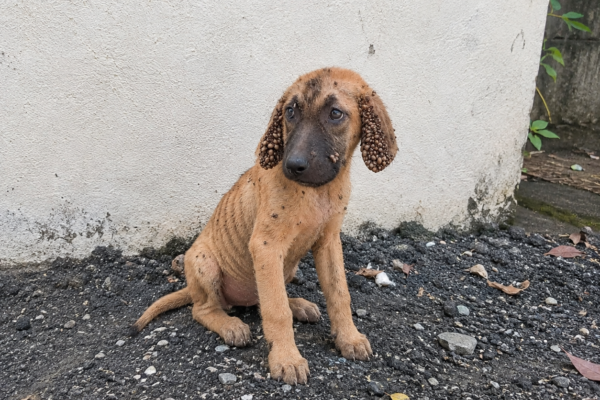
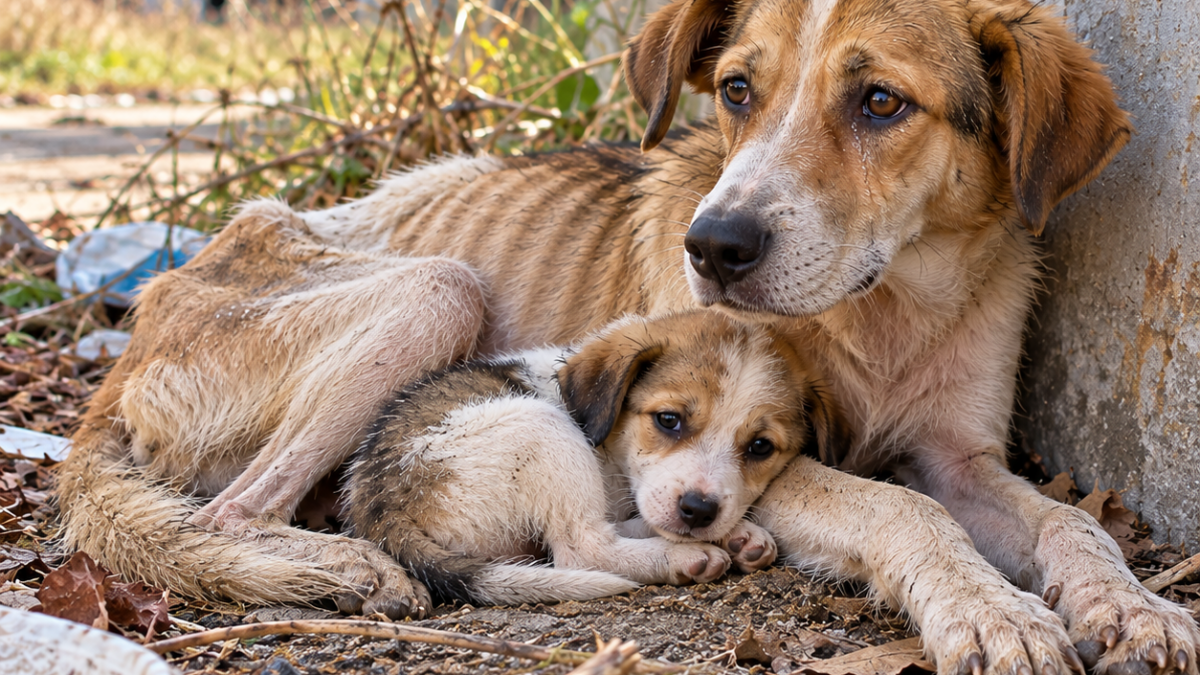
The innocent puppy stayed close to his mother without understanding that she was crying because she had exhausted herself trying to keep him alive.
She had almost no strength left and no milk to give, yet for days she seemed to plead for help while people passed without stopping.
When I finally saw them, I thought I was looking at one desperate mother and one fragile puppy, but there was something nearby I had not discovered yet.
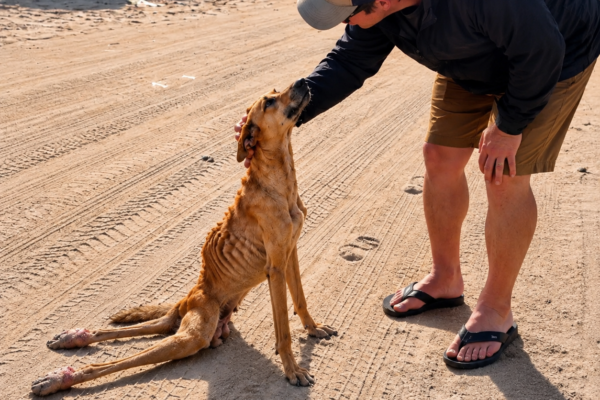
The mother dog was completely exhausted.
Her body looked as though every small reserve of strength had already been used.
She could barely move, and standing was almost impossible.
For days, she had cried and seemed to ask for help, but no one had stopped.
Beside her was a tiny puppy who could not possibly understand why his mother had become so weak.
He stayed close to her.
He did not know why she had no milk.
He did not understand why she could not simply stand up and take care of him the way a mother normally would.
He only knew that she was there.
Watching them together broke something inside me.
I could not hold back my tears when I saw how thin she was and how helpless the puppy seemed beside her.
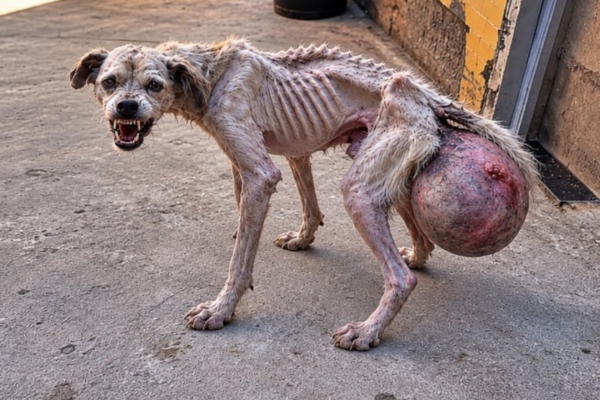
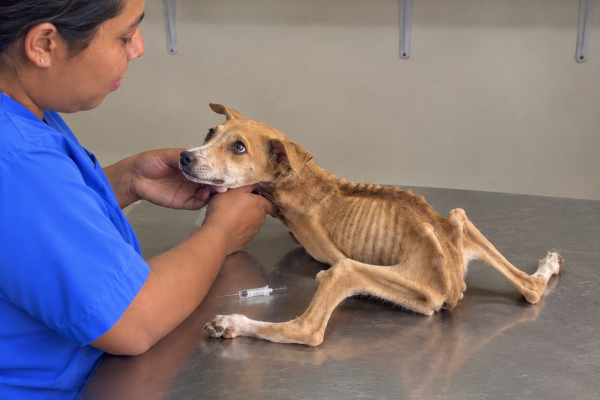
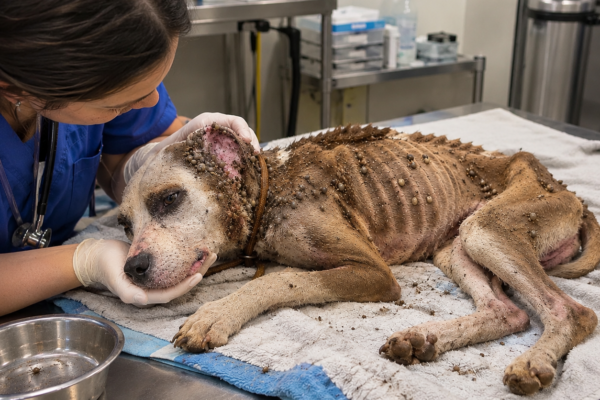
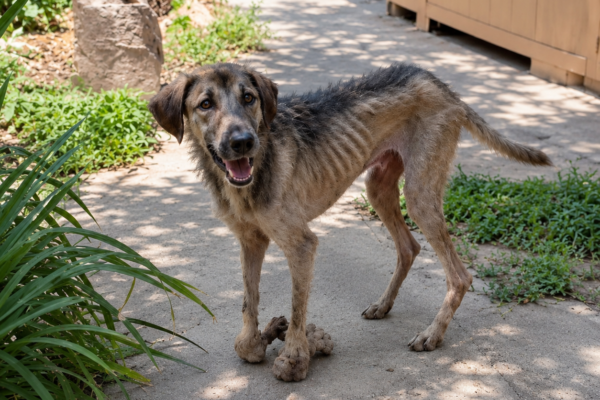
Her body was almost nothing but skin and bones.
She had pushed herself far beyond what she could physically sustain while trying to raise her young.
The little puppy was struggling too.
He was actually in the most serious condition of all.
Neither he nor his mother could properly get up.
Yet the puppy still moved toward her whenever he could.
He seemed to sense the change in her when help finally arrived.
He began kissing his mother again and again, pressing close to her face as though trying to comfort her in the only way he knew.
And something changed in her too.
The crying stopped.
Looking at her then, I felt as though she understood that she was no longer completely alone.
I had first believed there were only two of them.
Then we looked around the area more carefully.
That was when we found two more puppies nearby.
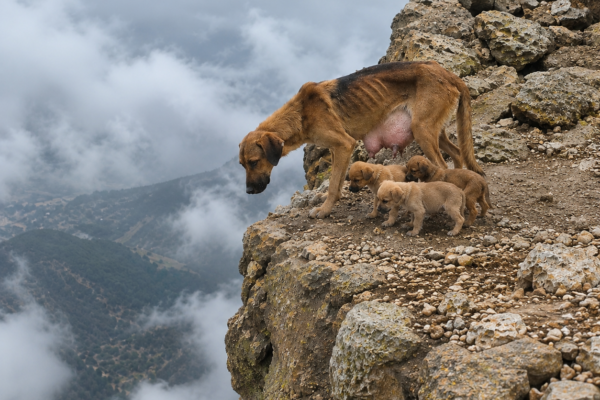
Paula, as I came to know the mother, did not have one puppy.
She had three.
All three had been surviving beside a mother who had already given almost everything her body had.
Paula was severely weak and malnourished.
One of the puppies was especially fragile and could not stand.
Another puppy had a noticeably different coat color from the others, but they shared one obvious behavior.
They were constantly hungry.
Food became the center of their attention.
Whenever it appeared, they ate eagerly, almost as if they feared it might disappear before they had enough.
It felt as though the harsh conditions they had lived through had taught them not to trust that another meal would come soon.
Paula seemed to carry that same fear.
Even when food was available, there was an urgency in the way she responded to it.
We made sure nutritious food was prepared for all of them, and chicken quickly became their favorite.
They were finally safe.
They were being watched closely.
They were receiving special care.
But recovery was not immediate.
After one week, I had hoped to see a dramatic improvement.
Instead, we were still worried.
The weakest puppy had not fully recovered and still could not walk on his own legs.
Paula was struggling in much the same way.
She needed a wheelchair to help her move around.
Seeing the mother and her puppy still unable to use their legs normally after everything we were doing frightened us.
Why was recovery taking so long?
We could only continue caring for them and wait.
Then the third week arrived.
For the first time, I could finally breathe with relief.
Paula and her puppies had recovered.
They could stand.
They could walk.
They could move wherever they wanted on their own feet.
And when they finally left the veterinarian behind, I could not hide how happy I was to see a family that had once been almost too weak to rise begin moving forward together.
**[END OF FACEBOOK OPENING — PART 1]**
When I first saw Paula, I did not know her name yet.
I only saw a mother dog whose body seemed to have reached its limit.
There are images that make you understand a situation before anyone has to explain it to you, and hers was one of them. She was lying there with almost no strength left, her body painfully thin, her frame showing through in a way that made it obvious she had not been receiving what she needed.
Beside her was a puppy.
He was so young that the world around him still seemed to be something he accepted rather than understood. He did not know what malnutrition meant. He did not know why his mother had no milk. He could not understand why she was unable to stand and care for him the way instinct had taught him to expect.
He only knew his mother.
And he stayed close to her.
That was the first thing that made the scene so difficult for me to look at.
The puppy’s innocence made Paula’s exhaustion feel even heavier.
He did not know that she had already given everything she could.
He did not know that the body beside him was weak partly because she had been trying to raise him and his siblings under conditions that had left her with almost nothing.
He did not know that when he searched for milk, there was little or none for her to give.
He did not know that she had been crying.
He did not know that, for days, she had seemed to be asking people for help.
He did not know that no one had stopped.
He was simply a puppy.
His needs were immediate and uncomplicated.
He was hungry.
He wanted warmth.
He wanted his mother.
And Paula, despite her condition, was still there.
That contrast was painful.
The mother had reached exhaustion.
The puppy had not yet reached understanding.
I remember looking at Paula and feeling that her weakness told the story more clearly than words could.
Her body was reduced almost to skin and bones.
It was difficult to imagine how she had continued trying to care for puppies in that condition.
Yet she had.
Whatever strength she had possessed had been spent on them.
She was so weak that even standing was beyond her.
The puppy near her was not much better.
He was the most serious case among them, although I did not know yet that there were more puppies waiting nearby.
At that first moment, all I saw was one mother and one baby.
The mother could not stand.
The puppy could not properly get up either.
And still, they reached for each other.
That was what brought tears to my eyes.
It was not only the physical condition.
It was the relationship between them.
The puppy had no solution to offer.
He could not bring food.
He could not find help.
He could not understand why his mother was crying.
But he could stay close.
He could touch her.
He could kiss her face.
That was what he did.
When I came near and the atmosphere around Paula began to change, the puppy seemed to feel it too.
I cannot know exactly what he understood.
I do not know whether he recognized that help had finally arrived.
But his behavior changed.
He moved toward his mother and kept kissing her.
Again and again.
His tiny gestures seemed almost like reassurance.
To me, it felt as though he was telling her the only thing he knew how to say.
I am here.
Paula’s crying stopped.
That moment stayed with me.
I do not want to turn it into something more mystical than it was.
She was an exhausted dog who had been under enormous stress.
But when I watched her stop crying while her puppy pressed close and we began helping them, I felt as though some of the unbearable pressure inside her had eased.
For the first time, perhaps she no longer had to manage everything alone.
She did not need to keep calling out into a world that had ignored her.
Someone had finally stopped.
That alone changed the situation.
I knelt near them and looked around.
At first, I thought the rescue was going to be about these two.
A mother and her fragile puppy.
But something did not feel complete.
The surroundings deserved another look.
We searched nearby.
That was when we found the other puppies.
There were two more.
Paula had not been caring for one puppy.
She had been trying to keep three alive.
The discovery explained even more about her condition.
Three puppies meant three hungry little bodies depending on one mother whose own body had already been depleted.
Three puppies wanting food.
Three puppies needing warmth.
Three puppies following a mother whose strength was disappearing.
The more I looked at Paula, the more the extent of her exhaustion became understandable.
She had not simply become thin.
She had exhausted herself while raising them.
That was the reality in front of us.
We gathered the puppies carefully.
All three needed attention.
One had a different coat color from the others, making him easy to distinguish, but appearance quickly became secondary to condition.
The puppy beside Paula, the one I had seen first, was the most worrying.
He was extremely weak.
He could not stand properly.
Paula could not stand either.
Seeing a mother and her baby both unable to rise created a particular kind of fear.
When an animal is hungry but walking, you can at least see some reserve of energy.
When an animal is lying there unable to get up, the situation feels different.
Every movement becomes important.
Every breath catches your attention.
Every attempt to shift position makes you watch closely.
Paula had reached that stage.
So had the weakest puppy.
Getting them into care became the only thing that mattered.
There was no need for a dramatic speech.
There was no point asking how anyone could have passed them without helping.
Those thoughts came naturally, but they could wait.
Paula could not.
The puppies could not.
They needed food.
They needed medical care.
They needed somewhere safe enough that their bodies could stop spending energy simply surviving.
We took them in.
From that moment, their world became very different.
For the first time in who knew how long, nutritious food was prepared specifically for them.
They were watched closely.
They received special care.
They no longer had to depend entirely on Paula’s exhausted body.
That part mattered enormously.
Paula had already carried too much.
She had no milk.
She had no strength.
Yet the puppies’ hunger had not disappeared just because their mother could no longer feed them.
Now, food came from another source.
And the way they reacted to it told me how deeply hunger had shaped them.
They ate with urgency.
All of them seemed hungry almost constantly.
Food arrived, and their attention locked onto it.
It did not feel like ordinary puppy enthusiasm.
There was desperation mixed into it.
Their difficult circumstances had taught them something painful very early.
Food could not be assumed.
A meal in front of them did not necessarily mean another meal would come later.
Paula seemed to carry the same uncertainty.
Even after she was safe, her behavior around food suggested that she still expected scarcity.
She appeared to think I might take it away.
Or that a long time might pass before food appeared again.
I could not explain to her that things had changed.
I could only show her.
The bowl stayed.
Another meal came later.
Then another.
No one took food from her as punishment.
No one forced her to compete for what she needed.
There was enough.
That lesson had to be repeated through experience.
At first, the repetition did not seem to calm her completely.
When an animal has been hungry for long enough, a full bowl does not instantly erase the memory of emptiness.
The body remembers urgency.
The eyes follow food.
The animal eats as though every bite must be secured before the opportunity disappears.
That was what I saw with Paula and the puppies.
They ate.
Then they looked for more.
Their bodies needed nutrition, but something emotional seemed to sit beside that physical need.
They did not trust abundance yet.
Chicken quickly became their favorite.
Whenever chicken appeared, their interest became obvious.
It was one of the first details that gave the difficult days a little warmth.
For a while, everything about them had been weakness, worry, and feeding schedules.
Then we started learning preferences.
They liked chicken.
That simple fact made them feel more like individuals and less like patients.
It reminded me that beneath the malnutrition and exhaustion were dogs capable of enjoying things.
The puppies did not know they were part of a rescue story.
They knew food tasted good.
They knew warmth felt better than cold.
They knew their mother was nearby.
They knew tiredness.
And gradually, they learned that meals kept coming.
Paula learned too.
Her recovery, however, was not quick.
I wish I could say that proper food and care produced an immediate transformation.
That would have been easier.
But one week passed, and the situation was still serious.
I looked at the weakest puppy and felt the same worry tightening inside me.
He had not recovered completely.
He still could not walk on his own legs.
His body had been through too much.
The food was helping.
The care mattered.
But neither could reverse everything overnight.
Paula was struggling too.
She still could not move normally.
To help her get around, she had to use a wheelchair.
Seeing her supported that way was difficult.
At the same time, the wheelchair gave her a chance to move when her own body could not yet manage it.
The image of her using it stayed with me because it showed both sides of her condition.
She was still very weak.
But she was not being left helpless.
She had support now.
The weakest puppy did not have that independence yet.
He could not stand and walk normally.
I watched him closely.
Every little attempt mattered.
If he shifted his body, I noticed.
If he tried to push himself up, I watched.
If he tired quickly, I worried.
The same was true with Paula.
A week of care had passed.
The food was nutritious.
They were receiving attention.
They were safe.
Yet the improvement I desperately wanted was not fully visible.
That was when the question began repeating in my mind.
Why is this taking so long?
I knew recovery could require patience.
But knowing that does not make waiting easy when you love the animal in front of you.
Every day, I wanted proof that their bodies were responding.
I wanted Paula to stand.
I wanted the puppy to stand.
I wanted to see them walk without help.
I wanted to believe the danger had passed.
Instead, we were still in the middle of uncertainty.
Paula’s face had already begun to look different because she was no longer carrying the same desperate burden alone, but her body remained fragile.
Her thinness had not vanished.
Strength had to return slowly.
Food needed time to become weight.
Rest needed time to become energy.
Care needed time to become recovery.
The puppies were in the same process.
Their hunger remained intense.
When meals came, they ate eagerly.
The different-colored puppy stood out visually, but behaviorally they all shared that same powerful relationship with food.
They had known too much hunger too early.
Watching them eat could make me happy and sad at the same time.
Happy because there was enough now.
Sad because their urgency reminded me that there had not always been enough.
Paula often watched the food carefully.
Sometimes I felt as though she expected me to remove it.
I wanted to tell her, “You don’t have to worry.”
But words were not the solution.
Another bowl was.
And another after that.
Trust was built by repetition.
So we kept feeding them.
We kept caring for them.
We kept watching.
We kept waiting.
The first week ended without the complete recovery I had hoped for.
The second week became an exercise in patience.
There were no dramatic new events.
There did not need to be.
Our days revolved around the same essential things.
Nutrition.
Rest.
Observation.
Movement.
The puppies.
Paula.
Their condition.
Their progress.
I began to understand that sometimes rescue is not defined by the moment an animal is found.
Sometimes the real work begins afterward, in the quiet period when nothing appears to change quickly enough.
You feed an animal and want to see strength immediately.
You provide safety and want fear to disappear.
You offer care and want the body to respond.
But living bodies do not follow our emotional schedules.
Paula’s body had been pushed far beyond normal exhaustion.
She had raised three puppies while severely malnourished.
Her muscles were weak.
Her whole condition reflected deprivation.
One week of food could not erase that.
The weakest puppy had suffered too.
His small body had started life under harsh conditions.
He needed time.
Knowing that helped me remain patient, but it did not remove the worry.
Whenever I saw Paula in her wheelchair, I wondered how long she would need it.
Whenever I looked at the puppy still unable to walk independently, I wondered when his legs would finally carry him.
The other puppies were part of that same circle of care.
They were stronger, but they were not ignored.
All three needed nutrition.
All three had come through the same difficult beginning.
All three deserved attention.
Their mother deserved even more rest now that others could share the responsibility she had carried alone.
Sometimes I watched the puppies near Paula and remembered the first one kissing her face.
That image became a kind of symbol for me.
He had not known how to help her.
But now other people did.
He no longer had to solve a problem he could not understand.
Paula no longer had to produce milk from a body that had nothing left to give.
The puppies could eat from prepared food.
Paula could eat too.
There was enough for everyone.
It sounds simple when stated that way.
But after seeing hunger dominate their behavior, “enough” felt powerful.
Enough food.
Enough time.
Enough care.
Enough patience.
Those were the things they had been missing.
Gradually, tiny changes became easier to notice.
Paula became more alert.
The puppies’ movements gained energy.
Their bodies were still recovering, but life was beginning to occupy more space than weakness.
The same puppies who had seemed defined by hunger began to show curiosity.
The same mother who had been almost unable to stand began engaging more with what was around her.
Still, I did not allow myself to relax completely.
I had been frightened by how slowly the first week passed.
I wanted clear proof.
The third week brought it.
By then, something had changed decisively.
Paula recovered.
The puppies recovered.
The weakest puppy, the one who had not been able to walk on his own, could use his legs.
Paula no longer remained trapped in the same helpless condition.
They could move.
They could go where they wanted on their own feet.
When I saw that, I finally let out the breath I felt as though I had been holding for weeks.
Relief can arrive quietly.
It does not always look like celebration.
Sometimes it is simply realizing that you are no longer watching every movement in fear.
Sometimes it is seeing an animal stand and understanding that the thing you had been waiting for has happened.
Paula stood.
The puppy stood.
They walked.
That was enough to change everything.
I thought back to the first day.
Paula lying there.
Her body almost nothing but skin and bone.
The puppy beside her unable to help.
The tears.
The exhaustion.
The discovery of two more puppies.
The frantic hunger.
The uncertainty.
Then I looked at them three weeks later.
They were moving.
The difference was enormous.
The veterinarian was no longer a place they had to remain because they were too weak to go anywhere else.
They could leave.
When the time came for them to come out of veterinary care, I felt happiness rise in me so quickly I could not hide it.
There was no need to pretend calm.
I was happy.
Completely happy.
The mother who once could not stand could now explore.
The puppies who had begun life in hunger could move around on their own legs.
Their recovery had not come in the first week.
But it came.
That mattered more.
When Paula arrived at the house, she explored everything.
It was all new to her.
Watching her move through the home felt especially meaningful because I remembered the wheelchair.
Every step was a reminder of how far she had come.
She looked around.
She investigated.
She took in the unfamiliar environment.
I let her do it at her own pace.
There was no need to push her.
She had already been through enough.
The house was new.
The smells were new.
The rooms were new.
The feeling of being inside a safe place was something she had to learn.
The puppies explored too.
Their energy made the house feel different immediately.
The three little dogs who had once clustered around an exhausted mother were now discovering a world larger than hunger.
Their relationship with food still stood out.
Meals continued to matter enormously to them.
The memory of scarcity seemed slow to fade.
When they ate, they ate enthusiastically.
Chicken was still a favorite.
That detail never stopped making me smile.
After everything serious we had worried about, it was nice to have something as simple as a favorite food.
It meant we were no longer talking only about survival.
We were learning what made them happy.
Paula’s own relationship with food gradually softened.
The more meals came regularly, the less reason she had to fear that the next one might not appear.
Again, I cannot know exactly what she thought.
But I could see the change in behavior.
She did not have to live with the same urgency forever.
Consistency was teaching her something different.
Food was not disappearing.
People were not taking it away.
There would be another meal.
Then another.
The same principle applied to everything else.
She was safe today.
She would still be safe tomorrow.
The puppies were with her.
They were fed.
She did not need to sacrifice what little strength she had left trying to provide what her body could no longer produce.
The responsibility had shifted.
For the first time, Paula could simply recover.
That was one of the most emotional parts of caring for her.
Mothers are often seen only through what they give.
Paula had given until she had almost nothing left.
But now she was allowed to receive.
Food.
Rest.
Medical care.
Support.
Safety.
She did not have to earn those things by taking care of the puppies first.
They were hers too.
I watched her become stronger and thought about how different she looked from that first day.
Her coat began to look better.
Her body gradually filled out.
Her face no longer carried the same defeated exhaustion.
Confidence appeared slowly.
At first, it was subtle.
The way she moved into a room.
The way she looked around.
The way she approached food.
The way she interacted with us.
Later, the difference became impossible to miss.
But before that transformation was complete, there was another important part of the story.
The puppies had futures of their own.
Two months passed.
Those two months contained no invented drama.
They were simply the continuation of recovery and growth.
The puppies ate.
They moved.
They became stronger.
They lived safely.
They learned that food came regularly.
They learned that hands could bring care.
They learned that a home could contain warmth rather than danger.
And then happiness began arriving for them one by one.
The puppies were adopted.
Good families welcomed them.
That part filled me with a complicated emotion.
I had spent so much time worrying about whether they would survive that it was almost strange to reach a point where the question became where they would live.
Survival had once been uncertain.
Now they were healthy enough for a future.
Each adoption represented a separate life beginning.
I did not invent details about those families because the source does not provide them.
I only knew they were good families.
They loved the puppies.
They cared for them.
A good future was waiting.
That was enough.
The first time I looked at those puppies, I had not been able to imagine much beyond the next meal.
Now I could think about homes.
Families.
Care.
The contrast was overwhelming.
The weakest puppy, the one who once could not stand on his own feet, no longer faced the world from that helpless position.
He had recovered.
He could walk.
He could leave for a home of his own.
The differently colored puppy, once distinguished mainly because of his coat, now had a family too.
The third puppy did as well.
One by one, Paula’s babies moved into safe lives.
For Paula, motherhood had finally changed.
She no longer had three starving little bodies depending entirely on her.
She no longer had to give milk she did not have.
She no longer had to use the last of her strength protecting them.
Her puppies were safe.
They had recovered.
They were loved.
And after spending so much of herself keeping them alive, Paula finally reached a moment where her own future mattered.
That was when I looked at her and almost had to ask myself the same question I might have asked someone who had only seen the beginning.
Do you recognize Paula?
Because she looked so different.
The dog in front of me no longer resembled the broken mother I had first found.
Her body had changed.
But the transformation was not only physical.
She looked more confident.
She moved differently.
Her presence felt different.
There was life in her again.
The fear and exhaustion that had shaped her face had softened.
She was more beautiful, yes, but beauty was not only about appearance.
It was the confidence.
The peace.
The way she occupied space as though she finally believed she had the right to be there.
That was the Paula I was getting to know.
The puppies had been adopted.
Paula stayed.
She became a member of our family.
There was no need for another dramatic event to justify that decision.
By then, she already belonged with us.
We had seen her at her weakest.
We had watched her in the wheelchair.
We had waited through the slow first week.
We had worried when recovery did not seem fast enough.
We had celebrated when she walked.
We had watched her explore the house.
We had fed her.
We had learned how much she loved chicken.
We had watched her puppies grow strong enough to leave.
Paula’s place in our lives had formed naturally through all of those ordinary moments.
Keeping her did not feel like starting a new story.
It felt like continuing the one already happening.
She was family.
The sentence was simple.
The journey to it was not.
Sometimes I thought about the first days when she cried.
The source says she had asked for help for several days and no one stopped.
I could not know every person who passed.
I did not know what they saw or why they did not stop.
But I knew what Paula experienced.
She remained there.
Weak.
Without milk.
With three puppies.
Waiting.
Her cries had gone unanswered until the day we found her.
Now, when I saw her inside our family, I felt the weight of that silence differently.
It was no longer the final answer she received.
Someone eventually stopped.
Help eventually came.
That did not erase the days before.
But it changed everything that followed.
Paula’s story became one of the clearest reminders I had ever received that motherhood can hide suffering.
When people saw the puppies, their attention naturally went to them.
Puppies are small.
They are vulnerable.
They make people want to protect them.
But Paula had been the one carrying the greatest burden.
She was their source of warmth.
Their source of milk until her body could no longer provide it.
Their protection.
Their center.
She had exhausted herself so completely that she could no longer stand.
Her condition was not a sign that she had failed them.
It showed how much she had already spent.
That understanding changed the way I looked at her.
I never saw her as simply an unhealthy dog.
I saw a mother who had given too much because there had been no one else to give.
When help arrived, the goal was not only to save the puppies.
It was to save Paula from having to keep sacrificing herself.
That was why seeing her eat mattered.
Every bite she swallowed was something she kept for her own body.
Every hour she rested was time she did not have to spend searching for food.
Every moment the puppies were fed by us was a moment she did not have to produce what she no longer had.
Recovery was not selfish.
It was necessary.
Paula had earned the right to receive.
Watching her learn that was beautiful.
At first, her hunger made her anxious.
She watched food intensely.
She seemed afraid it would disappear.
But as days became weeks, the pattern changed.
Food arrived reliably.
The bowl was not a rare event.
Chicken was not a once-in-a-lifetime prize.
There would be more.
That kind of consistency can look boring from the outside.
For Paula, it was life-changing.
The harsh conditions that had shaped her behavior were no longer present.
Now she could develop new expectations.
She could expect to eat.
She could expect to rest.
She could expect us to be there.
That was confidence being built in the simplest possible way.
One day at a time.
The same was true for the puppies before they left.
Their beginning had taught them to eat as though every meal might be the last.
Their new environment taught them otherwise.
A bowl emptied.
Another came later.
They did not need to panic.
They did not need to compete desperately.
They were safe.
The nervous urgency around food gradually became something lighter.
Excitement.
Preference.
Enjoyment.
Chicken.
The transition from desperate hunger to simply loving a favorite food felt almost miraculous, even though nothing supernatural had happened.
That was the kind of recovery I treasured.
Not a dramatic transformation for an audience.
A practical transformation inside daily life.
The puppies could be puppies.
Paula could be Paula.
No one had to live entirely inside survival anymore.
After three weeks, their bodies had recovered enough to move freely.
After two months, the puppies were ready for their own homes.
Those time markers mattered to me because they showed both how fragile they had been and how quickly life can change when basic needs are finally met consistently.
One week had felt frighteningly slow.
Three weeks brought relief.
Two months brought separation for a good reason.
Each stage had its own emotion.
During the first week, I worried.
During the third, I celebrated.
At two months, I felt both happiness and the tenderness of saying goodbye to puppies whose lives had become connected to mine.
I did not want to keep them simply because letting go was difficult.
They had good families waiting.
That was the goal.
The puppies deserved homes where they could be loved individually.
Paula deserved time to become more than a mother in crisis.
So one by one, they left.
The house became quieter.
For Paula, that quiet must have felt different from the silence of the beginning.
Before, silence had surrounded weakness and unanswered cries.
Now quiet came after her puppies were safe.
That made all the difference.
She could rest without needing to monitor three hungry babies.
She could move through the house without them constantly depending on her.
She could discover who she was when survival was no longer her only responsibility.
That was when her confidence seemed to grow most clearly.
I saw her explore.
I saw her become comfortable.
I saw her respond to us.
The dog who had once been unable even to stand began carrying herself with a kind of quiet dignity.
Her body filled out.
Her coat looked better.
Her eyes looked brighter.
Her movements were sure.
When people who remembered the beginning saw her, the difference was striking.
“Do you recognize Paula?” was not really a question about her identity.
It was a question about transformation.
Could this confident dog truly be the same mother who had once been lying there, crying, with no milk and no strength?
Yes.
It was Paula.
The same dog.
The same mother.
But finally supported.
Finally fed.
Finally safe.
That distinction mattered.
Paula had not become valuable after she recovered.
She had been valuable when she was skin and bones.
She had been valuable when she could not stand.
She had been valuable when her body had nothing left to give.
Recovery only allowed the rest of us to see more of who she already was.
Her beauty afterward did not erase the beauty of her effort before.
It simply gave her a chance to live without being consumed by that effort.
I came to love that about her story.
There was no need to turn suffering into something noble.
Her suffering was painful and unnecessary.
What mattered was that it stopped.
What mattered was that help replaced neglect.
What mattered was that food replaced hunger.
What mattered was that strength returned.
What mattered was that her puppies survived.
What mattered was that Paula finally got a home too.
She became part of our family.
That decision gave me a deep sense of peace.
The puppies had moved into good homes.
Paula did not have to wonder where she belonged next.
She belonged with us.
Her life after rescue did not need to become complicated.
It could be ordinary.
That was what I wanted for her.
Ordinary meals.
Ordinary rest.
Ordinary affection.
Ordinary walks around the home.
Ordinary days in which no one had to wonder whether she would survive until morning.
Sometimes the greatest happiness is the removal of crisis.
Paula taught me that.
There were no more days of crying for help.
No more puppies depending on a body without milk.
No more lying on the ground unable to stand.
No more wheelchair.
No more watching the weakest puppy struggle to use his legs.
No more waiting for evidence of improvement.
Those things moved into the past.
What remained was Paula.
Healthy.
Confident.
Beautiful.
Family.
I often thought about the puppy from the beginning.
The innocent one who had stayed beside her without knowing why she was crying.
He had been the most serious case.
He had not been able to stand.
There was something almost unbearable in remembering his little body pressed against hers, kissing her face as though love itself might be enough to fix what hunger had done.
At that moment, he could not help her physically.
But his closeness mattered emotionally to me.
He reminded me that animals can remain connected even when they have nothing material to give each other.
He had no food.
No medicine.
No strength to carry his mother.
But he had affection.
Later, we provided what affection could not.
Nutrition.
Veterinary care.
Support.
Time.
Together, those things gave Paula and the puppy a chance to recover.
That was why I never wanted to exaggerate the meaning of the puppy’s kisses.
They did not cure Paula.
They did not replace medical care.
They did not solve malnutrition.
But they were still meaningful.
They were the gesture of a baby staying near his mother when neither of them understood what would happen next.
That was enough.
After they recovered, watching the puppy stand on his own legs felt like an answer to that first scene.
He no longer had to lie beside her helplessly.
He could move.
He could explore.
Eventually, he could go to his own family.
The puppy had a future.
Paula had a future.
The other two puppies did too.
That was the miracle, if I can use that word without making it magical.
The miracle was not a sudden cure.
It was that care continued long enough for their bodies to respond.
The first week tested our patience.
The third rewarded it.
The second month opened new doors.
Every stage was connected.
If we had judged progress after one week and given up because the puppy still could not walk, we would never have seen the third week.
If we had assumed Paula’s need for a wheelchair meant she would never recover, we would have been wrong.
Their bodies needed time.
Time became part of the treatment.
That lesson stayed with me.
When we love an animal in crisis, we often want the story to move faster than biology allows.
We want the moment of rescue to be followed immediately by visible happiness.
But sometimes the animal remains weak.
Sometimes they continue to struggle.
Sometimes the first week looks disappointingly similar to the first day.
That does not mean care is failing.
Paula reminded me of that.
Her recovery was not instant.
It was gradual.
And because I had worried through the slow days, the moment she stood felt even more powerful.
I remember looking at her legs carrying her weight and feeling almost stunned by something that would ordinarily seem so simple.
A dog standing.
A dog walking.
Those are things people barely notice until an animal loses the ability to do them.
Then every step becomes precious.
Paula’s steps were precious.
So were the weakest puppy’s.
At first, they needed help.
Then, after three weeks, they could go anywhere on their own feet.
That sentence gave me more joy than almost anything else in the story.
They could go anywhere.
Not literally anywhere in the world.
But within the life in front of them, movement was theirs again.
Paula could explore the house.
The puppies could move around.
No wheelchair.
No helplessness.
No body pinned to one place by weakness.
Freedom had returned in the form of working legs.
I watched them move and thought about how quickly we take movement for granted.
Paula did not.
At least, that was how it felt to me as I watched her investigate the new home.
Everything interested her.
Rooms.
Corners.
Smells.
Objects.
The world had become something to explore rather than something to endure.
That difference was visible in her posture.
Confidence changes the way an animal enters a room.
Paula once seemed to make herself small because her body had no strength.
Later, she walked as though the space welcomed her.
And it did.
The house had become hers too.
As the puppies prepared to move into their adoptive homes, I spent time simply watching them.
They were no longer the fragile babies from the beginning.
Their bodies had filled out.
Their movements were stronger.
Their appetite remained good.
Their eyes had the brightness of young dogs experiencing new things.
I knew good families were ready to care for them.
That knowledge made letting them go easier.
Not easy.
Easier.
The purpose of helping them had never been to keep every dog with me forever.
It had been to give them the chance to reach the right future.
For the puppies, that future was adoption.
For Paula, it turned out to be us.
One by one, the puppies left.
Their departures changed the house.
Each absence was noticeable.
But it was not the painful kind of absence Paula had known before.
No one was being abandoned.
The puppies were leaving for families who wanted them.
That difference mattered enormously.
Separation can mean many things.
Paula’s early separation from help had been neglect.
The puppies’ separation from us was the result of recovery.
They were strong enough to go.
Healthy enough to be adopted.
Loved enough that other families wanted to take responsibility for them.
That was a happy separation.
I held onto that distinction whenever I missed them.
Paula remained.
Her life became quieter.
She had spent so much energy being a mother that I enjoyed seeing her simply exist as herself.
No puppies climbing over her.
No babies searching for milk she could not provide.
No desperate need to divide limited food.
No constant pressure.
She could eat her own meal.
Rest in her own place.
Follow us through the house.
Explore.
Receive affection.
That was the life she deserved.
The change in her appearance became more obvious with each passing day.
Her body no longer looked painfully hollow.
The severe thinness eased.
Her coat improved.
She looked beautiful.
But again, what struck me most was the confidence.
Confidence does not show up only in photographs.
It appears in small actions.
How quickly a dog approaches.
How comfortably she lies down.
Whether she watches every hand suspiciously.
Whether she moves through a doorway without hesitation.
Whether she eats with panic or with enjoyment.
Paula changed in those ways.
The fear of losing food diminished.
The uncertainty diminished.
The house became familiar.
We became familiar.
Life stopped feeling temporary.
That was when I knew she truly belonged.
I could not imagine sending her away after everything we had shared.
The thought did not fit anymore.
Paula was not waiting for a family.
She had one.
Ours.
The realization felt natural rather than dramatic.
She was simply there.
And we wanted her there.
That was enough.
Sometimes the best adoptions are not announced by a big moment.
They happen gradually until everyone realizes the dog is already home.
That was Paula.
Her bed was there.
Her food was there.
Her routines were there.
Our affection was there.
Her future did not need another transition.
She had already reached it.
I looked at her and thought about the phrase “the best things come to her.”
It felt right, but only if understood carefully.
Paula had not suffered so that she could be rewarded.
No animal needs to earn good things through pain.
She deserved them from the beginning.
The tragedy was that they had arrived late.
The happiness was that they arrived at all.
Food.
Care.
Recovery.
Her puppies’ safety.
A home.
Family.
Confidence.
Peace.
Those were the best things.
And now they were hers.
I never wanted her story to become only a sad memory.
When I thought of Paula later, I did not want the first image to remain the strongest forever.
Yes, she had been crying.
Yes, she had been weak.
Yes, she had been severely malnourished.
Yes, her body had been skin and bones.
Yes, she had been unable to stand.
Those facts mattered.
But so did what followed.
Paula walking.
Paula eating chicken.
Paula exploring the house.
Paula watching her puppies become strong.
Paula seeing them leave for good homes.
Paula becoming part of our family.
Paula growing more beautiful.
Paula growing confident.
Those images deserved equal space.
Maybe more.
Because rescue should not freeze an animal forever in the worst condition we first saw.
Paula changed.
She healed.
She became more than the dog we rescued.
She became the dog we lived with.
There is a big difference between those roles.
A rescued dog is often described through the past.
A family dog is described through the present.
Paula became present tense.
She is here.
She belongs here.
She is loved here.
That was the most important transformation.
I still thought about her puppies, of course.
Knowing they were in good families brought comfort.
The source tells me they were loved and cared for.
I did not need more detail than that.
Their futures were good.
That was what mattered.
Sometimes I imagined the differently colored puppy being immediately recognizable in his new home because of that coat.
Sometimes I remembered the weakest puppy and marveled that he could now walk wherever he wanted.
But I stopped my imagination there.
Their real lives belonged to their families now.
I did not need to invent scenes.
It was enough to know they were safe.
Paula seemed able to move forward too.
The intense focus she once had on feeding and protecting them eased.
She could become attached to us without the constant pressure of motherhood.
That new attachment felt strong.
She had survived the most difficult part with her puppies.
Now she could receive care without having to divide her attention.
She could allow herself to be loved.
That mattered to me.
Animals who have been through harsh conditions sometimes seem to carry an expectation that comfort will disappear.
Paula had shown that especially around food.
But consistency slowly challenged that expectation.
Meal after meal.
Day after day.
Night after night.
Nothing was taken from her.
The family remained.
The house remained.
Her place remained.
Confidence grew from that repetition.
That was why I never thought of her transformation as cosmetic.
Yes, she became more beautiful physically.
But confidence was the deeper change.
Beauty could be seen in a picture.
Confidence had to be lived with.
I saw it in her choices.
Her willingness to move freely.
Her ease around us.
Her calmer relationship with food.
Her curiosity.
Her ability to settle.
Those were the things that told me Paula was truly healing.
Sometimes I looked at her while she rested and remembered the mother who could not even stand.
The memory made the present almost unbelievable.
But the change had not happened in one leap.
I had watched every stage.
I knew how much time was inside that transformation.
The first frightening day.
The discovery of the three puppies.
The veterinary care.
The special food.
The constant hunger.
The favorite chicken.
The first week without enough improvement.
The wheelchair.
The puppy unable to walk.
The anxiety.
The second week of waiting.
The third week and relief.
The return home.
The exploration.
The two months.
The adoptions.
Paula remaining.
All of those steps were part of the dog resting calmly in front of me.
That was why she felt precious.
Not because she was fragile anymore.
Because I remembered when she had been.
I respected the strength it had taken for her body to recover.
I respected the devotion she had shown her puppies even while she was starving.
And I respected the trust she eventually placed in us.
That trust became part of our family.
I often wondered what the innocent puppy from the beginning would have understood about all of it.
Nothing in human terms, probably.
He did not know why his mother cried.
He did not understand malnutrition.
He did not understand veterinary treatment.
He did not understand adoption.
He knew sensations.
Hunger.
Warmth.
Pain.
Comfort.
His mother’s smell.
Food arriving.
Hands helping.
His legs slowly becoming strong enough to carry him.
A new family.
That was enough for his life to change.
Perhaps understanding is overrated in rescue.
Animals do not need to comprehend our explanations.
They need conditions to improve.
They need food.
Medical care.
Safety.
Patience.
Love.
The puppy received those.
So did his siblings.
So did Paula.
That was the practical heart of the story.
Help came.
And because it came, four lives changed.
When I think about the days no one stopped, I still feel sadness.
A mother had cried.
Her babies had been hungry.
She had no milk.
Her body was failing.
Yet people continued past.
But I do not want anger to become the center of Paula’s story.
Anger cannot feed a dog.
It cannot strengthen a weak puppy.
It cannot help a mother stand.
Action can.
Someone finally stopped.
Food was prepared.
Veterinary care was provided.
A wheelchair helped Paula move.
The puppies were monitored.
Weeks of care continued.
That was what changed the outcome.
The lesson for me was not simply that people had failed Paula.
It was that helping even after others have passed by still matters.
It is not too late merely because suffering has already happened.
Paula was in terrible condition when we found her.
But she recovered.
The puppy was in serious condition.
He recovered.
The two other puppies were hungry and weak.
They recovered too.
Late help was still help.
That thought comforted me.
It also made me grateful that we had arrived before it became even later.
I did not need to imagine what might have happened otherwise.
The source does not tell me, and I do not want to create tragedy that did not occur.
What happened was enough.
They survived.
They healed.
Their lives moved forward.
That was the truth worth holding.
By the time Paula became part of our family, the emotional meaning of food had changed in our home.
At the beginning, every meal carried fear.
Would there be enough?
Would it disappear?
Would they have to wait again?
Later, food became routine.
Chicken became pleasure rather than desperation.
A bowl was not a rescue event anymore.
It was dinner.
That ordinary shift meant more than people might realize.
When survival needs become routine, life can expand into other things.
Curiosity.
Play.
Rest.
Affection.
Confidence.
Paula finally had room for those.
Her puppies did too before they left.
I loved seeing that transition.
I loved when the dogs stopped looking like they were racing against hunger.
I loved when eating could simply be eating.
I loved when Paula could explore instead of conserve every ounce of energy.
I loved when the weakest puppy could walk instead of dragging his body through exhaustion.
I loved when the puppies became healthy enough for families to choose them.
I loved when Paula stopped being the mother everyone worried might collapse and became the dog people could barely recognize because she looked so much better.
Those were the best parts.
And none required inventing anything beyond what was already there.
Their recovery was enough.
Sometimes real improvement is more moving than any dramatic twist.
Paula proved that.
Her story did not need a villain to return.
It did not need a confrontation.
It did not need media attention.
It did not need another crisis.
A starving mother got help.
Her puppies got help.
They recovered.
The puppies found families.
Paula found ours.
That was enough.
More than enough.
The simplicity of the ending is what made it beautiful.
The dog who had cried because she could not provide for her babies ended surrounded by people who provided for her.
The puppies who had been constantly hungry ended in homes where families loved and cared for them.
The puppy who could not walk ended able to move on his own feet.
The mother who needed a wheelchair ended walking through a house she could explore freely.
The body that had been skin and bones became healthy enough that people might barely recognize her.
The frightened, exhausted dog became confident.
That was Paula.
The same dog.
Different circumstances.
Different future.
As she settled more deeply into our family, I stopped measuring every day against the rescue.
At first, I could not look at her without remembering what she had been through.
Later, I could simply look at her and see Paula.
That was a gift.
No animal should have to remain forever trapped in the identity of a victim.
Paula had a personality beyond suffering.
She had preferences.
She loved food, especially chicken.
She was curious.
She could explore.
She could become comfortable.
She could trust.
The more those parts of her emerged, the less the old condition defined her.
I still respected the past.
I simply did not let it take over her present.
Her present was good.
She was safe.
Her puppies were safe elsewhere.
She was loved.
She belonged.
Sometimes I wondered whether she missed the puppies after they left.
The source does not tell me, so I cannot claim what she felt.
What I can say is that she adapted.
She became part of our family.
She grew more confident.
Her life continued.
That was enough evidence that she had found stability.
I did not need to put human thoughts into her mind.
Her behavior told its own story.
She stayed.
She explored.
She relaxed.
She changed.
Those things mattered more than speculation.
There were evenings when I watched her from across the room and remembered the sound of her crying.
The contrast could still catch me unexpectedly.
A calm dog in a safe home.
A memory of a desperate mother asking for help.
Both were Paula.
The difference was what care could do.
It did not rewrite history.
It changed the present.
That was the power of rescue in its most realistic form.
You cannot undo suffering.
You can stop it from continuing.
You cannot give an animal back every meal they missed.
You can make sure the next one comes.
You cannot erase the days no one helped.
You can be the person who finally does.
You cannot make a mother’s exhausted body instantly strong.
You can feed it long enough that strength returns.
You cannot force frightened animals to trust.
You can remain consistent until they choose to.
Paula and her puppies taught me all of that without ever knowing they were teaching anything.
They simply lived through it.
The weakest puppy’s recovery remained one of the things I thought about most.
After one week, he still could not walk on his own legs.
That had frightened us deeply.
A week feels long when you are watching a small animal struggle.
Every day seems like it should bring visible improvement.
When it does not, your mind starts asking questions.
What if this does not change?
What if we are not doing enough?
Why is it taking so long?
Those questions had followed me.
Then, by the third week, he was walking.
That experience taught me not to confuse slow progress with no progress.
His body had been healing even when I could not yet see the result I wanted.
Paula’s was too.
Nutrition was working.
Rest was working.
Care was working.
Time was working.
Recovery was happening underneath the frustration.
When it finally became visible, it seemed sudden only because we had been waiting for one clear sign.
The sign was movement.
They stood.
They walked.
The waiting changed into relief.
I breathed easier.
I smiled more.
The whole emotional atmosphere around them shifted.
We no longer approached every day expecting another problem.
We could begin thinking about life beyond treatment.
Home.
Adoption.
Normal routines.
That transition was enormous.
For Paula, it meant exploring a house.
For the puppies, it meant becoming ready for families.
For me, it meant allowing happiness to replace fear.
I had spent so much time worrying that happiness initially felt almost unfamiliar.
Then it grew.
When the puppies were adopted, I felt proud of them in the strange way you can feel proud of animals who never knew how close you were to fearing for them.
They had done nothing intentionally heroic.
They had simply survived.
That was enough.
Their bodies had done the work of healing.
Their appetites had helped.
Their willingness to eat had mattered.
The veterinary care had mattered.
The nutritious meals had mattered.
Every person who cared for them had mattered.
Now the result was visible.
Healthy puppies going to families.
A healthy mother staying with ours.
I could not ask for a better outcome from the facts we had been given.
The differently colored puppy had once stood out because he looked unlike the others.
Later, I liked thinking that his difference would simply become one of the things his family loved about him.
Again, I did not invent details of that home.
I did not need to.
He was adopted by a good family.
That was enough.
The same was true for the others.
The source gave them a hopeful future.
I respected that.
I did not need to extend the story years ahead.
Their good homes were the ending of their part.
Paula’s ending remained with us in the present.
That was where I wanted to leave her too.
Not older.
Not at some imagined future milestone.
Not in a scene the source never gave me.
Now.
Paula healthy.
Paula confident.
Paula beautiful.
Paula family.
There is something deeply satisfying about ending a rescue story in the present when the present is good.
It allows the happiness to remain alive.
Nothing else has to happen.
No tragedy has to close the circle.
No additional twist is needed.
Paula has what she needed.
Her puppies have what they needed.
The story can rest there.
Sometimes I would look at Paula and say her name simply because I liked knowing she had one that belonged in our home.
Paula.
The dog who had once seemed almost invisible to the world had become someone we recognized instantly.
Her needs were known.
Her preferences were known.
Her presence mattered.
If she was hungry, we noticed.
If she moved to another room, we noticed.
If she rested, we let her rest.
If she wanted to explore, she could.
That attention itself was part of being family.
No one passed her by anymore.
No one ignored her cries.
She did not need to cry for help.
Help had become routine.
That was perhaps the most beautiful change of all.
When care becomes routine, crisis loses its hold.
Paula did not have to ask for what she needed through desperation.
Food simply came.
Safety simply existed.
Affection simply happened.
The house simply remained.
Her puppies were no longer in danger.
She could simply be.
For a dog who had spent every bit of energy trying to keep her young alive, being allowed simply to exist was a profound gift.
I watched her enjoy it.
The more relaxed she became, the more I felt my own relief deepen.
Her recovery had changed me too.
The image of her first day had frightened me.
The slow progress had made me impatient with time.
The third week had taught me relief.
The adoptions had taught me to let go.
Paula staying had taught me that some rescues become family almost before you realize it.
Each stage brought a different lesson.
But the strongest one remained simple.
Do not underestimate what consistent care can do.
Paula did not need one grand gesture.
She needed many ordinary ones.
Nutritious meals.
Medical attention.
Support for movement.
Time.
A safe place.
People who did not leave.
Her puppies needed the same.
That combination changed their lives.
It is easy to be drawn to dramatic rescue moments.
The first approach.
The first touch.
The moment an animal is lifted to safety.
But with Paula, the most meaningful moments happened afterward.
The fifth meal.
The tenth meal.
Another day of rest.
Another attempt to stand.
Another day in the wheelchair.
Another morning when the puppy still could not walk, but care continued anyway.
Those moments did not look dramatic.
They were the reason the third week happened.
Recovery was made from repetition.
The same repetition later built confidence.
A safe night.
Another safe night.
Food today.
Food tomorrow.
A person present today.
The same person present tomorrow.
Paula learned that security could repeat.
That was new.
That was why she changed.
By the time she became fully part of the family, the old fear around food no longer controlled every interaction.
She could enjoy chicken without acting as though it might be the last food she ever saw.
That shift made me smile.
A favorite food should be a pleasure, not a source of panic.
Paula deserved that ordinary pleasure.
She deserved to have preferences rather than survival strategies.
She deserved to be a dog rather than a constant mother in crisis.
I loved giving her that chance.
I also loved that her puppies received the same chance somewhere else.
Their families could know them as playful young dogs rather than as starving babies.
They did not have to remain emotionally tied to their beginning either.
Their story moved forward.
That was the meaning of the two-month mark.
Not merely that time had passed.
That enough had changed for new lives to begin.
Paula’s new life began with us.
She became more beautiful because health returned.
She became more confident because security became familiar.
She became family because love stopped being temporary.
The phrase “the best things come to her” felt like a promise already being fulfilled.
Not a promise of perfection.
A promise of ordinary good things.
Meals.
Warmth.
Care.
A place.
Belonging.
I did not need more.
Neither did she.
Sometimes I thought about how little the innocent puppy had understood on the first day.
His mother was crying.
He kissed her.
He stayed near.
He did not know she was exhausted because of the work of feeding and protecting him and his siblings.
He did not know that his hunger was part of the pressure crushing her body.
He did not know that she had no milk.
He did not know why she could not stand.
None of that was his fault.
He was a baby.
He needed what babies need.
The tragedy was that Paula had been left to provide without support until she could not.
Once support arrived, the whole family began to heal.
That was why I never looked at the puppy with blame.
His innocence was part of what made the scene so painful.
He loved his mother.
He needed her.
He could not understand that she needed someone too.
We became that someone.
Not because we replaced the bond between mother and puppy.
Because we supported it.
We fed them both.
We allowed Paula to stop carrying everything alone.
That is what help looked like.
The puppy could continue loving his mother without depending entirely on her failing body.
Paula could continue being near her babies without having to produce milk she did not have.
That balance saved them from the cycle they had been trapped in.
As Paula recovered, I sometimes saw her with the puppies and felt grateful that they were all getting stronger together.
There was no dramatic moment when she announced she felt better.
No words.
Just movement.
More alert eyes.
A stronger posture.
A body beginning to fill out.
The puppies becoming more active.
Those were the signs.
Then, eventually, walking.
When the wheelchair was no longer the center of Paula’s movement, I felt an enormous emotional release.
The device had helped her when she needed it.
I was grateful for that.
But seeing her move without it was different.
Her legs carried her.
The floor under her belonged to her again.
She could choose where to go.
For a dog who had been unable to stand, that freedom was huge.
I watched her use it to explore the house.
That detail always made me smile.
After weeks of being watched as a patient, Paula could finally be curious.
She could sniff around.
Look at things.
Choose directions.
That was health returning not only to the body, but to behavior.
Curiosity requires spare energy.
A starving animal does not have much of it.
Paula finally did.
The puppies did too.
That is why the house felt so different once they came out of veterinary care.
We were no longer surrounded only by worry.
There was movement.
Interest.
Appetite.
Personality.
Life.
It filled the rooms.
Then, after two months, the house gradually changed again as the puppies left.
One by one.
Good families.
Good care.
A good future.
I held those truths closely.
I never wanted to turn adoption into loss.
It was success.
The puppies had reached the point where someone else could continue loving them.
That was what we had hoped for.
Paula’s role in their survival had been enormous.
Now she could let them go without being physically drained by them anymore.
Whether she understood adoption the way I did did not matter.
What mattered was that her babies were safe.
And Paula was safe too.
She no longer had to follow them into the next stage.
Her next stage was with us.
That was where the story settled.
I found myself looking at her more often after the puppies were gone.
Without them around, Paula became even more visible as an individual.
Before, every thought about her had included motherhood.
Paula and the puppies.
The mother dog and her babies.
The family of four.
Now there was Paula.
Just Paula.
That allowed me to notice more.
The confidence in her movement.
The way she responded to attention.
The calm in her face.
The improvement in her body.
The beauty that emerged as health returned.
It felt as though I was meeting her again.
The first Paula had been buried under exhaustion.
The new Paula had room to show herself.
That was why I could ask, “Do you recognize Paula?”
The answer was yes.
But it was understandable if someone needed a second look.
She had changed so much.
Her body no longer told a story of starvation at first glance.
Her posture no longer screamed weakness.
Her eyes did not carry the same desperation.
She looked like a dog who belonged somewhere.
Because she did.
Our family.
That word still gave me satisfaction every time I thought it.
Paula had begun the story crying where people passed without helping.
She ended it in a family that saw her.
The difference was not abstract.
It was daily.
Someone filled her bowl.
Someone knew her favorite food.
Someone noticed her mood.
Someone cared whether she was comfortable.
Someone would act if she became ill.
Someone wanted her there.
That is what family meant for her.
And those things were the “best things” finally coming into her life.
I did not need to know what else the future would hold.
The source ended with hope.
I wanted to stay inside that hope.
Paula was healthier.
Her puppies were safe.
She was loved.
That was enough future for me.
If I extended beyond it, I would only be guessing.
There was no need.
The present was beautiful enough.
I looked at Paula and remembered the first time her crying stopped after the puppy kissed her and help surrounded her.
At the time, I had felt as though she was thanking me.
I knew that was my human interpretation.
But the feeling remained.
Her eyes softened.
Her body stopped carrying the same visible panic.
She seemed to understand, at least in the practical way animals understand changes in circumstance, that someone was finally doing something.
Now, months later, I looked at her confidence and felt that same sense more strongly.
She no longer needed to thank anyone.
She simply belonged.
That was better.
Gratitude was not the goal.
Safety was.
Trust was.
Health was.
A home was.
Paula had them.
The puppy who had once kissed her face was safe somewhere with a family.
His siblings were too.
The family that had once been bound together by hunger could finally spread into separate safe lives.
There was sadness in remembering where they began.
But happiness outweighed it now.
The story had earned that happiness through patience.
It did not arrive in the first week.
That detail remained important to me.
If I had written the story only from beginning to end quickly, I might have skipped how frightening that week was.
But living through it felt long.
Paula still could not move normally.
The puppy still could not walk.
We still wondered why recovery was taking so long.
The outcome was not guaranteed emotionally, even if I know it now.
That waiting taught me respect for slow healing.
The third week felt different because the first had been hard.
Every step Paula took carried the memory of the wheelchair.
Every step the puppy took carried the memory of his legs failing him.
The past amplified the joy.
That is why details matter.
A healthy dog walking is ordinary.
Paula walking was extraordinary to me.
A puppy running toward food is ordinary.
That puppy walking toward anything was a victory.
Three puppies being adopted is a happy event.
These three being adopted after what they had survived felt almost impossible.
Paula becoming family was beautiful.
Paula becoming family after being ignored while crying for help made it profound.
The circumstances changed the meaning of ordinary things.
That is what I carried forward from them.
I also learned not to judge an animal’s behavior around food too quickly.
Paula’s fear that food might be taken away was not greed.
The puppies’ constant hunger was not bad behavior.
It was history.
Their bodies and instincts were responding to scarcity.
Once I understood that, patience came more easily.
There was no reason to scold them for eating eagerly.
They needed to learn through abundance that panic was unnecessary.
That takes time.
Again, consistency did what explanation could not.
Food came.
Food stayed.
Food came again.
The lesson repeated.
Eventually, behavior changed.
That same principle applied to trust.
Safety came.
Safety stayed.
Safety came again the next day.
Trust grew.
Paula’s confidence was built that way.
Not through one emotional rescue moment.
Through hundreds of ordinary confirmations.
You are safe.
Still safe.
Still safe.
Again.
Again.
Again.
That repetition became the foundation of her new personality.
The beautiful, confident Paula did not appear from nowhere.
She was created by health returning and fear receding.
That transformation belonged to her.
We only made the conditions possible.
I liked thinking about it that way.
Rescue did not make Paula into something.
It gave Paula room to become herself.
The same was true for the puppies.
They did not owe us a specific personality.
They only needed the chance to grow.
Their adoptive families would discover who they were.
That part belonged to them.
Our role had been to get them there.
And we did.
Two months after the beginning, their lives were no longer centered on survival.
That was the success.
I sometimes wished the people who had passed Paula during those early days could have seen her later.
Not so I could shame them.
Not because I wanted revenge.
Simply because the transformation might have helped them understand what a difference stopping can make.
The dog they might have seen as hopeless was not hopeless.
The puppies they might have assumed were too weak recovered.
Three weeks.
That was all it took before Paula and the puppies could walk on their own.
Two months before the puppies were moving into families.
A small amount of time compared with an entire life.
Help mattered.
That was the message I took from them.
Not guilt.
Responsibility.
If you can help, help.
But I did not turn Paula’s story into a lecture.
She did not need that.
She needed to remain the center.
So when I looked at her now, I focused on what she had.
A home.
A family.
A strong body.
Confidence.
Good food.
Peace.
The puppies were no longer at risk.
She could stop mothering them through crisis.
She could simply be loved.
That was where I wanted her story to rest.
There are many ways to measure recovery.
Weight.
Mobility.
Appetite.
Energy.
For Paula, confidence became another measure.
At first, she was physically collapsed.
Later, even when her body improved, I watched for emotional change.
Would she still guard food anxiously?
Would she explore?
Would she relax in the home?
Would she accept us?
She did.
Those signs told me that the rescue had reached deeper than the surface.
Paula was not only surviving in a new place.
She was living there.
That distinction was important.
A dog can be physically safe and still remain emotionally tense.
Paula gradually stopped carrying the same tension.
Her body language softened.
Her movements became natural.
Her beauty returned because health and confidence arrived together.
I loved seeing both.
The first time she confidently walked through the house, I remembered her wheelchair.
The first time she ate without the same frantic urgency, I remembered the days she feared losing food.
The first time she settled comfortably as though the room belonged to her, I remembered the mother crying for help outdoors.
Those contrasts gave the present extra sweetness.
But over time, even I stopped comparing constantly.
Paula deserved to exist without always being measured against her suffering.
So I let her become ordinary.
That was a form of respect too.
She did not need me to tell the rescue story every day.
She needed me to live with her.
Feed her.
Love her.
Enjoy her company.
Let her be part of family life.
That was enough.
Her puppies were doing the same in their homes.
They did not need to remain “the rescued puppies.”
They could be someone’s dogs.
That was the point.
Rescue should eventually become life.
For Paula, it did.
Some mornings, I looked at her and almost laughed at the difference.
Not because what happened was funny.
Because she seemed so completely at home that the first image felt like another world.
The dog who could not stand was now walking around confidently.
The dog who had nothing left was now surrounded by enough.
The dog whose puppies were starving had seen all three grow strong and leave for loving homes.
The mother who had cried was now peaceful.
That kind of change invites disbelief.
But I had witnessed every step.
I knew it was real.
And that made me deeply happy.
The source ends with the idea that the best things are coming to Paula.
I understand that as hope grounded in what is already happening.
Her life had changed direction.
She was no longer moving toward exhaustion.
She was moving toward comfort.
No longer toward scarcity.
Toward enough.
No longer toward isolation.
Toward family.
Those were the best things.
I did not need to invent future years to prove the point.
The direction was already clear.
Paula was home.
That was enough to make the ending feel complete.
When I think of the entire story now, I return to two images.
The first is the puppy kissing his mother while she lay too weak to stand.
The second is Paula walking through the house, confident and curious.
Everything important happened between those two images.
Help arrived.
Two more puppies were found.
Food became regular.
Chicken became a favorite.
Medical care continued.
The first week brought worry.
The wheelchair supported Paula.
The weakest puppy struggled.
Time passed.
The third week brought recovery.
They walked.
They left veterinary care.
The house became new territory.
Two months passed.
The puppies found families.
Paula stayed.
That is the story.
Simple when listed.
Enormous when lived.
And the part that still moves me most is how little the puppy knew at the beginning.
He did not know his mother was crying because she had reached the end of her strength.
He did not know she had been sacrificing herself for him and his siblings.
He did not know help had failed to come for days.
He did not know what the future held.
He only knew to stay near her.
He kissed her.
Then help arrived.
Sometimes innocence and suffering exist side by side in a way that is almost unbearable.
But in Paula’s story, they did not remain there forever.
The puppy grew strong.
Paula grew strong.
The siblings grew strong.
The family survived.
That is what I choose to remember.
Not the helplessness.
The recovery.
Not the crying.
The peace afterward.
Not the hunger.
The meals that followed.
Not the wheelchair.
The walking.
Not the fear.
The confidence.
Not the possibility of loss.
The homes they found.
Paula taught me that the moment an animal looks most broken is not necessarily the moment that defines the rest of her life.
She looked exhausted beyond words when I first saw her.
If I had judged her future only by that body, I would have been wrong.
Inside the skin and bones was still a dog capable of healing.
Capable of becoming beautiful again.
Capable of confidence.
Capable of belonging.
She needed help reaching that version of herself.
Once she received it, she did.
The puppies were the same.
The weakest one could not stand.
That did not mean he never would.
One week without full recovery did not mean there would be no recovery.
The third week proved that.
I carried that lesson forward.
Patience can be as important as urgency.
Urgency gets an animal into care.
Patience keeps you there while healing takes its time.
Paula needed both.
We moved quickly when we found her.
Then we waited.
Fed.
Watched.
Supported.
Waited again.
That combination made the difference.
I am grateful we did not lose hope after the first week.
I am grateful we did not look at the wheelchair and decide Paula’s condition was permanent.
I am grateful we kept going.
Because three weeks later, the entire family was walking.
Two months later, the puppies were going home.
And Paula?
Paula had already found hers.
She became ours.
That was the ending I could not have imagined on the first day.
When I cried looking at her, I was thinking only about how much pain was in front of me.
Later, I cried for a different reason.
Happiness.
Relief.
Recognition.
The dog in front of me was still Paula, but her life no longer looked like the one we had found.
She had become a member of our family.
More beautiful.
More confident.
Loved.
Safe.
And every time I looked at her, I felt that the best part of her story was not that she had survived something terrible.
It was that she was finally allowed to live without having to survive every single day.
That difference meant everything.
Paula no longer needed to cry for help.
She no longer needed to exhaust herself trying to feed hungry puppies from a body with no milk.
Her babies no longer needed to press against her wondering why she could not give them what they needed.
They had grown.
They had healed.
They had families.
Paula had one too.
And now, when I looked at her, I did not see a mother who had failed.
I saw a mother who had given everything she had until help finally arrived.
I saw a dog who had been reduced to skin and bones and still found her way back to strength.
I saw confidence where there had once been fear.
I saw beauty where exhaustion had once hidden it.
I saw family.
The innocent puppy had not known why his mother was crying.
He had only known to stay close and kiss her.
In the end, he did not need to understand the whole story.
Neither did his siblings.
They only needed the chance to grow beyond it.
They received that chance.
So did Paula.
And when I see her now, safe inside our family, I no longer think first about the days when no one stopped.
I think about the day someone finally did.
I think about the food that kept coming.
The chicken they loved.
The wheelchair that helped Paula move when she could not yet move alone.
The frightening first week.
The third week when they stood.
The moment they walked.
The house Paula explored.
The puppies leaving for good families after two months.
And the dog who remained with us.
Paula.
Healthy.
Confident.
Beautiful.
Home.
The best things did not erase what she had suffered.
They simply gave her something stronger to live inside.
And now, at last, those good things belong to her.