They dumped their trash on my land—so after they insisted it was “their property,” I returned every piece gift wrapped to their front door.
They dumped their trash on my land—so after they insisted it was “their property,” I returned every piece gift wrapped to their front door.
They thought five quiet acres, an old fence line, and one divorced guy living alone meant they could keep crossing the boundary until I finally gave up.
What they didn’t know was that an old survey, a trail camera, and one photograph from the previous owners were about to turn their favorite excuse into a serious problem.
I bought the place in Bastrop County in 2016, after the kind of divorce that makes silence feel less lonely than conversation.
The house wasn’t impressive.
Three bedrooms, faded siding, a workshop that leaned slightly east, and a chicken coop I built after watching enough online tutorials to become dangerously confident with a circular saw.
But the land was mine.
Just under five acres of mesquite, stubborn grass, oak shade, and enough open sky that Austin felt much farther away than it actually was.
For years, the Calderons lived next door.
They were the ideal country neighbors because we mostly left one another alone.
Mr. Calderon helped me pull a tractor out of mud once.
His wife brought tomatoes over every August.
Nobody measured where somebody parked a mower.
Nobody needed to.
Then they sold.
The new owners arrived in March.
Ethan and Brooke Mercer were younger than I expected, maybe early thirties, driving a spotless white SUV and standing near our shared boundary with their phones raised like they were inspecting a property they had accidentally inherited from another planet.
I waved.
Ethan glanced at me.
Brooke didn’t.
Two weeks later, I walked toward my back pasture with coffee in one hand and found twelve contractor bags sitting fifteen feet inside my property.
They weren’t little kitchen bags.
They were the heavy black kind contractors use when they want something gone.
One had split open.
Food containers.
Broken cabinet hardware.
Packaging.
Chunks of drywall.
Part of a microwave.
I followed the tire tracks toward the Mercers’ place.
Ethan answered the door wearing socks, expensive joggers, and the expression of a man being interrupted by something beneath his pay grade.
“Those bags behind my fence are yours?”
He looked past me toward the field.
“We’re renovating.”
“That wasn’t the question.”
He sighed.
“We figured that area wasn’t being used.”
I stared at him.
“It’s being used as my property.”
He gave me a tight smile.
“It’s temporary.”
I told him there was a county disposal facility less than fifteen minutes away.
Then I told him I wanted everything removed by the end of the day.
He closed the door without apologizing.
I should have left the bags exactly where they were and started documenting everything.
Instead, I did what I thought a reasonable neighbor would do.
I loaded all twelve bags into my pickup, drove them to the transfer station, paid the fee myself, saved the receipt, and mailed Ethan an invoice for the disposal cost.
He ignored it.
For nearly three weeks, nothing happened.
Then I went away for a weekend.
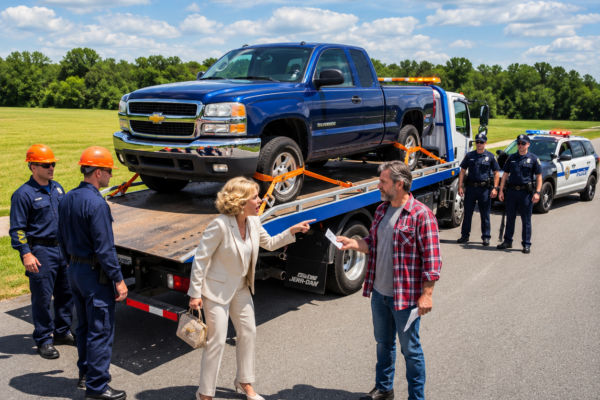
When I came home Sunday evening, there was a sectional couch in my pasture.
Beside it sat broken tile, splintered cabinets, drywall, torn carpet, empty adhesive buckets, and several paint cans.
Deep tire tracks ran through the grass.
That was the moment it stopped being a neighbor problem.
I photographed everything before touching a single thing.
Wide shots.
Fence posts.
Tire marks.
Debris.
The survey stake near the oak tree.
Then I called Frank Morales, an attorney I’d known for years.
He looked at the photographs and said something I still remember.
“Before you get angry, get boring.”
“Boring?”
“Records. Dates. Photos. Survey. Certified mail. Boring wins these fights.”
So we got boring.
A surveyor confirmed the recorded boundary.
Frank sent a formal demand.
The Mercers hired an attorney.
Their response claimed the boundary was “not readily apparent” and suggested they had believed the unused ground was part of their parcel.
That argument might have sounded plausible if Ethan hadn’t already been told exactly where the line was.
Then Mrs. Calderon called me.
She had heard about the dispute through another neighbor.
“I think I still have something you should see,” she said.
The next afternoon, an envelope arrived by courier.
Inside was an old closing survey, a photograph of Mr. Calderon and me repairing the boundary fence years earlier—and one detail in the background that made Frank go completely silent.
He enlarged the photograph on his computer.
Then he pointed at something just beyond Ethan’s property.
“Do you still have that?”
I looked closer.
And suddenly I understood why he was asking.
[END OF FACEBOOK CAPTION]
[FIRST COMMENT / FULL STORY CONTINUATION]
The object in the photograph was an old cedar post.
Not one of the newer metal T-posts along the fence.
This one was thicker, weathered gray, and leaned slightly toward the Calderon property.
About four feet behind it, half-hidden by summer grass, was a small black box strapped to an oak.
My old trail camera.
I had forgotten about it.
Years earlier, coyotes had been getting too close to the chicken coop at night, so I installed two motion cameras along the back pasture.
One quit working after a storm.
The other I eventually stopped checking.
At least, I thought I had.
“I haven’t changed the batteries in that thing in forever,” I told Frank.
“Doesn’t matter,” he said. “Go look.”
We drove back to my place together.
Frank normally wore polished shoes even when everybody else knew better.
That afternoon, he changed into a pair of old boots he kept in his trunk.
“That should tell you how serious I am,” he said.
We crossed the pasture without touching the debris.
The couch was still there, sagging in the Texas heat.
Flies moved around one torn cushion.
Drywall dust had washed into the grass after a brief rain.
Near the oak, I pushed aside a curtain of branches.
The camera was still strapped to the trunk.
The plastic housing was sun-faded.
A spider had built a web across the latch.
I opened it.
The batteries were dead.
Frank looked disappointed for exactly two seconds.
Then I saw the memory card.
“Don’t get excited yet,” he said.
“I’m not excited.”
“You’re smiling.”
“I’m cautiously optimistic.”
“That’s lawyer language.”
“No. Lawyer language costs three hundred dollars an hour.”
He gave me a look.
We took the card inside.
My kitchen had become command central over the previous week.
Survey maps covered one end of the table.
Certified-mail receipts were clipped together.
Photographs sat in labeled folders.
The transfer-station receipt from the first twelve bags had been scanned, printed, and backed up twice because Frank believed losing evidence was one of the few genuinely unforgivable sins.
I inserted the card into an adapter.
The computer recognized it.
There were hundreds of files.
Mostly deer.
One raccoon that appeared convinced the camera was personally insulting him.
A feral cat.
Wind-blown branches.
Then we reached the dates after the Mercers moved in.
Frank leaned closer.
The first useful clip showed Ethan near the boundary with a contractor.
They were standing beside the cedar post.
Ethan pointed toward my pasture.
The contractor shook his head.
There was no audio.
That mattered.
Frank reminded me immediately.
“We don’t invent conversations.”
“I know.”
“We can describe what the video shows. We cannot claim we know what they said.”
The next clip was better.
It showed the white SUV from their driveway area.
Then a pickup truck with a utility trailer.
The trailer crossed the visible fence opening onto my side.
Two men unloaded bags.
One was Ethan.
The camera angle wasn’t perfect, but it didn’t need to be.
The cedar post appeared at the left edge of the image.
The surveyor’s orange flag, installed years ago and recently refreshed, was visible several yards away.
Another clip, recorded three weeks later, showed a larger trailer carrying the couch.
This time Ethan wasn’t alone.
Brooke stood near the opening.
She looked toward my house twice while two workers moved renovation debris into the pasture.
Frank sat back.
“Well,” he said.
I waited.
“That’s more interesting.”
“Interesting?”
“You want me to say devastating.”
“I’d settle for useful.”
“It’s useful.”
That was Frank.
He could watch a meteor hit the courthouse and describe it as a development.
We copied the files immediately.
One set went onto my computer.
One went onto an external drive.
One went to Frank.
He told me to leave the original memory card alone and photograph the camera exactly where we had found it.
Then he called the Mercers’ attorney.
He didn’t tell me everything he said.
He didn’t need to.
I heard one sentence from across the kitchen.
“We have additional documentation that materially changes the boundary argument.”
That was it.
No threat.
No dramatic declaration.
No “gotcha.”
He hung up five minutes later.
“They want to see it.”
“Are we sending it?”
“Yes.”
“That fast?”
“Facts don’t become stronger because you hide them.”
I hated how often Frank was right.
The following morning, their attorney requested more time to respond to the demand letter.
Frank agreed to forty-eight hours.
I didn’t.
Not emotionally.
But legally, it was his call.
By then, I had spent nearly two weeks waking up angry.
Not raging.
That would have been easier.
This was the slower kind of anger.
The kind that sits beside you while you make coffee.
The kind that turns an ordinary drive to the hardware store into an internal argument with someone who isn’t even in the truck.
I kept replaying Ethan’s first response.
We figured that area wasn’t being used.
The sentence bothered me more than the trash itself.
Because it reduced ownership to visibility.
If I wasn’t mowing that exact patch that exact morning, apparently it was available.
If nobody stood there defending it, apparently it didn’t matter.
That logic had followed me through most of my divorce too.
People making decisions about my time, my house, my money, my future because silence looked like consent.
That was probably why I reacted so strongly.
Frank knew that.
He had handled part of my divorce years earlier.
One evening, while we reviewed repair estimates for the rutted pasture, he closed the folder.
“You know this isn’t your divorce.”
I looked at him.
“I know.”
“Do you?”
“Yes.”
He waited.
That was another annoying lawyer habit.
They learn silence professionally.
Finally I said, “I’m not going to do anything stupid.”
“That wasn’t my question.”
“What was your question?”
“Are you trying to fix your land, or are you trying to make these people feel what you felt six years ago?”
That landed harder than I wanted it to.
I got up and opened the refrigerator.
There was nothing in there I needed.
I closed it.
“I want them to understand there’s a line.”
“Good.”
“And I want them to stop acting like the line only exists if they agree with it.”
“Also good.”
“And maybe I want them embarrassed.”
“There it is.”
“I said maybe.”
Frank smiled.
“Just remember embarrassment is expensive when you get creative.”
At that point, I had not told him about the gift-wrap idea.
Because technically, I didn’t have one yet.
Not completely.
The idea formed the next afternoon.
The Mercers’ attorney sent a response to the trail-camera footage.
The tone had changed.
Gone was the confident language about an uncertain boundary.
Now the letter focused on intent.
It acknowledged that renovation material had been placed on my side but characterized it as a “temporary staging decision” made during construction.
Temporary.
That word again.
Frank read the letter twice.
“What’s a temporary staging decision?” I asked.
“Trash with a necktie.”
I laughed despite myself.
The letter offered to pay the original disposal invoice.
Nothing for the second dumping.
Nothing for pasture repair.
Nothing for survey costs.
Nothing for legal fees.
And, remarkably, it asked that I “cooperate in allowing removal access at a mutually convenient time.”
I read that sentence three times.
“They want permission to come back onto my property to collect the stuff they claim they barely meant to put there.”
“That’s what it says.”
“How generous.”
“Don’t get sarcastic in writing.”
“I’m not writing.”
“You have the face you make before writing something sarcastic.”
Frank proposed a simple counteroffer.
They could hire a licensed hauler.
They could remove everything under an agreed schedule.
They could pay to repair the ruts.
They could reimburse documented expenses.
And both sides could sign a written boundary acknowledgment to prevent future disputes.
It was boring.
It was fair.
It was exactly the kind of solution adults should accept.
They rejected it.
Not all of it.
Just the part requiring them to pay for land restoration and professional cleanup.
Their attorney wrote that those costs appeared “disproportionate.”
I had two contractor estimates.
One was $4,860.
The other was $5,200.
The damaged area needed debris removal, soil work in the deepest ruts, reseeding, and inspection for fragments of tile, nails, and other construction material before I could safely run equipment through it.
Frank sent the estimates.
The response came the next morning.
Ethan and Brooke were willing to contribute $1,500.
I called Frank.
“Contribute?”
“I saw it.”
“To fixing damage they caused?”
“I saw it.”
“Like a charity?”
“I understand the word.”
That was when I stopped wanting a negotiated apology.
I wanted a record.
Not revenge.
A record.
Something written clearly enough that six months later nobody could pretend the problem had been vague.
Frank filed the civil claim.
Nothing dramatic happened.
There was no immediate courtroom showdown.
No sheriff appeared to drag anyone away.
No judge pounded a gavel while a crowd gasped.
Real disputes are mostly paperwork.
Forms.
Deadlines.
Emails.
Photographs renamed with dates.
Invoices.
Scheduling calls.
The emotional part happens at two in the morning when you’re staring at the ceiling.
The official part happens under fluorescent lights while someone asks whether Exhibit 7 is a duplicate of Exhibit 6.
A hearing date was eventually set.
In the meantime, the debris stayed where it was because Frank wanted the condition preserved until the Mercers had been given full opportunity to inspect it.
They did.
Their attorney came with a photographer.
So did Ethan.
Brooke did not.
I stood thirty feet away with Frank while Ethan walked around the couch.
He barely looked at me.
The photographer documented the broken tile and paint buckets.
At one point Ethan stopped beside the cedar post.
He stared at it.
Then at the orange survey marker.
Frank noticed.
“So much for invisible,” he murmured.
Ethan heard him.
“That marker wasn’t obvious when we bought the property.”
Frank didn’t answer.
I did.
“It was obvious when I told you where the line was.”
Ethan looked at me for the first time.
“We didn’t think this would become a lawsuit.”
“That makes two of us.”
He rubbed the back of his neck.
Up close, he looked tired.
Not defeated.
Just worn thin.
There were dark circles under his eyes.
His renovation had clearly become more than he had expected.
For the first time since this started, I wondered what was happening inside their house.
I found out accidentally.
Two days later, I stopped at a hardware store in town for fencing staples.
The contractor who had appeared on the trail camera was at the checkout counter.
He recognized me.
His name was Luis.
He hesitated before speaking.
“You’re the guy next door to Ethan?”
“That depends what he told you.”
Luis grimaced.
“That bad?”
I shrugged.
“He put construction debris on my property twice.”
Luis looked embarrassed.
“I told him not to.”
I stopped.
“When?”
“The first time.”
We stepped outside.
I didn’t record him secretly.
I didn’t try to trap him.
I just asked what had happened.
Luis said his crew had been hired for interior demolition.
They had a roll-off container scheduled, but the delivery had been delayed.
Ethan didn’t want debris stacked beside the house because Brooke was upset about how the property looked.
Luis told him they could leave it in the trailer overnight.
Ethan supposedly said there was unused ground beside the fence.
Luis said he wasn’t comfortable with it.
The first batch went there anyway.
When I complained, Luis assumed that would end it.
Later, Ethan hired another crew for part of the project.
The couch and heavier debris appeared after that.
“Would you be willing to tell my attorney what you just told me?”
Luis looked toward the store.
“I don’t want trouble.”
“I understand.”
“I’ve got employees.”
“I understand.”
“And Ethan still owes me money.”
That explained more than he probably intended.
I gave him Frank’s card.
“You don’t owe me anything. If you want to talk to him, call. If not, don’t.”
Luis took the card.
Three days later, he called.
His statement didn’t transform the case.
The photographs and video were already strong.
But it destroyed the idea that this had been some innocent misunderstanding nobody noticed until afterward.
More important, it gave me my first glimpse of motive.
Image.
Brooke hated the renovation mess.
Ethan hated delays.
They had spent more than expected.
Their roll-off service had become another bill.
The neighboring field looked empty.
So they made somebody else’s land absorb their inconvenience.
That didn’t make them monsters.
It made them selfish.
For some reason, that was easier for me to understand.
And harder to excuse.
About a week before the hearing, Frank called.
“I have a question.”
“That never sounds good.”
“Do you still want the material removed?”
“Obviously.”
“Then we should push them for a removal date one more time.”
“Why?”
“Because courts like people who try to solve problems before asking the court to solve them.”
I agreed.
We offered three dates.
The Mercers chose none.
Instead, their attorney said his clients preferred to address all issues through the pending case.
That meant the couch stayed.
The broken tile stayed.
The paint stayed.
Everything stayed.
And that was when the gift-wrap idea finally became a real plan.
It began with fifty-dollar sarcasm.
I was standing in the farm-supply aisle staring at heavy-duty storage totes when I noticed a display of oversized red ribbon left over from some seasonal promotion.
I picked up one roll.
Then another.
The teenage employee stocking shelves watched me.
“Big birthday?”
“Something like that.”
I bought ten clear storage containers that day.
Then ten more.
Not fifty.
The original mess didn’t require fifty once the larger items were separated properly.
I also bought contractor bags, absorbent material for any containers that might leak, gloves, labels, and industrial stretch wrap.
When I got home, I called Frank.
“I need you to talk me out of something.”
“That sentence alone is billable.”
I told him.
There was a long silence.
“No.”
“No because it’s illegal?”
“No because I hate it.”
“That’s different.”
“It is.”
“So is it illegal?”
“I am not giving you a blanket blessing to load debris onto somebody else’s property.”
“It’s their debris.”
“That sentence will not protect you from every possible problem.”
“What if I place it on their property without blocking the driveway, sidewalk, mailbox, door, or emergency access?”
“Still not something I’m recommending.”
“What if I inventory every item?”
“You’re enjoying this too much.”
“I’m trying to understand the boundaries.”
“I appreciate the irony.”
We talked for almost an hour.
Frank made the risks very clear.
I could create a new dispute.
I could weaken my position if I damaged anything.
If any material was hazardous, I absolutely should not move it casually.
I should not trespass inside fenced or enclosed areas.
I should not obstruct access.
I should not threaten them.
I should not create a public spectacle.
I should not treat their porch like a landfill.
“Basically,” I said, “you’re telling me not to do the version that would make a good internet story.”
“I am begging you not to do the version that would make a good criminal complaint.”
That was fair.
So we modified the idea.
First, the paint cans.
A waste contractor inspected them.
Several were empty.
Two contained dried residue.
One had usable paint.
Anything requiring special handling would go through the proper disposal route, not back to the Mercers.
Next, sharp construction material.
That went into rigid containers.
Nothing loose.
Nothing unstable.
The couch was too large and too ridiculous to “gift wrap” safely, so I left it exactly where it was for the pending proceeding.
The smaller, clearly identifiable household and renovation debris was inventoried.
Frank sent the Mercers’ attorney written notice.
The notice said that because his clients had repeatedly declined reasonable removal dates, certain nonhazardous movable items might be relocated from my land while the larger disputed debris remained preserved and documented.
Their attorney responded with a warning not to damage the items.
That was the first time anyone on their side had called the garbage “items.”
I printed the letter.
I highlighted that word.
Items.
That Saturday, my garage became the strangest packaging station in Bastrop County.
I wore gloves.
I sorted slowly.
Broken cabinet pulls.
Plastic packaging.
Trim pieces.
Sections of laminate.
Empty containers.
Discarded hardware.
A busted lamp.
Pieces of shelving.
Anything uncertain stayed behind.
Each tote got a number.
Each number matched photographs.
Every container received a simple typed inventory.
Then, because I am not always as mature as Frank would like, I wrapped a red ribbon around each tote.
Not bows the size of a car.
Just one clean strip.
On each lid, I taped a white card.
RETURNED MATERIAL — CONTAINER 01.
No insults.
No profanity.
No “Merry Christmas.”
No “Enjoy your garbage.”
Frank had forbidden humor.
Or, as he put it, “I am trying to keep your personality from becoming Exhibit A.”
On the evening before delivery, he came by.
He walked into the garage and stopped.
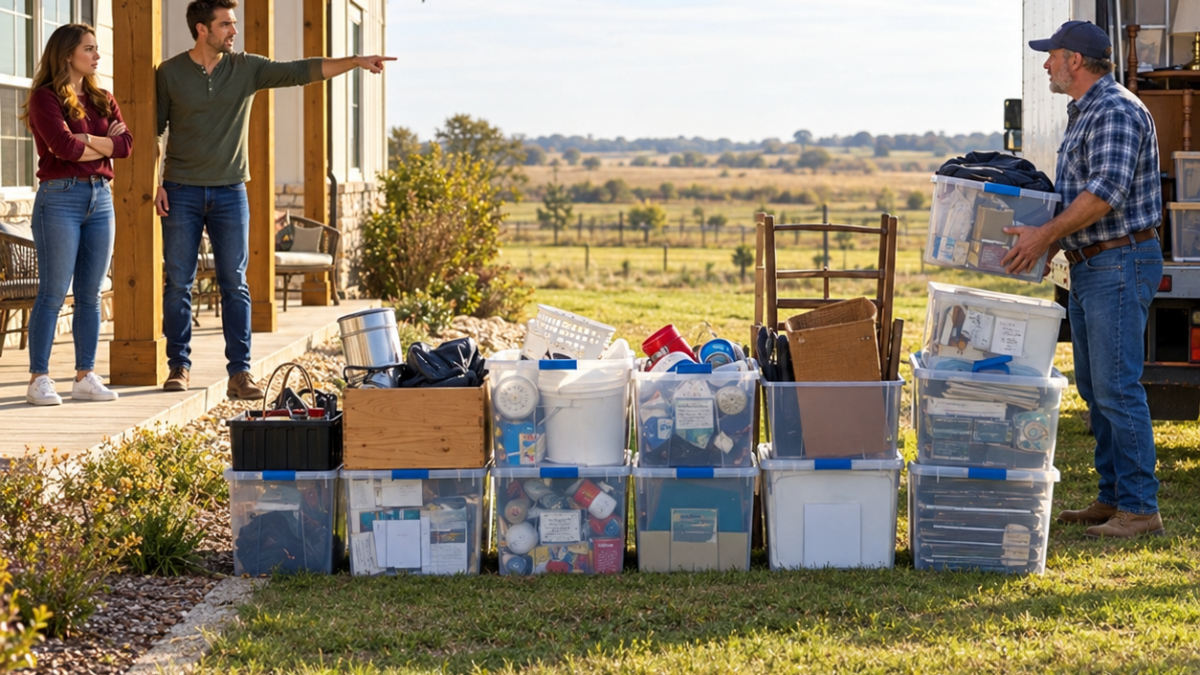
There were twenty-four clear totes lined in rows.
Red ribbon crossed each one.
“You did it.”
“You knew I would.”
“I hoped age would finally improve you.”
“I’m fifty-two, Frank. The evidence is against that.”
He crouched beside Container 08.
Inside were broken white tiles.
“You padded these?”
“Yes.”
“Photographed?”
“Yes.”
“Inventory?”
“Yes.”
“Hazardous material?”
“None.”
“Blocking their front door?”
“No.”
“Driveway?”
“No.”
“Mailbox?”
“No.”
“Public road?”
“No.”
“You are leaving a clear path?”
“Four feet minimum.”
He stood.
“I still hate it.”
“But?”
“But if you’re going to ignore my preference, at least you’ve ignored it methodically.”
That was as close to approval as I was going to get.
I hired a small local moving company rather than doing it alone.
That mattered.
I wanted witnesses.
I wanted people who understood safe lifting.
And, frankly, I did not want Ethan later claiming I had scratched his porch railing while carrying a tote.
The company owner, Marcy, listened to my explanation over the phone.
“So these are his things?”
“Yes.”
“That he put on your land?”
“Yes.”
“And now we’re moving them to his land?”
“Yes.”
“In gift wrap?”
“Technically ribbon.”
She was quiet.
Then she said, “I charge hourly.”
At 7:15 the next morning, the truck arrived.
Not 6:00.
I wasn’t trying to wake anybody.
I wasn’t trying to scare them.
We loaded the totes.
The drive next door took less than a minute.
That was almost funny.
All those certified letters.
All those legal bills.
All those emails.
For a distance I could have walked in boots.
Marcy’s crew parked completely on the Mercers’ driveway apron after I confirmed the delivery location with the property survey.
We did not enter their garage.
We did not block their vehicles.
We did not stack anything against the door.
Instead, the totes were arranged in two neat rows along the wide front walk, beginning several feet from the porch and stopping well before the steps.
A clear path remained from the front door to the driveway.
The effect was somehow more ridiculous because it was so organized.
Twenty-four transparent boxes.
Twenty-four red ribbons.
Twenty-four inventory cards.
Their own discarded renovation mess had become a catalog.
Marcy stood back.
“You weren’t kidding.”
“No.”
“This is the most passive-aggressive moving job I’ve ever done.”
“Professional term?”
“Absolutely.”
I took photographs.
Wide angle.
Property markers.
Walkway clearance.
Driveway.
Front steps.
Timestamp.
Then the door opened.
Brooke appeared first.
She wore gray workout clothes and held a coffee mug.
For three full seconds, she didn’t speak.
Her eyes moved from me to Marcy’s truck to the rows of containers.
“What is this?”
I kept my voice level.
“Material removed from my property.”
She stepped onto the porch.
“You brought garbage to our house?”
“I returned material your attorney asked us not to damage.”
That was petty.
Frank later told me so.
But it was accurate.
Brooke set the mug on the railing.
“Ethan!”
He came out a few seconds later.
His expression changed faster than hers.
Confusion.
Recognition.
Anger.
“You have got to be kidding me.”
“No.”
He walked down one step.
“Get this off my property.”
That sentence hung there.
Even Marcy looked away.
I almost smiled.
“Your property?”
He realized it too.
His jaw tightened.
“You know what I mean.”
“I do.”
He took out his phone.
“You cannot come over here and dump things.”
I nodded toward the containers.
“Nothing is loose. Nothing is hazardous. Nothing is blocking access. Everything is inventoried. Your attorney was notified.”
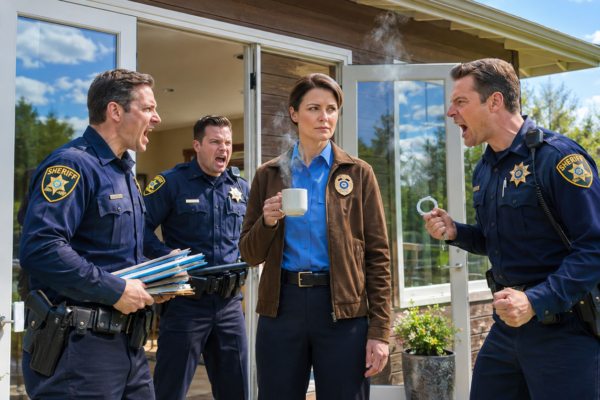
“I’m calling the sheriff.”
“County deputy will probably come.”
“Good.”
“Fine with me.”
Brooke stared through the side of one container.
She could see pieces of the broken shelving they had removed from the dining room.
“You went through our trash?”
“No. I handled material placed on my land.”
“That is insane.”
Maybe it was.
I could admit that privately.
But I also knew how much time I had spent trying to solve this normally.
The first disposal.
The invoice.
The conversation.
The demand.
The removal dates.
The survey.
The attorney letters.
The offers.
The documentation.
This was not where I started.
It was where they kept pushing the situation.
The deputy arrived twenty minutes later.
His name was Deputy Reeves.
He was younger than the officer in the original version of this story would probably have been if Hollywood had cast him.
Mid-thirties.
Calm.
No dramatic swagger.
He talked to Ethan first.
Then Brooke.
Then me.
I showed him the folder.
He did not pronounce anybody right.
He did not declare my delivery unquestionably legal.
He did not lecture the Mercers.
He looked at the containers.
He checked the clear walkway.
He asked whether anything dangerous was inside.
I explained the sorting and disposal process.
Then he said, “This sounds like you already have a civil case pending.”
“Yes.”
He looked at Ethan.
“Your attorney involved?”
“Yes.”
“Then I’m not deciding ownership of construction debris in a driveway.”
Ethan pointed at me.
“He trespassed.”
Reeves turned to me.
“Did you enter the house?”
“No.”
“Backyard?”
“No.”
“Garage?”
“No.”
“Damage anything?”
“Not that I’m aware of.”
Marcy spoke up.
“My crew placed the containers.”
The deputy took everyone’s information.
He photographed the scene.
Then he told us something refreshingly uncinematic.
“If either side believes a crime occurred, you can make a report. I’m documenting the call. But the property dispute itself is something your attorneys and the court are already dealing with.”
That was it.
No triumphant speech.
No arrest.
No applause.
Just documentation.
Which, by then, I had learned was usually more useful.
Before leaving, Reeves looked at the ribbons.
He paused.
“I’m not asking why.”
“Probably wise.”
His mouth moved slightly.
Not quite a smile.
Then he left.
The Mercers’ attorney called Frank before I even got home.
Frank called me.
“You’re famous.”
“That was fast.”
“He used the phrase ‘provocative stunt.’”
“Accurate.”
“He is very unhappy.”
“Also accurate.”
“He claims you’re harassing his clients.”
“Are we worried?”
“I’m always worried. That’s why you pay me.”
“What did you tell him?”
“That the delivery was documented, nonhazardous, and performed without obstructing access, and that if his clients want the remaining material removed from your land, perhaps they should finally choose one of the dates we offered.”
I sat down at my kitchen table.
“So I didn’t ruin the case?”
“I didn’t say that.”
“Frank.”
“You made my week more complicated.”
“Did I ruin the case?”
A pause.
“No.”
I exhaled.
“But if you put a bow on one more disputed object without calling me, I will personally bill you for my blood pressure medication.”
Fair enough.
The hearing came nine days later.
By then, most of the gift-wrapped containers had disappeared from the Mercers’ front walk.
I never asked where they took them.
That wasn’t my problem anymore.
The couch and larger debris remained in my pasture exactly as photographed.
The courtroom was smaller than people imagine.
No mahogany grandeur.
No television lighting.
Just benches, fluorescent panels, a judge, court staff, attorneys, and people waiting for their turn.
Our case was not the only one that morning.
Before us, a contractor argued about unpaid cabinets.
After us, a landlord was scheduled for something involving a security deposit.
Real life has a way of making even your personal war share a hallway with somebody else’s plumbing dispute.
Frank presented the timeline.
The first dumping.
My conversation with Ethan.
The disposal receipt.
The invoice.
The second dumping.
The photographs.
The recorded survey.
The fresh survey.
The trail-camera clips.
Luis’s statement.
The contractor estimates.
The correspondence offering removal dates.
The Mercers’ refusal to choose one.
Their attorney pushed back where he could.
He argued that the initial property line had not been obvious to his clients.
Frank did not overstate.
He agreed that a new rural buyer might initially misunderstand an unfenced or lightly marked area.
Then he pointed out that misunderstanding stopped being a meaningful explanation after I personally told Ethan where the boundary was.
The judge asked Ethan a direct question.
“After your neighbor told you the first materials were on his property, did you verify the boundary before additional renovation debris was placed there?”
Ethan shifted in his chair.
“Our understanding was that the area was still disputed.”
“Based on what?”
“Our purchase documents.”
Their attorney handed up a copy of the marketing map from the real-estate listing.
That was new.
The shaded parcel image was imprecise.
The graphic could absolutely confuse someone glancing at it.
For the first time, I saw how this might have started.
The judge studied it.
Then she looked at the recorded survey.
“These are not the same kind of document.”
“No, Your Honor,” their attorney said.
“The marketing image is not a boundary survey.”
“No.”
That mattered.
But not as much as what came next.
The judge asked about the cedar post.
Then the survey flag.
Then the original conversation.
Then the second dumping.
Frank played the trail-camera clip.
Nobody gasped.
Nobody shouted.
The room did not erupt.
The video simply showed what it showed.
A trailer crossing onto my side after the first dispute.
Debris being unloaded.
Ethan present.
The judge watched it twice.
Then she asked Luis’s statement to be referenced.
After nearly an hour, the judge did not hand me some theatrical fortune.
She did something more useful.
She found the evidence sufficient to support my civil claims for trespass-related property damage and documented cleanup costs.
Some of what we requested was reduced.
The court wanted clearer separation between actual restoration expenses and projected costs.
Legal fees were addressed only to the extent recoverable and supported.
There was no magical $12,000 jackpot.
Instead, the final amount—after documented disposal, survey costs, physical restoration, cleanup, and the portions the court allowed—was significant enough that Ethan stopped looking at me entirely.
More important to me, the written order recognized the recorded property boundary and required the Mercers to remove the remaining debris within a set period or face additional enforcement through the ordinary civil process.
No ambiguity.
No “temporary staging.”
No “unused land.”
A date.
A line.
A responsibility.
When we walked into the hallway, I expected to feel victorious.
I had imagined that moment more than once.
Ethan embarrassed.
Brooke furious.
Frank satisfied.
Me finally vindicated.
Instead, I felt tired.
Across the hall, Brooke sat on a bench with both hands around her phone.
Ethan stood beside their attorney.
They were speaking quietly.
For the first time, Brooke looked less like the woman in oversized sunglasses who had inspected the countryside as if it had failed to impress her.
She looked exhausted.
Then I heard her say, “We can’t keep paying for this.”
Their attorney lowered his voice.
I turned away.
It wasn’t my business.
But the sentence followed me home.
The remaining debris was removed four days later.
A professional crew arrived at 8:00 a.m.
Frank advised me to stay inside unless needed.
I did.
Mostly.
I watched through the kitchen window as workers lifted the sectional.
They collected broken tile.
They swept the obvious fragments.
They loaded the larger pieces into a trailer.
Ethan was there.
He wore work gloves.
That surprised me.
At one point, he and another man wrestled the couch through the fence opening.
It caught on a post.
Ethan stopped.
He stared at the boundary marker.
Then he carefully repositioned the couch so it wouldn’t hit it.
I noticed that.
He noticed me noticing.
Neither of us waved.
After the truck left, I walked the pasture.
The damage looked worse without the debris covering it.
Deep tracks.
Compressed soil.
Bits of plaster.
Several nails.
A shard of tile half-buried near where I occasionally drove the mower.
I crouched and picked it up.
That small piece bothered me more than the couch.
A couch is obvious.
You avoid it.
A nail disappears in grass until it finds a tire.
Or a hoof.
Or a boot.
That was why this had never been only about appearance.
I hired one of the contractors who had provided the restoration estimate.
He brought a compact tractor and soil.
We filled the worst ruts.
We removed contaminated debris from the top layer in two areas.
We reseeded.
The invoice hurt.
Even knowing part of it would eventually be reimbursed did not make writing the check pleasant.
Months passed.
The legal paperwork crawled toward completion.
Payments did not arrive instantly.
There were deadlines.
Negotiations.
A payment arrangement.
More attorney emails.
Nothing about the aftermath looked like television justice.
It looked like envelopes.
But the boundary was professionally marked.
New permanent markers went in at key points.
I repaired the weak section of fence.
Not because I wanted a wall between us.
Because ambiguity had already cost enough.
One Saturday morning, while I was setting a new post, Ethan approached.
I heard him before I saw him.
Boots in dry grass.
I set the post driver down.
He stopped on his side.
For several seconds, neither of us spoke.
Then he said, “Brooke hated those boxes.”
I almost laughed.
“I assumed.”
“The ribbons especially.”
“That part was mine.”
“I know.”
Silence.
He looked at the fence.
“I was angry when you brought them back.”
“I was angry when you brought them over the first time.”
“I know.”
That was new.
Not an apology.
But new.
He crouched and picked up a small rock.
Turned it once in his fingers.
Dropped it.
“Our renovation got out of control.”
I waited.
“The contractor schedule fell apart. The dumpster company wanted extra money. Brooke was dealing with her mom being sick back in California. We were fighting constantly.”
I leaned against the post.
“I’m sorry about her mom.”
He nodded.
“She kept saying the place looked like a construction site.”
“It was a construction site.”
“I know that now.”
“You knew it then.”
He looked at me.
Fair point.
He rubbed his palms against his jeans.
“The first time, I really did think that strip might be ours.”
I believed him.
Not because I suddenly trusted him.
Because the marketing map from court had shown me how the mistake could begin.
“But after I came to your door?”
He looked away.
“No.”
The answer was quiet.
That was the closest thing to honesty I had gotten from him.
“After that,” he said, “I was just pissed.”
“At me?”
“At everything.”
“Those aren’t the same thing.”
“I know.”
A truck passed on the county road.
The sound faded.
He looked toward my house.
“I thought you were trying to make us look stupid.”
“I was trying to get you to stop putting garbage on my land.”
“The boxes made us look stupid.”
“The boxes were your garbage.”
He almost smiled.
Almost.
Then he said, “Yeah.”
I drove the post another six inches into the ground.
Ethan watched.
“We’re probably selling.”
I stopped.
“You just got here.”
“Brooke wants to be closer to Austin. Her mom may move in with us.”
I nodded.
“That’s a lot.”
“Yeah.”
There were a hundred things I could have said.
Some satisfying.
Some cruel.
Some funny.
I could have told him country life requires understanding where your property ends.
I could have told him the next buyer might appreciate a survey.
I could have asked whether he needed help loading.
I didn’t.
Instead I said, “If you sell, make sure the boundary paperwork goes with the house.”
He gave one short laugh.
“Trust me.”
Then he walked back.
They did not sell immediately.
The sign appeared three months later.
By then, something strange had happened.
We had become functional neighbors.
Not friends.
There were no backyard barbecues.
No borrowed tools.
No tomatoes exchanged over the fence.
But when one of their delivery drivers accidentally blocked my gate, Ethan moved the truck before I had to ask twice.
When a storm dropped a branch near our shared access area, we both came outside with chainsaws.
We worked from opposite sides.
At one point, the branch shifted.
“Hold up,” he said.
I stopped.
He repositioned his cut.
We finished without argument.
That was the first time we cooperated on anything.
It felt almost suspicious.
Brooke remained distant.
I rarely saw her.
Once, at the mailbox, she surprised me by speaking.
“I owe you an apology.”
I didn’t know what to do with that sentence.
She kept her eyes on the envelopes in her hand.
“I told Ethan the field looked abandoned.”
“It wasn’t.”
“I know.”
“I live there.”
“I know.”
A car approached.
We both stepped farther from the road.
She said, “I grew up in subdivisions. Fences everywhere. Sidewalks. Property lines you could see. When we bought the place, I thought open space meant nobody cared what happened to it.”
“That’s not usually how open space works.”
“No.”
She gave a tired smile.
“I understand that now.”
I didn’t forgive everything in that instant.
Real life rarely gives you emotional music on cue.
But I believed she meant it.
“That second dump,” I said. “After you knew.”
Her face tightened.
“That was Ethan.”
I studied her.
“You were in the trail-camera footage.”
She nodded.
“I was.”
There was nothing else to say.
She had been there.
Whatever hesitation she felt had not stopped it.
An apology didn’t erase that.
But it was still better than pretending.
Their house sold the following spring.
The buyers were a couple named Aaron and Melissa with two children and an elderly golden retriever that immediately discovered a gap beneath my fence.
The first week they moved in, Aaron knocked on my door.
I opened it cautiously.
He held a folder.
For one terrible second, I thought I was about to experience some new rural nightmare.
Instead he said, “I think this is the survey.”
I stared at him.
He laughed.
“Ethan told me I should show it to you before I moved a single fence post.”
That might have been the funniest thing Ethan ever did.
We walked the boundary together.
I showed Aaron the cedar post.
The permanent markers.
The old fence.
The oak where the camera had been.
The camera itself was gone by then.
I had replaced it with a newer one closer to the chicken coop.
When we reached the section where the couch had sat, the grass had mostly recovered.
You could still see faint differences in color where the soil had been repaired.
Aaron pointed.
“What happened there?”
I considered how much to tell him.
Then I said, “Renovation disagreement.”
He looked back toward his house.
“With Ethan?”
“You could say that.”
He smiled uncertainly.
“I’m guessing there’s a story.”
“There’s always a story.”
A month later, Melissa brought over peach cobbler.
Her kids named three of my chickens even though I repeatedly explained that naming chickens was how you ended up emotionally negotiating breakfast.
Life settled again.
That was what I had wanted all along.
Not punishment.
Not a viral moment.
Not twenty-four clear containers with ridiculous red ribbons.
Quiet.
Ordinary, almost boring quiet.
Years later, I still have one of the ribbons.
Not intentionally.
After the delivery, a short piece had fallen behind a shelf in my garage.
I found it while cleaning one winter.
Red, dusty, creased in the middle.
For a moment I stood there holding it, remembering those weeks when every trip to my back window ended with me staring at somebody else’s trash.
Then I looked through the open garage door.
The pasture was clean.
The fence was straight.
The survey markers were still exactly where they belonged.
Aaron was on his side teaching his daughter how to ride a small dirt bike.
She stalled it.
He laughed.
My chickens were scratching beneath the oak.
Nothing dramatic.
Nothing cinematic.
Just land being land again.
I almost threw the ribbon away.
Instead, I tied it around the handle of the folder where I keep the survey, the photographs, and the old transfer-station receipt.
Frank saw it once.
He pointed.
“You kept the bow?”
“Evidence.”
“That is not evidence.”
“Emotional evidence.”
“That is even worse.”
I closed the folder.
Maybe he was right.
But I kept it anyway.
Not because the gift-wrapped return was the smartest thing I ever did.
It wasn’t.
And not because I believe every disrespectful neighbor deserves a truckload of poetic justice delivered to their porch.
Most disputes should end much earlier than ours did.
A conversation.
A survey.
A written agreement.
A professional cleanup.
That would have been cheaper for everybody.
What stayed with me was something simpler.
The Mercers had mistaken quiet for indifference.
Then they mistook patience for permission.
For a while, I nearly made the opposite mistake and confused standing up for myself with making them suffer.
Those are different things too.
The court order mattered.
The survey mattered.
The documentation mattered.
The restored field mattered.
Even Ethan eventually admitting he knew better mattered.
The ribbons were just the part everyone would remember.
The boundary was the part that actually changed things.
And years later, that old cedar post is still standing beside the fence, weathered and crooked, exactly where it was before any of us started arguing about who had the right to cross the line.
The difference is that now nobody has to argue about where the line is.