The morning Karen Whitmore marched to my grill and informed me that my three-foot cedar fence was “destroying the visual harmony” from her second-story sunroom, I was holding one hot dog, one cheap beer, and exactly zero interest in redesigning my backyard for a woman who had bought a house behind mine ten years after the fence went up. T
The reporter arrived Friday afternoon.
I was cleaning fingerprints off thirty thousand dollars’ worth of bad judgment when a white station wagon stopped in front of my house.
A woman climbed out carrying a microphone bag.
Behind her came a cameraman.
She looked at the glass.
Then at my rusty grill.
Then back at the glass.
“Alex Mercer?”
“Depends.”
She smiled.
“Dana Ruiz. Channel Eight.”
“That sounds expensive.”
“The microphone is. I’m salaried.”
I liked her immediately.
She pointed toward the fence.
“I was told you installed fifty feet of ballistic security glazing because your neighbor complained about a three-foot wooden fence.”
“That is an oversimplification.”
She waited.
I looked at the glass.
“An accurate oversimplification.”
The cameraman laughed.
Dana said:
“Can we talk?”
I glanced toward Karen’s sunroom.
Curtain moved.
Of course.
“Sure.”
I did not tell the story the way people later told it online.
Karen did not wake up one morning and randomly demand bulletproof glass.
There had been six weeks of letters.
Architectural requests.
Bamboo.
Photographs.
Emails.
An HOA meeting where she referred to my fence as “an unnecessary visual barrier adversely affecting adjacent owners.”
That last part became funny only later.
At the time, it got under my skin.
The fence had mattered to me for a reason Karen never knew.
My dad and I built it.
He was seventy-three then.
Early Parkinson’s.
Still stubborn enough to insist on setting every post.
I had suggested hiring somebody.
He called that “paying strangers to miss lunch.”
So we rented an auger.
Dug post holes.
Fought roots.
Argued over level.
Ate sandwiches sitting on overturned buckets.
When we finished, Dad leaned on the last post and said:
“A good fence isn’t there to keep people apart.”
I looked at him.
“What is it there for?”
“To save everybody from having to guess.”
That sounded profound enough that I remembered it.
Then he ruined the moment.
“Also keeps their ugly dog out.”
Dad died four years later.
The fence stayed.
I never told Karen that.
Didn’t matter legally.
Sentimental value isn’t zoning.
But every time she called it an eyesore, what I heard was someone treating one of the few things Dad and I built together as though it had appeared simply to annoy her.
Still, I could have said no and stopped there.
The fence was lawful.
The HOA had already rejected her first attempt.
I could have kept trimming bamboo and ignoring letters.
Instead, she said glass.
And I work in structural systems.
That was like telling a chef:
Fine, if you insist on cooking, at least use fire.
I called three companies.
The first one thought I was joking.
The second tried to sell me a security package that included perimeter sensors and enough electronics to protect a minor embassy.
The third was Garrett Structural Glazing.
Owner:
Gary Levesque.
Sixty.
Mustache.
No visible surprise reflex.
He arrived in an old Ford with a cracked dashboard.
Walked the line.
Measured.
Looked uphill at Karen’s house.
Then at me.
“You want transparent?”
“Yes.”
“Six feet?”
“Maximum allowed.”
“Impact resistant?”
“Very.”
“How very?”
I explained the neighbor dispute.
Gary stared at me.
Then said:
“So this isn’t security.”
“Not primarily.”
“This is emotional engineering.”
“That’s fair.”
He scratched his chin.
“I have six surplus laminated panels from a canceled bank remodel.”
My heart moved in a dangerous direction.
“What rating?”
“Enough.”
“That’s not a rating.”
“Enough for the stupidity you’re planning.”
Perfect.
The glazing still cost more than my car.
The engineering wasn’t trivial either.
Transparent doesn’t mean lightweight.
Each panel needed proper steel framing.
The foundation had to resist wind.
Drainage had to work.
Edges had to be protected.
I couldn’t simply stand giant sheets of heavy laminated material in dirt and call it a fence.
Gary brought in structural engineer Priya Shah.
Priya reviewed the plan.
Then reviewed it again.
Then called me.
“Alex?”
“Yeah?”
“Are you independently wealthy?”
“No.”
“Then I want to make sure I understand the project.”
“Transparent boundary.”
“Ballistic laminated glazing.”
“Yes.”
“Between two residential backyards.”
“Yes.”
“Because your neighbor complained about wood.”
“Technically.”
Long silence.
“I’m charging extra.”
Fair.
The permit office was more interested in engineering than neighborhood drama.
Also good.
The city inspector asked:
“Why ballistic glazing?”
I said:
“Availability.”
That was true.
Mostly.
He looked at me for several seconds.
Then stamped the structural review.
The HOA architectural committee was trickier.
Five members.
Karen was one.
She should have recused herself.
She didn’t volunteer.
The committee chair made her.
His name was Martin Ellis.
Retired dentist.
Patient man.
Karen hated him because he read documents aloud.
Martin opened the meeting with:
“This application is being reviewed under Section 6.4, transparent or decorative boundary systems.”
Karen interrupted.
“It is not decorative.”
Martin looked at the rendering.
“I would say it is aggressively decorative.”
Two people laughed.
Karen didn’t.
She objected to height.
Six feet allowed.
Material.
No prohibition.
Reflectivity.
The glazing manufacturer provided data showing low exterior reflectance.
Setback.
Correct.
Steel posts.
Powder-coated in an approved neutral finish.
She objected to “militarization.”
Martin said:
“That is not an architectural standard.”
She objected to “psychological intimidation.”
Martin took off his glasses.
“That is definitely not an architectural standard.”
Approval passed four-zero.
Karen abstained after being reminded that voting against a compliant application she had personally demanded would look unusual in minutes.
I kept a copy of those minutes.
Not because I expected court.
Because they were funny.
Installation happened over two days.
Day one:
Footings.
Neighbors wandered over.
Mr. Henderson brought a folding chair.
He was seventy-one and treated construction like free television.
“What are you building?”
“Fence.”
He looked at the rebar cages.
“You keeping dinosaurs?”
“Possibly.”
Day two:
Crane.
That brought everybody.
Kids.
Dogs.
Two retired men who apparently had nowhere to be.
A delivery driver parked for five minutes.
Karen watched from upstairs.
At first, she smiled.
I could see it.
She thought she’d won.
The first panel went up.
Clear.
Then the second.
Third.
By the fourth, the smile disappeared.
Because the irony of transparent glass is that visually it can almost vanish.
But structurally?
Those panels were not subtle.
Thick edges.
Steel.
Mass.
The old cedar fence looked like something my father built over a weekend.
The new barrier looked like a museum had decided my lawn contained a dangerous artifact.
When Gary finished, he stood beside me.
“Never call me again.”
“You enjoyed this.”
“Immensely.”
“Then why—”
“I don’t want to know what idea comes next.”
Karen arrived ten minutes later.
She touched the panel.
“What is this?”
I gave her the specification.
She blinked.
“Why would you need that?”
“I don’t.”
“Then why buy it?”
“You requested glass.”
“Normal glass.”
“Normal glass is a poor choice for an exposed boundary.”
“You know what I meant.”
That sentence.
The anthem of people who discover their words have consequences.
I put my palm against the panel.
“Transparent.”
She looked through it.
At my grill.
Patio.
Patchy grass.
Trash bins.
All of it now available in glorious high definition.
The old fence had hidden the lower part of my yard.
The new one hid nothing.
Not one mower.
Not one gardening shoe.
Not one beer cooler.
Her perfect vista had improved exactly as requested.
She hated it instantly.
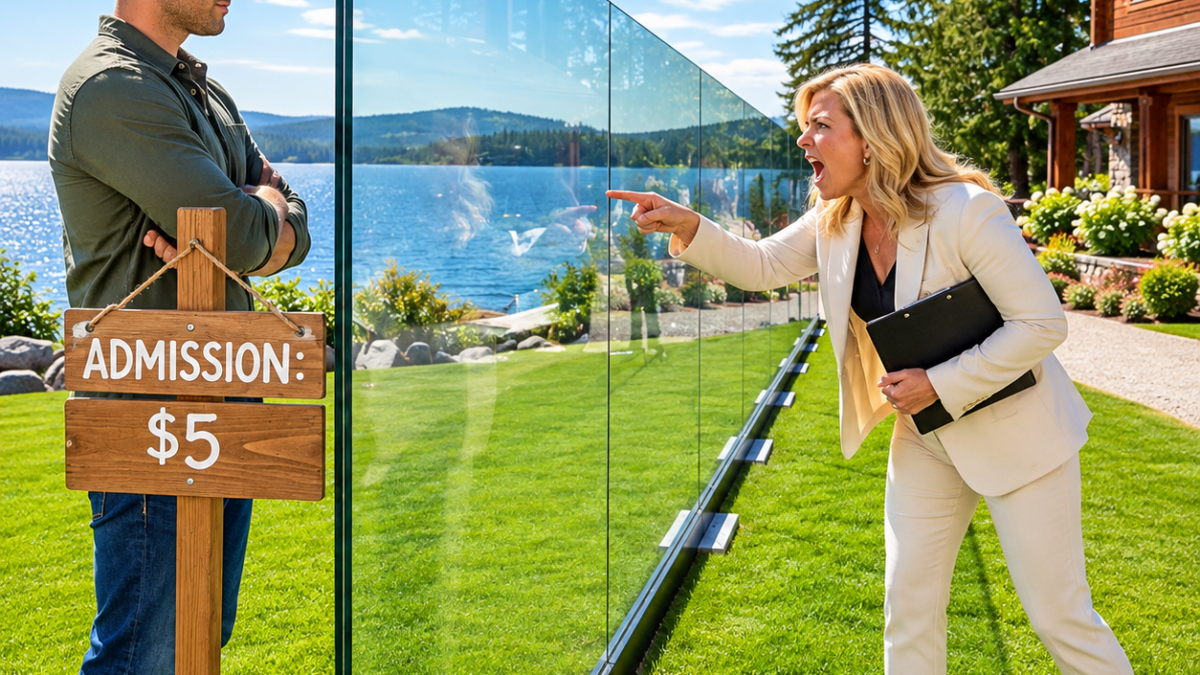
Then she saw the sign.
I had gotten a temporary neighborhood-event permit for Saturday because I knew curious people would come whether I charged or not.
I figured organized stupidity was safer than spontaneous stupidity.
Parking off-site at a nearby church lot with permission.
Walking only.
No food sales.
No amplified music.
Four hours.
Insurance rider.
Occupancy limit.
The five-dollar admission was real.
So was the legal-aid pledge.
Our neighborhood association had spent years fighting about things normal people couldn’t afford lawyers to fight about.
Fence disputes.
Contractor liens.
Drainage problems.
A retired couple nearly lost thousands once because nobody helped them read a demand letter.
I thought if my bad decision attracted money, some of it should do something useful.
Karen heard only one part.
“You’re charging admission?”
“For Saturday.”
“To look at me?”
“No.”
“My house is directly behind it.”
“So is a substation.”
“That is not funny.”
“It’s a little funny.”
She walked away.
Then Channel Eight called.
Which is where Dana came in.
I told her the truth.
Not:
HOA tyrant versus heroic homeowner.
The truth.
Karen was difficult.
I was petty.
The fence was legal.
The glass was absurd.
The event was permitted.
I had spent more money than was sensible because one sentence had activated the wrong part of my engineering brain.
Dana asked:
“Do you regret it?”
I looked at my bank account on my phone.
“Yes.”
She laughed.
“Seriously?”
“Financially? Deeply.”
“What did it cost?”
“I would like my mother not to see this interview.”
“She’s watching?”
“She watches everything.”
Dana nodded toward the fence.
“Why ballistic-rated?”
“Surplus material was available, and laminated security glazing is durable.”
“Not spite?”
“Some spite.”
“How much?”
I held my fingers two inches apart.
The cameraman laughed again.
Dana looked uphill.
“Has Karen commented?”
“Ask Karen.”
So she did.
Karen opened the door.
Saw camera.
Closed door.
That clip aired.
Saturday morning, forty people were waiting fifteen minutes before opening.
That was a problem.
My permit expected modest attendance.
Dana’s segment had made “modest” unlikely.
So I capped entry.
Ten at a time.
People walked through my side yard.
Paid.
Looked at the glass.
Read the engineering display I had created because apparently I cannot do anything halfway.
LAMINATED GLAZING.
STEEL POST DESIGN.
WIND LOAD.
FOUNDATION SECTION.
One kid stared at the drawing.
“Can it really stop bullets?”
His dad looked embarrassed.
I answered carefully.
“The material is tested to a ballistic standard. That does not mean you should shoot it.”
“Could we test it?”
“No.”
“Why?”
“Because I enjoy not being arrested.”
The father whispered:
“Thank you.”
Some people came for the joke.
Others genuinely liked the engineering.
A local architecture student spent twenty minutes asking about edge loading.
Gary showed up.
I stared.
“You told me never to call.”
“You didn’t.”
“Why are you here?”
“My wife saw the news.”
He had brought business cards.
Opportunist.
By noon, we had collected just over two thousand dollars.
Not enough to pay for the glass.
Enough to make me feel less sick.
Karen called code enforcement.
Expected.
The inspector arrived.
Saw permit.
Checked parking.
Counted people.
Looked at the fence.
“You again.”
“Hello, Steve.”
He stared through the glass.
Karen stood thirty yards uphill pretending not to watch.
Steve said:
“Any food?”
“No.”
“Amplified sound?”
“No.”
“Street obstruction?”
“No.”
“Alcohol sales?”
“No.”
“Any plans to shoot the wall?”
“No.”
“Good.”
He signed the event inspection.
Then paid five dollars.
“For what?”
“My wife wants a picture.”
Government efficiency.
Karen moved to Plan B.
The HOA.
Monday morning:
NOTICE OF POTENTIAL COMMERCIAL ACTIVITY.
I expected that too.
The letter claimed charging admission may violate the residential-use restriction.
Reasonable question.
The Saturday event had a temporary city permit.
But HOA rules were separate.
So I didn’t make jokes.
I hired attorney Beth Harmon.
Beth had represented three homeowners in our development over the years.
Sharp.
Calm.
Zero patience for theatrics.
She read the HOA declaration.
Then my event permit.
Then the sign.
Then looked at me.
“Why did you write admission?”
“Because that is what it was.”
“You couldn’t write suggested donation?”
“That felt dishonest.”
“Congratulations on your integrity.”
“Thank you.”
“That wasn’t praise.”
She explained the problem.
One temporary fundraising event might be fine.
Operating a recurring admission-based attraction from a residential property could become a legitimate HOA and zoning issue.
“So I stop.”
“Yes.”
“That easy?”
“Yes.”
“What about my business model?”
“You do not have a business model.”
“Dana called me an entrepreneur.”
“Dana is not your lawyer.”
Fair.
I removed the admission sign.
Saturday stayed Saturday.
No continuing paid tours.
That part of the source story would’ve been funny longer.
Real life works better when you know when the joke is over.
The HOA closed the commercial-activity inquiry.
Karen was furious.
Not because she won.
Because I complied before she could escalate.
People like Karen sometimes need resistance.
Other times, nothing frustrates them more than reasonable behavior.
Then something unexpected happened.
The television segment spread online.
Not enormous.
Not national-folk-hero enormous.
A few million views over several weeks.
Enough.
Gary’s company received calls.
Ballistic glazing manufacturer received calls.
A home-improvement podcast wanted an interview.
A trade publication wrote:
WHEN RESIDENTIAL DESIGN BECOMES MALICIOUS COMPLIANCE.
That phrase followed me everywhere.
Gary called.
“I hate you.”
“How many leads?”
“Twenty-three.”
“You’re welcome.”
“Company wants to use your installation in advertising.”
“What company?”
“The glazing manufacturer.”
“Why?”
“Because nobody has ever made their product look this stupid before.”
He was joking.
Mostly.
The manufacturer offered me a licensing fee for photos and video.
Not life-changing.
But significant.
Gary offered a referral payment because the installation generated actual security projects.
Banks.
Dispensaries.
A pharmacy.
Not more neighbor-spite walls.
Thank God.
Within four months, the media licensing and related fees covered almost half my out-of-pocket cost.
The event proceeds covered another piece.
I still paid plenty.
Bad decisions should retain some consequences.
Otherwise you don’t learn.
Karen changed tactics.
She stopped complaining about the fence.
Started complaining about visibility.
That was the funniest phase.
Her attorney sent Beth a letter.
The glass allegedly created “intrusive reciprocal sightlines.”
Beth read that twice.
Then slid it across the desk.
“She wanted transparent.”
“I know.”
“You had opaque wood.”
“I know.”
“She demanded removal because it blocked sightlines.”
“I know.”
“Now transparent sightlines are intrusive.”
“I know.”
Beth removed her glasses.
“I dislike your neighborhood.”
I framed that letter too.
Karen began installing curtains.
Heavy ones.
Then interior shades.
Then tall planters.
From my yard, her sunroom gradually disappeared.
She had achieved something remarkable.
She spent six weeks demanding that my fence stop blocking her view.
Then spent thousands blocking her own.
Mr. Henderson noticed.
“Reverse fence.”
“What?”
“She built the fence inside.”
He was right.
Then came the bamboo.
Remember the bamboo?
Karen had planted running bamboo along her side of the original cedar fence.
Bad choice.
It spread.
When the cedar came out for construction, we discovered rhizomes extending under the line.
I had them professionally contained on my side.
Karen did not.
Within another season, shoots appeared twenty feet into her landscaping.
She blamed me.
Of course.
“Your construction disturbed it.”
“Your bamboo.”
“It never spread before.”
“It was literally planted to spread across my fence.”
“That is not what I said.”
I retrieved her email from the prior year:
Perhaps natural greenery will soften the barrier where you refuse to cooperate.
She read it.
Then said:
“That doesn’t prove intent.”
I respected the attempt.
She eventually paid a bamboo specialist.
The glass remained.
Summer became fall.
Something I hadn’t expected happened with the fence.
Bird strikes.
Not many.
One was too many.
A transparent barrier can be dangerous to birds because they see reflected vegetation or apparent open space.
My engineering plan had addressed humans.
Wind.
Structure.
Impact.
I had not thought enough about birds.
One morning I found a small warbler stunned beneath a panel.
It survived.
I didn’t wait for a second.
I called a local wildlife group.
They recommended visible markers spaced across the glass.
Not opaque enough to destroy transparency.
Enough for birds to perceive the surface.
Small exterior dots.
Karen noticed the installation.
“What are you putting on it?”
“Bird markers.”
“That wasn’t approved.”
“They’re removable safety markings.”
“They interfere with transparency.”
I stared at her.
This time I wasn’t amused.
“A bird hit the wall.”
She paused.
“Oh.”
That was the first normal response I’d heard from her in months.
“Is it alive?”
“Yes.”
“Good.”
I installed the markers.
Karen did not complain.
That moment bothered me later because it reminded me that people are rarely one thing.
Karen wasn’t a cartoon.
She was controlling.
Status-conscious.
Competitive.
She treated her preferences like collective standards.
But a stunned bird still bothered her.
Humans are inconvenient that way.
I had gotten used to enjoying her as a villain.
Villains are easier than neighbors.
The next major dispute came from somewhere else.
A teenager hit a baseball into the glass.
Hard.
The ball bounced back so fast it nearly scared him into adulthood.
No damage.
His father came over pale.
“I am so sorry.”
“It’s fine.”
“I’ll pay.”
“For what?”
“The glass.”
“There’s no damage.”
“Are you sure?”
I tapped it.
Solid.
The kid whispered:
“That’s awesome.”
His father:
“Not helping.”
That incident made me appreciate the material for the first time without thinking about Karen.
It was, in fact, a very durable fence.
Ridiculously durable.
But durable.
Winter arrived.
The glass collected frost in beautiful patterns.
Sunlight came through.
Snow piled along the base.
Dad’s cedar fence had blocked wind better.
That I missed.
I also missed the warmth of wood.
The way cedar aged.
The smell after rain.
Ballistic glazing has many qualities.
Nostalgia isn’t one.
I began wondering whether my brilliant victory had cost me something I hadn’t priced.
One evening I was sitting outside with a coat on.
Mom called.
She had seen every article.
Obviously.
“You still happy with your aquarium?”
“It’s not an aquarium.”
“Looks like one.”
“Thanks.”
“Your father would’ve hated it.”
I looked at the glass.
“I know.”
“He would’ve thought it was funny for about ten minutes.”
“I know.”
“Then he would’ve asked why you spent all that money.”
“I know.”
Mom had perfected a conversational strategy based on forcing you to agree with your own prosecution.
She said:
“Did you save any of the wood?”
I hadn’t thought about that in months.
“Yes.”
When the cedar fence was removed, Gary’s crew had stacked the boards along my garage.
I couldn’t bring myself to throw them out.
Dad had installed them.
Some were rotten at the bottom.
Most were still usable.
Mom said:
“Build something.”
Simple.
I did.
A bench.
Not a good one.
I design structures.
Furniture is different.
The first version rocked.
The second pinched.
The third looked acceptable.
I put it on the patio facing the glass.
One of Dad’s old fence boards formed the backrest.
I carved a line underneath where nobody could see it unless they looked.
TO SAVE EVERYBODY FROM HAVING TO GUESS.
His fence was gone.
Not entirely.
That helped.
Around the same time, the neighborhood legal-aid fund used the open-house money for its first case.
Not an HOA case.
A widow named Mrs. Palmer had a contractor dispute involving drainage work.
Small amount by litigation standards.
Huge amount to her.
A volunteer attorney negotiated repairs without court.
She wrote me a thank-you note.
I almost threw it away because she credited my “generous community fundraiser.”
Generous was not how the fundraiser began.
Petty.
The word was petty.
But intentions don’t own every outcome.
Sometimes something started for immature reasons grows past them.
That complicated my story in a way the internet disliked.
People wanted:
Karen complains.
Alex builds bulletproof fence.
Karen suffers.
Alex profits.
End.
Real life kept going.
Karen still lived uphill.
I still lived downhill.
Trash day remained Thursday.
We saw each other at the mailbox cluster.
HOA meetings happened.
Sometimes we agreed.
That was uncomfortable.
One debate involved speeding through the neighborhood.
Karen wanted additional stop signs.
So did I.
We both spoke in favor.
Afterward, she caught me outside.
“This does not mean we’re friends.”
“I wasn’t worried.”
“Good.”
“Good.”
Then we stood there awkwardly.
She said:
“Your bird markers look terrible.”
There she was.
“Thank you, Karen.”
“Just saying.”
Months later, her husband left.
I didn’t know details.
Didn’t ask.
One evening I saw a moving truck.
Not Karen’s stuff.
Mostly his.
After that, the McMansion became quieter.
The sunroom lights stayed off.
I stopped seeing her at meetings for a while.
Then, one rainy Saturday, somebody knocked.
Karen.
No makeup.
Sweatshirt.
Hair tied back.
She looked ten years less expensive.
“What?”
She almost smiled.
“I deserve that.”
I waited.
“Can we talk?”
“About?”
“The fence.”
Of course.
I stepped outside.
Rain made lines down the glass.
Karen looked at the panels.
“I hate it.”
“I know.”
“I hated the wood too.”
“I know.”
She hugged herself.
“I think I hated that I couldn’t control what I saw.”
That was more self-awareness than I had budgeted for.
“What do you mean?”
“When we bought the house, the realtor kept saying view. View. View. View.”
She pointed toward the hill.
“We spent too much.”
I said nothing.
“My husband thought it was ridiculous.”
“The house?”
“My obsession.”
Rain hit the patio cover.
She continued.
“When your fence was there, I saw it every morning and thought about how much we paid.”
“So this was really about buyer’s remorse?”
“Don’t make it sound reasonable.”
“It isn’t.”
She laughed.
Barely.
Then:
“I thought if the fence disappeared, the house would feel worth what we spent.”
I looked through the glass.
Electrical substation.
Diner sign.
Gray sky.
My lawn.
“The view isn’t very good.”
“No.”
We both laughed.
First time.
She touched the edge of one panel.
“Then you built this.”
“You told me to.”
“Yes.”
“I spent a medically irresponsible amount of money.”
“Yes.”
“Important that we both acknowledge responsibility.”
“You are unbelievable.”
“Frequently.”
She looked at Dad’s bench.
“That from the old fence?”
“Yes.”
“Your father built it, didn’t he?”
I looked at her.
“How do you know?”
“Mr. Henderson.”
Of course.
Neighborhood intelligence agency.
“He told me after all this started.”
I waited.
Karen’s face changed.
“I didn’t know.”
“You didn’t need to.”
“No.”
She looked at the bench again.
“But I might have behaved differently.”
Maybe.
Maybe not.
I said:
“My dad used to say a fence saves people from guessing.”
She thought about that.
“What were we guessing?”
“Where your preferences stopped.”
That landed.
No dramatic tears.
No apology speech.
Just silence.
Then Karen said:
“I’m sorry I made your life miserable over a view.”
Direct.
Specific.
Better than most apologies.
“I’m sorry I turned your suggestion into a small infrastructure project.”
She smiled.
“Are you?”
“Not entirely.”
“I figured.”
We stood there.
Rain easing.
She asked:
“Would you ever put wood back?”
I looked at the glass.
“I don’t know.”
“I wouldn’t object.”
I laughed.
“Your official approval means everything.”
“I deserved that too.”
She left.
For the first time, the glass felt less like a weapon.
That mattered.
Two years passed.
The media attention disappeared.
Thank God.
The manufacturer stopped using my photos.
Gary still got occasional calls.
People still drove by sometimes.
No more admission.
No tours.
No red polo.
The permit had been one day.
Exactly as promised.
The glass became ordinary.
That’s what neighborhoods do.
Today’s scandal becomes tomorrow’s landmark.
Delivery drivers used it for directions.
“House with the giant glass fence.”
Kids used it as a meeting point.
Joggers stopped noticing.
Karen reopened her sunroom.
Curtains stayed partly closed.
We waved occasionally.
Not often.
Enough.
Then the HOA proposed updated fencing standards.
I expected disaster.
Martin Ellis had retired.
New architectural committee.
Twenty years of mismatched amendments had created confusion.
The board hired a consultant.
Draft rule:
No new ballistic or security glazing as decorative fencing without specific engineering and aesthetic review.
At first I was offended.
Then I read it again.
Reasonable.
My installation would be grandfathered.
Existing structure could remain.
Replacement panels permitted like-for-like if damaged.
New installations needed review.
I went to the meeting.
Karen was there.
Someone asked:
“Alex, don’t you think they’re targeting you?”
I said:
“No.”
Surprised murmurs.
“Why not?”
“Because rules can learn from ridiculous people.”
Karen raised her hand.
“Which ridiculous person?”
I looked at her.
“Yes.”
People laughed.
The rule passed.
Fairly.
That’s another part revenge stories usually cut.
Sometimes the person who fought authority has to admit a new rule is sensible.
Being against overreach doesn’t mean being against rules.
Glass that heavy needs real engineering.
Sightlines matter.
Bird safety matters.
Maintenance matters.
Emergency access matters.
We learned things.
Three years after installation, one panel developed edge delamination.
Not dangerous.
Ugly.
Cloudiness at the corner.
Manufacturer warranty covered it.
Replacement required a crane again.
Neighbors appeared again.
Mr. Henderson, now seventy-four, brought popcorn.
“Tradition.”
“You need hobbies.”
“This is my hobby.”
Karen walked down.
Watched.
Gary had retired.
His daughter Elise now ran the company.
She supervised the replacement.
Karen said:
“Three generations of this fence are going to haunt me.”
“Only two.”
“Feels like three.”
Elise looked at us.
“You’re Karen?”
Karen closed her eyes.
“Please don’t.”
Elise laughed.
“My dad tells this story every Thanksgiving.”
“Of course he does.”
Once the new panel was installed, Karen touched it.
Then said:
“I still prefer wood.”
I looked at her.
“Careful.”
She backed away.
“No suggestions.”
Smart.
The legal-aid fund became permanent.
Not because of my fence money alone.
Other residents donated.
Local attorneys gave hours.
The HOA eventually contributed annually.
We renamed it the Neighborhood Resolution Fund because Beth argued “legal aid” implied services we weren’t technically providing ourselves.
She remains annoyingly precise.
The fund paid for mediation.
Document reviews.
A few survey consultations.
One elder-law referral.
Nothing dramatic.
That’s good.
The best dispute is the one that becomes boring before anybody needs a judge.
I volunteered occasionally.
People arrived furious.
“My neighbor is stealing three feet.”
“HOA has no right.”
“The contractor destroyed everything.”
Sometimes they were correct.
Sometimes they weren’t.
I learned to say:
“Before we decide who the villain is, let’s read the documents.”
I hated how much that sounded like Beth.
Karen volunteered once.
That shocked everyone.
A homeowner was fighting the board over a second-story addition.
Karen had experience with architectural review.
She spent an hour explaining how to make the submission properly.
Afterward I asked:
“Who are you?”
She rolled her eyes.
“I can be useful.”
“I’m processing.”
“Take your time.”
People change slowly.
Not cleanly.
Karen still complained about garbage cans.
Still overused the phrase property values.
Still believed beige was a personality.
But she stopped treating every preference as authority.
Mostly.
I stopped treating every disagreement as an engineering challenge.
Mostly.
The biggest change happened to me.
I had built the glass partly because I wanted her to feel stupid.
That’s true.
I can polish the story all I want.
Talk about compliance.
Structural design.
Legal boundaries.
Community fundraising.
At the center was a forty-two-year-old man who heard “replace it with glass” and thought:
I am going to make you regret those words.
Funny?
Yes.
Healthy?
Not especially.
Dad would’ve laughed first.
Then asked whether I had proved anything beyond my ability to obtain financing.
As I got older, I understood his fence line better.
A boundary isn’t successful because it humiliates the person across it.
It’s successful because both people know where it is.
The cedar did that.
The glass does too.
Just much more expensively.
Seven years after the installation, Mom sold her house.
I helped move boxes.
In the garage I found Dad’s old level.
Yellow.
Scratched.
The same one we used on the cedar fence.
I brought it home.
Put it on the bench.
Karen happened to be outside.
“What’s that?”
“My dad’s level.”
“From the fence?”
“Yeah.”
She came closer.
“Can I see?”
I handed it through the side gate.
She turned it over.
Dad’s initials scratched into the plastic.
R.M.
Karen ran her thumb over them.
Then handed it back.
“You know something?”
“What?”
“I’m glad you kept the wood.”
“Me too.”
She looked at the glass.
“I’m still not glad about that.”
“Consistency is important.”
She laughed.
We sat on opposite sides of the transparent wall for a while.
Not together.
Not separated either.
Strange.
Her patio chair uphill.
Mine below.
Glass between.
We could see each other perfectly.
Could barely hear each other without raising our voices.
Maybe appropriate.
She lifted her coffee.
I lifted mine.
No speeches.
A few years later, Karen sold the McMansion.
Not because of me.
Her daughter had moved to another state.
Karen wanted something smaller.
The house sold for a perfectly respectable price.
Apparently the ballistic fence did not destroy property values.
Sorry to disappoint.
On moving day, she came by.
One cardboard box in her arms.
“I have something.”
She handed me the first scented letter.
The original.
VERTICAL OBSTRUCTION.
I stared.
“You kept a copy?”
“I keep everything.”
“That’s terrifying.”
“I thought you might want the original.”
I laughed.
“I have mine on the refrigerator.”
“Still?”
“Behind a pizza coupon.”
She shook her head.
Then looked at the glass.
“Alex?”
“Yeah?”
“Do not build anything else because of me.”
“I make no promises.”
“Seriously.”
“Fine.”
She held out her hand.
I shook it.
Then she hugged me.
Unexpected.
Short.
When she stepped back, she said:
“I was awful.”
“You were difficult.”
“That’s generous.”
“You improved.”
“So did you.”
“Debatable.”
She smiled.
Her moving truck pulled away that afternoon.
No victory music.
No crowd.
No reporter.
Just somebody leaving a house.
The new owners were a couple named Priya and Mark Chen.
First week, Mark walked down.
“I need to ask about the glass.”
Here we go.
“My wife loves it.”
I blinked.
“What?”
“She says the yard feels bigger because you can see through.”
“Your predecessor had a complicated relationship with it.”
“So we’ve heard.”
“From whom?”
He pointed toward Mr. Henderson’s house.
Of course.
Mark said:
“Can our kids draw on it with window markers for Halloween?”
That question would have broken old Karen’s brain.
“Washable?”
“Yes.”
“Go for it.”
Halloween night, the entire fifty-foot wall became a mural.
Ghosts.
Pumpkins.
A giant dragon.
One child drew a stick figure labeled GRUMPY LADY.
I erased that one.
Not because Karen would see it.
Because she no longer needed to be the joke.
That was when I knew the story had really ended.
Not when the glass went up.
Not when the reporter arrived.
Not when people paid five dollars.
Not when Karen apologized.
When I no longer wanted strangers laughing at her.
The wall stayed.
The story moved on.
Kids drew on it.
Bird markers stayed.
Morning frost covered it.
Sunset passed through.
Dad’s cedar bench aged beside it.
Sometimes people still recognize the house.
“Is this the bulletproof fence place?”
“Ballistic-rated.”
They stare.
“Why?”
“Long story.”
Some ask for the tour.
I don’t charge anymore.
Usually I point at three things.
The old cedar bench.
The glass.
The legal-aid fund plaque near the side gate.
Then I tell them:
“The wood came first.”
Because that’s the part I care about now.
My father and I built a three-foot fence so two neighbors wouldn’t have to guess where one yard ended and another began.
Years later, Karen tried to turn that boundary into an argument about a view.
I responded by making the boundary impossible to miss.
Fifty feet of transparent overreaction.
Did it work?
Yes.
Did it cost too much?
Absolutely.
Was charging five dollars at the open house funny?
Still funny.
Did the internet pay for the whole thing?
No.
People exaggerate that.
Licensing fees, donations, and referrals helped substantially.
I still paid for my own stupidity.
As I should have.
And was Karen some irredeemable monster?
No.
She was a neighbor who got used to confusing preference with authority.
Then she got embarrassed.
Then defensive.
Then quieter.
Eventually better.
I had my own version of the same flaw.
I confused being technically allowed to do something with being wise to do it.
The permit said I could build the wall.
The engineering said it would stand.
The HOA rules said it complied.
None of those documents said:
Alex, this is a mature use of thirty thousand dollars.
That was on me.
Boundaries need law.
They also need judgment.
These days, when I sit on Dad’s bench, I can see straight through the glass.
The diner sign still flickers.
The substation still hums.
The Chen kids leave soccer balls everywhere.
My grill finally died.
I replaced it with a nicer one.
Nothing ballistic.
I’m learning.
Dad’s old level hangs inside the garage.
Sometimes I think about the sentence he gave me after we set the last cedar post.
A good fence isn’t there to keep people apart.
It’s there to save everybody from having to guess.
He was right.
The funny thing is, Karen spent six weeks complaining that she couldn’t see through my fence.
So I gave her fifty feet of perfect transparency.
And somewhere between the permits, the reporters, the legal letters, the five-dollar tickets, and the ridiculous weight of all that glass, both of us finally saw the one thing the old cedar fence had been saying all along:
This is my side.
That is yours.
Neither one has to ruin the view.