My neighbor reported my “illegal” shed to the city—then the inspector fined him instead.
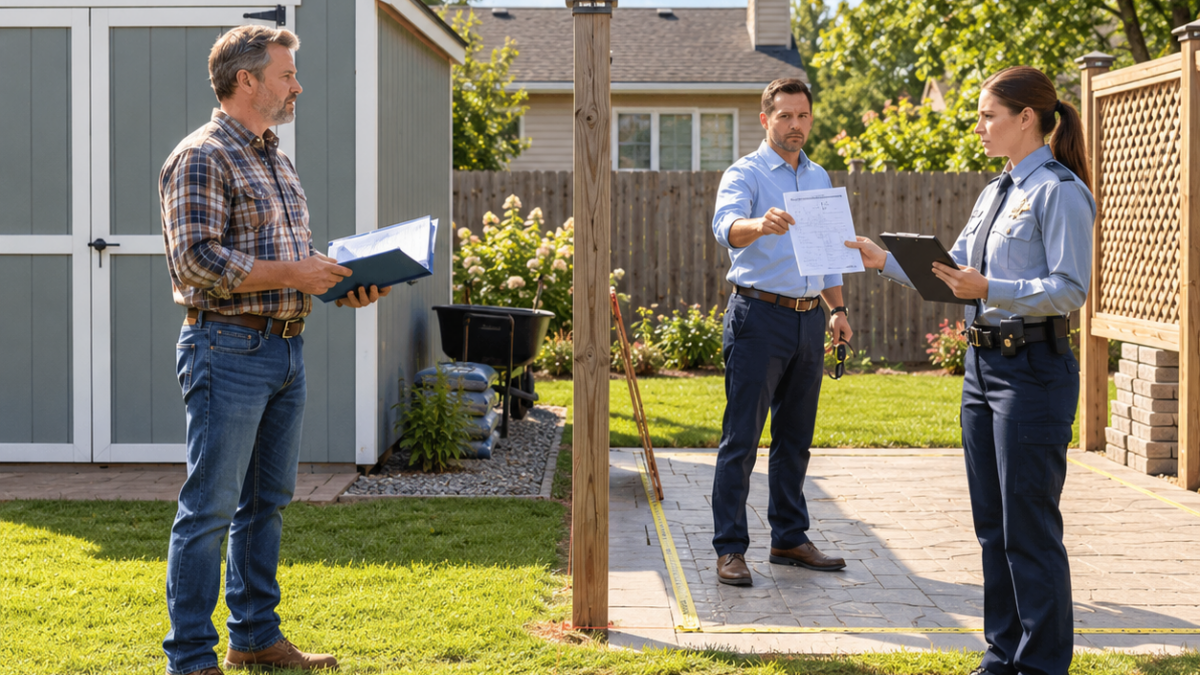
My neighbor reported my “illegal” shed to the city—then the inspector fined him instead.
He expected a red violation notice on my door and probably thought I’d be tearing the shed apart before dinner.
What he didn’t know was that I had a folder full of permits in my desk—and the inspector was about to notice something on the other side of my fence.
I didn’t move to Brook Hollow to fight with anybody.
My wife, Hannah, and I had bought our house six years earlier because it was quiet, ordinary, and almost aggressively suburban.
Kids rode bikes in the street until the porch lights came on.
People waved while dragging trash cans to the curb.
The biggest neighborhood controversy I remembered from our first year involved somebody mowing at 7:15 on a Sunday morning.
Our backyard was one of the reasons we bought the place.
It was deep enough for Hannah’s vegetable beds, a maple tree, a grill, and eventually a small storage shed where I could keep the mower, snowblower, tools, and everything else that had slowly swallowed half our garage.
I built the shed three years after we moved in.
Twelve feet by ten.
Gray siding to match the house.
Nothing extravagant.
But before I bought lumber, I called the city.
I submitted a site plan.
I checked the setbacks.
I applied for the required permit.
I waited.
When the approval came through, I printed everything.
During construction, I took photographs of the footing locations and measurements because an ugly kitchen-remodel dispute years earlier had taught me one lesson: paperwork feels unnecessary right up until the moment you desperately need it.
The final inspection passed without a correction.
Then the shed sat there for three peaceful years while absolutely nobody cared.
That changed when Caleb Mercer bought the house next door.
At first, I liked him.
I helped carry his sectional sofa through the front door.
He brought over beer the following weekend.
He worked in commercial real estate, drove a spotless black SUV, and spoke about property the way some people talk about religion.
Values.
Standards.
Marketability.
Presentation.
The first strange conversation happened while a survey crew was marking his lot.
Caleb stood near the side yard watching orange flags go into the grass.
“You know exactly where your property line is, right?” he asked.
“Pretty much,” I said.
“I have the recorded plat.”
He nodded toward my backyard.
“And the shed?”
“Permitted.”
“How far from the line?”
I told him.
Three feet from the rear boundary, five from the side.
A few days later he asked again.
This time, I pulled the approval email up on my phone.
He read it, handed the phone back, and gave me a thin smile.
“Good,” he said. “Rules are there for a reason.”
After that, the questions became a pattern.
Had the shed gone through architectural review?
Did I know detached buildings could affect nearby appraisals?
Was I sure the structure hadn’t been grandfathered under older rules?
I finally told him our section of the neighborhood didn’t require the kind of HOA approval he kept referring to.
He didn’t argue.
He just said, “Interesting.”
Then, on a Tuesday afternoon, I came home and found a bright orange code-enforcement notice taped beside my front door.
A formal complaint had been filed alleging that my accessory structure was unpermitted and inside a restricted setback.
Hannah came outside while I was still reading it.
“Your shed?”
“Apparently.”
“But you have the permit.”
“I know.”
She looked toward Caleb’s house.
“You think he did this?”
I didn’t answer.
I didn’t have to.
Instead of walking next door, I went upstairs.
From the bottom drawer of my desk, I pulled out the folder labeled BACKYARD STRUCTURE.
Permit application.
Approved site plan.
Inspection signoff.
Photographs.
Measurements.
Emails.
Everything.
The city scheduled the inspection for Friday morning.
The inspector arrived just after nine.
Her name was Denise Alvarez.
She wore work boots, carried a tablet, and had the calm expression of someone who had probably spent years listening to neighbors insist that six inches of grass represented a constitutional crisis.
I handed her the folder.
She looked surprised.
Then we walked behind the house.
She measured the shed.
Rear setback.
Side setback.
Foundation location.
She compared everything with the approved plan on her tablet.
Then she measured again.
“Your shed is fine,” she said.
The tension left my shoulders.
I thought that was it.
Denise closed the site plan.
Then she looked over my rear fence.
Her eyes stopped on Caleb’s backyard.
Six months earlier, he’d had a small concrete landing outside his sliding door.
Now a stamped patio stretched almost the width of the house, and a tall privacy screen stood near the rear boundary on heavy posts set into concrete.
Denise stared at it for several seconds.
Then she reopened her tablet.
“Was that patio always there?”
“No.”
She scrolled.
“And the screen?”
“New this spring.”
Another pause.
She looked at the map.
Then at the fence.
Then back at the map.
Finally, she said, “I need to check something.”
[END OF FACEBOOK CAPTION]
[FIRST COMMENT / FULL STORY CONTINUATION]
Denise enlarged the parcel map on her tablet and pinched the screen with two fingers.
I stood beside her without saying anything.
The expression on her face wasn’t excitement.
It wasn’t some movie moment where an inspector suddenly realizes she’s uncovered a criminal conspiracy.
It was much more ordinary than that.
Professional curiosity.
She traced a thin dashed line across Caleb’s rear yard.
“Utility easement,” she said quietly.
I leaned closer but didn’t pretend to understand everything I was seeing.
“How wide?”
“Recorded as five feet on this map. I want to verify it against the property file before I say anything definitive.”
That sentence stayed with me.
Before I say anything definitive.
It was the opposite of how Caleb had handled my shed.
He had made an assumption first and looked for proof second.
Denise was doing it the other way around.
She stepped toward the fence and studied the concrete patio again.
From our side, you could see that the stamped surface extended almost to the back boundary.
The privacy screen was even closer.
Its posts disappeared into thick round concrete footings.
“Do you know when that work was done?” she asked.
“Late spring. Maybe May.”
“Contractor?”
“I saw trucks. I don’t know the company.”
She nodded.
Then she opened the city’s permit history.
I deliberately looked away.
Whatever was on Caleb’s property was his business.
At least, that was what I told myself.
The problem was that he had made my property the city’s business first.
Denise tapped several times.
Her mouth tightened.
“There’s no permit history showing this work.”
“Does it need one?”
“Parts of it might. Depends on dimensions, drainage, the footing details, the screen classification, and whether any portion is inside that easement. I’d need to verify the actual site conditions.”
I shoved my hands into my pockets.
“So what happens?”
“I talk to the property owner.”
She walked back around the side of my house rather than climbing through the fence like we were raiding a compound.
I followed as far as my driveway.
Caleb’s garage door was open.
His SUV sat inside gleaming under the overhead lights.
He appeared before Denise even reached the front walk.
That told me he had been watching.
He stepped outside wearing sunglasses and the same pale-blue polo he wore whenever he seemed determined to look casually expensive.
“Everything all right?” he called.
Denise introduced herself.
“I’m here regarding a complaint about an accessory structure at the neighboring property.”
Caleb nodded as if he were hearing this information for the first time.
“Right.”
“The structure that was reported is permitted and matches its approved site plan.”
His smile barely changed.
“Good. Glad to hear it.”
Denise continued.
“While I was verifying the site, I observed what appears to be recent work in your rear yard. I’m not seeing a corresponding permit in the system, and the parcel map shows a utility easement near the rear boundary. I need to ask you a few questions.”
Caleb’s smile disappeared.
Only for a second.
Then the commercial-real-estate version of him came back.
“Of course. We’re all about compliance.”
I almost laughed.
I didn’t.
Denise asked when the patio had been expanded.
“May.”
“Who performed the work?”
“A contractor.”
“Do you have the permit number?”
“He handled all of that.”
“Do you have the contractor’s information?”
“Inside.”
“Would you mind getting it?”
Caleb glanced at me.
That was the first moment his confidence slipped.
Not because he had been caught doing anything yet.
Because I was standing ten yards away with a folder full of approved documents while an inspector was asking him where his paperwork was.
He disappeared into the house.
Denise waited.
I started to head back toward my yard.
She stopped me.
“Mr. Lawson?”
“Yeah?”
“You don’t need to stay for this.”
“I figured.”
I nodded toward the house.
“I’m going inside.”
That mattered to me later.
At the time, part of me wanted to stand there.
I wanted to hear every question.
I wanted to watch Caleb discover exactly how irritating it felt to have an official examine your property because somebody else had invited them there.
But I went inside.
Not because I was noble.
Because Hannah was watching through the kitchen window, and the expression on her face was enough to remind me that there was a difference between enjoying consequences and turning them into entertainment.
“What’s happening?” she asked.
“Apparently his patio might be inside an easement.”
Her eyebrows lifted.
“Seriously?”
“Inspector’s checking.”
Hannah looked through the window.
Caleb had returned carrying a folder that looked about one-quarter as thick as mine.
“I’m not going to say it,” she said.
“Say what?”
“That this is unbelievably ironic.”
“You just said it.”
“I said I wasn’t going to.”
We both smiled.
Then she became serious.
“You didn’t report him, right?”
“No.”
“You didn’t tell the inspector to look?”
“No.”
“Okay.”
That answer seemed important to her.
It was important to me too.
The next forty minutes passed mostly out of sight.
Denise and Caleb went into his backyard.
I heard fragments through the open kitchen window.
Measurements.
Questions.
The scrape of a tape measure being pulled across concrete.
At one point Caleb’s voice rose.
Not shouting.
Sharp enough to carry.
“My contractor told me this didn’t require anything.”
Then Denise.
“I understand. I’m telling you what I’m seeing in the property record.”
A few minutes later I heard Caleb again.
“It’s decorative.”
Another calm response.
“The classification depends on how it’s constructed, not what you call it.”
Then silence.
Eventually Denise came back to my door.
She had my original complaint paperwork tucked beneath her tablet.
“Everything on your property is cleared,” she said.
“So the complaint is closed?”
“As far as your shed is concerned, yes.”
I exhaled.
“Thank you.”
She handed back the copies I’d given her.
“You were smart to keep these.”
“Bad experience with a kitchen remodel.”
She smiled.
“I wish more homeowners had your filing habits.”
I hesitated.
I could have left it there.
Instead I asked, “Is he in trouble?”
Denise’s expression became careful.
“That’s between the city and the property owner.”
Fair answer.
She started down the steps.
Then she turned.
“For what it’s worth, a complaint doesn’t give someone control over the inspection process. We verify what was alleged. If we observe other potential violations while we’re lawfully on site, we document them too.”
I nodded.
After she drove away, Caleb stood in the gap between our houses.
He didn’t wave.
Neither did I.
For almost an hour, nothing happened.
Then he knocked on my door.
Hannah and I looked at each other.
“I’ll get it,” I said.
When I opened the door, Caleb was holding his sunglasses instead of wearing them.
“You knew.”
No hello.
No attempt at politeness.
I kept one hand on the doorframe.
“Knew what?”
“The easement.”
“I knew there was a utility easement somewhere along the back. It’s on the plat.”
“And you didn’t say anything.”
“When?”
“When I built the patio.”
I stared at him.
“You never asked me.”
His jaw tightened.
“You watched the work.”
“Yes.”
“You could have said something.”
I almost answered too quickly.
Then I stopped.
The anger I had been holding since Tuesday was still there.
The orange notice.
The accusations.
The questions about standards.
The assumption that my shed must somehow be wrong because he didn’t like looking at it.
I could have unloaded all of it.
Instead I asked one question.
“Did you file the complaint about my shed?”
He looked past me toward the street.
That was enough.
“Caleb.”
“Yes.”
“Why?”
“I had concerns.”
“You saw the permit on my phone.”
“I saw an email.”
“You asked the setback.”
“That doesn’t mean it was measured correctly.”
“So you thought I lied?”
“I thought it should be verified.”
I nodded once.
“And now your property is being verified.”
His mouth tightened.
“That’s not the same thing.”
“Why?”
“Because I wasn’t trying to hide anything.”
“Neither was I.”
He looked at me for several seconds.
The screen door between us creaked softly in the wind.
Finally, he said, “This is petty.”
I almost laughed.
“You called the city on a shed you already knew had a permit.”
“I told you, I wanted it verified.”
“And the city verified it.”
“That doesn’t mean you had to stand there while she started inspecting my yard.”
That one landed differently.
Because he was right about part of it.
I had stood there at first.
And I had enjoyed the shift in his expression more than I wanted to admit.
Still, I hadn’t directed Denise toward anything.
I hadn’t lied.
I hadn’t filed a complaint.
I hadn’t built his patio.
So I said, “I didn’t ask her to inspect your property.”
“You could have warned me.”
“Warned you about what? That an inspector might notice construction while she was standing ten feet away?”
He stared at me.
I could see embarrassment sitting underneath the anger.
Embarrassment is dangerous fuel in a neighbor dispute.
It makes people say things they cannot easily take back.
For a moment I thought he was going to.
Instead, he shook his head.
“This neighborhood is unbelievable.”
Then he walked home.
I closed the door.
Hannah was standing in the hallway.
“How bad?”
“Not great.”
“What did he want?”
“He thinks I should have warned him.”
“About the easement?”
“About the inspector noticing his yard.”
Hannah crossed her arms.
“And did you know his work violated anything?”
“No.”
“Then what exactly were you supposed to warn him about?”
“I think that’s the problem. He assumed I knew because I had my paperwork.”
“That is not how paperwork works.”
I laughed.
She didn’t.
“Be careful,” she said.
“With what?”
“This.”
She pointed vaguely toward the wall separating our houses.
“Do not let this become your hobby.”
I knew exactly what she meant.
Neighborhood wars rarely begin with people planning to destroy each other.
They begin with small things.
A complaint.
A fence.
A tree limb.
A parking spot.
Then people start keeping score.
A camera goes up.
A second camera appears in response.
Someone photographs trash cans.
Someone measures grass.
Someone starts documenting when the other person’s guests arrive.
Soon nobody remembers what peace felt like before they decided every inconvenience was evidence.
“I’m not doing anything,” I said.
“Keep doing that.”
Two business days later, a certified letter arrived at Caleb’s house.
I knew because I happened to be getting my mail when the carrier handed him the envelope and asked for a signature.
I did not slow down.
I did not ask.
That night, however, I heard voices next door.
Caleb and another man stood on the patio.
The second man wore work boots and a faded contractor shirt.
I assumed he was the person who had built it.
Their conversation was tense enough that I could hear pieces through the fence.
“You told me it was exempt.”
“For a basic patio.”
“It is a patio.”
“Not with those footings.”
“You designed the screen.”
“You asked for privacy.”
“I asked you to handle permits.”
“I said I’d tell you if we needed one.”
“And apparently we needed one.”
The voices lowered.
I went inside.
The next afternoon, Caleb’s contractor knocked on my door.
That surprised me.
He introduced himself as Mitch Avery.
Broad shoulders.
Gray beard.
Cap with the logo of a small remodeling company.
“Sorry to bother you,” he said. “I’m trying to locate the rear property markers. Caleb said you might know where yours are.”
I stepped onto the porch but didn’t invite him in.
“There’s an iron pin near the maple, and another one closer to the corner. Survey flags were here when he bought the house.”
Mitch rubbed his jaw.
“You mind if I take a look from your side? I won’t touch anything.”
That request was reasonable.
So I walked him around back.
We found the marker under grass and leaves.
Mitch crouched beside it.
He measured toward Caleb’s patio, then stood very still.
“How bad?” I asked before I could stop myself.
He exhaled.
“Bad enough that I wish I had insisted on pulling the property records myself.”
“That sounds like a contractor problem.”
“It is.”
He didn’t get defensive.
That earned him a little respect.
He looked toward the privacy screen.
“When we started, Caleb told me he’d already checked the setback. Said there was no issue because the old slab was already there.”
“The old slab was much smaller.”
“I know that now.”
He tucked the tape measure onto his belt.
“He wanted it almost to the rear line. I told him I didn’t love that. He kept saying the lot was his and he’d had it surveyed.”
I didn’t respond.
Mitch gave a humorless smile.
“You’re probably enjoying this.”
The question irritated me.
“Less than you’d think.”
He nodded as if he believed me.
“Inspector says the city wants a revised site plan and utility review before they decide whether any part can stay.”
“Is that unusual?”
“No. Just expensive when concrete is already in the ground.”
He started toward the gate.
Then he stopped.
“For what it’s worth, if I’d seen the easement note, I wouldn’t have poured there.”
That sentence introduced something new.
Until then, I had thought of Caleb as the guy who trusted a contractor and got burned.
Now I wondered whether the contractor had trusted Caleb too.
The following week, a utility locator marked a strip across the back of Caleb’s yard.
Blue and yellow paint appeared on the grass.
Small flags ran directly behind the privacy screen.
One line passed close enough to a footing that even I could understand why the city was concerned.
That night Caleb came outside while I was grilling.
He didn’t say anything.
Neither did I.
He stood staring at the flags.
Then at the patio.
Then at the screen.
Finally he went inside.
The next development came three days later.
A small white city vehicle pulled into his driveway.
Denise stepped out with another employee carrying rolled plans.
They spent about twenty minutes in the backyard.
This time I stayed in the house.
When they left, Caleb sat alone on the patio.
No phone.
No sunglasses.
No performance.
Just a man sitting on concrete.
I felt something uncomfortable then.
Not guilt exactly.
Recognition.
I knew what expensive home repairs felt like.
I knew the special kind of nausea that comes when something you thought was finished suddenly turns into demolition, fees, applications, delays, and checks with too many zeroes.
For a moment I imagined walking over.
Then I remembered he had known my shed was permitted and filed the complaint anyway.
Compassion did not require me to rescue him from consequences.
So I stayed home.
A formal correction notice went up on his side gate the following Monday.
It was not some dramatic red condemnation tag.
It was a plain administrative document in a plastic sleeve.
The city required him to submit documentation for the patio expansion and screen, verify the easement conditions, and correct any portions that could not be approved.
There was a compliance deadline.
There were reinspection fees.
There could be civil penalties if the work remained unresolved.
Caleb spent the next two weeks trying to avoid demolition.
He hired a surveyor.
Then a permit consultant.
Then, according to Hannah, a civil engineer whose truck had been parked outside for most of a Saturday morning.
I never asked for details.
Brook Hollow provided them anyway.
Suburbs are efficient rumor systems.
A neighbor named Jeff heard from Mitch’s cousin that the utility department refused to approve permanent footings within the easement.
Someone else claimed Caleb could keep the entire patio.
Someone said he had already been fined five thousand dollars.
Someone said he was suing the contractor.
Most of it was probably nonsense.
I ignored it.
The reality appeared one Wednesday at 7:42 in the morning.
A demolition saw started next door.
Hannah and I were drinking coffee.
The blade hit concrete.
She looked toward the window.
“That sounds expensive.”
I took another sip.
“I’m not going outside.”
“Good.”
Thirty seconds passed.
The saw screamed again.
Then a jackhammer.
I lasted four minutes.
Hannah smiled without looking at me.
“I thought you weren’t going outside.”
“I’m checking the weather.”
“Through the backyard?”
“The weather is different back there.”
She laughed.
I stepped onto the patio.
Dust floated above Caleb’s fence.
Mitch and two workers were cutting a long strip from the rear edge of the stamped concrete.
The beautiful decorative pattern fractured into chunks.
The privacy screen had already been removed.
Its posts lay on the grass.
Caleb stood near the sliding door wearing hearing protection.
He noticed me.
Our eyes met.
I expected anger.
Instead he looked tired.
I gave him a small nod.
After a second, he returned it.
That was all.
The work continued for two days.
The patio was reduced enough to satisfy the revised plan.
The tall privacy wall disappeared completely.
Later, a shorter freestanding lattice section went up closer to the house, outside the easement.
The city closed the case after reinspection.
But not without cost.
Caleb had missed the original correction deadline while trying to obtain retroactive approval for the full design.
That triggered an administrative citation and reinspection charges.
I learned that from Caleb himself, months later.
The amount wasn’t life-changing.
It was simply enough to make the title of the whole ridiculous episode painfully accurate.
He had called the city hoping an inspector would fine me over my shed.
Instead, my permit stayed clean, his patio got cut apart, and the violation notice—with the fees attached—went to his address.
For several weeks afterward, we barely spoke.
That was worse than the argument.
Before the complaint, Caleb and I had at least been neighbors in the casual American sense.
We waved.
We talked about weather.
Once he borrowed my ladder.
Afterward, every interaction had weight.
If we reached the mailboxes at the same time, one of us slowed down.
If I was mowing near his side of the yard, I became hyperaware of the boundary.
If he had friends over, I wondered whether I was becoming a story.
There’s the guy with the shed.
There’s the reason my patio got demolished.
That kind of tension changes how a place feels.
Your home is supposed to be where your shoulders come down.
For a while, mine didn’t.
Then something happened that complicated the version of Caleb I had built in my head.
It was late September.
Leaves had started collecting along the fence.
I was raking near the maple when I heard his gate.
“Mark?”
I looked up.
Caleb stood on his side wearing an old Ohio State sweatshirt.
No polished polo.
No sunglasses.
No real-estate voice.
“You got a minute?”
I leaned on the rake.
“Sure.”
He approached the fence.
For several seconds he said nothing.
Then:
“I shouldn’t have filed that complaint.”
Simple sentence.
No speech.
No excuses yet.
I waited.
He looked toward the shed.
“I handled it badly.”
“Why did you do it?”
He rubbed his hands together against the cool air.
“When we bought this place, the appraisal had a note about nearby accessory structures. Not a warning exactly. Just something about neighborhood conformity.”
I frowned.
“My shed?”
“Not specifically. I don’t think so.”
“Then why make it specifically about my shed?”
He sighed.
“Because I got fixated.”
That answer surprised me.
He continued.
“My work is commercial property. Every day I deal with risk, value, maintenance issues, deferred repairs, zoning, tenants doing things they’re not supposed to do. Then I bought the most expensive house I’ve ever owned, and suddenly I was looking at everything like it was an asset I had to manage.”
He nodded toward my shed.
“I saw that back there and thought, Is that allowed? Could somebody build something even bigger? Could this affect resale? Then I asked you, and you had the permit, but…”
“But?”
“I still thought maybe you were wrong about the setback.”
I stared at him.
“You thought I was either lying or incompetent.”
“When you say it like that…”
“How else would you say it?”
He gave a small, embarrassed laugh.
“I don’t know.”
A dry maple leaf scraped across the patio between us.
He looked toward his own yard.
“You know what the worst part was?”
“What?”
“I didn’t check my own property.”
I almost smiled.
He did first.
“I stood there talking to you about rules while trusting a contractor and a survey I barely looked at.”
“Mitch said you told him the setback was fine.”
Caleb’s head came up.
“He talked to you?”
“He needed to find the property marker.”
Caleb nodded slowly.
“Yeah. I told him it was fine.”
“So he didn’t just mess up.”
“No.”
That mattered.
Not because it made Caleb worse.
Because it made him more human.
He had spent weeks blaming the contractor because blaming one person is easier than admitting a chain of bad assumptions.
“I should have looked at the easement,” he said.
“Probably.”
“I should have asked you before calling the city.”
“Definitely.”
He accepted that.
Then he said something I did not expect.
“And you were right not to warn me.”
I straightened.
“About what?”
“The inspection.”
He looked at the fence.
“I was angry because I felt embarrassed. I wanted somebody else to be responsible for that feeling.”
That was more self-awareness than I had given him credit for.
“I didn’t know your patio violated anything.”
“I know that now.”
“I also didn’t tell Denise to inspect it.”
“I know.”
For the first time since the complaint, we stood there without defending ourselves.
Then Caleb laughed softly.
“I still hate that shed.”
I looked at him.
“Seriously?”
“The color.”
“It matches my house.”
“Exactly.”
I laughed.
He laughed too.
It didn’t fix everything.
But it changed the temperature.
A few days later, he waved when I drove past.
The following week, Hannah found a package on our porch that had been delivered next door by mistake.
Caleb brought it over instead of leaving it by the mailbox.
Tiny things.
But neighborhoods are built out of tiny things.
So are feuds.
The choice is often which kind you keep feeding.
By November, the leaves were gone.
The shortened patio looked normal.
If you had not known what happened, you never would have guessed that several feet of stamped concrete had once extended farther back.
The new lattice screen was smaller and honestly looked better.
One Saturday morning I saw Caleb measuring a low platform near his grill.
Tape measure in one hand.
Printed sheet in the other.
He caught me watching.
“Don’t start.”
“I didn’t say anything.”
“I can hear you thinking.”
“What am I thinking?”
“Permit.”
“Actually, I was thinking setback.”
He pointed the tape measure at me.
“Five feet from the side.”
“Look at you.”
“Three from the rear.”
“You’re becoming dangerous.”
He shook his head.
Then held up the paper.
“City handout.”
“I’m proud of you.”
“Go organize a folder.”
“Already have one.”
That became the first joke we had shared about the whole mess.
Winter arrived early that year.
By December, snow covered both yards.
Property lines disappeared beneath white drifts.
The edge of my shed softened.
The shortened patio vanished completely.
One Saturday morning I was clearing the driveway when Caleb walked over carrying two paper cups.
“Truce coffee?”
I rested my shovel against the garage.
“Are we still at war?”
“I’m not sure. Nobody formally filed the paperwork ending it.”
I laughed.
He handed me a cup.
We stood there drinking coffee while our breath clouded in front of us.
After a while he nodded toward the backyard.
“You ever think about how ridiculous that got?”
“Which part?”
“All of it.”
“The complaint?”
“Yes.”
“The inspection?”
“Yes.”
“The jackhammer?”
He groaned.
“Especially the jackhammer.”
“I thought the percussion section was impressive.”
He laughed into his coffee.
Then he became quiet.
“I think I wanted control.”
I looked at him.
“Over my shed?”
“Over everything.”
He stared down the street.
“New house. New neighborhood. Big mortgage. I didn’t know anybody. At work, I’m usually the guy who knows what the rules are. Here, I didn’t.”
“So you compensated.”
“Poorly.”
I took a drink.
“I was territorial too.”
He looked surprised.
“You?”
“You came in asking about boundaries and standards before you’d finished unpacking. I’d lived here for years. I knew everybody. I probably heard every question as, ‘You people have been doing this wrong until I arrived.’”
Caleb winced.
“That bad?”
“A little.”
“I didn’t mean it that way.”
“I know.”
That was the strange thing about understanding someone’s motive.
It doesn’t erase what they did.
It just removes some of the mystery.
Caleb had not targeted my shed because he woke up wanting to make my life miserable.
He was anxious about control, money, and the unfamiliar feeling of owning something expensive enough to scare him.
He turned that anxiety outward.
I responded by becoming defensive of territory I already knew was mine.
Then a city inspector arrived carrying a measuring tape and forced both of us to confront the literal version of the boundaries we had been arguing about emotionally.
The shed was mine.
The patio was his.
The rules applied to both.
And the fence did not make either of us king.
By spring, things were almost normal.
Not best-friend normal.
We never became the kind of neighbors who vacationed together or had keys to each other’s houses.
But if Hannah and I went out of town, Caleb rolled our trash cans back from the curb.
When his family visited, I moved my car so they had more driveway space.
He borrowed my post-hole digger once and returned it cleaner than he found it.
I helped him carry a new grill into the backyard.
Before he assembled it, he unfolded the manufacturer’s instructions, then pulled out a city zoning sheet.
I stared at him.
“What?”
“Nothing.”
“Say it.”
“I’m just impressed.”
“You ruined me.”
“You’re welcome.”
He pointed toward the shed.
“I still reserve the right to complain about that color.”
“File it in writing.”
“Never again.”
That line made both of us laugh.
The permit folder stayed in the bottom drawer of my desk.
I added the complaint closure letter to it.
Not as a trophy.
As a reminder.
Paperwork had protected me, yes.
But paperwork had not repaired the relationship.
That took something much less satisfying than revenge.
Time.
Embarrassment.
An apology that was not perfect.
A conversation neither of us particularly wanted to have.
And the decision not to turn one stupid dispute into a permanent identity.
Years later, the shed is still standing.
Same gray siding.
Same dimensions.
Same approved setback.
The maple beside it is bigger now, and one of its roots has started lifting the edge of the small stone path Hannah put in.
Caleb’s patio is still shorter than the one he originally wanted.
The lattice has weathered from brown to silver.
There has never been another code complaint between us.
Sometimes I see him in the backyard with a tape measure.
He checks everything now.
Planter boxes.
A grill pad.
Fence posts.
Once, while I was trimming the maple, he called over.
“Mark.”
“What?”
“Rear setback. Three feet?”
“For that structure, check the current city sheet.”
He stared at me.
“You could just answer.”
“I could.”
“You’re enjoying this.”
“A little.”
He disappeared inside.
Two minutes later he came back holding a printed page.
“Three feet.”
“There you go.”
He shook his head.
Then he smiled.
The funny part is that when I remember the whole episode now, I barely think about the inspector.
I don’t think about the orange notice.
I don’t even think about the jackhammer, although I admit that sound is difficult to forget.
I remember the fence.
The two of us standing on opposite sides of it, both convinced the problem existed entirely in the other man’s yard.
The city eventually closed both files.
Mine required no correction.
His required concrete removal, a redesigned screen, new paperwork, inspections, and an administrative penalty for missing the initial compliance deadline.
Those were the official consequences.
The unofficial one lasted longer.
For months, every conversation between us carried the memory of what happens when you choose enforcement before conversation.
Caleb wanted the city to confirm where my boundary was.
Instead, the inspection forced him to learn where his own boundary had been all along.
And that old gray shed still sits exactly where the approved plan says it belongs.
These days, when Caleb looks at it, he doesn’t see an illegal structure anymore.
He sees the reason he finally started checking his own side of the fence first.