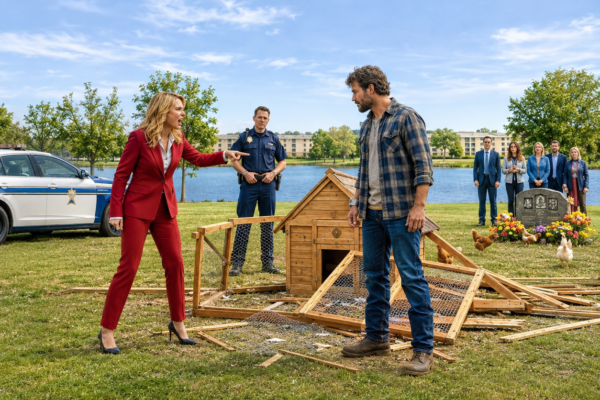
The whole thing started on a July afternoon when my HOA president pressed a handheld color meter against my beige garage door and informed me, with the seriousness of a bomb technician, that I had painted it the wrong kind of beige. T
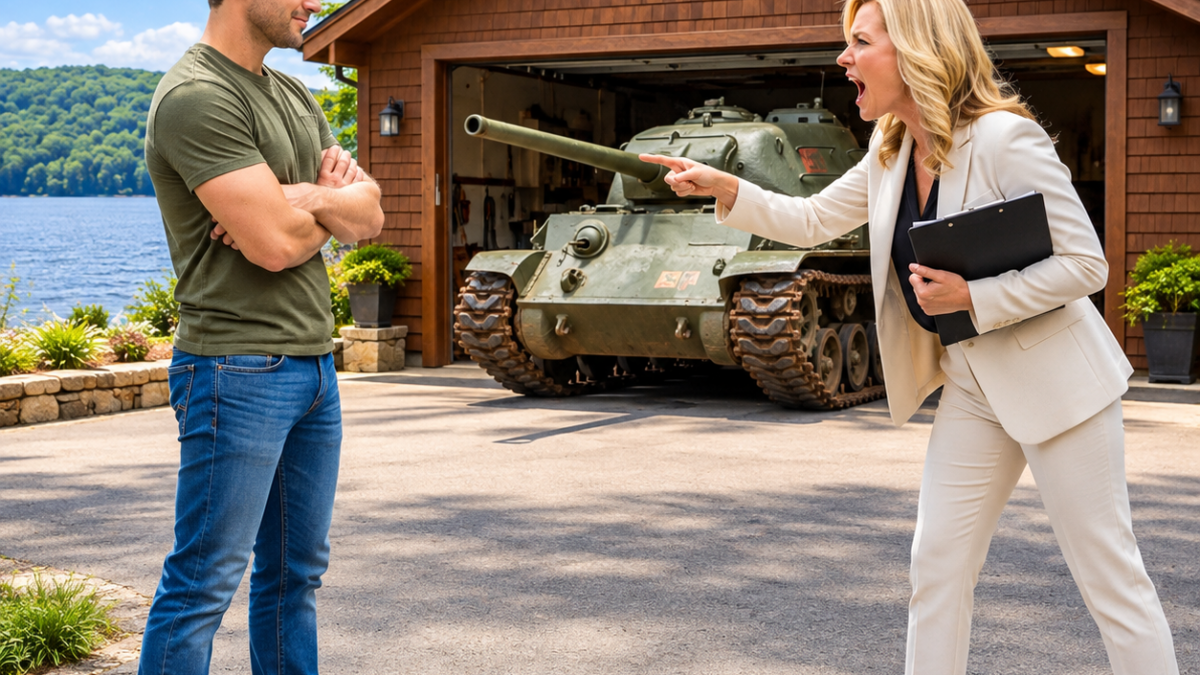
Brenda did not laugh.
That was unfortunate, because I thought it was my best line.
She stood on the sidewalk staring at the vehicle as if history itself had personally violated the architectural guidelines.
The tank was an M5A1 Stuart.
Small by armored-vehicle standards.
Huge by cul-de-sac standards.
Olive drab.
White star.
No functioning armament.
No ammunition.
No live weapons systems.
No engine roaring through the neighborhood.
The museum had transported it on a commercial lowboy, and the crew had positioned it where the approved temporary-display plan showed it could sit without blocking the sidewalk, street, fire access, or my neighbor’s driveway.
Before anyone gets excited, no, I had not gone online at three in the morning and secretly purchased a combat vehicle.
Sarah would have murdered me before the HOA had the opportunity.
The Stuart belonged to the Commonwealth Military Heritage Museum forty minutes outside town.
My friend Marcus Avery served on its board.
We had met through a veterans’ software project years earlier.
When Leah discovered Whispering Pines had a heritage-display provision buried in an old supplement to the covenants, I called Marcus half joking.
“Do you have anything very historic and extremely ugly?”
“How ugly?”
“HOA ugly.”
There was silence.
Then:
“I’ll call you back.”
Twenty minutes later, he did.
“We have a Stuart scheduled for a Veterans Heritage Day display next month.”
“You’re lending me a tank?”
“No.”
“Understandable.”
“We may be willing to make Whispering Pines an educational stop if your association approves a historical exhibit.”
“Brenda will never approve that.”
“Does the rule require the president’s approval or architectural committee acknowledgment?”
I stopped.
Marcus had spent years dealing with museum boards.
He understood bureaucracy.
I called Leah.
She groaned.
Then she read the provision again.
An old developer amendment permitted temporary heritage exhibits associated with recognized educational or civic organizations, subject to safety, insurance, duration, and placement requirements.
Not forever.
Not personal ownership.
Not “anything Dave thinks is funny.”
But potentially valid.
The museum prepared paperwork.
Insurance certificate.
Transport plan.
Display period.
Historical description.
Vehicle status.
Public-safety conditions.
No climbing without museum staff.
No engine operation on site.
No access to the interior.
No weapons functionality.
Leah submitted the package.
The architectural committee had ten business days to respond.
It responded on day nine.
Denied.
Reason:
“Vehicle inconsistent with neighborhood character.”
Leah read that sentence twice.
Then looked up.
“That isn’t one of the stated criteria for heritage exhibits.”
“So?”
“So we appeal.”
I smiled.
She pointed at me.
“Do not enjoy this.”
“I’m paying you by the hour. I’m entitled to something.”
The board appeal happened Thursday.
Sarah was still in Chicago on business.
I had told her about the garage-door fight.
I had not told her about the tank proposal.
There are decisions in marriage that should be discussed beforehand.
This was one.
I had chosen not to.
I am not proud of that.
At the time, I called it preserving the surprise.
Later, Sarah called it:
“Financially and emotionally suicidal project management.”
Also fair.
The appeal meeting took place in the clubhouse.
Brenda sat in the middle.
Jerry beside her.
Susan, secretary.
Bob, vice president, who looked as if he had awakened in the wrong meeting and decided not to alert anyone.
Leah sat beside me.
Marcus attended representing the museum.
Brenda opened.
“Mr. Henderson seeks to install military equipment in a residential neighborhood.”
Marcus said:
“Temporary display.”
Brenda looked at him.
“An armored fighting vehicle.”
“Historically, yes.”
“Tank.”
“M5A1 Stuart light tank.”
I liked Marcus immediately all over again.
Brenda pointed at me.
“This is retaliation.”
Leah answered before I did.
“My client’s motives are not an enumerated review criterion.”
Brenda’s eyes narrowed.
“I know exactly what he is doing.”
I whispered:
“She does.”
Leah kicked my shoe.
Marcus presented the museum plan.
Whispering Pines Heritage Weekend would coincide with an existing neighborhood summer picnic.
The Stuart would remain for forty-eight hours.
Museum signage would explain its service history.
Two museum volunteers would supervise public viewing during posted hours.
No engine start.
No rides.
No climbing.
No pretending it was an operational weapon.
The vehicle was demilitarized decades earlier.
Transport would occur by licensed heavy hauler.
My driveway placement had been reviewed by the transporter.
Insurance coverage exceeded what the HOA provision required.
Brenda listened like somebody being forced to hear a dentist describe flossing.
Then Jerry asked:
“What does this have to do with Mr. Henderson’s garage door?”
Marcus said:
“Nothing.”
I smiled.
Leah kicked me again.
Jerry continued.
“It appeared immediately after his architectural dispute.”
Leah answered:
“Timing is not a valid basis for rejecting an otherwise compliant heritage-display application.”
Brenda said:
“This is absurd.”
Then Bob woke up.
“Is it a real World War II tank?”
Marcus looked at him.
“Yes.”
Bob sat straighter.
“My father drove a Stuart.”
Nobody spoke.
Marcus turned.
“Where?”
“Pacific.”
“Army?”
“Yes.”
Bob looked toward me.
Then Brenda.
“I want to see it.”
Brenda stared at him.
“Bob.”
“What?”
“This is not a museum board.”
“No.”
He adjusted his glasses.
“But the rule allows historic displays.”
Jerry started flipping through the documents.
Susan said:
“It does.”
Brenda looked betrayed.
That was the first time I noticed something important.
For all her certainty, Brenda did not control the board.
She was simply the person who did the most work.
That can look like control when everyone else is tired.
Leah made her closing point.
“If the board wants to amend the heritage provision prospectively through whatever process the documents require, it can consider doing that. But applying a new unwritten standard to this application would raise the same problem we’re already disputing with Mr. Henderson’s garage-door enforcement.”
That landed.
Because the paint fight was not settled.
The architectural committee had ordered me to repaint matte.
I had appealed.
Then temporarily removed the door during permitted maintenance.
The HOA had issued a visible-storage complaint.
Leah challenged that too.
Everything had become paper.
Brenda hated paper when other people used it.
The board voted.
Bob yes.
Susan yes.
Jerry no.
Brenda no.
Tie.
Everyone looked around.
There were supposed to be five directors.
The fifth, Linda Harper, was joining remotely.
Her face appeared on a laptop.
She had heard everything.
Linda said:
“I’m voting yes.”
Brenda closed her eyes.
“Linda.”
“The paperwork meets the rule.”
“It’s a tank.”
“For two days.”
“In his driveway.”
“Yes.”
Linda shrugged.
“My grandchildren will love it.”
Approved.
That was how a World War II tank ended up in Whispering Pines.
Not because I found a magical loophole allowing permanent armored warfare.
Because an old civic-display provision existed and the museum produced a temporary exhibit that met it.
Less dramatic.
More satisfying.
The Stuart arrived Friday morning.
Quietly, by tank standards.
The transporter handled everything.
I stayed out of the crew’s way.
Marcus kept repeating:
“Do not direct heavy equipment.”
“I’m standing here.”
“You are the type of person who says ‘a little left’ to professionals.”
“I am.”
“Don’t.”
Neighbors appeared.
Mrs. Higgins across the street came first.
She wore gardening gloves and held a mug.
“Dave.”
“Morning.”
“Is that a tank?”
“Yes.”
“Why?”
“Community cohesion.”
She stared.
Then laughed so hard coffee came out her nose.
That was the moment the entire episode stopped belonging to me.
Word moved through Whispering Pines.
Children arrived on bicycles.
Parents arrived with phones.
Mr. Callahan from three houses down wore an old VFW cap and stood beside the Stuart for ten silent minutes.
Marcus came over.
“You okay, sir?”
Callahan nodded.
“My brother trained on these before they sent him overseas.”
Marcus asked his name.
Callahan told him.
They talked quietly.
I stepped away.
That was the first uncomfortable thing about my joke.
The tank had meant “HOA compliance” to me.
To Callahan, it meant his brother.
To Marcus, history.
To a few veterans in the neighborhood, something else entirely.
A symbol can become smaller when you turn it into a punch line.
I decided that if we were doing the display, we were going to do it properly.
I removed the little sign I had printed:
APPROVED MATTE-FINISH VEHICLE SCREEN.
Leah had already told me it was obnoxious.
She was right.
Marcus replaced it with the museum placard.
M5A1 STUART LIGHT TANK
AMERICAN, WORLD WAR II ERA
TEMPORARY EDUCATIONAL DISPLAY
COMMONWEALTH MILITARY HERITAGE MUSEUM
Simple.
Better.
Then Brenda appeared.
Slippers.
Bathrobe.
No clipboard.
It was barely seven.
She stopped at the end of my driveway.
That was when I gave her the line.
“Good news, Brenda. It’s matte.”
She stared.
“David.”
“Yes?”
“What have you done?”
“Board-approved heritage display.”
“You brought a tank.”
“The museum brought a tank.”
“Because of a garage door.”
“Indirectly.”
Her eyes moved toward the empty garage opening.
I had installed a temporary interior privacy screen behind the opening after the visible-storage complaint, with building department confirmation that the setup was safe during the short maintenance period.
Nothing dangling.
No improvised structure.
No exposed hazards.
The Stuart sat on the driveway in front, not inside the garage.
Brenda pointed.
“You cannot seriously think this improves the appearance of your property.”
“No.”
That confused her.
I continued.
“I think it demonstrates that our rules have become more important than their purpose.”
“You did this to embarrass me.”
Partly.
“Yes.”
There.
She did not expect that.
Neither did I.
Brenda folded her arms.
“At least you admit it.”
“I’m trying.”
“What if the driveway cracks?”
“I’m responsible.”
“What if children climb on it?”
“Museum staff supervise during viewing hours. Outside those hours it is restricted.”
“What if somebody gets hurt?”
“Covered by the event plan and insurance, though ideally nobody gets hurt.”
“What if residents complain?”
“They can.”
She looked toward the gathering neighbors.
Nobody appeared to be complaining.
Mrs. Higgins waved.
Brenda did not wave back.
Then she said:
“You think because you found one obscure clause you won.”
“No.”
“You’re acting like a child.”
Also partly true.
“I know.”
That answer bothered her most.
She walked away.
I expected police.
None came.
Apparently someone had already called the non-emergency line asking whether the tank was legal.
An officer drove past around nine.
Did not stop.
Thank God.
The source version of this story gives me a cop who admires the tank and declares it “a very heavy car.”
Real life is less cinematic.
A police officer would not settle HOA covenants at the curb.
The museum had transport documentation.
The vehicle was demilitarized.
It was stationary.
It was on private property under an approved event plan.
There was no criminal issue requiring drama.
So there wasn’t any.
By noon, however, there was another problem.
Sarah.
Her flight had been canceled.
She was coming home early.
My phone rang.
“Hi, sweetheart.”
“You sound weird.”
“No.”
“You sound exactly like you did when you ordered the seven-foot television.”
“That television was reasonably priced.”
“What happened?”
“Nothing.”
“David.”
“I have something to tell you.”
Silence.
“What did you buy?”
“Nothing.”
Longer silence.
“What did you borrow?”
I looked at the Stuart.
A child posed beside it while Marcus explained the suspension.
“Historical artifact.”
“David.”
“World War II.”
Silence.
“David.”
“Tank.”
Another silence.
Then:
“I’m sorry, what?”
I explained.
Garage door.
Paint.
Finish.
Appeal.
Heritage rule.
Museum.
Approval.
She said nothing for so long I thought the call dropped.
“Sarah?”
“I’m deciding whether to change my flight.”
“I thought it was canceled.”
“I will personally rebuild the airline.”
“It’s only here for the weekend.”
“Is it armed?”
“No.”
“Does it run?”
“The museum handles that.”
“That was not my question.”
“I am not operating it.”
“Good answer.”
“Are you mad?”
“I don’t know yet.”
“Fair.”
“Did you spend our kitchen money?”
“No.”
Important.
The museum charged only event transport costs, which I had paid from my personal hobby account after Sarah and I had long ago agreed we each got discretionary money without committee hearings.
Marriage has bylaws too.
Useful ones.
She sighed.
“I’m landing at three.”
“I’ll pick you up.”
“No.”
“Why?”
“I want you home when I arrive.”
“That sounds threatening.”
“It is.”
She hung up.
Marcus watched me.
“Wife?”
“Yes.”
“Does she know?”
“Yes.”
“And?”
“I may need asylum.”
“We have an armored vehicle.”
“Helpful.”
Sarah arrived at 4:12.
Uber.
She got out.
Saw the Stuart.
Stopped.
The driver got out to unload her suitcase.
He saw the Stuart.
Stopped too.
Sarah looked at me.
Then tank.
Then me.
“Explain it again.”
I did.
Shorter.
She walked around the vehicle.
Read the placard.
Looked at the garage opening.
Read the HOA approval letter taped inside my front window because I am exactly that person.
Then:
“Where is the garage door?”
“Contractor storage.”
“Not destroyed?”
“No.”
“Good.”
She turned toward me.
“You made it sound like you tore it off and burned it.”
“I may have leaned into the drama.”
“You think?”
She put both hands on her hips.
“Why?”
“Because they made me repaint twice.”
“That is not why.”
I knew.
Sarah always does that.
Takes the joke apart until the little frightened thing underneath is showing.
I looked at the ground.
“They treated me like I was stupid.”
“Ah.”
“And I did exactly what they wanted the first time.”
“Yes.”
“Then they found something else.”
“Yes.”
“I felt like the point was getting me to submit.”
Sarah looked toward Brenda’s house.
“Maybe.”
“You don’t think so?”
“I think Brenda likes rules.”
“That is the understatement of the century.”
“I also think you hate feeling controlled.”
“Everyone hates feeling controlled.”
“You specifically.”
She was right.
My father had been a Marine mechanic.
Good man.
Terrible at letting children make decisions.
Everything in our house had a correct way.
Correct lawn height.
Correct wrench.
Correct career.
Correct posture.
I became a software engineer partly because computers were the only authority figures I could argue with and eventually prove wrong.
Sarah knew all that.
She touched my arm.
“You turned a paint dispute into a tank because somebody told you what to do.”
“When you say it like that—”
“How else would I say it?”
“Community heritage initiative?”
She laughed.
Good sign.
Then:
“I’m still mad.”
“Less good.”
“You involved our house in a stunt without talking to me.”
“Yes.”
“That is the part you apologize for.”
“I’m sorry.”
“Properly.”
I took a breath.
“I’m sorry I made a decision affecting our home because I was angry and assumed you’d find it funny afterward.”
She nodded.
“Thank you.”
“You do find it funny, though.”
She stared.
Then looked at the Stuart.
A six-year-old saluted it while his mother took a picture.
Sarah covered her mouth.
“Unfortunately.”
Marriage saved.
Mostly.
The Heritage Weekend became the biggest neighborhood event Whispering Pines had held in years.
That was not my plan.
I wanted petty compliance.
Instead we got folding tables.
Veterans brought photographs.
Marcus brought a display on armored cavalry history.
The museum set up a donation jar for restoration projects.
Kids got printed history sheets.
No climbing inside the vehicle.
No pretend gunnery.
No war games.
Just history.
Mr. Callahan returned Saturday wearing a jacket with his brother’s service insignia.
He brought a photograph.
Two young men in uniform beside a Stuart.
One was him.
One his brother.
I stared.
“You served too?”
“Training unit. Stateside mostly.”
He pointed.
“That’s Tommy.”
His brother had died in Europe.
Not in a Stuart.
Different unit.
Still.
Callahan touched the museum vehicle’s side lightly.
“Same smell?”
Marcus asked.
Callahan smiled.
“Oil and bad decisions.”
Marcus laughed.
They talked for an hour.
I stopped making jokes about the tank after that.
At noon, Sarah set up lemonade.
This was how she dealt with chaos.
She fed it.
Mrs. Higgins brought cookies.
Jerry, the HOA treasurer, appeared with his grandson.
He avoided me.
His grandson did not.
“Mr. Henderson, is it yours?”
“No.”
“Can you buy one?”
“Probably.”
Sarah, from ten feet away:
“No.”
The child looked confused.
I said:
“See? Governance.”
Jerry laughed despite himself.
That helped.
Later he approached.
“Dave.”
“Jerry.”
“I owe you an apology.”
I did not expect that.
“For what?”
“The finish violation.”
I waited.
He rubbed the back of his neck.
“Brenda brought the inspection to the board after the fact.”
“What does that mean?”
“We didn’t vote on your second notice.”
I stared.
“The letter said ‘board determination.’”
“I know.”
“Was it?”
“No.”
Anger returned immediately.
Cold.
Different from comedy.
“Who authorized it?”
“Brenda.”
“Can she?”
“For routine enforcement, maybe. But calling it a board determination was wrong.”
“Why didn’t you say anything?”
Jerry looked toward his grandson.
“Because I didn’t read it.”
There it was.
The sentence behind half of American governance.
I didn’t read it.
He continued.
“I signed the batch approval sheet.”
Without reviewing?
Apparently.
Jerry said:
“She does all the work. Most weeks that means everything runs.”
“And when she’s wrong?”
He nodded.
“Exactly.”
Sarah had wandered close enough to hear.
She said:
“Sounds like your board needs a process problem fixed.”
Jerry looked at her.
“You must be Sarah.”
“How can you tell?”
“Dave said you’re reasonable.”
I said:
“I have never said that.”
She elbowed me.
Jerry smiled.
Then left.
Saturday evening, after the crowd thinned, Sarah and I sat on the porch.
The Stuart rested under streetlights.
Olive steel among hydrangeas.
Absurd.
Beautiful, in its way.
Sarah said:
“What do you actually want?”
“About what?”
“Garage door.”
“I want them to admit the enforcement was ridiculous.”
“No.”
I looked at her.
“That’s what your anger wants.”
“What do you want?”
I thought.
“A garage door.”
She nodded.
“A normal one?”
“Yes.”
“What color?”
“Beige.”
She laughed.
“Which beige?”
I glared.
She laughed harder.
Then:
“Do you care if it’s matte?”
“No.”
“Then why are we doing this?”
“Principle.”
“Ah.”
Dangerous word.
She leaned back.
“Principle is useful until it becomes a costume anger wears.”
“Did you read that somewhere?”
“No.”
“You’re annoying.”
“Yes.”
Monday morning, the tank left.
Forty-eight-hour display complete.
Professional transporter returned.
Museum crew handled it.
Mr. Callahan came out to watch.
So did half the neighborhood.
Marcus gave me a framed copy of the display placard.
“You caused the museum’s best donation weekend this year.”
“How much?”
“Enough to make me consider provoking another HOA.”
Sarah said:
“No.”
Marcus nodded.
“Understood.”
When the truck disappeared, my driveway looked empty.
The garage looked worse.
A rectangular mouth.
Inside privacy screen.
Contractor tools.
Nothing heroic.
Just a house that needed its door back.
That afternoon, Leah called.
“Board wants mediation.”
“What changed?”
“Public humiliation.”
“Tank?”
“Probably.”
“Victory.”
“No.”
“Why do you keep ruining words?”
“Because this is where you either solve the problem or become a man who spends two years litigating beige.”
That was persuasive.
We met Thursday.
Not courtroom.
Conference room.
Brenda.
Jerry.
Susan.
Bob.
Linda on video.
HOA counsel.
Me.
Sarah.
Leah.
Sarah insisted on attending.
“I co-own the house.”
“You also want to supervise me.”
“Same thing.”
The HOA lawyer opened.
“We can probably resolve the color matter.”
I leaned back.
Brenda said nothing.
Counsel continued.
“The board is prepared to withdraw the current fines and accept your existing Tuscan Dune color in a matte or low-sheen finish.”
I looked at Sarah.
She looked at me.
“Could’ve done that two weeks ago,” I said.
Leah touched my sleeve.
Meaning behave.
The attorney continued.
“The association will also reimburse the reasonable cost difference associated with repainting caused by inconsistent notices.”
That surprised me.
“What about the removed door?”
“Reinstallation at owner expense.”
Fair.
I had chosen that.
“Architectural approval?”
“Expedited.”
“Same door?”
“Yes.”
“Same Tuscan Dune?”
“Yes.”
“Matte?”
He nodded.
I sighed.
“Fine.”
Brenda finally spoke.
“No.”
Everyone looked at her.
The HOA lawyer blinked.
“Brenda.”
“We cannot reward this.”
Sarah leaned forward.
“Reward what?”
“The spectacle.”
Sarah smiled politely.
“My husband can be ridiculous.”
“Thank you.”
She continued.
“But the board sent him a second notice described as a board decision when your treasurer says the board did not actually make one.”
Jerry looked at the table.
Brenda’s jaw tightened.
Sarah went on.
“He repainted once.”
“Yes.”
“You changed the objection.”
“The finish standard existed.”
“Did the original notice identify the finish?”
“No.”
“So why should he bear every cost of discovering the board wanted two different things?”
Brenda replied:
“Homeowners are responsible for knowing the guidelines.”
Sarah nodded.
“Sure.”
Then:
“Board officers are responsible for following them too.”
Silence.
That woman should have been my lawyer.
Leah looked delighted.
Brenda said:
“If we give him a variance—”
“I’m not asking for a variance,” I said.
Everyone turned.
That surprised me too.
“I’ll install the approved color and approved finish.”
Brenda frowned.
“Then what do you want?”
“Written withdrawal of the fines.”
“Already offered.”
“Reimbursement for the second paint job.”
“Already offered.”
“And a review of enforcement procedure.”
There.
That was the thing.
Not neon paint.
Not eternal tank.
Process.
Jerry looked up.
Linda said through the laptop:
“I support that.”
Susan nodded.
Bob said:
“Can we keep the tank clause?”
Everyone stared.
He shrugged.
“My grandchildren liked it.”
Sarah laughed.
Even Brenda almost did.
The settlement took another hour.
Final agreement:
Fines withdrawn.
No lien.
No continuing violation.
HOA reimbursed my second paint-material cost and part of the contractor expense caused by the disputed enforcement sequence.
I paid to reinstall the garage door because removal had been my choice.
I agreed to repaint the final surface in approved Tuscan Dune matte.
The board agreed to adopt a written enforcement protocol.
Not because I demanded governance of the kingdom.
Because three directors now admitted they had been signing or ratifying notices without understanding what they said.
We signed.
Brenda signed last.
She pushed the paper toward me.
“Happy?”
“Relieved.”
“That tank was excessive.”
“Yes.”
She looked surprised.
“You admit it?”
“Completely.”
“Then why?”
I looked at Sarah.
Then Brenda.
“Because at the time excessive felt like the only language anybody was hearing.”
Brenda sat back.
For the first time, she didn’t argue.
The garage door returned Saturday.
Same panels.
No heroic neon.
No electric lime.
The source version gives me a fluorescent radioactive door after victory.
Sarah would have divorced me.
Instead, I painted it Tuscan Dune.
Matte.
It looked exactly like Desert Sand.
Mrs. Higgins crossed the street while I was cleaning brushes.
“Which one is that?”
“Tuscan Dune.”
She squinted.
“Looks beige.”
“Careful.”
She laughed.
Brenda drove past.
Slowed.
I waited.
She kept going.
No spectrometer.
Progress.
But the story did not end there.
That would be too easy.
Two months later, Whispering Pines held board elections.
Brenda ran again.
Everyone assumed the tank incident would destroy her.
It didn’t.
She won.
Barely.
That surprised me.
Then I thought about what Martin Hayes had said in the last story I told you.
People are complicated.
Brenda had run the HOA for six years.
She knew vendors.
Budgets.
Insurance.
Pool contracts.
Reserve studies.
She answered emails at midnight.
She had helped negotiate a new trash contract that saved money.
Got streetlights repaired.
Organized storm cleanup.
Stopped a developer from removing mature trees along the entrance.
People were tired of her.
They also relied on her.
Both things were true.
I attended the first meeting after the election.
Brenda looked at me.
“David.”
“Brenda.”
“No tank?”
“Not tonight.”
A few people laughed.
She did too.
Tiny.
Then she surprised me.
Agenda item four:
Enforcement Procedure Revision.
The board adopted a new process.
First notice had to cite exact rule.
Photograph included.
Clear cure period.
If a homeowner challenged the notice, a second director reviewed before fines escalated.
Architectural inspectors could not characterize something as a “board determination” without an actual vote or delegated authority documented in minutes.
Changes to color palettes had prospective effective dates.
Owners who had already received approval would not be retroactively cited unless maintenance required repainting anyway.
Jerry proposed that last one.
Unanimous.
Then Brenda said:
“Any comments?”
I raised my hand.
She sighed.
“Of course.”
I stood.
“Looks good.”
She waited.
“That’s it?”
“That’s it.”
“Sit down.”
I did.
Sarah later said:
“That may be the first mature interaction you two have had.”
“Unfair.”
“True.”
The museum invited Whispering Pines to host Heritage Weekend again the next year.
Brenda approved it.
But not at my house.
Community green.
Reasonable.
They brought the Stuart back.
Mr. Callahan came.
This time Marcus displayed his photograph alongside the vehicle.
Callahan cried.
Quietly.
So did his daughter.
I stood away.
The joke had become a tradition.
That was strange.
Children called it “Dave’s tank.”
Not mine.
Never was.
Marcus eventually taped a sign inside the museum office:
THIS TANK DEFEATED A GARAGE-DOOR DISPUTE, 2026.
Historically questionable.
Spiritually accurate.
Sarah saw it.
“Your legacy.”
“I was hoping for software patents.”
“No.”
At home, the garage door survived.
Matte Tuscan Dune.
Amazingly durable.
I learned Sarah had been right about matte showing dirt.
Wait.
No.
I had been right.
That detail mattered.
Every spring I had to scrub pollen from the texture.
I mentioned this to Brenda once.
She said:
“Personal maintenance issue.”
Then smiled.
She remembered.
I laughed.
Something shifted after that.
We stopped being enemies.
Not friends.
Neighbors.
There is a big difference.
Enemies interpret every act as part of the conflict.
Neighbors occasionally borrow ladders.
The first time Brenda asked for mine, I stared.
She said:
“What?”
“I’m enjoying this.”
“Why?”
“You need my property.”
“I need your extension ladder.”
“Terms.”
She closed her eyes.
“David.”
“You may use it for forty-eight hours provided the finish remains matte.”
She took it.
“You’re exhausting.”
“Community cohesion.”
She walked away.
Sarah watched from the kitchen.
“You are never going to let that die.”
“No.”
“Thought so.”
A year later, Jerry resigned as treasurer.
Not scandal.
Grandchildren.
Nobody wanted the job.
Brenda asked me.
Absolutely not.
“You’re a software engineer.”
“That does not make me an accountant.”
“You understand spreadsheets.”
“So do twelve-year-olds.”
“You complain about governance.”
“Correct.”
“Then help.”
I refused.
She asked again.
I refused.
Third time, Sarah said:
“Do it.”
I stared at her.
“You’re supposed to protect me.”
“You spend hours criticizing HOA budgets you haven’t read.”
“They post summaries.”
“Exactly.”
So I became treasurer.
Worst punishment Brenda ever inflicted.
The reserve study was eighty-three pages.
The pool needed resurfacing.
Stormwater culverts were nearing end of life.
Insurance premiums had jumped twenty-three percent.
Suddenly the people complaining about a fifty-dollar fine seemed easier than deciding whether to raise dues $18 a month.
At my first budget meeting, a homeowner said:
“Why can’t you just use reserves for everything?”
I started explaining.
Their eyes glazed.
Brenda watched me.
Smiling.
Afterward:
“Fun?”
“I hate you.”
“Community service.”
“Where’s the tank?”
She laughed.
Being on the board taught me something I did not particularly want to learn.
Rules are not always petty because rule-makers are petty.
Sometimes rules exist because thirty houses made thirty individually reasonable decisions and produced one collective mess.
Street parking.
Drainage.
Fence access.
Pool safety.
Trash.
Short-term rentals.
Some restrictions genuinely mattered.
The danger came when convenience turned into rigidity.
Or when a rule’s purpose got forgotten and only enforcement remained.
I also learned Brenda received approximately thirty hostile emails a week.
People called her names.
Threatened lawsuits.
Once someone mailed her a bag of dog waste over a parking notice.
That changed how I saw her.
Not absolution.
Context.
At one board meeting, we reviewed an architectural request for a garage door.
House on Pine Court.
Owner wanted dark blue.
Guidelines allowed beige families only.
Everyone looked at me.
“Why are you looking at me?”
Brenda said:
“Garage-door specialist.”
Very funny.
Owner, Kevin Morales, attended.
“We painted the shutters blue.”
Approved.
“Yes,” Brenda said.
“And the door would match.”
Susan asked:
“Why not?”
Brenda opened the palette.
I waited for it.
Desert Sand.
Tuscan Dune.
Stone Mist.
Harvest Clay.
Twenty shades of sadness.
Kevin said:
“My wife is sick of beige.”
I said:
“So is civilization.”
Brenda looked at me.
Then the door sample.
Then neighborhood photos.
She asked:
“Would dark blue hurt anything?”
No one had a good answer.
The rule existed because original developer wanted uniformity.
Developer had been gone fifteen years.
We recommended updating the palette.
Not open season.
Broader choices.
Homeowners voted.
Blue approved.
Green approved.
Dark red.
Charcoal.
No reflective neon.
Sarah called that the David provision.
Kevin installed his blue garage door.
It looked good.
The world did not end.
Home values did not collapse.
Whispering Pines became slightly less beige.
Brenda admitted nothing.
But six months later she painted her own front door dark green.
I stood on the sidewalk.
“Interesting shade.”
She did not turn.
“Walk away, David.”
“Approved palette?”
“Walk.”
“Finish?”
She raised the paint roller.
I left.
Sarah nearly fell over laughing when I told her.
The Stuart kept coming once a year.
Eventually the museum restored another vehicle and rotated exhibits.
A jeep one year.
A half-track replica another.
No weapons.
No stunts.
Educational.
Mr. Callahan became honorary speaker.
He told children about his brother.
Not battles.
About being nineteen.
Missing home.
Bad coffee.
Letters from their mother.
The history became human.
When Callahan died at ninety-four, the museum brought the Stuart to his memorial display at the community green.
Not my driveway.
Brenda arranged the permit.
She called me.
“Marcus confirmed?”
“Yes.”
“Insurance certificate?”
“Already sent.”
“Transport plan?”
“Yes.”
“Barricades?”
“Brenda.”
“What?”
“You have become me.”
Silence.
Then:
“I hate you.”
“Correct.”
Callahan’s daughter placed his old photograph beside the tank.
People came.
Quiet.
No jokes that day.
Afterward, Marcus said:
“This vehicle has done more community work in Whispering Pines than some elected officials.”
Brenda heard him.
“Careful.”
He smiled.
Years passed.
Sarah finally got her kitchen.
Granite countertops.
She chose the stone.
I stayed out.
Marriage growth.
During demolition, contractor found an old paint can in the garage.
DESERT SAND.
Original color.
Sarah brought it inside.
“Souvenir.”
“Throw it away.”
“No.”
She wrote with marker:
THE COLOR THAT STARTED THE WAR.
Placed it on a shelf.
Visitors asked.
I told story.
Each year it got shorter.
First version took forty-five minutes.
Eventually:
“HOA disliked beige. I overreacted with a museum tank. We fixed the rules.”
Accurate.
Sarah preferred:
“He removed a perfectly good garage door because he has emotional regulation issues.”
Also accurate.
Brenda retired from the board after eleven years.
At her final annual meeting, the room was full.
Not because people wanted to celebrate her departure.
Okay, some did.
Mostly because she had served a long time.
Jessica Harper—Linda’s daughter—presented a plaque.
BRINGING ORDER TO WHISPERING PINES, 2019–2030.
Brenda read it.
Then said:
“That is dangerously vague.”
Everybody laughed.
She gave a speech.
Thanked volunteers.
Apologized for mistakes.
Then looked at me.
“I learned that sometimes strict enforcement creates outcomes stranger than the violation.”
People knew.
Laughter started.
She continued:
“And if anyone here ever complains to me about garage-door sheen again, I will personally call the museum.”
That got applause.
Afterward she handed me her old color spectrometer.
I stared.
“No.”
“Yes.”
“Why?”
“I never want to see it again.”
“What am I supposed to do?”
“Measure your soul.”
“Currently beige.”
“I know.”
I kept it.
Of course.
It lives beside the Desert Sand paint can.
Sarah calls it the Shrine of Stupidity.
Fair.
New board president was Kevin Morales.
Blue-door Kevin.
First month, someone complained that two neighboring houses had “clashing porch temperatures.”
Kevin called me.
“No.”
“You don’t even know what I’m asking.”
“No spectrometer.”
“How did you—”
“Experience.”
The complaint died.
Good.
Brenda and I became actual friends eventually.
Not because of the HOA.
Because Peter died.
Heart attack.
Unexpected.
She was sixty-two.
One morning married.
That evening not.
I recognized the look.
Sarah and I went over.
No lectures.
No “call if you need anything.”
We brought food.
Sat.
Sarah handled practical things.
I washed dishes.
Brenda cried.
At one point she looked at me.
“How do people do this?”
I thought of every person who had asked me something similar after loss.
There is no useful answer.
“They do tomorrow.”
She frowned.
“What?”
“Don’t do forever.”
I dried a plate.
“Do tomorrow.”
That had been Sarah’s line when my father died.
Brenda nodded.
Next day.
Then next.
Grief reduced our old feud to its proper size.
Tiny.
Months later she came to our house.
Saw the spectrometer.
“You kept that?”
“Artifact.”
“Throw it away.”
“Historical significance.”
“I’m serious.”
“Museum says preservation matters.”
She laughed.
Then cried.
Grief does that.
We sat at the kitchen table.
She said:
“Peter always thought the tank was hilarious.”
“No.”
“Yes.”
“He looked furious.”
“He was trying not to encourage you.”
“Wise man.”
“He asked Marcus about buying one.”
“What?”
“I told him I would divorce him.”
I laughed until my stomach hurt.
Peter had been my secret ally the whole time.
Years later, Whispering Pines renovated the clubhouse.
They created a small history wall.
Original sales brochure.
Old aerial photo.
Storm cleanup.
Pool renovation.
Callahan’s military photograph.
Then, without telling me, one picture.
The Stuart in my driveway.
Caption:
THE GREAT GARAGE DOOR DISPUTE — 2026
A MINOR ARCHITECTURAL DISAGREEMENT RESULTED IN MAJOR HISTORICAL INTEREST AND LATER REVISIONS TO THE COMMUNITY’S ARCHITECTURAL REVIEW PROCEDURES.
I stared.
“Minor?”
Kevin said:
“Legal reviewed the wording.”
“Cowards.”
Brenda stood beside me.
“I wanted ‘Dave Loses Mind Over Beige.’”
“Accurate.”
Sarah said:
“I voted for it.”
Traitors.
The photo showed me younger.
Standing beside the Stuart.
Hands in pockets.
Smug.
Brenda at the edge.
Clipboard.
I looked at her.
“You hated me.”
“I hated your face.”
“Specifically?”
“In that picture, yes.”
“Fair.”
Sarah said:
“You deserved it.”
Also fair.
At sixty-seven, Sarah and I decided to move.
Not because of the HOA.
Stairs.
Grandchildren farther north.
We found a ranch-style house twenty minutes from our daughter.
No HOA.
I made a point of that.
The realtor said:
“There’s a voluntary neighborhood association.”
I nearly left.
Sarah grabbed my shirt.
“Voluntary.”
“Gateway drug.”
We bought the house.
Selling Whispering Pines felt stranger than expected.
I had spent years complaining about conformity.
Then the place became community.
Mrs. Higgins had died.
Jerry moved to Arizona.
Susan’s grandchildren bought her house.
Kevin was still there.
Brenda moved to a smaller townhouse but visited.
The blue garage door on Pine Court still looked good.
My garage door?
Tuscan Dune.
Matte.
We had never changed it.
The buyers were a young couple.
Priya and Andrew Collins.
During final walkthrough, Andrew touched the door.
“Nice neutral color.”
I looked at Sarah.
Sarah looked at me.
Do not.
I did.
“Tuscan Dune.”
Andrew blinked.
“Okay.”
“Not Desert Sand.”
Sarah grabbed my arm.
“David.”
Priya laughed.
“Is there a story?”
“No,” Sarah said.
“Yes,” I said.
We compromised.
I told them after closing.
They laughed.
Andrew said:
“Wait. The tank photo in the clubhouse is you?”
“Unfortunately.”
“That’s incredible.”
“No,” Sarah said.
“It is,” Priya said.
I liked her.
At the moving truck, Brenda came by.
She carried a small wrapped package.
“Housewarming.”
“We haven’t moved yet.”
“For the next one.”
I opened it.
A miniature metal tank.
Olive green.
Four inches long.
On the base:
TUSCAN DUNE ENFORCEMENT VEHICLE.
I laughed.
Sarah took it.
“This is going in his office.”
“Absolutely.”
Brenda hugged Sarah.
Then me.
Longer than expected.
“You were the most irritating homeowner I ever had.”
“You were the most irritating president.”
“Good.”
She looked at the house.
“You made us better.”
I shook my head.
“We all did.”
She nodded.
Then pointed at the garage.
“For the record, Desert Sand really did have a yellow undertone.”
I stared.
“Leave.”
She laughed all the way down the driveway.
Our new house had a white garage door.
First morning, I stood outside with coffee.
Looked at it.
Sarah came beside me.
“What?”
“Seems plain.”
“David.”
“Maybe dark green.”
“Fine.”
“Blue?”
“Fine.”
“Tank?”
She slowly turned.
I raised both hands.
“Joke.”
“Good.”
We painted it dark green.
No application.
No committee.
No spectrometer.
I expected freedom to feel triumphant.
Mostly it felt ordinary.
Paint.
Brushes.
Music.
Sarah on a ladder doing trim because she does not trust me near edges.
I stepped back.
“Looks good.”
She nodded.
“No taupe undertone.”
“Don’t.”
We laughed.
The little tank model sits on my desk now.
Beside it, Brenda’s spectrometer.
Beside that, the old photograph of the Stuart at Whispering Pines.
I eventually donated the Desert Sand paint can to hazardous-waste collection.
Some history does not need preserving.
Every Veterans Day, Marcus sends me a picture of the real Stuart.
Still museum property.
Still restored.
Still not mine.
Its display card now includes one ridiculous extra line:
TEMPORARILY EXHIBITED AT WHISPERING PINES, 2026.
No mention of garage doors.
Historians have standards.
I respect that.
People who hear the story always ask the wrong question.
“Did you really park a World War II tank because the HOA hated your garage-door color?”
Yes.
Temporarily.
Legally.
Safely.
With more paperwork than the original paint violation deserved.
Then they ask:
“Did you beat the HOA?”
No.
That is not what happened.
The HOA did not disappear.
Brenda did not get humiliated into exile.
I did not keep a tank permanently pointed at anybody’s hydrangeas.
I repainted the garage door.
Matte Tuscan Dune.
Exactly what the rule required.
But the board also changed how it enforced rules.
No more pretending one person’s decision was a board vote.
No more retroactive palette surprises.
Clear notices.
Actual appeals.
Actual review.
More colors.
Better records.
And the people running the association learned that obedience is not the same thing as cooperation.
I learned something too.
Compliance can become its own kind of ego.
I told myself I was defending principle.
Partly true.
I was also angry.
I wanted Brenda to feel ridiculous.
The tank accomplished that.
For about ten minutes.
Then Mr. Callahan stood beside it holding a photograph of his brother, and suddenly the machine meant more than my feud.
That was useful.
Objects outgrow jokes.
Communities outgrow fights.
People can too.
The funniest thing is that twenty years later, when grandchildren visit, they do not care about the HOA story.
They see the photograph.
“Grandpa had a tank!”
“No.”
“Grandpa drove a tank!”
“No.”
“Grandpa fought a war!”
“Absolutely not.”
Sarah shouts from the kitchen:
“HE FOUGHT WITH A LADY ABOUT BEIGE!”
The children collapse laughing.
I say:
“It was a complex architectural governance dispute.”
More laughter.
Then I show them the miniature.
Tell them about the museum.
Callahan.
His brother.
Why the display became Heritage Weekend.
That part matters more now.
One granddaughter asked:
“Was Brenda mean?”
I thought.
“Sometimes.”
“Were you mean?”
Damn children.
“Sometimes.”
“Who won?”
There it was.
The question adults ask too.
I looked at Sarah.
She smiled.
I said:
“Eventually, everybody got better at being neighbors.”
My granddaughter frowned.
“That’s not winning.”
“No.”
“What happened to the tank?”
“Museum.”
“What happened to Brenda?”
“Friend.”
“What happened to the ugly door?”
“Stayed there until we moved.”
She considered all that.
Then:
“So the tank lost.”
I laughed.
Maybe.
Or maybe the tank did exactly what it was supposed to do.
It arrived absurdly.
Sat there quietly.
Made an argument nobody could ignore.
Then left before the joke became the whole neighborhood.
That seems wiser to me now than it did then.
The land didn’t change.
The house didn’t change much.
The door went back.
The rules survived.
But the people learned to question what the rules were for.
And every once in a while, somewhere in the Commonwealth Military Heritage Museum, a child walks past an olive-drab M5A1 Stuart and has no idea that for forty-eight ridiculous hours, that old tank helped settle the most aggressively beige dispute Whispering Pines ever had.