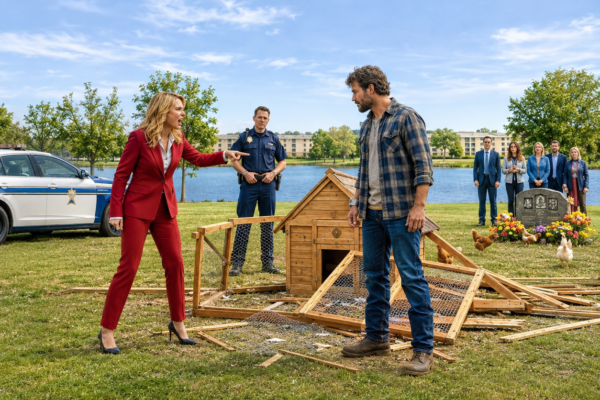
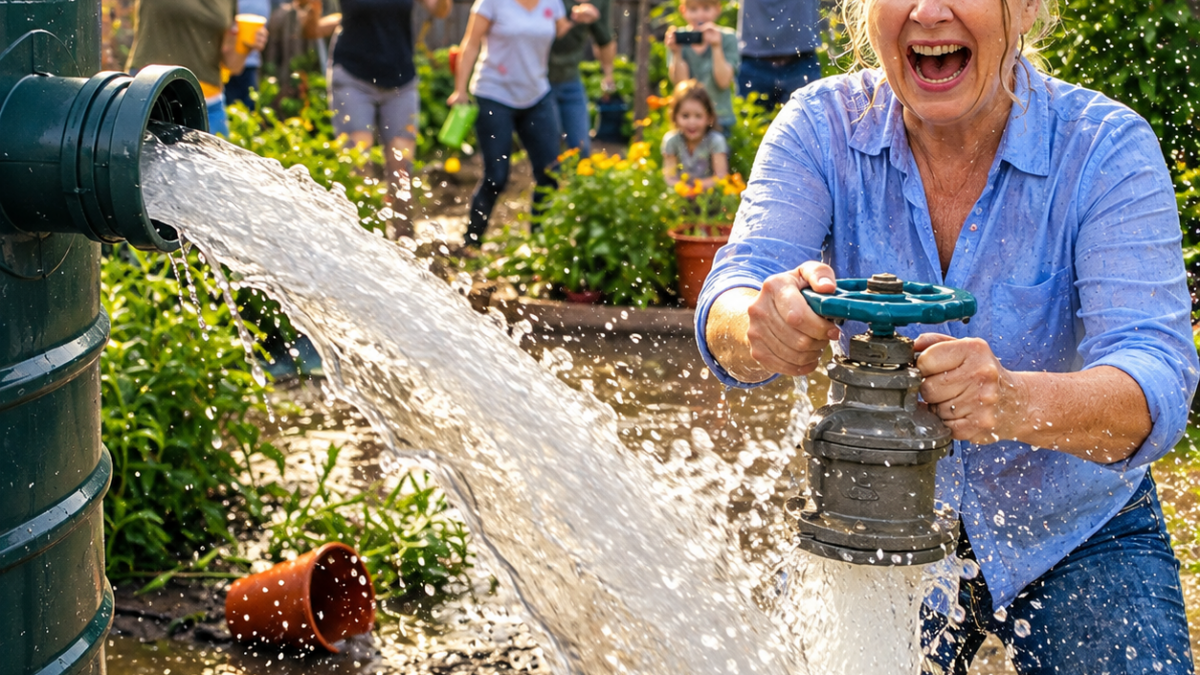
I walked into my side yard and found 3,000 gallons of carefully collected rainwater gone, the storage tanks empty, and a silver stream still running along the curb while half my neighborhood watched from their driveways. T
The first person out of the city vehicle was a woman named Elena Garcia.
She wasn’t a councilwoman.
She wasn’t a police officer.
She was something far more dangerous to Patricia Holloway at that particular moment.
She was a water-conservation program manager with documentation.
Elena wore khaki pants, walking shoes, and a blue city polo. She carried a binder under one arm and had the calm expression of somebody who spent most of her working life explaining drought policy to angry people.
A second city employee climbed out behind her.
He introduced himself as Marcus Bell, an environmental compliance specialist.
No sirens.
No handcuffs.
No dramatic arrest.
Just two professionals with identification badges, clipboards, and questions.
I’ve learned that people who enjoy authority tend to fear competent paperwork more than raised voices.
Patricia walked toward them immediately.
“Good morning. I’m Patricia Holloway, president of the Meadow Creek Estates Homeowners Association.”
Elena shook her hand.
“Elena Garcia. City water conservation.”
“Yes, I gathered that.”
Patricia glanced at me.
“We’re currently dealing with a private compliance matter.”
Elena looked past her at thirty second-graders gathered around raised garden beds.
“Actually, we’re here because we received a report involving a registered conservation system.”
Patricia’s smile weakened.
“I believe there’s been some misunderstanding.”
“There usually is.”
I liked Elena immediately.
Sarah came over.
She was wearing a straw hat the children had decorated with felt vegetables.
There was a giant orange carrot glued over her left ear.
She somehow still looked more professional than all of us.
“Dave,” she whispered, “where’s Tony?”
“On his way.”
“How far?”
“He said twenty minutes.”
“You said that twenty minutes ago.”
“I know.”
A boy carrying a green watering can walked up.
“Mr. Dave?”
“Yeah, Caleb?”
“There’s no water.”
“I know.”
“Why?”
That question had already traveled through the class.
Children are excellent investigators because they haven’t learned to pretend obvious things aren’t obvious.
I crouched.
“We had a problem with our storage tanks.”
“Did they break?”
“No.”
“Did someone steal the water?”
Behind me, Patricia made a small noise.
I chose my words carefully.
“The water was drained before we were ready to use it.”
“Why?”
“Adults disagreed about the tanks.”
Caleb stared at me.
Then at Patricia.
Then back at me.
“That’s dumb.”
Sarah covered her mouth.
I looked at the ground.
Elena Garcia suddenly became extremely interested in her binder.
Patricia did not laugh.
“Children,” she said, “shouldn’t be involved in adult disputes.”
Sarah answered before I could.
“They aren’t involved in the dispute.”
She gestured toward the wilted beds.
“They’re involved in the consequence.”
That landed.
Patricia looked away.
Elena asked if we could speak somewhere quieter.
We walked toward the shade structure beside the garden.
Tom joined us.
Mike, my attorney neighbor, had also appeared.
He was dressed properly this time, which was disappointing because I had grown accustomed to receiving legal guidance from a man wearing a KISS THE COOK apron.
Elena opened the binder.
“Mr. Reynolds, we’ve confirmed that your collection system was included in Meadow Creek’s drought-preparedness registration.”
“Correct.”
Tom nodded.
“I submitted the neighborhood registrations.”
Elena turned to him.
“We found your filing.”
Patricia crossed her arms.
“The HOA was never notified.”
Tom looked genuinely confused.
“Patricia, you were copied.”
“I don’t recall that.”
“I can forward the email.”
“That doesn’t mean the installation complied with HOA covenants.”
Mike stepped in.
“Let’s separate those issues.”
Patricia looked at him.
“And you are?”
“Michael Turner. I’m Dave’s neighbor.”
Patricia relaxed slightly.
Then he added:
“And an attorney.”
She unrelaxed.
Mike continued.
“The association may have procedures concerning exterior modifications. That’s a separate question from whether the association or its agents had authority to enter Dave’s property and drain registered conservation equipment before the notice period expired.”
“I did not personally enter his property.”
“Who authorized the workers?”
“The association’s maintenance contractor.”
“Who instructed them?”
Patricia didn’t answer.
Mike nodded.
“That’s something we’ll document.”
Elena raised a hand.
“We’re not here to decide private liability. Our concern is the conservation system and the water loss.”
That distinction mattered.
It would continue to matter.
People love stories where one person says, “That’s illegal,” and suddenly the universe produces police cars.
Real life is messier.
HOA rules are one thing.
Property rights are another.
City conservation programs are another.
Civil liability is another.
And depending on exactly what happened, who authorized it, and what local regulations say, the consequences can vary.
Mike had already warned me not to turn my anger into a legal opinion.
“Facts first,” he’d said.
So facts first.
My tanks had contained roughly 3,000 gallons of collected rainwater.
Workers hired by the HOA had drained them.
The system had been registered through a city conservation initiative.
The notice I’d received said I had 48 hours to address the alleged violation.
The tanks had been drained before those 48 hours passed.
The water had been intended primarily for irrigation at the community garden.
Those were facts.
Everything else could wait.
Elena asked Patricia:
“Why was the water released?”
“The tanks were noncompliant.”
“That doesn’t answer why the stored water was released.”
“The equipment had to be prepared for removal.”
“Was removal scheduled?”
Patricia hesitated.
“The homeowner had been instructed to remove it.”
I pulled the notice from my folder.
“I received this Monday.”
Elena read it.
“Forty-eight hours.”
“Yes.”
“What time was the system drained?”
Mark called from behind us.
“About four-thirty.”
Everyone turned.
He had somehow arrived still holding coffee.
Mark treated coffee the way some people treat oxygen.
He walked over.
“I saw the truck.”
Elena asked:
“Yesterday afternoon?”
“Yeah.”
“Did you see what they did?”
“They connected hoses and drained the tanks toward the street.”
Patricia interrupted.
“Mark, you don’t know what instructions they were operating under.”
“Nope.”
He sipped his coffee.
“That’s why I didn’t say I did.”
I almost smiled.
Elena wrote something down.
Then Sarah’s voice came from the garden.
“Dave.”
I turned.
She was kneeling beside one of the tomato beds.
That plant was worse.
Leaves curled inward.
Soil pale and dry.
The Arizona sun was climbing.
Paperwork could wait.
Plants couldn’t.
I checked my phone.
Nothing from Tony.
I called.
He answered immediately.
“I’m six minutes out.”
“You said twenty minutes forty minutes ago.”
“Welcome to road construction.”
“Please tell me you have water.”
“I have water.”
“Approved source?”
“Dave.”
“I have city people standing here.”
“Then tell them Tony Delgado has a delivery manifest, source documentation, and enough paperwork to make your heart flutter.”
“It does.”
“You need hobbies.”
Then I heard the diesel engine.
Everyone else heard it too.
A water truck turned into the parking lot.
The children cheered.
Actually cheered.
Like Santa Claus had arrived in a tanker.
Tony climbed down.
He was sixty, broad-shouldered, sunburned, and wearing the same battered baseball cap he’d owned since college.
“Where’s my desperate irrigation nerd?”
“Here.”
He handed me a folder.
“Delivery documents.”
I hugged him.
“Okay,” he said. “That’s uncomfortable.”
“You brought water.”
“You’re still paying me.”
“I take back the hug.”
Then he looked past me.
At Patricia.
He stopped.
Not dramatically.
Just completely.
His face changed.
Patricia’s did too.
“Anthony.”
Tony removed his sunglasses.
“Patty?”
I looked between them.
Sarah looked between them.
Mike looked between them.
Even Elena stopped writing.
“You know each other?” I asked.
Tony gave a small laugh that contained no humor.
“Yeah.”
Patricia straightened.
“Anthony and I are related.”
Tony looked at me.
“She’s my sister.”
Thirty children were ten yards away.
So I did not say the first word that came into my head.
Mike did.
Very quietly.
“You have got to be kidding me.”
Patricia heard him.
“No.”
Tony folded his arms.
“How long has it been?”
“Twelve years.”
“Closer to thirteen.”
“This isn’t the time.”
“You’re right.”
He pointed toward the truck.
“I have two thousand gallons of irrigation water getting hotter by the minute.”
Then he walked away.
That should have ended it.
But family history is like groundwater.
You can pave over it.
It still finds cracks.
Sarah organized the children under the shade structure while Tony and his employee prepared the approved delivery.
We kept the kids away from equipment and let the professionals handle the transfer.
That’s important.
Thirty excited second-graders and a water truck are not a combination requiring improvisation.
Once the garden’s irrigation storage was safely replenished, we let the children use their little watering cans at the beds.
Emma filled hers halfway.
She walked toward the peppers with both hands gripping the handle.
“Not too much,” Sarah told her.
Emma nodded seriously.
“I know. Plants can drown too.”
“Exactly.”
She poured carefully around the roots.
Within minutes the garden changed.
Not magically.
Plants don’t recover like movie characters.
But the soil darkened.
The dust settled.
The children relaxed.
Parents started smiling again.
Someone brought oranges.
Someone else brought folding chairs.
The grand opening had become less of a ceremony and more of a rescue operation.
And somehow that made it better.
Nobody had planned it.
Nobody had coordinated matching shirts.
Nobody had written speeches.
People just helped.
Patricia stood near the edge.
Alone.
Clipboard against her chest.
Tony saw her.
He walked over.
I didn’t mean to listen.
I absolutely listened.
“You going to stand there all morning?”
“I’m staying out of the way.”
“That’d be a first.”
She looked at him.
“Still charming.”
“Still measuring everybody’s lawn?”
“This isn’t about us.”
“No. It’s about water.”
Her expression changed.
There it was.
Something old.
Tony lowered his voice.
“You remember Mesa Verde Landscaping?”
Patricia looked toward the garden.
“Of course.”
“You remember what Dad said when you lost it?”
“Don’t.”
“What did he say?”
“Anthony.”
“He said you should’ve planned better.”
Patricia’s jaw tightened.
Tony continued.
“And you hated him for it.”
“I didn’t hate Dad.”
“You didn’t speak to him for six months.”
“He had no idea what happened.”
“Exactly.”
Tony pointed toward me.
“Neither did you.”
Patricia stared at the children.
I walked away.
Some conversations don’t need an audience.
An hour later, the local television reporter arrived.
Alyssa Chen.
She had interviewed me briefly the previous evening after hearing about the drained tanks.
I had expected a thirty-second neighborhood piece.
Apparently the story had attracted more attention than I realized.
Alyssa walked through the garden with Sarah.
She interviewed Elena about drought conservation generally.
She interviewed me about the collection system.
I kept it boring.
That was Mike’s instruction.
“How much water was lost?”
“Approximately three thousand gallons of stored rainwater.”
“Why was it stored?”
“Primarily for landscape conservation and the community garden.”
“Who drained it?”
“Workers hired through the HOA.”
“Was the system illegal?”
“I’ll let the city answer questions about its registration.”
“Do you believe Patricia Holloway broke the law?”
“That’s not for me to decide.”
Alyssa lowered the microphone.
“You’ve been coached.”
“Extensively.”
Mike waved from twenty feet away.
Alyssa laughed.
Then Patricia approached.
For once, she didn’t demand the camera be turned off.
She stood beside me.
Alyssa raised the microphone.
“Ms. Holloway, do you want to respond?”
Patricia looked directly into the camera.
“The HOA acted based on our understanding of existing exterior-modification rules.”
“Do you still believe draining the tanks was appropriate?”
Long pause.
“No.”
I looked at her.
She continued.
“I believe we acted without enough information.”
Alyssa asked:
“Did Mr. Reynolds tell you the tanks supplied this garden?”
“Not before the initial enforcement action.”
“Did anyone from the HOA ask him what the tanks were for before ordering them drained?”
Another pause.
“No.”
“Did you know they were part of a registered conservation initiative?”
“No.”
Tom coughed.
Patricia heard him.
She corrected herself.
“I don’t remember receiving that information.”
Better.
Not good.
But better.
Alyssa asked:
“What happens now?”
Patricia looked toward the children.
“I don’t know yet.”
That answer surprised me.
Because it was the first time I’d ever heard Patricia Holloway admit she didn’t know something.
The news segment aired that evening.
I watched it at Mike’s house.
He grilled burgers.
Naturally.
His wife Denise kept telling him to stop giving legal commentary to the television.
“I am not giving legal commentary.”
“You just said ‘bad answer.’”
“That was conversational commentary.”
“Eat your burger.”
The segment was fair.
More fair than social media.
Social media turned Patricia into a cartoon villain before the weather forecast started.
People posted screenshots.
Old HOA complaints resurfaced.
Bird feeder.
Wind chimes.
Driveway stains.
Grass height.
Trash cans visible fifteen minutes too long after pickup.
Some complaints were legitimate.
Some were exaggerated.
Some were plainly nonsense.
I stopped reading.
Anger can become entertainment very quickly.
I had been angry because something useful was destroyed.
I didn’t need strangers turning Patricia into a human piñata.
The next morning, she came to my house.
No clipboard.
That was how I knew something serious had happened.
I opened the door.
“Patricia.”
“Dave.”
She held an envelope.
“If that’s another violation notice, I admire the commitment.”
“It isn’t.”
She handed it to me.
Inside was a letter from the HOA’s insurance carrier acknowledging notice of my property-damage claim.
Another page confirmed that the association had paused enforcement against the tanks while counsel reviewed the matter.
I looked up.
“Thank you.”
“The board voted last night.”
“Without me?”
“You aren’t on the board.”
“I know. It just feels unusual for Meadow Creek to conduct business without inviting me to be yelled at.”
She almost smiled.
Almost.
Then she looked at the tanks.
Empty.
“You built all that?”
“Designed most of it. Licensed people handled the parts they needed to handle.”
“And it really supplies the garden?”
“Yes.”
“How often?”
“Depends on rainfall, season, and demand.”
“Does it save much municipal water?”
“Enough to matter.”
She stepped closer.
Not onto my property.
She stopped at the edge.
That detail mattered too.
“Can you show me?”
I stared at her.
“What?”
“The system.”
“You ordered it emptied two days ago.”
“I remember.”
“You called it water hoarding.”
“I remember that too.”
“You threatened me with daily fines.”
“Dave.”
“Just establishing the mood.”
She sighed.
“Will you show me?”
I did.
Not because she’d earned forgiveness.
She hadn’t.
Not because the dispute was over.
It wasn’t.
I showed her because people can’t make better decisions about systems they refuse to understand.
I explained the roof collection.
The sealed storage.
The screening.
The filtration.
The overflow management.
The garden connection.
The maintenance schedule.
I didn’t give her a lecture on every fitting.
I’m capable of growth.
She listened.
Actually listened.
At one point she touched the decorative screen.
“This could be taller.”
I stared at her.
She caught herself.
“Sorry.”
“No, you’re right.”
That surprised both of us.
“The original screening was temporary,” I said.
“Could it look more intentional?”
“Yes.”
“Would that reduce visibility from the street?”
“Yes.”
She nodded.
“So there was a compromise available.”
“There usually is when people talk before draining three thousand gallons.”
She accepted that.
No defense.
No “rules are rules.”
Just:
“Yes.”
Then she said something unexpected.
“My landscaping company failed during a drought.”
I leaned against the fence.
“Tony mentioned something.”
“He shouldn’t have.”
“He didn’t give details.”
She looked embarrassed.
“I was thirty-nine. Divorced. Two employees. Twelve years building the business.”
“What happened?”
“Water restrictions hit. Customers stopped installing landscapes. Existing clients canceled maintenance. I had debt on equipment.”
She looked at the empty tanks.
“I lost almost everything.”
“I’m sorry.”
“I became obsessed with rules after that.”
“That’s an unusual lesson.”
“I thought if everyone followed the rules, outcomes would become predictable.”
There was no self-pity in her voice.
That made me listen.
“My business failed because circumstances changed faster than I did,” she said. “I told myself it was because everyone else had behaved irresponsibly.”
“And Tony?”
“He was experimenting with low-water landscaping.”
“He still does.”
“I reported him.”
“I heard.”
“I thought he was cheating restrictions.”
“Was he?”
“No.”
She swallowed.
“I never apologized.”
There are moments when someone offers you the first honest piece of themselves.
You can use it as a weapon.
Or you can set it down carefully.
I chose carefully.
“Maybe start there.”
She nodded.
Then left.
The board’s independent review took six weeks.
Six long weeks.
My tanks stayed.
The daily fines never began.
The insurer arranged for the lost-water and system-inspection claim to be evaluated.
The HOA reimbursed documented costs associated with restoring the system and the emergency garden supply as part of a civil resolution.
No dramatic million-dollar payout.
No mansion changing hands.
No police hauling Patricia away.
Just checks, invoices, legal fees, board meetings, and a written agreement.
The more important result was the policy review.
It turned out Meadow Creek’s exterior rules had been written twenty years earlier.
They said plenty about satellite dishes.
Nothing useful about modern rainwater systems.
Nothing about drought infrastructure.
Nothing about solar batteries.
Nothing about heat pumps.
Nothing about native pollinator gardens.
The neighborhood had changed.
The climate had changed.
Technology had changed.
The rules hadn’t.
Patricia had treated that gap as permission to say no.
The new board attorney treated it as a reason to update the documents.
There were three public workshops.
I attended all three.
So did Patricia.
The first one was terrible.
A man named Gerald spent eleven minutes arguing that rain barrels would cause the neighborhood to become “industrial.”
A woman named Lisa asked whether solar panels attracted lightning.
Someone else wanted artificial turf prohibited because it looked “emotionally dry.”
I wrote that phrase down.
I’m still not sure what it means.
But people talked.
Engineers answered questions.
Landscapers spoke.
The city sent a conservation representative.
Homeowners discussed screening requirements.
Maintenance.
Mosquito prevention.
Drainage.
Safety.
Visibility.
Reasonable standards.
Actual issues.
Not panic.
At the second workshop, Patricia did something nobody expected.
She stood.
“I owe Mr. Reynolds an apology.”
The room went quiet.
I looked at Mike.
He raised his eyebrows.
Patricia continued.
“I enforced an aesthetic rule before understanding the function of his system. Worse, I authorized action before the notice period had expired.”
No excuses.
That mattered.
“The association should not operate that way.”
A man in the back muttered:
“Now she figures it out.”
Patricia heard him.
She nodded.
“Yes.”
That shut him up.
Then she said:
“I also owe several other homeowners apologies for treating enforcement as an end rather than a tool.”
Mrs. Henderson was sitting in the front row.
Eighty-two years old.
Owner of the notorious bird feeder.
She raised one finger.
“My cardinals would appreciate that.”
Everyone laughed.
Patricia laughed too.
“Your bird feeder citation has been withdrawn, Mrs. Henderson.”
“Good.”
“The feeder still needs to be kept clean.”
Mrs. Henderson pointed at her.
“Don’t ruin the moment.”
That was the first HOA meeting I ever enjoyed.
By the third workshop, we had something resembling a modern conservation policy.
Rainwater systems could be approved under objective standards.
Screening could be required where reasonable.
Safety and maintenance mattered.
Aesthetics could be considered.
But aesthetic preference alone wouldn’t automatically defeat legitimate conservation equipment.
More importantly, the HOA adopted a basic due-process policy.
Notice meant notice.
Owners got time to respond.
The association couldn’t simply send contractors onto someone’s property to alter equipment except in genuine emergencies or through proper legal authority.
You’d think that would be obvious.
Apparently obvious things occasionally need paragraphs.
Patricia offered to resign as president.
The board accepted.
That surprised her.
It surprised me too.
For a moment, I saw the old Patricia return.
The tightened jaw.
The offended eyes.
She had expected contrition to erase consequences.
It doesn’t.
An apology can repair relationships.
It doesn’t automatically restore trust.
Martin Hayes, the vice president, became interim president.
He was boring.
Wonderful man.
Every meeting started on time.
Every agenda was published.
He never once measured grass personally.
Meadow Creek entered a golden age of administrative dullness.
Patricia remained a homeowner.
For a while, she stopped attending meetings.
Then one Saturday morning I found her at the community garden.
She was pulling weeds.
Tony was there.
They weren’t speaking.
Not exactly.
He was repairing a drip line on one side.
She was weeding the other.
They had apparently reached the diplomatic stage of sibling reconciliation where two people occupy the same acre without insulting each other.
I walked over.
“Morning.”
Tony grunted.
Patricia said:
“Morning.”
“How long have you two been here?”
Tony checked his watch.
“Forty minutes.”
“Any casualties?”
“Not yet.”
Patricia threw a weed into the bucket.
“He still installs emitters too close together.”
Tony looked up.
“She still gives opinions nobody requested.”
Progress.
Emma came running into the garden.
She had her mother with her.
“Mr. Dave!”
“Hey, Emma.”
She pulled me toward the pepper bed.
The plant she’d watered on the crisis morning had recovered.
Not completely.
One branch had died.
But new leaves had formed.
“Look!”
“I see.”
“I saved it.”
“You helped.”
“No.”
She pointed firmly.
“I saved it.”
Her mother smiled apologetically.
“We’re working on humility.”
“Don’t rush it.”
Emma crouched beside the plant.
Then Patricia walked over.
Emma recognized her.
Children remember everything.
“You’re the lady who took the water.”
Patricia stopped.
Tony looked down quickly because he was trying not to laugh.
Patricia crouched.
“Yes.”
“Why?”
Adults had asked Patricia that question for weeks.
Reporters.
Attorneys.
Board members.
Neighbors.
Nobody asked it like a seven-year-old.
Patricia considered her answer.
“Because I thought something was wrong before I understood it.”
Emma frowned.
“Why didn’t you ask Mr. Dave?”
Patricia looked at me.
Then back at Emma.
“I should have.”
Emma thought about this.
Then handed Patricia a small watering can.
“This one is thirsty.”
Patricia took it.
“Okay.”
And that was that.
Children don’t always need revenge.
Sometimes they just need adults to become useful.
By autumn, the rainwater system was restored and improved.
We added screening.
Not because Patricia won.
Because the screening was a good idea.
That distinction mattered to me.
Compromise doesn’t mean surrendering to whoever behaved badly.
Sometimes the other person had one reasonable point buried beneath ten unreasonable ones.
The tanks did look unfinished.
So we made them look finished.
Cedar screening.
Native vines.
Access panels for maintenance.
Clear signage.
The city inspected the relevant portions.
The HOA approved the exterior appearance under the new policy.
Five other homeowners eventually installed their own systems.
Then eight.
Then twelve.
We didn’t create one giant neighborhood network.
That would’ve introduced more complexity than anyone needed.
Each homeowner used an appropriately designed system for their own property, while the community garden developed its own dedicated storage and approved irrigation setup.
That was better.
More resilient.
Less dependent on one house.
I had learned something too.
The original garden had depended too heavily on my tanks.
That wasn’t Patricia’s fault.
It was mine.
I had designed a clever system.
I hadn’t designed enough redundancy.
Engineers hate admitting that.
But resilience means asking:
What happens when this part fails?
What happens when a valve breaks?
What happens when there’s no rain?
What happens when an HOA president orders your water drained because she thinks your tanks are ugly?
You know.
Normal engineering scenarios.
So the garden got backup plans.
Approved emergency supply procedures.
Clear maintenance responsibility.
Better drought-tolerant planting.
More mulch.
Shade strategies.
Soil improvements.
And a dedicated garden committee instead of Dave Reynolds being the man everyone called whenever a basil plant looked tired.
That last improvement was Sarah’s demand.
“You need boundaries.”
“I have boundaries.”
“You answered a garden text at 2:14 in the morning.”
“It was about irrigation.”
“It was about cilantro.”
“Cilantro needs water.”
“Dave.”
“Fine.”
The children returned every month.
Their plants grew.
Beyoncé the tomato plant became enormous.
Taylor Swift produced more fruit.
Bob died.
Nobody knew why.
The children held a small memorial.
Emma made a sign.
BOB WAS A GOOD TOMATO.
I still have a photograph.
Tony began volunteering too.
He taught the kids about drip irrigation and desert plants.
Patricia started showing up occasionally.
At first, parents watched her carefully.
Trust takes longer to refill than a water tank.
She understood.
She didn’t demand forgiveness.
That helped.
One afternoon I found her and Tony sitting beneath the shade structure.
Coffee between them.
Not speaking.
But not angry.
I walked past.
Tony called:
“Dave.”
“Yeah?”
“You’re the reason I’m talking to my sister again.”
“Sorry.”
Patricia threw a napkin at me.
Tony laughed.
Then Patricia did.
I realized I’d never heard her laugh before all this.
Not the tight social laugh she used at HOA meetings.
A real one.
It changed her face.
People aren’t simple.
That’s inconvenient for storytelling.
It would be easier if Patricia were evil.
Then the lesson would be easy.
Bad HOA president destroys water.
Good homeowner defeats her.
The end.
But Patricia wasn’t evil.
She was controlling.
Proud.
Rigid.
She liked authority too much.
She confused enforcement with leadership.
She made a decision that damaged my property and threatened something children had spent months building.
Those things were real.
But so was the woman who’d once built a landscaping company from nothing.
So was the sister who hadn’t spoken to her brother in thirteen years.
So was the homeowner who eventually stood in a room and admitted she was wrong.
Accountability and humanity can exist at the same time.
That’s another thing I’ve learned.
Forgiveness without accountability becomes permission.
Accountability without humanity becomes punishment.
Communities need both.
The following spring, Meadow Creek held its first Water Wise Weekend.
I hated the name.
Patricia loved it.
She wasn’t president anymore.
She had joined the new environmental advisory committee as a regular member.
Regular.
One vote.
No special authority.
I think that was good for her.
The event included demonstrations on native landscaping, irrigation efficiency, rainwater harvesting, soil health, and drought planning.
Tony brought sample irrigation equipment.
The city sent Elena.
Sarah brought her new class.
Mike ran the hamburger grill.
He wore the apron.
I finally understood that the apron was not a joke.
It was a lifestyle.
Mrs. Henderson ran the bird table.
Her cardinals were not invited.
Emma, now eight, stood beside our rainwater display.
A couple walked up.
Emma pointed at the tanks.
“These collect rain.”
The woman smiled.
“How much?”
Emma looked at me.
I gave her the number.
She repeated it proudly.
Then she pointed at Patricia.
“She dumped it all out once.”
Patricia closed her eyes.
“Emma.”
“What?”
“We don’t need to include that in every tour.”
“Yes we do.”
Tony nearly fell out of his chair laughing.
By lunchtime, half the neighborhood had heard the story from Emma.
Her version improved with each telling.
By the fifth group, Patricia had apparently drained “a million gallons.”
By the seventh, the garden had contained endangered tomatoes.
By the ninth, I had confronted Patricia with “the water police.”
I pulled Emma aside.
“Okay. We need to work on accuracy.”
She looked disappointed.
“Stories are better big.”
“Sometimes.”
“Isn’t a million bigger than three thousand?”
“Significantly.”
“So it’s better.”
“No.”
She sighed.
Adults were exhausting.
At three that afternoon, Elena Garcia presented Meadow Creek with a city recognition for neighborhood conservation efforts.
Not a grand award.
No mayor.
No television cameras.
Just a framed certificate.
Martin accepted it as HOA president.
Then he surprised me.
“I think Patricia should come up.”
The crowd went quiet.
Patricia looked horrified.
Martin continued.
“Not because she started us on the right path.”
Laughter.
“Quite the opposite.”
More laughter.
Even Patricia smiled.
“But because changing direction publicly is difficult. Patricia made a serious mistake. She also stayed here to help repair what followed.”
Patricia walked forward.
Martin handed her the certificate.
She looked at it.
Then handed it to me.
I shook my head.
“No.”
“Dave.”
“Put it in the community center.”
“Why?”
“Because it’s not mine.”
She looked toward the garden.
Kids.
Parents.
Tony.
Sarah.
Elena.
Mrs. Henderson.
Mike burning hamburgers.
“Community center,” she said.
“Community center.”
That’s where it hangs.
Right beside the updated conservation policy.
And, at my request, beside a photograph of the empty tanks.
Patricia objected.
Naturally.
“Why do we need that picture?”
“History.”
“It’s humiliating.”
“History often is.”
She stared at me.
“Did you steal that line from somebody?”
“Probably.”
The picture stayed.
Not to shame her.
To remind all of us what happens when rules become more important than purpose.
Years ago, when I started designing irrigation systems, an older engineer told me something I didn’t appreciate.
“Water always exposes bad assumptions.”
I thought he meant hydraulic design.
He did.
But I’ve learned it applies to people too.
You assume a pipe has pressure.
Open it.
You’ll know.
You assume soil holds moisture.
Measure it.
You’ll know.
You assume your HOA authority extends farther than it does.
Drain somebody’s conservation tanks.
Eventually you’ll know.
Water finds the low places.
So does truth.
Two summers after the incident, Arizona gave us another brutal dry spell.
Weeks of heat.
Almost no meaningful rain.
The tanks ran low.
This time nobody panicked.
The garden committee followed the drought plan.
Watering schedules tightened.
Mulch went down.
Some beds were rested.
The children learned that conservation isn’t about pretending resources are unlimited.
It’s about deciding what matters when they’re not.
Patricia volunteered every Tuesday.
She became obsessed with soil-moisture readings.
Of course she did.
The woman who once measured grass now carried a moisture meter.
Tony called it “character development.”
She called him “immature.”
They had Sunday dinner together twice a month.
Neither admitted enjoying it.
One evening, Patricia and I were closing the garden.
The sun was low.
Tomatoes glowed red beneath the leaves.
She turned off the approved irrigation controller.
Then she looked at me.
“Do you still hate me?”
I considered it.
“No.”
“Did you?”
“Yes.”
She nodded.
“Fair.”
“I hated what you did more than I hated you.”
“That’s very diplomatic.”
“I’ve had practice.”
She sat on the edge of a raised bed.
“I thought resigning would be the worst part.”
“Wasn’t it?”
“No.”
“What was?”
“Realizing everybody had been afraid to disagree with me.”
I didn’t answer.
She looked at me.
“You knew?”
“Patricia, you measured grass with a ruler.”
“It was in the rules.”
“You measured it personally.”
“The landscaping contractor was inconsistent.”
“You had a holster for the ruler.”
“It was convenient.”
I laughed.
She did too.
Then she became serious.
“I thought being respected meant nobody challenged me.”
“That’s not respect.”
“I know that now.”
“What do you think it is?”
She watched Emma’s pepper plants moving in the evening breeze.
“Maybe people trusting that you’ll listen before deciding.”
I nodded.
“That’s closer.”
She stood.
“Don’t get sentimental.”
“Wouldn’t dream of it.”
We locked the garden shed.
Then she walked home.
I stayed.
The tanks at my house were connected again.
The garden’s own storage system sat nearby.
Everything had backups.
Everything had labels.
Everything had maintenance records.
Beautiful.
I realize that sentence confirms every stereotype about irrigation designers.
I’m comfortable with that.
A few weeks later, Sarah’s class held another garden day.
Different children now.
Same little watering cans.
One boy asked why there was a photograph of empty tanks hanging in the community center.
I told him the short version.
“Someone made a decision before asking enough questions.”
“What happened?”
“We fixed it.”
“Did the person get in trouble?”
“Yes.”
“Did you stay mad?”
“For a while.”
“Why’d you stop?”
Children always ask the difficult part.
I looked across the garden.
Patricia was showing another group how mulch reduced evaporation.
Tony stood behind her making exaggerated faces.
She turned.
Caught him.
Smacked his arm with her gardening glove.
They both laughed.
I looked back at the boy.
“Because staying angry wasn’t helping the plants.”
He accepted that immediately.
Adults would want more.
Justice.
Punishment.
Vindication.
Consequences.
Children understand gardens.
If something is broken, fix what you can.
If something is thirsty, water it.
If something dies, learn.
Then plant again.
That doesn’t mean pretending nothing happened.
We didn’t.
The HOA paid for the damage it was responsible for.
Policies changed.
Patricia lost her position.
The board’s authority became more transparent.
Owners received better notice protections.
The system was rebuilt.
Those consequences mattered.
But after accountability comes a choice.
You can keep feeding the conflict.
Or you can feed something else.
We fed the garden.
Literally, sometimes.
Compost.
A lot of compost.
Three years after Patricia drained my tanks, Meadow Creek experienced one of the strongest summer storms we’d had in a long time.
Rain hammered my roof.
Gutters roared.
I stood beneath the patio watching the gauges rise.
One tank.
Then another.
Water moved through the collection system exactly the way it was supposed to.
No leaks.
No overflow problems.
No drama.
My phone buzzed.
A text from Patricia.
HOW FULL?
I checked.
I sent her the number.
She replied:
BEAUTIFUL.
I stared at the message.
Three years earlier, she had called those tanks unsightly water hoarding.
Now she thought stored rain was beautiful.
People can change.
Not always.
Not because you humiliate them.
Not because you defeat them publicly.
Sometimes consequences create the opening.
Then what happens with that opening depends on the person.
Patricia used hers.
The next morning, I walked to the community garden.
Everything smelled different after rain.
Wet soil.
Creosote.
Wood.
Leaves.
Water droplets hung from the shade structure.
The garden storage was full.
Emma was there with Sarah.
She was ten now.
Tall enough that I had to stop thinking of her as the tiny girl with pigtails.
She walked beside me.
“Mr. Dave?”
“Yeah?”
“Remember when somebody emptied all the water?”
“Unfortunately.”
“Mrs. Holloway says we’re not supposed to make fun of her about it anymore.”
“That’s probably kind.”
Emma thought about it.
“Can I make fun of her a little?”
“Ask Mrs. Holloway.”
Patricia was twenty feet away.
Emma yelled:
“Mrs. Holloway!”
Patricia turned.
“WHAT?”
“CAN I STILL TELL PEOPLE YOU DUMPED ALL THE WATER?”
Patricia closed her eyes.
Tony, standing beside her, nearly dropped a shovel.
“ONLY IF YOU SAY I WAS WRONG!”
Emma looked at me.
“See?”
“Excellent compromise.”
She ran off.
I walked toward the main bed.
Beyoncé’s descendants were growing there.
Not literally.
Probably.
Sarah had saved seeds from some of the original tomatoes, but I had long ago lost track of which celebrity tomato produced which generation.
There are limits to my recordkeeping.
Patricia came over.
“You encouraged her.”
“I did nothing.”
“You absolutely encouraged her.”
“I respect historical accuracy.”
“You’re impossible.”
Tony walked past.
“Runs in the neighborhood.”
She glared at him.
He grinned.
Then the children arrived.
Twenty-eight that year.
They gathered beneath the shade.
Sarah began explaining the garden.
She talked about drought.
Rainfall.
Roots.
Storage.
Responsibility.
Then she pointed toward me.
“Mr. Reynolds helped design our water system.”
A little boy raised his hand.
“Did he build all of it?”
“No,” Sarah said. “Lots of people helped.”
Good answer.
Another child pointed toward Patricia.
“What does she do?”
Tony whispered:
“This should be good.”
Patricia heard him.
She walked forward.
“I help make sure we don’t waste water.”
I raised an eyebrow.
She saw me.
“And,” she added, “I ask questions before making decisions.”
Tony applauded.
The kids joined him because children will applaud almost anything if one adult starts.
Patricia bowed.
I laughed so hard my side hurt.
Later, when everyone had gone, I sat alone beneath the shade structure.
The garden was quiet.
Water moved softly through the irrigation lines.
Nothing dramatic.
No confrontation.
No reporter.
No HOA meeting.
Just water reaching roots.
That’s the part people miss.
Systems aren’t valuable because they’re impressive.
They’re valuable because somebody depends on them.
A tank is ugly plastic until a child has spent four months growing a pepper plant with the water inside it.
A rule is just language until somebody uses it against a neighbor.
A community isn’t a clubhouse, a sign, or a set of covenants.
It’s the moment people decide another person’s problem belongs to all of them.
The morning my tanks were emptied, I thought Patricia had destroyed months of work.
She hadn’t.
She’d destroyed water.
Water can be replaced.
What nearly broke was trust.
That took longer.
Much longer.
But we rebuilt that too.
Not exactly as it was.
Better.
With safeguards.
With clearer rules.
With more people involved.
With less dependence on one stubborn irrigation designer’s backyard.
That’s the funny thing about resilience.
You rarely build it before the failure.
You build it because of the failure.
I eventually replaced the original tanks with newer units when they reached the end of their service life.
Patricia came over while the contractor was finishing the screened enclosure.
She stood on the sidewalk.
“Those look good.”
“Careful.”
“What?”
“You’re complimenting rainwater tanks.”
“I’ve grown.”
“Apparently.”
She studied the enclosure.
“Could use jasmine.”
I looked at her.
“There’s the old Patricia.”
“I’m just saying.”
“We’re using a native vine.”
“Even better.”
She walked away.
I smiled.
That evening, rain clouds gathered over the mountains.
Not enough for a storm.
Just dark edges against an orange sky.
I stood beside the tanks.
Three years earlier, I’d stood in almost the same place staring at empty containers and water running uselessly down the street.
I had been furious.
I wanted Patricia embarrassed.
Removed.
Punished.
I wanted everyone to know I was right.
Some of those things happened.
I was right about the system.
She lost the presidency.
The HOA paid for what it damaged.
But none of that became my favorite part of the story.
My favorite part happened months later.
Emma handed Patricia a watering can.
“This one is thirsty.”
And Patricia took it.
That’s the image I remember.
Not the clipboard.
Not the empty tanks.
Not the television interview.
A woman who had made a terrible decision kneeling beside the plant her decision almost killed, carefully pouring water around its roots.
There are people who will tell you never to forgive someone who abuses authority.
I understand why.
Forgiveness without change is dangerous.
But Patricia changed.
Slowly.
Imperfectly.
With consequences.
With embarrassment.
With resistance.
With help.
That’s different.
Today, Meadow Creek’s community garden is bigger than it was then.
There are raised beds for seniors.
A children’s section.
Native flowers.
Herbs.
Peppers.
Tomatoes.
A small accessible path Mrs. Henderson uses with her walker.
Her bird feeder citation is framed in the garden shed.
She insisted.
Patricia hates that almost as much as the photograph of my empty tanks.
Tony volunteers twice a month.
He and Patricia speak every week.
Sarah has brought hundreds of children through the garden.
And every class hears the same lesson.
Not the HOA story.
The water lesson.
Rain falls.
You capture what you can.
You use it carefully.
You don’t waste what somebody else may need.
And when something goes wrong, you don’t stand around deciding whose fault the thirsty plant is.
You find water.
You help.
Then you figure out how not to make the same mistake again.
Last spring, Emma came back with her middle-school science club.
She was taller than Sarah.
That made Sarah unhappy.
Emma showed her classmates the storage system.
Then she found me.
“Mr. Dave.”
“Emma.”
“Mrs. Holloway says you still tell the story wrong.”
“Does she?”
“She says you make her sound mean.”
“She was mean.”
Patricia yelled from the next bed:
“I CAN HEAR YOU.”
Emma laughed.
Then she looked at the tanks.
“Do you ever worry someone will empty them again?”
“No.”
“Why?”
I looked around.
At the new policy posted inside the shed.
At the garden committee.
At the independent storage.
At the city registration.
At the neighbors who now understood what the system did.
At Patricia carrying a tray of seedlings.
“Because now everybody knows what they’re connected to.”
Emma nodded.
She thought I meant the pipes.
Maybe I did.
Maybe I didn’t.
That night, after everyone left, I walked home.
The tanks were nearly full from an early spring storm.
I placed my hand against one.
Cool plastic.
Thousands of gallons behind it.
Stored sunlight and clouds, if you want to get poetic.
I usually don’t.
Across the street, Mark stood in his driveway with his eternal coffee mug.
“Dave!”
“Yeah?”
“Tanks full?”
“Almost.”
“Patricia going to drain them?”
“Not unless she wants thirty schoolchildren chasing her with watering cans.”
He laughed.
Then his expression changed.
“You know, I still feel bad.”
“About what?”
“That first day.”
“What first day?”
“When I saw those workers draining them.”
He looked down at his mug.
“I should’ve called you.”
I remembered.
Of course I remembered.
“You thought I knew.”
“Still.”
“Mark.”
He looked up.
“If anything like that happens again, call me.”
“Absolutely.”
“Then we’re good.”
He nodded.
“Coffee?”
“No.”
“You sure?”
“You’ve been holding that same cup for three years.”
He looked offended.
“Different cups.”
“I’ve never seen proof.”
He walked inside muttering.
I went back to the tanks.
The sun dropped behind the roofs.
A sprinkler clicked somewhere in the distance, probably violating at least three of Patricia’s new conservation recommendations.
The neighborhood sounded normal.
Kids.
Dogs.
Garage doors.
Dinner.
Ordinary life.
And I thought about what those tanks had taught all of us.
Patricia thought she was emptying an ugly backyard installation.
She didn’t see the pipes underground.
She didn’t see the garden two blocks away.
She didn’t see thirty children.
She didn’t see Sarah’s months of work.
She didn’t see the parents who’d built beds.
She didn’t see the seeds waiting for water.
That’s the danger of making decisions based only on what you can see from the sidewalk.
Everything is connected to something.
Sometimes literally.
Sometimes not.
The ugly tank may feed a garden.
The annoying bird feeder may be the brightest part of an old woman’s morning.
The wheelchair ramp may be somebody’s independence.
The solar panel may be keeping a family’s electric bill manageable.
The native yard you think looks messy may be keeping pollinators alive.
You don’t have to approve everything.
Communities need standards.
Safety matters.
Maintenance matters.
Neighbors matter.
But before you decide something has no value because you don’t understand it, ask one question.
What’s this connected to?
Patricia didn’t.
Not that morning.
She saw three tanks.
She emptied them.
Three thousand gallons disappeared down the street.
But the strangest thing happened afterward.
The water came back.
The garden came back.
The rules changed.
Her brother came back into her life.
And eventually, the woman with the clipboard came back too—just without needing the clipboard quite so much.
These days, whenever rain starts tapping against my roof, I can hear the collection system working.
Water moves through the gutters.
Into storage.
Toward something useful.
I usually stand there longer than necessary.
Engineers do that.
We like watching systems work.
But now I think about something else too.
That little girl.
That wilted pepper plant.
That watering can.
And Patricia kneeling beside it.
Because sometimes the thing you empty without thinking turns out to be supplying far more than you ever bothered to see.