At 6:17 one morning, I ran barefoot into my driveway and found our HOA president smashing a crowbar through the windshield of a pickup truck because she decided it was lowering neighborhood property values.
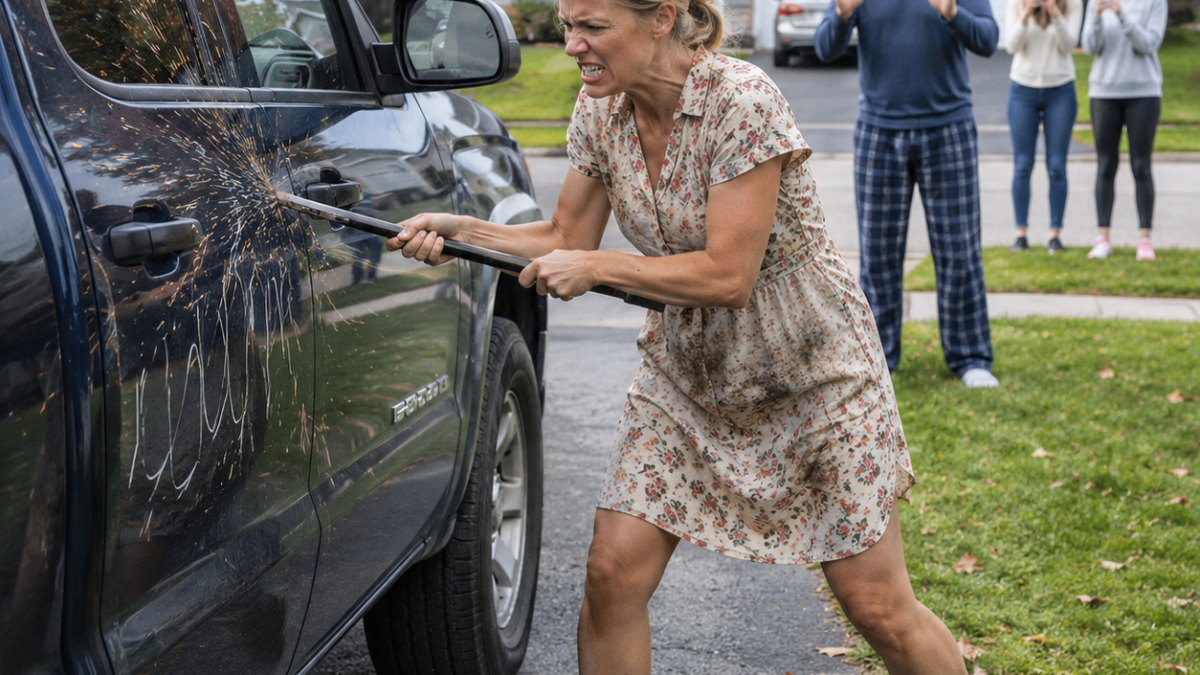
The crowbar stopped halfway through another swing.
For one second, everything in Brier Hollow went silent.
No sprinklers.
No leaf blowers.
No garage door motors.
At least that is how I remember it.
In reality, all those sounds were probably still there.
My brain simply stopped processing them.
Evelyn stood beside Lena’s truck with both hands wrapped around the crowbar.
The windshield was shattered.
The driver’s-side mirror hung by wiring.
A long gouge ran across the door where Evelyn had carved GET OUT deeply enough that bare metal showed beneath the paint.
Glass glittered across my driveway.
Oil from something she had struck near the front quarter panel had stained her spotless white tennis skirt.
Neighbors stood on porches with phones raised.
For eight years, people in Brier Hollow had watched Evelyn Cross act as if the neighborhood existed for her approval.
Now they were watching her destroy a vehicle in broad daylight.
I pointed at the truck.
“That belongs to Lena.”
Evelyn sneered.
“I don’t care who it belongs to.”
“You should.”
She lifted the crowbar slightly.
I could see anger making another decision for her.
“That truck belongs to the district attorney.”
Everything changed.
Not slowly.
Instantly.
Evelyn’s grip loosened.
The crowbar dropped several inches.
Her mouth opened.
Nothing came out.
The color drained from her face.
One neighbor across the street actually lowered his phone as if he needed to hear better.
Evelyn looked at the government plates.
Then at me.
Then back at the truck.
“What did you say?”
“Lena is the district attorney.”
Her eyes moved toward my front door.
Lena was already standing there.
She had come outside behind me without my noticing.
Sweatpants.
Gray sweatshirt.
Hair pulled back.
Barefoot.
Completely calm.
That calm frightened Evelyn more than shouting would have.
Lena looked at the windshield.
Then the mirror.
Then the words cut into the door.
Finally, she looked at Evelyn.
“Put the crowbar down.”
Evelyn did.
It hit the pavement with a metallic clank.
No one moved.
Lena stepped carefully around the broken glass.
She stopped several feet from Evelyn.
“You were told repeatedly not to interfere with vehicles on this property.”
Evelyn found her voice.
“This truck has been in violation for weeks.”
“It has legal registration.”
“That isn’t the point.”
“It is parked in his driveway.”
“It violates community standards.”
Lena looked at the truck again.
“Did the community standards authorize this?”
Evelyn’s mouth tightened.
“You people think because you have government jobs—”
“Stop.”
Lena did not raise her voice.
That somehow made Evelyn stop.
“I’m not asking you to explain yourself to me here.”
She glanced toward the neighbors recording.
“Do not touch the vehicle again.”
Evelyn looked around and seemed to remember the audience.
The woman who had spent years controlling public scenes suddenly realized she was standing in the middle of one she could not control.
She tried to recover.
“I am the HOA president.”
No one answered.
She looked at me.
“You’re responsible for this.”
“For what?”
“For provoking this situation.”
I almost laughed.
Lena did not.
She said:
“Go home, Evelyn.”
Evelyn pointed at her.
“You do not order me around in my own neighborhood.”
Lena’s expression barely changed.
“Then consider it advice.”
A siren sounded somewhere beyond the entrance.
Evelyn heard it.
So did everyone else.
She looked toward the street.
Then at the crowbar.
Then at the damage.
The first officer arrived less than five minutes later.
By then, there were at least nine neighbors outside.
Several had recorded the entire incident from different angles.
One camera showed Evelyn approaching before I came outside.
Another captured the first hit.
Mine caught the end.
Lena’s truck had its own cameras.
Between all of us, there was almost no part of what happened that morning without a timestamp.
Evelyn had spent years depending on nobody coordinating.
That morning, everyone coordinated without planning to.
The officer walked toward the truck.
He stopped when he saw the windshield.
“Who did this?”
Evelyn immediately stepped forward.
“This vehicle has been illegally occupying—”
The officer held up a hand.
“That wasn’t my question.”
She froze.
I pointed.
“She did.”
The officer looked at Evelyn.
“Ma’am?”
She folded her arms.
“I was enforcing HOA regulations.”
“With a crowbar?”
“It was an abandoned vehicle.”
Lena finally spoke.
“No.”
The officer turned.
She introduced herself by name and position.
His posture changed, but Lena immediately said:
“Treat this like any other property-damage complaint.”
That mattered.
She did not want the morning turned into a story about title.
She wanted evidence.
The officer asked for identification.
Ownership documents.
Video.
Witnesses.
Photographs.
He documented the damage.
Evelyn talked constantly.
Illegal parking.
Declining property values.
Repeated noncompliance.
Her authority as HOA president.
My history of violations.
My supposedly aggressive behavior.
The officer kept returning to the same simple fact.
“Did you damage the vehicle?”
Finally Evelyn said:
“I took reasonable corrective action.”
The officer stared at her.
“Does that mean yes?”
She looked at Lena.
Then at me.
Then said nothing.
That silence was the beginning of the end.
But the real collapse had started months earlier.
The truck was only where years of smaller decisions finally became visible.
When I first moved into Brier Hollow, Evelyn did not look dangerous.
Annoying, yes.
Controlling, absolutely.
But dangerous?
No.
She looked like the kind of person people joke about over backyard fences.
Clipboard.
Perfect lawn.
Strong opinions about paint colors.
She was in her late fifties.
Bottle-blonde hair that never seemed to move.
Real estate agent.
Married to a retired police lieutenant.
And she mentioned her husband’s former badge often enough that everyone understood the implication.
Not a direct threat.
Never that obvious.
More like:
“My husband knows everyone at the department.”
Or:
“You really don’t want me making a formal complaint.”
Or:
“I know how these things work.”
When I had just come through a divorce, that sort of pressure worked on me.
I was tired.
Financially bruised.
Emotionally hollow.
I wanted quiet more than I wanted to be right.
So when she fined me $150 because my faded navy mailbox allegedly “appeared black under certain lighting,” I paid.
Thirty houses on the street had nearly identical mailboxes.
I knew that.
I counted them.
Still paid.
What was $150 compared with another conflict?
That was exactly the calculation people like Evelyn depended on.
Small enough to swallow.
Too irritating to fight.
Then another.
Then another.
By the time I realized what was happening, payment had become a pattern.
I had taught her something I never meant to teach.
Push me and I comply.
The first time Lena saw an HOA notice on my kitchen counter, she picked it up.
“What’s this?”
“Nothing.”
“Two hundred twenty-five dollars is nothing?”
“It’s Evelyn.”
“That also doesn’t answer the question.”
I told her about the guest-parking rule.
Forty-eight hours in a thirty-day period.
Seventy-five dollars per extra day.
Retroactive enforcement.
She read every line.
“When did this rule pass?”
“Last week.”
“Membership vote?”
“No idea.”
“Notice?”
“Mailbox announcement.”
“Board minutes?”
I laughed.
She looked at me.
“What?”
“You sound like a lawyer.”
“I told you I work in legal.”
“Legal is vague.”
“That was intentional.”
At that point, I knew Lena worked around the courthouse.
I assumed prosecutor, public defender, counsel for some county office.
She never volunteered details.
I never pushed.
After divorce, I had learned not every relationship needed immediate excavation.
She knew I repaired MRI machines.
I knew she disappeared into court buildings and came home with stories she could never tell.
That felt fair.
She put the parking notice down.
“You should request the bylaws.”
“I have them.”
“You read them?”
“No.”
She smiled.
“There’s your weekend.”
I hated that woman sometimes.
Not really.
But I hated that she was usually right in ways requiring homework.
We spent Saturday morning going through the HOA documents.
Not romantic.
Coffee.
Highlighters.
A three-ring binder large enough to injure someone.
The guest-parking restriction was not there.
There was language allowing the board to regulate common-area parking.
Nothing clearly giving Evelyn unilateral authority to invent retroactive private-driveway fines.
There were procedures for notice.
Meetings.
Amendments.
Records.
Votes for certain changes.
Lena did not tell me what to do.
She asked:
“What do you want?”
“I want her to stop.”
“That’s not a process.”
“I know.”
“So figure out what she’s actually doing.”
That was when I started paying attention.
Morning walks.
Phone camera.
Notebook.
Not spying.
Observing what was plainly visible.
Evelyn’s son had five extra cars outside during a weekend party.
No citations.
Her book club occupied half of Maple Lane every Thursday.
No tickets.
Her brother-in-law’s work truck sat on the street for nearly two weeks.
Nothing.
Meanwhile, Mrs. Andwyn received a fine because her daughter visited for three days.
The Harrisons’ son came home from college and his car generated multiple warnings.
Another homeowner had a visiting nurse and got questioned about overnight parking.
The pattern was not subtle once I started looking.
Some people were protected because they were close to Evelyn.
Others were targeted because she simply seemed not to like them.
The Harrisons noticed too.
So did Mrs. Andwyn.
At first they spoke quietly.
Driveway conversations.
Whispers near mailboxes.
Nobody wanted their name attached to a complaint.
That was how Evelyn maintained power.
Not through rules alone.
Through isolation.
Every homeowner thought they were dealing with her individually.
Nobody saw the full map.
I requested records.
Meeting minutes.
Violation logs.
Financial statements.
Vendor contracts.
Not angry.
Not accusatory.
Just a written request under the association’s own procedures.
The secretary responded.
Her name was Elaine.
Sweet woman.
Probably in her seventies.
Printed everything.
That habit changed the case.
Most of the packet was ordinary.
Minutes.
Budgets.
Notices.
Then I found an email chain.
It was tucked between two meeting summaries.
Probably printed accidentally.
From Evelyn.
To two board members.
The line that changed everything was highlighted because someone had apparently printed it after searching for my name.
That guy is becoming a problem.
Then:
His truck-driving girlfriend makes the street look cheap.
We need to pressure him before property values suffer.
I read it three times.
My first emotion was not anger.
Embarrassment.
That surprised me.
I imagined board members discussing Lena like she was visual pollution.
Talking about me like a problem to be pressured.
Then anger came.
I photographed the page.
Called Lena.
She was at my house in twenty minutes.
She read it.
Once.
Twice.
Then she sat.
“This changes things.”
“How?”
“This isn’t a random fine anymore.”
“It never was.”
“No.”
She tapped the page.
“This gives you evidence of intent.”
I watched her.
“You’re doing the lawyer thing again.”
“I am.”
“What does that mean?”
“It means you preserve this.”
“Okay.”
“And every other record.”
“Okay.”
“And you do not start screaming at Evelyn across the street.”
“I wasn’t planning to.”
She gave me a look.
“Fine. I was thinking about it.”
“That’s different.”
Then Evelyn escalated.
New landscaping rules.
Professional maintenance.
Monthly inspections.
Approved vendors.
Fines for weeds.
The only approved landscaping vendor anyone could identify was connected to Evelyn’s brother-in-law.
That was when annoyance turned into curiosity.
How many vendor relationships were like that?
I remembered conversations from my divorce.
My lawyer complaining about HOA records in another matter.
Fee caps.
Board authority.
State restrictions.
Water conservation.
So I started reading beyond the Brier Hollow binder.
Not because I became a legal expert.
I did not.
Because once somebody repeatedly uses rules against you, learning the actual rules becomes self-defense.
Our state protected certain drought-tolerant and water-conscious landscaping practices.
The exact details mattered less than the principle.
Evelyn could not simply demand wasteful landscaping because she preferred one aesthetic.
I replaced the thirsty grass.
Native plants.
Lavender.
Wildflowers.
Low-water groundcover.
Things that belonged in our climate.
Three days after installation, the yard looked less like the neighborhood brochure.
It also used less water.
Evelyn arrived with her clipboard.
She stood on the sidewalk.
“This is not a lawn.”
“No.”
“That was not a compliment.”
“I know.”
“This violates community appearance standards.”
“It complies with applicable conservation protections.”
Her face changed.
“Who told you that?”
“I read.”
She stared.
I almost felt cruel.
Then she wrote something on her clipboard.
“You’ll receive notice.”
“I’m sure.”
The notice came.
Then another.
Then another.
Seven in ten days.
Garbage cans.
Blinds.
Oil stains that did not exist.
Noise from pets I did not own.
At one point, I was cited for a dog barking after ten.
I did not have a dog.
I wrote back:
Please provide name and breed.
No answer.
Neighbors started laughing.
Quietly at first.
Then less quietly.
The landscaping did something unexpected.
People liked it.
Mrs. Andwyn asked what I planted.
The Harrisons asked where I bought the lavender.
Another neighbor wanted to reduce her water bill.
For the first time, Evelyn’s version of order visibly failed to create loyalty.
People saw an alternative.
Then came the fake inspector.
At least, that is how he appeared.
A man showed up claiming he was there to inspect landscape compliance.
I asked for credentials.
He became nervous.
I asked which county department.
He gave a vague answer.
I asked for a business card.
None.
Then I recognized him from a photograph on Evelyn’s social media.
Family.
He left before I finished asking questions.
That story traveled through Brier Hollow faster than anything else.
People started requesting their own records.
Violation histories.
Board minutes.
Contracts.
That frightened Evelyn.
When one target asks questions, you can punish them.
When twenty targets ask, punishment becomes evidence.
I requested financial records next.
That was where the story stopped being neighborhood drama.
The numbers looked wrong even to me.
Evelyn’s compensation had increased dramatically over time.
Vendor expenses had ballooned.
Several contractors seemed oddly connected.
Different business names.
Similar mailing addresses.
Recurring payments.
Backdated violation entries.
Digital photographs with timestamps that did not match the dates fines were issued.
I took the packet to Lena.
She did not act surprised.
That bothered me.
“Why aren’t you surprised?”
She looked at me.
“I’m surprised you found this much.”
“That’s not the same thing.”
“No.”
“Lena.”
She closed the folder.
“What?”
“When you say legal, what exactly does that mean?”
Silence.
Long enough that I knew the answer mattered.
Finally she said:
“I’m the district attorney.”
I stared.
“What?”
“District attorney.”
“For the county?”
“Yes.”
I actually laughed.
Not because it was funny.
Because suddenly hundreds of small details made sense.
The government plates.
The late court nights.
The way she asked questions instead of giving opinions.
Her obsession with procedure.
I pointed at her.
“You let me call you a paperwork goblin.”
“You still can.”
“You’re the DA.”
“Yes.”
“And you never mentioned that.”
“I told you I worked in legal.”
“That is like a surgeon saying he works in a building.”
She smiled.
Then the smile disappeared.
“There’s another thing.”
Of course there was.
“What?”
“I’ve been looking at HOA fraud for about two years.”
I stopped.
“This HOA?”
“Partly.”
I sat.
She continued.
“There have been complaints about multiple associations.”
“Evelyn?”
“She’s been on the radar.”
“For what?”
“I can’t discuss an active investigation with you beyond what you already legitimately obtained.”
“You’re dating someone she’s targeting.”
“I know.”
“That seems like a problem.”
“It is something I disclosed.”
I looked at the records.
“So all this time—”
“All this time, I have been extremely careful not to use you as part of my work.”
“Until now?”
“Still now.”
She leaned forward.
“Listen to me.”
I did.
“Anything you collected because you are a homeowner belongs to your dispute.”
“Okay.”
“Anything I know through my office stays separate unless it becomes part of formal process.”
“Okay.”
“You are not my informant.”
“Good.”
“You do not go bait Evelyn.”
“I wasn’t planning to.”
She gave me the same look again.
“Fine.”
“I document,” I said.
“You document.”
That separation mattered.
A lot.
In the version people repeated later, Lena secretly moved into my house to catch Evelyn.
No.
We met by accident.
We dated.
Her case existed before me.
My HOA problems existed independently.
Eventually those two paths collided because Evelyn made them collide.
At 6:17 that morning.
With a crowbar.
Lena’s government vehicle was not some hidden trap.
It was simply where she parked.
Evelyn had seen it dozens of times.
She just never cared enough to ask who owned it.
That was her pattern.
Assumption first.
Authority second.
Facts never.
After police documented the truck damage, Lena went to work.
Not to arrest Evelyn immediately.
To avoid contaminating everything.
That disappointed half the neighborhood.
People expected handcuffs before breakfast.
Real cases do not work that way.
The property-damage complaint became one piece.
The financial investigation was another.
HOA records.
Vendor contracts.
Witnesses.
Bank activity.
Board procedures.
Selective enforcement.
Potential fraud.
Everything had to be authenticated.
Connected.
Reviewed.
Neighbors kept recording and preserving what they had.
Mrs. Andwyn found years of notices.
The Harrisons found payment records.
One former board member kept old emails.
Elaine, the secretary, had paper archives reaching back nearly a decade because she refused to throw anything away.
Evelyn had spent years treating her as outdated.
Elaine’s filing cabinets became devastating.
Inside were versions of documents that did not always match later digital copies.
Earlier minutes.
Fee schedules.
Original vendor approvals.
Emails.
Handwritten notes.
The paper trail became heavier.
That was when Evelyn started losing control publicly.
She called an emergency HOA meeting.
Officially, it was about “community misinformation.”
Unofficially, it was about me.
Everyone knew.
The clubhouse was packed.
People who had not attended a meeting in years showed up.
Mrs. Andwyn sat in the front row with two binders.
The Harrisons brought copies.
One man carried a folder so thick he had rubber bands around it.
Evelyn entered ten minutes late.
Perfectly dressed.
No visible panic.
She took the front seat.
Tapped the microphone.
“Recently, certain residents have engaged in a campaign to undermine this association.”
People murmured.
She continued.
“False accusations have circulated regarding enforcement procedures, vendor relationships, and financial management.”
I sat beside Lena.
Evelyn looked directly at us.
Then:
“Some residents believe their personal connections place them above community standards.”
There it was.
She knew now.
At least partly.
She knew Lena worked for the county.
Maybe not everything.
But enough to be angry.
Lena remained silent.
Evelyn continued for almost twenty minutes.
Property values.
Standards.
Harassment of board volunteers.
Disrespect.
Dangerous misinformation.
At no point did she mention smashing a truck.
Finally, Mrs. Andwyn raised her hand.
Evelyn ignored her.
The Harrisons raised theirs.
Ignored.
A man in back called:
“Are we allowed to ask questions?”
Evelyn looked irritated.
“At the appropriate time.”
“When?”
“After the board presentation.”
Another resident stood.
“We’ve been listening to the board presentation for eight years.”
That drew laughter.
Evelyn’s face tightened.
The room had never laughed at her before.
That was the beginning.
I stood.
She immediately said:
“You are out of order.”
“I requested time on the agenda.”
“Denied.”
“Then why did the secretary confirm it?”
Elaine looked up from her papers.
“Because it was approved.”
Evelyn turned.
“Elaine.”
“It was.”
That small rebellion changed the room.
Elaine had spent years quietly filing whatever she was given.
Now she spoke against Evelyn in front of everyone.
I walked toward the projector.
“Five minutes.”
Evelyn stood.
“You will not hijack this meeting.”
Lena finally spoke.
“Let him present the records.”
Evelyn looked at her.
“This is not your courtroom.”
“No.”
Lena nodded.
“It’s their association.”
That line landed.
The projector came on.
First slide.
Parking enforcement.
Dates.
Vehicles.
Citations.
Exemptions.
No dramatic language.
Just comparisons.
Evelyn’s son’s guests.
No fines.
Book club.
No fines.
Brother-in-law work truck.
No fines.
Mrs. Andwyn’s daughter.
Fine.
Harrisons’ son.
Fine.
Me.
Fine.
The room grew quiet.
Second slide.
Internal email.
That guy is becoming a problem.
His truck-driving girlfriend makes the street look cheap.
We need to pressure him before property values suffer.
Someone gasped.
Evelyn stood.
“That email is out of context.”
“Then give us the context.”
She did not.
Third slide.
Landscaping vendor.
Ownership connection.
Payments.
Approved-vendor restriction.
Another resident called out:
“Is that your brother-in-law?”
Evelyn looked toward the board.
Fourth slide.
Compensation.
Increases.
Fee collections.
Historical cap documents.
That was where Lena had insisted I be careful.
I did not say “she stole millions.”
I displayed records.
Association collections over multiple years.
Fee authority.
Apparent discrepancies.
Let people see.
Do not overclaim.
That was Lena’s rule.
Then came the truck video.
I did not want to play it.
Mrs. Andwyn did.
“Everyone should see.”
So we did.
6:17 a.m.
Evelyn entering my driveway.
Crowbar.
Windshield.
Mirror.
GET OUT.
The room watched in complete silence.
Evelyn stared at the screen.
For the first time, she looked smaller than the room.
When the video ended, no one spoke.
Then Lena stood.
She had stayed seated through everything else.
Now she stepped forward.
She opened her jacket.
Badge visible.
Not theatrically.
Just enough.
“My name is Lena.”
Most people knew that.
Few knew the next part.
“I am the district attorney.”
The silence became absolute.
Evelyn’s face changed exactly the way it had in my driveway.
She knew.
Lena continued.
“I need to make something clear.”
Her voice was calm.
“This meeting is not a criminal proceeding.”
Important.
“No one here should treat neighborhood allegations as convictions.”
She looked around the room.
“However, several matters involving this association are now part of active investigations being handled through appropriate agencies.”
Evelyn stood.
“This is intimidation.”
Lena looked toward the back of the room.
Two law-enforcement officers entered.
They had not been visible from where Evelyn sat.
Lena did not personally slap cuffs on her.
She did not turn the clubhouse into a courtroom.
She said:
“Evelyn Cross, officers need to speak with you regarding the outstanding warrant.”
That was the moment Evelyn finally understood the meeting was not hers.
One officer approached.
Then another.
Evelyn backed away.
“On what charge?”
The officer answered quietly.
She looked at Lena.
“You set me up.”
Lena shook her head.
“No.”
Then she looked toward the screen still frozen on an image of Evelyn holding the crowbar.
“You documented yourself.”
Handcuffs clicked.
Nobody cheered.
I am glad.
The room did not feel victorious.
It felt stunned.
Eight years of confidence had collapsed into procedure.
Evelyn’s husband was not there.
Her board allies sat frozen.
One of them gathered papers and quietly left.
Another began whispering with counsel.
Elaine cried.
That surprised me.
I sat beside her afterward.
“Why are you crying?”
She wiped her face.
“I knew things were wrong.”
“You kept records.”
“I also stayed.”
“So did everyone.”
“I should’ve spoken earlier.”
Maybe.
Maybe all of us should have.
But shame was not useful anymore.
Evidence was.
The board effectively collapsed within days.
Resignations.
Emergency meetings.
Counsel.
Audits.
The association itself eventually dissolved and reorganized because so many enforcement and financial structures had become compromised.
Again, not magically overnight.
The story version compresses it.
Real life involved lawyers.
Auditors.
State filings.
Resident votes.
Temporary administrators.
An extraordinary amount of boring paper.
That boring paper mattered.
Investigators traced inflated vendor contracts.
Questionable fees.
Backdated charges.
Shell businesses.
Misrepresented records.
The exact criminal exposure became far larger than one shattered windshield.
Evelyn ultimately took a plea deal.
Prison time.
Restitution.
Her real estate license was gone.
People around Brier Hollow focused on that.
I focused on refunds.
Families started receiving money.
Not everyone got life-changing checks.
Some did.
Years of improper fees add up.
Mrs. Andwyn received enough back that she sat at my kitchen table and cried.
“I thought I was bad with money.”
That broke my heart.
“What?”
“I kept thinking I was falling behind because I couldn’t budget.”
She had been paying fine after fine.
Garden.
Parking.
Fence.
Late fees.
Administrative charges.
Each one small enough to blame herself for.
Together they had eaten into retirement income.
“They made me feel irresponsible.”
I did not know what to say.
Lena did.
“You weren’t.”
Mrs. Andwyn looked at her.
“Then why did I keep paying?”
Lena answered gently.
“Because you believed the notices were legitimate.”
That was the entire neighborhood.
Authority had arrived on expensive letterhead.
People trusted it.
That was not stupidity.
Society depends on trusting systems most of the time.
Abuse happens when someone understands that trust and exploits it.
The Harrisons joined the effort to rebuild governance.
They insisted new enforcement procedures apply equally.
No selective exceptions.
No president’s friends receiving silent immunity.
No retroactive parking tricks.
No private vendor relationships without disclosure.
Mrs. Andwyn became treasurer.
Nobody expected that.
Least of all her.
When residents nominated her, she laughed.
“I grow vegetables.”
Someone said:
“Exactly. We need someone normal.”
She won.
Her first policy?
Quarterly financial review.
Transparent reports.
Competitive bidding.
Vendor conflicts disclosed.
Costs dropped.
Dramatically.
The first time a landscaping contract came in at nearly half what the HOA had been paying, Mrs. Andwyn brought the old invoice to my porch.
“Look.”
I did.
Then looked again.
“That’s ridiculous.”
She smiled.
“Funny what happens when three companies are allowed to bid.”
The guest-parking rule disappeared.
Not revised.
Gone.
Residents still had reasonable rules for blocking streets and long-term abandoned vehicles.
No arbitrary forty-eight-hour monthly limit invented to target one girlfriend’s pickup.
Lena’s truck was repaired.
That took time.
Windshield.
Mirror.
Bodywork.
Paint.
The word GET OUT was eventually gone.
For a while, you could still see faint evidence if light hit the door at the wrong angle.
Lena noticed once.
Ran her fingers over it.
“You want them to redo it?”
I asked.
“No.”
“Why?”
“It’s fine.”
“It isn’t perfect.”
She looked at me.
“Neither are we.”
“Deep.”
“Shut up.”
That was Lena.
She never became comfortable being the center of the story.
People thanked her constantly after the investigation.
She kept redirecting.
Residents documented.
Auditors reviewed.
Investigators worked.
Other prosecutors handled pieces when conflicts required it.
Law enforcement executed warrants.
She was not some lone superhero.
That mattered to her.
It mattered to me too.
The headline version became:
Karen destroys DA’s truck and gets arrested.
Good headline.
Not the whole truth.
If Lena had not been the district attorney, destroying someone’s truck with a crowbar would still have been wrong.
If I had not found financial records, selective enforcement would still have been wrong.
If no prosecutor had lived in my house, residents still deserved transparent governance.
The title made Evelyn freeze.
The evidence made the system move.
There is a difference.
Six months after the arrest, Brier Hollow looked physically different.
My yard was no longer unusual.
Native plants had spread.
Not everywhere.
People still liked grass.
Nothing wrong with grass.
But several homeowners replaced high-water sections with drought-tolerant landscaping.
Lavender appeared along walkways.
Wildflowers.
Native grasses.
Water bills dropped.
Bees came back.
Birds too.
I remember standing outside one morning and hearing actual birds louder than leaf blowers.
That felt like a miracle.
Evelyn had once claimed my landscape made the street look cheap.
Now real estate listings in the neighborhood advertised water-conscious landscaping as a feature.
I enjoyed that more than I should have.
Lena enjoyed it too.
“You’re smug.”
“I earned a little.”
“No.”
“Tiny amount.”
“Still no.”
We stood in the yard.
The same driveway where Evelyn had destroyed the truck.
No glass.
No crowbar.
No neighbors filming.
Just us.
Boring.
Beautiful.
My own habits changed.
I stopped automatically throwing official-looking letters on the counter and assuming someone else knew better.
I read.
Not obsessively.
Enough.
Board notice?
Read it.
Fee?
Ask basis.
Rule change?
Meeting minutes.
Vendor contract?
Disclosure.
That does not mean living in permanent suspicion.
That would be exhausting.
It means understanding where authority comes from.
The new board learned the same thing.
Meetings became quieter.
Sometimes painfully boring.
Perfect.
A boring HOA meeting is a sign nobody has turned landscaping into a personal crusade.
People disagreed.
Of course.
Pool hours.
Trash.
Parking.
Fence materials.
Normal neighborhood arguments.
But everyone could ask questions.
Records were available.
Votes happened.
Rules applied the same way.
No one said:
“My husband used to be a lieutenant.”
No one needed to.
Evelyn’s husband disappeared from neighborhood life after her case.
I never learned how much he knew.
I did not speculate.
That became another discipline.
When one person is exposed, people start rewriting everyone around them as accomplices.
Evidence should decide that.
Not anger.
Same with board members.
Some had enabled Evelyn.
Some had been weak.
Some claimed ignorance.
Audits separated responsibility as best they could.
Not everybody faced the same consequences.
That frustrated people.
It was also fair.
We had just spent years suffering under selective enforcement.
Replacing it with selective revenge would have taught nothing.
Elaine stayed.
She almost moved.
Residents convinced her not to.
She became secretary again under the new structure.
At the first rebuilt meeting, she brought three binders.
Someone joked:
“Any accidental emails in there?”
The room laughed.
Elaine turned red.
Then smiled.
“Everything is available intentionally now.”
That line received the closest thing to applause we ever had.
Transparency had become culture.
Not because everyone suddenly became morally superior.
Because everyone had seen the cost of not having it.
The Harrison family helped rewrite enforcement procedures.
One rule mattered more than any other.
Comparable conduct had to be treated comparably.
Simple.
If guest parking was a problem, the rule applied to Evelyn’s friends too.
If RVs were restricted, board members did not get exemptions because they knew someone.
If a violation existed, evidence had to support it.
That one eliminated a shocking amount of nonsense.
My nonexistent dog never barked again.
A miracle.
Mrs. Andwyn kept her vegetables.
More than before.
Her backyard looked like a small farm by the second summer.
Evelyn would have had a heart attack.
That thought made Mrs. Andwyn laugh every time.
I never liked celebrating Evelyn’s downfall.
But some irony was too good to ignore.
The divorce that brought me to Brier Hollow eventually stopped defining my life too.
That surprised me.
When I moved in, everything was measured against what I had lost.
Money.
Marriage.
Dog.
House.
Routine.
Pride.
I had chosen Brier Hollow because it looked forgettable.
Then it became the place where I learned to fight differently.
Not with yelling.
Not most of the time.
With documentation.
People repeat that word so much it sounds boring.
It should.
Documentation is boring.
That is why bullies underestimate it.
Anger burns off.
Paper stays.
At first, I had one yellow mailbox fine.
Then parking notice.
Then email.
Then logs.
Financial statements.
Contracts.
Photographs.
Video.
Each item alone looked manageable.
Together they became a pattern impossible to explain as misunderstanding.
Evelyn’s greatest mistake was assuming nobody would ever put the pieces beside each other.
For years, nobody did.
Not because people were stupid.
Because everyone saw only their piece.
Mrs. Andwyn saw vegetables.
Harrisons saw trash cans and parking.
I saw mailbox and Lena.
Someone else saw towing.
Another saw vendor costs.
Evelyn survived in the gaps.
Once the neighborhood compared notes, the gaps disappeared.
That was more powerful than Lena’s title.
I asked Lena one night whether she knew Evelyn would eventually go too far.
“No.”
“Really?”
“I suspected financial misconduct.”
“That’s not what I asked.”
“No.”
She took a sip of coffee.
“I didn’t predict crowbar.”
“Seems like an investigative failure.”
She looked at me.
“Most criminals don’t provide their own 4K footage.”
“Efficient.”
“Very.”
We laughed.
Then I asked:
“Were you scared?”
“When?”
“When she hit the truck.”
Lena considered.
“Not for the truck.”
“For me?”
“Yes.”
I had run into the driveway screaming.
Barefoot.
Half-awake.
A woman swinging metal.
I had not thought about that.
“You thought she’d hit me?”
“I thought she was angry enough not to think.”
That quieted me.
I had spent months telling the story as Evelyn destroying a truck.
Lena remembered the morning as someone she loved running toward a person holding a crowbar.
Perspective changes danger.
“Sorry.”
“For what?”
“Running out.”
“What were you supposed to do?”
“Maybe shoes.”
She smiled.
“Definitely shoes.”
The truck became a joke eventually.
Not immediately.
Lena kept it.
People assumed she would replace it.
“No.”
“Why?”
“It works.”
“It has been attacked by an HOA president.”
“Still works.”
The repair shop restored almost everything.
One tiny scratch remained near the lower rear door.
Nobody saw it unless Lena pointed.
She never did.
I did.
Sometimes reminders shrink.
That is healthy.
The neighborhood’s financial refunds took longer than anyone wanted.
Audits.
Claims.
Restitution structure.
Records.
Some amounts disputed.
Some clear.
People got impatient.
I did too.
Lena reminded me:
“Slow does not mean nothing is happening.”
I hated prosecutor wisdom.
She had endless supplies.
Eventually checks arrived.
For some families, hundreds.
Others thousands.
Enough to matter.
One family used part of theirs to repair a roof they had postponed.
Mrs. Andwyn paid off a small credit-card balance.
The Harrisons took their son out to dinner when he graduated.
Ordinary uses.
That was what restitution looked like.
Not cinematic.
Money returned to lives from which it should not have been taken.
Evelyn’s real estate license was gone.
That seemed fitting to residents because she had spent years talking about property values.
I tried not to enjoy that connection too much.
She served prison time under the plea arrangement.
I did not visit.
Did not write.
Did not search for photographs.
I had no interest in turning punishment into entertainment.
The morning with the truck was enough Evelyn for one lifetime.
People occasionally asked:
“Did she ever apologize?”
No.
Not to me.
Not to Lena.
At least not directly.
For a while, I wanted one.
Then less.
An apology from someone forced by consequences is not necessarily closure.
The neighborhood changed without it.
My life changed without it.
That became enough.
The strangest apology came from a former board member.
He knocked on my door almost a year later.
I recognized him.
He had sat beside Evelyn through dozens of meetings.
Quiet.
Always voting yes.
He looked older.
“I should have stopped her.”
I did not reassure him immediately.
“Why didn’t you?”
He swallowed.
“She knew things about people.”
“What things?”
“Debts. Marriages. Complaints. Personal things.”
“She blackmailed you?”
“I wouldn’t call it that.”
“What would you call it?”
He looked down.
“Pressure.”
There was that word again.
Pressure.
Evelyn’s email had said:
We need to pressure him.
Pressure was her system.
Not one dramatic threat.
A hundred small ones.
Fine.
Embarrass.
Delay.
Exclude.
Imply.
Make resistance expensive.
People eventually choose quiet.
The former board member said:
“I kept thinking if I stayed close, I could limit her.”
“Did you?”
“No.”
That honesty mattered.
“What are you going to do now?”
“Nothing on a board ever again.”
I laughed.
“Reasonable.”
He smiled weakly.
Then left.
I never became his friend.
But I respected that visit.
Accountability without cameras.
No crowd.
No advantage.
Just a man admitting he failed.
That was rarer than Evelyn’s kind of confidence.
My relationship with Lena deepened through all of this, though not in the way people imagine.
Dating a district attorney did not turn my life into legal drama.
Mostly it meant she came home late and complained about people leaving wet towels on furniture.
I learned she was terrible at loading a dishwasher.
She learned I could repair machines worth millions but somehow never replaced a bathroom fan without swearing.
Normal.
That normality mattered.
After Evelyn’s arrest, people treated Lena differently.
Too deferential.
They stopped joking.
Called her “Madam District Attorney” at neighborhood events.
She hated it.
At one barbecue, someone asked her opinion about a fence dispute.
She pointed at me.
“He reads HOA rules now.”
I nearly choked.
“Do not send them to me.”
She smiled.
“Community service.”
No.
Absolutely not.
I had learned enough to protect myself.
I did not want a second career.
Mrs. Andwyn ignored that.
She called whenever bylaws confused her.
Eventually I started answering.
Maybe Lena was right.
That bothered me.
Brier Hollow’s property values did not collapse after Evelyn.
Another irony.
The neighborhood remained desirable.
Maybe more.
Transparent governance made buyers less nervous.
Native landscaping reduced water costs.
Competitive contracts lowered dues pressure.
People actually spoke to each other.
The disaster Evelyn claimed she was preventing arrived only when she tried to enforce her version of perfection.
Once she was gone, imperfect people somehow managed to coexist.
Mailboxes faded.
One house had brighter flowers than another.
A basketball hoop stayed slightly crooked.
Nobody died.
Civilization survived.
My mailbox remained navy.
Or black in certain lighting.
I never repainted it.
Years later, the sun faded it even more.
At one meeting, someone jokingly proposed creating an official color called Mercer Blue.
I voted no.
Lena voted yes just to annoy me.
The motion failed because no one else understood the joke.
Good.
We had enough rules.
The original yellow fine stayed in a drawer.
I kept it.
Not as a trophy.
As a reminder.
$150.
That was where the whole pattern started for me.
Not because the amount mattered.
Because I knew the fine did not make sense.
I paid anyway.
There are times when compliance is practical.
There are times when it teaches the wrong person the wrong lesson.
The trick is knowing which moment you are in.
I did not.
Not then.
I do now, more often.
Authority should be explainable.
If someone cannot show the rule, process, vote, record, or basis behind a demand, confidence is not a substitute.
That principle changed how I handled work too.
Hospital administrators.
Service contracts.
Warranty disputes.
I stopped assuming whoever sounded most official was correct.
I checked.
Not aggressively.
Professionally.
Facts.
That habit saved money more than once.
Evelyn would hate knowing she made me better at my job.
The native yard matured.
Lavender thickened.
Wildflowers reseeded.
Pollinators returned.
One morning, I watched a goldfinch land on a seed head outside the window.
Lena stood beside me.
“You realize Evelyn would’ve cited that bird.”
“Unapproved yellow.”
“Too bright.”
“Property values.”
We laughed.
That was when I knew the story had become memory instead of injury.
Humor arrived without anger attached.
For months, every joke about Evelyn still carried tension.
Then one day it did not.
Healing is sometimes just losing the need to clench your jaw.
Elaine died a few years later.
Not related to anything in the story.
She was old.
Her daughter invited several neighbors to the memorial.
Mrs. Andwyn spoke about her records.
Not the case.
Her habit of saving everything.
Receipts.
Birthday cards.
Recipes.
Minutes.
Elaine had once apologized to me for including the internal email by accident.
I told her not to.
That accident had helped expose years of behavior.
She said:
“I still feel like I made a mistake.”
Lena answered:
“You preserved a record.”
That became how I remembered Elaine.
Not as the secretary who accidentally leaked something.
As the woman who preserved records in a system depending on forgetfulness.
Sometimes integrity looks like filing paper.
People expect bigger heroes.
They should broaden their definition.
The Harrisons stayed.
Their son eventually moved away after college.
When he visited, nobody fined him.
Revolutionary.
Mrs. Andwyn expanded her garden.
Still excessive according to the old standards.
Perfect according to her.
The new governance structure was not flawless.
No organization is.
People argued over budgets.
Some audits found mistakes.
Normal mistakes.
Corrected.
The key difference was nobody treated questions as betrayal.
That was the culture Evelyn had built.
Question me, and you become a problem.
After her, questions became ordinary.
“How was this approved?”
“What did bids show?”
“Who voted?”
“Can we see the minutes?”
No one panicked.
That is what healthy authority looks like.
It survives scrutiny.
Lena said that constantly.
I pretended I invented it.
She let me.
The morning of the truck remained the story outsiders remembered.
Whenever a new neighbor learned what happened, they asked:
“Is it true she carved GET OUT into the district attorney’s vehicle?”
“Yes.”
“Did she know?”
“No.”
“What happened when she found out?”
“She stopped.”
That always made them laugh.
I understood.
The irony is almost too perfect.
A woman convinced status protected her attacked the property of someone whose job represented a much larger legal system.
But Lena never liked that framing.
One night she finally explained why.
“If I were a teacher, would it have been okay?”
“No.”
“If I were a nurse?”
“No.”
“If I worked at a grocery store?”
“No.”
“Then my title isn’t why she was wrong.”
I nodded.
“It’s why she froze.”
“Yes.”
“That’s the title.”
She rolled her eyes.
“The universe has no taste.”
She was right.
The truck owner being DA made the moment memorable.
The wrongdoing existed before anyone knew.
That distinction became central to how I told it.
Evelyn’s mistake was not failing to identify a powerful victim.
Her mistake was believing ordinary people were safe to mistreat.
For years, she had been mostly correct about consequences.
People paid.
Whispered.
Moved on.
Then the ordinary people compared records.
That is what ended her system.
Lena’s office mattered.
Auditors mattered.
Police mattered.
But the initial crack came from homeowners who stopped believing they were alone.
Mrs. Andwyn.
Harrisons.
Elaine.
Me.
Others.
That part deserves more attention than the crowbar.
Systems survive through separation.
One person with one complaint looks difficult.
Twenty people with similar documents look like evidence.
That lesson followed me.
Whenever someone says:
“Maybe it’s just me.”
I ask:
“Have you compared notes?”
Not because every pattern proves wrongdoing.
Because patterns cannot be seen from inside one data point.
My work repairing MRI systems had taught me that too.
One error code means almost nothing.
Repeated failures under the same conditions tell a story.
Evelyn thought residents were isolated incidents.
Eventually we became a dataset.
She hated data.
Six months after everything, Brier Hollow held its first neighborhood gathering without an official HOA agenda.
No podium.
No citation table.
No rules presentation.
Food.
Kids.
Music.
Lena’s repaired truck sat in my driveway.
Nobody cared.
At one point Mrs. Andwyn put a folding chair partly on the grass.
I pointed.
“Violation.”
She looked at me.
“I’ll fight you.”
Fair.
The Harrisons brought a huge tray of food.
Elaine sat near the shade.
Someone hung string lights without filing anything.
Anarchy.
It was the safest I had felt there.
Not because rules vanished.
Because nobody was waiting for another person to fail.
Evelyn had made the neighborhood look perfect while making people afraid.
After her, it looked slightly less perfect and felt more like home.
That trade was worth everything.
I stayed.
That surprised me.
During the worst months, I considered selling.
Every yellow notice made the house feel less mine.
Every morning walk became evidence gathering.
Every time Lena parked, I wondered what Evelyn would invent.
Leaving would have been understandable.
Maybe easier.
But once everything collapsed, I realized I liked Brier Hollow.
Not the HOA.
The people.
I had just never known them because fear kept everyone behind doors.
Evelyn’s system prevented community while claiming to protect it.
Afterward, neighbors borrowed tools.
Shared plants.
Watched each other’s houses.
Normal things.
The place I bought to disappear became the place where people knew me.
Life is irritating like that.
It rarely follows the reason you chose an address.
I eventually stopped keeping every HOA document on my kitchen table.
Boxes moved to storage.
Digital copies remained.
The yellow mailbox notice went into the drawer.
The email stayed in the case file.
The truck photographs remained somewhere in cloud storage.
I did not revisit them.
Evidence has a purpose.
After that purpose is served, constantly rereading it can become another form of captivity.
Lena taught me that too.
Not as DA.
As someone who had seen too many victims build their entire lives around proving what happened.
“You don’t have to forget.”
She told me.
“You just don’t have to keep presenting the case to yourself.”
I liked that.
The case was over.
I knew what happened.
So did everyone who needed to know.
I could stop arguing with an imaginary Evelyn at two in the morning.
Eventually I did.
Not immediately.
Gradually.
One morning years later, I walked outside at almost the exact same time.
6:17.
No reason I noticed.
Habit maybe.
Sun coming up.
Street quiet.
Lena’s truck in the driveway.
Newer by then.
Different vehicle.
Still government plates.
No glass.
No crowbar.
Mrs. Andwyn walking past with garden gloves.
The Harrisons’ house quiet.
Native plants moving in a light breeze.
I stood barefoot on the pavement.
For a second, I could see the old morning overlaid on the new one.
Evelyn swinging.
Windshield exploding.
Phones raised.
Her face when she heard:
“He’s the DA.”
Then it was gone.
Just a suburban street.
I went inside and made coffee.
That is probably the best ending I can give the story.
Not prison.
Not restitution.
Not the dissolved board.
Not Evelyn losing her license.
All of those mattered.
But the ending I cared about was a morning when 6:17 became an ordinary time again.
No fear.
No confrontation.
No clipboard.
No one deciding who made the street look cheap.
Just a neighborhood finally boring enough that nobody needed to record it.