The HOA vice president kept parking her white Tesla across the only gate to my private road, so after months of warnings, certified letters, camera footage, and one final notice, the morning my forty-ton logging truck came through was the morning her little power game finally collided with something bigger than her title.
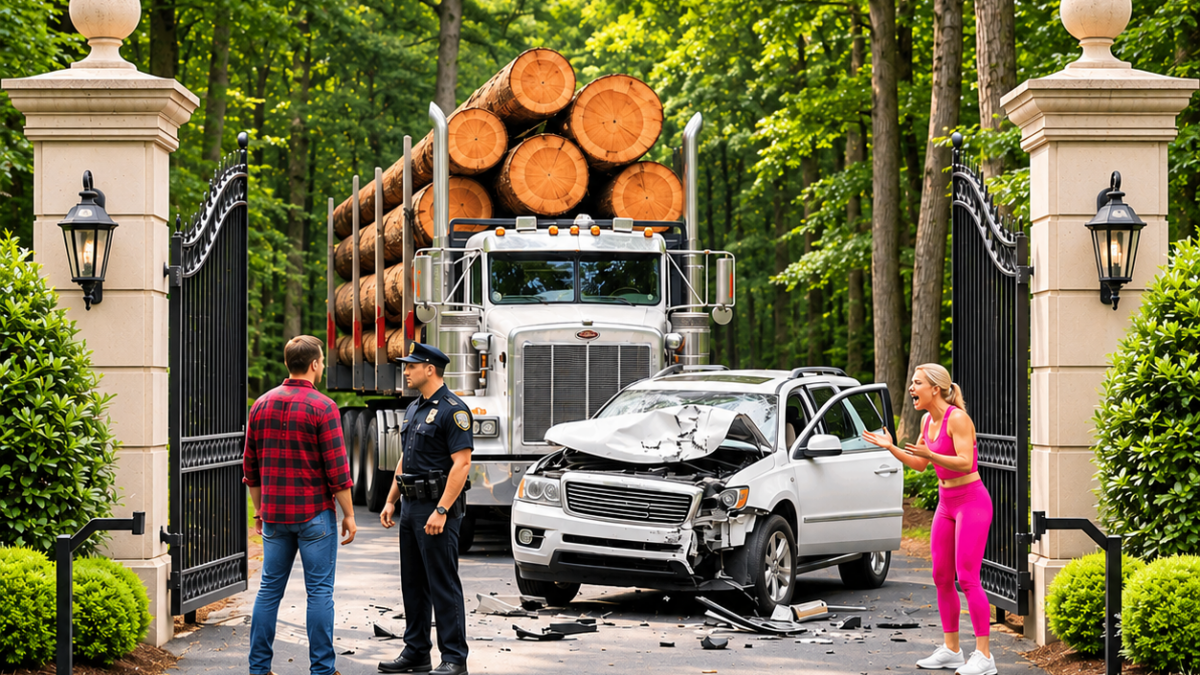
The driver hit the brakes.
Hard.
Air brakes do not sound like car brakes.
They exhale.
A deep mechanical rush that seems to come from the truck’s entire body at once.
The loaded tractor-trailer slowed, but forty tons does not stop because somebody changes her mind at the last second.
Brianna ran down the sidewalk in slippers and a sweatshirt, one hand holding her phone, the other waving at the driver like she could physically stop momentum.
Deputy Carl Mason stepped into the road.
“Ma’am, stay back.”
“That is my car!”
“Yes, ma’am.”
“Tell him to stop!”
“He is stopping.”
She looked toward me.
“You did this.”
I said nothing.
That had become my favorite strategy around Brianna.
Silence made her fill the space herself.
The logging truck rolled to a stop several yards short of the Tesla.
No collision.
No crushed hood.
No cinematic revenge.
Not yet.
That distinction matters.
Because by then I had spent too much time building a clean case to ruin it by becoming the person who damaged somebody else’s property on purpose.
The title people later gave the story was much simpler.
HOA Karen blocked my gate, so I crushed her Tesla with a logging truck.
What actually happened took longer.
It was messier.
And strangely enough, much more satisfying.
The truck driver’s name was Ray Sutton.
Fifty-six.
Thirty-one years hauling timber.
The kind of man who could tell you what a road surface would do under load by looking at the dust.
He leaned out his window.
“Morning, Evan.”
“Morning.”
He nodded toward the Tesla.
“That the problem?”
“That’s the problem.”
Brianna heard him.
Her face changed.
Not fear.
Offense.
As if being called “the problem” was somehow more outrageous than parking across a private commercial entrance after months of warnings.
She marched toward us.
Deputy Mason raised one hand.
“Ms. Hale, do not enter the truck’s path.”
“You don’t understand.”
“I understand enough.”
“This road belongs to the community.”
“No, ma’am.”
“It serves Maple Ridge.”
“That doesn’t make it Maple Ridge property.”
She stared at him.
Then at the reflective sign mounted beside my gate.
PRIVATE ROAD.
NO PARKING.
AUTHORIZED ACCESS ONLY.
VEHICLES BLOCKING COMMERCIAL ACCESS SUBJECT TO TOW AT OWNER’S EXPENSE WHERE PERMITTED BY LAW.
Brianna pointed.
“He put that up to harass me.”
Deputy Mason looked at the sign.
Then at me.
Then back at her.
“He put up a no-parking sign on his private road?”
“Yes.”
Mason waited.
Brianna apparently heard how that sounded only after saying it aloud.
She changed direction.
“He has no right to tow an HOA officer’s vehicle while I’m performing association business.”
I finally spoke.
“What association business are you performing at five-thirty in the morning?”
Her mouth tightened.
“You wouldn’t understand.”
Ray Sutton laughed inside the cab.
Not loudly.
Enough.
Brianna spun toward him.
“This doesn’t concern you.”
Ray said:
“It concerns me a little.”
“I have thirty-eight tons of pine behind me and nowhere to put it.”
Technically, we were not delivering pine.
We were taking out a mixed load of harvested timber from a managed section farther back on my property.
But Ray was not interested in explaining forestry logistics to Brianna.
Neither was I.
The source story had Evan deliberately schedule a legitimate time-sensitive commercial run, notify the HOA, county, and sheriff in advance, and then find Brianna’s vehicle sitting squarely across the gate before the truck arrived.
That part happened exactly because Mark insisted on it.
If the access problem was going to become a legal issue, he wanted an actual business need.
Not a staged stunt.
Not a fake truck rented for revenge.
Not me manufacturing damages.
I owned a small timber and land-management business.
Most of my acreage was pine and mixed hardwood.
We selectively harvested.
Sold firewood.
Cleared storm damage.
Maintained trails.
The truck needed that gate because the road behind it was built for commercial loads.
There was no alternate route.
The driveway to my house branched off later.
Brianna knew that.
She had parked there anyway.
Deputy Mason looked at her.
“Ma’am, you need to move the car.”
She folded her arms.
“I’m not moving anything until this access dispute is resolved.”
“It is resolved for purposes of today.”
“No, it isn’t.”
Mason remained calm.
“I reviewed the county parcel map and the recorded survey before coming out.”
“That road is private.”
“The vehicle is blocking it.”
“You received written notice from the landowner.”
“The tow company is here.”
“You can move it yourself right now and avoid the tow.”
Brianna stared.
“Who gave you my private information?”
Mason blinked.
“What information?”
“My address.”
“You live across the street.”
That almost made Ray laugh again.
Brianna’s cheeks reddened.
She pulled out her phone.
“I’m calling our attorney.”
“Fine.”
“Move the vehicle first.”
“No.”
There it was.
One syllable.
The entire story inside it.
No.
Not confusion.
Not misunderstanding.
Not:
I didn’t see the sign.
Not:
I thought I could park here.
No.
She understood.
She simply believed her refusal should matter more than everybody else’s rights.
Mark arrived three minutes later.
He had insisted on being present.
His truck came down the county road and pulled behind the deputy’s cruiser.
He climbed out carrying a folder and coffee.
“Did I miss the arrest?”
“There’s no arrest,” I said.
“Good.”
Brianna saw him.
“Oh, perfect.”
Mark smiled.
“Morning.”
“You again.”
“Still me.”
“This entire stunt is harassment.”
Mark held out his coffee.
“Would you like the certified letter receipt?”
“What?”
“Or the survey?”
“The county parcel map?”
“The photographs from May, June, July, August?”
“The HOA management emails acknowledging Evan’s road is not association property?”
“The cease-and-desist notice you signed for?”
“Which part feels surprising this morning?”
Brianna looked at Mason.
“Are you going to let him speak to me like this?”
Mason said:
“He’s speaking.”
I looked away before I smiled.
Mark continued.
“You have two options.”
“Move the car.”
“Or the tow company removes it.”
“That’s not a negotiation.”
Brianna looked toward Maple Ridge.
Several residents had begun gathering.
Of course.
People detect conflict the way birds detect storms.
First one garage door.
Then another.
A man in running shorts stood beside a mailbox.
A woman walked a Labrador far more slowly than any Labrador had ever wanted to walk.
Two teenagers held phones.
Brianna saw the audience.
That changed everything.
She lifted her chin.
“I am not moving that car because doing so would concede that the road isn’t community access.”
Mark looked at me.
Then Mason.
Then her.
“That is not how property rights work.”
“You don’t preserve an easement claim by parking a Tesla in front of a logging truck.”
She pointed at him.
“You think you’re funny?”
“No.”
“He is,” I said.
Mark ignored me.
Deputy Mason said:
“Last warning.”
“Move it voluntarily or it gets towed.”
Brianna held out her phone.
“My attorney is calling back.”
“Take the call while moving your vehicle.”
“I am not moving it.”
Mason looked toward the tow operator.
“Proceed.”
The operator’s name was Darius Cole.
He had stayed almost invisible until then.
That is what good tow operators do when people are angry.
They let law enforcement and owners argue.
They work.
He walked toward the Tesla with a wheel-lift dolly.
Brianna stepped in front of him.
Mason immediately moved between them.
“Ma’am.”
“You cannot obstruct him.”
“He is stealing my car.”
“No.”
“He is removing a vehicle from a private access lane after notice.”
“I’ll sue all of you.”
Mark said:
“That’s what courthouses are for.”
Brianna’s eyes snapped toward him.
The tow operator waited.
Mason said:
“Ms. Hale, I need you on the sidewalk.”
She finally stepped back.
Not because she agreed.
Because she saw the deputy’s body camera.
That mattered.
Darius inspected the Tesla.
Photographed all sides.
Existing scratches.
Wheel position.
License plate.
Interior visible condition.
Every step documented.
Then he began preparing it for tow.
That was when Brianna’s husband arrived.
His name was Stephen.
I had met him twice.
Quiet man.
Software executive.
Looked permanently tired.
He came running from their house barefoot.
“Brianna?”
She turned.
“They’re taking the car.”
Stephen looked at the gate.
The truck.
Deputy.
Tow operator.
Mark.
Me.
Then the giant sign.
He closed his eyes.
Actually closed them.
“Did you park there again?”
Brianna stared at him.
“Whose side are you on?”
“I asked a question.”
“This is about HOA access.”
Stephen rubbed both hands over his face.
“No.”
She stepped closer.
“What do you mean, no?”
“I mean this is not HOA access.”
“You know that.”
Brianna went still.
The neighbors went quiet.
That was the first time anyone close to her contradicted the story publicly.
She said:
“Stephen.”
He looked exhausted.
“Our title company looked at this when we bought.”
“The Maple Ridge road ends at the county turnaround.”
“Evan’s gravel road is private.”
“You know that.”
Brianna’s face drained.
Mark stopped moving.
I looked at Stephen.
“You knew?”
He nodded.
“I thought she stopped doing this.”
Brianna’s voice sharpened.
“Do not discuss this with him.”
Stephen laughed once.
No humor.
“I’ve been asking you for six months to stop parking there.”
She turned away.
That was the first crack.
Not the tow.
Not the deputy.
Her husband saying the truth out loud.
Darius finished positioning the tow equipment.
He lifted the Tesla’s rear axle.
Then paused.
“Vehicle locked.”
Brianna said nothing.
Stephen held out his hand.
“Give me the key.”
She ignored him.
“Brianna.”
“No.”
“You’re going to damage the car being stubborn.”
“They’re already damaging it.”
Darius shook his head.
“Not yet.”
That phrase became important.
Not yet.
He explained that towing an electric vehicle requires care.
Certain drivetrains should not be dragged with wheels rolling improperly.
He wanted it loaded correctly.
Flatbed if necessary.
The company had one fifteen minutes away.
Mark whispered:
“See?”
“What?”
“This is why you don’t just push a car with a logging truck.”
“I never planned to.”
“You thought about it.”
“Briefly.”
He raised one eyebrow.
Fine.
I had.
Months earlier.
In the fantasy version.
Everybody has one.
Brianna parks there.
Big truck comes.
Crunch.
Problem solved.
Then the sane part of your brain reminds you that intentional property destruction is still property destruction even if somebody behaves like an idiot.
So we waited.
The logging truck idled.
Fuel burning.
Driver on clock.
My loading crew waiting.
Contract delivery window shrinking.
Every minute now had a business cost.
Mark documented that too.
At 6:04, the flatbed arrived.
Brianna’s attorney finally called.
She put him on speaker.
I recognized the voice.
Gerald Price.
HOA counsel.
He sounded as though he had been woken from a deep sleep.
“Brianna, where are you?”
“In front of Evan’s property.”
“Why?”
“They’re illegally towing my vehicle.”
Pause.
Gerald said:
“Is the vehicle blocking his gate?”
She looked at everyone around her.
“Yes.”
Another pause.
“Move the vehicle.”
Brianna’s mouth opened.
“Gerald.”
“Move it.”
“You said the access question remained unsettled.”
“No.”
“I said the board should not make statements about access rights until title review was complete.”
“That review is complete.”
“When?”
“Three weeks ago.”
She went silent.
My heart began beating faster.
Mark looked at me.
I looked at him.
Gerald continued.
“The survey does not show a Maple Ridge easement over Mr. Coleman’s road.”
“The association has no authority to direct parking there.”
“I sent that opinion to the board president and management.”
Brianna looked toward a man standing among the neighbors.
HOA president, Peter Walsh.
He looked sick.
She shouted:
“You knew?”
Peter said:
“Yes.”
“And you didn’t tell me?”
“I emailed the entire board.”
Brianna pulled out her phone.
“You buried it in an attachment.”
Peter said:
“It was titled LEGAL OPINION — COLEMAN ACCESS ROAD.”
Somebody behind me whispered:
“Oh, wow.”
Brianna turned toward the sound.
That was when she lost awareness of everything else.
The tow operator.
The flatbed.
The logging truck.
The fact that the Tesla had already been partially repositioned.
Darius had lowered it again temporarily while preparing a safer loading angle.
The Tesla now sat slightly diagonal.
Still inside my road.
But its rear quarter extended farther into the truck’s turning path than before.
Ray Sutton saw it immediately.
He climbed down from the cab.
“We’ve got a problem.”
Everyone looked.
He pointed.
“I can’t make that turn with the trailer where the car sits now.”
Darius said:
“I’ll shift it.”
Brianna shouted:
“No one touches it.”
Mason said:
“Ma’am, the vehicle is being removed.”
She rushed toward the Tesla.
Mason moved.
Stephen grabbed her arm.
Not violently.
Just stopped her.
“Enough.”
She jerked away.
“You’re humiliating me.”
Stephen looked at her.
“No.”
“You’re doing that yourself.”
The neighborhood went silent again.
Brianna stared at him.
Then got into the Tesla.
For one second, I thought:
Finally.
She closed the door.
Vehicle powered on.
Darius stepped back.
Mason motioned for everyone to clear.
I opened the gate fully.
Ray climbed into his cab.
Brianna reversed.
Then stopped.
She lowered the window.
“You want the road clear?”
“Yes.”
“Fine.”
She pulled forward.
For some reason I still do not understand, instead of driving back toward her house, she turned the Tesla farther onto my private road.
Past the gate.
Maybe she intended to prove she had access.
Maybe she wanted to turn around.
Maybe anger made her stupid.
Mark shouted:
“Brianna, stop.”
She kept moving.
Deputy Mason raised his hand.
“Stop the vehicle.”
She accelerated a little.
Not fast.
Enough.
She drove maybe sixty feet beyond the gate.
Then stopped directly in the narrow widening where Ray needed to swing his trailer.
I could not believe it.
No one could.
Stephen whispered:
“Oh my God.”
Brianna got out.
Left the car there.
Closed the door.
Walked back toward us.
“There.”
“I’m not blocking the gate.”
Mark stared.
“Now you’re trespassing farther inside his property.”
Brianna said:
“You people are impossible.”
Ray climbed down again.
He looked at me.
Then at the road.
Then at her.
“I cannot clear that car with the trailer.”
Mason said:
“Ms. Hale, move it back to your property.”
“No.”
“Move the vehicle.”
“I complied.”
“No.”
“You moved the obstruction deeper onto private property.”
Her face tightened.
“I am not discussing semantics.”
Mason’s voice changed.
Not louder.
Firmer.
“This is not semantics.”
“You have been directed repeatedly to remove your vehicle.”
“If you do not, it will be towed.”
She crossed her arms.
“Then tow it.”
Darius sighed.
We began again.
That was when the actual damage happened.
Not because Ray decided to crush her Tesla.
Not because I gave some secret signal.
Not because the deputy told him he could.
The Tesla was being loaded onto the flatbed.
Darius had winched it partway up.
One front wheel shifted because the car’s steering was not aligned as expected.
The vehicle rolled several inches sideways.
Darius stopped immediately.
“Hold.”
At the same moment, Ray had begun inching the tractor forward under Mason’s direction to create more room for the flatbed’s rear.
He was moving at walking speed.
The trailer was not yet through the turn.
The rear of the Tesla shifted.
The forward corner of Ray’s logging trailer touched the Tesla’s rear quarter panel.
A crunch.
Short.
Ugly.
Final.
Everyone froze.
Brianna screamed.
“My car!”
Ray stopped instantly.
Darius stopped winching.
Mason looked at both vehicles.
No one moved for maybe five seconds.
The damage was not the cartoon destruction people later described.
The Tesla was not flattened.
Not turned into a soda can.
The rear quarter panel buckled.
Tail lamp shattered.
Bumper cover tore loose.
The trailer’s heavy steel corner had done what heavy steel does to lightweight bodywork.
It looked terrible.
Repairable.
Expensive.
Brianna stared at it.
Then at me.
“You crushed my car.”
I said:
“I didn’t touch your car.”
“You planned this!”
“No.”
“You brought that truck here!”
“For my business.”
“You knew!”
Mark stepped between us.
“Stop.”
Brianna pointed at me over his shoulder.
“I am suing you.”
Mark said:
“Then do that.”
“But stop making statements before the deputy finishes documenting the accident.”
Deputy Mason called another unit to handle the collision report because he had been involved in the scene management.
Good procedure.
Nobody wanted the same deputy deciding fault in a property-damage event he had helped coordinate.
Ray climbed down.
He looked sick.
“I never saw it shift.”
Darius said:
“It moved off line when the steering unloaded.”
Mark asked:
“Is everyone okay?”
Yes.
That mattered more.
No injuries.
No one between vehicles.
No one in the Tesla.
Property damage only.
The second deputy arrived.
Officer Carla Mendes.
She photographed.
Interviewed Ray.
Darius.
Mason.
Brianna.
Stephen.
Me.
Reviewed the camera footage.
My gate camera had captured everything.
So had Darius’s truck camera.
Ray’s dashcam.
Mason’s body camera.
There would be no argument about sequence.
That was the paper trail Mark had wanted.
Except now it included a collision.
Officer Mendes did not announce roadside fault.
She documented.
Insurance would handle damage.
Potential negligence could be sorted later.
Brianna wanted Ray cited immediately.
Mendes refused.
She wanted me cited for “setting a trap.”
Mendes asked:
“What specific act are you alleging?”
“He scheduled the truck knowing I park here.”
Mark closed his eyes.
Mendes looked at Brianna.
“You were notified not to park here?”
Brianna said nothing.
“Were you?”
“Yes.”
“Did you receive written notice of today’s commercial access?”
“Yes.”
“Were you instructed to move the vehicle before the truck entered?”
“Yes.”
“Did you move it farther onto private property?”
Brianna looked toward Stephen.
“Yes.”
Officer Mendes wrote.
That was enough for me.
No speech.
No triumph.
Just facts.
The Tesla was finally secured to the flatbed.
Darius transported it to the repair facility chosen through the towing process.
Ray inspected his trailer.
Minor scrape.
No structural damage.
Then, two hours late, the logging truck entered my property.
The gate opened.
The truck rolled through.
Nobody cheered.
I did not smile.
I stood beside Mark and watched the trailer disappear down the gravel road.
My entire body felt empty.
Months of anger had pointed toward that morning.
I expected relief.
Instead I felt tired.
Mark handed me coffee.
Cold.
“Drink.”
“I’m not thirsty.”
“Drink.”
I did.
Brianna stood across the county road beside Stephen.
No car.
No clipboard.
No sunglasses.
She looked smaller.
Not because she had been defeated.
Because without the symbols, she was just a person who had made a long sequence of bad decisions.
Peter Walsh, the HOA president, approached me.
“Evan.”
I looked at him.
“I owe you an apology.”
“Not today.”
He nodded.
Fair.
Then he turned back.
At 9:40, my phone rang.
My mother.
Of course.
“Are you in jail?”
“What?”
“Your cousin sent me a picture of a smashed white car.”
“Mom.”
“Well?”
“No.”
“Good.”
“Did you smash it?”
“No.”
“Are you sure?”
“Yes.”
Pause.
“Were you hoping it would get smashed?”
I looked at Mark.
He could somehow hear her from three feet away.
He smiled.
I said:
“Maybe six months ago.”
My mother laughed.
“That’s my boy.”
“Please never say that in court.”
“What happened?”
I told her.
Slowly.
When I finished, she said:
“That woman blocked me once.”
“I know.”
“You did all this because of me?”
“No.”
“Good.”
That surprised me.
She continued.
“You do not build your whole life around one old woman being inconvenienced.”
“I was not inconvenienced.”
“I had snacks in the car.”
“Mom.”
“I’m serious.”
“You did the right thing by making her stop.”
“But don’t turn me into the reason you stayed angry.”
That sounded unfairly wise.
I said:
“You could have said that months ago.”
“You didn’t ask.”
Mothers.
The logging operation took three days.
No further blockage.
No HOA presence.
No Brianna.
Nothing.
Quiet.
On Monday, Mark called.
“She retained counsel.”
“Of course.”
“Insurance claim plus civil demand.”
“For me?”
“You.”
“Ray.”
“His company.”
“Tow company.”
“Possibly HOA.”
“How am I liable?”
“That’s what they’ll argue.”
“You scheduled a commercial convoy while aware she had a history of blocking access.”
“That’s not illegal.”
“No.”
“You notified everyone.”
“Yes.”
“You did not direct Ray to contact her car.”
“No.”
“You did not touch the Tesla.”
“No.”
“Good.”
“So we respond.”
Her demand letter arrived.
$96,000.
Tesla repair.
Diminished value.
Rental.
Emotional distress.
Punitive damages.
Attorney fees.
Loss of use.
Mark laughed at the emotional-distress line.
I did not.
I had learned not to laugh at claims until a judge does.
The insurer for Ray’s trucking company investigated.
Darius’s towing insurer investigated.
My liability insurer investigated.
Three adjusters.
Four camera angles.
Thirty-seven emails.
Mark’s certified-letter file.
County survey.
Title report.
HOA emails.
Sheriff notification.
Delivery contract.
Logging manifest.
The entire history.
For once, bureaucracy felt beautiful.
Then Brianna’s own insurance carrier requested her statement.
That created another problem for her.
She initially said she had parked briefly and was not aware of commercial traffic.
Then camera footage showed:
Repeated prior parking.
Certified notice.
The voicemail that morning.
The deputy directing her to move.
Her moving the Tesla deeper onto my property.
The flatbed loading sequence.
Her insurer did not simply deny everything.
Insurance is not that magical.
The collision involved multiple actors.
They examined whether the tow operator’s loading method contributed.
Whether Ray should have remained fully stationary until loading was complete.
Whether scene coordination was adequate.
Eventually, the insurers apportioned responsibility through settlement.
The tow company accepted a share because the vehicle shifted during loading.
Ray’s insurer accepted a smaller share because his tractor moved before the flatbed operation was completely finished.
Brianna’s own conduct reduced what she could realistically claim from others.
My insurer declined liability on my behalf after investigation.
No evidence I directed anyone to damage the Tesla.
No vehicle operation by me.
No intentional collision.
No legal duty to surrender my commercial access simply because a trespassing vehicle remained after notice.
That felt good.
Not because Brianna got less money.
Because I had stayed clean.
Mark said:
“This is why I told you not to touch the car.”
“I know.”
“You wanted to.”
“I know.”
“Say thank you.”
“Never.”
He sent me an invoice.
I reconsidered.
The bigger fight involved the HOA.
Brianna had spent months telling Maple Ridge residents that my road was community access.
Some believed her.
Why?
Because the original developer’s marketing map showed a dotted line near my property labeled:
FUTURE SERVICE CONNECTION.
Not legal access.
Not easement.
Concept.
The subdivision was originally supposed to connect to another county road through land the developer later failed to acquire.
My road sat near that proposed connection.
Over time, people conflated:
future connection
with:
community access.
Brianna had found the old map.
Then treated it like law.
The HOA had asked its attorney to review.
Gerald Price concluded:
No recorded easement.
No deeded access.
No maintenance agreement.
No prescriptive claim established from HOA use.
No authority to direct residents or vendors onto Coleman road.
He sent that three weeks before the logging incident.
Peter Walsh did not immediately announce it because the next board meeting had not occurred.
That was his mistake.
Brianna received the email and ignored it.
That was hers.
Then Mark found something worse.
Brianna had issued fake “access notices” on HOA letterhead.
Not formally approved.
The notices claimed my road was part of the Maple Ridge emergency and service corridor.
They instructed residents:
Temporary parking permitted along private lane during community events where necessary.
That was why other cars had occasionally appeared.
Not just Brianna.
She had created authority from a marketing map.
No board vote.
No legal opinion.
No recorded right.
Peter was furious.
He called an emergency HOA meeting.
I attended only because Mark recommended it.
Maple Ridge clubhouse.
Nice building.
Stone fireplace.
Rows of folding chairs.
Maybe sixty homeowners.
Brianna sat at the board table.
Her Tesla was still in repair.
She had a rental SUV.
Parked legally.
Good start.
Peter opened.
“We need to address the Coleman access-road issue.”
Brianna interrupted.
“This is pending litigation.”
Her attorney, seated beside her, whispered something.
She stopped.
Peter continued.
He projected the survey.
County map.
Developer concept plan.
Gerald’s legal opinion.
Then the unauthorized access notice.
He asked:
“Brianna, did you issue this?”
She looked at the screen.
“Yes.”
“Board authorization?”
“I believed it fell under vice presidential administrative authority.”
Gerald said from the side:
“It did not.”
The room shifted.
Brianna looked at him.
“You never said that.”
“I said the association had no established access right.”
“That is not the same thing.”
“It is fairly close.”
A few people laughed.
Peter did not.
He looked angry.
“Did you continue parking on Mr. Coleman’s road after receiving Gerald’s opinion?”
“Yes.”
“Why?”
“Because I disagreed.”
There it was again.
No misunderstanding.
Disagreement.
Peter rubbed his forehead.
“You disagreed with counsel about whether the HOA had property rights?”
“Yes.”
“I believed longstanding community use created an equitable claim.”
Gerald leaned toward his microphone.
“I specifically advised the board that I found no basis to represent such a claim as established.”
Brianna said:
“You’re protecting yourself now.”
Her attorney touched her arm.
She stopped again.
Then residents spoke.
Some defended her.
A woman named Diane Morrison:
“Brianna has done more for this neighborhood than anybody.”
True, apparently.
She organized pool events.
Food drives.
Holiday decorating.
Volunteer cleanup.
Negotiated better landscaping rates.
Another man:
“She can be difficult, but she gets things done.”
Also probably true.
Then other residents spoke.
One said Brianna told him he could park near my gate during a graduation party.
Another had received a fake warning after I asked him to move his boat trailer from my road.
He thought I was an angry outsider trying to “privatize community space.”
That phrase came from Brianna.
The room slowly realized how much of the conflict she had manufactured.
Not only between her and me.
Between me and people who thought they were using a shared resource.
That bothered me more than the Tesla.
A woman named Melissa Grant stood.
“I owe Evan an apology.”
I looked up.
She lived two houses inside Maple Ridge.
I knew her only by face.
She continued.
“I told my kids not to go near his property because I thought he was trying to block emergency access.”
“I repeated that to neighbors.”
“I believed an HOA email.”
“I’m sorry.”
I nodded.
“Thank you.”
Another homeowner stood.
Then another.
Not all apologizing.
Some asking:
Why did the board allow this?
Peter answered honestly.
“We didn’t know she was sending some of these communications.”
That was not a good answer.
But it was an honest one.
Someone shouted:
“How can a vice president send official notices without the president knowing?”
Exactly.
Governance failure.
Not just Brianna.
Maple Ridge had weak controls.
Board officers shared access to email templates.
No approval log.
No counsel review requirement.
No distinction between community announcements and legal enforcement.
Brianna used those gaps.
Maybe not because she intended fraud.
Because she believed she was solving a problem.
That is how overreach often happens.
Someone decides the process is too slow for the certainty they feel.
Then they skip it.
The board voted that night.
Brianna was removed as vice president.
Not automatically off the board.
Their bylaws required member recall for that.
Peter proposed:
Immediate suspension of external-property communications.
Written acknowledgment that my road was private.
Formal notice to residents rescinding prior access statements.
No HOA parking or event use.
Counsel review for any future claim involving non-HOA property.
Passed unanimously.
Brianna voted no on one item.
Guess which.
The private-road acknowledgment.
Her attorney whispered.
She changed to abstain.
Progress, technically.
The written notice arrived the next morning.
MAPLE RIDGE ESTATES COMMUNITY NOTICE
The gravel road and gate adjoining the western boundary are privately owned by Evan Coleman and are not HOA common property.
Maple Ridge Estates holds no recorded parking, access, or maintenance easement over that road.
Residents, guests, vendors, and contractors should not enter or park without owner permission.
Prior statements suggesting general community access are withdrawn.
I printed it.
Put it beside my gate.
Mark told me not to be petty.
I said:
“Public education.”
He said:
“Petty public education.”
Fair.
The recall petition began two weeks later.
I stayed out.
I did not sign.
I was not a Maple Ridge member anyway.
Residents collected signatures.
Brianna fought it.
She wrote a letter.
Listed her accomplishments.
Said the access dispute arose from years of informal neighborhood use and unclear developer representations.
That part had some truth.
She said I had “weaponized commercial activity” against a resident vehicle.
That part angered me.
Mark told me not to respond.
I did not.
She said the Tesla damage was evidence my approach had been reckless.
That was an argument.
Not entirely ridiculous.
Ray’s insurer had accepted a portion of responsibility.
Tow insurer too.
But her letter omitted the fact that she had moved the vehicle deeper onto my property after a deputy told her to remove it.
Residents had the video.
The recall vote was seventy-four to twenty-nine.
She lost her board seat.
No cheering.
No dramatic walk of shame.
She gathered her things.
Left.
Stephen stayed seated.
That was telling.
I learned later they had separated.
I want to be careful with that.
The access dispute did not “destroy her marriage.”
Real relationships are bigger than neighborhood stories.
Stephen later told me they had been struggling for years over money, control, work, family.
The Tesla incident became one more thing.
Not the cause.
Months passed.
My road stayed clear.
The new board president, Melissa Grant—the woman who had apologized—asked to meet.
She came alone.
Stopped at the gate.
Called me.
“Can I come in?”
Those words.
Beautiful.
“Yes.”
She walked up.
We sat on my porch.
She brought cookies.
Apparently Maple Ridge believed diplomacy required baked goods.
I approved.
She said:
“We need a formal emergency-access agreement.”
I tensed.
She raised one hand.
“Not general access.”
“Emergency only.”
“What kind?”
“Fire apparatus if our western entrance is blocked.”
“Evacuation if county orders it.”
“Nothing else.”
“Recorded easement?”
“No.”
“Revocable emergency license with specific triggers.”
That was reasonable.
We hired separate lawyers.
Worked with county emergency management.
Fire department.
Sheriff.
We created a narrow agreement.
Use only when public access points were physically unavailable or emergency officials determined immediate life-safety need.
No routine traffic.
No parking.
No HOA events.
No contractor shortcut.
HOA responsible for any damage caused by emergency use beyond ordinary conditions.
Signs remained.
That was coexistence.
Not surrender.
The first time the agreement was actually used came two years later.
Wildfire.
Dry spring.
Wind.
A brush fire jumped near the eastern subdivision entrance.
County deputies blocked it.
Fire department asked to move one engine and evacuate several households through my road as a precaution.
The sheriff called.
Not the HOA.
I opened the gate.
Cars came through.
Families.
Dogs.
Kids crying.
No one cared who had been right two years earlier.
Brianna was gone by then.
Her old house belonged to another family.
I stood near the gate directing vehicles.
Melissa pulled over.
Window down.
“Thank you.”
“Go.”
She went.
Two hours later fire crews contained the threat.
No homes lost.
Residents returned through the regular entrance.
Emergency agreement worked exactly as written.
That night I sat on the porch.
Thought about Brianna saying:
This road serves Maple Ridge whether you like it or not.
She had been wrong about authority.
But reality had irony.
The road could serve Maple Ridge.
When I chose.
Under defined circumstances.
By agreement.
Consent changed everything.
The next spring my mother came to visit.
Still using the walker.
Still complaining that everyone treated her like glass.
I met her at the gate.
She looked around.
“No white car.”
“No.”
“Good.”
She pointed at the big sign.
“You made that bigger.”
“Yes.”
“Men.”
“What?”
“You solve emotional problems with metal signs.”
“I solved a parking problem.”
“Sure.”
I helped her into my truck.
She looked toward Maple Ridge.
“Did the woman move?”
“Yes.”
“Because of you?”
“No.”
“Because of herself mostly.”
My mother nodded.
“Usually how it works.”
We drove up the gravel road.
She looked out the window at the pines.
Then said:
“You know I could have walked from the gate that day.”
“No, you couldn’t.”
“I had the walker.”
“It was ninety degrees.”
“I’ve survived worse.”
“Mom.”
She smiled.
“You needed a reason to finally stop being polite.”
I looked at her.
“Maybe.”
She patted my arm.
“Glad I could help.”
That evening she stood near the gate.
Clear.
Quiet.
She said:
“Looks like you got your peace back.”
The source story ended with Evan’s mother returning to find the road clear again and with Evan recognizing that the real issue had never been one parking spot, but whether someone else could turn entitlement into control over his land.
That part stayed true.
But the car did not become the symbol I expected.
The gate did.
For months I had looked at it as something defensive.
Keep out.
Private.
No parking.
No trespassing.
After the wildfire, it looked different.
A gate is not a wall.
Its whole purpose is that someone decides when it opens.
That is what Brianna never understood.
She thought refusing access meant hostility.
I had thought granting access meant weakness.
Both were wrong.
Ownership is choice.
Consent.
Terms.
Responsibility.
The logging business grew.
Ray kept hauling for me.
Every time he approached that gate, he called ahead.
Not because he had to.
Because after the Tesla incident he became almost religious about clear access.
Once he joked:
“Any electric vehicles in the kill zone?”
“Don’t call it that.”
“Any luxury obstructions?”
“No.”
“Good.”
Darius Cole, the tow operator, became a customer.
Bought firewood every winter.
The first year he came, he pointed at the gate.
“I still have nightmares about that Tesla.”
“You?”
“I was the one winching it.”
“I thought my insurance guy was going to live in my office.”
We laughed.
Then he got serious.
“You know people tell that story like the logging truck intentionally crushed it.”
“I know.”
“Annoys you?”
“Sometimes.”
“You could correct them.”
“I do.”
“Doesn’t work?”
“No.”
People prefer a simple revenge story.
Entitled HOA woman.
Patient landowner.
Logging truck.
Crunch.
Justice.
The real version has insurance allocation.
Scene safety.
Tow procedures.
Lawyers.
HOA governance.
Emergency access agreements.
Much less satisfying in thirty seconds.
More useful over a lifetime.
Brianna’s lawsuit against me was eventually dismissed by agreement after insurers settled the vehicle damage and her attorney reviewed the access evidence.
No giant punitive judgment against her.
No criminal charges.
No arrest.
No insurer declaring “entitlement isn’t covered.”
Reality is less poetic.
She paid some towing and legal costs.
Her auto insurer covered portions subject to policy terms and fault determinations.
The commercial insurers handled their shares.
I paid nothing toward the Tesla damage personally.
My legal costs were not nothing.
Mark discounted some.
Not enough.
I complained.
He said:
“Freedom isn’t free.”
I nearly threw him off the porch.
He laughed.
Brianna sold her house almost a year later.
Not immediately.
The market was slow.
She and Stephen sold as part of their separation.
I knew because county records are public and curiosity is a character defect.
She moved to another city.
I never saw her again.
Until seven years later.
That part surprised me.
I was at a county planning hearing about a timber access permit.
Different issue.
Afterward a woman called:
“Evan?”
I turned.
Brianna.
Hair shorter.
No sunglasses.
Older.
So was I.
She held no clipboard.
For a second, every old emotion returned.
Then disappeared almost as quickly.
Time does that.
She said:
“I heard you still have the road.”
I smiled.
“Hard to relocate.”
She laughed.
That was new.
Then:
“I owe you an apology.”
I looked around.
People leaving the hearing room.
No audience that mattered.
“Okay.”
She said:
“I was wrong.”
Not:
Things got out of hand.
Not:
We both made mistakes.
“I was wrong.”
“I knew the legal opinion said the HOA didn’t have an easement.”
“I convinced myself the lawyer was being too cautious.”
“I thought if enough residents used the road, eventually it would become something we could formalize.”
“I thought you were being selfish.”
“I also hated that you wouldn’t let me tell you what to do.”
That was honest.
I said:
“I hated you telling me what to do.”
“I know.”
She looked down.
“The car?”
I waited.
She said:
“I moved it farther in because I wanted to prove I could.”
“I know.”
“I’ve replayed that morning a lot.”
“Me too.”
“I thought you had set the whole thing up.”
“I thought the truck was there to scare me.”
“It wasn’t.”
“I know that now.”
She paused.
“Stephen told me I had spent months turning you into an enemy because I couldn’t tolerate being told no.”
“That hurt more than the repair bill.”
I almost smiled.
Then she said:
“I teach property managers now.”
I stared.
“Of course you do.”
She laughed.
“Not enforcement.”
“Governance.”
“Boundaries.”
“Documentation.”
I shook my head.
“You’re kidding.”
“No.”
“I use a case study about unauthorized access claims.”
“Does it include a Tesla?”
“Not by name.”
“Coward.”
She laughed again.
Then grew serious.
“I’m sorry about your mother.”
“She’s fine.”
“I mean blocking her.”
“I know.”
“I didn’t think about who was behind the gate.”
“I only thought about winning the argument.”
That was the best apology she could have given.
Because it named the real harm.
When people become obsessed with authority, they stop seeing who their authority lands on.
An eighty-year-old woman in a hot car.
A delivery driver losing hours.
A business owner waiting.
Neighbors misled.
A husband embarrassed.
A tow operator stuck in a conflict he never asked for.
She asked:
“Do you forgive me?”
I thought.
Years earlier I would have wanted to say something profound.
Instead:
“Yes.”
She looked surprised.
“So easily?”
“It’s been seven years.”
“That’s not easily.”
Fair.
We shook hands.
Then walked in opposite directions.
No friendship.
No coffee.
Enough.
I told Mark.
He said:
“You forgave her?”
“Yes.”
“Without billing her?”
“Yes.”
“You’ve gone soft.”
“I’m older.”
“Same thing.”
My mother died two years later.
Eighty-nine.
At home.
Peacefully.
After the funeral I drove to the gate.
No reason.
Just did.
The metal sign was faded.
Private road.
No parking.
The reflective letters had cracked in the sun.
I remembered her sitting in the car the day Brianna blocked it.
Hands on the walker.
Pretending not to be tired.
“Don’t make a fuss.”
That had been Mom’s favorite instruction.
Then years later:
You needed a reason to stop being polite.
Both things were true.
There is a difference between politeness and surrender.
I had spent half my life confusing them.
Being polite means respecting another person.
Surrender means handing them the right to define your boundaries.
You can be kind and still say no.
You can be calm and still call a lawyer.
You can forgive someone and still keep the gate.
That became the lesson I carried.
I replaced the old sign.
Same wording.
Smaller.
Mark came by.
“Why smaller?”
“People can read.”
“Brianna couldn’t.”
“She could.”
“She just disagreed.”
“Fair.”
We stood there.
He looked down the road.
“You ever regret not just selling an easement to Maple Ridge?”
“No.”
“Never?”
“No.”
“What if they offered a million?”
I thought.
“Call me.”
He laughed.
Ownership has principles.
It also has numbers.
I am not a saint.
Years later, Maple Ridge did ask about a permanent secondary emergency easement.
Not general traffic.
Emergency.
The voluntary license worked, but county planners wanted a more durable route as wildfire risk increased.
This time everybody did it correctly.
Survey.
Appraisal.
Lawyers.
Fire department.
Insurance.
Limited deeded emergency easement with strict conditions.
No parking.
No daily residential use.
No HOA event access.
Activated only by authorized emergency personnel or physical closure of primary exits under defined conditions.
Maple Ridge paid.
I accepted.
The road remained mine.
The easement remained narrow.
The gate remained.
A Knox-style emergency access system was installed.
That was not defeat.
That was agreement.
Brianna had tried to create access through repetition and confidence.
Years later, the community got what it actually needed through negotiation and payment.
That contrast pleased me.
Maybe too much.
The Tesla story became local folklore.
Every version got bigger.
In one, Ray drove straight through at forty miles per hour.
Impossible.
In another, the truck flattened the Tesla completely.
No.
In another, the deputy told me:
You’re legally allowed to crush it.
Absolutely not.
One version had Brianna standing on the hood.
Please.
I corrected people.
They looked disappointed.
Eventually I stopped correcting everyone.
Only when it mattered.
A group of young landowners once asked me to tell the story at a county forestry association dinner.
I agreed.
I showed them the survey.
Certified notice.
Camera stills.
Logging manifest.
Tow invoice.
HOA legal opinion.
Insurance letters.
One young guy raised his hand.
“When do we get to the part where you crush the Tesla?”
Everyone laughed.
I said:
“Right now.”
Then showed the photo of the buckled quarter panel.
He frowned.
“That’s it?”
“That repair cost more than your first truck.”
He nodded respectfully.
Then I said:
“But if you take one thing from this story, don’t take the crunch.”
“Take the paperwork.”
Groans.
I continued.
“Seriously.”
“If you have a private access problem, don’t turn it into a contest.”
“Survey.”
“Title.”
“Signs.”
“Written notice.”
“Camera.”
“Lawyer.”
“Law enforcement when appropriate.”
“Tow through a lawful process.”
“Don’t create an accident because you want a story.”
A man in the back said:
“That’s less fun.”
“Yes.”
“It also keeps you from becoming the defendant.”
Mark, seated beside him, raised his glass.
“Best sentence he’s ever learned.”
The logging truck itself ran another six years.
Then Ray retired it.
He invited me to the yard before selling.
Old Kenworth.
Faded paint.
Steel trailer.
Scratches everywhere.
He pointed at one tiny mark near the corner.
“Tesla.”
I laughed.
“You kept that?”
“Battle scar.”
“It was a quarter-panel accident.”
“Battle scar sounds better.”
He sold the truck to a company in Georgia.
I never saw it again.
But sometimes when I heard air brakes on the county road, I remembered that morning.
Not the impact.
The moment before.
The truck coming around the bend.
The deputy waiting.
The tow operator.
Mark with his coffee.
Brianna’s Tesla centered beneath the sign.
Everything I had spent months preparing finally gathered in one place.
I thought the consequence was going to be dramatic.
It wasn’t.
The real consequence began earlier.
The day Brianna signed for the certified letter and ignored it.
The day the HOA attorney sent the legal opinion and she dismissed it.
The day Stephen told her the road was private and she parked there anyway.
The day she moved the Tesla deeper onto my land after a deputy told her to remove it.
By the time steel touched sheet metal, the important decisions had already happened.
That is how consequences usually work.
The dramatic moment is only the receipt.
My road is quiet now.
Maple Ridge is still next door.
Different board.
Different families.
Same manicured lawns.
Still too many identical mailboxes for my taste.
We get along.
Some residents buy firewood.
A few hunt with permission.
Kids ride bicycles near the county turnaround but know the private road starts at the sign.
The HOA sends new homeowners a map showing the boundary correctly.
That alone would have prevented most of the old conflict.
Melissa Grant stayed president for three years.
Then stepped down.
The association adopted a rule requiring counsel review before making any claim involving land outside the recorded HOA plat.
Good rule.
Boring rule.
The best kind.
The emergency easement appears in closing packets now.
Highlighted.
No one can honestly say they do not understand.
Clarity is peace.
My mother used to say peace was when nobody bothered you.
I think she simplified it for children.
Peace is when everyone understands where they can stand without taking something from somebody else.
The gate is still there.
I repaint it every few years.
The reflective sign catches headlights at night.
PRIVATE ROAD.
AUTHORIZED ACCESS ONLY.
The line below no longer says:
TRESPASSERS TOWED.
I changed it.
It now says:
PLEASE DO NOT BLOCK GATE.
Mark mocked me.
“Soft.”
“Clear.”
“You think please would’ve stopped Brianna?”
“No.”
“Then why?”
“Because most people aren’t Brianna.”
That took me a long time to remember.
Most people do not need threats.
Most people see a gate and understand.
Most people make mistakes and apologize.
Most people move the car when asked.
Rules should be written for reality, not for the worst person you ever met.
One spring afternoon, a delivery driver stopped partly across the gate while checking his GPS.
Old me would have felt the irritation instantly.
I walked down.
He lowered the window.
“Sorry, sir.”
“Wrong address.”
“No problem.”
He moved.
Ten seconds.
Done.
I stood there afterward and laughed.
That was the peace I had wanted all along.
Not victory.
Not a crushed car.
Not a board member removed.
Not an audience watching somebody lose.
Just:
Hey, you’re blocking the gate.
Sorry.
I’ll move.
A functioning civilization in eight words.
People still ask whether I was glad the Tesla got damaged.
The truthful answer is complicated.
In the first second?
Yes.
There was a piece of me that heard the crunch and thought:
Finally.
I am not proud of that.
But pretending otherwise would turn me into the kind of storyteller who wants to look better than he was.
The feeling passed quickly.
Because damage creates work.
Insurance.
Calls.
Statements.
Lawyers.
Expenses.
Stress.
Stephen’s face.
Ray worrying about his job.
Darius worrying about liability.
Deputy Mason writing another report.
Nothing about it was clean.
If the Tesla had been towed away without a scratch, the outcome would have been better.
That is what maturity eventually forced me to admit.
The damage was not justice.
The boundary being respected was justice.
The HOA correcting its records was justice.
Brianna losing authority she abused was accountability.
My mother reaching my house without obstruction was peace.
Those are different things.
It took me years to separate them.
The title remains better than the truth.
HOA Karen Kept Parking Her Tesla in Front of My Gate — So I Crushed It With a Logging Truck.
Fine.
People click titles.
But if you ever hear somebody tell the story like I deliberately gave Ray a signal and watched forty tons flatten a luxury car because a woman annoyed me, understand what really happened.
I spent months refusing to do exactly that.
I documented.
Warned.
Posted signs.
Sent certified notice.
Notified law enforcement.
Scheduled real work.
Arranged lawful towing.
Then watched a woman who had been given every possible exit move her own car deeper into a place she had already been told she had no right to occupy.
A towing operation went wrong by inches.
Heavy steel won.
Sheet metal lost.
Nobody was hurt.
And afterward, every person involved had to answer for the part they actually played.
Including me.
That is less cinematic.
It is also the reason I can still stand at my gate years later without wondering whether I became the very thing I was fighting.
I protected my boundary.
I did not give myself permission to destroy hers.
And in the end, the difference between those two choices weighed a lot more than forty tons.