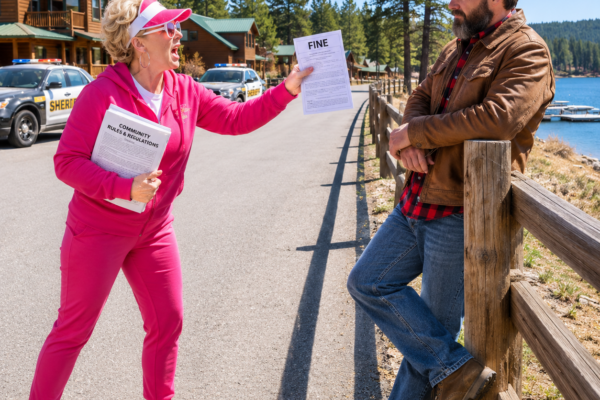
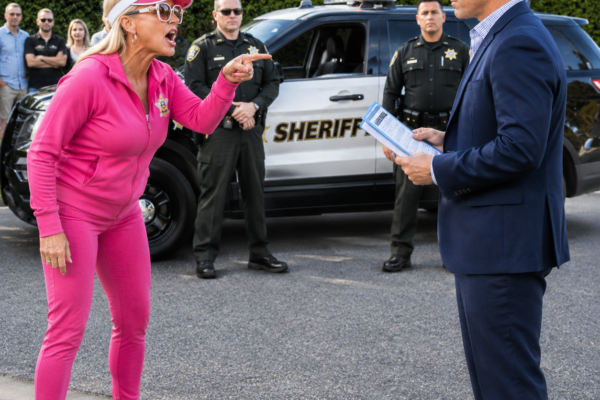
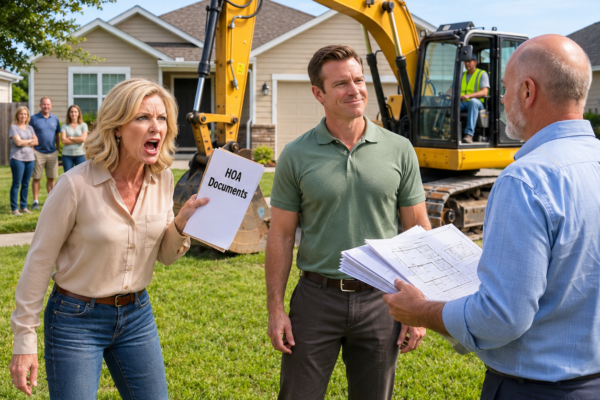
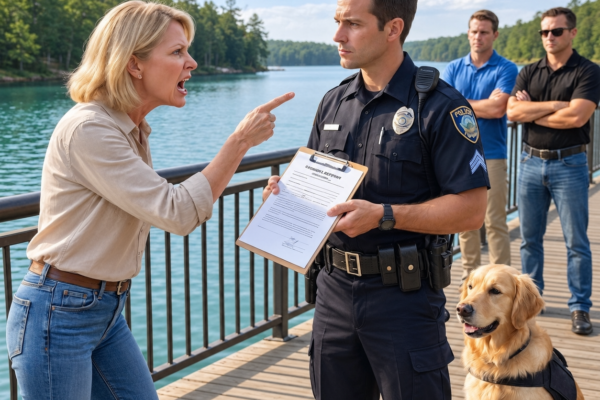
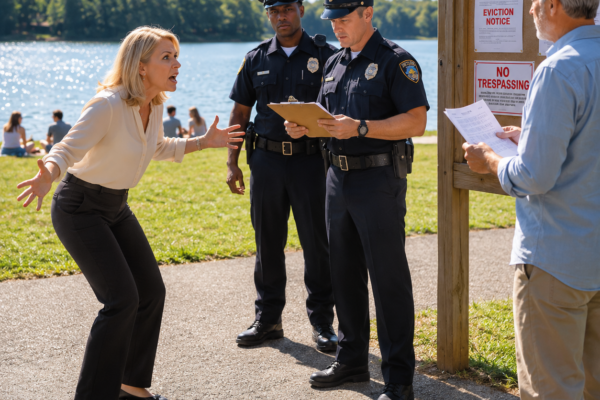
HOA cut through my fence, bulldozed a path between my apple trees, and started pouring a “community walking trail” across my orchard without ever asking me—so I built a permitted barrier on my side of the property line and waited for them to explain their shortcut to the county.h
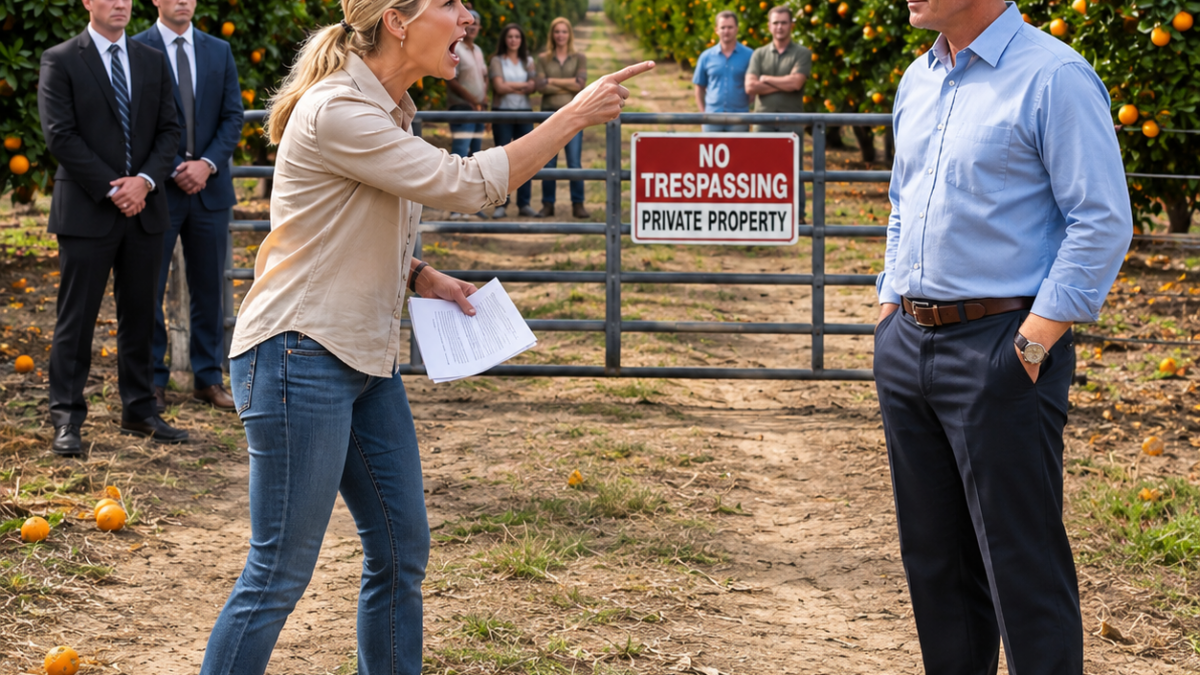
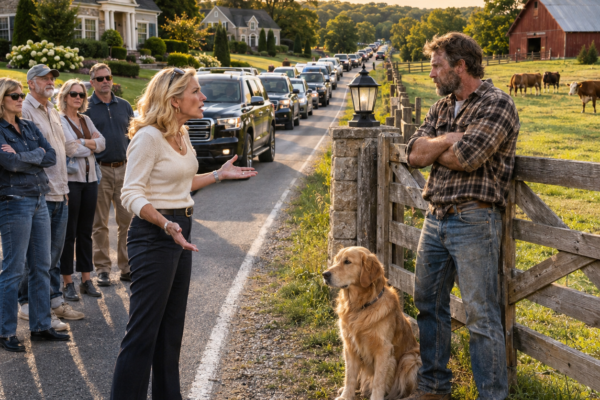
“This trail isn’t failing because David blocked it,” he said. “It’s failing because Cedar Ridge built it where Cedar Ridge had no right to build.”
Susan Vance stared at him.
For once, she did not have an immediate answer.
That was unusual.
Susan could produce an answer before most people finished asking a question.
She had an extraordinary ability to sound certain even when certainty was exactly what she lacked.
She looked from the county inspector to the four-foot barrier I had installed across the unfinished walkway.
Then to the bright orange survey marker directly beside it.
Then to the attorney standing near my gate.
Finally, she looked at me.
“You planned this.”
I almost laughed.
“Planned what?”
“To embarrass us.”
“No.”
“You waited until the project was almost complete.”
“I sent you three letters before your contractor cut my fence.”
“The board believed we had access rights.”
“You believed advertising something would eventually create access rights.”
“That is not what happened.”
My attorney, Michael Brooks, quietly opened the folder he had brought.
I knew what was inside.
Board minutes.
Emails.
My deed.
The plat.
The county’s stop-work notice.
The temporary restraining order.
Photographs.
Invoice for the destroyed irrigation line.
Survey measurements.
And Susan’s own words.
Michael said:
“Ms. Vance, this conversation should probably stop.”
Susan looked at him.
“Why?”
“Because you are currently standing next to unpermitted construction on my client’s property while a court order prohibits further entry.”
She opened her mouth.
Michael added:
“And because your association has already filed suit against him.”
That finally did it.
Her mouth closed.
The contractor foreman looked like a man who had just realized his morning was going to involve more lawyers than concrete.
The county inspector turned toward him.
“Nothing else gets poured.”
The foreman nodded.
“Understood.”
Susan pointed at the barrier.
“What about that?”
The inspector glanced at my plans.
“Permitted.”
“It completely blocks our trail.”
“Yes.”
“That cannot be allowed.”
He looked at her.
“Why not?”
“Because residents use it.”
“They are not supposed to be on this parcel.”
“You’re taking his side.”
“No, ma’am.”
He held up the violation file.
“I’m taking the side of the recorded boundary.”
That sentence became famous in our neighborhood.
Not nationally.
Not on television.
Just locally.
For months afterward, Cedar Ridge residents repeated it whenever anyone complained about the wall.
The recorded boundary.
Simple.
Almost boring.
And somehow it took a lawsuit to make people respect it.
My name is David Gallagher.
I had been growing apples most of my adult life.
Not because it was my childhood dream.
My childhood dream was to get as far from the orchard as possible.
When you grow up on a farm, you spend your teenage years convinced everybody else lives a glamorous life because their parents do not wake them at five in the morning during harvest.
I went to college.
Studied agricultural business.
Took a job with a produce distributor.
Moved two counties away.
Wore clean shirts.
Sat in meetings.
Thought I had escaped.
Then my father got sick.
I came home for what I told myself would be six months.
That was twenty-seven years ago.
My father died four years after I returned.
By then I had married Ellen.
We had converted the old farmhouse kitchen.
Expanded cold storage.
Added drip irrigation.
Replanted several aging blocks.
Opened a roadside stand.
Built a small cider operation.
And somehow the place I had spent years trying to leave had become the one place I could not imagine giving up.
Ellen loved the orchard before she loved me.
At least that is what she claimed.
She was an elementary-school librarian and had grown up in town.
When we started dating, she would come out during bloom season and walk the rows for hours.
She knew nothing about apples.
She would point at trees and ask:
“What kind?”
I would answer.
She would forget.
Then ask again.
After we married, she planted flowers around the farmhouse, painted the farm-stand sign, and convinced me tourists would buy cider doughnuts if we sold them on weekends.
She was right.
She was usually right in ways that irritated me.
She died seven years before Cedar Ridge built its trail.
Breast cancer.
Three years from diagnosis to funeral.
I kept working because orchards do not recognize grief leave.
Trees bloom.
Fruit sets.
Irrigation breaks.
Apples ripen.
Customers still ask whether you have Honeycrisp even when your wife has been dead eleven days.
That sounds cruel.
It helped.
Routine gave sorrow somewhere to stand.
Cedar Ridge Estates arrived later.
The developer bought land west of us and another parcel north of the creek.
Before that, the area had been open hay fields, woods, and one neglected cattle pasture.
I was not against development.
People need houses.
Farmers sell.
Land changes.
My grandfather’s orchard itself had once been forest.
There is no morally pure landscape frozen at the year your family bought it.
The problem started when Cedar Ridge’s marketing treated surrounding private land as though it were part of their purchase.
Their original brochure showed:
“COUNTRYSIDE LIVING.”
“DIRECT CONNECTION TO NATURE.”
“SCENIC ORCHARD VIEWS.”
“CREEK-SIDE WALKING.”
I did not object.
They had views.
The creek partly touched their land.
They could say what they saw.
Then a later brochure said:
“STEPS FROM HISTORIC GALLAGHER ORCHARDS.”
Still true.
Then:
“FUTURE CONNECTION TO ORCHARD TRAILS.”
Not true.
Nobody asked me.
I called the developer.
A marketing manager apologized and said the language was conceptual.
It disappeared from the next brochure.
I thought that was the end.
Then the HOA took over from the developer.
And Susan Vance became president.
Susan was not incompetent.
I say that because stories like this become useless when the antagonist is written as stupid.
Susan was smart.
Organized.
Energetic.
She had worked in corporate event planning.
She knew how to run meetings.
She knew how to pressure contractors.
She knew how to get forty residents to volunteer for something nobody had cared about the week before.
Under her first year as president, Cedar Ridge:
Repaired drainage complaints.
Negotiated better snow removal.
Replaced dying entry landscaping.
Started a neighborhood emergency contact system.
Created social events.
People liked her.
Even I liked her initially.
She came to the orchard stand one October and bought three gallons of cider for a Cedar Ridge fall festival.
She thanked me for “being such a wonderful neighbor.”
I said:
“You’re welcome.”
Then she asked whether residents could occasionally walk through the orchard during blossom season.
I said:
“During public events, sure.”
“What about mornings?”
“No.”
She smiled.
“Safety?”
“Insurance.”
“Farm operations.”
“Sprayers.”
“Equipment.”
“Private property.”
She nodded.
“I understand.”
Apparently not permanently.
The orchard is not a park.
That sounds obvious.
But from a distance, rows of trees look peaceful.
People imagine strolling.
In reality we have:
Tractors.
Sprayers.
Forklifts.
Irrigation lines.
Chemical applications.
Workers.
Beehives during pollination.
Uneven ground.
Cold-storage traffic.
Harvest bins.
Branches at eye level.
Occasionally angry geese near creek.
Public access requires control.
We host customers where customers are supposed to be.
Farm stand.
Parking.
Designated u-pick blocks during scheduled weekends.
Not random wandering through fifty acres.
Most people understand.
Susan thought the risk could be “managed through signage.”
I told her no.
That should have been enough.
The accidentally copied email came about a year later.
My niece Jessica managed our business email and weekend stand.
She was twenty-seven, fast, organized, and vastly better at social media than I was.
One afternoon she came into equipment barn carrying her laptop.
“Uncle David.”
“What?”
“You know Susan?”
“Unfortunately.”
“She wants your orchard.”
I looked up from the sprayer pump I was rebuilding.
“What?”
Jessica put laptop on workbench.
The subject line:
CEDAR RIDGE COMMUNITY ENHANCEMENT — PHASE ONE WALKING NETWORK.
Susan had apparently meant to copy a contractor named D. Gallagher.
Instead she copied our general Gallagher Orchards address from some old thread.
The PDF showed a loop trail beginning near their retention pond.
It followed the rear of several homes.
Then crossed the property boundary.
My boundary.
Ran beside creek.
Entered the lower orchard.
Turned near a row of Granny Smiths.
Then reconnected farther north.
Labels:
SCENIC ORCHARD EDGE.
CREEK OVERLOOK.
FUTURE BENCH.
POLLINATOR AREA.
Jessica zoomed.
“There’s a bench where your irrigation manifold is.”
“I see.”
“And look.”
She pointed.
“Future interpretive sign.”
The wording:
GALLAGHER HERITAGE ORCHARD.
I stared.
“They’re putting an interpretive sign about my farm on my farm?”
“Apparently.”
I called Susan.
No answer.
I emailed:
I was mistakenly included on the Cedar Ridge walking trail proposal. The route shown enters Gallagher Orchards property. We have not granted access and will not approve this route. Please revise plans accordingly.
She replied the next day.
David,
I believe there is some misunderstanding regarding the concept. The trail will create tremendous community value and likely benefit your farm stand through increased visibility. No final construction has occurred on your parcel. We’ll keep you informed as planning develops.
Warmly,
Susan
I replied:
There is no misunderstanding. Do not plan or construct a trail on Gallagher Orchards property.
Not warm.
Clear.
Two weeks later, orange flags appeared inside my fence.
That was when I understood Susan had interpreted “no” as “negotiation not completed.”
The workers were polite.
They had a plan set showing a “pedestrian access easement.”
I asked:
“Where is the recorded easement?”
One man said:
“HOA gave us map.”
“That’s not what I asked.”
They looked at each other.
I told them to leave.
They did.
No confrontation.
I photographed everything.
Then I called the county recorder.
No pedestrian easement.
No trail easement.
No public right-of-way.
Only:
Drainage easement near creek.
Utility access near road.
Nothing giving Cedar Ridge residents a right to cross.
I sent certified letter.
Susan responded with her “win-win” email.
I should have hired Michael then.
I did not.
That was my mistake.
I believed clarity would eventually matter more than confidence.
It did.
Just not quickly.
Construction started on Cedar Ridge’s property first.
Concrete sidewalk.
Six feet wide.
Nicely done.
It looped behind houses.
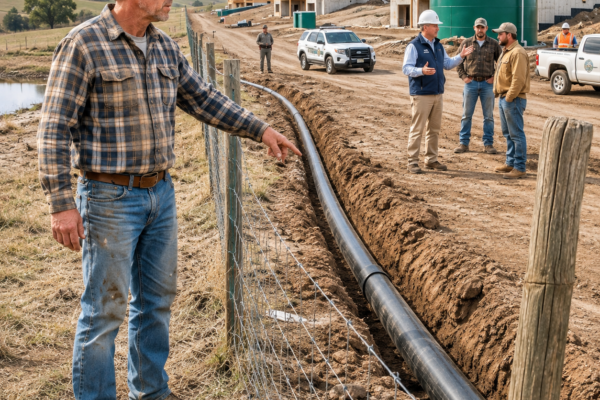
Then curved directly toward my chain-link boundary fence.
I watched.
I called management.
They said Susan assured board access issue was being handled.
I said:
“It isn’t.”
They asked me to put it in writing.
I sent everything.
Management forwarded to board.
A director named Tom Weaver replied privately:
David, I’m confused. Susan told us you were discussing a limited easement.
I answered:
We are not.
That email later became important.
Tom had tried to ask.
Susan reassured.
Board moved on.
Passive governance again.
Then Monday came.
Fence cut.
Skid steer.
Grass torn.
Young Honeycrisp roots damaged.
I called sheriff.
Deputy arrived.
Susan did too.
She told him:
“This is a planned community connection.”
I said:
“This isn’t your community.”
Susan said:
“We have longstanding access.”
The deputy asked:
“Do you have easement?”
Susan held up master plan.
Deputy looked at me.
I held deed.
He sighed in the way officers sigh when two people want them to become land court.
He said:
“This is likely civil.”
Correct.
Then:
“Until it’s resolved, nobody should escalate.”
Also correct.
I told contractor to leave my parcel.
The contractor did.
Susan agreed everyone would act in good faith.
Next morning, more gravel appeared.
That was when I hired Michael Brooks.
Michael was fifty-nine.
Real-estate attorney.
Grew up on dairy farm.
He understood agricultural property disputes.
His first question:
“How much land did they take?”
“Not much.”
He raised an eyebrow.
“Then why are you angry?”
I knew what he was doing.
I said:
“Because it’s mine.”
“Good.”
Then:
“Anything sentimental?”
“Some young trees.”
“Irrigation.”
“Fence.”
“Creek edge.”
“Any special regulation?”
“Drainage easement.”
His face changed.
“Show me.”
That became first turning point.
The drainage district had rights near creek.
And county required erosion/stormwater review for permanent hardscape within specified buffer.
Cedar Ridge’s path crossed:
Their land.
Then mine.
Then approached regulated corridor.
No permit had been issued for construction on my parcel.
The permit they had obtained covered common-area sidewalk within Cedar Ridge’s recorded subdivision.
Their project team had simply extended it beyond approved limits.
Michael said:
“This is not just boundary trespass.”
“It’s permit scope.”
“Good.”
“Why good?”
“More people care.”
Lawyers think like that.
We hired surveyor.
Licensed.
Not Michael pointing at plat and “confirming in ten minutes.”
Surveyors do surveying.
Eric Mendoza retraced boundary.
Recovered pins.
Compared plat.
Confirmed trail had crossed between five and seven feet onto my parcel along one section and more at curve.
The gravel route farther in went through young apple row.
No ambiguity.
Good.
Michael sent cease-and-desist with survey.
Copied:
HOA.
Management.
Contractor.
County zoning.
Drainage district.
Insurance contact if known.
Contractor stopped.
Susan did not.
County code enforcement inspected.
The officer was Carl Nguyen.
Very calm.
The source version makes him whistle theatrically.
He actually said:
“Well, this is unfortunate.”
Which is government language for:
Someone has created paperwork.
He measured.
Photographed.
Reviewed permit set.
Then told Susan:
“The approved path terminates inside your common parcel.”
She said:
“The continuation is part of community master plan.”
Carl said:
“The master plan is not a construction permit.”
Then:
“You also need drainage review for work in this area.”
Susan said:
“We’re not altering drainage.”
Carl pointed at gravel and grading.
“You already have.”
That became violation.
Stop-work order.
Requirement to stabilize disturbed soil.
No further work pending review.
Simple.
Susan treated the stop-work order as something to negotiate around.
That was her biggest mistake.
Three nights later I found fresh gravel.
Not huge.
A few yards.
Someone had extended the path farther.
Camera at equipment shed caught truck headlights but not plate clearly.
Contractor denied.
Susan denied directing.
Could have been volunteer.
We never proved who.
But physical work after stop order made county angry.
Michael said:
“We’re going to court.”
He sought temporary injunction.
We presented:
Deed.
Survey.
Certified letters.
Stop-work notice.
Photos.
Video.
Emails.
The judge issued temporary order barring Cedar Ridge, its agents, contractors, and anyone acting on its behalf from entering or constructing on disputed Gallagher parcel pending hearing.
That order was specific.
Now everyone knew.
No ambiguity.
I installed barrier after that.
Not out of nowhere.
The unfinished walkway on Cedar Ridge’s side ended at the cut fence.
Residents had started walking to the edge.
Some stepped through despite signs.
One woman with stroller came twenty yards into orchard because she thought trail “continued.”
That created safety problem.
We restored fence first.
Susan’s side removed section again? Not after TRO.
But opening geometry still encouraged crossing around.
So I applied for a security/retaining barrier at a narrow farm-access point where grade required stabilization.
Engineer designed low concrete wall with steel fencing above adjacent section.
Permitted.
Entirely mine.
Four feet at trail termination.
It made visual statement.
Yes.
Did I enjoy that?
Yes.
Michael warned:
“Do not write victory messages on it.”
I had not planned to.
Mostly.
We put one sign:
PRIVATE PROPERTY
NO PUBLIC TRAIL ACCESS
Enough.
Cedar Ridge residents hated wall.
I understand.
They had a beautiful new path that ended at gray concrete.
Some had been told trail would connect.
They had paid special assessment.
A few assumed I was being stubborn.
One email forwarded to me called me:
“The orchard guy holding neighborhood hostage.”
I wanted to respond.
Michael said:
“No.”
“Why?”
“Because your deed is more persuasive than Facebook.”
Annoying.
Correct.
Then Cedar Ridge sued.
That surprised even Michael.
Their lawyer, Peter Sloan, filed complaint seeking declaratory and injunctive relief.
They argued several theories.
Not all ridiculous.
Prescriptive easement.
Implied easement.
Estoppel based on historical public use and marketing reliance.
Some equitable argument that pathway formalized longstanding community access.
They also sought order requiring removal/modification of barrier.
Why would a real attorney file that?
Because clients sometimes insist and there were enough historical facts to create colorable claims.
Residents had indeed occasionally walked near orchard edge.
Before Cedar Ridge, local fishermen used creek access informally.
Teenagers cut through.
Customers sometimes wandered beyond stand.
For decades my family had not prosecuted every trespasser.
Could repeated use ripen into legal rights?
Depends heavily on jurisdiction, duration, adversity, permission, continuity, nature of use.
Not impossible question.
But their evidence had problem.
Our signs.
And their own documents.
For at least fifteen years, we had signs:
PRIVATE FARM — CUSTOMERS USE DESIGNATED AREAS ONLY.
NO PUBLIC CREEK ACCESS.
FARM OPERATIONS — KEEP OUT.
Occasional entry despite signs does not automatically become an easement.
More damaging:
Cedar Ridge’s own newsletter from four years earlier said:
Please respect neighboring Gallagher Orchards as private agricultural property. Residents should not enter orchard rows or creek access without permission.
Susan herself had signed that newsletter.
Michael found it through discovery.
He called me.
“David.”
“Yes?”
“Your friend Susan used to understand property.”
He sent PDF.
I laughed for full minute.
Then stopped.
Because lawsuit costs were already near $30,000.
Nothing funny about that.
We counterclaimed.
Trespass.
Property damage.
Injunctive relief.
Restoration.
Declaratory judgment confirming no trail easement.
Attorney fees where allowed under specific claims/order violations.
We initially discussed slander of title.
Michael ultimately did not push it heavily because legal fit was uncertain; the HOA had made access claims, not necessarily recorded false ownership instrument.
Good lawyers remove satisfying but weak claims.
We included no fantasy allegations.
No emotional distress millions.
No punitive demand just for headlines.
Though willful trespass could support enhanced damages depending law, Michael said:
“We plead facts first.”
That became mantra.
Discovery hurt Cedar Ridge more than us.
Board minutes:
Tom Weaver:
Do we have executed easement from Gallagher?
Susan:
Developer plans always contemplated connection.
Tom:
That isn’t an easement.
Susan:
David will come around once he sees benefit.
Another email:
Once construction is substantially complete, practical objections become easier to resolve.
Another:
Residents will expect access after assessment. Gallagher won’t want to be person who takes that away.
There.
Not cartoon villain.
A strategy.
Create momentum.
Make refusal socially costly.
Same mistake other developers make.
Build enough that owner feels cruel saying stop.
Susan did not think of herself as stealing.
She thought she was creating inevitability.
That is entitlement with project management software.
The most damaging email came from another director.
Subject:
PROPERTY RIGHTS QUESTION.
Board member Leah Morgan wrote:
I checked county records and do not see pedestrian easement on Gallagher parcel. Should we pause design until we have one?
Susan replied:
Counsel can address documentation if needed. We should not lose the construction window over technical sequencing.
Technical sequencing.
That phrase cost Cedar Ridge dearly.
It showed she knew documentation was not settled and chose construction anyway.
When Peter Sloan saw discovery, his tone changed.
He called Michael.
Suggested mediation.
Susan refused initially.
She wanted judicial declaration.
She truly believed historical community use should matter.
Also, by then admitting error meant explaining special assessment.
Residents had paid around $96,000 for trail project.
About $58,000 already spent.
If path stopped at wall, people would ask why.
That made her double down.
Sunk cost becomes emotional prison.
County became involved separately.
Not “joined to destroy HOA.”
It enforced its own code.
Cedar Ridge had to remove unauthorized hardscape from my parcel regardless of private easement claim unless they ultimately obtained right and permits.
Drainage district required restoration.
Insurance carrier sent reservation-of-rights letter.
Not simple “we pay nothing.”
Liability policies often involve defense duties even where intentional-act exclusions may limit indemnity.
The insurer appointed counsel for covered aspects and warned intentional trespass could create uncovered exposure.
That terrified board.
Not Susan at first.
Other directors began asking:
“Could reserves be used?”
“How much?”
“Will dues rise?”
“Are we personally liable?”
Now governance woke up.
Money is alarm clock.
The special board meeting was packed.
I did not attend.
Michael advised against.
Jessica went as observer because she lived elsewhere? Not member. So no.
Marcus? Different story. Here my neighbor Brenda was not Cedar Ridge resident? She lived near orchard outside. So she couldn’t attend either.
But meeting minutes later came through discovery.
Residents demanded answers.
Susan said:
“The orchard has historically functioned as a community-adjacent recreational asset.”
A homeowner asked:
“Did Mr. Gallagher agree?”
Susan:
“We expected agreement.”
Homeowner:
“That’s not what I asked.”
Good question.
Another:
“Why did we collect money before obtaining land rights?”
No good answer.
The board voted 4-1 to enter mediation.
Susan was the one.
Then board limited her authority over litigation.
Not removed as president yet.
Due process.
Good.
Mediation first round failed.
Susan wanted:
Permanent six-foot pedestrian easement along orchard edge.
HOA would pay me $25,000.
Build fence.
Assume liability.
Provide insurance.
Restrict hours.
No bikes.
No dogs maybe.
Professionally, not absurd.
Financially, low but negotiable.
I said no.
Mediator asked why.
I said:
“Farm operations.”
“Spraying.”
“Equipment.”
“Insurance.”
“Privacy.”
“Creek habitat.”
“Future planting.”
Then:
“And I don’t want it.”
Mediator nodded.
That last answer mattered.
Owners do not always need maximize social benefit.
Subject to law, no can simply be no.
Mediator asked:
“Would you consider seasonal access?”
“No.”
“Special event?”
“We already host public orchard events.”
“Could Cedar Ridge residents enter through farm stand?”
“Yes.”
“Like everyone else.”
There.
I was not banning them from existence.
I objected to a permanent neighborhood shortcut that turned working orchard into extension of subdivision.
Susan said:
“You’re punishing residents for board mistake.”
I said:
“No.”
“I’m declining to donate a trail.”
She said:
“We offered compensation.”
“You built before offering.”
Silence.
That was issue.
Second mediation focused not easement but settlement.
Remove path.
Restore land.
Pay damages.
Fees.
Board apology/clarification.
Susan resisted apology.
Other directors wanted end.
Still no deal.
So hearing approached.
Judge Maria Martinez presided.
She had grown up on a farm, yes, but that was incidental.
Michael joked:
“Do not tell anyone that as though it decides case.”
Fair.
Judges are not supposed to rule based on childhood tractor memories.
The evidence did enough.
Hearing lasted two days.
Not one dramatic afternoon.
Day one:
Surveyor.
County recorder.
Me.
County code officer.
Day two:
Susan.
Two residents.
Board director.
Expert on agricultural operations.
Lawyers.
Peter Sloan argued prescriptive use.
He produced resident testimony:
People had walked creek edge for years.
One man said he jogged route weekly.
I asked Michael afterward:
“Is that bad?”
He said:
“Listen.”
Cross-examination:
Did you walk through orchard before Cedar Ridge existed?
No.
How long in Cedar Ridge?
Six years.
Prescriptive period required much longer in our jurisdiction.
Did you see signs?
Yes.
Did you believe orchard was public?
Not exactly.
Did anyone give permission?
I assumed HOA had.
There.
Not enough.
Other resident had lived eight years.
Same issue.
No continuous legally sufficient adverse use for required period.
Implied easement theory did worse.
The parcels had not been divided in a way creating necessity from common ownership relevant to their claim.
No landlocked access.
No necessity.
The trail was amenity, not essential access.
Estoppel?
Cedar Ridge relied on developer marketing, not representations from me.
I had expressly objected.
Hard to claim you relied on owner’s permission after owner repeatedly said no.
Then Susan testified.
Peter guided carefully.
She explained:
Goal was healthy walkability.
Residents requested connection.
Original development concept showed orchard adjacency.
She believed public use history supported access.
She believed increased farm-stand business would benefit me.
She had no intention to harm.
All plausible.
Then Michael cross-examined.
He displayed my first email.
No access.
Second certified letter.
No access.
Board member’s question:
Do we have easement?
Susan’s answer.
Construction-window email.
Then:
“Ms. Vance, after receiving Mr. Gallagher’s written refusal, did you instruct the board to stop construction?”
“No.”
“Did you obtain signed easement?”
“No.”
“Did you obtain county approval for construction on Gallagher parcel?”
“We believed existing approvals—”
“Yes or no?”
“No.”
“Did you know a director had raised that no easement appeared in county records?”
“Yes.”
“And you continued?”
“We believed issue could be resolved.”
“After construction?”
“Yes.”
There.
Hubris.
No need insult.
Her own answer did work.
Michael displayed photos.
Cut fence.
Ruts.
Irrigation pipe.
Damaged Honeycrisps.
Susan looked uncomfortable.
He asked:
“Did you authorize contractor to enter Gallagher property?”
“I authorized trail construction under approved project.”
“Which crossed Gallagher property.”
“According to later survey—”
“The survey was available before.”
She paused.
“We had preliminary mapping.”
“Showing boundary?”
“Yes.”
“And contractor crossed it?”
Silence.
“Yes.”
County inspector testified.
No permit for extension.
Work within creek buffer required review.
Disturbed soil risked runoff.
Not catastrophic environmental threat.
Just violation.
He issued stop.
Observed later additional gravel.
Could not identify who placed.
Court noted.
No dramatic felony.
My agricultural expert explained why permanent public trail inside orchard presented problems.
Pesticide re-entry intervals.
Equipment.
Liability.
Seasonal labor.
Biosecurity.
Irrigation.
Crop theft/picking.
Dogs.
Children.
The orchard was not simply scenic green space.
Susan’s attorney asked:
“Could these risks be mitigated?”
“Yes.”
“With fencing and hours?”
“Some.”
“So access possible?”
“Possible does not mean advisable.”
Good answer.
I testified last.
Peter asked:
“Mr. Gallagher, isn’t it true the orchard invites the public?”
“During designated hours.”
“And sells goods?”
“Yes.”
“And hosts u-pick?”
“Some weekends.”
“So public access is not incompatible.”
“Controlled access is part of business.”
“Would Cedar Ridge trail increase customers?”
“Maybe.”
“Then your refusal is partly personal?”
“Yes.”
He paused.
Probably expected denial.
I continued:
“They cut my fence after I said no.”
“They built on my land.”
“That made it personal.”
Judge looked at me.
Not disapproving.
Just listening.
Peter asked:
“Is wall intended to punish Cedar Ridge?”
“No.”
“What is purpose?”
“Keep people from following an unfinished trail onto active farm.”
“And make a point?”
“Yes.”
Michael closed eyes slightly.
Truth.
I added:
“The point is the property line.”
That was better.
The judge ruled later in written order.
Not immediate courtroom speech.
Another realism disappointment.
Three weeks.
Longest three weeks of my life.
Michael called.
“We won the access claim.”
I sat down.
He continued:
“No prescriptive easement.”
“No implied easement.”
“No estoppel.”
“Barrier stays subject permit.”
“Injunction permanent against unconsented trail construction.”
I closed eyes.
“And counterclaim?”
“Liability for trespass established.”
“Damages hearing/amount partially stipulated.”
“Attorney fees?”
“Some recoverable under injunction enforcement and contractual/statutory grounds; not every dollar.”
“Punitive?”
“Court declined separate punitive award at this stage because compensatory/enhanced remedies and fee shifting sufficient, but findings are strong.”
I was weirdly disappointed.
Then ashamed.
Why did I need punitive?
I had land.
Injunction.
Restoration.
That should have been enough.
Michael said:
“David.”
“Yes.”
“Do not become Susan.”
Fair.
The written order had one sentence I still keep.
“An association’s desire to create a community amenity does not enlarge the association’s recorded boundaries.”
Perfect.
Another:
“Marketing expectations cannot substitute for an interest in land.”
Also perfect.
No “HOAs are not sovereign entities” speech.
Though true enough in spirit.
Just law.
Cedar Ridge’s suit was dismissed with prejudice as to the easement theories litigated.
Our claims settled damages shortly after.
Why settle after liability win?
Money disputes.
Value of young trees.
Restoration methods.
Fees.
Insurance.
Better to finish.
Settlement:
HOA removed all construction from my parcel.
Restored grade.
Repaired irrigation.
Replaced fence.
Replanted damaged trees according to arborist/agronomist plan.
Paid crop-loss calculation.
Paid substantial portion of legal fees.
Paid additional damages for trespass.
County supervised creek-buffer restoration.
HOA trail redesigned entirely within Cedar Ridge property.
My barrier stayed for two years, then I later modified it.
More on that.
Residents paid indirectly.
That bothered me.
The HOA used insurance where coverage applied and reserve funds for uncovered portions.
A special assessment was considered.
Ultimately avoided through reserves and phased project cancellation.
But reserve balance dropped.
People were angry.
At Susan.
Board.
Me.
Lawyers.
Everyone.
One man came to farm stand.
“You cost us thousands.”
I said:
“Your board built on my land.”
He said:
“You could have let us use it.”
“Yes.”
He stared.
That answer disarmed.
I did have choice.
I chose no.
He did not have to like it.
Property rights often impose disappointment.
Not every disappointed person is wrong for feeling it.
Susan resigned as president before recall vote.
Not immediately.
After insurer’s governance review and several directors demanded.
Her resignation email was defensive.
She said:
“My vision for a healthier, more connected community has been distorted into a personal attack.”
She thanked supporters.
No apology to me.
At the time, that made me furious.
Later less.
People do not become self-aware on our preferred schedule.
Tom Weaver became interim president.
First action:
Independent governance review.
Findings:
Board relied too heavily on president.
Property-rights verification absent.
Capital projects lacked legal checklist.
Management assumed board had secured access.
Contractor assumed owner/client had secured access.
Residents assumed marketing reflected rights.
Everyone assumed.
No one verified.
That was the system failure.
Susan drove it.
Others enabled.
New policy:
No construction project leaves HOA parcel without title/legal verification.
Any easement must be recorded before bidding.
County permits confirmed.
Environmental/drainage review.
Member communications cannot advertise access not legally secured.
No president-only project authorization above modest threshold.
Boring.
Excellent.
The unfinished trail was redesigned.
Instead of crossing my orchard, it looped back toward retention pond and connected to county sidewalk along road.
Longer.
Less scenic.
Legal.
At one point Cedar Ridge asked whether I would allow an overlook platform on their side facing orchard.
Sure.
Their land.
They planted native shrubs.
Nice.
I had no issue.
That surprised some residents.
They assumed I opposed people seeing orchard.
No.
I opposed people building in it.
Important distinction.
The wall became controversial.
Once litigation ended, I looked at it differently.
Four feet concrete.
Functional.
Ugly.
I had built it because I needed safety and wanted clear boundary.
Also because I was angry.
No point pretending.
Two years later, when redesigned trail no longer terminated there, wall was unnecessary at full height.
Jessica said:
“Keep it.”
“Why?”
“Monument.”
That word made decision.
I removed top section.
Kept low retaining base.
Installed cedar fence and gate for farm access.
No public access.
Still private.
But less Berlin Wall.
I did not need architecture to keep arguing after people stopped.
That felt good.
Susan came to orchard one morning three years after settlement.
Called first.
Asked if she could speak.
I almost said no.
Then yes.
We sat at picnic table beside farm stand before opening.
She looked different.
Hair longer.
No coral blazer.
Normal jacket.
She said:
“I owe you an apology.”
I waited.
“I’ve tried to write it.”
“Then I thought writing would be easier for me than you.”
Reasonable.
She said:
“I knew we did not have signed easement.”
There.
Direct.
“I believed if trail was already built, you would negotiate.”
“Yes.”
“I told myself you were unreasonable because you would benefit.”
“Yes.”
“I told myself residents needed it.”
“Yes.”
“I did not let myself say the obvious thing.”
“What?”
“You had already said no.”
There.
That was apology.
She continued:
“I also let board think the access question was farther along than it was.”
“Why?”
“Because I was afraid project would die.”
“It should have died.”
“Yes.”
She looked toward trees.
“I hated wasting money already spent.”
“Sunk cost.”
“I know that phrase now.”
She laughed without humor.
“Apparently expensive education.”
I asked:
“Why my orchard?”
“Honestly?”
“Yes.”
“Because it made Cedar Ridge feel special.”
That surprised me.
She said:
“The development is nice.”
“But it’s houses around retention pond.”
“Your orchard made it feel rural.”
“Historic.”
“Authentic.”
“Buyers loved proximity.”
“We wanted connection to thing we did not create.”
That was more profound than she realized.
Development often sells borrowed scenery.
Mountain view somebody else owns.
Farm somebody else works.
Open field somebody else may build.
Lake somebody else controls.
Residents begin to feel emotional ownership over surroundings because surroundings helped sell home.
But emotional value does not create deed.
Susan said:
“I thought if we maintained trail and brought customers, we were contributing.”
“You never asked whether I wanted contribution.”
“I know.”
That was central.
Good motives do not eliminate consent.
I asked:
“Do you think ruling was fair?”
She hesitated.
“Yes.”
That surprised me.
“Even fees?”
She smiled faintly.
“No.”
Fair.
Then:
“But access ruling, yes.”
“Why now?”
“Because after leaving board, I joined a nonprofit.”
“They wanted to install signs on neighboring private land for fundraiser.”
“I heard myself say, ‘Did we ask owner?’”
She laughed.
“That was when I realized.”
People learn sideways sometimes.
Not when judge tells.
Later.
Different context.
I accepted apology.
Not verbally grand.
I said:
“Thank you.”
She said:
“That’s it?”
“What do you want?”
“I don’t know.”
I smiled.
“Me neither.”
She bought cider doughnuts.
Paid full price.
No HOA discount.
Cedar Ridge residents gradually returned to farm stand.
Some had avoided during lawsuit.
Awkward.
Then normal.
A few apologized.
A few never did.
Fine.
They were not board.
They had believed what they were told.
One woman said:
“We thought orchard access was part of what we bought.”
I said:
“I’m sorry developer/HOA gave that impression.”
She said:
“We should have read.”
Maybe.
Marketing powerful.
People buy lifestyle.
Documents dense.
Responsibility shared.
Jessica had idea.
“Why don’t we offer Cedar Ridge resident night?”
I stared.
“No.”
“Once a year.”
“No.”
“Paid tickets.”
I considered.
She smiled.
Capitalism defeats pride.
We created annual twilight orchard walk during blossom.
Tickets.
Limited.
Guided.
Insurance.
Waivers.
Designated route.
No creek.
No random access.
Cedar Ridge residents loved it.
So did town.
Irony:
I eventually offered exactly the experience Susan wanted.
On my terms.
Scheduled.
Safe.
Paid.
Not permanent easement.
That distinction mattered.
Susan attended first one.
She looked at me.
“Really?”
“Don’t.”
She laughed.
The event grew.
Not huge.
Maybe 120 people over two evenings.
We explained orchard operations.
Pollination.
Pruning.
Irrigation.
Why people cannot wander during spray periods.
Residents understood.
Education did more than wall.
But education works after boundaries respected.
Not instead.
A Cedar Ridge child asked:
“Why don’t we have trail here all time?”
I said:
“Because this is a farm.”
He said:
“So?”
I pointed to tractor.
“Would you want sidewalk through your kitchen while cooking?”
He thought.
“No.”
“This is my kitchen.”
He nodded.
Not legally precise.
Good enough.
Crop damage recovery took time.
Honeycrisp saplings replaced.
Five years until full production.
The settlement used calculated lost yields.
No magic.
Young trees are not just nursery price.
Establishment cost.
Lost production.
Labor.
Irrigation.
Experts.
That claim taught HOA what “minor encroachment” can cost on agriculture.
Six feet through orchard is not six feet of lawn.
The creek bank restored with native seed and erosion mat.
County inspected twice.
No long-term damage.
Good.
I would rather have no environmental disaster.
Justice does not require poisoned creek.
Michael Brooks retired eventually.
At his party I gave him box of apples.
He said:
“That’s it?”
“You billed enough for fruit.”
Fair.
He kept framed copy of Susan email?
No.
Lawyers have too much paper already.
He said:
“Your case taught nothing new legally.”
“That sounds insulting.”
“It’s compliment.”
“How?”
“Law already said don’t build on other people’s property.”
Apparently we needed reminder.
I donated litigation records? No.
Kept essential.
Shredded duplicates.
Jessica scanned.
Family archive now includes:
Grandfather’s original deed.
Dad’s irrigation plans.
Ellen’s orchard event flyers.
Trail lawsuit.
Lives become folders.
Strange.
Ellen’s memory changed too.
For years I treated certain parts orchard as untouchable because she had touched them.
After lawsuit I realized Susan had accidentally exposed how tightly I was holding.
Not her fault?
Not credit either.
Just consequence.
I replanted one flower bed differently.
Moved birdbath.
Added bench.
I felt guilty.
Then not.
Ellen had hated museums.
She wanted living farm.
So I let it live.
The crushed row became productive again.
Trees grew.
One replacement Honeycrisp produced first decent crop in year four.
Jessica picked apple.
Held it up.
“Lawsuit apple.”
I said:
“Never call it that.”
She sold basket label:
BOUNDARY HONEYCRISP.
I threatened to fire her.
She reminded me family.
Unfortunately.
Customers loved.
I surrendered.
Susan heard.
Texted Jessica:
That is objectively funny.
Jessica showed me.
I refused to laugh.
Then did.
Healing sometimes looks like terrible branding.
Cedar Ridge HOA never sued another neighboring landowner while I was there.
Not because terrified.
Because procedure changed.
They negotiated drainage easement with farmer north of development later.
Asked first.
Paid fair market.
Recorded.
Everyone happy.
Tom Weaver called me:
“You’ll be proud.”
“I had nothing to do with it.”
“You made us scared.”
“Good enough.”
That easement allowed stormwater pipe.
Necessary.
Landowner agreed.
No lawsuit.
This is what normal property transactions look like.
Not every easement is oppression.
Not every owner should say no.
The problem was never easements.
It was assumption.
I was offered trail easement again fifteen years later by a new board.
Different alignment.
Along far edge.
They offered serious compensation.
Insurance.
Fence.
Maintenance.
Seasonal closure.
Would not interfere with orchard operations much.
I actually considered.
Then declined because succession plans and farm use still made it undesirable.
But conversation respectful.
No anger.
That was progress.
No had become acceptable answer.
I eventually transferred orchard operations to Jessica.
Not ownership fully at first.
She became general manager.
I reduced workload.
She added online ordering.
Farm dinners.
Cider subscription.
Things I mocked.
All profitable.
Young people annoying.
When she proposed small public walking loop inside designated orchard section, I stared.
“You’ve joined enemy.”
She laughed.
“It’s controlled.”
“Ticketed.”
“Seasonal.”
“On our land.”
“Your terms.”
Exactly.
We built.
Safe.
Nice.
No irony lost.
The difference between a trail and trespass is not concrete.
It is permission.
Susan visited years later with granddaughter.
They bought tickets.
She stood at start of official orchard loop.
Sign:
GALLAGHER ORCHARDS WALKING ROUTE — OPEN DURING POSTED HOURS.
Susan took photo.
Sent me.
Caption:
LOOK, I FINALLY GOT MY TRAIL.
I replied:
YOU PAID $12.
She wrote:
WORTH IT.
That became last running joke.
She died? Not necessary. Could keep living. But long aftermath maybe eventual.
Years later, Susan moved to be near daughter.
Before leaving she stopped farm stand.
She said:
“I’m going to miss this.”
“The cider?”
“The orchard.”
I looked around.
“You were always allowed to like it.”
“I know that now.”
Good.
She bought six doughnuts.
Too many.
Said road trip.
She wrote me one letter after move.
Not apology again.
Just photo of community garden at new neighborhood.
She had volunteered.
She wrote:
THEY ASKED LANDOWNER FIRST.
I laughed.
No reply needed.
I sold part of orchard conservation easement years later?
Maybe useful.
Development pressure continued.
Jessica and I placed agricultural conservation easement on core acreage through county program.
Not because Susan.
Economics.
Estate planning.
Keep orchard farming.
Received compensation/tax benefits subject law.
Protected from subdivision.
Cedar Ridge residents supported.
Funny.
The community that once wanted access helped preserve view by contributing to local conservation fund.
No trail right.
Just preservation.
Better relationship.
Property values? We need not quantify.
Cedar Ridge marketed:
“Adjacent to protected working orchard.”
Accurate.
Not “access.”
Their website included:
Gallagher Orchards is privately operated. Please visit only during posted public hours.
Beautiful sentence.
I screenshot.
That was victory.
Not damages.
Accurate language.
The concrete wall eventually disappeared almost entirely.
Low base remains under fence.
People ask why foundation so thick.
Jessica says:
“Long story.”
Good.
Not every scar needs explanation.
Sometimes I think about what would have happened if I had agreed at beginning.
Trail through orchard.
Maybe people respectful.
Maybe business increased.
Maybe no lawsuit.
Maybe creek damage.
Maybe liability.
Unknown.
No does not require proof future disaster.
That is important.
Owners do not have to forecast catastrophe to justify refusal.
They can simply prefer no easement.
Likewise, Cedar Ridge residents were not wrong to want walkability.
Susan was not wrong to imagine a scenic connection.
The wrongdoing happened when desire became entitlement.
If she had come with map and asked:
Would you sell six-foot easement?
I could have said no.
She could redesign.
No villains.
Instead she treated my refusal as obstacle to overcome through momentum.
That made legal conflict.
The lawsuit taught me something uncomfortable too.
I began enjoying being “right” as identity.
Neighbors congratulated.
Customers asked.
Local paper wrote short article:
ORCHARD OWNER PREVAILS IN TRAIL DISPUTE.
I clipped it.
Then Ellen’s sister saw.
She said:
“Ellen would hate that photo.”
“What?”
“You look smug.”
I looked.
She was right.
I threw clipping drawer.
Not away.
I am not saint.
But stopped making story centerpiece.
Years after, a customer recognized me.
“You’re guy who beat HOA.”
“I grow apples.”
He laughed.
“No, seriously.”
“So am I.”
That distinction mattered.
I did not want Susan to become biggest crop I ever grew.
Michael once said:
“Clients think winning means other side suffers.”
“Usually winning means problem stops.”
He was right.
My problem stopped.
Fence repaired.
Trees replanted.
No trail.
Fees largely recovered.
County satisfied.
Cedar Ridge changed.
Everything after was extra.
The source version ends at punitive damages because that feels satisfying.
My actual ending is quieter.
One October afternoon, years after Susan moved, I was pruning near southern boundary.
Cedar Ridge’s redesigned walking path ran parallel on its own side, maybe thirty feet away.
A couple walked past.
They waved.
I waved.
They stayed on their land.
I stayed on mine.
No wall between except fence.
No hostility.
Both enjoyed same autumn air.
That was solution.
Not one side owning view.
Not one side being punished forever.
A line everyone understood.
A few weeks later, one of their children’s soccer balls came over fence.
The boy stood on path.
“Mr. Gallagher?”
“Yes?”
“Can I get my ball?”
I walked over.
Picked it up.
Tossed back.
He said:
“Thanks.”
He did not climb fence.
He asked.
Simple.
Permission.
Again.
Almost every property story comes down to that word.
Ask.
My grandfather used to say:
“Good fences don’t make good neighbors.”
“Good neighbors make fences boring.”
I thought he invented.
Probably stole from someone.
Still true.
A property line should be boring.
Coordinates.
Pins.
Fence.
Not battlefield.
When line becomes drama, usually someone stopped respecting that boring function.
Susan made line into negotiation.
I made wall into statement.
Eventually both calmed.
Line remained.
If you own property near development, learn boundaries.
Keep survey.
Know easements.
Do not rely on online GIS as final.
If construction crosses line, document before confrontation if safe.
Tell contractor.
Call owner.
Use surveyor.
Lawyer when needed.
Code enforcement if permits.
Do not damage equipment.
Do not threaten workers.
Do not move survey pins.
And do not assume occasional tolerated walking creates public trail automatically.
The law varies.
Get advice.
If you are on HOA board, do even more.
Before promising an amenity:
Own land.
Or obtain easement.
Recorded.
Reviewed.
Before spending member money:
Verify permits.
Access.
Insurance.
Environmental requirements.
And never let “we already spent money” become argument for continuing a known mistake.
Stop.
It gets more expensive.
Always.
Cedar Ridge spent tens of thousands proving that.
The most important email in entire dispute was not threatening.
Not dramatic.
It was Leah Morgan asking:
“Do we actually possess an easement?”
If Susan had answered:
No. Let’s pause.
Nothing else happens.
Fence stays.
Honeycrisps live.
No lawsuit.
No fees.
No wall.
No damaged creek edge.
No angry residents.
One honest pause could have prevented everything.
That is what I remember.
People admire persistence.
Sometimes persistence is stupidity with calendar.
Knowing when to stop is leadership too.
Susan learned.
I learned.
The board learned.
The orchard is still there.
Jessica runs most days.
I live in farmhouse but travel more.
Ellen’s flowers?
Some originals.
Some descendants.
Some entirely new.
Birdbath Julian story? Wrong story. Here birdbath maybe damaged? Source did mention broken bird bath. We should include replacement maybe.
The birdbath Susan’s contractor damaged was replaced from salvage stone.
Not same.
Fine.
I keep broken base behind barn?
No.
Thrown away.
No shrine.
Every spring the Honeycrisps bloom near old trail route.
You cannot see where gravel once cut through unless you know.
Soil restored.
Irrigation buried.
Grass.
Trees.
The land did what land does.
It kept growing after humans stopped arguing.
That humbles me.
The official Cedar Ridge path now has a small sign near the turn away from orchard:
TRAIL CONTINUES WITHIN CEDAR RIDGE COMMON AREA.
Nothing dramatic.
No “PRIVATE PROPERTY AHEAD” from their side.
My fence has:
GALLAGHER ORCHARDS
PUBLIC ENTRY AT FARM STAND DURING POSTED HOURS
That is enough.
Visitors go around.
Buy doughnuts.
Jessica makes money.
Susan was right that residents could benefit orchard business.
She was wrong that benefit entitled path.
Both true.
When people ask whether I would let Cedar Ridge residents use orchard now, I say:
“Yes.”
Then:
“When invited.”
That is not contradiction.
It is boundary.
Generosity without consent becomes taking.
Consent without ability to say no is performance.
And that is why the lawsuit mattered.
Not because a judge humiliated Susan.
Not because HOA paid.
Not because I got to block trail.
It established that a community’s expectations end where another owner’s rights begin unless that owner agrees otherwise.
Simple.
Old.
Still apparently controversial.
I sometimes sit near southern rows at sunset.
Cheap beer.
Tractors quiet.
Cedar Ridge lights through trees.
You can hear people walking their legal path.
Dogs.
Kids.
Conversation.
It no longer irritates me.
They are neighbors.
Not invaders.
Because now everybody knows where line is.
Susan once thought community footprint should extend wherever residents wanted to walk.
I once thought concrete wall needed stand forever to remind them.
We were both wrong in different ways.
Community is not boundaryless.
And boundaries do not require hostility.
They just require respect.
If you remember only one thing, remember this:
A brochure is not an easement.
A master plan is not a deed.
A board vote is not permission from neighboring landowner.
And a path does not become legitimate simply because enough people are excited to use it.
Susan found that out after construction.
Cedar Ridge found it out in court.
The rest of us found out how expensive it is when leaders confuse vision with authority.
The apple trees just kept growing.
Which, in the end, was exactly what I wanted.