HOA Karen Lived on My Land for 5 Years Then Demanded I Join Her HOA She Regretted It.h
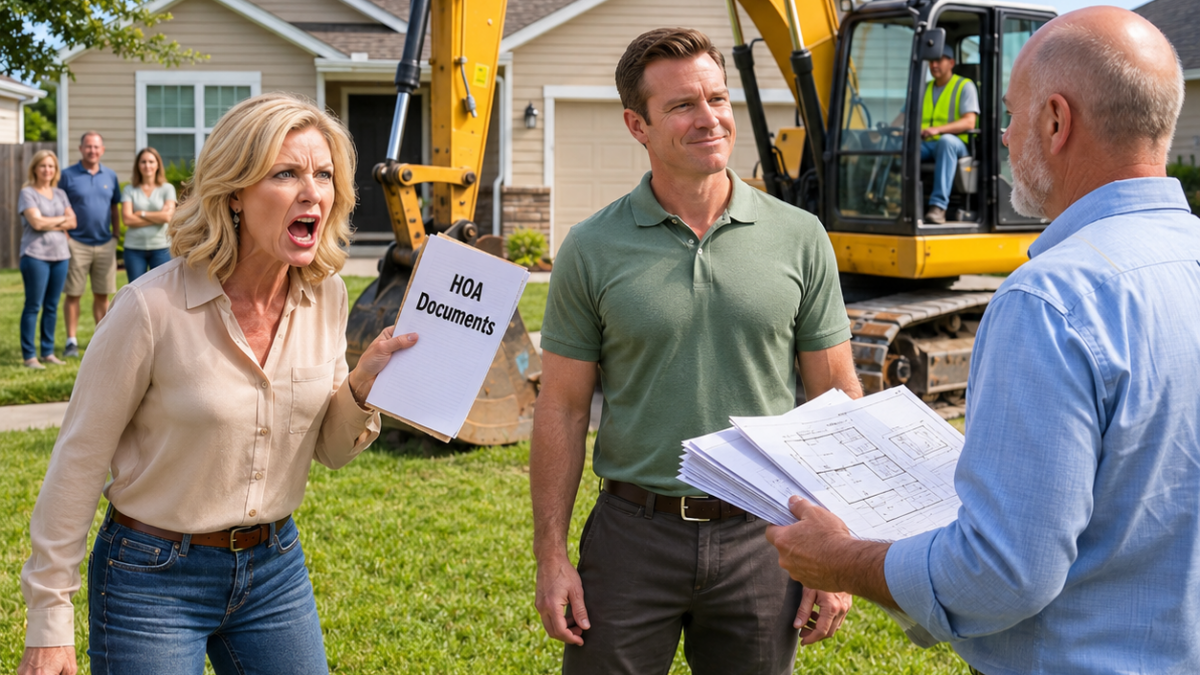
Susan did not faint.
She did not lose her wig.
She did not turn eight different colors.
Real people almost never perform as well as the internet wants them to.
She simply stared at the map.
Then at me.
Then back at the map.
Her wooden spoon remained on the folding table where she had dropped it.
For years, Crestview had used that ridiculous spoon as an unofficial meeting gavel because Susan had brought it to a neighborhood barbecue once and decided it was “more memorable than Roberts Rules.”
Nobody had challenged her.
That was beginning to feel like the theme.
“This is wrong,” she said.
Marcus Gallagher stood beside me.
He had attended because I knew exactly what would happen if I came alone.
Susan would call my survey fake.
So I brought the man who signed it.
Marcus was fifty-nine, bald, deeply suspicious of decorative fences, and incapable of enjoying a dramatic reveal unless all monuments had first been tied into a coordinate system.
He said:
“The survey is correct to the best of my professional opinion.”
Susan pointed toward him.
“Who hired you?”
“Mr. Pendleton.”
“So you work for him.”
“I was retained by him.”
“Exactly.”
Marcus looked at me.
That look meant:
I warned you this meeting would be stupid.
Retired Judge Thomas Bradley kept studying the drawing.
Thomas lived three houses down from Susan.
He had served on the county bench for twenty-one years before retiring.
That did not make him the final authority on a property line.
He knew that better than anyone.
He said:
“This is a survey, Susan.”
“It is not a judgment.”
“But if the deed descriptions and monuments support it, we have a serious issue.”
Susan snatched up the Crestview plat.
“Our recorded subdivision map shows my lot.”
“Yes,” Marcus said.
“It does.”
“Then you admit it.”
“No.”
He pointed.
“This line here is the lot line shown on the final recorded plat.”
Then another line.
“This heavier line appears on several later landscaping and fencing drawings.”
“That is the line people have been occupying.”
“They are not the same line.”
Susan stared.
Marcus continued.
“Your house itself was originally built within the platted lot.”
That got my attention.
Because the source version of this story made it sound as though Susan’s entire home had been built on Uncle Richard’s property since the 1990s.
That would have created a much harder legal problem.
The truth was stranger.
And more manageable.
The original Higgins house sat correctly.
Barely.
The eastern foundation wall was several feet inside Crestview’s recorded boundary.
But when Susan and her husband bought the house five years earlier, they remodeled.
New driveway edge.
Expanded rear patio.
Large gazebo.
Herb garden.
And an enclosed sunroom addition wrapping around the southeast corner.
Whoever prepared that addition site plan used the occupation fence and old landscaping line instead of the deed boundary.
The result?
The sunroom crossed the actual line by as much as eight feet at one corner.
Her gazebo was mostly on my parcel.
So was the stone herb garden.
Part of the driveway flare.
And the strip she had recently declared an HOA greenbelt.
She had not lived entirely on my property.
But she had spent five years drinking coffee, hosting committee meetings, and lecturing neighbors from a sunroom partly built across Uncle Richard’s deed line.
The title remained emotionally accurate enough for me.
Legally, the distinction mattered.
Susan did not appreciate nuance.
“You expect me to believe the county issued a permit for my addition on somebody else’s land?”
Marcus answered:
“Building permits are not title insurance.”
“The county reviews the plans submitted.”
“It does not guarantee your surveyor located every private boundary correctly.”
“I had a survey.”
“Do you have it?”
Susan looked toward David Vance.
David was Crestview’s secretary and had spent most of the previous six months laughing at Susan’s jokes approximately half a second too late.
He now looked deeply interested in the floor.
Susan said:
“My contractor handled it.”
Marcus nodded.
“Then your contractor may have relied on an existing fence.”
“Which is one reason fences should not automatically be treated as title boundaries.”
Susan pushed the survey away.
“This is harassment.”
I almost laughed.
Instead:
“No.”
“You called this meeting to force my property into your HOA.”
“I came because you put my name on the agenda.”
“You arrived with an ambush.”
“I arrived with a survey.”
“Same thing.”
Thomas Bradley said quietly:
“No, Susan.”
The room settled.
He continued.
“This is exactly what a boundary survey is for.”
Susan looked at him.
“You’re supposed to be on this board.”
“I am.”
“Then act like it.”
“I am.”
That sentence changed the room.
Not because Thomas was choosing me.
He wasn’t.
He was choosing process.
Susan had grown accustomed to treating disagreement as disloyalty.
Thomas did not.
He handed the survey back to Marcus.
“What does Arthur want?”
Good question.
Everyone looked at me.
The source version has me sliding a five-year back-rent invoice across the table.
One hundred twenty thousand dollars.
Then demanding Susan choose between buying the land, leasing it under humiliating conditions, or going to court.
That would have felt good.
It also would have been legally reckless.
My attorney, Sarah Brooks, had spent forty-five minutes the previous afternoon preventing me from doing exactly that.
Sarah practiced real-estate and land-use law from an office above a pharmacy downtown.
She was forty-six, wore running shoes with business suits whenever she thought nobody important would notice, and had an irritating tendency to answer my hypothetical revenge plans with:
“Do you want the version that survives?”
Her advice before the meeting:
Do not demand rent.
Do not call Susan a trespasser as though ownership has already been adjudicated.
Do not threaten to evict her from a room attached to her house.
Do not claim you automatically own the sunroom.
Do not say “fraud.”
Do not negotiate in front of seventy angry homeowners.
State the facts.
Then stop.
So I said:
“I want Crestview to stop asserting jurisdiction over my ten-acre parcel.”
“I want Susan and the HOA to stop entering or maintaining any portion of my property without permission.”
“And I want the boundary issue handled through counsel, surveyors, title companies, and whatever legal process is necessary.”
Susan folded her arms.
“That’s it?”
“For tonight.”
Her expression sharpened.
“What does that mean?”
“It means my lawyer will contact yours.”
“You’re threatening me.”
“No.”
“That is literally a threat.”
Thomas Bradley sighed.
“A lawyer contacting another lawyer is not usually considered a threat.”
Someone in the back laughed.
Susan whipped around.
“Who said that?”
Nobody volunteered.
Good.
The meeting ended badly.
But not explosively.
The board refused Susan’s motion to begin legal enforcement against me.
Three directors voted no.
Susan voted yes.
David Vance abstained.
That was the first time anyone on that board had publicly denied her something substantial.
She took it personally.
The next morning, Sarah Brooks sent four letters.
One to Susan.
One to Crestview’s board.
One to Crestview’s management company.
One to its attorney.
The letters did not declare victory.
They did something better.
They created a freeze.
No further HOA enforcement against my parcel pending confirmation of jurisdiction.
No entry onto the disputed strip.
No alteration of fences, landscaping, markers, or structures.
Preserve all records relating to:
My property.
The greenbelt designation.
Susan’s addition.
The 1993 subdivision fence.
Any survey used for her construction.
Any board claim that my parcel belonged to Crestview.
And:
Please identify any recorded declaration, annexation, easement, covenant, or other instrument establishing HOA authority over the Pendleton parcel.
There was none.
That part was easy.
The harder part was Susan’s side of the boundary.
Sarah called me after Crestview’s attorney responded.
“Good news.”
“I like good news.”
“The HOA has no credible argument that your ten acres are subject to its declaration.”
“I knew that.”
“Do you want the good news or applause?”
“Continue.”
“Bad news.”
“I knew there was bad news.”
“Susan’s encroachment is not as simple as your survey makes it feel.”
I sat down.
“Why?”
“Because land law enjoys punishing confidence.”
She explained.
Susan had occupied the strip for five years.
But the fence line had existed much longer.
Some landscaping on that strip dated to the original development.
Previous Crestview owners had used portions.
Could Susan claim adverse possession?
Maybe.
Could she tack earlier possession from previous owners?
Potentially, depending on the facts and jurisdiction.
Was the occupation hostile?
That was unclear.
Because Uncle Richard had signed something in 1993.
The temporary landscaping license.
I knew about it.
But I had not understood its importance.
The developer wanted a landscaped buffer along the subdivision’s eastern edge.
Richard did not care.
He granted written permission to plant shrubs, install a decorative split-rail fence, and maintain a narrow strip along his boundary.
The agreement said:
Permission is revocable and shall not constitute conveyance, easement, dedication, or acknowledgment of ownership.
Sarah said:
“That sentence may be the reason you’re not staring at a serious adverse-possession problem.”
“Because they had permission.”
“For the landscaping and fence occupation described, yes.”
“Permissive use generally is not hostile possession.”
“So Susan has nothing.”
“Stop.”
“What?”
“We have not analyzed every year.”
“The license was with the original developer.”
“Later maintenance may or may not have remained permissive.”
“Ownership changed.”
“Facts matter.”
“And the sunroom was built much later.”
“But she only built it five years ago.”
“Which is likely short of the limitations period for an adverse-possession claim by itself.”
“Likely?”
“Arthur.”
“Fine.”
“Likely.”
Then she said:
“There is another problem.”
“What?”
“Good-faith improvement.”
I stared.
“She built on my land.”
“Yes.”
“Why is that my problem?”
“Because courts sometimes have equitable tools when someone improves land under a genuine boundary mistake.”
“Especially when removing part of a house would cause enormous hardship compared with the land value.”
“So the court can give her my land.”
“Not casually.”
“But a forced conveyance, equitable easement, compensation, reformation, or negotiated boundary adjustment can become possible depending on state law and facts.”
I hated every word.
Sarah continued.
“This is why you are not going to the hardware store for a saw.”
“I wasn’t.”
“You were thinking something.”
“I’m a civil engineer.”
“That is not reassuring.”
I hung up feeling less victorious.
Which, Sarah would later tell me, was exactly where she wanted me.
Confidence is useful.
Certainty is expensive.
Over the next three weeks, both sides reconstructed the history.
Marcus returned.
So did Susan’s surveyor.
His name was Glenn Parker.
Not related to the original developer.
He was embarrassed.
Not dishonest.
The site plan for Susan’s sunroom addition had been prepared from a boundary survey ordered during her home purchase.
That survey correctly showed the platted line.
So how did the addition cross it?
A contractor later prepared a revised placement sketch.
He used the fence line as the practical setback reference.
The building department approved construction dimensions from the house.
Nobody reconciled the revised site sketch with the boundary survey.
The contractor’s project manager had retired.
The company still existed.
Its insurer became very interested.
Susan’s title insurance company became less interested.
Why?
Because title insurance covered title conditions existing when she purchased.
The sunroom encroachment was created afterward by her own construction project.
The old landscaping strip was a different issue.
Her homeowner’s policy had questions.
The contractor’s general liability insurer had questions.
Everyone suddenly liked documents.
Uncle Richard’s old files became more important.
He had not been secretly waiting to destroy Crestview.
No note saying:
Let them think what they want until they become a problem.
That was too perfect.
What he did have was better.
A 1998 letter to the HOA’s first landscaping chair.
You may continue mowing the strip east of your fence this season as we discussed. This is permission for convenience only and should not be treated as a boundary agreement. Please stay clear of the survey pin near the maple. — Richard Pendleton
Another from 2007.
Okay to replace three shrubs along fence. No permanent structures.
Then 2015.
A short email to Susan herself.
That shocked me.
She had been landscape committee chair before buying her current house.
Richard wrote:
Susan, fine to have your landscaper trim the brush along the old fence. The fence is not the deed line. Please remind the crew not to move markers.
I read it twice.
Then called Sarah.
“She knew.”
“Maybe.”
“She received an email saying the fence isn’t the deed line.”
“Yes.”
“She knew.”
“She knew Uncle Richard claimed the fence wasn’t the deed line.”
“That matters.”
“It does.”
“Does that destroy good-faith mistake?”
“Potentially.”
“But remember: she may not have connected the email to the boundary of the house she bought later.”
“How do you forget that?”
“Humans are talented.”
Susan’s lawyer produced her answer.
She said the 2015 email concerned general brush maintenance along Crestview’s eastern fence farther north.
She did not understand it to refer to the corner lot she later purchased.
Possible.
Marcus overlaid the landscaping maps.
The strip was continuous.
Still.
Not a clean smoking gun.
Property cases are disappointing that way.
Then came the issue that mattered most to me.
The greenbelt mowing.
Susan had walked onto my land after I expressly told her to stop.
That happened during my ownership.
No historic ambiguity.
No old license.
I had sent written notice.
She came back anyway and mowed.
Then called it HOA property.
That was ordinary trespass territory.
Not criminal fraud.
Not enough to take her house.
But useful evidence showing that once I asserted the correct line, she chose not to respect it.
Crestview’s management company reviewed my alleged fines.
There were fifteen notices.
Total “accrued penalties” on Susan’s spreadsheet:
$7,850.
Not eighteen thousand.
More importantly, the management company had never posted any of them to a legitimate owner account.
Why?
I did not have one.
I was not a Crestview member.
Susan had been sending notices directly from a template she created.
The property manager, Elise Morgan, later said:
“I repeatedly told Susan we could not assess a nonmember parcel through our system.”
Susan apparently believed management was being timid.
One email:
Whether Pendleton is formally annexed is less important than whether his property materially affects Crestview standards. We cannot allow jurisdictional technicalities to undermine the community.
Sarah read that and said:
“Jurisdictional technicalities are commonly called jurisdiction.”
I loved her a little for that.
The HOA’s attorney, Mark Feldman, was less amused.
He had never approved Susan’s “visual corridor” theory.
In fact, he had warned the board.
Crestview’s declaration applied to platted lots specifically described in the recorded instrument plus property later annexed according to an amendment procedure.
My parcel appeared nowhere.
Susan’s so-called Article 4, Section C?
It existed only in a “Community Standards Handbook” she had helped revise.
The language read:
Owners should consider visible impacts on adjoining Crestview homes when maintaining boundary-facing property.
Advisory.
For Crestview owners.
Susan had transformed that into:
Any property visible from Crestview falls under HOA authority.
Sarah called it “an impressive grammatical invasion.”
The board did not laugh when Mark showed them the difference.
That was when the wider review began.
Not because my boundary automatically proved Susan had done everything wrong.
Because the board discovered she had been creating formal-looking notices outside management’s normal process.
Treasurer Ellen McCarthy requested an enforcement audit.
Susan objected.
“We’re letting Arthur derail the association.”
Ellen answered:
“No.”
“We’re checking whether our president has been issuing fines outside the association’s system.”
That distinction mattered.
The audit covered the previous eighteen months.
Crestview had forty-seven homes.
Not some thousand-unit empire.
There were 116 enforcement notices.
Most came through management.
Valid.
Trash cans.
Parking.
Unapproved fence stain.
Dead tree.
Short-term rental.
Routine.
Twenty-seven came directly from Susan.
Of those:
Ten were informal warnings that should not have been labeled violations.
Seven cited standards not yet formally adopted.
Four had fine amounts different from the published schedule.
Three involved issues the declaration did not regulate.
Three were legitimate violations but lacked proper hearing notice.
No fabricated photographs.
No forged ballots.
No embezzlement.
No crime spree.
Just a president who kept treating procedure as optional when she felt the answer was obvious.
The board reversed or reprocessed affected cases.
Refunds and credits totaled about $9,600.
Some homeowners received money back.
Others simply had fines removed.
Valid underlying issues remained where appropriate.
One homeowner’s unapproved shed still needed review.
A dangerous dead tree still had to come down.
Good governance did not mean every person Susan had annoyed suddenly became innocent.
That was important.
Meanwhile, my boundary dispute moved toward mediation.
I had filed a quiet-title and declaratory action after negotiations stalled.
Not because I wanted Susan homeless.
Because the line needed a durable legal answer.
The lawsuit named:
Susan and Paul Higgins.
Their lender.
Any title interest necessary.
Not the entire HOA as owner of her house.
Crestview participated separately because its landscaping and fence occupied the strip.
Sarah warned me:
“We are asking the court to establish the line and determine remedies.”
“We are not asking a judge to hand you Susan’s sunroom keys.”
“I know.”
“You say that now.”
“I knew before.”
“No.”
Fair.
The first site conference included both surveyors.
Sarah.
Susan’s attorney, Michael Tran.
The contractor’s insurance representative.
A title-company lawyer.
And Judge Thomas Bradley.
Not as judge.
As neighbor and board liaison.
He mostly kept quiet.
Marcus set stakes.
Thirty-foot strip.
At Susan’s lot, the deed line ran through:
A landscaped bed.
The edge of the driveway flare.
Her herb garden.
The gazebo.
And under the outer portion of the sunroom.
Susan stood on the patio.
No blazer.
No wooden spoon.
Just jeans.
She looked smaller without the meeting room.
I felt something I hadn’t expected.
Pity.
Not enough to surrender the land.
Enough to stop enjoying the geometry.
This was her home.
Not a game piece.
She had bought it believing the fence made sense.
Then built an addition under a flawed construction layout.
That did not make my title disappear.
It did make bulldozer fantasies obscene.
Michael Tran asked:
“Arthur, what do you actually need?”
I said:
“The line acknowledged.”
“Crestview off my property.”
“No HOA jurisdiction.”
“My uncle’s strip restored where practical.”
“And the sunroom?”
I looked at it.
Sarah answered for me.
“We are open to a negotiated lot-line adjustment around the residence if compensation, title work, access, and restoration can be resolved.”
Susan’s head snapped toward us.
“You’d sell?”
“Some of it,” I said.
Not the entire thirty-foot strip.
Why?
The strip connected to a narrow drainage swale and tree buffer along my eastern boundary.
Selling the full length would create future access and setback problems.
But the small area occupied by her house addition?
Different.
I had no desire to own eight feet under someone else’s breakfast room.
That is the thing revenge stories leave out.
Winning land you cannot meaningfully use can become another burden.
The appraiser valued the required lot-line adjustment.
Not $97,000.
About $34,500 for the portion needed to regularize the sunroom and driveway, considering area, utility, and impact.
The gazebo was separate.
It extended farther.
Susan wanted to buy that land too.
I said no.
Why?
Because the gazebo sat where I wanted the tree buffer restored.
She could move it.
It was not part of her house.
It had been built from modular cedar sections.
Expensive but movable.
The herb garden could move too.
Susan hated that.
“I use that gazebo for meetings.”
Thomas Bradley, who had listened quietly, said:
“That is probably not the strongest argument available today.”
Even Susan almost smiled.
Negotiation stalled over the gazebo for two weeks.
Then her contractor’s insurer stepped in.
Removing and rebuilding it several feet west cost less than prolonging litigation.
They agreed to cover most.
The sunroom was harder.
The contractor denied full liability because Susan had approved the revised site plan.
Susan said she relied on them.
The insurer said both contributed.
Eventually money came from several directions.
Contractor.
Susan.
A smaller contribution from the surveyor’s professional-liability carrier.
No dramatic check.
Settlement structure.
Then the HOA strip.
Crestview wanted to keep its decorative fence in the old location.
I said no.
Why?
Because that was how this problem survived thirty years.
The fence looked like a boundary.
People treated it like one.
If we were fixing the record, we were fixing the visual cue.
Marcus and Crestview’s surveyor designed a new alignment.
Fence moved to the true subdivision line where practical.
At Susan’s adjusted lot area, the new deed line curved around the sunroom parcel.
Permanent monuments set.
Recorded lot-line adjustment.
Revised plat reference.
No folklore.
The greenbelt disappeared from HOA maps.
Crestview received a revocable landscaping license for one narrow section where moving mature trees would have caused unnecessary damage.
The license explicitly said:
No ownership.
No adverse claim.
No expansion.
Either party could terminate upon notice subject to restoration.
I had learned from Uncle Richard.
Permission should survive as permission.
Not mutate into title through memory.
The quiet-title settlement took four months.
The final agreement was thirty-eight pages.
My uncle’s old landscaping license was one page.
Sarah said:
“That is the evolution of trust.”
“What?”
“Page one: people think everyone will remember.”
“Page thirty-eight: nobody assumes anything.”
She wasn’t wrong.
My parcel remained outside Crestview.
Explicitly.
The HOA agreed in the recorded settlement that:
No declaration.
Bylaw.
Rule.
Architectural standard.
Fine schedule.
Board policy.
Or “visual corridor” guideline applied to my ten-acre parcel absent a future voluntary annexation executed by me or my successors according to law.
I insisted on that language.
Not because I thought Susan would return.
Because future boards forget.
Records don’t have to.
The $7,850 in fake fines?
Formally withdrawn.
Crestview issued a letter stating they had never become enforceable assessments against my parcel.
No lien.
No debt.
No owner account.
Good.
Susan and Paul purchased the exact lot-line adjustment under the sunroom and driveway for the appraised amount plus transaction costs.
Not rent.
Not punishment.
Purchase.
They received clean title to the strip they actually needed.
I received money.
More importantly, the line became rational.
The gazebo moved.
The herb garden moved.
The HOA fence moved.
Crestview restored my side with native grasses and trees.
The lawn strip Susan had mowed became part of my woodland edge again.
No humiliating sign.
No “NO HOA ACTIVITY” banner.
Sarah Brooks would have resigned as my lawyer if I demanded one.
The settlement also required each side to stop entering the other’s property except by permission or emergency.
Normal.
That should not need thirty-eight pages.
It did.
The lawsuit dismissed after recording.
No judge yelling about arrogance.
No criminal referral.
No fraud charge.
Why?
Because Susan’s fake fines against me had never actually been collected.
She was wrong.
Persistent.
Overreaching.
But wrong HOA enforcement does not automatically become criminal fraud.
Sarah said:
“Do not ask the criminal system to solve every civil abuse of authority.”
That line stayed with me.
The HOA consequences were separate.
The independent enforcement review went to the board.
Susan’s useful work appeared in it too.
She had renegotiated trash service.
Improved reserve contributions.
Organized storm cleanup.
Got the county to repair a dangerous shoulder near the subdivision entrance.
Created a volunteer program checking on older residents during heat waves.
Crestview was financially healthier than before her presidency.
That was why residents tolerated the other behavior.
One owner told me:
“Susan answers her phone.”
That sounds small.
It isn’t.
People forgive a lot from someone who responds.
The report’s conclusion was not:
Susan is evil.
It was:
Too much enforcement authority had become concentrated in the president outside management’s documented process.
The board removed Susan as president.
Four to one.
She voted no.
She remained a director until member recall.
The meeting was uncomfortable.
I attended only because my property had started the review.
Susan spoke.
“I did what the board asked me to do.”
Thomas Bradley said:
“We asked you to improve enforcement consistency.”
“Yes.”
“We did not ask you to create rules.”
“I interpreted existing authority.”
“That is the issue.”
Susan looked at him.
“You all liked the results.”
Silence.
Because she was right.
They had.
Thomas answered:
“We liked not having to do the work.”
That was better.
He continued.
“That’s on us.”
Susan’s face changed.
Not absolved.
Seen.
That mattered.
The recall vote happened six weeks later.
56 percent remove.
44 percent retain.
Close.
Closer than people expected.
Susan had supporters.
One homeowner said:
“I disagree with what she did to Arthur, but she got this neighborhood under control.”
Another:
“She made the board function.”
Another:
“She fined me unfairly twice.”
Democracy is messy when people are real.
Susan lost the director seat.
Thomas served as interim president until the next election.
Then refused to run.
“I spent twenty-one years wearing a robe,” he told me.
“I am not spending retirement debating mailbox stain.”
Crestview elected Lisa Nguyen.
Her first major reform was boring.
Every enforcement notice had to come through management.
Directors could report violations.
They could not independently issue fines.
Each notice had:
Exact rule.
Evidence.
Date.
Cure opportunity where applicable.
Hearing rights.
Fine schedule.
No rule citation?
No monetary fine.
The handbook shrank.
Not from a phone book to fifteen pages overnight.
They kept legitimate rules.
Removed duplicated commentary.
Separated covenants from guidelines.
Marked advisory language as advisory.
Lisa created a one-page chart:
WHO HAS AUTHORITY TO DO WHAT
Board.
Management.
Architectural committee.
Homeowners.
Common property.
Private lots.
Neighboring non-HOA parcels.
Under that last category:
NO HOA JURISDICTION ABSENT AGREEMENT OR APPLICABLE LAW.
I asked for a copy.
Framed it?
No.
I was tempted.
Instead I put it in my property file.
Growth.
Susan remained my neighbor.
That is another thing revenge stories dislike.
She did not disappear.
Her house still stood.
Most of it always had been hers.
Now all of it legally sat inside her adjusted boundary.
The sunroom remained.
Gazebo moved.
For months, we did not speak.
Then one Saturday I saw a landscaping truck stop near my east line.
Old reflex.
I walked over.
The foreman showed me the work order before I asked.
“Mrs. Higgins wants these shrubs trimmed.”
“All work stays west of these monuments.”
He pointed.
“She gave us the survey.”
That surprised me.
Susan had marked the line in red.
No trespass.
No mowing.
No interpretation.
Just:
DO NOT CROSS.
I stood there.
The foreman asked:
“Problem?”
“No.”
That was the first sign she had learned something.
The second came at the annual meeting.
Lisa proposed a volunteer cleanup day along the subdivision entrance.
Someone suggested trimming brush along my roadside edge “while we’re already there.”
Susan raised her hand.
“No.”
Everyone looked at her.
She said:
“That belongs to Arthur.”
Lisa nodded.
“Correct.”
Another resident said:
“It looks messy.”
Susan answered:
“Then ask him.”
I heard about that from Thomas.
He called.
“You should be proud.”
“Why?”
“Susan defended your weeds.”
“Native prairie vegetation.”
“Whatever helps you sleep.”
The first time Susan and I spoke again was almost a year after settlement.
I was replacing one of Uncle Richard’s bluebird houses.
Yes.
The same birdhouses Susan had initially called nonconforming.
No HOA approval required.
She walked along her driveway.
Stopped at the line.
Actually stopped.
That mattered.
“Arthur.”
“Susan.”
She pointed toward the birdhouse.
“Still ugly.”
“It’s cedar.”
“It’s crooked.”
“Bluebirds don’t use levels.”
She almost smiled.
Then:
“Can we talk?”
I climbed down.
She stayed on her side of the monument.
I stayed on mine.
Ridiculous.
Appropriate.
“I owe you an apology.”
I waited.
“For the HOA notices.”
“The mowing.”
“The visual corridor nonsense.”
I raised an eyebrow.
She sighed.
“Yes.”
“Nonsense.”
“You knew it was nonsense?”
“Not at first.”
That interested me.
“What did you think it meant?”
Susan looked embarrassed.
“When we revised the handbook, counsel said owners should consider visual impact on adjacent homes.”
“I thought that meant we could address conditions outside Crestview if they affected property values.”
“Why?”
“Because otherwise what was the point?”
I laughed.
She did not.
Then I realized she was serious.
“The point was to tell your owners how their own lots affect neighboring views.”
“I know.”
“Now.”
“Yes.”
That phrase had become popular in my life.
Susan continued.
“I kept reading our documents as if they were designed to solve every problem the neighborhood might have.”
“They aren’t.”
“I know.”
“There are county codes.”
“Nuisance law.”
“Neighbor agreements.”
“Buying land.”
“Calling someone.”
“Sometimes the answer is that you don’t control it.”
She nodded.
“That last one was difficult.”
I believed her.
Then she said:
“You enjoyed the meeting.”
I smiled.
“The survey meeting?”
“Yes.”
“A little.”
“A lot.”
“Maybe.”
“You waited.”
“I did.”
“Why didn’t you tell me earlier?”
That question bothered me.
Because there was a truthful answer I didn’t especially like.
“I wanted you to be wrong in public.”
Susan looked at me.
I continued.
“You’d been sending notices.”
“Mowing my land.”
“Calling my property a problem.”
“When Marcus found the line, I could have had Sarah send you the survey privately before the meeting.”
“I didn’t.”
“You wanted the room.”
“Yes.”
She nodded.
“I would have done the same thing.”
“I know.”
That was not comforting.
I said:
“I’m not proud of that part.”
Susan smiled faintly.
“Good.”
Then:
“I’m sorry about Uncle Richard’s strip.”
“Thank you.”
“I honestly thought the fence was the line when I bought.”
“I believe that.”
“The addition…”
She looked toward her sunroom.
“I should have hired my own surveyor before construction.”
“Yes.”
“The contractor told me the fence was close enough.”
“That sentence probably paid several lawyers’ mortgages.”
She laughed.
Then became serious.
“The weird thing is, after everything, I like the new line better.”
“What?”
“My herb garden gets more sun where we moved it.”
I stared.
“Of course.”
“And the gazebo has a better view.”
“Leave.”
She laughed.
No friendship.
But normal.
That was enough.
Uncle Richard’s old note became important to me for a different reason.
In the source story, he supposedly wrote:
Let them think what they want until they become a problem.
Funny.
Also not what he did.
His real habit was quieter.
He documented permission.
One sentence.
Two sentences.
Dates.
He understood something I had missed.
Being neighborly does not require being vague.
When a neighbor wanted temporary access across his lane, he wrote it down.
When Crestview wanted to trim brush, he wrote it down.
When the developer planted shrubs, he wrote:
Permission.
Not boundary.
Not ownership.
That paperwork saved me decades later.
I started doing the same.
Neighbor wants to stack firewood on my edge for two months?
Email.
County crew needs temporary access for drainage survey?
Letter.
Crestview asks to enter and prune a tree leaning toward their fence?
Written permission.
Not because I distrusted everyone.
Because people leave.
Memories leave faster.
Paper remains.
Three years after the settlement, Susan sold her house.
Not because of me.
Her husband Paul wanted to move closer to their daughter outside Nashville.
The sale created one final boundary moment.
The buyer’s surveyor came.
Found the new monuments.
Reviewed the recorded lot-line adjustment.
No confusion.
The buyer knew:
Here is Crestview.
Here is Pendleton.
Here is the sunroom parcel acquired in the settlement.
No old fence mythology.
Clean.
Susan called me two days before closing.
“Arthur.”
“Yes?”
“I’m moving.”
“I heard.”
“Lisa told you?”
“Thomas.”
“Of course.”
Pause.
Then:
“Do you want the gazebo?”
I stared through my kitchen window.
The gazebo she had moved west after the settlement.
“No.”
“Why would I want your gazebo?”
“You fought pretty hard about where it sat.”
“I fought about whose dirt it sat on.”
“Different.”
“Yes.”
She laughed.
Then:
“I have something else.”
She came over.
Stopped at the line again even though by then she did not need the ritual.
She handed me a small wooden object.
The spoon.
Her meeting gavel.
I burst out laughing.
“What am I supposed to do with this?”
“Burn it.”
“Keep it.”
“Give it to Thomas.”
“Anything.”
“Why?”
She looked toward Crestview.
“Because I don’t want to bring it to Tennessee and become president of anything.”
I held the spoon.
“Personal growth.”
“Do not make this worse.”
I gave it to Thomas Bradley.
He mounted it in his garage above a small plaque:
SUBJECT TO JURISDICTION
Susan hated that when he sent her the photograph.
I loved it.
That was the kind of revenge I could live with.
Harmless.
Years passed.
Crestview changed.
New residents.
New board.
Susan’s name slowly stopped appearing in stories.
That was healthy.
My ten acres stayed outside.
The native grass grew.
Deer continued violating community aesthetic standards without remorse.
The birdhouses stayed crooked.
I added two more solar panels.
Nobody fined me.
Lisa once called because one panel reflected sunlight into a Crestview bedroom for approximately twenty minutes during late-summer evenings.
My first instinct was:
Not my HOA.
Then I stopped.
Different question.
Not jurisdiction.
Neighbor impact.
I walked over.
Confirmed the glare.
Adjusted the panel angle four degrees.
Problem solved.
Sarah Brooks heard.
“You compromised.”
“I corrected a nuisance.”
“You’re becoming civilized.”
“Don’t spread it around.”
That mattered.
Being outside the HOA did not mean I owed neighbors nothing.
It meant their legitimate concerns had to be addressed through the right channel.
Neighbor conversation.
County law.
Nuisance principles.
Agreement.
Not invented dues.
Authority matters.
So does responsibility.
The next major property issue came when Crestview wanted to replace its east fence.
Lisa called before hiring anyone.
“We have the new recorded survey.”
“Yes.”
“Can our surveyor meet Marcus on-site?”
“Yes.”
“Can we stage materials on your side for three days?”
“How much?”
“About six feet.”
“Send me a plan.”
She did.
I granted temporary access.
No payment.
Why?
It helped them install the fence correctly.
Some people who heard the old story thought I was crazy.
“After what they did?”
It wasn’t they.
Susan was gone.
The board had changed.
The process was correct.
Holding a grudge against an institution after it reforms can become its own kind of irrationality.
I learned that slowly.
Marcus eventually retired.
At his retirement barbecue, he gave me a framed survey pin.
Not the actual monument.
A spare brass cap.
Engraved:
VISUAL CORRIDOR
I laughed.
“You’re a terrible person.”
“You paid me.”
“Too much.”
“Worth every penny.”
He asked whether I remembered the moment we found the discrepancy.
“Of course.”
“You looked happy.”
“I was.”
“Then worried.”
“When you said house.”
“Yes.”
“I thought you’d celebrate.”
“I was thinking about litigation.”
“That’s why you were always the better civil engineer.”
I took that as a compliment.
Arthur Pendleton, destroyer of HOAs?
No.
Civil engineer.
I liked lines because they solved uncertainty.
The funny part is that the boundary case taught me lines do not always solve things by themselves.
A line can tell you:
This side is mine.
That side is yours.
But then someone’s sunroom crosses it.
Someone planted thirty-year-old trees on it.
A fence sits in the wrong place.
A license exists.
Equity appears.
Insurance appears.
History appears.
People appear.
That is when law stops being geometry.
The quiet-title case taught me more about property than three decades of development work.
Because engineers like clean answers.
Courts manage human mess.
Sarah Brooks reminded me of that years later when we updated my estate plan.
“You still think your survey was the victory?”
“Yes.”
“No.”
“What was?”
“The settlement.”
“That sounds like lawyer propaganda.”
“The survey told you where the problem was.”
“The settlement made the answer usable.”
I hated when she was right.
My estate plan became obsessive.
Not because I expected another Susan.
Because I had seen how inherited ambiguity grows.
Deed.
Survey.
Recorded settlement.
Crestview boundary acknowledgment.
Temporary licenses.
Solar access.
Drainage map.
Utility easement.
Everything indexed.
My niece Anna would inherit the ten acres.
She lived in Oregon and had no idea what “the Susan strip” meant.
Good.
She shouldn’t need folklore.
I walked the boundary with her one Thanksgiving.
She stared at a brass monument.
“This caused all that?”
“No.”
“A fence in the wrong place caused some of it.”
“A president with confidence caused some.”
“A contractor using the wrong reference line caused some.”
“A board not checking authority caused some.”
“Uncle Richard’s paperwork prevented more.”
Anna nodded.
“So what do I need to know?”
I pointed.
“That is the line.”
Then handed her the file.
“And this explains why.”
Simple.
The old greenbelt strip became my favorite part of the property.
Not because I turned it into something dramatic.
I planted native wildflowers.
Little bluestem.
A few serviceberries.
Milkweed.
No sign.
No fence saying:
SUSAN WAS WRONG HERE.
The land didn’t need to perform the argument forever.
The first summer after planting, Lisa emailed.
What seed mix did you use? The board likes it.
I sent the supplier.
Crestview planted similar natives near its stormwater basin.
That amused me.
Susan once fined me for a “nonconforming natural habitat.”
Five years later, the HOA copied it.
No revenge could improve on that.
Thomas Bradley died at eighty-two.
Heart failure.
His family held a small memorial.
The wooden spoon was displayed in his garage among tools and old courthouse memorabilia.
His son asked:
“What is this thing?”
I told him.
He laughed.
Then gave it back to me.
I finally did what Susan suggested.
Not burn it.
I put it in my kitchen utensil drawer.
For years it had represented fake authority.
Now it stirred chili.
That felt healthier.
One evening Anna opened the drawer.
“Why is this spoon engraved?”
“Long story.”
She read the little brass plate Thomas had screwed into the handle.
SUBJECT TO JURISDICTION
She stared.
“You people are weird.”
Correct.
Susan and I exchanged Christmas cards for a few years.
Not sentimental.
Her first:
Tennessee has no HOA. Paul insisted.
I wrote:
SMART MAN.
Next year:
Neighbor’s shed is purple. I am practicing restraint.
I answered:
CALL THE NATIONAL GUARD.
She replied with a laughing face.
Then fewer cards.
People drift.
That is normal.
The last I heard, she joined a library fundraising board.
I hope they gave her a written scope.
Crestview remained Crestview.
Still forty-seven beige houses.
Though less beige over time.
The board eventually expanded approved exterior colors.
Susan would have considered three of them dangerous.
One house became dark green.
Property values survived.
Another installed solar panels.
Survived.
Kids left basketball hoops out occasionally.
Usually fixed after reminders.
No civilization collapse.
The HOA still fined people.
Properly.
One owner ignored repeated notices about a collapsing dead tree over the sidewalk.
Fine valid.
Tree removed.
Another ran short-term rentals prohibited by the declaration.
Enforced.
Good.
Rules are not the enemy.
Unbounded interpretation is.
That distinction became important enough that Lisa asked me to speak at one board orientation.
I refused.
Then she said dinner was included.
I accepted.
My presentation lasted eight minutes.
Title:
YOUR DOCUMENTS DO NOT CONTROL LAND THEY DO NOT DESCRIBE
Slide one:
Crestview plat.
Slide two:
My parcel.
Slide three:
The old fence.
Slide four:
The new line.
Then:
“Before you send an enforcement letter, ask three questions.”
“Is this property subject to our authority?”
“Is there an actual rule?”
“Has the required process been followed?”
“If any answer is no, stop.”
One new director asked:
“What if the condition is genuinely harming the community?”
“Use the right tool.”
“County code.”
“Neighbor communication.”
“Civil counsel.”
“Buy an easement.”
“Negotiate.”
“Not every problem belongs to an HOA.”
That was it.
No Susan jokes.
Mostly.
Lisa later said:
“You’ve become reasonable.”
“I always was.”
She laughed for an inappropriate amount of time.
The title people still use for the story is:
HOA Karen Lived on My Land for 5 Years Then Demanded I Join Her HOA She Regretted It.
I understand why.
It compresses everything.
Susan had lived for five years with part of her sunroom crossing my deed line.
She demanded I submit to Crestview.
Then a survey reversed the perspective.
Poetic.
But the title leaves out the most important part.
Discovering somebody’s improvement on your land does not automatically make them your tenant.
It does not automatically create five years of rent.
It does not hand you their house.
It does not guarantee criminal fraud.
It creates a property problem.
Sometimes a very strong one.
Then the hard part begins.
History.
Possession.
Permission.
Improvements.
Equity.
Title insurance.
Contractor liability.
Surveys.
Recorded documents.
Negotiation.
My best leverage was not humiliating Susan.
It was having a clear deed, a credible retracement, Uncle Richard’s written permissions, proof that my parcel was never annexed into Crestview, and records showing Susan continued asserting control after receiving notice.
Her strongest argument was not:
HOA supremacy.
That was nonsense.
It was:
She had built part of a valuable home improvement across the line under a genuine or partly genuine mistake, and tearing it down would be wasteful compared with a narrow compensated boundary adjustment.
Both sides had something real.
That is why settlement worked.
Susan kept her sunroom.
I kept my property except the exact area I chose to convey.
The gazebo moved.
The fence moved.
The HOA left me alone.
She paid for land she actually needed.
I received restoration.
Everyone updated the record.
No one lost a house.
That is a better ending than a judge ordering bulldozers because someone deserved embarrassment.
The meeting reveal still felt good.
I won’t lie.
Watching Susan demand jurisdiction over me seconds before discovering her own sunroom crossed my line?
That was satisfying.
But satisfaction is a moment.
Property decisions outlive moments.
If I had used that moment to demand absurd rent, humiliation signs, or revenge conditions, I might have turned a strong case into a stupid one.
Sarah Brooks taught me that.
“Do you want the version that feels good or the version that survives?”
I still hear it.
The version that survives is usually less theatrical.
It is also the version future owners can understand.
Today the east boundary is boring.
That is the highest compliment I can give it.
Survey monuments.
Correct fence.
Recorded lot adjustment.
Native plants.
No one mowing the wrong side.
No one issuing fake fines.
No emergency meetings.
No wooden spoon.
Just two owners using their own land.
Exactly the way it should have been from the beginning.
And if Anna eventually sells my place, the buyer will get a title report showing exactly what they own.
If Crestview changes presidents, the next one will have a map showing exactly where the HOA stops.
If Susan’s old house sells again, its deed will include the small strip she bought through the settlement.
Nobody will need Uncle Richard’s memory.
Nobody will need my story.
Nobody will need to guess.
That is the part I am proudest of.
Not that I proved Susan wrong.
That we fixed the line well enough that someday nobody will remember there was ever a fight.
Because property disputes become dangerous when stories replace documents.
Susan had a story:
The fence is the boundary.
Crestview maintains this strip.
Arthur affects us.
Therefore Crestview controls him.
I had my own story for a while:
The deed says mine.
Therefore everything over the line is mine too.
Both stories were simpler than reality.
The documents forced us to become more accurate.
The survey gave us geometry.
The old licenses gave us history.
The settlement gave us a future.
That is how you end a boundary war.
Not by making the other person homeless.
By making the next argument unnecessary.