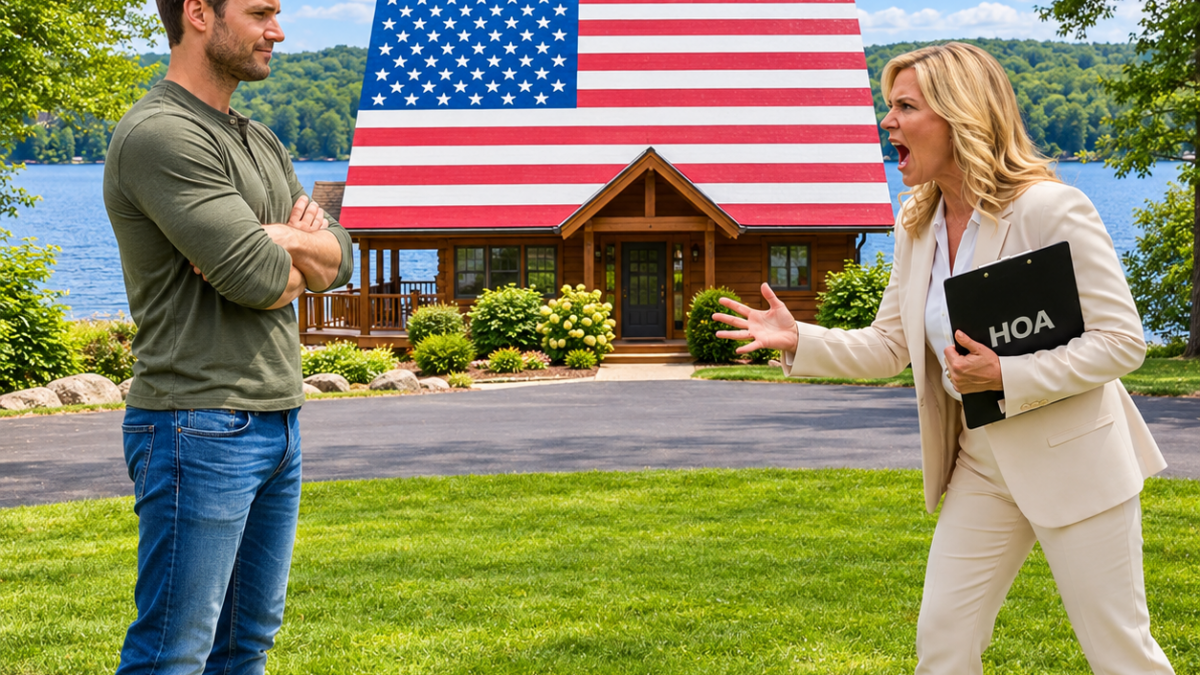
At 8:03 on a Saturday morning, my HOA president stood in the middle of the street staring at my house while three roofers pulled down the blue safety tarps and revealed a red, white, and blue roof big enough to make half the block come outside in pajamas. T
I called before I finished my coffee.
A woman answered on the second ring.
“ACLU of Virginia legal intake.”
“My name is Jack Miller. I got an email this morning.”
Pause.
“Flag roof?”
I closed my eyes.
“That sounds worse when somebody else says it.”
She laughed.
Not at me.
That helped.
“My name is Maya Chen. I reviewed the initial materials.”
“Are you a lawyer?”
“Yes.”
“Are you taking the case?”
“Slow down.”
There it was.
Lawyer voice.
Calm enough to make your adrenaline feel childish.
She asked whether Sarah was on the deed.
Yes.
Whether we had a mortgage.
Yes.
Whether any lien had actually been recorded yet.
No.
Whether the original flag was still down.
Yes.
Whether the roof was structurally inspected.
Yes.
Permit closed?
Final inspection scheduled for Tuesday.
Roofing contractor licensed and insured?
Yes.
Any evidence the HOA had approved other flags?
I hesitated.
“I’ve seen college flags.”
“Documented?”
“No.”
“Military banners?”
“Maybe.”
“Photographs?”
“No.”
“Okay. Don’t guess.”
That phrase became familiar.
Maya asked me to forward the appeal denial and the newest fine notice.
Then she said something I did not enjoy hearing.
“The federal flag law is not a magic wand.”
“I figured that out.”
“It generally protects an owner’s right to display the United States flag, but associations may impose reasonable time, place, and manner restrictions.”
“That’s what they said.”
“Correct.”
“So they’re right?”
“Not necessarily.”
I sat down.
“The question is whether their restriction was actually reasonable and consistently applied, and whether their governing documents support what they did.”
“And the roof?”
“The roof is a different issue.”
My stomach dropped.
“Different how?”
“A roof designed to resemble a flag is not automatically the same legal thing as displaying a flag on a pole.”
“So I spent fifteen thousand dollars on a legal theory that might not exist.”
“Did your roofer tell you he was a constitutional lawyer?”
“No.”
“Good.”
She let that settle.
Then:
“But that does not mean the HOA can invent fines either.”
I looked through the kitchen toward Sarah.
She was standing in the doorway listening.
“The escalating assessment caught our attention,” Maya continued. “Especially because you appealed the original flag citation, complied, then made a roof replacement that appears to satisfy the specific roofing provision.”
“They’re using a catch-all clause.”
“I saw.”
“And charging me per shingle.”
“I saw that too.”
“What did you think?”
Another pause.
“I thought somebody got creative.”
“Brenda.”
“I’m not assigning motives yet.”
Of course not.
Lawyers refused to enjoy the best parts.
Maya explained that the ACLU did not ordinarily become the neighborhood appeals department every time an HOA made somebody angry.
Private associations were not government agencies.
The First Amendment did not automatically apply to them the same way it applied to a city council or police department.
But private land-use rules could still raise civil-liberties concerns when they burdened expression, and state statutes, contracts, federal flag-display protections, and ordinary association law could all matter.
What interested them most was not whether my roof was tasteful.
Nobody seemed willing to defend that proposition.
It was whether the association had used vague rules and rapidly escalating financial penalties to punish protected or presumptively lawful expression without consistent standards.
“We’re interested enough to help you find counsel,” Maya said.
Not the dramatic cavalry charge I had imagined.
Still.
Help.
Real help.
She connected me with Simon Vance.
He was not, as the original internet version of this story would later claim, “the ACLU’s senior federal attack lawyer.”
There was no such title.
Simon was a Richmond civil-rights and property attorney who had handled several cases with civil-liberties organizations.
The ACLU affiliate agreed to consult on the flag-display issue and, if necessary, support the case.
Simon would represent us directly.
He called at 11:40.
First thing he said:
“I saw the roof.”
I waited.
“It is hideous.”
Sarah burst out laughing.
I liked him immediately.
“Thank you.”
“That was not praise.”
“I’ll take it.”
“Now tell me why you did it.”
“Because they made me take down the flag.”
“Wrong answer.”
I blinked.
“What?”
“If litigation starts and opposing counsel asks why you spent fifteen thousand dollars on that roof, ‘to annoy my HOA president’ is not your best testimony.”
“It’s true.”
“Then we deal with truth.”
He paused.
“Try again.”
I thought.
“Our roof needed replacement.”
“Yes.”
“I wanted something the roofing clause allowed.”
“Yes.”
“And I wanted to make a point about the original flag dispute.”
“Better.”
“It was also absolutely designed to make Brenda furious.”
Sarah covered her face.
Simon sighed.
“Mr. Miller.”
“Jack.”
“Jack, civil liberties do not become stronger because you were funny.”
“That hurts.”
“Good.”
Then he got serious.
“Your strongest case is not that the Constitution guarantees you a giant flag roof.”
“Understood.”
“It doesn’t.”
“Understood.”
“Your strongest case may be that the association’s specific roof rule says one thing, you complied with it, and afterward they reached for vague catch-all language and created an extraordinary fine structure not clearly authorized anywhere.”
“Per shingle.”
“I am aware.”
“Four thousand shingles.”
“I am painfully aware.”
“And the original flag?”
“That may matter separately.”
“How?”
“If they prohibited a conventional American flag primarily because red, white, and blue were aesthetically unacceptable, while allowing comparable displays, that restriction may be difficult to characterize as reasonable.”
“May.”
“Yes, Jack. Lawyers say may.”
“Can you say definitely once?”
“Definitely stop talking.”
Sarah laughed again.
Simon asked us to do nothing publicly.
No TikTok.
No neighborhood Facebook war.
No interviews.
No patriotic press conference.
No drone footage.
No “Freedom House” merchandise.
I had already found a website that printed shirts.
Sarah deleted the tab.
He sent the HOA’s law firm a preservation letter and demand for a temporary enforcement standstill.
No new fines.
No lien.
No collection.
No foreclosure action while we reviewed documents.
He requested the minutes from the board session that authorized the per-shingle penalty.
The schedule of fines.
Architectural decisions from the prior three years.
Written standards governing flags.
Records showing who sat on the architectural committee when my appeal was denied.
And every version of the covenant amendments.
Brenda replied personally within forty minutes.
Simon forwarded it to me with one sentence:
Do not respond.
Her email was six paragraphs.
She called my roof “an aggressive political display.”
That phrase caught Simon’s attention.
She said Whispering Pines had a compelling interest in maintaining “ideological neutrality in streetscape appearance.”
Another interesting phrase.
Then she wrote that American flags were allowed only under “board-defined conditions.”
Simon called me.
“Jack.”
“Yeah?”
“Did your original citation say ideological neutrality?”
“No.”
“Did your appeal denial?”
“No.”
“It said aesthetics?”
“Right.”
“Send me everything again in chronological order.”
I did.
The language had changed.
First the flag was a color problem.
Then a placement problem.
Then an unauthorized bracket problem.
Then after my roof appeared, Brenda started calling it political expression.
That did not automatically make the HOA wrong.
But changing explanations are useful things for lawyers to notice.
Tuesday morning, the county inspector passed the roof.
Rusty stood beside me while the inspector signed off.
“See?”
Rusty said.
“Roof first.”
“Joke second.”
He nodded.
“Still an ugly joke.”
The inspector looked up.
“I’m not putting that in the report.”
Smart man.
Rusty handed me the final invoice.
Fifteen thousand dollars.
Paid.
Done.
No surprise charges.
That mattered more to Sarah than every legal argument combined.
Then Rusty looked toward Brenda’s house.
Her curtains moved.
“She ever come talk to you?”
“No.”
“Good.”
“You sound disappointed.”
“I brought ear protection.”
I laughed.
Rusty didn’t.
“Seriously, Jack.”
“What?”
“Don’t make this personal with the crew.”
“It isn’t.”
“She starts bothering my guys, I pull them.”
“Job’s finished.”
“I mean callbacks.”
I nodded.
Fair.
Rusty had become a minor celebrity among neighborhood children.
One boy asked for his autograph on a roofing shingle.
Rusty refused.
Then signed the kid’s baseball cap when nobody was looking.
Wednesday, Simon got the first document batch.
That evening he called.
“You have neighbors named Gary Whitcomb and Linda Park?”
“Gary’s treasurer. Linda’s secretary.”
“They voted on the fines?”
“I assume.”
“You assume too much.”
“What do the minutes say?”
“That’s the problem.”
The emergency meeting had been held by video call.
Three board members attended.
Brenda.
Gary.
Linda.
The minutes said:
Discussion regarding Miller property.
Board consensus to enforce architectural harmony provisions.
No recorded motion authorizing a per-shingle fine.
No vote establishing $600 per day.
No citation to a fine schedule allowing it.
“Can Brenda impose a fine herself?”
“The bylaws give the board enforcement power.”
“Not president?”
“Correct.”
“So the fine is invalid?”
“I’m not saying that yet.”
“You really hate happiness.”
“I hate losing because my client celebrated too early.”
Next came the architectural records.
That was where things got interesting.
Whispering Pines had approved flags.
Lots of them.
Not just American flags.
Virginia Tech.
University of Virginia.
Marine Corps.
Army.
A Pittsburgh Steelers flag.
Seasonal garden banners.
A rainbow “Welcome Spring” flag two streets over.
Brenda’s committee had sometimes limited size or placement.
Reasonable enough.
But nobody else had been cited because their flag contained colors outside the earth-tone palette.
Mine appeared to be the first.
Maya called.
“This matters.”
“Because it proves discrimination?”
“No.”
There went another good word.
“It suggests the color rationale may not have been applied consistently.”
“Better.”
“It also strengthens the argument that ordinary flag display had not historically been considered incompatible with community aesthetics.”
“What about my bracket?”
“That’s their cleaner argument.”
I groaned.
“The two screws?”
“If the rules require approval for exterior attachments, yes.”
“So I lose?”
“You could have been required to use an approved mounting method without being prohibited from displaying the flag itself.”
That was exactly the distinction Brenda had refused to make.
Simon sent another letter.
We were willing to reinstall the flag using an approved, non-damaging bracket.
We were willing to comply with neutral size and placement restrictions that applied equally to everyone.
We were not agreeing that the association could ban the display because red, white, and blue were aesthetically disruptive.
As for the roof, Simon demanded the HOA identify the specific authority for its daily fine calculation.
That afternoon Gary knocked on our door.
I had never spoken to him privately.
He was sixty-three.
Retired accountant.
Mustache that seemed disappointed in everyone.
He stood on the porch holding nothing.
“Jack?”
“Gary.”
“Can we talk?”
I looked toward Brenda’s house.
“She send you?”
“No.”
“Then yes.”
Sarah came into the living room.
Gary sat at our dining table.
The roof was not visible from there.
I think he appreciated that.
He put both hands around the glass of water Sarah gave him.
“I didn’t vote for the per-shingle fine.”
I said nothing.
He continued.
“We discussed fines.”
“Okay.”
“Brenda said counsel had approved a daily structure.”
“Did counsel?”
“I don’t know.”
“You’re treasurer.”
“I know.”
His voice sharpened.
Not at me.
At himself.
“She sent the final letter after the call.”
“Without showing you?”
“Yes.”
“Linda?”
“She says the same.”
“Why didn’t you stop it?”
He looked down.
There it was.
The question people hate because the answer is usually not dramatic.
“I trusted her.”
I waited.
Gary rubbed his forehead.
“She’s been president nine years.”
“That long?”
“Three terms. Nobody wanted it.”
“Why?”
“Because it’s miserable.”
Fair.
“People call because a neighbor’s trash can is visible.”
He counted off examples.
“Fence stains. Barking dogs. Parking. Pool passes. Storm drains. Snow removal. Leaf piles. Contractors.”
He looked exhausted just saying it.
“Brenda did it.”
“All of it?”
“Almost.”
“And everybody let her.”
“Yes.”
“Until she started charging me per shingle.”
Gary looked toward the ceiling.
“Pretty much.”
I should have enjoyed that.
Instead, I felt something unpleasant.
Recognition.
Brenda had not seized a throne.
People had placed a chair in the middle of the room and slowly stopped checking who sat in it.
Gary said:
“Our insurer has been notified.”
“By Simon?”
“By board counsel.”
“Why?”
“Foreclosure threats create exposure.”
“Are you saying they can foreclose over this?”
“I’m saying our attorney is very unhappy that Brenda used the word before we had a recorded lien.”
“So what happens?”
“Special meeting Friday.”
“Public?”
“Member meeting.”
“Am I invited?”
“You’re a member.”
“Good.”
Gary stood.
Before leaving, he looked at the roof through the front window.
“I hate that thing.”
“You and Simon.”
“Simon?”
“My lawyer.”
Gary sighed.
“I already like him.”
Friday came.
The community center filled.
Not hundreds.
Whispering Pines wasn’t a stadium.
Maybe seventy homeowners.
Enough that folding chairs came out of the storage closet.
Sarah sat beside me.
She had spent the afternoon threatening me with bodily harm if I spoke out of turn.
Simon attended by video.
Maya from the ACLU affiliate listened remotely but made clear she was there on the civil-liberties issue, not to certify my roof as a constitutional treasure.
That distinction became very important.
Brenda sat at the center of the board table.
Beige blazer.
Of course.
Gary to her right.
Linda to her left.
Two other directors who had not participated in the emergency call sat at the end.
Brenda opened.
“We are here because a homeowner has decided to test the limits of community cooperation.”
I felt Sarah’s hand on my knee.
Translation:
Do not speak.
Brenda continued.
She displayed a photograph of my roof.
People murmured.
One child in back whispered:
“Cool.”
His mother shushed him.
Brenda described it as a “massive political installation.”
Simon’s face appeared on the screen.
He leaned toward his microphone.
“Madam President, may I ask a point of clarification?”
She stiffened.
“You’ll have your opportunity.”
“I’m asking whether the board now considers the roof political expression.”
“It depicts a national symbol.”
“That wasn’t my question.”
Brenda stared at the screen.
“Yes.”
Simon wrote something.
Probably happy lawyer notes.
She realized too late.
Then she described property values.
No appraisal.
No sales data.
No broker letter.
Just concern.
A homeowner named Mr. Henderson raised his hand.
“My appraisal came yesterday.”
Brenda closed her eyes.
Of course it had.
“Not relevant.”
“It went up.”
Laughter.
Not because the roof caused it.
Just because timing hated Brenda.
Simon eventually spoke.
He was much less theatrical than the source version everyone later repeated.
No threats to bankrupt the HOA.
No promise that CNN was coming.
No claim he would own Brenda’s house by breakfast.
He did something more effective.
He separated the issues.
“The association may adopt and enforce valid architectural standards.”
Brenda looked relieved.
“Mr. Miller does not have an unlimited constitutional right to make every exterior design choice he wants simply because he calls it expressive.”
Several of Brenda’s supporters nodded.
I looked at Sarah.
She whispered:
“Trust him.”
Simon continued.
“The federal law regarding display of the United States flag also permits reasonable restrictions.”
Brenda smiled.
Then he changed direction.
“But reasonable does not mean improvised.”
The room quieted.
“The association historically allowed numerous residential flags containing colors outside the neutral architectural palette.”
Photographs appeared.
Virginia Tech.
Army.
Steelers.
Spring banner.
People turned to identify houses.
“The association’s roofing provision specifies approved materials and condition requirements.”
Next slide.
Roofing clause.
“No explicit color limitation appears in the provision we received.”
Brenda interrupted.
“Catch-all harmony clause.”
“Yes.”
Simon nodded.
“You may have an argument under that clause.”
That surprised everyone.
Including me.
“But even assuming it applies, enforcement must follow the association’s own procedure.”
Next slide.
Emergency minutes.
“The record we received does not document a board vote authorizing a per-shingle penalty.”
Gary shifted.
Linda stared at the table.
“The published fine schedule does not appear to contain such a calculation.”
Next.
Fine schedule.
“Nor does the record show a board vote authorizing a foreclosure threat.”
Silence.
Brenda said:
“The president has enforcement discretion.”
Simon replied:
“Please identify that authority.”
She opened the binder.
Flipped pages.
Nobody moved.
Finally:
“The board delegated day-to-day enforcement.”
“Written delegation?”
“I don’t have it in front of me.”
“Then we should not speculate.”
Maya spoke next.
Her tone was almost gentle.
“That is why the civil-liberties concern here is broader than whether anyone likes Mr. Miller’s roof.”
I wished she had said liked.
She did not.
“When a homeowner receives escalating financial penalties after a dispute over expressive conduct, the rules need to be clear, neutral, and consistently applied.”
Brenda crossed her arms.
Maya continued.
“The original flag dispute also appears capable of resolution through a standard mounting and placement rule instead of a categorical color objection.”
A veteran named Douglas Hayes stood in the third row.
Retired Navy.
Seventy-two.
Quiet man.
He had never spoken at a meeting.
“I have a flag.”
Brenda said:
“Mr. Hayes—”
“It is mounted on my garage.”
“Approved.”
“It wasn’t.”
Silence.
“I put it up after my son deployed.”
He looked uncomfortable.
“Eight years ago.”
Brenda stared.
“I thought the prior board approved it.”
“They never said anything.”
He sat.
Then a woman named Priya Desai raised her hand.
“I have a University of Virginia flag.”
Another homeowner:
“Commanders flag.”
Someone groaned.
“Sorry about that.”
Laughter.
The room changed.
Not anti-Brenda.
Not pro-me.
People started realizing the rules existed partly through habits nobody had documented.
That was worse for the board than a simple rebellion.
Linda spoke.
“We need review.”
Brenda looked at her.
“What?”
“The architectural policies.”
“They are clear.”
“No.”
Linda’s voice shook.
“They aren’t.”
First crack.
Gary spoke next.
“I move that all fines associated with the Miller roof be suspended pending independent legal review.”
Brenda snapped:
“We already have counsel.”
“Our counsel advised that.”
Gary looked at her.
That landed.
“Second,” Linda said.
Vote.
Four in favor.
One opposed.
Brenda.
Fine clock stopped.
I exhaled for the first time in ten minutes.
Then Gary made another motion.
Withdraw the lien and foreclosure threat unless later authorized through proper procedure after counsel review.
Four to one.
Brenda again.
Then Linda:
“Reopen Mr. Miller’s original flag request under a neutral mounting standard.”
Unanimous.
Even Brenda voted yes.
That surprised me.
After the meeting Simon called.
“You survived.”
“Barely.”
“Do not gloat.”
“I wasn’t going to.”
Sarah looked at me.
Simon heard her laugh.
“You were absolutely going to.”
“Maybe internally.”
“The roof is not finally safe yet.”
“What happens?”
“Independent counsel reviews the catch-all provision.”
“And ACLU?”
“Maya will stay involved on the flag-display policy.”
“So this isn’t over.”
“Nothing involving property lawyers is ever over.”
The review took three weeks.
That was important.
Stories make legal fights look like doors that slam shut after one perfect speech.
Real disputes end in email chains.
Draft language.
Insurance calls.
Minutes.
Revised drafts.
More emails.
Independent counsel concluded the board probably had authority to regulate conspicuous roof colors prospectively through clear architectural standards.
But the existing documents did not provide enough specificity to justify the extraordinary per-shingle fine structure Brenda had created.
The fines were withdrawn.
Completely.
No lien.
No foreclosure.
The roof could remain.
Not because a judge declared it protected political speech.
Not because the ACLU “won the Constitution.”
Because the governing documents were ambiguous, enforcement had been irregular, and retroactively inventing a penalty formula was indefensible.
Future roof-color rules would require proper amendment.
That was enough.
The original porch flag was approved using a removable bracket that met the structural standard.
I put it back up.
Same flag.
Same red.
Same white.
Same blue.
Nothing exploded.
Sarah stood beside me when I installed it.
“Feels anticlimactic.”
“That’s adulthood.”
“You spent fifteen grand to learn adulthood?”
“Roof needed replacing.”
She stared.
“What?”
“Mostly.”
“Jack.”
“Yes, I was also insane.”
“Better.”
Brenda remained president.
For two months.
That surprised people who only knew the internet version.
Nobody forced her to resign at the Friday meeting.
Simon never gave her a three-minute ultimatum.
The ACLU did not demand her head.
Associations have bylaws.
Officers have terms.
Members have procedures.
Whispering Pines required a recall petition signed by a percentage of homeowners, notice, and a membership vote.
Gary refused to lead it.
“I don’t want this to become revenge.”
I respected him more for that.
The petition happened anyway.
Not because of my roof alone.
That would have been ridiculous.
Homeowners began reviewing older enforcement actions.
Some were perfectly ordinary.
Trash cans left out.
Unapproved fences.
Late dues.
Nothing scandalous.
Others showed inconsistency.
Some homeowners had received warnings.
Others immediate fines.
Some architectural requests waited months.
Others got approved in days.
Brenda had not been stealing.
She had not been taking kickbacks.
She had not secretly bought anyone’s property.
The problem was discretion.
Too much of it.
Too little written process.
Too much confidence that everyone understood what she meant.
That sounds smaller than corruption.
In a neighborhood, it can still make people miserable.
A homeowner named Denise Alvarez had been fined over a wheelchair ramp color three years earlier.
That one angered people.
The ramp itself had been approved.
The paint shade had not.
Her husband had just come home from rehabilitation after a stroke.
She paid the fine because she had no energy left.
When the story resurfaced, Brenda said:
“The color rule applied.”
Denise answered:
“Maybe.”
Then:
“But you called me four times while I was helping my husband learn to walk.”
The room went quiet.
Brenda had nothing to say.
Another resident showed emails about a temporary mourning wreath left on a door beyond the seasonal-decoration period.
Another had been warned over a child’s chalk drawings visible from the sidewalk.
Individually, stupid.
Collectively, a leadership style.
The recall meeting was standing room only.
Sarah and I went.
I did not speak.
That was deliberate.
This could not become Jack Miller versus Brenda Whitaker.
The homeowners had to decide what kind of governance they wanted.
Brenda spoke for herself.
And for the first time, I heard her history.
She had moved to Whispering Pines after living for fourteen years in another subdivision that deteriorated during a long dispute with a developer.
Common areas neglected.
Pool closed.
Houses poorly maintained.
Property values dropped during the recession.
She and her late husband lost money when they sold.
“I promised myself,” she said, “I would never live somewhere that stopped caring.”
That explained a lot.
Not everything.
But a lot.
She had mistaken strictness for care.
Then strictness became identity.
“If I pushed too hard,” she said, looking around the room, “it was because I believed standards protect all of us.”
Denise answered from her seat:
“Standards can protect us.”
Pause.
“People still need kindness.”
Brenda’s face changed.
Only slightly.
The recall passed.
Not unanimously.
Sixty-eight percent.
Enough.
Gary became interim president because apparently retirement had not punished him sufficiently.
First thing he did was ask for volunteers.
Nobody raised a hand.
He stared at the room.
“Exactly.”
Laughter.
Then hands went up.
Sarah’s was one.
I turned.
“What are you doing?”
“Making sure you never run.”
Fair.
She joined the architectural-review rewrite committee.
So did Denise.
Douglas Hayes.
An actual architect named Carmen Soto.
And, at Sarah’s insistence, Brenda.
That shocked everyone.
Including Brenda.
Sarah explained later.
“She knows where every problem is.”
“She created half of them.”
“Exactly.”
“You trust her?”
“No.”
“Then why?”
“Committees don’t require trust. They require minutes.”
I married well.
Maya from the ACLU affiliate reviewed the draft flag policy informally with our counsel.
Simple.
One standard-sized American flag could be displayed year-round.
Reasonable placement.
Safe mounting.
Larger displays or multiple flags could be regulated through neutral criteria.
No restrictions based solely on the flag’s red, white, and blue colors.
Other banners were governed by content-neutral size and placement rules.
Nobody was required to like anyone else’s message.
The architectural committee rewrote roof standards too.
Prospectively.
Roof colors had to come from an approved palette unless a variance was granted.
I was grandfathered.
Literally.
My roof could stay until replacement.
The vote passed.
I stood in my driveway that evening looking up.
Red.
White.
Blue.
I should have felt triumphant.
Instead I felt tired.
Rusty pulled up two days later to check a flashing detail.
He climbed down.
“All good.”
“Thanks.”
He looked at the roof.
“Still worth it?”
I thought.
“Yes.”
“Liar.”
“Okay.”
He laughed.
“How much would you do differently?”
“Everything between taking the flag down and calling a lawyer.”
“Meaning?”
“I probably would call the lawyer before ordering custom red shingles.”
“That sounds less fun.”
“Significantly.”
He nodded toward the roof.
“Still got a hell of a warranty.”
That I did.
The roof became a local curiosity.
Not a national landmark.
No airline pilots navigated by it.
No satellites altered course.
But delivery drivers mentioned it.
Kids loved it.
Some neighbors hated it.
One realtor asked whether it could be digitally removed from listing photos of the house next door.
I told him Photoshop was constitutional.
Simon called six months later.
“Still ugly?”
“Still waterproof.”
“Most important.”
“Can I quote you?”
“No.”
He had become a friend in the specific way lawyers become friends with former clients.
Christmas cards.
Occasional emails.
Mutual complaints about paperwork.
Maya sent us a note after the new policies passed.
She wrote:
The useful outcome here is not that every homeowner can turn a roof into a flag. It is that expressive restrictions should be clear, reasonable, and applied consistently.
Sarah framed that.
Not the roof photo.
The sentence.
I complained.
“Why not frame both?”
“Because one is wisdom.”
“And the roof?”
“Evidence.”
Fair.
Brenda sold her house eventually.
Not one month later in disgrace.
Two years.
Her daughter lived in North Carolina and had twins.
She wanted to be closer.
Normal reason.
The week before closing, she knocked on my door.
I nearly looked for a citation pad.
She noticed.
“I’m not president anymore.”
“Muscle memory.”
She looked older.
So did I.
She held a small box.
“I found this.”
Inside was the original pink violation slip.
My first flag citation.
I laughed.
“You kept a copy?”
“I kept everything.”
“Of course you did.”
Her mouth twitched.
Then she looked toward the porch.
The American flag was moving in a light breeze.
Proper bracket.
Approved mounting.
No catastrophe.
“I was wrong about the flag.”
I said nothing.
She continued.
“Not about wanting standards.”
“I agree.”
That surprised her.
“I was wrong about treating color like danger.”
That was better.
“And the roof?”
She looked up.
Long pause.
“I remain correct about the roof.”
I laughed.
So did she.
Actual laugh.
Then she became serious.
“I hated what you did.”
“I know.”
“You wanted to humiliate me.”
I could have denied it.
Didn’t.
“Yes.”
Sarah had taught me something about clean answers.
Brenda nodded.
“Thank you.”
“For admitting I was a jerk?”
“For not pretending.”
She looked down.
“I gave you reasons.”
“Yes.”
“That doesn’t make it right.”
“No.”
We stood there in a silence that did not need fixing.
Then she said:
“Your wife was smarter about all of this than either of us.”
“Absolutely.”
“I hated her committee drafts.”
“She knows.”
“She removed twenty-seven adjectives from my enforcement section.”
“Also smart.”
Brenda smiled.
At the sidewalk she turned.
“Jack?”
“Yeah?”
“Do not do the roof again.”
“No promises.”
She pointed at me.
“I mean it.”
“Drive safe, Brenda.”
She moved.
North Carolina.
Never joined an HOA board there, as far as I know.
The internet version says Florida.
It says she became president of another gated community and started measuring palm trees.
Funny.
False.
Real life is usually less tidy.
Gary served one year.
Refused another.
Carmen Soto became president.
Architect.
Mother of three.
Had the revolutionary belief that rules should be understandable by people who did not attend every board meeting.
Whispering Pines changed.
Not dramatically.
Still maintained.
Still orderly.
Still lots of beige.
But people stopped acting like beige was a moral virtue.
Doors changed colors.
A few deep blues.
One dark green.
Denise painted hers red.
Beautiful.
No one died.
A family installed solar panels.
Another planted a pollinator garden.
Mr. Henderson kept using his leaf blower too early on Sundays.
No legal reform solved that.
Sarah and I finally took the Cabo trip.
Two years late.
On the second day, sitting by the water, she looked at me over her sunglasses.
“You know how much cheaper this trip would have been if you had not built the flag roof?”
“I don’t.”
“I do.”
“Don’t tell me.”
“Four vacations.”
“Roof needed replacement.”
“Two and a half vacations if we subtract normal roofing cost.”
“See?”
“That was not absolution.”
We laughed.
Then she said:
“I’m glad you fought.”
I looked at her.
“Really?”
“I’m not glad about how.”
Fair.
“But you were right that something was wrong.”
I waited.
“And I was right that you were being insane.”
“Also fair.”
Marriage survives when both people are allowed to win different parts of the argument.
A year later, our daughter Emily was born.
The first photograph of me holding her at home has the roof visible through the hospital-style exhaustion haze of the front window.
Red stripe.
White stripe.
Tiny blue corner.
When she was four, she called it “Daddy’s giant flag.”
When she was six:
“Why did you put a flag on our house?”
Sarah answered before I could.
“Because your father has trouble responding proportionally.”
I said:
“Because somebody told me I couldn’t have a small one.”
Emily looked between us.
“So you made a huge one?”
“Yes.”
She thought.
“That seems bad.”
Sarah almost fell off the couch laughing.
Children are ruthless.
When Emily reached ten, she asked the better question.
“Why didn’t you just move?”
I looked around the living room.
Photos.
Height marks on the pantry doorway.
Sarah’s plants.
Our dog asleep under the table.
“Because it was our house.”
“But Brenda lived here too.”
“Yes.”
“So both of you thought the neighborhood belonged to you?”
That stopped me.
“Kind of.”
“Who was right?”
“Neither.”
She nodded.
Then returned to homework.
Ten years old.
Civil philosopher.
The roof aged.
Good materials, but nothing lasts forever.
Red softened.
White grayed slightly.
Blue lost some shine.
I liked it better that way.
Less shouting.
More history.
People occasionally asked whether I would redo it.
“No idea.”
Then fifteen years after Rusty installed it, an inspection showed several sections nearing replacement.
Not emergency.
Time.
Rusty had retired.
His son Daniel ran the company.
Daniel came out.
Stood in the driveway.
“I grew up hearing about this roof.”
“Good things?”
“No.”
Fair.
He inspected.
“Could get another couple years.”
“Would you?”
He looked at me.
“I’d replace before you start chasing leaks.”
“Can we recreate it?”
He laughed.
“Yes.”
Then:
“Do you want to?”
That was the question.
I looked up.
For fifteen years the roof had represented the same thing to other people.
Defiance.
Patriotism.
HOA revenge.
Loopholes.
To me it had changed.
At first, it was about Brenda.
Then the lawsuit threat.
Then Sarah.
Then neighbors.
Then Emily.
Now?
It was a story we had already learned.
I did not need to repeat the stunt to prove it happened.
“I want something quieter.”
Daniel looked shocked.
“You okay?”
“Probably not.”
Sarah chose the new color.
Deep slate blue.
Approved palette.
I teased her for becoming establishment.
She reminded me she had literally helped write the palette.
The week before replacement, Emily came home from college.
She stood in the driveway.
“Last look?”
“Yeah.”
“You sad?”
“Little.”
“It was kind of ugly.”
“Everybody says that.”
“Grandma would have loved it.”
“My mother?”
“No. Mom’s mom.”
“She hated HOAs.”
“Exactly.”
We took photographs.
Not drone spectacle.
Just family photos.
Sarah.
Me.
Emily.
Roof behind us.
Then Daniel’s crew removed it.
Course by course.
Red.
White.
Blue.
I kept three shingles.
One of each color.
The rest went into disposal like any old roof.
That surprised people.
They expected me to preserve the entire thing in a barn.
Objects do not need museums just because arguments happened around them.
The porch flag stayed.
Standard size.
Approved bracket.
Flapping quietly.
The new blue roof looked good.
Really good.
Brenda would have approved.
That thought irritated me for approximately twenty minutes.
Then I got over it.
Months later, Simon came through town for a conference.
He stopped by.
Stood in the driveway.
Looked up.
“Thank God.”
“You liked the old one.”
“I respected its legal utility.”
“That is lawyer for love.”
“It was lawyer for please never do that again.”
Maya had become legal director at another nonprofit by then.
Gary moved to Arizona.
Linda still lived three streets over.
Carmen remained on the board but not as president.
Whispering Pines continued.
No revolution.
No collapse.
Just incremental improvement.
That is what disappointed online audiences whenever I told the real ending.
People want Brenda defeated.
Board destroyed.
ACLU victorious.
Flag roof permanently shining over a suburb that learns freedom.
Reality gave us something better.
The board learned to write rules before enforcing them.
Homeowners learned to read what they signed.
The president learned that authority does not become wiser because nobody challenges it.
I learned that finding a loophole is not the same as finding the best solution.
Sarah learned never to leave me alone with covenant documents and a construction supplier catalog.
The ACLU did not arrive because they believed my roof was beautiful.
They got involved because the original dispute raised real questions about how an association restricted an ordinary American flag and how aggressively it responded after I pushed back.
They never told the HOA it had zero authority.
They never claimed every architectural rule violated free speech.
They asked narrower questions.
Where is the rule?
Was it applied consistently?
Is the restriction actually reasonable?
Did the board follow its own process?
Those questions did more damage to bad governance than shouting ever did.
Simon once told me:
“Power gets uncomfortable when you ask for the page number.”
I wrote that down.
Years later, Emily found the three old shingles in my workshop.
“Why are you keeping these?”
“One red.”
“I can see that.”
“One white.”
“Dad.”
“One blue.”
“Why?”
I told her.
She had heard the story before.
Every child hears family legends until the adults become unbearable.
This time she listened differently.
Maybe because she was twenty-one.
When I finished, she held the blue shingle.
“So the ACLU saved the house?”
“No.”
“Your lawyer?”
“Helped.”
“The roof loophole?”
“Started the next fight.”
“Then what saved it?”
I thought.
“Procedure.”
She frowned.
“That is the least exciting ending possible.”
“Exactly.”
Clear rules.
A board willing to reconsider.
Neighbors who showed up.
An insurer that asked uncomfortable questions.
Lawyers who separated rights from ego.
A wife who kept me from turning every grievance into a crusade.
That saved it.
Then Emily asked:
“Would you do it again?”
I looked at the old red shingle.
Fifteen thousand dollars.
Legal letters.
Sleepless nights.
Sarah calculating retirement withdrawals at the kitchen table.
Brenda standing in the street.
The flag coming down.
The roof going up.
Police.
Meetings.
Lawyers.
The ordinary porch flag finally returning.
“No.”
Emily laughed.
“Really?”
“I’d call Simon first.”
“Then?”
“I’d install the approved bracket.”
“That’s disappointing.”
“Growth usually is.”
She put the shingle back.
That evening I walked outside.
The house looked almost normal.
Slate-blue roof.
Sand-dune siding, though Sarah eventually convinced me to repaint it a warmer cream.
Hydrangeas.
Porch light.
American flag beside the front door.
Not enormous.
Not aggressive.
Just there.
A couple walked past with their dog.
New residents.
They did not know Brenda.
Did not know Rusty.
Probably did not know why the architectural guidelines had an unusually specific section on national flags and content-neutral banner restrictions.
That was fine.
Good rules should outlive the argument that created them without requiring everybody to reenact it.
The breeze lifted the flag.
For one second it stretched completely open.
Red.
White.
Blue.
Same colors Brenda once called too aggressive.
Same colors I later spread across two thousand square feet of roofing because somebody had bruised my pride.
I smiled.
Not because I had beaten her.
Not anymore.
Because after everything, I had finally learned the difference between being allowed to make a point and needing to make the biggest point possible.
The little flag was enough.
It always had been.