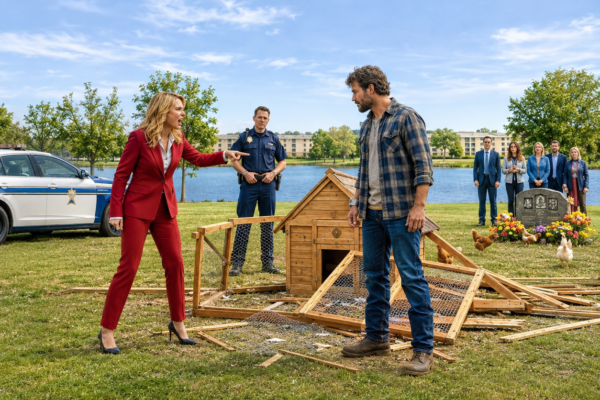
At 9:17 on a Thursday night, HOA president Brenda Mercer stood across the street in her tennis visor, staring at my sidewalk while every repaired crack glowed electric blue beneath her feet like somebody had dropped a piece of the Milky Way into suburban concrete. T
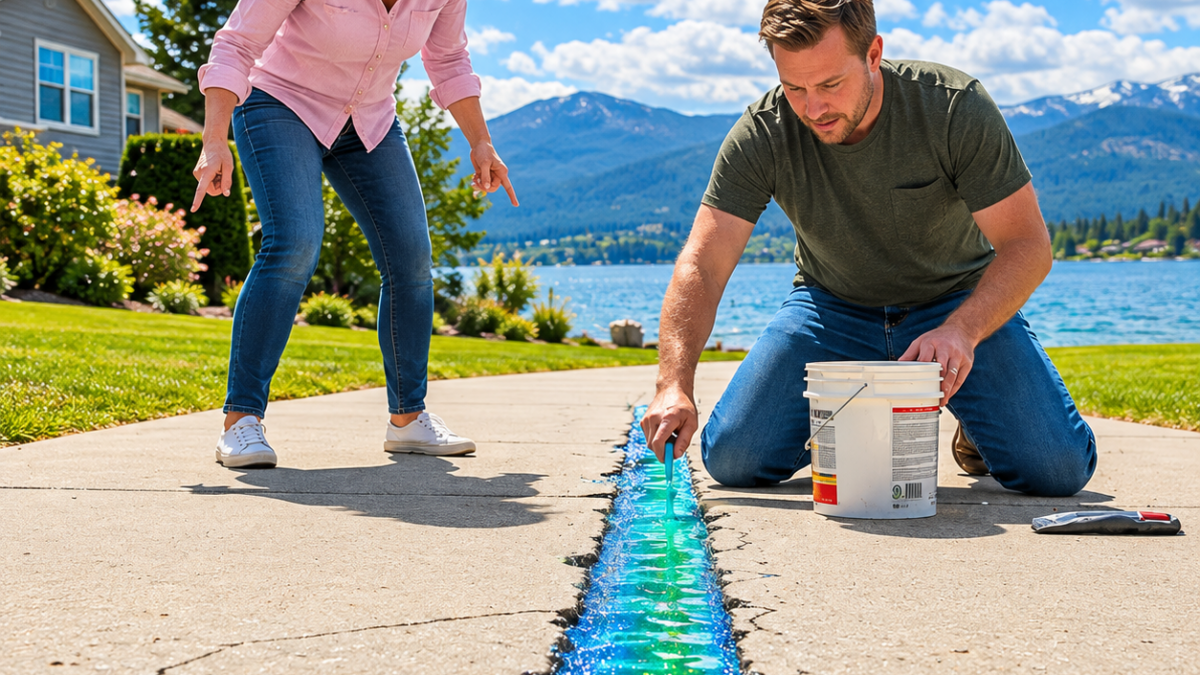
Brenda flipped pages so fast I could hear the plastic sleeves slapping against one another.
She had brought the big binder.
Not the ordinary clipboard.
The binder.
Every neighborhood has an object that tells you trouble has been promoted from casual to official.
At Maple Creek Estates, it was Brenda’s black three-ring binder.
She found a tab.
“Section Twelve, Subsection C.”
“Sounds ominous.”
“All exterior modifications must comply with the approved architectural color palette.”
I leaned slightly toward the page.
“Paint, siding, shutters, permanent fixtures.”
“Exactly.”
“My sidewalk repair is none of those.”
“It’s blue.”
“During the day.”
“It’s glowing.”
“At night.”
“That does not help your argument.”
I smiled.
“It helps mine.”
Her mouth tightened.
Behind her, three kids were still crouched beside the sidewalk.
One of them whispered:
“It looks like lava.”
His sister corrected him.
“Alien lava.”
Brenda turned.
“Children, please don’t touch that.”
Khloe stepped out behind me.
“It’s fully cured.”
Brenda looked at her.
“And you are?”
“Khloe Bennett.”
“I know who you are.”
“Then why’d you ask?”
I covered my mouth with my coffee mug.
Brenda ignored me.
“Ms. Bennett, you’re an engineer.”
“Structural.”
“Is this safe?”
Khloe looked at me.
That look meant:
I am about to answer honestly, and you may not enjoy it.
She walked down the steps.
Tested the surface again with her shoe.
“The repair appears flush.”
“Appears?”
“I haven’t done a formal inspection.”
Brenda seized on that.
“So it may be unsafe.”
Khloe gave her a flat look.
“That isn’t what I said.”
“Is epoxy approved for sidewalk repair?”
“Some formulations are.”
“This formulation?”
“Leo showed me the manufacturer sheet. Exterior concrete crack repair, appropriate width range, UV-resistant, with mineral aggregate added.”
Brenda stared at her.
Khloe continued.
“I also made him add a non-slip broadcast while the surface was tacky.”
I raised a finger.
“She bullied me.”
“You wanted a glowing skating rink.”
“I wanted artistic integrity.”
“You wanted a lawsuit.”
Brenda looked from me to Khloe.
I could practically see her regretting that the weird guy across the street happened to date a structural engineer.
She closed the binder.
“This will be reviewed.”
“Great.”
“Do not make additional modifications.”
“I’m out of cracks.”
“That isn’t funny.”
“I thought it was a little funny.”
She walked away.
Gary followed.
His Pomeranian stopped.
Looked at the sidewalk.
Then sat directly on one of the glowing lines.
Gary tugged the leash.
“Princess, come on.”
Princess refused.
I liked Princess immediately.
Khloe waited until Brenda’s front door closed.
Then she turned to me.
“You enjoyed that.”
“Deeply.”
“This is going to get worse.”
“Probably.”
“I want that acknowledged now.”
“Officially acknowledged.”
“So when we end up spending Saturday at an HOA hearing instead of hiking—”
“You can say you told me so.”
“I won’t.”
“You absolutely will.”
“Yes.”
She went inside.
I stayed outside another ten minutes.
The glow softened as the stored sunlight discharged.
That was something I liked about photoluminescent material.
It wasn’t electric.
No wires.
No blinking.
No transformer humming.
It absorbed light during the day and released it slowly after dark.
By midnight the effect would be faint.
By morning it would look almost ordinary again.
Temporary magic.
Which, in Maple Creek Estates, might have been the most offensive kind.
The next morning, my phone had forty-three notifications.
Khloe had sent me one message from the bedroom at 6:12 a.m.
YOU ARE INTERNET NONSENSE NOW.
Under it was a link.
A teenager named Mason Reed lived six houses down.
He had filmed the sidewalk the night before.
Thirty-second video.
Slow pan over the glowing repairs.
Caption:
MY NEIGHBOR GOT TOLD TO FIX HIS SIDEWALK BY THE HOA SO HE DID THIS.
I played it twice.
“Khloe.”
From the bathroom:
“No.”
“You don’t know what I’m asking.”
“I know enough.”
“It has eighty thousand views.”
Silence.
Then she appeared in the doorway with a toothbrush in her mouth.
“How many?”
“Eighty thousand.”
She took the toothbrush out.
“Delete the internet.”
“I don’t control the internet.”
“You work in design.”
“That is not what design means.”
She came over.
Read comments.
Most were jokes.
Some people loved it.
Some thought it was tacky.
One person wrote:
YOUR HOA IS GOING TO INVENT A NEW BYLAW BEFORE BREAKFAST.
I showed Khloe.
She pointed at the screen.
“That person understands institutions.”
By nine, Brenda understood the internet too.
She sent a neighborhood email.
SUBJECT: UNAUTHORIZED EXTERIOR ALTERATIONS.
No names.
But somehow everyone knew.
Residents were reminded that “novel or unconventional treatments” to exterior elements might require review.
I read the email at my desk while Buster slept beneath it.
“Novel,” I said.
Buster opened one eye.
“Unconventional.”
Tail thump.
“We’ve been promoted.”
He went back to sleep.
At eleven, a second email arrived.
This one only to me.
Formal hearing.
Tuesday.
Architectural Control Committee.
Fine pending.
I forwarded it to Khloe.
Her reply:
SATURDAY HIKE IS SAFE.
TUESDAY DINNER IS NOT.
Reasonable.
I spent the weekend doing something that surprised everyone.
Nothing.
No neon mailbox.
No phosphorescent driveway numbers.
No glowing lawn flamingos.
Not because I lacked ideas.
I had many.
Too many.
Because once you’ve found a loophole, the quickest way to lose it is to abuse it.
The sidewalk remained the sidewalk.
Kids visited at dusk.
Parents came too.
Tom Miller from Number Thirty-Two brought a lawn chair one evening.
“What are you doing?”
“Watching the circus.”
“What circus?”
He pointed across the street.
Brenda was photographing the sidewalk.
Tape measure.
Phone.
Binder.
Gary held a flashlight.
I sighed.
“She’s measuring photons now.”
Tom laughed so hard he nearly spilled his beer.
Tom was sixty-two.
Retired postal supervisor.
Had lived in Maple Creek since the first phase was built.
He knew everything.
Not gossip.
Institutional memory.
There is a difference.
“Brenda wasn’t always like this,” he said.
I looked over.
“No?”
“No.”
“What was she like?”
“Quieter.”
“That is difficult to imagine.”
“Her husband, Paul, used to do most of the social stuff.”
“I’ve never met him.”
“Gone twelve years.”
“Died?”
“Divorced.”
“Oh.”
Tom sipped.
“She started volunteering after that.”
“For HOA?”
“Architecture committee first.”
“Then president.”
“Eventually.”
Across the street Brenda knelt with a small ruler.
“What happened?”
Tom shrugged.
“People kept letting her do things.”
“That sounds ominous.”
“It’s how every volunteer organization works. One person raises their hand three times and suddenly they control Christmas.”
Fair.
He looked toward the glowing lines.
“For what it’s worth, I think it looks good.”
“Thank you.”
“My wife hates it.”
“Also fair.”
“She thinks blue clashes with your shutters.”
“My shutters are charcoal.”
“Tell Debbie.”
“I value my life.”
Smart man.
Tuesday came.
The clubhouse smelled like coffee, carpet cleaner, and decades of losing arguments.
The Architectural Control Committee turned out to consist of Brenda, Gary, a woman named Eleanor Price, and a man named Raj Patel.
Raj was an accountant.
Eleanor taught piano.
Both looked as though they would rather be anywhere else.
Khloe came with me.
I carried documents.
Not a giant presentation.
Product data.
Photos.
The original violation notice.
Measurements.
One printed section of the declaration.
Brenda opened.
“Mr. Maxwell, you were instructed to repair multiple cracks in the homeowner-maintained sidewalk bordering your property.”
“Yes.”
“You did so.”
“Yes.”
“With luminescent blue epoxy.”
“Photoluminescent mineral-filled structural repair epoxy.”
Gary wrote that down.
I watched him try to spell photoluminescent.
He gave up halfway.
Brenda continued.
“You did not submit an architectural request.”
“The violation notice did not instruct me to.”
“All modifications require review.”
“Repairs?”
She paused.
“Exterior changes.”
I slid the original letter forward.
“This instructed me to remedy the crack condition within fourteen days.”
“Yes.”
“It did not say the repair required prior review.”
“You are expected to know the covenants.”
“I read them.”
That got her attention.
“All of them?”
“Most.”
Khloe whispered:
“He didn’t sleep.”
True.
I continued.
“The architectural approval section specifically lists alterations, additions, color changes, structures, fixtures, hardscape redesign, and replacements materially different from existing construction.”
Brenda leaned forward.
“Exactly.”
“I didn’t replace the sidewalk.”
“You altered its appearance.”
“I repaired cracks.”
“With blue epoxy.”
“Correct.”
Eleanor spoke for the first time.
“Can I ask something?”
Brenda looked annoyed.
“Of course.”
Eleanor looked at me.
“Why blue?”
“Best nighttime output.”
She smiled slightly.
“Could it have been beige?”
“Yes.”
Brenda looked triumphant.
I continued.
“But beige photoluminescent pigment is terrible.”
Eleanor laughed.
Brenda didn’t.
Raj picked up the manufacturer sheet.
“This is actually a concrete repair product?”
“Yes.”
“Not craft resin?”
“No.”
“Compressive strength?”
I told him.
Bond strength?
I showed the sheet.
Temperature range?
Sheet.
UV exposure?
Sheet.
Slip resistance?
Khloe answered that one.
“We added a compatible broadcast aggregate and tested the finished surface for texture. I wouldn’t call it a certified pedestrian-surface test because we didn’t commission a lab, but it has more texture than the adjacent concrete.”
Raj nodded.
“Any height differential?”
“No.”
“Drainage affected?”
“No.”
Brenda interrupted.
“This is not an engineering seminar.”
Khloe looked at her.
“You cited safety.”
Silence.
Raj looked down again.
Eleanor said:
“I walked it last night.”
Brenda turned.
“You what?”
“My granddaughter wanted to see it.”
Gary smiled.
“So did mine.”
Brenda looked at Gary.
“You took your granddaughter?”
“After dinner.”
“You told me it was a nuisance.”
“I said people were gathering.”
“That is what a nuisance is.”
Raj looked up.
“Not necessarily.”
I sat very still.
Something interesting was happening.
Brenda had assumed the committee was an extension of her opinion.
The committee had just remembered it was four people.
She knew it too.
Her posture changed.
More formal.
“We have an obligation to preserve aesthetic consistency.”
Eleanor nodded.
“I agree.”
My stomach dropped slightly.
Then she continued.
“But he complied with the written repair demand.”
Brenda stared.
“The appearance is completely inconsistent.”
“Yes.”
“So?”
“So our documents are unclear.”
Raj nodded.
“That’s my concern.”
Gary looked between them.
He seemed distressed by pluralism.
Brenda said:
“Then we fine him and clarify afterward.”
Raj’s eyebrows rose.
“That is backwards.”
The room went quiet.
I liked Raj.
Brenda folded her hands.
“Mr. Maxwell intentionally exploited ambiguity.”
I answered before Khloe could stop me.
“I intentionally complied with the text you sent me.”
“Please.”
“You gave me a final notice as my first notice.”
Brenda’s eyes flicked toward Gary.
I continued.
“You photographed cracks, cited a width threshold, and told me to remedy them in fourteen days.”
I slid the letter toward the center.
“I did.”
Eleanor picked it up.
“Why does this say final notice?”
Brenda’s jaw tightened.
“Administrative template.”
“Was there an earlier notice?”
“No.”
“So it wasn’t final.”
“It is standard wording.”
Raj rubbed his forehead.
“That’s not great.”
Brenda looked at him.
“Whose side are you on?”
Nobody spoke.
The question hung there.
Raj slowly lowered his hand.
“I’m on the committee.”
That was the moment.
Tiny.
But important.
Brenda realized she had said the quiet part aloud.
This was not supposed to have sides.
I wasn’t an enemy force.
I was a homeowner.
The committee went into closed deliberation.
Khloe and I waited outside.
I paced.
She leaned against the wall.
“You know what your problem is?”
“Only one?”
“You enjoy process when you think you can beat it.”
“Who enjoys losing process?”
“Normal people avoid it.”
“Boring.”
“See?”
Twenty-two minutes later, they called us in.
Decision:
The repair would remain temporarily.
No fine yet.
Committee requested an independent inspection regarding safety and a legal review regarding architectural authority.
Brenda read it like a hostage statement.
I nodded.
“Fair.”
She looked surprised.
“You agree?”
“Yes.”
That annoyed her more than if I’d celebrated.
Outside, Khloe took my arm.
“You handled that almost like an adult.”
“High praise.”
“Don’t ruin it.”
“I won’t.”
I ruined it forty-eight hours later.
Not intentionally.
Police cruiser pulled up at dusk.
Two officers.
Officer Miller.
No relation to Tom.
And Officer Davis.
They approached slowly.
Older one, Miller, looked exhausted before speaking.
“Mr. Maxwell?”
“Yes.”
“We received a complaint regarding a light nuisance.”
I looked at the sidewalk.
Then at Brenda’s house.
Blinds moved.
Of course.
“What kind of nuisance?”
Miller checked his notes.
“Distracting illumination adjacent to a roadway.”
Davis looked down.
His mouth twitched.
Miller continued.
“Is this powered?”
“No.”
“Any electricity?”
“No.”
“Flashing?”
“No.”
“Projecting toward traffic?”
“No.”
He looked at the sidewalk.
The lines glowed gently.
He stepped onto one.
Nothing happened because reality is disappointing.
“What is it?”
“Photoluminescent aggregate in crack-repair epoxy.”
Miller stared.
Davis looked away, shoulders moving.
“Officer Davis?”
“Yes, sir.”
“Anything funny?”
“No, sir.”
“Good.”
He looked at me.
“Any city citation?”
“Not that I know of.”
“Permit issue?”
“Repair didn’t require one according to public works when I called.”
Miller turned toward Brenda’s house.
She was now standing on her porch.
“Ma’am?”
“Yes?”
“You called?”
“Yes. It creates a hazardous distraction.”
Miller looked toward the nearest intersection.
Then the sidewalk.
A car passed without exploding.
“Have there been crashes?”
“No.”
“Complaints from drivers?”
“Residents have reported vehicles slowing.”
I raised my hand.
“May I?”
Miller gave me a tired look.
“I’m afraid.”
“People slow because teenagers posted it online.”
He nodded.
“That tracks.”
Brenda snapped:
“This is not funny.”
Miller’s voice stayed calm.
“No, ma’am.”
Davis stared at the sky.
Miller continued.
“I’m not seeing a criminal or traffic issue.”
“It’s a public nuisance.”
“That may be something for code or civil enforcement, depending on the facts. It isn’t a police matter from what I’m seeing tonight.”
Brenda folded her arms.
“So you refuse to act.”
“I’m telling you I don’t have an offense.”
He looked at me.
“Keep the sidewalk clear.”
“Yes, sir.”
“No crowds blocking the street.”
“Absolutely.”
“And maybe tell visitors not to park in front of hydrants.”
“That happened once.”
“I know.”
“How?”
“I was here.”
Right.
Mason’s viral video had brought visitors.
Not hundreds.
But enough.
I had already posted a little sign near my porch:
PLEASE ENJOY FROM THE SIDEWALK.
DON’T BLOCK DRIVEWAYS.
DON’T BE WEIRD.
Khloe had made me remove the last line.
Police left.
Davis gave the glowing crack one final look.
“Sir?”
“Yes?”
“My daughter would love this.”
Miller said:
“Davis.”
“What?”
“Car.”
They left.
Brenda remained on the porch.
I did not wave.
Growth.
The independent inspector arrived Monday.
His name was Gus Marino.
Concrete contractor.
Thirty-one years.
Big mustache.
Bigger shoulders.
He knelt with a level.
Straightedge.
Moisture meter.
Hammer tap.
He checked adhesion.
Surface.
Edges.
Crack widths.
Then walked it wet after I sprayed with a hose.
Brenda attended.
Of course.
Khloe too.
Gus stood.
“Well.”
Brenda asked:
“Is it safe?”
He looked at the sidewalk.
“As safe as the rest of this neighborhood’s homeowner walks.”
“What does that mean?”
“It means I found no trip lip, no loose material, no delamination, and decent texture.”
Brenda’s face tightened.
“Decent?”
“I wouldn’t specify glossy epoxy as a full walking surface.”
I nodded.
“It isn’t.”
“Exactly. Crack lines only.”
Khloe asked:
“Any issue with differential movement?”
“Watch it through freeze-thaw.”
“We barely get freeze-thaw.”
“Still.”
He wrote notes.
Then looked at the adjacent slab.
“You’ve got one corner starting to settle.”
I stared.
“Where?”
He pointed.
Tiny.
Less than an eighth inch.
I groaned.
Brenda almost smiled.
Gus looked at her property across the street.
“Actually, hers is worse.”
The smile died.
“Excuse me?”
He walked over.
We followed.
Her front sidewalk had a section lifted by a tree root.
Nearly half an inch.
Gus pointed.
“That’s a real trip hazard.”
Brenda looked horrified.
“This inspection is about his sidewalk.”
“You asked me to assess pedestrian safety.”
“My walkway has never been cited.”
“Doesn’t make gravity optional.”
Khloe turned away.
She was laughing silently.
I looked at Buster in my window.
Even he appeared judgmental.
Gus submitted his report.
My repair passed.
Brenda’s walkway got scheduled for grinding.
I did not report her.
That point mattered later.
The HOA’s attorney responded next.
Not Brenda’s personal lawyer.
Association counsel.
A woman named Mira Patel.
No relation to Raj.
Her opinion was careful.
The board likely had authority to regulate sidewalk appearance prospectively if the declaration and amendment procedures were followed.
But imposing a retroactive fine for a repair made in response to an ambiguous directive presented risk.
Especially because the original rule specified condition, not repair color.
Translation:
Brenda could change the rule for the future if homeowners approved it.
She could not confidently invent the rule after I complied.
The $500 fine arrived anyway.
That was Brenda’s mistake.
Bright red envelope.
UNAPPROVED AESTHETIC MODIFICATION.
$500.
Khloe read it.
“She ignored counsel?”
“Maybe.”
“Call Mira.”
“I can’t. She represents HOA.”
“Right.”
“Call our own lawyer?”
We had one.
Technically.
Khloe’s college roommate’s husband, Daniel Cho.
Real-estate attorney.
I had resisted involving him because nothing kills comedy faster than billable hours.
Then the fine arrived.
Daniel read everything.
Said:
“Leo.”
“Yes?”
“This is the stupidest file I’ve opened all month.”
“Thank you.”
“Not praise.”
“I’m sensing a pattern.”
He explained.
The HOA could enforce valid covenants.
Could fine if procedures allowed.
Could adopt new standards.
But due process under its own governing documents mattered.
Notice.
Opportunity to be heard.
Consistent application.
And any lien threat needed actual authority and compliance with state law.
“This is not a constitutional crisis,” he said.
“I never said constitutional.”
“You used the phrase inalienable right to glow in your email.”
“That was to Khloe.”
“She forwarded it.”
Betrayal.
Daniel sent a short letter.
Dispute the fine.
Request records.
Ask for board minutes authorizing it.
Ask for legal basis.
Ask that collections pause pending appeal.
No threats.
No dramatic “see you in court.”
Boring professionals ruin excellent feuds.
That is why you hire them.
Then the local TV station called.
I almost said no.
Khloe said:
“You should.”
I stared.
“Who are you?”
“I want Brenda to stop framing you as reckless.”
“Television seems like escalation.”
“It is.”
“Then why?”
“Because you already went viral.”
Fair.
Reporter Cynthia Hale interviewed me at dusk.
I did not call myself a folk hero.
I did not talk about tyranny.
Khloe threatened bodily harm if I said “beige dictatorship.”
Instead I explained:
“I got a repair notice. I thought highlighting the repair would be funny. I also made sure the product was appropriate and the surface stayed safe.”
Cynthia asked:
“Were you trying to embarrass the HOA?”
I considered lying.
“No.”
Good.
“Yes.”
Better.
“I was irritated by the final-notice language.”
“What do you want now?”
“For everyone to calm down.”
Khloe off-camera mouthed:
GOOD ANSWER.
Cynthia interviewed Brenda.
Brenda gave a statement about standards, predictability, and property values.
She sounded less ridiculous on television than people hoped.
Because Brenda wasn’t stupid.
She had an argument.
Neighborhoods do use standards to prevent genuinely harmful modifications.
The question was how much uniformity people actually wanted.
That became the real issue.
Not blue epoxy.
Control.
The Channel Eight segment aired.
Balanced.
Children liked sidewalk.
Some residents hated it.
Concrete inspector found no safety defect.
HOA documents unclear about repair appearance.
Board considering amendment.
The story got attention.
Then disappeared.
Because the world has actual problems.
I was grateful.
Brenda was not.
She scheduled a community meeting.
Proposed Amendment 14B.
Approved sidewalk repair materials:
cementitious concrete patch.
Neutral gray.
No luminescent, reflective, phosphorescent, glittering, metallic, color-shifting, or “other visually conspicuous additives.”
Khloe read the list.
“Glittering?”
“She knows me.”
“Color-shifting?”
“She really knows you.”
“Metallic?”
“Do not.”
“I wasn’t going to.”
“You were.”
I was.
The amendment required a homeowner vote.
Brenda campaigned.
So did some of her supporters.
Not sinister.
They knocked doors.
Sent emails.
Their position:
Standards need clarity.
One glowing repair is funny.
Fifty unusual walkways would look chaotic.
The HOA should define acceptable materials.
Reasonable.
Our side formed accidentally.
Tom.
Mason’s parents.
Eleanor.
A group of younger families.
Their position:
Safety matters.
Color of crack filler does not.
Don’t create rules solely because one person embarrassed the president.
Allow some creativity.
Also reasonable.
I hated that both sides were becoming reasonable.
Makes winning harder.
Khloe insisted my meeting speech acknowledge that.
“If you make Brenda a cartoon villain, you lose anybody undecided.”
“She measured my cracks.”
“She was doing her job.”
“She called police.”
“She overreacted.”
“She fined me against counsel.”
“Probably overreacted again.”
“Whose side are you on?”
Khloe stared.
I stopped.
“Oh.”
“Exactly.”
That phrase.
Same one Brenda used on Raj.
I sat down.
“Sorry.”
“Good.”
She kissed my forehead.
“Now write a better speech.”
Meeting night.
Clubhouse packed.
Not a hundred screaming revolutionaries.
Sixty-four homeowners represented.
Large for Maple Creek.
Brenda had slides.
Of course.
Property values.
Visual consistency.
Enforcement predictability.
Examples of neighborhoods with defined hardscape standards.
Some good points.
One slide showed my sidewalk at night.
The camera exposure made it look like radioactive veins tearing open the earth.
I whispered to Khloe:
“That is an incredible photo.”
“Focus.”
Brenda ended:
“This is not about one homeowner. This is about whether Maple Creek wants clear, consistent standards.”
Applause from maybe twenty people.
Then me.
I stood.
No slideshow.
One photograph.
Kids sitting near the glowing lines.
Not touching resin.
Just talking.
I said:
“Brenda is right about one thing.”
The room quieted.
She looked suspicious.
“We should have clear rules.”
Khloe smiled.
I continued.
“If repair materials need safety specifications, write them.”
Raj nodded.
“If we want minimum slip resistance, define it.”
Khloe nodded.
“If we want products rated for exterior concrete, define that.”
Gus, in the back because his sister lived in Maple Creek, raised a thumb.
“But I don’t think the color of material inside a repaired crack is protecting anyone.”
A man said:
“It protects appearance.”
“Fair.”
I nodded.
“If most homeowners want every repair gray, then vote yes.”
Brenda looked surprised again.
I continued.
“But ask what we’re solving.”
I held up the picture.
“My sidewalk became weird.”
Laughter.
“It also became safer than it was before because the cracks are repaired.”
More quiet.
“Kids noticed it.”
“Neighbors talked.”
“I met people I had lived near for two years and never spoken to.”
I looked around.
“I’m not asking for glowing roofs.”
A voice:
“Yet.”
Laughter.
“Thank you, Tom.”
I continued.
“I just don’t want us to confuse consistency with community.”
That was the line.
Not planned as a viral quote.
Just true.
“A neighborhood should have rules against things that hurt neighbors.”
“Dangerous construction.”
“Blocked sidewalks.”
“Drainage problems.”
“Neglected property.”
“Those matter.”
I glanced toward Brenda.
“But harmless difference?”
I shrugged.
“I think we can survive a little.”
Then I sat.
Vote.
Twenty-one in favor.
Forty-three opposed.
Amendment failed.
No cheers at first.
Then scattered applause.
Brenda stood at the podium.
Hands gripping the sides.
For one ugly second I wanted to grin at her.
Then I saw her face.
Not rage.
Something closer to fear.
She gathered her papers.
Gary tried to help.
She shook her head.
Meeting ended.
Daniel called next morning.
“Fine rescinded.”
“What?”
“The board voted after the amendment failed.”
“Brenda?”
“Abstained.”
“Really?”
“Yep.”
“Can I frame the letter?”
“I cannot legally prevent you.”
I framed it.
Obviously.
For a week, life became normal.
The sidewalk glowed.
Children stopped treating it as breaking news.
Mason’s video plateaued.
Gus repaired Brenda’s raised slab.
She stopped walking past my house with the clipboard.
Then one Saturday I saw her kneeling in her flower bed.
No visor.
Hair loose.
Pulling weeds.
I almost kept walking.
Probably should have.
Instead:
“Morning.”
She looked up.
“Leo.”
No warmth.
No hostility either.
Progress.
I stopped at the edge of her lawn.
“Gus did good work.”
“Yes.”
“He likes your sidewalk.”
She looked at me.
“Don’t.”
“Sorry.”
She went back to weeds.
I should have left.
Instead:
“You okay?”
That made her stop.
Slowly.
“Why wouldn’t I be?”
“The meeting.”
Her shoulders tightened.
“I lost a vote.”
“Yes.”
“I have survived worse.”
“Okay.”
I started to turn.
Then she said:
“Do you know why I care?”
I looked back.
She was still kneeling.
Gloves muddy.
No binder.
No committee.
Just Brenda.
“No.”
She sat back on her heels.
“My husband and I bought a house when we were twenty-nine.”
I waited.
“Not here.”
“Okay.”
“Older neighborhood.”
She pulled another weed.
“We put everything into it.”
“Savings?”
“All of it.”
“Then more.”
She laughed without humor.
“Everybody tells you houses are safe investments.”
I nodded.
“The previous owner had built a deck.”
“No permit?”
She looked at me.
“How do you know?”
“Guess.”
“No permit.”
She rubbed soil from her glove.
“Looked fine.”
“Inspector found problems?”
“Buyer did.”
This was after they tried to sell.
The deck had improper footings.
Wrong ledger attachment.
Water intrusion behind siding.
Repair estimate grew.
Then permitting exposed another unapproved addition.
Sale collapsed.
They spent months fixing.
Market shifted.
Paul lost work.
They refinanced.
Then sold for far less than expected.
Not literally everything.
But enough that their marriage never recovered.
“We fought constantly.”
Brenda said.
“About money?”
“About whose fault everything was.”
She looked at her house.
“When Paul left, I decided I would never live somewhere where nobody enforced anything.”
There it was.
The binder suddenly made sense.
Not justified.
Made sense.
“I joined the committee because people were approving things without reading.”
She smiled faintly.
“I read.”
“I noticed.”
“Then I became president.”
“Also noticed.”
She looked toward my house.
You could see the sidewalk in daylight.
Just pale blue seams.
“Your sidewalk made me furious.”
“Because it glowed.”
“Because you enjoyed finding what I missed.”
That landed.
I didn’t answer.
She continued.
“You turned the rules into a joke.”
“I turned one vague rule into a joke.”
“To me, that was the same thing.”
Wind moved through her hydrangeas.
“I spent years believing if every rule was specific enough, every risk could be controlled.”
She shook her head.
“That sounds foolish out loud.”
“No.”
“It does.”
“It sounds like someone got burned.”
She looked at me.
“You’re being very reasonable.”
“Khloe has been working on me.”
“Tell her thank you.”
“I will.”
Brenda looked down.
“I shouldn’t have called the police.”
“No.”
“I shouldn’t have issued the fine after counsel told us the rule was unclear.”
“No.”
“I shouldn’t have stamped final notice on a first notice.”
“That one really offended me.”
She almost laughed.
Almost.
“Administrative template.”
“Terrible template.”
“Yes.”
Then she said:
“But I still think blue sidewalks are ridiculous.”
I smiled.
“Allowed.”
“I will never like it.”
“Also allowed.”
She picked another weed.
“Maybe a little.”
“What?”
“Nothing.”
“Brenda.”
She sighed.
“The blue has grown on me.”
That was our peace treaty.
Not friendship.
Not hugs.
Not suddenly becoming co-presidents of Fun.
Just understanding.
Maple Creek changed slowly after that.
Not into an artist colony.
Nobody painted houses purple.
Nobody installed disco mailboxes.
The association updated enforcement procedures.
First notice meant first notice.
Final notice meant an actual final notice.
Radical.
Architectural committee added a written appeal path.
Raj pushed for clearer safety standards.
Khloe reviewed some proposed walkway language informally, then insisted the HOA hire its own engineer because she refused to become “the free girlfriend consultant.”
Reasonable.
Brenda stayed president through the end of her term.
That surprised people.
She even won reelection once.
Narrowly.
Because a lot of residents still valued what she did well.
Budgets were clean.
Reserves healthy.
Landscaping contracts competitive.
Pool maintained.
Insurance reviewed.
She became less theatrical about minor violations.
Gary remained Gary.
Some forces in nature are permanent.
One afternoon he knocked on my door.
“Leo.”
“Gary.”
“I have a crack.”
I stared.
“In your sidewalk?”
“Yes.”
“How wide?”
He looked embarrassed.
“Three-eighths.”
“Serious.”
“Brenda sent a notice.”
I tried not to smile.
“First notice?”
“Yes.”
“Progress.”
He shifted.
“I wanted to ask where you bought the…”
His voice faded.
“The what?”
“The material.”
I leaned against the doorframe.
“Gary.”
“Don’t make me say it.”
“The glow epoxy?”
His eyes closed.
“Yes.”
I laughed.
“I thought it was ridiculous.”
“It is.”
“My granddaughter likes yours.”
“Ah.”
“She wants purple.”
“Purple doesn’t glow as efficiently.”
“I know.”
I stopped.
“You know?”
“I researched.”
I smiled slowly.
Gary pointed at me.
“Don’t.”
“Come inside.”
We built Gary’s repair together.
Not purple.
Violet-blue.
He submitted an architectural request first.
Because unlike me, Gary believed paperwork was a moral virtue.
The committee approved it.
Three to one.
Brenda voted no.
Of course.
But she signed the approval letter as president.
No sabotage.
No grudge.
That mattered.
Gary’s granddaughter loved it.
Then Mrs. Henderson wanted green.
The committee panicked.
Maple Creek nearly entered a phosphorescent arms race.
Raj proposed compromise.
Homeowner walkway repairs could use subdued photoluminescent aggregate provided they remained flush, slip-resistant, professionally suitable, and limited to actual repair lines rather than decorative patterns.
No giant glowing dragons.
I considered that targeted discrimination.
Khloe considered it excellent governance.
It passed.
Brenda voted yes.
I looked at her across the meeting room.
She refused to look at me.
Afterward:
“You voted for glow.”
“I voted for clarity.”
“Same result.”
“Not even slightly.”
“Welcome to the rebellion.”
“Leo.”
“Sorry.”
Buster got older.
That was the part of the story nobody expected.
Years pass faster when measured in dogs.
When the sidewalk fight began, he was six.
Golden coat.
Too much energy.
By eleven, his face had gone pale.
He walked slower.
But every evening after dinner he still wanted the same route.
Front door.
Down the glowing sidewalk.
Turn at Tom’s.
Around the pond.
Home.
At dusk the repaired lines illuminated first.
Buster eventually learned to follow them.
Not because he needed to.
Just habit.
One October evening, his back legs were bad.
Khloe and I walked slowly.
Buster reached the brightest crack.
Stopped.
Lay down.
I sat beside him.
Khloe sat on the other side.
Cars passed.
Leaves moved.
Soft blue beneath his paws.
A little boy rode past on a scooter.
“That’s the glow dog!”
Apparently Buster had also become local infrastructure.
He died that winter.
Cancer.
Fast.
Two weeks from diagnosis.
I thought I was prepared because dogs do not live forever.
I wasn’t.
Khloe found me sitting on the sidewalk one evening afterward.
No dog.
Just leash in my hand.
She sat beside me.
Didn’t say anything.
The lines glowed.
“Stupid sidewalk,” I said.
“Why?”
“Everything happened here.”
“Good things too.”
“I know.”
She leaned her head against me.
Tom brought over a small wooden box later.
Inside was a brass tag.
BUSTER
CHIEF SIDEWALK INSPECTOR
I laughed through tears.
We mounted it low on the porch post.
Brenda saw it.
Next day she left a bag on the step.
Dog treats.
Then remembered.
She returned ten minutes later.
I caught her.
“What are these?”
She froze.
“Oh.”
We both looked at the bag.
“I forgot.”
That broke something in me.
I laughed.
Then she laughed.
Then I cried.
Then she hugged me.
First and only time.
Very awkward.
Brenda hugged like someone complying with a fire drill.
But she stayed.
That matters.
A year later Khloe and I got married.
Small ceremony.
Backyard.
Tom officiated because apparently retired postal supervisors can become ordained online in four minutes.
Gary handled chairs with military precision.
Raj did nothing because he had boundaries.
Eleanor played piano.
Brenda came.
No clipboard.
Blue dress.
I noticed.
“Coincidence?”
“Yes.”
“Sure.”
“Leo.”
Khloe walked down our glowing sidewalk at dusk.
Not planned originally.
Then she realized timing would make it possible.
The repairs had charged all afternoon.
As sunlight faded, blue lines appeared beneath her shoes.
Everyone went quiet.
For once, I did too.
She reached me.
Whispered:
“You know this means your stupid sidewalk is in our wedding photos forever.”
“Legacy.”
“Don’t ruin this moment.”
“Yes, ma’am.”
The photographer captured one picture I still keep over my desk.
Khloe standing in front of me.
Blue light beneath us.
Brenda in the background smiling.
Gary’s granddaughter on tiptoe trying to stay on a glowing line.
That was Maple Creek now.
Still beige houses.
Still rules.
Still trash-can deadlines.
But less afraid of being alive.
Brenda retired from the board at sixty-four.
Her final meeting had cake.
Someone ordered beige frosting.
That was me.
She saw it.
“Really?”
“I thought it was respectful.”
“You are forty-three years old.”
“Correct.”
“When will this end?”
“Never.”
She cut the cake.
Then handed me the first piece.
The new president was Raj.
Best possible outcome.
He loved spreadsheets more than authority.
Meetings became twenty minutes shorter immediately.
His first policy:
No emergency meetings unless there was an actual emergency.
He used the glowing-sidewalk amendment as an example.
“We spent ninety minutes debating crack color.”
Brenda, from the audience:
“It was complicated.”
Raj:
“It was blue.”
People laughed.
She did too.
A few years after that, Brenda sold her house.
Not because of conflict.
Her daughter had moved to Colorado.
Grandchild.
She wanted to be closer.
Moving truck came on a Saturday.
Khloe and I walked over.
Brenda stood in the empty driveway.
House looked strange without her.
“Need anything?”
I asked.
“No.”
“Boxes?”
“No.”
“Coffee?”
“I have coffee.”
“Unsolicited architectural advice?”
She smiled.
“I have survived enough.”
Her eyes moved toward our house.
Sidewalk still visible.
Repairs had faded slightly over the years.
Not much.
Good material.
“You’ll maintain that thing?”
“Yes.”
“Properly?”
“Yes.”
“Manufacturer intervals?”
“Brenda.”
“I’m asking.”
“Yes.”
She nodded.
Then:
“My new neighborhood doesn’t have an HOA.”
I stared.
“You?”
“My daughter insisted.”
“Are you scared?”
“Terrified.”
“What if somebody paints a door red?”
She looked grim.
“I’m working through it.”
I laughed.
She opened her car door.
“Leo.”
“Yes?”
“You know I meant what I said.”
“About what?”
“Rules.”
I nodded.
“I know.”
“They matter.”
“I know.”
She looked at the glowing repairs.
“Just not all equally.”
“Exactly.”
She got in.
Then rolled down the window.
“And the blue really did grow on me.”
I smiled.
“I know.”
“How?”
“You told me.”
“I hoped you forgot.”
“Graphic designer.”
“What does that have to do with memory?”
“Nothing.”
She shook her head.
Drove away.
Khloe stood beside me.
“You’re going to miss her.”
“No.”
“You are.”
“I’m going to miss conflict.”
“That is worse.”
Probably.
New owners were a couple named Marcus and Lena.
Two kids.
They repainted Brenda’s old front door sage green.
Approved.
No crisis.
Their son Oliver discovered the glowing sidewalk the first week.
“What is that?”
“Long story.”
“Why does it glow?”
“Also long.”
“Can ours glow?”
Marcus looked alarmed.
“Do not answer that.”
I gave Oliver Gary’s number.
The tradition survived.
Ten years after the original notice, Maple Creek replaced several sidewalk panels neighborhood-wide.
Tree roots.
Settling.
Age.
Our repaired section was still structurally fine, but adjacent panels needed work.
Raj—still involved though no longer president—called.
“Leo.”
“Yes?”
“Public works consultant recommends replacing the whole run for consistent elevation.”
I looked at the sidewalk.
My sidewalk.
The original glowing cracks.
Wedding.
Buster.
Kids.
Brenda.
Everything.
“When?”
“Spring.”
“Can they save the epoxy?”
“No.”
I knew.
Concrete does not care about nostalgia.
Still hurt.
Khloe came home and found me outside.
“You heard?”
“Yes.”
“I’m being stupid.”
“Yes.”
“Thank you.”
She sat.
We looked at the lines.
It was February.
Cold.
Clear.
Faint blue after sunset.
“What do you want to do?”
“Fight it.”
“No.”
“I know.”
“Good.”
“I want a piece.”
“That can be arranged.”
The contractor cut out one small section before demolition.
About eight inches square.
Concrete with a blue glowing vein through the middle.
Khloe designed a steel frame for it.
We mounted it inside my office.
Under it, a tiny plaque:
BYLAW 7, SECTION 4A
COMPLIED WITH AGGRESSIVELY
Khloe objected to “aggressively.”
I overruled.
The new sidewalk was poured.
Gray.
Beautifully boring.
For three nights I hated it.
Then Raj came over.
“Wait until tonight.”
“What?”
He smiled.
Raj did not smile mysteriously.
This worried me.
At dusk, the new sidewalk began to glow.
Not cracks.
A narrow aggregate band ran along one edge.
Subtle.
Blue-green.
Uniform.
Professionally integrated.
I stared.
“What did you do?”
“New neighborhood pedestrian specification.”
“Who approved this?”
“Board.”
“Why?”
“Low-level wayfinding.”
“You put glow aggregate into the standard sidewalk?”
“Yes.”
“Brenda knows?”
Raj’s smile widened.
“I mailed her a photo.”
My phone rang.
Colorado number.
I answered.
“Hello?”
Brenda.
“You people are impossible.”
I laughed until I had to sit down.
That became Maple Creek’s standard whenever sidewalk panels were replaced near common paths.
Not every inch.
Just small luminescent markers at intersections and darker stretches.
Nothing dramatic.
Practical.
Kids loved them.
Older walkers liked visibility.
Nobody called police.
Nobody made national news.
Nobody cared.
Which was perfect.
The thing that started as malicious compliance became ordinary.
That happens more often than people think.
Somebody does something weird.
People resist.
Then somebody asks whether the weird thing is actually useful.
Sometimes the answer is no.
Sometimes it is.
Ours was somewhere in between.
The original glow repair was mostly a joke.
A safe joke.
A petty joke.
But still a joke.
What lasted was not the loophole.
It was the conversation.
How much control does a neighborhood need?
How much individuality can it tolerate?
Which rules protect people?
Which rules protect nothing but habit?
And what happens when the person enforcing the rules starts believing that questioning them is the same as attacking the community?
I learned too.
At thirty-seven, I thought Brenda was the whole problem.
Power-hungry HOA president.
Clipboard tyrant.
Enemy of joy.
Easy.
By forty-seven, I understood something less satisfying.
Brenda had been trying to prevent chaos.
Badly, sometimes.
Too aggressively, definitely.
But not because she hated people.
Because one unapproved structure had helped wreck the biggest financial decision of her young life.
She became obsessed with preventing the same kind of surprise.
I became obsessed with proving rules could be bent.
Both of us were reacting to something bigger than a sidewalk.
That does not excuse overreach.
Understanding is not surrender.
But it makes the story better.
These days, when new residents ask why Maple Creek has faint blue markers in some sidewalks, somebody eventually points at me.
“That guy.”
I always deny everything.
Khloe does not.
“Oh, it was him.”
“Khloe.”
“He stayed up until two in the morning researching glowing concrete because an HOA letter hurt his feelings.”
“It was a final notice.”
“His first notice.”
“Exactly.”
The new residents laugh.
Then I show them the framed chunk in my office.
Still glows.
Not as bright.
Enough.
Beneath it hangs another frame.
Plain white HOA letter.
One sentence.
The $500 fine has been rescinded.
And beside that, Buster’s brass tag.
Chief Sidewalk Inspector.
Three ridiculous artifacts from a ridiculous fight.
Three things I would never throw away.
Sometimes at night Khloe and I walk Maple Creek.
Same three house models.
Same tidy lawns.
Different people now.
A few brighter doors.
Native gardens where the rules allow them.
One tasteful flamingo.
Gary finally got one.
His granddaughter gave it to him.
Brenda would hate it.
Or pretend to.
At the corner near our house, the new sidewalk marker catches the last sunlight and begins to glow.
Khloe always notices first.
“There.”
Soft blue.
Nothing dramatic.
Just enough light to trace the edge.
I think about the beige envelope.
The red circles.
The absurdity.
The committee hearing.
Police cruiser.
Gus with his level.
Brenda kneeling in her garden explaining why order mattered to her.
The wedding.
Buster.
The concrete saw cutting out my little piece of history.
Then I think about the sentence Brenda said before she moved.
Rules matter.
Just not all equally.
She was right.
The crack rule mattered because broken walkways can hurt people.
Repair standards matter because bad materials fail.
Structural safety matters.
Drainage matters.
Slip resistance matters.
Clear procedures matter.
Whether the safe repair glows blue after sunset?
Maybe that never deserved a war.
But I’m glad we had the argument.
Because Maple Creek ended up with better rules.
Brenda ended up a little less afraid of unpredictability.
I ended up a little less interested in treating every rule like an enemy.
And an ugly set of sidewalk cracks became something people remembered with affection.
All because the HOA told a graphic designer:
Fix it.
They just forgot to specify how boring the fix had to be.