Barbara Patterson rolled her gold HOA golf cart into my driveway and ordered me to remove my battered old pickup because Whispering Pines had just adopted a rule against “visually offensive vehicles,” T
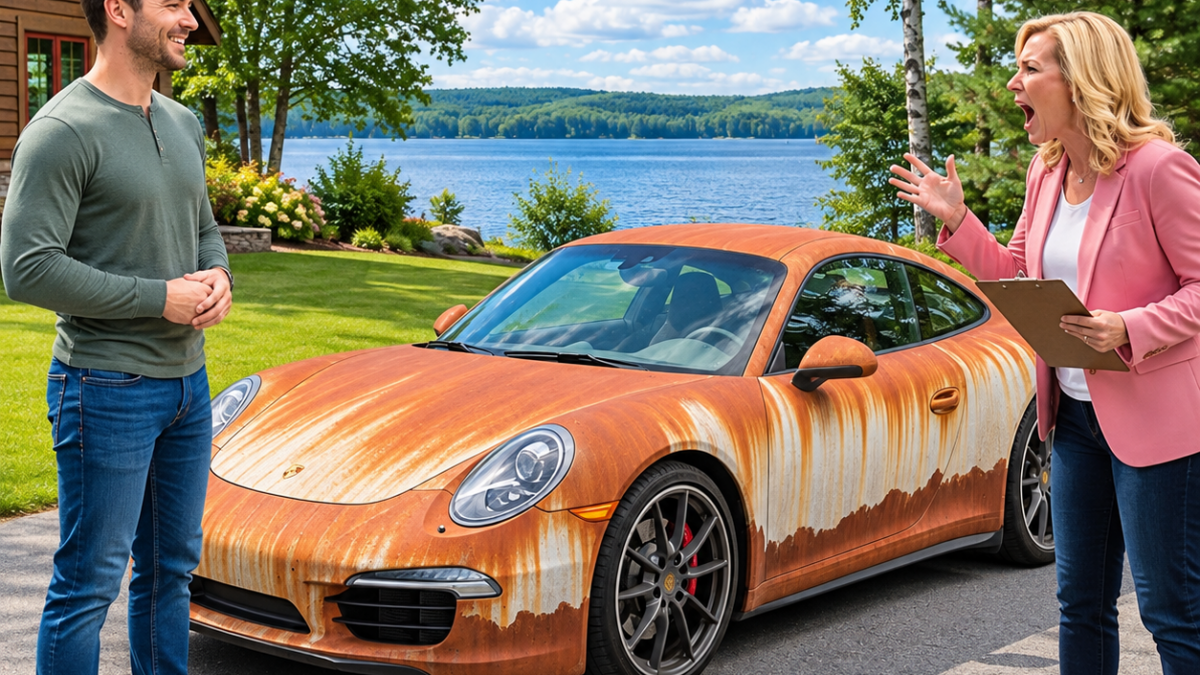
—and called the police.
Not the HOA management company.
Not the architectural committee.
The police.
I heard enough of her side of the conversation to understand that my car had apparently become an environmental disaster in the thirty seconds since I parked it.
“Yes, an abandoned vehicle.”
Pause.
“No, it’s occupied. The owner is here.”
Pause.
“That doesn’t make it less abandoned.”
I leaned against the McLaren.
“Technically, Barbara, I think it does.”
She covered the phone.
“Do not speak to me.”
“Happy to help.”
She moved farther down the sidewalk.
“It is covered in rust. There may be leaking fluids. The bumper is being held together with tape.”
I looked down.
The printed duct tape was excellent.
Vinnie had scanned real strips of silver tape at high resolution. Every wrinkle, fiber, and shadow was there.
From six feet away it looked embarrassing.
From six inches away it was obviously flat.
I ran my thumb across it.
Smooth as glass.
Barbara ended the call.
“You have finally gone too far.”
“Interesting.”
“You sold that awful truck. I thought perhaps you had developed some respect for this neighborhood.”
“And then?”
“And then you did this.”
She pointed at the McLaren as if it had insulted her mother.
“I put a protective wrap on my car.”
“That is not protective.”
“It literally is.”
“It looks diseased.”
“Different question.”
“Michael, people paid a great deal of money to live here.”
“So did I.”
“That does not give you the right to destroy the aesthetic standards everyone else follows.”
I looked around.
Beige brick.
Beige siding.
Gray roof.
Black shutters.
Silver SUV.
White SUV.
Another silver SUV.
Whispering Pines sometimes looked less like a neighborhood than a dealership waiting room.
“You’re right,” I said.
Barbara blinked.
I continued.
“That’s why I followed Resolution 404.”
Her mouth tightened.
“You are making a mockery of it.”
“That wasn’t listed as a prohibited condition.”
She opened her mouth.
Closed it.
Then the patrol car arrived.
One car.
No sirens.
Officer Miller stepped out.
He was maybe fifty, with the expression of a man who had already mediated too many suburban disputes that week.
He looked at Barbara.
Then me.
Then the McLaren.
He stopped.
“That yours?”
“Yes, sir.”
“What happened to it?”
“Vinyl wrap.”
He looked again.
“No.”
“Yes.”
He came closer.
I pointed.
“Touch it.”
He did.
His fingertip landed on a large printed rust bubble above the rear wheel.
He expected texture.
There was none.
His eyebrow went up.
“You’re kidding.”
“No.”
He looked at the bumper.
“That tape?”
“Picture of tape.”
He touched it.
Then the dark streak down the hood.
“That oil?”
“Printed.”
Miller looked at Barbara.
“Ma’am, is this what you called about?”
“It is a wreck.”
“It appears operational.”
“It is visually a wreck.”
Miller looked at me.
“Registration current?”
“Yes.”
“Inspection?”
“Yes.”
“Any actual fluid leak?”
“No.”
He crouched briefly and looked underneath without touching anything.
Dry pavement.
He stood.
Barbara said:
“It is a neighborhood blight.”
Miller nodded patiently.
“That sounds like an HOA question.”
“I want it removed.”
“Do you own the property?”
“No, but—”
“Then I’m not ordering a registered vehicle removed from somebody’s private driveway because of a vinyl graphic.”
She stared.
“It looks unsafe.”
He pointed toward the McLaren.
“Looking unsafe and being unsafe are different things.”
I loved this man.
Then he turned toward me.
“Mr. Thompson, I’m not deciding whether this violates your HOA documents.”
There went my plan to adopt him.
“Understood.”
“That is civil.”
“Understood.”
“If they fine you, argue with them, not me.”
“Yes, sir.”
He started walking away.
Then stopped.
Turned back.
“How much does that car cost?”
“Enough that my wife hates this conversation.”
A laugh escaped him.
He got into the cruiser and left.
Barbara remained.
I expected screaming.
Instead she became very quiet.
That was worse.
“You think you’ve found a loophole.”
“I think you wrote a rule defining actual deterioration and I have a car with none.”
“You deliberately made it look prohibited.”
“Yes.”
“At least you admit it.”
“I’ve never denied that.”
She picked up her clipboard.
“You’ll have your notice by morning.”
“I assumed.”
“And this time the board will not be amused.”
“Was the board amused before?”
“No.”
“Then no change.”
She climbed onto her golf cart.
The electric motor whined.
At the end of the driveway she turned.
“You should ask yourself why you need to antagonize people who are only trying to protect your property value.”
That sentence stayed with me after she left.
Not because I agreed.
Because some part of me knew Sarah was going to ask the same question with better grammar.
I walked inside.
She was standing in the kitchen with a glass of wine.
“Hi.”
She looked through the window.
Then at me.
Then back at the car.
“What did you do?”
“You knew about the wrap.”
“I knew you were getting a rust effect.”
“This is a rust effect.”
“This looks like a pirate ship sank on the Beltway and somebody hauled up the remains.”
“Vinnie is talented.”
“Mike.”
“Yes?”
“You spent five thousand dollars making a car we already paid too much for look like tetanus.”
“Technically the car cost well over two hundred thousand dollars, so proportionally—”
She held up one finger.
“Do not finish that sentence.”
I stopped.
Sarah and I had been married eight years.
She worked in corporate communications, which meant she spent her professional life explaining to executives why words they considered brilliant were, in fact, going to get them sued or mocked.
At home, I provided similar opportunities.
She took another sip.
“Police?”
“Barbara called.”
“Why?”
“Environmental hazard.”
“Because of the fake rust?”
“And fake oil.”
Sarah covered her face.
“You added fake oil?”
“Vinnie did.”
“Of course Vinnie did.”
She looked outside again.
“Is the actual car okay?”
“Perfect.”
“Wrap removable?”
“Yes.”
“No damage to the paint?”
“No.”
“Insurer knows?”
That stopped me.
“Yes.”
“Really?”
“Vinnie recommended I notify them because of the value.”
She nodded.
“Good.”
“See? Responsible rebellion.”
“No such thing.”
She sat at the island.
“Tell me what happens next.”
“Barbara sends a violation.”
“And?”
“I appeal.”
“And?”
“She loses.”
“That confidence is exactly how you ended up buying soy futures two days before that export announcement.”
“That was a completely unrelated market anomaly.”
“How much?”
“We’re not discussing this.”
“Exactly.”
I opened the refrigerator.
Sarah said:
“I understand why you’re angry.”
“That sentence always has a second half.”
“But you sold Betsy.”
There it was.
I shut the refrigerator.
“She practically wrote a rule around my truck.”
“Probably.”
“Probably?”
“Mike, the truck had a bumper held on with a zip tie.”
“Industrial zip tie.”
“And a taillight housing repaired with clear packing tape.”
“Temporary.”
“For eleven months.”
“She ran.”
“I know.”
“She was useful.”
“I know.”
“And Barbara got to decide that because she wasn’t pretty enough, she didn’t belong.”
Sarah’s expression softened.
“I know.”
I leaned against the counter.
“That’s what bothered me.”
“Not the wave?”
“The wave did not help.”
She smiled.
Then became serious again.
“Fight the rule if the rule is bad.”
“That’s what I’m doing.”
“You wrapped the McLaren to look like a decomposing refrigerator.”
“Demonstrative exhibit.”
“You wrapped the McLaren because you wanted Barbara to make a face.”
I paused.
“Both can be true.”
“Exactly.”
The notice arrived at 8:04 the next morning.
Email first.
Certified letter later.
VIOLATION OF RESOLUTION 404.
The board alleged visible rust, deteriorated paint, mismatched panels, apparent body damage, and creation of a nuisance affecting community aesthetics.
Initial fine: $200.
Additional charges if not corrected after the cure period.
The email included photographs.
Beautiful photographs, actually.
Golden morning light.
The fake corrosion looked spectacular.
I forwarded them to Vinnie.
He replied:
GOOD ANGLES.
Sarah looked over my shoulder.
“You two deserve each other.”
I submitted an appeal.
Not a rant.
Not a meme.
Three paragraphs.
The vehicle contained no corrosion, peeling paint, mismatched physical panels, or body damage as those terms were expressly defined in Resolution 404.
Its original factory finish remained intact under removable vinyl.
I requested inspection before any further enforcement.
Barbara denied the request.
Reason:
“Visual inspection is sufficient.”
That was when I called a lawyer.
Not because I thought I was about to lose the house.
Because I trade for a living.
You survive markets by recognizing the moment a joke becomes exposure.
Jessica Wren came recommended by a friend.
She practiced real-estate and community-association law in Fairfax.
She also had no patience for me.
That turned out to be useful.
I sat across from her desk.
She reviewed Resolution 404.
Then the declaration.
Then the board minutes.
Then photographs of my car.
She looked at me.
“You did this intentionally?”
“Yes.”
“How intentionally?”
“I had an artist design fake corrosion specifically around the rule definitions.”
She stared.
“That is one of the dumber intelligent things I have heard this month.”
“Thank you.”
“Not a compliment.”
“Still accepting it.”
She tapped Resolution 404.
“First, stop calling this legal.”
“I didn’t.”
“You told your wife it was legal.”
“How do you know that?”
“You have a face.”
I sat back.
Jessica continued.
“An HOA restriction can sometimes be interpreted according to purpose, not only dictionary games. If the governing declaration gives broad authority over driveway appearance, the board may have more room than you think.”
“So I could lose?”
“Of course.”
That irritated me.
“Then why define rust?”
She nodded.
“Now we are talking.”
She ran a finger down the page.
“Visible rust is defined as actual corrosion.”
“Yes.”
“Peeling paint is defined as coating degradation.”
“Yes.”
“Body damage means physical deformation.”
“Yes.”
“Your car has none?”
“None.”
“What about mismatched body panels?”
“All factory.”
“Wrap makes one door look different?”
“Yes.”
“Still same physical panel?”
“Yes.”
She leaned back.
“You have an argument.”
“Strong?”
“Decent.”
“I’ll take decent.”
“Second problem.”
“What?”
“Was this rule properly adopted?”
“It passed at an emergency board meeting.”
“Did the declaration authorize the board to create this category without a member vote?”
I didn’t know.
Jessica smiled.
“You read definitions for sport but skipped enabling authority.”
“That sounds judgmental.”
“It is.”
She requested records.
Minutes.
Notice.
Architectural authority.
Fining schedule.
Prior vehicle enforcement.
Conflict wasn’t exciting after that.
It became administrative.
Which is where most real disputes either die or become expensive.
The board produced the minutes.
Resolution 404 had passed four to one.
Barbara proposed it.
Jerry seconded.
Bob and Karen supported.
Linda Morse opposed.
The minutes were short.
Concern regarding deterioration of neighborhood aesthetic due to visibly neglected vehicles.
Discussion.
Vote.
Effective immediately.
I asked Jessica:
“Can they do that?”
“Maybe.”
“Lawyers are incredible.”
She ignored me.
“The declaration gives the board rulemaking power over common areas and certain exterior conditions. Vehicle restrictions already exist elsewhere. The question is whether 404 supplements them or creates a new substantive restriction that required a different process.”
“So?”
“So I’m not telling a judge something is invalid until I’m prepared to defend that sentence.”
She had also requested historical enforcement.
There wasn’t much.
Three recreational-vehicle notices.
One unregistered car.
A boat trailer.
Nothing resembling Betsy.
Nothing based purely on cosmetic rust.
That helped the targeting argument.
Then Jessica discovered something I had missed.
The fine schedule allowed $200 for certain continuing violations.
But Resolution 404’s escalating daily structure had not been separately incorporated into the published enforcement policy.
“Can they still fine me?”
“Probably some amount if violation is valid.”
“Two hundred a day?”
“I would challenge it.”
That was less satisfying than “Barbara goes to jail,” but considerably more useful.
My hearing was scheduled for the following Wednesday.
Sarah came.
So did Vinnie.
I did not invite Vinnie.
He invited himself.
He wore a black button-down shirt and had trimmed his beard.
“You clean up nice.”
“I look like nightclub security.”
“You do.”
“Jessica said I might testify.”
Jessica looked at me.
“I said I might need a declaration from the installer.”
“Same thing.”
“No.”
The clubhouse was full.
Thirty-five people.
A normal architectural appeal drew maybe four.
Apparently a fake-rust McLaren was democracy’s missing ingredient.
Barbara sat at the front.
Jerry beside her.
Bob.
Karen.
Linda.
I noticed Linda looking amused.
Barbara called the meeting to order.
“Mr. Thompson is appealing the association’s determination that his vehicle violates Resolution 404.”
I stood.
Jessica touched my arm.
“Let me.”
Right.
Lawyer.
Useful.
She presented calmly.
The car was currently registered.
Inspected.
Operable.
Undamaged.
No actual rust.
No peeling paint.
No mismatched body panels.
No compromised lights.
No broken glass.
No leakage.
Then she produced a small square of leftover vinyl from Vinnie.
“This is the material.”
She handed it down.
Board members touched it.
Smooth.
Barbara did not.
Jessica displayed close-up photographs.
Printed rust.
Printed holes.
Printed rivets.
Then factory-condition photos taken during installation.
Volcano Yellow paint beneath.
“Resolution 404 is unusually specific,” Jessica said.
I loved the word unusually.
It was lawyer for “you did this to yourself.”
“The board chose to define prohibited conditions physically. Mr. Thompson may have behaved provocatively, but provocation is not among those definitions.”
Barbara said:
“This is obviously against the purpose of the rule.”
Jessica nodded.
“That is your strongest argument.”
Barbara looked surprised by the concession.
Jessica continued.
“But if the board intended to prohibit visual simulations, wraps, artwork, unusual colors, or other cosmetic treatments, it could have said so within whatever authority the declaration permits.”
Jerry asked:
“So anybody could wrap a car to look burned?”
Jessica answered:
“Under the current text, perhaps.”
Someone in the back whispered:
“Awesome.”
Barbara glared toward the audience.
I recognized Frank Henderson.
Retired attorney.
Permanent troublemaker.
Jessica then addressed the adoption question.
“I also reserve my client’s objection that the board’s enforcement mechanism exceeds its rulemaking authority and does not align with the published fining schedule.”
Barbara stiffened.
“We have counsel.”
“I know.”
“Our counsel reviewed this.”
“Then perhaps your counsel can respond.”
Barbara’s jaw moved.
Their lawyer was not there.
Interesting.
Then it was my turn.
Barbara said:
“Michael, is there anything you wish to add?”
Jessica whispered:
“Briefly.”
I stood.
I had prepared a speech.
Three pages.
I left it on the chair.
“I sold my truck because of this rule.”
Barbara looked at me.
“She was ugly.”
A few laughs.
“Betsy had real rust. Real peeling paint. A bent bumper. Under the language you adopted, she violated it.”
I paused.
“So I complied.”
Then the McLaren photo appeared behind me.
“I wanted to know whether the board was regulating actual neglected vehicles or regulating whatever individual board members personally disliked.”
Barbara said:
“That’s not fair.”
“Maybe not.”
I nodded.
“But that is why I did this.”
I ran my hand over the vinyl sample.
“This looks worse than Betsy ever looked.”
More laughter.
“But it is worth more, safer, newer, cleaner, and in objectively better condition.”
Barbara leaned forward.
“Which proves you’re mocking the rule.”
“Yes.”
Silence.
I continued.
“I am.”
Jessica closed her eyes.
Sorry.
“But if a rule cannot survive being read literally, maybe the rule needs work.”
Linda Morse nodded.
Jerry looked thoughtful.
Barbara did not.
The board went into executive session.
Twenty-five minutes.
People waited.
Vinnie passed around photographs of the wrap.
Sarah whispered:
“You enjoyed that too much.”
“Little.”
“You admitted mockery.”
“Honesty.”
“Legal strategy?”
“Less so.”
Jessica turned.
“Correct.”
The board returned.
Vote.
Linda voted to dismiss.
Bob voted to dismiss.
Jerry hesitated.
Then voted to reduce the fine but require removal.
Karen supported enforcement.
Barbara supported enforcement.
Two to two with Jerry effectively in the middle.
He clarified.
“I believe the visual effect violates the purpose, but the definitions are bad.”
That made three people unwilling to enforce the rule as written.
Barbara looked furious.
After more discussion, they tabled the matter pending advice from counsel.
No new fines meanwhile.
That should have ended it.
It didn’t.
Because the next morning Barbara sent the entire neighborhood a message.
Not herself.
From the HOA account.
Subject:
MAINTAINING WHISPERING PINES STANDARDS.
The email did not name me.
It did not need to.
It warned against “deliberate attempts to exploit technical wording through deceptive vehicle appearance.”
It said such conduct threatened property values and community harmony.
I read it twice.
Then Sarah said:
“Don’t answer.”
“I wasn’t.”
“You were making your answer face.”
“What does that look like?”
“Expensive.”
I closed the laptop.
For forty-eight hours, nothing happened.
Then my phone started filling with photos.
Frank put a giant removable bullet-hole decal on his Mercedes.
The Johnson family added fake mud-splash graphics to their spotless Land Rover.
A teenager three streets over put temporary primer-style wrap on one fender of his Civic.
Not dangerous.
Not destructive.
Stupid.
Funny.
Barbara had created something worse than noncompliance.
Fashion.
I called Frank.
“Take the bullet hole off.”
“Why?”
“Because I don’t want this turning into everyone trying to annoy Barbara.”
“I am not trying to annoy Barbara.”
“You put it on the driver’s door facing her patrol route.”
“Coincidence.”
“Frank.”
He laughed.
“I’ll leave it one week.”
“Two days.”
“Five.”
“Three.”
“Deal.”
I hung up.
Sarah stared.
“Are you president now?”
“God forbid.”
The McLaren became locally famous.
First came a neighborhood Facebook photo.
Then a car forum.
Then Vinnie posted professional shots.
The captions spread.
Brand-new supercar wrapped to look abandoned after HOA bans rusty truck.
People love a clean villain.
Barbara became “The Queen of Beige.”
I hated that.
Not immediately.
At first I laughed.
Then someone posted her home address.
I called the page administrator.
“Remove it.”
They did.
Another person posted a photograph of Barbara from an HOA picnic.
Comments got ugly.
I reported it.
Sarah saw me.
“Good.”
“This wasn’t supposed to become that.”
“It always does online.”
“I didn’t post her.”
“No.”
“But I fed the story.”
“Yes.”
That bothered me.
I called Vinnie.
“No more Barbara references.”
“Got it.”
“Car only.”
“Car only.”
The attention did have one useful consequence.
A charity car show invited us.
Grand Dominion Concours and Cars.
Not the stuffy Sunday judged class.
Saturday exhibition lawn.
Art cars.
Custom builds.
Restomods.
Vinnie wanted to go.
Sarah did too.
“You?”
She shrugged.
“I want to see rich people react to fake duct tape.”
Marriage.
We went.
The McLaren drew crowds all day.
People touched nothing.
Took photos.
Asked questions.
Vinnie explained the process.
One older collector named Marcus Thorne spent twenty minutes studying the wrap.
He was less interested in the HOA story than the workmanship.
“Continuous print?”
“Yes,” Vinnie said.
“Panel registration?”
“Mapped digitally.”
“Removable?”
“Fully.”
Marcus looked at me.
“Would you sell it?”
“No.”
“What if I make a foolish offer?”
“All offers are educational.”
He gave me his card.
Two days later an email arrived.
He offered $285,000 for the McLaren in its current art-car configuration, subject to inspection.
I showed Sarah.
She read it.
“Sell.”
“No.”
“Mike.”
“No.”
“We could buy another one and make money.”
“It’s mine.”
“Your emotional attachment to depreciating machines concerns me.”
“Noted.”
The car also won a People’s Choice trophy at the show.
Not a concours engineering award.
Not proof it was objectively beautiful.
People just liked the joke.
Still, that trophy became relevant sooner than I expected.
Because the HOA finally got serious.
Their outside counsel advised the board that Resolution 404 was ambiguous as applied to graphic simulations.
That should have produced a rewrite.
Barbara pushed a different direction.
The HOA issued a nuisance determination under an older covenant provision prohibiting exterior conditions that “materially detract from the visual character and value of adjacent property.”
Now they weren’t saying fake rust was real rust.
They were saying it looked so awful that it was a nuisance.
Fine: $500.
Then another notice threatened continuing penalties and collection remedies.
Jessica called me.
“Now I’m irritated.”
“Finally.”
“This is a new theory after the first one got challenged.”
“So?”
“So selective moving-target enforcement is easier to argue.”
“Can they lien?”
“Potentially for amounts lawfully assessed and collectible, depending on the documents and state law. Stop trying to turn every answer into yes or no.”
“Markets have binaries.”
“Law is why markets need disclosures.”
She sent the HOA a demand to suspend enforcement.
The HOA refused.
Then, strangely, they filed first.
Not a giant damages suit.
A declaratory action asking the county circuit court to confirm its authority to enforce the nuisance provision and collect the fines.
Jessica smiled when she read it.
“Good.”
“I’m being sued.”
“Yes.”
“Why good?”
“Because now the board has to put its theory on paper and defend it under rules it doesn’t control.”
That calmed me.
Slightly.
We counterclaimed narrowly.
Declare the fines invalid.
Require release of any lien based on them.
Enjoin enforcement under the current notices.
Attorney fees if available under the declaration’s prevailing-party clause.
No million-dollar emotional distress claim.
No “constitutional rights.”
No punitive crusade.
Jessica said:
“We want the judge thinking this is a contract interpretation problem with one overenthusiastic board, not a suburban civil war.”
I liked her less every day.
Which meant she was doing excellent work.
Discovery started.
That was when Barbara’s certainty became expensive.
Emails.
Drafts of Resolution 404.
Board messages.
Inspection notes.
One draft email from Barbara to Jerry said:
If Mike refuses to clean up that Ranger, we need a standard that gives us teeth.
Another:
We can’t have a $1,500 rust bucket sitting twenty feet from a McLaren. It makes the entire street look ridiculous.
I stared at that one.
Not because it was devastating.
Because it captured the whole problem.
The McLaren made Betsy less acceptable to her.
Not more.
She wasn’t protecting against abandonment.
She was comparing.
Jessica deposed Barbara.
I attended.
Barbara wore a navy blazer.
No visor.
A court reporter sat at the end of the conference table.
Jessica began gently.
“You proposed Resolution 404?”
“Yes.”
“Why?”
“We had increasing concerns about neglected vehicles.”
“How many?”
Barbara paused.
“Several.”
“Identify them.”
“One recreational vehicle on Oak Lane.”
“Already prohibited under another rule?”
“Yes.”
“Any others?”
“Mr. Thompson’s truck.”
“Anything else?”
Pause.
“I don’t recall.”
Jessica showed her the draft email.
“So when you wrote that the board needed a standard giving you ‘teeth’ if Mike refused to clean up the Ranger, you had his vehicle specifically in mind.”
Barbara said:
“Among others.”
“Name another unregistered or cosmetic-deterioration vehicle not already covered.”
Barbara looked toward her lawyer.
Her lawyer said:
“If you know.”
“I don’t remember.”
Jessica moved on.
“Resolution 404 defines rust as corrosion on exterior metal.”
“Yes.”
“Did Mr. Thompson’s McLaren contain corrosion?”
“It appeared to.”
“Did you touch it?”
“No.”
“Did you inspect it mechanically?”
“I’m not a mechanic.”
“Did you review the installer’s certification that the surface was vinyl?”
“Eventually.”
“After that, did you still contend it contained actual rust?”
Barbara hesitated.
“No.”
“Actual peeling paint?”
“No.”
“Actual mismatched body panels?”
“No.”
“Actual physical deformation?”
“No.”
“So the initial Resolution 404 violations did not exist.”
Barbara’s lawyer objected.
“Calls for legal conclusion.”
Jessica nodded.
“Let’s make it factual.”
She slid the photographs across.
“Any actual corrosion?”
“No.”
“Paint failure?”
“No.”
“Physical panel mismatch?”
“No.”
“Body deformation?”
“No.”
Then Jessica brought out the nuisance notice.
“What material reduction in neighboring property value did you identify?”
Barbara’s posture changed.
“It was obvious.”
“That wasn’t my question.”
“We had complaints.”
“How many written complaints?”
Another pause.
“Three.”
“From whom?”
Two board members.
One homeowner.
Jessica asked:
“Any appraisals?”
“No.”
“Sales data?”
“No.”
“Broker opinion?”
“No.”
“Did any adjacent owner attempt to sell during the period?”
“No.”
“Were you aware the vehicle won a public-choice award at a regional automotive event?”
Barbara sighed.
“Yes.”
“Were you aware of a written offer approaching three hundred thousand dollars?”
“Yes.”
“Does the car’s value determine neighborhood property value?”
“No.”
“Agreed.”
That surprised me.
Jessica continued.
“Then why does its value matter?”
Barbara looked directly at me.
“Because he keeps acting as if expense makes ugliness respectable.”
That was not what I expected.
Jessica paused.
Then:
“Do you think the rule should allow the board to determine what is ugly?”
Barbara said:
“Yes.”
“Under what objective standard?”
Silence.
There it was.
Not corruption.
Not fraud.
Taste.
In a blazer.
After the deposition, I expected triumph.
Instead I felt tired.
Jessica packed her files.
“You okay?”
“She really believes it.”
“Most people believe their side.”
“No. I mean she honestly thinks she’s protecting the place.”
Jessica shrugged.
“Intent and authority are different questions.”
On the drive home, I thought about that.
So did Sarah when I told her.
“She’s not a cartoon villain.”
“I know.”
“You sound disappointed.”
“I am a little.”
Sarah laughed.
Then she asked:
“Why does she care that much?”
I didn’t know.
The court hearing came six weeks later.
By then, I was sick of the wrap.
Not visually.
Procedurally.
Every trip to the grocery store became a conversation.
Every fuel stop produced phones.
One teenager followed me three miles to get video.
I stopped driving the McLaren as often.
Which was absurd.
I had spent five thousand dollars to make a car more annoying to myself.
Still, I left the wrap on through litigation.
Not because Jessica told me to.
She didn’t care.
Because removing it felt like changing the exhibit before the argument finished.
Judge Reynolds was older, silver-haired, and unimpressed with everyone.
The hearing was not a jury trial.
It was a bench proceeding on cross-motions and stipulated facts, with limited testimony about the rule’s meaning and enforcement.
The judge looked at the photographs.
Then at counsel.
“I want to make sure I understand the dispute.”
HOA counsel stood.
“Yes, Your Honor.”
“The defendant owns a functioning late-model sports car.”
“Supercar,” I whispered.
Jessica elbowed me.
Judge Reynolds continued.
“The vehicle is wrapped in graphics designed to depict severe deterioration.”
“Yes.”
“But it is not severely deteriorated.”
“Correct.”
“And the association first cited him under a regulation defining rust and damage as actual physical conditions.”
“Yes.”
“Then after the board became uncertain that regulation applied, it cited him under a nuisance provision.”
“Yes.”
The judge removed his glasses.
“Because you dislike the artwork.”
The HOA attorney said:
“Because the visual presentation materially undermines the community’s aesthetic standard.”
“Evidence of material impact?”
Counsel referred to board findings.
Resident complaints.
Covenant authority.
Judge Reynolds asked:
“Independent valuation effect?”
“No appraisal, Your Honor.”
“Comparable sales?”
“No.”
“Expert testimony?”
“No.”
The judge put his glasses back on.
Jessica presented our side.
She did not talk about the McLaren’s market value first.
That disappointed me.
She focused on contract language.
Resolution 404 prohibited defined physical conditions.
Those conditions did not exist.
The nuisance clause could not be used as an unlimited fallback whenever the board disliked an appearance not otherwise prohibited.
The declaration gave architectural authority, yes.
But enforcement still had to be based on an identifiable standard applied in good faith.
Then she addressed value.
Not as proof of beauty.
As rebuttal to the claim that the vehicle was neglected or abandoned.
Current registration.
Professional wrap installation.
Insured value.
Maintenance records.
Car-show award.
Collector offer.
Nothing about the car indicated abandonment.
Its ugliness was deliberate.
Judge Reynolds looked at me.
“Mr. Thompson.”
I stood.
“Yes, Your Honor.”
“You did this to irritate the association.”
My lawyer did not elbow me because we were too far apart.
“Yes, Your Honor.”
The judge’s mouth almost moved.
“You understand that good faith applies to owners too.”
“Yes.”
“Would you describe your conduct as neighborly?”
Harder.
“No.”
A few people behind me shifted.
I continued.
“I’d describe it as a protest.”
“Expensive protest.”
“Yes, sir.”
“Do you intend to keep the wrap forever?”
“I don’t know.”
That was honest.
He nodded.
Then turned toward Barbara, who had been permitted to testify briefly about board purpose.
“Ms. Patterson, what would satisfy the association?”
“Removal of the wrap.”
“And if he replaced it tomorrow with purple geometric graphics?”
She hesitated.
“We would review it.”
“Pink?”
“Review.”
“Photographs of flowers?”
“Depends on the design.”
“So the standard you ask me to enforce is essentially whatever the board later decides is sufficiently tasteful?”
Her lawyer stood.
“Your Honor—”
Judge Reynolds lifted a hand.
“I understand the association has legitimate aesthetic authority. That is not unusual.”
Then:
“But authority to regulate aesthetics is not the same as authority to invent a standard after the fact.”
That was the line.
The ruling came in writing three days later.
Resolution 404 did not apply to simulated damage where its definitions expressly required actual physical deterioration.
The original fines were invalid.
The later nuisance enforcement was also set aside because the association had not identified a sufficiently concrete standard under which my specific wrap had been evaluated, and the record suggested the nuisance theory was adopted as a substitute after the original theory failed.
The judge did not declare all aesthetic rules invalid.
Did not say HOAs could never regulate vehicle appearance.
Did not constitutionalize rusty graphics.
He said this enforcement, under these documents, had gone beyond what the association had actually written.
Any recorded lien based solely on those fines had to be released.
Under the declaration’s fee provision, I recovered a substantial portion of reasonable legal fees.
Not every dollar.
Jessica was annoyed.
“I wanted all.”
“I thought lawyers loved compromise.”
“Only other people’s.”
The HOA did not appeal.
That decision was not Barbara’s alone.
The board voted four to one against spending more community money.
Barbara was the one.
I learned that later.
The email announcing the outcome went to everyone.
It was painfully neutral.
COURT RESOLUTION OF VEHICLE MATTER.
No Queen of Beige.
No surrender.
No apology.
Just:
Fines withdrawn.
Lien released.
Resolution 404 suspended pending review.
Legal fees to be paid according to the court order.
Then the line that mattered:
A member working group will recommend revised, objective vehicle-maintenance standards.
Sarah read it.
“Congratulations.”
“Feels anticlimactic.”
“That’s because nobody exploded.”
“I was promised a meltdown.”
“You already got the golf-cart face.”
Fair.
Barbara resigned as president two weeks later.
Not from the board immediately.
From the presidency.
Her letter cited health, family, and the need for new leadership after an exhausting year.
The neighborhood gossip said she had been forced out.
That was not exactly true.
The other directors had lost confidence in her enforcement style.
Jerry had told her privately that he would support a leadership change.
Linda was already pushing for one.
Barbara chose to step aside before a formal vote.
Different thing.
Still painful.
For the first time since this started, I felt bad for her.
Not enough to regret defending myself.
Enough to recognize what had happened.
She had spent six years treating Whispering Pines like a machine that only ran because she kept tightening every bolt.
Then one bolt pushed back.
The whole machine did not fall apart.
It simply kept running without her hand on every control.
That can be hard to survive if being necessary has become part of who you are.
Frank wanted to celebrate.
“Party at your house.”
“No.”
“Burn a beige flag.”
“No.”
“Rust-themed cake.”
“Tempting.”
Sarah said:
“No.”
Frank sighed.
“You two hate democracy.”
We did have dinner with Vinnie and Jessica.
Quietly.
Vinnie wore his tuxedo T-shirt because he had promised.
Jessica nearly left when she saw it.
During dessert he asked:
“What happens to the wrap?”
I looked at Sarah.
She shrugged.
“His car.”
Dangerous freedom.
I kept it.
Four months.
Longer than necessary.
The McLaren became famous enough that strangers recognized it.
Vinnie received customers asking for “the Thompson rust.”
He refused to reproduce the exact design.
“Art should have one original.”
I told him that was suspiciously sophisticated for a man with a neon beer sign in his office.
He charged more.
The wrap changed how I used the car.
I stopped worrying about dust.
Nobody noticed dirt on fake rust.
Road grime became visual enhancement.
One tiny stone nick in the laminate?
Character.
At a grocery store, people parked far away from me because they assumed I had stopped caring about life.
It was liberating.
Then one Saturday morning, I opened the garage.
Sunlight hit the wrap.
And I was done.
No revelation.
No moral thunder.
I missed Volcano Yellow.
I missed seeing that stupid shard of sunlight in my driveway.
I called Vinnie.
“It’s time.”
He went silent.
“You sure?”
“Yes.”
“You know the rust car has more followers than you.”
“Painful.”
“I could buy it.”
“No.”
“Collector still interested?”
“No.”
“Then bring her in.”
Removing the wrap took two days.
Vinnie’s crew warmed each section carefully and peeled it.
Rust vanished.
Primer vanished.
Duct tape vanished.
Fake holes vanished.
Underneath was yellow paint so perfect it looked wet.
I walked around the car when they finished.
For months my brain had learned the rotten version.
Now the McLaren looked impossibly new.
Vinnie handed me a square of the old wrap.
One printed rust bubble.
“Souvenir.”
I took it.
Sarah later framed it.
Label:
THE FIVE-THOUSAND-DOLLAR TANTRUM.
Marriage is cruel.
I drove home.
No cameras.
No plan.
No statement.
Just me and the car.
Barbara sat on her porch.
She was no longer president.
Still lived across the street.
Still kept immaculate roses.
Still watched the neighborhood because habits survive elections.
She saw me turn in.
Her eyes followed the clean yellow McLaren.
I parked.
She smiled.
That old Barbara smile.
“Finally.”
I turned.
“What?”
“You came to your senses.”
There it was.
A tiny match held next to a very dry pile of personality.
“The wrap had served its purpose.”
“Of course.”
She folded her arms.
“I knew eventually you would realize something that looked like garbage did not belong here.”
I felt my left eye twitch.
Inside the house, Sarah appeared at the window.
She saw my face.
Her eyes widened.
She shook her head.
No.
I looked at Barbara.
Then the yellow car.
Then the framed rust sample still lying on the passenger seat.
“Actually,” I said, “I was thinking about a new design.”
Barbara’s smile faded.
“What design?”
I paused.
Sarah shook her head harder.
“Something organic.”
“Michael.”
“Maybe Swiss cheese.”
Barbara stared.
“Moldy Swiss cheese.”
“Michael.”
“Hyper-realistic holes. Green fuzz.”
Sarah opened the front door.
“MIKE.”
I laughed.
Barbara did not.
I went inside.
Then called Vinnie.
He answered:
“Cheese?”
“How did you know?”
“Your wife texted me.”
“What?”
“She said if I wrap the McLaren again she’s suing me personally.”
Traitor.
“Could we do it for a car show?”
Silence.
“That is different.”
“Temporary.”
“Three days?”
“Two.”
“I can design removable panels.”
“Cheese?”
“Disgusting cheese.”
Sarah appeared beside me.
“No driveway.”
“Car show only.”
She thought.
“Charity?”
“Yes.”
I had not thought of charity.
“Yes, charity.”
She sighed.
“Fine.”
So that is how the cheese incident happened.
Not another HOA war.
One weekend.
A charity art-car show.
The McLaren became a giant moldy Swiss-cheese hallucination.
Children loved it.
Adults were disgusted.
Barbara saw pictures online.
She sent one text.
I hate you.
I replied:
CULTURED.
She did not answer for two days.
Then:
Okay, that was funny.
Progress.
The bigger change happened with Resolution 404.
The review committee included Linda, Jerry, me, two other owners, a property manager, and association counsel.
Barbara declined to participate.
Probably wise.
Our first meeting lasted three hours because everybody arrived expecting to relitigate the McLaren.
Association counsel shut that down.
“We are not drafting the Mike Thompson Car Rule.”
“Thank you,” Sarah said from the audience.
We focused on purpose.
What problem should a vehicle standard actually solve?
Abandoned vehicles?
Unregistered vehicles?
Broken windows?
Fluid leaks?
Cars sitting on jacks for months?
Commercial repair operations?
Those were different from:
Paint faded.
Bumper dented.
Owner poor.
Owner likes weird art.
That distinction embarrassed me a little.
Because I had assumed the original rule was only about control.
Some residents had real concerns.
A few years earlier, a house in another section had accumulated four dead vehicles, leaking oil into the driveway and blocking emergency access.
The HOA needed tools.
The error was turning objective maintenance concerns into a vague luxury standard.
Our rewrite focused on safety, registration, operability, active leakage, missing safety equipment, and prolonged dismantling in visible areas.
Cosmetic deterioration alone?
Not prohibited.
Decorative wraps?
Allowed unless they violated a separate, properly adopted rule concerning obscene or unlawful material.
Unusual colors?
Cars are cars.
No palette.
Frank proposed:
“Vehicles may be ugly.”
Counsel refused.
I still think it would have saved pages.
Members approved the new standard.
Strong majority.
One person objected.
Barbara.
Of course.
But she surprised me at the next meeting.
She stood during comments.
“I still believe appearance affects community character.”
Fair.
She continued.
“But I agree the prior rule was too subjective in application.”
Everybody turned toward me.
I did not smile.
Sarah would have killed me.
Barbara said:
“I also regret that Resolution 404 became associated with one homeowner.”
That was as close to an apology as I expected.
Then she looked straight at me.
“Even if that homeowner responded in the most immature way financially possible.”
People laughed.
Including me.
I stood.
“Fair.”
That could have been the end.
Then Old Betsy came back.
Not permanently.
The following spring Sarah and I finally built the deck.
I say “we.”
Mostly me, Dave the contractor, and several YouTube videos that should not qualify as engineering supervision.
Dave was the man who had bought the Ranger.
He arrived Saturday morning carrying lumber.
In Betsy.
Same faded blue.
Same primer patch.
Bumper straighter.
He had fixed the taillight properly.
The truck rolled into Whispering Pines loaded with pressure-treated boards.
At the gate, security called me.
“Mr. Thompson?”
“Yes?”
“There is a contractor here saying you invited him.”
“Yes.”
“The vehicle…”
I waited.
“What about it?”
Long pause.
“Never mind.”
I smiled.
Betsy came down my street.
I heard that old exhaust note before I saw her.
Something tightened in my chest.
Dave parked in my driveway.
Climbed out.
“What?”
“Nothing.”
“You look emotional.”
“I am not emotional.”
“You want her back?”
“Yes.”
“No.”
“Had to ask.”
He loved that truck.
Good.
That made selling hurt less.
We unloaded lumber.
Barbara came outside.
Of course.
She crossed the street.
Dave looked at me.
“HOA?”
“Former president.”
“Am I in trouble?”
“No.”
Barbara stopped beside Betsy.
Looked at the rusted wheel arch.
The peeling clear coat.
The mismatched primer.
Then at me.
I waited.
She touched the hood lightly.
“How old?”
“2003.”
Dave said:
“Runs like a clock.”
Barbara looked at him.
“You use it for work?”
“Every day.”
She nodded.
Then:
“Parking overnight?”
Dave looked at me.
I started laughing.
Barbara smiled.
“Kidding.”
That may have been the moment our feud actually died.
Not in court.
Not when she resigned.
Not when the rule changed.
When Betsy returned to my driveway and Barbara made the joke first.
Sarah came outside carrying lemonade.
“You remember Betsy?”
Barbara said:
“I remember the rear bumper.”
“Fixed now.”
Dave slapped it.
“Mostly.”
Barbara looked at the truck.
Then my clean yellow McLaren in the garage.
“I never understood why you cared so much about that thing when you had this.”
She pointed at the McLaren.
I answered:
“Because Betsy did work.”
“So does the McLaren.”
“Different work.”
“What work does the McLaren do?”
“Generates poor decisions.”
Sarah said:
“Accurate.”
Dave laughed.
Barbara smiled.
Then she said something I did not expect.
“My father drove a truck like this.”
I looked at her.
“What?”
“Not a Ranger. Old F-150.”
She leaned against the bed.
“Rust everywhere.”
“Did you make him sell it?”
Her smile vanished.
“No.”
I regretted the joke instantly.
She looked down.
“He lost his house when I was in college.”
Nobody spoke.
“Factory closed. Then my parents got behind. Their neighborhood went downhill fast afterward. Foreclosures. Empty houses. Cars that stopped moving.”
There it was.
Not justification.
Origin.
Barbara continued.
“When we bought here, I promised myself I would never live somewhere that looked like that.”
Sarah sat on the edge of the tailgate.
“Barbara.”
“I know.”
Barbara shook her head.
“I know a faded truck does not cause foreclosure.”
She looked at me.
“But in my head, deterioration always came before loss.”
That sentence changed her for me.
Not absolution.
Understanding.
“Why didn’t you tell anybody that?”
She laughed softly.
“Because ‘I have unresolved childhood anxiety about rust’ is not a persuasive board presentation.”
“Could have saved me five thousand dollars.”
“You enjoyed every dollar.”
“Most.”
She touched Betsy’s fender.
“I should not have made your truck a symbol.”
I swallowed.
“I should not have made you one either.”
She looked at me.
“Queen of Beige?”
“I didn’t create that.”
“You repeated it.”
Once.
Maybe twice.
“Yeah.”
“I hated that.”
“I’m sorry.”
She nodded.
“Thank you.”
Sarah looked between us.
“Are we all emotionally healthy now?”
Dave said:
“I just came to build a deck.”
Perfect.
The deck took three weekends.
Betsy came each time.
No violation.
No pink notices.
No patrol stops.
Barbara occasionally brought coffee.
Nobody discussed undertones.
That summer Whispering Pines looked slightly different.
Not dramatically.
No junkyard revolution.
No neon riot.
Just more human.
A red Jeep.
Blue garage doors.
One bronze pickup with a dent the owner never fixed.
A teenage girl wrapped her Mini Cooper lavender.
The Johnsons kept their Land Rover spotless because that is what they liked.
Frank removed the fake bullet hole because his wife hated it.
The world survived diversity.
Property values did not collapse.
Actually, values rose that year.
Not because of my McLaren.
Because Northern Virginia real estate does what Northern Virginia real estate does.
I resisted emailing Barbara.
Growth.
Two years later, Jerry asked me to join the board.
I laughed.
He did not.
“No.”
“We need someone who reads the documents.”
“That qualification should disqualify me from happiness.”
“You caused half the current documents.”
“Exactly.”
Sarah said:
“Do it.”
I turned.
“You too?”
“You complain about them constantly.”
“Civic criticism.”
“Volunteer.”
Betrayed by marriage again.
I served one term.
One.
Never again.
Being on an HOA board taught me humility at industrial scale.
My first month, a homeowner called at 10:30 p.m. because his neighbor’s porch light was “aggressively blue.”
Another wanted reimbursement because leaves from a common-area tree landed in his pool.
One man accused the association of discrimination because we would not let him store a twenty-four-foot fishing boat across the sidewalk.
I began understanding why Barbara carried a clipboard like a weapon.
Not agreeing.
Understanding.
Every rule exists because at some point somebody did something nobody imagined needed a rule.
Then somebody writes the rule too broadly.
Then somebody else interprets it too aggressively.
Then a software trader wraps a McLaren like a shipwreck.
Civilization.
My board term was mostly budgets.
Insurance.
Drainage.
Pool repairs.
The boring things that actually matter.
Barbara attended meetings.
Always second row.
She never heckled me.
Almost never.
Once, during discussion of landscaping contracts, I said:
“We need an objective standard.”
She called from the audience:
“Careful, Michael. That’s how it starts.”
Everybody laughed.
I deserved it.
The rust wrap lived on.
Not on the car.
On the internet.
Every few months the story resurfaced.
Usually wrong.
One version said my McLaren cost four million dollars.
It did not.
One said Barbara had been arrested for trying to tow it.
She had not.
One said a judge ordered the HOA dissolved.
Absolutely not.
One said I parked twelve rusted supercars in formation outside Barbara’s house.
I wish.
People would send me links.
Vinnie loved them.
Sarah hated them.
Barbara eventually found them funny.
Mostly.
Someone made shirts.
HOA APPROVED RUST.
I bought one.
Sarah threw it away.
Years later, Vinnie’s shop expanded.
Bigger building.
Professional studio.
Corporate fleet contracts.
Movie work.
He framed photographs of memorable projects.
Our rusted McLaren was in the center.
I visited one afternoon.
“You still have this?”
“You made me famous.”
“I thought talent did.”
“Don’t get sentimental.”
He had kept the original digital files.
“Want another?”
“No.”
“Cheese?”
“No.”
“Fake fire damage?”
“No.”
“Barnacles?”
I paused.
“No.”
“Growth.”
“Sarah threatened you?”
“Also.”
The McLaren stayed Volcano Yellow after that.
I kept it longer than financially sensible.
That car marked a period of my life.
Markets.
Marriage.
Betsy.
Barbara.
A fight that began over an old truck and somehow turned into lawyers arguing over whether an image of oxidation qualified as oxidation.
Eventually I sold the McLaren.
That surprised everyone.
Especially me.
I was forty-seven.
The car had become expensive to maintain.
Technology moved.
I drove it less.
A collector in Maryland bought it.
Before delivery, I opened the glove box.
Inside was the little square of fake rust Vinnie had given me.
I had forgotten Sarah moved it there after reframing the larger piece.
I held it.
Smooth vinyl.
Brown and orange.
A picture of decay that had protected perfect paint underneath.
I put it in my pocket.
The new owner asked:
“Any stories with the car?”
Sarah started laughing before I answered.
“Couple.”
I told him.
He stared at the McLaren.
“No way.”
“Yes.”
“You have pictures?”
Hundreds.
He bought the car anyway.
Two months later he sent me a photograph from a show.
He had displayed the McLaren alongside a poster of the rust-wrap version.
Caption:
THE CAR THAT WON A FIGHT ABOUT UGLINESS.
I corrected him.
We did not win because the car was ugly.
We won because the rule was vague.
He did not change the sign.
Marketing beats precision.
Barbara eventually moved.
Grandchildren in North Carolina.
The week before she left, Sarah and I had her over for dinner.
If you had told me during Resolution 404 that Barbara Patterson would someday drink wine at my table and compliment Sarah’s risotto, I would have asked what medication you were taking.
But there we were.
No clipboard.
No golf cart.
No McLaren.
No Betsy either.
Dave still had her.
Barbara looked around our kitchen.
“Quiet.”
“Usually.”
“I’m going to miss the neighborhood.”
“You ran it for six years.”
“Eleven, counting committees.”
“That explains everything.”
She rolled her eyes.
After dinner she handed me a small envelope.
Inside was the original pink Resolution 404 notice.
My copy had been email.
This was hers.
At the top, in her handwriting:
THOMPSON — FORD RANGER.
“You kept this?”
“I kept everything.”
“Why give it to me?”
“Evidence.”
I smiled.
Then saw she had written something on the back.
Rules should solve problems, not people.
I looked at her.
“You wrote that?”
“Do not make a scene.”
“That’s actually good.”
“I know.”
“I may frame this.”
“Then I’m taking it back.”
I moved it out of reach.
She laughed.
Before leaving, she stopped beside the garage.
Sarah’s SUV inside.
My newer truck beside it.
Not rusty.
Yet.
Barbara said:
“What happened to Betsy?”
“Still working.”
“Good.”
Then:
“You know, I didn’t actually hate that truck.”
“Barbara.”
“I hated looking at it.”
“Same thing.”
“No.”
She thought.
“Maybe.”
We hugged.
Brief.
Awkward.
Real.
The next morning her moving truck left Whispering Pines.
I watched from the driveway.
Not because I wanted to make sure she was gone.
Because endings deserve witnesses.
A month later she mailed us a Christmas card from North Carolina.
Picture of grandchildren.
New townhouse.
In the corner of the photograph was her car.
A gray Lexus.
Normal.
Except on the rear window she had placed one tiny sticker.
Printed rust.
I called immediately.
She answered laughing.
“You’re unbelievable.”
“Michael, it is vinyl.”
“No actual corrosion?”
“None.”
“Peeling paint?”
“None.”
“Body damage?”
“None.”
“Then I guess you’re compliant.”
“I learned from an idiot.”
Fair.
Old Betsy finally died at twenty-nine.
Dave called me.
I thought someone in his family had passed because his voice sounded strange.
“She’s done.”
I knew immediately.
“What happened?”
“Transmission. Frame’s too far gone to justify it.”
I drove to his yard.
There she sat.
More rust than blue now.
Bumper had sagged again.
Seats torn.
Odometer numbers almost unbelievable.
She had hauled decks.
Concrete.
Drywall.
Tools.
Three teenage employees learning trades.
A lawn tractor.
One refrigerator.
Apparently a goat once.
“Why goat?”
“Long story.”
Dave handed me the keys.
“Thought you might want them.”
I held them.
“You keep the truck?”
“Scrapyard next week.”
I walked around her.
Touched the hood.
Rough.
Actual rust this time.
Real oxidation.
No vinyl.
No loophole.
I thought I would be sadder.
Instead I felt grateful.
Things are allowed to wear out.
That was maybe the lesson Barbara and I both needed twenty years earlier.
Decay is not moral failure.
Sometimes a truck gets old.
Sometimes paint peels.
Sometimes people become rigid because they are afraid of losing things.
Sometimes other people respond by spending five thousand dollars to make a supercar look infected.
Life is undignified.
I removed Betsy’s old Ford badge with Dave’s permission.
Cleaned it.
Mounted it in my garage.
Beside it I framed the Resolution 404 notice.
Beside that, the rust-vinyl sample.
Sarah looked at the display.
“You built a shrine to being annoying.”
“Automotive history.”
“Same thing.”
Our daughter—yes, we eventually had one, Emma—grew up hearing the story.
By seventeen she was sick of it.
When she got her first car, a used Honda Civic, she wanted to wrap the roof black.
I said:
“Check whether that’s allowed.”
She stared at me.
“Who are you?”
“Responsible parent.”
“You wrapped a McLaren in fake rust to irritate an HOA.”
“Which taught me the importance of reading governing documents.”
She looked at Sarah.
“Mom?”
“Your father was born forty-five.”
Emma wrapped the roof.
It looked good.
Whispering Pines did not care.
By then our vehicle standard was one paragraph longer than necessary but far better than Resolution 404.
Registered.
Operable.
Safe.
No active leaks.
No prolonged dismantling.
No blocking access.
Simple.
Nobody measured paint.
Emma came home one day behind an old pickup.
Primer hood.
Dent in the tailgate.
Some rust.
My heart jumped.
For half a second, Betsy.
Then the truck drove on.
Emma noticed my face.
“What?”
“Nothing.”
“You’re crying.”
“Allergies.”
“In November?”
“Climate change.”
She shook her head.
Kids do not respect history.
Good.
They shouldn’t have to carry every feud their parents found meaningful.
I retired from the HOA board after my one term and never returned.
They occasionally asked.
I always declined.
Best contribution a person can sometimes make to governance is leaving before they start believing it needs them.
That was Barbara’s problem.
Could easily have become mine.
Whispering Pines kept changing.
Homes remodeled.
Trees grew.
Some original residents died.
Young families moved in.
The golf cart Barbara used disappeared.
Nobody knew where.
The neighborhood added EV chargers.
Suddenly the great aesthetic crisis was whether charging cables could cross driveways.
History repeats with different extension cords.
I watched from a safe distance.
One spring, a new homeowner named Tyler approached me at the mailbox.
Late twenties.
Tesla.
Perfect hair.
“Are you Mike Thompson?”
“Depends.”
“The McLaren guy?”
Unfortunately.
“Yes.”
He smiled.
“My dad showed me that story when I was in college.”
I suddenly felt ancient.
“He says you destroyed the HOA.”
“No.”
“That Barbara lady went to jail?”
“No.”
“Seriously?”
“She moved to North Carolina.”
“Oh.”
He looked disappointed.
“Didn’t the judge order her to pay you millions?”
“No.”
“Didn’t cops tow her golf cart?”
“No.”
“Man.”
“Internet lied to you.”
“So what happened?”
I told him.
Board passed targeted-looking rule.
I sold truck.
Wrapped car.
Board fined.
Lawyers argued.
Court interpreted documents.
Fines removed.
Rule rewritten.
Barbara resigned leadership.
People eventually got along.
Tyler stared.
“That’s way less cool.”
“Yes.”
Then I showed him the Ford badge in my garage.
The pink notice.
The vinyl.
He read Barbara’s handwritten line.
Rules should solve problems, not people.
He became quiet.
“That’s actually pretty good.”
“Yes.”
“Did she really write it?”
“Yes.”
“After losing?”
“After learning.”
He nodded.
Then asked:
“Could I wrap my Tesla to look burned?”
I closed the garage.
“Go home, Tyler.”
Some people cannot be helped.
Years later, Sarah and I downsized.
Whispering Pines had been home most of our adult lives.
Leaving was harder than expected.
Not because of the house.
The people.
Frank had died.
Jerry moved.
Linda retired to Florida.
Vinnie still sent Christmas cards featuring increasingly ridiculous cars.
Barbara and I spoke twice a year.
Emma lived in Richmond.
The house was too big.
On our final evening, I stood in the garage.
Empty.
The shrine had been packed.
Only faint marks remained where frames hung.
Sarah came beside me.
“You ready?”
“No.”
“Same.”
We sat on the garage floor.
The exact place where the McLaren used to sit.
She leaned her head on my shoulder.
“Was it worth it?”
“What?”
“All of it.”
I knew what she meant.
The wrap.
Lawyer.
Court.
Neighborhood drama.
“Selling Betsy?”
“No.”
“Fight?”
“Yes.”
I thought.
“The rule needed changing.”
“That wasn’t my question.”
Of course.
Sarah.
Always taking the argument down to the human thing.
“Did I need to make it that personal?”
“No.”
“Did Barbara?”
“No.”
“Would we have changed the rule without the car?”
“Maybe.”
“Would anyone remember?”
“No.”
She smiled.
“So?”
I laughed.
“I don’t know.”
“That’s probably the right answer.”
We locked the garage.
Drove away the next morning.
Our new place had no HOA.
For the first six months I missed having something to complain about.
Sarah said this proved the HOA had become my hobby.
I denied it.
Then one afternoon she found me reading county fence ordinances for no reason.
Case closed.
Barbara visited us once after we moved.
She was seventy by then.
Still sharp.
She walked through the garage.
Saw Betsy’s badge.
Resolution 404.
Vinyl sample.
She put on her reading glasses.
“You really framed that?”
“Historical document.”
“It was a terrible rule.”
I stared.
“Say that again.”
“No.”
“Please.”
“No.”
“I’ll record it.”
She laughed.
Then Sarah brought coffee.
We sat outside.
No identical lawns.
Our neighbor had a purple mailbox.
Another had an old van.
Across the street, someone was restoring a 1970s Chevrolet in his driveway.
Primer spots everywhere.
Barbara watched him.
I watched Barbara.
She noticed.
“Don’t.”
“What?”
“I know what you’re doing.”
“I said nothing.”
She looked at the Chevy.
Then at me.
“It’s his driveway.”
I put my hand over my heart.
“Beautiful.”
“Michael.”
Sarah laughed.
The Chevrolet owner started the engine.
Loud.
A little smoke.
Barbara flinched.
Then smiled.
Growth has limits.
That evening, after she left, I took the fake-rust sample out of its frame.
Held it in the light.
It was faded now.
Funny.
The thing created to imitate decay had actually begun to age.
Edges curled slightly.
Print less vivid.
I almost replaced it.
Then didn’t.
Let it age.
Some objects earn the right.
The story people remember is that an HOA banned ugly cars, so I made my expensive McLaren look rustier than the truck they forced me to sell.
That happened.
Barbara’s face when I pulled into the driveway?
Real.
Police inspecting fake oil?
Real.
The hearing?
Real enough in spirit.
The lawsuit and the ruling?
Very real in the world of this story.
But the best part was never watching Barbara melt down.
It was what happened after everybody stopped performing.
I learned that rules written to target one irritating person usually become bad rules for everybody.
Barbara learned that protecting property values and controlling taste are not the same thing.
The board learned that authority needs standards people can actually understand.
Sarah learned—
Actually, Sarah learned nothing.
She was right from the beginning.
I hate that.
And Betsy?
She taught me the simplest lesson.
Useful does not have to be beautiful.
Beautiful does not have to be tasteful.
Expensive does not make something worthy.
Rust does not make something worthless.
The McLaren was immaculate beneath that disgusting vinyl the entire time.
Betsy was genuinely worn out and still worth more to me than her sale price.
Barbara looked polished while making a bad rule.
Vinnie looked like a biker who might eat a tire iron and turned out to be an artist.
Things are rarely what they look like from the curb.
Maybe neighborhoods aren’t either.
The last photograph I have from Whispering Pines was taken at the annual summer picnic shortly before we moved.
I did not know Sarah took it.
I’m standing beside the yellow McLaren before I sold it.
Dave had brought Betsy over because he was helping repair the picnic pavilion.
She’s parked behind me.
Faded.
Rusty.
Bumper crooked again.
Two vehicles that could not have looked more different.
One worth hundreds of thousands.
One worth almost nothing.
Barbara is in the background holding a paper plate.
No clipboard.
She is laughing at something Frank said.
Kids are running between the tables.
Someone’s bicycle is lying in the grass.
A cooler is open.
A dog is stealing a hamburger.
Nothing looks uniform.
Nothing looks curated.
Nothing looks like the luxury brochure Barbara spent years trying to create.
It looks better.
It looks lived in.
Every once in a while, I look at that photograph and think about Resolution 404.
All those definitions.
All that precision.
Rust.
Paint.
Panels.
Damage.
We thought the argument was about what made a car ugly.
It wasn’t.
It was about whether a community could protect itself without sanding every person down until nobody stood out.
Barbara wanted order.
I wanted freedom.
Neither one works very well alone.
You need rules.
You also need room.
Room for an old work truck.
Room for a ridiculous yellow supercar.
Room for a mistake.
Room for a joke.
Room for somebody to change their mind without being humiliated forever.
And sometimes, apparently, room for five thousand dollars’ worth of fake rust.
I still have that little piece of vinyl.
Still smooth.
Still pretending to be broken.
Next to it is the old Ford badge from Betsy.
Real scratches.
Real age.
Real wear.
One was designed to look ruined.
The other earned every mark honestly.
I keep them together.
Not as trophies from a war with an HOA.
As reminders.
Because after all the fines, meetings, lawyers, wraps, photographs, arguments, and one very unnecessary cheese car, the thing I remember most clearly is not Barbara dropping her clipboard when she saw the McLaren.
It is that final picnic.
Old Betsy in one corner.
Volcano Yellow in the other.
Nobody measuring either one.
Nobody demanding that one disappear so the other could make the neighborhood look richer.
Just two cars on the same street, belonging for completely different reasons.
And for once, Whispering Pines didn’t look perfect.
It looked like people actually lived there.