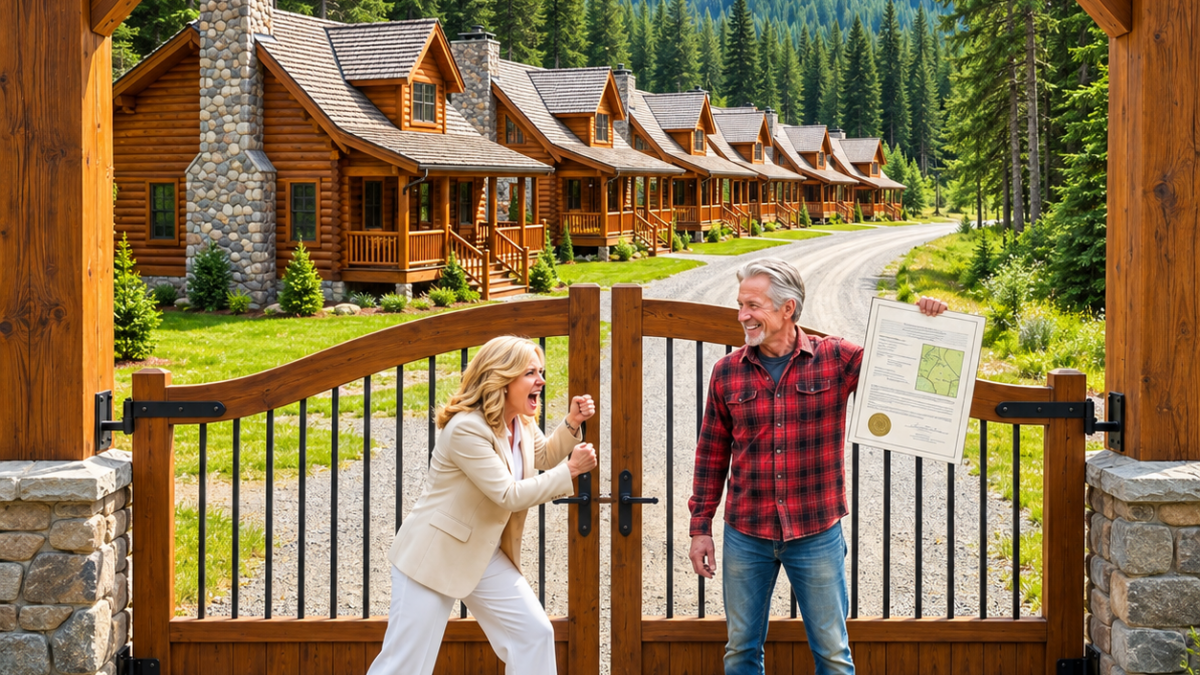
By the time the champagne tables were set inside the model cabin, fifty families had signed contracts on mountain homes built across eighty acres of forest my father bought in 1978, and not one of those buyers knew the road beneath their tires crossed land that had never legally belonged to the developer. t
Ray was beside me.
Phil Stanton, the independent surveyor, walked on my other side.
Nobody marched in with police.
Nobody announced arrests.
Real property litigation rarely arrives with handcuffs on cue.
It arrives with paper.
Thick paper.
Stamped paper.
Paper that makes lenders stop answering phones.
Inside the model cabin, fifty families sat in folding chairs beneath timber beams that had been stained to look older than they were.
Children wandered between rows.
A catering company had arranged champagne flutes beside a banner reading:
WELCOME TO MOUNTAIN LAUREL FOREST RETREATS.
Garrett Whitmore stood near the fireplace.
Tall.
Gray suit.
Expensive boots polished enough to reflect the recessed lights.
When he saw Ray, he stopped talking to the title-company representative.
Then he saw me.
His face lost what little color it had left.
Shelby stood.
She had been in the front row wearing burgundy.
Pearls.
Perfect hair.
For nine months, every time I saw her, she carried herself like someone who had already won.
That morning, she looked at my father’s survey tube and knew she had not.
Garrett crossed the room.
“What are you doing here?”
Ray answered.
“My client is an adjoining—and according to the pleadings, underlying—landowner.”
“This is a private closing event.”
Ray held up one hand.
“We’re not here to disrupt your customers.”
“You already have.”
One of the buyers stood.
“What’s happening?”
Garrett turned immediately.
“Nothing.”
The woman from the title company closed her eyes.
Bad word.
Nothing.
When fifty closings are frozen, nothing is the one answer nobody believes.
Another buyer asked:
“Why did my lender just say title is suspended?”
Then somebody else:
“Ours too.”
The room began to move.
Not physically.
Emotionally.
Whispers.
Phones.
Chairs scraping.
A little girl started crying because adults around her suddenly sounded frightened.
I hated that.
Those buyers had not cut my trees.
They had not moved a boundary.
They had not created anything.
They thought they were buying cabins.
Some had driven from Florida.
Some from Atlanta.
One couple had a rental truck parked outside.
They were victims of the same thing I was.
Just at a different end of it.
Ray stepped forward.
“My name is Ray Combes.”
Garrett said:
“Ray.”
Warning.
Ray ignored him.
“I represent Colton Mercer.”
He gestured toward me.
“There is a recorded title dispute involving the land beneath this development.”
Silence.
Not absolute.
You could hear the ventilation system.
Somebody’s phone vibrated against a folding chair.
Ray continued.
“A lawsuit was filed Thursday. Notices of pending litigation were recorded against the affected parcels. The title companies and lenders will make their own decisions, but based on what we’ve been told, today’s closings cannot proceed.”
A man in the third row stood.
“Are you saying these houses don’t belong to the developer?”
Ray chose his words carefully.
“We are saying the developer’s claimed boundary is being challenged and that our evidence shows the cabin sites are on Mr. Mercer’s deeded acreage.”
Garrett pushed forward.
“That is absolutely false.”
Phil opened a large portfolio.
Garrett looked at him.
“Who are you?”
“Phil Stanton.”
“Never heard of you.”
“I’m a licensed surveyor.”
Garrett’s mouth tightened.
Phil unfolded two maps across the dining table.
One was the 1978 plat.
The second was his current survey.
Then a third.
The survey Mountain Laurel had relied on.
Anybody could see the difference.
Even if you had never read a survey in your life.
The original western boundary followed terrain.
Creek.
Ridge.
Recorded monuments.
Old stone line.
The development survey cut through those references with a new line pulled far east.
A buyer near the table whispered:
“That’s not even close.”
Garrett said:
“You don’t understand surveying.”
Phil looked at him.
“I do.”
That ended that exchange.
Shelby finally spoke.
“This is a harassment campaign.”
I looked at her.
“No.”
“You’ve been threatening this community for months.”
“No.”
“You filed complaints against us.”
“I filed a title claim against your husband’s company.”
“You waited until today deliberately.”
That part was complicated.
I looked at Ray.
He did not rescue me.
Good lawyer.
Sometimes your client has to answer.
“I knew the closings were scheduled.”
People started talking again.
A woman said:
“So you used us?”
“No.”
She stared at me.
“You knew we were coming here.”
“Yes.”
“And you didn’t tell us?”
That hurt because it was fair.
“I didn’t have your names.”
“You had the development.”
“Yes.”
“You could’ve stopped construction months ago.”
Ray stepped in.
“We put the developer on formal notice of the title dispute before the project was completed.”
Every head turned toward Garrett.
There it was.
The part he had hoped nobody would ask about.
One buyer said:
“When?”
Ray opened his folder.
“June nineteenth.”
Another:
“You told them?”
“Yes.”
Garrett said:
“That letter was based on a meritless claim.”
Ray looked at him.
“Then you proceeded at your own risk.”
The title-company representative spoke for the first time.
“Mr. Whitmore.”
Garrett turned.
“Not now.”
“Yes. Now.”
Her name tag said CLARISSA HOLT.
She was maybe fifty.
Calm.
The kind of professional who had probably spent three decades surviving everyone else’s emergencies.
“Did you receive a written title objection in June?”
Garrett’s silence answered before his mouth did.
“Our counsel received correspondence.”
Clarissa’s face hardened.
“Was it disclosed to our underwriting team?”
“We believed it had no merit.”
“That isn’t what I asked.”
Shelby said:
“This is not the place—”
Clarissa turned toward her.
“Fifty purchasers are sitting here.”
Nobody interrupted after that.
Clarissa looked back at Garrett.
“Was a pending ownership dispute disclosed to the title underwriter before policies were prepared?”
Garrett loosened his tie.
“Our attorneys were handling it.”
Clarissa stepped away.
Pulled out her phone.
And suddenly the grand closing weekend was over.
Not officially.
But everybody knew.
One by one, buyers left the chairs.
Some demanded contracts.
Some called attorneys.
Some called banks.
One man walked outside and kicked the tire of his rented SUV.
The champagne stayed untouched.
I stood near the window.
Beyond the model cabin, cedar roofs stepped down the ridge.
Beautiful.
Truly beautiful.
That made it worse.
If the cabins had been ugly, maybe anger would have been easier.
But they were careful buildings.
Stonework.
Porches.
Black-framed windows.
Fireplaces.
They had taken my forest and turned it into something people genuinely wanted.
That was the tragedy.
Wrong could produce something attractive.
It was still wrong.
A woman approached me.
Mid-forties.
Blue sweater.
Her husband behind her.
Two boys near the door.
“I’m Dana Whitaker.”
“Colton.”
“I know.”
She looked through the window.
“Cabin twenty-eight.”
I nodded.
“We sold our lake place.”
“I’m sorry.”
“My husband retires next year.”
He raised one hand slightly.
“We wanted mountains.”
“I understand.”
“Do you?”
There was no anger in the question.
That made it harder.
“Yes.”
She looked at me.
“If the land is yours, what happens to us?”
“I don’t know.”
That answer surprised her.
“You filed fifty claims.”
“Yes.”
“You don’t know?”
“I know what my lawyer filed.”
I paused.
“I don’t know how the case ends.”
Her husband asked:
“Do you want the cabins?”
I looked toward the ridge.
“No.”
Then:
“Maybe.”
Truth.
“I want my land back.”
Dana folded her arms.
“With fifty houses on it.”
“Yes.”
She looked like she might cry.
I hated Garrett for putting us both there.
Not because he had beaten me.
Because he had made strangers stand across from each other feeling like one person’s justice had to be another person’s disaster.
I said:
“You didn’t do this.”
She looked at me.
“Neither did you.”
That was the first decent sentence anyone said that morning.
By noon, the parking lot emptied.
Moving trucks left.
Rental SUVs.
Families.
Catering van.
Title company.
Lenders.
At one fifteen, only four vehicles remained.
Mine.
Ray’s.
Phil’s.
Garrett’s Mercedes.
Shelby’s white Escalade.
We stood outside.
Wind moved through bare branches.
Garrett walked toward me.
“You think you won?”
Ray said:
“Garrett.”
Garrett stopped six feet away.
“You think filing paperwork means you own thirty million dollars in improvements?”
“No.”
That surprised him.
I continued.
“I think a judge is going to decide where my property line is.”
His eyes narrowed.
“And then?”
“Then we find out what your decision to keep building after notice costs you.”
Shelby stepped closer.
“You knew what you were doing.”
“So did you.”
Her expression flashed.
“Those families are innocent.”
“Yes.”
“You ruined their closings.”
“No.”
I pointed at Garrett.
“He sold them land he’d been warned he might not own.”
“You could’ve stopped this.”
“I tried.”
“You sent a letter.”
“Yes.”
“A letter.”
Ray said:
“That letter invited title resolution before further construction.”
Garrett laughed.
“Resolution?”
“Yes.”
“You demanded access for survey.”
“Which you denied.”
Garrett’s laugh disappeared.
Ray continued.
“You were offered mediation in July.”
Shelby looked at her husband.
That was new information to her.
Interesting.
Garrett said:
“I’m done talking.”
He turned.
Ray added:
“Preserve your records.”
Garrett stopped.
“Everything.”
Emails.
Survey instructions.
Title commitments.
Loan files.
Board communications.
Permit submissions.
All of it.
Ray did not list them aloud.
He simply said:
“You’ve been served with preservation obligations through counsel.”
Garrett looked at him.
Then left.
Shelby stayed.
For three seconds.
Maybe four.
She looked at me.
Then the forest.
“You could have sold us the acreage.”
“You never asked.”
“That’s not true.”
“You offered me money after you built.”
“That’s still an offer.”
I stared at her.
“Shelby, you told me that land had belonged to the development for two years.”
“It did according to the recorded survey.”
“You signed the board letter supporting that survey.”
She said nothing.
“You never called me.”
“We relied on professionals.”
“You told me to check my ‘little paperwork.’”
Her face changed.
She remembered.
Good.
I picked up Dad’s survey tube.
“My paperwork was fine.”
Then I walked to my truck.
That was the dramatic part.
The part people tell later.
Fifty closings.
Thirty million dollars frozen.
HOA president watching her development collapse.
But lawsuits do not end where Facebook stories usually do.
They begin there.
The next Monday, Ray called me at 7:03 a.m.
“You free?”
“I’m retired.”
“You say that like it means anything.”
“What happened?”
“Three motions.”
“Already?”
“Developer wants the notices canceled.”
“Of course.”
“They’re also asking for emergency declaratory relief.”
“Okay.”
“And the title underwriter filed a motion to intervene.”
I stared at the coffee pot.
“What does that mean?”
“It means we’re no longer in a two-party property fight.”
“When were we ever?”
“Fair.”
“Buyers?”
“Several hired counsel.”
I closed my eyes.
“How bad?”
“Messy.”
“Not what I asked.”
“It could be years if everyone decides to prove a point.”
I sat down.
“Ray.”
“Yeah?”
“I don’t want years.”
“Neither do they.”
That became leverage nobody had planned.
Not the cabins.
Time.
Garrett’s development loan was carrying interest.
Buyers had deposits tied up.
Lenders had files frozen.
The HOA had a political crisis.
Title insurers faced exposure.
Contractors had unpaid retainage.
I wanted land.
Everyone needed uncertainty to end.
That is what moved the case.
Judge Patricia Embry held the first emergency hearing seventeen days later.
No television.
No crowded courtroom.
Thirty lawyers.
That felt worse.
Garrett had three.
The title company had two.
Underwriter had outside counsel from Atlanta.
Seven buyers had separate lawyers.
Mountain Laurel HOA had one.
The survey firm had another.
County representatives sat in the back.
Ray had me.
And a yellow legal pad.
“Feeling underdressed?” I whispered.
“No.”
“You own one pen.”
“I bill by the argument, not accessories.”
Judge Embry entered.
Everyone stood.
The first issue was simple.
Should the notices remain on the cabin parcels while the title case proceeded?
Garrett’s attorney argued my claim was strategic interference.
That I had delayed seeking court relief while construction continued.
That removing the notices would protect innocent buyers.
Ray stood.
“Your Honor, my client objected before completion.”
He handed up the June letter.
“Requested survey access.”
Next document.
“Requested title mediation.”
Next.
“Produced his deed.”
Next.
“Produced the 1978 plat.”
Next.
“Respondents continued construction.”
Garrett’s lawyer said:
“Because their licensed survey established ownership.”
Ray nodded.
“Then the appropriate way to resolve conflicting surveys was adjudication before selling fifty homes.”
Judge Embry looked over her glasses.
That ended the exchange.
Not the case.
But the tone.
She kept the notices in place.
Then she ordered expedited discovery.
No transfers.
No new liens.
No occupancy.
No destruction.
No alterations except maintenance and winterization.
The cabins would sit.
The land would wait.
Just like me.
Discovery answered questions I had been asking for nine months.
Some answers made me sick.
Others were more ordinary than I expected.
The 2022 surveyor was Dale Kesler.
He had not invented the line from nothing in one criminal afternoon.
Reality was more bureaucratic.
Mountain Laurel’s planning consultant had provided him an old conceptual development map.
The map showed an “anticipated expansion area.”
Somehow that planning line got treated as if it represented ownership.
Kesler’s first draft included a note:
BOUNDARY REQUIRES OWNER-TITLE CONFIRMATION.
That note disappeared before recording.
Who removed it became important.
Emails showed a project manager asking Garrett:
Need title confirmation before final plat?
Garrett replied:
HOA has historical control docs. Shelby coordinating.
Another email from Kesler:
I still need source deed for eastern call. Current geometry does not reconcile with Mercer plat.
Garrett:
Use development control line per board confirmation. We are on schedule.
Not a confession.
Not yet.
Then an HOA board email.
Shelby to the board secretary:
Please prepare a letter confirming the eastern adjustment is consistent with Mountain Laurel’s long-range plan.
The secretary responded:
Are we confirming ownership or only plan consistency?
Shelby:
Plan consistency. Counsel can handle wording.
The final letter said:
The Mountain Laurel Estates Association confirms the adjusted boundary as consistent with the association’s historical development rights and approved expansion plan.
Historical development rights.
That phrase mattered.
Because there was no document conveying my land.
No deed.
No option.
No signed purchase agreement.
No easement allowing development.
Nothing.
They had treated a plan like a property interest.
Ray explained it at my kitchen table.
“Fraud is going to depend on intent.”
“I know.”
“Do not jump ahead.”
“I know.”
“They may have believed some old developer right existed.”
“Did it?”
“We haven’t found it.”
“What about the survey note?”
“Bad for them.”
“Removed note?”
“Potentially very bad.”
“But?”
“We still prove who removed it and why.”
I looked at Ellie’s photograph on the mantel.
“Does any of that change my boundary?”
“No.”
That was the difference.
Civil title was getting clearer.
Criminal intent was not.
I could live with that.
I wanted the land question answered.
The rest belonged to investigators.
Then Ray found the title commitment.
Three months before construction.
Mountain Laurel’s lender had ordered a title review.
Exception 14 listed:
Possible conflict with Mercer Parcel 47B along eastern project boundary; survey reconciliation recommended before vertical construction.
I read it twice.
“They knew.”
Ray corrected me.
“The project file knew.”
“That’s lawyer nonsense.”
“It’s important lawyer nonsense.”
“Garrett got this?”
“His CFO did.”
“Shelby?”
“Unknown.”
“Surveyor?”
“Referenced in email.”
I walked to the window.
Winter forest.
Bare gray trunks.
Cabin roofs.
“You think he can say nobody told him?”
“He can say anything.”
“Do you believe it?”
“That is not my job.”
“Ray.”
“My job is proving what matters.”
He tapped the title commitment.
“This matters.”
The criminal investigation into my burned shed stayed separate.
That was another thing the internet later ruined.
People tell the story as if Garrett burned my shed personally and got caught on video pouring gasoline.
No.
A camera had captured a truck similar to one associated with him near the area.
That was suspicious.
Not proof.
Fire investigators handled it.
They interviewed employees.
Pulled phone data through proper process.
Looked at vehicle records.
Months later, they identified a subcontractor named Bryan Lusk who had worked site security.
His truck matched.
He eventually admitted being near the shed.
He denied setting the fire.
Investigators developed additional evidence I was not shown at the time.
That case proceeded separately.
I did not confront him.
Did not follow anyone.
Did not play detective.
Losing twenty years of field notebooks taught me not to turn evidence into entertainment.
What survived the fire mattered most.
Dad’s 1978 deed was in the house safe.
My Corps notebooks were elsewhere.
Ellie’s journals were untouched.
One evening, I held the charred handle from Dad’s old chainsaw.
Hank Prior sat beside me.
He had been Dad’s friend.
Seventy-one.
Retired history teacher.
He looked at the burned foundation.
“You going to rebuild?”
“Eventually.”
“Same place?”
“I don’t know.”
He nodded.
Then:
“Your father hated that shed.”
I looked at him.
“What?”
“Roof leaked.”
“He built it.”
“Exactly.”
I laughed.
First time I had laughed there.
Hank continued.
“He always said he’d replace it.”
“He never did.”
“Farmers and old buildings.”
“I’m not a farmer.”
“You inherited the disease.”
We sat quietly.
Then Hank looked toward the cabin development.
“Those places are pretty.”
“I know.”
“That bother you?”
“Yes.”
“Because you want to hate them.”
“Yes.”
He nodded.
“That’s inconvenient.”
Everything about Hank was inconvenient.
In March, Judge Embry held the boundary trial.
Three days.
Not six months.
Expedited.
Phil testified first.
He explained the original calls.
Monuments.
Ridge.
Creek.
Stone wall.
Iron pipes.
Modern measurements.
Then Kesler’s survey.
Missing reconciliation.
Straight-line shift.
Eighty acres.
Garrett’s lawyer cross-examined hard.
“Mr. Stanton, surveys can differ, correct?”
“Yes.”
“Monuments can move?”
“Yes.”
“Creeks migrate?”
“Yes.”
“Old plats contain errors?”
“Yes.”
“Then why are you so confident?”
Phil looked at the judge.
“Because every independent category of evidence points the same direction.”
He listed them.
Deed calls.
Physical monuments.
Historical occupation.
Tax parcel.
Older plats.
Creek reference.
Stone wall.
Iron corners.
Aerial history.
Neighboring deed calls.
Then:
“The development survey is the outlier.”
That sentence did more work than an hour of argument.
I testified next.
Ray asked about Dad.
The purchase.
My surveying career.
The boundary.
Then June.
The notice letter.
The denied access.
My attempts to resolve.
On cross-examination, Garrett’s attorney came at the timing.
“You deliberately allowed construction to continue.”
“I did not authorize it.”
“That wasn’t my question.”
“I know.”
“You chose not to seek an immediate injunction.”
“Yes.”
“Why?”
“My attorney advised that ownership could be resolved without emergency relief if the developer would engage.”
“They didn’t.”
“No.”
“Yet construction continued.”
“Yes.”
“And you watched.”
“Yes.”
“You understood buildings were being completed.”
“Yes.”
“You understood buyers were being solicited.”
“Yes.”
“So you wanted the financial consequences to increase.”
Ray stood.
“Argumentative.”
Judge Embry said:
“Sustained.”
The lawyer tried again.
“Mr. Mercer, did you hope additional construction would improve your bargaining position?”
I thought carefully.
“Yes.”
Ray did not move.
Truth was better.
The lawyer looked pleased.
Then I added:
“After they were warned.”
He stopped smiling.
“I didn’t ask—”
Judge Embry looked at him.
“You opened it.”
He sat.
Garrett testified on day three.
He said he believed the land was Mountain Laurel’s.
He said professionals handled survey and title.
He said Shelby’s HOA role was separate from his company.
He said the Mercer parcel had been incorrectly mapped for decades.
Ray approached.
“Did you receive Mr. Mercer’s June nineteenth letter?”
“My counsel did.”
“Did you?”
“I was aware of it.”
“Did it include the 1978 plat?”
“Yes.”
“Did you stop construction?”
“No.”
“Why?”
“We believed our survey was correct.”
“Did you permit an independent joint boundary review?”
“We did not believe it was necessary.”
“Did your lender’s title commitment flag a Mercer conflict?”
Garrett paused.
“I don’t recall.”
Ray handed him the document.
“Refresh your recollection.”
Garrett read.
“Apparently.”
“Before vertical construction?”
“Yes.”
“Did you stop?”
“No.”
“Did Mr. Kesler request source-deed confirmation?”
“I don’t remember that email.”
Ray gave him the email.
Another pause.
“Yes.”
“Did you provide a deed showing Mountain Laurel owned the eighty acres?”
“We had development documents.”
“My question was deed.”
“No.”
“Purchase agreement?”
“No.”
“Option?”
“No.”
“Recorded easement allowing residential development?”
“No.”
“Any instrument signed by Colton Mercer?”
“No.”
Ray returned to counsel table.
That was the title case.
Judge Embry ruled two weeks later.
The Mercer boundary controlled.
The 2022 development survey could not overcome the deed and physical evidence.
The eighty acres were mine.
All fifty cabins stood on my land.
That did not mean I woke up owning thirty million dollars free and clear.
Ray explained it before I could enjoy the headline.
“The buildings create remedy questions.”
“I know.”
“Good-faith improver arguments.”
“They had notice.”
“Which hurts them.”
“Removal?”
“Possible.”
“Compensation?”
“Possible.”
“Conveyance?”
“Possible.”
“Settlement?”
“Most likely.”
I hated the word.
“Why?”
“Because tearing down fifty completed cabins damages everybody.”
“They cut down my forest.”
“I know.”
“They could restore it.”
“Not in your lifetime.”
That stopped me.
Eighty acres of hardwood.
Dad’s work.
Ellie’s ridge.
You can remove cabins.
You cannot reinstall sixty-year-old oaks.
I sat at the kitchen table.
Ray waited.
“What do you want the land to be in twenty years?” he asked.
Not tomorrow.
Twenty years.
That changed the question.
“I don’t know.”
“Then figure that out before mediation.”
Mediation took place in Atlanta.
Ten hours first day.
Nine second.
Everybody there.
Developer.
Lender.
Insurer.
Title company.
Survey firm.
HOA carrier.
Buyer representatives.
Me.
Ray.
Enough bottled water to survive a siege.
The first proposal from Garrett’s side was twelve million dollars for the eighty acres.
I sell.
They keep everything.
Buyers close.
Problem disappears.
“No.”
Ray didn’t even take it back.
Second offer.
Fifteen.
“No.”
Third.
Seventeen plus my attorney fees.
“No.”
Mediator asked:
“Mr. Mercer, what number buys the acreage?”
“None.”
That changed the negotiation.
Garrett came into our room personally.
Against lawyer advice, I assume.
“Then what do you want?”
I looked at him.
“My land.”
“It has fifty cabins.”
“I noticed.”
“You cannot turn it back into forest.”
“I know.”
“Then be realistic.”
Ray said:
“Garrett.”
I raised a hand.
“I am being realistic.”
I pulled out a map.
Not Dad’s.
Mine.
I had drawn it the night before.
The eighty disputed acres.
Cabins.
Roads.
Creeks.
Remaining timber.
Hummingbird Loop.
“What is this?” Garrett asked.
“A future.”
He stared.
I pointed.
“Thirty cabins here.”
Lower ridge.
Already heavily disturbed.
Road access consolidated.
Utilities installed.
“Those can remain residential.”
Then upper ridge.
Twenty cabins.
Closer to Ellie’s trail.
More fragmented forest.
“These come back to me.”
Garrett laughed.
“You want twenty finished cabins?”
“I want that land.”
“What will you do with them?”
“Not your concern.”
“It is if we’re settling.”
“Fine.”
I looked at him.
“I’m not tearing them down.”
His face changed.
Then I pointed to the thirty lower cabins.
“The original buyers get first opportunity to proceed, but with clean title through whatever settlement structure the lawyers build.”
Ray had helped formulate that.
No pretending I could simply “take their sales.”
What I could demand was that nobody close on my land unless my title rights were resolved.
That gave me a seat at every sale.
I continued.
“For every lower cabin that closes, the land component and part of the settlement proceeds go through escrow to resolve my claims.”
Garrett said:
“You want our sales revenue.”
“I want compensation for land, timber, damage, lost use, legal fees, and the risk you created after notice.”
“You’re asking for everything.”
“No.”
I pointed to the thirty lower cabins.
“You keep a viable project.”
Then the twenty upper ones.
“I keep this.”
He stared.
“What’s the number?”
Ray answered.
Not me.
“Cash component: nine-point-four million, plus conveyance of the twenty upper-ridge improvements and acreage already adjudged to Mercer, buyer-deposit protection, restoration escrow, fees allocated by agreement, and no further development north of the creek.”
Garrett actually laughed.
Then stopped when nobody else did.
“That’s insane.”
Ray shrugged.
“Then keep litigating.”
We did.
For three more months.
That mattered.
Settlements that look inevitable afterward are rarely inevitable while you are living them.
Garrett’s lender began foreclosure discussions.
The title insurer wanted resolution.
Buyer lawyers threatened separate claims.
Mountain Laurel homeowners demanded an audit of the HOA’s role.
Shelby was no longer giving triumphant speeches.
She was fighting to remain president.
Emails showed she had used HOA staff time to support development communications for her husband’s project.
Board minutes were incomplete.
Conflict disclosures were poor.
That did not automatically make her a criminal conspirator.
It did make homeowners furious.
At an emergency meeting, Mountain Laurel removed her as president.
Not 89 to 4.
Nothing cinematic.
Six board members voted.
Four for removal.
One against.
One abstained.
Residents filled the clubhouse anyway.
Hank went.
I did not.
He called afterward.
“She’s out.”
“How was it?”
“Sad.”
That surprised me.
“Sad?”
“She kept saying she thought the development would increase everybody’s values.”
“Probably did.”
“She said that’s why she supported it.”
“Do you believe her?”
Hank paused.
“Partly.”
That was probably right.
People rarely wake up thinking:
Today I will become the villain.
They tell themselves:
Progress.
Property values.
Jobs.
Tourism.
Community.
Efficiency.
Then each compromise makes the next one easier.
Shelby had crossed lines.
But maybe she crossed them believing the destination justified the route.
That did not excuse it.
It explained why she kept walking.
The criminal side developed separately.
Dale Kesler, the surveyor, surrendered his license during disciplinary proceedings.
Not because a complaint magically invalidated his survey.
Because his own file became impossible to defend.
Drafts lacked required reconciliation.
Source documents were incomplete.
He had signed a final plat after expressing unresolved concerns.
He later testified in a state investigation.
Garrett’s legal exposure grew.
Not every dramatic charge from the original story survived contact with prosecutors.
There was no instant eight-year sentence.
No courtroom arrest at closing.
There was, eventually, a plea involving false project records and improper representations connected to the development file.
The exact sentencing mattered less to me than the civil title result.
Shelby was not banned from every HOA in Georgia for life.
That kind of neat ending belongs on television.
She faced civil claims from homeowners and buyers, stepped away from Mountain Laurel, and eventually sold her house.
The shed arson case ended differently too.
Bryan Lusk, the security subcontractor, pleaded to property-damage and arson-related charges after investigators developed evidence beyond my camera image.
Nothing established that Shelby ordered it.
Garrett denied involvement.
The state did not prove otherwise.
I refused to turn suspicion into fact just because it made a better story.
Ray liked that.
“Facts are enough,” he said.
He was right.
The settlement finally happened in July.
Sixteen months after I found the first fresh stump.
Not thirty million dollars handed to me.
Better.
Because it solved the future.
Here’s what the agreement did.
The judgment confirming my boundary remained.
Mountain Laurel Development relinquished all claim to the disputed eighty acres.
The twenty upper-ridge cabins and their associated improvements were conveyed as part of the resolution.
The thirty lower cabins were placed into a structured resale process.
Original contract buyers received first opportunity to close under revised agreements after clean title was established.
Sale proceeds did not simply become “mine.”
They flowed through escrow.
From that escrow came lender payoffs, buyer credits, contractor settlements, transaction costs, and the negotiated compensation owed to me.
My portion—land value, timber damages, lost use, litigation expense allocation, and negotiated settlement—was substantial.
Large enough that I never needed to work again.
I already wasn’t.
But that wasn’t the part that mattered.
Every single one of those thirty eventual sales required my title participation.
My signature.
My release.
My deed structure.
Nothing closed around me anymore.
That was what the title meant when people later said:
Colton took every sale.
I did not take the buyers’ money.
I took back control of transactions that should never have been possible without me.
Dana Whitaker was the first buyer to call.
“Cabin twenty-eight.”
“I remember.”
“Ray says we can still buy.”
“If you want to.”
“At the same price?”
“No.”
Silence.
I continued.
“Lower.”
Another silence.
“Why?”
“Independent appraisal came in below your contract.”
She laughed once.
Not because it was funny.
Relief.
“How much lower?”
I told her.
She started crying.
That scared me.
“Dana?”
“I’m here.”
“You okay?”
“We thought we lost everything.”
“You didn’t.”
“We already hired a lawyer.”
“Keep the lawyer.”
She laughed through it.
“Of course you’d say that.”
“Yes.”
Her husband came on speaker.
“Mr. Mercer?”
“Colton.”
“Why are you doing this?”
“What?”
“Letting us buy.”
I looked out toward Hummingbird Loop.
“Because you bought a cabin.”
Not my land.
Not Garrett’s fraud.
A cabin.
A future.
“You did not move my boundary.”
He was quiet.
“Thank you.”
Thirty buyers had choices.
Twenty-six proceeded.
Four walked away and received negotiated deposit protections through the settlement structure.
The four cabins they left later sold normally.
By fall, thirty families legally owned lower-ridge retreats on parcels carved out through new deeds from me.
That was strange.
One year earlier, I would have said no part of those eighty acres would ever leave Mercer ownership.
Then life happened.
I did not feel like I betrayed Dad.
I wondered if I would.
I didn’t.
Dad cared about land because he thought stewardship meant paying attention.
Not freezing time.
The lower ridge was already changed.
Roads.
Utilities.
Cabins.
Destroying all of it to prove a point would not bring the trees back.
So I used the changed land carefully.
The twenty upper-ridge cabins became another question.
Ray asked:
“Sell them?”
“No.”
“Rent?”
“Maybe.”
“Private retreat?”
“No.”
“Then?”
I thought about Ellie.
Three years before she died, we spent a week at a veterans’ family retreat in North Carolina.
Not because either of us needed services.
A friend ran it.
We volunteered.
Ellie taught kids how to identify wildflowers.
I repaired trail signs badly.
On the drive home she said:
“Places where nobody expects anything from you are rare.”
I remembered that sentence.
So I called Hank.
“You busy?”
“I’m seventy-two.”
“That is not an answer.”
“What do you want?”
“I have twenty cabins.”
He was silent.
Then:
“That is a ridiculous sentence.”
“I know.”
I told him the idea.
Veterans.
Gold Star families.
Caregivers.
Families dealing with illness.
Not a giant nonprofit empire.
A modest retreat.
Free stays funded by part of the settlement and rental income from a few cabins during open weeks.
Hank said:
“Ellie’s Ridge.”
I swallowed.
“You named it fast.”
“She named it years ago.”
He was right.
We formed a nonprofit.
Slowly.
Lawyer.
Accountant.
Board.
Insurance.
Operating budget.
No heroic shortcuts.
The first year, we opened eight cabins.
Then twelve.
Eventually all twenty.
Not every week free to everybody.
That would have burned through money in a year.
We partnered with established organizations that referred families.
Some weeks cabins were reserved for retreat programs.
Some were rented commercially to fund operations.
The balance worked.
Each porch got a hummingbird feeder.
That was Hank’s idea.
“Too sentimental?” he asked.
“No.”
“Good.”
Hummingbird Loop reopened too.
I had avoided it for five years.
The first time I walked it again, I got fifty yards.
Stopped.
Ellie’s trumpet vine climbed the old fence post exactly where she had left it.
Ruby-throated hummingbird hovering near the flowers.
Tiny wings invisible.
Green back flashing.
I sat on a rock.
Couldn’t continue.
Hank was with me.
He said nothing.
Eventually I said:
“I thought this would get easier.”
He looked down the trail.
“Did someone promise that?”
“Everybody.”
“Everybody lies at funerals.”
That made me laugh and cry at the same time.
We finished the loop.
Two miles.
Slow.
The upper ridge looked different now.
Cabins between trees.
But not destroyed.
We planted heavily.
Oaks.
Sourwoods.
Dogwoods.
Hemlock restoration where possible.
Native understory.
Removed decorative turf the developer had installed.
Reduced lighting.
Changed drainage.
Added wildlife crossings.
It would never be Dad’s forest again.
It became something else.
I had to learn that restoration is not rewind.
It is responsibility after damage.
The Thomas Mercer Conservation Fund came later.
Not 160 acres magically locked forever by one signature.
I worked with a land trust and attorneys to place a conservation easement on the remaining core forest, with terms tailored around forestry, trails, habitat, and the portions I intended never to subdivide.
I kept ownership.
Development rights were restricted.
The document was longer than some novels.
Dad would have complained.
Then read every page twice.
A scholarship came after that.
Small.
One student a year.
Forestry.
Surveying.
Land management.
Rural students preferred, but not required.
Hank insisted surveying be included.
“Your entire story exists because people stopped reading surveys.”
“Fair.”
The first recipient was a girl named Nora Bell.
Nineteen.
Her father ran a grading company.
She wanted to become a licensed surveyor.
At the scholarship dinner she said:
“My dad told me surveyors are the people who tell contractors they built the road wrong.”
I said:
“Your father is wise.”
She looked at me.
“He also called you the man who stole fifty cabins.”
I closed my eyes.
Hank laughed into his water.
“That is not what happened.”
“I know.”
“Good.”
“Mostly.”
“Please learn title law before graduation.”
She smiled.
Nora later interned with Phil Stanton.
Full circle.
Shelby disappeared from my daily life.
For years.
Then one Tuesday afternoon, I saw her in Gainesville.
Grocery store.
Canned tomatoes aisle.
No pearls.
No white blazer.
Jeans.
Gray sweater.
She saw me at the same time.
Both of us stopped.
There is no good etiquette for meeting the former HOA president who helped turn your forest into a legal war.
“Colton.”
“Shelby.”
She looked older.
So did I.
“How are you?”
“Fine.”
“You?”
“Fine.”
We stood beside canned beans.
America.
Eventually she said:
“I heard about Ellie’s Ridge.”
“Okay.”
“My sister’s husband stayed there.”
That surprised me.
“What?”
“Vietnam veteran.”
I knew the group.
Did not know the connection.
“He was there in May.”
“How is he?”
“He talks about the hummingbirds.”
I looked at the shelf.
“Good.”
Shelby touched her cart.
“I owe you an apology.”
I waited.
This was not the moment I had imagined for years.
No courtroom.
No board meeting.
No cameras.
Canned tomatoes.
“I told myself Garrett’s survey people knew better than you did.”
She looked at me.
“Then when you objected, I told myself you were angry about progress.”
I said nothing.
“And when the title letter came…”
She stopped.
“You saw it?”
“Yes.”
That mattered.
“I saw the June letter.”
“Did Garrett?”
“Yes.”
There it was.
Not legal evidence now.
The case was over.
Just truth.
“I told him to stop.”
I looked at her.
“You did?”
“Once.”
“What happened?”
“He said stopping would destroy financing.”
“And?”
“I let him convince me.”
She swallowed.
“Then I defended it because admitting he was wrong meant admitting I had helped.”
That sounded human.
Painfully human.
“What about the board letter?”
“I signed it.”
“I know.”
“I should not have.”
“I know.”
She nodded.
No argument.
Then:
“I was cruel to you.”
“Yes.”
“You were cruel back.”
I almost objected.
Then thought about every private fantasy of watching their development collapse.
“Yes.”
She smiled slightly.
“Fair.”
I asked:
“Why didn’t you tell the board about Garrett’s conflict?”
She looked toward the end of the aisle.
“I thought everybody knew we were married.”
“That’s not disclosure.”
“I know that now.”
We stood there.
Then she said:
“I’m sorry about Ellie’s ridge.”
That almost ended me.
Not the land.
Not the money.
Ellie’s ridge.
“You used her photograph.”
“I didn’t know.”
“Garrett’s marketing team did.”
“I know.”
“Still.”
“Yes.”
I looked at her.
“Thank you.”
Not forgiveness ceremony.
No hug.
No redemption speech.
Just two older people in a grocery store admitting what happened.
Then she said:
“The cabins are prettier now.”
I laughed.
She did too.
“Less turf.”
“Garrett loved turf.”
“I noticed.”
She pushed her cart away.
At the aisle end, she stopped.
“Colton?”
“Yeah?”
“Do you ever wish you’d stopped us sooner?”
That question followed me home.
I thought about it all evening.
Then overnight.
Then while walking Hummingbird Loop the next morning.
Would Dad’s trees still exist if I had gotten an injunction immediately?
Some.
Maybe many.
Would the cabins exist?
Probably not.
Would fifty families have gone through months of fear?
No.
Would Ellie’s Ridge exist?
No.
Would I have needed it?
No.
There is danger in turning outcomes into justification.
I knew that.
A good ending does not make every earlier choice good.
So I called Ray.
He answered:
“What did you break?”
“Nothing.”
“Then why are you calling?”
“Do you think we waited too long?”
Silence.
He knew immediately what I meant.
“We sent notice.”
“I know.”
“We sought voluntary resolution.”
“I know.”
“You made a strategic choice not to seek immediate injunctive relief.”
“Yes.”
“Would I advise the same choice in every case?”
“No.”
“Would you advise it now?”
Long pause.
“Maybe not.”
That was Ray.
No mythology.
I sat on my porch.
“Why?”
“Because damages can be compensated.”
“And?”
“Mature forest can’t.”
I looked toward the ridge.
Exactly.
He continued.
“We got a strong result.”
“Yes.”
“That doesn’t mean the path was perfect.”
“No.”
“Do you regret it?”
“Some.”
“Good.”
“Good?”
“Only idiots leave litigation thinking every decision they made was brilliant.”
I smiled.
“Thanks.”
“Billable insight.”
“You’re retired.”
“Habit.”
After that call, I changed the story I told.
People wanted the simple version.
HOA stole forest.
Quiet surveyor waited.
Fifty closings frozen.
Developer crushed.
Cabins taken.
Justice.
Easy.
I started telling the harder version.
They were warned.
They kept building.
I waited.
That increased leverage.
It also allowed more damage.
Both can be true.
Knowing law is not the same as knowing what should be done.
Winning does not purify every strategic choice.
That mattered because Nora Bell started bringing surveying students to the property.
Once a year.
Phil retired.
Nora took over his field trip.
Twenty students in orange vests walking Dad’s old line.
I met them at the stone wall.
She would say:
“Mr. Mercer, tell them what happened.”
I always started:
“First, stop calling me Mr. Mercer.”
Nobody stopped.
Then:
“Second, do not learn the wrong lesson.”
That got their attention.
“The lesson is not to wait until fifty buildings are finished so you can take them.”
Students laughed.
“I’m serious.”
Then I would point at the iron pipe.
“The lesson is that a line on a computer is not a substitute for reconciling deeds, monuments, possession evidence, adjoining calls, and field conditions.”
That was the survey lesson.
Then:
“And if you discover a conflict, resolve it before somebody pours concrete.”
That was the human lesson.
Nora would nod.
Every year.
The cabin buyers became neighbors.
That was another strange outcome.
Dana and her husband, Michael, bought cabin twenty-eight.
They came most weekends after his retirement.
One Saturday, Dana appeared on my porch holding a pie.
“Why does everybody bring pie?”
“Because you look like a man who forgets dessert.”
Fair.
She sat.
“We’re replacing the hot tub.”
“Okay.”
“I wanted to make sure there isn’t some weird restriction.”
I laughed.
“You own your parcel.”
“I know.”
“Check the declaration for the lower-ridge association.”
“Already did.”
“Then why ask me?”
She looked toward the forest.
“Habit.”
That was funny and sad.
The lower thirty cabins had their own small owners’ association eventually.
Not Mountain Laurel.
A road-maintenance association.
Minimal.
Snow.
Private road.
Shared well infrastructure in a few sections.
No mailbox-color committee.
Dana became president.
I teased her relentlessly.
“HOA Karen.”
“Keep talking and I’ll regulate your pie intake.”
“Abuse of power.”
She was good at it.
Transparent budget.
Written votes.
Conflicts disclosed.
No landscaping patrol.
At the first annual meeting, she invited me.
I declined.
“You own no unit here anymore,” she said.
“Exactly.”
“You carved our lots.”
“Regret everything.”
“You’re giving a five-minute history.”
“No.”
She put my name on the agenda.
I went.
Five minutes.
I told them:
“You all know the title story.”
They did.
“You also know I was angry.”
A few nodded.
“I need you to understand one thing.”
I looked around.
“You are not living on stolen land anymore.”
Silence.
“You bought clean deeds.”
I had signed many.
“This is your community.”
Dana watched me.
“I don’t want your kids growing up thinking they live in cabins some old man still claims emotionally.”
A child near the back whispered:
“He’s not that old.”
I smiled.
“Thank you.”
Then:
“The line is settled.”
That felt good.
Maybe better than the judgment.
A boundary dispute ends legally when a court enters judgment.
It ends emotionally when everybody stops expecting it to move again.
My father’s cast-iron skillet finally cracked when I was seventy-one.
I had been cooking cornbread.
He would have blamed me.
Hank said:
“You can weld cast iron.”
“Not that.”
“Sentimental?”
“Yes.”
“Thought you hated sentimental.”
“I hate other people being sentimental.”
“Healthy.”
I hung the skillet in the cabin.
Bought another.
Life.
Hank died at seventy-eight.
Stroke.
Fast.
His funeral packed the high-school auditorium because he had taught thirty-five years and apparently remembered every student’s name.
At the service, his daughter handed me an envelope.
“He left this for you.”
Inside:
Colton—
Stop turning every dead person into a land-use project.
Take a vacation.
—Hank
I laughed at a funeral.
Loud.
People stared.
Perfect Hank.
I did take a vacation.
Maine.
Two weeks.
No property disputes.
No surveys.
I hated it for three days.
Then loved it.
When I returned, Ellie’s Ridge was full.
A group of military caregivers.
I stayed away.
That was important.
The retreat was not mine in the emotional sense anymore.
People needed space without the founder walking around explaining trees.
Sunday morning, one woman found me on Hummingbird Loop.
Late thirties.
Her husband had been injured in Afghanistan.
She said:
“Are you Colton?”
“Unfortunately.”
She smiled.
“My daughter said there’s a man who knows every tree.”
“She exaggerates.”
“She wants to know why there are so many hummingbird feeders.”
I told her about Ellie.
She listened.
Then said:
“My husband hasn’t slept through a night in six years.”
I did not know what to say.
She continued.
“He slept nine hours yesterday.”
“That’s good.”
“He says it’s the quiet.”
I looked toward the cabins.
“Ellie liked quiet.”
The woman touched one trumpet-vine leaf.
“Thank you.”
I hated praise.
Still do.
So I said:
“Tell your daughter hummingbirds are territorial little jerks.”
She laughed.
Better.
Years went on.
The settlement money became less dramatic.
It moved into accounts.
Taxes.
Trusts.
Reserve funds.
Insurance.
Nonprofit endowment.
Boring adult systems.
The number thirty million stopped meaning anything because thirty million had never been mine.
That was the developer’s projected sales value.
A headline.
A symbol.
What I actually gained was enough.
Land restored to the record.
Twenty cabins.
Settlement funds.
Control of subsequent transactions.
Compensation.
A future.
Enough.
That word became more important as I got older.
Enough.
Garrett eventually disappeared from local development circles.
The plea case, civil judgments, lender losses, and professional reputation did what prison fantasies didn’t need to.
His company dissolved.
I heard he moved to Florida.
Maybe true.
Maybe not.
I stopped checking.
Shelby’s old HOA changed too.
New board.
Outside management.
Conflict-of-interest policy.
Written land-use review.
Independent title verification for expansion projects.
Again, boring.
Useful.
One year, their new president, Angela Ruiz, called me.
“Mr. Mercer?”
“Colton.”
“We’re replacing a trail bridge near your north boundary.”
“Okay.”
“We had it surveyed.”
“Good.”
“We want to show you before construction.”
I almost laughed.
“What?”
“Nothing.”
“Would Tuesday work?”
“Yes.”
Tuesday, they came.
Engineer.
Surveyor.
Angela.
Me.
We walked the line.
Bridge entirely on their land.
Temporary access request over twelve feet of mine.
Written agreement.
Insurance.
Restoration.
I signed.
Construction happened.
Nobody sued anybody.
At the end, Angela sent me photographs and a thank-you.
I put that letter in Dad’s old file cabinet.
Not because I expected court.
Because paperwork can record peace too.
When I turned seventy-five, Nora brought a group of students out.
One kid asked the question everybody eventually asks.
“If the developer offered you thirty million for everything now, would you sell?”
“No.”
“Forty?”
“No.”
“Fifty?”
“No.”
He smiled.
“A hundred?”
I looked around.
Dad’s trees.
New trees.
Cabins below.
Hummingbird Loop.
Ellie’s trumpet vine.
“Depends.”
The students laughed.
They expected the heroic never.
But life taught me not to perform absolutes for strangers.
Nora said:
“What would it depend on?”
I looked at her.
“What happens to it afterward.”
That was the true answer.
Money was not the opposite of stewardship.
Indifference was.
If somebody offered an absurd amount and permanently protected the forest better than I could, maybe.
If they wanted another resort?
No.
No number.
Ownership is temporary.
Dad owned it.
Then me.
Someone else will.
The question is what condition the land is in when your name leaves the deed.
I updated my estate plan that year.
Not dramatic.
Necessary.
The conservation easement stays.
Ellie’s Ridge stays nonprofit.
The lower-ridge road agreements stay.
The cabin operation keeps reserves.
Scholarship continues while funds permit.
Hummingbird Loop remains open to retreat guests and limited educational groups.
My niece Katherine becomes successor trustee.
Nora gets a small advisory role on boundary matters.
She complained.
“I don’t want your boundary problems after you die.”
“That’s why you’re perfect.”
“You’re horrible.”
“Licensed professionals deserve challenges.”
I left Dad’s survey tube to the county historical society.
That surprised Katherine.
“You’re not keeping it in the family?”
“No.”
“Why?”
“People should see it.”
The 1978 plat mattered because it was used.
Documents hidden in closets protect less than documents understood.
The historical society agreed to display a reproduction, not the fragile original.
Good.
The caption:
MERCER PARCEL 47B SURVEY, 1978
A DOCUMENT CENTRAL TO A MAJOR RAVEN COUNTY TITLE DISPUTE
No mention of thirty million.
No HOA Karen.
No “man takes fifty cabins.”
I liked that.
The older I get, the more suspicious I become of stories that fit neatly on plaques.
One June morning, I walked Hummingbird Loop alone.
Slow now.
My knees complain on the climb.
At the first bend, a ruby-throat hovered beside the trumpet vine.
Same place.
Maybe not the same bird.
Of course not.
But continuity plays tricks on us.
I stopped.
Ellie once wrote:
The mountains are breathing.
I had found that line in her journal years after the development brochure stole a similar image.
For a long time, that made me furious.
Now it made me smile.
Because the brochure was gone.
The company was gone.
The marketing videos were gone.
Ellie’s handwriting remained.
I carried a photocopy in my wallet.
Ridiculous thing to carry.
I took it out.
Read it.
Then continued uphill.
From the ridge, I could see both worlds.
Lower cabins.
Thirty privately owned roofs tucked through trees.
Cars.
Children.
Smoke from fireplaces.
Then upper ridge.
Ellie’s Ridge.
Twenty cabins.
Quiet.
Hummingbird feeders.
New oaks.
Beyond that, protected forest rolling toward the county line.
Someone once tried to move my boundary twelve hundred feet with a computer line.
For a while, I thought the victory was moving it back.
It wasn’t.
The victory was learning that a boundary is only the beginning of the question.
Once you know what is yours, you still have to decide what kind of owner you will be.
Angry?
Patient?
Punishing?
Careful?
I had been all four.
Some days in the same hour.
When people retell the story, they always love the closing weekend.
Of course they do.
Champagne untouched.
Fifty transactions frozen.
Developer sweating.
HOA president realizing the quiet widower had documents.
Good scene.
But the moment that matters most to me happened two years later.
Dana’s oldest grandson got lost on Hummingbird Loop.
Not badly.
Seven years old.
Wandered ahead during a family walk.
By the time adults realized, he had followed the wrong fork toward Ellie’s Ridge.
A retreat volunteer found him sitting on a log.
Crying.
She brought him to my cabin because I was closest.
I gave him hot chocolate.
Too much.
He told me:
“Grandpa says this used to all be yours.”
I smiled.
“Some still is.”
“Did they steal it?”
Children hear everything.
“People made serious mistakes about who owned what.”
“Did you beat them?”
I thought about Garrett.
Shelby.
Ray.
Phil.
Buyers.
Judges.
Surveyors.
Lawyers.
Trees.
Ellie.
“No.”
He frowned.
“But Grandpa said—”
“I got the land question fixed.”
“That’s beating.”
“Maybe.”
He drank chocolate.
Then:
“Do you hate the people in our cabins?”
“No.”
“Why?”
I looked toward the lower ridge.
“Because you’re in one.”
He smiled.
Then spilled hot chocolate on Dad’s old kitchen table.
Perfect.
Dana arrived ten minutes later terrified.
She hugged him.
Then me.
Then apologized for hugging me.
I told her:
“Property rights don’t prohibit hugging.”
She cried harder.
After they left, I wiped chocolate from the table.
That was when I understood the case was really over.
Not when Judge Embry ruled.
Not when settlement papers were signed.
Not when Garrett’s company dissolved.
When a child from one of those disputed cabins could get lost on my trail and end up safe in my kitchen.
No sides.
Just neighbors.
Last year, I found another glossy brochure in an old file.
MOUNTAIN LAUREL FOREST RETREATS.
YOUR ESCAPE STARTS HERE.
I almost threw it away.
Instead, I brought it to the historical society with the survey.
Not because Garrett deserved preservation.
Because bad records matter too.
History becomes dishonest when we save only the documents that make us look wise.
They displayed the brochure beside the maps.
People can see the aerial photo.
Ellie’s ridge.
Cabins superimposed.
Marketing language.
Then the survey conflict.
Then the final boundary.
A school group came through once while I was there.
Teacher recognized me.
“Mr. Mercer, would you speak?”
“No.”
Students looked disappointed.
Then one raised his hand.
“Did you really get thirty million dollars?”
I sighed.
Teacher laughed.
“See?”
I faced them.
“No.”
“What?”
“I did not get a thirty-million-dollar check.”
“Then the internet lied?”
“Frequently.”
I explained.
Projected sales.
Title freeze.
Settlement.
Escrow.
Twenty cabins.
Thirty sales.
Compensation.
Nobody looked as excited.
Good.
One girl asked:
“So why does everybody say you took all the sales?”
“Because every sale had to stop until my ownership rights were resolved.”
“And then?”
“Then no closing happened without the clean title structure created through the settlement.”
She nodded.
“That’s still cool.”
“Thank you.”
Another boy asked:
“Did the HOA lady go to jail?”
“No.”
“Developer?”
“Legal consequences, but not the dramatic version you probably saw online.”
He looked disappointed too.
I continued:
“The interesting part is not punishment.”
A teenager actually rolled his eyes.
Fair.
“The interesting part is fifty expensive houses nearly changed hands because enough people trusted a bad boundary without resolving contradictory evidence.”
That got the teacher’s attention.
Maybe not the students.
Yet.
Then Nora, who was with the group, said:
“Which is why we verify our control.”
Now they listened.
She was better at teaching.
I stepped away.
Outside the historical society, I sat on a bench.
Ray joined me.
Eighty now.
Retired.
Still carries one yellow legal pad everywhere.
“You ruined their story,” he said.
“Good.”
“They wanted revenge.”
“They got title procedure.”
“Cruel.”
I looked at him.
“You really said wait until champagne?”
He smiled.
“Something like that.”
“I blame you for everything.”
“Your invoice was paid years ago.”
“You said I’d get everything.”
“I was younger.”
“You were sixty-three.”
“Very young.”
We watched kids climb into a school bus.
Then Ray said:
“Would you do it differently?”
There it was again.
Years later.
Same question.
“Yes.”
He waited.
“I’d seek court review sooner.”
He nodded.
“But I’d still fight.”
“Obviously.”
“I’d still refuse the two-hundred-thousand-dollar release.”
“Obviously.”
“I’d still keep the upper ridge.”
“Good.”
“I’d still let the innocent buyers proceed.”
“Good.”
“And Ellie’s Ridge?”
I looked toward the mountains.
“Every time.”
Ray closed the legal pad.
“That’s enough.”
Maybe it was.
That evening, back home, I cooked cornbread in the replacement skillet.
Not Dad’s.
Mine.
That distinction finally felt okay.
After dinner, I walked to Hummingbird Loop.
Slow.
The cabins below were lit.
Some privately owned.
Some belonging to the retreat.
From far away, you could not tell which was which.
That pleased me.
No visible hierarchy.
No victory flags.
No plaques saying THIS ONE WAS WON IN LITIGATION.
Just warm windows in trees.
At the trail junction stands one simple sign.
LOWER RIDGE RESIDENCES →
ELLIE’S RIDGE RETREAT ↑
MERCER CONSERVATION LAND — FOOT ACCESS ONLY
Three directions.
Three futures that came out of one bad survey.
I touched the signpost.
Then kept walking.
At the first trumpet vine, hummingbirds moved in the fading light.
Ellie would have liked the place.
I think.
She would also have told me I became unbearable during litigation.
She would have liked Dana.
Hated Garrett’s brochure.
Loved Nora.
Argued with the nonprofit board.
Rearranged every cabin’s furniture.
And she absolutely would have stolen the best porch for herself.
That thought made me laugh.
Alone in the woods.
The sound carried down the ridge.
For years, the forest had been where I went because I did not have much left to say.
Then people cut roads into it.
Built cabins.
Filed paper.
Started fights.
Forced me back into the world.
I hated them for that.
Then, somewhere between lawsuits and hummingbird feeders, the world stayed.
People came.
Families rested.
Students learned.
Neighbors walked.
Trees returned slowly.
Not the same trees.
That is important.
Restoration is not pretending damage never happened.
It is deciding damage does not get the final word.
The title of the story will probably always be dramatic.
HOA Built 50 Cabins Worth $30M On My Forest — So I Waited Until Closings Then Took Every Single Sale.
Fine.
Tell it that way if you need the headline.
But here is what actually mattered.
They drew a line where no line belonged.
My father had taught me how to find the old one.
My wife had taught me why the land was more than acreage.
My lawyer taught me patience.
The buyers taught me that innocent people can stand on the other side of your lawsuit.
And the forest taught me something slower.
Ownership is not winning possession.
Ownership is what you do after the judge says the land is yours.
I reached the highest bend just before dark.
Below me, thirty privately owned cabins glowed along the lower ridge.
Twenty retreat cabins were quieter above them.
Beyond both, the protected forest faded into blue.
A hummingbird hovered near Ellie’s vine.
Then disappeared into the trees.
For a long time, I stood there listening.
No excavators.
No nail guns.
No lawyers.
Just wind.
Leaves.
A creek somewhere below.
The mountains breathing.
And this time, nobody needed a survey to tell me exactly where I was.