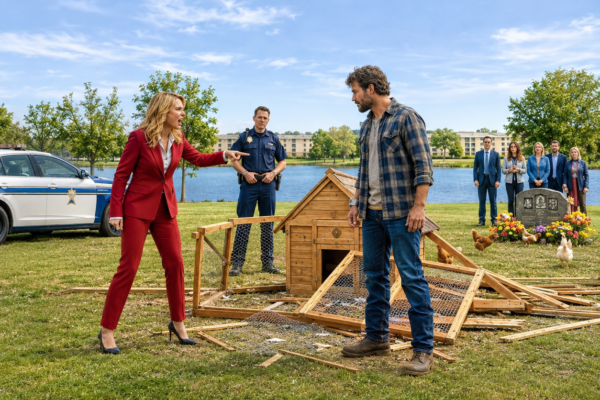
Carol Whitmore stopped mid-power-walk in front of my house because the harmless six-legged unicorn she had forced my daughter to wash away had been replaced by a photorealistic canyon that appeared to split my front walk open into glowing orange rock. T
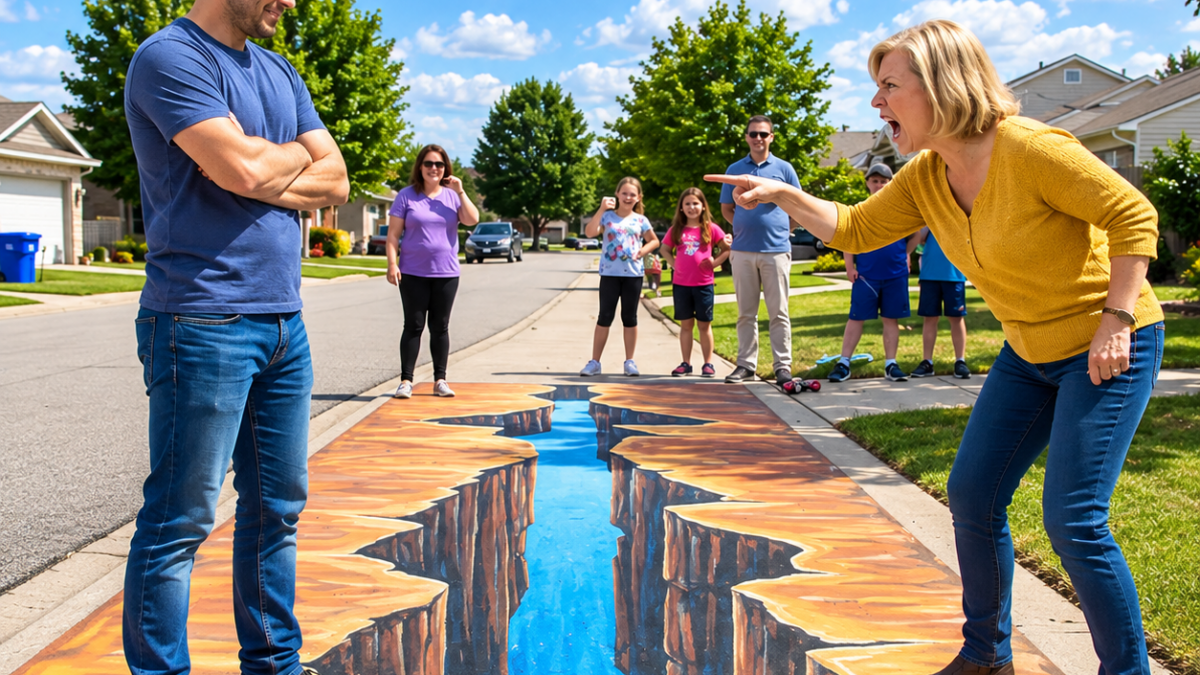
This time, Carol did not scream.
She stood at the end of my driveway with her phone in one hand and her stainless-steel water bottle in the other.
For maybe fifteen seconds, she simply stared.
Julian had outdone himself.
What looked like a clear river began near our garage and flowed toward the sidewalk in impossible perspective.
Blue-green water curved between painted banks.
Koi floated beneath the “surface.”
Lily pads cast shadows that weren’t really there.
A wooden footbridge seemed to rise three inches above perfectly flat concrete.
And along the banks were little cartoon versions of neighborhood kids.
Leo holding a sketchbook.
Mia riding Sparkle Hoof, who still had six legs because my daughter refused to compromise her artistic vision.
Gary’s son Ethan flying a kite.
The Gable twins chasing a butterfly.
Mrs. Alvarez’s little girl kneeling beside a painted frog.
No caricature of Carol.
No tentacle stealing her flowers.
No gnome being eaten.
Nothing aimed at her.
Julian had been firm about that.
“First piece was mischief,” he told me the night before.
He stood in our garage studying his perspective sketch while I held a pizza box.
“Second piece has to be better than your argument.”
“What does that mean?”
“It means if she says it’s ugly, everyone should know she’s lying.”
Sarah, sitting on the workbench, pointed at him.
“That. I like that.”
I said, “I was thinking maybe a shark wearing an HOA badge.”
Julian shook his head.
“You want revenge.”
“A little.”
“I want a portfolio piece.”
Sarah raised her beer.
“Artist wins.”
So we made the river.
And now Carol was staring at it.
Children were already gathering.
Not on the art.
Julian had marked the best viewing point with a small piece of painter’s tape so nobody would accidentally step into his working area while he finished the shadows.
Leo was explaining forced perspective to Ethan with the confidence of a tenured professor.
Mia was telling everyone Sparkle Hoof had “been upgraded for water.”
I never understood what that meant.
Carol lifted her phone.
I walked toward her.
“Morning.”
She did not look at me.
“Is this another commissioned piece?”
“Yes.”
“Professional?”
“Yes.”
“Paid?”
“That is generally how professional works.”
Sarah was watching from the porch.
I could feel her disapproval from thirty feet away.
I corrected myself.
“Sorry. Yes. I hired Julian again.”
Carol finally looked at me.
“You are doing this specifically because I complained.”
There are moments in conflict where the emotionally satisfying answer and the useful answer stand beside each other.
The satisfying answer was:
Absolutely.
The useful answer was:
“The first one? Partly.”
Carol’s eyes narrowed.
“And this?”
I looked at the river.
Kids laughing.
Mrs. Gable taking pictures.
Julian adding a tiny white highlight to a koi.
“This one is for them.”
Carol did not believe me.
Which was fair.
I had not yet fully believed myself.
She photographed the whole piece.
Then the property boundary.
Then Julian.
Then me.
Then she walked home.
Gary came across the street carrying coffee.
“Was that it?”
“For now.”
“I thought she’d explode.”
“I think we disappointed her.”
He looked at the river.
“Man.”
“What?”
“That is ridiculous.”
“Good ridiculous?”
“Very.”
His son yelled:
“Dad! Stand on the bridge!”
Gary walked over to the viewing mark.
Julian positioned him.
From my phone camera, Gary looked like he was standing on a wooden bridge above moving water.
He stared at the picture.
Then shouted:
“Linda! Put shoes on! You have to see this!”
His wife appeared in the doorway.
“Why?”
“We have a river!”
“We do not have a river.”
“We do now!”
That was how Monday started.
By eight, maybe twenty neighbors had stopped.
By nine, Julian was packing up.
He knelt beside Leo and handed him a box of cheaper student pastels.
“Don’t use these on Dad’s carpet.”
Leo’s eyes widened.
“For me?”
“Yeah.”
“Really?”
“Artists need supplies.”
Leo looked at me.
I nodded.
Then he asked Julian:
“How do you make something look deep when it’s flat?”
Julian smiled.
“That’s the whole job.”
He pulled out his sketchbook.
Vanishing points.
Grids.
Angles.
Light.
Shadow.
He explained it at a level an eight-year-old could understand without pretending the kid was stupid.
Leo listened harder than I had ever seen him listen to me explain fractions.
When Julian left, he said:
“Next time your dad wants revenge art, charge him double.”
Leo nodded solemnly.
“I will.”
At 10:17, I got the email.
NORTHWOOD ESTATES HOA — FORMAL NOTICE OF REPEAT EXTERIOR SURFACE VIOLATION.
Sarah and I opened it together.
The board had not fined us yet.
That detail matters.
Carol had submitted another complaint.
The management company had automatically generated a notice requiring us either to remove the chalk or request a hearing.
The cited language was the same.
Clean.
Uniform.
Unaltered.
Sarah read it twice.
Then looked outside.
“It washes off.”
“I know.”
“We have rain Thursday.”
“I know.”
“It’ll be gone before the hearing.”
“Probably.”
She looked at me.
“Then why are you smiling?”
Because I had finally done the thing I should have done before hiring Julian.
I had read the rest of the documents.
The actual rule did say exterior surfaces had to be maintained in a clean and serviceable condition.
But enforcement guidelines separated permanent modification from temporary holiday and recreational use.
There was even a section allowing temporary children’s play equipment on driveways for limited periods.
Basketball hoops.
Hopscotch mats.
Inflatable sprinklers.
Nothing about chalk.
That did not automatically mean chalk was allowed.
It meant the documents were less clear than Carol claimed.
I requested the hearing.
Then I did something even more unusual.
I stopped.
No third mural.
No giant squid.
No army of chalk gnomes.
No “CAROL LOVES BEIGE” banner.
Julian texted me three possible ideas.
One involved a T-Rex emerging from a storm drain.
I wanted it badly.
Sarah saw my face.
“No.”
“I didn’t say anything.”
“You were thinking loudly.”
“The dinosaur has tiny arms.”
“No.”
“Historically accurate tiny arms.”
“Mark.”
“Fine.”
The rain came Thursday.
The river disappeared slowly.
Blue thinned first.
Then the bridge.
Then the fish.
By Friday afternoon, only pink and purple ghosts remained in the pores of the concrete.
Mia stood beside me with her hands on her hips.
“Sparkle Hoof died again.”
“She washed away.”
“That’s dying for chalk.”
I had no answer.
She looked at me.
“Can I draw her again?”
I almost said yes immediately.
Then I stopped.
Because the entire fight had started when my children’s play became an adult symbol.
I did not want Mia drawing because her father needed evidence.
“Do you want to?”
“Yes.”
“Then yes.”
She sat down with the box Julian had given Leo.
Sparkle Hoof returned.
Seven legs this time.
Evolution.
Monday afternoon, two police cruisers arrived.
Not lights and sirens.
Just cruisers.
That detail also matters.
Carol had called the non-emergency line after seeing another chalk drawing.
She apparently described an ongoing neighbor harassment dispute and asked for documentation.
The officers came because when one neighbor says another neighbor is deliberately harassing them, police do not know the truth until someone talks to people.
Officer Miller was older.
Officer Davis looked maybe thirty.
Miller walked up first.
“Mr. Henderson?”
“That’s me.”
“We received a complaint from a neighbor.”
I looked toward Carol’s house.
Her blinds moved.
Miller followed my eyes.
“Please don’t go over there.”
“I wasn’t planning to.”
“Good start.”
Sarah joined me.
The kids stayed inside.
Also deliberate.
I was not turning them into props.
Miller explained that Carol said I had repeatedly commissioned drawings intended to target and distress her.
I answered truthfully.
“The first canyon was partly because she complained about my kids’ chalk.”
“Okay.”
“The second piece was a neighborhood river.”
“Did it depict her?”
“No.”
“Her house?”
“No.”
“Her name?”
“No.”
“Any threats?”
“No.”
“Any communication telling her it was about her?”
“No.”
He looked at the faint remains.
“And this?”
“My daughter.”
Mia had drawn a purple horse-like creature with enough legs to qualify as municipal transportation.
Officer Davis studied it.
“What is that?”
From inside the screen door, Mia shouted:
“UNICORN.”
He nodded.
“My mistake.”
Miller rubbed a finger over a faded blue patch.
Chalk came away.
He looked at me.
“This is all temporary?”
“Yes.”
“Whose concrete?”
“My front walkway and driveway inside the surveyed lot.”
“You have that?”
I went inside and brought the plat.
He checked it.
Then asked whether anything had been drawn on Carol’s property.
“No.”
Whether we had blocked the public sidewalk.
“No.”
Whether crowds had created traffic problems.
“No.
“Any threats between you?”
“No.”
He walked across the street to speak with Carol.
That conversation lasted longer.
We could not hear most of it.
Good.
It was none of our business.
When Miller returned, he said:
“At this point, I don’t see a criminal matter.”
Not:
You won.
Not:
Carol is crazy.
Not:
The police support sidewalk art.
Just:
No criminal matter apparent from what they had.
“This sounds like an HOA and neighbor dispute,” he continued. “My recommendation is you communicate through the association and leave each other alone directly.”
“That works for me.”
“And I’m going to give you the same advice I gave her.”
“What?”
“Stop trying to make the other person react.”
That hit harder than I expected.
I looked at him.
“I’m not—”
Sarah touched my arm.
I stopped.
Miller noticed.
“Sir, I’m not telling you what you can draw.”
“I understand.”
“I’m telling you neighbor disputes get stupid fast.”
That was not legal doctrine.
It was experience.
“We’ve been to arguments that started over branches and ended with somebody in jail.”
“Understood.”
“Good.”
Davis looked once more at Sparkle Hoof.
“How many legs?”
“Seven,” I said.
He shook his head.
“Definitely suspicious.”
Miller gave him a look.
They left.
Carol stood on her porch watching.
I did not look at her again.
That evening, Gary posted a photograph of the river on the neighborhood Facebook group.
Caption:
Julian Vega’s temporary 3D chalk piece on the Henderson driveway before the rain took it. Kids loved it. Very cool to watch.
No mention of Carol.
No police.
No “war.”
Then somebody in the comments mentioned the cruisers.
Then somebody else explained why.
Then somebody uploaded a photograph of the canyon.
Within two hours, the thread had over a hundred comments.
Some loved the art.
Some thought I was being childish.
One neighbor wrote:
I support chalk but hiring a professional because someone annoyed you is the most suburban thing I’ve ever heard.
Fair.
Another:
If this makes my dues go up, I’m hosing it off myself.
Also fair.
Carol commented once.
Temporary or not, homeowners are obligated to respect community standards.
I typed six different replies.
Deleted all six.
Sarah watched me.
“Growth.”
“Painful growth.”
“Still counts.”
The post escaped the private group because somebody shared a screenshot publicly.
By the next morning, a local reporter emailed.
Jessica Chang.
Channel 4.
She wanted to do a short neighborhood feature.
I said no.
She asked why.
“Because this is already getting stupid.”
She replied:
That may be the story.
I showed Sarah.
She laughed.
Jessica called later and persuaded me.
Not by promising fame.
By asking whether Leo and Mia were upset when the original drawings were removed.
That was the part everyone had forgotten.
Including me.
I agreed under conditions.
No filming Carol’s house without her consent.
No filming the kids unless Sarah and I both agreed.
No framing the story as a “war.”
No surprise confrontation.
Jessica agreed.
She interviewed Julian separately.
He gave the best line.
“Street art is supposed to disappear.”
She asked:
“Doesn’t that make all this conflict seem excessive?”
Julian shrugged.
“Sometimes people are more afraid of temporary things than permanent ones.”
Of course he had a line.
Artists get those.
I got:
“My daughter asked whether her unicorn was illegal, and I got mad.”
Not exactly poetry.
Jessica asked:
“So you hired a professional artist as retaliation?”
I winced.
“Initially?”
“Yes.”
“Do you regret that?”
I looked toward my driveway.
The river was gone.
Sparkle Hoof remained.
“Parts of it.”
She waited.
“I regret making Carol the audience.”
“What do you mean?”
“The first piece was designed around her reaction. That made the whole thing about us.”
“And the second?”
“The second was when I remembered the kids.”
That made the segment.
So did Julian teaching Leo perspective.
So did Mia explaining that seven legs made Sparkle Hoof “faster uphill.”
Carol declined an on-camera interview.
Jessica included a written statement from the HOA instead.
Northwood Estates said it was reviewing its temporary-decoration policy and wanted to balance individual expression with neighborhood standards.
Reasonable.
Boring.
Exactly what an HOA statement should sound like.
The story aired at five.
I looked much balder than I expected.
That was my main takeaway.
Sarah’s was:
“You crossed your arms the whole time.”
“I was nervous.”
“You looked like you were guarding a hostage.”
“Helpful.”
The neighborhood reaction was bigger.
People who had never attended an HOA meeting suddenly wanted to see the bylaws.
That was good.
People who had grievances from seven years earlier suddenly decided their grievance was part of the chalk story.
That was less good.
My email filled with:
They made me repaint my mailbox.
They denied my shed.
They fined my mother’s RV.
They rejected my rose trellis.
One man had a fourteen-paragraph complaint about decorative stones.
I stopped reading after paragraph three.
The HOA president, Bill Henderson—no relation—called me.
“Mark.”
“Bill.”
“You made television.”
“Apparently.”
“My wife says your artist is talented.”
“He is.”
“My phone has not stopped ringing.”
“Sorry.”
“No, you’re not.”
I considered.
“Not completely.”
He sighed.
“Emergency meeting Saturday.”
“About me?”
“About the rule.”
That was better.
“Carol presenting?”
“She requested time.”
“Okay.”
“You get time too.”
“I don’t want this to become a trial.”
“Neither do I.”
“Then don’t put us opposite each other at tables.”
Long pause.
“You’ve been to our meetings.”
“Yes.”
“You know we only own two tables.”
Fair.
Saturday morning, Sarah made me wear a collared shirt.
“Why?”
“Because Channel 4 made you look like a man who sells fireworks from his trunk.”
“That’s stereotyping.”
“Put on the shirt.”
The clubhouse was packed.
Not literally everyone.
Maybe sixty people.
More than usual.
Bill sat up front.
Treasurer Ellen Watts.
Secretary Rob Kwan.
Two board members.
Carol sat in the first row with her binder.
I sat beside Sarah.
Leo and Mia stayed with my sister.
Again, no children as props.
Bill opened.
“We are not here to decide whether anyone likes the artwork.”
Good.
“We are here to clarify the temporary surface-decoration policy.”
Better.
“And maybe to survive until lunch.”
Best.
Carol spoke first.
She was prepared.
I need to give her credit for that.
She did not call me a criminal.
She did not accuse Julian of destroying property values.
She read the actual rule.
Clean.
Uniform.
Unaltered.
Then she showed photographs of the canyon and river.
Several people smiled.
Carol noticed.
Her jaw tightened.
“These images prove the scale of the problem.”
She argued that temporary markings could become excessive.
What if everyone covered their driveway every weekend?
What if drawings contained obscene material?
Political insults?
Advertising?
What if crowds formed?
What if chalk stained porous concrete?
What if kids drew on common sidewalks rather than private driveways?
These were legitimate questions.
That annoyed me.
I wanted her argument to be stupid.
Parts of it weren’t.
Then she said:
“Rules exist because not everyone agrees about what is tasteful.”
Also true.
I looked at Sarah.
She whispered:
“Don’t make that face.”
“What face?”
“The face where facts inconvenience you.”
Carol concluded by recommending a blanket ban on visible pavement markings except during an HOA-approved annual children’s event.
That was where she lost me.
One afternoon per year to be six years old.
Bill thanked her.
Then called me.
I brought one sheet of paper.
No slide deck.
No photographs.
Everybody had seen enough chalk.
“I owe Carol an apology.”
The room went quiet.
Carol looked genuinely startled.
So did Sarah.
I had not told her.
“I hired Julian the first time because I wanted a reaction.”
Carol folded her arms.
“That was petty.”
Gary said from the back:
“Very.”
Laughter.
I nodded.
“Extremely.”
The tension changed.
“I was angry because my daughter asked whether her drawing was illegal.”
I looked at Carol.
“You made my kids feel like they had done something wrong.”
Her expression shifted.
Only slightly.
“But then I made my response about embarrassing you.”
I paused.
“That wasn’t much better.”
Sarah squeezed my hand when I sat back against the table.
I continued.
“The police officer told me something useful. He said stop trying to make the other person react.”
Nobody laughed at that.
“I still think the rule was being stretched too far.”
I held up the policy.
“This says exterior surfaces should be maintained. It doesn’t tell parents whether a hopscotch grid counts as an alteration.”
A woman raised her hand.
Bill said:
“Please let him finish.”
“I’m almost done.”
I looked around.
“I don’t want no rules.”
Carol looked surprised again.
“If somebody spray-paints profanity on a driveway, that’s different.”
A few nods.
“If somebody draws something threatening at a neighbor, different.”
More.
“If people block sidewalks or create traffic hazards, address those.”
More.
“But six-year-olds should not need architectural approval for a unicorn that disappears in rain.”
That got applause.
Not an eruption.
Enough.
Then I said:
“And professional temporary art probably deserves a notice requirement if it’s going to attract people.”
That got different applause.
Carol did not clap.
But she was listening.
“I’m willing to agree to that.”
I sat.
Bill rubbed his forehead.
“This is disturbingly reasonable.”
Gary shouted:
“We can fix that!”
More laughter.
Then Mrs. Gable stood.
Eighty-two.
Tiny.
Sweet.
Dangerous in ways people underestimated.
“I have a question for Carol.”
Carol turned.
Mrs. Gable said:
“When you saw Mia crying, did you know she was upset?”
The room changed.
Carol’s mouth opened.
Closed.
“I didn’t see her cry.”
“She was.”
Carol looked at me.
Then at the table.
“I saw her get quiet.”
Mrs. Gable nodded.
“Same thing sometimes.”
Carol did not argue.
Mrs. Gable sat.
That was the emotional turning point.
Not my speech.
Not television.
Not police.
An eighty-two-year-old woman saying:
Same thing sometimes.
The board tabled enforcement against my chalk pending a policy rewrite.
No fines.
No grand victory.
A committee would draft clearer rules.
Bill asked for volunteers.
Sarah raised her hand.
I did not.
She looked at me.
“Why aren’t you volunteering?”
“I’ve contributed enough.”
“For once, correct.”
Carol raised her hand too.
Then Mrs. Gable.
Gary.
A landscape architect named Priya Shah.
And—because the universe enjoys comedy—Julian.
Bill stared at him.
“You live here?”
“No.”
“Then you’re not a voting member.”
“Consultant?”
Bill looked at me.
“No.”
“Smart.”
But they did invite Julian to one session to explain materials.
He showed them the difference between washable sidewalk chalk, artist pastels, temporary spray chalk, paints, sealants, and permanent coatings.
That was useful.
He also told them:
“If you write a rule around what looks ugly, you’re going to spend the rest of your lives arguing about ugly.”
Bill wrote that down.
Carol did too.
The final policy took six weeks.
Temporary washable chalk on privately maintained driveways and walkways was allowed.
No application to another person’s property without permission.
No obscenity or credible threats.
No blocking pedestrian access.
No commercial advertising without approval.
Large commissioned works expected to draw spectators required a simple courtesy notice to the management company.
Common-area sidewalks remained subject to separate rules because ownership and accessibility were different.
Permanent paint or sealant required architectural approval.
Simple.
Specific.
Readable.
Sarah brought the final draft home.
Eight hundred words.
“Eight hundred?”
“You should have seen the first version.”
“How long?”
“Three thousand.”
“Carol?”
“Mostly.”
I laughed.
“Did you delete adjectives?”
“So many.”
Then Sarah pointed to one sentence.
Temporary chalk art by children is considered ordinary recreational use and does not require prior approval.
I read it twice.
“Nice.”
“Mia has regulatory protection.”
“Sparkle Hoof has regulatory protection.”
“Do not tell her that.”
I absolutely told her.
She ran upstairs.
Came back with chalk.
“Where are you going?”
“To exercise my rights.”
Six years old.
America.
Carol did not sell her house.
That part of the original story would have been satisfying.
Also false to how people actually behave.
She kept living three houses down.
Kept power walking.
Kept serving on the compliance committee for another year.
The first few weeks were awkward.
We waved.
She gave half-waves.
Mia drew.
Carol did not photograph her.
That alone felt strange.
Then one evening, I was taking the trash out when I saw Carol kneeling beside her driveway.
At first, I thought she was inspecting a crack.
Classic Carol.
Then I saw pink chalk.
I stopped.
She saw me.
We stared at each other.
On the driveway was a flower.
Not great.
Not terrible.
Definitely a flower.
“Granddaughter?”
I asked.
Carol looked down.
“She’s visiting.”
A little girl appeared from behind Carol’s SUV.
Maybe five.
Curly hair.
Purple dress.
She held green chalk.
“Grandma made a tulip.”
I looked at Carol.
“Nice tulip.”
“It’s supposed to be a peony.”
“Of course.”
Her eyes narrowed.
Then she laughed.
Very small.
But real.
Her granddaughter drew a sun beside it.
Carol did not stop her.
Progress rarely arrives with applause.
Sometimes it arrives as a badly drawn peony.
Julian’s story changed too.
The Channel 4 segment brought him commissions.
A brewery.
A library festival.
Two elementary schools.
A pediatric hospital courtyard.
He sent Leo pictures.
Leo kept drawing.
Not obsessively.
Kids change interests every week.
For three months he wanted to be a pavement artist.
Then paleontologist.
Then goalie.
Then architect.
The perspective lessons stayed.
When he was eleven, he entered a school art contest with a hallway drawing that appeared to open into a forest.
Won second place.
He was furious.
“Who won?”
“Madison.”
“What did she do?”
“A portrait.”
“Was it good?”
Long pause.
“Yes.”
Growth.
Mia never developed technical discipline.
She developed confidence.
Which might be more useful.
Sparkle Hoof gained so many legs over the years that by age nine she looked like a centipede with a horn.
Mia insisted this was intentional.
Sarah saved photographs of every version.
I did not know that until much later.
The river became an annual tradition.
Not permanent.
That was Julian’s idea.
“You don’t seal it.”
“Why?”
“Because then it stops being chalk.”
I had suggested preserving one.
He refused.
“Temporary is the point.”
Every spring, once school ended, we invited kids from Northwood Estates to draw on our driveway.
No competition.
No judging.
Julian came when his schedule allowed.
Sometimes he made a large centerpiece.
Sometimes he just taught.
One year it was outer space.
One year an aquarium.
One year a giant tree whose roots appeared to break through the pavement.
Rain always took it.
The first time a storm washed away an entire weekend’s work, Leo stood at the window looking devastated.
Julian happened to be there packing equipment.
He said:
“Good.”
Leo spun around.
“Good?”
“Now the driveway is empty.”
“That took two days.”
“Yep.”
“It’s gone.”
“Yep.”
Leo looked offended.
Julian continued.
“You know what empty means?”
“What?”
“Next idea fits.”
I wrote that down.
I started writing a lot of Julian down.
For a guy who wore paint-stained shorts to every serious meeting, he had an irritating amount of wisdom.
Carol started attending chalk day.
Not the first year.
Second.
She brought lemonade.
Nobody commented.
Third year she brought her granddaughter, Sophie.
Sophie and Mia became friends.
That complicated everything beautifully.
Children are terrible at respecting adult feuds.
Mia came home one afternoon.
“Can Sophie sleep over?”
I froze.
Sarah looked delighted.
“Ask your father.”
Traitor.
“Her grandmother knows?”
“Yes.”
“Carol knows she’ll be here?”
“Yes.”
“And she’s okay with it?”
Mia rolled her eyes.
“She knows where we live, Dad.”
Fair.
At six that evening, Carol walked Sophie over with a pink duffel bag.
We stood on the porch.
Two adults who had once needed police mediation over chalk.
“Sophie has an inhaler.”
“Okay.”
“In front pocket.”
“Got it.”
“She’s allergic to walnuts.”
“No walnuts.”
“She has trouble sleeping if she watches anything scary.”
“We were thinking animated movie.”
Carol nodded.
Then:
“Thank you.”
“For?”
“Having her.”
“It’s a sleepover.”
“I know.”
She looked through the doorway.
Mia and Sophie were already screaming upstairs.
Carol smiled despite herself.
“Good luck.”
“Coward.”
She laughed.
Then left.
That night, Sarah found me making popcorn.
“You know what’s weird?”
“All of this?”
“Carol trusts us with her granddaughter.”
I looked toward the stairs.
Six years earlier she had apparently believed my children’s sidewalk art threatened civilization.
Now her granddaughter was sleeping under our roof.
“That is weird.”
Sarah poured candy into the popcorn.
“Maybe people aren’t one argument forever.”
I stared at her.
“Did Julian tell you that?”
“No.”
“Sounds like him.”
“I married you. I’m allowed wisdom too.”
Fair.
The HOA changed slowly.
Bill stayed president two more years.
Then quit.
“I want Saturdays back.”
Nobody blamed him.
Priya Shah replaced him.
Her campaign platform was one page.
CLEAR RULES.
CONSISTENT PROCESS.
FEWER EMAILS.
Landslide.
Carol left the compliance committee voluntarily.
Not because she had been humiliated.
Her husband, Dennis, developed Parkinson’s.
That was the part of Carol I had known nothing about.
He had been diagnosed months before the first chalk dispute.
Early symptoms.
Tremor.
Balance issues.
Medication changes.
Doctor visits.
Carol had responded the way Carol responded to fear.
Control everything controllable.
Grass.
Trash cans.
Walkways.
Chalk.
Her house had to stay orderly because something inside it was becoming frighteningly unpredictable.
I learned that from Sarah.
Carol told her during one committee session.
When Sarah told me, I felt terrible.
Then immediately defensive.
“Having a sick husband doesn’t give her the right—”
“I didn’t say it did.”
Right.
Explanation is not absolution.
But explanations can keep anger from becoming mythology.
Carol was not the Beige Witch.
She was a scared woman with a binder.
She had still hurt my kids.
I had still designed a professional artwork partly to humiliate her.
Both were true.
A few weeks later, I saw Dennis struggling with a bag of mulch near their garage.
I walked over.
“Need a hand?”
He looked embarrassed.
“I’ve got it.”
The bag slipped.
“I can see that.”
He laughed.
I carried it.
Then three more.
Carol came outside.
Stopped.
“What are you doing?”
“Stealing your mulch.”
Dennis said:
“He’s doing what my stubborn self refused to ask him to do.”
Carol looked at me.
“Thank you.”
“Sure.”
That could have been the moment we became best friends.
We did not.
Real life resisted narrative efficiency.
We became easier neighbors.
Better.
When Dennis had a bad year, Gary organized meals.
Sarah coordinated appointments when Carol needed help.
I mowed their front lawn twice.
Carol hated that.
“Your lines are diagonal.”
“Grass is shorter.”
“That’s not the point.”
“There she is.”
She laughed despite herself.
Dennis died eight years after the chalk dispute.
Quietly.
Home hospice.
Carol had spent forty-six years with him.
At the funeral, photographs showed a version of her I had never known.
Long hair.
Bell-bottoms.
Camping.
A red convertible.
Carol laughing so hard in one picture that her head was thrown back.
No binder.
No visor.
No beige.
I stood beside Sarah looking at the display.
“She was cool.”
Sarah whispered:
“Don’t tell her.”
“I heard that.”
Carol was behind us.
I turned.
She smiled.
“I was extremely cool.”
“I withdraw every opinion I’ve ever had.”
“Too late.”
After the service, she hugged Sarah.
Then me.
That surprised both of us.
“You were good to Dennis.”
“He was easy.”
“Yes.”
She pulled back.
“Unlike me.”
I could have made a joke.
Didn’t.
“You had a hard few years.”
She looked at me carefully.
“You don’t have to rewrite history.”
That was a very Carol sentence.
“I was awful about the chalk.”
I nodded.
“You were.”
“And you hired an artist to scare me with a fake sinkhole.”
“Canyon.”
“Whatever.”
“Technically—”
“Mark.”
“Sorry.”
She almost smiled.
Then:
“I deserved some of it.”
“I enjoyed too much of it.”
She nodded.
“Probably.”
Clean.
No saints.
No villains.
Just people finally strong enough to admit proportions.
The annual chalk day continued.
Carol came the summer after Dennis died.
Alone.
She stood at the edge of our driveway watching kids draw.
Mia was fourteen by then.
Too cool to draw unicorns publicly.
Supposedly.
Julian arrived around noon.
He had more gray in his beard.
Still wore paint-stained jeans.
He saw Carol.
“Peony lady.”
She stared.
“How do you know about that?”
I suddenly became interested in a cooler.
“Mark.”
Julian smiled.
“Neighborhood legend.”
“You told him?”
I held up both hands.
“Art history matters.”
Carol shook her head.
Then asked Julian:
“Do you have pink?”
He handed her three shades.
“What for?”
She walked onto the driveway.
Kneeled.
And began drawing.
Dennis loved cardinals.
Everybody knew that after the funeral photos.
Carol drew one.
It was not professional.
The head was too large.
The tail looked crooked.
But when she finished, she sat back on her heels.
Julian crouched beside her.
“Want help with the shadow?”
“No.”
He nodded.
“Good answer.”
Rain took the cardinal two days later.
Carol came over after.
“It washed away.”
“Yes.”
She looked at the clean driveway.
“I thought I’d be sad.”
“Were you?”
“A little.”
She smiled.
“But I have a picture.”
That was Julian’s whole philosophy in one sentence.
Make it.
Love it.
Let weather happen.
Leo eventually went to college for architecture.
Not art.
Close enough.
His college essay included one paragraph about forced perspective and the idea that where you stand changes what you see.
He did not mention Carol by name.
Thank God.
Mia studied elementary education.
That made perfect sense.
Her first classroom had an entire chalk wall.
When she showed me the picture, I said:
“Your HOA approve that?”
She hung up on me.
Sarah and I stayed in Northwood Estates.
People always expect these stories to end with someone moving.
We didn’t.
It was home.
The maple in our yard grew.
Gary got hearing aids and still denied needing them.
Mrs. Gable reached ninety and continued knowing everybody’s business.
Priya’s pollinator-garden proposal caused a new argument that somehow made the Chalk War look sophisticated.
Neighborhood life continued.
That is the victory nobody posts about.
Not domination.
Continuation.
Years after the original fight, the concrete driveway finally needed real work.
Cracks.
Spalling near the edge.
Tree roots.
I called a contractor.
Not Frank from the source version.
A local concrete company with an engineer on staff.
They recommended replacing one section.
When the new slab cured, Mia came home for the weekend.
She was twenty-four.
Teacher.
Still chaotic.
She brought chalk.
“What?”
I asked.
“You have new concrete.”
“Yes.”
“Blank canvas.”
“I am almost sixty.”
“And?”
“My knees.”
“I’ll do it.”
She knelt.
Started drawing.
A unicorn.
Four legs.
I stared.
“What happened?”
“To what?”
“The legs.”
She smiled.
“I grew up.”
“That’s terrible.”
Then she added a fifth.
“Better?”
“Getting there.”
Leo arrived that afternoon.
He had brought his fiancée, Nora.
Julian came because by then he was basically extended family.
Carol came with Sophie, now in college herself.
Gary came.
Priya.
Mrs. Gable’s daughter brought her because ninety-year-old Mrs. Gable refused to miss “the horse thing.”
Someone set up folding chairs.
Sarah made lemonade.
No news vans.
No police.
No HOA hearing.
Just people.
Julian looked over the fresh concrete.
“We doing something big?”
I shook my head.
“No.”
He looked surprised.
“Really?”
“Kids first.”
Mia corrected:
“Adults.”
“You’re still my kid.”
“That is not legally relevant.”
Leo laughed.
They drew.
Everybody did.
No centerpiece.
No professional illusion.
No commissioned revenge.
Just chalk.
Bad flowers.
Names.
Fish.
A dinosaur.
Three suns.
A suspiciously good cardinal that Carol insisted Sophie drew.
And Sparkle Hoof.
Eventually eleven legs.
Mia claimed each represented “a chapter.”
Nobody asked.
At sunset, we sat on the lawn.
I looked at the driveway.
Messy.
Bright.
Absolutely not uniform.
Carol sat beside me.
Not close.
Comfortably.
“You know,” she said, “I still think the canyon was obnoxious.”
“It was.”
“You admit that now?”
“I admitted it years ago.”
“No. You admitted it was petty. Different.”
“Fine. Obnoxious.”
She nodded.
“And expensive.”
“Yes.”
“How much?”
I told her.
She turned.
“You paid that?”
“Not ten thousand.”
“That’s not what I asked.”
“Enough.”
She laughed so hard she coughed.
Sarah called from behind us:
“Finally someone reacts appropriately.”
Carol wiped her eyes.
“You could have just appealed the notice.”
“I did.”
“After washing it off.”
“Yes.”
“You could have asked the board for clarification.”
“Yes.”
“You could have called Bill.”
“Yes.”
“You could have done almost anything except hire a professional artist to create a fake geological disaster.”
“Yes.”
She smiled.
“Still.”
“What?”
“It was very good.”
I looked at her.
“The canyon?”
“Technically excellent.”
“Julian!”
He looked over.
“What?”
“Carol admits the canyon was good.”
She raised one finger.
“Technically.”
Julian bowed.
That was the closest thing to victory I ever needed.
The next morning, rain came.
Not hard.
Steady.
Colors ran.
Children’s names blurred.
Sparkle Hoof lost six legs first.
Then the rest.
The cardinal disappeared.
The dinosaur became a green cloud.
By lunch, the driveway was almost gray again.
I stood under the porch roof watching.
Sarah came beside me.
“You sad?”
“No.”
“Liar.”
“Little.”
She leaned against me.
“Take a picture?”
“Already did.”
Of course I had.
Somewhere in our house are thousands of photographs.
Birthdays.
Vacations.
Graduations.
Dennis laughing at a barbecue.
Carol’s peony.
Leo beside the first canyon.
Mia with seven-legged Sparkle Hoof.
The river.
The board meeting.
Julian covered in blue dust.
The later driveway full of grown children drawing like they were six again.
The photograph I value most is simpler.
It was taken the morning after Carol’s original complaint.
I didn’t know Sarah took it.
Leo and Mia are sitting on our front steps.
The concrete is wet because I had just washed their drawings away.
Leo is holding one broken orange chalk stick.
Mia has her head on his shoulder.
There is nothing dramatic in the frame.
No Karen.
No HOA binder.
No artist.
No police.
Just two kids looking at a blank driveway.
For years, that picture made me angry.
Now it doesn’t.
Because I know what came afterward.
Blank did not mean finished.
It meant there was room.
Room for another unicorn.
A canyon.
A river.
A cardinal.
An apology.
A friendship nobody planned.
Children growing up.
Adults growing up slower.
Rules getting clearer.
Neighbors learning that community standards and community spirit do not have to be enemies.
Carol complained about my kids’ sidewalk chalk.
I answered by hiring a 3D pavement artist because, at the time, I thought the best response to pettiness was more imaginative pettiness.
I was partly wrong.
The artist was still the right call.
Just not for the reason I thought.
Julian did not help me defeat Carol.
He helped all of us see that a patch of gray concrete could look completely different depending on where we stood.
From one angle, it was a crack in the earth.
From another, colored dust.
From Carol’s porch, a violation.
From my daughter’s knees, a canvas.
From years later, a memory.
And every time rain washed the pictures away, the concrete gave us the same invitation all over again.
Start over.