He Survived a Brutal Accident—But the Person He Trusted Refused to Help Him
The first thing I remember clearly is the woman’s voice.
She was crying.
Not the quiet kind of crying where someone is trying to remain composed.
She sounded frightened.
Urgent.
The kind of voice that immediately makes you stop whatever else you are doing because you understand that something has already gone badly wrong.
“Hello,” she said. “We need help urgently. There’s a small dog.”
Her words came quickly.
“He’s badly injured. I’m afraid he won’t survive.”
We started asking questions.
Where was he?
What happened?
Was he conscious?
Was anyone with him?
The woman told us the dog was lying at the entrance of an apartment building.
People there believed he had been hit by a vehicle.
She tried to give us the address.
That should have been the easy part.
It wasn’t.
The area was filled with apartment buildings that looked almost identical.
Same general shape.
Same kind of entrances.
Similar numbers.
Similar roads between them.
We drove in circles longer than I want to remember.
One turn looked correct.
Then it wasn’t.
Another building seemed to match the description.
Wrong again.
The woman kept trying to guide us.
Every time we realized we were not there yet, the tension inside the vehicle became worse.
There is a particular helplessness in knowing an injured animal is somewhere close while you cannot physically reach him.
You imagine the minutes differently.
A normal minute disappears without notice.
A minute when a dog may be bleeding, frightened, or in severe pain feels enormous.
We checked another entrance.
Nothing.
Another building.
Still nothing.
I remember looking ahead at row after row of similar apartment blocks and feeling panic rising.
Where are you?
The woman called again.
Or perhaps we called her.
The details blur around the urgency.
What I remember is the repeated attempt to match her description with what we could see.
Finally, after what felt far longer than it probably was, we found the building.
Then we saw him.
A small dog near the entrance.
He was young.
Much younger than the way suffering made him look.
Later we would learn he was only about one year old.
At that moment, age was not the first thing anyone noticed.
Pain was.
Fear was.
He watched us approach and immediately became more frightened.
His body tried to make sense of strangers moving toward him while he was already injured.
He could not know we had come to help.
From his perspective, humans had not exactly given him reasons to feel safe that day.
Someone had hit him.
Someone had left.
The person who should have protected him had not taken him for treatment.
Now more people were walking toward him.
Of course he was afraid.
We slowed down.
No sudden movements.
No reaching immediately.
An injured dog can react defensively even if he is normally gentle.
Pain narrows the world.
Everything becomes a possible threat.
We spoke softly.
Fontek did not have that name from us yet as a symbol of recovery.
At that moment, he was simply a frightened young dog trying to survive something he did not understand.
People around the building began telling us what they knew.
There had been an accident.
A driver had struck him.
According to the people there, the driver said he was going to get help.
Then he disappeared.
He did not return.
At least no one there had seen him return.
That alone was upsetting.
Then we learned something worse.
The dog’s owner lived in the apartment building.
We assumed that meant there had been some misunderstanding.
Maybe the owner had not been home when the accident happened.
Maybe he had only just learned.
Maybe there was some reason the dog was still outside.
Then we heard what had actually happened.
The owner knew.
He knew the dog was injured.
He knew the dog had been hit.
Yet he had not taken him to a veterinarian.
His reasoning was simple.
The driver had caused the accident.
Therefore, in his mind, the driver was responsible.
He was not.
I remember the anger that explanation created in me.
Responsibility can be argued later.
Money can be discussed later.
Police can investigate later.
A dog with a badly injured leg does not have the luxury of waiting for adults to decide who should care first.
Fontek belonged to this man.
He was one year old.
He was crying outside the building.
And the person who called himself the owner had allowed him to stay there for hours.
That fact was difficult to absorb.
People sometimes become so focused on blame that they forget the living being in front of them.
Who caused the accident?
Important.
Who will pay?
Important.
Who should be held accountable?
Important.
But the first question should have been:
How do we stop this dog from suffering right now?
No one needed a legal decision before lifting him into a vehicle.
No one needed police permission to take him to a veterinarian.
No one needed the driver to return before pain mattered.
Fontek needed treatment.
That was the entire world from his perspective.
We approached him slowly.
He watched every movement.
His eyes were wide.
His body tense.
When one of us moved closer, he tried to pull away as much as his injuries allowed.
That reaction hurt to see.
A one-year-old dog should not look at helping hands as if they might bring more pain.
But trust is not automatic simply because your intentions are good.
You earn it through what happens next.
We talked to him.
Waited.
Moved carefully.
Eventually, we got close enough to examine him more clearly.
His left rear leg was badly injured.
The position alone told us something serious had happened.
His front leg was injured too.
The source mentioned that injury twice, which tells you how visible and important it was in those first hours.
Fontek had been hurt in more than one place.
He was not a dog who could simply “walk it off.”
We prepared to move him.
Handling an animal with a serious fracture requires care.
Every unnecessary shift can increase pain.
So we supported him as gently as we could.
He trembled.
Whether from pain, fear, shock, or all three, I could not know.
I kept thinking about how long he had already been there.
Hours.
An entire section of his young life reduced to waiting outside his own building while adults argued responsibility around him.
We got him into the vehicle.
As soon as we started toward veterinary care, some of the panic in me changed shape.
Finding him had been the first emergency.
Now medicine became the next one.
At the clinic, the veterinarians began evaluating the damage properly.
The rear leg was the biggest concern.
His left hind leg had a severe fracture.
This was not something that would heal correctly through rest alone.
It required surgery.
His front leg had also been hurt in the accident.
Fortunately, the injuries there would prove easier to heal than the major fracture in the back.
Fontek was only one year old.
I kept returning to that fact.
One year.
Barely out of puppyhood.
A dog at that age should be learning games.
Learning the boundaries of a home.
Discovering people.
Running too fast.
Sleeping too hard.
Chewing things he should not chew.
Instead, he was in a veterinary clinic because a collision had broken his body and the person who legally owned him had declined to help.
There is no way to explain that to a dog.
There is only what you do afterward.
The veterinarians stabilized him.
We stayed close.
Fontek’s fear did not vanish the moment he entered the clinic.
Clinics contain unfamiliar smells.
Hands.
Equipment.
Painful examinations.
But he also began showing us another side of himself.
Beneath the fear, there was affection.
He wanted contact.
Comfort.
A person near him.
That made everything harder emotionally.
Some injured dogs withdraw completely.
Fontek seemed to want reassurance while still being afraid of what might happen next.
A hand near him might make him tense.
Then, once he realized it was gentle, he wanted more.
It was almost as though he had two expectations fighting inside him.
People can hurt.
People can comfort.
He did not yet know which one would win.
The next day, the veterinarians performed surgery on his rear leg.
That was the major turning point medically.
The broken hind leg needed to be repaired so that he would have a chance to use it normally again.
We knew the surgery was necessary.
Knowing that does not make waiting easier.
The moment an animal disappears into a surgical area, control leaves your hands.
You have already made the decision.
Now you depend on professionals.
You sit.
You wait.
You replay everything that led there.
The phone call.
The wrong address.
The identical apartment blocks.
The dog outside the entrance.
The owner’s refusal.
The fracture.
Then you try to stop replaying because none of those thoughts can help the surgeons.
Fontek was in their hands.
We could only wait.
The surgery was completed.
His condition afterward was stable.
That word—stable—can sound modest.
For us, it was everything.
He had made it through.
The fracture had been treated.
Now the next part began.
Recovery.
People imagine recovery as a straight line.
Surgery.
Healing.
Happy dog.
Real healing is slower.
A wound does not care how badly you want the story to progress.
Tissue closes at its own speed.
Swelling reduces gradually.
Pain changes.
The animal has to learn how to move again.
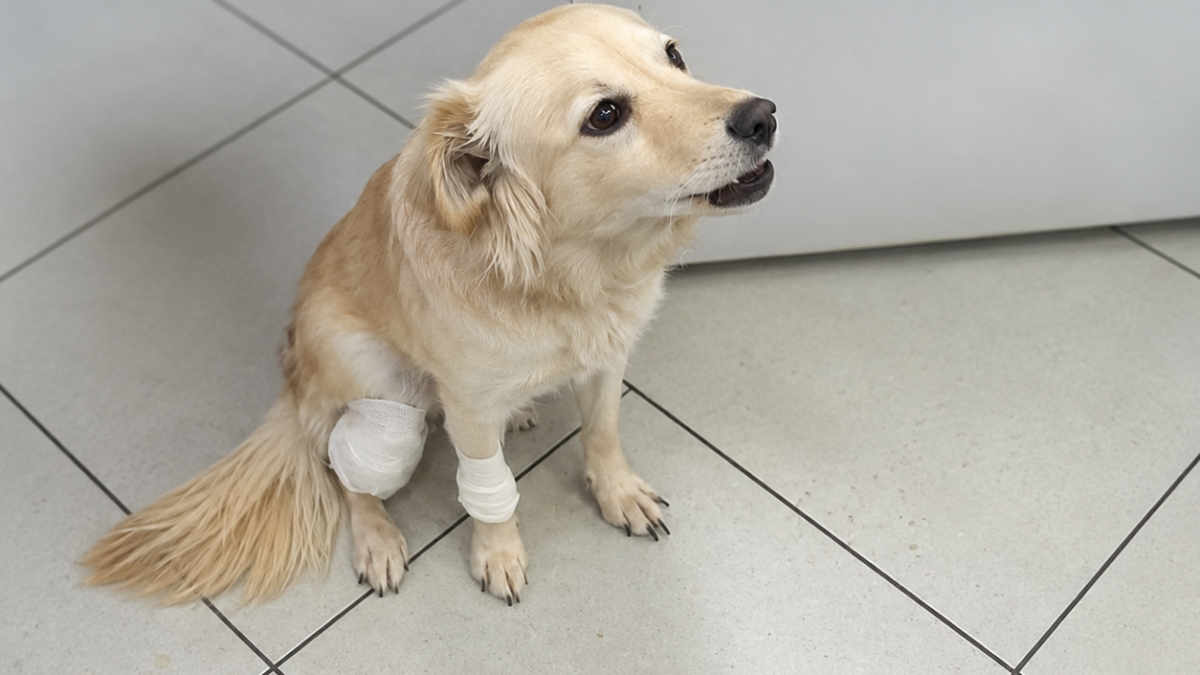
Dressings need attention.
One part improves while another still worries you.
Fontek’s surgical wound would need time.
His other injuries needed care too.
We followed veterinary instructions.
He ate well.
That was one of the earliest pieces of good news.
He slept well too.
Those two ordinary behaviors reassured us.
Appetite and sleep told us his body had enough stability to focus on recovery.
Watching him eat after everything that had happened felt strangely comforting.
A dog eating does not know he is giving humans hope.
He simply eats.
But when you have spent hours worrying whether an animal will survive surgery, a bowl being emptied can feel like an announcement.
Still here.
Still fighting.
Still interested in life.
Fontek rested.
We kept watching the wounds.
One day became another.
Healing at first was difficult to see.
You stare too often and changes look microscopic.
Then, around twenty days after the injury and surgery period began, the progress became unmistakable.
Fontek’s wound was gradually closing.
The front leg had almost healed by then.
That was a huge relief.
One major problem remained.
There was still a deep wound on his thigh that concerned us.
That area needed more careful attention.
The veterinarian showed us how to handle it.
Cleaning.
Dressing changes.
Monitoring.
This was the final day Fontek needed to remain at the veterinary clinic.
That should have been a simple happy milestone.
In many ways, it was.
He had arrived frightened and broken.
Now he was stable enough to leave.
His front leg was almost healed.
The surgical recovery was moving in the right direction.
Only the deeper thigh wound demanded continued close care.
The veterinarian explained exactly what we needed to do at home.
I listened carefully.
Aftercare is where people sometimes make mistakes because the dramatic medical event is over.
But a successful operation can still be undermined by poor wound care.
Fontek needed regular cleaning.
Fresh dressings.
Consistency.
We took that responsibility seriously.
Throughout those twenty days, another part of his personality became impossible to miss.
He was incredibly affectionate.
Fontek wanted to be held.
Constantly.
The young dog who had been terrified when we approached him outside the building now seemed to crave closeness once he learned which people were safe.
If you sat, he wanted near you.
If you reached down, he leaned in.
If you held him, he relaxed.
There was something heartbreaking in how much he wanted physical reassurance.
I sometimes wondered whether he had always been like this.
Maybe he had always been naturally affectionate.
Maybe the accident intensified his need for closeness.
Maybe both.
I did not know.
I only knew what he showed us.
He wanted comfort.
So we gave it.
There are moments in rescue when holding an animal feels medically unnecessary but emotionally essential.
Fontek had doctors for his leg.
Medication for pain.
Dressings for wounds.
He also needed arms around him.
A voice.
A person who stayed.
That was not written on a prescription.
It mattered anyway.
By the time he left the clinic, we had already made another decision.
We would find him a new home.
Whatever happened legally later, emotionally we could not imagine returning him to the situation where he had been left outside injured.
The source of the story makes our thinking clear.
We believed the owner had abandoned him.
That assumption would later create a serious problem.
At the time, it seemed obvious.
A dog is hit.
The owner refuses to take responsibility for treatment.
The dog remains crying outside for hours.
Rescuers step in.
What else were we supposed to call that?
We began thinking about Fontek’s future.
A safe home.
People who would not argue about blame while he suffered.
People who would take him to a veterinarian first and deal with responsibility second.
At the same time, we did not forget the driver.
We had asked police to look for him.
Witnesses said the driver had caused the accident and claimed he was leaving to get help.
Then he disappeared.
That needed investigation.
Police had a license plate to work from.
They followed it.
Eventually, they found him.
When questioned, the driver maintained his version of events.
He said he had gone to find help for the dog.
According to him, when he came back, the dog was gone.
That was what he said.
There was one problem.
No one had seen him return.
People at the apartment building had been there.
They had seen the dog waiting.
They had watched hours pass.
No one could confirm the driver’s claim.
We could not decide guilt beyond what authorities could establish.
That was their responsibility.
But the contradiction remained.
He said he returned.
Witnesses did not see it.
Police would deal with that.
Our day-to-day responsibility remained Fontek.
He came home with me.
That should have been the easiest stage emotionally.
The major surgery was behind us.
He was eating.
He was sleeping.
His wounds were improving.
I had instructions.
Dressings.
Cleaning.
Rest.
Safe environment.
But Fontek had another injury we had not fully appreciated yet.
Fear.
Not the dramatic panic he had shown outside the apartment building.
Something quieter.
A fear of being left.
I already had other dogs in the home.
Fontek was not comfortable with them at first.
It was not that they attacked him.
The source does not describe aggression from them.
His fear was more general.
He did not want to be left alone with other dogs.
If I moved away, he followed me.
If I changed rooms, Fontek was behind me.
If I stood up, he stood.
If I went somewhere, he wanted to go too.
It became obvious quickly.
He was not ready to believe safety existed without direct human confirmation.
At first, I thought perhaps the strange environment explained it.
New house.
New dogs.
Different smells.
That was certainly part of it.
But the pattern felt deeper.
Wherever I went, he followed.
His eyes tracked me.
Sometimes he positioned himself close enough that I could feel him against my legs.
It was as though distance itself had become dangerous.
Again, I could not know exactly what Fontek remembered from the accident.
Dogs do not narrate events back to us.
I could not claim he was replaying one specific scene.
But his behavior was clear.
He feared being left alone.
He needed reassurance.
So I gave it repeatedly.
“You’re okay.”
I touched his head.
“Everything is safe.”
He followed me into another room.
“I’m right here.”
Over and over.
Safety is not learned because a person says it once.
A frightened dog learns through repetition.
You leave the room.
Return.
You put down food.
No one takes it.
Another dog passes.
Nothing bad happens.
You go to sleep.
Morning comes.
The same people are there.
Again.
Again.
Again.
Meanwhile, his wound care continued.
I changed the dressing regularly.
Cleaned the area.
Followed the veterinarian’s instructions.
At first, Fontek watched every movement carefully.
Understandably.
The thigh wound was deep.
Touching near it could be uncomfortable.
I worked slowly.
Remove the old dressing.
Inspect.
Clean.
Replace.
Fontek was remarkably cooperative.
His affectionate nature helped.
If I reassured him, he often settled.
The wound began healing faster.
That progress made the routine easier psychologically.
Every dressing change felt less like maintaining damage and more like watching the body rebuild.
The open area became smaller.
Healthier.
We kept going.
Sometimes care is exactly that.
Not innovation.
Consistency.
Do the same correct thing tomorrow.
And tomorrow.
Then suddenly, you look and realize the wound that once frightened you is almost closed.
Fontek’s body responded.
So did his mind.
At first, the other dogs worried him.
Then curiosity began competing with fear.
He watched them.
Observed their routines.
They moved through the house without danger.
They ate.
Rested.
Played.
Approached people.
No one was being abandoned outside.
No one was being hurt.
Home had a rhythm.
Fontek began learning it.
He made his first real friends.
That sentence meant more to me than I expected.
He was only one year old.
Perhaps he had known other dogs before.
The source does not tell us.
But these became the first friendships we could actually witness in his new life.
At first, he stayed close to me while the others played.
Then he moved a little farther.
Sniffed.
Engaged.
Retreated.
Tried again.
Confidence develops in tiny expansions.
One foot farther from the safe person.
One more second near another dog.
One playful movement.
Then another.
Soon, the house stopped looking like a place full of potential threats.
It became a social world.
Fontek changed rapidly.
Every day, something seemed different.
The dog who once followed me because he was afraid gradually began following because that was simply where activity was happening.
There is a subtle difference.
Fear-following feels tense.
The body close.
Eyes monitoring.
Ready to react.
Companion-following feels loose.
Curious.
Relaxed.
Fontek moved toward the second.
His tail was different.
His posture was different.
He started running through the house.
Playing.
There is no better evidence of physical and emotional recovery than a young dog using his body for joy again.
That hind leg had once been severely fractured.
His front leg had been injured.
He had spent hours outside crying.
Now he ran.
Maybe not recklessly at first.
We still respected recovery.
But he moved with growing confidence.
The house filled with his energy.
The other dogs no longer frightened him.
Instead, they became part of his world.
He played.
Rested near them.
Followed them.
Became one of them.
That is what integration looks like when it works.
Not forcing a new dog to socialize.
Giving enough time for safety to become believable.
Eventually, Fontek seemed to decide:
These dogs are not a threat.
This home is not temporary danger.
These people stay.
That was the transformation.
He became an inseparable part of the house.
I stopped thinking of him as a patient first.
He was Fontek.
A young dog.
Affectionate.
Playful.
Needing attention.
Sometimes too much attention.
The kind of dog who wanted to be near you simply because he liked being near you.
The wounds were no longer the introduction.
That is one of my favorite stages in rescue.
The medical story becomes background.
The personality moves forward.
Fontek had personality.
He was loving.
Social.
Sensitive.
At times almost comically attached.
If I moved, he noticed.
If the other dogs started playing, eventually he joined.
If there was affection available, Fontek wanted his share.
The house had accepted him.
He had accepted the house.
We began believing the hard part was over.
Police were dealing with the driver.
Fontek was healing.
We had no intention of returning him to the man who had refused to care for him.
We were thinking ahead.
Then the phone rang.
The person calling was Fontek’s owner.
Former owner, we called him in our minds by then.
But that was exactly the problem.
Legally, the situation was not as simple as our emotions had made it.
The man said he had heard Fontek recovered.
He said no one had notified him.
Then he said:
“I want you to give me my dog back.”
I remember the feeling that went through me.
Cold.
Immediate.
No hesitation.
No.
The answer inside me came before the legal questions did.
No.
This was the dog you left outside.
This was the dog whose fractured leg you refused to treat because you said the driver was responsible.
This was the dog who cried for hours.
This was the dog strangers rescued.
This was the dog who underwent surgery the next day.
This was the dog whose wound we cleaned again and again.
This was the dog who followed me through the house because being left terrified him.
Now that he was recovered, you wanted him back?
No.
We told him we would not return Fontek.
The man did not accept that.
He said he would involve the authorities.
That sentence changed everything.
Until then, we had treated the situation emotionally as abandonment.
Now we had to face something we had overlooked.
Legal ownership.
Fontek was still legally connected to him.
We had focused so much on the driver that we had almost forgotten the owner could become the central legal issue.
The driver had caused the accident.
Police had traced him.
Witness statements existed.
So much of our attention had gone there.
Meanwhile, we had assumed the owner’s refusal to help meant he had effectively surrendered Fontek.
But had he formally done that?
That was the problem.
The answer was not automatically yes.
I felt sick.
Fontek was playing in the house.
He had no idea a phone conversation had just threatened everything familiar again.
Dogs are mercifully unaware of legal ownership disputes.
He only knew his life.
Food.
Home.
Friends.
Me.
Safety.
We knew paperwork could potentially disrupt all of it.
The next days were some of the most stressful of the entire rescue.
In some ways, even more stressful than the medical recovery.
When Fontek had a fracture, we knew the next step.
Veterinarian.
Surgery.
Wound care.
Medical problems may be frightening, but they often give you concrete tasks.
Legal uncertainty is different.
You wait.
Explain.
Provide evidence.
Hope the facts matter.
Fontek’s owner had rights on paper.
That fact could not simply be ignored because we were angry.
We had to deal with it properly.
We gathered the history.
The phone call that led us to him.
The condition in which we found him.
The hours outside.
The severe fracture.
The owner’s refusal to seek care.
His statement that the driver was responsible and that he himself was not.
The surgery.
The treatment.
The recovery.
Everything mattered.
We also had the broader context.
When Fontek needed help most, the owner had not provided it.
That was the heart of the case.
Ownership creates responsibility.
Not only rights.
That distinction mattered enormously now.
You cannot reasonably claim the benefits of ownership while rejecting the obligations the moment they become difficult.
At least that was what we hoped authorities would recognize.
But hope does not remove anxiety.
Every morning during that period, I looked at Fontek differently.
He had no idea.
He ran.
Played.
Approached the other dogs.
Came to me.
Wanted affection.
His world had finally become stable.
I feared someone might arrive and tell us to undo it.
I imagined him returning to the apartment building.
I hated the image.
Again, I did not know exactly what he remembered.
But I remembered enough for both of us.
The entrance.
The fear.
The fracture.
The owner’s indifference.
Could we really send him back because of a legal technicality?
Those questions consumed us.
The man kept insisting.
Authorities became involved.
We waited for the decision.
Fontek continued living.
That contrast became almost unbearable.
Humans worried about documents.
The dog celebrated recovery.
One afternoon, I watched him play and thought about his first day outside the apartment building.
Same dog.
One year old.
Then:
body broken.
Now:
running.
Then:
afraid of our approach.
Now:
coming voluntarily into my arms.
Then:
left crying.
Now:
surrounded by dogs he trusted.
I could not accept that all of this might be temporary.
But personal refusal was not enough.
We needed the decision to support what was right for Fontek.
The authorities looked at the circumstances.
The owner’s failure to help was central.
He had known the dog was injured.
He had chosen not to take responsibility for veterinary care.
Whatever blame belonged to the driver, the owner’s duty toward Fontek did not vanish.
That neglect mattered.
Fortunately, justice sided with us.
Those words were almost impossible to believe at first.
Fontek would stay.
He would not be returned.
The owner who had failed to help him when he was badly injured would not take him back now that others had done the difficult work of healing him.
Fontek could remain in our home.
Forever.
That word carried a different weight after the legal uncertainty.
Forever.
Not until the wound heals.
Not until the owner calls.
Not until authorities decide.
Forever.
I looked at him and felt something in my chest loosen that I had been holding for days.
He came toward me, likely expecting nothing more than affection.
I held him.
There are moments when a dog does not understand why a hug feels different.
Fontek probably did not.
I did.
This time there was no hidden countdown.
No legal question hanging over us.
He was home.
That was the miracle for me.
Not magic.
Not something impossible.
A miracle in the emotional sense.
A dog nearly lost through human indifference had reached safety.
Then nearly lost again through legal uncertainty.
And still, he stayed.
His love and loyalty finally had somewhere worthy to land.
That sentence mattered to us because Fontek gave affection so freely.
Even after being failed.
That is one of the difficult things about dogs.
They do not always reserve love for people who deserve it.
They attach.
Trust.
Follow.
Sometimes humans receive that loyalty and treat it casually.
Fontek had followed me everywhere because fear made him unsure.
Later, he followed because attachment had grown.
I wanted that attachment to be rewarded, not exploited.
Now it would be.
He could trust the home.
We would not send him back.
The driver investigation remained a separate matter.
Police had located him through the license plate.
He continued claiming he had returned after going to get help and found the dog gone.
No witness confirmed seeing him return.
That contradiction remained with the authorities.
We did not invent a final punishment.
The source does not give one.
It is important not to pretend we know more than we do.
What mattered for Fontek’s daily life was that he was no longer waiting for either man.
Not the driver.
Not the original owner.
His life had moved elsewhere.
The apartment building became part of his history.
Not his address.
The clinic became part of his history.
Not his home.
The deep thigh wound became part of his history.
Not his identity.
That is how rescue should work.
The crisis becomes past tense.
The dog becomes present tense.
Fontek was present.
Running.
Playing.
Eating.
Sleeping.
Making friends.
Seeking hugs.
That was who he was.
Sometimes I thought about the woman who made the first call.
Her voice had been full of fear that he might not survive.
She had looked at the injured dog outside the building and refused to let indifference become the final answer.
Without that call, how long would Fontek have remained there?
I do not know.
I refuse to invent the outcome.
But the question itself is painful.
She called.
We came.
Even though we got lost.
Even though every building looked the same.
Eventually, we found him.
That was enough to change the path.
The rescue did not begin with us being heroic.
It began with us being confused and frightened and driving around trying to find the correct entrance.
That is worth remembering.
Good outcomes can begin messily.
You do not need a perfect plan.
You need to keep going until you reach the animal.
We kept going.
Fontek survived.
I think about those identical buildings sometimes.
At the time, they were an obstacle.
Later, one entrance became permanently burned into memory.
That entrance.
The place where a one-year-old dog lay after an accident.
The place where a legal owner had been physically close enough to help and chose not to.
Distance was not the problem.
That is one of the hardest details.
His owner lived there.
He was not in another city.
Not unreachable.
He knew.
Sometimes neglect does not come from absence.
It comes from refusal.
That is harder to forgive.
Again, I do not claim to know every financial or personal detail of the man’s situation.
The source gives his reasoning.
The driver was responsible.
He was not.
That is what we judge.
Not hidden circumstances.
Those words.
That choice.
Fontek suffered under it.
The law later considered the failure to help important enough that the dog remained with us.
That outcome validated what our hearts had believed from the beginning.
Rights without care are not the whole story.
Fontek needed protection.
He got it.
Still, I did not want his happy ending to become only a story about defeating his former owner.
That gives too much space to the person who failed him.
The more important story is what Fontek became afterward.
He became confident.
That transformation deserves more attention than the dispute.
In the beginning, his fear was almost physical around him.
Approach and he recoiled.
Home with other dogs and he clung to me.
Every transition felt risky.
Then safety accumulated.
He learned the house.
He learned the dogs.
He learned my footsteps.
He learned which places were comfortable.
He learned that when I left a room, I returned.
He learned meals came predictably.
He learned dressing changes were not punishment.
He learned pain reduced.
He learned his leg could support him.
He learned play.
These lessons were not taught formally.
They were lived.
That is the deepest kind of rehabilitation.
Not commands.
Expectations.
This place is safe.
The dogs are friends.
The human comes back.
My body works.
Life can be good.
You cannot rush those conclusions into an animal.
You let experience build them.
Fontek built quickly once given the chance.
That is why the source says he changed greatly every day.
He truly did.
One day hesitant.
Another curious.
Then playful.
Then confident.
The physical and emotional changes seemed to mirror each other.
As the wound closed, his world opened.
That is not a scientific causal claim.
Just the pattern we observed.
Less pain.
More movement.
Less fear.
More interaction.
Eventually, the small dog who had once been terrified by approaching strangers was voluntarily asking for affection from people he trusted.
That is remarkable.
Not because affection itself is rare.
Because trust after suffering is always worth respecting.
I never wanted to treat Fontek’s friendliness as proof that what happened had not affected him.
The clinginess showed it had.
The fear of being alone with the other dogs showed it had.
Healing does not mean nothing happened.
It means the event stops controlling the future.
That was what happened.
Fontek’s past remained real.
It simply stopped deciding every reaction.
He could be left briefly in a room with the other dogs and remain calm.
He could play without checking me every second.
He could sleep.
He could relax.
Those are milestones people may not notice if they only look for dramatic transformations.
We noticed.
The first time he stayed with the other dogs without immediately searching for me, I felt proud.
Not because he loved me less.
Because he felt safer.
Healthy attachment allows distance.
Fearful attachment demands constant proof.
Fontek moved toward healthy attachment.
That mattered.
I wanted him to know he could love people without panic.
That he could have dog friends.
That home remained home even if I stepped outside his line of sight.
We gave him time.
He used it.
The dressing changes became another kind of trust ritual.
At first, medical handling made his body tense.
Later, he knew the pattern.
He would settle.
I cleaned.
Changed the dressing.
Finished.
Then affection.
He learned that discomfort had an ending.
That may sound simple.
It matters enormously for animals who have experienced pain.
Predictability reduces fear.
Fontek began anticipating the end rather than panicking at the beginning.
His wound healed faster under consistent care.
That practical success reinforced everything.
We were not only comforting him emotionally.
We were actively helping his body close the last dangerous gap.
The deep thigh wound had been the final concern on discharge day.
Then slowly it ceased to be.
I remember the relief of seeing healthy healing where there had once been an open wound.
The body knows how to rebuild when given support.
Clean environment.
Regular dressing.
Time.
Fontek’s body did its work.
I sometimes touched the healed area gently later and remembered how worried we had been.
He did not care.
Of course.
To him, the important thing was that it no longer hurt.
That is how animals keep us humble.
We attach stories to scars.
They move.
The front leg had healed much earlier.
The rear leg, repaired surgically, regained function.
The thigh wound closed.
Eventually, the visible evidence of the accident became less important than the dog using his body normally.
Running.
That was the best medical report.
Not a sentence from a doctor.
A young dog running through the house.
A body doing what a one-year-old body should do.
That is what we had wanted from the first day.
Not survival alone.
Function.
Joy.
A future.
We got it.
Fontek’s affection grew alongside the movement.
He wanted hugs.
The source says he always wanted to be held.
That remained part of him.
Some dogs love closeness in a quiet way.
Fontek seemed to actively seek it.
If I sat down, he came.
If I crouched, he leaned.
If arms opened, he stepped into them.
After the legal decision, every hug felt different to me.
Before, there had always been the possibility that our care was temporary.
After, affection became rooted.
You are not going anywhere.
Neither am I.
That kind of certainty changes humans too.
I stopped looking at him as a dog I was protecting for now.
He was family.
That word arrived gradually, then suddenly seemed obvious.
Fontek was part of the house.
Not a guest.
Not a foster dog waiting for placement.
Not a medical case.
Part of us.
His bowl belonged.
His sleeping place belonged.
His habits belonged.
His friends belonged.
He belonged.
That is the ending the source gives, and it is the one that matters.
Forever in our home.
I sometimes think about the former owner’s phone call and wonder what he expected.
Perhaps he believed legal ownership made the request simple.
“My dog recovered. Give him back.”
Maybe he did not understand why we reacted so strongly.
Again, I do not invent his inner thoughts.
But the timing spoke loudly to us.
No request while Fontek was undergoing surgery.
No urgent demand while the wound was deep.
No appearance during painful treatment.
Then recovery.
Then ownership asserted.
That sequence was difficult to accept emotionally.
If you want the dog when he is healthy, you must also want responsibility when he is broken.
That principle became central in our minds.
A dog is not an object you claim once others repair it.
Care has to exist during the expensive, difficult, frightening parts too.
That is what family means.
We had lived those parts with Fontek.
The former owner had declined.
Authorities saw enough in that failure to allow Fontek to remain with us.
We were grateful.
I do not need to turn that into revenge.
The best outcome was simply separation.
Fontek safe.
Former owner no longer controlling his future.
No dramatic confrontation required.
No scene of Fontek choosing between us.
That would have been cruel and unnecessary.
The legal process happened among humans.
The dog got to keep living.
That is exactly how it should be.
He did not need to be brought back to the apartment entrance for some emotional test.
He did not need to recognize or reject anyone.
He did not need to perform loyalty.
His welfare came first.
We kept him away from the conflict as much as possible.
At home, he played.
That contrast helped us too.
When legal stress became overwhelming, Fontek reminded us why we were fighting.
Not for a principle in abstraction.
For the dog rolling around with new friends.
For the dog sleeping safely.
For the dog whose appetite was good.
For the dog asking to be held.
Concrete life.
That is what laws about animal welfare should protect.
A living being.
Not ownership paperwork alone.
I became very aware of the word “owner” through this experience.
Ownership can suggest possession.
But with an animal, the moral reality is guardianship.
Responsibility.
Food.
Medical care.
Safety.
Attention.
If a human wants the right to say “my dog,” they must also accept the sentence “my responsibility.”
You cannot separate them when convenient.
Fontek’s case forced that truth into the open.
The driver was responsible for causing the collision, according to the accounts.
Yes.
That did not erase the owner’s responsibility to get Fontek medical care afterward.
Two responsibilities can exist at once.
That distinction seems obvious.
Yet Fontek spent hours outside because someone refused to see it.
I hope never to forget that.
Blame can wait.
Pain cannot.
That is perhaps the simplest lesson from the accident.
If an animal is suffering, help first.
Arguments later.
Had someone done that immediately, Fontek might have reached care sooner.
We cannot change the hours he lost.
We can remember them.
The woman who called understood instinctively.
She did not say:
This isn’t my dog.
She cried.
Called.
Stayed concerned.
Responsibility can sometimes begin with simply being the person who refuses to look away.
She did that.
We did the next part.
Veterinarians did theirs.
Police did theirs.
Eventually, authorities did theirs.
Fontek’s survival and future became a chain of people choosing to act.
That chain repaired what indifference had allowed.
I am grateful for every link.
The woman’s name is not given.
She does not need one in this story.
Her voice mattered more.
A stranger crying for a dog that was not legally hers showed more urgency than the person whose name was likely attached to him.
That contrast stays with me.
Care is behavior.
Not labels.
She behaved like someone who cared.
We tried to do the same.
Fontek responded.
That is the full moral structure.
I think about his age again.
One year.
At one, dogs are still forming expectations about the world.
A terrible event can shape them.
So can a good recovery.
Fontek had been shown cruelty or indifference at a vulnerable moment.
Then he was shown consistency.
I am glad the second experience came so quickly after the first.
He did not spend years learning fear.
His confidence returned within a much shorter period.
That gave me hope.
Early emotional support matters just as early medical treatment matters.
Again, not a formal scientific conclusion from one case.
An observation.
He was young.
He adapted quickly.
The source says he soon adjusted to his new life.
That is exactly what we saw.
The house became his.
The dogs became friends.
He became confident.
Youth may have helped.
Love did too.
Routine definitely did.
No single magic ingredient.
Many small ones.
One day, I saw him racing across the room and almost laughed at the absurdity of the transformation.
This dog?
The one we found outside, unable to use his leg normally?
The one terrified when we approached?
Now running?
Life can change faster than memory.
My memory still held the injured version while the dog in front of me had already moved ahead.
That taught me to update my picture of him.
Do not keep rescued animals trapped in the image of suffering because the image moves people.
See who they are now.
Fontek now was playful.
Social.
Affectionate.
That deserved equal space.
More space, eventually.
The accident was one day.
Home became hundreds of days.
The story should follow the same proportion emotionally.
Crisis opens it.
Life fills it.
That is why I spent so much time noticing his friendships.
A dog friend is more than cute footage.
For Fontek, it represented a shift from fear to social confidence.
He had been afraid to be left alone with other dogs.
Later, he wanted their company.
That reversal matters.
Fear can make the world smaller.
Friendship expands it.
Fontek’s world expanded.
At first:
Me or danger.
Later:
Me, other dogs, rooms, play, rest, home.
More safe categories.
That is recovery.
The first friend he made became evidence that he could trust beyond one person.
Then another interaction.
Another.
Soon the house was not divided into safe human and scary dogs.
It was one group.
His group.
That made the legal threat even more painful.
Returning him would not have meant changing address only.
It would have broken a social world he had built.
Authorities considered welfare.
Thank goodness.
A dog is not interchangeable between environments just because the same legal name is attached.
Relationships matter.
Routine matters.
History matters.
Fontek’s history with us included medical recovery and emotional rehabilitation.
That carried weight.
We did not want special treatment for ourselves.
We wanted his actual welfare recognized.
It was.
That is why I can say justice was on our side without inventing a specific court ruling or punishment.
The result itself tells us enough.
Fontek stayed.
The owner did not take him back.
That is the factual endpoint.
We leave legal detail there.
No need to decorate it.
The emotional result is enormous enough.
Forever.
After the decision, the first ordinary day felt strange.
Nothing had changed physically.
Same house.
Same dogs.
Same Fontek.
Yet everything felt lighter.
I no longer interpreted each phone notification as possible bad news.
I no longer wondered whether someone would demand we surrender him.
The future stopped feeling borrowed.
That changes how you love an animal.
Not more deeply perhaps.
More peacefully.
I could make plans around him without mental asterisks.
His bed belongs there.
His friendships can continue.
His medical follow-up remains our responsibility.
His next season of life will happen here.
Peace is underrated in rescue.
People celebrate the dramatic save.
The surgery.
The legal victory.
But peace afterward is the real reward.
No emergency.
No dispute.
A dog sleeping.
That is what we wanted.
Fontek eventually slept without the constant need to know where I was.
At least much more than before.
He still liked following me.
Some dogs simply do.
But the quality changed.
There was affection instead of panic.
If I went to another room and closed a door briefly, he could remain with the other dogs.
That may sound insignificant.
It was not.
It told me the fear of abandonment had loosened.
He trusted the system of home.
Home is a system.
Doors close.
People return.
Meals arrive.
Night comes.
Morning follows.
Other dogs remain.
Nothing catastrophic happens.
Again.
Again.
Fontek learned.
That lesson is more valuable than any command.
Sit.
Stay.
Come.
Useful.
But deeper:
You are safe here.
That cannot be taught in one session.
It has to be lived.
He lived it.
The old fear lost power.
I sometimes held him and remembered the first frightened reaction outside the building.
Then I stopped comparing.
He did not need every hug turned into a before-and-after story.
Sometimes he just wanted affection.
Give it without making him carry symbolism.
That became important to me.
Rescued dogs are allowed to be ordinary.
Fontek did not need to be “the accident dog” forever.
He could be the dog who stole the comfortable spot.
The dog who wanted another cuddle.
The dog who played too loudly.
The dog who followed me into the kitchen.
Those identities are healthier.
We let him have them.
This is one reason I dislike ending rescue stories at the medical discharge.
That is only transition.
The deeper story begins afterward.
How does the animal live?
Fontek lived well.
That is the point.
Twenty days got him through a critical part of healing.
The months and days after showed what treatment was for.
Not merely closing a wound.
Opening a life.
There is no purpose in saving a leg if the dog remains emotionally abandoned.
We addressed both.
Maybe imperfectly.
But sincerely.
Fontek rewarded the effort by becoming himself.
That is enough.
His loyalty found the right place.
The source says that.
I understand it as meaning his attachment was finally met with reciprocal care.
He did not become loyal only after rescue.
Dogs often attach even to people who fail them.
The difference now was where that loyalty landed.
On people who would respond when he was hurt.
That is what “right place” means to me.
Love is precious.
It should be received responsibly.
Fontek gave affection.
We gave care.
Healthy exchange.
Not exploitation.
That is the happy ending.
I occasionally imagined what Fontek might have become if the first owner had taken him to the vet immediately.
Maybe he would have returned to that apartment and lived there.
We would never have met.
Perhaps he would have been fine.
That alternate life is unknowable.
I do not claim rescue was “meant to happen.”
The accident was bad.
The neglect was bad.
Our meeting came from circumstances I would never wish on him.
I am grateful for him without being grateful for the suffering.
Important distinction.
Happy outcomes do not justify painful causes.
Fontek deserved care before we arrived.
He received it after.
That is good.
No need to make fate responsible.
Humans made choices.
Some poor.
Some good.
The good choices eventually became stronger.
That is enough hope.
The driver made a choice after the collision.
He claimed he went for help.
Whether he truly returned remained disputed.
The owner made a choice.
He refused to seek treatment.
The woman made a choice.
She called.
We made a choice.
We kept searching through identical buildings.
Veterinarians made decisions.
Surgery.
Treatment.
Authorities made decisions.
Fontek stayed.
A life can turn through choices.
That is the real structure of the story.
No magic.
Responsibility.
I like that because responsibility is repeatable.
You cannot create miracles on command.
You can choose care.
That is within reach.
Fontek’s body responded to care.
His mind did too.
The results looked miraculous emotionally.
But beneath them were daily actions.
Dressing changes.
Cleaning.
Food.
Sleep.
Reassurance.
Time.
These are not glamorous.
They work.
Every rescue story should honor the boring parts.
Boring parts are where healing lives.
The surgery lasted one day.
Wound care lasted longer.
The phone call with the owner lasted minutes.
Legal stress lasted days.
Trust building lasted longer.
Home continues.
Time proportions tell you what really matters.
Fontek was not saved once.
He was cared for repeatedly.
That is a better phrase.
Repeated care.
The opposite of the repeated indifference he might otherwise have experienced.
This is how homes are built.
I sometimes wondered whether I had reassured him too much early on.
Every time he followed, I touched him.
Every time he worried, I spoke.
Would that make him more dependent?
Then I watched him gradually become more confident and realized reassurance had not trapped him.
It had given him a secure base.
Again, this is observation, not a universal training rule.
For Fontek, patience worked.
As confidence grew, he needed less constant reassurance.
The direction was healthy.
That was what mattered.
We followed his behavior.
Not an ideology.
He learned independence inside safety.
That is different from forcing independence through absence.
Very different.
A dog afraid of abandonment does not need to be “taught” by being left to panic.
Fontek needed evidence.
We gave it.
Then he could tolerate distance.
That lesson influenced how I saw many anxious rescue dogs afterward.
Fear is information.
Not manipulation.
Respond wisely.
Fontek’s fear had a history.
Respect it.
Then help create a new one.
The new history eventually becomes stronger.
He did that beautifully.
There was also something touching about how quickly play returned once pain reduced.
Play is unnecessary for survival.
That is why it is such a good sign.
A starving or severely frightened animal may not play.
A safe young dog often does.
Fontek played.
That told us his brain had energy for joy.
His leg could handle movement.
His social world felt safe enough.
Several forms of healing converged in one behavior.
Run.
Chase.
Interact.
Simple.
Huge.
Sometimes I would stop what I was doing just to watch.
Not because I thought every play session was profound.
Because I remembered the entrance.
Then, eventually, I stopped remembering every time.
That was good too.
When you can watch a dog play without immediately thinking of suffering, the dog has escaped the narrative.
I wanted that for Fontek.
He deserved to become more than his worst day.
Eventually, he did.
Most days, he was just Fontek.
That is where I place him now.
If someone asks his story, I tell it.
The accident.
The refusal.
Surgery.
Twenty days.
Wound.
Home.
Fear.
Friends.
Owner’s call.
Legal threat.
Justice.
Forever.
But if no one asks, he does not carry the story visibly.
He lives.
That is what rescue is supposed to allow.
The past becomes optional information rather than current condition.
Beautiful.
The final legal decision also changed our relationship to the word “former.”
Before, we called the man former owner because emotionally that made sense.
After, it became true in the only way that mattered for Fontek’s future.
He would not return.
No more uncertainty.
I did not celebrate someone else’s loss.
I celebrated Fontek’s safety.
Important distinction.
Revenge has no place in good rescue.
Accountability does.
The owner had failed to provide care.
The result reflected that.
Then we moved on.
No need to keep him central.
Fontek was central.
Always.
I think about the first call again.
“I’m afraid he won’t survive.”
He did.
That alone is extraordinary emotionally.
But survival became only the first line of the answer.
He survived.
Then healed.
Then trusted.
Then played.
Then faced a legal threat.
Then stayed.
The title could have ended at “survived the accident.”
The story did not.
Sometimes the harder challenge comes after the emergency.
A dog can survive trauma and still need protection from the environment that failed him.
Fontek did.
We almost missed that second fight because we thought abandonment was obvious.
It wasn’t legally automatic.
That taught us a practical lesson.
Never assume an animal’s ownership status simply because someone behaves neglectfully.
Document.
Clarify.
Involve authorities appropriately.
Again, this is not legal advice.
It is what our experience taught emotionally.
We focused on the driver.
Forgot the owner issue could return.
Then it did.
The stress could have been reduced if we had considered it earlier.
We learned.
Fontek benefited from the eventual result.
That is enough.
The driver and owner represented two different types of responsibility.
The driver was tied to the accident.
The owner was tied to care afterward.
We had initially focused on the first because the collision was dramatic.
But the second became more important to Fontek’s future.
That is another lesson.
The person who causes harm and the person responsible for responding can be different.
Both matter.
We cannot use someone else’s wrongdoing to excuse our own duty.
The owner’s statement had essentially done that.
Driver caused it, so not my responsibility.
But Fontek’s pain existed independently of blame.
If your dog is injured, you help.
Then pursue the driver.
Simple morally.
The legal process later agreed enough to protect Fontek.
That gave us some faith.
Not every system fails.
Sometimes the facts are seen.
We were grateful.
I never learned to enjoy legal uncertainty.
Those days were exhausting.
Every call felt heavy.
Every conversation required repeating painful details.
But I would do it again for Fontek.
That is what advocacy means.
The animal cannot explain the timeline.
We can.
The dog cannot say:
He left me outside.
We can provide witnesses.
The dog cannot show documents.
We can.
The dog cannot argue welfare.
We can describe injuries and treatment.
Humans have to carry that burden.
We did.
That is part of rescue too.
Not only feeding and petting.
Paperwork.
Statements.
Calls.
Persistence.
Boring again.
Essential again.
When the decision finally favored Fontek staying, all those tedious pieces became meaningful.
One file can protect one life.
Remember that.
No need for fanfare.
Just do the work.
We did.
Fontek’s reaction to the outcome was, of course, nonexistent in the human sense.
He did not know he had won anything legally.
He did not celebrate.
He probably wondered why we were suddenly hugging him more intensely.
That made me laugh through relief.
Dogs are wonderfully uninterested in our administrative victories.
His victory was simpler.
Nothing changed.
That was the win.
Same bed.
Same friends.
Same people.
No car ride away.
No apartment building.
Continuity.
Sometimes the best result of a legal process is that the animal’s ordinary day remains ordinary.
Fontek’s did.
He ate.
Played.
Slept.
That is justice translated into canine terms.
Stay where safe.
I loved that.
There were no dramatic final scenes.
No confrontation with the owner.
No public spectacle.
No punishment described.
Fontek just stayed.
That quiet ending fits him.
His loudest suffering happened at the beginning.
His happiness could be quiet.
Or playful.
Whatever he chose.
The source calls it incredible happiness, almost a miracle.
I understand.
When you have watched uncertainty pile onto uncertainty, normal life feels miraculous.
Lost address.
Severe fracture.
Surgery.
Deep wound.
Fear.
Driver dispute.
Owner returns.
Legal ownership.
Then:
Home.
Yes.
Emotionally, miracle.
Practically, the result of persistence.
Both can coexist.
I think of Fontek now as the dog who taught us that rescue does not end when the body stabilizes.
There is medical rescue.
Emotional rescue.
Legal protection.
All three mattered.
Miss one and the outcome could have been different.
Medical only?
He heals, then maybe returns to neglect.
Emotional only?
Love without surgery would not repair the fracture.
Legal only?
Rights without daily care do not create a home.
Together:
life.
That combination is what made the ending satisfying.
We had to address the whole situation.
Body.
Mind.
Future.
That is comprehensive rescue.
Fontek deserved nothing less.
His young age made the future feel especially important.
He had years ahead, potentially.
The source does not specify how many.
We do not invent.
What mattered was that his future would no longer be organized around the person who failed him.
At one year old, he could build an entirely different adult life.
That made me happy.
The accident might become one early chapter instead of the defining event.
His friendships would grow.
His confidence would deepen.
Home would become the default.
We leave those possibilities open.
No invented years-later epilogue.
The story ends in the present with permanence.
Perfect.
Fontek is home forever.
We stop there.
No need to age him artificially.
No need for future illness.
No anniversary.
No reunion with anyone.
The source gives a complete emotional endpoint.
We respect it.
I still want to stay a little longer with what “forever” meant in that moment, though.
Not literal immortality.
Dogs do not live forever.
Humans do not either.
“Forever” in rescue means:
For the rest of the life available.
No planned surrender.
No conditional acceptance.
No expiration when medical care becomes expensive.
No return because the dog is inconvenient.
That is what we promised.
The owner had treated responsibility as conditional.
We did not.
Fontek could get older.
Need care.
Become less playful.
Have other medical problems someday.
The source does not tell us any of that happens, so we do not add it.
But the commitment includes possibility.
That is what permanence means.
We did not choose only the healthy Fontek.
We had already chosen the broken one.
That gave the word credibility.
We had held him when injured.
Cleaned wounds.
Waited through surgery.
Worried through law.
Of course the healed dog belonged.
The difficult part had already been accepted.
That is family.
Not selecting only the pleasant stages.
Staying through changing stages.
Fontek had proof.
He did not need the concept.
His body had experienced it.
Pain.
We stayed.
Fear.
We stayed.
Clinginess.
We stayed.
Legal threat.
We stayed.
Now confidence.
Still here.
That repeated staying is probably the strongest answer to abandonment.
Not speeches.
Pattern.
I hope Fontek’s nervous system learned it fully.
His behavior suggested it did.
More relaxed.
More independent.
More playful.
Good.
No need to claim perfect emotional recovery.
Dogs have individual temperaments.
Some remain more attached.
That is okay.
The source says he became much more confident.
We preserve that.
More, not magically fearless.
Nuance matters.
He could still want closeness and be healthy.
Affection is not pathology.
He loved being held.
We loved holding him.
That became part of home.
I think sometimes people try to “fix” every behavior in rescue animals.
Not everything needs fixing.
Fontek’s desire for affection was not a problem.
His panic at being left was the issue.
As panic reduced, affection remained.
Perfect.
That tells you what was personality and what was fear.
The clinginess softened into companionship.
We did not need to make him emotionally distant to prove healing.
He could be loving and confident.
Both.
That became his mature new self.
One of my favorite images is him playing with the dogs he once feared.
That is such a clean emotional reversal.
At first, other dogs represented uncertainty.
Later, playmates.
No explanation required.
Movement shows trust.
He could turn his back.
Chase.
Be chased.
Engage.
Those behaviors require a level of comfort.
We enjoyed every moment.
The house was louder because of him.
Better.
A young dog should make a house slightly more chaotic.
That chaos was evidence of normal life.
I welcomed it.
Better noise than the crying outside the apartment entrance.
Better paws running through rooms than a fractured leg lying still.
Better competition for attention than isolation.
Contrast sharpens gratitude.
We did not need to mention it every day.
But sometimes it hit me.
This sound used to be pain.
Now play.
That is healing.
Fontek himself did not carry gratitude like a human debtor.
Good.
We did not want gratitude.
We wanted trust.
There is a difference.
Rescue should not create a relationship where the animal is expected to “repay” kindness by being perfect.
Fontek could be annoying.
Demand hugs.
Follow too closely.
Make messes.
Play at inconvenient times.
That is normal.
We accepted the whole dog.
Not a grateful symbol.
That is dignity.
I think about the owner’s request again through this lens.
“I want my dog back.”
My dog.
Possessive phrase.
But doghood is not possession alone.
Relationship creates obligations.
Fontek’s experience exposed the gap.
The law eventually protected welfare over simple claim.
We were relieved.
I do not know every legal standard applied.
I will not fabricate one.
The source says justice was on our side because the owner had not cared to help him.
That is the conclusion.
Enough.
Fontek remains.
The driver’s final legal status is unknown.
Enough.
No false certainty.
Fidelity matters.
I want the emotional story strong because facts are strong, not because we add punishment.
We do not know if the driver was fined.
Charged.
Nothing.
We leave it.
The same with the former owner.
We know he did not get Fontek back.
That is all.
Good storytelling sometimes means stopping before speculation.
The dog’s happy life is more important anyway.
The source’s final lines thank viewers and promise future videos.
We do not need that.
Fontek’s story should end with Fontek.
No CTA.
No platform.
Just home.
That keeps emotional focus clean.
If I were to stand at the beginning again—the phone call, the crying woman—I could never predict how many different forms of fear would follow.
First fear:
Will he survive?
Second:
Will surgery work?
Third:
Will the deep wound heal?
Fourth:
Will he adjust emotionally?
Fifth:
Will the owner take him back?
Each time, the answer eventually moved toward safety.
Yes, he survived.
Yes, surgery stabilized him.
Yes, the wound healed.
Yes, he adjusted.
Yes, he stayed.
That sequence is why the ending feels so powerful.
Every stage had its own uncertainty.
No single rescue moment solved everything.
We kept solving the next thing.
That is a useful model for hard cases.
Do not demand certainty about the end.
Handle the next need.
Address.
Veterinarian.
Surgery.
Aftercare.
Home.
Police.
Legal defense.
One step.
Then another.
Eventually, forever.
That is how impossible situations become manageable.
Fontek taught us patience in stages.
The address problem taught persistence.
The medical problem taught trust in experts.
The wound taught consistency.
The emotional fear taught reassurance.
The ownership dispute taught documentation and advocacy.
One dog.
Many lessons.
I do not need him to be a symbol for everyone.
He was enough for us.
But stories teach through individuals.
This one did.
The apartment building remains in my memory less as a place and more as a question.
How many people walked past?
The source does not say.
I do not invent a crowd.
Some people clearly saw enough to report what happened.
The woman cared.
Witnesses gave information.
That is important.
Not everyone there was indifferent.
The owner was.
The driver, at minimum, left the scene claiming he would seek help.
Others eventually helped connect us.
We should not flatten an entire building into cruelty.
Specific accountability matters.
This makes the story more truthful.
There were helpers.
Otherwise we might never have found Fontek.
Humanity was mixed from the beginning.
As it usually is.
One person harms.
Another ignores.
Another calls.
Another treats.
Another protects.
Fontek moved through all of them.
His future depended on which actions ultimately prevailed.
Care prevailed.
That is the hopeful part.
Not that humans are uniformly good.
That enough good choices can interrupt bad ones.
This case proves it.
A phone call interrupted neglect.
Surgery interrupted damage.
Home interrupted fear.
Law interrupted reclamation.
Beautiful pattern.
Interruption as rescue.
Sometimes you do not need to erase harm.
You stop it from continuing.
That is exactly what happened.
The fracture had already occurred.
Could not undo.
Repair.
The owner had already refused care.
Could not undo.
Prevent return.
The dog had already learned fear.
Could not erase.
Build safety.
Rescue is often forward-facing.
You cannot change yesterday.
You can change what happens next.
That became our guiding principle even when we did not say it aloud.
Fontek embodied it.
Yesterday:
crying outside.
Next day:
surgery.
Twenty days:
wound healing.
Later:
home.
Then:
friends.
Then:
forever.
Forward.
I like ending there.
Forward.
Not back to the apartment.
Not back to legal conflict.
Fontek moves forward.
That is the right direction.
Sometimes he still follows me from room to room.
That behavior never disappeared completely.
I no longer interpret it automatically as fear.
He likes being close.
That is who he is.
The difference is in his body.
Loose.
Comfortable.
Maybe pauses to greet another dog.
Maybe stays behind for a while.
Choice.
Fear reduces choice.
Confidence increases it.
Fontek has choice now.
Follow or stay.
Play or rest.
Seek hug or lie with dogs.
That freedom is one of the deepest signs of safety.
We gave environment.
He created choices within it.
That is a good home.
The front door no longer means abandonment.
It is simply a door.
The other dogs no longer mean danger.
They are friends.
A bandage no longer covers an open wound.
The wound is healed.
A phone no longer means someone may take him away.
That dispute is settled.
Objects lose their threatening meanings as life stabilizes.
I love that process.
Normality reclaims the world.
Fontek deserves normality.
He had enough drama at one year old.
Let the rest be ordinary.
That is why we do not invent future adventures.
Ordinary is the happy ending.
Maybe he runs.
Sleeps.
Gets cuddled.
Plays.
Those behaviors are already established.
Enough.
No need to send him to beaches or mountains.
No need for birthdays.
Home is plenty.
The source says his love and loyalty are in the right place.
I return to that as the final emotional idea.
Love and loyalty should not be punished.
Fontek gave them readily.
Now they are returned.
He follows someone who comes back.
He trusts dogs who play with him.
He sleeps in a place where injury leads to treatment, not abandonment.
That is the right place.
A place where affection has reciprocal responsibility.
That is home.
I think the most haunting contrast remains the owner’s first statement and later demand.
At first:
The driver is responsible. I am not.
Later:
I want my dog back.
Those two positions cannot sit comfortably together.
Ownership when convenient.
No responsibility when expensive.
Then ownership again when the animal is healthy.
That contradiction is the moral center of the dispute.
Authorities saw it.
Fontek stayed.
Good.
I do not need to rage more.
The result says enough.
He is safe.
That is stronger than anger.
Anger burns.
Safety lasts.
We chose safety.
I am happy with what we accomplished together.
That phrase in the source matters because rescue was not one person’s achievement.
The woman who called.
Our team finding the address.
Veterinarians.
Police investigating the driver.
People caring for Fontek.
Authorities considering the ownership issue.
The other dogs helping him socialize simply by being part of home.
Fontek himself adapting.
Together.
That word is accurate.
No solitary hero.
A network.
Fontek benefited.
That is how many good outcomes happen.
I may narrate much of the home section in first person because he lived with me, but the rescue belongs to many.
That humility matters.
I did not perform the surgery.
I did not locate the driver through a license plate.
I did not make the final official decision alone.
I changed dressings.
Cleaned wounds.
Reassured.
Advocated.
One role.
Others had theirs.
Fontek needed all of them.
That is why “we” remains important.
We accomplished this.
He gave us reason.
Maybe that is the best form of community.
Different people carrying different parts of one vulnerable life until the life can carry itself again.
Fontek now carries himself.
Literally on healed legs.
Emotionally with much greater confidence.
That image completes everything.
The broken rear leg was the first obvious crisis.
Walking freely becomes the quiet answer.
The injured front leg healed.
The deep thigh wound healed.
The frightened heart softened.
The legal uncertainty ended.
Whole dog.
Not perfect.
Whole enough.
That is what recovery looks like.
I do not believe every scar disappears.
Physical or emotional.
But scars are not the same as open wounds.
Fontek no longer lives in active injury.
That is enough.
One year old when we met.
A whole future ahead.
We stop here while that future remains open.
No invented old age.
No ending beyond source.
Fontek is home.
Forever in the only sense any of us can promise.
For all the time he has.
Loved.
Protected.
Cared for.
That is the final answer to the crying dog outside the apartment building.
He survives.
He heals.
He belongs.
And this time, when he reaches for someone, the person on the other side reaches back.