My neighbors built their brand-new privacy fence eight feet inside my property line, laughed when I showed them the survey, and told me I still had “plenty of yard” left.
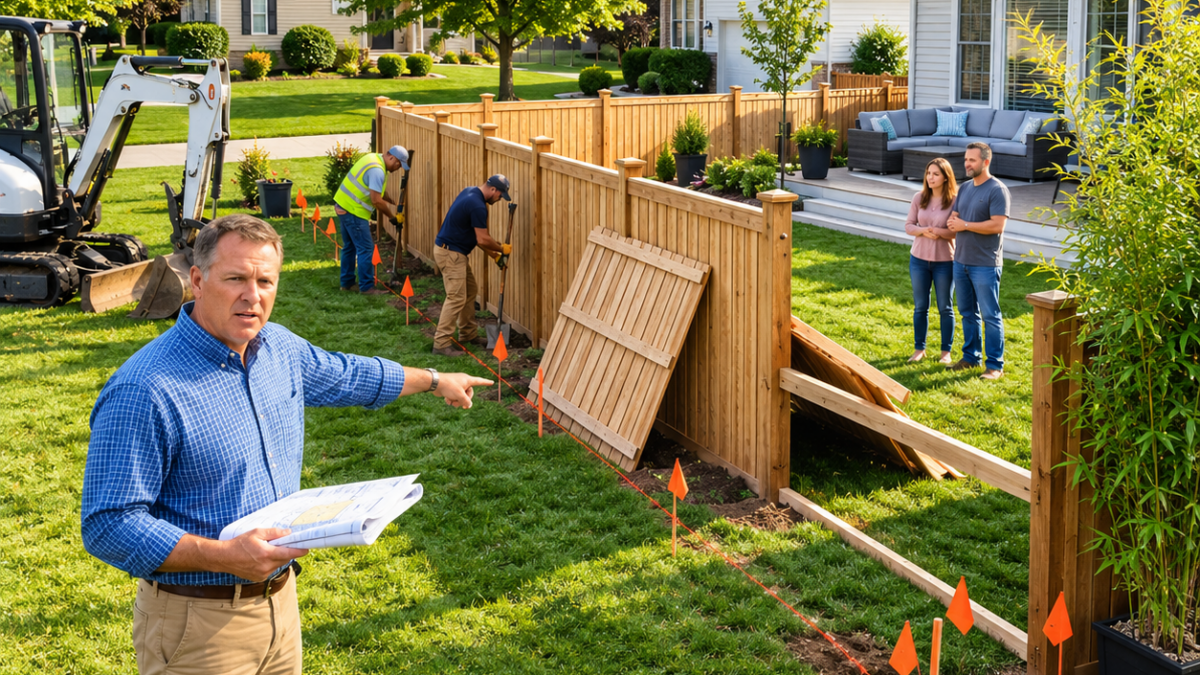
My neighbors built their brand-new privacy fence eight feet inside my property line, laughed when I showed them the survey, and told me I still had “plenty of yard” left.
They were so convinced I wouldn’t spend the money to fight them that they finished the fence, landscaped the stolen strip as part of their backyard, and started planning a patio expansion on land that legally belonged to me.
What they didn’t know was that the county survey had revealed something about that eight-foot strip that gave me a perfectly legal way to make the backyard they had just created almost impossible for them to use.
I had lived in the same modest white house outside Columbus, Ohio, for nearly twelve years.
I bought it after my divorce, when I was forty-three and badly needed one thing in my life that felt permanent.
My daughter Emily spent summers there before college.
My old golden retriever, Cooper, wore a dirt path beneath the maple trees chasing squirrels he never caught.
I planted the flower beds myself.
The backyard wasn’t enormous, but it was unusually deep for the neighborhood, and I knew every corner of it.
For years, the house behind mine belonged to Walter and Janice Porter.
Good neighbors.
We waved.
Talked football.
Borrowed tools.
Never once argued about where our yards met.
Then they retired to Florida and sold to Ryan and Madison Keller.
Within a week, contractors were everywhere.
New roof.
New landscaping.
New deck.
New exterior lighting.
I didn’t mind.
Then one afternoon Ryan wandered over while I was trimming shrubs.
He had a tape measure in one hand.
“You got lucky with this lot,” he said.
“If this were mine, I’d fence all of it.”
I laughed.
“Good thing it isn’t.”
He laughed too.
Three days later, a fence crew arrived.
By sunset, cedar panels stretched almost the entire width behind my house.
Something looked wrong.
I measured the next morning.
Then measured again.
Eight feet of my backyard had disappeared.
I went to Ryan.
“The fence looks like it crossed the line.”
He barely glanced outside.
“Contractor followed the markers.”
“Can I see the survey?”
“I don’t have it.”
“Who surveyed?”
“I’d have to ask.”
“Then maybe stop construction until we verify it.”
Ryan looked through his back window at the new cedar.
“Honestly, it looks good where it is.”
That sentence told me everything.
I hired a licensed surveyor named Carl Jensen.
Three days later, Carl planted bright orange flags across my backyard.
The fence was not inches off.
It was roughly eight feet inside my property for almost ninety feet.
More than seven hundred square feet of my land sat on Ryan’s side of his fence.
I emailed him the stamped survey.
I included photographs.
I politely asked him to relocate the fence.
He ignored me for six days.
When I finally went to his house, he sighed before I finished speaking.
“Daniel, moving it is going to cost thousands.”
“It’s on my property.”
“You still have a huge yard.”
I stared at him.
“So your solution is that I give you seven hundred square feet because fixing your mistake is expensive?”
“You’re making this bigger than it needs to be.”
Then he shut the door.
That night I spread my deed, subdivision plat, survey, and county records across my kitchen table.
I expected to call a lawyer the next morning.
Instead, I noticed something on Carl’s survey.
The stolen strip wasn’t burdened by any utility easement.
It wasn’t common property.
There was no drainage restriction preventing ordinary landscaping.
It was simply mine.
A week later, I had an attorney send Ryan a formal encroachment notice giving him thirty days to remove the fence.
He responded through an email saying he “disputed my interpretation” but provided no survey of his own.
So I stopped arguing.
I obtained the approvals I needed for a permanent landscaping structure entirely inside my property line.
The following Monday, a crew arrived carrying steel posts, cedar planters, irrigation lines, and enough mature screening plants to fill a truck.
Ryan came off his deck before the first hole was finished.
“What are you building?”
I pointed toward Carl’s orange survey stakes.
“Something on my property.”
His eyes moved from the stakes to his fence.
Then to the narrow strip between them.
For the first time since this started, Ryan seemed to understand that putting his fence on my land hadn’t moved the legal boundary at all.
By the end of the second day, twelve steel posts stood exactly along that boundary.
And when Ryan finally realized what was going to hang between them, he stopped looking angry.
He looked worried.
[END OF FACEBOOK CAPTION]
[FIRST COMMENT / FULL STORY CONTINUATION]
The delivery truck arrived at seven thirty the next morning.
Ryan was already outside.
I could see him through the gaps between the cedar panels, pacing along what he had apparently decided was his backyard.
Mike Donnelly, the landscaping contractor I hired, climbed out of his pickup carrying a clipboard.
He was fifty-something, broad through the shoulders, with a gray beard and the permanent squint of a man who had spent thirty years looking into sunlight.
He studied the fence.
Then the orange survey stakes.
Then Ryan.
“You want to remind me which side is yours?” he asked.
I pointed.
“Everything up to the flagged line.”
“And the fence?”
“Also mine, apparently.”
Mike laughed once.
Ryan heard him.
“What’s that supposed to mean?”
Mike’s expression immediately went professional.
“Nothing, sir. We’re working from the survey.”
Ryan stepped closer to the property line.
“You can’t build against my fence.”
I looked at him.
“Your fence is eight feet into my yard.”
“We’re disputing that.”
“Then show me your survey.”
He folded his arms.
“My contractor used the existing markers.”
Carl, my surveyor, had already explained what probably happened.
There were old wooden landscaping stakes near the rear corner.
Not legal monuments.
Not iron pins.
Not survey markers.
Somebody—either Ryan or the fence company—had assumed they meant something.
That assumption had produced nearly ninety feet of expensive cedar in the wrong place.
Mike lifted his clipboard.
“We’re not touching your structure.”
Ryan’s eyes narrowed.
“What exactly are you installing?”
“A permitted privacy landscape.”
“Meaning?”
Mike glanced at me.
I answered.
“Planter screens.”
Ryan stared.
“On that strip?”
“On my side of the actual boundary.”
“You’re doing this to block us.”
“I’m landscaping my property.”
“That’s ridiculous.”
I almost reminded him that he had described losing eight feet of my yard as no big deal.
Instead, I said, “You have my attorney’s notice.”
His face tightened.
“This is harassment.”
“No, Ryan. Harassment would be me coming onto your property. I’m standing in mine.”
He looked toward his fence.
That sentence landed harder than I expected.
Because for the first time, the physical problem became obvious.
His fence had not expanded his property.
It had simply trapped a strip of my property on his side.
He had built a wall around land that wasn’t his.
And now I was about to use that land.
Mike clapped his hands once.
“Guys, let’s unload.”
The first planter sections were heavy cedar boxes lined with waterproof membranes.
Not cheap temporary pots.
They were four feet long, almost three feet high, built to sit between the steel posts.
I had specifically told Mike I wanted everything freestanding and removable.
No attachment to Ryan’s fence.
No roots crossing underground.
No concrete structure beyond the support posts Mike had confirmed were allowed.
And, after talking with a local attorney, no invasive running bamboo.
The original idea had been bamboo.
Mike talked me out of it.
“Running bamboo is a lawsuit with leaves,” he told me.
So we chose clumping bamboo varieties and columnar evergreens mixed with tall ornamental grasses.
Dense.
Fast growing.
Contained.
Legal.
And, once mature, nearly impossible to see through.
The important part was placement.
The planter system ran along the true property line.
Ryan’s fence sat eight feet behind it.
That meant the strip between my legal screening wall and his fence belonged to me.
He could see it.
But legally, he had no right to use it.
And because his fence blocked access to the rest of his yard from that side, his new backyard suddenly became considerably smaller.
Mike’s crew worked all morning.
By lunchtime, the first six planters were in.
Ryan and Madison watched from their deck.
They had spent money on that deck.
You could tell.
Composite boards.
Black metal railing.
Outdoor kitchen.
Gas fire feature.
Built-in lighting.
A sectional sofa that looked cleaner than anything inside my house.
Before the fence went up, the deck looked over both yards.
Open grass.
Maple trees.
Afternoon sun.
Now the view was changing.
The planter boxes created a precise line almost eight feet in front of their fence.
Plants would eventually rise above eye level.
But even unfinished, the message was clear.
That eight-foot strip was not theirs.
Around two, Madison finally came over.
She had never spoken to me alone.
“Daniel?”
I turned.
“Hi, Madison.”
“Can we talk?”
I set down the garden hose.
“Sure.”
She looked toward the workers.
“Ryan says you’re putting up a second fence.”
“It’s not a fence.”
“It looks like one.”
“It’s a line of raised planters and privacy screening.”
“Why?”
I almost gave the obvious answer.
Because your husband stole eight feet of my yard.
But she looked less angry than embarrassed.
So I kept my voice calm.
“Because your fence is on my property.”
She sighed.
“I know what the survey says.”
“That’s different from saying you believe it.”
She looked away.
“Ryan thinks the original property line was different.”
“Based on what?”
“The contractor.”
“The contractor didn’t survey it.”
She didn’t answer.
That told me she knew.
“Madison, I sent you both the stamped survey.”
“I saw it.”
“I gave Ryan a month to move the fence.”
“I know.”
“I had a lawyer send formal notice.”
“I know.”
Her eyes dropped toward the grass.
“Then what are we talking about?”
She rubbed her forehead.
“You don’t understand how much we’ve already spent.”
There it was again.
Not where the line was.
What correcting it cost.
“On the house?”
“Everything.”
She gestured toward their property.
“The roof. The kitchen. The deck. Landscaping. The fence.”
“That doesn’t change the deed.”
“I know.”
Her voice was quieter now.
I studied her.
“Does Ryan?”
She looked back toward the deck.
He was watching us.
“I think he thought you’d let it go.”
The words were so plain they almost didn’t register.
“He thought I’d give him the land.”
“He thought eight feet wouldn’t matter to you.”
“It matters to him.”
She didn’t argue.
Because that was the entire contradiction.
Eight feet was supposedly meaningless when it belonged to me.
But suddenly very important when he might lose it.
Madison said, “What are you hoping happens?”
“I want the fence moved.”
“That’s it?”
“Yes.”
“You’ll remove all this?”
I looked toward the planter frames.
“If your fence goes to the correct line, I don’t need a second privacy screen here.”
She nodded slowly.
Then she walked back.
Ryan met her halfway across their yard.
I couldn’t hear everything.
I heard enough.
“This is exactly what he wants.”
“It is his land.”
“You’re taking his side.”
“I’m looking at the survey.”
Then their voices dropped.
Mike walked over.
“Family meeting?”
“Apparently.”
He studied Ryan.
“You think they’ll move it?”
“Eventually.”
“You sound confident.”
“I’m not.”
Mike smiled.
“You paid a deposit on a lot of plants for somebody who isn’t confident.”
“I’m motivated.”
By five thirty, all twelve planter sections were in place.
The plants came the next day.
Mature clumping bamboo in large nursery containers.
Columnar arborvitae.
Switchgrass.
A few narrow Japanese maples toward one corner because I didn’t want the whole thing looking like a military barrier.
Mike had designed it well.
That was important.
I didn’t want something ugly.
I wanted something useful enough that, if Ryan never moved his fence, I would still enjoy looking at it.
By Friday, the installation was complete.
From my side, it looked good.
Really good.
A clean raised garden border running along the actual boundary.
Fresh mulch.
Drip irrigation.
Dense green screening.
From Ryan’s side, it was something else.
His cedar fence sat behind my new landscape wall.
Between them was eight feet of grass he had thought he gained.
Now he couldn’t legally landscape it.
Couldn’t extend his patio into it.
Couldn’t place furniture there.
Couldn’t build the pergola extension he had apparently planned.
And as the plants filled in, his deck view was going to disappear.
But that wasn’t what made the backyard difficult to use.
The bigger problem was access.
Ryan’s deck stairs descended toward the disputed strip.
The walkway his contractor had built curved directly toward the fence.
The grill area sat near one end.
A future hot-tub pad had already been marked near the other.
He had designed the entire backyard around the assumption that the fence marked his boundary.
Once the actual property line was restored visually, everything felt compressed.
The deck suddenly sat much closer to the legal edge of his yard than he had expected.
His landscaping beds curved onto my strip.
Two irrigation heads were on my side.
Three low-voltage lights were too.
Even the corner of a decorative stone border crossed the line.
Carl came back the following week to mark everything again.
Ryan was furious.
He stood on his deck with his arms folded.
Carl ignored him.
Surveyors have a special ability to remain emotionally unaffected by people who hate measurements.
After an hour, Carl called me over.
“There’s more.”
That was not what I wanted to hear.
“What?”
He pointed toward the back corner.
Ryan’s deck itself was inside his property.
Barely.
But the stairs?
One lower landing extended over the line by eleven inches.
I closed my eyes.
“Tell me you’re kidding.”
“No.”
“What about the patio?”
Carl pointed.
“Mostly okay.”
“Mostly?”
“Those pavers cross about eighteen inches for roughly twelve feet.”
I looked toward Ryan.
He was watching.
Carl lowered his voice.
“This is why you survey before construction.”
“I’ve heard rumors.”
He smiled.
I asked him to prepare an updated exhibit.
That afternoon, I called my attorney.
Her name was Alicia Monroe.
She was not flashy.
No dramatic threats.
No courtroom speeches.
When I first brought her the case, she spent twenty minutes asking me why I cared about eight feet.
Not because she thought I was wrong.
Because good lawyers want to know whether clients are protecting something or feeding anger.
When I told her the strip was more than seven hundred square feet, included part of my drainage pattern, and affected future resale, she nodded.
“That’s a real problem.”
Then she said something that stayed with me.
“Your strongest position is boring. Keep it boring.”
“What does that mean?”
“No threats. No cutting the fence down yourself. No trapping their dog. No moving markers. No social media. No revenge construction that violates nuisance rules. Document. Notify. Give them a reasonable cure period. If they refuse, we file.”
So that was what I had done.
The landscaping project had come only after she confirmed I could lawfully use my own strip and after Mike obtained the approvals his installation required.
When I told Alicia about the stairs and pavers, she went quiet.
“They built those after your survey?”
“Looks like the patio work started before, but some finishing happened afterward.”
“Photographs?”
“Plenty.”
“Dates?”
“From my security cameras.”
“Good.”
She sighed.
“We send a supplemental notice.”
“Another thirty days?”
“Fourteen for the improvements. The fence deadline stays where it is.”
“What if they ignore it?”
“Then we ask the court for an order confirming the boundary and requiring removal of the encroachments.”
No revenge.
No magic.
Just process.
I almost hated how reasonable it sounded.
Then she added, “And stop smiling.”
“I’m on the phone.”
“I can hear it.”
Four days later, Ryan came over holding Alicia’s letter.
Not walking.
Marching.
He stopped at the edge of my driveway.
“You’re seriously threatening to sue us over eleven inches of stairs?”
I looked at the envelope.
“Did you read the rest?”
“This is insane.”
“Did you read the survey?”
“We already talked about the survey.”
“No, I talked. You shrugged.”
He pointed toward the backyard.
“And then you built that wall.”
“It’s landscaping.”
“You know exactly what it is.”
“Yes.”
That caught him.
I nodded.
“It’s a reminder of where my property starts.”
His face tightened.
“You’re trying to make our backyard miserable.”
“No. You made your backyard dependent on land you didn’t own.”
“You could have just worked with us.”
I stared at him.
“I asked you to stop construction.”
“That was before everything was finished.”
“I sent you a survey.”
“We disagreed.”
“You never hired another surveyor.”
“We shouldn’t have to spend money every time a neighbor gets upset.”
There it was.
Again.
Money.
His money.
His cost.
His inconvenience.
I said, “Ryan, I’m going to make this very simple. Hire your own licensed surveyor. If they prove Carl is wrong, I’ll pay for your survey and move my landscaping.”
His expression changed.
Only slightly.
“You’ll put that in writing?”
“Yes.”
“And if your survey is right?”
“You move everything.”
He looked toward my house.
“And you remove the plants?”
“When the fence is on the right line, we can discuss what stays.”
“That isn’t good enough.”
“It’s more than you offered me.”
He stood there another moment.
Then he walked away.
For the first time, I thought he might actually do it.
Three days later, a different survey truck appeared at Ryan’s house.
I watched from my kitchen.
Two men unloaded equipment.
One walked to the front corner.
The other disappeared behind Ryan’s garage.
Ryan followed them around for nearly four hours.
He looked confident at first.
Then less confident.
By noon, he stopped following them.
Around two, one of the surveyors stood near the disputed fence staring at his data collector.
Then he walked toward Carl’s orange flags.
He checked one.
Then another.
Then the iron monument near the corner.
I couldn’t hear what he said.
I didn’t need to.
Ryan put both hands on his hips.
The surveyor pointed toward the fence.
Ryan shook his head.
The surveyor pointed again.
Ryan walked inside.
I poured coffee.
The next morning, Alicia received an email from Ryan’s attorney.
Not Ryan.
An actual attorney.
His name was Peter Sloan.
The email acknowledged that Ryan’s survey “substantially corresponded” with ours.
I laughed when Alicia read that line to me.
“Substantially?”
“That’s lawyer for ‘your survey is right.’”
“What happens now?”
“They want to negotiate.”
“About the line?”
“No.”
“Then what?”
“Buying the strip.”
That surprised me.
“How much?”
“They haven’t offered yet.”
I looked out the kitchen window.
Seven hundred square feet of grass.
Nothing remarkable.
But selling it would permanently alter my lot.
It might affect setbacks.
Future improvements.
Drainage.
Resale.
And most importantly, it would reward exactly what Ryan had done.
Build first.
Force negotiation later.
“I’m not selling.”
“Think before you answer.”
“I have.”
“You’ve had twelve seconds.”
“I started thinking six weeks ago.”
Alicia was quiet.
“Fair.”
Peter’s first offer was $12,000.
I declined.
Second was $20,000 plus they paid survey and legal expenses.
Declined.
Third was $30,000.
That was enough money to make me uncomfortable.
Emily called that weekend.
She lived in Chicago by then.
She had heard pieces of the story but not everything.
“You turned down thirty thousand dollars for grass?”
“It’s not grass.”
“It literally is.”
“It’s land.”
“Land covered in grass.”
“Correct.”
She laughed.
“Dad.”
“What?”
“That’s a used car.”
“I own a used car.”
“That’s a very used car.”
I looked out at my fifteen-year-old pickup.
“Still runs.”
“Barely.”
I smiled.
Then Emily’s voice changed.
“Are you doing this because you need the land or because he made you angry?”
That was annoyingly perceptive.
“Both.”
“Which one more?”
I didn’t answer.
She waited.
“I don’t know.”
“Then figure it out before you spend ten thousand dollars proving a point.”
“I already spent money.”
“That is not a defense.”
Children grow up and become your least affordable conscience.
I walked outside after the call.
The evening was warm.
The new plants moved slightly in the breeze.
On the other side, I could hear Ryan and Madison.
Not arguing.
Talking.
Low voices.
The dispute had stopped being funny.
For all of us.
That mattered.
The next Monday, I met Alicia at her office.
“I want to know what happens if I sell the strip.”
She nodded.
“Good question.”
We reviewed it properly.
Lot-line adjustment.
Municipal approval.
Updated legal descriptions.
Possible lender consent.
Setback implications.
Tax parcel changes.
Title work.
Survey costs.
Potential issues with my side yard.
By the time she finished, selling seven hundred square feet sounded like a small corporate merger.
“Could it be done?” I asked.
“Probably.”
“Should it?”
“That’s not my decision.”
“What would you do?”
“I wouldn’t buy property from someone who acquired bargaining leverage by encroaching on mine.”
“That sounds like advice.”
“It’s an observation.”
I leaned back.
“What about an easement?”
“For what?”
“Let them use the strip while I retain ownership.”
Alicia studied me.
“You want that?”
“No.”
“Then don’t create twenty years of future confusion because thirty thousand dollars feels flattering.”
That settled it.
I rejected the sale.
Peter responded two days later.
They would relocate the fence.
But they wanted ninety days.
I said thirty.
They asked sixty.
Alicia suggested forty-five.
We settled on forty-five.
In exchange, I agreed not to file suit while they complied.
The stairs and pavers were to be corrected too.
It should have ended there.
It didn’t.
Because Ryan apparently decided agreeing to something and doing it were separate activities.
Week one passed.
Nothing.
Week two.
Nothing.
Week three.
A fencing contractor came out.
Measured.
Left.
Then silence.
At day thirty-eight, Alicia emailed Peter.
Peter responded that contractor scheduling was difficult.
At day forty-three, Ryan told me from across the yard, “They’ll get here when they get here.”
I looked at him.
“The deadline is Friday.”
“Then sue me.”
He said it casually.
Like he was tired.
Maybe he was.
I was too.
But there are sentences that make decisions for you.
That was one.
Friday passed.
Monday morning, Alicia filed.
Not for some ridiculous damages claim.
For declaratory and injunctive relief.
Confirm the surveyed boundary.
Require removal of encroachments.
Prevent continued unauthorized use.
Recover costs where allowed.
Peter called that afternoon.
Ryan suddenly had a fence crew available Wednesday.
Amazing what a filing number can do for scheduling.
Wednesday morning, three trucks arrived.
One belonged to the same fencing company that installed the original fence.
Mike came over because he wanted to see it.
“You’re enjoying this too much,” I told him.
“I’ve been in landscaping thirty-one years. Property-line disputes are our version of professional sports.”
The crew foreman walked into my yard carrying rolled plans.
His name was Luis.
He looked at the survey stakes.
Then the fence.
Then me.
“You Daniel?”
“Yes.”
He removed his cap.
“We built this.”
“I know.”
He winced.
“I wasn’t on that crew.”
“Convenient.”
He laughed.
“No, seriously. Different team.”
I showed him Carl’s survey.
He studied it carefully.
Then Ryan’s survey.
Then he shook his head.
“I don’t know what they used.”
“Ryan said survey markers.”
Luis walked to the rear corner.
He pointed toward an old wooden stake.
“That?”
“I assume.”
“That’s landscaping.”
“I know.”
He stared at it.
Then at the ninety-foot cedar fence.
“Damn.”
Ryan heard him.
“Can we just get this done?”
Luis turned professional immediately.
“Yes, sir.”
They started removing panels.
One by one.
The cedar fence Ryan had spent thousands installing came apart in reverse.
Screws out.
Panels lifted.
Rails removed.
Posts exposed.
Concrete broken.
The first post left a hole nearly three feet deep in my yard.
I stood on the porch with coffee.
Not because I wanted Ryan to see me watching.
Because after nearly two months of letters, surveys, contractors, arguments, and legal bills, I wanted to see the land physically return.
Madison came outside around ten.
She sat on the deck.
Ryan stayed inside.
By noon, half the fence was gone.
And for the first time since the whole thing started, our yards were open again.
The effect was strange.
The privacy landscape I had installed still marked the true line.
Behind it, the disputed strip lay exposed.
My grass.
My irrigation.
My maple tree.
My dirt.
Nothing special.
And yet seeing it again felt like getting back something much larger than seven hundred square feet.
Luis’s crew pulled the final post around two thirty.
Then they began laying out the correct line.
This time, both surveys were on the table.
Every measurement was checked.
Ryan came outside.
He stood beside Luis.
“Can we move it six inches their way so the post clears that root?”
Luis shook his head.
“No.”
“It’s six inches.”
Luis pointed toward me.
“I am not going through this twice.”
I nearly choked on my coffee.
Ryan looked at me.
I looked away.
The new fence went in exactly where the legal boundary belonged.
Not close.
Not approximate.
Not “looks good here.”
Exactly.
The deck stairs were next.
A carpenter removed the lower landing and rebuilt it slightly narrower.
The patio crew pulled the encroaching pavers.
The stone border was shifted.
Two irrigation heads moved.
Three lights relocated.
It took less than three days.
That was the part that stayed with me.
Months of conflict.
Thousands in surveys and legal fees.
Weeks of stress.
Three days to physically fix it.
On Friday afternoon, Ryan’s contractor finished.
Mike came over Monday.
“You still want these planters moved?”
I looked at the landscape.
The screen had filled in beautifully.
From my side, I liked it.
From Ryan’s side, it still blocked most of the view.
But now there was no disputed strip trapped behind his fence.
The line was clean.
“Some of them.”
Mike nodded.
We redesigned it.
Instead of one continuous wall, we removed every third planter.
We relocated several bamboo clumps to the side yard.
Kept the arborvitae.
Opened sight lines.
Let afternoon light through.
Within a week, Ryan’s backyard was usable again.
His deck no longer faced a dense green wall.
His flower beds got more sun.
The patio opened visually.
And I still had a tasteful privacy screen on my side.
Nobody got everything.
That felt right.
The lawsuit was dismissed after compliance.
Ryan paid part of my survey costs and legal expenses under our settlement.
Not enough to make me rich.
Enough that I wasn’t carrying the full bill for defending a line he had refused to verify.
For almost two months afterward, Ryan and I barely acknowledged each other.
No waves.
No arguments.
Nothing.
Madison would occasionally nod if we both collected mail at the same time.
Then winter came.
The first snow exposed property lines better than any fence.
My yard.
His yard.
A clean narrow ridge where the fence stood.
Simple.
In January, a heavy storm brought down a maple limb near Ryan’s side.
Not one of mine.
One of his.
It landed across the top of the new fence.
I saw it from the kitchen.
For thirty seconds, I considered pretending not to notice.
Then I put on boots.
Ryan was already outside with a hand saw when I walked back.
He looked at me.
“This tree is on my side.”
“I know.”
“Just making sure.”
That was almost a joke.
Almost.
I grabbed the limb.
“You cut. I’ll hold.”
He hesitated.
Then nodded.
We spent twenty minutes getting the branch off the fence.
At one point the saw bound in the wood.
I shifted my grip.
Ryan said, “Careful.”
“I’ve survived your property improvements. I’ll be fine.”
He laughed.
A real laugh.
First one I had heard from him in months.
When the limb was down, we stood in the snow catching our breath.
Ryan looked at the fence.
“Looks better here.”
“It does.”
He brushed sawdust from his jacket.
“I was an ass.”
I looked at him.
He kept staring at the fence.
“That your official position?”
“Don’t make me repeat it.”
I smiled.
He finally looked over.
“I thought the contractor had checked everything.”
“Then why didn’t you move it after my survey?”
He exhaled.
“Because by then I’d already spent almost eleven grand.”
“That was the problem.”
“I know.”
“No. I mean that was actually the problem.”
He frowned.
I continued.
“You stopped asking where the line was and started asking how much being wrong would cost.”
Ryan nodded slowly.
“That’s fair.”
He kicked snow off his boot.
“Then I got angry because you wouldn’t absorb the cost.”
“Also fair.”
“No. Not fair.”
“Accurate.”
He smiled.
“Accurate.”
I asked the question I had wondered about from the beginning.
“Did you deliberately tell them to take the extra eight feet?”
His head snapped toward me.
“No.”
I watched him.
He looked offended.
Then tired.
“No. I swear.”
“So what happened?”
He pointed toward the old rear corner.
“The contractor asked where we wanted the fence. I showed him the old wooden stakes.”
“The landscaping stakes.”
“I didn’t know that.”
“And nobody ordered a survey?”
He shook his head.
“I thought Walter’s old garden border followed the line.”
I stared at him.
“That’s it?”
“That’s it.”
For months, part of me had imagined a deliberate plan.
Ryan calculating how much yard he could steal.
Telling workers to move posts.
Betting I would never notice.
The truth was somehow more ordinary.
He guessed.
Then, once proven wrong, pride took over.
That didn’t excuse what followed.
But it changed the shape of it.
The original mistake was negligence.
The real wrongdoing came afterward.
When facts became inconvenient.
I nodded.
“You should have told me that.”
“You were already mad.”
“I wasn’t that mad at first.”
Ryan laughed.
“You measured your yard three times before breakfast.”
“How do you know that?”
“Madison saw you through the window.”
“That proves nothing.”
“It proves you’re you.”
We stood there another minute.
Then he said, “For what it’s worth, the landscaping thing was brutal.”
“I know.”
“You planned that.”
“Yes.”
“Completely legal?”
“Yes.”
He shook his head.
“That made it worse.”
I smiled.
“I know.”
Spring changed everything.
The grass filled in where the old fence posts had been.
Mike replanted the damaged strip.
The final survey pins stayed.
This time, everybody knew what they meant.
Ryan built a smaller pergola entirely inside his property.
Before construction, he walked over with a site sketch.
“I’m thinking of putting this here.”
I looked at him.
“Why are you showing me?”
“Trauma.”
I laughed.
He pointed toward the line.
“It’s three feet inside the setback requirement.”
“Did you verify that?”
“Yes.”
“With whom?”
“A surveyor.”
“Which one?”
He stared at me.
“Daniel.”
“Just checking.”
The pergola went up without incident.
That was how normal returned.
Not with a grand apology.
Not with friendship.
With boring things.
Trash cans.
Snow.
Tree branches.
Contractors asking permission.
A nod across the yard.
Boundaries working because everybody finally knew where they were.
A year later, Emily came home for Memorial Day.
She walked into the backyard and stopped.
“This is it?”
“What?”
“The famous battlefield.”
I looked around.
Fresh grass.
Fence.
Planters.
Maples.
Ryan grilling behind his house.
“Pretty disappointing, right?”
“You made it sound bigger.”
“It felt bigger.”
She walked toward the boundary.
“Where was the old fence?”
I pointed eight feet into my side.
Her eyebrows rose.
“Oh.”
“Exactly.”
“That is a lot.”
“Thank you.”
“I still think thirty thousand dollars was a lot too.”
“Please leave my property.”
She laughed.
We sat on the porch that evening.
Cooper had been gone several years by then.
His old worn path beneath the maple had finally disappeared.
Emily looked toward Ryan’s house.
“You guys okay now?”
“Mostly.”
“Friends?”
“No.”
“Enemies?”
“No.”
“Neighbors.”
“That’s usually enough.”
She nodded.
Then she looked toward the landscaping screen.
“Do you regret building that?”
That question took longer.
“A little.”
“Really?”
“I needed to use the land so he understood the fence didn’t change ownership.”
“That sounds like the lawyer answer.”
“It probably is.”
“What’s the non-lawyer answer?”
I looked at the remaining planters.
“I was angry.”
Emily waited.
“I did everything legally. I checked permits. I kept it on my land. I didn’t damage anything.”
“But?”
“But part of me wanted him to look outside every morning and hate that fence.”
She smiled.
“At least you admit it.”
“I’m old. Confession gets easier.”
“Would you do it again?”
“Not exactly.”
“What would you do?”
“Survey. Written notice. Lawyer. Deadline. Court if necessary.”
“No jungle wall?”
“Maybe a small tasteful shrub.”
She laughed.
That was the difference time made.
When the dispute was happening, the landscaping felt like control.
A way to stop being ignored.
Years later, I could admit it was also retaliation.
Legal retaliation.
Measured retaliation.
But retaliation all the same.
I don’t regret defending the boundary.
I do think there are cheaper ways to learn what pride costs.
Ryan learned that.
So did I.
Because while he paid to build a fence twice, I paid surveyors, lawyers, landscapers, and contractors too.
I lost evenings reading documents.
Lost weekends thinking about eight feet of grass.
Lost sleep over a man who lived fifty yards away.
Nobody tells you that part when they tell property-dispute stories.
People love the satisfying moment.
The survey flag.
The removal crew.
The corrected fence.
They skip the months when your stomach tightens every time you hear a truck outside.
They skip wondering whether your neighbor will escalate.
They skip explaining the situation to family.
They skip legal retainers.
They skip that weird feeling of standing in your own backyard and not feeling relaxed because somebody else has turned it into evidence.
That is why the best part was never watching Ryan’s fence come down.
It was forgetting about the fence afterward.
Two years later, Walter and Janice came back to visit friends.
Walter stopped by.
He had aged.
So had I.
We sat on my porch drinking iced tea.
He looked toward the rear fence.
“New owners put that in?”
“Twice.”
He turned.
“Twice?”
I told him the short version.
Walter laughed so hard he started coughing.
When he recovered, he said, “Those wooden stakes still back there?”
“What stakes?”
“The ones by the old garden.”
I stared at him.
“The stakes Ryan thought were the property line?”
Walter nodded.
“Janice put those in for tomatoes.”
I closed my eyes.
Walter looked confused.
“What?”
“Nothing.”
“You okay?”
“I just spent about nine thousand dollars because of Janice’s tomatoes.”
Walter started laughing again.
I laughed too.
Because by then, what else was there to do?
An entire neighborhood dispute had begun because a new homeowner assumed a gardening stake was a legal monument.
Then refused to admit the mistake after a professional survey proved otherwise.
That was the whole story in miniature.
Assumption.
Pride.
Cost.
Resolution.
The next weekend, I removed the old wooden stakes.
Not because they mattered anymore.
Because I never wanted anyone confusing them with anything again.
I left the actual survey pins alone.
Those stayed.
Small.
Metal.
Unimpressive.
Accurate.
Ryan noticed me pulling the wooden stakes.
“What are you doing?”
“Destroying history.”
He walked over.
I showed him one.
“This is your famous survey marker.”
He stared.
“That?”
“Walter says Janice used it for tomatoes.”
Ryan closed his eyes.
“No.”
“Yes.”
“No.”
“Yes.”
He started laughing.
Not happy laughter.
The kind where your body gives up before your pride does.
“You’re telling me I spent twenty grand on fences because of a tomato stake?”
“I believe the total was higher.”
“Don’t.”
“I’m just saying.”
“Daniel.”
I held up both hands.
He looked at the stake again.
Then said, “I hate this neighborhood.”
“No, you don’t.”
“No.”
He smiled.
“I really don’t.”
We threw the wooden stake in my trash.
Years later, the corrected fence is still there.
So are several of the planter boxes.
The clumping bamboo never escaped its containers.
Mike takes personal pride in that.
Ryan eventually sold the house.
Not because of me.
He got transferred to Cincinnati.
Before moving, he came over one afternoon.
The house was already half packed.
“You want something?”
“What?”
He held out a small envelope.
Inside was a copy of his closing survey.
The correct line was highlighted.
I looked at him.
“What is this?”
“Proof.”
“Of what?”
“That I learned.”
I laughed.
He pointed toward the new buyers’ house.
“I also gave them a copy.”
“Smart.”
“And told them not to use any vegetable stakes for legal decisions.”
“Very smart.”
He looked across the fence.
“They seem nice.”
“I’ll try not to sue them.”
“I’d appreciate that.”
Then he offered his hand.
I shook it.
No speech.
No dramatic reconciliation.
Just two men who had spent months arguing over a narrow strip of grass and eventually learned to stand on opposite sides of it without needing to win anything else.
The new owners were named Marcus and Elena.
Two weeks after they moved in, Marcus came over holding a plate of ribs.
“I was told there’s a property-line story.”
I stared at him.
“Ryan told you?”
“He said never build anything without asking you first.”
“That’s not quite the lesson.”
“I figured.”
He handed me the plate.
“Where is the line?”
I walked him to the back.
Showed him the survey pins.
The fence sat precisely where it should.
Marcus nodded.
“Perfect.”
That was the easiest property discussion I ever had.
Three minutes.
No lawyers.
No certified letters.
No planters.
No $30,000 offer.
Just a question followed by an answer.
Sometimes I stand in the backyard now and think about how strange ownership is.
The dirt looks the same on both sides of a legal line.
Grass doesn’t know whose deed it sits on.
Trees don’t care.
Rain crosses boundaries without asking.
But people need lines.
Not because every inch has to become a fight.
Because clarity prevents fights.
The mistake Ryan made was not installing a fence in the wrong place.
Mistakes happen.
Contractors make them.
Homeowners make them.
Surveyors sometimes make them too.
The mistake was deciding that correcting it should become my burden simply because he had already spent the money.
That turned a construction error into a conflict.
And for a while, I made my own mistake.
I let proving the point become almost as important as protecting the land.
The planters taught both of us something.
His fence could not move my boundary.
My anger could not improve it either.
Only the survey did that.
Only the documents.
Only the boring, precise little pins in the ground.
That is why I still have Carl’s original survey framed in my workshop.
Not in the living room.
I’m not completely insane.
But it hangs over the workbench.
Every now and then someone notices it.
“What’s that?”
I usually say, “An expensive reminder.”
And if they ask what it reminds me of, I tell them this:
Before you build a fence, know where your land ends.
And before you tell your neighbor that eight feet doesn’t matter, make sure you’re prepared to lose eight feet of your own.
The last planter Mike installed is still beside the maple tree.
It no longer blocks anyone’s backyard.
It just holds a row of tall grasses that turn gold every fall.
From my porch, you can see the corrected fence behind it.
Straight.
Quiet.
Exactly where the survey says it belongs.
And after everything Ryan and I spent arguing about that line, that simple fact turned out to be the only victory I ever really needed.