The city inspector stood in my backyard staring at the engineering plans in her hands, then at the perfectly ordinary patch of grass beneath her shoes, apparently trying to understand how a rejected 120-square-foot shed had somehow turned into an approved underground project almost seventeen times larger. T
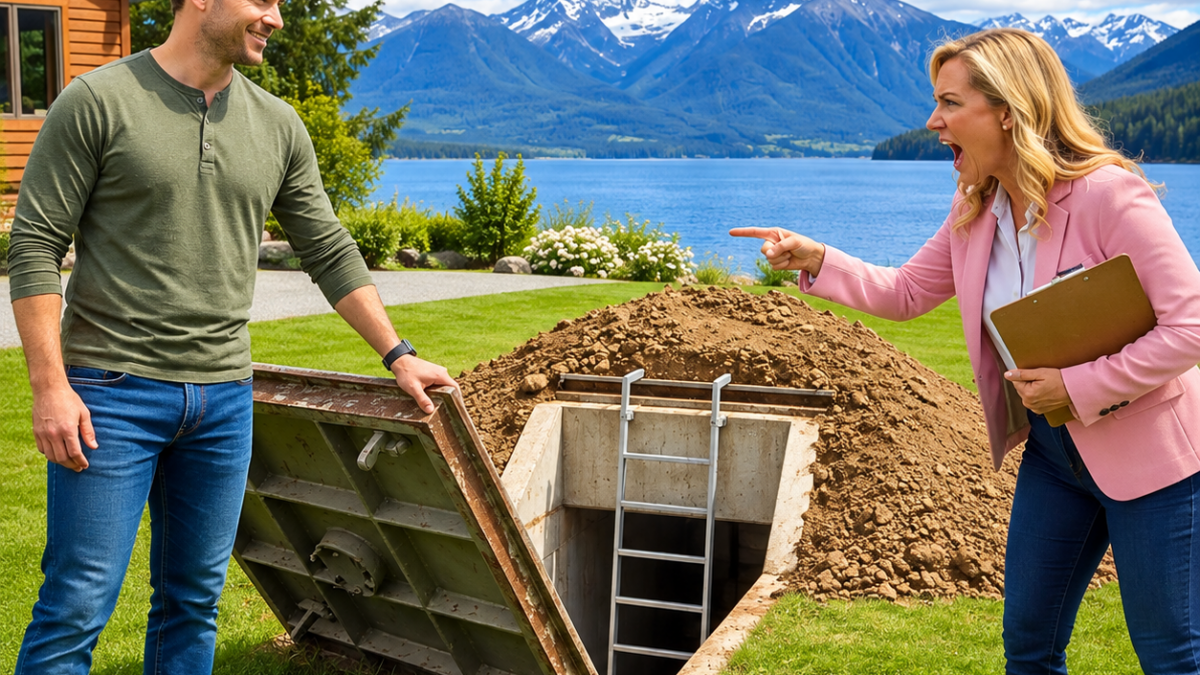
I followed Gus Mercer across what used to be my lawn.
Gus owned Mercer Excavation.
He was sixty-two, built like a refrigerator, and possessed the emotional range of a parking meter.
I’d hired him precisely because he was the opposite of me.
I got excited.
Gus got permits.
I made jokes.
Gus checked drawings.
I occasionally said things like, “Imagine a hidden bookshelf door.”
Gus would stare at me until I remembered that structural engineering and Scooby-Doo architecture were different professions.
Now he pointed toward three orange survey flags.
“Old line.”
“What kind?”
“Don’t know yet.”
That was not the answer I wanted.
The utility-location work we’d commissioned had identified all active public services near the property.
But old neighborhoods collect history underground.
Abandoned irrigation.
Old drainage.
Disconnected utilities.
Previous construction nobody documented properly.
Our survey crew had found something inconsistent with the records.
Gus folded his arms.
“We stop here until we know what it is.”
“How long?”
“As long as it takes.”
I looked at the excavator.
Then at the enormous temporary fencing.
Then at Eleanor.
She was watching through binoculars.
Actual binoculars.
“Eleanor!”
The binoculars dropped.
“I can see you!”
She disappeared behind the fence.
Gus didn’t even blink.
“You attract interesting people.”
“You have no idea.”
He pointed at the flags.
“Don’t touch anything.”
“I wasn’t going to.”
“You were leaning toward it.”
“I was looking.”
“Look from farther away.”
That sentence probably saved me from becoming the kind of homeowner contractors tell stories about at Christmas parties.
Work stopped.
The appropriate utility professionals came out.
The line turned out to be abandoned infrastructure from a previous irrigation arrangement, disconnected long before I’d bought the house.
Harmless now.
But the delay taught me something important.
Underground construction doesn’t reward improvisation.
Every mistake becomes expensive.
Sometimes dangerous.
Sometimes both.
So from then on, whenever Gus said stop, we stopped.
Whenever the engineer wanted another inspection, we got another inspection.
Whenever the city asked for revised documentation, I complained privately and submitted revised documentation.
This was going to be absurd.
It was not going to be reckless.
That distinction became increasingly important.
Because by the second week, everyone in the neighborhood had an opinion.
Some thought I was building a swimming pool.
Some thought I was installing geothermal equipment.
Gary Whitmore from across the street became convinced I was constructing a wine cellar.
“I don’t even drink wine.”
“You will after you see the bill.”
Fair point.
Eleanor had another theory.
She cornered me beside my mailbox.
“You’re building a bunker.”
“No.”
“You are.”
“It’s an underground residential accessory space.”
“That’s a bunker.”
“My attorney says I’m not allowed to call it that.”
Her eyes narrowed.
“Why?”
“Because every time I call it a bunker, he develops chest pain.”
She looked toward my backyard.
“What do you need a bunker for?”
“I don’t.”
That confused her.
“Then why are you building one?”
“Because I couldn’t build a shed.”
She stared at me.
“Mitch, that’s the stupidest thing I’ve ever heard.”
“I’ve spent enough money that I prefer ‘eccentric.’”
“You need therapy.”
“Probably cheaper.”
For once, Eleanor and I agreed.
The neighborhood started calling it the Doomsday Bunker anyway.
Then someone posted photographs online.
That was when things became annoying.
The headline in our local Facebook group said:
MITCH IS PREPARING FOR THE APOCALYPSE.
Within an hour, people were asking whether I knew something they didn’t.
One man messaged me privately:
“How many months of food are you storing?”
I replied:
“Currently six granola bars.”
Another asked whether the bunker would withstand “government electromagnetic attacks.”
I blocked him.
Then a prepper group from another county somehow found the post.
That was when my attorney called.
“Mitch.”
“Morning, Rachel.”
“Stop replying to people.”
“I’m having fun.”
“You are a land-use case with a social media addiction.”
“That’s harsh.”
“Stop calling it a bunker online.”
“I haven’t.”
“You posted a picture saying ‘Rake Command will be operational by Christmas.’”
“That isn’t the word bunker.”
Silence.
Then:
“I regret taking your case.”
“You say that every week.”
“I mean it more every week.”
Rachel Monroe had been practicing land-use law for twenty-three years.
She was terrifyingly competent.
She had also become the only person capable of preventing my sense of humor from turning into evidence.
The important thing, she kept reminding me, was that the project had been approved based on professional plans and would remain subject to inspections.
The shed denial and underground project were related emotionally.
Legally, they were separate applications.
“Do not confuse those things,” she told me.
“Can I confuse them recreationally?”
“No.”
“Can I make T-shirts?”
“No.”
“What if—”
“No.”
I ordered one T-shirt.
RACHEL NEVER SAW IT.
Construction continued.
The excavation grew.
Then came concrete.
Then waterproofing.
Then drainage systems.
Then structural work.
I will spare you the technical details.
Not because I don’t love technical details.
I do.
Deeply.
Dangerously.
But this is a story about human stubbornness, not a construction manual.
What matters is that professionals designed it, professionals built it, inspectors reviewed the relevant stages, and every time I suggested a cheaper shortcut Gus reacted as though I’d insulted his mother.
One afternoon I asked:
“Do we really need another inspection?”
Gus turned.
“Yes.”
“Okay.”
That’s how persuasive he was.
My savings account began shrinking at a rate normally associated with yacht ownership.
The original shed would’ve cost me maybe twelve thousand dollars.
The underground project crossed six figures before we finished the structural shell.
Then kept going.
Every invoice reminded me that there was a point in this process where I could have bought three beautiful prefabricated sheds and simply moved to a house without restrictive setbacks.
But spite is a fascinating financial adviser.
It never asks whether something is wise.
Only whether it is possible.
My sister, Claire, visited during month three.
She stood beside the excavation.
Looked down.
Looked at me.
“You’re an idiot.”
“Mom said I was creative.”
“Mom also thought you were going through a phase when you bought that motorcycle.”
“I sold it.”
“After you crashed into a hedge.”
“The hedge survived.”
Claire turned to Gus.
“Can you fill this back in?”
“Absolutely.”
I gasped.
Gus nodded.
“Would cost him.”
“Don’t give her ideas.”
Claire looked at the plans.
“Two thousand square feet?”
“Roughly.”
“You live alone.”
“Yes.”
“Your underground storage space is bigger than my first house.”
“Yes.”
“You needed somewhere to put a rake.”
“Several rakes.”
“How many?”
I thought about it.
“Four.”
She walked away.
Family can be cruel.
By month four, the structure disappeared beneath the lawn.
That was the strangest part.
For months, my backyard had looked like an archaeological excavation.
Then slowly the earth returned.
Drainage was completed.
Landscaping was restored.
Grass went back.
From Eleanor’s second-floor window, my property looked nearly normal again.
Nearly.
There was a discreet exterior entrance integrated into the approved design.
Nothing secret.
Nothing hidden from inspectors.
Nothing disguised as a flowerpot that opened when you pulled a fake tulip.
I had proposed that.
Rachel had said no.
Inside, however, I allowed myself some fun.
The upper level contained a workshop and storage area.
The lower level had a media room.
A small office.
Mechanical space.
Additional storage.
And one ridiculous room that existed entirely because my architect had asked what I wanted to do with unused square footage.
I said:
“Arcade.”
He said:
“Seriously?”
I said:
“I’ve spent too much money to become reasonable now.”
So we built an arcade.
Not huge.
But enough.
Pac-Man.
Galaga.
A pinball machine.
An old racing cabinet I found from a restaurant auction.
Neon lighting.
A couch.
And above the storage-room door, I mounted a brass plaque.
AUTHORIZED RAKE FACILITY.
Rachel saw it during the final walkthrough.
She stared at the plaque.
Then at me.
“I hate that I like this.”
“Growth.”
“Don’t.”
The final inspections approached.
That’s when Bartholomew P. Higgins III returned.
He hadn’t personally handled most of the underground application.
Different departments had reviewed different components.
But he had become fascinated by the project.
I think my bunker—sorry, underground accessory space—had become his white whale.
He arrived with Inspector Davis.
Davis was everything you want in an inspector.
Serious.
Thorough.
Unimpressed.
She didn’t care that I was angry about the shed.
Didn’t care that the neighborhood thought the project was hilarious.
Didn’t care that I’d named the arcade Rake Command.
She cared whether what had been built matched what had been approved.
Which was exactly how it should be.
We walked through.
She checked documentation.
Asked Gus questions.
Asked the structural engineer questions.
Reviewed safety systems.
Examined required access and egress.
Looked at electrical work.
Mechanical work.
Everything relevant to her inspection.
Bartholomew followed.
Quietly.
We reached the storage room.
He saw the rake.
One rake.
Dead center against an enormous wall.
He looked at me.
“Is that…”
“Yes.”
“The rake?”
“One of them.”
He stared.
“You built all this because we denied your shed.”
Rachel stepped between us verbally.
“The project was submitted and reviewed on its own merits.”
Bartholomew ignored her.
“Mr. Callahan.”
“Mitch.”
“You could’ve bought a smaller house.”
“True.”
“You could’ve rented storage.”
“Also true.”
“You could’ve appealed again.”
“Did that.”
“You could’ve sold the lawn mower.”
I frowned.
“Let’s not say things we can’t take back.”
Inspector Davis actually laughed.
First time.
Tiny laugh.
But I heard it.
Then she returned to business.
There were items to correct.
Of course there were.
A labeling issue.
A documentation update.
A minor finishing detail.
Nothing dramatic.
Nothing that couldn’t be fixed.
I fixed them.
Because here’s the thing nobody tells you in revenge stories.
Winning against bureaucracy usually involves doing more bureaucracy.
There is no magical moment where you slam one obscure ordinance onto a desk and twelve government employees gasp.
Real permits are boring.
Reviews take time.
Codes overlap.
Engineers disagree.
Attorneys use phrases like “it depends” because it usually does.
My victory wasn’t finding a loophole.
My victory was more irritating.
I complied.
Thoroughly.
Every time somebody asked for documentation, I produced it.
Every time the plans required revision, professionals revised them.
Every inspection happened.
Every correction was addressed.
I didn’t defeat the process.
I survived it.
And because I survived it, eventually Inspector Davis signed the final approval.
I stared at the document.
“That’s it?”
“That’s it.”
“I can use it?”
“For the approved uses.”
“Can I call it a bunker now?”
Rachel said:
“No.”
Davis said:
“I don’t care what you call it in your house.”
I pointed at Rachel.
“See?”
“You are exhausting.”
Bartholomew stood near the doorway.
He looked almost disappointed.
Then he surprised me.
“Can I ask you something?”
“Sure.”
“Why didn’t you just modify the original shed proposal?”
“I tried.”
“No, I mean really modify it. Smaller footprint. Different location. Integrated storage.”
I thought about that.
“Because by then I was angry.”
He nodded.
“That’s what I figured.”
I expected another lecture.
Instead, he said:
“We probably could’ve communicated better.”
That stopped me.
“Probably?”
He exhaled.
“The denial letter was rigid.”
“Historical sightlines.”
“Yes.”
“Pizza Hut.”
“I know about the Pizza Hut.”
“Do you?”
“Yes, Mitch.”
“Because it’s extremely visible.”
“I know.”
Rachel touched my shoulder.
Enough.
Bartholomew continued.
“The board had concerns about setbacks. Those were legitimate.”
“I understand that now.”
“The aesthetic language was unnecessary.”
That was as close to an apology as Bartholomew Higgins seemed physically capable of producing.
I accepted it.
Then I asked:
“Want to see the arcade?”
He hesitated.
Rachel whispered:
“Don’t.”
He said:
“Yes.”
Ten minutes later, the man who denied my shed was playing Galaga beneath my lawn.
Life is weird.
I didn’t throw the giant “bunker warming party” I’d fantasized about.
My insurance agent strongly preferred that I not turn an underground residential space into a nightclub.
Fair.
Instead, I invited twelve neighbors for a small open house.
Gus came.
Rachel came.
Claire came.
Gary brought beer.
Eleanor arrived eleven minutes late because she wanted everyone to believe she wasn’t interested.
She descended the stairs and stopped.
Her mouth opened.
“This is under your lawn?”
“No, Eleanor. We teleported to Nevada.”
She glared at me.
Then walked through the workshop.
The storage.
The media room.
The arcade.
Finally she reached the rake room.
She stared at the plaque.
Then at the single rake.
“You’re sick.”
“Would you like a soda?”
“You spent all that money for this?”
“There are other rooms.”
“I don’t care.”
She pointed at the rake.
“That thing started this?”
“Technically the lawn mower contributed.”
“Where’s the lawn mower?”
Silence.
I suddenly realized something.
“Oh no.”
Everyone looked at me.
Claire said:
“What?”
I ran upstairs.
Across the lawn.
Around the side of the house.
There it was.
My lawn mower.
Still beneath the same faded tarp.
Exactly where it had been when this whole ridiculous saga began.
I stood there staring.
Gary came outside.
Then Claire.
Then Gus.
Then Eleanor.
One by one, they saw it.
Nobody spoke.
Then Eleanor laughed.
Not a polite laugh.
Not a little chuckle.
The woman folded over.
She had to grab the fence.
Claire started.
Then Gary.
Then Gus.
Even Gus.
I pointed at them.
“This isn’t that funny.”
That made it worse.
Rachel came outside.
“What happened?”
Claire couldn’t speak.
She just pointed.
Rachel saw the mower.
Then looked at me.
“Mitch.”
“I forgot.”
“You built two thousand square feet of underground storage.”
“Yes.”
“And forgot the lawn mower.”
“Yes.”
She closed her eyes.
“This is the greatest day of my career.”
I left the mower there.
Not forever.
I’m stubborn, not insane.
But for another week.
Because it was funny.
And because I needed the reminder.
The bunker hadn’t been a brilliant act of rebellion.
It had started as one.
Then professionals, regulations, engineering, cost, and reality had transformed it into something else.
Something useful.
Something ridiculous.
Something I loved.
But definitely not something anyone should copy simply because a zoning board rejects a shed.
I could have appealed differently.
Redesigned.
Negotiated.
Bought an outdoor storage cabinet.
Cleaned my garage.
That last option remains unacceptable.
But I had been so focused on proving that the word “no” couldn’t stop me that I nearly forgot what problem I’d originally wanted to solve.
The lawn mower under the tarp reminded me.
So did the bill.
Dear God, the bill.
For the first year, I used the underground space mostly as a workshop.
Then something changed.
A summer storm knocked out power across part of town.
Nothing apocalyptic.
No zombies.
No mushroom cloud over Pizza Hut.
Just a nasty storm.
Trees down.
Power lines damaged.
Some homes without electricity overnight.
My place still lost grid power, but the underground area had been designed with professionally installed backup systems appropriate to the approved plans.
I invited Eleanor over because her house was getting hot.
She refused.
“I am perfectly capable of surviving a power outage.”
Twenty minutes later, she knocked.
“I reconsidered.”
“Come in.”
She brought a pie.
“What’s that?”
“Payment.”
“For air conditioning?”
“For silence.”
We sat downstairs.
Gary came too.
Then an elderly couple from three houses down.
Nobody treated it like the apocalypse.
We watched an old movie.
Played cards.
Ate Eleanor’s pie.
When power returned, nobody noticed for twenty minutes.
Eleanor looked around.
“You know, this is actually useful.”
I stared at her.
“Can you repeat that?”
“No.”
“I want it recorded.”
“You’ll never hear it again.”
That night changed how I thought about the place.
I’d built it from anger.
But anger is terrible furniture.
You can’t live comfortably inside it.
So I stopped treating the space like a monument to Bartholomew.
I made it part of my home.
I moved my workshop downstairs.
Organized tools.
Finally.
Built proper storage.
Moved seasonal decorations out of the garage.
Put family photographs in the hallway.
Claire donated a framed picture of a garden shed.
Underneath, she added a brass label:
THE ROAD NOT TAKEN.
I hate my sister.
I hung it anyway.
The garage became usable again.
Then, one Saturday morning, something miraculous happened.
I parked my truck inside it.
For the first time in seven years.
I stood there admiring the empty floor.
Eleanor appeared in my driveway.
“What happened?”
“I organized.”
She looked concerned.
“Are you ill?”
“Go home, Eleanor.”
She smiled.
Our relationship had changed too.
She still complained.
That’s how Eleanor expressed affection.
If three days passed without an email about something on my property, I checked whether she was okay.
Then came the strangest development.
The zoning board updated its guidance for accessory structures.
Not because of me alone.
At least that’s what Bartholomew insisted.
But my case had apparently exposed something.
The neighborhood’s rules had been written decades earlier.
Modern lots were different.
Storage needs were different.
Some standards were unnecessarily rigid.
The city held public workshops.
I attended.
Quietly.
For the first meeting.
At the second, I spoke.
Not about bunkers.
About proportionality.
“If someone wants a small shed,” I said, “the process shouldn’t accidentally make a professionally engineered underground addition feel easier than a box for rakes.”
People laughed.
Bartholomew didn’t.
Then he did.
Just slightly.
New guidance eventually allowed more flexibility for modest accessory structures where setbacks, drainage, visibility, and neighboring properties could be responsibly addressed.
Not a free-for-all.
Not “build whatever you want.”
Better rules.
Clearer options.
More predictable review.
Eleanor opposed the changes.
Naturally.
“What happens when everyone has sheds?”
“They store things.”
“Property values could suffer.”
“Eleanor.”
“What?”
“You’ve been inside my underground arcade.”
“That is different.”
“How?”
“Your foolishness is invisible.”
I couldn’t argue.
Then Gary applied for a shed.
Approved.
Eight by ten.
Tasteful siding.
Placed appropriately.
Total process: six weeks.
Total cost: less than my arcade machines.
I attended the installation.
He opened the doors.
Rakes.
Mower.
Shovels.
Everything fit.
He looked at me.
“Want one?”
“Get off my property.”
He laughed for five straight minutes.
Bartholomew retired two years later.
He invited me to his retirement party.
I assumed it was a clerical error.
It wasn’t.
Rachel went with me.
She said she wanted to witness “the final diplomatic summit.”
Bartholomew approached carrying a wrapped box.
“For you.”
I opened it.
A miniature wooden shed.
Handmade.
Maybe eight inches tall.
Inside was a tiny rake.
I stared at him.
“You’ve been waiting years for this.”
“Absolutely.”
I shook his hand.
“Thank you.”
Then I gave him my gift.
A framed photograph of my lawn.
Nothing else visible.
He looked confused.
I said:
“Two thousand square feet.”
He laughed.
Really laughed.
For the first time since I’d known him, Bartholomew P. Higgins III looked less like a zoning official and more like a normal guy.
“You were a nightmare,” he said.
“So were you.”
“Fair.”
We drank coffee.
Talked about retirement.
He admitted something.
“When your underground application first came in, I thought you were trying to embarrass us.”
“I was.”
“I know.”
“But?”
“But eventually you stopped fighting the department and started working through the process.”
“Rachel threatened me.”
“I assumed.”
Across the room, Rachel raised her glass.
Bartholomew looked at me.
“You know the funny thing?”
“What?”
“If you’d come back after the original denial and asked for a meeting instead of immediately appealing, we probably could’ve found a workable shed design.”
I stared at him.
“You’re telling me this now?”
“Yes.”
“After I spent—”
Rachel appeared instantly.
“No.”
“But he—”
“No.”
“He just said—”
“I heard him.”
She handed me coffee.
“Drink.”
I drank.
Because personal growth has limits.
After Bartholomew retired, the miniature shed went downstairs.
I placed it beside Claire’s framed photograph.
The rake room eventually filled.
Four rakes.
Two shovels.
A leaf blower.
Camping equipment.
Holiday decorations.
Toolboxes.
And yes.
The lawn mower.
I finally moved it inside.
Eleanor held a ceremony.
She showed up with a ribbon.
“What’s this?”
“We are marking the completion of your seven-year shed project.”
“It hasn’t been seven years.”
“Emotionally it has.”
Gary brought scissors.
Claire brought champagne.
They tied the ribbon around the mower.
I cut it.
People applauded.
I live among idiots.
They’re my favorite people.
Years passed.
The neighborhood changed.
Kids grew up.
Houses sold.
New families arrived.
Most newcomers heard about “Mitch’s bunker” eventually.
The story became neighborhood folklore.
It also became less accurate every year.
According to one version, I built it secretly in a weekend.
Impossible.
Another said the government tried to seize it.
Never happened.
Another said I found a forgotten tunnel beneath the subdivision.
Absolutely not.
My favorite claimed I had enough food underground to survive ten years.
At the time, my pantry contained tortilla chips, mustard, and a suspicious jar of pickles.
People prefer dramatic stories.
Reality is usually better.
Because the real lesson wasn’t that I found a magical loophole.
I didn’t.
The real lesson was that anger started something, but discipline finished it.
Spite made me ask the question.
Could I build underground?
Professionals turned that question into something safe and legal.
Gus kept me from rushing.
Engineers kept the structure sane.
Rachel kept me from turning jokes into legal problems.
Inspectors caught details.
The city made corrections.
Even Bartholomew eventually helped improve the rules that started the mess.
Nobody “lost.”
Not really.
I got my ridiculous underground space.
The city got a compliant project.
The neighborhood got better shed rules.
Gary got an actual shed.
Eleanor got years of material for complaints.
Rachel probably bought a vacation home with my legal fees.
Everybody won.
Except my savings account.
We don’t discuss my savings account.
One evening, long after the project stopped being news, I sat downstairs alone.
No movie.
No arcade.
Just quiet.
I walked into the storage room.
There were tools along the wall.
Bins labeled CHRISTMAS.
CAMPING.
ELECTRICAL.
PLUMBING.
THINGS I REFUSE TO THROW AWAY.
And there, hanging neatly on a rack, was the original rake.
I took it down.
Turned it over in my hands.
A rake.
Twenty-dollar rake.
Maybe thirty now.
Inflation.
That stupid thing had needed a home.
I’d asked for 120 square feet.
They said no.
I got angry.
And somehow that anger ended with me standing beneath my lawn in a room larger than some apartments.
I laughed.
Then I carried the rake upstairs.
Eleanor was outside watering flowers.
She saw me.
“Where are you going?”
“Yard work.”
“With the famous rake?”
“Yes.”
“Be careful.”
“Why?”
“That thing has caused enough damage.”
I laughed.
Then I raked leaves.
Completely ordinary leaves.
Across a completely ordinary lawn.
Above two thousand square feet of absolutely unnecessary underground construction.
And maybe that’s the best ending.
Not revenge.
Not defeating Bartholomew.
Not proving the city wrong.
Just finally using the rake.
A few months later, Gary came over.
He leaned on the fence.
“Mitch.”
“What?”
“I need help.”
“With?”
“My shed.”
I smiled.
“Permit trouble?”
“No.”
“Setback?”
“No.”
“Drainage?”
“No.”
“Then what?”
“I bought too much stuff.”
I stared at him.
He stared at me.
Then both of us looked down at my lawn.
“No.”
“I didn’t say anything.”
“You were thinking it.”
“Maybe a small basement?”
“Go home, Gary.”
He laughed.
I went inside.
Downstairs, the miniature shed Bartholomew gave me sat on the shelf.
Tiny rake inside.
I picked it up.
For years I’d told the story as if the city denying my shed had forced me underground.
It hadn’t.
Nobody forced me.
That’s important.
I chose the absurd option.
I chose to turn frustration into a project.
Then, fortunately, enough responsible people surrounded me to make sure the project became something better than a reckless hole in the ground.
The difference matters.
Because stubbornness by itself isn’t courage.
Sometimes it’s just stubbornness.
The useful part is what you build after the anger cools.
Mine happened to be underneath the grass.
And yes, technically, after all those years, I finally got the perfect place to store my rake.
It only took two thousand square feet to do it.