The morning our HOA president marched onto my porch and informed me that Captain, my African gray parrot, had violated “community decency standards,” he was sitting ten feet away whistling the Andy Griffith theme like he had retained counsel. T
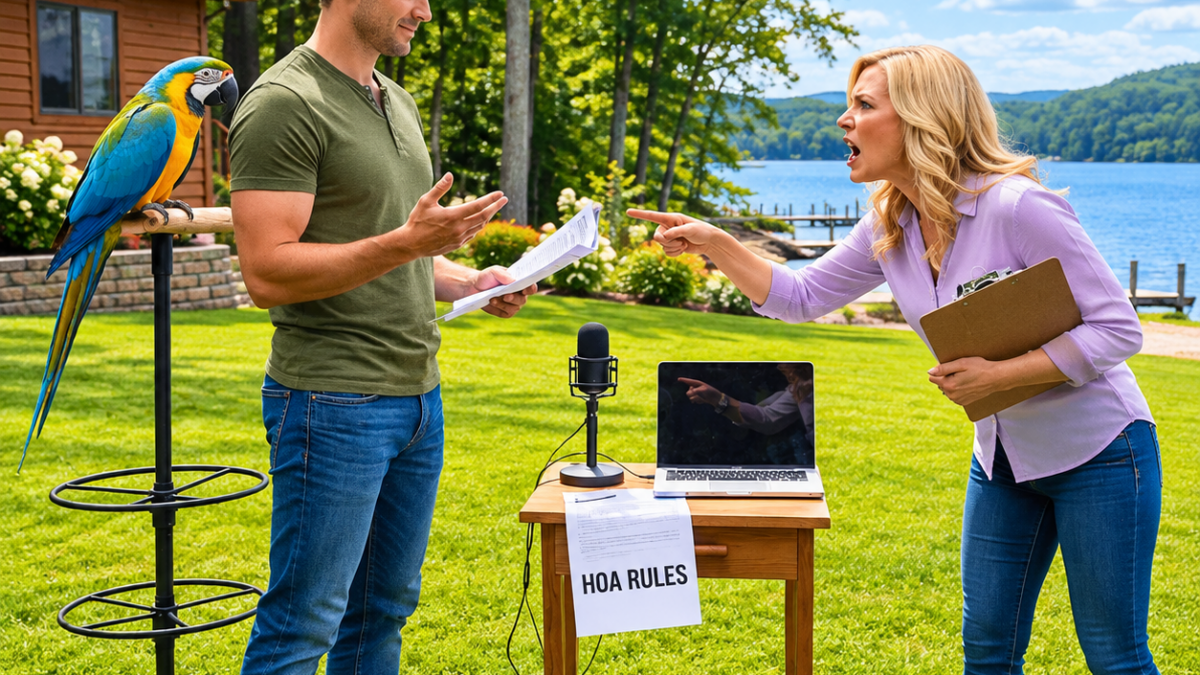
Captain’s first public recital happened on a Saturday morning.
I had not planned it.
That is what I tell people.
Technically, I had opened the living-room window at exactly nine.
Technically, I had moved Captain’s perch slightly closer to it.
And technically, I may have whispered:
“Look, buddy. Brenda.”
But everything after that belonged to the bird.
Brenda was three houses down wearing a pink visor and attacking petunias with a hand cultivator.
Captain saw her.
His feathers lifted slightly around his neck.
He waddled toward the window.
I held my breath.
Then, in the flat mechanical tone he had somehow developed specifically for HOA regulations, he announced:
“ARTICLE NINE. SECTION TWO. TRASH RECEPTACLES SHALL NOT BE VISIBLE FROM THE STREET.”
Brenda stopped.
One hand in the dirt.
Captain continued.
“RECEPTACLES MUST BE STORED NO LATER THAN SIX P.M. ON COLLECTION DAY.”
Brenda looked left.
Right.
Up.
For one wonderful second, she appeared to believe God had become extremely concerned with garbage cans.
Then Captain added:
“APPROVED COLORS INCLUDE BEIGE, TAUPE, AND GRAY.”
Her head turned toward my house.
Slowly.
I saw the exact moment she understood.
Confusion disappeared.
Her lips tightened.
Her left eye twitched.
Captain looked delighted.
I covered my mouth.
Brenda stood up.
Brushed soil from her gardening gloves.
Then marched inside.
Captain turned to me.
“Mission accomplished.”
That was still one of his old movie phrases.
“Good bird.”
“Article Seven.”
“Not yet.”
“Exterior structures.”
“Captain.”
“No shed, canopy, tent—”
“Save something for later.”
He took an almond.
For the next ten days, Captain became the unofficial soundtrack of Whispering Pines.
Not constantly.
That mattered.
I was not trying to create a real nuisance.
I kept windows closed early in the morning and after dinner.
During client meetings, Captain stayed in the den with music and enrichment toys.
I tracked his louder periods.
Partly because Brenda had frightened me into behaving like a laboratory technician inside my own home.
Partly because attorney Beth Lang, whom I called after the first warning, gave me the least exciting legal advice imaginable.
“Do not turn a funny dispute into an actual violation.”
Beth was forty-six.
HOA and condominium law.
Dry humor.
No interest in revenge fantasies.
She read the governing documents.
Then the warning.
Then asked:
“How often does the bird vocalize loudly?”
“I don’t know.”
“Find out.”
“He’s a parrot.”
“Parrots have clocks.”
“I’m pretty sure they believe clocks are a human conspiracy.”
“Mark.”
So I logged it.
Captain’s loudest stretch usually lasted five to fifteen minutes in late morning.
Occasional bursts later.
Nothing overnight.
Nothing continuous.
Beth said:
“Reasonableness matters. The HOA can regulate genuine nuisance noise. It cannot realistically require an intelligent bird never to make sound.”
“What about profanity?”
“Content regulation gets weirder.”
“Weirder legally?”
“Weirder factually. The board can probably address excessive disruptive noise more comfortably than policing specific words uttered inside your home that happen to be overheard outside.”
“So teaching him bylaws—”
“Is childish.”
“I heard lawful.”
“I said childish.”
“But not unlawful.”
Beth sighed.
“I regret taking your call.”
I sent her Captain’s first bylaw recording.
She replied:
I regret it more.
The neighborhood did not.
Dave Mercer across the street had a mower problem.
Not mechanical.
Chronological.
Dave believed sunrise was a personal invitation to operate gasoline equipment.
Our rules restricted noisy yard machinery before eight.
One Thursday at 7:28 a.m., Dave fired up his mower.
Captain was eating banana.
He froze.
Head tilted.
Then marched toward the window.
“ARTICLE FIVE. SECTION FIVE.”
Dave kept mowing.
“OPERATION OF POWER EQUIPMENT IS RESTRICTED TO EIGHT A.M. THROUGH EIGHT P.M.”
Dave looked around.
Captain repeated it.
Dave shut off the mower.
He checked his watch.
Then stared at my window.
I stepped outside.
“Sorry.”
Dave pointed at my house.
“Was that Captain?”
“Yes.”
“The bird just cited me.”
“Yes.”
He scratched his chin.
“I hate that I’m wrong.”
“Go make coffee.”
He wheeled the mower back into the garage.
At 8:01, it started again.
Captain did not object.
That afternoon Dave knocked.
He carried a six-pack.
“For the compliance officer.”
I took it.
“He can’t drink.”
“For you.”
“Better.”
Dave leaned toward the window.
“Hey, Captain.”
Captain appeared.
“Mailman approaches.”
“Wrong script,” I said.
Dave laughed.
“You teach him fences yet?”
“Working through landscaping.”
“Do roof pitches.”
“Why?”
“My shed application got kicked back.”
I pointed at him.
“No weaponizing Captain for private disputes.”
“Aren’t you weaponizing Captain for a private dispute?”
“That’s different.”
“How?”
“It’s my bird.”
Fair enough.
Captain’s reputation spread.
Kids stopped outside and asked him questions.
Mostly useless ones.
“What’s the rule on trampolines?”
“What’s the rule on basketball hoops?”
“What’s the rule on my dad parking his boat in the driveway?”
Captain knew fragments, not the entire declaration.
People imagined he had become a feathered attorney.
He had not.
He had become a very talented pattern machine with a disturbing commitment to repetition.
African grays are astonishing that way.
They do not memorize like tape recorders exactly.
They associate sounds with contexts.
Captain started connecting Brenda with certain phrases.
Trash rules.
Noise rules.
Architectural approval.
I did not explicitly teach him:
Brenda equals violation.
But he got there.
One afternoon Brenda walked past.
Captain saw her through the window.
“Prior written approval required.”
I nearly fell out of my chair.
He had selected that without prompting.
Brenda stopped.
I closed the window immediately.
Not because she was right.
Because that felt targeted.
And Beth had been clear:
“Do not harass her.”
So I changed Captain’s training.
No person-specific cues.
No reactions to Brenda.
He could recite bylaws as enrichment.
Not as an attack command.
That distinction mattered.
I also started teaching ordinary things again.
His name.
My name.
Weather.
Fruit.
“Blueberry.”
“Blueberry.”
“Good.”
“Article Nine.”
“No.”
“Blueberry receptacle.”
“Absolutely not.”
He was evolving.
Brenda’s next letter arrived anyway.
SECOND NOTICE OF NUISANCE.
This one cited “persistent vocal recitation of association rules in an apparent mocking tone.”
I read that phrase three times.
Mocking tone.
The board was attempting to regulate sarcasm in a parrot.
I called Beth.
“You’re laughing.”
“No.”
“You are.”
“I’m a professional.”
“I can hear it.”
“Send me the letter.”
She wrote back to the association.
Not aggressive.
Not theatrical.
She asked for dates.
Times.
Duration.
Witnesses.
Audio recordings.
Specific governing provisions.
Notice of hearing procedures.
She also stated that I had modified Captain’s behavior after the first complaint and that any enforcement needed to distinguish actual unreasonable noise from occasional daytime vocalization by a lawful household pet.
Three days later, management responded.
One documented complaint.
Brenda.
Date:
Saturday.
Time:
10:14 a.m.
Duration:
Approximately four minutes.
Content:
Trash receptacle rules.
Beth forwarded it to me.
Her note:
Four minutes at 10:14 a.m. is not the hill they want to die on.
I felt better.
Then Brenda found a different hill.
The police arrived on a Thursday.
Two officers.
Sergeant Miller and Officer Banks.
Not sirens.
Not guns out.
Just a knock.
I opened the door.
“Mr. Harrison?”
“Yes.”
“Everything okay in here?”
That is not the question you want from police when you are wearing sweatpants at two in the afternoon.
“Yeah.”
Officer Banks checked his notes.
“We received a request for a welfare check. Caller reported repeated shouting from the residence and expressed concern someone might be experiencing a mental-health crisis.”
I understood instantly.
“Did she say the shouting involved HOA bylaws?”
Banks looked up.
Miller’s eyes narrowed slightly.
“How’d you know?”
“Come in.”
I pointed toward Captain.
He sat on his perch.
Silent.
Professional.
Miller looked at the bird.
Then at me.
“Parrot?”
“African gray.”
Banks said:
“The bird is doing the shouting?”
“Yes.”
Miller’s expression did not change.
He had the face of a man who had spent three decades learning that reality can always get more annoying.
“What does he shout?”
“Lately? Mostly homeowner-association rules.”
Banks lowered the notebook.
“Why?”
“That requires backstory.”
“I’m afraid to ask.”
Captain saved me.
“ARTICLE TWO. SECTION FOUR. SOLICITATION IS PROHIBITED.”
Banks looked at him.
Then at Miller.
Captain repeated:
“SOLICITATION IS PROHIBITED.”
I said:
“He thinks uniforms mean official visitors.”
Miller stared at Captain.
“Does he say anything threatening?”
“Not anymore.”
“Anymore?”
“Before the HOA complaint he had an action-movie phase.”
Banks looked interested.
Miller shut that down with one glance.
“Sir, are you safe?”
“Yes.”
“Anyone else inside?”
“No.”
“Any weapons involved in today’s disturbance?”
“No.”
“Any reason we should believe someone needs emergency assistance?”
“No.”
Miller nodded.
“That’s really all we need.”
I hesitated.
“Did Brenda Tagert call?”
Miller didn’t confirm immediately.
“We don’t usually discuss complainants beyond what’s necessary.”
Fair.
Then he said:
“The caller identified herself as an HOA official.”
There it was.
I felt anger rise.
Not funny anger.
Different.
A welfare check is serious.
Police come because someone might be sick, suicidal, hurt, confused, in danger.
Using that system to continue a neighborhood dispute felt ugly.
Miller must have seen it.
“Don’t go over there.”
“I wasn’t planning to.”
“Good.”
“Can I get an incident number?”
“Yes.”
“I’ll need it for my attorney.”
He nodded.
Smart.
Banks looked at Captain.
“Can he really memorize whole sections?”
“Fragments.”
Captain puffed up.
“Grass shall not exceed four inches.”
Banks turned away.
Shoulders shaking.
Miller almost smiled.
Almost.
Before leaving, he said:
“Mr. Harrison, if future complaints come in, we still have to assess what’s reported. But today we don’t see an emergency.”
“I understand.”
He glanced at Captain.
“Maybe teach him weather.”
“I’ve tried.”
Captain:
“Architectural Review Committee.”
Miller walked out.
Banks made it to the sidewalk before laughing.
I closed the door.
Then sat on the couch.
My hands were shaking.
Captain climbed down.
“Mark okay?”
That stopped me.
He knew that phrase from me.
Whenever he got startled, I said:
Captain okay?
Now he was using it back.
“Yeah, buddy.”
“Mark okay?”
“Yeah.”
He leaned his head against the cage bars.
I scratched his neck.
For the first time since this started, none of it felt funny.
I called Beth.
She became very quiet when I explained the welfare check.
“Get the report when available.”
“I have the incident number.”
“Good.”
“Can the HOA do that?”
“The HOA didn’t call police. Brenda did.”
“She called as HOA president.”
“Still an individual communication unless the board authorized it.”
“What do I do?”
“Nothing tonight.”
“I hate that advice.”
“I know.”
“Can we send a letter?”
“Tomorrow.”
“What do I say if she approaches me?”
“Nothing.”
“Can Captain say something?”
“Mark.”
“Kidding.”
Mostly.
Beth sent a cease-and-desist style letter the next morning.
Not claiming Brenda had committed a crime.
We could not know intent yet.
Not threatening a lawsuit.
Just documenting that police had found no emergency and asking that future concerns related to association enforcement go through the management and hearing process rather than law enforcement unless there was a genuine safety issue.
The HOA’s vice president called me.
His name was Gary Levin.
I barely knew him.
“Mark?”
“Yeah.”
“I wanted to tell you the board didn’t authorize Brenda to call police.”
“I figured.”
“She didn’t tell us.”
“Okay.”
Long pause.
“We’re getting uncomfortable.”
“With me?”
“With this.”
That mattered.
“Then do something.”
Gary sighed.
“You have never been on an HOA board.”
“No.”
“It’s five volunteers trying not to get sued while thirty-seven people email about mulch.”
“Then stop letting one volunteer act like she’s the government.”
Another silence.
“You’re not wrong.”
Progress.
Brenda changed tactics again.
The new target was Captain’s enclosure.
His normal cage sat inside my living room near a front-facing window.
Large cage.
Powder-coated metal.
Wheels.
Clearly furniture.
Apparently not clearly enough for Brenda.
NOTICE OF UNAPPROVED STRUCTURE.
She cited architectural restrictions requiring approval for “exterior structures, enclosures, sheds, and permanent installations visible from the street.”
Then described Captain’s cage as a “metal enclosure structure.”
I forwarded it to Beth with no message.
She replied:
I need a vacation.
Then:
The clause appears to apply to improvements to property, not movable furniture inside the dwelling.
That should have ended it.
But I was tired of should.
I had developed what can only be described as regulatory paranoia.
I started imagining every object through Brenda’s eyes.
Floor lamp?
Unauthorized illumination structure.
Bookshelf?
Interior vertical obstruction.
Toaster?
Unapproved heating appliance visible through glazing.
I hated living like that.
That was when Sam Delaney entered the story.
Sam was a contractor Dave recommended.
Late forties.
Big hands.
Sunburned neck.
Tool belt heavy enough to change ocean tides.
He looked at Captain’s cage.
Then at the warning letter.
Then at me.
“So you want me to build what?”
“A recessed bird alcove.”
“A bird what?”
“Permanent built-in habitat.”
“For the parrot.”
“Yes.”
“Why?”
I handed him the letter.
He read.
Once.
Twice.
“She’s calling the cage a structure?”
“Yes.”
Sam looked at Captain.
Captain stared back.
“Architectural review committee.”
Sam lowered the paper.
“That bird just say architectural review committee?”
“Yes.”
“How much money have you spent on this dispute?”
“Don’t ask.”
He grinned.
“You are deeply unwell.”
“Can you build it?”
“Yes.”
That answer came too fast.
Sam loved stupid projects.
Important clarification:
I did not mortgage my house to build a $5,000 revenge cage.
That version sounds better online.
The actual project cost less because the wall configuration was simple, and I already needed to replace built-in shelving damaged by an old leak.
We combined work.
The final design included:
A recessed nook.
Ventilation.
Bird-safe lighting.
Washable wall panels.
Storage.
Sound-absorbing material behind the finished wall.
Removable enclosure inside.
Important point:
Captain still needed a proper enclosure.
You do not seal a parrot behind decorative glass like a museum artifact.
Sam consulted an avian veterinarian about materials and airflow after I insisted.
Captain’s health came first.
Spite second.
Maybe third.
Coffee was second.
We also improved acoustic treatment.
That actually reduced noise reaching outside.
Imagine that.
A revenge renovation producing a reasonable solution.
I submitted plans through the HOA’s normal architectural process because the built-in work was technically interior, but portions were visible through the front window.
Beth recommended over-disclosure.
“Make them say yes.”
The architectural committee approved it.
Four-one.
Guess who voted no.
Sam delivered the approval packet personally.
I told him not to.
He ignored me.
When the work was finished, Captain had a beautiful indoor habitat.
Neutral trim.
Integrated cabinet.
Perches.
Foraging wall.
Full-spectrum bird-safe lighting.
A ventilation grille.
Acoustic panels.
It looked less like a cage and more like a tiny executive office designed by someone with a walnut addiction.
Captain loved it.
He strutted from perch to perch.
“This is a fortress.”
I laughed.
“Not exactly.”
“Fortress.”
“Fine.”
“Article Seven.”
“Please enjoy the fortress quietly.”
He rang his bell.
The next HOA email arrived that evening.
EMERGENCY BOARD MEETING.
Topic:
Resident conduct and ongoing nuisance concerns.
Mandatory appearance requested.
Not legally “mandatory” in the sense Brenda made it sound.
But Beth told me to attend.
“You want due process?”
“Yes.”
“Then participate in it.”
“Can I bring Captain?”
Silence.
“Beth?”
“Why?”
“He is the accused.”
“He is a parrot.”
“I feel like that has been overlooked.”
Another silence.
“If pets are allowed in the clubhouse and you can transport him safely, I cannot stop you.”
That was not approval.
I treated it as such.
Wednesday night, Whispering Pines clubhouse was packed.
Usually HOA meetings attracted six people and one person attending only because their fence application was on the agenda.
That night:
Forty-six residents.
Maybe fifty.
Word had spread.
Not just about Captain.
About Brenda.
The welfare check.
The letters.
The cage-as-structure notice.
People had their own stories.
Dave’s grass.
Janine Parker’s holiday wreath that stayed up until January 16.
Mr. Cho’s mailbox post.
A retired teacher fined because her grandson’s car remained overnight on a street during a snow emergency.
Some enforcement was legitimate.
Some petty.
The bigger problem was inconsistency.
Brenda sat at the front.
Gary vice president.
Linda Cho treasurer.
Marcus Reed secretary.
Another director named Claire Watson.
Association manager present.
So was association counsel.
That surprised me.
Older man.
Robert Ellis.
Beth whispered:
“Good.”
“Why?”
“Because somebody in this room understands liability.”
Captain sat in a covered travel carrier next to me.
Quiet.
I had given him a pistachio.
Bribery works across species.
Brenda opened the meeting.
“Tonight we are addressing an unfortunate pattern of deliberate antagonism.”
Beth leaned toward me.
“Do not react.”
I didn’t.
Brenda described Captain’s original profanity.
Fair.
She described my response as “weaponizing association language.”
Less fair.
She described the built-in habitat as “mockery through excessive compliance.”
Interesting phrase.
Then she mentioned the wellness check.
Not that she had initiated it.
Only that “outside authorities became concerned.”
Beth wrote something down.
Hard.
Brenda proposed a $1,000 fine for harassment and persistent nuisance.
Robert Ellis, association counsel, leaned toward Gary.
Whispered.
Gary looked uncomfortable.
Then Brenda opened the floor.
Beth stood first.
“Before Mr. Harrison responds, I’d like clarification on the legal basis for the proposed fine.”
Brenda said:
“Conduct detrimental to the community.”
Beth held up the declaration.
“Can you identify the provision?”
Brenda pointed to Article Five nuisance language.
Beth nodded.
“Then the relevant question is unreasonable disturbance, correct?”
“Yes.”
“Do you have logs showing frequency and duration?”
Brenda stiffened.
“We have multiple complaints.”
Robert Ellis spoke.
“Madam President, counsel recommends we answer the question directly.”
Gary shuffled papers.
Management had produced a complaint log.
Seven entries.
Five from Brenda.
One anonymous.
One from someone saying Captain woke their baby.
That one mattered.
Beth asked:
“When?”
Manager checked.
“9:37 p.m.”
My stomach dropped.
That was after the quiet hours I had set for myself.
I remembered the night.
Captain had been startled by a dropped pan and screamed.
Maybe thirty seconds.
Still.
A baby woke.
That was real impact.
I looked at Beth.
She gave the smallest nod.
Acknowledge it.
I stood.
“I’m sorry about that one.”
People looked at me.
“I mean that. Captain shouldn’t have been making loud noise that late, and since then his evening enclosure routine has changed.”
The parent who filed it was near the wall.
Young father.
He nodded.
“Thank you.”
That helped more than any joke would have.
Beth continued.
“Other than that complaint, are any documented events after eight p.m.?”
No.
“Any longer than approximately five minutes?”
No.
“Any threatening statements directed at a person since Mr. Harrison modified the bird’s vocabulary?”
No.
Brenda interrupted.
“The content itself is harassment.”
Beth looked at her.
“The content is your governing document.”
People laughed.
Robert Ellis closed his eyes.
Beth did not smile.
“Mockery may be irritating. Irritation is not automatically a violation. If the board intends to fine a resident for speech or pet vocalization, it should identify a specific provision and apply it consistently.”
Brenda’s face reddened.
“He deliberately trained the bird to humiliate me.”
I finally spoke.
“I trained him to stop repeating profanity.”
“You trained him to say our rules when I walk past.”
“I stopped using you as a cue after the first week.”
That surprised her.
“It still does it.”
“He recognizes you.”
Laughter.
Even I knew that was dangerous.
Beth touched my arm.
Stop.
I did.
Brenda pointed at the carrier.
“The animal is disruptive.”
Captain chose that moment to say:
“Unreasonable noise.”
The room lost it.
Not explosive laughter.
More like a wave.
People covering mouths.
Gary’s shoulders moving.
Linda staring at the table.
Robert Ellis removed his glasses.
Brenda slammed her hand down.
“This is exactly what I mean!”
Captain:
“Due process required.”
I turned toward the carrier.
I had not cued him.
That phrase had become one of his favorites because I had practiced it repeatedly after Beth explained the fine procedure.
Robert Ellis actually laughed.
One short sound.
Then covered it with a cough.
Brenda stared at him.
He composed himself.
“Madam President, the bird is not legally determinative.”
That made it worse.
Dave yelled from the back:
“Let him finish!”
Gary banged the gavel.
“Please.”
I uncovered Captain’s carrier.
He climbed onto the travel perch.
The room quieted.
I looked around.
Then at Brenda.
“I’ll admit something.”
She folded her arms.
“This started as a joke.”
Beth looked at me.
I continued.
“I was angry.”
Good.
“I got a profanity warning for a bird repeating movie lines. I felt ridiculous. So I did something ridiculous back.”
People listened.
“But the first warning wasn’t completely unreasonable.”
Brenda blinked.
Nobody expected that.
“Captain can be loud. Some of the stuff he said was inappropriate with the windows open. I needed to manage that better.”
The father of the baby nodded.
I continued.
“So I trained him.”
Captain:
“Article Nine.”
“Not now.”
Small laughter.
“I trained him with HOA language because I thought it was funny.”
Pause.
“It is funny.”
Bigger laughter.
“But the point stopped being funny when police came to my house because somebody reported that a man inside was shouting rules and might be unstable.”
The room changed.
Brenda said:
“I was concerned.”
I looked at her.
“Were you?”
“Yes.”
“Then why didn’t you call me?”
“You had become hostile.”
“I had not threatened you.”
“You were mocking me.”
“Mockery is not a mental-health emergency.”
Robert Ellis raised a hand.
“Mr. Harrison, we should avoid litigating the police call in this hearing.”
Fair.
I nodded.
“My point is simpler.”
I looked at the board.
“I will accept reasonable rules.”
Noise limits.
Pet nuisance standards.
Safety.
Even architectural review when it actually applies.
“But I won’t accept rules becoming a tool for one person to punish a resident because she dislikes being laughed at.”
Nobody moved.
I pointed toward Captain.
“He is not the problem anymore.”
Captain:
“Four inches.”
Someone laughed.
“The problem is whether enforcement is about actual harm or about control.”
I sat.
Beth whispered:
“That was almost mature.”
“Thank you.”
“Almost.”
Then Robert Ellis spoke.
He had reviewed the governing documents and the enforcement history.
His advice was careful.
The board could address genuine excessive animal noise.
It should not base fines merely on disfavored content where the underlying noise was otherwise ordinary and daytime.
The indoor bird cage was personal property, not an architectural structure.
The built-in renovation had been voluntarily submitted and approved.
The proposed $1,000 fine did not appear supported by the association’s published fine schedule.
That was important.
Brenda had jumped from a warning to a number the rules did not authorize for this category.
Gary asked:
“So we can’t fine him?”
Ellis answered:
“You may enforce properly adopted rules through the procedures in your documents and applicable law. I am advising against the proposed motion in its current form.”
Translation:
Please stop before somebody sues us.
Gary called for a motion.
Brenda made one.
One-thousand-dollar fine.
No second.
Silence.
Her face changed.
Board procedure is cruel in the simplest way.
A motion without a second does not become a fight.
It dies from loneliness.
Gary looked around.
“Is there a second?”
Nothing.
Brenda turned to Linda.
Linda looked down.
Marcus adjusted his pen.
Claire shook her head.
“No.”
Gary said:
“Motion fails for lack of a second.”
Someone clapped.
Gary immediately said:
“No applause, please.”
Captain whistled the Andy Griffith theme.
That did it.
The whole room laughed.
Even Gary.
Brenda stood.
“This board is becoming unserious.”
Robert Ellis replied:
“No. I believe the board is becoming careful.”
That line ended her evening.
She gathered her folder.
Walked out.
Did not slam the door.
I almost respected that.
The meeting continued.
Actual business.
Reserve budget.
Pool gate.
Landscaping contract.
An owner requested approval for solar panels.
Nobody declared revolution.
That was good.
Afterward people gathered around Captain.
I hated that.
Not because I minded affection.
Because a parrot is not a prop.
I kept people back from the carrier.
One at a time.
No fingers through bars.
No shouting phrases at him.
Dave said:
“He’s a hero.”
“No.”
Captain:
“Hero.”
“Great.”
Dave grinned.
“Too late.”
The story could have ended there.
Funny bird beats HOA president.
Everybody cheers.
But life is rude enough to keep developing after a satisfying ending.
The next morning Brenda resigned as HOA president.
Not from the board.
Just president.
Her email was six paragraphs.
She said the association had become “unwilling to maintain appropriate standards.”
She cited personal attacks.
Volunteer burnout.
Lack of institutional support.
Some of that was fair.
Serving on an HOA board is miserable.
People want you to enforce rules against their neighbors but never against them.
They email at midnight.
They assume unpaid volunteers are property managers, police, therapists, and landscape architects.
Brenda had done years of work.
Not all badly.
She negotiated a good trash contract.
Led a successful reserve-funding plan.
Organized storm cleanup after a derecho.
People are rarely only the worst thing they do.
Gary became interim president.
His first act was not heroic.
It was administrative.
He created a complaint form requiring:
Specific rule.
Date.
Time.
Location.
Description.
Supporting evidence if available.
No more “resident is disrespectful” notices.
No enforcement without review by management.
No single director directing compliance action.
That one page changed Whispering Pines more than Captain ever did.
Complaints dropped.
Not because rules disappeared.
Because people had to describe actual conduct.
Dave’s mower at 7:30?
Real.
Fence color not on approved palette?
Real.
“I dislike Mark’s bird’s tone”?
Harder.
The board also hired an outside mediator to review several old disputes.
Some fines were upheld.
Others reduced.
A few dismissed.
That mattered to me.
I did not want the lesson to become:
HOA rules are stupid.
Some were.
Some weren’t.
Trash cans left in the street for days create problems.
Blocked sidewalks matter.
Noise at midnight matters.
Drainage modifications matter.
People buy into communities partly because expectations exist.
The problem was not having rules.
It was confusing governance with personal authority.
Brenda had done that.
So had I, in a smaller way.
I turned compliance into performance specifically to embarrass her.
Funny?
Yes.
Kind?
No.
I started training Captain away from bylaws.
Not completely.
You cannot simply delete a parrot’s vocabulary.
Believe me.
If African grays came with factory reset buttons, half their owners would pay extra.
But we added better material.
“Good morning.”
“Beautiful day.”
“Hello, Dave.”
“Mailman.”
The mailman remained “stooge” for another year.
Some battles are unwinnable.
I taught Captain bird names.
Cardinal.
Blue jay.
Crow.
He loved “crow.”
Possibly because it sounds judgmental.
I taught him:
“Welcome home.”
That one became important.
Every time I came through the door:
“Welcome home, Mark.”
Sometimes:
“Welcome home, stooge.”
Progress is nonlinear.
Brenda and I avoided each other.
Months.
Winter came.
Windows stayed closed.
Captain’s public career ended naturally.
People still asked for bylaw performances.
I usually said no.
Not because Brenda won.
Because constant performance stressed him.
Parrots need sleep.
Predictability.
Foraging.
Social interaction.
Not neighborhoods treating them like jukeboxes.
An avian vet named Dr. Cynthia Rao told me:
“He does not exist to entertain your neighbors.”
That sentence embarrassed me.
I had been so focused on proving Captain could talk that I had not asked whether he should be asked to perform constantly.
So rules changed at my house too.
No stranger commands.
No tapping cage.
No feeding without permission.
Quiet period every afternoon.
Twelve hours dark sleep.
Better enrichment.
Captain got calmer.
So did I.
Then one evening in February, Brenda knocked.
Not angry knocking.
Three normal taps.
I opened.
She wore a winter coat.
Mr. Bojangles beside her.
She held an envelope.
My first instinct was:
What now?
She must have seen it.
“This isn’t a violation.”
“That’s refreshing.”
She almost smiled.
“Can we talk?”
I stepped onto the porch.
Cold.
Snow left in shaded patches.
She handed me the envelope.
Inside was a copy of the police welfare-check dispatch record.
“I requested it.”
“Why?”
She looked uncomfortable.
“I wanted to know what I actually said.”
That answer caught me.
“And?”
“I sounded worse than I remembered.”
I waited.
She looked toward my living-room window.
Captain was visible on a perch.
“I told them someone was yelling obsessively and that I was worried about your mental state.”
“Yes.”
“I believed I was worried.”
“That is a strange sentence.”
“I know.”
She took a breath.
“I think I wanted somebody official to tell you to stop.”
There.
Honesty.
“So you used a welfare check as enforcement.”
“Yes.”
“That could have gone badly.”
“I know.”
“No, Brenda.”
I kept my voice low.
“You called police to my house and suggested I might be unstable because a parrot was reciting bylaws.”
She looked down.
“I know.”
“What if I had panicked?”
“I know.”
“What if they had misunderstood something?”
“I know.”
“Stop saying that.”
She looked at me.
“What do you want me to say?”
The answer arrived immediately.
“The truth.”
She nodded.
“I was angry.”
Good.
“I felt mocked.”
Better.
“And I wanted someone with more authority than the board to make you take me seriously.”
There it was.
I relaxed slightly.
“Thank you.”
“For what?”
“For not calling it concern.”
She winced.
Then:
“I’m sorry.”
I did not say it was okay.
It wasn’t.
I said:
“I appreciate the apology.”
We stood there.
Captain saw her.
I braced.
He said:
“Good evening.”
Brenda looked through the window.
“That’s new.”
“We’re expanding his range.”
“He still know the rules?”
“Unfortunately.”
From inside:
“Trash receptacles.”
Brenda closed her eyes.
I laughed.
She did too.
Tiny.
Reluctant.
But real.
Mr. Bojangles barked.
Captain barked back.
Perfect imitation.
The poodle jumped.
Brenda stared at him.
“Did he just—”
“Yes.”
Captain barked again.
Mr. Bojangles barked.
Captain barked.
This went on for twenty seconds.
Brenda picked up her dog.
“I’m leaving.”
“Probably wise.”
She walked away.
Captain:
“Goodbye, Bojangles.”
I had never taught him that.
I stood in the doorway laughing.
After that, Brenda and I reached what diplomats call normalized relations.
Not friendship.
We waved.
Sometimes.
She rejoined the board meetings eventually but did not seek the presidency.
Gary served two years.
Then Claire Watson.
The complaint process stayed.
Association counsel reviewed the fine schedule.
They discovered half the community believed fines worked differently from the documents.
So the board rewrote the enforcement policy.
Notice.
Opportunity to respond.
Hearing.
Published ranges.
Escalation.
Appeal process.
No mysterious “conduct unbecoming” category invented during meetings.
Captain had accidentally become part of governance reform.
Gary joked about putting his picture in the clubhouse.
I said no.
Brenda said:
“Absolutely not.”
First unanimous thing we’d agreed on.
The built-in bird habitat became the best money I spent during the whole mess.
Not because it defeated Brenda.
Because Captain thrived in it.
The acoustic treatment meant I could work while he vocalized without clients hearing everything.
The lighting improved his schedule.
Storage kept seed bags off my floor.
The removable enclosure made cleaning easier.
Sam came back once to inspect a vent.
Captain saw him.
“Architectural Review Committee.”
Sam almost cried laughing.
“You remember me!”
“He remembers everyone associated with construction trauma.”
Sam scratched his beard.
“Still got that beige trim.”
“Whispering Pines Gray.”
“Ugliest color I’ve ever applied.”
“It’s approved.”
Captain:
“Approved.”
Sam pointed.
“See? Bird knows quality.”
Three years passed.
Captain’s action-movie language faded but never disappeared.
One day a delivery driver dropped a box.
Captain yelled:
“Get to the chopper!”
I had to sit down.
Some memories are permanent.
My freelance business improved too.
The hot-sauce company from that disastrous call?
They hired me.
I found out months later that Cynthia, the lead client, had actually liked Captain.
“She thought you handled chaos well,” her operations manager told me.
“That was handling chaos?”
“Apparently.”
They even sent Captain a tiny company bandana.
He hated it.
I never made him wear it again.
Important lesson:
Bird dignity.
The neighborhood gained new residents.
One family moved into the house across from Dave.
Father named Tom.
Mother, Aisha.
Two kids.
Moving truck arrived on a hot July morning.
Tom wandered over holding the Whispering Pines binder.
Three inches thick.
Same white vinyl.
Expression:
terror.
“Hey.”
“Hey.”
“I’m Tom.”
“Mark.”
He held up the binder.
“Is this thing real?”
I looked at it.
“Oh yes.”
“There’s a page on satellite dishes.”
“Two.”
“Mailbox posts.”
“Three, counting appendix.”
He stared.
“How does anybody remember this?”
I looked toward the open living-room window.
No.
I resisted.
For almost five seconds.
Then:
“Captain?”
From inside:
“ARTICLE NINE.”
Tom jumped.
I laughed.
Captain continued:
“MOVING VEHICLES MUST NOT OBSTRUCT TRAFFIC AND MUST BE REMOVED WITHIN TWENTY-FOUR HOURS.”
Tom stared at the window.
Then me.
“Did your bird just cite the HOA rules?”
“Yes.”
“Why?”
“Long story.”
Captain:
“Welcome home.”
Tom smiled.
That was the better phrase.
Aisha came over later.
Met Captain.
Asked before approaching.
Good.
Their daughter Layla became fascinated with birds.
Not the talking.
The intelligence.
She borrowed books.
Asked why parrots imitate.
Why African grays live so long.
Why they need complicated enrichment.
Why captivity is controversial.
Questions most adults never asked.
Eventually she volunteered at a parrot rescue.
At sixteen, she gave a presentation at school about responsible exotic-pet ownership.
Captain appeared in one slide.
Not as a meme.
As an example of cognitive complexity.
That made me prouder than any HOA-meeting laugh.
Captain aged.
African grays can live decades.
Long commitment.
People say they want a talking bird because videos are funny.
They don’t imagine thirty or forty years of morning screaming.
Vet bills.
Dust.
Food flung onto walls.
Chewed trim.
Emotional needs.
Planning your estate around a creature who may outlive you.
That last one hit me when I turned fifty.
Captain was still healthy.
I wasn’t old.
But responsible parrot ownership requires uncomfortable math.
So I created a care trust.
Named backup guardians.
Funded veterinary expenses.
Documented diet.
Sleep routine.
Words he knew.
Words I wished he didn’t.
Brenda witnessed one of the signatures.
That surprised both of us.
Notary couldn’t make the scheduled appointment.
Brenda was nearby.
I asked.
She read the document title.
CAPTAIN HARRISON CARE TRUST.
She looked at me.
“You are leaving money to the profanity bird.”
“Former profanity bird.”
“He told my dog to prepare to die last month.”
“Relapse.”
She signed.
Then said:
“Put me third backup.”
I stared.
“What?”
“If something happens and nobody can take him.”
“You?”
“Don’t make it weird.”
“Brenda, you tried to fine him.”
“Yes.”
“You called police because of him.”
“I apologized.”
“You called his cage an unapproved structure.”
“That interpretation was wrong.”
“You want to inherit Captain?”
“I said third backup.”
Captain, from the other room:
“Brenda.”
She smiled.
He had learned her name years ago despite my efforts not to encourage it.
“What would you even do with him?”
“Read bylaws, apparently.”
I laughed so hard the notary rescheduled for another day because I couldn’t finish the forms.
Brenda did become third backup.
Life is ridiculous.
Whispering Pines changed.
Not radically.
Still beige.
Still rules.
Still arguments.
But the board grew less theatrical.
Residents learned the documents.
That was perhaps Captain’s strangest legacy.
People stopped assuming Brenda—or Gary—or any president—was the HOA.
The HOA was the association.
The documents.
The votes.
The procedures.
The owners.
Presidents came and went.
Rules had amendment procedures.
Authority had limits.
Residents had obligations.
That sounds obvious.
It wasn’t.
One annual meeting, a homeowner named Rick stood up furious about being fined for leaving commercial equipment in his driveway.
He said:
“This board has no authority over me.”
Gary, no longer president but still attending, looked at me.
I looked at Captain’s empty travel perch.
Captain stayed home by then.
Too stressful.
The new president calmly read the declaration.
Commercial vehicles restricted overnight.
Notice sent.
Hearing offered.
Rick had ignored both.
The fine was valid.
I voted to uphold it.
Rick glared.
“I thought you were anti-HOA.”
“I’m anti-making-it-up.”
Big difference.
Rules do not become invalid just because the person receiving them is angry.
That’s another thing my fight with Brenda taught me.
I had been right about overreach.
That did not make every resident right forever.
Captain still helped people learn.
I recorded a few voluntary clips at the board’s request.
Not enforcement.
Education.
Short videos.
Captain sitting on his perch.
“POOL HOURS: SEVEN A.M. TO TEN P.M.”
“PET WASTE MUST BE REMOVED.”
“NO PARKING IN FIRE LANES.”
Residents loved them.
The board’s email open rate increased dramatically.
Beth saw one.
Texted:
I cannot believe this became sanctioned communications.
I replied:
Compliance.
She sent a middle-finger emoji.
Attorney professionalism.
Brenda eventually moved.
Her sister developed health problems in Indiana.
She decided to relocate.
A week before leaving, she knocked again.
Captain was twenty-something by then.
Still sharp.
Less constant.
Brenda stood inside the living room and looked at the habitat she once tried to classify as an architectural violation.
“He really does live well.”
“He has better lighting than I do.”
She watched him crack a walnut.
“Captain.”
He looked at her.
“Brenda.”
She smiled.
“I suppose we’re even.”
I laughed.
“No.”
“No?”
“You filed a profanity complaint.”
“Yes.”
“I spent weeks teaching a parrot governing documents.”
“Yes.”
“You lost the presidency.”
“Yes.”
“I spent thousands renovating my living room.”
“That was your decision.”
“True.”
She considered.
“Fine. Nobody won.”
“That sounds closer.”
Captain dropped the shell.
“Due process.”
Brenda put both hands over her face.
“Of course.”
She had brought something.
The old violation letter.
Original copy.
Framed.
I stared.
“You framed my warning?”
She turned it around.
At the bottom she’d added a small brass plaque.
FIRST AMENDMENT TO CAPTAIN’S VOCABULARY.
I laughed.
“That is legally inaccurate on several levels.”
“I know.”
“You’ve changed.”
“Do not tell anyone.”
I hung it beside the habitat.
Still there.
On moving day, Tom and Aisha helped Brenda load boxes.
Dave supervised without being asked.
Mr. Bojangles was older.
Gray muzzle.
Captain saw him through the window.
“Bojangles.”
The dog looked up.
Captain whistled the Andy Griffith theme.
Brenda stopped in the driveway.
Looked back.
Waved.
Then left.
No dramatic defeat.
No clipboard breaking.
No cheers.
Just the end of one chapter.
The new owner moved in two weeks later.
Young doctor named Priya Desai.
She came to my door.
“Hi. I’m told you have a famous parrot.”
I sighed.
“Unfortunately.”
Captain:
“Welcome home.”
She smiled.
“That’s sweet.”
“Wait.”
“Article Nine.”
“There it is.”
Years later, when people tell the story, they exaggerate.
They say Captain memorized the whole HOA declaration.
He didn’t.
They say police officially declared him “code compliant.”
No.
They say Brenda was removed from office because a parrot defeated her in a public trial.
Also no.
She resigned the presidency after losing support from the board.
Normal governance.
They say I built a $5,000 government-certified fortress so the HOA couldn’t touch his cage.
We remodeled a wall and built a better habitat.
Still absurd.
Just less absurd.
The real story is funnier to me now because nobody was a genius.
Brenda overreached.
I got petty.
Captain learned what he was rewarded for learning.
The board eventually did its job.
The lawyer told everybody to calm down.
Police checked a welfare call and left when nobody needed help.
Neighbors started reading documents.
That’s it.
No federal agents.
No prison.
No million-dollar settlement.
Just a parrot.
A binder.
And several adults forced to rediscover proportion.
Captain taught me something I did not expect.
Words sound different when stripped of authority.
When Brenda said:
“Article Five.”
It sounded like a threat.
When Captain said:
“Article Five.”
It sounded ridiculous.
Same words.
Different speaker.
That made people ask whether the rule itself was ridiculous.
Sometimes it was.
Sometimes it wasn’t.
But once people laughed, they stopped being afraid to read.
That mattered.
Governance thrives on boring participation.
People hate hearing that.
They want heroes.
Villains.
Revolutions.
Actual community life is minutes.
Budgets.
Notices.
Votes.
Appeals.
Showing up.
Reading.
Asking:
Where does it say that?
Captain accidentally normalized that question.
A resident would get a notice.
Instead of panicking, they’d open the declaration.
Some would discover:
Yes, I violated the rule.
Others:
No, this section doesn’t apply.
Then they’d ask for a hearing.
That’s healthier than either blind obedience or permanent rebellion.
I retired Captain from HOA communications when he got older.
He deserved a quieter life.
No more educational videos.
No meeting appearances.
His days became simple.
Breakfast.
Window watching.
Naps.
Foraging toys.
Music.
Occasional insults.
He never fully lost the movie vocabulary.
At sixty, I dropped a glass in the kitchen.
It shattered.
From the living room:
“I ain’t got time to bleed.”
I sat on the floor laughing.
Captain:
“Mark okay?”
“Yeah.”
“Mark okay?”
“Yeah, buddy.”
He was still asking.
That phrase became the one I loved most.
Not bylaws.
Not jokes.
Mark okay?
Two words learned because he had heard me ask them when he was scared.
Captain did not understand language exactly like we do.
But anybody who has lived with an African gray long enough will hesitate before saying they understand nothing.
He knew tone.
Routine.
People.
He knew when I was upset.
He knew when someone arrived.
He knew Brenda.
God help us, he knew Brenda.
He knew home.
One winter morning, I woke before sunrise.
House quiet.
Snow outside.
Captain had been slowing down.
Arthritis.
Medication.
Vet checks.
Still eating.
Still himself.
I uncovered his enclosure.
He climbed toward me slowly.
“Morning.”
“Good morning.”
I offered my hand.
He stepped up.
Lighter than he used to feel.
We sat by the window.
Whispering Pines looked different.
Trees taller.
Cars newer.
Same ridiculous mailbox standard.
I thought about how many years we had spent there.
He looked outside.
Then said:
“Welcome home.”
“I’m already home.”
“Welcome home, Mark.”
I swallowed.
“Thanks, buddy.”
He tucked one foot.
Fluffed.
Rested.
No bylaw.
No action movie.
Just quiet.
Captain lived several more years after that.
Long enough for Layla, the girl who first asked real questions about parrots, to finish veterinary school.
She specialized in avian medicine.
Of course she did.
Her first visit back after graduation, she stood in my living room wearing scrubs.
Captain stared.
“Doctor.”
She froze.
“Did you teach him that?”
“No.”
Her eyes filled.
“Doctor.”
She laughed and cried at the same time.
Captain enjoyed this tremendously.
When he eventually died, it happened at home after a period of decline managed with our veterinarian.
I had known it was coming.
Didn’t help.
The house became unbearably quiet.
Not peaceful.
Quiet.
Different.
I kept expecting:
Mailman.
Article Nine.
Mark okay?
Nothing.
For thirty years, silence had been something I occasionally begged Captain for.
Then I got it.
I hated it.
People sent cards.
Dave brought beer.
Tom brought food.
Beth sent flowers with a note:
No legal advice. Just sorry.
Sam came by and stood in front of the empty habitat.
“Damn bird.”
“Yeah.”
Brenda called from Indiana.
I almost didn’t answer.
“Mark?”
“Hey.”
“I heard.”
“Yeah.”
Silence.
Then she said:
“I’m sorry.”
“Thanks.”
Another silence.
“He was a menace.”
I laughed.
“Absolutely.”
“And very compliant.”
“That too.”
She cried.
So did I.
Afterward I sat beside the framed warning letter she had given me.
Captain’s first violation.
The document that started everything.
I thought about taking it down.
Didn’t.
The habitat stayed empty for six months.
Then Layla asked whether the local rescue could use part of the space for educational visits.
Not permanent housing.
Temporary acclimation for birds waiting on appropriate placement.
I said yes.
Carefully.
One bird at a time.
No circus.
No repeating the mistake of treating animals like entertainment.
The first was a neglected Amazon parrot named Louie.
Louie hated men.
Loved apples.
Knew exactly one phrase.
“Who farted?”
Wonderful.
I stood in front of the habitat.
“Absolutely not.”
Louie:
“Who farted?”
“No.”
“WHO FARTED?”
I looked at Captain’s framed violation.
Somewhere, the universe was laughing.
Whispering Pines eventually replaced the massive paper binders with an online portal.
Searchable.
Hyperlinked.
Readable.
Captain would have hated it.
Or loved it.
Hard to know.
There’s still a little plaque in the clubhouse.
Not a statue.
No heroic bird portrait.
Just something Gary proposed years ago after Captain’s educational videos became popular.
It reads:
READ THE RULE BEFORE YOU FEAR THE RULE.
No name.
I like that.
People ask whether Captain really changed the HOA.
Not by himself.
Birds don’t reform institutions.
People do.
But he made us laugh at something we had gotten too afraid to question.
And laughter opened the door.
The final time Brenda visited Whispering Pines, years after Captain was gone, we walked past the clubhouse.
She saw the plaque.
“That’s about him.”
“Partly.”
“And me.”
“Partly.”
She nodded.
“I still think the first profanity complaint was justified.”
I laughed.
“It probably was.”
She stared.
“What?”
“You were right that I needed to manage the noise better.”
She stopped walking.
“You waited twenty years to admit that?”
“I admitted it at the meeting.”
“I was angry. I didn’t hear anything after ‘bylaw parrot.’”
Fair.
I said:
“You were wrong about almost everything after.”
“I know.”
“And the welfare check.”
“I know.”
“And the cage.”
“I know.”
“And the thousand-dollar fine.”
“I know.”
“Just checking.”
She smiled.
“You enjoyed this far too much.”
“Yes.”
We stood outside my old house.
I had sold it by then.
Tom and Aisha’s daughter bought it when they downsized.
She kept the bird alcove.
Used it as a reading nook.
The approved Whispering Pines Gray trim was still there.
Brenda pointed.
“Ugly color.”
“You picked it.”
“I approved it.”
“Difference?”
“Huge.”
We laughed.
Then she said:
“Do you miss him?”
Every day.
But I said:
“Yeah.”
“He really knew my name.”
“He really did.”
“Think he liked me?”
I looked at her.
“Captain liked reactions.”
“That isn’t an answer.”
“It’s the safest one.”
She nodded.
Then quietly:
“I liked him.”
I knew.
We said goodbye.
These days I keep one feather in my desk drawer.
Gray.
Red tip.
Captain’s.
Beside it is a photocopy of Article Five.
Noise and nuisance.
I use neither for anything.
Sometimes, when somebody tells me a homeowners association is evil, I push back.
Organizations aren’t people.
They can be badly designed.
Poorly governed.
Captured by personalities.
But they can also be fixed.
Sometimes.
Not always.
Whispering Pines still has rules.
Still has violations.
Still has hearings.
What changed was fear.
Residents stopped assuming the president’s interpretation was the same thing as the document.
Board members stopped assuming enforcement was personal judgment.
And presidents stopped walking around with clipboards like badges.
Mostly.
I also stopped treating rules as insults.
A rule can be valid even when you dislike it.
A complaint can be legitimate even when the complainant irritates you.
And sometimes the person you’re fighting is right about one small thing inside a much larger overreach.
Brenda was right about one thing.
Captain could be obnoxiously loud.
I needed to manage that.
She was wrong to treat his vocabulary as a moral emergency.
Wrong to turn enforcement personal.
Wrong to use a welfare check as leverage.
Wrong to invent structural violations.
Wrong to seek a penalty the schedule didn’t support.
Both truths can coexist.
That took me longer to learn than teaching Captain “architectural review committee.”
People still tell me the best line in the story is:
“What’s the charge? Excessive compliance?”
Funny line.
I’ll take it.
But my favorite moment happened years later.
Tom had just moved in.
He stood on my porch holding that enormous binder, terrified he’d accidentally break some rule before unpacking.
I called toward the window.
Captain recited the moving-truck provision.
Tom stared.
Then Captain added something I had never prompted.
“Welcome home.”
Tom laughed.
His shoulders dropped.
That was Captain at his best.
Not the weapon.
Not the joke.
Not the neighborhood’s feathered lawyer.
Just a strange gray bird making somebody feel less afraid of where they had landed.
Rules should do that too.
At their best, they tell people where the boundaries are so nobody has to guess.
They should not make people afraid to live in their own homes.
And authority should never become so fragile that it feels threatened by hearing its own words repeated back.
Brenda tried to make Captain quieter.
I made him more bureaucratic.
Everybody laughed.
Then we finally started reading.
And somewhere between Article Five, Section Three and Captain’s last perfectly timed “Welcome home,” Whispering Pines became what it had always claimed to be.
A community.
Not because everyone followed every rule.
Because eventually, even the people writing the violations learned they had to follow them too.