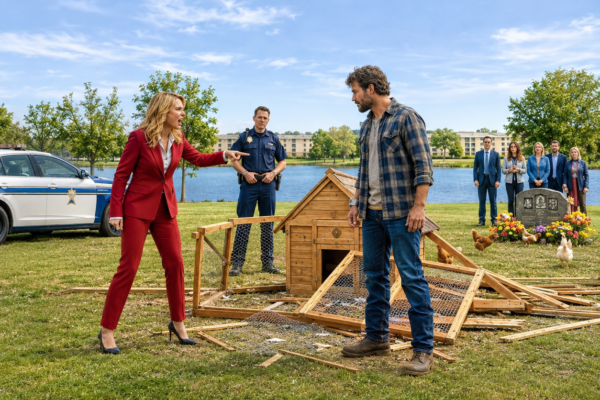
The morning Ridgerest Meadows held a ribbon cutting on the third bridge they had built across my creek, their HOA president stood on my property beside a catered table, smiled at two hundred neighbors, and told me, “Water belongs to everyone, sweetheart.” t
Tammy did not answer immediately.
She stood beside her white Escalade with one hand on the open driver’s door and the other gripping a pair of sunglasses.
Cold wind moved through the bare maples behind her.
The survey flags along the creek fluttered bright orange against brown winter grass.
“What kind of pond?”
I looked upstream.
“A conservation pond.”
“For what?”
“Wildlife. Irrigation. A little fishing.”
Her eyes narrowed.
“And the creek?”
“What about it?”
“You’re not planning to interfere with Ridgerest.”
There it was.
Not Laurel Creek.
Not my property.
Ridgerest.
I had learned something about Tammy by then.
If she said community, she meant control.
If she said shared, she usually meant something belonging to somebody else that she wanted access to.
If she said concern, a certified letter generally followed.
“My engineer and attorney are handling the project through the county.”
That irritated her more than if I had insulted her.
“I asked a simple question.”
“And I gave you a simple answer.”
“Will this reduce flow to the park?”
“I don’t know yet.”
That was true.
Hydrology isn’t magic.
Flow changes seasonally.
Rainfall matters.
Storage matters.
Release schedules matter.
The final design would maintain a downstream release for ecological reasons.
My lawyer, Katherine Yates, had made that requirement non-negotiable before she would even discuss strategy.
She was forty-nine, sharp-eyed, and specialized in water and land-use disputes.
The first time I described my idea, she stared at me across her desk.
“You want to build a dam because your neighbor built bridges.”
“No.”
“That is precisely how you just explained it.”
“I want to build a conservation pond I’ve considered for years.”
“Garrett.”
I looked at the topo map.
“Fine.”
She waited.
“I also want their park to stop depending on my land as though they own it.”
“Better.”
“How?”
“Because now you sound like a landowner with a legitimate project instead of a man trying to starve a subdivision pond.”
“I wouldn’t starve anything.”
“Then prove that in the design.”
So we did.
Not me alone.
That was another thing retirement had taught me.
Knowing how something works is not the same as being the right person to approve your own work.
I hired an independent civil engineer, hydrologist, and environmental consultant.
My experience let me ask good questions.
It did not exempt me from review.
We mapped the watershed.
Measured seasonal flow.
Evaluated downstream conditions.
Identified wetlands.
Modeled storm events.
Designed a small impoundment with controlled release.
Enough to create a pond on my upper acreage.
Enough to support irrigation and habitat.
Enough that the downstream creek would continue flowing under ordinary conditions.
But not necessarily at the same volume Ridgerest had enjoyed while treating every gallon passing my property as guaranteed park infrastructure.
Katherine explained the distinction repeatedly.
“Natural downstream users may have rights depending on the facts,” she told me.
“An HOA decorative pond is not automatically entitled to whatever flow level its landscaping committee prefers.”
“What about their bridges?”
“Separate problem.”
“Can we remove them?”
“Eventually.”
“Why eventually?”
“Because I prefer judges to Garrett Holloway with a chainsaw.”
“I don’t own a chainsaw big enough.”
“Excellent. Keep it that way.”
She filed a civil action seeking declarations about the property boundary, trespass, and removal of the structures.
No press release.
No threats.
Paper.
Tammy responded with paper of her own.
Ridgerest’s attorney, a man named Malcolm Pierce, sent a six-page letter claiming historical recreational access.
Katherine read it.
“How historical?”
“Development is eight years old.”
She looked at me.
“Then not very.”
Next came a theory based on public-water access.
Then implied easement.
Then community reliance.
Then some language about estoppel.
Katherine answered each one without drama.
Meanwhile, the third bridge stayed.
That bothered me most.
Not because it was the largest.
Because it occupied Elena’s bend.
I started avoiding that part of the creek.
That made me angrier than the bridge itself.
My land.
My wife’s place.
And I was avoiding it because strangers were crossing every afternoon with Labradoodles.
One Sunday, I watched from my porch as a family came off the bridge.
Father.
Mother.
Two little girls.
The youngest stopped near my NO TRESPASSING sign.
The father read it.
Then looked toward my house.
I expected him to keep walking.
Instead he turned around.
Took his family back across the bridge.
Ten minutes later he knocked on my door.
“Mr. Holloway?”
“Yes.”
“My name’s Dennis Caldwell.”
I knew the name.
Software developer.
Ridgerest resident.
He looked embarrassed.
“I think we’ve been lied to.”
That was the first crack.
I invited him in.
He stood in my kitchen staring at Elena’s watercolor.
“That’s the creek?”
“Yes.”
“Same bend?”
“Yes.”
He looked closer.
“That rock.”
“Yes.”
I poured coffee.
Dennis sat at the table.
“I’ve lived over there five years.”
“How much do you know about the park?”
“Until last month? Nothing except what they tell us.”
“What changed?”
“The special assessment.”
“What assessment?”
He laughed without humor.
“You really don’t get our newsletters.”
“No.”
“They charged every household twelve hundred dollars last year for trail improvements.”
I stared at him.
“On top of monthly dues?”
“Yes.”
“What was it described as?”
He opened his phone.
Found an email.
RIDGEREST GREENWAY EXPANSION AND WATERFRONT ENHANCEMENT.
Waterfront.
My creek.
My bank.
My wife’s rock.
“How much total?”
“About two hundred forty thousand from the assessment. Plus park money already in the budget.”
I sat back.
Dennis continued.
“I started asking where the trail was supposed to go.”
“And?”
“Tammy said across association common land.”
“It doesn’t.”
“I know that now.”
He looked at the watercolor again.
“I pulled our plat.”
“Good.”
“The HOA boundary doesn’t reach the creek.”
“No.”
“So why are the bridges there?”
“Excellent question.”
Dennis rubbed both hands over his face.
“There are two hundred families over there.”
“I know.”
“Most don’t know.”
“I figured.”
“Tammy told everybody you were an absentee owner who had informally allowed park access.”
“I’ve lived here three years.”
“She said you spent most of your time in Virginia.”
“I spent three weeks in Virginia after Elena died.”
Dennis looked sick.
“I’m sorry.”
“Not your fault.”
He paused.
“What are you going to do?”
I looked toward the creek.
“Use my property.”
“And the park?”
“That depends on what the park actually owns.”
He nodded.
Then surprised me.
“Would you talk to some people?”
“No.”
“Why?”
“I’m already the angry widower next door.”
“That’s exactly why.”
“No.”
He leaned forward.
“Garrett, Tammy controls every meeting.”
“Not my problem.”
“She controls newsletters.”
“Still not.”
“She tells people you’re threatening to destroy the park because you hate families.”
I felt something rise.
Then forced it down.
“Dennis.”
“Yes?”
“I spent twenty-eight years designing flood-control projects. If I wanted to destroy something with water, I would not announce it in an HOA newsletter.”
He blinked.
“That was a joke.”
“I know.”
“You don’t look like you joke.”
“Elena said the same thing.”
That ended the conversation.
Not badly.
Dennis left with copies of the public plat and my certified letter to the HOA.
Two weeks later, thirty Ridgerest homeowners met at a brewery in Asheville.
I did not attend.
Dennis told me afterward.
They compared dues statements.
Assessment notices.
Park maps.
Board minutes.
Some were angry.
Some defended Tammy.
A few said it didn’t matter who technically owned the creek because the park was good for everybody.
That sentence became important later.
Good for everybody.
There is nothing wrong with something being good for everybody.
The problem is when “everybody” excludes the person who owns the land beneath it.
While residents asked questions, I kept working.
The county inspector assigned to the pond was Wayne Hargrove.
No relation to anyone in the HOA.
Fifty-six.
Twenty-two years inspecting everything from retaining walls to agricultural structures.
He walked the site for nearly two hours.
Didn’t flatter me.
Didn’t care about my résumé.
Good.
At the upper meadow, he stopped.
“Why here?”
“Narrow valley.”
“I can see that.”
“Stable abutments. Existing grade works.”
He looked at my independent engineer.
“Your design?”
“Yes.”
Then at me.
“You helping?”
“Consulting obnoxiously.”
Wayne smiled.
“I’ve met retired engineers.”
He reviewed the plans.
Emergency overflow.
Normal outlet.
Sediment control.
Construction access.
Downstream release.
Vegetation restoration.
Then he said:
“I understand there’s a dispute.”
“Yes.”
“Not part of my permit review.”
“Good.”
“You understand this approval won’t decide water rights.”
“Yes.”
“Or your trespass case.”
“Yes.”
“Or guarantee nobody sues you.”
“Yes.”
He nodded.
“Then we understand each other.”
Two weeks later the permit came through.
With conditions.
Monitoring.
Inspection.
No work during certain wet-weather conditions.
Downstream flow protection.
Erosion controls.
We followed every one.
Tammy filed an objection.
Denied.
She appealed.
A hearing officer upheld the permit.
She filed an environmental complaint.
County staff inspected again.
No violation.
Then somebody entered my property without permission.
Trail camera caught him at 7:14 Wednesday morning.
Gray pickup.
Consultant vest.
Handheld GPS.
Clipboard.
He walked the pond site.
Photographed test pits.
Poked at sediment controls.
Never knocked.
I called Katherine before calling anyone else.
“Do not confront him.”
“I’m watching him on camera.”
“Good.”
“He’s on my land.”
“Document.”
“I hate that word now.”
“You love that word.”
Fair.
The sheriff’s office took a trespass report.
The consultant later admitted Ridgerest hired him to prepare an independent assessment.
His report said the pond might “reverse hydrological behavior” of Laurel Creek.
My hydrologist read that phrase three times.
Then called me.
“Garrett.”
“Yes?”
“I don’t know what that means.”
“Neither do I.”
“Rivers don’t reverse because an HOA is upset.”
“I know.”
He sighed.
“I’m going to write a professional response.”
“Thank you.”
“Then I’m going to print his report and put it in the office bathroom.”
“I support only the first action.”
Katherine used the incident carefully.
Not to humiliate the consultant.
To show a pattern.
Ridgerest had been told repeatedly that the creek corridor was private.
Yet the association continued treating it as open-access property.
The three bridges became increasingly hard for its lawyers to defend.
Then the press entered.
Tammy called them first.
That was her mistake.
Sandra Jessup covered county development for the Asheville Citizen Times.
She was thirty-one.
Fast.
Serious.
Did not arrive with a camera crew asking me to point angrily at a creek.
She called.
“Mr. Holloway?”
“Yes.”
“Tammy Pritchard says you’re building a dam to destroy a community park.”
“Does she?”
“She does.”
“Did she send you the subdivision plat?”
Pause.
“No.”
“Ask her.”
Another pause.
“Why?”
“Because you’re a reporter.”
Sandra came out the next day.
I gave her coffee.
Katherine insisted on being present.
Smart.
We showed only records we could support.
Deed.
Survey.
Subdivision plat.
HOA correspondence.
Recorded notices.
Photographs.
Three bridges.
Park permit.
Board documents.
Public planning records.
Earl Tisdale’s affidavit stating the developer instructed him to keep Laurel Creek outside the subdivision boundary.
Sandra stared at that one.
“He remembers the exact instruction?”
“He signed a sworn statement.”
“Is he available?”
“Yes.”
She interviewed Earl separately.
Then Dennis.
Then HOA board members.
Then county staff.
Then Tammy.
Then Vince.
She called me three days later.
“Your pond is legally permitted?”
“Yes.”
“With minimum downstream release?”
“Yes.”
“Will it dry the creek?”
“No.”
“Will it reduce flow?”
“Likely during filling and under some operating conditions.”
“Will it affect their decorative pond?”
“I don’t know exactly.”
“You’re a hydraulic engineer.”
“I still don’t know exactly.”
She paused.
“Thank you.”
“For what?”
“For not pretending.”
That article had not yet run when construction began.
Small dozer.
Compaction equipment.
Dump trucks.
Nothing enormous.
No secret.
No revenge crew arriving at midnight.
Every load ticket documented.
Every inspection scheduled.
Every drainage control maintained.
The work gave me something I had not had since Elena died.
A reason to wake before dawn that was not grief.
At six-thirty I would walk the site.
Steam rising from the creek.
Workers setting grade stakes.
Engineers arguing about moisture content.
Normal problems.
Solvable problems.
There is comfort in math when life has given you something math cannot fix.
Elena’s cancer had been like that.
No calculation mattered.
No career mattered.
No expertise mattered.
One day she was painting.
Then she was tired.
Then doctors.
Then treatments.
Then less hair.
Then more blankets.
Then one April morning the dogwood outside our bedroom window bloomed and she said:
“Pretty.”
That was the last complete sentence she spoke.
For three years afterward, I hated spring.
The pond project did something strange.
It did not make me miss her less.
It made missing her part of motion again.
One evening I found myself drawing the pond shoreline by hand instead of CAD.
She used to complain my technical drawings had no soul.
I could hear her.
Too straight, Garrett.
Water hates straight lines.
She was right.
We softened the edge.
Native rushes.
Willow.
Habitat shelf.
The environmental consultant approved.
I called it Elena Pond privately.
Didn’t put it on the permit.
Too personal.
Tammy found out anyway.
She sent a letter accusing me of using my late wife “as emotional cover for an anti-community infrastructure project.”
Katherine read it.
Then looked at me.
“Do you want me to respond?”
“No.”
“Good.”
“Why?”
“Because I was going to say no.”
That was the day I stopped being merely annoyed with Tammy.
I became done.
Not revenge.
Done.
There is a difference.
Revenge wants suffering.
Being done wants separation.
I wanted my creek separate.
My property separate.
My grief separate.
No more newsletters.
No more bridge lights.
No more strangers casting fishing lines where Elena painted.
The third bridge glowed blue-white every evening.
I could see it from my kitchen.
Ridiculous little LED strips.
They reflected in her watercolor over the sink.
I stopped turning on the kitchen light at night so I wouldn’t see them.
Then January came.
The pond structure passed final inspection.
We began filling gradually.
Not closing off the creek.
Managing it.
The controlled outlet maintained downstream water.
Rainfall was light that month.
That mattered.
Ridgerest’s decorative pond had never been designed with much storage margin.
It depended on a fairly continuous inflow.
Nobody told homeowners that because apparently nobody had asked.
Within five days, the park pond dropped four inches.
Then seven.
By day ten, thirteen.
A muddy ring appeared around the edges.
The little decorative fountain pump began sucking air.
Maintenance shut it off.
The walking trail beside the pond became less scenic.
Photos appeared online.
RIDGEREST PARK WATER CRISIS.
Tammy blamed me immediately.
Emergency newsletter.
UPSTREAM OWNER DISRUPTS COMMUNITY WATERWAY.
I read it at breakfast.
Then went outside.
Laurel Creek below the pond was still flowing.
Lower.
Clear.
Cold.
Exactly within the operating conditions our engineers had set.
I measured anyway.
Habit.
The brook trout habitat reach looked fine.
No stranded fish.
No dry channel.
No erosion.
Upstream, Elena Pond was beautiful.
A great blue heron stood in the shallows.
I watched him for ten minutes.
Nature has no respect for litigation calendars.
Two hours later, a Ridgerest resident came down the unauthorized trail.
Older man.
Red jacket.
He stopped when he saw me.
“Mr. Holloway?”
“Yes.”
“I’m George Mason.”
“Okay.”
“I’m on the HOA board.”
I knew.
Vice president.
Had remained silent through most of this.
He looked downstream.
“We’re losing the pond.”
“Yes.”
“Can you release more water?”
“Yes.”
His face lifted.
“Will you?”
“No.”
It sounded harsher than I intended.
He looked down.
I tried again.
“Not while your association is claiming a right to my creek and refusing to remove structures from my land.”
He nodded slowly.
“So this is leverage.”
“Yes.”
Honesty.
He looked at me.
“That’s uncomfortable to hear.”
“It’s uncomfortable to say.”
“What would it take?”
“Remove the bridges.”
“All three?”
“Yes.”
“Trail too?”
“Everything inside my boundary.”
“Anything else?”
“Recorded acknowledgment that Ridgerest has no ownership or automatic access right to Laurel Creek.”
He winced.
“Tammy will never agree.”
“That’s your governance problem.”
He almost laughed.
“That’s becoming clear.”
Then:
“What about the park pond long-term?”
“I’m willing to negotiate a licensed release arrangement.”
His eyes widened.
“You’d give us water?”
“No.”
I looked at him.
“I’d agree to a documented operating arrangement under defined conditions.”
“Paid?”
“Maybe.”
He looked nervous.
“I’m not trying to profit from thirsty grass.”
“Then what?”
“Monitoring. Maintenance. Conservation contribution. No pretending my land is yours.”
George looked downstream.
“That sounds reasonable.”
“It was available before the third bridge.”
He nodded.
“I know.”
That evening George called Dennis.
Dennis called Brenda Marsh, the treasurer.
Brenda—not to be confused with every other HOA Brenda in America—had been trying to reconcile park expenses.
She found invoices.
Bridge construction.
Trail work.
Lighting.
Landscaping.
Consulting.
Legal.
Numbers became uncomfortable.
Not because $340,000 had vanished into Tammy’s pocket.
That would have been simpler.
The money mostly went where invoices said it went.
The problem was where the improvements were.
Some sat on land Ridgerest did not own.
Homeowners had financed assets the HOA had no secure right to keep.
That is a governance disaster even without theft.
Brenda called me.
“Mr. Holloway?”
“Yes.”
“I’m reviewing park expenditures.”
“I heard.”
“I need to verify something.”
“Okay.”
“Did you ever sign permission for the bridges?”
“No.”
“Trail?”
“No.”
“Any license?”
“No.”
“Oral permission?”
“No.”
“Did your wife?”
“No.”
“Your father?”
“Dead before the development.”
“Grandfather?”
“Dead before most of us were born.”
She sighed.
“Okay.”
“You sound disappointed.”
“I was hoping someone had a piece of paper nobody showed me.”
“I understand.”
“I don’t think you do.”
She sounded tired.
“I’ve signed checks.”
I stopped.
“For what?”
“Maintenance.”
Silence.
“On the bridges?”
“Yes.”
“That doesn’t make you responsible for building them.”
“I’m treasurer.”
“Did you know?”
“No.”
“Then now you do.”
She inhaled.
“Tammy told us your family granted historical access.”
“Ask her for the grant.”
“I did.”
“And?”
“She told me not to undermine the board.”
There it was.
The emergency HOA meeting happened five days later.
Ridgerest clubhouse.
Standing room only.
Tammy stood behind a podium.
Navy blazer.
Pearls.
Vince sat front row.
Dennis had invited me.
Brenda Marsh had invited Katherine.
Sandra Jessup sat in the back.
Her article was still not published.
County attorney Phil Wexler attended as an observer after questions about Vince’s planning votes reached his office.
No sheriff waiting outside with dramatic warrants.
No handcuffs.
No ambush.
Just documents.
That frightened Tammy more.
She opened.
“What we are witnessing is an intentional environmental attack on Ridgerest Meadows.”
Murmurs.
“Our pond has lost nearly fourteen inches of water because one angry man upstream has chosen to manipulate a shared natural resource.”
I sat still.
Katherine whispered:
“Do not make a face.”
“I’m not.”
“You are.”
Tammy continued.
“We must authorize litigation demanding immediate restoration of natural flow.”
Dennis raised his hand.
Tammy ignored him.
George raised his.
Ignored.
Brenda Marsh stood.
Tammy stopped.
“Brenda.”
“As treasurer, I need a financial clarification before we vote.”
“This is not a budget item.”
“If you’re proposing litigation, it is.”
Applause.
Tammy’s jaw tightened.
Brenda continued.
“I invited Mr. Holloway to present documentation relevant to park assets.”
“He is not a member.”
“He owns the land under some of the assets.”
Silence.
That sentence changed the room.
Tammy looked toward me.
Then toward Vince.
Vince did not look back.
I walked to the front.
No dramatic speech.
I had prepared twelve slides.
I used seven.
Slide one:
Ridgerest subdivision plat.
Boundary highlighted.
Creek outside.
“This is the recorded subdivision map.”
Slide two:
My deed and current survey.
“This is the creek corridor.”
Slide three:
Bridge locations.
All three crossing or touching my property.
A woman whispered:
“Oh my God.”
Slide four:
My certified demand for removal.
Received months earlier.
Signed receipt.
Slide five:
Earl’s old warning letter to the HOA.
Creek private.
No automatic access.
Received years earlier.
Brenda Marsh looked at Tammy.
“You had this?”
Tammy said:
“That letter was legally disputed.”
“By who?”
Nobody answered.
Slide six:
Park expenses.
Not accusation.
Invoices.
Known amounts.
Maintenance.
Construction.
Engineering.
Lighting.
Trail materials.
I said:
“I am not claiming your money was stolen.”
That mattered.
Several faces softened.
“I’m telling you your association spent substantial homeowner money installing and maintaining improvements on property it did not control.”
A man in the third row shouted:
“Why?”
I looked at Tammy.
Then away.
“Ask your board.”
Slide seven:
Vince’s planning commission votes.
Dates.
Ridgerest matters.
No dramatic accusation.
I said:
“I’ve raised questions with the county regarding whether proper conflict procedures were followed.”
Vince stood.
“That is defamatory.”
County attorney Wexler spoke from the back.
“No, Commissioner Pritchard.”
Everyone turned.
Wexler continued.
“Questions have been raised. My office is reviewing them. No conclusions tonight.”
Vince sat.
Good.
Facts.
Not theater.
Tammy grabbed the microphone.
“This man is manipulating you.”
Nobody responded.
She pointed at me.
“He built a dam to kill our park.”
I looked at her.
“The pond is permitted.”
“You admitted you can release more water.”
“Yes.”
“And refuse.”
“Yes.”
The room reacted.
Katherine stood beside me.
I continued.
“I am maintaining the required downstream release.”
Tammy laughed.
“Required by who?”
“My permit.”
“Then why is our pond dying?”
“Because your pond was designed around water coming from property your association does not own.”
Silence.
That was the sentence.
Not clever.
Not cruel.
Just true.
Tammy’s face changed.
“You’re holding the community hostage.”
“No.”
I looked around.
“I offered your vice president terms this week.”
George stood.
“He did.”
Now people looked at George.
“He offered to negotiate reliable downstream releases if we remove the trespassing structures and acknowledge the property boundary.”
Tammy stared at him.
“You went behind my back?”
“I went to the man who owns the creek.”
The room erupted.
Not cheering.
Talking.
Questions.
Anger.
Years of compressed confusion.
Dennis stood.
“How much are we spending on legal fees?”
Brenda Marsh answered.
“Forty-two thousand this fiscal year.”
“What about park legal?”
“Most of that.”
“Special assessment?”
“Not yet.”
Someone shouted:
“Not yet?”
Tammy banged the gavel.
Nobody stopped.
A woman near the front stood.
“My daughter uses that trail every day.”
I looked at her.
“I’m sorry.”
“Do you hate us?”
“No.”
“Then why shut it down?”
“I didn’t shut your trail.”
“You took the water.”
“I built a permitted pond on my land.”
“That sounds like the same thing.”
It was the hardest question of the night because emotionally, she was right.
To her, the effect mattered more than the property doctrine.
I put the remote down.
“I understand why it feels that way.”
Tammy looked shocked.
I continued.
“If I bought into Ridgerest believing that pond and trail were permanent amenities, I’d be furious too.”
The woman crossed her arms.
“Then fix it.”
“I’m trying.”
“How?”
“By making the arrangement real.”
She stared.
“What does that mean?”
“It means your park should sit on your land. Your access should be documented. Your water arrangement should be documented. Your board shouldn’t depend on assumptions.”
She looked toward Tammy.
Then back.
“And if the bridges come down?”
“I’m willing to increase releases under a written agreement once our lawyers finish the terms.”
That shifted the room again.
Tammy had framed me as a man trying to kill the park.
I was offering a way for the park to survive.
Just not on my creek bank.
Brenda Marsh raised a motion.
Independent audit of park spending.
Passed overwhelmingly.
George moved for a special meeting to consider removal of Tammy from the presidency.
Enough signatures followed.
Dennis moved to authorize counsel to negotiate bridge removal and a water agreement with me.
Passed.
Tammy stood behind the podium.
Still president.
But no longer in control.
Afterward, Vince approached me in the parking lot.
“Garrett.”
I stopped.
Katherine stopped with me.
“Your wife would be ashamed.”
That was his mistake.
I felt the world narrow.
Elena.
Paint on her fingers.
Her laugh.
Her saying pretty at the dogwood.
Katherine touched my sleeve.
I looked at Vince.
“You never met my wife.”
“No.”
“Then never use her again.”
He opened his mouth.
I walked away.
That was as close as I came to losing control.
Sandra’s article ran three days later.
Headline:
RIDGEREST PARK DISPUTE EXPOSES PROPERTY-LINE AND GOVERNANCE FAILURES.
Less exciting than the internet wanted.
Better journalism.
The article laid out the contradiction.
Subdivision boundary.
Private creek corridor.
Unauthorized bridges alleged.
Park expenditures.
Vince’s planning votes under county review.
My permitted pond.
The HOA’s claim that downstream park amenities were harmed.
It did not call Tammy corrupt.
Did not call Vince criminal.
Did not say I “destroyed” Ridgerest.
It said documents raised serious questions.
That was enough.
Regional television arrived.
I declined most interviews.
Tammy gave three.
That did not help her.
The recall vote happened two weeks later.
One hundred eighty-six households participated.
Tammy lost.
Not unanimously.
She still had supporters.
People she had helped.
Neighbors who liked strict standards.
Residents who believed the land dispute should have been settled quietly.
Fair.
But the majority wanted different leadership.
Brenda Marsh became interim president.
Her first call was to Katherine.
“Can we settle this?”
Katherine looked at me.
“Yes.”
Settlement took six weeks.
Bridge one:
Removed.
Bridge two:
Removed.
Bridge three:
Removed.
Trail sections inside my buffer:
Removed and restored.
Concrete footings:
Extracted where environmentally practical.
Bank stabilization:
Paid by HOA.
Native vegetation:
Restored.
Ridgerest retained its park entirely on HOA-owned land.
Its pond remained.
Then came water.
We negotiated a licensed downstream-flow arrangement.
Not ownership.
Not easement over my creek.
A revocable-but-stable agreement with defined terms.
Monitoring.
Drought provisions.
Maintenance contributions.
No recreational access across my property.
No fishing rights.
No implied future ownership.
The HOA paid an annual amount into a conservation account.
Not rent to me.
Conservation.
Water-quality monitoring.
Bank restoration.
Habitat.
Katherine suggested I name the fund.
I resisted.
Then one morning I looked at Elena’s watercolor.
The Elena Holloway Creek Fund.
Ridiculous name.
Too sentimental.
I used it anyway.
The day bridge three came down, I stood far back.
Didn’t want workers thinking I was supervising.
Composite decking came off.
Railing.
Lighting.
Steel.
Then the concrete near Elena’s rock.
Careful work.
Slow.
One footing had partially cracked the edge.
When the crew removed the last section, the rock appeared.
Not untouched.
A fracture ran through one corner.
But there.
I walked down after everyone left.
Sat.
Cold stone.
March water around my boots.
I put one hand flat where her easel used to stand.
Nothing mystical happened.
No sudden breeze.
No sign.
No voice.
Thank God.
Grief is strange enough without pretending nature sends messages on schedule.
I just sat.
Then cried.
Harder than I had at the funeral.
Maybe because funerals are crowded.
That creek bank wasn’t.
Eventually I laughed too.
Because I remembered Elena yelling at me from that exact rock twenty years earlier.
“Stop moving.”
“I’m fishing.”
“You’re in my painting.”
“Paint faster.”
“Garrett.”
“What?”
“You’re ruining the composition.”
Apparently even my wife had once wanted me off Laurel Creek.
That helped.
Two days later I opened the pond outlet farther under the new operating agreement.
Not dramatically.
No giant gate.
No wall of water.
Controlled increase.
The downstream creek deepened gradually.
Ridgerest’s pond stopped falling.
Then began recovering after spring rains.
The fountain returned.
Trail reopened—but ended at the HOA boundary.
A new overlook was built there.
On their side.
Permitted.
Surveyed.
Owned.
You would be amazed how peaceful a park becomes when everyone knows exactly whose dirt is beneath it.
Vince resigned from the planning commission during the county ethics review.
The final findings were less spectacular than rumor.
Several procedures had been mishandled.
Disclosures inadequate.
Recusal questions legitimate.
Some permit-review steps had been sloppy.
There was no dramatic criminal conspiracy.
No federal agents.
No prison.
Just a public report.
Resignation.
Reputational damage.
And new county conflict-of-interest procedures.
I preferred that to fantasy justice.
Institutions improve when failures become rules.
Tammy and Vince sold one of their two Ridgerest properties.
Kept the house for another year.
Then moved.
I saw Tammy once before she left.
Grocery store.
Produce aisle.
She was holding avocados.
I was buying lemons.
We noticed each other.
Could have walked away.
She didn’t.
“Garrett.”
“Tammy.”
Her hair was longer.
No sunglasses.
She looked tired.
“The pond looks good.”
“Elena Pond?”
She blinked.
“I meant ours.”
“Ridgerest pond.”
“Yes.”
“It recovered.”
“I know.”
Silence.
Then:
“I was wrong about the bridges.”
That surprised me.
“Thank you.”
“I still think the water situation was cruel.”
I nodded.
“Some days I agree.”
She stared.
“You do?”
“Yes.”
“You could have released more.”
“Yes.”
“Earlier.”
“Yes.”
“Then why didn’t you?”
Hard question.
I picked up a lemon.
Put it down.
“Because I was angry.”
She waited.
“And because every softer request had been ignored.”
She nodded slowly.
“That’s fair.”
“No.”
She looked at me.
“It explains it.”
I continued.
“It doesn’t automatically make every choice fair.”
Tammy looked toward the floor.
“I thought if I gave you an inch, everybody would start challenging everything.”
“HOA?”
“Yes.”
“I figured.”
“People don’t understand how hard it is.”
“Probably not.”
“You make one exception, then another.”
“Sounds exhausting.”
“It was.”
She looked at the avocados.
“Somewhere along the way I started treating disagreement like disobedience.”
That was the most honest thing she ever said.
I didn’t know what to do with it.
So I said:
“I treated your whole neighborhood like Tammy.”
She looked up.
“What?”
“I was angry at you.”
“And Vince.”
“Yes.”
“But when I held the water back, everyone felt it.”
“Yes.”
She almost smiled.
“Look at us.”
“What?”
“Accountability.”
“Don’t ruin it.”
She laughed.
Short.
Then serious again.
“I am sorry about Elena’s rock.”
My throat tightened.
“Thank you.”
“I didn’t know.”
“You knew after I told you.”
“I know.”
That was enough.
We walked away.
No hug.
No friendship.
Better.
Truth.
The Ridgerest audit took four months.
No giant theft.
No hidden Cayman account.
No mystery mansion.
Most park money had actually been spent on the park.
But recordkeeping was awful.
Approval procedures loose.
Conflict disclosures inconsistent.
Contracts insufficiently reviewed.
And spending on improvements outside HOA property had exposed residents to huge legal risk.
Refunds came from insurance settlements, contractor recoveries, and reserve adjustments.
Not every homeowner got a giant check.
Some received credits.
Some saw future dues stabilize.
The new board published budgets online.
Meetings streamed.
Contracts above a threshold required competitive bids.
Property boundaries had to be verified before capital projects.
That last policy was unofficially called the Garrett Rule.
I hated it.
Dennis loved it.
He became board president two years later.
His first act was calling me.
“Garrett.”
“No.”
“I haven’t asked.”
“You’re asking me to join the board.”
“Yes.”
“No.”
“Advisory committee?”
“No.”
“Water committee?”
“No.”
“Annual picnic?”
“Maybe.”
Progress.
The conservation fund did well.
Ridgerest contributed annually.
So did I.
County schools partnered with it.
Elena had taught middle school art.
That gave me an idea.
Every April we hosted Watercolor Day.
Thirty children.
Paper.
Brushes.
Creek science in the morning.
Painting after lunch.
Earl Tisdale taught kids how to read a plat until he was eighty-one.
They hated it.
Then loved the measuring wheel.
Dennis burned hot dogs.
Consistently.
One year a girl named Lila sat on Elena’s rock.
I almost told her to move.
Then stopped.
She painted the creek purple.
Not blue.
Purple.
I asked:
“Why?”
She looked at me like I was stupid.
“Because the sky is purple in the water.”
I looked.
Sunset starting.
She was right.
Elena would have liked her.
The pond upstream matured.
Willows filled in.
Dragonflies.
Frogs.
Herons.
Native trout did better than I expected.
I fished less.
Sat more.
At sixty-eight, my knees preferred sitting.
The dam itself became boring.
Which is the highest compliment you can give water infrastructure.
No failures.
No erosion issues.
Inspections clean.
Controlled release doing its job.
People online kept calling it:
THE DAM THAT KILLED AN HOA PARK.
Not true.
The park never died.
Its illusion did.
The illusion that the HOA owned more than its deed.
The illusion that a popular amenity justified trespass.
The illusion that nobody would ever pull records.
The illusion that water could be promised forever without understanding where it came from.
Those died.
Good.
The real park improved afterward.
Smaller footprint.
Native plants.
Less decorative turf.
Better stormwater management.
The HOA converted part of the old trail budget into conservation work.
The decorative pond got supplemental rain capture and recirculation improvements so it was less dependent on Laurel Creek.
Smart.
Resilient.
The engineers they hired were good.
One called me.
“Mr. Holloway?”
“Yes.”
“We’re redesigning Ridgerest’s water system.”
“Congratulations.”
“Heard you’re the reason.”
“I’m the reason they hired you.”
He laughed.
“Can I ask a few historical flow questions?”
“Sure.”
We talked for an hour.
When we finished:
“You know, they call your dam revenge infrastructure.”
“That sounds expensive.”
“It’s funny.”
“It’s wrong.”
“What would you call it?”
I looked out the window.
“Boundary infrastructure.”
He was quiet.
“That’s less marketable.”
“Yes.”
At seventy, I finally sold six acres of the upper property to a conservation trust.
Kept the house.
Creek.
Pond.
Elena’s bend.
The trust protected the ridge from development.
Ridgerest residents supported it.
Imagine that.
Tammy’s old house belonged to a young family by then.
Two children.
Golden retriever.
They used the HOA trail.
Stopped at the overlook.
Never crossed my boundary.
Sometimes the kids waved.
I waved back.
That was all I had wanted originally.
Respect.
Not surrender.
Not fear.
Not a dry pond.
A line.
I learned something uncomfortable from the whole mess.
Being legally right can become intoxicating.
Engineers are especially vulnerable.
We love a clean result.
Input.
Output.
Constraint.
Solution.
Human systems are not hydraulic equations.
When I started the pond project, I told myself everything was technical.
Permit.
Flow.
Storage.
Property.
Access.
But underneath the calculations was grief.
And anger.
And a man who had watched strangers pour concrete onto the place his wife painted.
The math was real.
So was the hurt.
Pretending one had nothing to do with the other would be dishonest.
Katherine knew before I did.
Years later, over lunch, she said:
“You finally admit I was right.”
“About what?”
“You wanted revenge.”
“I wanted lawful land use.”
She stared.
“Fine.”
I sighed.
“Partly revenge.”
“Thank you.”
“But you let me do it.”
“I made sure you didn’t do anything reckless.”
“You billed me while doing it.”
“Extensively.”
I smiled.
“What would you have done differently?”
She thought.
“Filed for the bridge injunction earlier.”
“Why?”
“Might have avoided the dam becoming the emotional center of the case.”
“Would Tammy have listened?”
“No.”
“Then?”
Katherine smiled.
“I’m a lawyer. We pretend earlier paperwork would have saved everyone.”
Fair.
Earl died at eighty-two.
Stroke.
Quick.
His daughter gave me his original field notebook.
Inside was the Ridgerest survey.
Page dated eight years before the fight.
Boundary call.
Creek excluded.
A note in Earl’s handwriting:
Developer requests 40′ offset from Laurel Creek to avoid waterway complications.
Five words in the margin:
MAKE SURE THIS IS CLEAR.
It was clear.
People simply stopped reading.
I framed that page next to Elena’s watercolor.
Not because it proved I won.
Because it reminded me how disasters begin.
Usually not with hidden facts.
With visible facts people decide are inconvenient.
The last annual Watercolor Day I attended before turning the program over to the conservation trust, thirty-two kids sat along Laurel Creek.
Some on HOA land.
Some, with permission and supervision, on mine.
That part mattered.
Permission.
Dennis stood at the check-in table.
Every family signed the access waiver.
Every child got a colored wristband.
Temporary licensed access.
Katherine would have been proud.
One boy asked:
“Mr. Holloway, is this the creek you fought the HOA over?”
“Yes.”
“Did you really turn it off?”
“No.”
“But my dad says you did.”
“Your dad likes dramatic stories.”
The father, fifteen feet away, shouted:
“That is completely accurate.”
Kids laughed.
The boy pointed upstream.
“Is the dam still there?”
“Yes.”
“Did it kill the park?”
I looked downstream.
Ridgerest’s pond fountain caught sunlight through the trees.
Children played near the gazebo.
Native grasses moved beside the trail.
“No.”
He seemed disappointed.
“It made people fix some things.”
“That’s boring.”
“Most good endings are.”
He considered that.
Then dipped his brush in purple paint.
“Can I paint the water red?”
“You can paint it whatever color you see.”
He painted it red.
Elena would have approved.
That evening, everyone went home.
Paper cups collected.
Brushes washed.
Trash gone.
No strangers.
No torn signs.
No bridge lights.
I walked to Elena’s rock.
Sat.
The fracture from the old concrete footing remained.
We never repaired it.
Could have.
Didn’t.
Some scars become part of the structure.
The creek moved around my boots.
Same sound.
Different man.
I looked toward the bend where bridge three used to stand.
Nothing there now except hemlocks.
Then upstream toward the pond I built while angry.
It was beautiful too.
Both things could be true.
Something born partly from spite could become useful.
Something advertised as community good could begin in trespass.
A person can be right about the deed and wrong about the spirit.
A person can be wrong about the boundary and still learn.
Water is good at holding contradictions.
It bends.
Pools.
Drops.
Finds another path.
But it always responds to the shape of the land beneath it.
Property disputes do too.
Tammy once told me:
“Water doesn’t read deeds, sweetheart.”
She was right about the first half.
Water doesn’t read anything.
People do.
Or they should.
Because when Ridgerest built three bridges over Laurel Creek, the creek itself didn’t object.
No alarm sounded.
No fence rose.
No invisible line appeared in the water.
The only thing protecting that boundary was paper.
A deed.
A plat.
A survey.
A certified letter.
Records people ignored until the consequences became visible.
That was the real lesson.
Not that I could build a dam.
Not that an engineer beat an HOA.
Not that the man upstream always wins.
None of that.
The lesson was simpler.
Before you build on land—
know whose land it is.
Before you promise water—
know where the water comes from.
Before you call something community property—
make sure the person who owns it has actually agreed.
Ridgerest still has its park.
I still have my creek.
The HOA still contributes to the Elena Holloway Creek Fund.
Kids still paint there every spring.
And bridge number three?
Gone.
Completely.
Except for one thing.
When they removed the railing, I asked the crew supervisor for a six-inch section of the old aluminum.
He looked at me.
“Why?”
I didn’t know then.
It sat in my workshop for years.
After Earl died, I finally had a small plaque made from it.
Not fancy.
Just engraved.
It hangs beside the door facing Laurel Creek.
Four lines:
LAUREL CREEK
PRIVATE LAND
ACCESS BY PERMISSION
PLEASE ASK
That was all I had wanted from the beginning.
Not revenge.
Not control.
Not a dead park.
Just four words nobody at Ridgerest had thought to use before they poured concrete:
Please ask first.