The Puppy Cried by the Road for Hours While People Passed Him By—His Injured Leg Was Worse Than Anyone Knew
The Puppy Cried by the Road for Hours While People Passed Him By—His Injured Leg Was Worse Than Anyone Knew
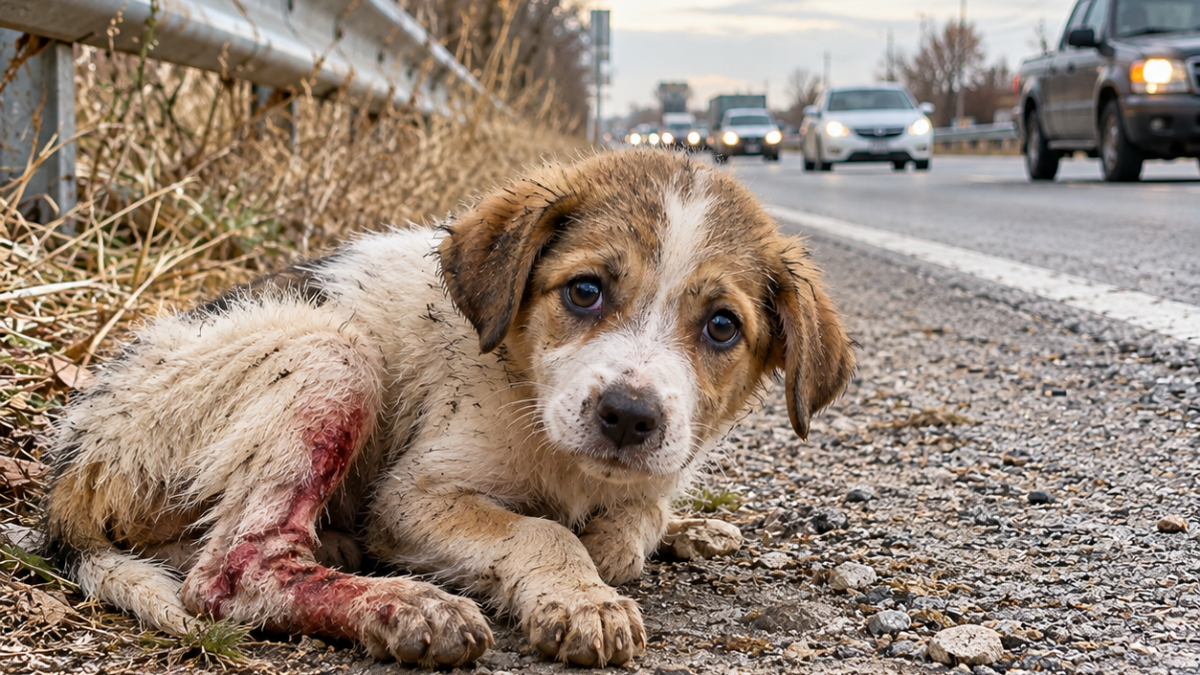
The puppy cried by the road for hours while people passed him by, and no one stopped to help.
Someone had left him there early that morning, badly injured and bleeding, yet he remained alone until a boy finally called me.
When Vizik looked at me from inside the car, trembling so hard he could barely settle, I still did not know what the X-rays were about to reveal.
I was told that a woman had left the puppy there early in the morning.
By the time anyone reached out for help, he had already spent hours sitting in the same place and crying.
People had passed nearby, but somehow that small frightened dog had remained there.
When I first learned about him, I could not understand how an injured puppy could be left beside a road for so long without anyone taking him somewhere safe.
A boy was finally the one who called me and asked for help.
When I reached Vizik, his condition immediately made the situation feel much more serious than a puppy simply being abandoned.
One of his legs was badly injured, and there was a lot of blood.
He was frightened, exhausted, and completely dependent on whoever chose to help him next.
There was no way to ask him what had happened before he was left there.
I could only look at the injury and wonder whether he had been struck nearby, whether an accident had happened on that road, and why nobody involved had taken responsibility for getting him medical care.
Once Vizik was in the car with me, he kept looking in my direction.
His little body trembled.
His eyes stayed fixed on me with the uncertainty of an animal who did not yet know whether he was safe.
I wanted to calm him, but there was no simple way to explain that we were going somewhere he could finally receive help.
Every movement seemed to frighten him.
The pain was clearly severe enough that he needed strong doses of pain medication.
After that, the veterinarians prepared him for X-rays and examinations so they could understand exactly what had happened to his leg.
I kept hoping there might be a way to save it.
Vizik was so young that the thought of him losing a leg before he had even had the chance to grow up normally was difficult to accept.
But the examination showed how badly the limb had been damaged.
The leg had been crushed.
There was no way to save it.
It had to be amputated.
After the procedure, Vizik seemed deeply sad.
That day, he did not want to eat.
He simply stayed quiet, and his silence worried me almost as much as the injury had.
I kept watching him, wondering how much pain he still felt and how confusing everything must have seemed after the road, the car, the clinic, and then waking up without the leg that had been so severely damaged.
I could not know what he understood.
I only knew that his usual needs had disappeared behind exhaustion and pain.
Then, by evening, something changed.
Vizik finally began eating, and once he started, he ate a lot, as though the hunger that had been hidden beneath fear and pain had suddenly returned all at once.
Watching him eat should have been a simple relief.
Instead, I felt a tear run down my face.
It was difficult not to think about the hours he had spent alone and crying while injured.
It was difficult not to think about how close he had been to having no one come for him at all.
Fortunately, the next day his mood was better.
He was still hurting, and he still could not stand up, but there was more life in his expression.
That small improvement gave me something to hold on to.
The question that stayed in my mind was the same one that would follow us through the next stage of his recovery.
Could this little puppy really learn to walk on three legs?
**[END OF FACEBOOK OPENING — PART 1]**
At that point, there was nothing we could do except give Vizik time and hope that good things would finally begin to come to him.
The hardest part of those first days was knowing that the accident itself could not be undone.
One thing seemed certain from the condition in which he had been found: Vizik had been in an accident.
His leg had not suffered a small wound that could simply be cleaned and wrapped.
It had been crushed so badly that the veterinarians could not save it.
That fact kept returning to me even after the surgery was over.
Somewhere before the boy called me, something had happened to this puppy.
Somewhere there had been an impact severe enough to destroy a leg.
And afterward, instead of receiving immediate care, Vizik had ended up beside the road.
I kept asking myself the same questions.
Why had the driver not called for a doctor?
Why had nobody taken him directly to a veterinary clinic?
Had they left the injured puppy there and simply waited for some kind of miracle?
I had no answer.
I could only look at Vizik and know that by the time I reached him, the only useful thing was to deal with what was in front of us.
The past had already injured him.
The present needed to protect him.
That distinction became important because anger could not heal Vizik.
Questions could not restore the leg.
Only care, food, medical treatment, rest, and time could help him move forward.
So that was where I tried to keep my attention.
In the beginning, nearly every small change in him felt important.
The first day after surgery, his sadness had frightened me.
He had been through so much in such a short period.
Hours of crying beside the road.
The pain in the crushed leg.
The car ride with a stranger.
Strong pain medication.
X-rays.
Examinations.
Then surgery.
I could not know how a puppy understood a sequence like that.
I only knew how it looked from the outside.
He had become very quiet.
He did not want food.
His body seemed to have retreated into itself.
There are moments with an injured animal when silence becomes louder than crying.
On the road, Vizik had cried because he was hurt and alone.
After surgery, he barely seemed to have energy for that.
I sat near him and watched.
There was nothing dramatic I could do.
He needed recovery more than reassurance in words.
So I stayed close.
I paid attention.
I waited.
Then evening came, and Vizik ate.
At first, I was simply relieved to see him interested in food.
Then he kept eating.
The hunger was suddenly obvious.
It was as if his body had finally moved one step beyond the shock of everything that had happened and remembered that it needed nourishment.
I watched his stomach begin to fill and felt something inside me loosen.
Food could not answer all my questions, but it was something tangible.
He wanted to eat.
That meant his body was asking for something from the future.
It wanted fuel.
It wanted strength.
It wanted another day.
I knew I was giving human meaning to a simple physical need, but at that moment I could not separate the two.
I had spent hours worrying about a puppy who had seemed defeated.
Seeing him eat felt like a response.
Not a promise.
Not a guarantee.
Just a response.
I am still here.
That was what it felt like.
The tear that came to my eye surprised me even though I had already been emotional since finding him.
Sometimes the smallest improvement is the one that breaks through everything we have been holding inside.
I had managed the drive.
I had managed seeing the blood.
I had managed hearing that the leg could not be saved.
I had managed the surgery.
But watching Vizik eat after refusing food made the emotions finally catch up with me.
He was still a puppy.
That was the truth I kept returning to.
He was not an old dog at the end of a long life.
He had hardly begun.
And now he had to learn how to begin again with three legs.
The next morning, his mood was better.
He still hurt.
He still could not stand.
Nothing about his situation had magically changed overnight.
But the emotional difference was visible.
He seemed less shut down.
His eyes were more aware of what was happening around him.
He responded more to the people nearby.
That was enough to give me hope.
Recovery often begins before we can point to a large physical milestone.
Sometimes it begins with appetite.
Sometimes with attention.
Sometimes simply with the return of interest in the world.
Vizik gave us those small signs.
I held onto every one.
We had to be patient because his body could not be rushed.
Even though the crushed leg was gone, the rest of him still had to recover from the accident and surgery.
He had to rest.
His wounds had to heal.
His remaining legs had to become the foundation for a completely different way of moving.
At that stage, I did not know how quickly he would adjust.
I did not know whether he would try to stand as soon as the pain eased or whether fear and confusion would keep him low to the ground.
The question stayed with me.
Can a puppy like this learn to walk on three legs?
Of course, I had hope.
But hope is different when the animal in front of you is still lying down.
I could imagine him running someday, but imagination was not evidence.
I needed to see what Vizik himself could do.
For the moment, that meant waiting.
Every day he ate well.
That became one of the most reassuring parts of his recovery.
Food returned to being something joyful instead of something I worried he might refuse.
His stomach filled.
His energy slowly had somewhere to come from.
The body that had been weakened by injury began receiving what it needed to repair itself.
Vizik particularly loved the little cakes shaped like bones.
Those became his favorite.
The sight of him eating them created a different image in my mind than the one from the road.
On the road, there had been blood, crying, fear, and people passing by.
At the clinic, there had been examinations, pain medication, and surgery.
Now there was a puppy focused on a favorite food.
That contrast mattered to me.
It reminded me that recovery is not always visible in the large things first.
Sometimes it appears in enthusiasm for something simple.
A bone-shaped cake.
A full stomach.
A better mood.
A quiet nap after eating.
These were not dramatic victories, but they were real.
And Vizik needed real progress more than anyone needed a dramatic story.
As the days passed, I began to see how quickly his body was recovering.
His appetite helped.
He ate every day and filled his stomach.
Little by little, the weakened puppy from the first day became more stable.
The incision from the amputation had to heal.
The remaining injuries had to settle.
His body had to become comfortable enough for movement to become possible again.
I watched that process closely.
There were times when I still found myself thinking about the road.
I wondered where Vizik’s mother was.
That question was different from the questions about the accident.
The accident made me angry.
Thinking about his mother made me sad.
Why had this puppy been alone there?
Where had he come from?
Had he wandered away?
Had something separated him from her?
I did not know.
The source of his first months remained a mystery to me.
I only had the puppy in front of me.
Sometimes I looked at him and thought, “I hope his mother knows her puppy is safe.”
Of course, I could not know whether she was somewhere nearby, whether she was searching, or whether she had any way to understand what had happened.
It was simply a thought that came from looking at him.
He was so young.
There was something painful about seeing a young animal go through injury and surgery without the mother who would naturally have been part of his earliest life.
I could not replace that relationship.
I did not try to pretend I could.
I could only be the person who was there now.
Vizik needed someone in the present.
I could give him that.
And because I was there every day, something between us began to change.
At first, when he looked at me in the car, his eyes were full of fear.
His body trembled.
He did not know me.
He had no reason to trust the person sitting beside him.
Everything around him was unfamiliar.
Later, after days of food, medical care, and my continued presence, his expression around me softened.
It did not happen in one grand moment.
Trust rarely does.
It came through repetition.
I was there again.
And again.
And again.
The frightening stranger from the car slowly became someone familiar.
That mattered more than I realized until much later.
There was still another physical stage ahead of us.
The stitches eventually had to come out.
By the time they were removed, Vizik seemed happy.
That moment felt like another line being crossed.
The surgery was becoming something behind us rather than something happening to him in the present.
The wound had progressed enough for the stitches to be removed.
I looked at Vizik and felt the same mixture of relief and uncertainty I had felt so many times.
One part was over.
But the biggest question remained.
Could he walk?
The removal of the stitches gave us the chance to find out more.
We took him so we could see whether he was able to stand and move.
I remember watching him carefully.
I had imagined this moment many times.
In some versions in my mind, Vizik simply pushed himself up and discovered what his new balance felt like.
In others, he struggled.
The real Vizik did something that immediately worried us.
He looked at us almost dazed.
Then instead of standing properly, he crawled.
He did not use the remaining back leg.
That frightened me.
The leg itself had recovered.
Physically, it was no longer the same injured problem that had kept him down.
Yet Vizik still did not use it the way we hoped.
Watching him crawl created a strange kind of helplessness.
The surgery had been successful.
The stitches were out.
The remaining hind leg had healed.
But healing a limb and trusting a limb are not always the same thing.
I reminded myself that Vizik had been through an accident severe enough to crush another leg.
He had experienced pain every time his body tried to move after that injury.
Then he had undergone surgery.
Perhaps his body needed more time to understand that movement could be different now.
Perhaps he simply needed practice.
“Maybe he needs time to practice it,” I said.
It was partly reassurance for Vizik and partly reassurance for myself.
I did not know exactly how long it would take.
I only knew we could not give up because the first attempt looked difficult.
We encouraged him.
Not by forcing him beyond what he could do, but by giving him opportunities to try.
I watched his body carefully.
Three legs had to do the work that four once would have shared.
Balance had changed.
The position of his weight had changed.
The way he pushed himself upward had changed.
Every ordinary movement had become something he needed to rediscover.
For a puppy, perhaps that adaptation could happen quickly once confidence returned.
But from where I stood, watching him crawl, it did not feel quick at all.
It felt uncertain.
Then Vizik surprised me.
He stood.
And he walked.
Three legs.
The sight stopped me emotionally before I even had time to think about it.
For days I had wondered whether he could do it.
Then suddenly the answer was in front of me.
Yes.
Vizik could walk on three legs.
His movement was not yet perfect.
There was still work to do.
He was still learning how to make the strongest possible use of the leg he had been reluctant to use.
But he was walking.
That one fact changed the atmosphere around his recovery.
Before, we had been waiting to discover whether movement would return.
Now we knew it could.
The question became how to make him stronger.
Vizik tried to use the remaining leg as much as possible.
That effort mattered.
Every step was practice.
Every time he placed weight correctly, he was teaching his body a new pattern.
The doctors had already done what medicine could do for the crushed limb and for his recovery.
Now rehabilitation became part of the process.
Vizik would need training so the remaining leg could become stronger.
I watched him attempt the movement again and again.
Sometimes the steps were awkward.
Sometimes he seemed uncertain.
But the puppy who had once only crawled was no longer staying on the ground.
He was trying.
That was enough to make me believe the future could be very different from the road where I had first learned about him.
I thought back to his trembling body in the car.
At that time, I had not known whether the leg could be saved.
I had not known what the X-rays would show.
I had not known that we would face an amputation.
I had not known that after the stitches came out, we would watch him crawl and wonder why he would not use the leg that had healed.
Now I was watching three-legged steps.
The distance between those moments felt enormous.
Vizik himself was still the same puppy.
That was important to remember.
The accident had changed his body, but it had not removed the sweetness in him.
He still liked food.
He still loved those bone-shaped cakes.
He still looked for comfort.
And now, with each day of practice, he was discovering movement again.
I began to understand that our job was not to make him into the puppy he would have been before the accident.
We could not do that.
We could only help the puppy he was now become as strong and confident as possible.
That shift in thinking helped me.
Instead of comparing every step to a four-legged puppy, I started looking at Vizik’s own progress.
Yesterday he crawled.
Today he stood.
Yesterday he avoided the hind leg.
Today he placed it and tried to move.
Yesterday I wondered whether he could walk at all.
Today he was proving he could.
Those were the comparisons that mattered.
The more I focused on his individual progress, the less frightening his new way of moving seemed.
Three legs were not the end of his life.
They were the body in which his life would continue.
Vizik began showing us that clearly.
He did not need anyone to feel sorry for him every second.
He needed encouragement.
He needed training.
He needed a safe place to practice.
And he needed time.
The same word kept returning throughout his story.
Time.
Time for the shock to pass.
Time for him to eat.
Time for the surgery wound to heal.
Time for the stitches to come out.
Time for him to understand his new balance.
Time for the remaining leg to become stronger.
Time for trust between us to grow.
Nothing about Vizik’s recovery could be forced into a single dramatic moment.
Even the first three-legged steps were only a beginning.
After that, he still needed repetition.
So we repeated.
Stand.
Balance.
Step.
Rest.
Try again.
The movements were small enough that someone watching casually might not understand why they mattered so much.
I understood.
I remembered the puppy lying quietly after surgery.
I remembered the crawling.
I remembered the dazed look.
Every step now answered one of those memories.
He was not trapped on the ground anymore.
That knowledge changed me too.
I began allowing myself to imagine ordinary things for him.
Grass.
Walking beside me.
Eating somewhere outside instead of inside a veterinary setting.
Sleeping during a car ride because the vehicle no longer meant fear.
Simple experiences.
Nothing extraordinary.
Yet all of them felt far away when Vizik first came to me.
With the help of the doctor and the care he received, Vizik became healthy again.
I do not mean that the missing leg returned or that the accident became irrelevant.
Healthy did not mean unchanged.
It meant his wounds had healed enough, his body had regained enough strength, and he was ready to leave the veterinary clinic and continue the next part of his life.
The day Vizik was discharged felt completely different from the day I had first brought him there.
The first drive had been filled with trembling.
He had looked at me, frightened and unsure.
I had watched him because I did not know what was happening inside his injured body.
Now, as we prepared to leave, the atmosphere was softer.
This time, Vizik felt safe beside me.
I could see it in the way his body relaxed.
There was no frantic uncertainty in him.
No need to watch every movement with the same fear.
He settled.
Then he fell asleep.
And he slept deeply for the entire trip.
That image stayed with me.
The puppy who had once trembled in the car now trusted the car enough to sleep.
Perhaps he trusted me enough too.
I could not know exactly what he understood, but his body told me he was no longer afraid in the same way.
A deeply sleeping dog does not look like a dog waiting for danger.
Vizik looked peaceful.
I watched him and felt as though we had closed a circle.
The first journey together had taken us toward pain medication, X-rays, surgery, and uncertainty.
This journey was taking us away from the clinic.
Toward something new.
I thought of it as Vizik preparing for a new journey.
Not one that needed a dramatic destination.
A journey into the life he had nearly lost.
I knew I would be there.
That was enough.
I had prepared many of the little cakes he loved.
Bone-shaped cakes had become such a simple source of happiness for him during recovery that bringing them felt right.
After all the medical routines, all the watching, all the careful attention to whether he ate, food could finally become something lighthearted.
When Vizik woke up, the first thing he did was eat.
I could not help smiling.
Some things about him had become wonderfully predictable.
Give Vizik a chance to enjoy his favorite food, and he would not waste it.
We sat together, and for a moment it felt almost like a picnic.
That was how simple the happiness had become.
No operating room.
No bleeding leg.
No people passing him on a road.
No question about whether the limb could be saved.
Just Vizik eating the cakes he loved while I stayed near him.
I thought about how different the word “journey” could feel depending on where you stood.
For Vizik, the first journey with me had been from abandonment into medical uncertainty.
Now the journey felt open.
Beautiful.
I would be there with him.
That thought gave me peace.
Having Vizik beside me felt good in a way that was difficult to explain without sounding too sentimental.
His presence had grown from responsibility into companionship.
At first, my attention had been entirely focused on what he needed.
Pain relief.
Tests.
Surgery.
Food.
Monitoring.
Encouragement.
But somewhere during those days, caring for him stopped feeling like a series of tasks.
Vizik became part of my life.
Having him there felt like a blessing.
That was the word that fit.
Not because everything about his story had been good.
Much of it had been painful and unfair.
The blessing was him.
The puppy himself.
The fact that after everything, he was still here.
Still eating.
Still learning.
Still capable of trusting.
Still willing to take another step.
I did not need to turn the accident into something meaningful.
The accident was terrible.
What became meaningful was what happened after.
Someone called.
Someone responded.
Doctors treated him.
Vizik survived the surgery.
He ate.
He healed.
He learned.
We became close.
Those were the parts I could hold with gratitude.
Once Vizik was out of the clinic, our practice continued.
Every day, we went to the grass to work on walking.
The grass became our small training ground.
There was something gentle about practicing there.
The surface was softer than the hard spaces where I had first seen him struggle.
He could focus on balance.
I could stay close enough to encourage him without crowding him.
At first, each session reminded me of how much concentration movement required from him.
People with four healthy limbs rarely think about every step.
Walking happens automatically.
Vizik had to rebuild that automatic confidence.
He had lost a leg.
His remaining limbs needed to work together differently.
His weight had to shift differently.
His body had to find a rhythm.
So we practiced.
Again and again.
I watched the small adjustments.
The pause before a step.
The moment he gathered himself.
The way he placed the remaining rear leg.
The brief uncertainty when his balance changed.
Then another step.
Sometimes I felt as though I was learning to walk with him even though my own legs were fine.
Emotionally, we were moving together.
That may be why those daily trips to the grass brought us so close.
I was not merely watching from a distance.
I was there for the attempts.
There for the hesitation.
There for the progress.
There when he needed encouragement.
There when a few steps became more.
Walking on three legs was Vizik’s physical challenge, but the practice became something shared between us.
Every day, I learned his rhythm a little better.
Every day, he seemed to understand that I would stay near.
The frightened puppy from the car had looked at me as though I might be another unknown danger.
The puppy on the grass looked at me as part of his safe world.
That transformation meant as much to me as the walking.
Maybe more.
Bodies can heal in visible ways.
Trust heals more quietly.
There is no X-ray that shows it.
No stitch that comes out when it is finished.
You notice it through behavior.
Vizik sleeping in the car.
Vizik eating beside me.
Vizik staying calm.
Vizik practicing while I remained close.
Those were my signs.
His body had lost a leg.
His ability to trust had survived.
I did not take that for granted.
Sometimes while he practiced, I thought again about the boy who had called.
One phone call had separated two possible futures.
Before the call, Vizik had been sitting beside the road, crying and bleeding while people ignored him.
After the call, he was on a path toward care.
The change did not happen because the world suddenly became perfect.
It happened because someone finally responded.
That thought stayed with me.
Vizik had spent hours being overlooked.
Then one person noticed enough to act.
And because of that, the rest became possible.
The car.
The clinic.
The medication.
The X-rays.
The surgery.
The food.
The stitches coming out.
The first three-legged steps.
The deep sleep during the ride home.
The cakes.
The grass.
All of it came after someone decided that a crying puppy beside a road should not remain there.
I often wished someone had acted sooner.
I wished the driver had taken responsibility.
I wished whoever left him there had not walked away.
I wished Vizik had never needed to cry for hours.
Those wishes were useless in practical terms.
They did not change the past.
So I tried to let them sharpen my gratitude instead of feeding endless anger.
He had been overlooked.
Then he was seen.
He had been left.
Then he was carried forward.
That was the truth of his story.
The walking sessions also taught me not to underestimate him.
At first, after the stitches were removed, his crawling frightened me because I thought perhaps something was still wrong.
The surviving back leg had recovered, yet he did not use it.
Then came that surprising moment when he finally walked on three legs.
From there, every day showed me a little more of what he could do.
Vizik was not moving the way he had before the accident, but he was creating a new normal.
That difference mattered.
I stopped waiting for him to look exactly like a four-legged puppy.
I started seeing the grace in the way he adapted.
His movement had its own rhythm.
Three points of support.
A quick shift of weight.
A careful placement of the hind leg.
Then forward.
There was effort, but there was also determination.
Again, I was careful not to pretend I could read his thoughts.
I did not know whether Vizik felt determined in the human sense.
I only knew what his behavior showed.
He kept trying.
That was enough.
He did not stay down after discovering movement was difficult.
He used the leg.
He practiced.
He became stronger.
When an animal keeps attempting something that is hard, sometimes the most respectful thing we can do is simply make the environment safe enough for the effort to continue.
That was what I tried to do.
I did not need to turn him into a symbol.
Vizik was not trying to teach the world a lesson.
He was trying to walk.
My job was to help him walk.
The emotional lesson came to me naturally afterward.
Progress can be very small and still matter.
A single step can change what you believe is possible.
Vizik proved that to me.
The first time he walked on three legs, I was surprised.
Later, I came to expect movement from him.
That change in expectation happened quickly.
One day, walking seemed uncertain.
Soon, walking became our daily practice.
That is how recovery can transform a person’s mind as well as an animal’s body.
At first, everything is a question.
Will he eat?
Will he heal?
Will the stitches come out without trouble?
Will he use the remaining rear leg?
Will he stand?
Will he walk?
Then, gradually, the questions turn into routines.
He eats.
He heals.
The stitches come out.
He stands.
He walks.
Now the question becomes how far he can strengthen himself.
I loved reaching that stage.
Routine is a gift after crisis.
The grass became part of our routine.
The cakes became part of our routine.
Vizik beside me became part of my routine.
His presence no longer felt like an emergency.
It felt like life.
That was exactly what I wanted for him.
There were still moments when I looked at the place where his leg had been and felt sadness.
The amputation was permanent.
No amount of love or training would change that.
I never wanted to pretend the loss was insignificant.
Vizik had paid a huge physical price for an accident he did not choose.
But the loss was not the same as the end.
That distinction became clearer every time he moved.
He was missing a leg.
He was not missing a life.
Those two statements could exist together.
Accepting both helped me stop seeing him only through pity.
Pity looks backward.
Care can look forward.
Vizik needed forward-looking care.
Strengthening.
Practice.
Food.
Safety.
Companionship.
Those were things I could actually give.
So when sadness came, I let it come.
Then I returned my attention to the puppy in front of me.
Usually, he was more interested in his food or in moving across the grass than in the story I was carrying in my head.
That helped.
Animals have a way of pulling us back into the immediate moment.
Vizik did not need me to replay the road every day.
He needed me present for today’s steps.
I learned to follow his pace.
Some days the practice felt easier.
Some days he seemed more hesitant.
That did not mean we were going backward.
Bodies have rhythms.
Confidence has rhythms.
The important thing was continuing.
We did.
Day after day, Vizik went to the grass.
Day after day, he practiced walking on three legs.
And with every attempt, the remaining leg became part of his new balance.
The word “training” can sound formal, but much of our work felt intimate and simple.
Go forward.
Pause.
Try again.
Encourage.
Rest.
Celebrate the movement without overwhelming him.
There was no need for drama.
The drama had already happened.
Recovery needed calm.
I think Vizik responded to that calm.
The car ride home from the clinic had been one of my first clear signs.
He slept the entire way.
Deeply.
That kind of sleep told me that the constant tension I had seen at the beginning was easing.
The first car ride had contained fear.
The second contained rest.
The vehicle had not changed.
Vizik’s sense of safety had.
That contrast stayed with me whenever I wondered whether our bond was real.
It was visible.
I could see it in his body.
He no longer trembled around me the way he had at first.
He knew my presence.
He accepted it.
He relaxed into it.
For a puppy who had been left alone while injured, that trust felt sacred.
I wanted to protect it from carelessness.
That meant being patient when he struggled.
It meant not expecting him to recover according to my emotional timetable.
It meant allowing him to be uncertain without treating uncertainty as failure.
When he crawled after the stitches were removed, I could have panicked.
Instead, I tried to remember that his entire experience of walking had recently been associated with terrible pain.
Even though the surviving hind leg had healed, his behavior still needed time to change.
“Maybe he needs time to practice it.”
That sentence turned out to matter.
Vizik did need practice.
And he did learn.
Sometimes the simplest explanation is the correct one.
Not another hidden injury.
Not disaster.
Time.
Practice.
Encouragement.
Strength.
I was grateful that we were able to give him those things.
Every successful step felt more valuable because it had not come instantly.
I watched him work for it.
He did not understand that anyone might be impressed by him.
He simply adapted because moving was part of life.
That natural adaptation humbled me.
Humans often make enormous stories around change.
Vizik made a step.
Then another.
Sometimes that is enough.
When he became more stable on three legs, the world around him seemed to expand.
A puppy who cannot stand has a very small immediate world.
The bed.
The food nearby.
The hands caring for him.
A puppy who can walk begins making choices again.
Where to go.
What to investigate.
When to stop.
Who to follow.
That return of choice mattered to me.
The accident had taken physical freedom from him for a time.
Recovery returned some of it.
Three legs gave him access to his world again.
That was beautiful to witness.
On the grass, he could move farther than he had the day before.
He could test his balance.
He could look around without being confined to where we placed him.
The change seemed small from a distance, but to me it was enormous.
Movement is independence.
Vizik was rebuilding independence one step at a time.
And yet the more independent he became physically, the closer we seemed emotionally.
That was another beautiful contradiction.
He needed me less for basic movement.
But our bond grew stronger.
He did not cling because he could not go anywhere.
He stayed connected because I had become familiar.
That felt more meaningful.
When he walked near me, I knew he had the ability to move away.
He chose the space around me.
Again, I could not claim to know his exact thoughts.
But behavior has meaning.
Vizik was comfortable beside me.
I was happy beside him.
That was enough.
The little bone-shaped cakes became a kind of thread through this stage of our lives.
He loved them.
I had prepared many for him when we left the clinic.
Watching him wake and immediately eat had made the moment feel almost festive.
Like a picnic.
After everything clinical and serious, that small feeling of celebration mattered.
I did not need balloons or a ceremony.
Vizik eating something he loved outside the atmosphere of fear was celebration enough.
Food had followed us through the entire journey.
After surgery, his refusal to eat had frightened me.
By evening, his hunger had reassured me.
During recovery, eating well helped his body heal quickly.
The bone-shaped cakes became his favorite.
Then, after discharge, they became part of our happy moment together.
The meaning of food changed as he recovered.
At first, it was a medical concern.
Later, it was pleasure.
That transition showed me how far we had come.
The same was true of the car.
At first, fear.
Later, sleep.
The same was true of movement.
At first, injury.
Later, practice.
The same was true of me.
At first, stranger.
Later, safety.
Vizik’s life did not transform through one miracle.
It transformed because ordinary things slowly changed their meaning.
That is what I remember most clearly.
The road is still part of his story.
But the road is not the only place where I see him in my memory.
I see the car.
I see the clinic.
I see him eating.
I see him quiet after surgery.
I see the tear in my eye.
I see the next morning when his mood improved.
I see the stitches being removed.
I see him crawling.
I hear myself saying he may need time to practice.
I see the surprise when he walks on three legs.
I see him sleeping deeply during the ride away from the clinic.
I see the cakes.
I see the grass.
Those images now surround the first one.
The roadside scene no longer stands alone.
That matters because trauma can dominate memory if nothing comes after it.
Vizik gave us so much that came after.
Every new scene reduced the power of the first.
The crying puppy beside the road became the beginning, not the entire story.
I often wondered how many people had passed him before the boy finally called.
The source only told me he had been there crying for hours and that nobody cared enough to act until then.
I did not know who those people were.
I did not know whether they assumed someone else would help.
I did not know whether they failed to notice the seriousness of his injury.
I only knew that Vizik remained there.
That fact hurt.
A puppy cannot make an appointment.
A puppy cannot explain the amount of blood.
A puppy cannot tell someone that his leg is crushed.
He can cry.
He can look.
He can wait.
Vizik had done those things.
Eventually, one person understood enough to make a call.
That changed everything.
Whenever I felt discouraged during recovery, I sometimes thought about that call.
We had already crossed the first and most important barrier.
Vizik was no longer invisible.
He had people watching his condition closely.
He had doctors.
He had food.
He had someone asking whether he was comfortable.
He had someone noticing when he did not eat.
He had someone celebrating when he finally did.
That level of attention was the opposite of being ignored beside a road.
I wanted him to experience that opposite long enough for safety to become normal.
Day by day, it did.
His health improved quickly once his body had the support it needed.
That speed amazed me.
Puppies have a way of moving toward life when given a chance.
Again, I did not romanticize it.
He had needed surgery.
He had needed pain medication.
He had needed professional care.
His recovery was not magic.
But once those needs were met, Vizik responded.
He ate.
He healed.
He tried.
The doctors helped his body become healthy again.
Then Vizik showed us what he could do with that health.
He walked.
When I first saw him take those steps, I felt something shift permanently inside me.
The question “Can he?” became “How strong can he become?”
That is a powerful change.
It turns fear into possibility.
We carried that possibility with us onto the grass every day.
There, Vizik practiced.
Some steps were quick.
Some more careful.
Sometimes I wanted to help too much.
That is a temptation when you love an animal who has been hurt.
You see difficulty and want to remove it.
But certain skills cannot be given.
He had to place his own feet.
He had to feel his own balance.
I could create safety.
I could encourage.
I could stay near.
But the movement belonged to Vizik.
That gave me respect for his process.
I did not want to turn training into pressure.
We were not racing anyone.
There was no deadline.
Every day could be enough for that day.
This approach brought us closer.
The grass sessions were not tests he had to pass.
They were time together.
If he walked a little, good.
If he needed to pause, we paused.
If he seemed stronger, we enjoyed it.
The closeness came from repetition.
I began anticipating his rhythms.
He began anticipating my presence.
There was trust in the routine.
Perhaps that is why I felt so strongly that having him in my life was a blessing.
It was not only because I had saved him from a terrible situation.
It was because caring for him changed the shape of my own days.
I had someone to think about.
Someone whose progress could make me happy.
Someone whose small victories felt important.
Vizik’s life had entered mine.
I did not feel burdened by that.
I felt grateful.
His three-legged walk became part of the visual language of our relationship.
At first, I saw the missing leg.
Later, I saw Vizik.
That shift may sound small, but it mattered.
When an animal has a visible injury or disability, people can sometimes see the condition before the individual.
I did too at first because the injury was urgent.
But after recovery, the missing leg became only one aspect of him.
Vizik had preferences.
He loved his cakes.
He had moods.
He could be frightened.
He could relax.
He could look confused.
He could be hungry.
He could sleep deeply.
He could learn.
The leg did not erase any of that.
Three legs changed his movement.
They did not reduce his personality.
The more time we spent together, the more obvious that became.
I stopped thinking of him as “the puppy who lost a leg” every second.
He was Vizik.
That was enough.
Sometimes I still wondered where his mother was.
That question never fully disappeared.
There was tenderness in it rather than anger.
I imagined, without claiming to know, that if she could somehow understand, I would want her to know her puppy was safe.
That was the thought I had during his recovery.
“I hope the dog’s mother knows her puppy is safe.”
It remained with me.
There was no way to send that message.
There was only the reality we could build around him.
So I tried to make the reality itself answer the thought.
He is safe.
He eats.
He sleeps.
He walks.
He is cared for.
He is not alone.
Those facts comforted me when questions could not.
The same was true of the accident.
Why did the driver not call?
I still did not know.
Why was Vizik left there?
I still did not know.
Why did people pass him for hours?
I still did not know.
But now I also had answers to different questions.
Did he receive treatment?
Yes.
Did he survive the surgery?
Yes.
Did he eat?
Yes.
Did he recover?
Yes.
Could he walk on three legs?
Yes.
Could he trust again?
His behavior told me yes.
Those answers became more important.
The story slowly moved from unanswered “why” questions to visible “what now” answers.
That shift is one of the ways healing feels.
You stop living entirely inside what caused the pain.
You start living inside what comes next.
Vizik taught me that.
The next thing was often small.
Another meal.
Another walk.
Another practice session.
Another sleep.
That simplicity saved me from becoming trapped in anger.
When I found myself replaying the roadside scene, Vizik usually brought me back by needing something ordinary.
Food.
Movement.
Attention.
His present kept interrupting my thoughts about the past.
I was grateful for that.
The present was where I could help him.
The past was where I could only grieve.
So we stayed in the present as much as possible.
On the grass.
Step by step.
Vizik’s remaining leg became stronger through use.
His body adapted.
I watched his confidence grow.
The puppy who had once looked dazed when we tried to see whether he could walk began showing a much clearer understanding of how to move.
The crawling became less central to my memory.
The walking replaced it.
That was another example of how new experiences changed the emotional weight of old ones.
For a while, crawling had terrified me.
Later, it became simply one stage he passed through.
Not the ending.
I learned to be careful about turning one difficult day into a prediction.
Vizik might struggle today and surprise me tomorrow.
He had already done that.
That lesson made me more patient.
Whenever something looked hard, I remembered the first three-legged steps.
Give him time.
Let him practice.
Do not decide the future too quickly.
There is wisdom in that, even beyond Vizik, but I did not need to turn his story into a lecture.
For us, it was practical.
Patience worked.
The remaining hind leg that he initially refused to use became part of his walking.
Training made it stronger.
That was the result that mattered.
The doctor’s help had returned Vizik to health.
Our daily practice helped him use that health.
Together, those parts formed the recovery.
Medical care first.
Then rehabilitation.
Then ordinary life.
The sequence felt natural once we were through it.
While living it, every stage had seemed uncertain.
That is often how things feel from inside a difficult situation.
Looking back, the path looks clearer than it felt at the time.
I could say now that Vizik was going to learn.
But on the day he crawled, I did not know.
I only hoped.
I think that honesty matters.
Hope is not the same as certainty.
I did not know the ending while I was living the middle.
That is why his first steps affected me so strongly.
They were information I had been waiting for.
His body answered.
Yes, he could do this.
From there, hope became grounded in evidence.
I had seen him walk.
No one could take that moment away.
Even if he still needed practice, the possibility was real.
I carried that confidence into our grass sessions.
When he hesitated, I had seen what he could do.
I could encourage without pretending.
You have done this before.
Try again.
Perhaps I did not say those exact words every time.
But that was the feeling behind my presence.
Vizik responded.
Again and again.
There was no dramatic day when he suddenly became perfect on three legs.
He became stronger by using them.
That gradual progress felt more meaningful than a sudden transformation would have.
I saw the work.
I saw the adaptation.
I saw how practice mattered.
And because I saw all of it, I valued each improvement.
Sometimes Vizik’s story felt divided into two types of pain.
The physical pain he endured.
And the emotional pain I felt watching what had happened to him.
His physical pain required doctors, medication, surgery, and recovery.
My emotional pain required time and the evidence that he was okay.
Every meal helped.
Every good mood helped.
Every step helped.
His recovery slowly treated my fear.
By the time he slept deeply beside me during the ride from the clinic, I felt calmer than I had in days.
His sleep said something I needed to hear.
We are leaving.
He is safe enough to rest.
The new journey can begin.
I knew I would be part of it.
That gave me purpose.
I had no need to imagine a distant future.
The immediate future was enough.
Feed him.
Practice.
Spend time together.
Let him get stronger.
Enjoy his presence.
Those simple goals made me happy.
The cakes I prepared were part of that happiness.
I smiled at how quickly he ate after waking.
It felt like a picnic because there was no medical urgency around the moment.
We could sit and enjoy it.
Vizik could taste something he loved.
I could watch without checking a monitor or worrying whether he would refuse the food.
That ease was new.
It was precious.
I think recovery becomes real when care begins making room for enjoyment.
At first, everything is functional.
Eat because you need strength.
Rest because you need healing.
Move because you need rehabilitation.
Later, the same activities become pleasures.
Eat because you like the cake.
Rest because you feel safe.
Walk because the grass is there and you can.
Vizik reached that transition.
I watched it happen.
That was why the grass walks felt so different from the first attempts inside the clinic.
There, movement had been a question.
On the grass, movement became practice and companionship.
Eventually, it began to feel like part of our life.
I loved being near him.
That feeling surprised me in its intensity.
A puppy I had not known before the boy’s call had become someone whose presence made my days better.
There is something extraordinary about how quickly a bond can form when care is concentrated.
You learn every expression.
Every small sign.
You pay attention to appetite.
To sleep.
To movement.
To fear.
To comfort.
Within a short time, you know the animal in a way that would normally take much longer.
Vizik and I had gone through intense days together.
That accelerated our closeness.
By the time he left the clinic, I did not feel like I was transporting an injured stranger.
I felt like I was bringing my puppy into the next part of our life.
That feeling came quietly.
There was no official moment when I named it.
It was simply there.
Having him in my life was a blessing.
I did not need another explanation.
Vizik belonged beside me.
Our daily routine proved it.
We went to the grass.
We practiced.
I watched his gait.
He watched me.
Sometimes I brought his favorite food.
Sometimes we simply spent time together.
Walking on three legs brought us very close because each step had history behind it.
I knew what it had cost him to reach that point.
He knew, at least through experience, that I would stay nearby.
That was our shared understanding.
Not spoken.
Lived.
I think often about how different safety looks from the inside and outside.
From the outside, Vizik was simply a puppy resting in a car.
From my perspective, that sleep represented enormous change.
From the outside, he was simply eating a bone-shaped cake.
To me, it connected back to the day he refused food.
From the outside, he was simply walking on grass.
To me, every step connected to the moment he crawled and would not use the healed hind leg.
Context transforms ordinary scenes.
Vizik’s recovery gave ordinary scenes extraordinary emotional weight.
That did not mean I wanted to keep him trapped in symbolism.
Eventually, I wanted a cake to be just a cake.
A walk to be just a walk.
A nap to be just a nap.
That would mean the past had finally stopped demanding attention from every present moment.
We were moving toward that.
Each day, the routines became more natural.
I worried less.
Vizik moved more confidently.
The missing leg remained visible, but the crisis around it faded.
That was healthy.
A healed body should be allowed to become ordinary.
Vizik deserved that.
He did not need everyone to look at him forever with sadness.
He needed people to see what he could do.
I saw it.
Three legs.
Forward.
Again.
It was enough.
When he tired, we rested.
When he was hungry, he ate.
When he wanted closeness, I stayed near.
There was no reason to make recovery more complicated than his needs required.
That simplicity helped both of us.
I could not solve the mystery of his past.
I could not find his mother in the information I had.
I could not change the driver’s decision.
I could not make the people who passed him stop earlier.
But I could make today good.
That became my answer.
A good today.
Then another.
Then another.
Vizik did not need a grand promise.
He needed repetition.
Good food.
Safe rest.
Practice.
Kindness.
The same person showing up.
That is how a new life becomes real.
One day, you realize it no longer feels “new.”
It simply feels like life.
Vizik and I were moving toward that point.
I began measuring progress less often because his stability became more trustworthy.
At first, every step deserved analysis.
Later, I could simply watch him walk.
That change was subtle but important.
If I counted forever, I would keep him in recovery forever.
At some point, the goal was to let him live.
His three-legged gait became his normal movement.
It did not need to be corrected into something impossible.
It needed only to be strengthened enough that he could use his body comfortably.
That was what we worked toward.
And he did become stronger.
The surviving leg learned its role.
His balance improved.
His hesitation decreased.
The puppy who had looked confused when we first tried to get him upright began moving with more purpose.
I saw confidence where I had once seen uncertainty.
Again, I did not claim to know exactly what he felt.
I only knew what his body showed.
Movement became easier.
That was a fact I could trust.
When I felt the urge to worry, I looked at that fact.
He is walking.
He is eating.
He is safe.
Sometimes three facts are enough to quiet a hundred questions.
Vizik gave me those facts.
I held onto them.
The roadside questions still appeared sometimes.
Why was he alone?
Why did the driver not seek help?
Why did a woman leave him there early in the morning?
What had happened before that?
I had no more answers later than I had at the beginning.
The difference was that the unanswered questions no longer controlled our days.
Vizik’s present had become stronger than the mystery.
That was a kind of victory.
I stopped expecting closure from the past.
Closure came from the puppy beside me.
His health.
His trust.
His steps.
That was enough.
I found myself smiling more during our walks.
At first, the grass had felt like rehabilitation.
Later, it felt like time together.
The distinction mattered.
Rehabilitation focuses on what is wrong.
Time together focuses on who is there.
Vizik was there.
I was there.
We were close.
That closeness became the real heart of the story for me.
The amputation was dramatic.
The rescue was urgent.
But the relationship grew in the quiet days afterward.
No crowd.
No excitement.
Just us.
One puppy learning a new body.
One person learning how deeply she cared.
That was the part I treasured.
I think Vizik did too, in the way he stayed relaxed and comfortable around me.
Again, I could not put human sentences into his mind.
But animals show attachment through presence.
Vizik’s body no longer tightened around me.
He could sleep.
He could eat.
He could practice.
He could simply exist.
That ease meant something.
I respected it.
Sometimes I remembered his first look in the car so vividly that the contrast almost hurt.
He had stared at me while trembling.
His whole body seemed to ask whether this new person would hurt him too.
At least, that was how it felt to me.
Now he looked at me without the same fear.
I wanted to tell that first version of Vizik, “You do not know me yet, but I am going to stay.”
There had been no way to communicate that then.
So I had to prove it afterward.
Staying became the message.
Every day of care repeated it.
I am still here.
Every walk repeated it.
I am still here.
Every cake.
Every practice session.
Every quiet moment.
Still here.
Trust can be built from those repetitions.
Vizik’s story showed me that more clearly than words could.
I began to realize that maybe my strongest emotion was not sadness anymore.
It was gratitude.
Gratitude can exist beside grief.
I still hated what happened to him.
I still wished he had all four legs.
I still wished the accident had never occurred.
But I was grateful he was alive.
Grateful the boy called.
Grateful the veterinarians treated him.
Grateful the surgery allowed him to heal instead of remaining in impossible pain.
Grateful he ate.
Grateful he adjusted.
Grateful he trusted me.
Grateful for every day on the grass.
Those feelings did not cancel each other.
They existed together.
That emotional complexity felt honest.
Vizik’s story did not need a falsely perfect ending.
He did not regrow the leg.
The accident did not disappear.
His mother did not suddenly appear.
We did not receive answers to every question.
But he became healthy.
He learned to walk on three legs.
He became safe with me.
That was enough for a meaningful ending.
Sometimes recovery is not restoration.
It is adaptation.
Vizik taught me the difference.
Restoration would have meant returning everything to exactly as it had been before.
That was impossible.
Adaptation meant building a good life with what remained.
That was possible.
More than possible.
It was happening.
Three legs.
A strong surviving hind leg.
Daily practice.
Food.
Safety.
Love.
That was the structure of Vizik’s new life.
When I saw him moving across the grass, I did not see a failed restoration.
I saw successful adaptation.
That gave me enormous peace.
It also helped me stop imagining his life as somehow incomplete because of the missing leg.
He was physically changed.
But he was not emotionally reduced in my eyes.
If anything, my understanding of him became larger.
I saw his vulnerability and his capacity.
His fear and his trust.
His struggle and his progress.
All of those things belonged to him.
He was whole in a different form than before the accident.
That realization mattered.
It changed the way I encouraged him.
I was no longer saying, in my mind, “Try to be like before.”
I was saying, “Become strong as you are now.”
There is kindness in that.
Vizik did not need to meet an impossible standard.
He only needed to become comfortable in his own body.
The grass practice supported that.
Every day, the movement seemed more familiar.
He began spending less energy figuring out how to start and more energy simply moving.
That was progress I could see.
The closer we became, the more natural my role felt.
At first, I had been the person responding to a rescue call.
Later, I was simply the person beside Vizik.
Labels faded.
Rescuer.
Patient.
Injured puppy.
Those labels had been necessary at first.
Then relationship replaced them.
Vizik and me.
That was simpler.
And warmer.
I did not need to keep telling myself I had saved him.
The bond was not a transaction.
I helped him because he needed help.
Then he became part of my life because that is what happened naturally.
There was no debt.
No expectation.
I did not want Vizik to owe me anything.
His presence was enough.
If he felt safe, I was happy.
If he ate well, I was happy.
If he walked a little better, I was happy.
If he simply slept beside me, I was happy.
That kind of happiness surprised me.
It made ordinary days feel full.
I think that was why the picnic-like moment with the cakes stayed so vivid.
It represented nothing and everything at once.
Nothing extraordinary was happening.
We were just together.
But that was exactly what Vizik had been denied on the road.
Someone staying.
Someone caring.
Someone seeing him.
Now he had that.
I did not need more.
The beautiful journey I imagined for him was not built from huge adventures.
It was built from these small experiences.
Eating after waking.
Walking on grass.
Sleeping safely.
Being near someone who loved him.
Those were enough to make the journey beautiful.
And I would be there.
That was the one promise I could make through action.
I could not promise that life would never hurt again.
No one can.
But I could be present.
For Vizik, presence had already made the difference between being abandoned and being cared for.
I never forgot that.
There was a moral weight to staying.
I did not experience it as obligation.
I experienced it as love.
Having him in my life was a blessing.
The phrase became more true with every day.
He had entered my life through a painful situation, but he did not remain associated only with pain.
He brought tenderness.
Routine.
Purpose.
Joy.
The quiet satisfaction of watching progress.
Even concern became a form of connection.
I worried because he mattered.
Eventually, I worried less because he became stronger.
That transition felt healthy.
I did not want love to become permanent fear.
Vizik deserved someone who could enjoy him, not only monitor him.
So I learned to enjoy.
The grass helped.
Being outside with him made the training feel lighter.
I could watch him move with space around him.
The movement was still purposeful, but the atmosphere was not clinical.
There were no X-ray machines.
No surgical preparation.
No stitches waiting to come out.
Just a puppy practicing.
That was where his new life truly began to feel normal.
One step.
Another.
Pause.
Look at me.
Move again.
Sometimes I imagined how impossible that scene would have seemed on the first day.
The first day had narrowed all possibilities.
The leg looked terrible.
The blood was frightening.
The puppy trembled.
The future seemed to depend entirely on what the clinic would find.
Now the future had widened.
Vizik could walk.
That single fact opened everything.
He could go outside.
He could explore.
He could strengthen himself.
He could live without being constantly carried.
Independence returned.
And because he could move independently, our closeness became more voluntary.
I loved that.
He stayed near me because he wanted comfort, not because he had no physical ability to go elsewhere.
That kind of connection felt pure.
I never needed to hold him in place.
He knew where safety was.
That was perhaps the biggest transformation of all.
On the road, he had no safe place.
In the car, he did not yet know whether I was safe.
At the clinic, safety came through treatment.
Later, safety became attached to me.
Eventually, safety became part of his everyday environment.
That progression was beautiful.
It happened without speeches.
No one announced it.
I simply noticed one day that Vizik was calm.
The trembling puppy was gone.
In his place was a puppy who could sleep deeply during a drive.
That was the evidence.
I often think we underestimate the meaning of sleep after fear.
Sleep requires surrender.
The body must believe, at least temporarily, that it can stop watching.
Vizik did that beside me.
I felt honored.
The image of him sleeping during the trip after discharge remains one of my favorites.
No crying.
No shaking.
No blood.
Just sleep.
He was preparing for his new journey in the most peaceful way possible.
Resting.
When he woke, he ate.
That sequence felt perfect.
Sleep.
Food.
Then life.
Basic things.
Beautiful things.
Everything an injured puppy should have received from the beginning.
We could not go back and give them to him earlier.
We could give them now.
So we did.
When he ate the cakes I had prepared, I felt almost like we were celebrating without needing to say so.
Vizik did not know it was supposed to be a special moment.
He simply loved the food.
That innocence made it better.
I could carry the meaning.
He could carry the cake.
I smiled.
There was relief in allowing him to be a puppy again.
Not a patient.
Not a tragedy.
A puppy.
One who happened to walk on three legs.
One who had a favorite food.
One who liked being near me.
One who still had a whole life in front of him.
That was who Vizik was becoming.
I did not need to know where the journey would lead years later.
The present was enough.
Every day, we had the grass.
Every day, he practiced.
Every day, our closeness grew.
Those facts were sufficient.
The future could remain unwritten.
In fact, I preferred it that way.
For so much of Vizik’s early story, circumstances had decided things for him.
The accident decided the loss of a leg.
The people who left him decided he would wait alone.
The boy’s call changed that direction.
Now, for the first time, there was open space ahead.
I did not want to fill it with assumptions.
I wanted Vizik to live it.
Whatever the next ordinary day brought would be enough.
A walk.
A meal.
A nap.
A stronger step.
The beauty was in having those possibilities.
That is what I meant when I thought a beautiful journey was ahead of us.
Not a specific event.
Possibility.
Safety.
Togetherness.
For a puppy who had once been left beside a road, that was enormous.
Sometimes I still saw the people passing him in my mind.
I imagined Vizik watching movement around him while crying.
The source did not tell me exactly how each person reacted, only that he remained there for hours and nobody cared enough to intervene until the boy called.
That image hurt because it contained so much helpless waiting.
Later, on the grass, Vizik no longer needed to wait for someone to notice.
I was already there.
That simple contrast gave me peace.
He had become visible to someone.
He mattered.
If he struggled, I noticed.
If he improved, I noticed.
If he ate, I noticed.
If he slept deeply, I noticed.
If he used his leg better, I noticed.
Attention itself became a form of love.
Vizik had gone from being overlooked to being known.
That was part of his healing too.
A dog cannot explain that need in words, but companionship makes it visible.
He stayed close.
I stayed close.
We built our days around that mutual presence.
The more confident he became on three legs, the more naturally our walks flowed.
At first, every movement had been deliberate.
Later, there were moments when I forgot to analyze each step.
That was the best sign of all.
His walking was becoming ordinary.
I did not have to think, “Three legs, three legs, three legs,” every second.
I could simply think, “Vizik is walking.”
That change felt like freedom.
For him.
For me.
The missing leg was still there in the sense that its absence shaped his movement.
But it no longer dominated every thought.
That is what adaptation had given us.
A new normal.
I had wondered whether that was possible.
Now I was living inside it.
We still practiced because strength mattered.
The remaining leg needed support through use.
But practice no longer felt like proof of survival.
It felt like maintenance of a life already underway.
I loved that stage.
There was confidence in it.
We knew he could walk.
Now we were helping him walk better.
That is such a different emotional position.
One is fear.
The other is growth.
Vizik had moved us from fear into growth.
I was grateful.
The doctors had played an essential role in that change.
Without pain management, examination, X-rays, surgery, and continued care, Vizik would not have reached this point.
I remembered the first time they explained that the crushed leg could not be saved.
The words had felt like loss.
Later, I understood that removing the destroyed limb had also made healing possible.
That did not make the loss good.
It made the decision necessary.
There is a difference.
I could grieve the leg and still be grateful for the surgery.
Both feelings belonged.
The same was true of strong pain medication.
I hated knowing he hurt enough to need it.
I was grateful he had access to relief.
Vizik’s story held many of those paired emotions.
Sadness and gratitude.
Fear and hope.
Loss and progress.
Uncertainty and trust.
Perhaps that is why it stayed so deeply with me.
Nothing was simple at the beginning.
By the end, life itself became simple.
Walk.
Eat.
Stay together.
That simplicity was earned.
I did not take it for granted.
Some evenings I looked at Vizik after our practice and remembered how quiet he had been after surgery.
He had not wanted to eat.
His silence worried me.
Then I compared that image with the puppy who now woke and immediately looked for food.
The difference made me smile.
Appetite had become part of his personality again rather than a medical concern.
That was a beautiful change.
I loved preparing the things he enjoyed.
The bone-shaped cakes had become a small language between us.
Here is something you love.
Here is another normal pleasure.
Here is a life where food can mean joy.
I never overcomplicated it.
Vizik ate.
I smiled.
Sometimes love really is that simple.
The same was true of walking.
Vizik stepped.
I felt proud.
He did not need to understand my pride.
He only needed to feel safe enough to continue.
We encouraged him.
He practiced.
The body learned.
The bond deepened.
Day after day.
I think the daily nature of it mattered more than any single session.
Consistency turns possibility into ability.
One step once might be luck.
Steps every day become a way of living.
Vizik built a way of living.
Three legs.
His own rhythm.
His own balance.
I watched the confidence settle into him.
He was no longer looking dazed every time we encouraged movement.
He began to expect that he could do it.
Again, I could not claim to know his thoughts, but the behavior changed.
The hesitation was less.
The action came sooner.
That was enough evidence for me.
He was adapting.
I often wondered whether people who had passed him would recognize him now.
The question was not important enough to answer, even if I could.
What mattered was that Vizik did not need their recognition anymore.
He had people who knew him.
He had care.
He had me.
The world that ignored him had become less relevant.
That is one of the quiet powers of rescue.
You cannot make every stranger care.
You can make sure one animal no longer depends on strangers for basic safety.
Vizik reached that point.
He was not waiting beside a road anymore.
He was walking beside me.
That sentence contained the entire emotional distance of his journey.
Waiting beside a road.
Walking beside me.
From passive suffering to active companionship.
I could not ask for a clearer transformation.
Sometimes I felt the urge to look backward simply because the contrast was so strong.
But Vizik’s movement always pulled us forward.
Step.
Step.
Step.
His body had its own argument.
The future is this way.
So I followed.
I did not need to know how many steps we would take over his lifetime.
The steps today were enough.
That perspective kept me grounded.
It also protected me from inventing an ending his real life had not reached.
Vizik was still growing into his new journey.
The most honest place to leave him was there.
Safe.
Learning.
Loved.
Walking.
Close to me.
No need for years-later scenes.
No need for grand conclusions.
His present was already beautiful.
The grass beneath his three feet was enough.
The cake in his mouth was enough.
The trust in his sleep was enough.
His life beside me was enough.
When I thought about the word “blessing,” I understood it differently than before.
A blessing did not mean something painful had been secretly good.
There was nothing good about Vizik being injured and abandoned.
The blessing was that he came into my life despite that.
I could hate what happened and still love what our relationship became.
That distinction kept the emotion honest.
I never wanted to thank the accident for bringing us together.
I wanted to thank the chance that allowed us to find each other after it.
Vizik deserved to have been safe from the beginning.
He was not.
So once he reached me, I tried to give him as much safety as the present allowed.
That was enough.
He gave me something in return without being asked.
Trust.
Companionship.
The joy of watching recovery.
Those things enriched my life.
That was why I called having him a blessing.
Not because he owed me gratitude.
Because his existence mattered to me.
That feeling grew strongest during our ordinary walks.
There was no dramatic music.
No audience.
No one applauding Vizik for using three legs.
Just the two of us on the grass.
He moved.
I stayed near.
Sometimes that is where love becomes clearest.
Away from emergencies.
Away from the moment of rescue.
In repetition.
In daily life.
Vizik and I had reached daily life.
I treasured it.
Every day that passed made the roadside scene feel more distant.
Not erased.
Distant.
That was healthy.
I did not want the worst morning of his life to remain the center of every day afterward.
The people who ignored him did not deserve that much power over his future.
The driver who failed to seek help did not deserve to remain the main character in his story.
Vizik was the main character.
His recovery.
His appetite.
His three-legged steps.
His trust.
His new journey.
Those things deserved the center.
So that is where I placed my attention.
When questions returned, I let them pass.
Why did this happen?
I do not know.
Where is his mother?
I do not know.
Why did people ignore him?
I do not know.
What do I know?
Vizik is safe.
Vizik can walk.
Vizik is with me.
Those answers were enough.
Sometimes certainty comes not from solving the past but from knowing the present.
I knew the present.
I knew where Vizik slept.
I knew what he loved to eat.
I knew how he moved.
I knew the grass where we practiced.
I knew the look of relaxation in the car.
I knew the difference between his fearful trembling and his peaceful sleep.
Those were real things.
I trusted them.
Our closeness grew around those realities.
I began anticipating the way he would position himself before taking a step.
I noticed how his balance shifted.
I could tell when he was ready to continue and when he needed a pause.
This kind of knowledge comes only through time.
It made me feel connected to him in a quiet, practical way.
Love is often described as emotion, but with animals it is also observation.
To love Vizik was to notice.
That habit had begun on the first day because his condition demanded it.
It remained afterward because he mattered.
I noticed when he was hungry.
I noticed when he was tired.
I noticed when he relaxed.
I noticed when his remaining leg carried more weight confidently.
I noticed when movement looked easier.
I did not need to write down those changes.
They lived in my memory.
That is how I knew he was getting stronger.
The doctors had given us the medical foundation.
Daily life showed me the result.
Healthy again.
Not uninjured.
Not unchanged.
Healthy.
That word held everything we had worked toward.
It allowed us to move from clinic time into life time.
Life time felt different.
Less measured.
More open.
We could have a picnic-like moment.
We could go to the grass.
We could simply sit together.
Vizik could sleep without anyone waking him for an examination.
Those ordinary freedoms mattered.
I saw them as part of recovery too.
An animal leaving medical care needs more than a healed wound.
He needs space to resume being himself.
Vizik found that space.
The puppy inside the patient emerged.
Hungry.
Curious.
Attached.
Ready to move.
That was the version I loved seeing.
His missing leg was visible.
His life was more visible.
That was how it should be.
I never wanted pity to become the atmosphere around him.
Encouragement, yes.
Care, yes.
Respect for what he had endured, absolutely.
But not constant sadness.
Vizik deserved joy.
He showed me he was capable of it.
Food brought joy.
Being near me seemed to bring comfort.
Movement brought possibility.
The grass gave him room.
Those things were enough to make our days warm.
The beginning had been cold emotionally.
A woman leaving him.
Hours of crying.
No one caring.
The ending was warm.
Vizik beside me.
Cakes.
Grass.
Practice.
Trust.
That emotional movement felt complete without needing another event.
I could look at him and know the story had turned.
Not finished in the sense that his life was over.
Turned.
The direction had changed.
That is perhaps the most accurate way to describe rescue.
You do not complete a life.
You change its direction.
Vizik’s direction had once been toward more pain, more waiting, and perhaps worse consequences if no one acted.
The boy’s call interrupted that path.
The clinic redirected it.
Our daily care continued it.
Now Vizik was moving toward strength.
Literally and emotionally.
Three-legged steps into a safer future.
I loved the simplicity of that image.
It did not need embellishment.
A puppy walking beside me on grass after losing a crushed leg.
Truth was enough.
I often thought about the moment I said, “Maybe he needs time to practice it.”
At the time, I was trying to make sense of his crawling.
Later, the sentence felt almost prophetic, but I did not treat it that way.
It was simply practical.
Vizik did need time.
Time and practice.
Those two things changed everything.
The modern desire for instant results can make recovery feel frustrating.
Animals do not care about our timelines.
Bodies heal when they heal.
Skills return through use.
Vizik reminded me of that.
He was not late.
He was recovering at his own pace.
Once I accepted that, each day became easier to appreciate.
Today’s progress did not have to equal tomorrow’s goal.
It only had to be progress.
A stronger stance.
A more confident step.
A longer stretch of movement.
That was enough.
When the remaining hind leg became stronger, I saw the practical value of all those small sessions.
The training was working.
Vizik’s body adapted because he had been given a chance to use it.
That filled me with pride, though again the pride was mine, not something I expected him to understand.
Vizik had no need to perform for me.
He simply lived.
I was the one witnessing.
That distinction kept our relationship healthy in my mind.
His recovery belonged to him.
My emotions belonged to me.
I could celebrate without making him responsible for my feelings.
If he had a harder day, it was not a disappointment.
It was just a harder day.
This patience made our time together gentler.
Perhaps Vizik sensed that gentleness through my behavior.
He remained calm.
He trusted.
That was all I needed to know.
The first day, his body had trembled when he looked at me.
Later, his body rested beside me.
There could be no clearer contrast.
Fear had become security.
Not because I told him to trust.
Because I behaved consistently enough that trust became possible.
That lesson stayed with me.
You cannot demand trust from an injured animal.
You can only create conditions in which trust might grow.
Food.
Safety.
Gentle handling.
Presence.
Predictability.
Vizik received those things.
Then his behavior changed.
He slept.
He ate.
He walked beside me.
That was trust made visible.
I never took it as entitlement.
It remained a gift.
There were many times I looked at him and thought how easily the story could have been different if the boy had not called.
I did not let myself dwell there long.
Imagined tragedy can consume gratitude if we allow it.
Vizik was here.
That was the reality.
I chose reality.
He was here.
Safe.
Alive.
Three-legged.
Hungry for his favorite cakes.
Ready for another practice session.
That was the life in front of me.
I wanted to honor it by being present.
So we went to the grass.
Again.
And again.
Each outing brought us closer.
The phrase “walking on three legs brings us very close” may sound strange until you live it.
The walking itself was his task.
But I was emotionally present for every stage.
I knew how hard it had been to reach those steps.
I knew the fear behind the first attempts.
I knew the relief of seeing him finally stand.
So every ordinary walk contained shared history.
That is what brought us close.
Not the missing leg itself.
The time spent moving through recovery together.
That bond could not be manufactured.
It emerged.
I was grateful for it.
Vizik was not simply a dog I once rescued.
He was part of my daily life.
That was the final transformation.
Roadside puppy.
Patient.
Recovering puppy.
Companion.
The last role mattered most.
Companion means the crisis is no longer the whole relationship.
You exist together beyond it.
Vizik and I reached that place.
We could enjoy time that had nothing to do with medical care.
That freedom was beautiful.
A small picnic.
A walk.
A nap.
Those scenes may seem too quiet for a dramatic story.
To me, they were the payoff.
Quiet was what Vizik had earned.
Not the silence of being ignored.
The peace of being safe.
Those are completely different things.
After surgery, his silence had worried me.
Now peaceful quiet made me happy.
Context changed everything.
Vizik could lie calmly without me fearing he was shutting down.
He could sleep deeply without me checking whether fear was exhausting him.
He could rest because rest was normal.
That was another milestone that did not require announcement.
Safety became boring in the best possible way.
That is what I wanted.
I did not want Vizik to live every day like a rescue story.
I wanted him to live like a dog.
Dogs eat.
Sleep.
Walk.
Stay close to people they trust.
Enjoy favorite foods.
That was enough.
The accident had taken one leg.
It did not deserve to take his entire identity.
So I let Vizik’s ordinary behaviors become the center.
His hunger.
His sleep.
His walking.
His closeness.
That is the Vizik I wanted to remember.
The puppy who adapted.
Not merely the puppy who was hurt.
When I look back now, the first image still hurts.
A young dog left early in the morning.
Crying for hours.
People passing.
A crushed, bleeding leg.
There is no way to make that image pleasant.
I do not try.
Pain should remain painful when it was unnecessary.
But I can place another image beside it.
Vizik on the grass.
Three legs beneath him.
Me nearby.
No blood.
No crying.
No strangers ignoring him.
Just practice.
Just life.
The second image does not erase the first.
It answers it.
That is how I hold his story.
Not as a single tragedy.
As a movement from one image to another.
And somewhere between those images are all the steps that made the movement possible.
The boy’s call.
The car ride.
The pain medication.
The X-rays.
The decision that the crushed leg could not be saved.
The amputation.
The silent first day.
The evening meal.
The tear.
The better mood the next morning.
The daily eating.
The favorite cakes.
The wondering about his mother.
The stitches coming out.
The crawling.
The healed hind leg he would not use at first.
The encouragement.
“Maybe he needs time to practice it.”
The surprise of three-legged walking.
The training.
The discharge.
The deep sleep in the car.
The cakes after waking.
The picnic feeling.
The grass.
All of those details belong.
None need to be replaced by something bigger.
They are enough to make Vizik’s journey complete.
I think that is important because sometimes people believe an emotional story needs another tragedy or another miracle to remain interesting.
Vizik needed neither.
His real life already contained enough.
The miracle, if we used that word carefully, was simply that care reached him in time for a new direction to become possible.
Everything after came through ordinary means.
Veterinary treatment.
Food.
Rest.
Practice.
Love.
Those are not magical things.
But when someone has been deprived of them, their effect can feel miraculous.
Vizik showed me that.
A healthy body after injury can feel miraculous.
A peaceful sleep after fear can feel miraculous.
A three-legged walk after crawling can feel miraculous.
A simple cake after refusing food can feel miraculous.
Not because the laws of life changed.
Because hope became visible.
I never forgot the moment hope first became visible in him.
Perhaps it was the evening he finally ate.
Perhaps the next morning when his mood improved.
Perhaps the first three-legged step.
There were several candidates.
Maybe hope did not arrive once.
Maybe it arrived repeatedly.
A little at a time.
That seems more accurate.
Hope was not one event.
It was a pattern.
Vizik kept giving us reasons to continue believing.
He ate.
He healed.
He tried.
That pattern carried us forward.
Our closeness became part of the pattern too.
He trusted a little.
Then more.
He slept.
He stayed calm.
That told me my presence had become part of his sense of safety.
I treasured that role.
Not because it made me important in some grand way.
Because it gave Vizik something he had lacked.
Someone dependable.
That is enough responsibility for any person.
I wanted to be worthy of it.
So I stayed consistent.
No sudden abandonment.
No disappearing after the dramatic rescue.
The quiet days mattered too.
Especially the quiet days.
Animals do not recover only during the moments people photograph.
They recover during long stretches when nothing dramatic happens.
Eating.
Sleeping.
Waiting.
Practicing.
Vizik’s story lived there.
I lived there with him.
That is why the bond became deep.
We were not only connected by the rescue moment.
We were connected by the days after.
Those are the days that turn rescue into relationship.
I could not imagine walking away once that relationship existed.
Vizik had become part of my world.
And I had become part of his.
Maybe that was the greatest answer to the people who ignored him.
Not anger.
Belonging.
He belonged somewhere now.
With me.
I did not need their regret.
I needed Vizik’s safety.
We had that.
The grass sessions continued.
Three-legged walking brought us physically beside each other and emotionally closer.
I watched him become stronger without needing to rush.
There was beauty in the repetition.
The same grass.
The same puppy.
A slightly stronger body.
A slightly more confident rhythm.
Progress that might be invisible to a stranger but obvious to me.
That intimacy of noticing is one of the deepest forms of companionship.
I knew where he had been.
Therefore I could see how far each small change carried him.
Vizik did not need to understand why I sometimes became emotional watching him walk.
I kept that part inside.
He deserved a relaxed companion, not someone crying over every step.
So I smiled.
I encouraged.
I stayed close.
The emotions came quietly.
Sometimes later.
Sometimes when he was asleep.
I would remember the bleeding leg and compare it to the calm body beside me.
Then the tears made sense.
Not sadness alone.
Relief.
Gratitude.
Love.
All mixed together.
That was what Vizik had become to me.
A mixture of emotions I could not reduce to one word.
Except perhaps blessing.
Yes.
Having him in my life was a blessing.
That remained true.
And the more ordinary our days became, the more true it felt.
At first, his presence came with emergency.
Later, it came with peace.
Peace is easier to appreciate when you remember the emergency.
Vizik gave me both experiences.
I preferred the second.
Of course I did.
I think he did too, if his relaxed body meant what it seemed to mean.
There was no need for him to look at every passerby anymore.
No need to cry until someone noticed.
He already had someone watching.
Someone who would notice before he needed to beg for help.
That was the life I wanted him to know.
The road had taught him abandonment.
Our days together could teach him consistency.
I hoped repetition would make that lesson stronger than the first.
Again, I could not know exactly what he remembered.
But his behavior suggested that fear was no longer controlling him.
That was enough.
When he slept deeply in the car, I knew.
When he ate after waking, I knew.
When he walked beside me, I knew.
Vizik was safe enough to participate in life.
That was everything.
I sometimes thought about his mother during those peaceful moments.
The thought came gently now.
“I hope she somehow knows he is safe.”
There was no expectation of an answer.
Just tenderness.
If she could see him, she would see a puppy who had survived something terrible.
A puppy missing a leg.
A puppy cared for.
A puppy learning to move again.
A puppy loved.
That was the image I wanted to send into the unknown.
Not the roadside image.
The grass image.
Maybe that was also how I made peace with not knowing where she was.
I could not reunite what I did not know how to find.
I could only care for Vizik.
So I did.
The present remained my responsibility.
This focus kept the story honest.
No invented reunion.
No sudden answer.
No dramatic discovery.
Only what we truly had.
Vizik.
Me.
His recovery.
That was enough.
Sometimes reality is powerful precisely because it leaves questions unanswered.
Life often does.
We do not always learn why something happened.
We simply decide what to do after.
Vizik’s story was like that.
I never learned why the driver failed to call.
I never learned why the woman left him there.
I never learned where his mother was.
But I did learn what Vizik could do with care.
He could heal.
He could trust.
He could walk.
Those discoveries mattered more.
I chose to center them.
Every day on the grass strengthened that choice.
The past was fixed.
Vizik’s body was changing.
Strengthening.
Adapting.
The future was active.
That made it easier to look forward.
I did not imagine years.
I imagined the next step.
That was enough.
One more step.
Then another.
This way of thinking matched Vizik’s physical reality.
He could not jump from crawling to effortless movement in a single thought.
He had to take steps.
So did I emotionally.
I moved from fear to hope gradually.
From anger to acceptance gradually.
From seeing him as injured to seeing him as capable gradually.
We were both adapting.
That parallel brought us closer in my mind.
Vizik was learning his body.
I was learning how to see him.
Not as broken.
Not as helpless forever.
As changed and still capable.
That was a more respectful way to love him.
I stopped thinking, “Poor puppy,” every time he walked.
Instead, I thought, “There you are.”
That shift mattered.
Pity keeps someone in the past.
Recognition meets them in the present.
I wanted to recognize Vizik.
Three-legged.
Healthy.
Safe.
Beloved.
That was who he was now.
The accident remained part of his body.
It did not remain the whole definition of his life.
I was glad.
When I looked at the empty space where one leg had been, I sometimes still felt the initial shock of the veterinarian saying it could not be saved.
Then Vizik would move.
His body would answer my sadness.
Yes, something is missing.
And yes, I am still going.
Both truths.
That became the emotional balance I needed.
No denial.
No despair.
Loss and life together.
Vizik embodied both.
Perhaps that is why his story touched me so deeply.
He did not need a perfect ending to have a beautiful one.
He needed safety.
Health.
Movement.
Connection.
He had those.
That was enough.
The word “beautiful” became simple around him.
A beautiful journey was not one without scars.
It was one in which scars did not prevent joy.
Vizik’s missing leg was visible.
So was his appetite.
So was his trust.
So was his strength.
Those things could coexist.
I saw beauty in that.
And I knew I would be there.
That mattered to me.
The future did not feel lonely for him anymore.
Whatever ordinary days came next, he had company.
I took comfort in that.
There was a time when Vizik had been alone beside a road.
Now loneliness was no longer the defining condition around him.
He had someone.
Sometimes one person is enough to change the emotional landscape of an entire life.
I did not say that to make myself heroic.
The boy who called mattered.
The doctors mattered.
Everyone who provided care mattered.
I was simply the one who continued beside him afterward.
That continuity became our bond.
Vizik’s story was never about one hero.
It was about what happens when someone finally responds to suffering instead of passing by.
A call.
A car.
A clinic.
Care.
Then time.
That sequence saved him.
I was grateful to be one part of it.
When we went to the grass, I sometimes felt the weight of all those earlier decisions.
If the boy had not called, there would be no walk.
If we had not gone to the clinic, there would be no safe recovery.
If the crushed leg had been left untreated, there would be no peaceful training.
Each good present moment rested on someone taking the next necessary step.
That thought made me value action.
Compassion matters most when it moves.
The people who passed Vizik may have felt sorry.
I could not know.
But pity without action had left him there.
The boy acted.
That mattered.
I acted.
The doctors acted.
Vizik received the result.
That was the lesson I carried, even though I did not need to preach it.
His body was the evidence.
Safe.
Walking.
Loved.
That was enough.
As our days continued, I felt less need to retell the worst part to myself.
Vizik gave me better things to remember.
The way he looked after a successful stretch of walking.
The way he relaxed near me.
The way he immediately ate after waking from the deep sleep during the trip.
The way the little cakes disappeared.
Those images made me smile.
They belonged to the same puppy who once cried for hours.
That contrast would always be part of me.
But the new images were warmer.
I let them take more space.
That was my own form of healing.
Vizik’s body healed visibly.
My memory healed by collecting safer scenes.
The grass.
The picnic feeling.
The sleeping puppy.
The walking puppy.
Those became the dominant images.
I think that is why I can tell his story now without ending in anger.
Anger was part of it.
But love became larger.
That is where I want the story to rest.
Not with the unknown driver.
Not with the woman who left him.
Not with the people who walked past.
With Vizik.
On three legs.
Beside me.
Eating something he loves.
Practicing on the grass.
Safe.
That is the ending he earned.
There is still one part of the early days I think about often.
When the stitches were removed and we first tried to see whether Vizik could walk, his confusion frightened me.
He looked at us almost as if he did not understand what we wanted.
Then he crawled.
At that moment, I could have interpreted the scene as defeat.
I am glad I did not.
Because a few attempts later, Vizik surprised me.
He walked.
That memory became my reminder not to define someone by the first attempt after trauma.
The body may need practice.
The mind may need confidence.
The animal may need time.
Vizik did.
Then he showed us more.
I carried that patience into every later session.
No single awkward step could worry me the way the crawling once had.
I knew progress could appear suddenly after repeated effort.
So we kept trying.
The remaining leg grew stronger.
Three-legged walking became less of a question and more of a skill.
That was the result of patience.
I was proud of him.
Not in a way that demanded he continue proving himself.
Simply proud.
He had adapted to something he never chose.
That deserves respect.
I never wanted to turn his adaptation into an excuse for what happened.
People sometimes say animals are resilient as though resilience makes neglect less terrible.
It does not.
Vizik’s ability to recover did not make the accident or abandonment acceptable.
It simply meant he had the capacity to live beyond them.
I honored that capacity without excusing the harm.
That distinction mattered to me.
His new life should not become a justification for his old suffering.
The old suffering was wrong.
The new life was beautiful.
Both statements can stand together.
Vizik did not need tragedy in order to deserve love.
He deserved love before the accident too.
We were simply late in getting it to him.
Once it arrived, I wanted it to be consistent.
That became my responsibility.
The daily grass walks were one way I fulfilled it.
Another was food.
Another was presence.
Nothing complicated.
Reliable care.
Vizik responded to reliability.
He became calmer.
Stronger.
More trusting.
That was the best feedback I could receive.
I did not need words from him.
His body told me.
And so the beautiful journey continued in the present.
No grand destination.
No need to rush toward one.
The road ahead was simply different from the road where he had been left.
This road contained companionship.
That alone changed everything.
I would be there.
Sometimes that promise is enough.
When I looked down at Vizik walking beside me, I felt the truth of it.
He was not asking passersby for help anymore.
He was not waiting.
He was moving.
With me.
I think that is the image I will always hold closest.
Not because it is dramatic.
Because it is complete.
A puppy who once could not save himself.
A puppy who lost a leg.
A puppy who learned to walk anyway.
A person beside him.
Grass beneath him.
Forward movement.
Nothing more needed.
Vizik had already given the story its meaning.
He had been ignored.
Then he was cared for.
He had been crushed physically.
Then he healed.
He had been unable to stand.
Then he walked.
He had been terrified of me.
Then he slept deeply beside me.
He had refused food.
Then he woke looking for his favorite cakes.
Every difficult image found a gentler answer later.
That pattern made the ending feel full.
There was no need to invent closure.
Closure was already present in the contrast.
I sometimes think about that evening after surgery when he finally ate.
If I had known then that he would someday walk on grass beside me, perhaps I would have cried even more.
But I did not know.
I only had the meal.
So I celebrated the meal.
That is another thing Vizik taught me.
Do not wait for the final victory before allowing yourself to feel relief.
Small victories matter because sometimes they are all you have.
Eat today.
Stand tomorrow.
Walk later.
Life is built that way.
One manageable step at a time.
Vizik’s recovery followed that rhythm.
So did my hope.
By the time he was discharged, the accumulation of small victories had become something large.
He was healthy enough to leave.
That was not one event.
It was the result of many.
The deep sleep in the car was the perfect symbol of it, though Vizik had no need for symbols.
He simply slept.
I watched.
And felt grateful.
Then he woke.
He ate.
We had our little picnic feeling.
And the new journey began.
Simple.
Warm.
Real.
That was the tone I wanted for his future too.
No more unnecessary drama.
Vizik had already had enough.
Let the days be gentle.
Let the grass be there.
Let the cakes be there.
Let me be there.
That was all I asked.
As we continued practicing, I began noticing that my own body relaxed too.
At first, during his walks, I had held tension in my shoulders.
I was ready to catch him.
Ready to react.
Ready for difficulty.
Later, I could stand more naturally.
I trusted him more.
I trusted his balance.
I trusted his strength.
That was my physical sign of acceptance.
I was no longer bracing for disaster.
Vizik had proven he could manage his new body.
My job shifted from guarding every second to accompanying him.
Accompanying is softer than guarding.
It leaves room for independence.
I liked that role better.
It suited the dog Vizik was becoming.
He was not helpless.
He was learning.
There is dignity in allowing an animal to use what he has.
I did not want to carry him forever because carrying would have been easier for me.
He needed to walk.
So I let him work.
I stayed nearby.
That balance of support and freedom became central to our routine.
Perhaps that is why we became so close.
He knew I would not abandon him.
He also had space to try for himself.
That is a healthy kind of closeness.
Not holding too tightly.
Not disappearing.
Simply being there.
Vizik seemed to thrive inside that.
I did too.
The story began with a puppy physically trapped by injury and circumstances.
It moved toward a puppy gaining movement and choice.
I loved that direction.
Choice is something we rarely notice until it is taken away.
Vizik once could not choose where to go.
He was hurt.
Left.
Unable to move normally.
Later, he could walk across grass.
Choose his direction.
Pause where he wanted.
Come closer to me.
That return of choice felt like freedom.
Three legs gave him more freedom than four injured legs had.
That is another paradox I came to understand.
The amputation was a loss.
It also removed a limb that could no longer be saved.
After healing, Vizik could rebuild movement.
So when I grieved the leg, I also respected the path surgery opened.
Again, two truths.
Loss and possibility.
His story held both.
I became comfortable holding both without needing to simplify.
Life is often like that.
Vizik did not need a simplified version.
He needed the real one.
He lost a leg.
He gained a life beyond the injury.
That was enough.
Every time he crossed a patch of grass, the second truth became visible.
I watched and smiled.
Sometimes he looked up at me.
Those moments felt like quiet conversations.
No words.
Just awareness.
You are here.
I am here.
We are moving.
That was enough conversation for me.
The more I loved Vizik, the less I needed to explain the relationship.
It existed.
It did not need a dramatic name.
Companionship was sufficient.
He had entered my life through emergency and stayed through affection.
That is how many of the strongest bonds begin.
Not because the emergency itself is good.
Because care creates intimacy.
You learn someone’s vulnerability.
Then you stay for their strength.
Vizik allowed me to see both.
I had seen him tremble.
I had seen him walk.
Those two images together made him precious to me.
I did not want to lose either.
The first reminded me to be gentle.
The second reminded me to believe in him.
That balance guided everything afterward.
Gentle belief.
Perhaps that is the phrase for our relationship.
I did not push him harshly.
I did not treat him as incapable.
I encouraged.
He tried.
It worked.
The grass became stronger beneath his steps because his own body became stronger above it.
Day by day.
No rush.
That was how our lives moved.
Sometimes I wondered whether he remembered the road.
There was no way to know.
I refused to invent an answer.
His present behavior was all I could read.
He did not act as though every passing person was a threat.
He did not tremble beside me.
He could relax.
That told me the present was not dominated by visible fear.
I was grateful.
If memories existed inside him, they did not prevent him from forming new experiences.
That was enough.
New experiences accumulated.
Car rides could mean sleep.
Grass could mean practice.
My hands could mean safety.
Food could mean pleasure.
The world was being rewritten through experience, even if I could not know how Vizik conceptualized it.
I saw the behavioral change.
That was real.
And so I continued giving him good experiences.
Not extravagant ones.
Consistent ones.
I think consistency mattered most.
One good day can be an exception.
Many good days become a pattern.
Vizik needed a pattern.
We created one.
Food.
Rest.
Walk.
Care.
Repeat.
That pattern stabilized his life.
It stabilized mine too.
I knew what our days were for.
Helping Vizik become stronger.
Enjoying him.
Being together.
There is peace in a simple purpose.
He gave me that.
When I said having him in my life was a blessing, this was part of what I meant.
He made the days feel meaningful without demanding anything grand.
A puppy walking on grass can give a day purpose.
A puppy eating a favorite cake can create joy.
A puppy sleeping peacefully can create gratitude.
Vizik made me pay attention to those things.
That attention enriched my life.
I would never say his suffering was necessary for that lesson.
It was not.
I wish he had never suffered.
But since he did, I refused to waste the good that followed by ignoring it.
I noticed.
I appreciated.
I stayed.
That was my response.
Toward the end of each practice session, when Vizik was ready to stop, I often felt a strange mixture of satisfaction and tenderness.
We had done enough for one day.
That sentence became important.
Enough.
Recovery does not require endless striving.
Rest is part of it.
Vizik needed strength, not exhaustion.
So we balanced effort and rest.
That balance reflected the entire journey.
Intervention and waiting.
Action and patience.
Surgery and healing.
Practice and sleep.
Both sides mattered.
The deep sleep in the car had shown me that.
His body knew when it needed to let go.
I respected that.
We did not train through everything.
We lived.
That was the goal.
Training served life.
Life did not serve training.
Vizik was not a project.
He was a puppy.
I reminded myself of that whenever I became too focused on progress.
Progress mattered because it allowed him to enjoy more of his life.
Not because he needed to impress anyone.
That perspective kept our walks joyful.
If he was slower, fine.
If he was stronger, wonderful.
He was still Vizik.
Loved either way.
I think animals sense the difference between being valued for performance and being valued for presence.
I cannot prove what Vizik understood, but I wanted my behavior to communicate that he belonged regardless.
He did not need to walk perfectly to stay with me.
He did not need to repay the surgery.
He did not owe anyone inspiration.
He was enough.
That belief made the happy ending real for me.
The beautiful journey ahead was not conditional.
Vizik did not have to become extraordinary.
He only had to be alive.
That was already extraordinary enough after the road.
The more I accepted that, the more peaceful our life became.
I stopped imagining milestones.
I enjoyed movement.
Stopped asking how quickly he should become stronger.
Noticed that he was stronger.
Stopped wondering whether he would ever be “normal.”
Realized this was normal now.
Three legs.
My Vizik.
There was freedom in that acceptance.
I hope he felt some version of it too.
His body seemed comfortable enough.
His behavior was relaxed enough.
That was all the evidence I needed.
We continued.
The grass did not care how many legs touched it.
It simply supported him.
I loved that image.
Nature can be wonderfully indifferent to the things humans label as defects.
Vizik stepped.
The ground held.
That was enough.
I held space nearby.
He moved through it.
Simple.
Sometimes simple images carry the deepest emotion.
I think that is why I keep returning to the grass.
The story began on a road where Vizik was ignored.
It continued on grass where he was accompanied.
Hard surface, abandonment.
Soft ground, companionship.
I did not need to force the symbolism.
It was already there.
The environments reflected the emotional difference.
On the road, he could not control what happened.
On the grass, he was learning control over his own movement.
That is a powerful change.
I watched it daily.
Perhaps this is why walking on three legs brought us close.
Every step was both physical and relational.
He trusted his body.
He trusted me nearby.
I trusted him to try.
We moved together.
There was no better way to build a bond.
At some point, I stopped thinking about whether Vizik could walk on three legs at all.
The question had been answered too many times.
Yes.
The new question was simply where we would walk today.
That is when I knew his new life had truly begun.
When survival questions turned into ordinary ones.
Not “Can he?”
But “Where?”
Not “Will he eat?”
But “Which cake first?”
Not “Is he safe with me?”
But “How close will he sleep?”
Those ordinary questions are the luxury of recovery.
Vizik reached them.
I cherished that.
The past became something I could tell rather than something we were still trapped inside.
That is what an ending should feel like.
Not the end of Vizik’s life.
The end of the crisis controlling it.
He was still growing.
Still practicing.
Still close to me.
The future remained open.
That was perfect.
I did not want to close it with invented events.
Vizik’s real present was enough.
He was healthy again.
Walking on three legs.
Training.
Safe.
Calm with me.
Eating what he loved.
Living beside me.
Those facts formed a complete emotional conclusion.
Sometimes the best endings are not final events.
They are stable conditions.
Safety.
Love.
Belonging.
Vizik had those.
That was the ending I had hoped for without knowing how to name it.
When I first drove him to the clinic, I hoped only that the doctors could help him.
When I heard the leg had to be amputated, I hoped he could survive the change.
When he refused food, I hoped he would eat.
When he crawled, I hoped he would stand.
Each hope was small because fear made the future narrow.
Now hope could be broad.
I hoped simply that our beautiful journey would continue.
That was enough.
I would be there.
No need to promise more than presence.
Presence had already changed everything.
Vizik no longer had to watch people pass and wonder whether anyone would stop.
Someone had stopped.
Someone had stayed.
That was the final answer to the opening image.
I stayed.
And he learned to walk beside me.
I think about those two facts together often.
Stay.
Walk.
My staying gave him a stable place from which to move forward.
His walking gave us a way to move forward together.
That became the shape of our relationship.
Beautiful in its simplicity.
I could not change the morning he was left there.
I could shape the mornings that came after.
Grass.
Practice.
Food.
Calm.
That was our answer.
No revenge.
No dramatic confrontation.
No explanation from the people who failed him.
Just a better life.
Sometimes that is the most powerful answer available.
Vizik did not need the world to apologize.
He needed the world around him to become safe.
It did.
That was enough.
As I watched him move, I sometimes whispered encouragement without thinking.
Not speeches.
Just the kind of small sounds we make when we want an animal to know we are with them.
Vizik responded to my presence more than my words.
He kept going.
Step by step.
I loved those moments.
The grass under him.
The space around us.
His three-legged rhythm.
My attention.
Nothing else mattered.
If someone had passed us then, perhaps they would have seen only a woman walking with a three-legged puppy.
They would not know the road.
The surgery.
The crying.
The blood.
The waiting.
The cakes.
The stitches.
The crawling.
That was fine.
Not every stranger needed to know.
Vizik did not need to remain a public tragedy.
He could simply be a dog on a walk.
That anonymity felt protective.
Normal.
Good.
I wanted more normal for him.
Normal mornings.
Normal meals.
Normal naps.
Normal walks.
That was my dream now.
Nothing grand.
He had already lived through enough extraordinary pain.
Ordinary happiness was the gift.
I gave it as best I could.
Vizik accepted it in the way puppies do.
By eating.
Sleeping.
Walking.
Staying close.
Simple.
The simplicity made me love him more.
There was no manipulation in his affection.
No complicated demand.
He needed safety.
He responded to it.
That purity of relationship is one reason animals become so important to us.
They bring us back to basics.
Are you here?
Yes.
Will you feed me?
Yes.
Will you keep me safe?
Yes.
Then we can rest.
Vizik and I reached that point.
The rest was growth.
When I look at him now in the place where the source leaves us, I do not need to imagine another chapter.
This one is complete.
Vizik is walking on three legs.
We go to the grass every day to practice.
Those walks bring us closer.
He is safe with me.
He is part of my life.
Having him there feels like a blessing.
That is enough.
The puppy who once cried for hours beside a road is no longer waiting for someone to notice him.
I notice him every day.
The puppy who once trembled in the car can now sleep deeply beside me.
The puppy who once refused food after surgery wakes ready to eat the cakes he loves.
The puppy who once crawled because he would not use his healed back leg now walks on three legs.
Nothing about those changes needs exaggeration.
They are powerful because they are true to his journey.
Vizik was hurt.
Vizik was helped.
Vizik adapted.
Vizik is loved.
That is the whole heart of it.
And when we step onto the grass again, I do not look at him and see only what is missing.
I see what is there.
Three strong points of contact with the ground.
A living puppy.
A familiar rhythm.
A companion beside me.
A new journey already beginning under our feet.
I stay close.
Vizik keeps walking.
And for us, that is more than enough.