when we found them huddled together with almost no strength left to play, their tiny bodies covered in scars and their eyes filled with fear, nothing about that explanation made sense.
The first thing their owner wanted us to understand was that the puppies had caused trouble.
That was how he framed it.
Before we could ask much about their condition, before anyone explained why several tiny bodies looked as though hunger had been hollowing them out for far too long, he told us about the chickens.
According to him, the puppies liked bothering them.
Teasing them.
Chasing them.
Creating problems.
“They need to learn a lesson.”
That was the explanation.
A lesson.
I looked at the puppies.
Then back at him.
Something immediately felt wrong.
Healthy puppies are movement.
They investigate whatever is close enough to smell.
They wrestle.
They stumble over one another.
They bite ears.
Grab tails.
Run toward sounds for reasons only puppies understand.
If these five had truly been spending their days relentlessly tormenting chickens, I expected at least some of that energy to remain visible.
Instead, they looked as though merely staying upright required negotiation with their own bodies.
They were painfully thin.
Not slim.
Not naturally small.
Thin in a way that made me stop looking at their faces and start looking at their ribs.
Their hips.
Their narrow legs.
Their hollow sides.
Their bodies did not look like bodies that had been overusing energy through play.
They looked like bodies that had been denied enough energy to begin with.
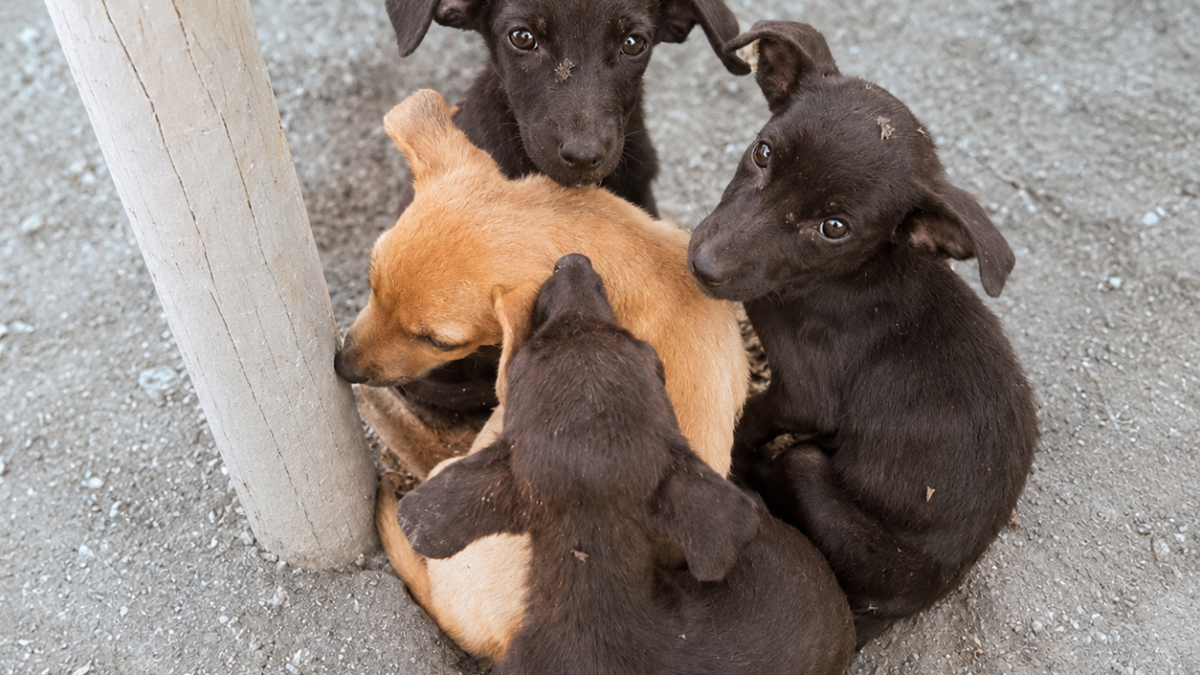
The puppies stayed close together.
That was another detail I could not ignore.
Rather than rushing toward us, they pressed against one another.
One small body against another.
Then another.
A cluster of frightened animals using each other as the only familiar source of comfort.
It almost looked like an embrace.
I know that word can sound too human.
I do not mean they consciously gathered and decided to comfort one another in the way siblings might in a human story.
What I mean is literal.
They huddled.
Touched.
Leaned.
Stayed close.
When hunger is constant, warmth matters.
When the environment feels unsafe, familiar bodies matter.
Whatever had happened there, proximity to one another seemed safer than moving away.
Their owner continued talking.
Their mother was gone, he said.
She had abandoned them.
He did not know where she had gone.
That was another explanation we had no immediate way to verify.
The mother dog was not there.
That much was true.
Where she had gone, why she was gone, and what had happened before her disappearance were questions we did not yet have answers to.
So I tried to separate fact from claim.
Fact:
Five puppies were present.
Their mother was not.
Claim:
She had simply abandoned them and disappeared.
Fact:
The puppies were severely thin.
Claim:
Their condition was related somehow to misbehavior around chickens and a need to be “taught.”
The more facts I gathered, the less the claims seemed capable of explaining them.
A hungry puppy does not become skeletal because he annoyed a chicken.
A lesson does not require prolonged starvation.
And even before the veterinarian documented the rest, their skin was already telling another story.
Scars.
Not one small mark from ordinary puppy roughhousing.
Multiple scars.
Across fragile bodies.
Some more visible than others.
One puppy had especially extensive scarring.
I found myself staring.
Then looking away.
Then looking again because rescue work requires you to see what is actually there, even when you would rather not.
The puppies were afraid.
Their eyes had the wide, fixed look of animals trying to predict what humans might do next.
At first, I thought perhaps the fear came simply from unfamiliar people arriving.
That would have been understandable.
But their behavior suggested something deeper.
They did not only avoid us.
They seemed reluctant to leave the small area they already knew.
Even when the possibility of moving away from the place appeared, they hesitated.
Fear can make confinement feel safer than uncertainty.
An animal may remain in a bad environment because at least the bad environment is familiar.
That is one of the cruelest effects of prolonged fear.
Escape does not automatically feel like rescue to the one being removed.
Sometimes rescue begins with terror.
I watched the puppies and felt sadness settle into anger.
Not loud anger.
Not the kind that helps nobody.
The kind you have to put somewhere temporarily because five animals need you to stay useful.
We began moving them.
All five.
One by one.
Carefully.
They were weaker than puppies should have been.
Their weight in our hands felt wrong.
Too little.
Puppies are small, but healthy puppies have substance.
Muscle.
Warmth.
Energy pushing against you.
These bodies felt fragile.
One puppy in particular worried us immediately.
He was tense.
His abdomen looked distended.
A full, swollen belly on a severely thin puppy is not the reassuring sign people sometimes think it is.
When ribs and spine are visible but the abdomen is enlarged, you worry.
Parasites.
Digestive problems.
Fluid.
Malnutrition.
Different possibilities.
We did not diagnose by sight.
That was the veterinarian’s job.
But we knew enough to understand this was not a normal “full belly.”
The puppy’s whole body looked strained.
We loaded them for transport.
They did not suddenly become excited because they were leaving.
There was no rescue-movie moment where five tails began wagging the second the gate closed behind us.
They were scared.
Exhausted.
Some barely had energy to resist handling.
I remember thinking:
Hold on.
Just hold on long enough for us to understand what your bodies need.
They had already survived long enough for help to reach them.
Now we needed medicine and food to do what sympathy could not.
At the veterinary clinic, the seriousness of their condition became clearer.
Malnutrition.
Dehydration.
Parasites.
Blood parasites requiring treatment.
And the scars.
So many scars.
Every finding made the original chicken story feel more absurd.
Yet we still did not know the complete truth.
That distinction mattered.
It is easy to look at scars and invent the exact weapon, exact moment, exact person.
I refused to do that.
The bodies showed that physical harm had occurred.
The source of every individual scar was not yet established for us.
We reported the case to the authorities for exactly that reason.
Let evidence lead.
Let investigators determine what they could.
Our role in that moment was medical.
One puppy was deteriorating quickly.
The one whose body had worried us from the beginning.
The doctors moved fast.
First aid.
Support.
Assessment.
Everything they reasonably could do.
I watched people working around a body that should have been busy growing.
That is one of the most painful images in rescue.
A puppy lying still while adults hurry.
Puppies are designed for chaos.
When they are too sick to create any, the quiet feels wrong.
We waited.
Hoped.
Told ourselves he had held on this long.
Maybe that would be enough.
Maybe now that help had arrived, the direction could change.
But sometimes the body has already spent every reserve before rescue reaches it.
This puppy could not hold on.
His weak body failed.
Help had come too late for him.
There are many phrases people use after losing a rescued animal.
“He crossed the rainbow bridge.”
“He stopped suffering.”
“He knew love at the end.”
Sometimes those words comfort people.
I understand why.
But in that moment, I did not want a beautiful phrase.
I wanted the puppy alive.
There were five when we arrived.
Now there were four.
That fact was ugly.
There was no way around it.
A puppy had survived hunger, fear, parasites, dehydration, and whatever had caused those scars long enough for strangers to pick him up.
Then his body gave out after rescue.
That can feel unbearable because rescue is supposed to mean the danger has ended.
But crossing the clinic door does not reset biology.
Damage comes with you.
Starvation comes with you.
Dehydration.
Infection.
Parasites.
The body arrives carrying every previous day.
Medicine begins from wherever the body is, not where we wish it were.
For him, the starting point was too far gone.
We were devastated.
But four puppies were still alive.
And grief, in rescue, rarely receives an empty schedule.
You cry.
Then someone needs medication.
Someone needs food.
Someone needs fluids.
Someone needs cleaning.
Someone needs observation.
The living pull you back.
The remaining four were still extremely weak.
Their bodies were full of parasites.
Blood parasite treatment had to continue.
Their nutrition needed careful rebuilding.
Their hydration needed support.
Their damaged skin needed time.
And emotionally, if we can use that word cautiously, they needed an environment where fear no longer made sense.
The first meals mattered enormously.
We placed food down and watched.
The puppies approached differently.
Some more quickly.
Some cautiously.
But hunger eventually overcame hesitation.
They ate.
I remember thinking this might be one of the best meals they had ever experienced.
Not because the food was luxurious.
It did not need to be.
Because it was enough.
Because nobody was using hunger as a lesson.
Because the bowl was not attached to punishment.
Because more food would come later.
That is what security looks like at first.
Not abundance piled dramatically onto a plate.
Reliability.
There will be another meal.
The puppies did not know that yet.
Their bodies ate as though the current bowl mattered completely.
I watched them and thought about the owner saying they teased chickens.
That explanation had tried to transform hunger into discipline.
But hunger was visible here as need.
Bodies do not negotiate moral stories.
A starving puppy eats.
That is all.
Afterward, they slept.
Full stomachs do something beautiful to depleted young animals.
Tension can soften.
The body shifts from seeking to digesting.
Eyes close.
For a while, the world becomes quieter.
We let them rest.
When they woke, treatment continued.
Blood parasites were a major concern.
The source of their illness was not simply lack of calories.
Their bodies were fighting multiple problems simultaneously.
That matters because recovery from severe neglect is rarely solved by one bowl.
Food restores what can be restored.
But disease requires treatment.
Parasites steal resources from an animal already deprived.
Skin injuries create discomfort and infection risk.
Dehydration affects nearly every system.
Everything interacts.
So recovery became layered.
Feed.
Treat parasites.
Hydrate.
Monitor.
Care for skin.
Repeat.
There is no dramatic shortcut.
One of the puppies had the greatest number of visible scars.
I looked at that little body often.
The scars were easier to see once dirt and immediate crisis were being addressed.
Some marks had already healed into the skin.
Others were still part of ongoing recovery.
Every one invited a question.
What happened?
Who did this?
When?
Why?
But scars do not answer.
They only remain.
That can make them almost more frustrating than an open wound.
An open wound gives you a job.
Clean it.
Treat it.
Protect it.
A scar gives you history without explanation.
We had authorities investigating.
So I tried to stop creating answers in my own mind.
The puppies deserved truth, not projections.
The only conclusion I allowed myself early was simple:
The story we had been told did not account for what we were seeing.
Something else had happened.
The authorities would investigate.
Meanwhile, the four survivors needed us.
Days began blending into one another.
That is normal in recovery.
You measure time differently.
Not Monday or Tuesday.
Medication day.
Better appetite day.
Stool improved day.
Skin less red day.
First time someone approached voluntarily.
First time a puppy slept without pressing tightly against another.
These become calendar markers.
At first, fear remained everywhere in their faces.
If a person moved too quickly, they watched.
Hands mattered.
Voices mattered.
Distance mattered.
We lowered our energy.
No sudden reaching.
No crowding.
No forcing affection simply because we wanted proof they understood they were safe.
That would have been for us, not them.
Instead, we allowed safety to become repetitive.
Food arrives.
No one hurts you.
Medicine happens.
Then you are left to rest.
Someone walks past.
Nothing happens.
A hand touches gently.
Nothing bad follows.
A door opens.
You are still safe.
Again.
Again.
Again.
Gradually, the puppies changed.
The first changes were physical.
Hydration improved.
Their bodies began using food instead of only enduring hunger.
Skin treatment started helping.
Damaged areas looked less angry.
Coats slowly became less rough.
The swollen look associated with parasite burden began improving as treatment progressed.
Their strength returned unevenly.
One might stand longer before tiring.
Another might show more interest in surroundings.
A third might approach food faster.
All small.
All meaningful.
Blood parasite treatment continued.
That was important.
We did not assume visible improvement meant the internal problem had vanished.
Rescue animals often look better before they are medically finished.
People see brighter eyes and think “healthy.”
But treatment courses need to be completed.
Follow-up matters.
So we continued.
The most powerful change, though, was not something a blood test measured.
Their eyes.
I know how sentimental that sounds.
But anyone who had seen them on the first day understood.
The fear began leaving.
Not all at once.
No magical morning when four puppies woke up and forgot everything.
Fear changed through degrees.
A stare became curiosity.
A tucked posture became a little more open.
A puppy who used to freeze when someone approached began watching instead.
Watching became sniffing.
Sniffing became staying.
Staying became stepping closer.
One day I realized I had entered the room and nobody immediately looked terrified.
That realization stopped me.
This is what people mean when they say love heals.
But I prefer to be more specific.
Love created the environment in which their nervous systems no longer needed constant fear.
Food helped.
Routine helped.
Gentle handling helped.
Medical relief helped.
Sleep helped.
Predictable people helped.
All of those things together are what we call love in practice.
The phrase “love healed their hearts” is emotionally true for me only because it was supported by hundreds of physical actions.
No one loved the parasites away.
Medicine did that.
No one loved dehydration away.
Fluids and water did that.
But trust?
Trust required human behavior.
That part love could reach.
The puppies began to play.
Slowly.
Not the frantic play people expect from videos of healthy litters.
At first, a paw.
A little mouth reaching for another puppy’s ear.
A few steps of pursuit.
Then fatigue.
But play matters.
A body that uses energy for play is a body beginning to believe energy is available.
A frightened animal who plays is spending attention on something other than danger.
That is a huge shift.
The four had spent the beginning of our story huddled simply to endure.
Now they could interact because interaction was enjoyable.
Past pain did not vanish.
The scars remained.
But the puppies were becoming more than evidence.
That mattered deeply to me.
We often photograph injuries in rescue because documentation matters.
Before photos.
Medical records.
Evidence.
But if we are not careful, we start seeing the animal only through the wound.
I did not want that.
This one has the worst scars.
This one was the most frightened.
This one was near death.
Those descriptions help explain history.
They should not become permanent names.
So we paid attention to personality.
Who was affectionate?
Who was cautious?
Who seemed clever?
Who wanted to play?
Who watched people?
Who relaxed first?
The source eventually gives us four names.
Tokyo.
Cocoa.
Paprika.
Pepper.
Names transformed the group.
No longer four survivors.
Individuals.
Tokyo.
Cocoa.
Paprika.
Pepper.
Each would eventually carry a separate future.
Before that, though, they needed to complete recovery together.
Their health improved.
The difference became obvious enough that we decided to mark it.
A small celebration.
Not because the story was over.
The authorities were still investigating.
Permanent families had not yet been found for all of them.
But survival itself deserved recognition.
Four puppies had come through days when we were not certain how their bodies would respond.
Their skin was healing.
Their parasite treatment was working.
They were eating.
Their fear had softened.
So we prepared a small party.
I smile remembering it because parties for rescued dogs are mostly for humans.
The puppies do not know the symbolism.
They do not understand, “This event marks your physical and emotional recovery.”
They know smells.
Food.
Attention.
New objects.
Maybe excitement in human voices.
Still, rituals matter to us.
We needed to mark the distance.
From the place where five puppies huddled starving.
To this room.
Four puppies standing.
Eating.
Curious.
We prepared treats they liked.
Small cakes too.
Favorite foods.
Nothing grand in the scale of human celebrations.
But enough.
We placed everything carefully.
The puppies investigated.
That is what healthy young dogs do.
They sniffed.
Moved.
Ate.
The simple normality was almost overwhelming.
There was a time when we had looked at their bodies and wondered whether all of them would survive.
One had not.
We remembered him.
The celebration did not erase that.
It honored the four still here without pretending the fifth had never existed.
That balance mattered.
Joy after loss can feel guilty if you let it.
As though smiling betrays the one who died.
It does not.
The living need joy too.
The four puppies had suffered enough.
They were allowed a good day.
So were we.
We laughed.
Watched them eat.
Took in the fact that no one was huddling simply to endure hunger anymore.
If they leaned against one another now, it could be companionship.
Not desperation.
That distinction meant everything.
The source says they healed physically and mentally.
I use “mentally” carefully.
We did not administer a psychological test.
But behavior changed in ways consistent with improved emotional well-being.
Fear diminished.
Play increased.
Social engagement increased.
Their bodies looked healthier.
That is enough to say recovery reached more than skin.
The party felt like a dream compared with the beginning.
A beautiful one.
But while we celebrated, the investigation remained unfinished.
Authorities were still working to determine the truth.
We had already reported the condition.
The scars.
The owner’s claims.
The missing mother.
The punishment story.
Investigators had more questions.
So did we.
But the puppies no longer had to remain in the old place while adults searched for answers.
They could move forward independently of the investigation.
This is important.
Justice can take time.
Healing should not wait.
We began looking for permanent homes.
That brought a new kind of anxiety.
After everything, you become protective.
Perhaps too protective.
You know what the puppies survived.
You know how badly trust can be broken.
Now strangers say:
“I want to adopt.”
And part of you thinks:
Are you safe?
Will you feed them?
Will you stay?
Will you understand?
Will you see scars and feel love instead of pity?
Will you treat normal puppy behavior as normal?
You cannot guarantee any future completely.
But you can choose carefully.
Tokyo was the first.
The first puppy to be adopted.
There is something emotional about the first departure from a rescued litter.
It proves the goal is actually happening.
Recovery was not simply about making them healthy enough to remain with rescuers forever.
We wanted lives.
Families.
Individual relationships.
Tokyo’s family learned the story.
They were moved by what this puppy had survived.
Again, I did not want pity alone to be the foundation.
Pity fades.
Daily care must remain.
What mattered was that they wanted Tokyo.
They were ready to provide a loving permanent home.
Tokyo, a puppy once associated with hunger and scars, was now ready to be associated with a household.
A bed.
Meals.
People.
Whatever ordinary routines would become theirs.
The source describes the puppy as black-haired around this stage.
The dark-coated puppy was ready.
There was no more medical crisis defining every day.
That departure was one of the first times I truly believed the story could end differently than it began.
Tokyo left.
We felt joy.
And the group changed.
Four survivors had been together.
Now one had a family.
Three remained in the rescue chapter, waiting for theirs.
Cocoa was next.
Cocoa had a different presence.
Affectionate.
Understanding, as the source puts it.
I would translate that behaviorally as sensitive and gentle in interactions.
The new family loved that personality.
That was important.
They did not simply choose “one of the scarred puppies.”
They chose Cocoa.
Personality.
Connection.
Individuality.
Every adoption moved the puppies farther away from being a single tragic group.
Tokyo has a home.
Cocoa has a home.
Paprika.
Pepper.
Separate futures.
That is what rescue should eventually create.
Cocoa deserved a peaceful life.
After fear, peace.
After uncertain food, reliable meals.
After physical harm, gentle hands.
The contrast mattered, but we tried not to make the past follow Cocoa into every introduction.
A new family needs to know relevant history.
They do not need to treat the dog like fragile glass forever.
Recovery includes being allowed to become normal.
Cocoa had earned normal.
The authorities contacted us again around this period.
They had new information.
The chicken story was false.
The puppies had not been tormenting the chickens the way the owner claimed.
That confirmation landed heavily, even though part of us had suspected it from the beginning.
Suspecting a lie and having investigators tell you it was a lie are different experiences.
The original explanation had done something ugly.
It had tried to give suffering a justification.
“They were bad.”
“They needed a lesson.”
Once the investigators rejected that story, the moral cover disappeared.
The puppies had not been punished for the behavior described.
They had simply suffered.
That truth was harder and cleaner at the same time.
No argument about discipline.
No debate about chickens.
Five innocent puppies had been in terrible condition.
One died.
Four carried scars.
That was the reality.
The owners also acknowledged the scars.
The source tells us that much.
But it does not give enough detail for me to describe precisely what actions caused every mark.
So I do not.
That uncertainty frustrates me.
Of course it does.
I look at the puppy with the heaviest scarring and want a complete explanation.
But honest storytelling sometimes ends a question with:
We know harm occurred.
We do not know every detail.
That is still serious.
The authorities had more information than we did, and their investigation established that the earlier story about chickens had been false.
That alone changed how we understood the owner’s words.
Lies are not neutral when animals are suffering behind them.
A false explanation can delay help.
Can make observers believe cruelty is discipline.
Can redirect blame from caretaker to animal.
That is what disturbed me most.
The puppies had already lost food, safety, and physical comfort.
Then the narrative tried to take innocence too.
No.
They were puppies.
Young.
Naive.
Dependent.
Whatever normal mischievous behavior they had, they depended on adults for food and protection.
Even if they had chased a chicken once, starvation would never have been acceptable.
This is important.
The investigation proved the story false.
But even had it been true, the treatment would still not have been justified.
Animals do not learn humane lessons through deprivation severe enough to leave them skeletal.
That is not training.
That is suffering.
I looked at the scars again with a different kind of sadness.
At least the puppies no longer lived under someone else’s explanation.
Their bodies could be documented honestly.
Their futures could be built honestly.
Paprika’s turn came.
Paprika was beautiful.
Playful.
Very intelligent.
The kind of puppy whose mind seemed constantly active.
She had reached the point where veterinary prevention could replace crisis medicine.
Fully vaccinated.
That detail made me unexpectedly emotional.
Vaccinations are routine.
Ordinary.
But routine medicine is a privilege after emergency medicine.
At the beginning, everything was urgent.
Malnutrition.
Dehydration.
Parasites.
Blood parasites.
Skin.
Now we were saying:
Paprika is fully vaccinated.
Ready for family.
That is a different world.
Preventive care means you expect a future worth protecting.
I loved that.
Paprika’s family was preparing to come take her home.
Not an emergency transport.
A pickup.
A family coming because they wanted her.
What a contrast.
We could anticipate the departure rather than fear it.
She was ready.
The source says Paprika and the siblings had tried to survive by any means they could.
That is how their early huddling felt.
Survival had been their entire job.
Now Paprika could use intelligence for play.
Learning.
Relationship.
Not calculating whether food would appear.
That is what recovery gives.
A larger purpose for the brain.
I often think physical rescue gets most attention because photographs show it well.
Before and after body condition.
Scars.
Weight.
Coat.
But mental space matters too.
A starving puppy cannot spend much energy learning games.
A terrified puppy cannot explore freely.
When basic safety stabilizes, personality expands.
Paprika’s playfulness felt like expansion.
Cocoa’s affection.
Tokyo’s readiness for home.
Pepper’s later bond with another dog.
These were all forms of life returning.
Pepper was eventually adopted too.
By then, each departure felt both easier and harder.
Easier because we had seen successful transitions begin.
Harder because attachment had grown.
Pepper’s new life sounded happy.
A family.
And a close companion.
Another animal beside Pepper.
The two went places together.
They seemed genuinely happy in each other’s company.
The source says Pepper forgot what happened to the siblings in the past.
I cannot know that literally.
Dogs remember in ways we still do not fully understand.
Trauma can leave behavioral traces even after a dog looks happy.
So I would phrase it differently.
Pepper appeared to move beyond the past.
The old fear no longer defined daily life.
That is enough.
Pepper enjoyed life fully.
That is the observable outcome that matters.
A dog does not need to erase memory to heal.
Humans often imagine healing as forgetting.
I disagree.
Healing can mean memory no longer controls behavior.
Pepper could bond.
Explore.
Travel alongside a companion.
Enjoy.
That is healing whether the past remained somewhere inside or not.
I like that understanding more.
It respects complexity.
The same for all four.
Tokyo did not need to forget hunger.
Cocoa did not need to forget fear.
Paprika did not need scars to disappear completely for the future to be good.
Pepper did not need amnesia.
They needed safety.
And they got it.
Each puppy began writing a separate chapter.
That phrase from the source is beautiful because it does not force one ending onto all four.
Tokyo’s chapter.
Cocoa’s.
Paprika’s.
Pepper’s.
Their stories had begun together, huddled in hunger.
But recovery allowed divergence.
That is progress.
Trauma made them a group.
Healing gave them individuality.
I love that.
At first, we could barely distinguish emotional narratives because everything was shared.
Starvation.
Fear.
Scars.
Treatment.
Later:
This one is affectionate.
This one playful.
This one smart.
This one has a close companion.
Differences.
Personality.
Future.
That is what normal development should look like.
Not four permanent symbols of cruelty.
Four dogs.
The changes in their lives felt enormous.
Sometimes new things arrived so quickly that I had to remind myself how short the distance was between fear and home.
A family comes.
A leash.
A car ride.
A new room.
A new bed.
Ordinary objects become life-changing when the previous life was deprivation.
I do not invent the exact furniture or household details because the source does not give them.
The principle is enough.
New environment.
New people.
New routines.
A future.
Watching these transitions created joy that was different from the celebration party.
The party marked recovery.
Adoption marked release.
Not release from us in a negative sense.
Release from rescue identity.
A successful rescue eventually makes itself less necessary.
That is the goal.
We should become temporary.
Families become permanent.
That can hurt emotionally.
You spend days or months protecting an animal.
Then the best outcome is that they leave.
Rescue requires loving toward departure.
Tokyo first.
Then Cocoa.
Paprika preparing.
Pepper eventually adopted.
One by one.
The room gets quieter.
That quiet is success.
I tried to remember that.
The beginning had a different quiet.
Five puppies too weak to play.
Fear.
Hunger.
Bodies pressed together.
The ending quiet comes because they have left for homes.
Same absence of noise.
Different meaning.
That contrast stayed with me.
I thought about the puppy we lost too.
He never got this chapter.
No family arrival.
No vaccination milestone.
No companion.
That fact remains painful.
The four happy endings cannot compensate mathematically.
You cannot say, “Four survived, so one death is acceptable.”
No.
Each life stands alone.
His death matters.
The others’ survival matters.
Both.
I carry him in the story without inventing a name or future.
He was one of five.
He held on until help arrived.
His body could not continue.
That is the truth.
Sometimes the most respectful thing is not to decorate loss.
Simply remember.
We do.
The authorities’ conclusion about the owner also did not resurrect him.
Accountability matters, but it does not reverse consequence.
That is why prevention matters so much.
Once a body is critically depleted, rescue may be too late.
The first puppy proved it.
People sometimes assume animals are resilient enough to endure anything until help appears.
They are not.
Puppies especially have limited reserves.
If you see severe neglect, waiting is dangerous.
Intervene through appropriate channels.
Report.
Seek veterinary care.
Do not assume tomorrow is guaranteed.
We learned that the hardest way.
The phrase “they all held on until help arrived” sounds hopeful.
For four, help became recovery.
For one, arriving at help was not enough.
That is the urgency hidden inside the story.
The body keeps a clock even when humans do not.
Starvation has duration.
Dehydration has duration.
Parasite burdens have duration.
Physical harm accumulates.
At some point, damage exceeds recovery.
We should not wait for that point.
That lesson belongs with the grief.
I also think about the mother dog.
The owner said she abandoned them.
We never received enough information in the source to know where she truly went.
That uncertainty bothered me.
Was she alive?
Had she been removed?
Had she wandered?
Was the owner’s statement another lie?
The authorities confirmed lies about the chickens, but the source does not tell us they disproved the claim about the mother.
So I leave that question open.
It is tempting to create a reunion.
Find the mother.
Bring her back.
Emotional ending.
But that would be dishonest.
We do not know.
The puppies’ story has enough truth without inventing her return.
Sometimes a missing figure remains missing.
That is reality.
The four puppies had to build futures without that answer.
They did.
That is enough.
I think about this because audiences often want complete closure.
Every question solved.
Every wrong punished.
Every family reunited.
But rescue stories frequently remain incomplete.
Authorities investigate only what evidence supports.
Animals disappear before we arrive.
Histories are unknown.
You learn to live with gaps.
The responsible storyteller preserves them.
Unknown mother.
Unknown exact cause of each scar.
Known lies about chickens.
Known severe neglect and physical harm.
Known death.
Known recovery.
Known adoptions.
That is enough certainty to tell a powerful story.
No need to fill holes with imagination.
The scars themselves already carry enough emotional weight.
One puppy had the most.
I remember touching near those marks only when necessary and wondering how such a small body had endured.
Again, no imagined weapon.
No invented incident.
Just the fact of scar tissue.
Scars prove the skin closed.
That is what scars are biologically.
In that sense, every scar contained both injury and healing.
I found some comfort there.
Not because scars are beautiful.
Because closure is evidence the body kept working.
The skin survived.
Later, medical treatment helped the remaining damaged areas recover too.
Their coats improved.
Skin became healthier.
The visible past softened.
Some marks might remain.
The source does not tell us.
We do not need to know.
Permanent marks do not prevent permanent homes.
That is another important lesson.
Rescue animals do not need perfect bodies before being loved.
Tokyo’s family knew the story.
Cocoa’s family knew.
Paprika’s family knew.
Pepper’s family knew enough to choose.
Scars did not disqualify.
That matters.
At the old property, scars were evidence of suffering.
In a new family, scars can simply be part of a body.
No ongoing danger.
Different meaning.
That is healing too.
I remember the owner’s phrase “teach them a lesson.”
The puppies ultimately did learn lessons, just not the one he described.
They learned food can arrive without fear.
Hands can touch gently.
People can come back.
Medicine can hurt briefly without being punishment.
A home can be safe.
Another dog can be a companion rather than competition for survival.
Those are the lessons I prefer.
Not taught through cruelty.
Learned through repetition.
Life teaching differently.
I do not claim dogs think in those sentences.
Their behavior changed because the environment changed.
That is enough.
Fear reduced.
Trust increased.
That is learning.
Humane learning.
When Tokyo’s adopters came, I imagine only what the source allows: people ready to love and care.
I do not add tears at a doorway.
No need.
The fact of adoption is emotional enough.
Same with Cocoa.
Paprika’s family coming soon.
Pepper’s life with a close companion.
These outcomes do not need cinematic embellishment.
The truth is already strong.
A puppy once too weak to play eventually leaves for a home.
That sentence carries everything.
The beginning and ending speak to each other.
At first:
No energy to play.
Later:
Paprika playful.
Pepper enjoying life fully.
The return of play is one of my favorite recovery measures.
Play is not necessary for survival.
Exactly.
That is why it matters.
When a puppy plays, survival has loosened its grip enough to allow joy.
I think about the party again.
Small cakes.
Favorite treats.
People smiling.
The puppies exploring.
At the beginning, food was medical necessity.
At the party, food was celebration.
Same mouths.
Different meaning.
That transformation touches me.
Food should be more than survival.
It can be pleasure.
Bonding.
Routine.
A birthday-like treat even if it is not anyone’s birthday.
The puppies got to experience abundance without desperation.
That is a very different relationship to food.
The source calls it a wonderful unforgettable day.
It was.
Not because of decoration.
Because we had evidence in front of us.
Four bodies that had changed.
Four sets of eyes that no longer looked constantly terrified.
The party was not the miracle.
They were.
Again, I use miracle emotionally, not medically.
Their recovery came from treatment and care.
But seeing the result can still feel miraculous.
Humans need words for awe.
That is one.
I am careful not to say they healed completely in some absolute psychological sense.
The source says physical and mental healing.
We observed strong improvement.
That is what I mean.
Future families may still have needed patience.
A history of fear can resurface.
But the puppies were ready.
That readiness was judged through behavior and health.
Good enough.
No dog enters adoption as a perfect blank slate.
These four certainly did not.
Families accepted real histories.
That is mature adoption.
I respect them for it.
The authorities’ investigation continuing in parallel created an odd emotional split.
One phone call about adoption.
Another about evidence.
One moment cake.
Next, scars.
Life rarely organizes itself by theme.
You handle joy and bureaucracy in the same week.
That is rescue.
I remember thinking how strange it was that Tokyo could be preparing for a new home while adults were still trying to establish exactly why Tokyo had suffered in the first place.
The future does not wait for the past to become fully understood.
Maybe that is healthy.
If we waited for perfect answers before allowing happiness, many rescued animals would remain stuck forever.
We did not.
Investigation continued.
Adoption continued.
Separate tracks.
That is the right approach.
Accountability for humans.
Life for puppies.
One should not pause the other.
The owner’s admission regarding the scars, combined with the authorities’ conclusion that the chicken story was false, gave us enough to know our initial discomfort had been justified.
But I do not turn that into a courtroom ending because the source does not give one.
No sentence.
No fine.
No arrest.
No invented punishment.
The puppies’ happy ending does not require legal spectacle.
If authorities continued their work, good.
Our work was to place the dogs safely.
That is where we put energy.
I sometimes wish accountability were immediate and visible.
But rescue teaches patience in that area too.
Document.
Report.
Follow up.
Then focus on the animal.
Anger can consume the caregiver otherwise.
I did not want the former owner occupying more emotional space than Tokyo, Cocoa, Paprika, and Pepper.
So I stopped letting him.
Their personalities became more interesting than his lies.
That is one of the best signs of recovery in a story.
The person who harmed them becomes background.
The animals become foreground.
Tokyo’s new family.
Cocoa’s tenderness.
Paprika’s intelligence.
Pepper’s companion.
That is where attention belongs.
I think of Pepper especially because the source says Pepper goes everywhere with the close companion.
Together.
Happy.
There is symmetry there with the beginning.
At first, siblings stayed pressed together to endure.
Later, Pepper chooses closeness in a safe life.
Companionship exists in both images, but the emotional context is opposite.
Beginning closeness:
Need.
Fear.
Hunger.
Later closeness:
Friendship.
Movement.
Shared experiences.
That change is beautiful.
Again, I cannot say Pepper consciously compared them.
We do.
Humans see patterns.
But the behavioral difference is real.
The puppy has companionship without crisis.
That is what we wanted.
Maybe Pepper still loves being near another dog because social closeness feels good.
No need to trace every preference to trauma.
Rescue animals are not psychological puzzles where every trait must be explained by suffering.
Pepper can simply enjoy a friend.
Important.
I do not want to overinterpret.
The same applies to Cocoa’s affection.
Affection is not necessarily compensation for deprivation.
It may simply be personality.
Paprika’s intelligence was always there.
Tokyo’s readiness was not created by scars.
The good traits did not come from abuse.
They survived it.
That distinction matters deeply.
People sometimes say hardship “made them stronger.”
I dislike that framing.
The hardship endangered them.
Treatment and care allowed their existing capacities to reappear.
The puppies did not need suffering to become lovable.
They were lovable before anyone harmed or neglected them.
We simply got to see it later.
This is ethically important.
Do not give cruelty credit for resilience.
Resilience belongs to the animal.
Care supports it.
That is the truthful frame.
The puppy we lost also had resilience.
He survived until help.
His body simply could not recover.
Again, worth is not measured by outcome.
I repeat because rescue stories can accidentally create hierarchy:
Survivors are fighters.
Those who die did not fight enough.
No.
All five endured.
Four bodies recovered.
One did not.
That is biology, not character.
We loved all five.
That is enough.
At some point, I realized the source title—starved for teasing chickens, but that wasn’t the real reason—contained a useful twist but also a danger.
It could make readers focus on discovering the “real reason” as though there were some secret legitimate explanation.
There was not.
The important revelation was that the stated reason was false.
The puppies had not been tormenting chickens as claimed.
The scars and condition pointed to serious mistreatment and neglect.
The source does not give a neatly articulated alternate motive beyond the owner’s lies and admission around the scars.
So I refuse to invent one.
Sometimes “the real reason” is not a satisfying motive.
Sometimes it is simply that adults failed dependent animals.
That is enough.
We do not need psychology for the perpetrator.
We need accountability.
And protection.
The puppies received protection.
That is the part with resolution.
I would rather know Tokyo sleeps safely than know every thought in the former owner’s mind.
Same for Cocoa.
Paprika.
Pepper.
Outcomes for victims matter more than explanations from those who caused harm.
That is where I find closure.
Looking at the four at the end, you could almost forget the beginning.
Almost.
Their bodies were healthier.
Behavior brighter.
Families appearing.
But I never wanted to forget completely.
Not because I wanted to hold them inside trauma.
Because memory creates vigilance.
The next time someone tells me an animal is thin because it is “bad,” I will question.
The next time punishment is used to explain severe deprivation, I will look closer.
The next time scars sit beside a convenient story, I will document.
That is how one case can protect another.
Not through endless grief.
Through learned attention.
The puppies changed us too.
That is true.
Again, they did not need to change us to deserve care.
But they did.
Every rescue does.
You become less willing to accept easy explanations.
More careful with language.
More aware that animals cannot contradict humans verbally.
If an owner says, “They caused trouble,” the animals cannot answer.
Their bodies become evidence.
That creates responsibility in everyone who sees.
Listen to words.
Look at bodies.
Compare.
If they do not match, investigate.
That principle may be one of the most important things in the story.
The chickens distracted from the real issue.
Five starving puppies.
We had to look past the explanation.
We did.
I am grateful.
What if we had accepted it?
What if someone had said, “Well, they must have been difficult puppies”?
The consequences could have been fatal for more than one.
One already died.
Delay matters.
Questioning saved time.
Again, no need to dramatize beyond facts.
The condition itself proves urgency.
I think about the word “innocent.”
The source calls them innocent and naive.
Yes.
Puppies are dependent.
Even mischievous behavior is development, not moral wrongdoing.
They test environments.
Chase movement.
Chew.
Explore.
Humans are responsible for managing that safely.
You secure chickens.
Supervise.
Train.
Separate spaces if necessary.
You do not deprive puppies of food until they become skeletal.
That distinction should be obvious.
Yet the story exists because it was not respected.
The authorities later confirmed the chicken accusation was false anyway.
But humane treatment should not depend on innocence.
Even a puppy who chases chickens still deserves food and care.
That principle is stronger.
I hold it.
Paprika being playful later almost feels like an answer.
Play was once framed as trouble.
Now play is celebrated.
What a change.
A healthy puppy should play.
We should not confuse natural energy with badness.
Maybe this is similar to Rex’s story before, though this is a different source and I do not merge them.
Still, the theme recurs in rescue.
Animals punished for being animals.
Puppies move.
Dogs run.
Mothers protect.
We need to understand species behavior before assigning moral labels.
These puppies were young.
Their job was to grow.
Our job was to help.
That is all.
The small celebration made play visible as a positive thing.
They moved around the treats.
Investigated.
Enjoyed.
No one scolded.
No one withheld food.
I loved that.
We were not only healing bodies.
We were returning permission to behave like puppies.
That is a powerful form of restoration.
The same with adoption.
Families chose them knowing they would still need normal puppy patience.
Toilet accidents.
Chewing.
Energy.
Learning.
The source does not list those behaviors, so I do not invent incidents.
But any puppy needs guidance.
The difference is guidance without cruelty.
That is what new homes represent.
Teaching without fear.
Boundaries without starvation.
Care without scars.
That is the future.
I like that.
Cocoa’s family loved the gentle personality.
Paprika’s family prepared because she was vaccinated and ready.
Pepper’s home included a close companion.
Tokyo went first.
Each path shows a different form of fit.
No one “best” puppy.
Different relationships.
That is how adoption should work.
Individual match.
Again, good.
I remember the moment we realized all four survivors would likely have futures beyond us.
There is a particular relief in that.
At the beginning, the question is:
Will they live?
Later:
Will they heal?
Later:
Will anyone want them?
Then:
Which family?
The questions become less existential.
That progression is a measure of success.
From survival to choice.
Beautiful.
I wish the fifth puppy had reached those later questions.
He did not.
We carry that absence quietly.
Maybe the four survivors carry no conscious memory of him now.
Maybe they do.
We cannot know.
We do.
Humans remember.
That is one role we can take.
Remember the one who did not get the future, while ensuring grief does not steal the future from those who did.
Balance again.
I think the party helped us do that.
Acknowledge life.
Not forget death.
Both.
Pepper’s later happiness helped too.
Every update from a new family does something to a rescuer.
It turns abstract hope into evidence.
Pepper happy.
Companion beside Pepper.
Going places together.
Those sentences reach backward.
They answer the old images.
Huddled, starving puppy.
Now moving through life with a friend.
That is why updates matter.
They close emotional loops.
Tokyo loved.
Cocoa loved.
Paprika ready.
Pepper happy.
The group is no longer trapped in the rescue setting.
That gives us permission to release some fear.
The former owner no longer controls their day.
That is perhaps the biggest victory.
Legal conclusions aside, practical control changed.
Food decisions moved to caring people.
Medical decisions moved to veterinarians and responsible families.
Where puppies sleep changed.
Who touches them changed.
Who defines them changed.
That is liberation in concrete terms.
No need for dramatic language.
Control over daily life moved toward safety.
That is enough.
I often think this is what rescuers truly do.
Not “save” in one heroic moment.
Transfer an animal from a system of harm into a system of care.
Then support the transition until care becomes permanent.
That is what happened here.
Remove.
Treat.
Recover.
Adopt.
Four steps, each containing dozens of tasks.
The source compresses them.
Living them does not.
Time passes.
Medication courses.
Skin heals slowly.
Fear fades slowly.
Families do not appear instantly.
Patience.
Again.
Patience is everywhere in rescue.
The puppies held on until help.
Then we held the process.
That is the partnership.
I find meaning there.
One day, I looked at the puppy with the most scars and realized I was noticing the eyes first.
That was a milestone.
At the beginning, scars dominated perception.
Later, personality did.
That is perhaps the best definition of recovery I can offer.
When the injury stops being the first thing you see.
Not because it disappeared entirely.
Because life grew larger around it.
That is what happened.
Tokyo, Cocoa, Paprika, Pepper.
Names grew larger than scars.
Families grew larger than investigation.
Future grew larger than the old property.
That is healing.
I love that.
The authorities can keep the evidence file.
We keep the names.
Different roles.
Both necessary.
At the end of the source, the puppies are described as ready for their new journeys.
That phrase is true for different reasons.
Some already adopted.
Some transitioning.
All no longer trapped at the beginning.
Journey does not mean travel necessarily.
It means next chapter.
I will not invent where every road goes.
The known outcomes are enough.
Tokyo first adopted.
Cocoa second.
Paprika vaccinated and family coming.
Pepper eventually adopted, happy, companion.
That is plenty.
Perhaps the source’s order around Pepper and Paprika creates some timing ambiguity.
I preserve the facts rather than forcing exact dates.
No dates are given.
Fine.
The emotional sequence remains.
Families came.
That is what matters.
The original owner’s lie about chickens is exposed during this process.
Good.
No need to delay happiness until investigation concludes fully.
We covered that.
I think readers might ask what happened to the owner afterward.
The source does not tell us.
So there is no responsible answer.
Authorities continued investigating and established important facts.
That is where we stop.
No invented arrest.
No fine.
No court.
This matters.
Justice fantasy is tempting in animal stories because readers want emotional compensation.
But false punishment would undermine the truth of the puppies’ actual recovery.
Their lives are enough.
We do not need to manufacture another climax.
The strongest ending is them leaving for love.
I stand by that.
If someone asks what the “real reason” was, I would say:
The stated chicken story was false.
The puppies were suffering severe neglect and physical harm, and investigators confirmed the owner’s explanation did not hold.
Beyond that, the source does not establish a single clean motive.
That honesty preserves credibility.
The scars were acknowledged.
The cruelty of the situation was clear.
Motive is secondary.
Care first.
I think one of the most moving images remains the beginning where they huddled.
I return to it now only to measure distance.
Then:
Five.
Hungry.
Weak.
Scared.
Pressing together.
Now:
Four survivors.
Health improved.
Skin healed.
Fear reduced.
Names.
Families.
One with a companion.
That distance is immense.
Not complete victory because one life was lost.
But real transformation.
We can hold both.
I refuse the phrase “everything turned out fine.”
It did not.
One puppy died.
That matters.
But much turned out better than it could have.
That matters too.
Nuance.
The ending should respect both.
So when I say the puppies “returned happy,” I mean the four survivors reached a state where joy and trust were visible again.
Not that the past became harmless.
Not that every question disappeared.
Just that happiness returned.
That is enough.
The source says “they overcame the pain of the past.”
I frame that as they were no longer visibly ruled by the same fear.
Good.
No need to claim complete psychological erasure.
We know better.
They were doing well.
Adoptable.
Connected.
That is strong evidence.
I think about love again.
“Love heals their hearts.”
Beautiful phrase.
But love also required money.
Veterinary care.
Medication.
Time.
Food.
Reporting.
Transport.
Adoption screening.
People often romanticize rescue into affection.
Affection matters.
Infrastructure matters too.
Tokyo’s happy ending required someone to open a home.
Cocoa’s too.
Paprika needed vaccinations.
Pepper needed a family willing to provide ongoing care.
The fifth puppy needed medicine that unfortunately could not save him.
These are practical realities.
They make the story more meaningful because the outcomes were not magic.
People did work.
Systems worked enough.
That is how change happened.
Maybe readers can be inspired by that more than by miracle language.
You can participate in systems.
Foster.
Adopt.
Report neglect.
Support veterinary treatment.
Again, I do not add a CTA because user has asked no CTA unless requested.
But the lesson exists quietly.
Action matters.
The first action was getting the puppies out.
That was the hinge.
If they had remained, I cannot know how many would have survived.
No speculation needed.
They were already extremely weak.
One died even after removal.
That tells enough.
Urgency.
I remember carrying them.
So light.
Scars under fur.
Fear.
I remember thinking we had arrived just in time.
Then the first puppy died and I realized “just in time” was not true for everyone.
That humbled me.
Rescue timing is rarely simple.
For some, you are in time.
For others, too late.
Same vehicle.
Same day.
Different bodies.
That is why early reporting matters.
Again.
No waiting.
The owner’s narrative had possibly allowed suffering to continue by presenting it as punishment.
We did not accept it.
Good.
Question harmful explanations.
That is perhaps the most actionable moral.
I think the puppies would not care what moral humans extract.
They care about the life in front of them.
Tokyo cares about Tokyo’s household.
Cocoa about Cocoa’s.
Paprika about play and family.
Pepper about the close companion.
That is where I want them mentally.
Not carrying our lessons.
Let humans carry the lesson.
Dogs carry toys.
Food.
Leashes.
Whatever dogs carry.
That distinction makes me smile.
We can keep the scars as memory.
They can have life.
That feels fair.
One final thought about the mother.
Her absence means the puppies had no adult dog protecting or feeding them when we arrived.
Whether she truly abandoned them by choice is unknown.
I resist blaming her.
Animals do not operate under human moral categories.
If she left, there may have been reasons.
If she disappeared because of human action, we do not know.
So I will not call her a bad mother.
The owner used her absence as part of the story.
We simply note:
She was gone.
The puppies were alone.
That is all.
This prevents another unfair narrative.
Good.
The puppies already had enough blame placed on them.
No need to place blame on an absent dog without evidence.
Humans were responsible for their welfare once they were being kept on that property.
That is the relevant responsibility.
Clear.
I think good storytelling in rescue requires this discipline.
Do not invent villainy where facts are enough.
Do not anthropomorphize animal motives beyond observation.
Do not turn death into a device.
Do not reward survivors morally.
Do not erase uncertainty.
And still, tell the emotion.
The emotion is there.
Five puppies huddled from hunger.
One dies.
Four heal.
Families come.
That is more than enough.
I do not need to make it bigger.
I only need to look carefully.
That is what I have tried to do.
At the very end, I imagine—not as a new event, but as the summary image—the four survivors no longer looking at the world through the same fear.
Tokyo somewhere with a family who chose.
Cocoa loved for gentleness.
Paprika bright and playful, vaccinated, ready for the next home.
Pepper moving through life beside a trusted companion.
Four separate lives.
The old group photograph still exists in memory.
But they are no longer required to stay together for survival.
That is perhaps the most beautiful reversal.
At first, closeness was necessity.
At the end, separation becomes safe.
You can leave your siblings because someone else will be there.
That is what adoption means.
A puppy who once could not imagine safety outside the huddle can enter a new family.
That is trust at scale.
Not just trusting one hand.
Trusting the future enough to move.
Beautiful.
The fifth puppy never reached that point.
We carry him with us.
No name given.
No invented legacy.
Just truth.
He mattered.
I think every good ending should leave room for the one who did not make it.
Not dominate.
Not disappear.
A small space.
We remember.
Then we let the four live.
That is compassionate.
The source ends with thanks to viewers and promise of future videos.
I leave that out.
The story has a better ending already.
The puppies are ready.
That is enough.
No marketing.
No request.
Just a final image.
Four lives moving forward.
If I had to say what changed most, I would not say their weight.
Not their skin.
Not even their adoption status.
I would say their relationship to people.
At first, human presence meant fear.
They did not dare leave.
They watched.
They huddled.
At the end, human presence meant family.
Someone coming to pick Paprika up.
Someone loving Cocoa’s gentleness.
Someone giving Tokyo a permanent home.
Someone building a life around Pepper.
That is an enormous transformation.
Humans had been part of the danger.
Humans became part of safety.
Trust did not return because we demanded forgiveness.
It returned because new people behaved differently.
That is the only apology animals really understand.
Changed behavior.
Feed.
Protect.
Treat.
Stay.
The former owner could not rewrite what happened.
Neither could we.
But the new families could write something else after it.
They did.
That is the chapter that matters now.
The puppies who once had no energy to play eventually became playful again.
The puppies whose eyes were filled with fear eventually looked at people without the same terror.
The bodies covered in scars eventually healed enough for families to see the dogs before the wounds.
The group that had only one another for survival eventually separated into homes where each could be loved individually.
That is recovery.
Not forgetting.
Not erasing.
Expanding beyond.
I think that is why Pepper’s happiness with a companion affects me so much.
Pepper is not alone.
But Pepper is not huddling from fear either.
Togetherness has changed meaning.
From survival to friendship.
That is one of the gentlest transformations in the story.
I love it.
Maybe Tokyo has something similar in the family.
Maybe Cocoa does.
Maybe Paprika will.
The source does not say.
I stop where knowledge stops.
Pepper’s known companion is enough to illustrate possibility.
The others have family.
Good.
No invention.
When authorities told us the chicken story was false, I expected anger to feel satisfying.
It did not.
Vindication does not feed a puppy.
It simply confirms you were right to be concerned.
The satisfying part had already happened.
Food.
Treatment.
Eyes changing.
Adoption.
That taught me something.
Being right about cruelty is less important than being useful to the animal.
Investigate, yes.
Report, yes.
But do not make your anger the center.
The puppies should be the center.
I return to them.
Always.
Tokyo.
Cocoa.
Paprika.
Pepper.
And the fifth puppy whose name we do not know from the source.
Five.
That is how it began.
Four surviving.
That is how recovery continued.
Each number matters.
I will not round grief down.
I will not round hope up.
Truth.
That is enough.
Perhaps one day all four will be old dogs sleeping in peaceful homes.
I cannot say.
That would be invention.
I resist the temptation.
The source gives present happiness and adoption progression.
Stay there.
Present tense can be a complete ending.
Pepper lives happily.
Tokyo has a family.
Cocoa has a family.
Paprika’s family is coming.
They are ready.
This is good.
No need decades.
The future is open.
That is success.
I think of them on the first day again.
Thin bodies.
Fear.
No energy for play.
The owner saying “lesson.”
If the puppies could answer in words, perhaps they would have had many things to say.
But they could not.
So their bodies answered.
Their scars answered.
Their bloodwork answered.
Their parasite burden answered.
Their dehydration answered.
Their hunger answered.
And eventually, authorities answered too.
The explanation was false.
The chickens were not the story.
The puppies were.
That is the final truth.
Not what they supposedly did wrong.
What was done to them.
And then what caring people did afterward.
Remove.
Treat.
Feed.
Protect.
Adopt.
That is the real arc.
The owner tried to define them by accusation.
We defined them by names.
I think that may be the most powerful contrast of all.
“Bad puppies.”
No.
Tokyo.
Cocoa.
Paprika.
Pepper.
Names instead of blame.
Lives instead of excuses.
Families instead of punishment.
That is how the story ends.
One by one, the fear that had once filled their eyes was replaced by ordinary puppy curiosity.
One by one, their bodies filled out.
One by one, the wounds closed.
One by one, the future opened.
And one by one, people began choosing them for reasons that had nothing to do with pity.
Tokyo was wanted.
Cocoa was loved for who she was.
Paprika’s bright, playful intelligence had a home waiting.
Pepper found a family and a companion to move through life beside.
The puppy we lost never received that future.
I will never pretend otherwise.
But his absence made us even more determined not to waste the future the other four still had.
So we did not.
We let them heal.
We let them play.
We let them trust at their own pace.
Then, when they were ready, we let them leave us.
That last part can be surprisingly hard.
After fighting so hard to keep an animal safe, your instincts say hold on.
But rescue is not possession.
The goal is not for them to need us forever.
The goal is to make ourselves unnecessary.
A family steps forward.
You check.
You prepare.
Then the puppy leaves.
And if everything goes well, your place in that puppy’s daily life becomes smaller.
That is success.
Tokyo did not need to remain “our rescue.”
Tokyo needed to become someone’s family member.
Cocoa too.
Paprika.
Pepper.
We opened our hands.
That is part of love as well.
Hold when they need holding.
Release when they are safe.
The first day, they clung to one another because they had almost nothing else.
At the end, they could walk toward separate people because they finally had enough.
Enough food.
Enough strength.
Enough trust.
Enough future.
That word—enough—feels like the perfect answer to starvation.
They had gone without enough for too long.
Now they had enough.
And more importantly, they had people committed to making sure “enough” was no longer temporary.
That is what a permanent home means.
Food tomorrow.
Care next week.
Safety after the rescue story stops being told.
The unseen continuation.
That is where real success lives.
No camera.
No before-and-after post.
Just breakfast.
Water.
Vaccinations.
Play.
Sleep.
A normal dog’s life.
I wanted that more than any dramatic ending.
They got it.
Or were on their way to it.
That is where I can finally breathe.
The authorities may continue carrying the old case.
The families carry the new lives.
Different people.
Different responsibilities.
The puppies do not need to stand in between forever.
They can move on.
And that is what they did.
At the beginning, their eyes seemed to ask whether every approaching person might hurt them.
At the end, people approached because they wanted to take them home.
That does not erase the old fear.
It answers it.
Not every hand is dangerous.
Not every person leaves you hungry.
Not every home is punishment.
Some homes feed.
Some protect.
Some stay.
The puppies learned that not from a speech.
From experience.
That is the only way trust truly returns.
Experience.
Good experience repeated.
I think of their small celebration as one of those repetitions.
People gathered.
Nothing bad happened.
Food appeared.
Nothing was taken away as punishment.
Attention surrounded them.
Safe.
Again.
Adoption visits.
Safe.
Vet vaccination.
Safe.
Car ride to home.
Hopefully safe, and in the source, the outcomes we know are happy.
Repetition rewrites expectation.
That is healing.
It takes time.
But these four had time.
The fifth did not.
Never forget urgency.
That is the twin lesson.
Give help early enough that time remains.
Then use that time patiently.
Urgency and patience.
Both.
Urgency to remove them.
Patience to rebuild them.
That balance defines good rescue.
We were late for one.
In time for four.
I carry both realities.
Maybe that is why every happy update feels so important.
It proves the time we still had was used well.
Tokyo’s adoption.
Cocoa’s.
Paprika’s preparation.
Pepper’s companionship.
These are not merely sweet endings.
They are what became possible because the surviving puppies held on and care arrived before their bodies crossed the same line as their sibling.
That makes me grateful.
Not triumphant.
Grateful.
There is humility in rescue when you understand how thin the margin can be.
We did not control everything.
We were fortunate enough to help four recover.
We honor that by caring well.
That is enough.
I do not know what happened to the chickens.
The source does not say, and by the end I almost laugh at how central they were made to sound at the beginning.
The chicken story was a distraction.
A false justification.
The real story was five dependent animals in desperate condition.
We looked past the distraction.
Good.
Sometimes that is all truth requires.
Stop listening to the loud explanation.
Look at the quiet evidence.
Five puppies.
Bodies.
Scars.
Fear.
There was the truth.
Later investigators confirmed part of it.
But the bodies had already spoken.
I think this is what I will remember most.
Animals cannot testify in words.
We have to learn to read condition.
Not project.
Observe.
Document.
Then let professionals and authorities build conclusions from facts.
The puppies were evidence and patients simultaneously.
We had to protect both roles.
Photograph scars.
Treat scars.
Report condition.
Feed the body.
Investigation and care.
Again, parallel.
Good.
The story comes full circle when the scars no longer dominate identity.
Evidence becomes archived.
Dog becomes family.
That is the goal.
I imagine the case file somewhere containing photographs of thin bodies.
Meanwhile, Pepper goes somewhere with a companion.
Two versions of the same dog existing simultaneously.
Past documented.
Present alive.
That is powerful.
The past can remain recorded without remaining current.
That is recovery in another form.
Tokyo’s family may know the story forever.
But perhaps one morning Tokyo is simply sleepy at breakfast.
Cocoa perhaps wants affection.
Paprika wants to play.
Pepper wants to follow the companion.
Ordinary details.
I do not know the exact ones.
I do know the principle.
Ordinary life replaces crisis.
That is what permanent homes offer.
I love ordinary life for rescued animals.
It is the best ending.
No spectacle.
Safe repetition.
The source closes by saying they were ready for a new journey.
Yes.
But before they moved forward, I think they had already completed the hardest journey.
From fear to trust.
From hunger to health.
From accusation to truth.
From being treated as trouble to being treated as individuals.
Everything after is growth.
That feels satisfying.
So I leave them there.
Not at the property.
Not in the clinic beside the puppy we lost.
Not under the authorities’ investigation.
Not even at the celebration.
I leave them moving toward homes.
Tokyo already chosen.
Cocoa chosen.
Paprika ready and expected.
Pepper living happily with family and a close companion.
Four survivors, no longer surviving minute to minute.
Living.
That word matters.
At the beginning, all their energy went toward enduring.
At the end, there is energy left for play.
Affection.
Curiosity.
Companionship.
That is life beyond survival.
The difference is everything.
The owner once said the puppies needed to be taught a lesson.
In the end, I think the lesson belonged to us.
Not the puppies.
We learned how dangerous a convenient story can be when it is allowed to explain suffering.
We learned to look closer.
We learned that a frightened puppy may stay near the place of harm because fear has narrowed the world.
We learned that scars require questions.
We learned that rescue can still arrive too late for one body even when it saves the others.
We learned that medical healing and emotional trust move at different speeds.
We learned that joy can return after fear without erasing what happened.
We learned that a scarred puppy is not a broken puppy.
And we learned that the greatest answer to cruelty is not a dramatic punishment we invent for the person responsible.
It is a safe life the animal actually receives.
Tokyo has that chance.
Cocoa has it.
Paprika is stepping into it.
Pepper is already enjoying it beside a companion.
That is the answer.
Not revenge.
Life.
The five puppies once pressed themselves together because hunger and fear had made the world too hard to face alone.
One of them never got to leave that chapter.
We will remember him.
The other four did.
They healed.
They stood stronger.
They played.
They learned people could be gentle.
And eventually, they became ready to walk away from one another because love was waiting in different directions.
That is how I know the story changed.
At the beginning, separation would have meant terror.
At the end, separation meant home.
Tokyo could go.
Cocoa could go.
Paprika could go.
Pepper could go.
Not because the bond between the siblings meant nothing.
Because each puppy finally had somewhere safe to go.
They no longer needed to cling together just to survive the night.
And after everything, there may be no more beautiful proof of healing than that.
They arrived to us as five frightened puppies whose bodies had been turned into evidence of someone else’s failure.
They leave this story as individuals.
One lost and remembered.
Four alive.
Four loved.
Four no longer defined by the lie that they deserved what happened to them.
They never did.
They were puppies.
They needed food.
Protection.
Gentleness.
Time.
When those things finally arrived, the truth appeared.
Not in an investigation report.
In the puppies themselves.
Their eyes softened.
Their bodies healed.
Their personalities emerged.
And their lives moved forward.
That is the truth I choose to end with.
Tokyo.
Cocoa.
Paprika.
Pepper.
No longer starving.
No longer huddling only to endure.
No longer waiting for someone to decide whether they deserve care.
They are writing new chapters now.
And this time, those chapters begin with something they should have had from the very start:
A full stomach.
A safe place.
Gentle hands.
And people who understand that being a puppy was never something they needed to be punished for.