They clear-cut my trees for their view—so I grew them back with a lawyer’s help.
They clear-cut my trees for their view—so I grew them back with a lawyer’s help.
The developer next door thought a checkbook could erase twenty-three mature hardwoods, forty feet of trespass, and nearly thirty years of memories because my forest was blocking the sunset from his new glass house.
What he didn’t know was that the surveyor had photographed every boundary marker before construction began—and one of those photographs showed exactly where the markers had been before somebody moved them.
I knew something was wrong before I saw the stumps.
For almost thirty years, I had watched sunrise from the porch of my cabin in eastern Tennessee.
Same ridge.
Same hardwood canopy.
Same narrow ribbons of morning light filtering through oak and hickory.
Then one Tuesday morning, sunlight hit me directly in the face.
Bright.
Unfiltered.
Wrong.
A chainsaw echoed somewhere uphill.
I put down my coffee and climbed the trail behind the house.
Halfway up, the birds disappeared.
At the ridge, I stopped.
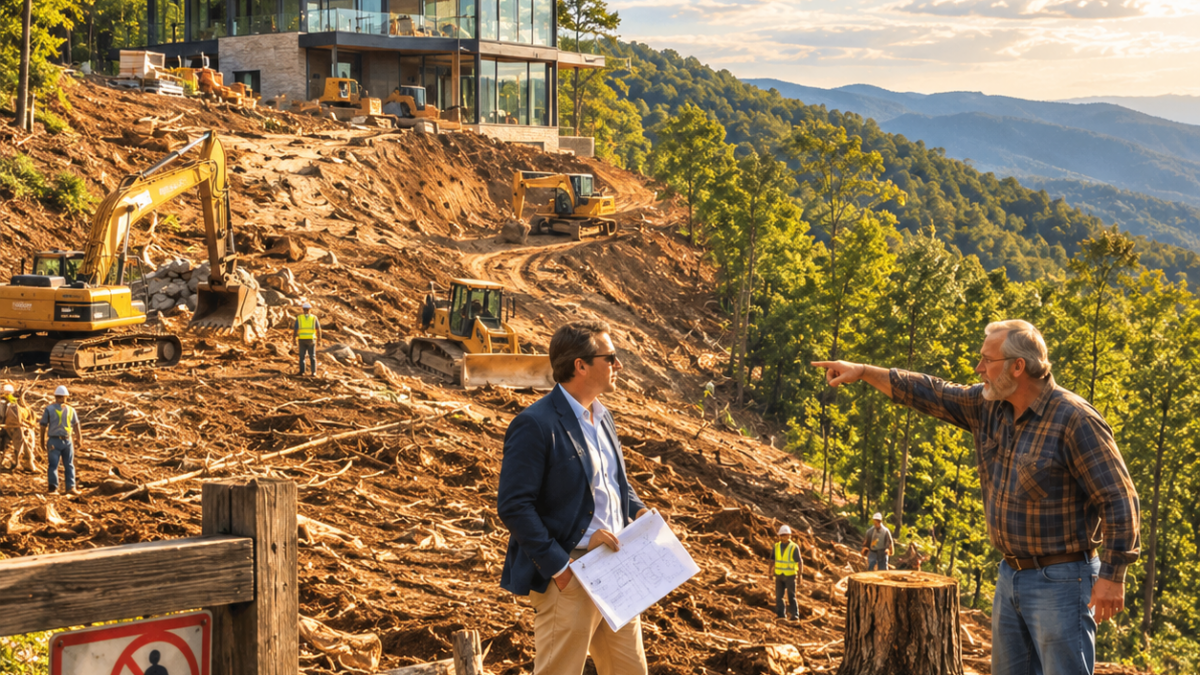
A strip of mountain roughly a hundred and fifty feet wide had been opened like somebody had taken a knife to the forest.
Oak.
Hickory.
Tulip poplar.
One enormous red oak I remembered sitting beneath with my father.
Gone.
The ground was churned into mud and sawdust.
Logs were stacked downhill.
Fresh stumps ran well beyond the line I had walked since the 1990s.
Victor Hale stood near an excavator studying plans.
He had bought the neighboring ridge six months earlier and was building what the real-estate brochures called a “contemporary mountain retreat.”
Steel.
Glass.
A huge west-facing deck.
The kind of place designed around the view.
I walked straight to him.
“You cut my trees.”
Victor lowered the plans.
“Those were yours?”
“You crossed the boundary.”
He glanced toward the hillside.
“The crews followed the clearing line.”
“No. They didn’t.”
His expression barely changed.
“Look, if they crossed a little, we’ll compensate you.”
He said it casually.
Like somebody had scratched my truck.
“How far do you think a little is?”
He shrugged.
“Twenty feet? Thirty?”
“Closer to forty.”
Victor pulled a checkbook from his jacket.
I thought he was joking until he uncapped his pen.
“What’s fair? Five thousand?”
I actually laughed.
That was when his expression hardened.
“They’re trees.”
I looked uphill at the stumps.
Some of those trees had shaded that ridge before Victor and I were born.
One had survived the 1993 storm that ripped half the county apart.
Several younger hardwoods had come from seedlings my father and I planted after another wind event years later.
Victor looked past me toward the opening his crew had made.
From his construction site, the western mountains were suddenly visible without interruption.
That was when I understood.
This wasn’t accidental grading.
The view was the point.
“Stop your crew,” I said.
“We’re nearly finished.”
“Stop them.”
He smiled without warmth.
“Don’t turn this into some hillbilly boundary feud.”
That sentence saved me from doing something stupid.
I went home instead.
Then I called Walter Boone.
Walter had handled a deed issue for me years earlier.
He was sixty-something, local, stubborn, and wore mud-covered boots into offices where everyone else wore polished shoes.
He arrived the next morning, climbed the ridge, and stood among the stumps for maybe thirty seconds.
Then he asked one question.
“Has anybody touched the survey stakes?”
I looked downhill.
One pink ribbon that should have been beside an old stone outcrop was now much farther onto my land.
“I think so.”
Walter’s face changed.
Not anger.
Focus.
By noon he had a licensed surveyor scheduled.
By the following afternoon, a consulting forester was measuring stump diameters, identifying species, photographing root flares, and tagging every cut tree on my side of the recorded line.
Twenty-three.
Walter spread the preliminary photographs across my kitchen table.
Then he placed two images beside each other.
The first had been taken months earlier by the surveyor hired before Victor’s construction began.
The second had been taken after the cutting.
Same ridge.
Same stone outcrop.
Same trees in the background.
But the bright boundary ribbon was no longer in the same place.
Walter enlarged the older photograph.
There, beside the original marker, stood Victor’s excavation foreman.
And in his hand was something neither Victor nor his attorneys were going to enjoy explaining.
[END OF FACEBOOK CAPTION]
[FIRST COMMENT / FULL STORY CONTINUATION]
It was a steel fence post.
Not mine.
Not part of the old boundary.
One of the temporary stakes the survey crew had driven when Victor’s site was first laid out.
The foreman was holding it horizontally across his body.
Walter zoomed in farther.
I leaned over the kitchen table.
“That proves he moved it?”
“No.”
Walter’s answer came immediately.
He had spent too many years practicing law to fall in love with a photograph before it actually proved anything.
“It proves he was standing next to the original monument with a temporary stake in his hands. That is not the same thing.”
He enlarged another photograph.
“This is more interesting.”
The second image was timestamped nine minutes later.
The surveyor had apparently taken it while walking farther along the ridge.
The original pink ribbon was still visible.
So was the temporary stake.
This time it had been placed within a few feet of the recorded line.
Walter opened the new survey photographs from that morning.
The same stake was now roughly forty feet downhill.
I stared at the screen.
“So somebody moved it.”
“Somebody appears to have.”
“Victor.”
“Maybe.”
“Walter.”
He took off his glasses.
“You want to win an argument with me at your kitchen table, or do you want to win the actual case?”
I leaned back.
“The case.”
“Then stop finishing facts before we have them.”
That was Walter.
He could make patience sound like a character defect.
The surveyor came back the next morning.
His name was Martin Keene.
Martin had spent twenty-seven years surveying mountain property and seemed personally offended by anybody who described a ridge line as simple.
He carried an old field book alongside newer GPS equipment.
“People think mountains make obvious boundaries,” he told me as we climbed.
“They don’t.”
“Mine was obvious to me.”
“That’s because you know it.”
He pointed through the timber.
“To somebody looking at a deed description, that rock over there might matter more than this whole ridge.”
We reached the old stone outcrop.
Martin found the recorded iron pin beneath leaf litter within minutes.
He knelt, brushed dirt away, and exposed the top.
“There.”
The legal boundary had not moved.
The pink ribbon had.
The temporary construction stakes had.
Martin worked the slope for almost two days.
He established the deed line from multiple control points, tied it to recorded monuments, photographed everything, and marked the encroachment.
When he finished, twenty-three stumps fell unquestionably on my side.
Some only several feet.
The worst nearly forty-three.
Victor’s clearing line did not wander randomly back and forth over the boundary.
That would have supported an accident.
It pushed onto my land in one broad arc.
The exact arc necessary to open his western view.
Walter stood beside me looking across the cut.
“That shape is going to matter.”
“Why?”
“Because accidents are usually messy.”
He pointed along the stumps.
“This is purposeful looking.”
I hated that phrase.
Purposeful looking.
The mountain felt violated.
The law needed adjectives.
The forester arrived that afternoon.
Her name was Dr. Claire Donovan, although she told me to call her Claire within thirty seconds of meeting her.
She wore canvas pants, carried a diameter tape over one shoulder, and had the calm demeanor of somebody accustomed to explaining why two apparently similar trees could have wildly different values.
She started with identification.
White oak.
Shagbark hickory.
Tulip poplar.
Red oak.
Smaller understory hardwoods.
She estimated age using stump dimensions, local growth conditions, and where necessary increment samples from comparable standing trees.
I followed her until she finally turned around.
“You don’t have to watch me measure every stump.”
“I know.”
“You’re going to anyway?”
“Yes.”
She nodded.
“Thought so.”
At the old red oak stump, she stopped longer.
The diameter was enormous.
I put my hand on the cut surface.
Pale wood.
Dark heart.
Saw marks still visible.
“My father used to sit here.”
Claire looked at me.
She did not write that down.
Not because it didn’t matter.
Because she understood the difference between emotional value and what she could professionally support.
“How old?”
“Tree?”
“Your father.”
“Gone twelve years.”
She nodded.
Then returned to measuring.
That small kindness mattered.
By the end of the week, my kitchen table had become a case file.
Survey.
Photographs.
Forestry inventory.
Drone images.
Victor’s five-thousand-dollar offer, which I had wisely refused.
Walter requested that I write down my recollection of every conversation while it was still fresh.
“Word for word?”
“As close as you can honestly remember.”
I wrote:
They’re trees.
Five thousand?
Don’t turn this into some hillbilly boundary feud.
Then I stopped.
Seeing the words on paper felt different from remembering them.
Walter read the page.
“You certain about this?”
“Yes.”
“All of it?”
“Yes.”
He tapped the last sentence.
“That one is ugly.”
“I noticed.”
“Which means we don’t embellish it.”
“I didn’t.”
“Good.”
He sent Victor a formal preservation letter the next day.
Do not disturb the stumps.
Do not alter remaining markers.
Preserve project emails.
Preserve site plans.
Preserve communications with contractors and surveyors.
Preserve photographs.
Preserve invoices.
Walter explained why while making himself coffee in my kitchen without asking.
“Cases get easier when everybody knows their records matter.”
“And if they delete something?”
“Then we deal with that if it happens.”
“You really never say anything satisfying, do you?”
“I charge extra for satisfaction.”
Victor responded through counsel.
Not one lawyer.
Three.
Their letter came from an Atlanta firm with an office in Knoxville.
It was seventeen pages long.
Walter read it on my porch.
I watched his eyebrows rise twice.
That was the equivalent of another man throwing furniture.
“Well?”
“They say there was an honest boundary mistake.”
“Forty feet?”
“They say the terrain is difficult.”
“He offered to pay me before anybody surveyed it.”
“They say he was trying to resolve a neighbor dispute amicably.”
I stared at him.
Walter turned a page.
“They also say the trees had limited commercial timber value.”
“Claire says otherwise.”
“Claire hasn’t finished.”
I hated that answer too.
The letter proposed mediation.
Walter advised accepting.
I nearly threw him off my porch.
“You’re kidding.”
“No.”
“He cut twenty-three trees and called me a hillbilly.”
“Then mediation is unlikely to improve his personality.”
“I’m serious.”
“So am I.”
Walter folded the letter.
“Mediation costs less than litigation. Judges notice reasonable attempts to resolve disputes. And if Victor is as confident as you think he is, giving him a room in which to talk may be educational.”
“For who?”
Walter smiled.
“Potentially us.”
So we went.
The mediation took place in a conference room in Knoxville.
Victor arrived in a navy suit with two attorneys.
I wore a clean shirt and boots.
Walter wore the same leather boots he wore everywhere.
The mediator was a retired judge named Linda Carver.
She began by explaining something that should have been obvious but rarely is.
Nobody had to like anybody.
Nobody had to admit moral failure.
The purpose was to see whether the dispute could be resolved without spending the next year fighting.
Victor avoided looking at me.
His attorneys did most of the talking.
They acknowledged that some cutting had crossed the boundary.
That was new.
But they characterized it as contractor error during a complicated site-clearing operation.
They offered twenty thousand dollars.
I looked at Walter.
He wrote one word on his legal pad.
Wait.
Claire’s final report had not arrived yet.
So we waited.
Victor finally spoke.
“This whole thing is getting ridiculous.”
The mediator looked at him.
“How so?”
“We’re talking about trees.”
I felt Walter’s hand touch my sleeve.
A warning.
Victor continued.
“They grow back.”
I looked across the table.
“Not in my lifetime.”
His attorney interrupted.
“We’re not going to engage in emotional rhetoric.”
I laughed.
The attorney frowned.
I said, “Your client cut the emotional rhetoric down.”
The room went quiet.
Walter covered his mouth.
Later he claimed he was coughing.
He was not.
The mediation ended without agreement.
Two days later, Claire’s report arrived.
The number on the first page shocked me.
Not because it promised some lottery payout.
Because the documented loss was much larger than Victor’s original five-thousand-dollar scribble.
Claire broke it into categories.
Commercial timber value was one part.
But the report also discussed site-specific impacts.
Loss of mature canopy.
Slope exposure.
Potential erosion.
Replacement and restoration requirements.
The difference between replacing a two-inch sapling and restoring the function of an eighty-year-old hardwood stand.
She was careful not to claim that a new sapling equaled a mature tree.
It did not.
That became the heart of the case.
A developer could plant replacement trees.
He could not buy time.
Walter read the report twice.
Then he called another specialist.
“So now what?”
“Now we calculate what we can prove.”
I leaned against the counter.
“Claire already did.”
“Claire calculated forestry and restoration issues. I want somebody looking at land impact.”
“Property value?”
“Among other things.”
I sighed.
“More experts.”
“Victor has three lawyers.”
“You have me.”
“That is not comforting.”
The restoration specialist was named Owen Price.
He managed reforestation projects for utility corridors, conservation easements, and storm-damaged mountain sites.
He walked the cut slope after rain.
That was when we discovered the first consequence beyond the trees themselves.
Water.
Before the clearing, runoff had filtered through leaf litter, roots, and undergrowth.
Now a channel of muddy water ran down the exposed grade.
It crossed my trail and deposited silt near a spring seep.
Owen crouched beside it.
“This is your immediate problem.”
“The stumps?”
“The slope.”
He explained that removing the mature canopy and disturbing soil had changed how rain moved across the hillside.
The stumps still held some soil.
But skid tracks and grading scars had created new paths.
“If we get a hard storm before this stabilizes, you’re going to lose topsoil.”
“What do we do?”
“Temporary controls now. Long-term restoration later.”
Walter approved emergency stabilization immediately.
Not because he was generous.
Because allowing preventable damage to worsen after discovering it would complicate everything.
We installed wattles.
Mulch.
Temporary seeding in the worst disturbed areas.
Not enough to permanently alter evidence.
Enough to stop the mountain from washing away while lawyers argued about it.
Victor’s attorneys complained.
Walter sent photographs of the runoff.
They stopped complaining.
Then discovery began.
This is where every dramatic property story becomes less dramatic than people expect.
Nobody burst into court with a secret document.
There were requests.
Responses.
Objections.
Electronic files.
Invoices.
Schedules.
Depositions.
Months of paper.
I learned more about Victor’s house than I wanted.
The project had been designed around a huge west-facing glass wall.
The original architectural rendering showed the mountain sunset beyond my trees.
Except the rendering had apparently treated my forest like transparent landscaping.
A design note from months before construction said:
WESTERN VIEW CORRIDOR TO BE CLEARED/OPENED.
Walter stared at that line.
“What does that mean?”
“It means they planned to cut.”
“Maybe.”
I glared at him.
He pointed at me.
“Facts.”
I hated him.
The next document was worse.
An email from Victor to the site superintendent.
We can’t have those hardwoods blocking the primary view. Push clearing as far as legally possible.
That phrase helped Victor.
As far as legally possible.
Walter said so immediately.
“He’s telling them not to trespass.”
“Keep reading.”
The superintendent replied:
Survey stakes put the line closer than conceptual site plan. Need owner decision before extending western cut.
Victor answered:
I’ll deal with the neighbor.
My kitchen went silent.
Walter read it again.
Then once more.
“That’s better for us.”
“Better?”
“For establishing knowledge.”
I pointed at the email.
“He knew.”
“It suggests he knew there was an issue.”
“Walter.”
“Yes. It’s bad.”
Finally.
A satisfying word.
The foreman’s deposition happened three weeks later.
His name was Curtis Lane.
He looked exhausted before anyone asked him a question.
His company had been hired only for site clearing.
Victor’s attorneys had initially suggested that Curtis misunderstood the boundaries.
Curtis apparently did not appreciate being positioned as the sole idiot in a multimillion-dollar project.
Walter began calmly.
“Were survey stakes present before clearing began?”
“Yes.”
“Were they visible?”
“Yes.”
“Did your crew initially clear only to those stakes?”
“Yes.”
“Did Mr. Hale ask for additional cutting along the western side?”
Curtis looked toward Victor’s attorney.
“Yes.”
“Did you tell him that additional cutting could cross the boundary?”
“I told him we needed the surveyor back.”
“What happened next?”
Curtis rubbed his hands together.
“Mr. Hale came to the site.”
Walter waited.
Curtis continued.
“He said the stake line was wrong.”
“Did he explain why?”
“He said the old owner had always treated the ridge break as the line.”
That was nonsense.
The previous owner was me.
Or at least the owner of the land Victor was pointing at was me.
Walter slid a photograph across the table.
“Do you recognize this?”
“Yes.”
“What are you holding?”
“Temporary stake.”
“Why?”
Curtis breathed out.
“Mr. Hale told me to move the clearing reference downhill.”
There it was.
Not move a legal monument.
That distinction mattered.
Curtis said the permanent iron pin had not been pulled.
But the visible construction reference had been repositioned.
“Did you understand that the new reference was the property boundary?”
“No.”
“What did you understand it to be?”
“The line Mr. Hale wanted cleared to.”
“Did anyone tell the cutting crew that?”
“I told them to follow the new stakes.”
My hands went cold.
Walter remained still.
“Did Mr. Hale know that line extended beyond the surveyed boundary?”
Curtis took a long time answering.
“He knew I had concerns.”
“That wasn’t my question.”
Victor’s attorney objected to the form.
Walter rephrased.
“Did you personally tell Mr. Hale that the requested clearing might extend onto the neighboring tract?”
“Yes.”
“And after that discussion, did he direct the clearing to continue?”
Another pause.
“Yes.”
Victor was not at the deposition.
I was almost glad.
I did not trust myself to look at him.
When we got outside, Walter stood beside his truck chewing gum.
“You okay?”
“No.”
“Good answer.”
“He knew.”
“Looks increasingly difficult for him to deny.”
“Why would somebody do that?”
Walter opened his truck door.
“You keep asking a legal case to explain a personality.”
“You think it can’t?”
“I think lawsuits are excellent at showing what people did. They are less reliable at telling us why.”
That night, I climbed the ridge alone.
I had avoided sitting beside the red oak stump since the first week.
This time I sat.
The sunset Victor had wanted was beautiful.
That was the worst part.
With the trees gone, you could see three ridges fading blue into the distance.
The sky turned orange behind them.
Victor had been right about the view.
He had just decided that wanting it gave him the right to remove whatever stood in the way.
I sat until dark.
Then I walked down without a flashlight because I knew every step.
The settlement offer changed after Curtis’s deposition.
Eighty thousand.
Then ninety-five.
Victor would pay money.
I would release claims.
Confidentiality.
No admission.
No court-ordered restoration.
I said no.
Walter made me explain why.
“Because I want the trees back.”
“You understand they can’t put eighty-year-old trees back.”
“I understand.”
“Then what do you actually want?”
I looked toward the ridge.
“I want that slope restored correctly.”
“Define correctly.”
“Native trees. Erosion repair. Monitoring. Replacement if saplings die. No ornamental nonsense. No grass lawn where the forest was.”
Walter wrote that down.
“What else?”
“Protection while they establish.”
He kept writing.
“And?”
I thought about the red oak.
“I want it to become woods again even if I’m dead before it looks like it used to.”
Walter stopped writing.
“That is useful.”
“Why?”
“Because now you’re telling me the objective instead of the anger.”
The next settlement proposal included restoration.
Victor rejected it.
According to his attorneys, a dense replanting plan would interfere with the property’s intended western view corridor.
I read that sentence twice.
Then I started laughing.
Walter was sitting across from me.
“What?”
“He still wants the view.”
“Yes.”
“After all this.”
“Yes.”
“He wants to pay me for cutting my trees, but he doesn’t want trees planted because they’ll block the view he cut them for.”
“Yes.”
I folded the letter.
“So now we know why.”
Walter looked at me.
“You said lawsuits couldn’t tell us why.”
“I said they were unreliable.”
“You’re impossible.”
“I’ve been told.”
We filed suit.
The process moved slowly.
Victor’s house continued going up.
Steel frame.
Glass.
Stone.
Concrete decks.
From my ridge, I could watch the project taking shape through the gap where my forest had been.
That became its own kind of insult.
Every wall looked like proof that the trees had been removed for a reason.
Then the first major storm arrived.
Rain fell for nearly twelve hours.
At 2:00 a.m., I woke to thunder.
By dawn, brown water was moving down the cleared slope.
The temporary controls held in some places.
Failed in others.
A shallow wash cut across the upper trail.
Owen arrived before lunch.
“So now what?”
“Now restoration isn’t optional.”
He photographed everything.
Victor’s side had problems too.
Mud reached one of his unfinished access areas.
His superintendent called mine—meaning Walter—before noon.
Apparently everybody was finally discovering that mature mountain forests did more than block sunsets.
Owen developed a restoration plan.
Not decorative landscaping.
Reforestation.
Native hardwood mix based on the surrounding stand.
White oak.
Northern red oak.
Tulip poplar.
Hickory.
Understory species.
Shrubs where appropriate.
Spacing designed for long-term canopy development rather than immediate visual effect.
Erosion stabilization.
Mulch.
Protection from deer browsing.
Monitoring.
Replacement planting.
Invasive control.
Five years minimum.
Longer stewardship recommended.
I read the species list.
“It’ll look terrible at first.”
Owen nodded.
“Reforestation usually does.”
“How long before it looks like woods?”
“Depends what you call woods.”
“Shade.”
“Years.”
“Real canopy?”
“Decades.”
I looked at the stumps.
“So I won’t see it back.”
“Not the way it was.”
That sentence hurt more than any damage estimate.
There was no legal remedy for time.
That was when my idea of winning changed.
At first, I had wanted Victor punished.
Then compensated.
Then exposed.
Now I wanted seedlings alive in the ground.
That felt more useful.
Trial was set for the following spring.
Before that happened, Walter tried mediation one final time.
Victor attended.
So did I.
This time, there was no joking about five thousand dollars.
No hillbilly comment.
He looked older.
The construction project had run over budget.
The lawsuit had become public through ordinary court filings.
His lender knew about it.
His partners knew about it.
Subcontractors knew.
Not because Walter had orchestrated some revenge campaign.
Because lawsuits involving property become difficult to hide when financing depends on clean title and predictable costs.
The mediator separated us into different rooms.
For six hours, offers moved back and forth.
Money.
Restoration.
Monitoring.
Access for contractors.
Indemnity.
Boundary monument protection.
Future vegetation rights.
Victor wanted a height cap on replacement trees.
I nearly walked out.
Walter stopped me.
“He wants what?”
“A permanent restriction so the replanted trees don’t block the view above a certain elevation.”
I stared at him.
“That is why he cut them.”
“Yes.”
“And now he wants me to sign away the right to regrow them.”
“Yes.”
“No.”
Walter nodded.
“That was my answer too.”
The mediation failed.
Trial began three months later.
There was no cheering crowd.
No television cameras.
No dramatic mob of locals waiting outside.
My sister came.
Tom from down the road came one day.
Claire sat in the hallway until she was called.
Owen arrived carrying restoration maps.
Martin carried survey exhibits.
Victor sat with his attorneys.
His wife attended only the first day.
The survey came first.
Martin explained the recorded line.
The monuments.
The temporary construction stakes.
The before-and-after photographs.
Victor’s attorney tried to establish that steep terrain made visual interpretation difficult.
Martin agreed.
That surprised me.
Then he added:
“That is why professionals survey before clearing.”
Simple.
The forester testified next.
Claire walked through all twenty-three trees.
Species.
Diameter.
Estimated age range.
Site function.
She carefully separated timber value from restoration cost.
Victor’s attorney pressed her.
“You cannot replace an eighty-year-old oak with another eighty-year-old oak, correct?”
“No.”
“So restoration is inherently speculative.”
“No.”
He paused.
Claire continued.
“You cannot replace time. You can replace the stand trajectory.”
I saw Walter write that down.
“What does that mean?” the attorney asked.
“It means you restore the conditions necessary for a future mature forest. Appropriate species. Appropriate spacing. Soil stabilization. Monitoring. Replacement of mortality. You cannot recreate yesterday. You can prevent the damage from becoming permanent.”
That sentence became the entire case for me.
You cannot recreate yesterday.
You can prevent the damage from becoming permanent.
Owen testified about runoff.
The storm erosion.
The replanting plan.
He showed photographs of nearby intact forest and compared root structure, ground cover, and runoff patterns.
Then Curtis Lane took the stand.
Victor stopped writing notes.
Curtis looked miserable.
Walter did not attack him.
That was important.
He walked him through the project.
Original stakes.
Victor’s request.
The concern about boundary.
The moved construction references.
The direction to continue clearing.
Victor’s attorney objected several times.
Some objections were sustained.
Some were not.
The essential testimony remained.
Curtis had warned Victor.
Victor had pushed the clearing farther anyway.
Then Walter introduced the email.
Survey stakes put the line closer than conceptual site plan. Need owner decision before extending western cut.
Then Victor’s response.
I’ll deal with the neighbor.
The courtroom became very quiet.
Victor eventually testified.
I expected arrogance.
Instead, he looked tired.
Walter asked about the house design.
“Yes, the west view mattered.”
“Was it a major design feature?”
“Yes.”
“Did the existing trees obstruct that view?”
“Some.”
“Were some of those trees on my client’s property?”
“I understood there was uncertainty.”
“After the site superintendent told you the survey stakes were closer than the conceptual plan?”
Victor’s attorney objected.
The question was rephrased.
Victor said he believed the old ridge convention supported a different practical boundary.
Walter asked what document supported that belief.
Victor referred to conversations with a prior owner of his own tract.
Not mine.
No recorded document.
No signed boundary agreement.
No survey.
Walter placed the photograph of the moved construction stake on the screen.
“You instructed Mr. Lane to move this reference?”
“I instructed him to mark the area we were discussing.”
“Forty feet onto Mr. Mercer’s recorded parcel?”
“I did not understand it that way.”
“Then why did you offer Mr. Mercer five thousand dollars the morning he confronted you?”
Victor looked at me.
For the first time during the entire trial, our eyes met.
“I wanted to avoid a fight.”
Walter waited.
“Did you tell him the trees would grow back?”
“Yes.”
“Did you refer to the dispute as a hillbilly property dispute?”
Victor’s attorney objected.
Overruled.
Victor swallowed.
“I don’t recall the exact language.”
I did.
Walter did not push farther.
He didn’t need to.
The case went to the jury on some claims while the court addressed other remedies separately.
That distinction mattered because the source story makes legal cases sound cleaner than they usually are.
They aren’t.
Different damages have different requirements.
Some relief is decided by juries.
Some by judges.
Some claimed attorney fees are recoverable.
Some aren’t.
Enhanced damages can depend on what is proven and under what legal theory.
Walter refused to promise me a number.
“What do you think?”
“I think we proved trespass.”
“What do you think?”
“I think Curtis hurt him badly.”
“What do you think?”
“I think asking me a third time will not make me psychic.”
We waited.
The jury returned in our favor on the central issues.
They found that Victor’s clearing had crossed my boundary and that the conduct was not merely an innocent mistake.
The damages were substantial.
Not the fantasy number people around town later repeated.
But enough to cover a serious timber loss and the documented harm.
The court then considered the restoration request separately.
That was the part I cared about most.
Victor’s counsel argued that money was enough.
Walter stood with Owen’s plan in his hand.
“Money can compensate for loss,” he said. “It cannot hold this slope together. It cannot shade the spring. It cannot become twenty-three hardwoods. A restoration plan can at least begin the work.”
The judge studied the photographs.
Then Victor.
Then me.
The final judgment took weeks.
When it arrived, I read the restoration section before the money section.
The order required Victor to fund professional stabilization and reforestation of the affected area consistent with an approved plan.
Native species.
Monitoring.
Replacement of failed plantings during the monitoring period.
Protection of the recorded boundary.
No unilateral vegetation removal from my parcel.
The financial award covered proven damages and certain litigation expenses allowed by the court.
There was no judicial one-liner about rich people and insanity.
No courtroom applause.
Victor said nothing.
Neither did I.
Outside, Walter leaned against the courthouse wall.
“You won.”
I looked at him.
“The trees are still dead.”
“Yes.”
“Doesn’t feel like winning.”
“No.”
He put his hands in his pockets.
“Most real victories don’t put things back the way they were.”
We stood there for a moment.
Then he said, “But we can start planting.”
That was the first time all day I smiled.
The restoration work began that fall.
Owen refused to rush it.
First came soil stabilization.
Drainage repair.
Removal of compacted skid paths where practical.
Invasive plants that had started colonizing disturbed ground had to be controlled.
Then species selection.
I wanted to plant twenty-three big trees.
One for every tree lost.
Owen told me that was sentimental and ecologically foolish.
“You’re rebuilding a forest, not arranging a memorial garden.”
“I thought you’d be nicer.”
“You hired me to keep trees alive.”
So we planted hundreds.
Not twenty-three.
Hundreds.
Most were small.
Some looked insultingly fragile compared with the giants that had been cut.
Tubed seedlings.
Bare-root stock.
Saplings.
Oaks no taller than my waist.
Hickories that looked like sticks.
Tulip poplars with leaves that seemed too big for their stems.
We planted in clusters based on slope and moisture.
We left room for natural regeneration.
Acorns already in the soil were sprouting in places.
Owen pointed to one tiny red oak.
“Volunteer.”
I crouched beside it.
“That was here already?”
“Probably came from one of your old trees.”
I touched one leaf.
That got me.
Not the judgment.
Not the checks.
That leaf.
The forest had started rebuilding before any lawyer told it to.
Victor’s company paid the restoration contractor under the judgment.
He never came to watch.
His construction project slowed.
That part of the source story had been exaggerated by gossip.
His lender did not magically destroy him overnight.
No bank executive rode onto the ridge and canceled his life.
But the judgment complicated things.
A lien associated with the case affected the property until the financial obligations were resolved.
His budget was already strained.
Contractor disputes developed.
Work paused twice.
The giant glass house remained unfinished through winter.
I could see its steel frame through the gap.
At night, wind moved through window openings that had not yet received glass.
It looked less like a luxury retreat than a shipwreck on a mountain.
I took no pleasure in that.
At least I tried not to.
Walter called me one January afternoon.
“Settlement on remaining payment issues.”
“What does that mean?”
“He wants to resolve the lien and stop further collection costs.”
“Can he?”
“If he pays.”
“Will he?”
“Looks like it.”
Victor eventually did.
Not immediately.
Not gracefully.
But enough of the judgment was satisfied that Walter released what needed to be released.
The rest was resolved through an agreement I won’t pretend I understood without him explaining it three times.
The restoration obligation remained.
That mattered more to me.
The first winter was hard on the plantings.
A cold snap killed several.
Deer damaged others.
One section washed despite the erosion measures.
Owen came back in spring.
He walked the slope with a clipboard.
“Mortality’s within expected range.”
“They’re dead.”
“Some.”
“You sound very relaxed about dead trees for a tree guy.”
“Because I expected some to die.”
“We replace them?”
“Yes.”
“Victor pays?”
“Under the monitoring agreement, replacement is part of the plan.”
That sentence almost made me enjoy paperwork.
We replanted.
Year two looked better.
Native grasses stabilized the open soil.
Blackberries came in too aggressively along one edge.
Owen cursed those more than Victor.
Natural oak regeneration appeared in several pockets.
The tulip poplars grew fastest.
Some passed six feet.
The oaks took their time.
“Typical,” I told them.
Owen stared at me.
“You’re talking to saplings now?”
“I live alone.”
“Fair.”
The second spring after trial, I found Victor at the ridge.
That surprised me.
He stood on his property beside the old construction site.
The house was still unfinished but enclosed.
Glass had finally gone in.
From his west-facing room, the view remained enormous because saplings are not eighty-year-old hardwoods.
Yet.
He saw me.
For a second, neither of us moved.
Then he walked toward the boundary.
He stopped on his side.
Good start.
“I’m selling.”
I had heard rumors.
“I figured.”
He looked at the young trees.
“They’ll eventually block it again.”
“Yes.”
A weak smile appeared.
“I suppose that’s the point.”
“No.”
He looked at me.
“That was never the point.”
“What was?”
“They belong there.”
Victor stared across the restoration area.
“I made a mistake.”
I waited.
People use that sentence when they mean many things.
Sometimes they mean I regret hurting you.
Sometimes they mean I regret getting caught.
Sometimes they mean I regret how expensive this became.
I did not know which one Victor meant.
So I said nothing.
He continued.
“I thought the line was negotiable.”
“That’s not the same as thinking the line was wrong.”
“No.”
That was more honesty than I expected.
He rubbed his hands together.
“When Curtis warned me, I thought you’d take money.”
“You were right about one thing.”
“What?”
“I would’ve taken money.”
Victor looked surprised.
“For the damage?”
“No. If you’d asked before cutting anything and wanted to buy a view easement or part of the land, I would’ve listened.”
“You would have sold?”
“Probably not.”
He laughed.
I did too.
“But I would’ve listened,” I said.
Victor looked uphill.
“I didn’t think I had to.”
There it was.
The whole case.
Not hatred.
Not madness.
Entitlement.
He had mistaken the ability to pay afterward for permission beforehand.
“I know,” I said.
He left a few minutes later.
No handshake.
No apology grand enough for the movies.
But something had changed.
When his property sold months later, the buyer visited me before closing.
Her name was Grace Ellison.
Architect.
From Asheville.
That made me nervous immediately.
She laughed when I told her.
“I promise not to cut anything.”
“I’ve heard versions of that before.”
She carried a survey.
A real one.
“I wanted to walk the line with you.”
That was all Victor had ever needed to do.
We walked.
I showed her the iron monuments.
The old stone outcrop.
The replanted area.
The stump of the red oak.
She stopped there.
“That was one of the cut trees?”
“Yes.”
“How old?”
“Claire estimated close to eighty.”
Grace ran her fingers across the weathered stump.
“I’m sorry.”
She had nothing to apologize for.
But it was still the first apology that felt uncomplicated.
She bought Victor’s place.
Finished the house differently.
Less glass.
More stone.
No helicopter pad.
Thank God.
The west view remained open for a few years.
Then the young trees began doing what trees do.
Growing without asking anyone’s permission.
By year three, some tulip poplars were over ten feet.
The oaks were smaller.
Sturdier.
The hickories looked unimpressive above ground because they were busy putting energy into roots.
Owen explained that every time I complained.
“You’re impatient.”
“I was fifty-eight when they cut the old trees.”
“And?”
“I don’t have eighty years.”
“No.”
“Very comforting.”
He leaned on his shovel.
“You’re not planting them for eighty-year-old you.”
That shut me up.
I started keeping photographs.
Same spot.
Every October.
The first year looked heartbreaking.
Plastic tubes.
Bare soil.
Mulch.
Tiny stems.
The second year looked messy.
The third looked alive.
The fifth began looking intentional.
By then, birds had returned to areas that once felt exposed.
Not the same birds.
Not the same canopy.
But movement.
Warblers in spring.
Squirrels using the larger saplings as if they had personally been waiting for construction to finish.
Leaf litter began accumulating again.
Shade returned in patches.
Rain stopped racing down the slope in brown sheets.
The spring seep cleared.
One afternoon, Grace called from next door.
“Come up here.”
“What happened?”
“Nothing. Just come.”
I climbed the ridge.
She stood on her deck facing west.
The sun was lowering.
In front of it, one tall tulip poplar from the restoration area had finally reached the bottom edge of her view.
A few leaves flickered in the light.
Grace pointed.
“Your forest is coming back.”
I looked at it.
“My lawyer’s forest.”
She laughed.
“Walter planted these?”
“Walter planted invoices.”
That evening I called him.
He had semi-retired by then.
“Trees are blocking the neighbor’s sunset.”
“File suit.”
“I’m serious.”
“So am I. Those trees have no respect for luxury real estate.”
“You remember Victor?”
“I try not to.”
I told him about the tulip poplar.
Walter went quiet.
“You kept the annual photos?”
“Yes.”
“Bring them by sometime.”
“Why?”
“I’d like to see what all my billable hours became.”
So I did.
We spread five photographs across his desk.
Year one.
Year two.
Year three.
Year four.
Year five.
Same angle.
In the first, the ridge looked wounded.
In the last, green filled much of the frame.
Walter picked up the final picture.
“That’s better than the judgment.”
“Yes.”
He looked at me.
“You know what Victor never understood?”
“What?”
“He thought compensation meant buying what he broke.”
Walter set down the photograph.
“It doesn’t. Compensation is what happens because you can’t buy it back.”
That stayed with me.
Claire visited once during year six.
She had another project nearby and stopped by after work.
We climbed to the red oak stump.
By then, young red oaks grew around it.
Some natural.
Some planted.
She inspected them.
“You’ve got good regeneration.”
“I did all the hard work.”
“You complained while professionals did the hard work.”
“That counts.”
She smiled.
Then she pointed to a sapling growing within several feet of the old stump.
“See that one?”
“Yeah.”
“Could be natural regeneration from the original tree.”
“Could be?”
“Acorn could have come from somewhere else.”
I looked at her.
“Can you just lie to me once?”
“No.”
I decided it was the old tree’s child anyway.
Professionally unsupported.
Emotionally certain.
Years passed.
My back got worse.
My coffee did not improve.
Grace became the kind of neighbor the Calderons in another life might have been.
We waved.
Shared road information.
Called when a tree came down across the access lane.
Once she asked whether one of the growing oaks could be selectively pruned because a branch would eventually cross near a utility line on her side.
She asked first.
That mattered.
We brought in an arborist.
We solved it in twenty minutes.
No lawyers.
I called Walter afterward.
“You’re becoming obsolete.”
“Best news I’ve heard all week.”
The strange thing is, I never forgot the morning the forest disappeared.
I can still remember sunlight hitting my face on the porch.
That unnatural brightness.
The chainsaws.
The silence on the ridge.
For years, I hated direct sunlight through that gap.
It felt like Victor was still there.
Then one autumn morning, I stepped outside with coffee.
The light looked different.
Soft again.
Not fully.
The canopy was young.
Gaps remained.
But leaves broke the sunrise into thin moving strips across the porch.
I stood there longer than necessary.
My coffee went cold.
Then I walked uphill.
The restoration area no longer looked planted.
That was the biggest change.
At first, you could see human intention everywhere.
Rows.
Tubes.
Mulch.
Stakes.
Protection cages.
By then, nature had messed up the pattern.
Seedlings appeared where nobody placed them.
Some planted trees died.
Wild ones filled spaces.
Vines climbed.
Leaves covered the ground.
Branches crossed.
The forest had stopped looking like a legal remedy.
It had started looking like a forest.
I sat on the old red oak stump.
It had softened with age.
Moss grew along one side.
The young oak Claire refused to certify as its descendant stood nearby, now taller than I was.
I put my hand on the trunk.
Ridiculous, maybe.
But I remembered planting saplings with my father decades earlier.
Back then I had been impatient too.
He used to tell me trees teach you whether you understand ownership.
I never knew what he meant.
I assumed it was one of those things fathers say when they want children to stop asking when something will be finished.
Now I think I understand.
You can own the ground.
You can hold the deed.
You can pay taxes.
You can hire lawyers.
But a mature forest is mostly borrowed time.
Somebody before you protected it.
You protect it while you can.
Somebody after you gets the shade.
Victor thought owning his ridge meant the mountain should reshape itself around him.
For a while, I made the opposite mistake.
I thought winning the lawsuit meant putting my mountain back exactly as it had been.
Neither was possible.
The only thing we could really do was give it another chance to become itself.
Walter died the following winter.
Heart attack.
Fast.
His daughter called me.
The funeral was held in a small church where half the county seemed to know him.
Lawyers.
Farmers.
Judges.
Mechanics.
A woman who said Walter had once saved her family farm from a title problem.
An old man who claimed Walter had represented him three times and advised him not to discuss any of those cases in church.
That sounded right.
Afterward, Walter’s daughter handed me an envelope.
“He left a few client files marked personal.”
Inside was a photograph.
Year five of the restoration.
The picture I had given him.
On the back, in Walter’s handwriting, were seven words:
This was the part worth fighting for.
I stood in the parking lot holding that photograph until most people had gone.
Months later, I had the sentence engraved on a small brass plate.
Not a giant sign.
Walter would have hated that.
I attached it to a bench near the trail below the restoration area.
You have to walk uphill to see the trees.
The bench faces west.
Yes.
Toward the sunset.
I thought that was funny.
Grace did too.
By year ten, several of the tulip poplars had become legitimate trees.
Not saplings.
Trees.
The oaks were coming.
Slowly.
Patiently.
One autumn evening, I sat on Walter’s bench while Grace’s grandchildren ran around on her side of the ridge.
They had never met Victor.
They had never seen the clear-cut.
To them, the young forest had always been there.
One little boy pointed at the sunset through the leaves.
“Pretty.”
I looked through the branches.
He was right.
The view had not disappeared.
It had changed.
Instead of one giant open panorama, the mountains showed through moving patches of gold and red.
Leaves framed the sunset.
Branches made shadows.
Birds crossed between us and the distant ridge.
It was a better view.
Not because I won.
Because it belonged to both sides without one of us having to destroy the other.
I keep the case records in a cabinet downstairs.
Martin’s survey.
Claire’s report.
Owen’s restoration maps.
Curtis’s deposition.
Photographs of the moved stakes.
Victor’s original five-thousand-dollar offer.
Walter’s invoices, which remain offensive.
And the annual photographs.
Those are the documents I look at most.
Not the judgment.
Year one is nearly bare.
Year three is hopeful.
Year five is green.
Year ten looks like something my father would recognize.
The red oak stump is still there.
Eventually it will rot completely.
The younger oak beside it will probably outlive me.
That used to make me sad.
Now it doesn’t.
Victor wanted a permanent view.
I wanted my old forest back.
Neither of us got exactly what we wanted.
He learned that a property line is not something wealth can casually erase.
I learned that restoration is not the same thing as reversal.
You cannot uncut an eighty-year-old tree.
You cannot sue time backward.
You cannot order a mountain to forget.
But with a good survey, a stubborn lawyer, a careful restoration plan, and a decade of rain and patience, you can stop one bad decision from becoming the final version of the land.
Some mornings, sunlight still reaches my porch more directly than it did before Victor came.
The canopy isn’t old enough yet.
Maybe it never will be while I’m here.
That’s all right.
I know what is growing between me and that western ridge.
White oak.
Red oak.
Hickory.
Tulip poplar.
Trees whose shade I may never fully sit under.
Trees planted because one man thought money gave him permission to remove what belonged to somebody else—and another man in worn-out leather boots helped me prove that it didn’t.
The old forest is gone.
I stopped pretending otherwise years ago.
But when the wind moves through the young hardwoods now, the ridge is no longer silent.
And that, more than the judgment, is how I know we grew it back.