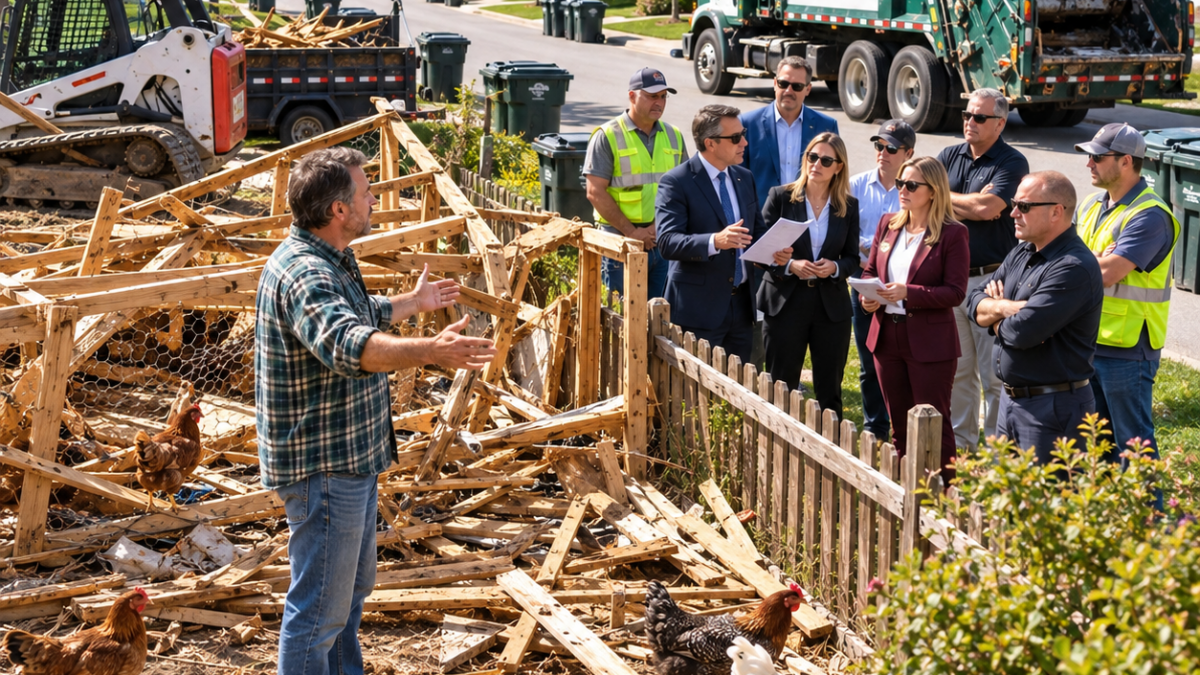
They demolished my chicken coop while I was away—so two weeks later, the garbage truck serving 218 homes reached the back of our neighborhood and found the only access road locked.
Rachel did not smile when she said it.
That should have warned me the next two weeks were going to be far less satisfying than the version people around the neighborhood eventually told.
In that version, I found a magic deed, slapped a steel gate across the road, and watched 218 homes drown in garbage until the HOA begged for mercy.
Real life took more paper.
More restraint.
And a lot more phone calls.
Rachel pulled the access agreement closer and read the revocation paragraph again.
Then she read it a third time.
“What exactly does this mean?” I asked.
“It means your uncle granted the association—or technically its predecessor entity—a private license to use this strip for one specific purpose.”
“Trash collection.”
“Waste-service access, yes.”
“Can I cancel it?”
“Possibly.”
“That doesn’t sound exciting.”
“Good. Property law should rarely sound exciting.”
She turned the document around.
The road ran along the western edge of my parcel for roughly sixteen hundred feet before reaching a masonry-walled trash compound shared by the neighborhood.
When the community was built in the early 1990s, the main internal streets had been designed around cul-de-sacs and decorative walls.
The developer had apparently discovered too late that full-sized garbage trucks could not safely turn through one section near the collection area.
My uncle, Harold, owned the adjacent acreage before the neighborhood existed.
He allowed a service lane along his western boundary.
The agreement required the association to maintain the surface, carry liability insurance, keep the route exclusively for waste and utility service, and avoid interfering with my uncle’s remaining use of the land.
Then came the sentence Rachel cared about.
The license could be terminated for material breach after written notice and an opportunity to cure.
I frowned.
“Material breach of what?”
“Of this agreement.”
“What did they breach?”
“Maybe nothing related to the road.”
That took some wind out of me.
“So the chicken coop doesn’t let me revoke it.”
“Not automatically.”
I leaned back.
“You could have started with that.”
“You wanted the truth or revenge?”
“The truth.”
“Then stop looking disappointed.”
She tapped another paragraph.
“But the agreement also renews periodically rather than running forever.”
I sat forward.
“How periodically?”
“Five-year terms.”
“When’s the current term end?”
She checked the execution date.
“Depending on how prior renewals were handled, possibly very soon.”
“How soon?”
“I need title records.”
I looked at the broken-coop photographs spread across her desk.
“And the demolition?”
“Separate problem.”
“They came onto my property.”
“Yes.”
“They destroyed my structure.”
“Yes.”
“They hadn’t even ruled on my appeal.”
“That appears to be true.”
“So they can do that?”
Rachel looked at me over her glasses.
“Daniel, you worked for government. You know the answer to that question depends on where authority comes from.”
I hated hearing my own philosophy repeated back at me.
“What do the HOA documents say?”
“I brought them.”
My uncle’s estate file included the declaration and amendments.
Rachel started reading.
The HOA had architectural-enforcement authority.
It could issue notices.
Impose fines after procedure.
Seek injunctive relief.
Arrange maintenance in limited circumstances involving immediate hazards or neglected common-facing landscaping.
What Rachel did not find was a general right allowing the association to enter a fenced private backyard and demolish a disputed accessory structure before the owner’s appeal.
“This is bad for them,” she said.
“How bad?”
“That depends on facts. Did you give them permission to enter?”
“No.”
“Any emergency?”
“My chickens were plotting a coup.”
“Daniel.”
“No.”
“Was the structure unsafe?”
“Not according to anything they sent me.”
“Did the governing documents expressly authorize self-help removal of unapproved structures?”
“Not that I’ve seen.”
“That’s what I’m seeing too.”
I folded my arms.
“So what happens?”
“First, a preservation letter. Nobody destroys video, emails, work orders, board minutes, contractor invoices, or access-control logs.”
“Then?”
“A demand for reimbursement, correction of the violation, and an explanation of the authority they claim allowed entry.”
“And Vanessa?”
“She does not get a special paragraph because you dislike her.”
“I don’t dislike her.”
Rachel stared at me.
“Fine. I dislike her.”
“Better.”
She began typing.
“Second, I’m ordering the title history on the waste-access lane.”
“Third?”
“We figure out who actually owns and maintains every inch of that road.”
“My deed says I do.”
“Your deed is an excellent start. I prefer confirmation before my client buys a dramatic gate.”
I smiled.
“You knew about the gate idea?”
“You have the face of a man mentally shopping for steel.”
She was irritatingly good.
That afternoon, Rachel sent three letters.
One to the HOA.
One to the property-management company.
One to Desert Ridge Maintenance, the contractor that had dismantled the coop.
The letters were boring.
I loved them.
They identified the property.
Referenced the pending architectural appeal.
Objected to unauthorized entry.
Demanded preservation of all records.
Requested the legal authority for demolition.
Required the association to preserve Marcus Bell’s gate-camera footage once we informed them it existed.
Then Rachel added one sentence near the bottom.
Please also preserve all records regarding the association’s use, maintenance, renewal, and claimed rights concerning the western waste-service access crossing the Harper parcel.
That sentence did not mention revocation.
It did not threaten the trash contract.
It simply told them we had found the road agreement.
I asked why she kept it vague.
“Because they may tell us something useful before they realize what matters.”
People reveal more when they think the argument is still about chickens.
The first response came from the contractor.
Desert Ridge Maintenance’s owner, Tom Alvarez, called Rachel before the day ended.
He was nervous.
Very nervous.
His crew had not made an independent decision to enter my yard.
They had received a work order from the HOA management company marked:
BOARD-AUTHORIZED REMOVAL.
Photographs attached.
Access approved by HOA president.
Tom’s crew had entered because the pedestrian gate was unlocked.
“That doesn’t mean they had permission,” I said.
“No,” Rachel replied, “but it tells us where the decision came from.”
The next morning, Tom emailed the work order.
At the bottom was a board-approval field.
V. WHITMORE — PRESIDENT.
I stared at it.
Rachel said, “Do not call her.”
“I haven’t moved.”
“You reached for your phone.”
“I was checking the time.”
“It’s nine-fifteen.”
“I could’ve forgotten.”
She ignored me.
The management company responded two days later.
Their attorney, Samuel Price, wrote that the HOA had acted under its governing documents to remediate an unauthorized structure after “repeated noncompliance.”
Rachel read that phrase aloud.
“Repeated?”
“I submitted one application, got no decision, received one violation, and appealed.”
“That is not what their timeline says.”
She showed me the enclosure.
The HOA’s internal record claimed I had been warned four times.
Three of those warnings had never reached me.
One was an internal note marked:
OWNER HAS PRIOR HISTORY OF RESISTING AUTHORITY.
I stared at it.
“Prior history?”
Rachel’s eyebrows rose.
“Interesting.”
“They’re talking about Vanessa.”
“Maybe.”
“That was twenty years ago.”
“Maybe.”
“She put that in an HOA file?”
“Maybe.”
“You’re enjoying this.”
“Professionally.”
We requested the underlying emails.
The association refused voluntarily.
Rachel did not immediately sue.
She scheduled a meeting.
Meanwhile, the title company completed the access review.
That was where the balance of the dispute changed.
The service road was unquestionably inside my parcel.
The neighborhood had no ownership interest.
No public dedication existed.
No permanent easement had ever replaced the original license.
The agreement had been renewed automatically in five-year increments unless either party gave at least sixty days’ notice before the end of a term.
Rachel calculated the dates.
Then recalculated them.
“Current term ends August thirty-first.”
It was July.
I looked at her.
“You’re kidding.”
“No.”
“How much notice?”
“Sixty days.”
“What date is today?”
“June twenty-third.”
I stared.
She knew exactly what I was thinking.
“You have time.”
“I can terminate it.”
“You can give notice of nonrenewal.”
“Same practical result.”
“Eventually.”
“And August thirty-first?”
“Unless they negotiate a replacement agreement, their contractual permission expires.”
I stood and walked to her office window.
Below us, traffic moved along a six-lane arterial.
“So I don’t need to prove a breach.”
“Correct.”
“I don’t need the chicken coop connected to the road.”
“Correct.”
“It just ends because the term ends.”
“If you give proper notice.”
“And then I can gate it.”
“After the license expires, subject to other issues we still need to examine.”
“What issues?”
“Emergency access, utility rights, waste codes, potential prescriptive claims, alternate routes, local health regulations, the trash contractor’s contract, whether the road has ever been dedicated by implication—”
I turned around.
“You really know how to ruin a moment.”
“That is why you are paying me.”
The prescriptive-right question made me nervous.
The neighborhood had used the lane for almost thirty years.
Could decades of use somehow create rights beyond the written agreement?
Rachel’s answer was cautious.
“Use that occurs because of permission is generally different from use that is hostile or adverse. The existence of the written license helps you.”
“Helps.”
“Nothing is absolute until all facts are known.”
We commissioned a survey.
The service lane sat entirely on my side except for the final apron into the HOA trash compound.
Utilities had separate recorded easements crossing portions of the land.
Those would remain.
Emergency services did not depend on the lane.
The fire department accessed the neighborhood through normal streets.
The road was primarily used by garbage trucks and occasionally septic or maintenance equipment servicing the trash enclosure.
The county environmental-health office confirmed the HOA had obligations to maintain regular solid-waste collection.
It did not require me to donate private access forever.
That distinction became very important.
On June twenty-sixth, Rachel sent formal notice.
The 1994 private waste-access license would not renew after August thirty-first.
The letter invited the association to negotiate a new access agreement if it wished to continue using the lane.
It also separately demanded reimbursement for the coop.
We did not close anything that day.
No garbage piled up.
Nobody lost service.
The HOA had sixty-six days to solve the problem.
Vanessa called me forty-eight minutes after delivery.
“Daniel.”
“Vanessa.”
“What are you doing?”
I was standing in the half-demolished footprint of the coop, pulling screws from lumber I could salvage.
“Cleaning up.”
“You know what I mean.”
“I assume Rachel’s letter reached you.”
“You cannot terminate trash access for the entire community because of a chicken coop.”
“I’m not.”
“That is exactly what you’re doing.”
“No. The access term is ending. I’m choosing not to renew the old agreement automatically.”
“Because of me.”
“Because I’ve learned I should pay more attention to who has permission to use my land.”
Silence.
“Two hundred eighteen homes depend on that route.”
“Then the board should probably call a property lawyer.”
“We have counsel.”
“Good.”
“The road has been used for decades.”
“With written permission.”
“Our homeowners pay to maintain it.”
“Because the agreement requires that.”
“You inherited the property knowing the arrangement existed.”
“Yes.”
“Then this is retaliatory.”
I set down the screwdriver.
“What happened to my coop?”
“That matter is under review.”
“No, Vanessa. What happened?”
“It was an unapproved structure.”
“That isn’t what I asked.”
She exhaled sharply.
“The board took enforcement action.”
“Did the board vote?”
Another silence.
“I’m not discussing privileged board procedure.”
“Then talk to Rachel.”
“Daniel—”
“Vanessa, I am not locking anyone out tomorrow. You have more than two months to negotiate new access or arrange another route.”
“You know another route would cost us a fortune.”
“That sounds like something your board should have considered before treating private property as common area.”
“You’ve been waiting years to do this.”
That accusation surprised me.
Not because it was completely false.
Because there was enough truth inside it to hurt.
I had remembered the motel.
I had remembered her standing in that old rental-house driveway accusing me of abusing authority.
I had remembered my wife washing clothes in a laundromat beside a motel vending machine.
I had told myself those memories no longer mattered.
Then Vanessa entered my backyard twenty years later and supervised the destruction of something I had built with my own hands.
Maybe part of me had been waiting.
Not for revenge.
For the roles to reverse.
I did not like admitting that.
“Talk to Rachel,” I said.
Then I hung up.
That evening, my wife, Laura, found me rebuilding a temporary shelter for the hens.
She handed me a bottle of water.
“You look miserable.”
“I’m fine.”
“Daniel.”
I sat on an overturned bucket.
She looked at the salvaged lumber.
“You don’t have to prove anything to Vanessa.”
“I know.”
“Do you?”
I stared toward the western wall where the service road ran beyond the property line.
“I’m not proving anything.”
“Then why do you look like you’re about to fight a war?”
I did not answer.
Laura sat beside me.
“When we lived in that motel, what did you want?”
“A safe house.”
“No.”
She looked at me.
“What did you want from Vanessa?”
I remembered that time more clearly than I wanted.
The mildew smell.
Our two boys sleeping on the other motel bed.
Plastic grocery bags holding clothes because we had not unpacked.
“What did I want?”
“For her to admit you weren’t making things up.”
That was exactly it.
I had reported hazards because they were hazards.
Vanessa turned it into a battle about ego.
Now she had destroyed my coop.
And some part of me wanted the universe to force her to sit across a table and admit that I had been right again.
Laura squeezed my hand.
“Make sure the road agreement is about the road.”
I looked at her.
“And the coop?”
“Make that about the coop.”
She stood.
“You spent your whole career telling people not to use one kind of authority to punish another kind of problem.”
I hated when my family remembered things I had taught them.
The next morning, I called Rachel.
“I need you to do something.”
“Good morning to you too.”
“If they reimburse the coop tomorrow, we still negotiate the road separately.”
There was a pause.
“That was already my plan.”
“I know.”
“Then why tell me?”
“Because I needed to hear myself say it.”
Rachel’s voice softened.
“Good.”
The HOA’s first response to nonrenewal was aggressive.
Their attorney argued that decades of reliance made termination unreasonable.
Rachel responded with the written five-year renewal language.
They suggested a permanent easement might have arisen.
Rachel pointed back to the written permission.
They claimed the road had become essential community infrastructure.
Rachel asked why the HOA had never purchased permanent rights if it considered the road essential.
That question appeared several times in the correspondence.
Nobody answered it well.
Then the residents found out.
Not from me.
From the board.
Vanessa sent a community email titled:
URGENT THREAT TO WASTE COLLECTION ACCESS.
The first sentence described a “neighboring property owner” attempting to terminate longstanding service access.
By the second paragraph, everyone knew it was me.
By dinner, I had fourteen voicemails.
Some supportive.
Most not.
One man said I was blackmailing 218 families over chickens.
A woman said her husband was disabled and asked how I could threaten sanitation service.
Another person called me “the coop terrorist.”
Laura laughed at that one.
I did not.
The next morning, somebody taped a paper chicken to my mailbox.
Under it they wrote:
218 HOMES > 8 HENS.
That one irritated me enough that I carried the sign into the kitchen.
Laura looked at it.
“Well?”
“Well what?”
“Mathematically, they’re correct.”
I glared at her.
She smiled.
“Emotionally, less useful.”
Around noon, my neighbor Marcus Bell walked over.
Marcus was seventy.
Retired accountant.
The sort of person who knew exactly how much a gallon of milk cost in 1987 and probably had the receipt.
“You getting murdered socially?”
“Yes.”
“Vanessa’s email was dishonest.”
“You’re on the board.”
“Treasurer.”
“Same board.”
He looked toward the house.
“Can we talk?”
We sat on the patio.
Marcus lowered his voice.
“The board did not vote to demolish your coop.”
I stopped moving.
“What?”
“Vanessa authorized it under what she called emergency enforcement.”
“What emergency?”
“She said the structure was unauthorized and constituted continuing noncompliance.”
“That’s not an emergency.”
“I told her that.”
“And?”
“She said the president had authority between meetings.”
“Does she?”
“Not for that.”
I stared at him.
“Why didn’t you stop it?”
Marcus looked ashamed.
“I didn’t know the crew was going that morning.”
“Did you know she planned removal?”
“I knew she was discussing contractor pricing.”
I stood.
“Marcus.”
“I know.”
“No, I don’t think you do.”
“I should have forced the issue.”
“You should have told me.”
“Yes.”
The answer came without defense.
That took some of my anger away.
Not much.
He pulled a folded sheet from his pocket.
“Board minutes from the last meeting.”
I did not take it.
“Are you allowed to give me that?”
“They’re homeowner records. You’re entitled to request them.”
“I’m not asking you to leak documents.”
“I’m telling you what to ask for.”
That was different.
I sat again.
“Why?”
“Because the email blaming you for the trash problem crossed a line.”
He looked toward the road.
“And because I’m tired.”
“Tired of what?”
“Every disagreement becoming personal.”
He laughed without humor.
“Do you know how many emails we get about trash cans?”
“No.”
“Neither should any human being.”
I almost smiled.
Marcus continued.
“Vanessa was not always like this.”
That was difficult for me to believe.
“She took over when the previous president moved. People liked that she was decisive. Problems got solved.”
“Until she started creating them.”
“That is how decisive people sometimes work.”
He looked at me.
“I think she still sees you as the tenant who embarrassed her family.”
“I didn’t embarrass anyone.”
“I know.”
“But she doesn’t.”
Marcus nodded.
“That’s why this needs to stop being about the two of you.”
Again, somebody was telling me the thing I already knew.
I requested the records formally.
The management company produced them after Rachel followed up.
The board minutes showed no demolition vote.
Emails showed Vanessa had pushed for immediate removal after my appeal request.
One message to the property manager read:
Mr. Harper has a longstanding pattern of challenging enforcement officials. Delay will only encourage further noncompliance.
There it was.
Twenty years later.
Not imagined.
Not inferred.
Written down.
Rachel read it twice.
“This is useful.”
I did not feel satisfied.
I felt tired.
“She remembered.”
“Apparently.”
“She used something from my old rental dispute to make an HOA decision.”
“That appears to be what the email suggests.”
“Can we use it?”
“Yes.”
“I hate that I want to.”
Rachel looked at me.
“Wanting accountability is not the same as wanting humiliation.”
“What if I want a little humiliation?”
“Then call someone less expensive.”
By mid-July, the neighborhood started asking harder questions.
Why had the coop been demolished before the appeal?
Who authorized entry?
How much had the contractor been paid?
Why did the HOA rely on a private waste road with no permanent easement?
Why had nobody renegotiated the agreement in nearly thirty years?
The board scheduled an emergency town hall.
Rachel told me to attend.
“Do I speak?”
“If asked.”
“Can I bring the access agreement?”
“You can bring a marching band if the clubhouse rules allow it.”
The room filled before seven.
Vanessa sat at the center table.
Marcus sat two chairs away.
Three other board members were present.
The HOA attorney, Samuel Price, sat at the end with a stack of papers.
I took a seat in the second row.
People stared.
One woman whispered to her husband.
A man behind me said, not quietly enough, “That’s the guy shutting off trash.”
I turned.
“That’s me.”
He looked surprised.
“Seriously?”
“Apparently.”
Vanessa called the meeting to order.
She spent ten minutes explaining the waste-access issue.
Her version was careful.
The association had used the service route for decades.
The current property owner had given notice of nonrenewal.
Alternative access could require significant capital improvements.
The board was evaluating legal and operational options.
Then someone asked the question everybody actually wanted answered.
“Why is he doing this?”
Vanessa paused.
Samuel leaned toward her.
She said, “There is a separate dispute involving an unapproved backyard structure.”
A woman near the aisle raised her hand.
“You mean the chicken coop?”
“Yes.”
“Did the HOA tear it down?”
“We remediated an unapproved improvement.”
The room reacted badly to that phrase.
One man laughed.
Another said, “Remediated?”
I stayed quiet.
Vanessa continued.
“The association has authority to enforce architectural standards.”
A voice from the back called, “Did you have authority to enter his backyard?”
Samuel reached for the microphone.
“The association is reviewing the procedure used in that matter.”
“That means no,” somebody muttered.
Vanessa’s face tightened.
Then a man named Greg Foster stood.
I recognized his voice from one of my angry voicemails.
“My family pays almost four hundred dollars a month in HOA assessments. I don’t care about chickens. I want to know whether my trash is getting picked up.”
Fair question.
Vanessa said the board was working with the waste company.
Greg turned toward me.
“Mr. Harper, are you actually going to lock the road?”
The room got quiet.
I stood.
“I gave notice that the old private access agreement will not renew on August thirty-first.”
“That wasn’t my question.”
“No permanent replacement agreement exists right now.”
“So yes.”
“If nothing changes, the HOA’s permission under that contract ends.”
Greg shook his head.
“That sounds like yes with lawyer words.”
A few people laughed.
He continued.
“My kids didn’t demolish your coop.”
“I know.”
“My wife didn’t.”
“I know.”
“So why should we lose garbage service?”
That was the question I had been asking myself at night.
I walked to the front microphone.
“Can I answer fully?”
Vanessa looked unhappy.
Samuel nodded.
I faced the room.
“The old agreement was signed by my uncle in 1994.”
I held up a copy.
“He allowed the association’s predecessor to use part of his land so garbage trucks could reach the collection compound.”
People listened.
“It was never a public street. The HOA never bought the road. Your deeds don’t include ownership of it. The agreement renews in five-year terms.”
I placed it on the table.
“The current term ends August thirty-first.”
Greg folded his arms.
“And you happened to discover that after the coop.”
“Yes.”
At least nobody could accuse me of dodging it.
“The demolition is why I started reading the property records.”
Vanessa stared at me.
I continued.
“But I’m not demanding that 218 homes go without waste service as punishment.”
Greg looked unconvinced.
“Then what are you demanding?”
“A real agreement.”
Someone asked, “For how much?”
“I haven’t set a number.”
That was true.
“Then what’s the point?”
“The point is the current agreement is thirty years old and gives the HOA use of private land for almost nothing while making the owner carry risk if something goes wrong.”
Marcus spoke from the board table.
“That is accurate.”
Every head turned toward him.
Vanessa looked furious.
Marcus continued.
“The association pays maintenance costs, but there is no meaningful access fee.”
A woman asked, “Why not?”
Marcus shrugged.
“Because no board revisited it.”
I said, “I inherited the arrangement and didn’t revisit it either. That part is on me.”
That changed the room slightly.
People expected me to blame everyone else.
I kept going.
“The coop is a separate issue. The HOA came onto my property and destroyed something before my appeal. My attorney and theirs are handling that.”
I looked at Greg.
“Your family should not pay for a personal fight between Vanessa and me.”
Vanessa’s eyes narrowed.
“So I’m proposing something simple.”
That part was new.
Rachel and I had worked on it that afternoon.
“The old access continues through August thirty-first as written. If we reach a replacement before then, the garbage trucks keep using the road without interruption.”
“And if you don’t?” Greg asked.
“Then the HOA has to use another lawful route or negotiate temporary access.”
A woman asked, “How much are you going to charge us?”
“I don’t know yet.”
“Could be anything.”
“No.”
I held up another sheet.
“I asked my attorney to obtain an appraisal of the access burden and maintenance impact.”
Samuel Price looked at Rachel, who sat near the back.
She nodded.
I said, “Whatever agreement happens should be based on actual use, insurance, maintenance, and property burden. Not a revenge number.”
That mattered.
I could feel it.
People were still angry.
But now they were listening.
Then Marcus did something that changed the meeting.
He opened a folder.
“Since we’re discussing accountability, homeowners should know the board did not vote to demolish Mr. Harper’s coop.”
Vanessa turned.
“Marcus.”
He kept reading.
“The president authorized contractor action between meetings.”
A murmur moved through the room.
Vanessa reached for the microphone.
“Under emergency enforcement authority.”
Samuel spoke quietly.
“Vanessa.”
She ignored him.
“The structure remained in violation.”
Marcus looked at her.
“His appeal was pending.”
“The appeal did not stay enforcement.”
“Show me that provision.”
Silence.
You could almost hear the air conditioner.
Marcus continued.
“The governing documents allow emergency entry for conditions threatening common property or safety.”
He looked toward me.
“I have seen no evidence that eight hens in an enclosed backyard created an emergency.”
A woman laughed.
Vanessa looked at Samuel.
He spoke carefully.
“The board should not litigate this issue publicly.”
That was lawyer language for please stop.
People understood anyway.
Greg Foster sat down.
He looked less angry with me now.
Not friendly.
Just less certain.
The meeting lasted another two hours.
Residents demanded bids for alternate trash access.
Marcus presented preliminary numbers.
The HOA owned a narrow strip at the eastern edge of the neighborhood that could theoretically connect the trash compound to a public street.
But it had problems.
A drainage channel.
Utility boxes.
A retaining wall.
Two mature palo verde trees.
Engineering estimates for a new service entrance ranged from ninety thousand to nearly two hundred thousand dollars depending on drainage and permitting.
The room groaned.
Someone asked why the original developer had not built it.
Marcus answered honestly.
“Because Harold Harper’s road was cheaper.”
That was my uncle.
For thirty years, his generosity had saved the neighborhood money.
Nobody had thought of it that way.
Not even me.
The meeting ended after ten.
Outside, Greg Foster caught up with me.
“Mr. Harper.”
“Daniel.”
He looked embarrassed.
“I left you that voicemail.”
“The hostage one?”
“That might’ve been me.”
“You were creative.”
He rubbed his forehead.
“I thought you woke up and blocked the truck because of a chicken coop.”
“I’d be angry too.”
“So you haven’t cut anything yet?”
“No.”
“Vanessa’s email made it sound immediate.”
“I know.”
He looked toward the clubhouse.
“She does that.”
“What?”
“Writes everything like the neighborhood is under siege.”
I smiled.
“You still think I’m being petty?”
“A little.”
“Fair.”
“But I also think they had no business going into your yard.”
“That’s more than I had yesterday.”
We shook hands.
The following week, the coop dispute moved.
Samuel Price called Rachel.
The board’s insurer had reviewed the claim.
They wanted settlement discussions.
Not because they suddenly agreed with me.
Because Marcus’s board records and the security video made the risk obvious.
The HOA had entered a fenced private yard.
Destroyed a structure.
Done so before the appeal hearing.
And based the decision partly on personal history irrelevant to the current property.
The insurer requested estimates.
I provided receipts.
Lumber.
Hardware.
Roofing.
Wire.
Concrete.
Automatic water system.
Labor estimates.
Replacement cost came to a little over seven thousand dollars.
Landscaping damage added another amount.
Attorney fees were already climbing.
Rachel proposed nine thousand dollars total reimbursement plus withdrawal of all coop-related fines and a written acknowledgment that future enforcement would follow the governing procedures.
Vanessa hated it.
I knew because Marcus told me she hated it.
“You shouldn’t tell me board discussions,” I said.
“He said while continuing to listen.”
“I’m serious.”
“Fine.”
He sipped coffee.
“She hated it.”
“Marcus.”
“Last one.”
The board ultimately approved the settlement without Vanessa’s vote.
That mattered.
I received a check.
The violation disappeared.
The HOA did not admit malicious conduct.
I did not get a dramatic confession.
I did get enough money to rebuild the coop.
That should have ended the personal part.
It did not end the road.
The access appraisal came back.
The lane burden was real but not enormous.
A waste truck passed twice weekly.
Occasional bulk pickups added trips.
The HOA paid for surface repairs.
The road occupied land I could not fence or develop freely.
Insurance exposure mattered.
The appraiser proposed a reasonable annual license value far below what neighborhood rumors had predicted.
Rachel turned that into a draft agreement.
Five-year term.
Monthly payment equivalent to roughly twelve dollars per household.
HOA maintains the road.
HOA carries specified liability coverage.
Waste-service use only.
No landscaping crews, moving trucks, contractors, or resident shortcuts.
No storage.
No widening without written approval.
Access suspended only after meaningful breach and notice, except emergencies.
My residential use remains unobstructed.
Association responsible for damage.
That was it.
No absurd reactivation penalty.
No class Vanessa had to attend.
No humiliation provision.
No revenge clause.
I read the draft.
“This is boring.”
Rachel smiled.
“Excellent.”
“How much per month?”
She told me.
It worked out to around twenty-six hundred dollars.
I calculated.
“Times twelve…”
“Yes.”
“Thirty-one thousand a year.”
“Approximately.”
“That seems like a lot.”
“It is less than building the alternate route.”
“By a lot.”
“Yes.”
I thought about the source story version people would eventually tell.
The chicken man charging 218 homes.
It sounded outrageous.
Then divided per home, it was ordinary.
That was true of many HOA budgets.
Large numbers are frightening until spread across hundreds of doors.
We sent the draft.
The board countered lower.
We negotiated.
Rachel removed one provision.
Samuel changed another.
Insurance limits were adjusted.
Road-inspection responsibility was clarified.
One disagreement lasted three days because nobody could agree who paid if a garbage truck damaged my irrigation line.
That was real negotiation.
Not speeches.
Not revenge.
Meanwhile, August approached.
The board had not signed.
That was when residents became nervous again.
The waste company sent notice that after the existing permission expired, it needed written proof of access before sending trucks down a disputed private lane.
Smart company.
It did not want a driver caught in the middle of a property fight.
Vanessa accused me in a board email of “weaponizing essential services.”
Teresa Miller, one of the board members, replied to everyone.
Then why has the board not approved the negotiated access agreement?
That email leaked.
By the next HOA meeting, residents knew.
The proposed cost per household had become public.
Twelve dollars and change each month.
People did math.
The anger shifted.
Not completely.
Some homeowners still believed I should let the road be used free because it had always been used free.
One man told me at the mailbox, “Your uncle didn’t charge us.”
“My uncle is dead.”
“He gave permission.”
“For fixed terms.”
“But morally—”
I stopped him.
“Morally, should the HOA have demolished my coop?”
He sighed.
“We’re not doing that.”
“That’s exactly why I’m asking.”
He looked away.
After a moment he said, “No.”
“Then maybe we both learned old arrangements deserve review.”
He nodded reluctantly.
That was about as much victory as neighbors usually give one another.
August twenty-fifth arrived.
Six days remained.
Still no signed agreement.
Rachel called.
“They’re stalling.”
“Why?”
“Vanessa.”
“What does she want?”
“Permanent easement.”
I sat up.
“They want me to give them permanent rights?”
“For a one-time payment.”
“How much?”
Rachel told me.
It was substantial.
More than ten years of the proposed license fees.
Laura heard the number from across the kitchen.
Her eyebrows rose.
I walked outside.
“Would you take it?” I asked Rachel.
“Not my property.”
“Everybody keeps saying that.”
“For a reason.”
“What’s the risk?”
“A permanent easement affects your land forever. Sale, inheritance, future use. You don’t revoke it because a board becomes difficult later.”
“And license?”
“More control, more administration, more periodic negotiation.”
I looked along the western edge.
The service road ran behind a row of oleanders, far enough from the house that most days I forgot it existed.
My uncle had allowed it for thirty years.
The neighborhood genuinely needed it.
I realized something uncomfortable.
I did not actually want to stop the garbage trucks.
I wanted the HOA to understand that permission was not ownership.
Those were different goals.
“License,” I said.
“You’re sure?”
“Yes.”
“No permanent easement?”
“No.”
Rachel sounded pleased.
“Good.”
“You agree?”
“I didn’t say that.”
“You said good.”
“I said good because you made a decision for a property reason instead of because Vanessa annoys you.”
“She more than annoys me.”
“Progress comes slowly.”
August twenty-eighth.
No agreement.
August twenty-ninth.
Still nothing.
The board scheduled an emergency closed session.
Marcus texted me afterward.
Vote failed 3–2.
I stared at the message.
Why?
He responded:
Vanessa insists you’ll back down.
I showed Laura.
She sat beside me at the kitchen table.
“Will you?”
“No.”
“Then she still doesn’t know you.”
The following morning, Rachel sent final notice.
The existing license would expire at 11:59 p.m. August thirty-first.
Our proposed replacement remained open for acceptance until then.
After expiration, any entry onto the private service road without permission would be unauthorized.
However, Rachel added something I had not expected.
For public-health reasons and to avoid unnecessary disruption, I would offer a seventy-two-hour temporary emergency access extension if the HOA executed a short-form agreement by midnight.
I called her.
“You added that.”
“Yes.”
“Why?”
“Because sometimes being legally entitled to create immediate chaos does not mean chaos helps you.”
“I thought you were my lawyer.”
“I am.”
“You’re supposed to enjoy chaos.”
“Wrong specialty.”
The HOA did not sign the short-form extension.
Vanessa believed I would blink.
At 11:59 p.m. August thirty-first, the old license ended.
At 6:30 the next morning, a licensed gate contractor met me at the western entrance.
The gate was not a fortress.
No concrete bunker.
No dramatic hydraulic wall rising from the earth.
A commercial steel swing gate across the private service lane.
Reflective PRIVATE PROPERTY signage.
Knox-style emergency access as required for authorized emergency personnel where applicable.
Camera.
Heavy lock.
I had permits for the improvements that required permits.
Survey stakes marked the property.
Rachel had copies of everything.
At 7:42, the garbage truck arrived.
I watched from twenty yards away.
The driver stopped.
He did not ram the gate.
He did not shout.
He called dispatch.
Five minutes later, he backed carefully out.
That was it.
Trash service to 218 homes had just lost its normal access route.
No fireworks.
No crowd.
Just a truck leaving.
By eight-thirty, Vanessa called.
I let it go to voicemail.
At eight-forty, she called again.
At eight-fifty-two, Samuel Price called Rachel.
At nine-ten, the HOA sent an emergency email.
WASTE COLLECTION DELAY.
The neighborhood group chat exploded.
By ten, people were posting photographs of full trash bins.
That was mostly theatrical.
Collection had only been delayed a few hours.
Nobody was drowning in garbage.
Yet.
The waste company offered alternatives.
Curbside individual collection could be arranged temporarily, but the internal street layout created logistical problems for the large trucks.
Smaller trucks cost more.
Another option was staging roll-off containers near the main gate.
Also expensive.
The eastern service route could eventually be built.
Very expensive.
The cheapest solution sat behind my new steel gate.
At eleven, Greg Foster knocked on my door.
I opened it.
He held up both hands.
“I’m not here to fight.”
“Come in.”
We sat at the kitchen table.
He looked toward the backyard.
“You rebuilding the coop?”
“Next week.”
“Good.”
He rubbed his face.
“My wife is furious.”
“At me?”
“Everybody.”
“Healthy marriage.”
“She says Vanessa is being ridiculous.”
“That’s one vote.”
Greg leaned forward.
“What does it take to open the gate today?”
“Board signature.”
“Same agreement?”
“Essentially.”
“How much?”
I gave him the final number.
He divided it mentally.
“That’s… what, thirteen bucks a house?”
“A little less depending on the month.”
“That’s it?”
“That’s it.”
He stared.
“Vanessa told people you wanted thousands per home.”
“I want thousands from the HOA per month.”
“Across 218 homes.”
“Yes.”
He leaned back.
“You realize how different those sentences sound.”
“I do now.”
“Can I tell people?”
“The proposed agreement has been circulated to the board.”
“That’s not what I asked.”
“Yes.”
Greg stood.
“This is going to get ugly.”
“It already did.”
At noon, nearly forty homeowners gathered at the clubhouse.
By two, there were over a hundred.
I did not go.
That was intentional.
The board needed to answer residents without me standing there as the villain or hero.
Marcus called at 2:18.
“You should probably come.”
“Why?”
“Because Vanessa just told everyone you’re demanding personal disciplinary authority over board members.”
“What?”
“I know.”
“I didn’t put anything like that in the agreement.”
“I know.”
“I’m coming.”
Laura pointed at me.
“Calm.”
“I am calm.”
“You’re putting on the angry shoes.”
“They’re just shoes.”
“You only wear those boots when you expect conflict.”
I changed shoes.
Marriage is compromise.
The clubhouse parking lot was full.
People stood outside.
When I entered, conversations stopped in waves.
Vanessa sat at the table.
She looked exhausted but still composed.
Samuel Price sat beside her.
Marcus saw me.
Relief crossed his face.
That told me everything.
Greg Foster stood near the microphone.
He pointed at me.
“Ask him.”
Vanessa said, “This is a board meeting.”
Greg ignored her.
“Daniel, are you demanding authority to remove HOA officers?”
“No.”
People murmured.
Vanessa’s jaw tightened.
Greg continued.
“Are you demanding an eleven-thousand-dollar reactivation fee?”
“No.”
“Are you demanding thirty-four thousand a year personally from each—”
“That sentence doesn’t even make sense.”
A few people laughed.
Greg corrected himself.
“From the HOA.”
“The proposed annual access payment is around thirty-one thousand, subject to the exact final terms.”
“Divided by?”
“Two hundred eighteen homes.”
Greg looked at the room.
“About twelve bucks a month.”
“Approximately.”
A woman called, “Why didn’t we know that?”
I looked at Vanessa.
“So did I.”
Samuel reached for the microphone.
“The proposed agreement has several operational conditions beyond price.”
“That’s true,” I said.
He looked almost surprised I agreed.
I walked to the front.
“Can we put the draft on the screen?”
Vanessa shook her head.
“It is privileged negotiation material.”
Samuel leaned toward her.
“Actually, if Mr. Harper consents and the board agrees—”
“I consent,” I said.
Marcus said, “I move that the current proposed access agreement be displayed.”
Teresa seconded.
Vanessa stared at them.
The vote passed.
The management projector flickered on.
Rachel’s draft appeared.
Monthly fee.
Maintenance.
Insurance.
Use restrictions.
Damage responsibility.
No resident vehicles.
No unrelated contractor traffic.
Five-year term.
Renewal process.
Notice and cure before suspension except serious safety conditions.
Nothing about forcing Vanessa to take a class.
Nothing about personal fines.
Nothing about revenge.
Residents read.
Silence changed into whispering.
A man asked, “This is what we’ve been fighting over?”
Samuel answered.
“This is the current draft, yes.”
Another person said, “Why haven’t we signed it?”
Vanessa spoke.
“Because accepting this establishes a dangerous precedent.”
I turned.
“What precedent?”
“That private infrastructure residents have relied upon for decades can suddenly become a revenue source.”
I almost answered angrily.
Then Marcus beat me to it.
“It was always private.”
Vanessa looked at him.
Marcus continued.
“We paid almost nothing because Harold Harper allowed it.”
“He allowed it for community benefit.”
“Yes.”
“And Daniel is exploiting the dependence his uncle created.”
The room got quiet again.
That one hurt because I could understand why she believed it.
I walked to the microphone.
“My uncle was generous.”
Vanessa looked at me.
“I agree.”
“He gave the neighborhood a cheap solution for thirty years.”
“Yes.”
“That does not obligate me to continue the same deal forever.”
“No, but—”
“And it does not obligate me to give the HOA permanent rights because the board failed to plan for renewal.”
“You only care because of the coop.”
“At first?”
I paused.
“Yes.”
That surprised her.
“It is the reason I opened the file.”
People listened.
“If you want me to pretend otherwise, I won’t.”
I looked around the room.
“But once I read the agreement, I realized my uncle had given away use of a strip of land for decades without the kind of insurance, compensation, and control I would agree to today.”
I pointed toward the projected draft.
“So I negotiated.”
Vanessa folded her arms.
“You closed the gate.”
“After sixty-six days of notice.”
“You knew people would panic.”
“I knew the board would have to choose.”
“Between paying you or losing service.”
“Between renewing private access or building another route.”
Her face tightened.
“That is coercion.”
Rachel, who had entered quietly near the back, spoke for the first time.
“No.”
Everyone turned.
She walked forward.
“Coercion would be forcing the association to surrender something it already owned.”
Samuel looked at her.
He knew where this was going.
Rachel continued.
“The association had a term license. The term ended. It had notice. It has alternatives. Expensive alternatives, but alternatives.”
Vanessa said, “You represent him.”
“Yes.”
“Of course you’d say that.”
Samuel touched Vanessa’s arm.
She pulled away.
Then Teresa Nguyen stood from the board table.
“We need to vote.”
Vanessa looked at her.
“This isn’t responsible.”
Teresa answered calmly.
“What is responsible?”
“Defending the association.”
“From twelve dollars per household?”
“From dependency on one private owner.”
“That dependency already existed.”
Teresa pointed toward the eastern boundary map displayed beside the screen.
“If the board believes the long-term answer is another road, we can budget for one.”
“Then we should.”
“Fine.”
Teresa looked toward the residents.
“But trash needs to move this week.”
Someone clapped once.
Then stopped.
No dramatic cheering.
Just impatience.
Teresa made the motion.
Approve the five-year waste-access license substantially in the form presented, authorize counsel to finalize technical language, and approve temporary access immediately upon execution.
Marcus seconded.
The vote was 4–1.
Vanessa voted no.
Samuel and Rachel spent another ninety minutes tightening language.
Insurance certificate.
Payment timing.
Gate access codes for the waste contractor.
Emergency entry.
Road damage.
No one cared anymore.
At 5:46 p.m., the agreement was signed.
I drove home.
Unlocked the gate.
Sent the access code to the waste company through the contact listed in the agreement.
At 7:20 the next morning, the garbage truck came back.
The driver punched the code.
The gate opened.
He drove through.
That was my great “cut trash service to 218 homes.”
Less than twenty-four hours.
No mountains of garbage.
No public-health disaster.
No elderly residents suffering for weeks.
Just enough interruption to make everyone finally deal with an arrangement they had spent decades assuming would never change.
The irony was almost disappointing.
Until the first payment arrived.
Laura looked at the deposit notice.
“That is a lot of eggs.”
“I’m buying golden chickens.”
“You’re rebuilding the same coop.”
“A man can dream.”
The coop reconstruction began the following week.
This time, I had everything documented.
County compliance confirmation.
HOA architectural approval.
Stamped site sketch.
Board acknowledgment.
Contractor insurance.
Photographs.
Rachel joked that I had assembled enough paperwork for a poultry hospital.
I made the new structure better.
Twelve feet instead of ten.
A shaded run.
Improved ventilation.
Galvanized hardware cloth buried along the perimeter.
Automatic door.
Better nesting boxes.
A little covered storage area for feed.
Vanessa did not attend the approval meeting.
Marcus said nothing about why.
The settlement money covered the rebuild.
Not the road payments.
I kept those completely separate in my head.
That mattered to me.
One was compensation for damage.
The other was payment for future property use.
If I mixed them emotionally, then Vanessa would have been right about at least part of the dispute.
Months passed.
Neighborhood anger cooled.
Most people stopped caring once the trash truck resumed its schedule.
That was another lesson.
People can debate property principles passionately until Tuesday’s garbage disappears.
Then practical life takes over.
Greg Foster became a friend, surprisingly.
Not close enough that we exchanged birthday gifts.
Close enough that he occasionally stopped by my garage.
One morning he brought coffee.
“You know the nickname stuck.”
“What nickname?”
“Chicken Toll Road.”
I closed my eyes.
“Wonderful.”
“Could be worse.”
“How?”
“Coop Coup.”
I pointed toward the street.
“Leave.”
He laughed.
Then he looked at the new coop.
“Nice.”
“Approved.”
“Can I see the permit?”
“Absolutely not.”
He watched the hens scratch beneath the shade structure.
“Were you really going to keep the gate locked?”
“Yes.”
“For how long?”
“As long as it took for them to choose another lawful solution.”
“What if the board had built the eastern road?”
“Then they would’ve built it.”
“And you would’ve lost the monthly money.”
“That wasn’t the point.”
Greg looked skeptical.
“I like the money.”
“That I believe.”
“I didn’t know it existed when the coop came down.”
“Also true.”
He took a sip of coffee.
“You know what I thought when Vanessa sent that first email?”
“What?”
“That you were some retired bureaucrat who got mad because somebody touched his chickens.”
“Accurate enough.”
“No.”
He looked toward the lane.
“I didn’t understand the part about permission.”
That word stayed with me.
Permission.
For thirty years, the HOA used that road.
People forgot it was permission because nothing interrupted it.
The road became psychologically theirs.
The same thing happened with my backyard.
Vanessa had spent so long thinking of the entire community through the lens of HOA enforcement that my fence stopped looking like a boundary.
My coop became a violation first and private property second.
Authority did not arrive with a dramatic announcement.
It expanded by habit.
That was exactly why the road mattered.
Not as revenge.
As a reminder.
Habit was not ownership.
Vanessa’s position deteriorated after the emergency meeting.
Not because I demanded her resignation.
I never did.
Homeowners started requesting records.
Meeting minutes.
Legal invoices.
Contractor expenses.
Enforcement statistics.
Some people who disliked me still wanted to know why a president had authorized demolition without a full board vote.
The answer remained unsatisfying.
Vanessa believed she had authority.
The bylaws contained limited emergency powers.
She interpreted them broadly.
Management questioned the decision but did not stop her.
The contractor saw a board-authorized work order and performed it.
Every person had enough of a piece of authority to convince themselves the next step belonged to somebody else.
That was how the coop disappeared.
No secret conspiracy.
No midnight plot.
Just an aggressive president, passive process, and several people assuming someone else had checked.
At the annual meeting four months later, Vanessa stood for reelection.
The room was full.
I did not speak.
She gave a surprisingly good presentation.
Budget stable.
Landscaping costs down.
Reserve contribution improved.
Pool resurfacing completed under budget.
People forget antagonists can be competent.
Vanessa was.
That was part of why she had lasted.
Then homeowner questions began.
A woman asked whether future emergency enforcement actions would require counsel review.
Vanessa said new policy required it.
A man asked whether architectural appeals automatically paused demolition or removal.
Samuel confirmed they now did except for documented immediate safety conditions.
Someone asked why that policy did not exist before.
Vanessa said, “Because we learned from an unusual situation.”
She did not say my name.
She did not need to.
Then Marcus announced he would not seek another term as treasurer.
Teresa ran for president.
Vanessa lost.
Not by a landslide.
That mattered.
Forty-three percent of voting households still supported her.
Some believed she had been unfairly blamed for one bad decision after years of competent service.
Others thought I had used economic leverage to embarrass her.
Some just liked strict enforcement.
Communities are never unanimous about anything.
Teresa won.
Vanessa packed her papers after the meeting.
I was standing near the back talking with Greg when she approached.
“Daniel.”
“Vanessa.”
Greg suddenly remembered he needed to be somewhere else.
Coward.
Vanessa looked toward the door.
“Congratulations.”
“For what?”
“You got what you wanted.”
I shook my head.
“I didn’t vote.”
“You know what I mean.”
“No.”
“You wanted me out.”
“Twenty years ago, maybe.”
She looked at me.
“And now?”
“Now I wanted my coop replaced and my property agreement handled properly.”
“That’s all?”
“No.”
She waited.
“I wanted you to admit you didn’t have the right to go into my yard.”
Her expression hardened.
“There it is.”
“There what is?”
“The old fight.”
Maybe she was right.
Maybe that was the one piece I had never completely separated.
I looked at her.
“You still think I abused authority when I reported your mother’s rental house.”
“You were an inspector.”
“Not assigned to that property.”
“You knew the system.”
“So?”
“You knew exactly what complaints would trigger.”
“The wiring sparked.”
“My mother nearly lost the house.”
“We had mold behind the bedroom wall.”
“You could have called us first.”
“I did.”
She stopped.
I remembered that too.
Three calls.
Two written requests.
Then the city complaint.
Vanessa’s certainty shifted slightly.
I said, “This is why we never got past it.”
“What?”
“You remember me as the person who brought government into your family’s property.”
“And you remember me as the person who evicted you.”
“Your mother ended the lease.”
“Because of the complaints.”
“Exactly.”
We stood there in the clubhouse while folding chairs scraped around us.
Vanessa looked older than she had when I first inherited the house.
So did I.
“I was twenty-seven,” she said.
“I know.”
“My mother was terrified.”
“I know.”
“She had just taken over that property after my father died.”
I did not know that.
Vanessa continued.
“She thought if the city cited the electrical system, she’d have to borrow money she didn’t have.”
“That doesn’t make the wiring safe.”
“No.”
It was the first time I had heard her say that.
She looked down.
“You were right about the wiring.”
That should have felt better.
It did not.
Because suddenly I saw the motel from both sides.
My family displaced.
Her mother frightened of losing property.
People making defensive choices.
Nobody feeling powerful at the time.
“What about the coop?” I asked.
Vanessa smiled without humor.
“You really need that sentence.”
“Yes.”
She looked toward the hallway.
“I was wrong to order the removal before the appeal.”
Not wrong about chickens.
Not wrong about architecture.
Specific.
Exactly what mattered.
I nodded.
“Thank you.”
She looked almost annoyed.
“That’s it?”
“That’s it.”
“No speech?”
“I’m retired.”
“You’ve never been that retired.”
I laughed.
So did she.
Only briefly.
Then she left.
Vanessa resigned from the board entirely three weeks later.
She did not move immediately.
For almost another year, we lived in the same neighborhood.
We were never friends.
Sometimes she waved.
Sometimes I waved.
Once her car battery died near the clubhouse.
I had jumper cables.
Helping her felt strangely anticlimactic.
She stood beside my truck while the battery charged.
“You going to bill the HOA?”
“Private roadside access fee.”
She rolled her eyes.
Progress.
The waste road agreement changed the neighborhood in quieter ways.
Teresa formed an infrastructure committee.
That sounded boring because it was.
They inventoried every strange old arrangement inherited from the developer.
Irrigation crossings.
Utility cabinets.
Landscape strips.
Shared walls.
Drainage responsibilities.
The private road was not the only thing people had assumed belonged to the HOA simply because the HOA used it.
One tiny parcel beneath a monument sign still belonged to the original developer’s dissolved partnership.
A pump-control cabinet sat partly on county land.
Three perimeter walls had maintenance responsibilities nobody understood.
Nothing caused another crisis.
Because this time they checked before something broke.
The HOA also commissioned a feasibility study for a future eastern waste entrance.
That made sense to me.
No community should depend forever on one private landowner if an alternative is practical.
The project remained expensive.
Teresa proposed funding it gradually through reserves rather than a massive special assessment.
I supported the idea.
Greg laughed when he heard.
“You’re helping them replace your road?”
“I’m helping them reduce dependence on my road.”
“That means losing your payments eventually.”
“Yes.”
He stared.
“You’re terrible at extortion.”
“I keep telling people that.”
The new route took three years.
Not because anyone fought it.
Permits.
Drainage design.
Utility relocation.
Budgeting.
Construction scheduling.
Arizona has a way of turning a simple strip of pavement into a conversation about water that lasts longer than some marriages.
When the new service entrance finally opened, Teresa called me.
“We can discontinue the western license at the end of the current year if you want.”
I stood beside the old steel gate.
“What does the board want?”
“Honestly?”
“Preferably.”
“We’d like to keep it as backup service access.”
“For what?”
“Emergency waste access if the eastern route is temporarily blocked.”
I laughed.
“So after three years building another road, you still want mine.”
“People like redundancy.”
“What’s the offer?”
She told me.
Much lower than before because regular traffic would stop.
Reasonable.
I accepted a one-year renewable backup license.
Rachel reviewed it.
No drama.
No neighborhood outrage.
Nobody taped chickens to my mailbox.
That was how agreements should work.
The monthly payments dropped dramatically.
I did not care.
By then the old story about me earning thirty-something thousand dollars a year because Vanessa destroyed a chicken coop had become neighborhood folklore.
Technically it had been true for a period.
But life continued.
Arrangements changed.
Infrastructure changed.
The road eventually carried one truck every few months at most.
The new eastern entrance became normal.
Permission, properly documented.
That phrase pleased me more than it should have.
The chickens outlasted almost everyone’s interest in the controversy.
Eight became seven when Hazel died.
Seven became nine after Laura decided I looked too sad and brought home two pullets without telling me.
The new coop weathered three brutal summers.
I added misters.
Then shade cloth.
Then an absurd little insulated cabinet for feed because rodents discovered our yard.
Greg called it Fort Cluck.
That name also stuck.
One Saturday morning, an elderly couple named Frank and Ruth Delgado stopped by.
They lived three houses down.
Ruth carried a carton.
“Peace offering,” she said.
Inside were twelve eggs.
I looked toward my backyard.
“I already have eggs.”
“These are from ours.”
“You have chickens?”
Frank looked guilty.
“Architectural committee approved them last month.”
I stared at him.
“You started keeping chickens after this mess?”
Ruth smiled.
“Three other homes did too.”
Greg, who happened to be in my garage, shouted, “Chicken revolution.”
I threw a shop rag at him.
The HOA had updated its rules.
Backyard hens were allowed with basic sanitation, enclosure, and setback requirements.
No roosters.
Reasonable.
My health-inspector brain actually liked the sanitation provisions.
I helped Teresa rewrite one section because the first draft used the phrase “odor-free condition.”
“Nothing involving chickens is odor-free,” I told her.
“What wording?”
“Free of unreasonable accumulation of waste.”
“You miss work, don’t you?”
“Sometimes.”
The rule passed.
Nobody sued.
No contractors demolished anything.
Imagine that.
Years later, people still asked whether I regretted closing the service road.
My answer changed depending on when they asked.
During the first week?
No.
During the angry emails?
Maybe.
During the board meeting when I realized residents thought I was punishing them personally?
Yes, a little.
After the agreement was signed?
No.
When the eastern road opened?
I felt relief more than victory.
The leverage had done its job.
It forced everyone to confront the truth that had been buried beneath habit.
The HOA did not own everything it controlled.
I did not have unlimited moral permission simply because I owned something.
Vanessa did not become evil because she made a terrible decision.
And innocent neighbors did not become enemies because they were angry about missing a garbage pickup.
Those distinctions mattered.
The old steel gate is still there.
The access road beyond it is quieter now.
Desert dust collects along the edges.
The camera sometimes records coyotes using the lane at night.
The trash truck mostly comes from the east.
My uncle Harold would probably laugh at the whole thing.
He hated paperwork.
He would have signed that 1994 agreement because somebody knocked on his door and said, “Harold, can the garbage truck cut across your land?”
He would have shrugged.
“Sure.”
That was his generation.
Handshake first.
Document later.
Maybe never.
But somebody had been smart enough to write the terms down.
That old folder saved everyone from arguing about memory thirty years later.
The final time I saw Vanessa was at a grocery store after she moved across town.
I was buying coffee.
She was standing near the eggs.
Of course.
She saw me looking.
“Don’t.”
“I didn’t say anything.”
“Your face did.”
She picked up a carton.
“Eight dollars.”
“Should’ve built a coop.”
She stared at me.
Then laughed.
“Still impossible.”
“Still cheaper than trash-road negotiations.”
She put the carton in her cart.
“How’s the neighborhood?”
“Quieter.”
“That because I’m gone?”
“I was trying to be polite.”
She shook her head.
Then looked serious.
“Teresa told me they built the eastern access.”
“They did.”
“So your empire collapsed.”
“Tragic.”
“Still charging them?”
“Backup license.”
She laughed again.
“I should’ve known.”
For a moment, neither of us spoke.
Then Vanessa said, “My mother died last winter.”
I hadn’t heard.
“I’m sorry.”
“She kept that old rental house until the end.”
“The one we lived in?”
“Yes.”
“Did she ever fix the wiring?”
Vanessa smiled faintly.
“Everything.”
“Good.”
“She complained about the cost for twenty years.”
“That sounds right.”
Vanessa looked at the egg carton.
“She admitted you were right.”
That surprised me.
“When?”
“After an electrician opened the wall and found heat damage near one of the old junctions.”
I stood very still.
“That could’ve started a fire.”
“I know.”
“Vanessa—”
“I know.”
There was nothing else to say.
She pushed the cart forward.
Then stopped.
“Daniel?”
“Yeah?”
“You were still a pain in the ass.”
“I can live with that.”
She smiled.
“So can I.”
Then she walked away.
That conversation closed something I had been carrying far longer than the chicken-coop dispute.
Not because she finally admitted I had been right.
Because by then being right mattered less.
The house had been repaired.
My family had moved on.
Her mother had lived another twenty years.
The neighborhood survived.
The chickens survived.
Even Vanessa and I survived knowing each other.
That is more than most revenge stories allow.
People want clean endings.
Villain loses.
Victim wins.
Gate closes.
Trash piles up.
Money changes hands.
President resigns.
Roll credits.
Real boundaries are less dramatic.
Sometimes the best outcome is that everyone becomes slightly more careful.
The HOA now asks before entering private property.
Management documents enforcement authority.
Board members receive annual governance training—not because I demanded Vanessa take a punishment class, but because Teresa thought every board member should understand due process and limits.
Contractors require written proof of access.
Residents know where the HOA boundary ends.
The waste company knows which road belongs to whom.
And I know that having leverage does not mean using all of it.
That lesson mattered most.
The day I found the demolished coop, I wanted Vanessa to feel powerless.
I can admit that now.
I wanted her to stand somewhere uncertain and understand what it felt like when somebody else controlled whether you could stay in a home.
That was the motel talking.
Not the sixty-three-year-old man in my backyard.
Not the inspector.
Not the landowner.
Just an old bruise.
If I had let that bruise make every decision, I could have become exactly what I believed Vanessa was.
Someone using legitimate authority for a personal score.
Rachel prevented that.
Laura prevented that.
Marcus helped.
Greg challenged me.
Even the angry residents helped because they forced me to explain what I was doing in terms that made sense outside my own anger.
By the end, I did not need Vanessa punished.
I needed boundaries respected.
That turned out to be enough.
Last month, I replaced one of the old cedar boards on the coop.
The Arizona sun had split it.
I was carrying the replacement across the yard when the backup gate camera chimed on my phone.
A waste truck.
Eastern access was closed temporarily while crews repaired a water line.
The driver pulled up to my gate.
Entered the code.
Waited.
The gate swung open.
He drove through slowly.
No argument.
No emergency email.
No board meeting.
No one asking who had authority.
Just a truck using a private road under a current written agreement that everyone understood.
Five minutes later, the gate closed again.
I went back to the coop.
Hazel’s replacement—another brown hen Laura named Louise—followed me around my boots looking for mealworms.
I screwed the cedar board into place.
The coop stood exactly where the first one had.
Only stronger.
A little larger.
Better ventilated.
Approved in writing.
Behind the western wall, the old service road lay quiet again.
For thirty years, everyone had treated that road like it simply belonged to the neighborhood because the garbage truck kept using it.
For one terrible morning, Vanessa treated my backyard the same way.
That was the mistake connecting everything.
Use is not ownership.
Authority is not ownership.
Habit is not ownership.
And confidence definitely is not ownership.
Sometimes the most important line on your property is the one nobody notices until somebody crosses it.
My hens scratched beneath the mesquite.
The new coop cast a long shadow across the gravel.
And beyond the wall, the steel gate stayed closed until somebody with permission needed it open.