They destroyed my garden for a drain pipe—and I made their system collapse.
They destroyed my garden for a drain pipe—and I made their system collapse.
The crew had a city work order, a trench through six years of my work, and a foreman who told me moving the pipe through my property was “faster.”
What he didn’t know was that the approved engineering plan on his own clipboard contained one detail that made his shortcut impossible to defend.
I live at the bottom of a sloping neighborhood outside Ridgeway, where rainwater naturally works its way downhill before disappearing toward a creek behind the older houses.
When I bought my place, the backyard was mostly packed clay and weeds.
I changed it slowly.
Two raised beds became four.
I hauled stones in five-gallon buckets because I couldn’t afford landscaping.
I planted herbs along the fence, ran a simple drip line under the mulch, and spent three frustrating years convincing two young fruit trees not to die.
My neighbor Carl used to lean over the fence and make fun of me.
“You know stores sell vegetables, right?”
“Not the point.”
Eventually he stopped joking and started bringing coffee.
By the sixth year, that garden was the first place I went every morning and the last place I checked before dark.
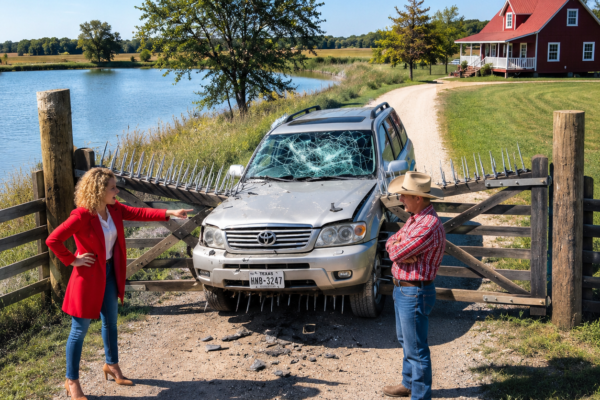
Then I walked outside one Tuesday with a mug in my hand and found an excavator sitting where my tomatoes had been.
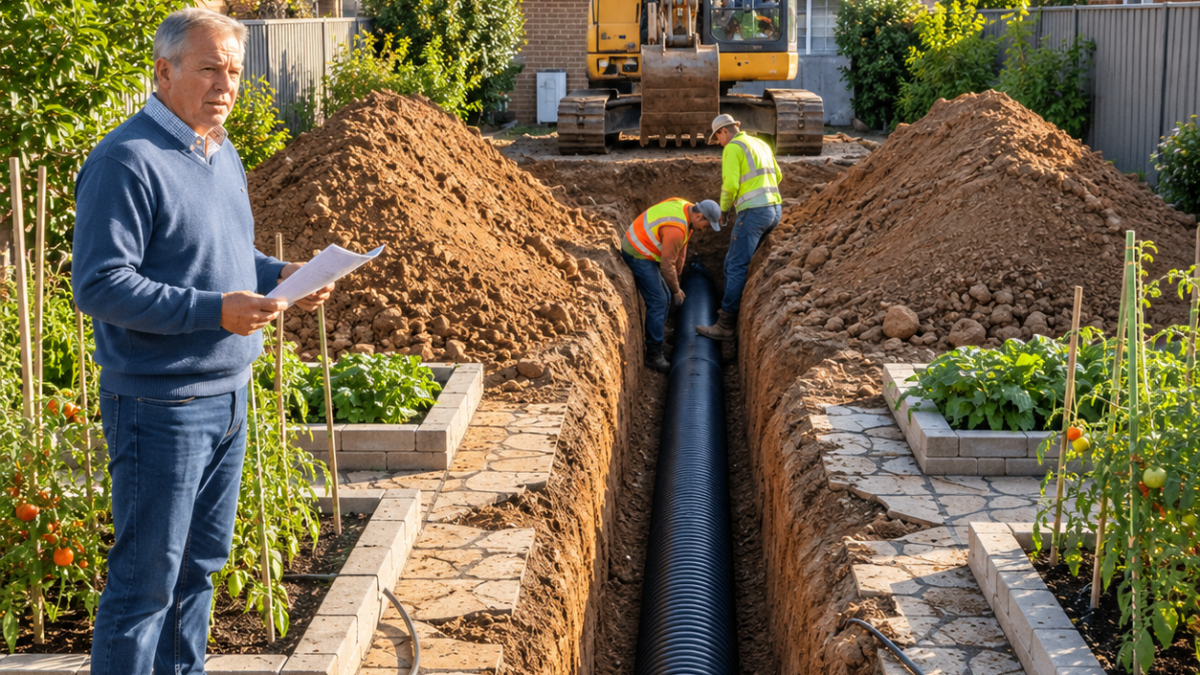
A trench cut through the center of the yard.
One raised bed was already splintered.
My irrigation tubing hung from a mound of dirt.
Workers in reflective vests were lowering sections of black stormwater pipe into the ground.
I honestly thought they had the wrong address.
The foreman didn’t.
He was a broad guy named Dale with sunburned cheeks, a hard hat covered in old inspection stickers, and the exhausted patience of somebody already behind schedule.
“You the homeowner?”
“Yes. Why are you digging through my garden?”
He handed me a packet.
“Municipal drainage improvement.”
I scanned it.
The project was real.
The neighborhood uphill had experienced repeated street flooding during heavy storms, and the city had approved a new stormwater line running toward the creek.
There was also, exactly as Dale said, a recorded drainage and utility easement across my property.
But it wasn’t where his excavator was sitting.
I walked him toward the rear fence.
“The easement is back there.”
“I know.”
I stared at him.
“Then why is the trench here?”
He looked toward the narrow strip along the fence.
“Rocky ground.”
“So?”
“More excavation. More equipment. Slower production.”
“You changed the route because my garden was easier to dig through?”
He gave me the kind of look people give when they believe practicality should end the argument.
“The discharge point is the same.”
“That’s not what I asked.”
“We’ll restore the surface.”
Behind him, an operator swung another bucket of soil onto what had been my herb bed.
I felt anger come up so fast that I had to stop speaking.
Dale mistook the silence for surrender.
“You probably won’t even notice once everything settles.”
That sentence did it.
Not because it was cruel.
Because he believed it.
My garden was simply loose soil on a schedule.
I went inside.
Not to give up.
To get my phone.
I photographed the trench.
The property markers.
The equipment.
The distance from the rear easement.
The broken irrigation.
The bedding material under the pipe.
And every page Dale had handed me.
By sunset, the pipe was buried.
My garden looked as if someone had dragged a road through it.
Carl came over after the trucks left.
He stared through the fence.
“You calling a lawyer?”
“Not yet.”
“City?”
“Eventually.”
He looked at me.
“What are you doing first?”
“Reading.”
For the next three nights, my kitchen table disappeared beneath project documents.
The approved alignment ran along the rear easement.
The construction notes required specific bedding, compaction, and grade control.
Any significant field change had to be documented and approved through the project engineer.
Then I found the part that made me sit back in my chair.
The rocky rear section Dale had avoided wasn’t an inconvenience the engineer had overlooked.
It was part of the design.
That route had been selected because the soil investigation identified stable subgrade there.
The garden route crossed disturbed, amended soil that required a different installation detail if used at all.
No alternate detail had been approved.
No revised alignment appeared in the project file I’d been given.
And the photographs on my phone showed the crew had installed the pipe as though nothing had changed.
The next morning I submitted a written complaint to the city engineering department with photographs, measurements, and references to their own drawings.
I didn’t accuse anyone of corruption.
I didn’t threaten a lawsuit.
I asked one question:
Who approved the field change?
Four days later, a storm rolled over Ridgeway.
By midafternoon, water was pooling across the scar where my garden used to be.
Then a city engineering truck stopped in front of my house.
Two inspectors stepped into the rain.
One of them crouched beside the sinking trench line, looked at the plans in his hand, and asked me to show him exactly where the crew had moved the pipe.
Twenty minutes later, muddy water began pushing up through the soil.
The younger inspector stood, stared toward the street uphill, and said, “Shut the inlet down.”
Then his supervisor turned to me.
“This line is coming back out.”
[END OF FACEBOOK CAPTION]
[FIRST COMMENT / FULL STORY CONTINUATION]
For a second, I thought I had misheard him.
Rain hammered the hood of my jacket and ran from the brim of the inspector’s cap.
“Coming out?” I asked.
“All of it that was installed off the approved alignment,” he said. “But first we need to stabilize the system and confirm what moved.”
The younger inspector was already on his radio.
His name, I learned a few minutes later, was Aaron Pike.
The supervisor was Melissa Grant, a civil engineer with the city public works department who had apparently been pulled into my complaint because it referenced the design sheets instead of simply saying somebody had damaged my yard.
Melissa didn’t look pleased.
Not at me.
At the ground.
Water had begun collecting in shallow depressions above the buried pipe.
The line wasn’t exploding or dramatically bursting apart.
It was doing something more believable and, from an engineering standpoint, more troubling.
The trench was settling unevenly.
Where the loose garden soil had compressed, sections of pipe appeared to have lost the intended slope.
Stormwater entering from uphill wasn’t moving through the line at the rate the design expected.
The system was backing up.
Aaron walked toward the side gate.
“The curb inlet at Willow Bend is surcharging.”
Melissa swore softly.
“Call operations. Have them throttle the temporary connection and get a vacuum truck staged.”
She looked at me.
“Did you take photographs during installation?”
“About forty.”
“With timestamps?”
“Yes.”
“Can I see them?”
We went inside.
My kitchen looked exactly the way it had for four nights.
Project drawings.
Permit packet.
Notebook.
Laptop.
A cold cup of coffee.
Carl would later say it looked like I had formed a one-man congressional committee on storm drains.
At that moment, Melissa didn’t laugh.
She scrolled through the photographs on my phone.
One showed the excavator starting the trench nearly twenty feet inside the property rather than along the rear easement.
Another showed the pipe resting on soil that had been scraped roughly flat but not prepared with the bedding shown in the approved detail.
Another showed my old irrigation line hanging from the trench wall.
Melissa stopped at a photograph of Dale standing beside the open excavation.
“What time was this?”
“Ten twenty-seven.”
“Same day?”
“Yes.”
“Do you remember what he told you about why they moved the alignment?”
I did.
I repeated it as accurately as I could.
Rocky ground.
More equipment.
More time.
This way was faster.
Melissa wrote every word down.
“Did he say the project engineer approved the change?”
“No.”
“Did he show you a revised drawing?”
“No.”
“Did he mention a field directive?”
“I don’t know what that is.”
“Then probably not.”
Aaron came through the back door after I waved him in.
“They’re closing the upstream intake until the storm rate drops.”
Melissa nodded.
“Any surface flooding?”
“Water’s stacking in the gutter, but operations is there.”
He glanced at the plans on my table.
Then at my photographs.
“This was installed yesterday?”
“Eight days ago,” I said.
His eyebrows went up.
Melissa corrected him.
“Signed off four days ago.”
That changed his expression.
“Who did the closeout?”
“Contract inspector.”
Aaron made a face that told me someone’s afternoon was about to get much worse.
I stood there dripping rainwater onto my kitchen tile.
“Can somebody explain what exactly is happening?”
Melissa pulled one of the drawings toward me.
She pointed to a line representing the pipe.
“Stormwater systems like this rely on grade. Water has to keep moving downhill. The approved route was designed around known elevations and soil conditions.”
She moved her finger toward my garden.
“When the contractor shifted laterally, they changed both.”
“So the pipe bent?”
“Possibly. Or settled. Or both. We won’t know until we expose it.”
“What happens if you leave it?”
“We’re not leaving it.”
That answer came immediately.
Not dramatic.
Not angry.
Final.
Outside, the storm began easing.
The pooling water didn’t disappear quickly.
That seemed to bother Melissa almost as much as the backup.
She and Aaron spent another hour taking measurements.
They marked the actual route with paint.
They photographed my property markers and the rear easement.
They checked elevations with a handheld survey instrument.
Then a larger public works truck arrived.
Two employees opened the upstream structures and inspected the connections.
No one shouted.
Nobody made a scene.
The seriousness showed in how little they talked.
By five, temporary measures had reduced the backup.
Melissa returned to my porch.
“I’m issuing a stop-work and corrective action notice on this section.”
“To the contractor?”
“To the project contractor and the construction management team.”
“What about my yard?”
She looked past me toward the mud.
“Restoration will be part of the correction.”
I laughed once.
Not because anything was funny.
“Restoration.”
“I know.”
“No, I don’t think you do.”
Her eyes came back to mine.
“That wasn’t lawn.”
“I can see that.”
“It took me six years.”
She nodded slowly.
“I’m not going to tell you it can be restored as if nothing happened. Some things can’t be replaced immediately. But document every loss you can. Plants, irrigation, raised beds, soil amendments, materials. Photographs from before will help.”
I had hundreds.
Birthday pictures with the garden behind us.
Summer barbecues.
Tomatoes spread across the picnic table.
Hannah kneeling beside the herbs.
My niece holding the first peach we ever got from one of the trees.
At the time, those photographs had been ordinary.
Now they were evidence.
That realization hurt more than I expected.
Melissa must have seen it.
“The city should have caught the deviation before this reached you,” she said.
That was the first admission anyone had made.
Not a legal admission.
Not some dramatic acceptance of liability.
Just a professional acknowledgment that the process had failed.
It mattered.
“Why didn’t they?”
“We’re going to find out.”
She left me her card.
Then the trucks pulled away.
I stood on the porch staring at the yard.
Carl appeared at the fence five minutes later.
He held an umbrella in one hand and two beers in the other.
“Coffee felt insufficient.”
I took one.
He looked toward the mud.
“So?”
“They’re removing the pipe.”
“All of it?”
“The part they moved.”
Carl took a drink.
“Dale’s going to love that.”
“I’m trying not to make this about Dale.”
“Why?”
“Because if one foreman can move a city drainage line without anybody catching it, the problem is bigger than one guy.”
Carl stared at me.
“You’re becoming disturbingly reasonable.”
“Give me time.”
He laughed.
Then he looked at the garden again.
“You okay?”
That question nearly got me.
Because until then, everything had been paperwork and measurements.
A problem.
A process.
Something I could organize.
But Carl had been there when I built the first bed.
He had watched those fruit trees grow.
He knew what I was looking at when I looked at the mud.
“I will be.”
He nodded.
Neither of us said anything for a while.
The next morning, the contractor returned.
Not at eight.
At 6:35.
The sound of diesel engines woke me.
I pulled on jeans and went downstairs.
Hannah was already at the window.
She had been out of town for work during the original installation and had come home to a backyard that looked unrecognizable.
Her anger was quieter than mine.
Which made it more dangerous.
“You’re not going out there alone,” she said.
“I’m drinking coffee.”
“You’re putting on boots.”
“I can drink coffee in boots.”
She gave me a look.
We both went outside.
Three trucks lined the curb.
An excavator sat on a trailer.
A vacuum truck idled behind it.
Dale stood in my driveway talking to a man I hadn’t seen before.
The new man wore a white hard hat and carried a leather folder.
When he noticed us, he walked over.
“Mr. and Mrs. Bennett?”
I nodded.
“I’m Patrick Monroe. Project manager for Ridgeway Civil.”
The company name was on the trucks.
He offered his hand.
I shook it.
Hannah did not.
Patrick seemed accustomed to that possibility.
“We received the city’s corrective directive last night. We’ll be excavating the installed line, assessing the bedding and pipe condition, then reinstalling along the approved alignment.”
“Through the easement,” I said.
“Yes.”
“Not through the garden.”
“No.”
Hannah crossed her arms.
“And what happens to the garden?”
Patrick looked behind us.
“We’ll restore all affected areas.”
She laughed.
Not kindly.
“You’re going to put six years back by Friday?”
Patrick paused.
“No.”
Good answer.
Had he said yes, Hannah might have buried him in the trench.
Instead he continued.
“We can rebuild the beds, replace irrigation, bring in equivalent soil, replace perennial plantings where practical, and compensate documented losses that can’t simply be re-created.”
“Who decides equivalent?” she asked.
“We’ll work through that with you and the city.”
“Not Dale?”
Patrick glanced toward the foreman.
“No.”
Dale heard his name.
He walked over.
He looked exactly as he had the first morning.
Same battered hard hat.
Same work boots.
Different face.
The easy impatience was gone.
“Morning,” he said.
I nodded.
Hannah didn’t.
Patrick opened his folder.
“Before we start, I need access authorization for the corrective work outside the recorded easement.”
I actually admired the sentence.
Eight days too late, but apparently somebody had discovered paperwork.
“You’re asking permission to dig up the trench you already dug without permission?”
Patrick didn’t flinch.
“Yes.”
“And if I say no?”
“We’d coordinate with the city and counsel regarding access to remove the improperly installed infrastructure. But I’d rather not begin there.”
Neither would I.
I read the document.
It was narrow.
Temporary access to the already disturbed area for removal.
Restoration obligations.
Photographic documentation before and after.
No expansion of easement rights.
No release of claims.
I handed it to Hannah.
She read every word.
Then she looked at Patrick.
“I want a copy before anybody starts.”
“You’ll have it.”
“And I want the irrigation replacement specified, not just ‘landscaping restoration.’”
Patrick wrote a note.
“Understood.”
“And no one cuts either fruit tree.”
Another note.
“Understood.”
She signed.
Then I signed.
Dale shifted his weight.
I looked at him.
“Now you have access.”
He knew exactly what I meant.
“Yeah.”
The excavation started twenty minutes later.
This time, I did not stand in the yard all day.
I had work.
So did Hannah.
But every time the excavator bucket hit the ground, I felt it in my chest.
By midmorning, the pipe was exposed.
Patrick knocked on my office window.
I went outside.
“You should see this.”
The trench was open for about thirty feet.
Sections of black pipe lay visible beneath wet soil.
Even without technical training, I could see the problem.
One segment sat higher than the next.
Another dipped noticeably in the middle.
The bedding beneath it varied from thin gravel in one section to almost nothing in another.
Patrick pointed.
“That joint moved.”
“Because of the soil?”
“Contributing factor. Bedding and compaction too.”
He seemed angry now.
Not at me.
“Was it installed like the plan required?”
“No.”
That word felt heavier than I expected.
No excuse.
No qualification.
No corporate language.
Just no.
Dale stood near the excavator listening.
Patrick turned toward him.
“Where’s the field-change ticket?”
Dale said nothing.
Patrick waited.
Finally Dale answered.
“There wasn’t one.”
“Who authorized the alignment?”
“We made the call onsite.”
“Who is we?”
Dale looked toward another supervisor.
The man looked away.
Patrick’s jaw moved.
“You relocated a designed storm line off an easement without an approved change?”
“The rock was killing production.”
“I did not ask about production.”
Dale’s voice hardened.
“We were already four days behind. The excavator couldn’t get through the rear section without the hammer attachment, and dispatch said it wouldn’t be available until Monday.”
“So you moved the line?”
“It still hit the connection point.”
Patrick stared at him.
“And the bedding?”
“We used what we had.”
Patrick closed his eyes for a second.
That was the moment I understood the failure.
It wasn’t one evil decision.
It was a chain of ordinary pressures.
A schedule.
Unavailable equipment.
A crew wanting to finish.
A supervisor choosing a shortcut.
Someone assuming the change was minor.
Someone else signing a form without comparing the installed alignment to the approved plan.
Every person moving the problem one step forward because stopping it would have been inconvenient.
Until the storm stopped it for them.
Patrick noticed me standing there.
His expression changed.
“This conversation should probably continue somewhere else.”
“I agree.”
Dale looked at me.
For the first time, there was real resentment in his face.
Not hatred.
Resentment.
I had become the person attached to consequences he had created himself.
“You happy?” he asked.
Patrick turned sharply.
“Dale.”
I held up a hand.
“It’s fine.”
Then I looked at Dale.
“No.”
He laughed without humor.
“Could’ve fooled me.”
I pointed toward the trench.
“You think this is what I wanted?”
“You filed the complaint.”
“After you dug through my garden.”
“We were going to restore it.”
“You installed it wrong.”
“It would’ve been corrected.”
“When?”
He didn’t answer.
“After somebody’s street flooded? After the pipe settled more? After the warranty expired?”
His face hardened.
“You don’t know anything about this work.”
“You’re right.”
I nodded toward Patrick.
“He does.”
Patrick looked miserable.
Dale said, “Everybody makes field adjustments.”
Patrick answered before I could.
“With approval.”
Silence.
Dale looked at him.
Then at me.
Then back at the trench.
Something in his shoulders dropped.
“Fine.”
He walked away.
Patrick rubbed the back of his neck.
“I apologize.”
“For him?”
“For all of this.”
I looked at the ruined garden.
“Fix it correctly.”
“We will.”
The crew removed every section of pipe from the garden route.
Some pieces were reusable.
Others had warped enough that Patrick ordered them replaced.
The excavation itself revealed another problem.
The garden route crossed an old area of fill from when the subdivision had been developed decades earlier.
Loose material.
Mixed soil.
Chunks of broken masonry.
Exactly the kind of subgrade the approved design had avoided.
Melissa Grant arrived around noon.
She climbed into the trench with Patrick and the city inspector.
They took photographs.
Measurements.
Samples.
I watched from behind the temporary barrier.
Carl appeared beside me.
“Looks expensive.”
“Stop enjoying this.”
“I’m not enjoying it.”
“You brought a lawn chair.”
He looked down at the folding chair tucked under his arm.
“My back hurts.”
“Sure.”
He set it up.
I laughed despite myself.
By late afternoon, the original line was completely gone.
For the first time since Tuesday, there was nothing buried beneath the center of my garden.
Just a trench.
A huge empty scar.
The next stage began at the rear of the property.
The approved route.
The difficult route.
A rock hammer arrived the following morning.
You could feel it through the house.
Boom.
Boom.
Boom.
The excavator broke through the hard layer near the easement one section at a time.
Progress slowed to a crawl.
Dale was still onsite, but Patrick had taken control of the work.
Every change went through him.
Every elevation was checked.
Every section of bedding was photographed before the pipe went in.
Melissa visited twice.
Aaron came once with survey equipment.
The difference between the first installation and the second was almost insulting.
The first had taken less than a day.
The replacement took four.
On day two, I walked toward the rear fence while Patrick was checking the trench.
“This is why they moved it, isn’t it?”
He looked at the rock hammer.
“Yes.”
“How much more does this cost?”
He smiled.
“More than I’m going to tell a homeowner standing inside the project limits.”
“Fair.”
He wiped dust from his glasses.
“The irony is, the difficult excavation was priced into the original bid.”
I stared at him.
“So the city was already paying for it?”
“Yes.”
“Then moving the line didn’t even save the city money.”
“No.”
“Just the contractor time.”
Patrick didn’t answer.
He didn’t need to.
I looked toward Dale.
He was studying a set of plans.
For once, he did not look back.
That afternoon, Melissa asked if she could speak with me privately.
We sat at the picnic table.
The garden around us looked like a battlefield.
She placed a folder between us.
“We’ve completed a preliminary review.”
“Okay.”
“The contractor installed outside the approved easement and without an authorized field revision. The bedding and compaction documentation is also incomplete.”
“Incomplete or wrong?”
“Both, potentially. We’re still reviewing.”
“What happens to them?”
“That’s between the city and the contractor.”
I smiled.
“You used that line before.”
“It remains a useful line.”
“Fair.”
She continued.
“The important part for you is that the city has directed full restoration of the unauthorized disturbance area.”
“Hannah is going to want that in writing.”
“It is.”
She slid a copy toward me.
I read it.
Reconstruction of garden beds.
Replacement of damaged irrigation.
Topsoil restoration.
Perennial replacement where feasible.
Regrading.
Settlement warranty for the disturbed ground.
That last one caught my attention.
“What’s this?”
“Because the trench through your garden was excavated twice, there’s a risk of future settlement. They’ll compact in lifts, but the contractor remains responsible for correcting settlement related to the work during the warranty period.”
I looked toward the trench.
“Good.”
“There’s another piece.”
She pushed a second document toward me.
It was a claim form.
“Document personal property and landscaping losses.”
“I thought restoration covered that.”
“Some items can be restored. Some can’t.”
The fruit trees had survived.
The tomatoes had not.
Neither had most of the herbs.
Several mature perennial plants were gone.
The old cedar boards from the original raised beds had been broken by the excavator.
A ceramic irrigation manifold housing I had built myself was crushed.
None of those things was individually worth a fortune.
Together, they represented years.
“How do you put a number on time?” I asked.
Melissa’s face softened.
“You usually can’t.”
That answer annoyed me because it was true.
“So what do people do?”
“They document replacement costs. Materials. Plants of comparable maturity where available. Professional labor if appropriate. The process is imperfect.”
“Very.”
“Yes.”
I filled out the form anyway.
Not because I wanted a payday.
Because the garden had been treated as free.
I wanted the paperwork to say otherwise.
Every broken board had a cost.
Every destroyed line.
Every perennial.
Every cubic yard of amended soil.
Even if the number never captured what the place meant to us, it forced somebody to acknowledge that destroying it was not the same as moving dirt.
Hannah handled the plant list.
She was ruthless.
“Four rosemary plants.”
“Three.”
“Four.”
“One was half dead.”
“It was recovering.”
“Hannah.”
“Four.”
I wrote four.
“Two blueberry bushes.”
“One blueberry and one currant.”
She looked at me.
“That explains a lot.”
“What?”
“I’ve been calling that thing a blueberry for three years.”
“You’ve also been eating it.”
“It had berries.”
“Excellent botanical standard.”
For the first time since the crew arrived, we laughed in the garden.
That mattered.
The restoration team came the following Monday.
Different truck.
Different people.
Different attitude.
Their supervisor was a woman named Rosa Delgado.
She walked the yard with us before unloading anything.
“Show me what was here.”
Not what should we put here.
Not what will satisfy the work order.
What was here.
Hannah took over.
She showed Rosa old photographs.
The four raised beds.
The narrow herb strip.
The irrigation header.
The gravel walkway.
The little bench near the peach tree.
Rosa marked dimensions on graph paper.
“What kind of soil mix?”
I told her.
“Mostly compost, screened topsoil, some aged manure.”
She nodded.
“Beds lined?”
“No plastic.”
“Mulch?”
“Shredded hardwood.”
She wrote everything down.
Then she pointed toward a surviving clump of oregano near the fence.
“This original?”
“Yes.”
“We’ll work around it.”
That simple sentence made me trust her.
The restoration took almost a week.
The crew rebuilt the beds from cedar.
Not identical.
Better, honestly.
I had used scrap lumber the first time.
They replaced the damaged irrigation with new tubing and a proper manifold box.
Fresh soil arrived by the truckload.
Rosa rejected the first delivery.
“Too sandy.”
I watched the truck leave.
“You can do that?”
She shrugged.
“It’s your garden.”
The second load was dark and rich.
Carl leaned over the fence.
“They’re giving you luxury dirt.”
“There is no luxury dirt.”
“You say that because you’ve been brainwashed by vegetables.”
Rosa overheard him.
“There is absolutely luxury dirt.”
Carl looked triumphant.
“Thank you.”
The plant replacement was harder.
You can buy a tomato plant.
You cannot buy the exact rosemary bush Hannah had cut from her mother’s garden years earlier.
You can replace a blueberry.
You cannot replace the summers attached to the old one.
Rosa understood that distinction.
She propagated what could be saved.
Moved surviving root sections.
Replanted herbs from undisturbed edges.
For the rest, we chose replacements.
Not replicas.
Replacements.
That language helped.
Trying to make the garden exactly as it had been would have turned every new plant into evidence of what was missing.
Instead, we rebuilt.
The city approved the new storm line after pressure testing and final inspection.
This time Melissa invited me to watch the final walkthrough.
Not because I had any official role.
Probably because after everything that happened, transparency was easier than another complaint.
We stood near the rear easement.
The ground above the new line was compacted and graded.
The garden itself sat untouched several yards away.
Aaron checked the downstream structure.
Patrick held the as-built drawings.
Melissa compared elevations.
Dale stood near the truck.
He had been quiet all week.
When the testing finished, Melissa nodded.
“This one passes.”
Patrick exhaled.
Aaron made a note.
Dale looked toward me.
I expected resentment again.
Instead he walked over.
“No clipboard today,” I said.
He looked down at his empty hands.
“Trying something new.”
I smiled slightly.
He stared at the rebuilt garden.
“Looks good.”
“It does.”
Silence.
He shoved his hands into his pockets.
“I was out of line the other day.”
I knew which day he meant.
“You were having a bad week.”
“That’s not an excuse.”
“No.”
He nodded.
Another silence.
Then he said, “The first route was my call.”
I didn’t respond.
He continued.
“We were behind. Equipment was tied up on another job. I looked at the grade, figured we could swing inside, keep production moving, document it later.”
“Did you intend to change the bedding too?”
His jaw tightened.
“No. That part got sloppy.”
“Because you were rushing.”
“Yeah.”
“Did you think it would fail?”
“No.”
I believed him.
That was important.
Dale wasn’t trying to build a failing system.
He wasn’t secretly hoping to flood the neighborhood.
He thought he was making a practical adjustment.
A shortcut he had probably made versions of before without consequence.
“Then why didn’t you stop when I pointed out the easement?”
That question seemed harder for him.
He looked toward the back fence.
“Because by then the trench was open.”
“So?”
“So stopping meant calls. Questions. Delay. Possibly pulling the crew off.”
“And destroying my garden was easier.”
He winced.
“Yeah.”
There it was.
Not maliciousness.
Convenience.
Somehow that had bothered me more from the beginning.
If he hated me, at least the destruction would have had a reason.
Instead, years of my work had been erased because the alternate route saved a few hours.
“I needed you to be wrong,” Dale said.
“What?”
“When you came out that morning.”
He rubbed his jaw.
“You were standing there saying the easement was somewhere else. I knew you were technically right. But I’d already made the call. So I started telling myself it didn’t matter.”
“That the pipe was outside the easement?”
“That the route mattered.”
He looked at the new installation.
“Turns out it mattered.”
I almost said something sharp.
I had several options.
That’s what plans are for.
Could’ve told you that.
Expensive lesson.
All true.
None necessary.
Instead I said, “Yeah.”
Dale nodded.
“Could’ve been avoided.”
“Yes.”
This time he met my eyes.
“Sorry about your garden.”
It wasn’t a polished apology.
He didn’t apologize for everything.
He didn’t accept some dramatic level of liability.
But it was the first time he called it a garden.
Not surface restoration.
Not access area.
Not disturbed soil.
Garden.
“Thank you,” I said.
He left ten minutes later.
I never saw him again.
The city’s internal review took longer.
I only learned pieces because some of the findings were included in a response to my complaint.
The project had used both contractor quality-control checks and third-party inspection.
The original installation record showed the pipe work had been accepted based largely on documentation submitted from the field.
The actual lateral alignment had not been independently verified before burial.
The city changed its procedure for the remainder of that drainage project.
Any field alignment change now required written approval before installation.
As-built location checks had to occur before trenches were closed in several sensitive sections.
Was that because of me?
Partly.
Was it a heroic reform?
No.
It was a boring procedural correction.
Exactly the kind that prevents exciting disasters later.
I preferred it that way.
Ridgeway Civil also covered the restoration and the property claim.
The settlement was not enormous.
There was no giant check.
No courtroom.
No news cameras.
No contractor losing his company overnight.
They paid documented replacement costs, some landscaping labor, damaged irrigation components, and a modest amount for plant losses that could not be restored in kind.
Hannah used part of it to buy a small greenhouse kit.
I objected.
“We do not have space.”
“We have space.”
“Where?”
She pointed toward the side yard.
“That is where the wheelbarrow goes.”
“The wheelbarrow can move.”
“Where?”
She smiled.
“Maybe Carl’s yard.”
Carl, overhearing from the fence, shouted, “Denied.”
We bought the greenhouse.
It fit.
Barely.
By late summer, the garden looked alive again.
Not finished.
Gardens are never finished.
That was one of the lessons I had somehow forgotten while fighting to restore it.
The old garden had not been valuable because it was complete.
It had been valuable because it kept changing.
Plants died.
Beds shifted.
Trees grew.
Weather ruined things.
We rebuilt.
The contractor had destroyed part of it in hours, but that didn’t mean the only meaningful version was the one that existed the morning before they arrived.
The new beds weathered.
The herbs spread.
The replacement blueberry—or currant, depending on whether you asked Hannah—put out new growth.
The peach tree survived the construction and produced exactly seven peaches.
Squirrels stole five.
Carl got one.
We got one.
“Six years of gardening,” Hannah said, holding the peach.
“For one fruit.”
“It’s a very exclusive operation.”
She cut it in half.
We ate it at the picnic table.
That evening, a thunderstorm came through.
Not as strong as the one that exposed the bad installation.
Strong enough to make me nervous.
I stood at the kitchen window.
Hannah noticed.
“You’re checking the drain.”
“I’m looking at the rain.”
“You’re absolutely checking the drain.”
I went outside.
Water ran down the street.
The curb inlet took it.
The new pipe carried it through the approved easement.
No pooling in the garden.
No soft trench line.
No muddy water pushing upward.
Just rain.
Carl opened his back door.
“You going to stand there every storm now?”
“Probably.”
He stepped onto his porch.
“Working?”
“So far.”
“Congratulations.”
“On what?”
“Your pipe.”
“It’s not my pipe.”
He grinned.
“You fought harder for it than anyone.”
That was not how I wanted to remember the story.
For a while, I didn’t tell people about it.
Because whenever someone heard the short version, they wanted revenge.
“They destroyed your garden?”
“Yes.”
“And then their system failed?”
“Yes.”
“That must have felt amazing.”
Not exactly.
The first moment when Melissa said the pipe had to come out did feel satisfying.
I won’t pretend otherwise.
I had spent days being treated as if I were emotional about something technical.
Then the technical facts proved I had been right.
There is satisfaction in that.
But standing in the rain watching water back toward the street did not feel like victory.
It felt like watching a preventable problem finally become expensive enough that nobody could ignore it.
That distinction mattered.
I didn’t make the pipe fail.
I did not touch it.
I did not block anything.
I did not sabotage the drainage system.
What I collapsed was the assumption that nobody would challenge the shortcut.
I read the plan.
I documented the route.
I asked who approved the change.
Then the storm did what engineering tests always eventually do.
It tested reality instead of paperwork.
A few months later, Melissa stopped by.
No city truck.
No hard hat.
She was walking the neighborhood with a colleague reviewing another drainage location.
She saw me in the garden.
“How’s restoration?”
I looked around.
“Growing.”
“Good.”
She glanced toward the rear easement.
“Line’s been performing properly.”
“That’s what I like to hear.”
She smiled.
“I figured.”
Before leaving, she said, “Your complaint was unusually specific.”
“Is that a compliment?”
“Very much.”
“I had good material.”
“You had patience.”
I laughed.
“That is not how my wife describes that week.”
Melissa became serious.
“Most people understandably focus on the damage they can see. You focused on the difference between the plan and installation. That made it easier to act quickly.”
“So reading the boring pages helped.”
“The boring pages are usually where the expensive information lives.”
That line stayed with me.
The following spring, the city resurfaced part of the street uphill.
A new project notice arrived in our mailbox.
Hannah brought it into the kitchen.
“You want this?”
I looked at the envelope.
“No.”
She raised an eyebrow.
“Really?”
“Put it on the counter.”
She smiled.
I opened it ten minutes later.
The project didn’t involve our property.
I still read every page.
Some habits become permanent.
So did Dale’s sentence.
You won’t even notice once it settles.
I thought about that whenever I worked in the rebuilt beds.
He had been wrong, but not in the way I first believed.
I noticed the changes.
Of course I did.
The cedar boards were newer.
The irrigation layout was cleaner.
The herb strip had gaps where mature plants used to fill the space.
The soil settled differently for two seasons.
But eventually something else happened.
I stopped comparing the garden to the old one.
The new garden developed its own history.
Hannah planted lavender where the rosemary had been lost.
I added a third fruit tree.
Carl donated an absurd concrete frog that I hated so much it became impossible to remove.
“Every respectable garden needs art,” he said.
“That is not art.”
“He has a hat.”
“That makes it worse.”
The frog stayed.
Children from two houses up started coming by in summer to see the strawberries.
Hannah’s greenhouse produced more basil than any two humans should legally possess.
The repaired garden became ours the same way the first one had.
Slowly.
One ordinary morning at a time.
Two years after the drainage project, a new family moved into the house on the other side of us.
The husband, Eric, was installing a fence.
I saw him measuring near the back property line.
He waved me over.
“You know anything about this easement?”
I laughed so hard he looked concerned.
“What?”
“Sorry.”
I climbed the small slope.
“Yes. I know something about the easement.”
He showed me his survey.
The proposed fence crossed near the drainage line.
“I don’t want to screw anything up.”
That sentence felt almost beautiful.
Not because he was afraid.
Because he asked before digging.
I showed him where the recorded strip ran.
Then I gave him Melissa’s old advice.
“Call the city and verify the current requirements. Don’t rely on me.”
“Fair.”
He did.
A week later, the fence posts went in outside the restricted area.
No conflict.
No damaged property.
No correction order.
No trucks coming back to undo work.
Just a boring fence installed correctly the first time.
I stood in the garden that evening and realized how much drama depends on people believing boring procedures are beneath them.
Permits.
Plans.
Survey lines.
Compaction.
Written changes.
Knocking on a door.
Making one phone call before an excavator arrives.
None of it makes a good story when it works.
That’s the point.
The expensive stories begin when someone decides the boring part can be skipped.
Carl eventually sold his house.
That hit me harder than I expected.
On his last morning, he brought coffee over like he had during the early garden years.
We sat beside the raised beds.
The concrete frog stared at us.
“You keeping him?” Carl asked.
“No.”
“You have to.”
“I absolutely do not.”
“He’s part of the property now.”
“I’m throwing him in your moving truck.”
Carl smiled.
Then he looked toward the rear easement.
“Remember when your yard was a sewer construction documentary?”
“Unfortunately.”
“You handled that better than I would have.”
“I nearly lost my mind.”
“Yeah, but quietly.”
“That’s apparently my brand.”
He drank his coffee.
“You know what I remember?”
“What?”
“The first night.”
I looked at him.
“When they left after tearing everything up,” he said. “I asked if you were going to fight them.”
“I remember.”
“You said you didn’t know.”
“I lied.”
“I know.”
He smiled.
“You had that look.”
“What look?”
“The same one you get when a tomato plant has a disease and you’re about to spend four hours reading agricultural extension papers.”
“That is a very specific insult.”
“It’s not an insult.”
He stood.
“Just promise me something.”
“What?”
“If somebody destroys this garden again, call me before you start reading municipal engineering documents.”
“Why?”
“I want updates.”
We hugged.
Carl moved three states away.
The concrete frog stayed.
Of course it did.
Years have passed since the drainage project.
The storm pipe still runs beneath the rocky strip at the back of the yard.
Most days, I forget it exists.
That is probably the highest compliment you can give infrastructure.
It works quietly.
The garden has changed again.
One of the replacement beds finally rotted enough that I rebuilt it myself.
The peach tree is larger.
The new fruit tree is beginning to produce.
The lavender Hannah planted after the restoration attracts bees all summer.
And every heavy rain still makes me glance toward the rear fence.
Water flows.
Nothing sinks.
Nothing backs up.
Nothing collapses.
The irony is that the system only became reliable after the first version failed.
Not because failure was necessary.
Because somebody had to be forced to respect the part of the plan they thought they could ignore.
The contractor’s shortcut had been designed around one assumption:
My property was easier.
Easier soil.
Easier access.
Easier than waiting for equipment.
Easier than making a phone call.
Easier than explaining a delay.
Easier than following the route they had already been paid to build.
For a few hours, they were right.
Then the rain came.
And suddenly every minute they thought they had saved came back as days of demolition, reinspection, reinstallation, restoration, paperwork, meetings, and cost.
That was the real collapse.
Not a dramatic burst pipe.
Not a flooded street.
Not revenge.
A shortcut collapsing under the weight of its own consequences.
I still have the project folder.
It sits in a cabinet in my office.
The photographs are there.
The original plan.
The complaint.
The city response.
The restoration agreement.
Sometimes I think I should throw it away.
Hannah says I never will.
She’s probably right.
But I don’t keep it because I’m still angry.
I keep it for the same reason I keep seed packets after the garden has been planted.
They remind me what went into the ground.
The crew thought they were burying a pipe.
Instead, they buried a mistake.
The rain brought it back to the surface.
And behind my fence, exactly where the engineering plan had drawn it from the beginning, the replacement line still carries every storm safely downhill while my garden grows above untouched soil.
That is all I ever wanted.