HOA Bulldozed My Greenhouse—So I Turned Their Neighborhood Into a Dust Bowl.
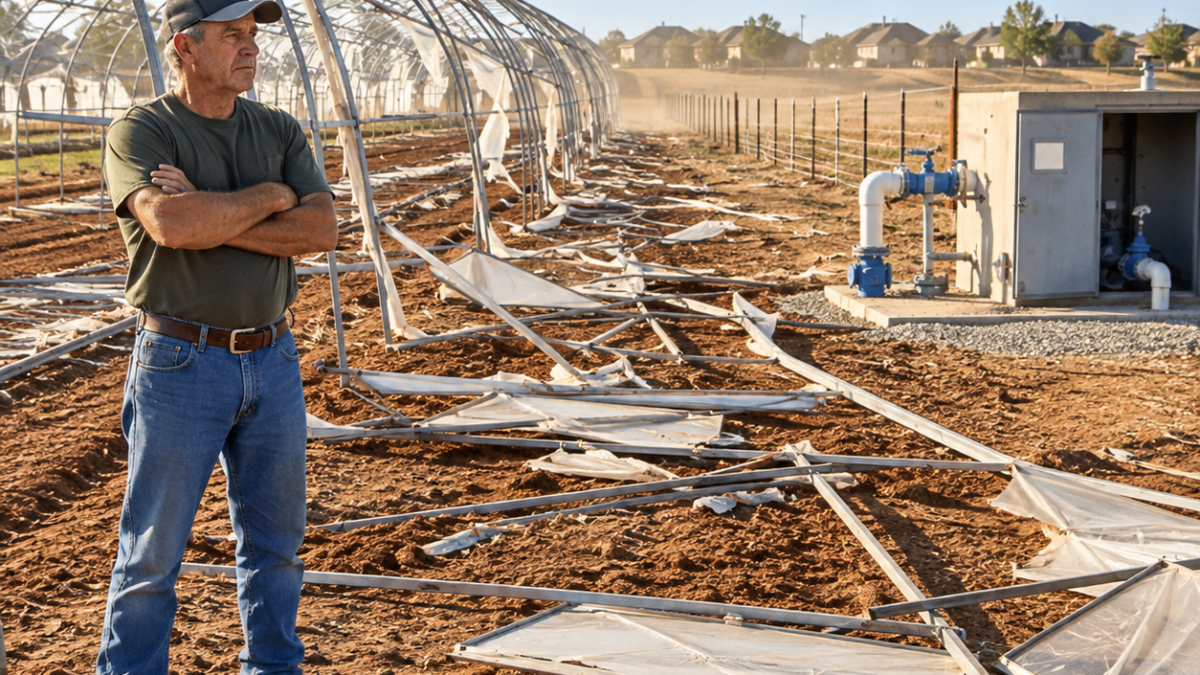
At seven fifteen the next morning, I was sitting at my kitchen table with cold coffee, three photographs of the wreckage, and the water agreement open in front of me when my attorney called again.
Her name was Carla Wynn.
She had represented my family for years, which meant she knew two things about me very well.
I hated wasting money.
And when I got angry, I became dangerously patient.
“Read paragraph twelve,” she said.
I found it.
The section covered suspension of irrigation service.
Not drinking water.
Not fire protection.
Not anything essential to human health.
Raw irrigation water.
The contract said I could temporarily suspend service if Silver Brook, its contractors, or agents damaged my irrigation infrastructure, entered restricted portions of my land without authorization, or materially interfered with the farm’s operations.
That mattered.
So did another sentence.
I had to provide written notice unless the damage created an immediate operational problem.
Carla had already drafted it.
“You’re not turning anything off as revenge,” she said.
“I know.”
“You’re suspending service because their people entered your land and damaged the system they rely on.”
“I know.”
“And you’re giving them an opportunity to inspect and respond.”
“I know.”
She sighed.
“You’re saying that in a tone I don’t like.”
“What tone?”
“The tone people use right before I have to explain their own behavior back to them in court.”
That almost made me smile.
“I’m not doing anything stupid.”
“Good. Because Victor Langford is going to try very hard to help you do something stupid.”
She emailed the notice.
I printed two copies.
One went by certified mail.
The other went to Silver Brook’s management company.
Then I drove to the pump house.
The building was ugly.
Concrete block.
Tin roof.
Steel door.
My grandfather’s old brass padlock had been replaced years ago, but I had kept it hanging on a nail inside.
The place smelled like dust, metal, and cool groundwater.
Pressure gauges lined one wall.
Two branches came off the main manifold.
One served my farm.
The other crossed south underground and supplied Silver Brook’s irrigation reservoir.
I stood there for a while.
Claire used to say pumps were honest machines.
They never cared how important you thought you were.
Give them pressure and maintenance, they worked.
Neglect them, they quit.
I turned the Silver Brook branch down slowly.
Not all at once.
First to half.
Then lower.
I watched the pressure respond.
My side remained steady.
Their side fell.
Finally the needle settled near zero.
Then I closed and locked the steel door.
Nothing dramatic happened.
No thunder.
No revenge music.
Just a quieter pump.
The first call came at 1:18 that afternoon.
Denise Harper.
She lived near Silver Brook’s east pond and had bought basil from my farm stand for years.
“Daniel?”
“Hey, Denise.”
“Do you know something about the irrigation water?”
“I do.”
“Our fountain stopped.”
“I’m sorry you got dragged into this.”
There was a pause.
“That doesn’t sound good.”
“It isn’t.”
“What happened?”
I looked through the window toward the wreckage.
“Your board sent machinery onto my farm and demolished my greenhouse.”
Silence.
Then, “What?”
“I’m guessing residents weren’t told.”
“No. Victor sent an email saying an unsafe agricultural structure was removed after multiple violations.”
“Silver Brook doesn’t have violations on my property.”
“I know that.”
Her voice had changed.
Less defensive.
More confused.
“So why is the water off?”
“Because the same operation damaged part of the irrigation infrastructure, and the usage agreement allows service to be suspended while the breach is addressed.”
Another pause.
“Is our house water affected?”
“No.”
“Our drinking water?”
“No.”
“Fire hydrants?”
“No.”
“Just landscaping?”
“Ponds, fountains, common-area irrigation. Anything tied to my agricultural line.”
She exhaled.
“Victor made it sound like you shut down the neighborhood’s water.”
“I suspected he might.”
“What are you asking for?”
“At the moment? An honest conversation.”
Denise said she would call the board.
By five o’clock, three more residents had called me.
By six, Silver Brook’s entrance fountain had stopped.
By sunset, the pond aerators were throwing less water because reservoir levels had begun dropping.
None of that made me happy.
It did make the problem visible.
For years, Silver Brook had treated my farm like scenery.
A pleasant rustic border beyond their stone entrance.
Something to complain about when a tractor started before breakfast.
Something to photograph when the sun set over my hay field.
They had never really thought about what happened on the other side of their fence.
Now they were about to.
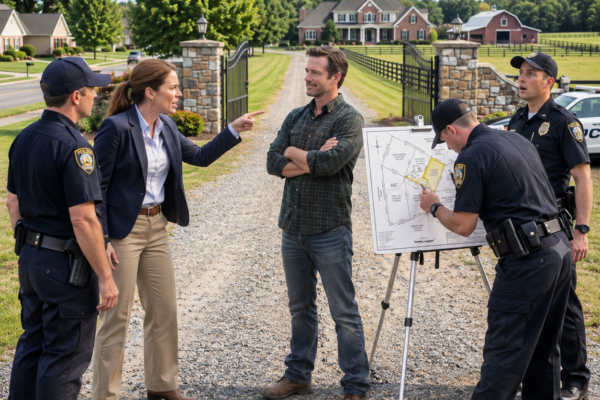
The next morning, Victor Langford arrived at my front gate.
He brought two board members.
Colin Mercer and Marissa Tate.
Victor drove a black SUV polished enough to reflect my mailbox.
He got out wearing khakis, loafers, and the expression of a man arriving to correct an employee.
I stayed inside the gate.
He did not bother saying hello.
“Turn the irrigation back on.”
“No.”
His eyebrows lifted.
“Excuse me?”
“You heard me.”
Marissa stepped closer.
“Daniel, people are already concerned. Our common landscaping was designed around that supply.”
“I know.”
“You can’t weaponize utilities because you’re upset.”
“I’m not.”
Victor gave a short laugh.
“You shut it off the morning after we removed your greenhouse.”
“You removed nothing.”
He stopped.
I continued.
“You trespassed onto my property with heavy equipment and destroyed a working agricultural structure.”
“It was noncompliant.”
“With what?”
“Our environmental standards.”
“This isn’t your development.”
“It impacts our development.”
“So does sunrise.”
Colin looked down.
Marissa crossed her arms.
Victor pointed toward the southern fields.
“The glare from that greenhouse created complaints from residents.”
“It was three hundred yards from your boundary.”
“It was visible.”
“So is your clubhouse.”
He stared at me.
I had promised Carla I wouldn’t get dragged into a shouting contest.
So I took a breath.
“Did you have a court order?”
Victor’s face tightened.
“No.”
“County condemnation?”
“No.”
“Building enforcement notice?”
“No.”
“Permission from me?”
“You were repeatedly notified.”
“That wasn’t my question.”
Marissa stepped in.
“We believed the HOA had authority under the community environmental compatibility agreement.”
“What agreement?”
She glanced at Victor.
That tiny glance told me more than her answer did.
Victor said, “The development documents give Silver Brook protections against adjacent nuisance uses.”
“Show me.”
“We don’t carry the entire file around.”
“I do.”
I lifted a folder from the gatepost.
Inside were the development agreement, my easement agreement, the irrigation contract, and the county plat.
“Which page?”
Victor’s jaw moved.
Colin spoke for the first time.
“Maybe we should have counsel review it.”
Victor turned on him.
“Our counsel already reviewed it.”
“Then bring the opinion.”
Silence again.
The wind pushed dry grass against the fence.
I handed Colin a copy of the suspension notice.
“This is why the irrigation is off. Your crew damaged infrastructure and interfered with my operations. Carla sent your management company the same thing yesterday.”
Victor barely looked at it.
“You’re going to destroy hundreds of thousands of dollars in landscaping.”
“No. You are welcome to purchase irrigation water elsewhere.”
“You know that isn’t practical.”
“That doesn’t make my pump yours.”
Marissa said, “Some residents had nothing to do with this.”
“I know.”
“Then you’re punishing innocent homeowners.”
That one landed.
Because she wasn’t entirely wrong.
I looked at her.
“That’s why domestic water is untouched. I’m not trying to hurt residents. I’m trying to stop supplying a private landscaping system under an agreement your board just breached.”
Victor folded the notice.
“What do you want?”
“First, access for my engineer to document the damaged connection.”
He frowned.
“What else?”
“You pay for the greenhouse you destroyed.”
“We can discuss depreciated value.”
I laughed once.
“No.”
“It was fifteen years old.”
“It was productive yesterday.”
“We’re not buying you a brand-new commercial greenhouse because you refused to follow compatibility standards.”
That was the moment I stopped feeling any uncertainty about shutting off the irrigation.
Not because he disagreed about money.
Reasonable people disagree about money.
Because he was still pretending the demolition itself had been legitimate.
I leaned against the gate.
“You want my terms?”
Victor nodded.
“You replace the greenhouse to equivalent functional capacity.”
“Equivalent,” he repeated cautiously.
“Not some shed from a catalog. A proper agricultural greenhouse, engineered and permitted.”
He said nothing.
“You pay for the crops your crew destroyed and the revenue I can document losing.”
Marissa shook her head.
“That could be speculative.”
“Then we document it.”
I continued.
“You repair every irrigation component damaged by the demolition.”
Colin nodded slightly.
“And the water agreement?” he asked.
“We renegotiate it.”
Victor laughed.
“There it is.”
“There what is?”
“The leverage.”
“You drove a machine onto the property that supplies your irrigation.”
He opened his mouth.
I kept going.
“You don’t get to complain that the consequences created leverage.”
He stared at me.
“What happens if we refuse?”
“Then your attorneys talk to mine. Your landscaping contractor finds another supply. And the sheriff’s report keeps moving through whatever process it moves through.”
Victor stepped closer to the gate.
“You think farmers are untouchable because you were here first.”
“No.”
I held his eyes.
“I think my deed means my property is mine.”
That ended the meeting.
They left without shaking hands.
By the third day, the heat arrived.
Late May in central Texas can give you one gentle morning and then punish you by lunch.
The thermometer climbed above ninety-five.
A dry southwesterly wind came in after noon.
Silver Brook had been built for appearance, not resilience.
Its common lawns were shallow-rooted Bermuda laid over graded soil.
Decorative magnolias lined the entrance.
Young oaks sat in circular beds that were watered almost every night.
Their ponds lost water naturally to evaporation and depended on makeup flow from my line.
Without irrigation, the changes began subtly.
Grass lost its shine.
Mulch dried.
Pond levels slipped.
Then the wind started moving loose topsoil from unfinished lots at the western end of the development.
Nobody’s house disappeared under a wall of dust.
It wasn’t 1935.
But Silver Brook’s immaculate image started failing remarkably fast.
A tan haze settled over one cul-de-sac.
Fine powder collected on parked cars.
The putting green developed pale patches.
Landscape crews arrived with tanker trucks.
Then came the photos.
Someone posted a picture of the dry entrance fountain on the Silver Brook residents’ page.
Another homeowner posted a brown patch near the clubhouse with the caption:
WHY ARE WE PAYING $410 A MONTH FOR THIS?
By afternoon, the comments had become a civil war.
Some blamed me.
Some blamed Victor.
Most simply wanted to know what had happened.
That evening, Denise called again.
“You need to see the email he sent.”
She forwarded it.
Victor had written:
Due to an ongoing dispute with an adjacent agricultural property owner, Silver Brook’s supplemental irrigation supply has been maliciously interrupted.
Maliciously.
Carla called ten minutes later.
“I saw it.”
“Denise sent it to you too?”
“No. Their attorney did.”
“That sounds promising.”
“It isn’t.”
She sounded tired.
“They’re threatening emergency injunctive relief.”
“Can they get it?”
“They can ask.”
“That wasn’t my question.”
“No, I don’t think their position is strong based on the agreement. But judges don’t enjoy people playing chicken with utilities, even nonessential irrigation systems.”
“I’m not playing chicken.”
“Then don’t start.”
She told me to document everything.
Flow records.
Damage.
Photographs.
Crop loss.
Revenue contracts.
My notice.
The sheriff’s report number.
Every phone call.
Every email.
Then she added something I hadn’t considered.
“Have your irrigation engineer inspect the connection before you restore anything.”
“Why?”
“Because if the demolition damaged their branch and you reopen under full pressure without knowing what condition it’s in, you could create a second problem.”
That was why I paid her.
Anger makes you look forward.
Good lawyers make you look sideways.
The engineer came the next morning.
His name was Luis Ortega.
He had installed part of the upgraded manifold six years earlier.
We walked through the wreckage.
He crouched beside a broken underground junction, cleared dirt with a gloved hand, and whistled.
“They ripped this line hard.”
“How bad?”
“Worse than I thought.”
A feeder serving greenhouse misting had been sheared.
A control wire was gone.
One pressure sensor was destroyed.
More importantly, the branch feeding Silver Brook had been jarred near the buried manifold.
He tested it.
“Do not reopen this at full pressure.”
“So Carla was right.”
“Never tell her I said that.”
I smiled.
Luis marked the damaged section.
“You’d probably get flow, but I wouldn’t trust it.”
“How long to repair?”
“If I can get parts? Couple days.”
“Do it.”
He looked at me.
“Who’s paying?”
“For now, me.”
“That greenhouse too?”
I looked across the flattened foundation.
“For now.”
He knew Claire.
He had eaten at our table.
His expression softened.
“I’m sorry, man.”
That was the first time someone had said it without attaching strategy, law, or money.
I looked away.
“Yeah.”
He put one hand on my shoulder.
Then we went back to work.
That afternoon, a reporter called.
Her name was Rachel Kim, and she worked for the county paper.
“I’m hearing there’s a dispute between your farm and Silver Brook Estates.”
“There is.”
“Did you intentionally shut off their water?”
“Their irrigation supply.”
“Can you explain the distinction?”
So I did.
Domestic water came from the municipal system.
Fire service was unaffected.
The line on my property supplied non-potable irrigation to common landscaping, ponds, and decorative amenities.
I had suspended it under the written agreement after their demolition crew entered my farm and damaged infrastructure.
“Did you shut it off to pressure them into rebuilding your greenhouse?”
“No. I shut it off because they breached the agreement and damaged the system.”
“Would you restore it if they repaired the damage?”
“When the infrastructure is safe and the contractual dispute is resolved, yes.”
“Residents say lawns are dying.”
“I’m sorry about that.”
“Some people say you’re holding the neighborhood hostage.”
I took a breath.
“My wife and I built that greenhouse fifteen years ago. It was entirely on my property. A crew connected to their HOA came onto my land while I was away and destroyed it. I’m not asking anyone to choose sides. I’m asking them to understand what happened before they decide who created the problem.”
That was the quote she used.
The article ran the following morning.
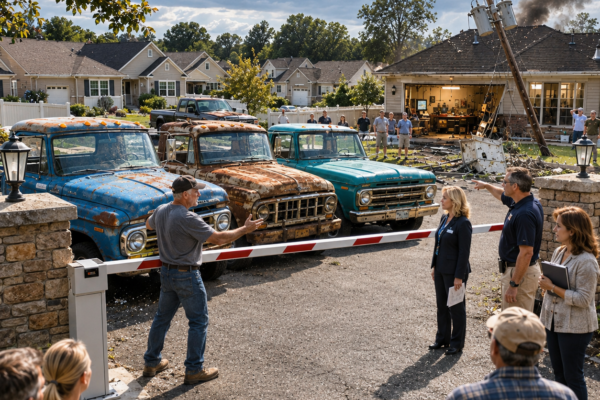
It included a photograph of the greenhouse wreckage.
That changed public opinion more than anything I said.
People could argue over water contracts.
They could argue about HOAs.
They could argue about whether I was stubborn.
But twisted steel and broken glass were hard to explain away.
By day five, Victor’s board had a bigger problem than brown grass.
Homeowners were asking for records.
Who authorized the demolition?
Which attorney reviewed it?
Who hired the equipment operator?
What insurance covered the action?
Where were the board minutes?
Denise called me from the clubhouse parking lot after an emergency meeting.
“You’re not going to believe this.”
“What?”
“They never voted.”
I stopped walking.
“What do you mean?”
“Victor says the board discussed it by email and he interpreted everyone’s responses as authorization.”
“Did they authorize demolition?”
“Colin says no.”
“Marissa?”
“She says she thought they were approving another violation letter.”
That sounded exactly like the kind of mess Carla had warned me not to imitate.
I called her.
She was quiet for several seconds.
“Do nothing different.”
“That’s all?”
“That’s all.”
“But if Victor acted alone—”
“Daniel.”
I stopped.
“Your job is not to prosecute Victor Langford from your tractor.”
“I don’t prosecute anybody from the tractor.”
“I know you well enough to be specific.”
She told me the board’s internal failure might matter later.
For insurance.
For indemnification.
For liability.
For governance.
But right then, my best move was still the least dramatic one.
Preserve evidence.
Make reasonable demands.
Do not interfere with investigations.
Do not threaten.
Do not gloat.
Do not post pictures of dying lawns.
That last instruction was unfortunately necessary because Eli had already sent me three.
One showed dust blowing across Silver Brook’s main boulevard beneath the caption:
COUNTRY LIVING HAS ARRIVED.
I deleted it.
By day six, Victor called.
His voice was different.
“We need to meet.”
“Where?”
“Your gate.”
“When?”
“Tomorrow morning.”
He arrived alone.
No black SUV.
No board members.
Just a gray pickup and a man who looked like he had slept badly for a week.
His polo shirt was wrinkled.
Dust coated his boots.
He stood outside the fence.
I stayed inside.
For a moment, we simply looked at each other.
Behind him, through Silver Brook’s open entrance, a tanker truck was feeding water into one of the irrigation storage tanks.
Victor glanced back at it.
“That costs us almost four thousand dollars a day.”
“I believe it.”
“We can’t sustain it.”
I said nothing.
“The board is under serious pressure.”
“Also believable.”
“People are talking about recalling us.”
“Victor, why are you here?”
He rubbed his face.
“We should not have sent the crew onto your property without final legal confirmation.”
There are apologies that take responsibility.
Then there are sentences designed to survive later discovery.
That was the second kind.
I let it sit between us.
He tried again.
“We handled it badly.”
“You bulldozed my greenhouse.”
“Yes.”
The word came out quietly.
It surprised me.
I looked at him.
He looked toward the ground.
“Yes,” he repeated. “We did.”
That was the first honest sentence I had heard from him.
The wind lifted a small curl of dust from the road shoulder.
It crossed between us and disappeared into the grass.
“What happened?” I asked.
He frowned.
“What do you mean?”
“How did an HOA president end up ordering demolition on land the HOA doesn’t own?”
His face tightened.
“I didn’t wake up wanting this.”
“Then how?”
For a while, he said nothing.
Then he leaned against his truck.
“The developer sold Silver Brook as protected rural luxury.”
“I know.”
“People paid for views. Quiet. Uniform surroundings.”
“They bought houses next to a farm.”
“I told them that.”
“Did you?”
He looked irritated.
Then tired.
“Yes. But complaints kept coming.”
“About tractors?”
“Tractors. Dust. Smell. Glare. Trucks. A rooster once.”
“That wasn’t even my rooster.”
“I know that now.”
I almost laughed.
He continued.
“The board kept getting pressure. Every meeting. Every email. People telling us we weren’t protecting their investment.”
“And you decided my investment didn’t count.”
His jaw flexed.
“That’s not how I thought about it.”
“How did you think about it?”
He looked toward my farm.
“Honestly?”
“Yes.”
“I thought you would fight us with letters.”
I said nothing.
“We’d been sending notices for years. Your attorney would answer. Nothing changed. I started thinking the county just didn’t care.”
“The county didn’t care because you didn’t have authority.”
“I know.”
“Now.”
“Yes. Now.”
That was as close to understanding as we had gotten.
Victor reached into his truck and pulled out a folder.
“I’m authorized to negotiate.”
“By the board?”
“Yes.”
“Proper vote this time?”
He gave me a tired look.
“Yes.”
I opened the folder.
Their first offer was better than I expected and worse than I would accept.
They proposed paying the depreciated structural value of the old greenhouse.
Replacing documented lost crops.
Repairing the irrigation damage.
Reimbursing my attorney fees to date.
And signing a letter acknowledging the HOA had no jurisdiction over my farm.
“What about the greenhouse?”
“That is the greenhouse.”
“No. That’s a check for what your insurer thinks fifteen-year-old steel is worth.”
“It was fifteen years old.”
“It was producing food.”
“Daniel—”
“If I burn down your ten-year-old clubhouse, do you want enough money to buy ten-year-old lumber?”
His eyes narrowed.
“That’s not comparable.”
“It’s exactly comparable.”
He took a breath.
“What do you want?”
I had spent days thinking about that question.
At first, my anger had wanted something excessive.
Double the greenhouse.
Fancy glass.
Automated systems.
A public apology.
Enough money to make Silver Brook hurt.
But somewhere between Luis inspecting broken pipes and Denise explaining that residents hadn’t even known about the demolition, my thinking changed.
I did not need revenge written into a contract.
I needed restoration.
“I want a greenhouse with equivalent production capacity,” I said.
Victor waited.
“Modern code. Modern wind rating. Equivalent environmental controls. If current materials mean it costs more than rebuilding a fifteen-year-old structure exactly, that’s your problem.”
He nodded slowly.
“Reasonable.”
“I want the crop loss documented by my records and accountant.”
“Okay.”
“I want restaurant contract losses where we can prove them.”
“We’ll review them.”
“I want the irrigation repairs.”
“Yes.”
“I want the suspension period not treated as a breach by me.”
He nodded again.
“I want a new agreement for the irrigation line.”
“That’s going to be difficult.”
“Then buy your own system.”
He looked toward the tanker truck.
“What terms?”
“Annual access fee.”
“We already pay maintenance.”
“You pay maintenance because you use my pump.”
“How much?”
“I’ll let the accountants negotiate.”
He exhaled.
“What else?”
“Indemnity for damage your contractors cause on my land. Written access procedures. No one crosses my property without notice except a genuine emergency.”
“Fine.”
“And I want the board to issue a statement saying the greenhouse was on private property and the removal was unauthorized.”
His expression changed.
“There it is.”
“What?”
“The public humiliation.”
“It isn’t humiliation if it’s true.”
“You want me to stand in front of everyone and say I screwed up.”
“No.”
I closed the folder.
“I want the association to correct the false statement it already sent.”
He stared at me.
“You called my greenhouse noncompliant. You told residents I maliciously interrupted their water. You want this resolved? Correct the record.”
His eyes went to the wreckage behind me.
For a long moment, he said nothing.
Then he nodded.
“Forty-eight hours.”
“Fine.”
“The irrigation stays off?”
“Until Luis completes repairs and Carla says the agreement is handled.”
Victor looked like he wanted to argue.
Then a gust of wind blew dust off the road and coated the side of his truck.
He wiped at it with one hand.
That tiny motion almost broke me.
Not because it was funny.
Because a week earlier, Victor probably would have called someone to clean it.
Now he just looked tired.
He climbed into the truck.
Before closing the door, he said, “For what it’s worth, I didn’t know about your wife.”
I froze.
“Who told you?”
“Denise.”
I looked toward the greenhouse foundation.
He followed my eyes.
“I’m sorry.”
Then he left.
That apology bothered me all day.
Not because it was inadequate.
Because it sounded genuine.
Real conflict gets inconvenient when the person you’re furious with starts behaving like a human being.
The next forty-eight hours were the worst Silver Brook had seen.
The heat stayed high.
Wind kept moving loose soil.
Common lawns yellowed.
The putting green turned patchy.
Pond edges receded enough to expose black liner beneath decorative stone.
The subdivision did not become an actual wasteland.
But compared with the manicured brochure image residents had paid for, it looked terrible.
The county paper ran a follow-up photograph showing dust hanging over the western entrance.
Someone online called it “the Silver Brook Dust Bowl.”
The name stuck.
I hated that I found it funny.
Eli loved it.
“You did it,” he said from my porch. “You turned those people into Okies.”
“Do not say that around Carla.”
“Why?”
“Because she’ll bill me for hearing it.”
We sat with beer while the sun dropped.
He looked toward the greenhouse site.
“You still miss her most in there?”
I knew who he meant.
“Yeah.”
Claire had been gone three years.
Some days grief was a room I walked into.
Other days it was weather.
The greenhouse had always been both.
Warm glass.
Wet soil.
Her handwriting on old plant markers.
The hook where she used to hang her gardening gloves.
Victor had not known any of that when he ordered the demolition.
That did not excuse him.
But it mattered to me.
“I keep thinking I should be happier,” I said.
“About what?”
“Winning.”
Eli snorted.
“You haven’t won anything. You’ve got a pile of metal.”
That was exactly what I needed to hear.
The next morning, Victor returned with a thicker folder.
This time he brought Colin.
No Marissa.
Victor handed me the agreement.
“We accepted most of it.”
“Most?”
“Your accountant’s crop figures still need verification.”
“Expected.”
“The irrigation fee is higher than we wanted.”
“Also expected.”
“We agreed.”
I looked at him.
“All of it?”
“Annual access. Maintenance contribution. Access procedures. Damage responsibility. Written acknowledgment that your property is outside HOA jurisdiction.”
“And the greenhouse?”
“Equivalent production capacity. Current wind code. Automated ventilation comparable to what you lost.”
“Comparable?”
Colin stepped in.
“We added an allowance for upgraded controls because matching fifteen-year-old equipment makes no sense.”
That sounded reasonable.
“What about the statement?”
Victor’s jaw tightened.
“It goes out today.”
I did not smile.
That mattered.
If I had smiled, he might have walked away just to avoid giving me the satisfaction.
Instead I said, “Thank you.”
He looked almost offended by the politeness.
Carla reviewed the agreement that afternoon.
She changed fourteen things.
Silver Brook’s attorney changed nine back.
They argued over insurance.
Then access.
Then what counted as a documented crop loss.
Then whether annual irrigation payments should adjust by CPI or actual pumping cost.
It was the least cinematic part of the entire story.
It was also the part that actually solved it.
Three days later, we signed.
The HOA’s statement went to every homeowner.
It read:
Following legal review, the Board acknowledges that the greenhouse located on the Reyes property was situated entirely outside Silver Brook Estates and was not subject to HOA architectural or aesthetic jurisdiction. Its removal was authorized without sufficient legal basis or property-owner consent. The Association regrets the action and is working with Mr. Reyes toward restoration and resolution.
I read it twice.
Then a third time.
Not because it felt triumphant.
Because the words “regrets the action” loosened something in my chest I hadn’t realized was still clenched.
For days, everybody had talked about money.
Water.
Contracts.
Grass.
Property values.
The statement was the first time Silver Brook publicly admitted the most basic truth.
They had crossed the line.
Construction began the following week.
I did not reopen the irrigation immediately.
Not because I wanted Silver Brook to suffer longer.
Luis had not finished the repair.
That distinction became important later, because people in town told the story as if I stood inside the pump house laughing while lawns died.
The truth was far less entertaining.
Luis had excavated the damaged junction.
A coupling needed replacement.
The pressure sensor had to be rewired.
The branch needed testing.
The system needed flushing before he would sign off.
“Two more days,” he told me.
Victor hated hearing that.
I could see it on his face.
But he did not accuse me of stalling.
Not anymore.
Silver Brook kept hauling water.
Residents kept complaining.
Two board members announced they would not seek reelection.
Marissa resigned outright.
Her letter said the board had “lost the confidence required for effective governance.”
That was the polite version.
According to Denise, one meeting had lasted four hours and ended with a man from Birch Court asking Victor whether he knew what a property line was.
Colin stayed.
Strangely, so did Victor.
The recall petition gathered signatures but never reached a vote.
Victor announced he would step down when his term ended.
That surprised me.
I had assumed he would either fight until the last ballot or vanish.
Instead he stayed long enough to help finish the settlement.
I respected that more than I expected.
The greenhouse went up slowly.
First the old foundation was removed.
Then the site was graded.
New footings.
Steel.
Drainage.
A modern control system.
Polycarbonate on the north service wall.
Tempered glazing where sunlight mattered.
The replacement was slightly larger than the original because modern standard dimensions worked better that way.
Not double.
Not a palace.
Just better designed.
Claire would have liked that.
One morning, as the frame rose above the pecan trees, I stood with a cup of coffee where our old potting bench had been.
For one second, I could almost hear her.
Not words.
Just that habit she had of humming old country songs without ever knowing the full lyrics.
I looked away before the crew saw my face.
The irrigation repair finished on a Thursday.
Luis pressure-tested it twice.
Then he handed me the report.
“You’re good.”
I called Carla.
“You signed the new agreement?”
“Yes.”
“Insurance certificate?”
“Yes.”
“Payment schedule?”
“Yes.”
“Damage repair?”
“Yes.”
“Then from my perspective, restore service.”
At four twenty that afternoon, Victor met me at the pump house.
He had asked to be there.
I agreed.
The steel door groaned when I opened it.
He stepped inside and looked around.
“This is it?”
“This is it.”
He seemed disappointed.
People expected the source of Silver Brook’s emerald landscape to look like a power station.
Instead it was pipes, gauges, filters, and old concrete.
I pointed toward the south branch.
“That line feeds your reservoir.”
He nodded.
“Five years,” he said.
“What?”
“Five years I’ve driven past your farm and never once wondered where the irrigation actually came from.”
“That’s probably true of most people.”
He looked at the gauges.
“We treated this like a service we were entitled to.”
“You were entitled to it.”
He looked at me.
“Under the contract.”
“Yes.”
“That’s not the same thing, is it?”
“No.”
I put my hand on the valve.
He watched.
“I want to make one thing clear,” I said.
“What?”
“This isn’t me forgiving what happened.”
“I know.”
“And this isn’t you doing me a favor by rebuilding.”
“I know.”
“This is us getting back to the agreement we should have respected in the first place.”
He nodded.
“Understood.”
I opened the valve slowly.
Pressure entered the branch.
The needle climbed.
Luis had told me exactly where it should settle.
Forty.
Fifty.
Sixty.
Stable.
No leaks.
No alarms.
The pump’s hum deepened slightly.
Somewhere beyond my southern fence, Silver Brook’s reservoir began filling again.
Victor listened.
“That’s it?”
“That’s it.”
He laughed once.
“Whole damn neighborhood spent three weeks losing its mind over that little handle.”
“Most fights are about smaller things.”
We walked outside.
Far beyond the fence, the entrance fountain sputtered.
Then stopped.
Then sputtered again.
A minute later, it found pressure.
Water climbed into the air.
I could barely hear people near the entrance.
Someone cheered.
Then somebody else.
Victor looked embarrassed.
“Don’t worry,” I said. “I’m not telling anyone.”
He extended his hand.
I shook it.
We never became friends.
That would have been too neat.
But after that day, we became something better than enemies.
People who understood the terms.
The new greenhouse opened before fall.
I brought the first tomato crop in during November.
Winter greens followed.
Then herbs.
The restaurant accounts returned.
One chef who had dropped me during the disruption came back after tasting the first batch of arugula.
Another never did.
That was part of the cost.
Not everything destroyed can be perfectly restored by writing a check.
Insurance covered some crop loss.
Silver Brook covered the rest according to the settlement.
Their landscaping recovered too.
Bermuda grass is stubborn.
So are magnolias.
The ponds refilled.
The putting green came back.
By the following spring, someone passing through Silver Brook would never have known it had spent weeks looking like the edge of a drought zone.
Except the residents remembered.
That mattered.
The board election changed almost everyone.
Colin stayed one more term.
Denise ran reluctantly and won.
Her first rule was that no board member could authorize entry onto neighboring property without written legal review and board approval except in a documented emergency.
Her second rule was that vendor contracts above a certain amount had to be reviewed by more than one officer.
Her third was unofficial.
“No one complains about tractors before seven unless the tractor is actually inside your house.”
I liked that one.
The HOA stopped sending me aesthetic letters.
No more greenhouse glare.
No more compost smell.
No more dust notices.
The irony was that once the hostility stopped, I became more willing to accommodate them.
During harvest, if conditions were extremely dry, I watered the farm road before hauling hay near their boundary.
I adjusted one exterior greenhouse light so it pointed downward instead of toward the subdivision.
Silver Brook planted a line of native trees along part of the southern edge.
Not because either side surrendered.
Because cooperation becomes easier after everyone understands what they do and do not control.
The annual irrigation check arrived on schedule.
The new rate was higher than the old one, but not punitive.
It covered pumping cost, maintenance, wear, and a modest access fee.
The agreement required Silver Brook to maintain emergency backup capacity for its landscaping so my pump was no longer their only option.
That was Carla’s idea.
“Never let somebody depend entirely on you if you don’t want their emergency to become your emergency,” she said.
She was right.
Victor stepped down that winter.
On his final week as president, he drove to the farm.
I was inside the greenhouse transplanting pepper starts.
He stood outside the door until I noticed him.
Then he knocked on the frame.
“You know it opens.”
“Wasn’t sure if I was allowed in.”
“That might be the smartest thing you’ve ever said.”
He smiled.
The place was warm and humid.
Condensation covered the glass.
Rows of green stretched behind me.
Victor looked around.
“This is nicer than the old one.”
“It is.”
“That still irritates me.”
I laughed.
“Why are you here?”
He walked to the bench.
“I’m leaving Silver Brook.”
“Moving?”
“Houston.”
“Work?”
“My wife’s mother needs help. We were thinking about it anyway.”
I nodded.
He touched the edge of the potting bench.
“For whatever it’s worth, I’m glad this got rebuilt.”
“So am I.”
He looked uncomfortable.
Then said, “I was an ass.”
I did not rescue him from the sentence.
“Yes.”
He nodded.
“I thought being president meant I was responsible for fixing every complaint.”
“That’s how you ended up trying to fix things that weren’t yours.”
“Yeah.”
He looked toward the rows of lettuce.
“You ever going to stop telling people about the dust bowl?”
“I’ve never told anybody about the dust bowl.”
He laughed.
“Right.”
“Eli handles public relations.”
“That makes more sense.”
At the door, he stopped.
“I am sorry about Claire’s greenhouse.”
I looked past him toward the light.
For months, people had called it my greenhouse.
Then Silver Brook’s greenhouse dispute.
Then the replacement greenhouse.
Victor was the first person besides me in a long time to call the old one Claire’s.
“Thank you,” I said.
He left.
Years later, I still think about that conversation more than I think about turning the valve.
That surprised me.
When people hear the story, they always focus on the dramatic part.
The bulldozer.
The HOA notice.
The irrigation.
The fountains going dry.
The dust blowing across million-dollar houses.
Those are the pieces people remember because they make a satisfying story.
Cause.
Effect.
Power reversed.
But living through it did not feel satisfying.
It felt exhausting.
I lost crops.
I lost sleep.
I paid lawyers.
I spent weeks walking past the wreckage of something Claire and I had built with our own hands.
Silver Brook residents who had done nothing wrong spent money repairing landscapes because their board made a decision they never approved.
Victor lost his position and a good amount of reputation.
Nobody came out untouched.
That is why I stopped calling what happened revenge.
Revenge would have meant keeping the water off after the system was repaired and the agreement was signed.
Revenge would have meant demanding absurd upgrades simply because I had leverage.
Revenge would have meant enjoying innocent residents’ losses.
I was tempted.
I am not going to lie about that.
There were evenings when I stood beside the southern fence, saw brown patches appearing inside Silver Brook, and thought, Good.
Let them feel it.
Then I would turn around and see the empty space where Claire’s greenhouse had been.
That always corrected me.
She had not spent fifteen years growing things so I could become somebody who enjoyed watching other people’s things die.
The point was never to create a dust bowl.
The point was to make the boundary impossible to ignore.
Today, the new greenhouse is the busiest part of the farm.
We grow winter tomatoes.
Specialty peppers.
Herbs.
Microgreens.
I experimented with dwarf citrus for two seasons and finally admitted Texas humidity had defeated my ambition.
I hired two local high school kids.
One stayed through college summers.
The church pantry still gets produce every month.
Some Silver Brook residents shop at the farm stand.
Denise still buys basil.
Colin buys tomatoes and pretends he does not remember threatening me with an injunction.
I let him pretend.
Eli still tells anyone who will listen that I personally destroyed an entire subdivision with one valve.
That is nonsense.
Texas sun did most of the work.
But the old pump house is still there.
Same concrete walls.
Same tin roof.
Same gauges.
Claire’s old coffee mug sits on a shelf because I found it buried in a box after the rebuild and could not bring myself to throw it away.
Every now and then, I go into that room to change a filter.
The Silver Brook branch is easy to recognize.
It has a new brass tag attached to it.
SILVER BROOK IRRIGATION.
Below that, Luis added another little tag as a joke.
He engraved it himself.
ASK BEFORE TOUCHING.
I left it there.
Last summer, a young couple from Silver Brook came to the farm stand with their daughter.
They had moved in long after Victor left.
The girl pointed toward the greenhouse.
“Is that the one the HOA knocked down?”
Her mother looked horrified.
“Emma.”
I laughed.
“No. This is the one they built back.”
The girl considered that.
“Why did they knock the other one down?”
I looked across the field toward the subdivision.
Its lawns were green.
The fountain was running.
Trees along the fence had grown tall enough to soften the view.
“Because some adults got confused about where their rules ended.”
She seemed satisfied with that answer.
Kids usually are when adults stop making things complicated.
That evening, I walked through the greenhouse after shutting down the farm stand.
The air was warm.
Water ticked through irrigation lines.
Condensation slid down the glass.
The last sunlight turned everything gold.
For half a second, I caught myself listening for Claire humming.
I still do that sometimes.
Then the ventilation fan came on.
The sound filled the space.
Outside, beyond the south fence, Silver Brook’s entrance fountain rose above the trees.
Both systems were running.
Mine.
Theirs.
Connected underground.
Separated by contract.
Kept alive by maintenance.
That felt like a better ending than watching anything dry out.
The greenhouse they destroyed is gone.
The dust settled.
The lawns grew back.
Victor moved away.
The angry emails stopped.
But the steel door on my pump house still locks every night, and the valve behind it still feeds a neighborhood that finally understands exactly where its authority ends.
Sometimes the strongest boundary on a piece of land is not a fence.
Sometimes it is a line buried underground, a contract in a filing cabinet, and one simple expectation that should never have needed a fight in the first place:
Ask before you cross it.