HOA gave me 48 hours to abandon the island cabin my grandfather built in 1971, then scheduled an excavator to tear it down before I could finish fighting them in court.h
HOA gave me 48 hours to abandon the island cabin my grandfather built in 1971, then scheduled an excavator to tear it down before I could finish fighting them in court.
Beatrice Harrington expected me to fold because Cedar Reef Estates controlled nearly $8 million in reserves and legal accounts, and she had spent two years proving that anyone who challenged her could be buried under fines, attorneys, inspections, and “emergency” board actions until selling became cheaper than resisting.
What Beatrice didn’t know was that the former HOA treasurer had kept copies of bank statements showing millions moving through a company she controlled, and the engineer whose name appeared on the report calling my cabin an “immediate structural hazard” was about to swear he had never inspected my property.
My name is Arthur Vale. My grandfather hauled river stone up the eastern bluff of Cedar Reef Island by hand when he built our A-frame cabin more than fifty years ago. It survived Pacific Northwest storms, salt air, two roof replacements, and three generations of my family. Under Beatrice, the old neighborhood association had transformed from a group that mostly handled road gravel and docks into an organization with an enormous reserve balance and aggressive enforcement machinery.
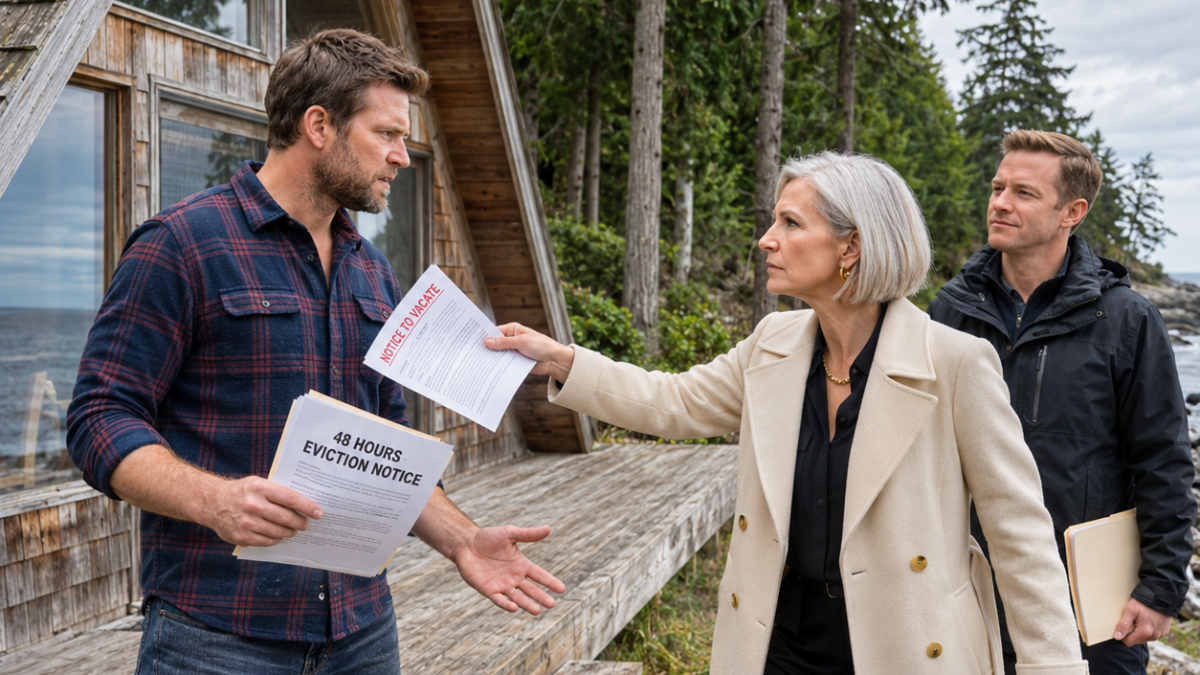
Then Derek Lehman, Beatrice’s compliance director, appeared during a sideways rainstorm and handed me a folder.
NOTICE OF EMERGENCY HAZARD ABATEMENT
VACATE WITHIN 48 HOURS
The papers claimed my foundation was sliding toward the bluff, assessed $150,000 in penalties, and said the HOA had transferred the debt to Harrington Coastal Holdings LLC, which intended to take possession.
There was no sheriff’s eviction order.
No completed judicial foreclosure.
No county condemnation.
And the “rapid foreclosure clause” Derek kept quoting did not exist in the declaration recorded against my land.
What did exist was a demolition reservation for Thursday morning.
That terrified me more.
Once a fifty-year-old cabin is splinters, winning six months later doesn’t rebuild the original walls.
I took the ferry to attorney Samuel O’Reilly.
He read the paperwork twice.
Then asked one question.
“How does a small island HOA have eight million dollars?”
That led us to Thomas Whitaker, the treasurer Beatrice had pushed off the board the year before.
Thomas opened a locked file box and handed us copies of statements he had retained from his time as treasurer.
Transfers.
Related companies.
“Consulting fees.”
Property purchases.
And repeated payments to Harrington Coastal Holdings.
Sam stared at the numbers.
“We’re not asking a judge to decide the whole case tomorrow.”
“What are we asking?”
He closed the file.
“To take the HOA away from her before she spends another dollar.”
[END OF FACEBOOK CAPTION]
[FIRST COMMENT / FULL STORY CONTINUATION]
I thought Sam was exaggerating.
Lawyers do that sometimes.
Not in court.
In offices.
They take something terrifying and describe the legal response with enough confidence that you can breathe again.
“What does ‘take the HOA away from her’ actually mean?”
Sam pushed his glasses higher.
“It means we ask the Superior Court for emergency injunctive relief and appointment of a temporary receiver.”
“I know what an injunction is.”
“Good.”
“I don’t know what a receiver is.”
“A neutral person appointed by the court to take control of property or an organization when the people running it can’t safely be left in control while litigation proceeds.”
“You mean replace Beatrice?”
“Temporarily, operationally.”
“The court doesn’t erase an elected board because you and I are upset.”
He tapped Thomas’s bank statements.
“But if an association’s money is being diverted to related companies, records may be disappearing, and the same people controlling the money are using it to take members’ property, a judge has options.”
“Can a judge do that tomorrow?”
Sam leaned back.
“That’s the hard part.”
My stomach tightened.
“What part?”
“Receivership is extraordinary.”
“Courts don’t like appointing someone to run a private association without giving the association a chance to respond.”
“And I have thirty-something hours.”
“Yes.”
“So?”
“So first we file for a temporary restraining order stopping demolition, transfer, foreclosure activity, and destruction of records.”
“Then we ask for an expedited hearing on temporary receivership.”
“How expedited?”
“If we can show immediate risk?”
He looked toward the rain streaking his window.
“Very.”
That was less dramatic than his first sentence.
Much more believable.
I preferred it.
He asked Thomas to come inside.
Thomas Whitaker had been waiting in Sam’s outer office with both hands around a paper coffee cup.
He looked older than I remembered.
Not just gray.
Reduced.
Beatrice had not literally forced him out of his waterfront home at gunpoint.
The truth was more ordinary and, in some ways, worse.
He had served as Cedar Reef treasurer for eight years.
When he questioned a series of reserve transfers, Beatrice pushed a motion to remove him as treasurer.
The board had authority to choose officers.
They did.
Then enforcement notices began.
Deck rail.
Exterior storage.
Drainage.
An unapproved retaining-wall repair performed nine years earlier.
Most were technically debatable.
Some were real.
Together, they exhausted him.
His wife had died the year before.
He sold.
A company connected to Beatrice bought his home.
He moved to the mainland.
“I should have fought.”
He said.
Sam shook his head.
“Selling because you’re tired is not consent to fraud.”
Thomas looked at me.
“I kept copies.”
“Why?”
“Because I knew something was wrong.”
He had not stolen the HOA’s live accounting database.
That would have created a new problem.
As treasurer, he had lawfully received monthly bank statements, reserve reports, invoices, and board packets.
He kept copies of records already in his possession.
Those copies showed Cedar Reef Estates had not simply accumulated $8 million through ordinary dues.
The association covered eighty-six expensive island properties.
Dues were high.
There were private roads.
A marina.
Two docks.
Water infrastructure.
Emergency shoreline work.
An eight-million-dollar reserve was large but not impossible.
The real problem was where portions of it went.
$420,000 labeled:
TEMPORARY LAND STABILIZATION ADVANCE
Recipient:
Harrington Coastal Holdings LLC.
$615,000:
STRATEGIC AMENITY ACQUISITION
Same recipient.
$288,000:
ENVIRONMENTAL MITIGATION CONSULTING
Recipient:
North Sound Coastal Strategies.
Thomas had found that company’s registered manager was Beatrice’s adult daughter.
Another $730,000 had moved from reserve savings into a “development opportunity account” approved during an executive session.
Thomas had objected.
The minutes said:
Treasurer expressed concern regarding investment structure.
That was polite.
His email was less polite.
We are not a venture-capital fund. Reserve money is collected to maintain association assets, not to finance acquisitions for directors’ private companies.
Beatrice replied:
Counsel has approved the structure.
Thomas asked:
Which counsel?
No answer.
Now Sam looked at me.
“How much of this can you authenticate?”
Thomas said:
“All statements came directly from the bank while I was treasurer.”
“Invoices?”
“Board packets.”
“Emails?”
“My HOA account and personal copies.”
“Did you alter anything?”
“No.”
“Do you still have original email exports?”
“Yes.”
“Good.”
Sam turned to me.
“Now the engineer.”
The hazard report carried the letterhead of Cascadia Geotechnical Associates.
Licensed professional engineer:
Dr. Helen Park.
Signature.
Seal.
The report claimed she inspected my cabin ten days earlier.
She had not.
I would have remembered a geotechnical engineer crawling under my deck.
Sam called her office.
He did not start by accusing anyone.
“This is Samuel O’Reilly representing Arthur Vale regarding 14 Cedar Bluff Lane on Cedar Reef Island.”
Pause.
“I’m looking at a report dated November 9 bearing Dr. Helen Park’s name and Washington seal.”
Another pause.
Then Sam’s expression changed.
“What do you mean you have no project there?”
He put the call on speaker with permission.
A woman from Cascadia’s office said:
“Dr. Park has not inspected a private residence on Cedar Reef Island this year.”
Sam:
“Did your company perform any work for Cedar Reef Estates?”
“We completed a shoreline-stability review of common property in March.”
“Was 14 Cedar Bluff Lane included?”
“Not as a private structure.”
Sam looked at me.
“Can you send us a written statement today?”
“I’ll have Dr. Park call.”
She did.
Thirty minutes later.
Helen Park had seen the report Sam emailed.
Her first sentence:
“That is not my report.”
The signature image was hers.
The seal number was hers.
The letterhead was outdated.
Several paragraphs had been copied from her March common-area study.
The specific conclusions about my cabin were not hers.
She had never evaluated my foundation.
“Will you sign declaration?”
Sam asked.
“Yes.”
That changed everything.
A large reserve transfer pattern was suspicious.
A fake engineering report attached to a forty-eight-hour demolition threat was immediate.
Sam started drafting.
I started feeding him documents.
Recorded declaration.
My deed.
HOA bylaws.
The amended rules Beatrice claimed gave “rapid foreclosure” authority.
There was a problem with those too.
Beatrice had not invented every word.
The board had adopted a collection policy authorizing expedited lien enforcement after proper notice and an opportunity to cure.
But nothing allowed:
Forty-eight-hour eviction.
Private transfer of someone’s title by board declaration.
Demolition without court order or valid emergency authority.
The association could potentially record liens for valid assessments under governing documents and applicable law.
Foreclosure required actual legal process.
My cabin had no completed foreclosure judgment.
Harrington Coastal Holdings had recorded something called an:
ASSIGNMENT OF ENFORCEMENT LIEN
That was not the same as ownership.
Derek had handed me a packet designed to make it feel inevitable.
Sam read the title report.
“He doesn’t own your house.”
“Who?”
“Harrington Coastal.”
“Then what is Thursday?”
“Self-help.”
“That’s legal?”
“Not the way they’re proposing it.”
“Why would a demolition company come?”
“Because somebody represented that Harrington had authority.”
That sentence made me feel sick.
People imagine property rights as physical.
Fence.
Door.
Key.
Most of the time they are pieces of paper that strangers trust until somebody produces a better piece.
The demolition company did not know my grandfather.
They would see a work order.
An owner authorization.
A hazard report.
Maybe an HOA letter.
Then an excavator bucket.
Sam filed at 8:07 the next morning.
Not by ambushing Judge Gregory Finch in a hallway.
The emergency motion went through the clerk.
Electronic filing.
Assigned department.
Telephone conference with judicial assistant.
Service sent to Cedar Reef Estates, Beatrice, Harrington Coastal Holdings, and their registered agents.
Our papers asked for:
Immediate temporary restraining order prohibiting demolition or alteration of my cabin.
No transfer or enforcement of the disputed lien.
Preservation of association financial records.
No movement of reserve funds outside ordinary-course expenses.
Expedited show-cause hearing on preliminary injunction and temporary receivership.
The proposed receiver was not Sam’s friend.
The court maintained a roster of experienced fiduciaries.
Sam suggested three names.
Judge would choose.
At 12:46, Beatrice’s lawyers filed opposition.
Fast.
Of course.
They argued:
My cabin was structurally unsafe.
The association had emergency powers.
Reserve transfers were legitimate investments designed to acquire common amenities.
Harrington Coastal was a service entity acting for the HOA.
Thomas was a disgruntled former officer who had taken confidential materials.
And receivership would cause catastrophic disruption to island services.
Reasonable arguments if the evidence went their way.
At 3:10, Judge Finch held an emergency remote hearing.
I sat in Sam’s office.
Beatrice appeared from her attorney’s conference room.
Judge Finch was not theatrically furious.
That made him scarier.
He looked tired.
Prepared.
He began:
“I have reviewed the submissions.”
Then:
“Mr. O’Reilly, I am not appointing a receiver today based solely on unauthenticated financial records from a former treasurer.”
Sam nodded.
“Understood.”
My heart sank.
Finch continued.
“I am, however, deeply concerned by the engineer declaration.”
He looked at Beatrice’s counsel.
“Ms. Klein, do you dispute Dr. Park says she did not inspect this structure and did not author the report?”
Her lawyer, Meredith Klein, answered carefully.
“We are investigating provenance.”
“That is not an answer.”
“At this time, we cannot authenticate the report as Dr. Park’s work.”
Finch:
“Yet your client scheduled demolition based in material part on it?”
Meredith:
“The board relied on information presented to it.”
“By whom?”
Pause.
“We are still determining.”
Judge Finch turned to Sam.
“Is demolition actually scheduled?”
“Yes, Your Honor.”
“Contract?”
Sam displayed confirmation.
Thursday.
8:00 a.m.
Finch looked at clock.
Then issued oral ruling later memorialized in writing.
No demolition.
No entry onto my parcel except genuine emergency response.
No enforcement of disputed lien.
No transfer.
Preserve records.
Reserve expenditures above $25,000 outside ordinary recurring operations required notice to opposing counsel pending hearing, except documented emergency.
And:
Expedited receivership hearing Friday.
The day after demolition had been scheduled.
I exhaled for first time in twenty-four hours.
Sam muted microphone.
“Your cabin survives Thursday.”
“What about Beatrice?”
“Friday.”
Then Judge Finch added:
“Because the plaintiffs have submitted evidence raising a substantial question about governance and related-party transfers, Cedar Reef Estates shall produce by Thursday noon bank records for all reserve accounts and all transactions with Harrington Coastal Holdings, North Sound Coastal Strategies, and entities controlled by current directors or immediate family members for the prior thirty-six months.”
Beatrice moved toward her lawyer.
Whispered.
Meredith’s face did not change.
But she wrote fast.
The demolition company called me at 6:20 that evening.
Their operations manager, Luke Jensen.
“Mr. Vale?”
“Yes.”
“We received a court order.”
“Good.”
“We’re standing down.”
“Thank you.”
“I want you to know we were told your property had been condemned by county building department.”
That got my attention.
“Who told you?”
“Our work authorization packet.”
“Can you send it to my lawyer?”
“My counsel says we should preserve it.”
“Good.”
“Mr. Vale?”
“Yes?”
“I’m sorry.”
He was not responsible for the scheme.
But he had almost sent an excavator to my porch.
“I appreciate that.”
The next morning I took the island ferry home.
My cabin was still standing.
That sounds simple.
It did not feel simple.
I walked inside and touched the riverstone fireplace like an idiot.
Grandpa Arthur had built it from stones hauled up from beach in a wheelbarrow.
Family stories say he did it alone.
Family stories lie.
Photographs show my father and two neighbors helped.
I prefer truth.
The cabin smelled like cedar and wood smoke.
Nothing had changed.
Everything had.
At 7:37 Thursday morning, headlights came up the gravel driveway.
My heart stopped.
A flatbed.
Excavator.
Derek’s SUV.
Then another vehicle.
Beatrice.
They had not received the message?
I stepped onto porch.
Phone already recording.
The excavator driver climbed down but did not unload.
Luke Jensen got out of a pickup behind.
He walked directly toward Beatrice.
“We’re not working.”
She said something I could not hear.
He handed her paper.
Court order.
Derek looked toward me.
Then marched up driveway.
He stopped short of porch.
“Arthur.”
“Derek.”
“This isn’t over.”
“I know.”
“You’re preventing necessary safety work.”
“No.”
“The judge is.”
He looked behind me at cabin.
“You realize if bluff fails, you’ll blame us.”
“If actual engineer says bluff failing, I’ll listen.”
“You have an engineer report.”
“No.”
“I have a fake document with a real engineer’s name.”
His face moved.
Very slightly.
That told me he had not known.
Interesting.
Beatrice approached.
Luke followed several feet behind.
“Arthur.”
She said.
“You went nuclear.”
“I asked court to stop you from bulldozing my home.”
“You’re jeopardizing every homeowner on this island.”
“How?”
“Our reserve accounts are restricted.”
“Temporarily.”
“We have vendors.”
“Then produce records Friday.”
She stared.
“You have no idea what Thomas stole.”
“He didn’t steal bank statements he received as treasurer.”
“That’s for the court.”
“Yes.”
It was.
She had no answer to that.
Then:
“You could have sold.”
There it was.
“You made three offers.”
“Generous offers.”
“I said no.”
“Your cabin sits on land this community needs.”
“No.”
“You want.”
Her eyes narrowed.
“You think this island can stay frozen in 1971?”
“No.”
“I think my property stays mine until I choose otherwise.”
She looked at cabin.
Then:
“You’ll regret this.”
Sam would later make me write that down verbatim.
Not because it proved fraud.
Because threats become relevant when records start disappearing.
Nothing disappeared.
That was the surprising part.
The court’s preservation order arrived before anyone could clean ledgers.
By Thursday noon, Cedar Reef’s bank produced records directly.
Not filtered through board.
They were worse than Thomas’s copies.
The $8 million existed.
More precisely, the association had held $8.24 million across operating, reserve, and investment accounts at peak eighteen months earlier.
Current balances:
$4.91 million.
Some reduction was legitimate.
Dock reconstruction.
Road stabilization.
Insurance.
Emergency seawall.
But approximately $2.36 million had moved to entities related to Beatrice or her family under transactions labeled as loans, consulting, acquisition deposits, and “strategic amenity investments.”
Board minutes authorizing them were inconsistent.
Two showed votes.
One lacked quorum.
Three referred vaguely to executive-session approvals with no resolutions.
A fourth transaction had no supporting minutes we could find.
Harrington Coastal then used some of those funds as earnest money and acquisition financing for island properties.
Including Thomas Whitaker’s former house.
And it had attempted to acquire mine through the disputed lien assignment.
That was not automatically embezzlement.
Associations sometimes invest.
Acquire property.
Use subsidiaries.
But a director’s private LLC receiving association money triggers enormous conflict and fiduciary questions.
Especially if members were not told.
Then North Sound Coastal Strategies.
Beatrice’s daughter received $288,000 over fourteen months.
What work?
Reports existed.
Some real.
Shoreline consulting.
Permit coordination.
But market comparison suggested high fees.
No competitive bid.
No conflict disclosure in member materials.
The demolition engineer report became another issue.
Metadata on the Word file used to create PDF showed author:
D. Lehman
Derek.
He had taken Cascadia’s March shoreline report, copied logo and seal, inserted property-specific language, then sent draft to Beatrice.
Email:
I adapted Park’s report for Vale. Should be enough for emergency declaration.
Beatrice:
Make it look final.
That email ended her argument that she relied innocently on a report somebody else gave her.
Friday hearing lasted five hours.
Judge Finch heard:
Thomas.
Bank custodian.
Dr. Helen Park.
Dennis? No, Derek.
Derek had hired counsel.
He invoked his right not to answer certain questions about report.
Reasonable.
No one in courtroom treated silence as confession.
Thomas testified.
Sam asked:
“Why did you retain records?”
“Because transactions concerned me.”
“Did you alter them?”
“No.”
“Did you authorize transfers?”
“Some routine transfers.”
“Related-party loans?”
“No.”
“Were they disclosed to members?”
“Not while I was treasurer.”
Beatrice’s counsel attacked credibility.
“You were removed from office.”
“Yes.”
“You disliked Mrs. Harrington.”
“After she moved association money into her company, yes.”
“Your home was cited for legitimate violations.”
“Some.”
“You sold voluntarily.”
“Yes.”
“Mrs. Harrington did not force you at gunpoint.”
“No.”
Good.
Truth survived.
Then bank records.
Then Helen.
“Did you inspect Arthur Vale’s cabin?”
“No.”
“Did you conclude it was in immediate danger of sliding into ocean?”
“No.”
“Is that your seal?”
“It is an image of my seal.”
“Did you authorize its use on this report?”
“No.”
“Could somebody reasonably believe document came from you?”
“Yes.”
That was devastating.
Beatrice testified too.
She denied personal theft.
Her explanation:
Harrington Coastal was created to acquire properties for the eventual benefit of the association and planned luxury amenities.
She had personally advanced money to deals and believed related-party structure allowed faster transactions than cumbersome HOA ownership.
Member approval would come later.
North Sound was qualified and provided real work.
The reserve loans were intended to be repaid with profits from future resort partnership.
Then my cabin.
She said:
“Mr. Vale’s property presented unresolved safety and aesthetic problems for years.”
Judge Finch:
“Aesthetic problems are not emergency hazards.”
“No.”
“But bluff condition—”
“Based on a report the engineer says is not hers.”
“I believed Derek had obtained proper authorization.”
Sam showed email:
Make it look final.
Beatrice said:
“I meant formatting.”
Could be.
Judge evaluated.
Receivership does not require criminal guilt beyond reasonable doubt.
It asks whether neutral control is necessary to preserve assets, records, and proper operation.
At 6:18 p.m., Judge Finch ruled from bench.
He did not dissolve HOA.
He did not declare Beatrice criminal.
He did something more targeted.
Cedar Reef Estates was placed into temporary judicial receivership for financial and governance functions pending further proceedings.
The board was not legally erased.
Its authority over money, enforcement, contracting, and property transactions was suspended except as directed by receiver.
Member social committees could continue.
Emergency maintenance continued.
A receiver would take custody of accounts and records.
The receiver:
Margaret Caldwell.
Not Harrison.
Fifty-eight.
Former restructuring lawyer and court-appointed fiduciary with a reputation for hating drama.
Judge Finch said:
“The purpose is preservation, not punishment.”
Then:
“Ms. Caldwell will determine what ordinary operations must continue and what transactions require review.”
Reserve funds remained association property.
Not federal government property.
Frozen only against unauthorized movement.
Residents still paid dues.
Bills still paid.
Road crews still worked.
Dock lights stayed on.
Nobody’s garbage stopped being collected.
Beatrice’s face remained composed.
Until Finch said:
“Receiver shall also investigate related-party transfers and report whether claims should be pursued against current or former officers, directors, vendors, or affiliated entities.”
That was the moment.
She knew this was bigger than my cabin.
Margaret Caldwell arrived on island Monday morning.
No sheriff convoy.
One assistant.
One forensic accountant.
Laptop cases.
She met board at association office.
Changed banking permissions.
Took custody of accounting credentials.
Copied servers.
Required all contracts submitted.
Suspended pending enforcement matters involving properties targeted for acquisition by Harrington Coastal.
Including mine.
Beatrice was allowed to attend as director?
Initially, yes, for limited governance matters not suspended.
But she had no check-writing authority.
No unilateral enforcement.
No contract authority.
No access to reserve accounts.
Derek was placed on administrative leave by receiver.
He was an employee.
Receiver could do that under court authority.
Not arrested.
That came later.
Margaret called me.
“Mr. Vale.”
“Yes.”
“I need access to copies of every enforcement communication you received for five years.”
“You’ll need truck.”
“I’ll take digital.”
“I’m kidding.”
“I’m not.”
She had no sense of humor.
At first.
Her team reviewed eighty-six owner files.
Pattern emerged.
Legacy owners—people who had purchased before Beatrice’s presidency—received enforcement at nearly three times rate of newer luxury-home owners.
That alone did not prove scheme.
Older houses have more violations.
Then correlations.
Eleven heavily enforced properties received purchase offers from Harrington Coastal or affiliates within six months of enforcement escalation.
Four sold.
Two were under active dispute.
One was mine.
Thomas was one of four.
The offers were not always below market dramatically.
But they followed pressure.
Receiver found internal spreadsheet.
Columns:
Property.
Owner age.
Estimated resistance.
Violation status.
Acquisition priority.
My row:
VALE — HIGH RESISTANCE — STRUCTURAL / ENVIRONMENTAL PATH
Thomas:
WHITAKER — FATIGUED / FINANCIAL PRESSURE
That phrase made him cry when he saw.
Not loudly.
He took off glasses.
Looked away.
“They wrote me down like a problem.”
I knew feeling.
Margaret’s first report to court was 112 pages.
No adjectives.
That made it brutal.
Key findings:
Related-party transactions insufficiently disclosed.
Reserve funds used for speculative acquisitions outside adopted reserve purpose.
Board approvals incomplete or procedurally defective.
Conflict-of-interest controls inadequate.
Enforcement processes selectively intensified against acquisition targets.
Engineering document altered without authorization.
Harrington Coastal received association funds and used them for transactions personally benefiting Beatrice’s affiliated interests.
Potential claims for breach of fiduciary duty, unjust enrichment, fraudulent transfer, and other theories.
Potential criminal issues referred to authorities.
That last sentence mattered.
Receiver did not arrest anyone.
She referred.
The prosecutor and state financial-crimes investigators decided.
Beatrice resigned from board two days after report.
Not because court forced.
Her attorneys advised.
Derek resigned too.
Then law-enforcement warrants came.
No handcuffs at my porch.
Investigators searched association office, Harrington Coastal office, and Beatrice’s mainland condo.
Months later criminal charges were filed.
Wire fraud? Some transfers crossed interstate banking systems, but federal jurisdiction is not magic.
The U.S. Attorney eventually joined because emails, wires, and development investors crossed state lines.
State charges covered theft-related conduct, forgery of engineer document, and corporate records issues.
Federal case focused on fraud involving investors and financial transactions.
Bribery?
The source had $50,000 to a building inspector.
Receiver found a $50,000 payment to consulting LLC owned by retired building inspector’s brother.
That looked awful.
Investigation showed retired inspector had provided legitimate permitting consulting, though conflict and invoicing were questionable.
No provable bribe to active public official.
So no bribery charge.
Important.
Do not invent crime because transaction looks ugly.
The fake report was enough.
The reserve misuse was enough.
Related-company scheme was enough.
My cabin?
The $150,000 penalty vanished.
Receiver’s counsel reviewed.
No valid basis for amount.
No valid ownership transfer.
The lien assignment was released.
The so-called rapid foreclosure notice formally rescinded.
Judge Finch later entered declaratory order confirming HOA could not evict or demolish based on internal forty-eight-hour notice and had not completed any lawful foreclosure process.
My title had never actually left me.
That surprised people.
Headline said HOA tried to seize cabin.
Legally, it never succeeded.
It had created enough official-looking paper that a demolition contractor almost acted as if it had.
Sometimes preventing theft is as important as reversing it.
I repaired garage? Wrong story. Cabin.
The cabin needed no structural repair because hazard was fake.
But I hired Helen Park for a real inspection.
Paid myself.
She spent half day.
Crawled under foundation.
Bluff.
Drainage.
Anchors.
Then handed report.
“Your cabin isn’t falling into ocean.”
“Good.”
“But.”
I groaned.
“There is always but.”
“Northwest bluff.”
“Drainage on uphill side needs improvement.”
“Two anchors show corrosion.”
“Deck ledger flashing should be replaced.”
“How urgent?”
“Not emergency.”
“Within year.”
I fixed all.
Why?
Because Beatrice being wrong did not make cabin immortal.
That became theme.
Someone abuses safety language.
Temptation is dismiss safety forever.
Don’t.
Real experts matter.
I rebuilt drainage.
Replaced anchors.
Flashing.
Cost $18,700.
Worth it.
I sent Helen’s report to receiver.
No violation.
Margaret wrote:
Thank you.
Closest thing to warmth.
Six months into receivership, Cedar Reef looked strange.
Board meetings still happened but Margaret’s representatives sat front.
Budgets posted.
Contracts visible.
Dues angry? Some.
Residents realized their $8 million had been partly invested in speculative land deals they never knowingly approved.
Some wanted every board member sued.
Margaret resisted.
“Responsibility is individual.”
She investigated votes.
Three directors had approved transactions believing Beatrice’s representation they were authorized and low-risk.
One asked questions.
One voted no twice.
Another had conflict.
No collective purge.
The HOA survived.
That mattered.
Roads still needed gravel.
Marina pilings still rotted.
Insurance still required.
An HOA can be badly governed and still serve legitimate functions.
Killing corporation would create new mess.
Receivership existed to stabilize.
Not revenge.
Thomas’s house became complicated.
Harrington Coastal had purchased after he voluntarily sold.
He wanted it back emotionally.
But new owner had bought from Harrington months later.
A retired couple.
Good faith.
Title insured.
They had no involvement.
You do not throw them out because prior board bullied Thomas.
Receiver negotiated.
Thomas received substantial financial settlement from association/affiliates for documented improper enforcement and loss-related claims.
He did not get waterfront house back.
That hurt.
The source’s easy restoration was fantasy.
Thomas visited once.
New owner invited.
They showed garden.
Thomas’s late wife had planted hydrangeas.
Still there.
He cried.
New owner offered cuttings.
Thomas accepted.
That was what he got back.
Plants.
Not deed.
Sometimes justice cannot rewind.
Beatrice’s criminal case resolved eighteen months after receivership.
She pleaded guilty to federal wire-fraud-related count involving false representations to development investors and one state offense related to falsified document/use of association funds.
Restitution.
Asset forfeiture limited to traceable proceeds.
Thirty-eight months federal custody followed by supervised release, with state disposition coordinated.
Not eight years because title needs villain sentence.
Derek cooperated.
He admitted altering engineer report under Beatrice’s direction.
He pleaded to document-related misdemeanor/felony reduced count depending jurisdiction and received probation plus professional consequences.
He was not innocent.
He also was not mastermind.
Beatrice’s daughter?
North Sound had done real consulting.
She repaid excessive amounts under civil settlement but was not criminally charged.
Again:
Families are not automatically conspirators.
Harrington Coastal was placed under separate receivership/liquidation.
Properties sold.
Proceeds used to repay association where tracing supported.
Insurance recovery.
Director-and-officer coverage fights.
Legal settlements.
By end of second year, Cedar Reef recovered approximately $1.74 million through asset sales, settlements, and insurance.
Not full $2.36 million disputed.
Lawyers and receiver cost money.
Margaret’s fees alone angered everyone.
At one meeting resident shouted:
“We’re paying half a million dollars for someone to tell us Beatrice stole money?”
Margaret replied:
“You’re paying me to determine what happened, preserve operations, recover assets, establish claims, and return governance to members in a way a court will approve.”
The resident sat.
She did have humor.
Dry.
Receivership ended after twenty-seven months.
Judge Finch required conditions first.
Restated conflict policy.
Independent annual audit.
Reserve investment limits.
No related-party contracts without disclosure, competitive process, and disinterested approval.
Formal enforcement procedure.
No property acquisition using reserve money unless specifically authorized under governing documents and member-approved budget.
No emergency demolition based solely on board-created report.
Independent professional verification.
Appeal rights.
Records access.
Member education.
Election.
A fresh board was elected.
Not appointed by receiver.
Margaret transferred bank authority.
Submitted final accounting.
Judge discharged receiver.
People applauded?
No.
Courtroom had twelve people.
Judge said:
“The association is returned to ordinary governance.”
That sentence was beautiful.
Ordinary.
My cabin remained.
I did not turn it into national anti-HOA headquarters.
I stayed.
That was enough.
Grandfather’s hearth.
Cedar walls.
Ocean.
Rain.
A few years later I replaced roof.
Metal.
Dark gray.
Approved? My parcel was in HOA and architectural rules applied.
Yes, I submitted application.
Some friends laughed.
“You asked HOA permission after all that?”
“Yes.”
“Why?”
“Because roof-color rule is real.”
They approved in six days.
That was governance.
Not every rule became oppression because Beatrice had abused others.
New president, Maya Singh, called.
“Arthur, we need clarification about reflectivity.”
I said:
“Manufacturer spec.”
Sent.
Done.
No feud.
That might be my favorite aftermath detail.
I could still participate without treating every envelope as attack.
The eight-million-dollar phrase never disappeared.
People said:
“Beatrice’s eight-million-dollar HOA.”
It was never hers.
That was the problem.
She treated collective money like personal leverage.
The reserve belonged to association for shared obligations.
Calling it “her war chest” was emotionally accurate but legally wrong.
After receivership, reserve balance rebuilt slowly.
Members approved revised reserve study.
Dues increased.
Nobody liked.
Irony:
Cleaning corruption does not make maintenance free.
We still needed docks.
Roads.
Slope work.
A storm damaged marina two years later.
Cost $900,000.
Some residents complained that if Beatrice had stayed, reserves would be higher.
I nearly exploded.
Maya said:
“Higher because she wasn’t maintaining assets properly.”
True.
Deferred maintenance hides behind impressive bank balance.
Receiver found several projects postponed while money moved toward acquisitions.
The new board spent.
Balance fell.
Infrastructure improved.
Healthy reserves are not trophies.
They are scheduled future expenses wearing a number.
Thomas moved back to island eventually.
Not waterfront.
Small cottage near ferry landing.
He used settlement and savings.
We became friends.
Real friends, not crisis allies.
He hated boats.
Why return island?
“Hydrangeas.”
He said.
The new cottage had terrible soil.
He planted cuttings from old house.
Three years later, blue flowers.
He invited old new owners.
They came.
That felt like closure more than court.
Sam O’Reilly retired.
Supposedly.
He kept answering phone.
His office moved from strip mall to home.
At retirement dinner, I said:
“You told me receivership was corporate death penalty.”
He winced.
“I was motivating you.”
“It wasn’t.”
“No.”
“What is it?”
“Corporate ICU.”
Better.
“You don’t kill patient.”
“You keep it alive while removing the guy pouring bleach into IV.”
Sam had metaphor issues.
Still good lawyer.
Judge Finch retired too.
I saw him once at ferry terminal.
No robe.
Baseball cap.
I almost did not recognize.
“Judge Finch?”
He looked at me.
“Mr. Vale.”
“You remember?”
“Receiverships are hard to forget.”
“Thank you.”
He raised hand.
“Don’t thank judges.”
“Fine.”
“Thank evidence.”
Then he boarded ferry.
Perfect.
Beatrice sent letter after release.
Not to me first.
To association.
Required? Partly restitution/settlement process.
She acknowledged misuse of conflict positions.
Claimed she had genuinely believed luxury redevelopment would protect long-term property values and association finances.
That may have been true.
Bad motives are rarely pure.
She wanted control.
Profit.
Prestige.
She may also have believed island was “improving.”
Dangerous combination:
Self-interest plus conviction that others benefit.
Months later, she sent me separate letter.
I almost threw away.
Read.
Arthur, I wanted your bluff because it completed the marina plan. I told myself your cabin was obsolete and that offering you money gave me moral permission to find another route when you refused.
Good.
The forty-eight-hour notice was designed to frighten you into leaving before you could challenge us. I knew it was not an eviction order.
There.
Specific.
The engineer report should never have been altered. I told Derek to make it look final because I wanted demolition contractor to move without asking questions.
That probably had been in plea records.
Still mattered.
Then:
I confused having money to litigate with being legally right.
Best sentence.
I replied once.
You nearly destroyed my grandfather’s cabin because you thought delay was an inconvenience you could eliminate. I accept your apology. Do not contact me again.
She did not.
I forgave?
Eventually.
Forgiveness is not reunion.
The island changed anyway.
Cedar Reef became more expensive.
New homes.
Modern architecture.
A few old cabins demolished by willing owners.
One sold for enough money to retire two generations.
Good for them.
My cabin remained visually ridiculous among glass houses.
Tourists photographed.
One realtor called it:
Iconic heritage A-frame.
I laughed.
Beatrice called eyesore.
Markets are funny.
I never listed.
No need.
One winter storm took out power for four days.
New luxury houses got cold when backup systems failed.
My wood fireplace kept going.
Neighbors came.
Maya.
Thomas.
Young couple from south bluff.
Kids.
We made chili.
Grandfather’s massive hearth warmed room.
Somebody said:
“This thing is amazing.”
I looked at riverstone.
“Environmental hazard.”
Everyone laughed.
That was when memory became funny.
Not before.
The tattered 48-hour notice stayed in desk drawer for years.
Eventually I framed first page?
No.
Too much villain shrine.
I burned it in fireplace.
Legally safe? It was a copy.
Original scanned.
Sam approved.
Paper curled.
VACATE WITHIN 48 HOURS
Blackened.
Ash.
That was more satisfying than any courtroom speech.
Not because destroying evidence.
Because it was no longer needed.
I kept the court’s temporary restraining order digital.
Receiver final report digital.
Grandfather photo physical.
Priorities.
The source version loves countdown.
Forty-eight hours.
Twenty-four.
Excavator.
Handcuffs.
Reality did contain countdown.
That part was true emotionally.
If demolition had occurred before court intervention, damages would never replace original cabin.
That urgency justified extraordinary relief.
But courts do not become action movies because deadline.
Sam filed.
Judge held hearing.
Evidence.
Order.
Demolition stopped because contractor complied.
That is how system should work.
The receivership came because financial evidence was bigger than cabin.
That mattered too.
A judge should not seize control of an $8 million association just because one homeowner says president is mean.
It took:
Bank records.
Related-party transfers.
Altered professional report.
Conflicts.
Defective approvals.
Evidence of asset risk.
Then court supervision.
Margaret Caldwell once told me:
“The most dangerous sentence in fiduciary work is ‘everyone knows what she’s doing.’”
I asked why.
“Because usually nobody actually does.”
Board members assumed Beatrice had counsel.
Counsel assumed board approved.
Accountant assumed transactions authorized.
Bank processed signatures.
Members saw polished annual summaries.
Derek assumed Beatrice had legal basis.
Demolition contractor assumed ownership paperwork valid.
Everyone knew.
Nobody knew.
Receivership forced each assumption onto paper.
That was its value.
Not punishment.
Verification.
I adopted that.
When contractor says permit?
Show.
When HOA cites rule?
Show.
When I think neighbor violating?
Check.
When someone claims emergency?
Ask who determined.
Not paranoia.
Friction.
A little friction prevents machinery from rolling too easily.
I am older now.
Cabin older.
At eighty? Arthur maybe current older.
Let’s say years later without age.
Grandfather’s A-frame has new windows.
Roof.
Foundation drainage.
Original hearth.
One beam still has pencil marks measuring my height as child.
Arthur Jr., age eight.
Eleven.
Fourteen.
My father’s handwriting.
That beam was twenty feet from where excavator bucket would have landed first.
Sometimes I touch.
Not daily.
I don’t live like survivor in museum.
I make coffee.
Split wood.
Complain ferry.
Forget garbage day.
Normal.
That is what saving home is for.
Not to spend rest life fighting.
To stop fighting.
One summer, a new homeowner asked why HOA has independent finance committee.
I said:
“Long story.”
“Something about receivership?”
“Yes.”
“Was it really eight million?”
“Roughly.”
“Did president steal all of it?”
“No.”
That surprised.
“Then what happened?”
“She treated shared money as if she could decide alone where it went.”
“Isn’t that stealing?”
“Sometimes legally.”
“Sometimes breach.”
“Sometimes bad governance.”
“Sometimes actual fraud.”
“Words matter.”
He looked bored.
“Internet version better.”
“Absolutely.”
“Did judge really take HOA away from her?”
“For a while.”
“That part’s cool.”
“Very expensive way to be cool.”
He laughed.
Then asked:
“Why didn’t you just sell cabin?”
I looked toward bluff.
Ocean flat that day.
San Juan Islands distant.
Grandfather could not have afforded land now.
Neither could my father.
Maybe neither could I if starting today.
“Because I didn’t want to.”
That was enough.
He nodded.
And that was the entire thing beneath eighty pages of court filings.
Beatrice offered.
I said no.
She treated no as obstacle to engineer around.
The law existed to make no meaningful.
Not always absolute.
Governments can condemn.
Valid liens can foreclose.
Safety orders can require action.
But each has process.
Evidence.
Authority.
Notice.
Review.
She tried to replace all that with a forty-eight-hour folder.
It almost worked because the machinery of confidence was already moving.
That is why I do not romanticize losing everything.
I was not fearless.
I shook.
I drove through rain without coat.
I thought about accepting money.
At Sam’s office I asked:
“If I take her buyout now, can demolition stop?”
He said:
“Probably.”
For five minutes, I considered.
That would not have made me coward.
Homes are objects too.
But I wanted cabin.
So we fought.
Thomas could not fight then.
He sold.
Not coward.
Different capacity.
Different grief.
Years later his hydrangeas bloomed.
Justice needs room for people who survive by leaving too.
Cedar Reef’s new governance was not anti-development.
The association later bought a small parcel for expanded emergency dock.
Member vote.
Independent appraisal.
No related entity.
Reserve use disclosed.
I voted yes.
Thomas voted no.
Both fine.
The parcel owner accepted.
No one manufactured hazard report.
Amazing what consent can do.
The private clubhouse Beatrice wanted never happened on my bluff.
A smaller community pavilion eventually built beside existing marina.
I attended opening.
Maya offered champagne.
I asked:
“Paid from reserve?”
She glared.
“Arthur.”
“Had to ask.”
“Yes, approved capital plan.”
“Good.”
“Drink.”
I did.
From pavilion deck, I could see cabin across water.
Tiny cedar triangle among trees.
Worth less than some houses around it.
Worth more to me.
That evening I returned by foot.
Opened door.
Fireplace cold because summer.
Grandfather’s stones dark.
I sat.
The title people repeat makes Beatrice sound like cartoon queen toppled by furious judge:
HOA Gave Me 48 Hours to Leave My Island Cabin — A Judge Put Her $8M HOA Into Receivership
That is true enough.
But the judge did not save me because he hated Beatrice.
He saved the status quo because evidence showed something might be very wrong and irreversible harm was hours away.
Then receivership followed because the association’s financial controls could not be trusted while case was examined.
That distinction is everything.
Law at its best is not vengeance.
It is pause button.
Stop bulldozer.
Freeze transfer.
Preserve records.
Then look.
That is what forty-eight hours bought me.
Time to look.
Once people looked, Beatrice’s empire stopped being intimidating.
Eight million dollars was not authority.
A board title was not authority.
A fake engineer’s seal was not authority.
A related LLC was not authority.
Authority came from documents, duties, votes, statutes, and courts.
And every one of those can be questioned.
The last physical reminder of Beatrice era disappeared when Derek’s old compliance sign was removed from association office.
CEDAR REEF COMPLIANCE DEPARTMENT
PROTECTING PROPERTY VALUES THROUGH CONSISTENT ENFORCEMENT
Margaret had left it during receivership because office signs were not priority.
New board took down.
Thomas asked for it.
“Why?”
“Garage decoration.”
He hung over workbench in cottage.
Under it he added:
ASK FOR RECEIPTS
Perfect.
On anniversary of receiver discharge, we had no ceremony.
Good.
I made fire.
Rain outside.
Same sideways island rain.
Somebody knocked.
Not pounding.
Three gentle knocks.
I opened.
Young couple from neighboring house.
They had package delivered to my place by mistake.
“Sorry.”
“No problem.”
They looked past me.
“Is that original fireplace?”
“Yes.”
“Wow.”
I invited them for coffee.
They came in.
No compliance badge.
No folder.
No threat.
Just neighbors.
We talked ferry schedules.
Storm drains.
Their dog.
My roof.
Normal community stuff.
Before they left, woman touched riverstone.
“Beautiful.”
“My grandfather built it.”
She smiled.
“I’m glad it’s still here.”
After door closed, I stood there a moment.
Not emotional exactly.
Just aware.
Fifty years earlier, Grandpa Arthur carried those stones uphill because he wanted fireplace.
Decades later, somebody with eight million dollars behind her told me his work was an eyesore that had forty-eight hours left.
She was wrong.
Not because sentiment defeated money.
Because money never gave her the right she claimed.
The cabin is still here.
The HOA is still here too.
That may be the better ending.
One survived because court protected ownership.
The other survived because court temporarily took power away from people abusing it long enough for members to rebuild something worth keeping.
And on Cedar Reef Island, that is how an eight-million-dollar HOA learned the difference between having resources and having the right to use them however you please.