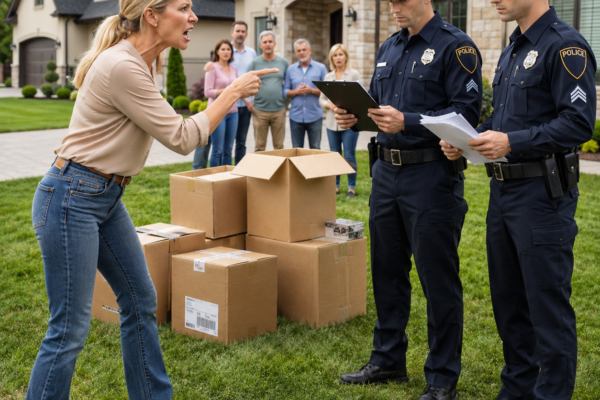
HOA President Sent 3 Bulldozers to Destroy My Ranch Gate—She Didn’t Know I Was the County Sheriff.h
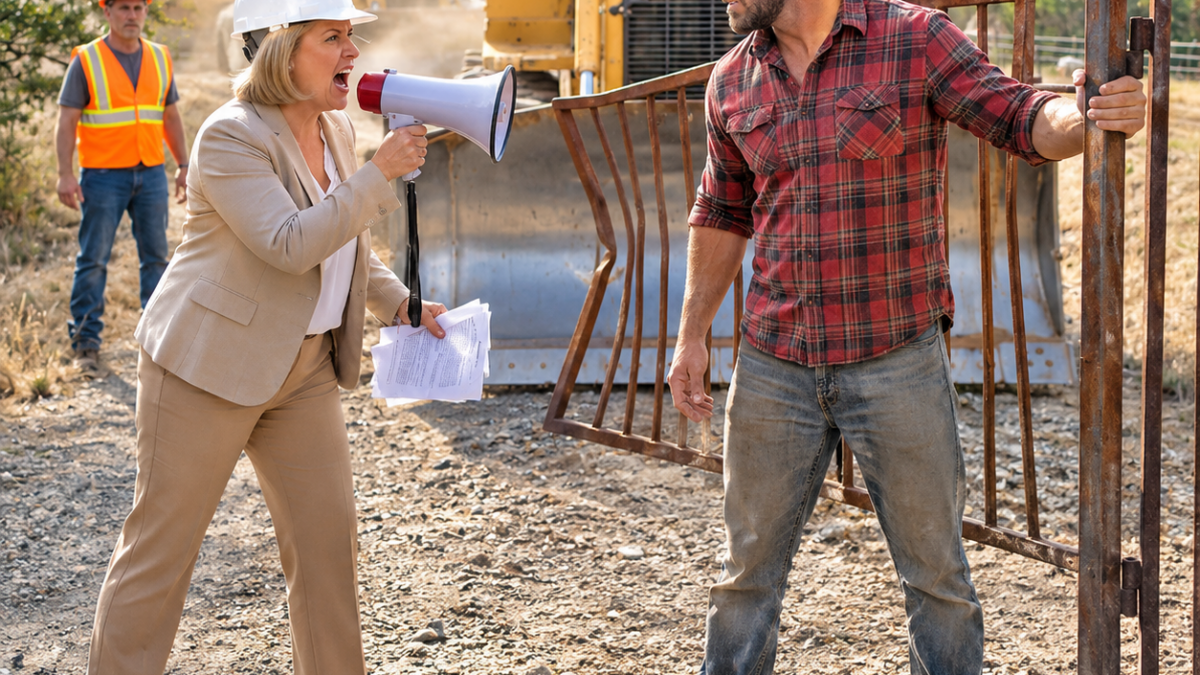
HOA President Sent 3 Bulldozers to Destroy My Ranch Gate—She Didn’t Know I Was the County Sheriff.
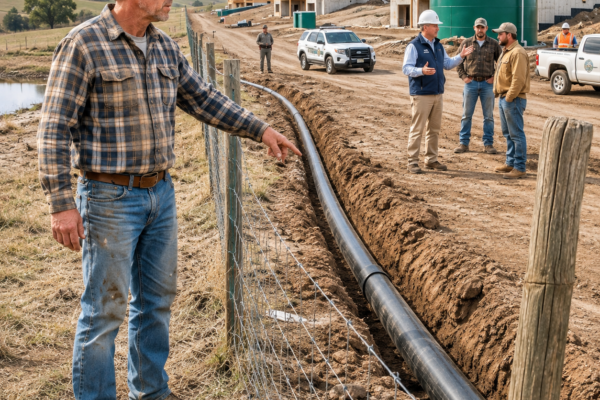
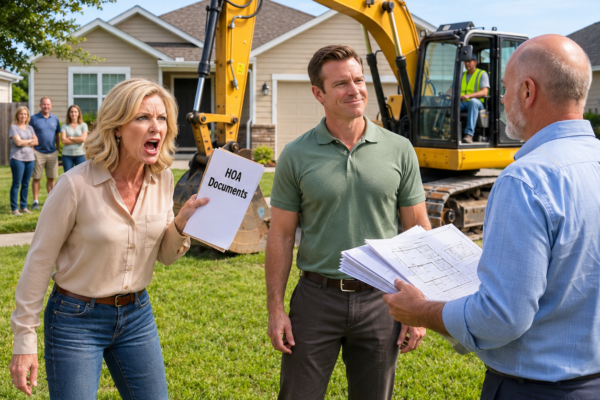
At 8:17 on my day off, I heard diesel engines coming up the county road and walked half a mile down my ranch driveway to find three Caterpillar bulldozers parked in front of the iron gate my grandfather welded in 1978.
Standing beside them in a brand-new white hard hat was Braylen Wilson, president of the HOA next door.
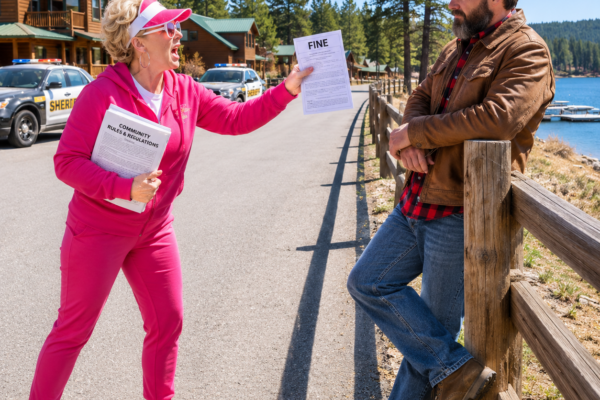
She had spent three weeks telling me my gate was an “eyesore” that violated Oakridge Heights’ architectural standards.
There was one problem.
My fifty-acre ranch wasn’t in Oakridge Heights.
It had been in my family since 1952.
The HOA boundary stopped nearly a hundred feet away.
I had shown Braylen the survey.
She sent violation notices anyway.
Then code complaints.
Then animal-control complaints.
Finally, she hired a demolition contractor and told them the gate was an HOA-controlled hazard authorized for removal.
The foreman looked uncomfortable when I arrived.
“Sir, she says the board has authority.”
“She doesn’t.”
I pointed to the survey monument.
“That machine crosses this line, you’re on private property.”
Braylen shouted from behind him:
“Push it down.”
The foreman didn’t move.
Smart man.
He wanted somebody independent to confirm what he’d been told.
So did I.
I pulled out my phone and called county dispatch.
But I made one thing clear:
“I’m the property owner in this complaint. Send the on-duty supervisor and request state assistance if needed. I’m not directing the investigation.”
Braylen laughed.
“You’re calling the sheriff on yourself?”
“Something like that.”
Nine minutes later, two marked units came around the bend.
Sergeant Harrison stepped out.
He looked at the bulldozers.
Then the gate.
Then me.
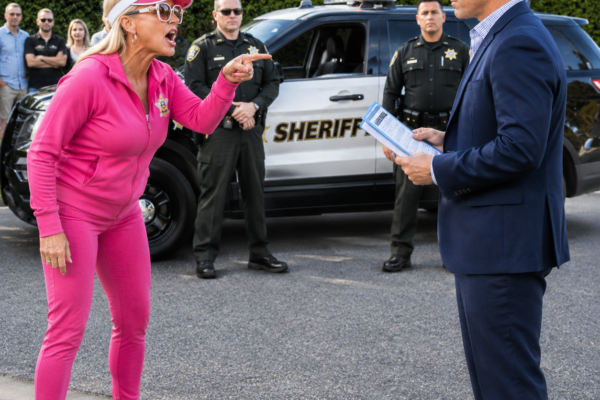
“Morning, Sheriff.”
Braylen stopped breathing for about three seconds.
I had been the elected county sheriff for ten years.
I simply hadn’t told her because I refused to use my badge to win a private property argument.
And I still wasn’t going to.
I handed Harrison my survey.
Then stepped back.
“This is my land. You handle it.”
That decision ended up hurting Braylen far more than if I had started barking orders.
Because once deputies, the county surveyor, the contractor’s insurer, and the HOA’s own attorney started comparing her paperwork to the recorded property lines, they found something much worse than an ugly gate.
Braylen hadn’t just misunderstood where her authority ended.
She had been telling other people she had authority she had never possessed.
[END OF FACEBOOK CAPTION]
[FIRST COMMENT / FULL STORY CONTINUATION]
Sergeant Harrison did not salute.
That is one of the first things the internet version always gets wrong.
He also did not immediately grab Braylen Wilson, spin her around, handcuff her, and announce that she had chosen the wrong rancher to mess with.
He looked at me.
Then at the three bulldozers.
Then at the iron gate.
Then at Braylen.
“Sheriff?”
“Morning.”
“You want to tell me what’s going on?”
“I’m the complainant.”
That changed his expression.
Not dramatically.
Just professionally.
“All right.”
“I’m off duty. This is my property.”
“Understood.”
“I’ve told the contractor I do not consent to entry or removal.”
“Understood.”
“And because I’m personally involved, I don’t want to direct your response.”
Harrison nodded.
“Good.”
Behind him, Deputy Wyatt had stepped out of the second unit and was already looking at the survey pin beside the road.
I continued.
“If this turns into a criminal investigation, call the district attorney and state bureau. I’m not making charging decisions on my own case.”
Braylen stared at me.
The new white hard hat seemed ridiculous now.
Not because she had suddenly become powerless.
Because the entire performance had been built around an assumption.
She thought I was a stubborn rancher she could overwhelm with official-looking paper.
She had not understood that I spent my working life dealing with official-looking paper.
More importantly, she had not understood that I knew exactly how dangerous it would be for me to start using my office after becoming personally angry.
Harrison looked toward the contractor.
“Who’s foreman?”
A heavyset man in a faded ball cap raised his hand.
“Gail Preston.”
“Company?”
“Preston Earthworks.”
“Everybody shut equipment down.”
Gail did not hesitate.
He waved at the operators.
Three diesel engines coughed down one after another.
The silence afterward was almost shocking.
Metal ticking as exhaust cooled.
Wind through scrub oak.
One of my dogs barking from somewhere up the hill.
Harrison said:
“Nobody moves a machine until we figure out whose property we’re standing on and what paperwork you were given.”
Braylen stepped forward.
“We already know.”
Harrison looked at her.
“Ma’am, I’m going to need your name.”
She blinked.
“You know who I am.”
“I don’t.”
That was almost funny.
“Braylen Wilson. President of Oakridge Heights.”
“Okay.”
She pointed toward me.
“This man has ignored multiple lawful HOA directives.”
Harrison glanced at me.
Then back at her.
“Is his property in your HOA?”
“It directly impacts our subdivision.”
“That wasn’t my question.”
Her jaw tightened.
“The gate fronts a shared visual corridor.”
Wyatt looked down at his notebook.
I watched him write something.
Probably:
shared visual corridor.
Braylen continued.
“Our board determined the structure was hazardous and inconsistent with the character of the community.”
Harrison said:
“Do you have a court order?”
“No.”
“County condemnation order?”
“The county has been notified.”
“Is that a yes?”
“No.”
“Building official order?”
“No.”
“Written owner consent?”
“No.”
She exhaled sharply.
“This is not a normal private-property situation.”
Harrison looked toward my gate.
It was iron.
Ugly.
Rust along the bottom rail.
Two thick posts set in concrete.
My grandfather had built it when Jimmy Carter was president.
Nothing about it looked normal.
Harrison said:
“What makes it abnormal?”
“The road serves Oakridge Heights.”
I answered before I could stop myself.
“The county road serves Oakridge Heights. My driveway serves me.”
Harrison looked at me.
I raised both hands.
“Sorry.”
“Please let me do this.”
Right.
That was harder than you might think.
When you have worn a badge long enough, answering questions becomes automatic.
When you are sheriff, people expect decisions.
Standing on my own property and deliberately becoming just another witness felt unnatural.
Necessary.
But unnatural.
Harrison turned back to Braylen.
“You hired the equipment?”
“The board authorized remediation.”
“Do you have the authorization?”
“Yes.”
She held out a folder.
Not a crumpled forgery with a fake county seal.
That part of the story got exaggerated later.
What she had was more believable.
And in some ways more troubling.
Oakridge Heights letterhead.
A board work authorization.
Photographs of my gate.
A parcel map.
An email chain.
A contractor scope:
REMOVE DETERIORATED STEEL GATE/OBSTRUCTION ADJACENT TO SOUTH GREENBELT ACCESS.
RESTORE SHOULDER.
INSTALL HOA-APPROVED ENTRY SCREENING SUBJECT TO OWNER COST RECOVERY.
Gail said:
“She told us it was HOA-controlled land.”
Braylen snapped:
“I told you it was within the community-control corridor.”
Gail looked at her.
“That’s not what you told me.”
There.
Small sentence.
Big difference.
Harrison asked Gail:
“Did you verify title?”
“No.”
“Survey?”
“She sent this.”
He pointed to the map.
Wyatt took the folder.
The map was a county GIS printout.
Anyone can print one.
GIS maps are useful.
They are not surveys.
Someone had added a thick red line labeled:
OAKRIDGE SOUTH ACCESS / HOA MAINTENANCE CONTROL.
The red line crossed my entrance.
That label did not exist on the county map.
It had been added.
Whether Braylen added it herself or somebody else had would become important later.
At the time, Harrison simply asked:
“Where did this annotation come from?”
Braylen said:
“Our architectural committee.”
“Is anyone on that committee a licensed surveyor?”
Silence.
“No.”
Harrison turned to Gail.
“You were going to demolish based on this?”
Gail looked embarrassed.
“We also had her representation the HOA controlled the strip.”
“Any permit?”
“She said no permit was required for removing their own gate.”
That made my stomach tighten.
Their own gate.
My grandfather’s gate had somehow become theirs in the paperwork.
I walked away ten feet.
Not because I feared losing my temper physically.
Because I knew my face.
Braylen had come to my ranch three weeks earlier with an almost identical certainty.
She was driving a white Range Rover.
Parked across the end of my driveway.
Not fully blocking a public road like later versions claimed.
But enough that I had to stop.
I was headed to work.
Old Ford.
Coffee.
Radio clipped to my belt under a jacket.
No uniform.
She stood at my gate with an iPad.
“Are you the tenant?”
That was her first question.
Not:
Are you John Miller?
Not:
Do you own this?
Tenant.
I said:
“I own it.”
She looked at my flannel shirt.
Boots.
Grease on one hand from a tractor battery I had changed before leaving.
Something in her face made it clear she had already built a profile.
Not necessarily poor.
Not necessarily stupid.
But someone outside the world she understood.
She introduced herself.
Braylen Wilson.
HOA president.
Then told me my gate violated Oakridge Heights standards.
I said:
“I’m not in Oakridge Heights.”
She said:
“You are immediately adjacent.”
“I know.”
“The gate is directly visible from our southern entrance.”
“I know.”
“It impacts community aesthetics.”
“I’m sure.”
Then she gave me a replacement brochure.
Powder-coated aluminum.
Stone columns.
Motorized opening.
The HOA would pay half.
That was actually generous if you ignored the part where I had never asked for a new gate.
I said:
“No.”
She asked why.
I touched the old iron.
“My grandfather built it.”
“That doesn’t make it safe.”
“It is safe.”
“It’s badly corroded.”
“Surface rust.”
“It looks abandoned.”
“I use it every day.”
She held out the notice.
“Section Four requires approved entry structures.”
“On HOA lots.”
She stared.
I went to the truck.
Pulled out a copy of my survey.
Yes.
I kept property documents in the glove box.
Occupational hazard.
The Oakridge boundary stopped almost one hundred feet down the road.
My fifty acres had been in the Miller family since 1952.
The developer bought adjoining ranchland decades later.
There was an easement connecting a greenbelt trail to the county shoulder near my southeast corner.
That easement did not include my gate.
Did not include my driveway.
Did not annex my property.
Braylen looked at survey.
Then said:
“Our attorney may interpret this differently.”
“Your attorney is welcome to call mine.”
That irritated her.
Not because it was rude.
Because it ended the conversation.
She wanted resolution on site.
I wanted documents.
She left saying:
“You have until the end of the month.”
I remember touching the gate after she drove away.
Granddad’s welds were ugly.
He had never believed in grinding anything smooth if it was strong.
The top bar leaned half an inch.
One hinge screeched.
The latch needed two hands in winter.
Sarah—my late wife—used to call it the world’s least welcoming entrance.
When she was alive, she kept asking me to oil the hinge.
I always said:
“Then how will I know who’s coming?”
She would roll her eyes.
The sound became part of the ranch.
After Sarah died, everything became louder because the house was quieter.
Gate.
Wind.
Dogs.
Coffee mug hitting porch rail.
I had lost her four years before Braylen arrived.
Cancer.
Fast at the end.
She had been a county school counselor.
Everyone knew her.
That is one of the strange things about being sheriff in the county where you grew up.
People know your family before they know your office.
Grief becomes public.
Then gradually private again.
The ranch was where I did not have to be Sheriff Miller.
No cameras.
No campaign events.
No calls unless serious.
Just John.
That was why I never told Braylen what I did.
Not to set a trap.
I simply did not want to use it.
She asked:
“What could you possibly do that requires keeping something like this?”
That part from the source was close.
She was angry.
I had told her to move the Range Rover because I needed to leave.
She said:
“What exactly do you do?”
I answered:
“County work.”
Technically true.
She heard:
road crew.
Maintenance.
Something blue collar.
Maybe that influenced her.
Maybe not.
I did not ask.
I could have shown badge.
Would have ended some of it.
Maybe.
But that would have turned a property disagreement into:
Sheriff versus HOA president.
I did not want that.
The law should have been enough without my title.
For three weeks, Braylen tested that belief.
Code enforcement complaint.
She claimed rusting equipment and possible fluid leakage.
County environmental inspector came.
Not my poker buddy laughing on the radio.
I knew him professionally, which was exactly why I made sure another inspector signed the closure.
They found:
One antique tractor.
Stored under cover.
No active leak.
Diesel tank compliant.
Used oil in approved containers.
No violation.
I signed acknowledgment like anyone else.
Then animal control.
Barking complaint.
My dogs, Scout and Molly.
Both rescues.
They barked when coyotes got close.
A deputy from animal services came after hours.
Listened.
No nuisance pattern.
Closed.
Then her lawyer’s letter.
That one was not comically fake.
It argued the gate created a potential hazard adjacent to a recreational corridor and requested replacement or screening.
My personal attorney, Daniel Brooks, answered:
No HOA jurisdiction.
No evidence of hazard.
Do not enter.
Do not alter.
Do not attach anything.
That should have mattered.
The bulldozers arrived six days later.
Which brought us back to Harrison holding Braylen’s folder.
He called county dispatch.
Not because I told him.
Because he needed the on-call county survey technician and road supervisor.
Then he called the district attorney’s office.
He explained:
Sheriff personally involved.
Potential property damage.
Possibly misleading documents.
Need independent guidance.
The DA requested state investigators be notified if evidence suggested document falsification or official impersonation.
Again:
No one yelled felony.
No one slapped cuffs on Braylen because I was sheriff.
We waited.
That was humiliating for her.
Not because she was under arrest.
Because contractors were standing around billing somebody by the hour while everyone checked what she had treated as settled.
Gail walked over to me.
“Sheriff?”
“John.”
“I wish you’d told me.”
“Would it have changed whether you crossed the line?”
He paused.
“That is a fair question.”
“Would it?”
He looked toward the gate.
“I should have verified anyway.”
Good answer.
“I told your operator to stop.”
“He did.”
The blade had not hit the gate.
That is another source exaggeration I am correcting.
The lead bulldozer had rolled forward several feet after Braylen shouted.
Gail stopped it before the blade crossed the survey line.
Close.
Too close.
But no clang.
No bent steel.
No crushed gate.
The most important thing that happened that morning was what didn’t happen.
A contractor listened to the bad feeling in his stomach before turning a paperwork dispute into irreversible destruction.
I respected Gail for that.
Braylen did not.
She walked over.
“You are in breach of contract.”
Gail said:
“I’m not demolishing private property while a deputy is telling me ownership is disputed.”
“I’m paying you.”
“Not enough.”
That line made Wyatt cough into his sleeve.
The county survey technician arrived.
Melissa Chen.
Licensed surveyor working contract for county transportation division.
She brought recorded plats.
Not there to settle private title by herself.
But enough to locate the county right-of-way and compare recorded documents.
She found the pin.
Then another.
Measured.
My gate sat wholly inside my parcel.
Nearest HOA-controlled greenbelt strip:
More than eighty feet away at its closest point.
Melissa said:
“There is no county record in this file showing HOA maintenance rights extending to this gate.”
Harrison looked at Braylen.
“Do you have another recorded instrument?”
She said:
“Our attorney does.”
“Can you produce it?”
“Not here.”
“Then nobody is touching the structure today.”
That should have ended the morning.
Then Wyatt asked about the red line.
“Who added this?”
Braylen said:
“It came from our property manager.”
Gail spoke.
“No.”
Everyone looked at him.
He retrieved his phone.
Opened email.
The map attachment had come directly from Braylen.
Subject:
COUNTY-VERIFIED SOUTH CORRIDOR.
The email body:
Attached is the county-confirmed control map showing HOA maintenance authority through the gate area. No private-owner approval is required for hazard removal.
County-confirmed.
That phrase was a problem.
Harrison asked:
“Who at the county confirmed it?”
Braylen looked at me.
For the first time, not angry.
Worried.
“Our management team was told—”
“By who?”
“I’d have to check.”
Harrison nodded.
“Then check.”
He photographed documents.
Collected copies voluntarily from Gail.
Braylen’s attorney was called.
Not arrested.
No vehicle search.
No impoundment.
No dramatic chase.
State investigator later interviewed everyone.
That process took weeks.
The bulldozers left before noon.
Gail refused to bill me.
I told him:
“You weren’t working for me.”
“I know.”
“Bill the person who hired you.”
He smiled.
“That’s the plan.”
Braylen stayed until the equipment was gone.
Then she walked toward her Range Rover.
I said:
“Braylen.”
She stopped.
This was the first time I addressed her after deputies arrived.
“You knew Daniel sent your attorney the survey.”
Her face tightened.
“Yes.”
“Then why are we here?”
She looked at the gate.
Not me.
“Because the board voted to remove a hazard.”
“Did the board see the survey?”
Silence.
There it was.
“Did they?”
She said:
“They saw management’s property map.”
My stomach dropped.
“Your map?”
“Our map.”
“That is not what I asked.”
She finally looked at me.
“I prepared the presentation.”
Then she left.
That sentence became more important than any badge reveal.
I drove home.
The gate squealed.
Granddad’s hinge.
Same as always.
I sat on porch.
Scout at my boots.
Molly chasing something invisible near fence.
My coffee was cold.
I should have felt victorious.
Instead I felt tired.
Because I knew what came next.
Reports.
Conflict disclosures.
Press inquiries.
Board meetings.
State investigators.
And because I was sheriff, every action I took would be viewed through that lens.
Daniel called.
“I heard.”
“Of course you did.”
“You okay?”
“Yes.”
“Gate?”
“Fine.”
“Good.”
Then:
“Do not call Braylen.”
“I already spoke one sentence.”
“What?”
“Asked if the board saw survey.”
“What did she say?”
“No.”
Daniel went quiet.
“Well.”
“Yeah.”
“Do not do anything else.”
“Why does every lawyer think I’m twelve?”
“Because you are personally offended and carry institutional authority.”
Fair.
Then county manager called.
Then county attorney.
Then local newspaper.
I declined comment beyond:
A private property dispute occurred at my residence this morning. Because I am personally involved, I have requested that the investigation be handled without my direction. Questions regarding any criminal review should be directed to the district attorney and investigating agency.
Boring.
Perfect.
Braylen gave a statement too.
She said:
Oakridge Heights had acted in good faith based on its understanding of property-control documents and safety obligations.
Also boring.
Also wise.
For forty-eight hours, the world waited.
Then Oakridge residents started asking questions.
The HOA board held an emergency meeting.
I did not attend.
Important.
This was their governance issue.
Daniel attended as my civil counsel for one agenda item:
Notice of no entry onto Miller property.
The rest was theirs.
Board had seven directors.
Braylen was president.
Three had voted for “remediation.”
What they had actually approved mattered.
Minutes showed:
Motion to authorize legal and maintenance action necessary to address the deteriorated gate adjacent to southern greenbelt, subject to counsel confirmation of association authority.
Subject to counsel confirmation.
There.
Counsel had not confirmed.
The HOA attorney had sent Braylen an email:
Based on materials presently available, we cannot confirm that the gate is located on association property or within an enforceable HOA easement. No physical removal should occur until survey/title questions are resolved.
That email was five days before bulldozers arrived.
The rest of the board had not seen it.
Braylen had told them counsel was “reviewing final procedural details.”
That was not the same thing.
Now we had a governance problem.
Did she deliberately lie?
Maybe.
Did she withhold material legal advice?
Yes.
The board suspended her as president pending investigation.
Not kicked off board immediately.
Their bylaws let directors remove an officer role but member vote handled elected seat.
Vice president Henry Alvarez took over.
Retired engineer.
Quiet.
He immediately sent me a letter.
Mr. Miller,
Oakridge Heights acknowledges it has no present authority to enter or alter your gate. No contractor or association agent will enter your parcel without your written permission or lawful emergency authority.
That was the letter I wanted three weeks earlier.
One page.
Problem could have ended.
Instead we were at the beginning of a larger one.
State investigators traced the map.
The base layer was county GIS.
The red corridor line had been added in a PDF-editing program.
Metadata showed the file created on Braylen’s HOA laptop.
Was that a forged government document?
Not automatically.
It still carried county logo from base map.
Her label said county-confirmed.
That could constitute a misrepresentation.
Criminal classification depended on intent and statute.
The DA did not rush.
Good.
They interviewed:
Braylen.
Property manager.
Board.
HOA attorney.
Gail.
County survey office.
Me.
I insisted my interview happen at state investigator’s office.
Not mine.
No uniform.
No sheriff desk.
Just John Miller.
That mattered to me.
Investigator asked:
“Did you ever tell Ms. Wilson you were sheriff?”
“Not before the incident.”
“Did you threaten arrest?”
“No.”
“Use county resources to research her?”
“No.”
“Direct code personnel to reject HOA complaints?”
“No.”
“Contact their supervisors?”
“No.”
“Why not tell her?”
“I didn’t think my job mattered.”
“Did you enjoy the moment she found out?”
I smiled.
“A little.”
He smiled too.
“Fair.”
Then:
“Do you want charges?”
I hated that question.
Not because victims should not have opinions.
Because people think sheriff can order criminal consequences.
“I want you and the DA to decide what evidence supports.”
“Civil damages are my lawyer’s problem.”
That answer felt right.
The DA eventually concluded the strongest provable conduct was not some massive felony conspiracy.
Braylen had knowingly authorized contractors to enter property after being advised ownership and authority were disputed.
She had represented an annotated map as county-confirmed without actual confirmation.
No gate was destroyed because the contractor stopped.
That limited damage.
The criminal case resolved months later through a plea to a misdemeanor offense related to attempted unlawful entry/property interference and a separate false-document representation count under applicable local law.
Probation.
Community service.
Restitution for my survey/legal costs tied directly to the incident.
No prison.
No lifetime nationwide ban on serving HOA boards.
The HOA removed her through its own process.
That separation mattered.
Criminal court is not a homeowners-association personnel department.
The board investigation was harsher in a different way.
Because it found the bulldozers were not an isolated decision.
Braylen had been elected eighteen months earlier.
Oakridge Heights was relatively new.
Eighty-five homes.
Expensive.
The developer had turned over control to residents.
The first resident board was disorganized.
Late budgets.
Landscape vendors unpaid.
Greenbelt maintenance uncertain.
Braylen came from corporate facilities management.
She was good at systems.
She built:
Vendor list.
Maintenance calendar.
Complaint tracking.
Reserve contributions.
Architectural review workflow.
Residents loved it.
Until the system became an extension of her certainty.
The review found several cases where she had ordered minor work beyond board authorization:
Trimmed vegetation along disputed boundary.
Removed an abandoned sign on land later confirmed county-owned.
Directed a contractor to repaint utility boxes without utility approval.
Nothing catastrophic.
Most had never been challenged because outcomes looked better.
That is how overreach becomes habit.
If people like the result, nobody asks where authority came from.
Then one day the same instinct arrives with three bulldozers.
Henry Alvarez said at the member meeting:
“We rewarded decisiveness.”
“We forgot to require verification.”
That was fair to everyone.
Braylen spoke.
Yes.
She attended.
No dramatic disappearance.
No lawyer preventing her.
She said:
“I believed the gate was unsafe and damaging the entrance corridor.”
Some residents murmured.
She continued.
“I believed Oakridge had authority.”
Henry interrupted gently.
“Even after counsel told you that was unconfirmed?”
Braylen looked at him.
“That email was cautious.”
“It said no physical removal.”
“Yes.”
“Did you provide it to the board?”
“No.”
“Why?”
She paused.
“Because I believed counsel was being overly conservative.”
There.
The whole case.
Not:
I hated John.
Not:
I wanted his ranch.
She believed caution was weakness.
She believed her judgment could fill the gap.
Then she said:
“I should have shown you.”
“Yes.”
“I should have waited for a survey.”
“Yes.”
“I should not have represented the map as county-confirmed.”
“Yes.”
No excuses.
Then:
“I was also under pressure.”
That was where human part came.
The southern entrance had been a problem.
Potential buyers complained about the view.
Three owners had emailed about my rusted gate.
One real-estate agent had suggested screening.
A child riding a bike had once gotten too close to the driveway opening because the greenbelt trail curved nearby.
The HOA’s insurer had asked about separation between trail and road.
Real issues.
None gave them ownership of my gate.
Braylen combined:
Aesthetic complaint.
Trail-safety concern.
Property-value anxiety.
Then decided removal solved all three.
She could have asked for:
Vegetative screening on their land.
Trail relocation.
Fence.
Safety sign.
Offer to purchase screening easement.
Any number of lawful choices.
Instead she treated my gate as the obstacle.
And obstacles, in her professional life, were things you scheduled equipment to remove.
I understood her better after hearing that.
Still voted? I could not vote.
Not member.
Oakridge residents did.
Recall petition qualified.
Final vote:
58 remove.
21 retain.
6 abstain/not returned.
Braylen lost her board seat.
No cheering.
Henry had asked people beforehand not to turn it into humiliation.
I respected that.
Braylen left meeting.
Then stopped near me.
I had attended only because members asked me to answer questions.
She said:
“You knew they would remove me.”
“No.”
“Yes.”
“You’re sheriff.”
“That has nothing to do with HOA vote.”
Her eyes flashed.
Then softened.
“I suppose that’s the point.”
Maybe.
She walked away.
The civil side took longer.
My gate was not destroyed.
So no dramatic replacement with fortress walls at HOA expense.
One operator had rolled close enough to scrape a shallow rut in the gravel shoulder.
Preston Earthworks repaired it voluntarily.
My direct damages:
Survey.
Attorney.
Security camera installation at gate.
Time.
Contractor mobilization was Braylen’s problem with HOA.
The association’s insurer entered.
They wanted settlement.
Daniel asked:
“What do you want?”
“Leave me alone.”
“That is not a settlement term.”
“It can be.”
He smiled.
We proposed:
-
Written acknowledgment Miller Ranch is outside Oakridge HOA jurisdiction.
Recorded boundary memorandum referencing survey.
HOA agrees no agents, contractors, signs, landscaping, or equipment cross onto my parcel without written permission except genuine emergency/legal authority.
HOA relocates greenbelt trail farther from driveway at its own expense to resolve safety concern.
HOA installs its own landscape screening entirely on HOA property if desired.
Reimbursement of documented legal/survey costs.
No gag clause preventing truthful discussion of public proceedings, but both sides agree no harassment.
Gate remains.
They accepted most.
Negotiated wording.
No stone fortress wall.
I did not want one.
Why would I block a view I had enjoyed for decades because Braylen hated my gate?
We did agree on a split-rail buffer near the greenbelt trail.
Not on my property.
The HOA planted native scrub oak and juniper behind it.
Within three years, houses were less visible from my driveway anyway.
Natural.
Better.
The gate got repaired too.
Not because bulldozer damaged it.
Because the incident forced me to admit Braylen had one point.
The hinge was terrible.
A local welder named Luis Ortega came.
I asked:
“Can you make it safer without making it look new?”
He laughed.
“You want restored ugly.”
“Exactly.”
He reinforced lower hinge.
Replaced one worn pin.
Stabilized latch.
Removed flaky rust.
Applied clear protective treatment that left most old iron visible.
The hinge still squealed.
I told him to preserve that.
He stared.
“You’re paying extra for noise.”
“Yes.”
“People are weird.”
Correct.
I paid.
The HOA did not.
Because restoration beyond their actual damage was mine.
I liked that.
The gate remained Granddad’s.
Not HOA-funded monument to conflict.
Gail Preston came back after settlement.
No bulldozer.
Pickup.
He brought beer.
“Peace offering.”
“You didn’t hit the gate.”
“I almost did.”
“You stopped.”
“About four seconds before making my insurance agent cry.”
We sat on porch.
He explained what happened.
Braylen called his office saying HOA needed hazardous structure removed.
Sent work order.
Map.
Board authorization.
Deposit.
His project coordinator asked:
“Any private-owner notice?”
Braylen replied:
Owner has been notified and cure period expired.
Technically true.
Notice had been sent.
But:
Owner consent not obtained.
Jurisdiction disputed.
Counsel warned against removal.
Those facts were omitted.
Gail said:
“I should have asked for title.”
“Yes.”
“You ever verify title on fence-removal jobs?”
“Now?”
“Yes.”
“Every time.”
Good.
Preston Earthworks changed policy.
Any demolition within ten feet of a disputed property line:
Survey or written owner authorization.
If third party hires removal of structure:
Proof of ownership/control.
No exceptions based on customer confidence.
That was a real outcome I liked.
Systems improve when mistakes become procedures.
Gail said:
“Braylen threatened to blackball us.”
“That true?”
“She said Oakridge would never use us again.”
“Not state contracts?”
He laughed.
“Internet version got ambitious.”
Exactly.
His company did not blacklist Oakridge forever either.
Two years later they bid drainage project.
Won.
Different board.
Proper scope.
No reason to punish eighty-five homes because one president made bad decision.
That is another lesson revenge stories hate.
Institutions contain people.
People change.
Do not confuse organization forever with one leader at one moment.
Henry Alvarez became HOA president.
Reluctantly.
His first action:
Get a current boundary survey of all common property.
He said:
“I would like never to discover another surprise ranch.”
Good.
They found:
Two landscaping beds slightly outside HOA parcel.
One trail segment crossing utility land without clear license.
A monument sign partly inside county sight triangle.
Nothing criminal.
They corrected.
The whole subdivision became more legally tidy because of one ugly gate.
Henry also created:
Authority checklist for contractors.
Who owns property?
What easement?
What board vote?
Any permit?
Any affected owner notice?
Any counsel caution?
If red flag:
Stop.
Boring.
Excellent.
Oakridge did not become anti-HOA.
It remained strict.
They still required approved exterior colors.
Still limited RV parking.
Still cared about lawns.
That was what owners bought.
Fine.
Their rules stopped at my boundary.
That was all I needed.
Braylen stayed in Oakridge.
Internet says she moved out of state in shame.
No.
Her husband liked the house.
Grandchildren nearby.
Mortgage good.
She had friends.
Why should she leave?
First year was awkward.
I saw her at grocery store.
We nodded.
Nothing more.
Then county wildfire season.
Dry summer.
A brush fire started near highway.
Wind pushed toward Oakridge.
My office coordinated evacuations.
I was sheriff.
That time badge absolutely mattered.
We opened emergency route through ranch pasture because the normal subdivision entrance risked smoke closure.
Oakridge residents drove across my property under emergency direction.
Including Braylen.
She was in the Range Rover.
Stopped briefly near me.
Window down.
“Thank you.”
“Keep moving.”
Not hostile.
Emergency.
Later fire contained.
No homes lost.
The temporary route showed something important.
Boundaries matter.
So do emergencies.
A good boundary system includes lawful ways to cross when life and safety require.
That is very different from:
I dislike your gate.
Therefore bulldozer.
Months after fire, Braylen contacted Daniel.
Asked if I would meet.
Neutral place.
County coffee shop.
Not sheriff office.
I agreed.
She arrived early.
No blazer.
Sweater.
Looked older.
Conflict does that.
She said:
“I owe you an apology.”
I waited.
“For the gate.”
“Yes.”
“For the contractor.”
“Yes.”
“For the map.”
“Yes.”
Then:
“And for assuming I knew what kind of man you were because of the ranch.”
That one surprised me.
She continued:
“I thought you were enjoying being difficult.”
“I was.”
She smiled slightly.
“Sometimes.”
“Okay.”
“But I thought you were someone who didn’t care about everyone else.”
“Because gate was rusty?”
“Because you refused everything.”
I thought.
“I refused changing my property for your HOA.”
“I know.”
“Now.”
“Yes.”
She looked at coffee.
“I did not know you were sheriff.”
“I know.”
“Would I have sent bulldozers if I had?”
That question hung.
She answered herself.
“No.”
I did not know how to feel about that.
She continued:
“That is the part I’m most ashamed of.”
“Not because sheriff deserves more respect.”
“Because it means I knew power could stop me.”
“I just thought you didn’t have any.”
There.
That was the best apology I ever received.
Not:
I misunderstood the survey.
Not:
I was protecting values.
She understood the deeper flaw.
She had treated legal boundaries as negotiable depending on who stood behind them.
I said:
“The ranch should have been enough.”
“Yes.”
“The survey should have been enough.”
“Yes.”
“My lawyer’s letter should have been enough.”
“Yes.”
She nodded.
“I know.”
We sat.
Then I asked:
“Why the hard hat?”
She actually laughed.
“I thought contractors required it.”
“Brand-new sticker was still on.”
“I know.”
“People noticed.”
“I know.”
Good.
I forgave her.
Not because apology erased.
Because carrying resentment after the system had corrected seemed pointless.
That did not make us friends.
But we became civil.
She later joined county conservation nonprofit.
No leadership for first year.
Then committee.
Trail planning.
Irony.
She became obsessed with property permissions.
Every proposed trail:
Ownership.
Easement.
License.
Consent.
Someone joked she had become “the boundary lady.”
I liked that.
Consequences that produce competence are better than consequences that produce only shame.
The criminal plea eventually came off probation.
No further issues.
She fulfilled community service.
Part of it with conservation group.
The record remained according to applicable law.
I never checked after.
Not my business.
My office never handled it.
State investigators and DA did.
That separation protected everyone.
One reporter asked:
“Sheriff, do you think your position helped you get justice faster?”
I answered:
“I think my position created extra responsibility to stay out of decisions.”
He looked disappointed.
Not headline material.
Then I added:
“If this had happened to a rancher who wasn’t sheriff, the survey should have mattered exactly the same.”
That became the quote.
Good.
Because that was the point.
My badge should not be required to stop a bulldozer at a private gate.
A contractor seeing dispute should stop.
A deputy seeing documents should investigate.
A board seeing counsel warning should wait.
A survey should have weight whether owner is sheriff, teacher, mechanic, retiree.
The fact Braylen behaved differently after learning my job was part of the problem.
We spent the next few years trying to make system less dependent on status.
County contractor association invited Gail and me to speak.
Title:
Working Near Property Lines: Stop-Work and Verification.
Not sexy.
Forty contractors attended.
Gail told story.
“I almost drove a D6 into the sheriff’s grandfather’s gate.”
Everyone laughed.
Then he said:
“The lesson isn’t don’t mess with sheriff.”
“It’s don’t let a client substitute confidence for documentation.”
Exactly.
We gave:
Checklist.
Survey.
Owner authorization.
Right-of-way.
Easement.
Utility locates.
Stop if disputed.
Call project manager.
No operator should be forced to decide title from cab.
That mattered.
I also revised sheriff’s office conflict policy.
We already had general recusal rules.
I wanted clearer.
If sheriff/deputy is personally involved as victim, landowner, family member:
On-duty supervisor takes scene.
Outside agency notified when feasible for investigative decisions.
Prosecutor determines charges.
Involved officer does not direct evidence collection beyond immediate safety.
People teased.
“John Miller rule.”
I said:
“Fine.”
Good policies often come from uncomfortable mornings.
I retired as sheriff five years later.
Three terms plus part.
Enough.
My knees worse.
County changing.
I wanted porch.
The retirement ceremony had speeches.
Deputy Harrison—now captain—told bulldozer story.
He said:
“First time I arrived at sheriff’s house and he told me to ignore him.”
People laughed.
Then:
“Also first time an HOA president tried to brief me using an architectural guideline binder.”
More laughter.
I told him he exaggerated.
He did.
Slightly.
Braylen sent a card.
Not attended.
Inside:
Congratulations on retirement. I assume the gate will now be even less regulated.
I wrote back:
It has applied for sovereign status.
She replied:
Denied.
We were fine.
The ranch stayed.
I never sold.
My niece and nephew will inherit eventually.
I finally documented everything better.
Survey.
Recorded boundary memorandum.
Greenbelt agreement.
Emergency-access route license only for declared emergencies and training.
Utility lines.
Maps.
No future HOA president should need to guess.
I added a plaque to gate?
No.
Absolutely not.
I considered:
PRIVATE RANCH
NO HOA AUTHORITY
Too petty.
Daniel said:
“Please don’t.”
I didn’t.
Gate itself said enough.
Old.
Heavy.
Clearly not theirs.
One winter hinge finally cracked.
Not rust.
Metal fatigue.
Luis returned.
“You still want squeak?”
“Yes.”
“You are insane.”
“Probably.”
He fabricated a new hinge modeled after old.
We intentionally left it slightly vocal.
Not shrieking like before.
More groan.
Age.
Like me.
Granddad would approve.
The three bulldozers became legend.
People say:
They attacked gate.
No.
They arrived.
One moved close.
Contractor stopped.
That is better.
The story’s satisfaction comes from destruction prevented, not destruction answered.
I did not need gate crushed to prove point.
I did not need Braylen dragged into cruiser screaming.
I did not need HOA bankrupt.
I did not need stone fortress wall.
I needed:
Stay off my land unless you have right.
That happened.
Everything after was cleanup.
The most important person that morning might have been Gail.
Not me.
Not Harrison.
Gail had a client shouting.
Deposit paid.
Equipment mobilized.
Crew waiting.
He still stopped.
There is moral courage in refusing an irreversible act when facts stop making sense.
He could have said:
I’m just following work order.
Then pushed.
Gate damaged.
Machine maybe damaged.
Civil claims.
Insurance.
More charges.
Instead:
Wait.
That word saved everyone money.
Even Braylen.
I tell contractors:
When somebody pressures you to hurry precisely when you become uncertain, slow down.
Urgency is not authority.
Another phrase I keep.
Oakridge’s southern entrance eventually looked better.
Their new native screening grew.
Trail moved farther from county shoulder.
No child had to pass close to my driveway.
Gate remained visible but less dominant.
Braylen’s original stated goals:
Better view.
Safer trail.
Possible without touching gate.
That was another painful lesson.
Conflict often happens because people lock onto one solution.
Gate is ugly.
Therefore remove gate.
No.
Maybe screen view.
Move trail.
Improve landscaping.
Ask owner if interested in refurbishment.
Multiple paths.
Once people decide only one acceptable outcome exists, every “no” feels like obstruction.
Braylen had that disease.
So did I sometimes.
I wanted gate exactly unchanged because she wanted change.
After she left board, I voluntarily repaired it.
Would I have accepted HOA paying half for sensitive restoration if they had asked respectfully before conflict?
Maybe.
I hate admitting.
Maybe.
Granddad’s gate could have used work.
But coercion changes decisions.
When someone says:
Do this because I have authority,
first question becomes:
Do you?
Everything else freezes.
That is why permission matters beyond legality.
Respect makes compromise possible.
Years later a new Oakridge president named Hannah Lee knocked.
Actually knocked.
At gate.
Called me from outside.
“I’d like to talk about planting near your southeast corner.”
“Come up.”
She drove.
We sat porch.
She showed plan.
Native trees on their land.
Would shade trail.
Screen gate.
No roots near my fence.
Asked if I objected.
“No.”
She looked surprised.
“That easy?”
“Yes.”
She laughed.
“Braylen told me you were difficult.”
“I am.”
“Not today.”
“Today you asked.”
There.
That is whole story.
Hannah later asked permission for survey crew to step two feet onto my parcel to establish line.
I signed temporary license.
Survey completed.
No bulldozers.
No sirens.
No headlines.
That is progress.
My dogs changed over years.
Scout died.
Molly later.
New dog named Hank.
Gate squeak never bothered him.
Sarah’s old porch chair remains.
I sit in mine.
Cheap beer still.
Retirement gave me time to hear crickets again.
Some evenings Oakridge houses glow beyond scrub.
Kids.
Grills.
Music.
Not sterile enemy subdivision.
Just people.
That changed too.
During conflict, I described them as McMansions.
Cookie-cutter.
Suburban.
It made it easier to imagine whole place represented Braylen.
It didn’t.
Eighty-five households.
Teachers.
Nurses.
Contractors.
Retirees.
One sheriff’s deputy eventually moved there.
Harrison teased me:
“Enemy territory.”
I told him:
“Pay your HOA dues.”
He did.
The subdivision was never enemy.
Braylen was not really enemy either.
She was a person with authority, pressure, certainty, and insufficient brakes.
That combination can do damage.
So can sheriff with same traits.
That realization humbled me.
If I had barked:
Impound dozers.
Arrest her.
Do it now.
Because I was angry and owned the office?
I could have become mirror.
Maybe law supported some action eventually.
Maybe not.
Process had to decide.
Recusal was not weakness.
It was boundary.
The same thing I demanded from HOA.
Your authority stops here.
Mine too.
That symmetry became the actual ending.
I framed no mugshot.
No court order.
I framed Granddad’s old survey.
1952 deed.
Not because paper defeated Braylen.
Because those documents existed before either of us.
My right did not become stronger when deputies said “Sheriff.”
It had always been there.
The badge reveal changed her behavior.
The deed should have changed it first.
That is why I dislike the title a little.
HOA President Sent 3 Bulldozers to Destroy My Ranch Gate—She Didn’t Know I Was the County Sheriff.
True enough.
But it implies:
She lost because she picked on a sheriff.
No.
She lost because she tried to exercise authority outside her property after being warned she did not have it.
I happened to be sheriff.
That made the moment dramatic.
It should not have changed the answer.
If I had been a mechanic, gate still mine.
If teacher, mine.
If unemployed, mine.
If tenant with owner’s permission, still not HOA’s to bulldoze.
Status should not be shield.
Records should.
Consent should.
Law should.
One of my last official acts before retirement was approving training bulletin about civil property disputes.
It said:
Deputies should not adjudicate complex boundary/title questions roadside absent clear orders or immediate criminal conduct.
Preserve peace.
Document.
Identify parties.
Review deeds/orders where relevant.
Refer civil issues appropriately.
If property damage or trespass is alleged, collect evidence without assuming ownership based solely on possession or organizational claims.
I smiled when I read.
Harrison said:
“Gate memo.”
“Shut up.”
It became policy.
Good.
Maybe some future deputy arrives at fence.
Neighbor waving map.
Owner waving deed.
Instead of picking confident voice, they slow down.
Worth it.
Braylen and I saw each other one final time before she moved.
County conservation event.
Trail ribbon-cutting.
Not Oakridge.
Different part.
She helped organize.
She was standing beside a new wooden trail gate.
I looked at it.
Then at her.
She said:
“Don’t.”
“What?”
“It’s on county land.”
“You checked?”
“Twice.”
“Any bulldozers?”
“John.”
I laughed.
She did too.
Then she said:
“I’m moving next month.”
“I heard.”
“My daughter’s in Oregon.”
“Good.”
She looked toward trail.
“I’m going to miss this place.”
“I know.”
Then:
“Do you think I’m a bad person?”
That was not a question I expected.
I thought.
“No.”
She looked relieved.
“I think you made a bad decision.”
“Several.”
“Yes.”
“I think you were too comfortable with power.”
She nodded.
“And?”
“I think you learned.”
She smiled.
“That sounds like a sheriff answer.”
“I’m retired.”
“Then buy better beer.”
She remembered.
I laughed.
We shook hands.
She moved.
No villain exile.
Just life.
I still get Oakridge Christmas cards from Henry and Hannah.
One year card photo showed southern entrance.
Gate visible in distance.
Tiny.
Not eyesore.
Just part of landscape.
I texted Hannah:
PROPERTY VALUES SURVIVED?
She wrote:
BARELY.
Then:
Gate looks good.
I replied:
Granddad knew what he was doing.
Maybe.
Mostly.
He built things to last because replacing them cost money.
No philosophy.
We add philosophy later.
The source version ended with:
What happens when unstoppable suburban entitlement meets immovable county law enforcement?
You found out.
Fun line.
But the real answer is different.
Nothing should be unstoppable.
Not HOA entitlement.
Not sheriff authority.
Not property-owner anger.
Every form of power needs a boundary.
Braylen crossed mine.
I could have crossed hers in response.
I didn’t.
Gail stopped equipment.
Harrison took control of scene.
Surveyor checked records.
State investigators handled evidence.
DA decided charges.
HOA members decided board seat.
Insurer settled civil costs.
Contractors improved procedures.
Braylen apologized.
I repaired gate.
Oakridge moved trail.
Life became boring.
That chain is less explosive than instant karma.
It is also what made the outcome legitimate.
And if you want the moment I remember most?
Not Harrison saying:
“Morning, Sheriff.”
Not Braylen’s face.
Not the bulldozers.
It was the moment Gail held up his hand and told the operator:
“Stop.”
Before the blade crossed.
Before iron bent.
Before anybody did something irreversible.
One word.
Stop.
Verify.
Then act.
That is how you protect a boundary without becoming the person who keeps crossing everyone else’s.
The gate is still there.
Granddad’s iron.
Rust under clear seal.
Hinge groaning.
Latch stubborn in winter.
Oakridge trees have grown high enough that most residents barely see it.
No one complains anymore.
Sometimes I walk down at dusk.
Open.
Close.
Listen to metal.
It still sounds like home.
Not because I won.
Because after all that machinery, paperwork, sirens, meetings, lawyers, and pride, the thing everybody wanted to turn into a symbol became what it had always been.
A gate.
On my land.
Exactly where it belonged.