HOA Towed My Generator Trailer, Didn’t Know It Was Registered to the Fire Department I Volunteer For.
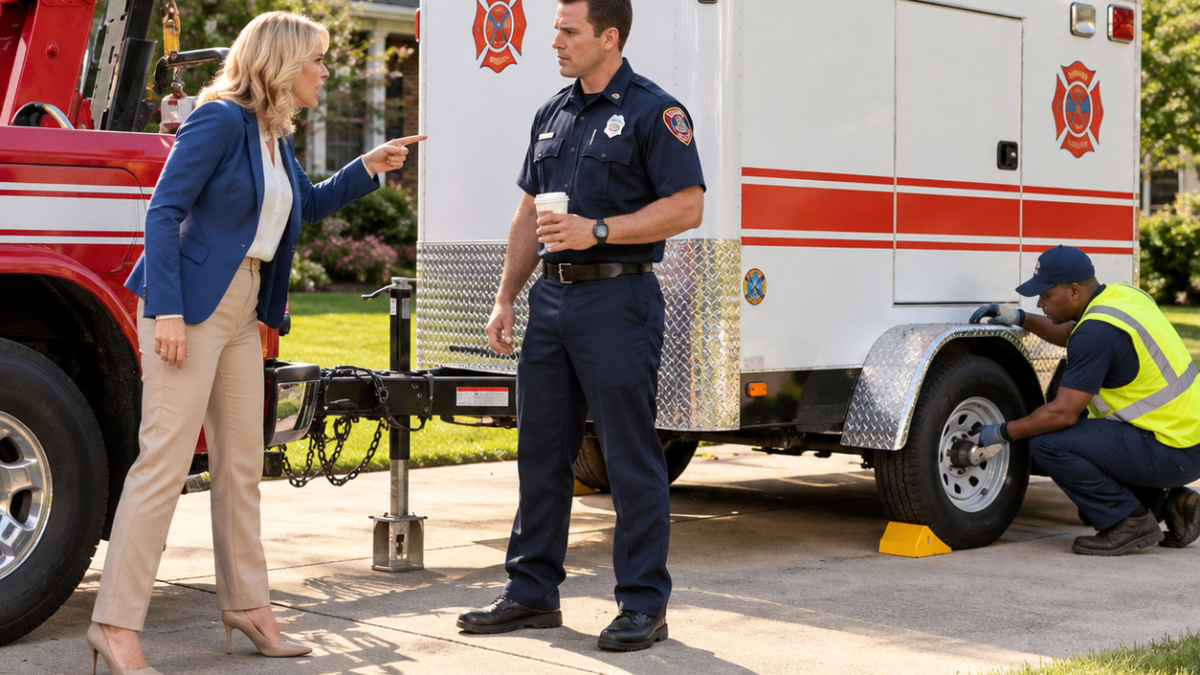
Reynolds took the clipboard.
His eyes moved across the page.
Then stopped.
I leaned closer.
Under the line marked VEHICLE DESCRIPTION, somebody had written:
Resident claims emergency use. HOA has determined designation is irrelevant to covenant enforcement. Remove regardless of markings.
For several seconds, nobody said anything.
The tow yard suddenly felt very quiet.
Ron rubbed one hand across the back of his neck.
“That wasn’t written by us.”
Lauren looked at him.
“Who wrote it?”
“That came over with the authorization.”
“From whom?”
He glanced at the signature.
“Melissa Harper.”
Reynolds handed the page back slowly.
“She knew.”
Lauren held up one finger.
“She knew Ethan claimed it was emergency equipment.”
“That’s what I mean.”
“It matters how we say things right now.”
That was Lauren.
Even standing beside a fire department trailer that had been dragged out of my driveway before sunrise, she refused to turn anger into a legal conclusion.
She looked at Ron.
“Did your driver check the registration before towing?”
Ron hesitated.
“I’d have to ask.”
“Please do.”
He went back inside.
Lieutenant Perez walked around the trailer.
There were two fresh scrape marks near the rear stabilizer.
One of the wheel chocks was missing.
The shore-power cord we normally used to keep the batteries maintained had been left in my driveway, which meant someone had unplugged the trailer before moving it.
Perez photographed everything.
I stood staring at the handwritten sentence.
Designation is irrelevant.
For two weeks I had wondered if Melissa simply hadn’t understood my emails.
Maybe she had thought I was exaggerating.
Maybe she assumed the trailer belonged to me personally and I had slapped fire department stickers on it because I volunteered.
Maybe the whole thing was bureaucratic laziness.
That one sentence removed most of those excuses.
Ron returned with a younger driver named Caleb.
Caleb looked like he had slept even less than I had.
“You towed it?” Lauren asked.
He nodded.
“About four-thirty this morning.”
“Did you notice the fire department markings?”
“Yes.”
“Did you check ownership?”
He looked at Ron.
Then at Lauren.
“I ran the plate through our normal intake.”
“And?”
“It came back government.”
My stomach tightened.
Lauren’s expression didn’t change.
“What did you do then?”
“I called dispatch.”
“Your dispatch?”
“Yes.”
“And?”
“They called the client contact.”
“Who was the client contact?”
“Melissa Harper.”
Reynolds folded his arms.
Caleb continued.
“I told dispatch I didn’t like it. They called me back and said the HOA confirmed removal.”
“Did anyone tell you the registered owner was a fire department?”
“I told them.”
Lauren nodded once.
“Thank you.”
Ron looked miserable.
“Look, we don’t want any part of this. We tow what property managers authorize.”
Lauren’s tone stayed even.
“I understand. But once your company learned the trailer was registered to a public emergency organization, the situation changed.”
Ron nodded.
“We’ll release it.”
“No charges?”
“No charges.”
“Storage?”
“No.”
“Tow fee?”
He shook his head.
“We’ll sort that out with the HOA.”
That was the first sensible decision anybody had made that morning.
We inspected the trailer before moving it.
Perez checked the generators.
Reynolds checked the communications cases.
I opened every compartment and compared the contents against the inventory sheet.
Nothing appeared missing.
One extension cable had shifted.
A floodlight mount had loosened.
The scratches looked cosmetic.
Still, Reynolds documented everything.
Emergency equipment lives a hard life.
It gets bounced down desert roads, dragged through mud, covered in ash, soaked in rain, and loaded by people working on three hours of sleep.
But when damage happens during a response, you understand why.
Damage caused because an HOA wanted an empty driveway feels different.
By 8:15, the trailer was hooked behind the department utility truck.
I should have felt relieved.
Instead, I felt sick.
Because the generator trailer had been unavailable for almost four hours.
Nothing had happened during those four hours.
No wildfire deployment.
No grid failure.
No rescue requiring portable lighting.
No medical staging area had needed the backup power.
That fact mattered.
It also bothered me.
The absence of an emergency did not make taking emergency equipment harmless.
It only meant we had been lucky.
Lauren rode back with Reynolds.
Perez followed with the trailer.
I drove my own truck.
At a red light, my phone buzzed.
Melissa Harper.
I let it ring.
Then she called again.
I ignored that too.
A voicemail appeared.
I didn’t listen to it until I reached the station.
Her voice was controlled.
“Ethan, I understand you retrieved the trailer. I would appreciate it if you contacted me directly before escalating a neighborhood compliance matter outside the association. We are prepared to discuss reasonable accommodation, provided the trailer is removed from visible storage.”
I played it twice.
Perez leaned against the workbench.
“She sounds like she thinks she’s offering you a favor.”
Reynolds said, “Forward it to Lauren.”
I did.
Twenty minutes later, Lauren called.
“Do not respond.”
“That’s becoming everybody’s favorite instruction.”
“Because you keep receiving messages worth preserving.”
“I’d like to tell her the trailer is going right back where it was.”
“You can tell her that later.”
“Through you?”
“Preferably.”
I sat on the edge of the workbench.
“What happens now?”
“We figure out what authority everybody actually had, what your HOA documents say, what municipal rules apply, what agreements exist between the city and your volunteer department, and whether the tow company followed applicable procedures.”
“That sounds less exciting than what Reynolds was hoping for.”
Across the room Reynolds yelled, “I can hear you.”
Lauren continued as if he hadn’t spoken.
“We also need to separate three issues.”
“Okay.”
“First, the HOA dispute with you as a homeowner.”
“Right.”
“Second, the towing of property that wasn’t legally yours to surrender.”
“Right.”
“Third, the operational impact on the department.”
I looked toward the trailer.
“What kind of impact?”
“That depends on whether the department had alternative equipment available and whether any calls came in during the time it was inaccessible.”
“There weren’t any.”
“Good. Then nobody gets to invent a disaster that didn’t happen.”
That sentence became important later.
Because by lunchtime, everyone was already inventing one.
Someone at the towing company apparently told someone else.
Someone else knew a Cedar Ridge resident.
By noon, a neighborhood Facebook post claimed the HOA had “stolen a fire engine.”
Another said firefighters had been unable to respond to a house fire.
Neither was true.
At 12:37, Melissa posted a statement in the Cedar Ridge residents’ group.
The Board has received questions regarding recent enforcement activity involving a resident-owned utility trailer.
The trailer was parked in violation of established community standards.
Upon learning that the resident asserts a connection between the trailer and volunteer emergency services, the Board is reviewing the matter.
No emergency services were disrupted.
Please avoid spreading misinformation.
Resident-owned.
I stared at those two words.
She had my emails.
She had the registration.
She had personally authorized the tow after being told the plate came back to the department.
And she still called it resident-owned.
I sent the screenshot to Lauren.
Three dots appeared.
Then:
Received.
Nothing else.
At 1:10, Captain Reynolds walked into the apparatus bay holding his dress uniform.
“Change.”
“For what?”
“Meeting.”
“With who?”
“City risk, department chief, management office.”
“Today?”
“Today.”
I looked at the trailer.
“Am I in trouble?”
Reynolds stopped.
“For what?”
“For storing it at home.”
He softened slightly.
“No.”
“You sure?”
“Ethan, the department assigned it to you.”
“I know, but if the HOA rules—”
“Stop.”
He put the uniform on the bench.
“You had written authorization from us. You notified your HOA. You documented the issue. You did exactly what you were supposed to do.”
That helped.
More than I expected.
At work, I was a systems engineer.
People came to me when networks failed.
I was used to being the person who knew what to do.
At the fire station, I had enough years behind me that newer volunteers occasionally looked to me before making decisions.
But that morning, I felt strangely helpless.
A board of neighbors had arranged to take equipment entrusted to me.
The department had to recover it.
Lawyers were involved.
A towing company was documenting damage.
And I kept thinking the same thing.
Maybe I should have moved it temporarily.
Maybe I should have parked it at the station after the first notice.
Maybe being right didn’t mean I had handled it correctly.
Chief Nolan answered that question before I asked.
He joined us in a small conference room at city hall.
The Mesa Verde department was technically a city-supported volunteer agency.
Most responders were unpaid, but the city owned much of our equipment, carried insurance, funded major purchases, and provided legal and administrative support.
That arrangement was the reason Lauren had become involved so quickly.
Deputy City Manager Thomas Avery sat at the end of the table.
Lauren opened a laptop.
Chief Nolan looked at me.
“Before we begin, Ethan, nobody here believes you acted improperly.”
I nodded.
He continued.
“But we may change where certain assets are staged after this.”
That stung even though it was reasonable.
“I understand.”
“Not as punishment.”
“I know.”
“Good.”
Lauren projected a timeline.
June 2: HOA warning issued.
June 2: I responded with registration and department letter.
June 4: Melissa replied that no exceptions would be granted.
June 7: I sent additional proof and requested board review.
June 10: Management company acknowledged receipt.
June 15: Tow authorized.
June 16, 4:32 a.m.: Trailer removed.
June 16, approximately 6:00 a.m.: I discovered it missing.
June 16, 7:40 a.m.: Asset recovered.
Avery studied the screen.
“Who at the management company reviewed the documentation?”
Lauren clicked to another email.
“That’s one of the questions.”
“Did the board vote on the tow?”
“We don’t know.”
Reynolds said, “Does it matter?”
“It matters to the HOA’s internal authority and insurance.”
Avery looked at me.
“Who is Melissa Harper?”
“HOA president.”
“How long?”
“Six years, I think.”
“Any prior disputes?”
“Nothing serious with me.”
That wasn’t entirely true.
Melissa and I had argued once about a trash container.
Two years earlier, I returned from a three-day wildfire assignment and forgot to pull my bin behind the gate.
The next morning, I received a warning photograph taken at 6:07 a.m.
I moved the bin.
End of story.
She had also warned me about a work truck being parked overnight during a telecom outage.
Again, I moved it.
I didn’t enjoy HOA rules, but I wasn’t interested in turning every disagreement into a constitutional crisis.
The trailer was different because it wasn’t mine.
And because the department had deliberately staged it with me.
Lauren enlarged another email.
It was one I had sent Melissa five days before the tow.
Melissa,
To avoid confusion, the trailer is titled and registered to Mesa Verde Fire & Rescue. I am not authorized to dispose of, relocate permanently, or surrender department equipment based on HOA enforcement without department approval. Please contact Captain Reynolds or the city office listed in the attached letter before taking any action involving the trailer.
She had replied forty-three minutes later.
Your volunteer affiliation does not create an exemption from Cedar Ridge governing documents.
No acknowledgment of ownership.
No call to Reynolds.
Nothing.
Avery took off his glasses.
“Did anyone from the HOA ever contact the city?”
Lauren shook her head.
“No.”
“Before towing?”
“No.”
“After?”
“Melissa left me one voicemail this morning asking that the city refrain from interfering in a private covenant matter.”
Reynolds laughed.
Avery did not.
“Play it.”
Lauren did.
Melissa’s voice filled the room.
She spoke professionally.
Calmly.
She described the tow as enforcement against a resident who had repeatedly refused to comply.
She said the city’s involvement risked “undermining private community governance.”
When it ended, Avery folded his glasses.
“Lauren?”
“Yes?”
“Set up a meeting.”
“With the HOA?”
“And their counsel.”
“What are we asking for?”
He looked toward Chief Nolan.
The chief answered.
“First, written confirmation that nobody from Cedar Ridge will interfere with department assets again.”
Lauren nodded.
“Second?”
“Reimbursement for recovery inspection and any verified damage.”
“Third?”
Avery spoke.
“I want to know who authorized moving government-owned equipment after being told what it was.”
Reynolds added, “And I want the parking issue resolved.”
Lauren looked at me.
“That part concerns your homeowner rights. We’ll need the covenants.”
“I have a copy.”
“Current?”
“I think so.”
“Never ‘think so’ about HOA documents.”
“That sounds like something printed on a mug.”
“It should be.”
The meeting ended at 3:20.
By 3:45, Melissa knew about it.
She called again.
This time she left no voicemail.
At 4:10, I received an email from Cedar Ridge’s management company.
SUBJECT: EMERGENCY BOARD REVIEW — TRAILER VIOLATION
Dear Mr. Walker,
The Association has temporarily suspended further enforcement concerning the trailer pending legal review.
Temporarily.
That word told me Melissa still believed she might win.
I drove home with the generator trailer behind the department truck.
Reynolds followed me into Cedar Ridge.
The guard at the entrance looked at the rescue decals.
Then at me.
Then very deliberately looked away.
When we reached my house, three neighbors were standing near the sidewalk.
One was Mrs. Alvarez from across the street.
She was seventy-two, five feet tall, and had spent the previous four years pretending not to know everyone’s business while knowing everyone’s business.
“Ethan,” she called.
I climbed out.
“Hi, Linda.”
“Did Melissa have the fire department’s trailer towed?”
Reynolds suddenly became fascinated by the hitch.
I said, “There’s a dispute about what happened.”
Linda folded her arms.
“That means yes.”
“I didn’t say that.”
“You didn’t have to.”
Her husband, Miguel, stood behind her watering a plant that absolutely did not need water.
A man two houses down raised his phone.
I pointed toward him.
“Please don’t record the department crew working.”
He lowered it.
Reynolds whispered, “Smart.”
We backed the trailer onto the same slab.
Same position.
Same orientation.
It looked almost stubborn sitting there.
Before leaving, Reynolds handed me a magnetic sign.
OFFICIAL MESA VERDE FIRE & RESCUE EQUIPMENT
AUTHORIZED STAGING LOCATION
I laughed.
“Seriously?”
“Chief’s idea.”
“This is going to make Melissa furious.”
“That is not why we made it.”
“Sure.”
He grinned.
“Mostly.”
I put the sign on the trailer door.
That evening, I finally listened to the neighborhood.
Cedar Ridge had about 180 homes.
Some residents supported me immediately.
Some supported the HOA.
Most were confused.
A few believed emergency equipment should receive an obvious exception.
Others said rules were rules and worried that allowing my trailer would open the door to boats, campers, work trailers, and abandoned RVs.
That argument was not completely ridiculous.
HOA rules exist partly because exceptions become precedents.
I understood that.
What bothered me was that nobody had tried to solve the problem before towing.
At 7:30, my doorbell rang.
Melissa stood outside.
No attorney.
No management representative.
Just Melissa.
I considered not opening the door.
Then I did.
She wore jeans and a blue blouse instead of the tailored jackets I usually saw at meetings.
Without the board-room uniform, she looked less intimidating.
Tired, mostly.
“Can we talk?”
“Lauren told me not to discuss the dispute directly.”
“I’m not here officially.”
“That sounds worse.”
Her mouth tightened.
“I just want you to understand why this happened.”
I stepped onto the porch but did not invite her inside.
She glanced toward the trailer.
“You’ve had violations before.”
“A trash bin and a work truck.”
“You consistently push boundaries.”
“I complied with both notices.”
“Eventually.”
“The trash bin was out one morning.”
“That isn’t the point.”
“It feels like the point.”
She took a breath.
“For months, residents have complained about trailers.”
“Mine?”
“Trailers generally.”
“That isn’t the same thing.”
“We had an RV parked for seven weeks on Willow Court. A contractor stored equipment on Juniper. Another homeowner had a boat on blocks.”
“And?”
“And every time the board enforced the rules, somebody said someone else got special treatment.”
I understood where she was going.
“You thought giving me an exception would make enforcement harder.”
“Yes.”
“That still doesn’t explain towing something you knew wasn’t mine.”
“I did not believe the city would consider it protected equipment simply because it was assigned to a volunteer.”
I stared at her.
“The registration says Fire & Rescue.”
“I saw the registration.”
“Then whose trailer did you think it was?”
She looked toward the driveway.
“That isn’t what I mean.”
“What do you mean?”
“I thought the HOA retained authority over what could be stored on residential property regardless of who owned it.”
That was at least more coherent than pretending the ownership hadn’t been clear.
“So instead of asking the department, you ordered it towed.”
“I believed we had authority under the parking rules.”
“You believed.”
“Yes.”
“Did the board vote?”
She didn’t answer.
That told me enough.
“Melissa.”
“I’m not discussing internal board procedure.”
“Then we’re done.”
I reached for the door.
She stopped me.
“Ethan, this situation is getting out of control.”
“My trailer was gone when I woke up.”
“I know.”
“No, I don’t think you do.”
She looked at me.
I continued.
“I spent the first five minutes wondering whether somebody had stolen twenty thousand dollars of rescue equipment from my driveway while I slept.”
Her shoulders lowered slightly.
“That wasn’t my intention.”
“Intent doesn’t put it back.”
“It’s back.”
“Because the fire department retrieved it.”
She looked away.
For the first time, Melissa didn’t seem like an HOA president.
She seemed like a woman realizing that the administrative action she had signed had become something larger than she expected.
“I should have called the department,” she said.
“Yes.”
“But I still believe we need a rule that works for everyone.”
“I agree.”
That surprised her.
I pointed toward the trailer.
“This doesn’t have to become permission for every RV in Cedar Ridge.”
“Residents won’t see the distinction.”
“Then explain it.”
“You think it’s that easy?”
“No. I think towing first was harder.”
She almost smiled.
Almost.
Then she nodded.
“The meeting is Thursday.”
“With the city.”
“And the board.”
“I’ll be there.”
She walked back toward her car.
Before opening the door, she turned.
“I didn’t know it would be treated this seriously.”
That sentence stayed with me.
Not because it excused anything.
Because it explained something.
Melissa hadn’t believed the equipment belonged to her.
She hadn’t wanted to sabotage emergency services.
She had done something far more ordinary.
She had become so accustomed to enforcing rules that she stopped asking what authority actually meant.
Thursday’s meeting took place at city hall.
Not a courtroom.
No television cameras.
No judge.
Just a long conference table, bad coffee, fluorescent lights, and enough folders to kill a tree.
Melissa brought Cedar Ridge’s attorney, Greg Lawson.
Greg arrived fifteen minutes early.
That alone told me he was worried.
Susan Park and Harold Greene, two other HOA directors, attended.
So did Laura Benton from the management company.
On the city side were Lauren, Avery, Chief Nolan, Reynolds, and me.
Greg began.
“The association wishes to resolve this efficiently.”
Lauren nodded.
“So do we.”
Melissa sat very straight.
Greg continued.
“We acknowledge the trailer is titled to Mesa Verde Fire & Rescue.”
Avery said, “Good place to start.”
Greg ignored the tone.
“The association’s position is that its parking restrictions apply to property stored on residential lots, regardless of title.”
Lauren slid a document toward him.
“The city is not arguing that public ownership automatically defeats every private covenant.”
That surprised Melissa.
Lauren continued.
“We are arguing that towing department property without contacting the owner, after being given ownership documentation, created avoidable risk and potential liability.”
Greg nodded.
“That is fair.”
Melissa turned toward him.
He kept looking forward.
Lauren placed the tow authorization beside my emails.
“The association had the department registration.”
“Yes.”
“The assignment letter.”
“Yes.”
“Captain Reynolds’s direct phone number.”
“Yes.”
“And a written warning from Mr. Walker that he did not have authority to surrender or permanently relocate the equipment.”
“Yes.”
Avery leaned forward.
“Why didn’t anybody call us?”
Nobody answered.
Susan Park looked at Melissa.
Melissa said, “I believed the documents were part of Ethan’s request for an exemption.”
“They were,” Lauren said.
“That doesn’t answer the question.”
Melissa’s hands tightened around a pen.
“I thought calling would simply result in the department advocating for its volunteer.”
Chief Nolan spoke for the first time.
“Of course we would.”
Melissa looked at him.
“But you also would have learned we had another option.”
“What option?”
“We could have moved the trailer temporarily to Station Two while your board reviewed the issue.”
Silence.
That was the simplest solution anyone had mentioned.
Chief Nolan continued.
“We stage equipment with volunteers because response geography matters. We are not interested in fighting homeowner associations. If you had called, we would have explained why it was there, how long we expected the assignment to continue, and whether another staging location was possible.”
Melissa looked down.
Reynolds folded his arms but said nothing.
Lauren turned to the tow company paperwork.
“Instead, your authorization specifically directed removal despite the emergency markings.”
Greg glanced at Melissa.
“That language was unfortunate.”
Reynolds finally spoke.
“That language is why we’re here.”
Greg nodded.
“Yes.”
There was no fight in him.
The towing company had already sent its own incident report.
Their insurer had apparently become involved after learning the driver discovered government registration before removal.
Desert Valley was not eager to be the test case for anybody’s HOA philosophy.
They offered to waive every fee and pay for the scratched stabilizer housing.
The city accepted.
That left Cedar Ridge.
Lauren proposed five things.
First, written confirmation that the tow had been unauthorized by the department and that Cedar Ridge would not order future removal of department equipment without giving the department notice except in a genuine immediate hazard.
Second, reimbursement for inspection and documented staff time associated with recovering and checking the trailer.
Third, withdrawal of my violation.
Fourth, a process for emergency-service equipment assigned to residents.
Fifth, legal review before future towing when ownership was disputed or evidence showed the vehicle belonged to a government or emergency organization.
Greg listened.
Then said, “Those are generally workable.”
Melissa looked at him again.
“Generally?”
He finally turned toward her.
“Melissa, they’re asking for procedures we probably should have had already.”
Susan Park stared at the table.
Harold Greene nodded slowly.
The room changed.
Until then, I had thought this was Ethan versus the HOA.
It wasn’t.
It was becoming the board versus the way the board had been operating.
Melissa saw it too.
“What about the trailer?” she asked.
Lauren gestured toward me.
“That is primarily an association issue.”
Greg opened the covenants.
The trailer rule prohibited commercial trailers, recreational trailers, and utility trailers from long-term visible storage unless specifically approved.
There was no emergency-equipment category.
There was also an architectural committee provision allowing variances for unusual circumstances where strict enforcement would create unreasonable hardship and where an exception would not materially affect neighboring property.
Greg tapped that section.
“We can use this.”
Melissa said, “That creates an exception.”
“Yes,” Greg replied.
“That is literally what a variance is.”
I nearly smiled.
She noticed.
“Something funny?”
“No.”
“Yes, there is.”
“Your lawyer just said what I emailed you two weeks ago.”
Greg closed his eyes briefly.
Lauren looked down at her papers.
Avery suddenly became fascinated by his coffee.
Melissa sat back.
“I was trying to apply one rule consistently.”
Susan Park spoke quietly.
“Consistency isn’t the same thing as refusing to look at circumstances.”
Melissa turned toward her.
Susan continued.
“We never voted on the tow.”
There it was.
The question I had been waiting for.
Greg looked at Melissa.
“Is that correct?”
Melissa’s face tightened.
“The board had previously authorized management to enforce trailer restrictions.”
“That wasn’t Susan’s question,” Greg said.
“No specific vote occurred.”
Harold leaned forward.
“Did management tell you to tow it?”
Laura Benton from the management company answered.
“No.”
Everyone looked at her.
She opened a folder.
“Our compliance coordinator recommended legal review after Mr. Walker submitted the department registration.”
Melissa stared at her.
“That recommendation came after the deadline.”
“No.”
Laura pulled out an email.
“It was sent June 10.”
Five days before the tow.
I felt the hair on my arms rise.
Laura slid the page toward Greg.
The email was simple.
Given the public-agency registration and resident’s claim that the trailer is assigned emergency equipment, recommend confirming ownership and authority before further enforcement action.
Melissa had replied:
Proceed under existing trailer policy. We cannot allow residents to manufacture exceptions.
The room went silent.
Not dramatic silence.
Not television silence.
The uncomfortable kind.
The kind where everybody suddenly knows more than they wanted to know.
Greg read the email twice.
Then he placed it carefully on the table.
“Melissa.”
She looked at him.
“Did you authorize the tow after receiving this?”
“Yes.”
“Did you speak to me first?”
“No.”
“Did you consult the board?”
“I believed I had authority.”
Greg leaned back.
That was the moment the fight ended.
Not because she had committed some spectacular crime.
Not because police burst through the doors.
Because her own paper trail showed exactly what had happened.
She had been warned to verify.
She had chosen not to.
Avery spoke quietly.
“We’re not interested in embarrassing your association.”
Melissa looked at him.
“We’re interested in making sure this doesn’t happen again.”
Greg asked for a recess.
The HOA side left the room.
I stayed with Reynolds.
He exhaled.
“Well.”
“That was worse than I expected.”
Lauren shook her head.
“No. It was clearer.”
“Is that lawyer for worse?”
“Frequently.”
I stared at the closed conference-room door.
“Are they going to remove her?”
Lauren gave me a look.
“That isn’t our decision.”
“Right.”
“And don’t make this about Melissa personally.”
“That’s difficult.”
“I know.”
Reynolds said, “She personally had our trailer hauled away.”
Lauren turned toward him.
“And if your goal is to protect department assets in the future, you focus on process.”
He sighed.
“You two are no fun.”
Forty minutes later, Cedar Ridge returned.
Greg spoke.
The board would issue a written acknowledgment.
The tow violation would be withdrawn.
The association would reimburse the department’s documented recovery and inspection costs through its insurance if appropriate.
A temporary variance would allow the trailer to remain at my home while a permanent emergency-equipment policy was drafted.
Future towing involving disputed ownership would require management review and counsel consultation.
And Melissa Harper would no longer hold unilateral enforcement authority pending a board governance review.
Melissa did not look at me.
Avery nodded.
“Acceptable, subject to final language.”
Lauren agreed.
Chief Nolan added one condition.
The department would install a lockable equipment box and improved wheel restraint at my property and provide the HOA with a direct emergency contact for the trailer.
That was reasonable.
The meeting ended without shouting.
No one was arrested.
Nobody paid fifty thousand dollars.
No judge called anyone corrupt.
We all collected our folders and walked out beneath the same flickering hallway light.
Real consequences often look disappointing from a distance.
Up close, they matter.
By Friday afternoon, Cedar Ridge residents received an email.
The board acknowledged that department-owned emergency equipment had been removed from a resident’s property without adequate verification.
The association apologized to affected parties.
The violation against me was withdrawn.
An emergency-service equipment policy would be considered at the next open meeting.
Melissa’s name was not on the email.
Susan Park signed it as acting board secretary.
That night, somebody placed a printed copy under my windshield wiper with one handwritten sentence:
About time.
I never discovered who.
The open HOA meeting happened ten days later.
I expected a circus.
It wasn’t.
Mostly.
About sixty residents showed up, which was roughly four times normal attendance.
People filled the clubhouse chairs and stood along the walls.
Some were angry about the towing.
Others were angry that HOA money might be used to reimburse the department.
A few were angry that the trailer remained visible.
One man spent five minutes arguing that emergency exceptions would destroy “the visual integrity of the neighborhood.”
Mrs. Alvarez turned around and asked him whether visual integrity could power a medical tent.
That ended his speech.
Susan chaired the meeting.
Melissa sat with the other directors.
She looked exhausted.
The board presented a proposed policy.
Emergency-service or public-safety equipment assigned to a resident could receive a renewable variance if ownership and assignment were documented.
The resident had to keep the equipment maintained.
It could not block sidewalks or sight lines.
The agency had to provide a contact.
If complaints arose, the HOA had to contact the resident and owning agency before enforcement.
No automatic permanent exemption.
No blank check.
Just a process.
It was boring.
Which meant it was good.
Then came public comment.
A man named Jeff Carson stood.
“My concern is precedent.”
Susan nodded.
“What precedent?”
“That anybody can claim special circumstances.”
Greg Lawson, the HOA attorney, answered from the side table.
“Anybody can request a variance. That does not mean anybody receives one.”
Jeff frowned.
“So what makes his trailer different?”
I hadn’t planned to speak.
But I stood.
“The title.”
People looked at me.
“It doesn’t belong to me.”
I continued.
“If I buy a sixteen-foot trailer tomorrow because I want to store dirt bikes, fine me. Make me move it. I agreed to the rules when I bought the house.”
Melissa finally looked at me.
“But this one was assigned by the fire department. The board had documents proving that. That’s the difference.”
Jeff sat down.
A woman in the back raised her hand.
“What happens if the department stops assigning it to you?”
“Then the variance ends,” Susan said.
Simple.
Another resident asked whether the trailer could be screened.
That was fair too.
My slab sat beside the garage, visible from the street.
The architectural committee proposed a short stucco wall with a gate that would hide most of the equipment without slowing deployment.
The fire department reviewed the design.
We approved it.
I paid for part of the improvement.
The HOA contributed part because the new policy benefited the community aesthetically.
That surprised me.
Compromise, it turned out, did not require anyone to surrender.
Then Susan addressed leadership.
“Before we adjourn, I need to discuss board governance.”
The room shifted.
Melissa stared straight ahead.
Susan explained that the board had reviewed enforcement delegation after the trailer incident.
They found that too many decisions had been handled informally by individual officers instead of recorded board action or management review.
No allegation of theft.
No dramatic accusation.
Just bad governance.
The directors voted to require documented approval for non-routine towing.
Then Harold Greene made a motion to elect a new board president.
Melissa’s face finally changed.
Not surprise.
She knew it was coming.
The directors voted.
Four to one.
Susan became president.
Melissa remained a director until the next scheduled election.
I expected her to storm out.
She didn’t.
She closed her folder.
Stayed through the rest of the meeting.
And when it ended, she helped stack chairs.
That was the first time I wondered whether I had reduced her too much in my own mind.
For two weeks, she had been the villain of my story.
The woman who ignored proof.
The president who believed rules mattered more than judgment.
The person whose signature sent department equipment to an impound lot.
All true.
But people are rarely just the worst thing they do.
A month after the meeting, I learned why Melissa had become so rigid about enforcement.
Not from gossip.
From Melissa.
I was attaching the trailer to the utility truck one Saturday morning when she walked past with her dog.
She stopped at the edge of my driveway.
“Going out?”
“Training exercise.”
She looked at the new screening wall.
“It turned out nice.”
“Yeah.”
A pause.
Then she said, “The neighborhood was different when I became president.”
I waited.
She continued.
“There were abandoned vehicles. People storing contractor equipment everywhere. One owner ran an auto repair business out of his garage. We had complaints constantly.”
“I heard some of that.”
“The board didn’t enforce anything.”
“So you started enforcing everything.”
She nodded.
“At first people thanked me.”
That was the part I hadn’t considered.
Melissa hadn’t invented her authority from nothing.
Residents had rewarded it.
They had liked having someone willing to send the notices they didn’t want to send.
They praised her when she made people clean yards.
They reelected her when property appearances improved.
Over time, decisiveness became identity.
And once your identity is being the person who enforces the rules, exceptions start feeling like personal defeats.
“I stopped asking whether I was solving a problem,” she said.
“And started asking whether somebody was complying.”
She looked at me.
“Yes.”
I tightened the hitch coupler.
“Why didn’t you call Reynolds?”
“Because I thought he’d tell me exactly what I didn’t want to hear.”
That answer was painfully human.
“You knew there might be a legitimate exception.”
“I knew there might be an argument.”
“And you didn’t want another argument.”
“No.”
She gave a small laugh.
“Instead I got city attorneys.”
“That strategy needs work.”
For the first time since the whole thing began, she laughed.
Actually laughed.
Then she grew serious.
“I’m sorry, Ethan.”
She had already said something close to that on my porch.
This was different.
No defense followed.
No explanation about precedent.
No covenant language.
“I shouldn’t have authorized the tow after management told me to verify it.”
“Thank you.”
“And I shouldn’t have written that the emergency designation was irrelevant.”
“No.”
“That was arrogant.”
“Yes.”
She smiled faintly.
“You could help me a little.”
“I’m a volunteer firefighter. We specialize in direct assessment.”
She shook her head.
Then walked away.
Three months passed.
The trailer stayed.
The new wall hid most of it.
The FIRE & RESCUE markings remained visible from the driveway gate.
The HOA stopped sending notices.
Life became ordinary again.
Then August brought heat.
Not normal Arizona heat.
The kind that makes asphalt soft and power systems nervous.
At 4:18 one Thursday afternoon, a transformer failure knocked electricity out across the northwest side of Mesa Verde.
The outage spread farther than expected.
Traffic signals went dark.
A cooling center at an elementary school lost part of its backup system.
An assisted-living facility reported generator trouble.
My pager sounded while I was still at work.
POWER SUPPORT REQUEST
STAGING: NORTHWEST SECTOR
REPORT TO STATION 3
I was twenty minutes from home.
Reynolds called.
“Can you grab the trailer?”
“Yes.”
“Meet Perez at Desert Vista Elementary.”
I left immediately.
When I reached Cedar Ridge, the neighborhood was dark.
Garage doors stuck shut.
Air conditioners silent.
People stood outside checking phones.
I backed my truck to the trailer.
The new gate opened wide.
The equipment was ready.
Battery maintained.
Fuel checked.
Cables packed.
I had the hitch connected in under four minutes.
As I pulled out, Mrs. Alvarez stood at the curb.
“Need help?”
“I’m good.”
Melissa was beside her.
She looked at the trailer.
Then at me.
“Go.”
No rule.
No argument.
No discussion of visual integrity.
Just go.
We powered portable cooling equipment at the elementary-school site while city crews worked the outage.
Later, part of our equipment supported lighting for utility crews near a damaged distribution cabinet.
Nothing cinematic happened.
No child was miraculously saved because my trailer arrived thirty seconds sooner.
No news helicopter circled overhead.
Nobody gave a speech.
We did what emergency support equipment is supposed to do.
We made a bad afternoon easier.
By midnight, most service was restored.
At 1:17 a.m., I backed the trailer into my driveway.
Melissa’s porch light was on.
She stepped outside.
“You guys okay?”
“Yeah.”
“Everything used?”
“Some of it.”
She nodded.
“I understand now.”
I knew what she meant.
The trailer didn’t need a dramatic rescue story to justify its existence.
Its value was readiness.
It sat quietly ninety-nine percent of the time so it could move during the one percent when sitting quietly stopped being useful.
The next morning, someone posted a photograph in the Cedar Ridge group.
It showed the trailer leaving the neighborhood during the blackout.
The caption said:
Turns out the ugly trailer has a job.
I laughed harder than I should have.
Susan replied:
So do our bylaws. We’re working on both.
That became Cedar Ridge’s new personality.
Less dramatic.
More willing to laugh at itself.
At the annual election, Melissa did not run for president.
She did run for an ordinary board seat.
She won.
That surprised people.
It didn’t surprise me.
She had made a serious mistake.
She had also spent the following months showing up, answering questions, helping rewrite procedures, and admitting what happened when residents asked.
Accountability does not always require banishment.
Sometimes it requires staying in the room after everyone knows you were wrong.
Susan remained president.
The board adopted the emergency-equipment policy permanently.
They also required management review before any tow involving contested ownership.
Residents received clearer notice and appeal instructions.
The towing company updated its contract language with Cedar Ridge.
If a vehicle or trailer displayed government, utility, medical, or emergency markings, ownership had to be verified before removal unless it created an immediate safety hazard.
That last phrase mattered.
Nobody wanted a fire department trailer blocking an intersection merely because it had a decal.
Rules still mattered.
Judgment mattered too.
The department changed things on our side as well.
We created standardized assignment packets for equipment staged at volunteers’ homes.
Each packet included registration, ownership information, agency contact numbers, deployment purpose, and parking needs.
The department began notifying HOAs or property managers in advance when possible.
Chief Nolan also moved two assets away from homes where associations had no workable accommodation.
That part rarely appears in satisfying revenge stories.
Sometimes the institution on your side also learns something.
A year after the tow, I was cleaning the trailer when I found the original violation notice inside a folder.
UNAUTHORIZED COMMERCIAL VEHICLE.
I held it beside the department registration.
For a moment, the entire dispute felt absurd again.
Two pieces of paper.
One said the trailer violated neighborhood rules.
The other said it belonged to the fire department.
The problem had never been that one piece of paper magically defeated the other.
The problem was that nobody with authority had bothered to sit down and reconcile them before ordering a tow truck.
I almost threw the violation away.
Instead, I folded it and put it in the station file.
Not because I wanted a souvenir.
Because Reynolds had been right about documentation.
People remember conflicts differently once enough time passes.
Paper doesn’t.
Desert Valley Towing paid for the damaged stabilizer housing through its insurer.
Cedar Ridge reimbursed the department’s documented inspection and recovery expenses.
There was no massive lawsuit.
No criminal conviction.
No special assessment bankrupting my neighbors.
Nobody deserved that.
Most Cedar Ridge residents had never known the tow was happening until it was already done.
Making all 180 households pay thousands of dollars for one bad enforcement decision would have felt less like justice and more like spreading the mistake around.
The consequences that mattered were quieter.
Melissa lost unilateral authority.
The board changed procedure.
The management company gained a verification rule.
The tow company became more careful.
The department improved its assignment paperwork.
And I kept the trailer.
Two years later, it still parks beside my garage.
The stucco wall hides most of it from the road.
The gate opens toward the driveway.
A small metal plaque is mounted beside it now:
MESA VERDE FIRE & RESCUE
AUTHORIZED EQUIPMENT STAGING
Susan joked that the plaque was the most expensive peace treaty in Cedar Ridge history.
Melissa disagreed.
“The lawyers were more expensive.”
She wasn’t wrong.
I still volunteer.
Still work telecom during the day.
Still drink coffee that gets cold before I finish it.
Still get pager alerts at inconvenient hours.
Sometimes the trailer sits untouched for weeks.
Sometimes I hook it up twice in the same weekend.
Wildfire season doesn’t care about HOA meetings.
Neither do blackouts.
One morning, almost exactly three years after it was towed, I came outside before sunrise carrying another half-warm cup of coffee.
For half a second, I looked toward the slab.
The trailer was there.
Generator housings locked.
Tires properly inflated.
Department plate on the tongue.
Fire & Rescue markings catching the porch light.
Nothing missing.
Nothing being argued over.
Nothing requiring a lawyer.
I walked past the gate, put my hand on the hitch, and smiled.
The HOA had once looked at that trailer and seen a rule violation.
The fire department saw equipment.
I saw responsibility.
Eventually, Cedar Ridge learned there was room for all three truths—as long as nobody confused having a rule with having the right to stop asking questions.
And ever since that morning, the trailer has remained exactly where it belongs:
ready to move when the fire department needs it, and impossible for anyone to tow away by pretending they don’t know whose name is on the registration.