PART 2: HOA Thugs Blocked My Exit Demanding My Vault Code—They Had No Idea I Was a 15-Year Army EOD Veteran
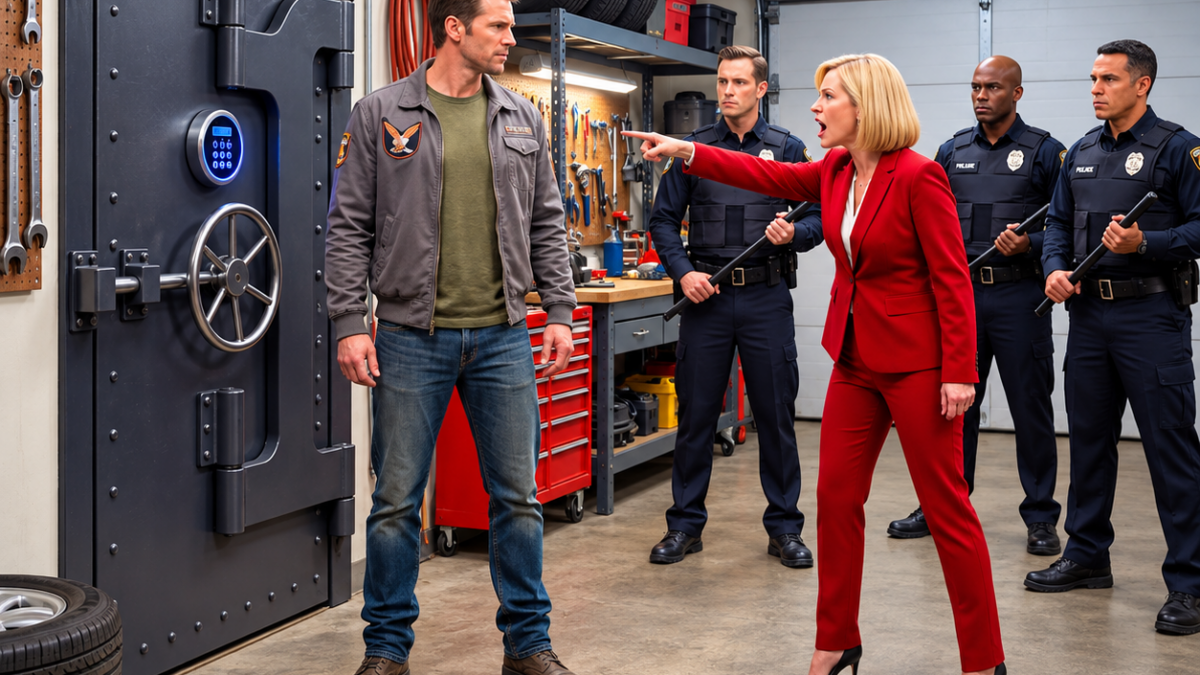
Bryce did not repeat himself once he saw the camera.
He changed vocabulary.
That was his first mistake.
“Mr. Thornfield, the board is merely requesting cooperation with a community safety inquiry.”
“You just told me I could not leave until I gave you my safe code.”
“That is not how I characterized it.”
“It is on video.”
The man beside my driver’s door stepped away first.
His name was Dennis Hale.
He was not brave enough to argue with a recording.
Bryce remained in front of the truck.
I checked the time.
7:06 a.m.
My Phoenix meeting started at nine.
If I missed it, I would lose the contract.
“Move.”
“You need to understand—”
“Bryce.”
I kept my voice level.
“You have no warrant.”
He said nothing.
“You have no police officer here.”
Nothing.
“You have no HOA provision I am aware of giving you authority to enter my home or demand access to my safe.”
Still nothing.
“And you are physically preventing me from leaving.”
His jaw tightened.
“You’re threatening me.”
“No.”
I held up the phone.
“I am documenting you.”
That distinction mattered.
Military training had taught me something television usually gets backward.
Calm is not weakness.
Calm gives you bandwidth.
Anger narrows the world until the only thing left is whatever offended you.
Calm lets you notice witnesses.
Cameras.
Positions.
Times.
Words.
Dennis looked toward Bryce.
“Maybe we should move.”
Bryce snapped:
“We are enforcing board authority.”
I asked:
“Show me the rule.”
He lifted his clipboard.
“I’m not litigating this on the street.”
“Then stop blocking my truck.”
The third board member finally moved away from the gate.
Bryce followed a few seconds later.
I got inside.
Before driving off, I said through the open window:
“Do not come onto my property seeking access to that safe.”
Bryce leaned closer.
“If you have nothing to hide—”
I drove away.
Anyone who has dealt with petty authority knows that sentence.
If you have nothing to hide.
It means:
Give me something I have no right to demand, and if you refuse, I will use your refusal as evidence that I deserved it.
I reached Phoenix forty-one minutes late.
The client rescheduled.
I lost half the day.
Not the contract.
Yet.
When I returned that evening, Dolores Ramirez was watering bougainvillea two houses down.
Dolores was eighty-two.
Arthritis in both hands.
Voice soft enough that people underestimated how closely she watched the neighborhood.
She waved me over.
“They did it to the Hendersons.”
“Did what?”
“Started with security complaints.”
I stopped.
The Henderson family had moved six months earlier.
Army couple.
Twin girls.
I had barely known them.
Dolores lowered her voice.
“Eight months of inspections.”
“Why?”
“Whatever they could find.”
She counted with bent fingers.
“Parking.”
“Noise.”
“Packages.”
“People coming to the house.”
“The husband traveled for work.”
“Then?”
“They sold.”
“For how much?”
“Thirty thousand under the first asking price.”
I remembered seeing a moving truck.
Assumed transfer orders.
Dolores continued.
“Three military families have left since Bryce became president.”
I stared at her.
“Three?”
“Every one started with an anonymous safety complaint.”
Coincidence was possible.
Pattern was different.
That night, I read all seventy-three pages of Willowbrook’s governing documents.
Then again.
Weapons-policy authority?
None.
Home-inspection authority?
None that supported what Bryce claimed.
Emergency power to block residents from leaving?
Nothing resembling it.
The HOA could enforce actual covenant provisions.
It could inspect certain exterior conditions in the ways described by its documents.
It could contact law enforcement if it believed a crime existed.
What it could not do, based on the records in front of me, was reinvent itself as a warrant service.
Three days later, cameras appeared.
Not mine.
HOA cameras.
Professional-grade housings.
Three units positioned near common-area poles and landscaping.
Every angle happened to face my corner lot.
Bryce called them a “community safety enhancement.”
I asked who authorized them.
“The board.”
“Why are all three pointed at my property?”
“Coverage optimization.”
“You’re recording my front porch.”
“The cameras are in common areas.”
That answer was not enough for me.
I photographed each camera.
Model number.
Position.
Field of view from public locations.
Then installed my own security system entirely on my property.
Not military hardware.
Not some fantasy spy network.
Commercial cameras.
Motion alerts.
Timestamped storage.
Visible signage.
A system any security professional might install after repeated harassment.
The purpose was documentation.
Bryce started driving past my house.
Once.
Twice.
Then constantly.
Eight times one day.
Sometimes he held his phone toward the property.
He followed me outside Willowbrook twice.
Badly.
The second time I stopped at a gas station.
He parked on the opposite side.
Pretended to examine windshield fluid for six minutes.
I took a photograph.
He left.
My instinct from the Army was not:
Fight him.
It was:
Build a timeline.
Date.
Time.
Action.
Witness.
Document.
I asked Willowbrook for financial records through the inspection process available under its governing structure and state law as advised by counsel.
I am deliberately phrasing that carefully because HOA record-access rights depend on jurisdiction and specific documents.
In the source case, the request put Bryce under pressure because residents had rights to examine substantial association records.
He stalled.
Then claimed the copying cost would be nearly two thousand dollars.
A retired teacher named Janet Hullbrook laughed when I showed her.
“For paper?”
“Apparently the ink is imported from Switzerland.”
Janet had taught government and history for thirty years.
She loved procedures.
Forms.
Deadlines.
Agencies.
The kind of person petty bureaucrats hate because she reads footnotes.
She helped me request the same records through the proper channels.
At the same time, I contacted the HOA’s insurer about the surveillance installation.
Their response created immediate concern inside the board.
The cameras had not been approved in the manner the carrier expected.
Coverage questions followed.
Within days, the three cameras disappeared.
Bryce said the removal was “routine technical repositioning.”
Sure.
Then the financial records began arriving.
Not everything.
Enough.
The first irregular payment was $47,000.
Recipient:
Kellerman Property Consulting LLC.
I searched the company.
Bryce controlled it.
The invoices described strategic community consulting.
I asked Janet:
“Do you remember the HOA hiring an outside strategist?”
“No.”
“Board minutes?”
“None I saw.”
“Work product?”
“Nothing.”
That did not prove theft by itself.
It proved we needed more.
Then invoices appeared for landscaping improvements residents could not identify.
Pool repairs while the pool remained broken.
Security work corresponding to cameras aimed at my property.
Charges to unfamiliar companies.
Some shared mailing addresses.
Some had Kellerman family connections.
We built a spreadsheet.
Not exciting.
Very useful.
Janet cross-referenced board minutes.
Dolores talked to older residents.
I spoke with two former Willowbrook owners, including one of the military families who had left.
Their stories sounded disturbingly similar.
Anonymous complaint.
Security concern.
Inspections.
Escalating fees.
Pressure.
Then a buyer appeared.
In more than one case, the purchaser connected through business records to entities associated with Bryce’s family or development contacts.
Now I understood why my corner lot mattered.
It was not just a house.
It bordered another parcel with redevelopment potential.
I called a meeting at the American Legion hall.
Twenty-three residents came.
I did not make a speech about war.
I put documents on tables.
HOA payments.
Invoices.
Photographs.
Camera records.
Violation letters.
Sale records.
The Henderson timeline.
My gate video.
People asked questions.
Good questions.
A man named Peter Sloan wanted to know whether we could prove every invoice fraudulent.
“No.”
That answer mattered.
“We can prove enough inconsistencies to demand a real audit.”
Janet nodded.
“We do not need to exaggerate.”
Dolores lifted one document.
“We need to make them explain.”
By the end of the evening, residents had enough signatures under the source’s association procedures to begin pushing for a recall vote.
More importantly, people stopped being isolated.
That changed Bryce faster than anything else.
Anonymous flyers appeared.
DANGEROUS VETERAN.
WEAPONS CONCERNS.
PROTECT OUR CHILDREN.
One accused me of suffering violent PTSD episodes.
I stared at that one for a long time.
Not because it hurt my feelings.
Because using a mental-health stereotype against combat veterans was exactly the kind of tactic Dolores had described.
I saved the flyer.
Photographed where it appeared.
Did not confront whoever distributed it.
Then my business phone rang.
A defense-industry client.
The conversation lasted less than three minutes.
“Spencer, we’ve received information that you are under federal investigation.”
“I’m not.”
“That may be.”
“It is.”
“We’re pausing the contract until compliance reviews it.”
“How much?”
Seventy-five thousand dollars.
Six months of work.
Paused indefinitely.
I asked where the claim originated.
They would not tell me.
Two more clients called that week.
Similar allegations.
Weapons trafficking.
Classified-information violations.
FBI investigation.
All false.
That was the first moment I nearly abandoned my own rule about staying calm.
Professional reputation is fragile.
In security consulting, suspicion itself becomes expensive.
I called my lawyer.
Not an old intelligence contact.
Not some shadow network.
An actual attorney.
Then I began contacting the affected clients in writing.
The local police complaint had been closed.
No known federal weapons investigation.
I provided what I could verify.
No dramatics.
My attorney preserved the communications and began examining potential defamation and business-interference claims.
Then my cameras captured Bryce entering my property after two in the morning.
That changed everything again.
I woke to the motion alert.
My phone showed him near the garage.
Backpack.
Gloves.
Looking around.
I did not go outside.
That was important.
I called law enforcement.
Kept recording.
Bryce appeared to manipulate the garage entry.
Then place items nearby.
When officers eventually examined what had been left behind, several pieces appeared designed to create the impression of prohibited weapons or contraband.
Some were obvious training or prop-type items.
I am not going to pretend I personally knew every criminal statute involved.
That was no longer my job.
My job was preserving the footage.
Original files.
Time stamps.
Cloud copies.
Camera metadata.
I gave investigators the video.
Did not edit a highlight reel.
Did not post it online.
That is another lesson people learn too late.
Evidence is not more powerful because social media sees it first.
Sometimes it becomes less useful.
Bryce denied wrongdoing.
His lawyer characterized the situation as a misunderstanding.
Investigators continued.
Then came the fake gas emergency.
2:47 a.m.
Fire trucks.
Ambulance.
Emergency crews.
Neighbors standing outside half asleep.
Bryce fully dressed.
Clipboard in hand.
He told residents there was a dangerous leak near my property requiring evacuation.
I called the gas utility directly.
They had no reported system incident matching what Bryce described.
Fire crews tested.
Nothing.
Then a construction crew connected to Bryce’s brother arrived claiming emergency excavation around my front yard might be necessary.
No normal permit process that I could see.
No utility confirmation.
No actual leak located.
The fire chief’s posture changed quickly.
I asked for the incident to be documented.
He did not need me to tell him false emergency reporting was serious.
That was for his department to determine.
By morning, county development records gave us another reason to care.
Plans connected to Bryce’s brother contemplated redevelopment involving my corner parcel and adjacent land.
My existing house stood in the way.
I sat at Janet’s kitchen table staring at the map.
She pointed.
“Here.”
My lot.
Another.
Then another.
Townhouses.
Access changes.
Higher density.
“This is why?”
“Possibly.”
Janet shook her head.
“Not because of weapons.”
“No.”
“Not because your truck scares children.”
“No.”
“Because your house is inconvenient.”
That theory fit the pattern better than anything Bryce had said.
The Henderson sale.
The other veteran families.
Below-market pressure.
Entities tied to development interests.
Manufactured emergencies.
If proven, this was not merely an HOA president with a personality problem.
It was financial.
That mattered because money leaves better tracks than motives.
Stephanie Kellerman called me at 3:17 one morning.
Bryce’s wife.
Head of architectural compliance.
For months, one of the people signing notices against residents.
Her voice shook.
“I need to talk.”
“Through my attorney.”
“Please.”
“I’m not meeting you alone without telling anyone.”
“Fine.”
Two hours later, with counsel aware of the meeting, Stephanie sat at my kitchen table.
No perfect HOA outfit.
No committee voice.
She carried a banker’s box.
“He’s leaving.”
“Who?”
“Bryce.”
She laughed nervously.
“Who do you think?”
“Where?”
“Nevada.”
She pushed the box toward me.
“He’s moving money.”
I did not touch it immediately.
“What is this?”
“Records.”
“Originals?”
“Some.”
“Copies?”
“Some.”
“Did you obtain them lawfully?”
“They’re from our home and association files I had access to.”
I called my attorney before reviewing further.
Chain of custody again.
Boring.
Essential.
The records described something larger than the first $47,000.
A management company that appeared to bill Willowbrook for services overlapping duties Bryce already performed.
Payments to shell or related businesses.
Reserve balances that did not match what residents believed existed.
Outstanding legitimate contractor bills.
According to Stephanie’s account, Willowbrook owed roughly $94,000 to real vendors while association money had been redirected elsewhere.
Then she said:
“He’s going to blame you.”
I looked up.
“For what?”
“The missing money.”
“How?”
“He thinks he can connect transfers to your consulting company.”
“I have never received HOA money.”
“I know.”
“He knows that?”
“Yes.”
“Then how?”
She held out a thumb drive.
I did not plug it into my computer.
Not then.
The military teaches caution around unexplained electronic media even when the person handing it to you is crying at your kitchen table.
My attorney arranged proper forensic review.
Stephanie said the drive contained financial records and planning files showing Bryce intended to manufacture a connection between the HOA losses and my company.
If true, he had chosen an extraordinarily bad target.
Not because I was a veteran.
Because my consulting business kept obsessive accounting records.
Every contract.
Invoice.
Client payment.
Tax document.
Separate accounts.
An accusation still could hurt me.
But a fabricated financial trail had to survive reconciliation against real banking records.
Stephanie also admitted she had helped establish some entities Bryce used.
She claimed she initially believed they were legitimate tax and management structures.
How much she knew and when became a matter for investigators.
I did not grant absolution across a kitchen table.
I also did not threaten her.
I told her:
“Tell the truth to the people handling the case.”
She nodded.
Forensic review of the financial records took time.
That is where the source story becomes more dramatic than real investigations usually are.
Real fraud cases are not won by one veteran announcing “RICO” over coffee.
They are built by accountants, investigators, subpoenas, bank records, witnesses, counsel, and prosecutors deciding what can actually be proved.
So that became our approach.
Insurance investigators were already reviewing irregular claims.
Association counsel became involved.
Residents pushed for an independent audit.
Law enforcement received the garage footage and false-emergency documentation.
My business attorney preserved communications sent to clients.
The development records went into another file.
One lane.
Then another.
Then another.
The more people looked independently, the harder it became for Bryce to control the narrative.
He escalated anyway.
My truck was vandalized.
Slashed tires.
Damage to the hood.
Security footage showed activity during the night.
Investigators received it.
Neighbors reported being offered favorable treatment if they supported Bryce publicly.
Several preserved those conversations.
I never instructed anyone to entrap him.
If he approached them, they documented what happened within legal advice applicable to them.
Again:
Evidence.
Not revenge.
Three additional consulting contracts were affected by false allegations.
Total potential value in the source reached roughly $127,000.
That hurt.
I had built that business after leaving the Army because I wanted my skills to mean something without wearing a uniform.
Now one neighborhood politician was trying to turn my service history into a weapon against my civilian livelihood.
That made staying disciplined more important.
Bryce wanted me angry.
He needed the story to become:
Dangerous veteran loses control.
I refused to give him that.
At the next neighborhood meeting, I wore jeans.
No medals.
No Army shirt.
No tactical anything.
I brought binders.
Janet brought a laptop.
Dolores brought lemon bars.
Those turned out to be the most effective morale tool of the entire campaign.
The meeting room filled beyond normal capacity.
Residents wanted answers.
Association counsel attended.
An insurance representative was present.
Investigators had their own processes underway, but contrary to the theatrical version people later told, no army of federal agents ringed the walls waiting for my cue.
That would have been absurd.
I took the front only because residents had asked me to explain what our group had documented.
I started with the gate video.
Bryce:
“Code first, then you can leave.”
Screen paused.
I looked at the room.
“That was the beginning for me.”
Then the closed police complaint.
Then the cameras.
Then the invoices.
Kellerman Property Consulting.
Payments.
Unexplained work.
Then the veteran-family timelines.
Harassment followed by sales.
Then buyer relationships.
Then development concepts.
My corner lot.
Then the nighttime garage footage.
I did not call Bryce a terrorist.
I did not announce convictions before trial.
I said:
“These are the records we gave the people whose job is to decide whether crimes occurred.”
That sentence made Bryce angrier than an insult would have.
He stood.
“This entire presentation is defamatory.”
My attorney responded from the side of the room.
“Then identify the inaccurate document.”
Bryce looked at the screen.
No answer.
Janet displayed the reserve-fund reconciliation.
Then the legitimate unpaid bills.
Then the entities receiving money.
Some residents had never looked at an HOA financial statement in their lives.
They were looking now.
A father in the third row raised his hand.
“My dues went from fifty to two-seventy-five.”
“Yes.”
“Where did the money go?”
That was not a question for me.
Everyone turned toward Bryce.
He grabbed his clipboard.
“The association has significant security and legal expenses because of hostile residents.”
Someone laughed.
Then another.
Not supportive laughter.
The kind that arrives when a room stops fearing the person talking.
Dolores stood slowly.
Eighty-two years old.
Watering-can hands now gripping the back of a folding chair.
“What did you do to the Hendersons?”
Bryce stared.
“They violated multiple—”
“They were raising two little girls.”
“They created documented security concerns.”
“Like Spencer?”
“The cases are unrelated.”
Janet clicked.
A spreadsheet appeared.
Dates.
Complaints.
Fines.
Sale.
Buyer.
Next veteran family.
Same pattern.
Then next.
Bryce’s face changed.
Not collapse.
Recognition.
The room had stopped accepting his explanations one at a time.
Patterns are hard to defend piecemeal.
Then Stephanie entered.
Nobody knew she was coming except attorneys and investigators involved in the appropriate process.
She did not sit with Bryce.
That told the room enough.
Bryce stood.
“What are you doing here?”
Stephanie kept walking.
She sat near the back.
No answer.
The recall discussion began.
Residents were furious.
But something happened I respected.
Susan McCall, a homeowner who had supported Bryce the year before, raised her hand.
“We need to stop acting like removing one man fixes everything.”
The room quieted.
“We elected him.”
Pause.
“We did not read the books.”
Another pause.
“We accepted ‘security concern’ every time somebody asked a question.”
She looked around.
“That part is ours.”
Correct.
Corrupt leadership thrives because scrutiny feels impolite until the cost of politeness becomes obvious.
The formal recall process continued.
But by then, the HOA issue was only one piece.
Financial investigators had records.
Insurance carriers had claim files.
My garage incident had law-enforcement attention.
County officials were reviewing the false emergency and development documents.
My attorney had the business-interference trail.
Bryce’s authority inside Willowbrook was shrinking.
His legal exposure was being determined somewhere else.
That is how it should work.
Then I got the call I had been waiting for and dreading.
Detective Martinez.
“Spencer.”
“Yeah?”
“We need another statement.”
“About?”
“The original gate incident.”
I went in.
Not in uniform.
Obviously.
Uniform had been gone for years.
I brought the video.
He watched.
“Did they physically touch you?”
“No.”
“Vehicle boxed?”
“The gate remained closed and Bryce stood in front.”
“How long?”
I gave him the timestamps.
“Safe code demanded?”
“Yes.”
“Why?”
“They claimed emergency inspection authority.”
“Any written authority?”
“None I received.”
Martinez nodded.
“Anything inside the safe illegal?”
“No.”
He smiled slightly.
“Already knew that.”
This was not about dramatic labels.
It was about exact facts.
Same with the financial side.
Investigators asked boring questions.
Who approved this invoice?
Who controlled this LLC?
Which account received the payment?
What board minutes mention it?
What service was performed?
Was there a contract?
Who benefited from the property purchase?
That was where Bryce had a problem.
He was excellent at narrative.
Bank statements do not care.
Months earlier, he had stood in front of my truck believing the safe was the interesting thing.
It never was.
The interesting thing was his own paperwork.
The case eventually widened beyond our neighborhood in the source account.
Records and investigators examined business activity in multiple states and prior disputes connected to Bryce.
Some earlier allegations had settled.
Some records were incomplete.
I am not going to pretend every rumor became a criminal count.
Prosecutors focused on conduct they believed they could prove.
Fraud-related transactions.
False representations.
Interference tied to money and business communications.
The property scheme.
Documents and payments.
That was enough.
Before the recall election concluded, Bryce was removed from operational control of association funds pending review.
A temporary board took over day-to-day matters.
First discovery:
The pool repair everyone thought cost eight thousand dollars had not been completed.
Second:
The landscaping “enhancement” billed at twelve thousand had little supporting work.
Third:
Several vendors residents assumed had been paid were months behind.
The reserve account was far worse than homeowners had been told.
People were angry.
Then scared.
Because punishing Bryce did not magically refill the bank.
A community still had bills.
Insurance.
Landscaping.
Pool.
Gate.
Utilities.
Lawyers.
That became the first adult problem of the post-Bryce era.
Janet put it best.
“Justice does not mow the common areas.”
So residents built a recovery budget.
Cut unnecessary spending.
Negotiated with legitimate vendors.
Pursued insurance coverage and restitution through the available processes.
Reduced administrative waste.
No victory parade.
Spreadsheets.
That was healthier.
Bryce’s arrest, when it came in the source outcome, was less cinematic than the story people later told.
Law enforcement acted based on the investigation.
I did not handcuff him.
I did not say some action-movie line while agents dragged him away.
I was at home when I heard.
Dolores called.
“Turn on the local news.”
“Why?”
“You know why.”
Coverage showed Bryce being escorted in connection with the fraud investigation.
Clipboard absent.
For once.
I sat on the couch.
Expected satisfaction.
Felt mostly tired.
Rebecca—my sister, not a spouse; another person who knew me well enough to recognize silence—called later.
“You okay?”
“Yeah.”
“You don’t sound victorious.”
“I don’t feel victorious.”
“What do you feel?”
“Like I can go get coffee tomorrow without wondering who’s following me.”
“That sounds better.”
It did.
The criminal case continued.
So did civil claims.
So did restitution proceedings.
The source gives Bryce a long federal sentence and substantial recovery for victims after conviction.
Rather than pretending every aggressive federal label in the transcript was automatically correct, the important factual spine is simpler:
Investigators treated the documented fraud and related interstate financial activity seriously.
Bryce ultimately faced major criminal consequences in the story.
Affected homeowners received restitution through the resulting processes.
The HOA recovered part of its losses through insurance and other recoveries.
And his control over Willowbrook ended permanently.
That was the outcome that mattered to me.
The new board elections were boring.
Perfect.
Janet refused to run for president.
Everyone begged.
“No.”
Treasurer?
“No.”
Secretary?
“No.”
“What will you do?”
“Attend every meeting and annoy whoever wins.”
She kept that promise.
Dolores became the unofficial conscience of the neighborhood.
No title.
No committee.
If somebody used the phrase “emergency authority” too casually, she would stare until they became uncomfortable.
The dues eventually came down as the association stabilized.
Not through magic.
Real budgeting.
Real vendor contracts.
Statements residents could inspect.
Two signatures required for meaningful expenditures.
Conflict disclosures.
Related-party transactions reviewed independently.
Ordinary controls.
The kind of boring procedures that make corruption harder.
The pool got repaired.
The landscaping recovered.
Security was handled by a legitimate vendor under a real contract.
No cameras pointed at one resident because somebody disliked his answers.
My own consulting work recovered too.
Not immediately.
Reputation repairs slower than tires.
My lawyers sent documentation to clients.
Investigative outcomes helped.
Two paused contracts returned.
One did not.
That was real loss.
I stopped pretending every victory restores everything.
Sometimes someone lies about you and even when the truth wins later, you still lose months of work.
That is why defamation and harassment are not harmless simply because the target survives.
I never recovered the morning Bryce blocked my truck.
Or the contract hours spent responding to false claims.
The Henderson family never got back the months that drove them from Willowbrook.
But some things could be repaired.
The new board contacted the veteran families who had left.
Not to lure them back.
To acknowledge what happened.
One of the Hendersons answered.
His email was short.
THANK YOU FOR FINALLY LOOKING.
That sentence stayed with me.
Finally looking.
That had been the real failure.
Everybody had looked at Bryce.
His suit.
Law degree.
Clipboard.
Confident voice.
Almost nobody had looked behind him.
At the invoices.
At the authority language.
At the sales.
At the patterns.
At who benefited.
People see a title and stop asking for the source.
President.
Attorney.
Committee chair.
Security director.
Sometimes the title is legitimate.
Sometimes the person is competent.
But authority still has limits.
The military taught me that better than any HOA dispute ever could.
The Army is hierarchical.
People imagine that means unquestioning obedience.
Wrong.
Professional organizations depend on lawful authority, defined responsibility, procedure, accountability, and people who know when something does not fit.
You do not walk up to an EOD technician and say:
“Trust me, cut the blue wire because I’m president of the neighborhood.”
That sounds ridiculous.
So did:
“Give us your safe code because we voted ourselves emergency inspection authority.”
The difference was only that Bryce said his sentence wearing loafers.
My safe never became part of any HOA inspection.
Its contents remained mine.
Legal property.
Private.
No board member entered my house.
No “emergency committee” touched it.
The vault code Bryce demanded never changed the story.
The refusal did.
Because his reaction to hearing no exposed the larger pattern.
He did not ask himself:
Do I have this authority?
He asked:
How do I make Spencer comply anyway?
That was exactly how he had treated other homeowners.
The Hendersons did not cooperate?
Increase pressure.
Someone questioned invoices?
Create a security issue.
A parcel became useful to redevelopment?
Turn its owner into a neighborhood problem.
My safe was not the target.
Compliance was.
Once I understood that, the fight became much easier emotionally.
I stopped taking each insult personally.
Dangerous veteran.
Aggressive truck.
Suspicious travel.
Weapons concern.
Hostile resident.
Different labels.
Same purpose.
Make my refusal look unreasonable.
Make neighbors afraid of me.
Then make isolation cheaper than resistance.
Bryce underestimated the neighborhood.
Not me.
The neighborhood.
He assumed Dolores was too old to matter.
She remembered everything.
He assumed Janet was just a retired teacher.
She understood process better than most attorneys I had met.
He assumed the veterans who had left would stay silent.
They sent records.
He assumed Norah-like residents would not question numbers.
They did.
He assumed his own wife would protect him forever.
She did not.
He assumed people who follow rules are easy to control.
That was the largest mistake.
People who respect legitimate rules become especially dangerous to corruption once they realize the rules are being counterfeited.
The corner lot remained mine.
The redevelopment plan changed.
Whatever future construction happened had to proceed without pretending my property was already available.
I received one legitimate inquiry months later from a developer asking whether I would consider selling.
I respected that.
He did not send an inspector.
Did not call my truck intimidating.
Did not demand my safe code.
He made an offer.
I said no.
He thanked me.
Conversation lasted twelve minutes.
That single meeting proved the entire Willowbrook war had been unnecessary.
Ask.
Accept the answer.
Negotiate if both sides want to.
Walk away if they do not.
Everything Bryce built depended on skipping those steps.
One evening Dolores brought over tamales.
We sat on my porch.
Desert cooling.
Palo verde shadows stretching across the street.
Kids riding bikes.
No one photographing my garage.
She looked toward the neighborhood gate.
“You know what I noticed?”
“What?”
“You leave more now.”
“What do you mean?”
“When Bryce was watching you, you stayed home.”
I thought about it.
She was right.
Not consciously.
But being surveilled had turned ordinary errands into decisions.
Coffee shop?
Someone follows.
Drive to Phoenix?
Suspicious travel.
Wash the truck?
Military activity, apparently.
I had made my world smaller because one man kept staring at it.
Now I drove when I wanted.
Morning consultation.
Lunch.
Hardware store.
Sometimes nowhere important.
Freedom becomes noticeable after somebody interferes with it.
A gate is just metal until a person uses it to tell you that you cannot leave.
Then it becomes something else.
That was why the first confrontation stayed with me more than the arrest.
Bryce in front of the bumper.
“Code first.”
As though he had already decided the safe belonged to his authority.
I sometimes wondered what would have happened if I gave it to him.
Probably another inspection.
Another demand.
Another accusation.
People who invent power are rarely satisfied when you reward the invention.
Boundaries work because they end the experiment.
No.
Show me the authority.
Put it in writing.
I am recording this.
Those were the most useful weapons I had.
Not anything in the safe.
Years of Army EOD work taught me to respect things capable of detonating.
Bryce thought that meant I was dangerous because I had handled explosives.
The opposite lesson had stayed with me.
Do not create unnecessary motion around an unstable problem.
Do not touch what you do not understand.
Do not guess.
Establish the facts.
Control the scene.
Bring in the right people.
Work the procedure.
That was how we handled bombs.
It turned out to be a decent way to handle corrupt paperwork too.
Janet once joked about it at a community barbecue.
“So the Army prepared you for HOAs?”
“Absolutely not.”
“Looks like it.”
“Bombs were simpler.”
Dolores laughed hard enough to spill iced tea.
That might have been the first time the whole story felt finished.
No cameras.
No news vans.
No investigative binders.
Burgers.
Kids.
Cheap folding chairs.
The pool pump actually running.
Fifty-dollar conversations instead of six-figure accusations.
I looked around Willowbrook and thought about the phrase Bryce used during his campaign.
Enhanced community standards.
He had believed standards meant control.
The neighborhood learned something better.
Standards are also for leaders.
Show the books.
Disclose the conflict.
Follow the recorded authority.
Get approval.
Use real contractors.
Do not weaponize safety language.
Do not manufacture emergencies.
Do not call disagreement a threat.
And above all:
A homeowner saying no is not automatically evidence of guilt.
My house is still on the corner.
Same truck.
Same safe.
Same code principle:
Nobody gets it because they stand in front of my bumper and demand it.
Sometimes new neighbors hear a cleaned-up version of the story.
“Is it true the HOA tried to inspect your gun safe?”
“Yes.”
“Is it true you took down the whole board?”
“No.”
That is where legends become stupid.
“I documented what happened.”
“Then what?”
“Other people looked.”
“That’s it?”
“That was enough.”
Because the real story was never:
Decorated veteran destroys HOA thugs.
That makes a good title.
The real story was quieter.
A man with a clipboard blocked a resident’s exit and demanded access he did not possess.
The resident asked where the authority came from.
There was no good answer.
Then he kept asking that same question about everything else.
Where did this fee come from?
Who approved this invoice?
Who owns this company?
Why was this family targeted?
Who bought the property afterward?
Who authorized the camera?
Who filed the emergency report?
Who benefits from the redevelopment?
One unanswered question led to another.
Eventually the questions became heavier than Bryce’s confidence.
That is usually how fake authority dies.
Not when somebody shouts louder.
When somebody makes it prove itself.
Bryce Kellerman thought the strongest thing in my house was locked inside a steel safe.
He was wrong.
The strongest thing I had was a record of exactly what he did after I refused to open it.