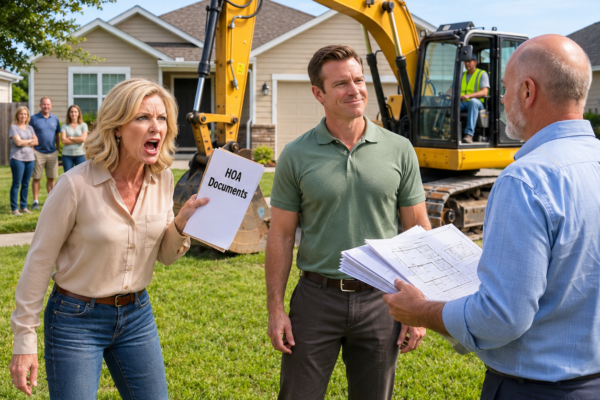
The first thing I saw when I pulled into my driveway was a backhoe tearing through the flower bed my late wife had planted ten years earlier—and the second was my new neighbor standing beside it with an iced coffee, telling me the ten-foot strip of my yard “wasn’t actually mine anymore.”h
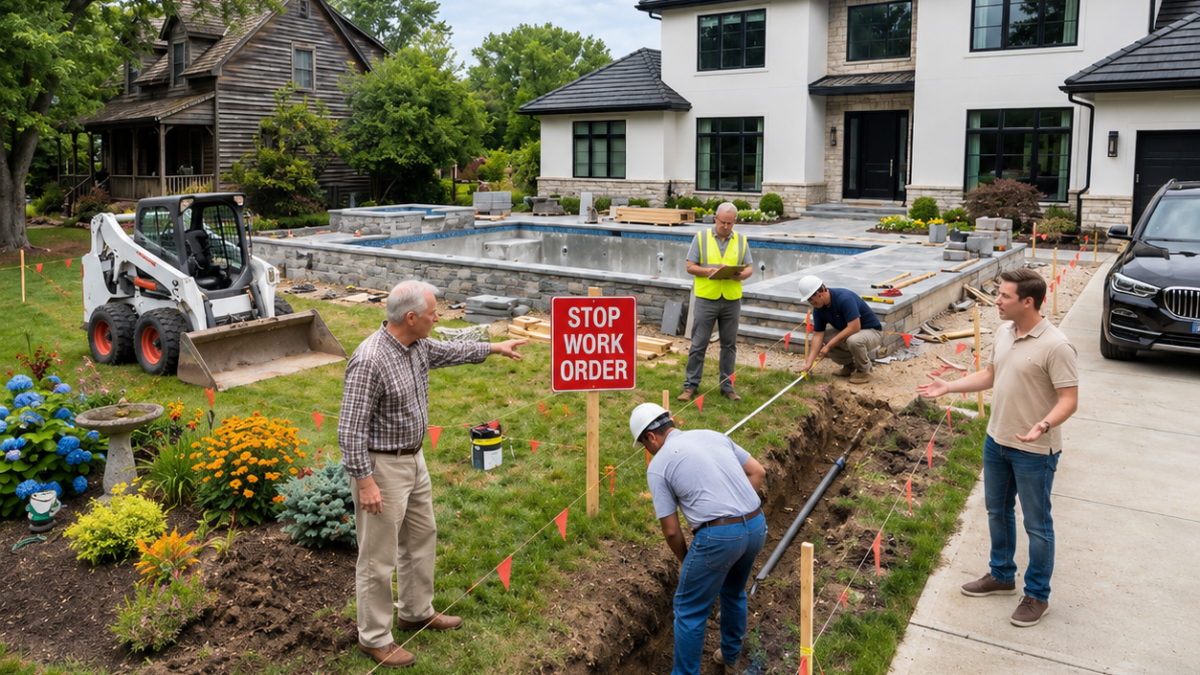
The first thing I saw when I pulled into my driveway was a backhoe tearing through the flower bed my late wife had planted ten years earlier—and the second was my new neighbor standing beside it with an iced coffee, telling me the ten-foot strip of my yard “wasn’t actually mine anymore.”
Julian Vance had spent nearly a year turning the house next door into his dream property: pool, outdoor kitchen, stone terrace, fire pit, glass walls, and an addition that looked more like a boutique resort than a suburban home.
What Julian didn’t know was that I had owned my house for almost twenty years, still had the original subdivision survey, and—buried in my uncle’s attic—there was a 1987 infrastructure map showing that the exact strip Julian had seized contained a recorded municipal sewer-access easement that prohibited permanent foundations above it.
My name is Gregory Hale.
I was fifty-six, taught history at a community college outside Boulder, and had absolutely no interest in becoming the neighborhood property-law expert.
Then I came home and found my hydrangeas flattened into mud.
“Your crew is on my property.”
Julian smiled.
“Not according to the updated survey.”
He unfolded a glossy plan showing the boundary curving almost ten feet into my side yard.
“That line has been there for thirty years.”
“Apparently it was wrong.”
Then he looked at the destroyed flowers and said:
“Besides, you weren’t really doing anything with the space.”
That sentence changed the entire dispute.
My wife Ellen had planted those hydrangeas the summer before she got sick.
The birdbath his excavator shattered had been hers too.
So I stopped arguing.
I hired a licensed boundary surveyor, pulled the recorded plat, photographed every monument, and searched the old planning files my uncle Leonard had saved from his years working for the city.
That was when I found the sewer easement.
Julian’s new patio foundation sat directly over it.
So did part of his outdoor kitchen.
And the plans for his expensive glass addition depended on that same area for final drainage and access approval.
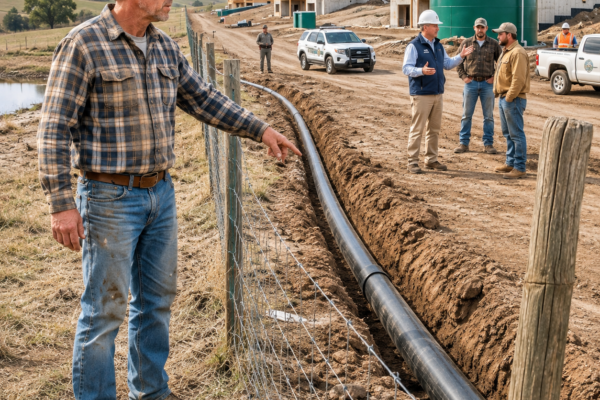
Monday morning at 8:13, three city vehicles pulled into our cul-de-sac.
Public Utilities.
Building Inspection.
Zoning Enforcement.
Julian walked outside smiling.
Then an inspector unfolded the easement map and asked:
“Sir, who authorized you to pour a permanent foundation over the city’s sanitary-sewer access corridor?”
Julian’s smile disappeared.
He pointed toward me.
“This is a boundary dispute.”
The inspector shook his head.
“No, sir. The boundary dispute is between you two.”
Then he tapped Julian’s permit set.
“This is why your house isn’t passing final inspection.”
[END OF FACEBOOK CAPTION]
[FIRST COMMENT / FULL STORY CONTINUATION]
“This is why your house isn’t passing final inspection.”
Julian stared at the inspector.
Then at me.
Then back at the plans.
For the first time since he moved onto our cul-de-sac, Julian Vance had absolutely nothing to say.
That alone was worth getting up early.
The inspector, a woman named Rebecca Lin, crouched beside the bright orange paint one of the utility crews had sprayed across the newly poured patio slab.
A thick line cut straight through the stonework.
On one side:
Julian’s outdoor kitchen.
On the other:
The framing for the glass addition he had been bragging about for six months.
Directly underneath:
A thirty-six-inch sanitary sewer main serving half the subdivision.
Rebecca stood.
“The recorded easement is twenty feet wide.”
Julian finally found his voice.
“My architect reviewed the property.”
Rebecca nodded.
“That may be.”
“My surveyor reviewed it.”
“That may also be.”
“My plans were permitted.”
“Yes.”
“So how can this suddenly be a problem?”
Rebecca pointed toward the red stop-work notice another inspector was taping to the construction fence.
“Because a building permit does not grant you the right to obstruct a recorded utility easement.”
Julian laughed.
It was not a happy laugh.
“You approved the plans.”
“The building department approved construction subject to all recorded property restrictions, easements, zoning requirements, and conditions.”
“That’s boilerplate.”
“It’s also binding.”
He looked at me again.
I could almost hear his internal argument:
This is Gregory’s fault.
Gregory complained.
Gregory found the map.
Gregory embarrassed me.
But none of those facts changed what sat beneath the patio.
Rebecca continued:
“We need unrestricted access to this sewer corridor.”
“My contractor can build access panels.”
“No.”
“We can reinforce the slab.”
“No.”
“I can indemnify the city.”
“No.”
Now I almost smiled.
Julian noticed.
His face hardened.
“You enjoying this?”
I thought about Ellen’s hydrangeas.
The birdbath.
The way he had said:
You weren’t really doing anything with it anyway.
I answered honestly.
“A little.”
Rebecca looked between us.
“Whatever your personal dispute is, keep it separate from my inspection.”
Fair.
I shut up.
The strange thing about that morning is that I still did not know whether Julian had actually stolen ten feet of my property.
Not legally.
Emotionally?
Absolutely.
But the boundary dispute was still unresolved.
And that mattered.
Because there were two different problems.
Problem one:
Where was the true lot line?
Problem two:
Could Julian build permanent structures over the municipal sewer easement?
The second question did not depend entirely on the first.
That easement existed across land associated with both parcels.
Even if Julian somehow proved the disputed strip belonged to him, the recorded utility rights could still block his foundation.
That distinction saved me from making the same mistake Julian had.
He treated every document that helped him as if it answered every question.
I was not going to do that.
So while the city shut down his construction, my surveyor kept working.
His name was Thomas Becker.
Sixty-four.
Licensed for more than thirty years.
The kind of man who would rather spend two hours finding one original monument than trust a modern digital map because it looked cleaner.
When I first handed him Julian’s survey, he frowned.
Not because it was obviously fake.
Because it wasn’t.
That would have been easier.
Julian’s survey had been prepared by a legitimate Denver firm.
Signed.
Stamped.
Recorded as an improvement survey.
The surveyor had relied on a legal description that contained an old ambiguity at the rear corner where our subdivision had been replatted in 1991.
One bearing conflicted with an earlier plat dimension.
Julian’s survey resolved that conflict in the interpretation most favorable to Julian.
Aggressively.
But not randomly.
Thomas said:
“This is going to take actual retracement.”
“How long?”
“Longer than you want.”
“Meanwhile he’s pouring concrete.”
“That is why your attorney should seek an agreement or temporary order.”
I hated that answer.
I wanted:
He’s wrong.
Here’s the line.
Done.
Property disputes rarely cooperate with anger.
My attorney was Rebecca Sloan.
Not the inspector Rebecca.
Different Rebecca.
Apparently my conflict required multiple women named Rebecca to explain basic civilization to two stubborn men.
Rebecca Sloan practiced real-estate litigation.
She reviewed:
My deed.
Julian’s deed.
Subdivision plat.
The 1991 replat.
Prior surveys.
Recorded easements.
Title commitments.
Fence history.
Aerial photographs.
Tax maps.
Utility records.
Then she said:
“Your case is good.”
“Good meaning?”
“Good.”
“Not certain?”
“Nothing involving a thirty-year-old survey discrepancy and rich people is certain.”
“I’m not rich.”
“Exactly.”
She smiled.
I did not.
Then she explained.
The long-standing fence had existed for at least twenty-seven years.
That alone did not automatically make it the boundary.
But original subdivision monuments, earlier survey calls, and the city’s utility map all appeared consistent with my interpretation.
Julian’s survey created a curved offset that did not align cleanly with original monumentation.
The most suspicious-looking part was also the most legally complicated.
The new line bent.
Not because Julian’s surveyor simply drew around his patio.
Because he used a particular interpretation of an old curve call tied to street geometry.
Still, Thomas believed that interpretation improperly projected a road curve into the side-lot boundary.
Surveyors love sentences like that.
Normal humans do not.
What I understood was:
Julian might have hired someone willing to interpret ambiguity aggressively.
That was different from forging a survey.
Important.
Rebecca sent a cease-and-desist letter.
Stop construction on disputed strip.
Preserve damaged landscaping.
No further entry onto my claimed property.
Request joint survey review.
Julian’s attorney responded within forty-eight hours.
His name was Andrew Kessler.
Of course Julian already had a lawyer.
Andrew’s letter said:
Mr. Vance relied in good faith upon a licensed survey and duly issued construction permits.
The alleged boundary remains disputed.
Mr. Vance denies trespass.
Reasonable access for ongoing work should not be obstructed.
I read it twice.
Then:
“Reasonable access?”
Rebecca said:
“Standard positioning.”
“He crushed my wife’s garden.”
“Yes.”
“That doesn’t sound reasonable.”
“No.”
“Can we stop them?”
“The city already stopped structural work over the easement.”
“What about everything else?”
“We ask court.”
That meant money.
I taught American history.
Community college.
My students assumed professors spent evenings reading books beside fireplaces.
I spent the next month reading legal invoices.
I knew enough history to appreciate irony.
Property law is one of the oldest engines of American conflict.
Boundaries.
Water.
Roads.
Access.
Fences.
People have been fighting over ten feet since people started measuring ten feet.
Now it was my turn.
I hated it.
Ellen would have hated it too.
That kept bothering me.
She had died eight years earlier from ovarian cancer.
The hydrangeas Julian’s crew flattened were not sacred because hydrangeas are sacred.
They were sacred because she had planted them during the last normal summer we had.
Before hospital schedules.
Before scans.
Before words like recurrence.
She had worn a blue shirt and an ugly gardening hat.
She kept planting things too close together.
I told her:
“They’ll crowd.”
She said:
“Then they’ll figure it out.”
That was Ellen.
Plants.
People.
Everything got room to figure itself out.
The birdbath came from a roadside antique store.
It was probably not antique.
She loved it anyway.
After she died, I never moved it.
Not once.
Then Julian’s backhoe snapped the base.
I knew it was an object.
I knew.
Still.
When Julian said that space was not being used, what I heard was:
Those memories are inefficient.
That was why I became so angry.
Not because ten feet changed my lot value.
Because he treated quiet use as no use.
Brenda Carter understood.
She lived across the street.
Seventy-one.
Widowed too.
She came over the night after the stop-work order carrying chicken casserole.
I said:
“You don’t need to feed me every time something bad happens.”
She said:
“You don’t need to eat it.”
Fair.
We sat at the kitchen table.
She asked:
“Did you win?”
“No.”
“But city stopped him.”
“That’s easement.”
“Not boundary.”
“Oh.”
I showed her maps.
She stared.
Then:
“I regret asking.”
Good.
Most people feel that way after five minutes of survey law.
She said:
“So what happens if the line is his?”
“I lose ten feet.”
“And flowers?”
“Already gone.”
“And if it’s yours?”
“He removes whatever crosses.”
She nodded.
Then:
“Either way, his patio is dead?”
“Parts of it.”
Brenda smiled.
“Consequences.”
That word again.
I was starting to like it too much.
Julian did not accept the city’s stop-work order quietly.
He appealed.
Not wrong.
He had spent close to a million dollars renovating.
The glass addition alone was projected at $310,000.
The pool, outdoor kitchen, stone terrace, landscape walls, drainage, and interior work pushed the total higher.
His dream house depended on final inspections.
The city had approved components at different stages.
Foundation.
Framing.
Electrical rough.
Plumbing.
But final certificate required compliance with all conditions.
The easement problem meant:
No final approval for the affected addition until corrected.
No signoff on outdoor kitchen gas installation.
No approval for part of pool enclosure where access corridor was blocked.
Not because I had magical power to “make his house fail.”
The city did.
My role was simply pointing them toward a recorded restriction they should have caught earlier.
That distinction mattered.
I did not bribe inspectors.
I did not invent violations.
I did not keep filing nonsense until they found something.
One real easement was enough.
Julian hired utility engineer.
Proposed reinforced removable slab.
The city considered.
Denied.
The easement language was explicit:
No permanent building, wall, foundation, pool, or other obstruction that would materially impair excavation and access without written utility approval.
The sewer main was old.
Forty-eight years.
Deep.
If it failed, crews might need to excavate the entire width.
A luxury kitchen built over it did not become acceptable because the countertops were expensive.
Then Julian proposed relocating the sewer.
That was possible in theory.
Estimated cost:
$420,000 to $600,000.
Engineering.
Bypass pumping.
New manholes.
Street work.
Testing.
Easement relocation.
Approval.
And the city did not have to agree merely because Julian wanted a pizza oven.
He abandoned that idea.
His contractors started blaming each other.
Architect blamed surveyor.
Surveyor blamed incomplete title packet.
General contractor said owner directed schedule.
Title company said recorded easement appeared in commitment exceptions.
Julian’s lawyer asked who had reviewed title exceptions.
That question became expensive.
Apparently Julian had received the title commitment.
The easement was listed.
But no one on the renovation team had plotted it carefully against final expansion.
Not uncommon.
Architectural drawings focus on design.
Survey focuses boundaries.
Title lists rights.
Civil engineer handles drainage.
General contractor builds.
If no one coordinates them, everybody can do their job and the project still fails as a whole.
That was exactly what happened.
Then Thomas found the original iron pipe.
Not sewer pipe.
Survey monument.
Buried under twelve inches of soil near the rear corner.
He called me at 7:10 one morning.
“Come outside.”
I was still in slippers.
He had a shovel.
Two younger crew members.
Orange flag.
At bottom of small excavation was rusted iron pin.
Thomas pointed.
“This matches the 1987 plat call.”
“What does that mean?”
“It means Julian’s interpreted curve doesn’t control the line the way his survey assumes.”
My heart started pounding.
“Say English.”
He smiled.
“Your old fence is within about three inches of the retraced boundary.”
I stared.
“So the ten feet?”
“Yours.”
“Certain?”
“As certain as surveyors get before lawyers ruin it.”
I laughed for first time in weeks.
He completed certified retracement.
Julian hired second surveyor.
Good.
If I were him, I would too.
Second surveyor met Thomas on site.
They disagreed initially.
Then reviewed monument.
Original plat notes.
Road curve.
Prior utility easement.
Historical fence.
Two weeks later, Julian’s surveyor issued revised opinion.
The disputed strip belonged to me.
Not a forged survey.
A mistaken interpretation.
Important.
Julian’s first survey company notified insurer.
No public humiliation.
Professional error process.
I expected Julian to apologize.
That was naive.
Instead his lawyer sent proposal:
Julian would purchase the ten-foot strip.
He offered $85,000.
My entire property was worth maybe $720,000 then.
Ten feet of side yard for $85,000 was objectively generous.
I almost took it.
Then I walked outside.
Saw bare mud where Ellen’s hydrangeas had been.
The strip also contained sewer easement.
Which meant Julian’s use remained limited even if I sold.
He wanted title because his setback calculations for the glass addition depended on it.
His addition had been designed close to property line.
Without strip, it violated side-yard setback.
There.
Another problem.
The dream house required those ten feet not only for patio.
For zoning geometry.
If he did not buy them, part of addition was too close to boundary.
If he did buy them, easement still blocked parts of patio but might save addition setback.
That was why he offered so much.
Rebecca asked:
“What do you want?”
“The land.”
“Then say no.”
“Is that stupid?”
“Financially?”
“Maybe.”
“Legally?”
“No.”
“Emotionally?”
“That’s your department.”
I said no.
Julian increased to $110,000.
Still no.
$125,000.
No.
Then Rebecca asked question that made me uncomfortable.
“If Ellen had never planted there, would you sell?”
I hated her.
I thought.
Maybe.
“Then make sure you’re not using her memory to prevent yourself from making a decision she wouldn’t care about.”
That hurt.
I went home.
Sat outside.
Ellen was not in dirt.
I knew that.
But I still did not want to sell.
Not just because flowers.
The strip gave my house separation.
Trees.
Drainage.
Privacy.
The city easement meant I could landscape shallowly but not build permanent structures.
Fine.
I did not need structures.
Quiet space had value.
I declined final offer.
That was choice.
Not revenge.
Mostly.
Julian’s addition had to be redesigned.
This was where title came true.
Without my ten feet:
The glass addition could not pass final zoning inspection as framed.
Part sat inside required setback.
Could he obtain variance?
He applied.
The Board of Adjustment held hearing.
He argued:
Survey error.
Substantial investment.
Minimal neighborhood impact.
Architectural hardship.
My attorney spoke.
Not me.
She said:
The hardship was self-created after construction proceeded despite boundary dispute and without securing land.
Setback existed before project.
Alternative design available.
The board denied variance.
Not because they hated Julian.
Because self-created financial inconvenience is generally weak basis for zoning variance.
He appealed? Considered.
Did not.
His lawyer likely told him odds poor.
So yes.
Part of his dream home literally could not pass final inspection.
The framed glass room had to come down.
Not entire house.
Not pool.
Not every improvement.
One side of addition.
Patio over easement.
Part outdoor kitchen.
Several landscape walls.
The amount removed was still staggering.
Workers spent three weeks undoing work they had just completed.
There is a particular sadness in demolition of something brand-new.
No decay.
No fire.
No storm.
Just expensive material being removed because it was built where it could not legally stay.
I watched less than people assume.
At first I thought I would sit on porch with beer.
Victory.
Instead the sound reminded me too much of the first backhoe in Ellen’s garden.
I went inside.
Revenge has bad soundtrack when it resembles original harm.
The neighborhood watched.
Of course.
Brenda treated it as serialized television.
Every morning:
“What are they removing now?”
“Stone wall.”
“Good episode.”
“Brenda.”
“What?”
“You’re enjoying this too much.”
“So are you.”
Fair.
The cost rumors became ridiculous.
Half a million.
Seven hundred thousand.
One person said $1.2 million.
I eventually learned through civil discovery and settlement documents that direct corrective work, redesign, fees, and delay were probably somewhere in low-to-mid six figures.
Still devastating.
But not mythical $400,000 demolition bill alone.
Julian could afford it.
That mattered.
He did not lose house because I complained.
He lost money because he built aggressively before resolving land and easement issues.
Difference.
The HOA got involved late.
Not to punish Julian for being unpopular.
His project had architectural approval based on plans showing a different side setback.
Once boundary corrected, approval no longer matched built condition.
The HOA issued stop and required revised submission.
No weekly extortionate fines.
One modest violation process.
Julian complied.
The board was almost annoyingly reasonable.
I wanted them to be dramatic.
They refused.
Good governance is terrible entertainment.
Our civil case moved toward mediation.
Claims:
Trespass.
Property damage.
Negligence.
Survey-related contribution among parties.
Potential unjust enrichment theories.
Boundary declaration.
Injunction.
Not criminal theft.
Julian had relied on survey.
That reduced moral clarity slightly.
But he also knew I disputed line before he continued work.
That increased it.
The crushed garden happened after I told his foreman to stop?
Actually first excavation was already underway when I arrived.
But Julian continued for two additional days after written objection before city stop.
That was harder to defend.
His lawyer knew.
Mediation happened ten months after first backhoe.
By then:
Boundary established by agreement based on retracement.
City easement confirmed.
Julian’s setback violation corrected.
Patio removed from access corridor.
Outdoor kitchen redesigned.
Pool deck modified.
My strip restored roughly.
But my hydrangeas were gone.
Birdbath broken.
Soil compacted.
One mature lilac damaged beyond saving.
I wanted restoration.
Money.
Legal fees.
And written boundary.
Julian wanted finality.
Insurance covered portions tied to contractor/survey negligence.
His personal contribution covered others.
We settled.
Not jackpot.
Enough to:
Restore landscaping.
Replace birdbath.
Repair irrigation.
Legal-cost contribution.
Install permanent surveyed monuments.
Build new fence entirely inside my property.
No admission of fraud.
No gag order.
Everyone released defined claims.
Boundary memorandum recorded.
That last part mattered most.
Future owners would not repeat this.
Julian asked to speak privately after mediation.
I almost refused.
Then remembered Ellen.
She used to say:
“If you keep every door closed because somebody once walked through wrong one, eventually you live in hallway.”
She said weird things.
Sometimes wise.
So I agreed.
We sat in empty conference room.
Julian looked exhausted.
No sunglasses.
No expensive little sneakers.
Normal dress shoes.
He said:
“I owe you apology.”
I waited.
“I was wrong.”
“About survey?”
“About more.”
Good start.
He rubbed his hands.
“When my surveyor told me line could be interpreted differently, I heard what I wanted.”
“Because of addition.”
“Yes.”
“And when you objected, I assumed you were sentimental and stubborn.”
“I was sentimental.”
He smiled faintly.
“Still.”
Then:
“I thought you’d take money.”
“You didn’t offer before digging.”
“I thought once work started you would.”
There.
That was the real theft.
Not fake survey.
Leverage through momentum.
Build fast enough that the other person feels resistance is unreasonable.
Julian admitted it.
“I figured if you saw how much project cost, you’d understand ten feet didn’t matter compared with whole thing.”
I stared.
“Ten feet mattered because it was mine.”
“I know.”
“Now?”
“Yes.”
He looked down.
“I understand how bad that sounds.”
I asked:
“Why tell me I wasn’t using it?”
He closed eyes.
“That was awful.”
“Yes.”
“I meant no structures.”
“I know what you meant.”
He looked toward conference door.
“My whole career is development.”
“Venture investments.”
“Everything is highest and best use.”
“Underperforming asset.”
“Unused capacity.”
“I think I started seeing everything that way.”
There.
That explained him better than:
Rich jerk.
If land was not monetized, improved, expanded, optimized, he read it as wasted.
Ellen’s hydrangeas had no ROI.
Therefore, in his mental model, the space was negotiable.
I said:
“My wife used it.”
He nodded.
“I know.”
“She died.”
“I know.”
“I’m sorry.”
That was first time apology reached me.
Not because he mentioned Ellen.
Because he stopped treating memory as argument.
He asked:
“What would you have done if I asked first?”
That question stayed.
Would I have sold?
Probably not.
Would I have allowed temporary construction access?
Maybe.
Would I have agreed to landscape adjustment?
Possibly.
Could we have relocated some plants?
Maybe.
Could we have worked something out?
Yes.
“I don’t know.”
I said.
“But asking would have kept you from becoming enemy.”
He nodded.
Fair.
Julian did not immediately sell.
The source version says he fled to Nevada.
Reality:
He stayed three years.
Finished house legally.
And honestly?
It was beautiful.
The redesigned glass room was smaller.
Pulled back.
Patio narrower.
Outdoor kitchen shifted.
Pool deck redesigned around easement.
Landscaping softened everything.
His property won a regional design award.
I almost died laughing when Brenda brought magazine.
“You’re kidding.”
“No.”
She pointed.
“Adaptive site constraints.”
I laughed until I coughed.
Ellen would have appreciated irony.
Julian changed too.
Not overnight.
He stopped blocking street with delivery trucks.
Actually introduced himself to neighbors.
Joined no HOA board.
Smart.
He sponsored cul-de-sac tree replacement after storm.
Did not put his name on plaque.
Better.
At first I suspected strategy.
Then realized maybe consequence had actually landed.
People can learn.
That does not erase trespass.
It does make aftermath more interesting.
One year after settlement, Julian came over.
He stood at gate.
“Gregory?”
“Yes.”
“I have something.”
He held stone birdbath.
Not Ellen’s.
Replacement.
Similar shape.
Weathered limestone.
“I found it at salvage yard.”
I stared.
“You already paid replacement.”
“I know.”
“This isn’t settlement.”
“No.”
He looked embarrassed.
“I remember yours.”
I touched edge.
Not same.
Could never be same.
I said:
“Thank you.”
We placed it near new hydrangeas.
No ceremony.
I did not tell him this mattered more than check.
Maybe he knew.
The hydrangeas were replaced with cuttings from Brenda’s plants.
Why?
Brenda had gotten cuttings from Ellen years earlier.
I had forgotten.
When mine were destroyed, Brenda said:
“I think these came from Ellen’s original.”
That hit me.
So the new hydrangeas were not replacements from nursery.
They were descendants.
Not identical.
Continuity.
Better.
We planted them together.
Brenda did most work because apparently history professors cannot plant straight.
The first bloom came following summer.
Blue-purple.
I sat on porch with cheap beer.
Thursday?
No.
Friday.
Close enough.
I thought:
This is what Julian did not understand.
Land use is not always visible in permits.
Sometimes a strip of dirt is doing exactly what its owner wants because it holds space for memory.
That is use.
So is shade.
Privacy.
Trees.
Nothing.
Nothing can be use too.
The city replaced sewer main seven years later.
That proved the easement issue was not theoretical.
Crews arrived.
Excavators.
Temporary fencing.
They needed most of corridor.
Julian’s old patio would have been directly in the way.
Had the city somehow allowed it to remain, they would have cut through.
Instead access was clear.
Work took eleven days.
They restored surface.
No drama.
Julian came outside one morning.
Watched excavation.
Then walked over to me.
“You have got to be kidding.”
“What?”
“They actually needed it.”
I laughed.
“You thought sewer main was fictional?”
“No.”
“But seven years.”
“Utility patience.”
He shook head.
Then:
“I would’ve lost entire patio.”
“Yes.”
“City inspector saved me money.”
“Eventually.”
He laughed.
Growth allows irony.
During sewer work, crews discovered one section of pipe worse than expected.
Emergency repair.
Had permanent structures blocked, delay would have been serious.
That reinforced why easements matter.
They are not bureaucratic lines invented to annoy homeowners.
Infrastructure needs access rarely.
Until suddenly it needs access very badly.
Then every inch matters.
My uncle Leonard’s old map went to city archives.
I donated original after digital scan.
He had kept it since planning department days.
I used to think he was a hoarder.
Maybe he was.
But records saved us.
The city already had recorded easement, technically.
His map simply helped me know what to ask for.
That distinction matters.
I did not win because secret attic document had magical authority.
I won because it pointed to official recorded rights professionals could verify.
Old paper is clue.
Not law by nostalgia.
I continued teaching.
Students found out story.
Of course.
One wrote paper on property disputes.
Another asked if I taught “revenge history.”
I said:
“All history is revenge history depending who writes textbook.”
That made class.
I created lecture around property records.
Not Julian by name.
We discussed:
Survey monuments.
Recorded plats.
Easements.
Adverse possession.
Boundary by acquiescence.
Title insurance.
Zoning.
Why tax maps are not necessarily surveys.
Why permits do not resolve ownership.
Students hated it.
Then loved stories.
Law becomes interesting when excavator crushes hydrangeas.
Julian’s house eventually passed final inspection.
Important.
The title says I made dream home never pass inspection.
For a long time, it did not.
It could not, as built.
But after he removed illegal/obstructing structures and redesigned setback issues, the corrected house passed.
That is how systems should work.
Inspection is not punishment.
It is condition.
Fix problem.
Pass.
If city had permanently blacklisted his house out of spite, that would be corruption in my favor.
I did not want that.
Eventually.
At first maybe.
Julian sold three years later.
Not massive forced loss.
Market had improved.
He probably still lost money relative to renovation cost because over-improvement rarely returns dollar for dollar.
But sale price was high.
Buyer loved house.
Julian moved to Nevada for business.
That part source got right.
A tech venture.
He came by before leaving.
No birdbath this time.
Just beer.
Expensive beer.
I drank one.
He asked:
“You hate me?”
“No.”
“Did you?”
“Yes.”
“How long?”
I thought.
“Until birdbath.”
He laughed.
“Cheapest part of project.”
“Exactly.”
Money had not fixed what acknowledgement did.
That was lesson for him.
Maybe me.
He said:
“I learned something from you.”
“Dangerous.”
“If someone says boundary matters, stop digging.”
“Good.”
Then:
“Also, history professors are spiteful.”
“I prefer persistent.”
“Same.”
We laughed.
He apologized again.
I said:
“You already did.”
“I know.”
“Then stop.”
He nodded.
Some people need repeat apology because they want their own discomfort relieved.
At some point, receiver must decide not to become confessional booth.
I had accepted.
Done.
The new owner, Maya Patel, was an architect.
She commissioned her own survey before closing.
Excellent.
She knocked first week.
“I want to confirm fence.”
I almost hugged her.
Instead:
“Please.”
We reviewed monuments.
Easement.
She said:
“I’m thinking about a garden along side.”
“Shallow-rooted plants.”
“No permanent structures.”
“Exactly.”
I loved her immediately.
Maya planted wildflowers.
No patio.
Easement remained accessible.
Our properties looked better together.
Ten-foot strip still mine.
Fence slightly inside.
Hydrangeas.
Birdbath.
Quiet.
Brenda died at eighty-one.
Her niece gave me one of her old gardening notebooks.
Inside:
Ellen gave me hydrangea cuttings, June 12.
Year.
That was how we confirmed new plants truly descended from Ellen’s.
I cried.
Again.
Grief is repetitive.
Not linear.
At Brenda’s memorial, someone told story of casserole.
Not my casserole specifically.
Apparently she fed half neighborhood through crisis.
That was her form of infrastructure.
No recorded easement.
But people depended.
Community has invisible systems too.
My house aged.
Roof replaced.
Fence once.
Birdbath cracked in winter and repaired.
Hydrangeas expanded beyond original bed.
I let them.
Ellen would approve crowding.
I retired at sixty-seven.
Still lived there.
No dream resort.
Cheap beer.
Porch.
Thursday lawn.
Mostly.
My knees changed schedule.
Maya’s daughter sometimes came over to smell hydrangeas.
One day she asked:
“Why fence bends here?”
Because after utility work, replacement fence followed slight interior offset around monument.
I told her:
“Property line.”
She said:
“Who owns other side?”
“Maya.”
“Who owns this side?”
“Me.”
“What if flower grows through?”
Good question.
I said:
“Then flower does not care.”
She laughed.
Children understand land better than adults sometimes.
Julian sent Christmas email years later.
Photo of modest Nevada house.
No giant patio.
No pool.
He wrote:
YOU’LL BE PLEASED TO KNOW ALL IMPROVEMENTS ARE INSIDE SETBACKS.
I replied:
SHOW SURVEY.
He sent PDF.
I laughed.
We remained not friends.
Something else.
Former adversaries with jokes.
That is enough.
The original steel pins remain.
The city added monument markers after settlement.
Not giant posts.
Small caps.
Professional.
Unremarkable.
That is what boundaries look like when no one is fighting.
You barely notice them.
Sometimes people ask:
Why didn’t you just take $125,000?
Fair.
Money could have paid retirement.
Travel.
New car.
I do not moralize.
Selling would not have dishonored Ellen.
Keeping was not inherently nobler.
I simply valued strip more than Julian did after accounting for money.
That is ownership.
Choice among lawful options.
Not necessarily financially optimal.
Mine.
Would I make same decision now?
Probably.
But I would recognize sooner it was a decision, not sacred duty.
At first I told myself:
Ellen’s land cannot be sold.
That was grief talking.
Later:
I want space.
Privacy.
Garden.
Easement buffer.
That was me.
Better.
We should not make dead people responsible for choices they cannot object to.
My greatest satisfaction was not watching inspectors arrive.
Though that was satisfying.
It was not red stop-work notice.
Not demolition.
Not Julian’s failed variance.
Not legal settlement.
Not sale.
It was seeing city excavators seven years later using the corridor exactly as intended.
Proof that rule existed for reason.
That transformed story from:
I found technicality to hurt him.
Into:
We prevented a dangerous obstruction.
That distinction matters to me.
Julian’s biggest mistake was not expensive sneakers.
Not bragging.
Not money.
Not even hiring aggressive survey interpretation.
It was continuing after uncertainty became explicit.
Once I said:
I dispute this boundary,
the responsible move was:
Stop.
Verify.
He chose:
Build faster.
Why?
Momentum.
Money.
Pride.
He assumed finished structure would create practical leverage.
People would hesitate to undo expensive work.
Sometimes they do.
That strategy works more often than anyone admits.
Build first.
Apologize later.
Make reversal seem wasteful.
It is used in business.
Politics.
Construction.
Relationships.
But sometimes the sewer line is still under the patio.
And reality does not care what you already spent.
My biggest mistake?
I enjoyed consequences enough that I almost stopped caring whether each one was necessary.
When city found issues, part of me wanted more.
Find everything.
Shut it all down.
Make him lose house.
That feeling was real.
Rebecca kept asking:
“What remedy actually protects your rights?”
Good question.
Not:
What hurts him most?
What restores boundary?
What compensates damage?
What prevents repeat?
Those are different.
Law is healthier when you ask second set.
People too.
Julian lost patio.
Part of addition.
Money.
Time.
Reputation.
But he also eventually got compliant house.
That was proper.
Accountability should have exit.
Otherwise people defend forever.
If no route back exists, apology becomes surrender instead of repair.
He had route.
He used it.
That is why years later we could drink beer.
The hydrangeas never looked exactly like Ellen’s originals.
Some blooms darker.
One plant shorter.
I used to compare.
Then stopped.
Replacement is not replication.
You cannot reconstruct past.
You grow something connected to it.
Good enough.
The birdbath Julian brought has one chip.
Not from demolition.
A squirrel knocked stone ornament into it years later.
I left chip.
Objects survive imperfectly.
So do people.
If you walk past my side yard now, you would never know ten feet nearly destroyed two neighbors’ lives.
Fence.
Flowers.
Birdbath.
Utility marker.
That is all.
No sign:
GREGORY WON.
Good.
Land does not need scoreboard.
The final time I saw Julian in person was years after sale.
He came through Boulder for business.
Called.
“Beer?”
“Sure.”
We sat on porch.
He looked older.
I did too.
He stared at hydrangeas.
“They came back.”
“Descendants.”
“Of original?”
“Through Brenda.”
He nodded.
“That’s good.”
Silence.
Then:
“I still think my first design was better.”
I laughed.
“Of course.”
“It was objectively better.”
“It was on my property.”
“Minor flaw.”
We laughed.
That was healing.
Not forgetting.
Context changing.
He asked:
“Do you ever tell story?”
“Sometimes.”
“Do you make me villain?”
“Depends audience.”
He groaned.
“Great.”
I said:
“You were villain for part.”
“Fair.”
“But not forever.”
He looked at me.
“Thanks.”
That mattered to him.
Maybe more than I expected.
People want biography, not sentence.
The truth is I was villain in someone else’s story once too.
Years before Ellen died, a student accused me of humiliating him in class.
I thought I was correcting misinformation.
He heard contempt.
I apologized.
Changed how I responded publicly.
No backhoe.
Still boundary.
We all overstep in different scales.
That does not equalize harm.
It does remind me not to flatten people.
So when people tell simplified version:
Rich neighbor stole ten feet.
Old professor found secret map.
City destroyed dream home.
Neighbor fled in disgrace.
I correct it.
He did encroach.
He did proceed too aggressively.
My land was damaged.
The sewer easement was real.
His house could not pass inspection as built.
He lost money.
But survey was not fake.
City did not act because I had connections.
Julian was not ruined.
And after he fixed everything, the home passed.
Reality is not weaker because punishment is proportionate.
It is stronger.
The thing I want remembered is the sentence:
“You aren’t really doing anything with it anyway.”
Because that assumption sits underneath so much entitlement.
If land is quiet, it is unused.
If person is polite, he is weak.
If widow lives alone, she doesn’t need space.
If old fence looks cheap, boundary must be flexible.
If garden doesn’t make money, patio is better use.
No.
Value is not only revenue.
Use is not only construction.
Ownership is not measured by how aggressively you improve.
Sometimes the highest use of ten feet is hydrangeas and nothing else.
That is allowed.
And if you want practical lesson?
Get survey before building near boundary.
Read title exceptions.
Plot easements.
Do not assume permit means access.
Do not rely solely on tax maps.
If neighbor objects, stop and verify.
If you are neighbor, document before destroying contractor equipment or screaming threats.
Hire surveyor.
Get attorney.
Call proper department.
Do not move monuments.
Do not invent your own measurements.
And never pour expensive concrete over a utility corridor because somebody says:
“It’ll probably be fine.”
It won’t.
Eventually sewer always wins.
Ellen would have laughed at that line.
She hated bathroom humor.
Actually, she pretended to.
I can hear her:
“Gregory, you turned my hydrangeas into lecture.”
Yes.
I did.
History professor.
Occupational hazard.
On Friday evenings I still sit outside sometimes.
Cheap beer.
Different chair.
Hydrangeas taller than fence.
Birdbath catching sunset.
Somewhere beneath the side yard, sewer line runs quietly.
No one thinks about it.
Exactly how infrastructure wants to be.
Maya’s wildflowers lean through fence gaps.
I never trim the ones that cross.
They are not stealing land.
They are flowers.
There is a difference.
And every now and then I look at the steel boundary marker near the back corner.
Small.
Dull.
Unimpressive.
It does not care about Julian’s money.
My memories.
The city.
Our arguments.
It simply marks where one parcel ends and another begins.
That line never needed anger.
We brought anger to it.
The marker only needed us to respect what it meant.
That was the lesson.
Not that I beat Julian.
Not that inspectors ruined his dream.
Not that old paperwork defeated new money.
The real lesson was simpler:
Before you build your dream on someone else’s ten feet, make absolutely sure those ten feet are yours.
Because once concrete is poured, pride will tell you it is too late to turn back.
Property law may disagree.
And if there happens to be a sewer main underneath?
Property law will not be the only thing waiting for you.