The HOA Called Me at 3:54 A.M. to Announce 100 People Would Be Swimming in My Private Pool at 6—And They Had No Idea What I Had in My Desk Drawer.
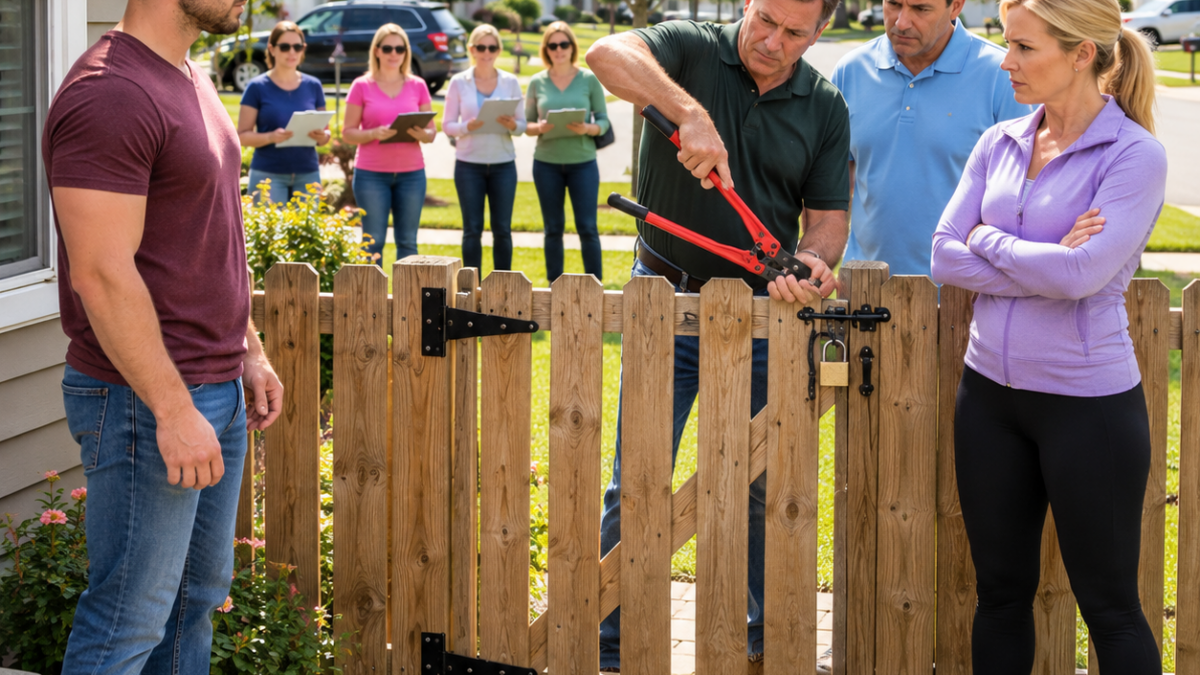
For a moment, I forgot about the man standing beside my gate with bolt cutters.
I was staring at the clipboard.
The image wasn’t sharp enough to read every word, but the signature at the bottom was unmistakable. Someone had written my first and last name in broad, looping handwriting.
Luke Harrington.
I had never signed an agreement with Victoria Hail.
I had never authorized the association to use my pool.
And I had certainly never agreed to host a hundred strangers in my backyard before sunrise.
“Can you enlarge that?” Melissa asked.
I opened the camera application and zoomed in.
The picture became grainy. The words above the signature dissolved into little gray squares.
But I could still make out two things.
The heading began with PROPERTY OWNER.
And the signature was followed by a date from the previous month.
My stomach tightened.
“That’s not mine,” I said.
Melissa looked from the monitor to my face.
“Are you sure?”
“Completely.”
Outside, Caleb tapped the gate latch.
The man with the red toolbox adjusted his grip on the cutters.
I called 911.
The dispatcher asked for my address, my name, and whether anyone was injured or threatening me.
“No one’s hurt,” I said. “But there’s a large crowd outside my house. I’ve told the organizers they don’t have permission to be here. Someone is preparing to cut the lock on my backyard gate.”
“Are you inside the residence?”
“Yes.”
“Stay there. Don’t confront them. Officers are being sent.”
I gave her a description of the people at the gate and told her about the cameras.
Then I watched the screen.
The man positioned the cutters around the padlock.
He hesitated.
I later learned his name was Dennis Rowe, a maintenance contractor who occasionally worked for the association.
At that moment, he looked uncomfortable.
Victoria said something to him.
He glanced toward the clipboard.
She held it up.
Whatever he saw apparently satisfied him.
The handles came together.
The lock snapped.
The sound reached me through the partially open kitchen window.
It wasn’t loud.
Just a short metallic crack.
But I felt it somewhere behind my ribs.
Melissa put a hand over her mouth.
“Oh, Luke.”
For thirty-six years, I’d never been particularly afraid of confrontation. Construction sites had taught me how to deal with angry subcontractors, unreasonable clients, and people who believed raising their voices could change a measurement.
But watching somebody deliberately open a locked gate on my own property was different.
I knew exactly how much that fence had cost.
I knew which boards I’d replaced after last winter’s storms.
I knew the tiny rust stain beneath the lower hinge.
And now a woman who had never contributed a penny toward any of it was standing there directing people inside.
By 6:03, approximately thirty guests had entered my backyard.
Others remained along the sidewalk, waiting for instructions.
A little boy carrying orange water wings hurried past my patio furniture.
A woman placed two coolers beside the grill.
Someone rolled a portable speaker onto the deck.
I saw a teenager reach toward the pool water.
My pulse climbed.
“Please tell them not to go in the water,” I said to the dispatcher when she asked for an update. “There’s no lifeguard here. I have not prepared this pool for a public event.”
She told me to remain inside and not attempt to control the crowd myself.
So I stood in my kitchen, helplessly watching strangers wander through a yard where I normally drank coffee alone.
Then a woman in a yellow sundress looked directly toward my back door.
She smiled.
Actually smiled.
And waved.
She thought I was hosting.
That was when I understood the ugliest part of what Victoria had done.
She hadn’t merely ignored my refusal.
She had apparently told ordinary families that I had agreed.
They weren’t all trespassers deliberately challenging my rights.
Most were people who believed they had been invited.
And some of them had brought their children.
***
The first patrol car arrived at 6:11.
A second pulled in behind it.
Officer Daniel Reeves, a broad-shouldered man with graying hair, approached my front porch while his partner, Officer Elena Ortiz, surveyed the crowd.
I met Reeves at the door with my blue folder.
“You’re the homeowner?”
“Yes.”
“You reported somebody cutting your gate?”
I pointed toward the backyard.
“Everything’s on video.”
He nodded.
“Before we look at that, I need to know whether anyone’s threatened you or whether there are weapons involved.”
“Nobody’s threatened me physically. They just won’t leave.”
“All right. Stay here for a moment.”
He walked around the house.
Officer Ortiz approached the pool area from the open gate.
I heard her ask people to step away from the water.
A few minutes earlier, music had been playing softly.
Now I could hear children’s sandals slapping against the concrete as parents gathered their belongings.
Victoria appeared beside the patrol car.
Even from the porch, I could recognize the posture.
Straight shoulders.
Clipboard tucked against her chest.
Chin lifted slightly.
She had practiced being listened to.
“Officer,” she began, “this is an association-sanctioned recreational program.”
Reeves didn’t raise his voice.
“Who owns the property?”
“Mr. Harrington owns the residential parcel, but the community has certain recreational interests under our development plan.”
“Do you have written authorization from the property owner?”
“Yes.”
My fingers tightened around the folder.
Reeves looked at her.
“May I see it?”
Victoria opened the clipboard.
The document was there.
I could see my name at the bottom.
The officer studied it briefly before looking toward my porch.
“Mr. Harrington, would you come over here, please?”
I walked down the steps.
Melissa followed, keeping a respectful distance.
Victoria gave me a thin smile.
“Luke, I’m disappointed you chose to involve the police.”
I didn’t respond.
Reeves held out the paper.
“Is this your signature?”
I looked.
The document was titled TEMPORARY RECREATIONAL ACCESS AUTHORIZATION.
It identified my address and described permission for the Redwood Heights Community Association to use my pool and surrounding deck for a one-day community event.
It specified up to 120 guests.
It even referred to the use of my outdoor electrical outlets.
At the bottom was my purported signature.
The handwriting was close enough to pass a casual glance.
But it wasn’t mine.
And the date beside it was a Tuesday when I’d been working at a customer’s house outside town.
“No,” I said.
Victoria immediately stepped forward.
“Luke, you agreed to participate during our neighborhood outreach discussions.”
“I told you no in writing.”
“There may have been confusion about the scope of the arrangement.”
“Victoria, that’s not my signature.”
Her eyes dropped to the paper.
Only for a second.
But I saw it.
Officer Reeves looked between us.
“All right. I’m not going to determine the authenticity of a signature here on the sidewalk. We will document the dispute.”
He turned toward Victoria.
“For now, the owner is telling us he doesn’t consent to this event. The pool is fenced private property, and a lock was cut to gain entry. The event needs to stop.”
Victoria swallowed.
“But these families have already arrived.”
“Then you’ll need to explain that to them.”
“Some of them drove half an hour.”
“I understand that.”
“We’ve paid deposits.”
“That doesn’t give you permission to use somebody else’s property.”
Caleb stepped forward.
“Officer, we’re not trying to cause problems.”
Reeves pointed toward the damaged lock.
“Who arranged for that to be cut?”
Caleb looked at Victoria.
Victoria looked at Dennis.
Dennis stared at his shoes.
Finally, he spoke.
“Mrs. Hail showed me the authorization. I asked if the homeowner knew. She said everything was cleared.”
I looked at him.
“Did you call me?”
“No, sir.”
“Did you knock on my door?”
He hesitated.
“No.”
Officer Ortiz returned from the backyard.
“The pool area is being cleared. There are still people on the sidewalk.”
Reeves nodded.
He asked Dennis for his identification, took statements from the organizers, and photographed the cut lock.
He did not announce that everyone was going to jail.
He did not threaten to seize association property.
He did not issue some magical order dissolving the HOA.
He simply documented what had happened.
And, one by one, the strangers began leaving my yard.
That should have been the end.
It wasn’t.
Because while the officers were interviewing Victoria, a woman carrying two towels approached me.
She was maybe forty, with dark hair tied into a messy ponytail.
Her little girl stood beside her.
“Are you Mr. Harrington?” she asked.
“Yes.”
Her expression changed.
“Oh, my God.”
I waited.
She looked at my house, then toward Victoria.
“They told us you donated the pool for a fundraiser.”
“I didn’t.”
The little girl tugged her mother’s shirt.
“Mom, are we in trouble?”
The woman knelt immediately.
“No, honey. We’re going home.”
Then she stood and looked at me again.
“I’m sorry. We had absolutely no idea.”
I believed her.
That made me feel worse.
Not toward her.
Toward the person who had placed her in that position.
“Did you pay for a ticket?” I asked.
She nodded.
“Forty dollars for adults. Fifteen for children.”
I stared at her.
“Tickets?”
“Yes. It was supposed to benefit the new community recreation fund.”
She unlocked her phone and showed me the invitation.
There was a bright blue promotional graphic featuring swimming goggles, balloons, and a photograph of my backyard.
My actual backyard.
The photo had been taken from an angle I recognized.
Outside my rear fence, near the utility easement.
Across the top were the words:
SUMMER TOGETHER — REDWOOD HEIGHTS COMMUNITY POOL DAY.
Below that:
HOSTED THROUGH THE GENEROSITY OF LUKE HARRINGTON.
I felt suddenly cold.
“Can you send me that?”
She nodded.
“Of course.”
Her name was Rachel Donovan.
Before she left, she said something that stayed with me.
“My daughter’s been excited about this for two weeks. I’m upset she’s disappointed, but I’m more upset somebody used your name without asking you.”
She paused.
“I hope you get it sorted out.”
It was the first normal thing anybody had said to me all morning.
***
By 7:15, the last guests were gone.
The vendor van had left.
Caleb had loaded the portable speaker back into his SUV.
Dennis had collected his tools.
Victoria drove away without looking toward my porch.
The police provided an incident number and explained that the report and evidence would be reviewed.
Whether the incident led to criminal charges would depend on the facts, applicable law, and decisions made through the normal process.
I understood.
I wasn’t interested in inventing consequences.
I wanted an accurate record of what had happened.
When I finally walked into the backyard, it looked almost normal.
That was the strangest part.
The water was still blue.
The lounge chairs were still where I’d left them.
The maple tree beside the fence moved in the morning breeze.
But there were damp footprints across the deck.
A crushed paper cup rested beside a planter.
Somebody had left a blue towel on the steps.
And my gate wouldn’t latch.
I bent down to pick up the broken padlock.
It fit in the palm of my hand.
A perfectly ordinary object.
Something I could replace for fifteen dollars.
Yet standing there holding it, I felt as though somebody had broken into a part of my life that had taken years to build.
Melissa came outside carrying two mugs of coffee.
She handed me one.
Neither of us spoke for a while.
Finally, she said, “You know she’s going to tell everyone you ruined the fundraiser.”
“Probably.”
“Are you ready for that?”
I looked toward the gate.
“No.”
She nodded.
“Then we’d better get you ready.”
***
Melissa was fifty-two and had lived in Redwood Heights for almost a decade.
She worked as a high school librarian and had the temperament of someone who could quiet a room without raising her voice.
When Victoria became president, Melissa had initially supported her.
That surprised me.
I’d always thought Melissa saw through people more quickly than I did.
“She seemed organized,” Melissa explained as we sat at my kitchen table. “The old board kept putting off maintenance. The walking paths were deteriorating. The clubhouse roof leaked every winter. Victoria actually got people moving.”
“Until she moved them into my backyard.”
Melissa gave me a tired look.
“I’m not defending her.”
“I know.”
“I’m telling you why people trusted her.”
That distinction mattered.
For months, I’d considered Victoria an irritating woman with an inflated sense of authority.
But Melissa saw something more complicated.
Victoria had built her reputation by getting things done.
She had organized volunteer cleanups, negotiated a landscaping contract, and convinced residents to approve improvements that previous boards had struggled to explain.
A lot of people liked her.
Some genuinely admired her.
And her reputation gave her tremendous informal influence.
The problem was that she’d started treating opposition as an obstacle to be removed rather than a disagreement to be addressed.
My property represented something she couldn’t direct.
That appeared to bother her more than the actual pool.
Melissa opened her phone.
“Look at this.”
The neighborhood Facebook group was already active.
A photograph of the police cars had been posted with the caption:
COMMUNITY FAMILY EVENT CANCELED AFTER HOMEOWNER DISPUTE.
Below it, people were arguing.
Some were furious about the wasted trip.
Others accused me of deliberately humiliating volunteers.
A few asked why a private homeowner had been expected to host a community event at all.
Then Victoria posted.
She described the morning as an unfortunate breakdown in communication over a previously discussed neighborhood partnership.
She said the association had acted in good faith.
She expressed regret for the disruption experienced by families.
She did not mention the cut lock.
She did not mention my repeated refusals.
And she did not explain the signature.
I read the post twice.
Then I started typing.
Melissa reached across the table.
“Don’t.”
I stopped.
She looked at the angry paragraph on my screen.
“You’re going to feel wonderful for about thirty seconds.”
“She’s lying.”
“Then prove it properly.”
I put the phone down.
She was right.
Anger had built enough furniture in my head to fill another house.
I didn’t need to live inside it.
***
By noon, I had copied the security footage to two separate drives.
I saved screenshots of the invitation, the board’s email chain, and Victoria’s public statement.
I photographed the broken gate from several angles.
Then I called the attorney who had handled my property purchase.
Her name was Rebecca Shaw.
Rebecca was in her late forties, spoke quickly, and had an extraordinary ability to make complicated documents feel less intimidating.
When I told her what had happened, she went quiet.
“Luke, tell me you haven’t posted anything online.”
“Not yet.”
“Good.”
I explained the phone calls, the forged-looking authorization, and the police response.
She interrupted only to clarify dates.
When I finished, she said, “Send me everything, but especially that document.”
“I don’t have the original.”
“Did you photograph it?”
“The officer did. I saw it, and Melissa got part of it on video.”
“All right. We’ll request the appropriate records and preserve what we can.”
I asked whether Victoria could really claim association rights over my pool.
Rebecca answered carefully.
“Your recorded documents do not show an association easement or recreational right over your property. But I want to review the current title records and the document she presented before making any broader conclusion.”
“Do you think she’s going to get arrested?”
“That’s not something I can predict.”
“Then what do I do?”
“First, we establish what happened. Second, we protect your property. Third, we deal with the people and organizations responsible through the proper channels.”
I looked through my window.
The broken gate was tied shut with a length of nylon rope.
“That sounds slow.”
“It probably will be.”
I sighed.
Rebecca’s voice softened.
“I know you want an answer today. But if someone used your name on an authorization you never signed, we need to be careful. That’s potentially more serious than an argument about a swimming pool.”
For the first time since the phone rang, I understood that the paperwork might matter more than the scene itself.
***
That afternoon, I drove to the hardware store.
Not because my attorney told me to.
Because I couldn’t stand looking at the damaged gate.
I bought a temporary hasp, a new padlock, and replacement hardware.
At the register, the cashier recognized me.
“You’re the pool guy.”
I looked up.
He winced.
“Sorry. That came out wrong.”
“It’s been a strange morning.”
He scanned the lock.
“My sister was invited. She thought it was a community pool.”
“It wasn’t.”
“Yeah. She’s figured that out.”
He handed me the receipt.
“Hope they make it right.”
Back at home, I spent an hour repairing the gate.
The old latch had been twisted when the lock was cut.
I straightened what I could, replaced the damaged parts, and checked the alignment.
By the time I finished, the sun had moved behind the neighbors’ roofs.
I closed the gate.
Turned the key.
Pulled once.
It held.
I should have felt better.
Instead, I stood there remembering the sight of strangers moving through my yard.
My first house had been a small duplex near a busy road.
For seven years, I’d listened to traffic outside the bedroom window.
Then my business grew.
I saved.
I worked weekends.
I refused vacations.
When I finally bought the Redwood Heights property, I spent the first evening sitting on the unfinished patio with a folding chair and a sandwich from a gas station.
There had been no pool then.
Just a patch of uneven concrete and a backyard filled with weeds.
Over the next four years, I’d designed the deck, hired licensed trades for the work I couldn’t perform myself, and saved enough to install the pool.
I remembered standing beside the finished water on the day the contractor removed the temporary barriers.
I hadn’t been thinking about entertaining crowds.
I’d been thinking about my father.
He had been a carpenter, too.
When I was a kid, he used to say that a good house didn’t have to be impressive.
It had to feel safe when you closed the door.
He died before I bought this place.
But the first thing I’d carried into the backyard after the pool was finished was the old wooden chair he’d kept in his workshop.
It sat beneath the maple tree now.
A little crooked.
One arm repaired twice.
That chair mattered more to me than Victoria could possibly understand.
And she had brought a hundred invitations to the place where I kept it.
***
The next morning, Rachel Donovan called.
We’d exchanged numbers when she sent me the event invitation.
She sounded hesitant.
“I hope I’m not bothering you.”
“Not at all.”
“I found something strange in the registration email.”
I sat down.
“What kind of strange?”
“There was an attachment I didn’t open when I signed up. I looked at it this morning.”
She forwarded the message.
The attachment was a two-page document labeled EVENT PARTICIPANT INFORMATION.
Most of it contained ordinary instructions about parking and bringing towels.
But near the bottom of the second page was a sentence that made me stop reading.
The event was described as taking place at a privately owned residential facility made available through a temporary access agreement.
Underneath was a statement that the property owner’s insurance would provide primary premises coverage, subject to policy conditions.
I read it again.
My insurance.
For an event I hadn’t approved.
My pulse started climbing.
I sent the document to Rebecca.
She called less than ten minutes later.
“Luke, have you spoken with your insurer?”
“No.”
“Do that today. Tell them exactly what happened and provide the event materials. Don’t make assumptions about coverage, but make sure there’s a record.”
I looked at the paragraph.
“Can an HOA just decide my insurance covers its event?”
“No. An invitation doesn’t create insurance coverage, and the language in this flyer doesn’t establish any obligation by your carrier.”
“Then why would they write it?”
“That’s one of the questions we need answered.”
I called my insurance agent, described the situation, and forwarded the materials.
He was understandably concerned about the unauthorized entry and the possibility of claims arising from it.
He explained that my ordinary homeowners policy was not designed to function as a public-event liability policy, and that actual coverage depended on the policy’s terms and the facts of any particular claim.
He asked whether anyone had been injured.
“Not that I know of.”
“That’s fortunate.”
I looked down at the flyer.
“Very.”
He promised to document the report and advise me about any needed follow-up.
After I hung up, I sat quietly for a long time.
There had been children beside my pool.
A temporary speaker near an outdoor electrical outlet.
Dozens of people moving through a space without planned supervision or proper event arrangements.
If a child had slipped.
If someone had been seriously hurt.
If a guest had fallen against the glass patio door.
The consequences could have been far worse than a broken lock.
I couldn’t stop thinking about the little girl who had asked her mother whether they were in trouble.
***
Two days later, Melissa invited me to her house.
When I arrived, she had laid three sheets of paper across her dining table.
“Where did you get these?” I asked.
“Association records.”
Melissa had served briefly on a landscaping committee several years earlier, and she still received certain community communications.
She also knew which records members could request under the association’s governing documents and applicable procedures.
She pointed to the first page.
It was a draft budget for a proposed recreation program.
The number beside COMMUNITY AQUATICS INITIATIVE caught my attention.
$18,400.
I blinked.
“That’s a lot of money for a pool party.”
“It wasn’t supposed to be just a pool party.”
She showed me the second page.
It outlined a summer series of recreational events that would supposedly increase community engagement and support a future capital improvement proposal.
My pool appeared in the document as the initial host facility.
“Initial?” I repeated.
Melissa nodded.
“Look at the next page.”
The third sheet contained a draft concept for a permanent neighborhood recreation area.
It proposed expanding amenities near the older east parcel of Redwood Heights.
My house stood on that parcel.
The diagram didn’t simply show people using my pool for one morning.
It showed a possible pedestrian access route along the side of my property.
And a proposed community recreational boundary overlapping part of my yard.
I stared at it.
“That can’t be serious.”
“It’s a concept drawing, Luke. Not an approved plan.”
“Why is my backyard on it?”
“That’s what I want to know.”
I studied the diagram.
There were arrows, shaded areas, and notes about future feasibility review.
It looked like the kind of preliminary drawing a consultant might prepare before anyone had examined title records.
But the idea behind it was unmistakable.
Somebody had imagined my property becoming part of a larger community facility.
“How long has this been circulating?”
Melissa folded her hands.
“At least two months.”
I remembered Victoria’s letters about neighborhood unity.
The complaints about my fence.
The improvement map.
The sudden insistence that my property should serve the community.
The pool event wasn’t necessarily the beginning of something.
It might have been an attempt to make something already imagined seem normal.
I looked at Melissa.
“Do other board members know?”
“I don’t know what each of them has seen.”
“Then we need to find out.”
***
Rebecca reviewed the documents that evening.
She was careful not to turn assumptions into conclusions.
A draft development concept didn’t create property rights.
A proposed access route wasn’t an easement.
And a board discussing ideas wasn’t automatically doing anything improper.
But she agreed that the documents raised important questions about the association’s planning and representations.
“We need the board minutes, any relevant resolutions, and the records supporting the event,” she said.
“Can we demand all of that?”
“We can make appropriate requests. Some records may be available to members, some through legal process, and some may not be accessible without further proceedings. We’ll approach this systematically.”
She also wanted to know who had prepared the authorization bearing my signature.
“That’s what bothers me most,” I admitted.
“It should.”
“Victoria was holding it when the lock was cut.”
“That matters. But possession alone doesn’t establish who created it.”
“I know.”
“Luke, I need you to promise me something.”
“What?”
“Don’t start calling people criminals on the neighborhood page.”
I sighed.
“I haven’t posted anything.”
“Keep it that way until we understand the evidence.”
I agreed.
Then I went outside.
The repaired gate was closed.
The new lock reflected the porch light.
And for the first time, I wondered how many people had seen the concept drawing of my property and never thought to tell me.
***
The association’s next board meeting was scheduled for Thursday evening.
I wasn’t an HOA member.
That distinction mattered.
I couldn’t assume I had the same participation or record-access rights as owners subject to the association’s governing documents.
But a board member named Patrick Sloan contacted me and said the association had agreed to hear my concerns during an invited portion of the meeting.
Patrick was sixty-one, a retired accountant with a quiet voice and the slightly exhausted expression of a man who regretted volunteering.
He called on Tuesday afternoon.
“Luke, I want to apologize for what happened.”
“Did you vote to use my pool?”
“No.”
“Did the board?”
There was a pause.
“We approved a community recreation budget. We were told arrangements for the location were being finalized.”
“Who told you that?”
“Victoria.”
“Did you see a signed authorization?”
“I saw a summary saying the homeowner had agreed in principle.”
I looked toward the blue folder on my desk.
“I never agreed in principle.”
“I understand that now.”
“What did the minutes say?”
Patrick exhaled.
“That’s one of the things I want clarified.”
His voice changed.
Less formal.
More personal.
“Luke, my wife used to tell me that whenever someone says a detail has already been handled, that’s exactly the detail I should ask about.”
“What happened to her?”
“She passed away two years ago.”
“I’m sorry.”
“Thank you.”
He paused.
“I joined the board because I thought keeping the neighborhood organized might give me something useful to do. I didn’t join to argue that a locked gate doesn’t mean anything.”
For the first time, I felt there might be someone inside the association who understood the difference.
I told Patrick I’d attend.
Then he said something unexpected.
“There’s another issue you should know about.”
I waited.
“The treasurer has been asking questions about the pool event’s expenses.”
“What questions?”
“Payments were authorized before the board received the final event plan. Some of the invoices are confusing.”
“How confusing?”
“I don’t want to make accusations without reviewing the records.”
“Fair enough.”
“But bring a copy of the invitation you received from that family.”
“Why?”
“Because the board was told admission would be free.”
***
Thursday came with a low gray sky and thunderstorms in the forecast.
I spent the afternoon at a renovation job replacing rotten steps behind a rental house.
Normally, physical work helped quiet my mind.
That day, I measured one board three times and still cut it short.
My employee, Jake, noticed.
“You all right, boss?”
“Just distracted.”
“Pool thing?”
I looked at him.
“Everybody knows about that?”
He shrugged.
“My mom lives two streets over.”
Of course she did.
He set down the drill.
“For what it’s worth, she was invited.”
“Did she go?”
“No. Said six in the morning was an ungodly hour to swim.”
I laughed despite myself.
Jake leaned against the railing.
“She did say they were selling tickets.”
“Yeah.”
“And that there was supposed to be a bigger community pool project afterward.”
My smile disappeared.
“She said that?”
“Something about a new recreation center. I didn’t pay much attention.”
I stared at him.
“Jake, can you ask her whether she kept the invitation?”
“Sure.”
He paused.
“Boss, don’t let this get in your head so much you fall off a ladder.”
I looked at the saw in my hand.
He had a point.
I put it down.
***
The board meeting took place in the Redwood Heights clubhouse, a tan brick building near the subdivision entrance.
It had folding chairs, fluorescent lights, a coffee dispenser, and a faded bulletin board announcing neighborhood yard sales.
There was nothing dramatic about the room.
Which made the situation feel almost absurd.
A hundred people had nearly been allowed into my private backyard because of decisions made in rooms like this.
I arrived with Rebecca and Melissa.
Victoria was already seated at the front table.
She wore a navy jacket and had arranged her documents into precise stacks.
Caleb sat two rows behind her.
Patrick stood near the doorway speaking with another board member.
When he saw me, he gave a small nod.
Victoria did not acknowledge me.
The meeting began with routine business.
Landscaping.
A drainage complaint.
An estimate for replacing the clubhouse gutters.
I sat listening, increasingly aware that ordinary governance was possible even with Victoria in the room.
People asked questions.
Someone corrected a budget figure.
A board member requested a contractor’s revised estimate.
Nothing collapsed.
Then Patrick introduced the pool-event review.
Victoria folded her hands.
“As everyone knows, our planned summer gathering was unfortunately interrupted by a disagreement concerning facility access.”
Rebecca wrote something on her notepad.
Patrick looked toward Victoria.
“I think we should begin by clarifying what authorization the association believed it had.”
Victoria nodded.
“Of course.”
She opened a folder.
“The event team received a written permission form.”
“From whom?” Patrick asked.
“From the property owner.”
I felt Rebecca’s hand briefly touch my forearm.
A reminder.
Let the question finish.
Patrick continued.
“Did you personally receive that form from Mr. Harrington?”
Victoria hesitated.
“It was provided through the event coordination process.”
“Who provided it?”
Caleb shifted in his chair.
Victoria looked toward him.
He stared at the table.
Patrick waited.
Nobody spoke.
Then Rebecca raised her hand.
The meeting chair recognized her.
“My client denies signing any authorization and has preserved written communications refusing access. We’d like the association to identify the source of the document, preserve the original if it exists, and correct any public statement suggesting he consented.”
Victoria’s expression tightened.
“This isn’t a courtroom.”
Rebecca nodded.
“Correct. I’m not treating it as one.”
A few people shifted in their chairs.
Patrick leaned forward.
“Then perhaps we can answer a simpler question.”
He looked directly at Victoria.
“Who gave Caleb the signed form?”
Victoria opened her mouth.
Closed it.
Then said, “I believe it came from our administrative files.”
Patrick glanced down at his notes.
“There’s a problem with that explanation.”
The room went quiet.
He removed a single printed email from his folder.
“Because the administrative coordinator says she never received a signed permission form from Mr. Harrington.”
Victoria stared at the page.
Patrick continued.
“And Caleb, according to the message you sent me yesterday, you received the authorization directly from Victoria.”
Caleb slowly lifted his head.
“That’s correct.”
The fluorescent lights hummed overhead.
I watched Victoria’s fingers press against the edge of the table.
She took a breath.
“I may have forwarded it, but that doesn’t mean I created it.”
Rebecca nodded once.
“That’s precisely why the document’s origin needs to be investigated.”
Patrick turned to the other board members.
“I move that we preserve all documents and communications relating to this event, suspend any further planning involving Mr. Harrington’s property, and appoint an independent reviewer to examine the event authorization and expenditures.”
Another board member seconded the motion.
Victoria looked toward her colleagues.
“You’re making an enormous issue out of a misunderstanding.”
Patrick didn’t raise his voice.
“A locked gate was cut, Victoria.”
She said nothing.
“And somebody signed a homeowner’s name to a document he says he never signed.”
The motion passed.
Not unanimously.
But comfortably.
There was no cheering.
No theatrical applause.
Just the scraping of pens against paper.
And Victoria sitting very still.
***
The meeting wasn’t over.
Patrick asked the treasurer, Elaine Porter, to present the preliminary expense review.
Elaine was a woman in her fifties who wore reading glasses on a chain and spoke with the careful precision of someone accustomed to reconciling receipts.
She placed a spreadsheet on the projector.
The pool event had incurred costs for catering, signage, equipment rental, coordination, and vendor deposits.
The total amount paid or committed was several thousand dollars.
The exact figure mattered less than the problem Elaine had identified.
Some expenditures had been approved using the recreation program budget before the association had confirmed written permission to use the venue.
Several charges were attached to a vendor account managed by Caleb’s event company.
And the ticket revenue hadn’t been clearly accounted for in the budget summary the board had approved.
Elaine looked at Victoria.
“Why weren’t admission fees disclosed in the final event plan?”
Victoria straightened.
“They were intended as voluntary contributions.”
Elaine adjusted her glasses.
“The invitations list fixed prices.”
“That was a marketing decision.”
“Then we need the receipts and the registration records.”
Caleb raised his hand.
“The online platform collected the payments. We can provide the transaction report.”
Elaine nodded.
“Please do.”
I watched the exchange.
It wasn’t a television courtroom.
Nobody confessed.
Nobody pulled a hidden microphone from their jacket.
The questions were dull, specific, and devastating in their simplicity.
Who approved the expenditure?
When was permission obtained?
Where was the original document?
Who received the money?
What did the board actually vote on?
For months, Victoria had answered objections with words like community, unity, and vision.
Now the people around her were asking for dates and signatures.
And those were harder to dismiss.
***
After the meeting, Patrick approached me outside.
The rain had stopped.
Water dripped from the clubhouse roof.
“I wish we’d asked these questions sooner,” he said.
“Me too.”
He looked toward the parking lot.
“Victoria isn’t stupid, Luke.”
“I know.”
“She’s been under a lot of pressure.”
I waited.
He continued.
“The recreation initiative was supposed to be her signature project. She promised homeowners a usable pool option before the next budget vote. She was convinced that if she could demonstrate strong participation, the board would support a larger facility proposal.”
“So she borrowed my property without permission.”
Patrick winced.
“I’m not excusing it.”
“I know.”
He slipped his hands into his coat pockets.
“She believed she could persuade you eventually.”
“After a hundred people had already arrived?”
“That’s what it appears she was counting on.”
I thought about that.
If she’d managed to get everyone into the pool without resistance, photographs would have been taken.
The event would have appeared in newsletters.
Residents might have assumed my involvement was voluntary.
The next time my property appeared on an association proposal, somebody could point to that day and say I’d already welcomed the neighborhood.
Maybe Victoria hadn’t planned the entire future that way.
Maybe she’d simply been desperate to deliver the event she’d promised.
But either way, she had treated my consent as something to obtain after making the decision.
Patrick started toward his car.
Then he stopped.
“One more thing.”
“What?”
“Your father built a porch for my sister about twenty years ago.”
I stared at him.
“Thomas Harrington?”
He nodded.
“She still talks about the way he came back after the job was finished because one step squeaked.”
A small smile crossed my face.
“That sounds like him.”
Patrick looked at me for a moment.
“He would’ve understood why you wanted that gate closed.”
I didn’t know what to say.
He gave my shoulder a gentle pat and walked away.
***
Over the following weeks, the dispute became less public and more complicated.
The association retained outside counsel.
Rebecca continued representing me.
An independent accountant reviewed the recreation program expenses.
The association preserved the relevant communications, and the disputed authorization was examined as part of the developing legal dispute.
Meanwhile, I received a formal letter from Victoria’s attorney.
It was the kind of document that sounded polite until you read it carefully.
It acknowledged that the community event had not proceeded as planned and that there had been a disagreement over property access.
It expressed a willingness to resolve the dispute without litigation.
But it stopped short of admitting that the authorization was invalid.
Rebecca read the letter in silence.
Then she looked at me.
“They’re leaving themselves room.”
“For what?”
“To negotiate without conceding every allegation.”
“Is that normal?”
“Very.”
I leaned back.
“So what do we do?”
“We respond with the specific facts we can prove and the remedies you need.”
She listed them.
Repair costs.
Any documented cleanup or security expenses reasonably related to the intrusion.
A written confirmation that the association asserted no recreational access rights over my parcel.
Removal of my property from its community-amenity promotional materials.
A correction of false statements implying I’d volunteered.
And assurances that the association would not enter my property without permission.
I listened.
Then asked, “What about Victoria?”
Rebecca studied me.
“What about her?”
“I want her held responsible.”
“That’s understandable. But separate your goals. You can seek accountability for the damage and unauthorized use without making your entire life depend on what happens to her personally.”
I looked toward the window.
It was late afternoon.
The maple tree cast long shadows across the pool.
“She made me afraid of my own backyard.”
Rebecca’s expression softened.
“Then let’s concentrate on making it yours again.”
***
The disputed signature remained the most disturbing part.
The copy Victoria had displayed resembled my handwriting in its overall shape, but it lacked the distinctive way I formed the capital H in Harrington.
My real signature came from years of signing contractor estimates, delivery receipts, and work orders.
I rarely thought about it.
But when Rebecca laid several genuine examples beside the disputed form, the differences were easy to see.
Still, she warned me not to overstate what those differences proved.
Handwriting varies.
Scanned copies can distort details.
And identifying who actually applied a signature requires more than a homeowner saying it looks wrong.
The original document became a central question.
Eventually, through the exchange of records, we learned the permission form had originated as an editable template prepared for possible use if I agreed to host an event.
That wasn’t unusual by itself.
Organizations prepare draft forms.
What mattered was how the draft became a supposedly executed authorization.
The electronic records showed the template had passed between the event coordinator and Victoria’s association email account.
A completed version, containing my name in the signature field, was later returned to Caleb.
Neither the available correspondence nor the accompanying files established that I’d ever received it.
There was no email sending it to me for signature.
No reply from me accepting.
No meeting note recording my consent.
And my written objections continued after the purported date of authorization.
Those facts changed the negotiations.
The association could no longer credibly describe the problem as a simple disagreement over the scope of permission.
It had to confront the absence of reliable evidence that permission had existed at all.
***
One Tuesday afternoon, Caleb asked to speak with me through our attorneys.
Rebecca recommended meeting in her conference room.
I agreed.
Caleb arrived wearing a gray polo shirt instead of the bright blue one he’d worn at the pool event.
He looked younger without the clipboard.
He sat across from me and placed his phone on the table.
For several seconds, he didn’t say anything.
Then he said, “I owe you an apology.”
I watched him.
“Go ahead.”
He swallowed.
“I was told the homeowner had signed off. I should have verified it myself.”
“Yes.”
“When you called that morning, I assumed you were changing your mind.”
“I told you I’d never given permission.”
“I know.”
“You laughed.”
He looked down.
“I did.”
I remembered his voice telling me I wouldn’t call the police on families.
“You thought I’d be too embarrassed to stop it.”
He was quiet for a moment.
“Yes,” he admitted.
That answer surprised me more than any excuse would have.
Rebecca said nothing.
Caleb rubbed his palms against his pants.
“Victoria kept saying you’d come around once you saw how much the community wanted it. She said you were stubborn but not unreasonable.”
I shook my head.
“Nobody asked whether I wanted a hundred people in my yard.”
“You’re right.”
“Nobody asked whether my insurance covered it.”
“I understand.”
“And you sent someone to cut my lock.”
His shoulders dropped.
“I told Dennis the access issue was resolved. That was wrong.”
For the first time, I saw something other than casual arrogance in him.
He looked frightened.
Not necessarily of me.
Of the consequences of having trusted somebody else’s assurance when his job required him to verify the arrangements.
He told us he had turned over the event records and payment information to the association’s reviewer.
He also confirmed that Victoria had provided the completed authorization and instructed him to proceed despite my last-minute objection.
Then he said something I hadn’t expected.
“I don’t think she ever believed you’d actually call the police.”
I sat back.
“Neither did I, until I watched someone cut my gate.”
He nodded.
His eyes were wet.
I didn’t forgive him that day.
But I appreciated that he had finally stopped pretending the problem was my attitude.
***
Victoria did not request a meeting.
Not then.
Instead, the association’s internal review continued.
The independent accountant eventually found that the event-related payments had been poorly documented and that the board had received incomplete information about the admission charges and vendor arrangements.
The review did not establish some enormous secret theft scheme.
It found something more ordinary and, in its own way, more troubling.
An elected volunteer leader had pushed a project forward without the controls and approvals that should have been in place.
The board had accepted summaries instead of verifying key details.
The event coordinator had relied on an authorization he hadn’t independently confirmed.
And the association had allowed its desire for a successful program to outrun the basic requirements of consent, contracting, and risk management.
As part of its response, the board adopted stricter procedures for outside events.
Future use of privately owned facilities required documented permission verified by someone other than the person arranging the event.
The association also revised its vendor-approval and payment processes.
Those changes were not exciting.
They didn’t fit neatly into a dramatic social media post.
But they addressed the conditions that had allowed the incident to happen.
Several board members privately admitted that they had been reluctant to challenge Victoria because she handled so much of the association’s work.
Patrick put it best.
“When one person does everything, everybody else stops asking whether they’re doing it correctly.”
That sentence stayed with me.
Because it wasn’t just about Victoria.
It was about the way a whole group had gradually surrendered its judgment to somebody who appeared confident.
***
The police investigation also moved forward.
Investigators reviewed the damaged gate, the security recordings, witness statements, and information about the disputed authorization.
I was interviewed more than once.
Dennis cooperated and explained that he’d been shown the document and told the property owner had approved access.
Caleb supplied his correspondence.
The officers did not promise me arrests or particular charges.
They explained that legal responsibility would be evaluated according to the evidence and applicable law.
Eventually, the property-entry and damage issues were addressed through a combination of the formal investigative process and the civil resolution efforts.
I learned something during those months.
The law moves differently from anger.
Anger demands an immediate answer.
A proper investigation requires proof.
I had to accept that proving Victoria behaved badly was not exactly the same as proving every legal allegation I might want to make against her.
And I had to decide how much of my time I was willing to spend chasing punishment after my property was protected.
That decision was harder than I expected.
There were days when I wanted every person involved to feel the same helplessness I’d felt standing in my kitchen.
Then I’d drive past a customer’s house where I had work to finish.
Or I’d sit with Melissa on the patio.
Or I’d remember the little girl holding orange water wings beside her mother.
And I’d realize that making those people afraid wasn’t going to give me back the morning I’d lost.
I still wanted responsibility.
I just no longer wanted revenge to become my second job.
***
In late summer, the association and I reached a written settlement.
The terms addressed the documented costs of repairing the gate, restoring the property, and dealing with the unauthorized entry.
The association also confirmed in writing that it claimed no right to use my pool or backyard as a community facility.
It agreed to remove images of my property from recreational promotional materials and issue a corrective notice to residents.
The notice stated plainly that I had not authorized the event and that the association’s prior communications had incorrectly represented my participation.
That paragraph mattered more to me than the reimbursement.
For weeks, strangers had treated me like a selfish man who had ruined a charity event.
Now there was a formal statement acknowledging that the event should never have been advertised at my home.
The board also removed my parcel from the concept drawings used to promote the proposed recreation initiative.
That didn’t mean my property rights had changed.
Those rights had existed all along.
It meant the association had finally stopped presenting my land as though it were available for its future plans.
Victoria resigned from the presidency before the next election.
Her resignation letter cited personal circumstances and the need for new leadership.
It did not contain a detailed apology to me.
Some neighbors believed she had been treated unfairly.
Others felt she should have stepped down much earlier.
I had no interest in controlling their opinions.
I’d spent enough time being angry about what people said in neighborhood meetings.
I wanted to go back to being a carpenter with a backyard.
***
Then, in September, Victoria came to my house.
It was a Saturday afternoon.
I was replacing a loose board on the deck when I heard the doorbell.
I checked the camera.
She stood on my porch wearing jeans and a pale green sweater.
No blazer.
No clipboard.
No association badge.
For a long moment, I considered not answering.
Then I put down the drill and opened the door.
“Luke.”
“Victoria.”
She looked past me toward the yard.
“Could we talk?”
I stepped onto the porch and closed the door behind me.
“What about?”
She folded her hands.
“The pool.”
I waited.
She glanced down at her shoes.
“I know you probably don’t want to hear anything from me.”
“That’s true.”
She nodded.
“I understand.”
For several seconds, we listened to a lawn mower somewhere down the street.
Then she spoke.
“When I joined the board, the clubhouse was deteriorating, the recreation committee barely existed, and people kept complaining that nobody organized anything.”
“I remember.”
“I thought I could improve things.”
“You did improve some things.”
She looked up, surprised.
I continued.
“The walking paths look better. The landscaping contract was overdue. You got those done.”
Her mouth moved slightly.
“Thank you.”
“That doesn’t excuse what happened.”
“I know.”
She took a breath.
“My husband left two years before I became president.”
I said nothing.
She looked toward the street.
“I was trying to build a life that still felt useful. I put everything into the neighborhood. Every event, every committee, every complaint. I convinced myself that if I could keep making things better, then at least something in my life was working.”
I watched her carefully.
It was the first time she’d spoken to me without sounding as though she were issuing instructions.
“The recreation project became important to me,” she continued. “Too important.”
“Important enough to use my name?”
She closed her eyes briefly.
“Yes.”
The word was barely audible.
I waited.
She looked at me again.
“I kept telling myself you would eventually agree. I thought once people showed up, you’d see that it was a good thing.”
“You knew I’d said no.”
“Yes.”
“And you went ahead.”
“Yes.”
There was no defensiveness in that answer.
No attempt to explain away the morning.
That was new.
She pressed her lips together.
“I didn’t think anyone would cut the lock until it actually happened. And when Dennis asked, I told him we had authorization.”
I stared at her.
“Why?”
“Because I’d already told everyone we did.”
The simplicity of it made me feel sick.
She had been afraid to admit a mistake.
So she had made a larger one.
Then another.
Until someone stood in my driveway holding bolt cutters.
“You could have canceled,” I said.
“I know.”
“You could have called me a month earlier.”
“I know.”
“You could have told everyone the venue fell through.”
She nodded.
“I should have.”
I looked out toward the pool.
“Victoria, there were children in my yard.”
Her eyes filled.
“I know.”
“If one of them had gotten hurt, do you understand what that would have done to their family? To me?”
She wiped beneath one eye.
“Yes.”
“I’m not sure you did that morning.”
She looked down.
“You’re probably right.”
We stood in silence.
Finally, she said, “I’m sorry, Luke.”
I wanted to feel something dramatic.
Vindication.
Relief.
Maybe the satisfaction of hearing the woman who had made me miserable finally admit she was wrong.
Instead, I felt tired.
“I’m glad you said that,” I answered.
She nodded.
“But I’m not inviting you inside.”
“I didn’t expect you to.”
“And I don’t want you contacting me about this property again.”
“I understand.”
She stepped backward.
Then stopped.
“For what it’s worth, I really did think the neighborhood needed something good.”
I looked at her.
“Maybe it did.”
She waited.
“But something doesn’t become good just because a hundred people want it.”
She lowered her eyes.
“You’re right.”
Then she walked down the steps.
I watched her cross the driveway and climb into her car.
She sat behind the wheel for almost a minute before leaving.
I never told anyone about most of that conversation.
Melissa knew she’d visited.
Rebecca knew we’d spoken.
But I didn’t post Victoria’s personal explanation online.
Her divorce wasn’t the neighborhood’s business.
And I didn’t need to make her private pain into entertainment to establish that she’d crossed a line.
***
By October, things were settling down.
The association elected new officers.
Patrick remained on the board for another term.
Elaine continued overseeing the financial records.
The recreation initiative was redesigned around facilities the association actually owned or could lawfully rent.
Some residents volunteered to help.
Others complained about the reduced program.
A few were still angry with me.
I learned to live with that.
I wasn’t going to persuade every neighbor that my refusal had been justified.
Some people believed community participation meant always saying yes.
Others believed private ownership mattered only when it was convenient for the group.
Their opinions weren’t something I could repair with a drill and a level.
But I could repair my deck.
So that’s what I did.
I replaced two worn boards near the pool steps.
I refinished the old wooden chair beneath the maple tree.
I installed better lighting along the rear fence.
And I upgraded the cameras, partly for security and partly because I’d discovered how useful they could be when somebody disputed what had happened.
I didn’t turn the backyard into a fortress.
I didn’t cover the fence in warning signs.
I didn’t spend the rest of my life expecting strangers to invade.
I made practical improvements.
Then I tried to enjoy the place again.
At first, that wasn’t easy.
Every time a car slowed near the driveway, I’d glance toward the gate.
Every unfamiliar voice beyond the fence made me look up.
I hated that.
I hated that Victoria had managed to take something peaceful and make it feel uncertain.
One evening, Melissa came over with a plate of homemade cookies.
She found me checking the gate latch for the third time.
“Luke.”
I turned.
“What?”
“It’s locked.”
“I know.”
“Then come sit down.”
I hesitated.
She pointed toward the patio.
“You’ve spent four months making sure nobody can get into this yard. When are you going to let yourself enjoy being in it?”
I looked at the lock.
Then at the pool.
She was right.
I put the key in my pocket.
And followed her to the chairs.
***
A few weeks later, Rachel Donovan sent me a photograph.
It showed her daughter standing beside a small public swimming pool at a community recreation center.
The little girl was holding the same orange water wings she’d carried to my house that June morning.
Rachel had written a short note.
“We finally got our swim day. Hope you’re doing well.”
I smiled.
Then she sent another message.
“She still remembers your house. She asked whether the man with the pretty pool was okay.”
I looked out my window.
The evening sun was touching the maple leaves.
I typed back.
“Tell her he’s doing just fine.”
Rachel replied with a little blue heart.
That exchange reminded me that not everybody who had entered my backyard was an enemy.
Most had simply trusted the wrong invitation.
And I didn’t want the worst decision of one association president to determine how I felt about every family in Redwood Heights.
That winter, I helped Patrick repair a section of the neighborhood walking path after a storm washed gravel into a drainage ditch.
The path wasn’t on my property.
I wasn’t obligated to help.
But Patrick called because he knew I had the tools.
We worked for two hours on a cold Saturday morning.
Nobody voted.
Nobody issued a formal community directive.
He asked.
I agreed.
That was all it took.
Afterward, he bought me breakfast at a diner near the highway.
We sat by the window with muddy boots and hot coffee.
Patrick raised his mug.
“Thanks for helping.”
I smiled.
“Happy to.”
He chuckled.
“See? You’re not opposed to community spirit after all.”
I laughed.
“Never was.”
***
The following summer, on the anniversary of the pool incident, my alarm went off at 5:45 a.m.
I’d forgotten to turn it off after a week of early construction starts.
For a second, I lay in bed staring at the ceiling.
Then I remembered the previous year.
The phone call.
The headlights.
The strangers.
The clipboard.
The sound of the lock snapping.
I got up and walked into the kitchen.
The security monitor showed an empty driveway.
An empty sidewalk.
A closed gate.
Beyond the fence, the water was still.
I made coffee and carried it outside.
The grass was damp.
A light breeze moved through the maple tree.
The wooden chair my father had owned sat exactly where it belonged.
I settled into it and listened.
A bird called from the far end of the yard.
Somewhere in the neighborhood, a garage door opened.
Normal sounds.
Unremarkable sounds.
The kind I’d once taken for granted.
At six o’clock, the sunlight touched the surface of the pool.
Nobody arrived with folding tables.
Nobody unloaded a speaker.
Nobody claimed the board had voted to use my property.
There was no sign at my driveway.
No clipboard.
No crowd.
Just me, my coffee, and a backyard I’d worked most of my adult life to afford.
I remembered something my father used to say whenever a customer asked him to cut corners.
“You can build a beautiful door, son, but it isn’t much use if anybody can decide to walk through it.”
When I was younger, I’d thought he was talking about hinges and locks.
Now I understood he meant something else.
A good home requires more than walls.
It requires the ordinary expectation that other people will respect what belongs to you.
And a good neighborhood requires more than shared interests.
It requires people who understand the difference between asking for generosity and demanding it.
That morning, I finished my coffee and walked toward the gate.
I checked the latch once.
Not because I was afraid.
Because I’d built it with my own hands, and I liked knowing it worked.
Then I went back to the old wooden chair.
The pool water caught the sunlight.
And at 6:00 a.m., for the first time in a long while, the only person who had decided what would happen in my backyard was me.