They dumped snow on my lawn for three winters straight—so when I finally learned where the property line really was, I buried the edge of their parking lot under the same snow they kept giving me.
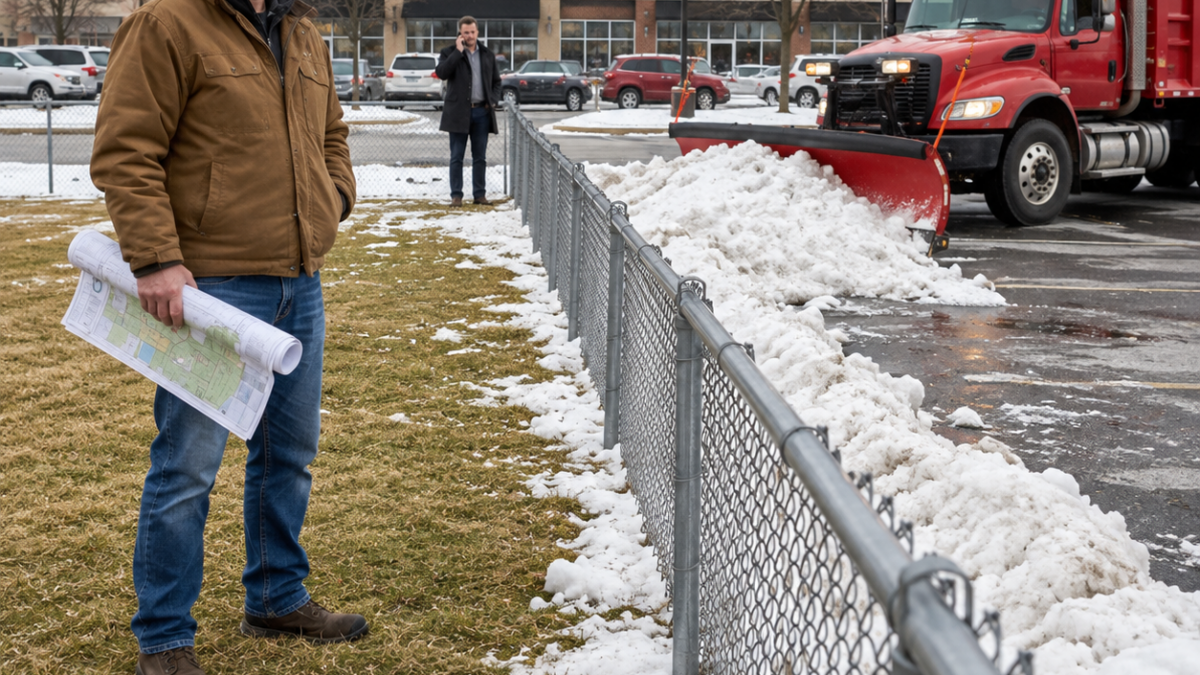
He was still twenty yards away when he started waving both arms.
“Shut that thing off!”
I finished the pass first.
Not because I wanted to provoke him.
Because I had already committed to where that load was going, and whipping the chute around while the auger was full would’ve sent snow somewhere I didn’t intend.
I eased off the drive lever.
The machine stopped pulling forward.
Then I released the auger.
The roar dropped to a steady engine rumble.
Mark reached the orange survey stakes and stared at the snowbank I had just built.
Four of Brookside’s rear parking spaces were buried along their outside six feet.
Not the entire spaces.
Not the travel aisle.
Not the cars.
Only the strip between the fresh survey stakes and my yard—the exact area Elaine’s measurements placed on my parcel.
It looked ridiculous.
White snow lay over black asphalt with painted parking lines disappearing beneath it.
Mark pointed at the pile.
“What the hell are you doing?”
“Clearing my property.”
“You’re dumping snow in our parking lot.”
“No.”
I pointed toward the orange stakes.
“I’m putting snow on my side of the surveyed boundary.”
His eyes moved from one stake to the next.
Then back to me.
“You can’t do this.”
“Your plow did it first.”
“That’s different.”
“Why?”
“Because this is commercial property.”
I almost laughed.
Instead, I shut the snowblower off completely.
The sudden quiet made the cold morning feel larger.
“Mark, I’ve called you for three winters.”
“You complained about snow.”
“I complained about your contractor putting snow on my land.”
“And now you’re retaliating.”
“I am clearing the pile your contractor put here forty minutes ago.”
“By covering our parking spaces.”
“Parts of parking spaces that my survey says are on my property.”
He stared at me.
“You don’t own this pavement.”
“That’s exactly the issue our attorneys are discussing.”
Mark looked toward the plaza.
Employees were beginning to arrive.
A woman in a grocery-store jacket slowed her car when she saw the buried spaces, then continued toward the front of the building.
Mark lowered his voice.
“You need to move this.”
“No.”
“You can’t just decide where the property line is.”
“I didn’t.”
I tapped one of the orange stakes.
“A licensed surveyor did.”
He reached toward it.
“Don’t touch the markers.”
His hand stopped.
That was the first moment I realized how close the argument was to becoming something stupid.
I didn’t want a shouting match in a parking lot.
I definitely didn’t want either of us doing something that would turn a boundary dispute into a police report.
So I stepped back.
“My attorney has already sent your ownership company the survey.”
“I know about the letter.”
“Good.”
“Then you know our attorneys dispute it.”
“They dispute what rights follow from the history. They haven’t produced a survey showing this line is wrong.”
Mark clenched his jaw.
“We’re not doing this here.”
“Works for me.”
I pulled the snowblower toward my garage.
He followed me two steps.
“What about the snow?”
I turned.
“It came from Brookside.”
“That’s not an answer.”
“It’s the only one I have right now.”
Then I went inside.
My hands were shaking slightly when I poured coffee.
Not from the cold.
I had spent three winters imagining how satisfying it would feel to finally push the snow back.
The reality was more complicated.
Yes, there was satisfaction.
I’d be lying if I denied it.
But underneath it sat another feeling.
Nervousness.
Because putting a line on a survey is one thing.
Acting on that line when a commercial property has treated the land as its own for years is another.
I called Rachel before Mark had finished photographing the snowbank.
She answered on the fourth ring.
“What happened?”
“How do you know something happened?”
“You never call me before seven unless something happened.”
I told her exactly what I’d done.
There was a long pause.
“Any vehicles blocked?”
“No.”
“Emergency access?”
“No.”
“Travel lane?”
“No.”
“Dumpster?”
“No.”
“Did you damage pavement, signs, curbing, landscaping, or equipment?”
“No.”
“Did you threaten anyone?”
“No.”
“Did anyone threaten you?”
“Mark told me I had to remove the snow.”
“That’s not a threat.”
“I know.”
Another pause.
“Send me the camera footage.”
“I will.”
“And photos.”
“Already took them.”
“Good.”
Her voice softened slightly.
“Michael, I understand why you did it.”
“That sounds like the beginning of a lecture.”
“It is.”
I leaned against the counter.
“Go ahead.”
“A survey is important evidence. It is not a magic force field. They may dispute the boundary, claim rights based on historic use, or raise other issues we haven’t fully investigated yet. I do not want this turning into you and Brookside physically fighting over six feet of pavement every snowstorm.”
“I’m not trying to start a war.”
“Then don’t behave like you’re in one.”
That stung because there was enough truth in it.
I looked through the window.
Mark was still standing by the buried parking spaces.
“Should I remove it?”
Rachel considered that.
“If the snow is safely placed entirely within the area your survey identifies as your parcel, and it isn’t obstructing an access lane or creating an immediate safety issue, I’m not going to tell you to rush outside before we’ve reviewed everything. But don’t add more today.”
“Fair.”
“And don’t post anything online.”
“I wasn’t planning to.”
“Good. People destroy good legal positions every day because they need strangers on Facebook to tell them they’re winning.”
I smiled.
“Anything else?”
“Yes.”
“What?”
“Your goal is not to ruin their parking lot.”
I looked at the snow-covered lines.
“Then what is it?”
“To stop the encroachment and get your property restored.”
She let that sit for a second.
“If we can solve those problems without spending two years in court, that’s a better victory than making Mark Ellison miserable.”
I knew she was right.
I also knew that for the first time in three winters, Mark was the one standing outside wondering what to do with unwanted snow.
And a small, stubborn part of me wasn’t sorry.
### The Phone Call From Brookside’s Owners
At 9:12 that morning, my phone rang.
The number wasn’t one I recognized.
“Michael Carter?”
“Speaking.”
“My name is Laura Whitman. I’m with Whitman Retail Holdings. We own Brookside Commons.”
That got my attention.
Until then, every conversation I’d had involved Mark, the snow contractor, or attorneys communicating by letter.
The actual ownership company had remained invisible.
Laura continued.
“I understand there’s been an incident this morning.”
“Your contractor pushed snow onto my property again.”
“I’m referring to snow being placed over several parking spaces.”
“So am I.”
She was quiet for a moment.
“I’m trying to understand what happened.”
Her tone was calm.
Not friendly exactly.
Professional.
I appreciated it.
“Our plow cleared Brookside’s lot,” I said. “The driver pushed several loads across the boundary stakes and onto my lawn. I cleared the accumulation from my property and placed it within the section that my survey shows is also my property.”
“That section is paved and used as part of Brookside’s parking lot.”
“That’s why our lawyers are talking.”
“I understand.”
I waited.
“Mr. Carter, I’m not calling to argue with you.”
“Okay.”
“I’d like to meet.”
“About the snow?”
“About all of it.”
That was the first sign the morning had changed something.
Three winters of phone calls had gotten me nowhere.
One morning of lost parking had gotten the property owner on the phone before breakfast.
We agreed to meet the following afternoon.
Rachel would attend.
Laura said Brookside’s attorney would be there too.
Before hanging up, she asked me not to move any additional snow onto the paved area.
I said I would agree provided Brookside’s contractor stopped pushing more onto my lawn while we were negotiating.
She didn’t hesitate.
“That’s reasonable.”
Ten minutes later, I received an email confirming that instruction had been sent to the snow contractor.
Three winters.
That was how long I’d waited to read that sentence.
The contractor was suddenly capable of moving snow somewhere else.
Amazing what a few unavailable parking spaces could accomplish.
### Why Six Feet Mattered So Much
The next day, Rachel and I met Laura and Brookside’s attorney, Thomas Keene, at the plaza management office.
Mark was there too.
He sat at the far end of the conference table and barely looked at me.
Laura began by placing a binder in front of her.
“We’ve reviewed the survey you provided.”
“And?” Rachel asked.
“Our preliminary review suggests the boundary issue is legitimate.”
Mark looked up.
That was clearly news to him.
Thomas stepped in.
“That does not mean we’re conceding every legal conclusion your client has raised.”
Rachel nodded.
“Understood.”
There was no dramatic courtroom moment.
No attorney pounding the table.
Just four adults and one increasingly uncomfortable operations manager discussing lines on old plans.
Thomas explained that Brookside had acquired the plaza nine years earlier from another ownership company.
Their acquisition survey had focused primarily on the commercial parcel and apparently relied on older boundary information.
The rear pavement had already existed.
Brookside had continued maintaining and using it.
“Do you know when the parking lot crossed the line?” I asked.
“We’re investigating.”
“I do.”
Everyone looked at me.
I slid copies of the previous owner’s handwritten note across the table.
“Margaret Holloway’s father owned my house before me. He allowed temporary access while the plaza expanded the loading area and repaved.”
Thomas read the note.
His expression didn’t change much, but Rachel noticed something because she leaned slightly forward.
“That doesn’t establish every fact,” Thomas said.
“No,” Rachel replied. “But it creates a serious problem for any argument that the use was necessarily hostile from the beginning.”
Thomas nodded.
Adverse possession had appeared in Brookside’s earlier legal response.
Rachel had warned me not to treat it like a magic phrase.
The rules varied by jurisdiction.
Long use alone wasn’t always enough.
Timing mattered.
The nature of the possession mattered.
Whether it was permissive mattered.
Taxes, notice, exclusivity, and other facts could matter depending on the applicable law.
Most importantly, neither side could responsibly resolve it by shouting “adverse possession” across a parking lot.
Laura closed the folder.
“I don’t want this tied up in litigation if there’s a reasonable commercial solution.”
That was the first thing anyone from Brookside had said that sounded useful.
Rachel asked, “What do you consider reasonable?”
Laura looked toward a site plan on the wall.
“The six-foot strip affects eleven parking spaces, the loading approach, and a portion of the dumpster pad.”
“Exactly,” Rachel said.
“If we lose use of it permanently, we’ll have to redesign the rear section of the property.”
“That’s not my client’s responsibility.”
“I didn’t say it was.”
Laura turned toward me.
“Mr. Carter, what do you want?”
I thought about Rachel’s advice.
Don’t go looking for humiliation.
Go looking for a solution.
“I want the snow dumping stopped permanently.”
“Agreed,” Laura said.
Mark shifted in his chair.
I continued.
“I want the damaged portion of my lawn restored.”
“Reasonable.”
“I want the survey expense reimbursed.”
Thomas made a note.
“And I want the encroachment resolved properly. Either the pavement and other improvements come off my land, or we reach a written agreement that recognizes the land is mine and defines exactly what Brookside is allowed to use.”
Laura looked at Thomas.
He looked at Rachel.
For the first time, the conversation had moved beyond whether I was an annoying homeowner.
We were talking about terms.
Laura said, “Would you consider selling the strip?”
“No.”
That came out faster than I expected.
Rachel glanced at me but didn’t interrupt.
Laura nodded.
“A long-term easement?”
“Maybe.”
“What term?”
“I don’t know yet.”
“Compensation?”
“I don’t know that either.”
Mark finally spoke.
“You’re going to charge us for pavement that’s been there fifteen years?”
Rachel answered before I could.
“Brookside is free to remove improvements from Michael’s parcel if ownership would prefer not to negotiate use rights.”
Mark leaned back.
Laura gave him a look that ended his participation in the discussion.
Then she turned toward us.
“We’ll develop a proposal.”
Rachel gathered her papers.
“Before we leave, I want confirmation regarding snow placement.”
Laura slid a printed email across the table.
Ridgeway Property Services had been instructed not to push, stack, or deposit plowed snow beyond Brookside’s surveyed parcel pending resolution of the dispute.
I read it twice.
Three winters of arguing.
Resolved in one paragraph.
Not the boundary.
Not yet.
But the snow.
The stupid pile of snow that started everything.
Solved.
### Spring Showed Me What the Snow Had Done
The snowbanks slowly collapsed through March.
What emerged underneath made my stomach turn.
A strip of lawn nearly seventy feet long had been crushed.
Salt had burned the grass brown.
Gravel from Brookside’s parking lot was embedded in the soil.
A plastic bottle cap appeared near one maple.
Two cigarette filters.
A torn food wrapper.
And, somehow, half a blue rubber glove.
I knelt and picked gravel from the mud.
The damage looked worse without snow covering it.
For years I’d treated the piles as temporary.
Winter comes.
Winter goes.
Snow melts.
Problem disappears.
But the problem hadn’t disappeared.
It had soaked into the ground.
Rachel suggested I get written restoration estimates.
Three landscaping companies came out.
All three said the damaged strip would need more than seed.
The soil near the plaza contained enough salt and debris that the worst sections should be removed, replaced with clean topsoil, graded, and either reseeded or sodded.
One landscaper recommended a drainage adjustment so meltwater from Brookside wouldn’t continue flowing toward the same area.
The estimates weren’t catastrophic.
But they weren’t trivial either.
I sent them to Rachel.
She added them to the negotiation file.
Meanwhile, Brookside commissioned its own survey.
That worried me more than I expected.
For several days I imagined a phone call telling me Elaine had made some huge mistake.
Then Rachel called.
“Their survey is in.”
I stood up from my desk.
“And?”
“They’re within a few inches of ours across most of the disputed section.”
I exhaled.
“So they agree it’s mine.”
“They agree the deed boundary is essentially where we said it is.”
“That’s yes with lawyer seasoning.”
She laughed.
“More or less.”
“What now?”
“Now they have to decide whether they want to remove the encroachment or pay for the right to keep using it.”
I looked through the kitchen window toward Brookside.
Without snow, the six feet seemed almost insignificant.
It was hard to believe how much depended on such a narrow strip.
But commercial parking spaces aren’t designed with spare six-foot pieces.
Loading areas aren’t either.
Move a boundary six feet and everything around it changes.
Delivery trucks need turning radius.
Dumpsters need clearance.
Parking stalls need dimensions.
Fire access and traffic flow may matter.
A six-foot strip of land could force Brookside to redesign much more than six feet of pavement.
And now they knew it.
### Their First Offer
Brookside’s first proposal arrived in April.
Twenty thousand dollars.
They wanted a permanent easement across the disputed strip.
They would restore my lawn and reimburse the survey.
That was it.
I met Rachel at her office.
She pushed the proposal toward me.
“What do you think?”
“I think twenty thousand dollars seems like a lot until I remember they want permanent rights.”
“Good.”
“Is it a fair offer?”
“That’s harder.”
She explained that an easement’s value wasn’t just calculated by multiplying square footage by some residential land price.
We had to consider how the strip affected both properties.
The burden on mine.
The benefit to theirs.
Future development.
Maintenance.
Insurance.
Access.
Snow storage.
Drainage.
Duration.
Restrictions.
Possible impact on resale.
“What would you do?” I asked.
“I’m your lawyer. I tell you risks and options. I don’t decide what your backyard is worth to you.”
I stared at the proposal.
“I don’t want them owning it.”
“They wouldn’t.”
“You know what I mean.”
She nodded.
I thought about the orange stakes.
The snow.
Vince saying, “Prove it.”
Mark telling me commercial property was somehow different.
“No permanent easement.”
“Then we’ll counter with a term easement.”
“Ten years.”
Rachel raised an eyebrow.
“Why ten?”
“Long enough for them to justify fixing their parking problem. Short enough that I’m not binding whoever owns this house fifty years from now.”
“That’s rational.”
“I have moments.”
We proposed a ten-year easement limited to specific portions of the strip.
Brookside would be responsible for maintaining the paved area.
They could not expand beyond the surveyed footprint.
No snow storage.
No drainage discharge onto my lawn.
No structures added without written permission.
They would restore my damaged landscaping.
They would reimburse professional costs.
And the easement would end after ten years unless a new agreement was negotiated.
The compensation figure Rachel proposed was significantly higher than twenty thousand.
Brookside rejected it.
Then came the emails.
The spreadsheets.
The calls.
More drawings.
More estimates.
For two weeks, it felt less like a neighborhood dispute and more like I had accidentally become the owner of a very small but strategically important country.
### Then Mark Made Another Mistake
One Tuesday afternoon, I came home and found two men near the back edge of my yard.
One was wearing a Brookside maintenance jacket.
The other was measuring from the pavement toward one of Elaine’s survey stakes.
I parked and walked toward them.
“Can I help you?”
The maintenance employee looked up.
“We’re checking clearance.”
“From my side of the line?”
He looked down.
One boot was on my grass.
“Sorry.”
He stepped back.
The other man introduced himself as an engineer hired by Brookside.
He was polite.
I had no issue with him checking conditions from their property.
But I hadn’t authorized anyone to enter my yard.
Five minutes later, Mark appeared.
“We need measurements for the loading area.”
“Then schedule access.”
“It’s six feet of grass, Michael.”
That sentence told me we were sliding backward.
I looked at him.
“No. It’s my property.”
He rubbed his forehead.
“We’re trying to solve this.”
“Then stop treating permission like an inconvenience.”
The engineer looked uncomfortable.
Mark lowered his voice.
“Nobody’s trying to steal your yard.”
I almost laughed.
“That’s a strange thing to say while negotiating the right to use six feet of it.”
He didn’t answer.
I pointed toward the plaza.
“Your engineer is welcome to contact Rachel and arrange access. Until then, measure from your side.”
The engineer nodded immediately.
“That’s fine.”
Mark looked at him.
Then at me.
For a second, I thought he was going to argue.
Instead, he walked away.
That evening I told Rachel.
She sent a short email establishing a simple protocol for site access.
Brookside agreed.
The incident was minor.
Nobody threatened anyone.
Nobody got arrested.
Nobody screamed.
But it reinforced something I’d been slowly learning.
Boundaries don’t stay meaningful because you privately believe in them.
They stay meaningful because expectations are clear and consistently enforced.
You don’t need to be cruel.
You don’t need to be loud.
But you do need to mean what you say.
### The Parking Lot Got Smaller
Negotiations continued into May.
In the meantime, Brookside’s attorney advised them not to rely on the disputed strip as though nothing had changed.
The plaza temporarily restriped the rear row.
Eleven spaces became eight.
The loading zone got tighter.
A delivery truck clipped a traffic cone one morning and sent it rolling across the pavement.
No damage.
Just embarrassment.
Customers probably didn’t notice most of it.
Employees did.
The grocery store manager, a guy named Aaron, approached me while I was shopping one evening.
“You’re Mr. Carter, right?”
I smiled.
“I feel like this is going somewhere.”
He looked embarrassed.
“I just wanted to say none of us at the store knew about the snow thing.”
“I know.”
“We complained to plaza management about the missing spaces.”
“I assumed somebody would.”
Aaron shook his head.
“They told us it was a property-line issue.”
“It is.”
He looked at the gallon of milk in my cart.
“Can I ask something?”
“Sure.”
“Did you really bury the parking spaces with their own snow?”
I sighed.
“Only the part my survey showed was on my parcel.”
He laughed.
“I’m sorry. I know it’s serious.”
“It was slightly funny.”
“More than slightly.”
Then his expression changed.
“For what it’s worth, I don’t blame you.”
“Thanks.”
“I do hope they fix it, though. Deliveries have been rough.”
“So do I.”
That conversation mattered to me.
The businesses weren’t villains.
Their employees hadn’t decided to dump snow on my lawn.
Most didn’t know the history.
If I insisted on a resolution that crippled the entire plaza simply because I had leverage, people who had nothing to do with the dispute would bear some of the cost.
Rachel had been right.
Winning and punishing were not automatically the same thing.
I wanted my land respected.
I wanted the damage fixed.
I wanted Brookside to pay fair value for whatever rights it needed.
I didn’t need the pizza shop to lose customers.
That realization changed how I negotiated.
### Laura Came to My House
In late May, Laura called.
“Could we meet at your property instead of the office?”
“Sure.”
She arrived the next afternoon.
No attorney.
No Mark.
Just Laura carrying a rolled plan under her arm.
We stood in my backyard beside the line of survey stakes.
The grass was greening everywhere except the salt-damaged strip.
She looked at it for a long time.
“I hadn’t seen the lawn after the snow melted.”
“It’s worse than it looked in photographs.”
“Yes.”
She walked slowly along the boundary.
The pavement sat just beyond the stakes.
“Can I be candid?”
“Please.”
“When we bought Brookside, this area was presented as established parking. We didn’t question six feet of existing pavement.”
“I understand.”
“That’s not an excuse for what happened afterward.”
“No.”
She nodded.
“The snow complaints should have been taken seriously.”
“Yes.”
“Mark should have handled them differently.”
I didn’t answer.
She unrolled the plan on my patio table.
Brookside’s engineer had drawn three alternatives.
Option one removed the encroaching pavement entirely.
That would require eliminating several spaces, rebuilding part of the dumpster area, altering the loading configuration, and reworking drainage.
Option two purchased the six-foot strip.
I rejected that immediately.
Option three used a ten-year easement similar to what Rachel and I had proposed.
Laura pointed to the third plan.
“This is what I want.”
“What changes?”
“We would relocate part of the dumpster enclosure within our deeded property. That reduces how much of your strip we need.”
I looked closer.
Instead of using the full six feet across the entire rear edge, the revised easement tapered in two places.
“We’d also install a curb or wheel stop arrangement so vehicles aren’t physically crossing farther into your property.”
“Good.”
“And we’d install a hedge on your side.”
“Who’s maintaining it?”
“Us for the first three years. After that, you, unless you prefer something else.”
I considered it.
“What about snow?”
“That’s separate.”
She pulled out another page.
Brookside was changing snow contractors for the coming winter.
The new contract included a map of approved stacking areas.
My property was explicitly marked as prohibited.
Excess snow would be hauled away once on-site banks reached predetermined limits.
I almost smiled.
“You know I asked for this three years ago.”
“I know.”
“Could’ve saved everyone a lot of money.”
Laura gave me a tired look.
“Most expensive problems begin as cheap problems people refuse to solve.”
That was probably the smartest sentence anybody had said during the entire dispute.
Then she gave me the new financial offer.
Forty thousand dollars for ten years.
Full landscaping restoration.
Survey reimbursement.
Legal fees up to an agreed cap.
Construction of the hedge.
Drainage work.
Written restrictions on use.
I didn’t say yes.
But for the first time, I didn’t immediately say no.
“I’ll send it to Rachel.”
“Of course.”
Laura rolled up the plans.
Then she looked toward the pavement.
“I heard about the snowblower.”
I groaned.
“Does everyone know about that?”
“Apparently.”
“I didn’t block their travel lane.”
“I know.”
“I didn’t bury any cars.”
“I know that too.”
“Good.”
Laura smiled slightly.
“Mark described it more dramatically.”
“I’m shocked.”
She laughed.
Then she grew serious.
“Between us, that morning probably accelerated this by two months.”
“Because they lost four parking spaces?”
“Because suddenly the problem had an operational cost.”
There it was.
The entire dispute in one sentence.
When the snow damaged my lawn, it was my inconvenience.
When the boundary reduced their parking, it became a business problem.
People pay attention to problems when the cost finally reaches them.
### The Number Reached Fifty Thousand
Rachel spent two weeks revising the agreement.
She changed enough language that I barely recognized the first draft.
No automatic renewal.
No expansion of rights by implication.
No snow storage.
No signs.
No dumpsters added.
No utilities without separate written permission.
No right to widen the paved area.
Defined maintenance obligations.
Defined insurance requirements.
A process for repairing damage.
A requirement that Brookside remove its pavement and restore the land when the easement expired unless we signed another agreement.
Then there was the money.
We countered at sixty thousand.
Brookside came back at forty-five.
Rachel suggested fifty.
They agreed.
When she called, I was mowing the front yard.
I shut off the mower.
“Fifty?”
“Fifty.”
“Plus restoration?”
“Yes.”
“Professional fees?”
“Within the negotiated terms, yes.”
“Hedge?”
“Yes.”
“Snow clause?”
“Yes.”
“Ten years?”
“Ten.”
I looked down the street.
“Sounds like we’re done.”
“Only if you want to be.”
That question sat with me longer than I expected.
I could refuse.
Force Brookside to remove everything.
Maybe take the dispute further.
Maybe argue over damages.
Maybe spend months or years proving exactly who had what rights and when.
Some neighbors later told me I should have.
“You had them,” Frank said from across the street when he heard the story.
Different Frank from my attorney.
Every neighborhood seems to come with one retired man who believes all disputes should end with someone tearing up concrete.
“Make them move the whole lot,” he said.
Maybe I could have.
Maybe it would’ve cost Brookside much more.
Maybe I could’ve squeezed another ten thousand.
Twenty.
More.
But standing in my backyard that evening, I asked myself the question Rachel had been pushing me toward from the beginning.
What did I actually want?
I wanted the dumping stopped.
Done.
I wanted my lawn repaired.
Included.
I wanted recognition that the land belonged to me.
The agreement did that.
I wanted fair compensation for allowing commercial use.
Fifty thousand dollars over ten years felt meaningful.
I wanted Brookside’s rights limited.
They were.
I wanted future owners of my house to understand the arrangement.
The recorded easement would spell it out.
And I wanted the whole stupid thing to stop consuming my life.
That mattered more than I had admitted.
For months, every trip into my backyard had turned into a property dispute.
Every orange stake reminded me of attorneys.
Every Brookside truck made me check the camera.
I was tired of being right.
I wanted to be finished.
I called Rachel.
“Let’s close it.”
### The Fence
There was one final issue.
During negotiations, Brookside had repeatedly asked that we remove the temporary survey stakes once the agreement was signed.
I agreed.
But I wanted a physical boundary between the lawn and commercial pavement.
Not a threatening wall.
Not razor wire.
Not anything dramatic.
A simple black chain-link fence along the adjusted easement line, with a row of evergreen shrubs on my side.
Brookside agreed to pay for it.
The fence crew arrived in June.
Watching them install it gave me a strange sense of déjà vu.
Posts.
Concrete.
Measurements.
Straight lines.
Only this time, nobody was angry.
Brookside’s engineer had marked the easement.
Rachel had approved the plan.
Laura had signed off.
The contractor knew exactly where everything belonged.
For a few hours, the fence temporarily cut across portions of the old parking stripes until Brookside’s paving crew finished the revised layout.
Mark came outside once.
He stood with his hands on his hips.
I expected another confrontation.
Instead, he said, “Looks different.”
“Yeah.”
“We’re losing three spaces permanently.”
“I know.”
He glanced at me.
“Residents aren’t going to like it.”
“Customers.”
“Right.”
He rubbed his chin.
“We could’ve avoided this.”
That surprised me.
“Yes.”
He looked toward the damaged lawn.
“I should’ve taken the first call more seriously.”
I didn’t rush to make him feel better.
He deserved a second or two of discomfort.
Then I said, “I wasn’t asking for much.”
“I know.”
“You told me to take it up with the plow company.”
“I know.”
“And they told me to prove it.”
A faint smile appeared on his face.
“That turned out badly.”
“For you.”
“Apparently.”
We both laughed.
It wasn’t friendship.
It didn’t need to be.
Sometimes resolution is just two people finally agreeing on the facts.
Before walking away, Mark stopped.
“For what it’s worth, the guy who told you to prove it doesn’t work that route anymore.”
“Because of me?”
“No.”
He smiled.
“He backed a plow into a loading dock.”
That felt almost disappointingly ordinary.
“Probably for the best.”
“Probably.”
He went back inside.
I watched the fence crew set the final post.
There was no applause.
No crowd.
No dramatic confrontation.
Just a straight line of metal showing where one responsibility ended and another began.
That was enough.
### They Restored Everything
The landscaping work took four days.
First, crews removed the contaminated top layer of soil where years of salted snow had been piled.
Then they brought in clean topsoil.
They corrected a shallow low spot that collected meltwater.
They installed irrigation along the new hedge line.
Finally, they laid sod.
Thick green rectangles covered the scar that had been brown since March.
I stood barefoot on it the following evening.
For the first time since I’d bought the house, the backyard looked deliberate rather than leftover.
The evergreens were still short.
They wouldn’t provide much privacy for another couple of years.
But they formed a clean border.
The black fence nearly disappeared behind them.
Beyond it, Brookside had repainted the parking spaces.
Eleven compromised spaces had been redesigned into eight properly contained ones.
The loading area was narrower but functional.
The dumpster enclosure had been moved enough to clear the disputed section.
The whole arrangement looked like something somebody had actually planned.
Laura came by for a final inspection.
We walked the boundary together.
She checked off items on a clipboard.
“Topsoil?”
“Done.”
“Sod?”
“Done.”
“Irrigation?”
“Working.”
“Hedge?”
“Still alive.”
She smiled.
“Give it a week.”
We reached the rear corner.
She looked toward Brookside.
“How do you feel?”
“About what?”
“All of it.”
I thought for a moment.
“Relieved.”
“Not victorious?”
“No.”
That answer seemed to surprise her.
“I thought I would.”
“And?”
“I think victory would’ve been solving it three years ago.”
She nodded.
“Fair.”
She held out her hand.
“I’m glad we reached an agreement.”
I shook it.
“So am I.”
Then she left.
That evening, I sat on the patio with a beer and watched the sprinklers run.
Water moved across the new sod in slow arcs.
Not exciting.
Not dramatic.
Just grass getting what grass needed.
For years, that corner of my yard had received salt, gravel, cigarette butts, and somebody else’s snow.
Now it was getting water.
It felt like progress.
### The First Storm Under the New Rules
January came with eleven inches overnight.
I woke before six and went straight to the kitchen window.
Old habit.
The parking lot lights glowed through the falling snow.
A blue plow truck entered Brookside.
Different contractor.
Different driver.
He cleared the grocery-store entrance first.
Then the main parking lanes.
I watched more carefully when he reached the back row.
The driver stopped.
Got out.
And walked toward the fence.
He brushed snow off a laminated site map attached to a post on Brookside’s side.
I actually laughed.
After three years of nobody caring where the line was, this man was checking a map before moving a single pile.
He returned to his truck.
The blade turned.
Snow rolled away from my fence toward a designated storage island.
On the next pass, he stopped several feet short of my property.
No gray ridge.
No salt.
No gravel.
No trash.
Nothing crossed the fence.
By seven, Brookside’s lot was clear.
So was the edge of my lawn.
I poured coffee and stood by the window.
This was the moment I’d imagined for three winters.
I expected some surge of satisfaction.
Instead, it just felt normal.
That’s when I realized normal had been the goal all along.
Later that morning, the snowbank inside Brookside grew too large.
A loader arrived.
Then a dump truck.
They hauled excess snow away.
It cost the plaza money.
Of course it did.
Snow removal costs money.
Land costs money.
Maintenance costs money.
The only reason Brookside’s old system had looked cheaper was because part of the cost had been quietly transferred to me.
My dead grass.
My damaged soil.
My time.
My frustration.
Once those things stopped being free, the real price became visible.
### The Envelope in My Desk
I kept one thing from the dispute.
Not the first insulting offer.
Not Mark’s letters.
Not even a photograph of the buried parking spaces, although I’ll admit I still have those.
I kept a copy of the survey.
It’s folded inside a brown envelope in my desk.
The orange stakes are long gone.
The permanent corner markers are discreet.
Most people who visit my house would never know there had been a dispute.
But sometimes I open that envelope.
Not because I enjoy remembering the fight.
Because the survey reminds me how easily assumptions become reality when nobody checks them.
Brookside assumed the pavement was theirs because it had been there a long time.
The plow contractor assumed my lawn was acceptable snow storage because nobody had physically stopped him.
Mark assumed my complaints weren’t urgent because I continued absorbing the inconvenience.
And for a while, I made an assumption of my own.
I assumed keeping the peace meant staying quiet.
It doesn’t.
Keeping the peace sometimes means saying no early enough that resentment never gets a chance to become the main language between neighbors.
If I’d ordered the survey after the first winter, maybe we’d have solved everything sooner.
Maybe not.
But I know this much.
Silence wasn’t making me reasonable.
It was making my boundary invisible.
### Three Years Later
The hedge is taller now.
From my patio, I can barely see the parking lot.
The grocery store is still there.
So is the pizza place.
The nail salon changed names twice.
Mark left Brookside the year after our agreement and took a facilities job somewhere closer to his home.
Laura still sends the occasional formal notice when work near the easement might affect access.
Everything gets documented.
Everything gets scheduled.
Everything is boring.
I love boring.
The ten-year easement still has years remaining.
Brookside pays its obligations.
The fence is maintained.
The snow stays on its side.
The lawn stays on mine.
Once, during a particularly heavy February storm, I watched the new contractor struggle with a rapidly growing snowbank.
He could’ve saved himself ten minutes by pushing part of it toward my property.
Instead, he stopped.
Called someone.
Waited.
A loader came.
The snow went into a truck.
Exactly as the agreement required.
I stood at the kitchen window with my coffee and remembered Vince saying, “Prove it.”
I had.
But proving the line turned out to be only the beginning.
The harder part was deciding what I wanted to do once I knew I had leverage.
I could have spent years fighting to make Brookside regret every mistake.
I could have insisted on tearing out all the pavement.
Maybe I could have gotten more money.
Maybe I could have made Mark miserable.
But somewhere between the first attorney letter and the final fence post, revenge stopped being interesting.
I didn’t want Brookside destroyed.
I wanted my property respected.
There’s a difference.
And every winter, when I see clean snow stacked safely behind that fence, I know we finally found it.
The funniest part is that people still tell the story wrong.
They say I got angry because a shopping plaza dumped snow on my lawn, discovered I owned part of their parking lot, and buried their spaces until they paid me fifty thousand dollars.
Technically, pieces of that are true.
But that’s not really what happened.
What happened was much simpler.
For years, Brookside treated six feet of my property like it didn’t matter.
Then one morning, I used those same six feet.
Suddenly everybody understood exactly how valuable they were.
The fence is still there today, running straight behind the hedge where the survey said the boundary belonged.
And when the snow comes down, Brookside doesn’t push a single inch across it anymore.