They Kept Pushing Snow Into My Driveway—So I Gave It All Back.
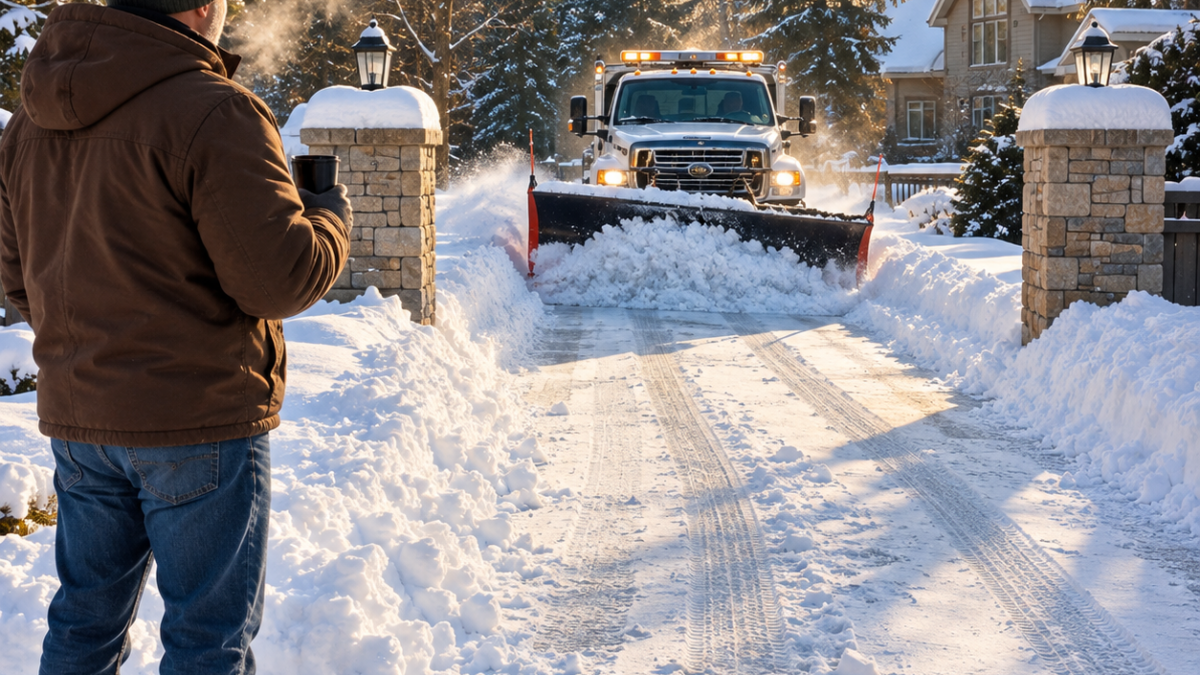
Rick hadn’t simply been pushing snow toward the easiest open space.
On the recording, he passed two perfectly usable places where he could have stacked it on Maple Ridge’s side of the entrance.
Then he backed up, turned his blade, and pushed the load into mine.
I replayed that section three times.
At first, I thought I was seeing things.
Then I checked the footage from the previous storm.
Same maneuver.
Same two open spaces.
Same final push across my driveway.
But there was something else.
Each time Rick approached the end of the private lane, he glanced toward the clubhouse.
Not once.
Not randomly.
Every time.
On the clearest recording, a woman in a dark winter coat stood outside the clubhouse holding a phone.
She watched Rick finish his pass, walked toward the end of the lane, and inspected the snowbank beside my driveway.
I enlarged the footage.
Even through the falling snow, I recognized Karen Hull.
I sat back in my office chair.
For weeks, I’d been trying to convince the property manager that her contractor was deliberately dumping snow onto my property.
Now I had footage suggesting she had personally watched him do it.
That didn’t tell me why.
But it made her claim that this was simply ordinary winter buildup considerably harder to believe.
I looked down at the development plan Frank had left on my kitchen table.
Then I looked at the snowblower sitting outside my garage.
There was an obvious temptation to make a point that evening.
I could already picture Rick arriving the next morning and discovering that the snow he’d dumped on me had been returned to Maple Ridge.
But something about those missing snow-storage spaces bothered me.
I decided to make one phone call before touching anything.
And that call changed how I approached the entire problem.
## The Parking Spaces That Weren’t Supposed to Exist
The person I called was my younger brother, Daniel.
Daniel doesn’t particularly enjoy getting involved in other people’s property disputes, which is unfortunate because he works as a civil engineering technician and has spent most of his adult life reviewing site plans, drainage layouts, and construction drawings.
When I described the situation, his first reaction was exactly what I expected.
“You’re calling me about snow?”
“I’m calling you about a parking lot that apparently swallowed its own snow-storage area.”
There was a pause.
“Okay. That’s a little more interesting.”
I sent him photographs of the original Maple Ridge development plan, along with screenshots from my security camera.
Ten minutes later, he called back.
“Where did you get this drawing?”
“Frank. He used to work for the highway department.”
“Is this the approved version?”
“I don’t know.”
“Then don’t assume it is.”
Daniel had a way of making perfectly reasonable statements sound like criticism.
He explained that older site plans often showed proposed features that changed during construction. The strip behind Maple Ridge’s parking lot might have been intended for snow storage, but an old photocopy didn’t prove that the association had violated anything by converting it.
“We need the actual approved plans,” he said. “And we need to know whether the current parking layout matches them.”
“So what do I do?”
“Start with the town office. Ask what they have in the property file.”
“Can you look at it?”
“Sure. But I’m not your surveyor, and I’m definitely not your lawyer.”
I smiled.
“You’re also not charging me.”
“Coffee and dinner. Minimum.”
I agreed.
After we hung up, I returned to the kitchen.
The development plan lay beneath a stack of unopened mail.
I pulled it out and studied the narrow strip behind the townhouse parking area.
According to the drawing, Maple Ridge had originally been designed with twelve marked parking spaces, a modest common lawn, and a snow-storage area along the northern edge of its property.
The current lot had fourteen spaces.
I knew that because I had counted them the previous summer when a moving truck blocked the lane.
The difference was only two spaces.
But two spaces in a small townhouse complex could be valuable.
Especially one where residents complained every winter that there wasn’t enough room for their vehicles.
I looked at the drawing again.
Then I noticed something that had escaped me before.
The extra parking spaces were immediately beside the storage area.
If they had been created by extending the pavement, that would explain why Rick had so little room to pile snow without affecting the lot.
It wouldn’t excuse putting the snow in my driveway.
But at least I was beginning to understand the problem.
Someone had taken away his easiest legal-looking place to put it.
And I had become the substitute.
The next morning, I drove to the municipal office before work.
Our town doesn’t have a grand city hall.
It’s a two-story brick building beside the library, with a parking lot that always needs resurfacing and a front door that sticks when the temperature drops below freezing.
The clerk, a woman named Susan, listened while I explained that I wanted to review the public records for Maple Ridge.
She didn’t seem surprised.
“Property lines or drainage?” she asked.
“Snow, actually.”
She looked up.
“That’s a new one.”
“Give it another week.”
Susan laughed and directed me to the town’s online permit archive, then helped me identify the older paper files that had not been digitized.
She was careful to explain that the town couldn’t settle a private property dispute simply because a drawing existed in its records.
But she did find a stamped site plan from the original townhouse approval.
The date was nearly twenty years old.
I took photographs of the relevant pages.
The approved drawing looked remarkably similar to Frank’s copy.
Twelve parking spaces.
A common landscaped area.
A section marked for winter snow storage.
There was also a drainage swale running along the back of the lot.
I asked whether later amendments might have changed the layout.
Susan checked the index.
“I see some building permits and routine property records,” she said. “I don’t see an amended parking plan here, but that doesn’t mean one doesn’t exist somewhere else.”
“Who would know?”
“The zoning administrator would be a good place to start.”
I thanked her and left with a notebook full of questions.
As I walked back to my truck, I felt the first real sense of control I’d had since the problem started.
For weeks, I’d been arguing with people who could ignore me.
Now I was gathering information that didn’t depend on their willingness to listen.
Still, none of it gave me the right to use their property however I pleased.
Daniel had made that clear.
If I moved snow back across the boundary, I needed to be careful not to block vehicle access, bury utilities, damage landscaping, or interfere with drainage.
And if I couldn’t identify a safe place for it, I shouldn’t do it.
That was frustrating advice.
It was also good advice.
Unfortunately, I was about to discover just how hard it can be to remain reasonable when someone else has decided reasonable people are easy to ignore.
## The Storm That Finally Broke My Patience
The forecast called for eight to twelve inches of snow.
In our part of Vermont, that isn’t a disaster.
It’s Tuesday.
But the temperature was expected to drop sharply afterward, turning whatever remained on the ground into something resembling frozen gravel.
I had a doctor’s appointment the following morning and a grocery delivery scheduled for that afternoon.
Nothing dramatic.
Just the ordinary obligations that become complicated when you can’t leave your driveway.
At 7:40 that evening, the first heavy flakes began falling.
By ten, the road had disappeared beneath a white sheet.
I checked the camera once before bed.
Nothing unusual.
At 4:18 a.m., motion alerts started appearing on my phone.
I opened the first recording.
Rick’s truck was entering Maple Ridge.
He cleared the parking lot efficiently, making overlapping passes and building a bank along the northern edge.
Then he approached the entrance.
I sat up.
The truck paused.
Its backup lights came on.
Rick reversed, turned the blade, and pushed a load toward my driveway.
A second pass followed.
Then a third.
On the fourth, the snow spilled across nearly the full width of my entrance.
I could see the orange driveway stakes bend beneath the pressure.
I checked the next recording.
Rick stopped his truck beside the clubhouse.
Karen came outside.
They spoke for approximately a minute.
Then Rick climbed back into the truck and pushed another load across my driveway.
That final pass erased whatever uncertainty I had left.
I watched the recording again, listening to the muffled engine noise through the camera microphone.
They knew where the boundary was.
They knew the entrance belonged to me.
They knew I had already complained.
And they kept doing it.
I pulled on my boots.
Outside, the storm was still moving through town.
Snowflakes flashed in the garage lights as I walked toward the street.
The pile was enormous.
Fresh snow covered the top, but underneath was a thick wall of packed material the plow had collected from the townhouse lot.
I put my shovel into it.
The blade barely penetrated.
“Unbelievable.”
I tried another spot.
Same result.
Then I heard a familiar voice behind me.
“You gonna dig a tunnel through that thing?”
Frank stood near the sidewalk wearing an old green parka and a knit hat with a faded highway department logo.
I straightened.
“Considering it.”
He stepped closer and examined the pile.
“That’s not going anywhere with a shovel.”
“I’ve got the blower.”
“Then use it.”
I looked toward Maple Ridge.
Frank followed my eyes.
“Oh.”
“Yeah.”
He was quiet for a moment.
“You’re thinking about giving it back.”
“I am.”
He rubbed his chin.
“Can’t say I blame you.”
That was the first encouraging thing anyone had said about the idea.
Then he added, “But don’t let them turn you into the problem.”
I looked at him.
“They already have.”
“No. They’ve made you deal with their problem. That’s different.”
Frank pointed toward the plowed snowbank along the townhouse entrance.
“Don’t put anything in the travel lane. Don’t hit their cars. Don’t bury a hydrant, a drain, or somebody’s front walk.”
“I’m not planning to.”
“And don’t assume everything on that drawing is exactly where it should be. That paper’s old.”
“I know.”
He studied me.
“You’ve got footage?”
“Plenty.”
“Then make sure you’re not throwing away your good position over a bad temper.”
I didn’t answer immediately.
The snow kept falling around us.
Finally, I nodded.
“Fair enough.”
Frank walked back toward his house.
I returned to the garage.
The old snowblower stood beside Emily’s gardening supplies, its red housing scratched from years of use.
She had bought it because she was tired of watching me come inside every winter with a sore back.
I still remembered her standing in the driveway the first time I used it.
She’d laughed when I accidentally sent a plume of snow over the fence into our own backyard.
“You’re going to need some practice,” she’d said.
I smiled at the memory.
Then I checked the oil, filled the tank, and rolled the machine toward the door.
I wasn’t planning to destroy anyone’s property.
I wasn’t going to bury their vehicles or block the lane.
But I was finished accepting that the only solution involved me breaking my back to keep their parking lot convenient.
I started the engine.
The familiar rumble filled the garage.
And for the first time that winter, the pile at the end of my driveway didn’t look impossible.
It looked movable.
## Forty Minutes of Snow Going the Other Direction
By the time I brought the snowblower outside, the snowfall had eased.
A thin gray light was beginning to appear behind the houses.
I parked the machine several feet from the snowbank and surveyed the area.
Maple Ridge’s entrance was directly to my left.
Beyond it was the edge of the common parking area, where Rick had already built a long bank of snow.
That bank wasn’t near a door or sidewalk.
It wasn’t blocking a vehicle.
And after walking along the accessible edge and checking for visible drainage openings, markers, and equipment, I could see there was room on the existing pile to receive more snow.
I wasn’t completely certain it was the best long-term storage location.
But it was the same general common-area bank the contractor had been using.
The difference was that I would be putting snow back on their side rather than continuing to absorb it on mine.
I checked the driveway camera.
It was recording.
Then I adjusted the chute.
The first pass was difficult.
Rick’s plow had compacted the snow into a heavy, icy mass that made the blower work harder than usual.
I took small bites, keeping the machine steady.
The auger rattled against chunks of frozen slush.
A stream of white snow burst from the chute and landed on the existing Maple Ridge snowbank.
I watched where it fell.
Exactly where I intended.
I adjusted the chute slightly and made another pass.
Then another.
For the first ten minutes, progress was slow.
I had to break up the largest chunks with a steel shovel before feeding them into the machine.
My gloves became damp.
Cold air seeped through the collar of my coat.
I could feel the vibration in my forearms.
But every pass opened another few inches of my driveway.
And each load landed back on the side from which it had come.
I didn’t throw snow into their driving lane.
I didn’t aim at their parked cars.
I didn’t create a wall across their entrance.
I simply used the available common-area snowbank instead of sacrificing my own access.
About halfway through, a porch light came on at the townhouse nearest the entrance.
A woman stepped outside carrying a travel mug.
She watched for a minute.
Then she walked toward me.
I stopped the engine.
“Morning,” I said.
She looked at the pile beside my driveway, then at the one along Maple Ridge’s edge.
“Are you moving snow into our lot?”
“I’m putting the snow your contractor dumped in my driveway back onto your existing snowbank.”
She glanced toward the road.
“Rick did that?”
“Several times.”
She frowned.
“I thought the town plow was doing it.”
“That’s what your property manager told me, too.”
I pointed toward my garage camera.
“I have recordings.”
She studied me for a second.
“My name’s Lisa. I live in number six.”
“Michael Bennett.”
“I know. I’ve seen you out here shoveling.”
That surprised me.
“Then you’ve seen the mess.”
“I have. I just didn’t know who was making it.”
She looked at the growing pile along the edge of the lot.
“Is this going to block our parking?”
“Not the way I’m doing it. I’m keeping everything on the snowbank and clear of the spaces.”
Lisa took a sip from her mug.
“Good. Because we already have enough parking problems.”
Something in her tone caught my attention.
“What kind of problems?”
She sighed.
“Two extra spaces were added a few years ago. Since then, the plow guys have complained there’s nowhere to put the snow.”
I switched off the fuel valve and let the engine settle.
“Who added them?”
“The association. Karen said we needed them.”
“Did everyone approve it?”
Lisa gave a small, tired laugh.
“You’ve obviously never been to one of our meetings.”
I raised an eyebrow.
“That bad?”
“Depends how much you enjoy being told the discussion is closed.”
She looked toward the clubhouse.
“Look, I don’t want to get dragged into a war with management. I just need to get to work.”
“I understand.”
“But I don’t think you should have to dig out our snow every morning.”
She hesitated.
Then she added, “If anyone asks, I’ll tell them I saw you putting it on the existing bank, not blocking our driveway.”
“Thanks.”
She started toward her townhouse.
Then she turned back.
“Michael?”
“Yeah?”
“Karen isn’t going to like this.”
I looked at the pile, then at my nearly cleared driveway.
“She’s had several opportunities to like the other options.”
Lisa smiled despite herself.
“Fair point.”
She went inside.
I restarted the blower.
By the time I finished, forty-three minutes had passed.
My driveway was open.
The Maple Ridge snowbank was noticeably larger.
Their vehicles could still enter and leave.
No doors or walkways were blocked.
I shut down the machine, brushed snow from my coat, and stood for a moment enjoying the sight of pavement at the bottom of my driveway.
For weeks, I’d been the one handling their extra work.
Now at least some of it was sitting where it belonged.
I went inside, made fresh coffee, and saved the camera recordings.
Then I wrote down the time, weather conditions, and exactly where I had placed the snow.
It felt slightly ridiculous to document my own snowblowing.
But if there was one thing the past month had taught me, it was that a written record becomes important the moment someone decides to argue about what happened.
I was halfway through breakfast when my phone rang.
The caller ID displayed a number I recognized from Maple Ridge’s management office.
I looked at the clock.
8:37 a.m.
Karen had wasted no time.
## Karen Hull Finally Returned My Call
“Mr. Bennett?”
“Good morning, Karen.”
Her voice had the tightly controlled quality of someone determined to remain professional while barely containing her irritation.
“We’ve received a complaint regarding your snow-removal activities.”
I set down my coffee.
“Which activities?”
“Snow has been transferred from your property onto association property.”
“Yes.”
She seemed briefly thrown by the lack of denial.
“So you’re acknowledging that?”
“Absolutely.”
“That creates a liability concern for our residents.”
I looked out the window.
Rick’s pickup had just pulled into Maple Ridge.
“Does it?”
“Of course it does.”
“Then you understand why I’ve been concerned about your contractor pushing snow onto my property.”
Silence.
“That situation is different.”
“How?”
“Snow accumulation at driveway entrances is a normal consequence of winter maintenance.”
“Karen, I have video of Rick driving his plow down your private lane, turning the blade, and depositing snow across my driveway.”
“We’ve already discussed this.”
“We have. Several times. That’s why I sent you the footage.”
“Our contractor has a responsibility to maintain safe access for fourteen homes.”
“And I have a responsibility to keep safe access to mine.”
She exhaled.
“Mr. Bennett, we cannot have residents or neighboring homeowners independently moving snow around the complex.”
“I’m not a resident of your complex, Karen.”
“That’s precisely my point.”
I let the silence settle.
Then I said, “You told me winter conditions affect everyone. Apparently you meant everyone except Maple Ridge.”
“That’s not a productive way to discuss this.”
“Neither is denying something that’s on video.”
Her tone sharpened.
“We could have our attorney review this.”
“You’re welcome to.”
I wasn’t bluffing about the footage.
I also wasn’t pretending that returning snow was legally risk-free.
I knew she might raise legitimate questions about where I had placed it, which was why I’d been careful.
I continued.
“I’d prefer not to involve attorneys. I’d prefer your contractor stop dumping snow in my driveway. I’ve been asking for that since November.”
“Rick says he’s using the only practical approach to clear the entrance.”
“Then the association needs to find another approach.”
“That isn’t always possible.”
“Your original development plan shows a designated snow-storage area behind the parking lot.”
The silence on the phone changed.
It wasn’t long.
Maybe three seconds.
But it was enough.
“What development plan?”
“The one filed with the town when Maple Ridge was approved.”
“Those plans are old.”
“I know.”
“Conditions change.”
“They do. That’s why I’m asking whether the current parking arrangement has an approved amendment and a workable snow-management plan.”
She didn’t answer that question.
Instead, she said, “You have no authority to investigate the association’s property.”
“I reviewed public records, Karen.”
“Why would you do that?”
“Because your contractor keeps putting your snow on my driveway.”
Another pause.
I could hear someone speaking faintly in the background of her office.
Then Karen said, “I’ll speak to the contractor.”
“Thank you.”
“But I need you to stop moving snow onto association property.”
“I don’t want to move your snow at all. That’s the entire point.”
“I’ll have someone contact you.”
Before she hung up, I made one final request.
“Please put the contractor instruction in writing.”
“I’ve heard you.”
“I know. I’d like to see it in writing.”
She ended the call.
I put my phone down.
Then I looked outside.
Rick was standing beside his truck, looking at the enlarged snowbank.
For the first time since I’d met him, he didn’t look particularly relaxed.
He took a photograph with his phone.
Walked along the pile.
Took another photograph.
Then he looked directly toward my house.
I raised my coffee mug.
He didn’t wave back.
I didn’t particularly care.
The morning had already been more productive than the previous six weeks combined.
But I was wrong about one thing.
I thought the hardest part of the dispute was behind me.
In reality, returning the snow had only forced everyone to acknowledge a much larger problem.
And Maple Ridge was about to discover that making its snow disappear from one property didn’t mean the problem had disappeared at all.
## The Letter That Made Everything Worse
Three days passed without another call.
During that time, I almost convinced myself that Karen had finally handled the issue.
The weather remained cold and clear.
My driveway stayed open.
Rick’s truck came once to tidy the townhouse parking lot, but he didn’t touch the snow piled along the edge.
I began to think the argument might end quietly.
Then a certified letter arrived.
The envelope bore the name of Maple Ridge’s property management company.
Inside were two pages printed on expensive-looking stationery.
The first page described my snow-removal activity as an unauthorized deposit of material on association property.
The second demanded that I refrain from any future action that could interfere with Maple Ridge’s maintenance operations.
It also reserved the association’s right to seek reimbursement for cleanup costs or property damage.
There was no invoice.
No photographs of damage.
No explanation of what they believed I had damaged.
Just a formal warning.
I read it twice.
Then I placed it on the kitchen table beside the photograph of Emily and our daughter, Sophie, taken during Sophie’s high school graduation.
Sophie lived in Burlington now and worked as a nurse.
She called most Sunday evenings, and I generally tried not to trouble her with the kind of petty frustrations that accumulate when you own an aging house.
That night, however, I told her.
She listened without interrupting.
When I finished, she asked, “Dad, did you actually blow all their snow back into their parking lot?”
“Onto the snowbank.”
“That’s not exactly a no.”
“I didn’t block anything.”
“I know.”
“You sound like your mother.”
“Good. She was usually right.”
I smiled despite myself.
Then Sophie said something I hadn’t considered.
“Are you sure you want to win this by fighting with them?”
“I don’t want to fight.”
“Then what do you want?”
I looked at the letter.
“I want to be able to leave my driveway after a snowstorm without spending an hour cleaning up somebody else’s mess.”
“Okay. Then make that the issue. Don’t let them turn it into some feud about who can throw snow farther.”
I laughed.
“That’s almost exactly what Frank said.”
“Then Frank’s smart.”
“He’ll appreciate that.”
Sophie paused.
“Dad, I’m serious. You’re out there by yourself in freezing weather. What happens if you slip? Or hurt your back? Or somebody drives into that pile while you’re working?”
“I’m careful.”
“You always say that.”
I stared at the photograph on the table.
Emily would have agreed with her.
Not because she would have thought I was wrong.
Because she hated watching a solvable problem turn into a contest of stubbornness.
“I’ll be careful,” I said again.
Sophie sighed.
“That wasn’t really my point.”
After we hung up, I sat at the kitchen table for a long time.
Then I opened my laptop and began writing a response.
Not the angry response I wanted to send.
The useful one.
I explained the history of the snow dumping.
I included the dates of my previous complaints.
I attached the video clips, photographs of the blocked driveway, and a photograph showing the snow I’d returned to the existing common-area bank.
I stated that I had not placed snow in the driving lane, damaged vehicles, or intentionally obstructed any access.
I also made clear that I disputed the suggestion that Maple Ridge could routinely use my driveway entrance as a snow-storage area.
Then I wrote:
“I would welcome a practical agreement under which neither party deposits snow onto the other’s property without permission, and your contractor maintains the private lane without obstructing my driveway.”
I read that sentence twice.
It wasn’t especially dramatic.
It didn’t sound like revenge.
It sounded like the resolution I should have been able to reach with a five-minute conversation in November.
I sent the email to the management company and copied the association’s general contact address listed on its website.
Then I made an appointment with a local attorney.
I wasn’t planning to sue.
But I’d received a formal legal-sounding warning, and I wanted to know where I stood before doing anything else.
The attorney’s name was Rachel Mercer.
Her office sat above a small insurance agency on Main Street.
When I arrived, she offered me coffee and asked me to explain what had happened.
I brought a folder.
She glanced at it.
“That’s a lot of paperwork for snow.”
“You should see the snow.”
She smiled.
Then she started reading.
For the next half hour, Rachel reviewed my emails, photographs, the letter, and the site plan.
She watched one of the security recordings.
Then she watched a second.
When she finished, she folded her hands on the desk.
“Let’s separate a few things.”
I nodded.
“First, your neighbor’s contractor shouldn’t assume he can use your driveway for snow storage. But we’d want to confirm the relevant property boundaries and any easements before making absolute claims about every inch of that entrance.”
“Fair.”
“Second, just because someone puts snow on your property doesn’t necessarily mean you have unrestricted permission to throw it back onto theirs.”
“I was careful.”
“I can see that. It matters. But I’d still advise against making a regular practice of it.”
I sighed.
“So I’m supposed to keep digging?”
“No. I’m saying there are better ways to protect yourself.”
She tapped the letter.
“This is not a court order. It’s a demand from the management company. We can respond.”
“What about the parking spaces?”
“That’s a separate issue. Your documents suggest something worth checking, but we don’t know yet whether the town approved a later change.”
“Daniel said the same thing.”
“Daniel sounds sensible.”
“He’ll be unbearable when I tell him.”
Rachel smiled again.
Then her expression became serious.
“What concerns me is that your documented complaints haven’t produced a meaningful response. The association needs a snow-management solution. That’s their operational problem. It shouldn’t automatically become yours.”
That was the first time a professional had stated the issue in a way that made complete sense to me.
Not revenge.
Not punishment.
An operational problem that somebody was refusing to address.
Rachel recommended sending a formal written demand asking the association and its contractor to stop placing plowed snow across my entrance, preserve the relevant maintenance records, and discuss a practical snow-storage arrangement.
She suggested obtaining a current survey if the exact boundary became disputed.
She also encouraged me to keep documenting incidents and to contact the appropriate municipal office if access or public-road snow placement raised safety concerns.
“One more thing,” she said as I stood to leave.
“What’s that?”
“If you get blocked again, prioritize getting your driveway open safely. Don’t try to stage a confrontation with the contractor. And don’t obstruct the lane to make a point.”
“I understand.”
She studied me.
“Do you?”
I thought about the forty-three minutes I’d spent blowing snow back onto Maple Ridge’s bank.
“Mostly.”
“Let’s aim for completely.”
I left her office feeling less triumphant than I’d expected.
But I also felt more certain.
The issue was no longer whether I could make Karen angry.
I’d already accomplished that.
The issue was whether Maple Ridge could be made to handle its own winter maintenance without treating my home as overflow space.
And that was a problem worth pursuing properly.
## The Woman in Townhouse Six
Two evenings later, Lisa knocked on my front door.
She was carrying a manila envelope and looked uncomfortable.
“Is this a bad time?”
“Not at all.”
I stepped aside.
She came into the entryway but didn’t immediately remove her coat.
“I wasn’t sure whether I should bring you this.”
I looked at the envelope.
“What is it?”
“Something I got from the association.”
I invited her into the kitchen.
She sat at the table while I poured coffee.
Then she slid the envelope toward me.
Inside were photocopies of association meeting notices, portions of meeting minutes, and a letter distributed to Maple Ridge owners three years earlier.
One page caught my attention immediately.
It described a proposal to improve parking availability by reconfiguring a landscaped section along the northern boundary.
I looked up.
“These are the two extra spaces?”
Lisa nodded.
“That’s when they started talking about them.”
“Who approved it?”
“That’s what I’ve never understood.”
She reached for another page.
“There was supposed to be a vote at the annual meeting. But the meeting was canceled because of bad weather.”
I almost laughed.
“Of course it was.”
“The board discussed the idea again later. Karen told us the parking changes were covered under the association’s maintenance authority.”
“Was she on the board?”
“No. She managed the property. But she handled most of the correspondence and contractor arrangements.”
“Did anybody object?”
“Several people.”
Lisa pointed to a printed email.
“One of the owners asked what would happen to the snow-storage area.”
I read the response.
It said the association’s maintenance contractor would adjust its seasonal operations to accommodate the new configuration.
There was no specific snow-storage plan attached.
No diagram showing an alternative location.
Just that sentence.
I read it again.
Lisa watched me.
“Sounds pretty thin, doesn’t it?”
“It raises questions.”
She nodded.
“That’s what I thought.”
“Why are you bringing this to me now?”
She looked down at her coffee.
For a moment, I thought she wasn’t going to answer.
Then she said, “My husband broke his hip two winters ago.”
I waited.
“He was coming home from physical therapy, and the parking lot was narrowed by a snowbank. He tried to maneuver around it, slipped while getting out of the car, and went down.”
“I’m sorry.”
“He recovered, mostly. But we asked the association to improve snow clearing around the parking spaces. Karen said they were doing everything they could.”
Lisa rubbed the edge of the envelope with her thumb.
“I believed her.”
She looked at me.
“Then this winter I watched the contractor pile snow in your driveway so our entrance would look perfect.”
I didn’t say anything.
“The more I thought about it, the more I wondered whether they’d been solving our parking problem by creating yours.”
That was exactly what I had been thinking.
But hearing it from someone inside Maple Ridge changed the weight of it.
Lisa wasn’t interested in helping me embarrass Karen.
She lived under the management structure I was criticizing.
She paid association dues.
She had neighbors she liked.
She couldn’t simply walk away from the consequences if the dispute became ugly.
“Are you comfortable with me sharing these with my attorney?” I asked.
She hesitated.
“They’re records I received as an owner. I don’t think they’re confidential, but I’d rather she review that question before anything gets circulated.”
“That’s reasonable.”
“And Michael?”
“Yeah?”
“Please don’t make this a public fight.”
I looked at her.
“That’s not what I want.”
“Because the people living there aren’t the ones pushing snow into your driveway. Most of them don’t even know what’s happening.”
“I know.”
She studied my face.
“I hope you do.”
When she left, I spread the documents across the table.
The original plan.
The meeting notices.
The parking proposal.
The management letter.
The video screenshots.
Piece by piece, an explanation was emerging.
Maple Ridge had created additional parking demand on land previously intended to help handle winter snow.
The contractor had continued operating as though snow could simply be pushed out of the way.
And because my driveway sat beside the lane’s entrance, I had become the convenient destination.
There was still one question.
Had the current board knowingly approved that arrangement, or had everyone simply inherited it and stopped asking questions?
I wasn’t sure.
But I was going to find out.
## The Board President Didn’t Know
Four days later, a man I didn’t recognize pulled into my driveway in a dark Subaru.
He climbed out holding a folded piece of paper.
I met him at the front door.
“Mr. Bennett?”
“That’s me.”
“I’m David Whitcomb. President of the Maple Ridge homeowners association.”
I’d expected someone older and more self-important.
Instead, David looked about forty-five, with tired eyes, salt-and-pepper hair, and the distracted expression of someone who had already spent too many hours dealing with a problem he hadn’t created.
“Do you have a minute?”
“Sure.”
We sat at my kitchen table.
David placed the paper between us.
It was a copy of Rachel’s letter.
“I received this yesterday.”
I nodded.
“I was hoping someone on your board would.”
He looked embarrassed.
“Until yesterday, I thought this was a complaint about normal snow buildup from the main road.”
I held his gaze.
“That’s what Karen told you?”
“Yes.”
“Would you like to see the recordings?”
He hesitated.
Then he nodded.
I opened my laptop.
The first video showed Rick clearing the townhouse parking lot and pushing a load across my driveway.
David leaned forward.
I played the second clip.
Then the third.
He didn’t speak until the recording ended.
“That’s our contractor.”
“Yes.”
“And that’s your driveway?”
“Yes.”
He watched one more clip.
Then he leaned back and rubbed his face.
“Why wasn’t this shown to the board?”
“I sent it to management twice.”
David looked at the correspondence dates.
“Did she acknowledge receiving it?”
“No.”
He stared at the screen.
“Okay.”
It was a quiet word.
But there was something in his voice that hadn’t been there when he arrived.
He wasn’t here to explain why I should accept the snow anymore.
He was trying to understand how the association had reached the point of receiving a lawyer’s letter over something so preventable.
“Can I ask you a question?” I said.
“Of course.”
“Where does Maple Ridge store its snow?”
He gestured toward the rear of the complex.
“Along the northern edge and wherever the contractor can safely stack it.”
“Was there ever a designated storage area?”
“Not that I know of.”
I showed him the approved development plan.
David bent over the drawing.
“Where did you get this?”
“Public town records.”
He studied the marked section.
Then he looked out the window toward the townhouses.
“Those are parking spaces now.”
“Two of them, yes.”
He sat quietly.
I could almost see the calculations happening behind his eyes.
“How long have you been board president?” I asked.
“Nine months.”
“And how long has Karen managed the property?”
“About six years.”
“Did you know the lot was reconfigured?”
“I knew extra spaces had been added. I didn’t know the original drawing showed a snow-storage area.”
He picked up the plan.
“May I take a copy?”
“Absolutely.”
I printed one.
Then he asked, “What do you want out of this, Michael?”
It was such a simple question that I almost didn’t know how to answer.
I looked toward the front window.
Beyond it, the driveway was finally clear.
“I want to be able to leave my house after a storm without digging out the snow your contractor deliberately puts there.”
He nodded.
“Anything else?”
“No damage to my property. No blocked driveway. No threats because I complained. And if there’s a legitimate boundary question, I’d like it resolved.”
“That’s it?”
“That’s it.”
David looked at the stack of documents on the table.
“You’d be surprised how complicated a simple request can become inside a homeowners association.”
“Unfortunately, I’m learning.”
He stood.
“I’m going to speak to the rest of the board.”
“Thank you.”
“And I’m going to review the snow-removal contract.”
I walked him to the door.
Before he left, he turned back.
“One thing, though. Please don’t return any more snow to our property while we sort this out.”
I considered arguing.
Instead, I nodded.
“As long as your contractor stops dumping it on mine, I won’t have any reason to.”
David gave a tired smile.
“That sounds like a deal we should have made a month ago.”
After his Subaru disappeared down the road, I remained on the porch for a moment.
It was the first conversation I’d had with someone from Maple Ridge that felt like two adults discussing a shared problem.
No dismissive remarks.
No threats.
No absurd claims that a wall of snow was just part of ordinary winter life.
Just a man looking at evidence and asking how to fix something that clearly wasn’t working.
I wished that had been the end of it.
But Karen had one more move to make.
And this time, it nearly cost Maple Ridge far more than the price of a few extra snowplow passes.
## The Contractor’s Invoice
The following Monday, David called.
“Michael, do you have a few minutes?”
“Sure.”
“I’m going to ask you something unusual.”
“After the last month, unusual is becoming pretty normal.”
He gave a short laugh.
“Have you ever spoken to our snow-removal contractor about changing his route?”
“Twice.”
“Did you ever ask him to stop plowing the lane altogether?”
“No.”
“Did you threaten him?”
I sat up.
“Absolutely not. Why?”
David sighed.
“Because management forwarded me an incident summary claiming you interfered with the contractor’s work and created an unsafe environment.”
I stared at the wall.
“Karen wrote that?”
“Her office submitted it.”
“What exactly did it say?”
“That you repeatedly confronted the driver, redirected snow onto association property, and threatened to interfere with future maintenance.”
I felt my jaw tighten.
“That’s not what happened.”
“I suspected there was more to it.”
“David, I have recordings.”
“I know.”
“Rick was sitting in his truck when I spoke to him. I didn’t touch his equipment. I didn’t stand in front of the plow. I asked him to stop blocking my driveway.”
“Understood.”
“Then I sent Karen the videos, and she ignored them.”
“I’ve seen the correspondence.”
I waited.
David lowered his voice.
“There’s another issue.”
“What?”
“The contractor submitted a change-order invoice.”
“For what?”
“Additional snow removal.”
I looked out the window toward Maple Ridge.
“Because I returned the snow?”
“That’s what I initially thought. But the invoice includes charges from storms before that happened.”
He explained that the contractor’s monthly billing included several line items described as extra handling, secondary relocation, and entrance clearing.
The largest recent charge was for additional time required to maintain the parking area after the storm when I had returned the snow.
That part, at least, made sense.
Rick had clearly spent more time dealing with the snowbank I’d enlarged.
But the earlier charges were more interesting.
“Apparently the contractor has been billing us for extra time every time the parking lot gets crowded with snow,” David said.
“Why?”
“Because the available storage space is inadequate.”
I stopped moving.
“Did he put that in writing?”
“Not in those words, but close.”
David explained that Rick’s company had included notes about limited on-site snow-storage capacity and the difficulty of maintaining the two outer parking spaces.
The contractor had recommended off-site snow hauling during heavy storms.
The association had repeatedly declined the extra service.
I rubbed my forehead.
“So instead of paying to haul the snow away, they kept pushing it into my driveway.”
“That’s what I’m trying to determine.”
“Karen knew?”
“I don’t know everything she knew yet.”
There was an important difference between what David suspected and what he could prove.
I was learning to respect that difference.
He continued.
“We’ve scheduled an emergency board meeting Thursday evening. I’d like you to attend for the portion concerning your property.”
“Will Karen be there?”
“Yes.”
“Will Rick?”
“I’ve asked his company to send a representative.”
I looked toward my garage.
The red snowblower sat quietly behind the window, its handle visible above the workbench.
“Then I’ll be there.”
After the call, I contacted Rachel.
She advised me to attend, bring copies of my documentation, and keep my presentation focused on the blocked access rather than trying to prove every theory about the association’s internal decisions.
“You’re not a member of Maple Ridge,” she reminded me. “Their parking approvals and contract management are ultimately matters for the association and relevant town authorities. Your immediate issue is the repeated snow dumping.”
“I understand.”
“Good. And Michael?”
“Yeah?”
“Don’t go into that meeting looking for an apology.”
“What should I look for?”
“A plan.”
That answer stayed with me.
An apology would feel good for five minutes.
A plan might keep my driveway clear for the next twenty winters.
I knew which one I needed.
## The Night the Townhouse Owners Finally Saw the Video
The meeting took place in the Maple Ridge clubhouse.
It wasn’t an impressive building.
Just a single-story structure with vinyl siding, a little kitchenette, folding tables, and a meeting room that smelled faintly of coffee and floor cleaner.
When I arrived, Lisa was waiting near the entrance.
“I’m glad you came,” she said.
“Me too. I think.”
She smiled.
“Fair warning. Karen isn’t in a great mood.”
“That’s becoming a tradition.”
Inside, about a dozen residents sat in folding chairs.
David stood beside a table with two other board members.
Karen occupied the seat nearest the projector.
She wore a charcoal blazer and had a legal pad arranged neatly in front of her.
When she saw me, she gave a restrained nod.
“Mr. Bennett.”
“Karen.”
Neither of us attempted a smile.
David introduced me and explained that the board had invited me to provide information regarding snow placement at the association entrance.
He also asked residents to keep questions respectful.
Then he gave me the floor.
I connected my laptop to the projector.
“I appreciate the opportunity to speak,” I began.
“Most of you don’t know me personally. I live in the blue house next to your private lane. I’ve lived there for eleven years, and until this winter, I’ve never had a serious problem with Maple Ridge.”
A few residents nodded.
“My complaint is simple. During multiple storms, your snow-removal contractor deliberately pushed snow from the townhouse property across my driveway entrance. That repeatedly prevented me from leaving until I cleared the accumulation.”
I showed the first photograph.
The wall of snow filled the screen.
Someone in the back said, “Good Lord.”
I showed the second.
Then the third.
Each photograph included a date.
Next, I played the camera footage.
The room grew quiet.
Rick’s truck appeared on the screen, cleared the townhouse entrance, reversed, turned its blade, and pushed snow toward my driveway.
Then it did it again.
A woman in the second row leaned forward.
“That’s not from the town truck.”
“No,” I said. “It isn’t.”
I played another clip.
The same maneuver.
Then another.
When the final recording ended, David switched on the lights.
For several seconds, nobody spoke.
Karen broke the silence.
“Those recordings don’t establish where the legal property boundary lies.”
It wasn’t an entirely unreasonable point.
I had anticipated it.
“That’s correct,” I replied. “That’s why I’m not claiming a video substitutes for a survey. What it does show is the contractor deliberately placing plowed snow across the entrance I use to access my home.”
Karen opened her notebook.
“And you subsequently deposited snow on association property.”
“Yes.”
Several people turned toward me.
I continued before Karen could frame it as a confession of something I hadn’t claimed otherwise.
“After weeks of complaints, I used my snowblower to move the accumulation onto the existing common-area snowbank. I kept it off the driving lane, parking spaces, and walkways. I documented where I placed it.”
Karen tilted her head.
“So you took matters into your own hands.”
“I cleared my blocked driveway and returned the snow to the existing bank. I understand there are better ways to handle a continuing property dispute. That’s why I’m here.”
A man in the front row raised his hand.
David recognized him.
“Go ahead, Peter.”
Peter looked toward Karen.
“Did management receive these videos before tonight?”
Karen’s pen stopped moving.
She took a moment to answer.
“We received several communications expressing concerns about winter maintenance.”
“That wasn’t my question,” Peter said.
He was an older man with a neatly trimmed beard and a quiet voice.
“Did you receive the recordings?”
Karen looked at David.
“Yes, we received video material.”
“When?”
“Over the course of several weeks.”
Peter leaned back.
“Then why was the board told this was normal road-plow buildup?”
Nobody answered immediately.
David reached for a folder.
“That’s one of the questions we’re reviewing.”
Karen straightened.
“I think it’s important to understand that management handles a significant volume of resident complaints during winter. We rely on qualified contractors to determine appropriate methods.”
Lisa raised her hand.
David nodded.
“I’ve lived here eight years,” she said. “I’ve watched Michael clear his driveway after storms. I didn’t realize our contractor was putting our snow there. I thought it came from the street.”
A younger man spoke from the back.
“Same here.”
Lisa continued.
“If we’ve got nowhere to put our snow, we need to solve that. We can’t just make him deal with it.”
A few residents murmured in agreement.
Karen began writing again.
I stood beside the projector, uncertain whether I should say anything else.
Then David spoke.
“We’ve also discovered concerns about the current site layout.”
He placed the original approved development plan on the screen.
Several residents leaned forward.
He identified the original parking arrangement and the area marked for winter snow storage.
“The association added two parking spaces several years ago. We’re reviewing the records to determine what approvals were required and whether they were obtained.”
Karen looked up sharply.
“David, I don’t think that’s appropriate for this portion of the meeting.”
“The board needs to understand how the parking changes affected snow management.”
“We’ve already discussed the lot configuration.”
“Not with the approved plan in front of us.”
That exchange changed the atmosphere.
Until then, the meeting had been about my driveway and Rick’s plow.
Now residents were looking at a much broader question.
What had happened to the space their development was supposed to use for winter snow?
David introduced a representative from Rick’s company, a broad-shouldered man named Alan Pierce.
Alan stood near the rear wall.
He looked uncomfortable.
“Can you explain the storage issue?” David asked.
Alan cleared his throat.
“Our contract covers plowing and routine snow stacking. It doesn’t include unlimited removal or hauling.”
“Have you recommended hauling snow off-site?”
“Yes.”
“When?”
“More than once.”
Alan glanced toward Karen.
“We raised it after the parking area was expanded, and we’ve mentioned it during heavy winters since then.”
David looked down at his notes.
“Did anyone instruct your operators to place snow across Mr. Bennett’s entrance?”
Alan hesitated.
“Not in writing that I’ve seen.”
Karen crossed her arms.
“So the claim that management ordered deliberate dumping is unsupported.”
I looked at her.
She was right about one narrow point.
I didn’t have a written instruction telling Rick to bury my driveway.
What I had was repeated footage, ignored complaints, and a management representative who had personally observed at least one of the relevant plowing operations.
Alan continued.
“Our drivers are expected to keep the entrance clear and avoid placing snow where it creates problems for neighboring properties. If that happened, it shouldn’t have.”
David looked at him.
“Why did it keep happening?”
Alan lowered his eyes.
“That’s something we need to review with the operator.”
The answer wasn’t especially satisfying.
But it was the first acknowledgment I’d heard from anyone associated with the contractor that the repeated dumping was not acceptable.
Then Peter spoke again.
“If the snow-storage area was taken away, where exactly did we expect the snow to go?”
David looked around the room.
“That’s the operational problem we need to resolve.”
There was a long silence.
Karen placed her pen carefully on the table.
She looked tired.
Not defeated.
Not humiliated.
Just tired.
For the first time, I wondered how much of this mess had accumulated because nobody wanted to tell the townhouse owners that convenient parking came with inconvenient costs.
Two extra spaces sounded good.
Paying to remove several truckloads of snow every winter sounded expensive.
And telling fourteen homeowners that their parking lot had been configured without adequate attention to winter maintenance sounded like the kind of conversation a property manager might postpone.
Especially if there was an easier solution.
Especially if that solution was somebody else’s driveway.
David turned toward me.
“Michael, I want to apologize on behalf of the board for the way your complaints were handled.”
I hadn’t expected that.
I shifted my weight.
“Thank you.”
“We should have investigated sooner.”
“I appreciate you saying that.”
He nodded.
“But we also need a way forward that doesn’t involve either side depositing snow onto the other.”
“Agreed.”
Karen looked at him.
“We can’t redesign the entire parking lot in February.”
“No,” David said. “But we can instruct the contractor appropriately, evaluate hauling, and review the site plan with the town.”
Alan nodded.
“We can quote an off-site removal service for heavy accumulation.”
“Please do.”
Peter raised his hand again.
“And what about the two parking spaces?”
David looked at the original drawing.
“Until we have a better answer, I think we should consider restricting them when snow accumulation makes that area unsuitable.”
The younger man in the back frowned.
“Then where am I supposed to park?”
It was a fair question.
And suddenly, everyone was facing the same reality.
Winter snow takes up space.
If you use that space for something else, the snow doesn’t vanish.
Somebody has to deal with it.
For weeks, that somebody had been me.
Now the people who had benefited from the arrangement were beginning to understand what it had cost.
## What Karen Finally Admitted
After the meeting, most residents stayed to talk.
Some approached me to apologize for not knowing what had been happening.
Others asked questions about the photographs.
One man wanted to know whether the town plow had ever contributed to the pile, and I told him it had.
Of course it had.
That was part of living on a winter road.
But a municipal plow leaving an ordinary ridge after clearing the street was not the same as a private contractor deliberately pushing several loads from a neighboring lot into my entrance.
I had no objection to clearing normal road-plow buildup.
I objected to being treated as Maple Ridge’s unofficial snow-storage contractor.
I was unplugging my laptop when Karen approached.
“Mr. Bennett.”
I turned.
“Yes?”
She glanced toward the other residents.
“Could we speak privately for a moment?”
I considered saying no.
Then I nodded.
We stepped into the small hallway outside the meeting room.
Karen held her notebook against her chest.
For several seconds, neither of us spoke.
Finally, she said, “I want you to understand that the parking expansion wasn’t my idea alone.”
“I never said it was.”
“The residents were unhappy about parking availability. The board at the time wanted a solution. We worked with the contractor to make the best use of the space.”
“Was the snow-storage issue discussed?”
“Yes.”
“And?”
She looked down.
“It was considered manageable.”
I waited.
“Until it wasn’t,” she added.
There it was.
Not an excuse.
Not exactly an apology.
But an acknowledgment.
“What happened when the contractor told you the storage space was inadequate?”
Karen shifted her notebook.
“We discussed options. Hauling costs were higher than expected. The board was reluctant to increase the maintenance budget.”
“Did anyone consider what was happening to my driveway?”
“At first, I believed your complaints concerned normal plow buildup.”
“Even after the footage?”
She didn’t answer immediately.
Then she said, “I should have reviewed it more carefully.”
I looked at her.
“Karen, I emailed you footage showing your contractor pushing snow into my driveway. You told me to buy better equipment.”
She closed her eyes briefly.
“That was an inappropriate response.”
“Yes, it was.”
“I was dealing with several other maintenance issues at the time.”
“I’m sure you were.”
She looked up.
“But that doesn’t excuse dismissing your complaint.”
I hadn’t expected her to say that.
The words sounded difficult for her.
I could have made it harder.
I could have asked why she was standing outside the clubhouse during the storm.
Why she hadn’t intervened.
Why she had threatened me with legal action after I returned the snow.
Instead, I asked the question I cared about most.
“Will it stop?”
Karen met my eyes.
“I believe the board is going to make sure it does.”
“I hope so.”
She nodded.
Then she hesitated.
“For what it’s worth, Mr. Bennett, I didn’t personally tell Rick to push snow into your driveway.”
“I understand that’s your position.”
She accepted the answer.
I didn’t tell her I believed her.
I didn’t tell her I didn’t.
The record didn’t establish exactly what instructions had been given to Rick.
And by then, the question of who had said what was becoming less important than ensuring the behavior ended.
Karen looked toward the meeting room.
“I’ve managed this development for six years. Most of the residents are good people. They just want somewhere safe to park and walk during winter.”
“I understand.”
“Sometimes keeping everyone satisfied becomes impossible.”
“Then sometimes you have to tell them that.”
She looked back at me.
For the first time, her expression softened.
“You’re probably right.”
I nodded.
“Good night, Karen.”
“Good night, Mr. Bennett.”
We walked in opposite directions.
I didn’t feel victorious.
But I did feel as though we had finally stopped arguing about whose inconvenience mattered more.
The problem was no longer invisible.
And that made a practical solution possible.
## Rick Came Back Without His Plow
The next morning, I was in the garage sorting tools when a truck pulled into my driveway.
Not the yellow plow truck.
A dark pickup.
I stepped outside.
Rick climbed out.
He looked different without the plow blade in front of him.
Smaller, somehow.
Less certain.
“Hey, Michael.”
“Rick.”
He shoved his hands into his jacket pockets.
“Got a minute?”
I leaned against the garage doorframe.
“Sure.”
He looked toward Maple Ridge.
“I heard there was a meeting.”
“There was.”
“Alan told me.”
I waited.
Rick exhaled.
“Look, I wanted to come over and explain something.”
“Okay.”
He pointed toward the townhouse entrance.
“That lot’s a nightmare to plow.”
I said nothing.
“Fourteen units, cars everywhere, narrow turning space, nowhere to stack snow once the banks get high.”
“I’ve seen it.”
“And when they added those two parking spots, they made it worse.”
“That’s becoming pretty clear.”
Rick shifted his weight.
“I’ve been doing that property for four winters. Every year, it gets harder.”
“So why use my driveway?”
He looked at the ground.
“Because it was the quickest way to keep their entrance open.”
I stared at him.
It was the same explanation he’d given me the first time.
Only now he sounded less proud of it.
“Rick, I told you to stop.”
“I know.”
“Twice.”
“I know.”
“You looked right at me and said you’d keep it in mind.”
He rubbed his jaw.
“Yeah.”
“And then you did it again.”
“Yeah.”
I let the silence stretch.
Finally, he said, “I was wrong.”
I didn’t answer immediately.
He looked toward the street.
“I wasn’t trying to make some big statement. I had six properties to clear that morning, and they wanted that entrance perfect. I took the easy line.”
“The easy line for you.”
He nodded.
“Yeah.”
I thought about all those mornings with the shovel.
The cold.
The soreness in my shoulders.
The frustration of standing outside my own home unable to leave.
“How much time did you save?”
He frowned.
“What?”
“By pushing it into my driveway instead of managing it somewhere else.”
Rick considered that.
“Depends on the storm.”
“Five minutes? Ten?”
“Sometimes.”
I shook my head.
“You saved a few minutes. I spent an hour clearing it.”
He looked embarrassed.
“I didn’t think about it that way.”
“That’s the problem.”
He nodded.
For a moment, neither of us spoke.
Then Rick said, “Alan’s changing the route. We’re supposed to keep the entrance clear without pushing anything toward your driveway.”
“Good.”
“And they’re talking about hauling snow when the banks get too high.”
“Also good.”
He looked at the garage.
“That’s a serious snowblower you’ve got.”
I glanced over my shoulder at the old red machine.
“It gets the job done.”
Rick gave a small smile.
“Yeah. Alan showed me the pictures.”
I waited.
“Guess I know what it feels like now.”
There was no arrogance in his voice.
Just recognition.
He had spent extra time cleaning a snowbank he’d thought was somebody else’s problem.
For once, he had experienced a small fraction of the inconvenience he’d been imposing on me.
I could have rubbed it in.
Instead, I said, “I’d rather neither of us have to keep doing this.”
“Me too.”
Rick held out his hand.
I looked at it.
Then I shook it.
“Just keep the snow out of my driveway.”
“That’s the plan.”
He returned to his truck.
As he pulled away, I noticed something unexpected.
I wasn’t angry anymore.
Not because everything was forgiven.
Not because the previous weeks hadn’t happened.
But because I no longer needed him to understand every hour of frustration he’d caused.
He understood enough to change his behavior.
That was worth more than another argument.
## The Town’s Answer Wasn’t What Anyone Expected
Over the next two weeks, Maple Ridge’s board reviewed the original development plan, its more recent parking arrangement, and the available town records.
David kept me informed when developments directly affected my driveway.
He was careful not to share private board discussions or information he wasn’t authorized to disclose.
I appreciated that.
It was possible to be cooperative without treating everyone else’s business as mine.
The zoning administrator eventually reviewed the records and the current parking configuration.
The result wasn’t the dramatic legal disaster some residents had predicted.
Nobody was arrested.
Nobody faced an overnight court judgment.
The town didn’t send bulldozers to rip out the parking lot.
Instead, the administrator identified questions about whether the paved expansion matched the approved site plan and asked Maple Ridge to provide documentation of any later authorization.
The association also needed to demonstrate how it intended to manage snow and drainage without adversely affecting surrounding properties.
It was ordinary municipal paperwork.
And it mattered more than any threat Karen had made.
Because Maple Ridge could no longer respond to the problem by pretending it was just a neighbor complaining about winter.
The board hired a civil engineer to review the layout.
A contractor examined the drainage swale.
The snow-removal company submitted a revised winter operations proposal.
The recommendation was straightforward.
The association could retain its existing parking arrangement while its status was reviewed, but during substantial snow accumulation the outer spaces might need to be temporarily unavailable.
Snowbanks had to remain clear of access routes, important drainage features, and neighboring property.
And when available storage capacity ran out, the association needed to pay for removal rather than pushing snow somewhere inappropriate.
There was nothing glamorous about the solution.
It involved orange cones.
Temporary parking restrictions.
A revised plowing route.
And an expense line in the maintenance budget.
Some residents disliked the cost.
Others disliked losing access to the outer parking spaces after heavy storms.
But the alternatives were becoming clear.
The snow either had to be stored safely in an appropriate location or taken away.
It couldn’t be made somebody else’s responsibility simply because their driveway happened to sit beside the entrance.
David told me the board had approved temporary snow-hauling arrangements for the remainder of the winter.
The first hauling truck arrived after another significant storm in February.
I watched from my window as workers loaded excess snow from the lot.
The process wasn’t quick.
It wasn’t free.
And the parking area looked messy for several hours.
But by evening, the entrances were clear.
So was my driveway.
For the first time that winter, everyone had dealt with the snow without one household quietly absorbing the burden for the others.
I made myself another cup of coffee.
And this time, I didn’t need to put on my boots.
## The Last Bad Storm
Of course, winter wasn’t finished with us.
In early March, a powerful storm moved across the state.
The forecast predicted more than a foot of snow, followed by gusting wind and falling temperatures.
It was the kind of storm that made even experienced Vermonters check their generators and fill the gas cans.
I brought firewood inside.
Checked the snowblower.
Parked my truck farther up the driveway.
Then I called Sophie.
“Big storm coming,” I told her.
“We’re getting it here, too.”
“Make sure you’ve got groceries.”
“Dad, I’m thirty-one.”
“That doesn’t mean you remember groceries.”
She laughed.
Then she asked, “Any more trouble with the townhouses?”
“Not lately.”
“Good.”
I looked out the window.
“Actually, they changed their plowing plan.”
“Really?”
“Really.”
“That’s progress.”
“It is.”
She hesitated.
“Are you still planning to shoot their snow back at them if they mess up?”
I smiled.
“I’d prefer to retire from international snow diplomacy.”
She laughed again.
“Mom would have loved that.”
I looked toward the garage.
“Yeah,” I said quietly. “She would have.”
The storm arrived after midnight.
By dawn, the world had disappeared beneath thick snow.
Trees bowed under the weight.
The street was barely visible.
My mailbox looked like a little black rectangle emerging from a white hillside.
I checked the driveway camera.
Rick’s plow truck appeared at 5:12 a.m.
I found myself holding my breath.
He entered Maple Ridge and began clearing the parking lot.
The first passes looked familiar.
Back and forth.
Blade angled.
Snow rolling along the pavement.
Then he reached the end of the lane.
My driveway was directly in front of him.
For months, this had been the moment when my morning went wrong.
I leaned closer to the window.
Rick slowed down.
Reversed.
Changed his blade angle.
Then pushed the snow toward Maple Ridge’s designated common-area bank, away from my entrance.
He made another pass.
Same result.
Then another.
No spillover.
No wall.
No deliberate dumping.
When the bank reached the height the revised plan allowed, he stopped stacking there and moved on to another section of the lot.
Later that morning, the hauling crew arrived.
I watched them load the accumulated snow.
For once, nobody had to argue about where it came from or where it belonged.
I opened the garage door.
The snow across my own driveway was manageable.
There was still an ordinary ridge left by the town plow along the street.
That was normal.
I could handle normal.
I started Emily’s snowblower and began clearing my driveway.
About twenty minutes later, Rick drove past.
He slowed near the entrance.
I looked up.
He lifted one hand from the wheel.
I returned the gesture.
Then he continued down the lane.
No confrontation.
No sarcastic remark.
No snow flying across the property line.
Just two men doing what winter required.
It felt almost absurdly peaceful.
And after the previous three months, I was grateful for every ordinary second.
## What Happened to Karen Hull
By April, most of the snow had melted.
The piles that had looked permanent in January shrank into dirty patches of ice beneath the trees.
Water ran along the curbs.
The birds returned.
Frank began complaining about potholes instead of snowbanks, which was how I knew spring had officially arrived.
The Maple Ridge board continued working through its property and maintenance issues.
The town eventually received additional documents relating to the parking changes.
The association’s engineer recommended modifications to the common area, improvements to drainage maintenance, and a more clearly defined winter snow-storage arrangement.
The board chose a phased approach rather than immediately reconstructing the entire parking lot.
It also retained an off-site hauling option for heavy storms.
None of that happened overnight.
There were contractor estimates.
Budget discussions.
Resident complaints.
Revised drawings.
And the slow administrative process that comes with changing anything involving shared property.
But progress was real.
The association’s maintenance plan was updated.
The snow contractor received clearer written instructions.
And the board established a process for documenting complaints from neighboring properties rather than leaving everything inside a management office.
Karen remained involved during the transition.
Then, in late spring, David told me Maple Ridge would be moving to a different property management company when its current service agreement ended.
He didn’t share the details of the board’s decision.
I didn’t ask.
I knew enough.
The board had reviewed what happened.
The association had changed its procedures.
And the manager who repeatedly dismissed my complaints would no longer be the person responsible for handling them.
I never received a dramatic confession from Karen.
No long apology letter.
No tearful speech on my porch.
One afternoon, shortly before her company finished its work at Maple Ridge, I saw her outside the clubhouse.
She was placing a cardboard box into her car.
When she noticed me standing near my mailbox, she paused.
For a moment, I thought she might pretend not to see me.
Instead, she walked over.
“Mr. Bennett.”
“Karen.”
She glanced toward the driveway.
“Looks better without all the snow.”
“It does.”
She gave a small, tired smile.
“I imagine you’re relieved.”
“I am.”
She looked at the house behind me.
“You’ve lived here a long time, haven’t you?”
“Eleven years.”
“That’s longer than I’ve managed Maple Ridge.”
I nodded.
She folded her hands together.
“I know we didn’t handle things well.”
I waited.
“I should have taken your first complaint more seriously.”
“Yes,” I said. “You should have.”
She accepted that without argument.
Then she looked toward the townhouse parking lot.
“People think property management is mostly organizing maintenance and collecting dues.”
“Isn’t it?”
“Sometimes.”
She gave a humorless little laugh.
“Sometimes it’s telling people that what they want isn’t practical, and knowing they’re going to be angry with you for saying it.”
I thought about the two parking spaces.
The snow-removal estimates.
The complaints she’d probably received from residents who wanted every inch of pavement available all winter.
“You still had a choice about how you handled me,” I said.
She nodded.
“I did.”
That was enough.
I didn’t need her to explain every decision.
I didn’t need her embarrassed in front of the neighborhood.
I didn’t need to know whether she regretted losing the management contract.
I just needed acknowledgment that what happened wasn’t acceptable.
Karen glanced at the driveway one final time.
“I’m sorry for the trouble, Mr. Bennett.”
“Thank you.”
She started toward her car.
Then I said, “Karen?”
She turned.
“Next time someone sends you a video, watch it before telling them they’re wrong.”
For a moment, she looked surprised.
Then she gave a small, embarrassed smile.
“That’s fair.”
She walked away.
And that was our final conversation.
## A Summer Without Snow
By June, Maple Ridge looked completely different.
Not because the buildings had changed.
They were still the same beige townhouses with white trim and narrow front porches.
But the parking area had been cleaned up, several drainage features were being maintained more regularly, and the association had posted clearer signs identifying temporary winter parking restrictions.
David stopped by one Saturday while I was repairing a section of my backyard fence.
He brought a folder.
“Thought you might want a copy.”
Inside was a letter from the board confirming that the association had adopted revised snow-removal procedures and instructed its contractor to avoid depositing snow across neighboring private driveways.
There was also a simple diagram showing the areas the contractor would use for snow stacking and where additional snow would be hauled away when necessary.
I read it carefully.
Then I looked up.
“This is all I wanted back in November.”
David sighed.
“Believe me, I know.”
I folded the letter.
“How much did this end up costing you?”
He smiled.
“More than anyone wanted.”
“The hauling?”
“Some of it. The engineering review, too. Plus the time everyone spent arguing.”
I shook my head.
“All because nobody wanted to deal with the snow properly.”
“Pretty much.”
He leaned against his Subaru.
“Can I tell you something?”
“Sure.”
“When I first got your attorney’s letter, I was annoyed.”
I laughed.
“I bet.”
“I thought, ‘Great, now we have a neighbor threatening legal action over snow.'”
“That’s not quite what the letter said.”
“I know. I read it properly afterward.”
He smiled.
“Then I watched the footage.”
I nodded.
“And I realized we’d spent more time defending the contractor than checking whether the complaint was true.”
He looked toward the townhouse entrance.
“That’s a terrible way to manage a shared property.”
I didn’t disagree.
David held out his hand.
“Anyway, I appreciate your patience.”
I shook it.
“I wasn’t always patient.”
“No,” he said, smiling. “I heard about the snowblower.”
“That story’s getting around, huh?”
“More than you know.”
We both laughed.
Then he added, “For what it’s worth, it made people pay attention.”
I looked toward the garage.
“Yeah. It did.”
“But I’m glad we’re doing it differently now.”
“Me too.”
After he left, I put the letter into the folder where I’d kept all the photographs and correspondence.
The folder had become surprisingly thick.
It contained storm dates, emails, printed screenshots, contractor notes, the original development plan, and enough paper to make a simple neighborhood disagreement look like a small construction project.
I thought about throwing it away.
Then I remembered how difficult it had been to convince anyone that the problem existed.
I placed it in the filing cabinet instead.
Not because I expected another fight.
Because sometimes the proof that a problem was real is the reason people finally solve it.
## Frank’s Opinion
Frank wandered over that afternoon while I was putting away the fence tools.
He had a habit of appearing exactly when he suspected something interesting was happening.
“That David fellow come by?”
“Yeah.”
“What’d he want?”
I showed him the association’s letter.
Frank read it slowly.
Then he handed it back.
“About time.”
“That’s what I said.”
He looked toward the townhouse entrance.
“Snow’s a funny thing.”
I smiled.
“Here we go.”
He ignored me.
“Everybody wants it gone. Nobody wants to pay to move it. And everybody figures somebody else has room.”
“Sounds familiar.”
Frank nodded.
“Used to happen when I worked for the highway department. People would shovel their sidewalks into the street, then complain when the plows pushed it back.”
“That’s not exactly what happened here.”
“No. But the thinking’s the same.”
He pointed toward Maple Ridge.
“They had too much snow and not enough room. Instead of admitting that, they made it your problem.”
I leaned against the fence.
“Pretty much.”
Frank looked thoughtful.
“You know, I still think you were taking a chance blowing it back.”
“I know.”
“Could’ve made the whole thing worse.”
“I know that, too.”
He grinned.
“But I would’ve paid good money to see Rick’s face the next morning.”
I laughed.
“Frank.”
“What?”
“You’re a terrible influence.”
“Been told that for seventy-two years.”
We stood together in the afternoon sun, watching a couple of children ride bicycles along the sidewalk.
There wasn’t a patch of snow anywhere.
It was hard to believe that only a few months earlier, the same little stretch of pavement had consumed so much of my life.
Then Frank said something I didn’t expect.
“Emily would’ve had this settled sooner.”
I turned toward him.
He smiled gently.
“She would’ve marched over there with a plate of cookies and left with a signed agreement.”
I laughed.
“You’re probably right.”
“Then she would’ve come home and told you to quit being stubborn.”
“Definitely right.”
Frank nodded toward the garage.
“She bought you that blower, didn’t she?”
“Christmas, seven years ago.”
“Good machine.”
“The best gift she ever gave me.”
He looked at me.
“Not the only good thing she left you.”
I didn’t answer immediately.
Then I looked toward the house.
Sophie was coming to visit the following weekend.
The flowerbeds Emily planted were beginning to bloom.
And the little stone birdbath by the front porch was filled with fresh water.
“No,” I said quietly. “It wasn’t.”
Frank patted my shoulder.
Then he wandered back across the lawn.
## The Next Winter
November returned faster than I expected.
One morning, I woke to a thin layer of snow covering the grass.
Nothing serious.
Just enough to turn the rooftops white and remind everyone that summer was officially over.
I stepped onto the porch with my coffee.
Across the lane, Maple Ridge looked quiet.
The association had installed two small signs reminding residents that the outer parking spaces could be closed during snow-removal operations.
The drainage area had been cleaned up.
The new management company had sent neighboring homeowners a brief winter maintenance notice with a phone number for reporting access problems.
It wasn’t a perfect system.
No winter maintenance plan ever is.
But it was a system.
And that was a remarkable improvement over pretending every problem could be solved by pushing it across the nearest boundary.
Our first major storm arrived in December.
Ten inches overnight.
Enough to require the snowblower.
Enough to test whether the previous winter’s agreements meant anything.
I woke before dawn and went downstairs.
The coffee machine gurgled in the kitchen.
Wind rattled the front windows.
I opened the security camera app.
Rick’s truck was already in Maple Ridge.
Same yellow pickup.
Same plow.
Same familiar headlights moving slowly through the falling snow.
I watched him clear the first row of parking spaces.
Then the second.
He stacked snow along the approved bank.
When the pile grew too large, he shifted to the next designated area.
Then he reached the entrance beside my driveway.
I sat perfectly still.
Not because I expected trouble.
More because some part of me had become accustomed to watching that particular moment.
Rick backed up.
Adjusted his blade.
Made one clean pass toward Maple Ridge’s snowbank.
Then another.
My driveway remained untouched by his plow.
He finished clearing the entrance and drove on.
I looked at the screen for another moment.
Then I put down my phone.
That was it.
No confrontation.
No email.
No attorney.
No certified letter.
No angry property manager explaining that winter affected everyone.
Just a snowplow doing its job without making me pay for it.
I finished my coffee.
Then I pulled on my boots and walked into the garage.
Emily’s old snowblower was waiting.
Its paint had faded a little.
The handle grips were worn.
There was a scratch along the side where I’d clipped the corner of the garage years earlier.
But the engine started on the second pull.
I cleared the snow from my driveway, including the ordinary ridge left by the town plow.
It took about twenty-five minutes.
When I finished, the entrance was wide open.
I shut off the machine and stood there watching the last few flakes settle onto the pavement.
Across the lane, a Maple Ridge resident was brushing snow off her windshield.
She waved.
I waved back.
Then I pushed the snowblower into the garage.
For a moment, I rested my hand on its cold metal housing.
I thought about Emily laughing when I first learned to use it.
I thought about Frank standing in the snow, warning me not to make myself the problem.
I thought about Lisa finding the courage to speak up, David taking responsibility for something he’d inherited, and even Rick finally admitting that the easy route had been the wrong one.
And I thought about Karen.
For months, she’d insisted that snow had to go somewhere.
She hadn’t been wrong about that.
She’d just forgotten that the place it went mattered.
I closed the garage door and returned to the warm kitchen.
On the refrigerator, Sophie had left a photograph from her last visit.
It showed the two of us standing in front of the house on a bright summer afternoon.
Behind us, the driveway was empty.
No snow.
No truck.
No dispute.
Just home.
I put my coffee mug in the sink and looked out the window one last time.
The Maple Ridge entrance was clear.
So was mine.
That was all I’d wanted.
I never needed to win a war with my neighbors.
I just needed them to understand that their convenience couldn’t keep coming at my expense.
And the funny thing is, after all those arguments, letters, meetings, and hours spent moving snow, the solution was exactly what I’d asked for on the first day.
Put the snow where it belongs.
That winter, for the first time in a long while, I didn’t need to give any of it back.