They tried to use HOA bylaws to force my military wife out of the home we had spent six years saving for, and by Friday afternoon two police cruisers were in our driveway while half the neighborhood stood outside waiting to see whether she would actually be removed.
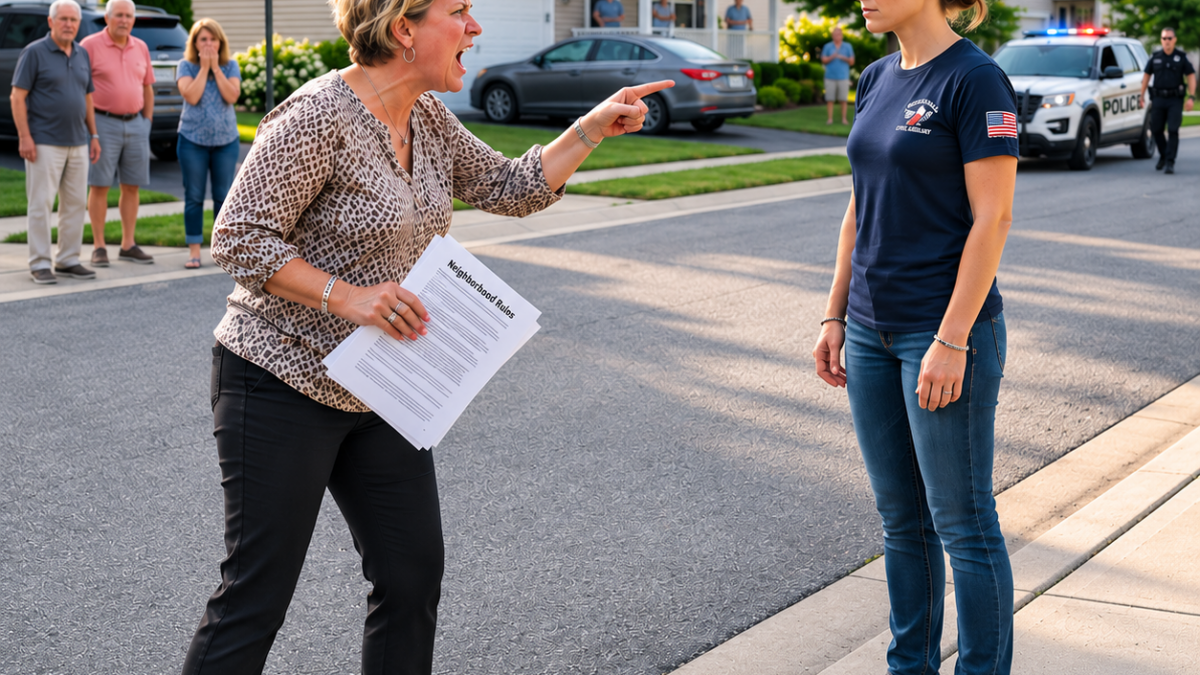
Olivia pulled out one card.
No dramatic speech.
No trembling hands.
No anger.
She simply handed it to the officer.
I watched his eyes move down.
For maybe two seconds, nothing happened.
Then his expression changed.
His eyebrows lifted slightly.
He looked at Olivia.
Then back at the card.
“Captain Olivia Carter?”
“Yes, sir.”
Her voice remained calm.
“Recently returned from overseas last week.”
The officer looked at the card one more time before handing it back carefully.
There was something almost ceremonial about the movement.
Not exaggerated.
Just respectful.
The younger officer glanced toward his partner.
Then toward Olivia.
Then toward me.
Across the street, Margaret was still standing with her arms folded.
She could not hear everything from where she was.
All she could see was that Olivia had handed something to the officer.
I could practically imagine the story Margaret had already written in her head.
Police arrive.
Unauthorized occupant identified.
HOA rules confirmed.
Military wife escorted away.
Neighborhood learns Margaret’s authority is not to be challenged.
That was the performance.
That was why the police had not simply been called privately.
Margaret had positioned herself across the street.
Neighbors had gathered.
Phones were out.
Curtains had moved.
Garage doors had opened.
People who normally had somewhere else to be suddenly found reasons to stand outside.
Margaret wanted witnesses.
She wanted everyone to see what happened when somebody refused her.
Instead, the older officer turned toward her.
And I watched the confidence start leaving her face before he had even reached the sidewalk.
***
The previous five days flashed through my head while the officer crossed the street.
Our first morning.
Olivia on her knees beside the walkway pressing small flowers into fresh soil.
Moving boxes stacked inside.
My complete inability to understand the sprinkler timer.
The retired couple across the street waving.
The little boy on the blue bicycle shouting, “Welcome!”
For maybe twelve hours, the neighborhood had felt exactly like the place we had imagined during the six years we saved for it.
Nothing extravagant.
That had been the appeal.
Old maple trees.
Sidewalks.
Front porches.
Kids riding bicycles after dinner.
A place where Olivia might finally be home long enough to unpack completely.
That mattered more than I knew how to explain.
People thanked her for her service all the time.
They saw the uniform.
The ceremony.
The idea of sacrifice.
They did not see the ordinary things service kept interrupting.
Birthdays through screens.
Holidays separated by time zones.
Anniversaries turned into scheduled video calls.
Plans that changed because orders changed.
Eleven months overseas had felt longer than eleven months because every normal thing had to be postponed.
When she returned, we did not want adventure.
We wanted boring.
A kitchen table.
A yard.
Neighbors.
A mortgage.
A place where our biggest argument might be whether the flower bed needed mulch.
We signed the closing papers three days after she landed back in the United States.
The deed paperwork had not fully caught up.
Our attorney told us that was temporary.
Nothing to worry about.
Then Margaret knocked at seven in the morning.
And within minutes, my wife had been reduced from returning service member to “guest.”
***
I can still hear the way Margaret said it.
“Your guest needs to leave.”
Not:
Excuse me, we have a paperwork question.
Not:
Welcome to the neighborhood.
Not:
Our records may be incomplete.
Your guest.
Like Olivia was somebody sleeping on our couch.
Like almost two years of marriage could be erased by one delayed county record.
Like the woman standing in our living room carrying her own moving box needed permission to remain in the home we bought together.
I laughed at first.
That was how ridiculous it sounded.
“Guest?”
I said.
“That’s my wife.”
Margaret looked at the clipboard.
Not at me.
Not at Olivia.
The clipboard.
That had become a pattern.
Paper when she wanted authority.
People when she wanted compliance.
“According to county records, only one legal homeowner occupies this residence. Your name appears on the deed. Hers does not.”
I had blinked twice because I genuinely wondered whether I had misunderstood her.
Olivia stepped beside me.
She was wearing an old Army shirt.
Jeans covered with dust from boxes.
Hair pulled back.
No makeup.
Tired from moving.
Happy anyway.
“There must be some mistake.”
Margaret ignored the invitation to solve it.
“She has twenty-four hours to vacate the property.”
That was the moment my body changed.
Shoulders tight.
Jaw tight.
Heat in my chest.
I have never had Olivia’s ability to stay calm when somebody is being absurd directly to my face.
She knew that.
She touched my arm.
Lightly.
“Let’s explain.”
That tiny touch stopped me from saying whatever sentence was already forming.
“We just closed,” I told Margaret.
“The paperwork hasn’t fully updated because Olivia was deployed. Our attorney already told us everything is legal.”
Margaret finally looked at her.
“Rules don’t care about stories.”
Olivia nodded once.
“Neither does the law.”
Margaret smiled.
Small.
Cold.
“We’ll see about that.”
Then she walked away.
***
I wanted to believe it ended there.
One difficult woman.
One stupid misunderstanding.
Our lawyer could send something.
County records would update.
Everybody would move on.
That was how reasonable people handled administrative problems.
But Olivia had seen something I had missed.
After Margaret drove away, I stood in the doorway trying to joke.
“Well. That’s one way to meet the neighbors.”
Olivia closed the door.
Her smile was faint.
“That’s one person trying very hard to make sure we know this isn’t just about paperwork.”
I wanted her to be wrong.
She wasn’t.
The first violation notice arrived the next morning.
Bold red letters.
Official-looking paper.
Unauthorized occupant.
Safety concern.
Community enforcement language.
The kind of document designed to make ordinary people feel as though a formal machine had started moving against them.
I laughed when I read it.
“What is this?”
Olivia took it from me.
She did not laugh.
She folded it carefully.
Then walked to the kitchen table.
“What are you doing?”
“Keeping it.”
“For what?”
She opened a folder.
Placed the notice inside.
“Evidence.”
I stared at her.
“You think this is going somewhere?”
She shrugged.
“People who abuse small amounts of authority rarely stop on their own.”
I wanted to tell her she had spent too much time expecting worst-case scenarios.
I wanted to say this was Tennessee suburbia, not overseas.
The irony of that thought would bother me later.
Because Olivia did not treat the neighborhood like a battlefield.
Margaret did.
***
By lunchtime, there was another notice.
Taped to the front door.
Then the neighborhood Facebook post.
Somebody had photographed our house.
The caption asked residents to report suspicious activity involving unregistered occupants.
No name.
No need.
Everybody knew which house was new.
Everybody knew Olivia had just moved in.
Suddenly normal life became evidence.
Olivia carrying groceries.
Photographed.
Olivia mowing the lawn.
Photographed.
Olivia carrying boxes into the garage.
Photographed.
Every ordinary act became proof that the unauthorized woman had not obeyed.
That was when my anger changed.
The first confrontation had been insulting.
The notices were bureaucratic.
The photographs felt personal.
I remember standing beside Olivia looking at the phone.
“Someone took this from across the street.”
She zoomed in.
“Looks like it.”
“This is insane.”
“Put it in the folder.”
“You’re serious?”
“Yes.”
She was always like that.
When I became emotional, she became procedural.
Not emotionless.
Procedural.
It is one of the reasons I married her.
She did not let feelings disappear.
She just refused to let them drive.
***
Neighbors changed almost immediately.
That hurt more than I expected.
People who had waved the first day suddenly became fascinated by their shoes.
Cars slowed near our house.
People looked.
Then looked away.
Nobody said anything outright.
That was almost worse.
Silence lets your imagination do the work.
Did they believe Margaret?
Did they think Olivia was somehow illegally occupying the house?
Did they think we were lying about being married?
Did they know she had been deployed?
Did it matter?
One afternoon, Olivia was watering the flowers when an elderly woman walked over.
She looked up and down the street before speaking.
“Honey, you might want to ignore Margaret.”
Olivia turned off the hose.
“Why?”
“She’s been president for almost twelve years.”
The woman lowered her voice.
“And she thinks this place belongs to her.”
Olivia smiled politely.
“Does everyone just let her do this?”
The woman looked toward Margaret’s house.
“Most people do.”
Then the sentence I would remember.
“It’s easier.”
That bothered me more than the violations.
Because it meant Margaret’s confidence had history behind it.
She had learned something from the neighborhood.
Not necessarily that she was right.
That resistance was expensive.
People paid fines.
Moved things.
Removed things.
Stayed quiet.
Not because every demand was legitimate.
Because fighting an HOA president takes time.
Energy.
Maybe lawyers.
Maybe embarrassment.
And most people want to live their lives.
Margaret had confused exhaustion with consent.
That was dangerous.
***
I walked to the HOA office that evening.
I told Olivia I was going to settle it.
She raised one eyebrow.
“You going to settle it or argue?”
“Settle.”
“Your face says argue.”
“My face is wrong.”
“Rare.”
I kissed her forehead and left.
The HOA office looked exactly like Margaret.
Polished.
Organized.
Plaques about leadership.
Community excellence.
Framed photographs.
Everything arranged to tell visitors that serious people did serious community work there.
Margaret sat behind the desk.
She did not ask me to sit.
“Mr. Brooks.”
“Margaret.”
“Has your guest left yet?”
I felt every good intention I had brought into the room disappear.
“Would you stop calling my wife a guest?”
She folded her hands.
“The deed says otherwise.”
“The county paperwork is temporary.”
“Then your attorney should have explained your community bylaws.”
“Our community bylaws don’t override state law.”
She leaned back.
“That’s your opinion.”
“No.”
I took a breath.
“That’s the law.”
She smiled again.
“We’ll let the proper authorities decide.”
That sentence made my stomach turn.
Not because I believed she was right.
Because she was enjoying escalation.
She did not want clarification.
She wanted a ruling.
An audience.
A demonstration.
Something that proved her interpretation mattered more than ours.
I left before I said something I would regret.
***
Olivia was sitting on the porch when I came home.
Coffee.
Calm.
Sun going down through the maples.
“How’d it go?”
“About as well as arguing with a brick wall.”
She laughed softly.
“Bricks are usually more flexible.”
Even then.
She could make me laugh.
I sat beside her.
“What do we do?”
“Keep everything.”
“Notices?”
“Yes.”
“Screenshots?”
“Yes.”
“Pictures?”
“Yes.”
“Attorney?”
“If necessary.”
I looked toward Margaret’s house.
“You’re not angry?”
Olivia took a sip.
“Of course I’m angry.”
“You don’t look angry.”
“That doesn’t mean it isn’t there.”
That answer would come back to me later.
Calm is not absence of anger.
It is refusing to give anger command authority.
***
Friday morning, Margaret returned with a stopwatch.
An actual stopwatch.
I wish that detail were exaggerated.
It wasn’t.
She knocked hard.
I opened the door.
“Your twenty-four hours have expired.”
“Olivia isn’t leaving.”
“Then I’m forced to proceed.”
“With what?”
“Police intervention.”
I laughed.
Could not help it.
“You’re calling the police because my wife lives with me?”
“I’m calling the police because you’re violating community regulations.”
“You realize they’re going to laugh at this.”
“We’ll find out together.”
She turned.
Walked away.
I closed the door.
“She’s bluffing.”
Olivia stood in the hallway.
She watched Margaret’s white SUV disappear.
Then looked at me.
“I don’t think she is.”
Forty minutes later, the cruisers arrived.
***
Now the older officer was standing across the street with Margaret.
We could not hear everything.
The wind carried fragments.
“Federal protections.”
“Military family.”
“Housing discrimination.”
Margaret’s arms slowly unfolded.
The younger officer remained near us.
He was quiet.
Professional.
He did not treat us like criminals.
That alone helped.
Across the street, the older officer asked Margaret something.
She answered quickly.
I could see her pointing toward our house.
Then toward her clipboard.
Still trying to make paper win.
Then his voice became loud enough that everyone standing outside could hear.
“Ma’am, were you aware that attempting to force the spouse of an active service member from her lawful residence under these circumstances could expose both you and your association to significant legal liability?”
Margaret blinked.
Once.
Twice.
“I—I was simply enforcing HOA policy.”
The officer answered immediately.
“HOA policy does not supersede federal law.”
The sentence traveled across the street like a physical thing.
Neighbors exchanged looks.
Phones lowered.
A man across the street muttered:
“You’ve got to be kidding me.”
Another neighbor shook his head.
The atmosphere changed so fast it almost felt visible.
Margaret had created an audience because she expected the audience to validate her.
Instead, the audience had just heard an officer tell her that the authority she had been performing all week stopped somewhere outside the law.
She looked smaller.
Not physically.
Contextually.
The clipboard was still in her hand.
The title was still hers.
She was still HOA president.
But suddenly those things were what they had always been.
Limited.
***
“There has to be some mistake.”
That was Margaret.
For the first time, her voice lacked certainty.
The older officer did not raise his voice.
“No, ma’am.”
He paused.
“The mistake was assuming your position gives you authority beyond the law.”
I will remember that sentence longer than almost anything else from the week.
Not because it humiliated Margaret.
Because it named the problem.
Position.
Authority.
Limit.
Margaret had spent twelve years in a role.
Somewhere along the way, role became identity.
Identity became entitlement.
Then entitlement became certainty that anything she called enforcement must be legitimate.
She had forgotten the possibility of a boundary above her.
The officer reminded her.
He walked back toward us.
“I’m sorry you both had to deal with this.”
Olivia smiled.
Not triumphant.
Tired.
“Thank you, officer.”
Then she said the five words that changed the feeling of the entire afternoon.
“We just wanted to come home.”
Home.
That was all.
Not revenge.
Not victory.
Not a crusade against the HOA.
Home.
She had spent eleven months overseas.
We had spent six years saving.
We had skipped vacations.
Worked overtime.
Celebrated anniversaries through screens.
The dream was not dramatic.
It was ordinary.
Margaret had somehow turned ordinary into a fight.
Olivia’s sentence stripped the fight back down.
We just wanted to come home.
Even the neighbors seemed to understand.
***
Margaret tried once more.
“The board will review this.”
The older officer interrupted politely.
“I’d recommend the board speak with legal counsel before taking another step.”
Then:
“Respect for military families isn’t just good manners. Sometimes it’s also the law.”
He did not shout.
Did not threaten her.
Did not turn the sidewalk into a lecture.
He gave advice.
Clear.
Professional.
Then both officers returned to their cruisers.
No warning for us.
No demand that Olivia leave.
No escort.
No handcuffs.
No dramatic confrontation.
They wished us a good afternoon.
Got into their cars.
And drove away.
Margaret’s entire performance ended with nothing happening to us.
That was probably the part she hated most.
***
The crowd did not scatter immediately.
That was awkward.
People stood in yards.
Phones down.
Some pretending they had not been recording.
Others staring openly now.
I felt exposed.
Even though the police had sided with basic reality, I still wanted everyone to go home.
I did not feel like a winner.
I felt like the first week in our new house had somehow become public property.
Then Mr. Hansen started clapping.
He lived three houses down.
Retired mechanic.
I had barely spoken to him.
One clap.
Then another.
His wife joined.
A young couple across the street followed.
Then more.
Not loud.
Not some movie scene where everybody cheers.
Just enough.
Enough that Olivia understood what it meant.
People were saying:
We saw what happened.
We understand now.
Maybe also:
We should have understood sooner.
Olivia looked down.
I could see emotion finally getting through the calm she had held all week.
Margaret turned away.
Walked quickly toward her house.
Her front door closed harder than necessary.
That sound ended the afternoon.
***
Inside, Olivia placed the military ID back in her wallet.
Then she sat at the kitchen table.
The evidence folder was there.
Notices.
Printed screenshots.
Photographs.
Dates.
I stood across from her.
“You okay?”
She nodded.
Then shook her head.
“Both.”
I sat.
For a while, neither of us spoke.
The house felt strange after so many people had been outside.
Quiet.
Our quiet.
At least again.
I finally said:
“I’m sorry.”
“For what?”
“This.”
She looked at me.
“You didn’t do it.”
“I brought you here.”
“We bought this house together.”
“My name is the one on the temporary deed.”
“And?”
“If we had waited—”
“Ethan.”
That tone stopped me.
She reached across the table.
“This is not because we closed three days after I came home.”
I looked at her.
“This happened because one person saw a paperwork delay and decided it gave her power over someone else’s life.”
Simple.
Specific responsibility.
Olivia was good at that.
“Don’t carry Margaret’s decision.”
I squeezed her hand.
“Military training?”
“No.”
She smiled.
“Common sense.”
***
The evidence folder stayed on the table that night.
For the first time, it felt less like preparation for battle and more like a record of something ending.
But Olivia did not throw anything away.
That was also her.
Relief did not erase documentation.
The next few days proved that keeping it was sensible, even though the direct confrontation had ended.
The neighborhood began talking.
Not whispering.
Talking.
People came to our door.
At first, I thought it would be one or two.
It became a steady stream.
Cookies.
A homemade pie.
Fresh tomatoes from somebody’s garden.
Handwritten notes.
Apologies.
Some people barely knew us.
One woman stood on the porch holding a plate covered in foil.
“I should have said something.”
Olivia looked at her.
“You didn’t know us.”
“I knew what Margaret was doing.”
That honesty mattered.
The woman looked embarrassed.
“She threatened us over a basketball hoop two years ago.”
“What happened?”
“We removed it.”
“Was it required?”
She looked down.
“I don’t know.”
That answer said everything.
They had not investigated.
They had not appealed.
They had removed it because resisting felt exhausting.
Another family told us they paid fines they suspected they never owed.
Again, easier.
Pay.
Move on.
Avoid becoming Margaret’s next project.
Every visit widened the story.
We had thought this was about us.
It wasn’t.
We were simply the first situation where Margaret’s interpretation ran directly into something strong enough to expose the limit publicly.
***
That realization made me less satisfied by the police scene.
If dozens of people had already experienced smaller versions, then Margaret had not become this way in one week.
A community had trained her.
Not intentionally.
Every time somebody gave in without asking.
Every time a neighbor thought:
Not my problem.
Every time someone watched another family get targeted and stayed quiet because getting involved felt inconvenient.
Authority expands into empty space.
Margaret had found plenty.
I am careful saying that.
It does not make the intimidated residents responsible for her behavior.
The person abusing authority owns that choice.
But communities create conditions.
Silence can become one.
That was what Olivia had asked the elderly woman.
“Does everyone just let her do this?”
Most people do.
It’s easier.
After Friday, easier changed.
Now staying silent felt more uncomfortable than speaking.
That difference toppled Margaret faster than anything we could have planned.
***
An emergency HOA meeting was announced less than a week later.
We did not attend.
That surprised everyone.
People assumed we would want front-row seats.
Maybe stand up.
Tell the story.
Demand Margaret’s resignation.
Present the evidence folder.
Watch the vote.
I wanted none of it.
Neither did Olivia.
“You sure?”
I asked.
She was sitting on the porch again.
Same chair.
Different week.
“Very.”
“What if they talk about us?”
“They already have.”
“What if Margaret lies?”
“People saw Friday.”
“What if—”
She looked at me.
“Ethan.”
I stopped.
“We wanted a home.”
There it was again.
Not a movement.
Home.
We stayed home while the meeting happened.
I made dinner.
Olivia finished planting the flowers Margaret had interrupted our first week.
That image meant more to me than attending the meeting ever could.
Dirt under her fingernails.
Evening light.
No uniform.
No police.
No clipboard.
Just my wife planting flowers at her own house.
***
By that evening, the result had spread through the neighborhood.
Margaret resigned before the meeting ended.
Officially, personal reasons.
Nobody believed the timing was accidental.
Two other board members stepped down shortly afterward.
I did not know exactly what was said inside the meeting.
We were not there.
I did not invent details afterward.
What mattered was the outcome.
Margaret was no longer president.
The structure that had protected her certainty for almost twelve years had finally pushed back.
Neighbors called it accountability.
Olivia was more cautious.
“Resignation doesn’t automatically fix a culture.”
She was right.
One person stepping down is easier than changing everybody’s habit of fear.
But it was a beginning.
***
The strangest part was Margaret herself becoming less interesting to me after that.
For a week, she had occupied almost every conversation.
Every morning.
Every glance toward the street.
Every phone notification.
Suddenly she was just a woman who lived in the neighborhood.
No clipboard at our door.
No stopwatch.
No notices.
No photographs.
No Facebook campaign.
Her title had carried enormous psychological weight because she used it constantly.
Once the title disappeared, so did much of the performance.
That taught me something.
Some bullies are terrifying partly because everyone around them keeps rehearsing their importance.
Remove the stage, and they become human-sized again.
***
Olivia never gloated.
That annoyed me a little.
I wanted at least one petty joke.
Something.
“You don’t feel even slightly satisfied?”
“About what?”
“Margaret resigning.”
“I’m relieved.”
“That’s it?”
She smiled.
“What do you want me to do? March around the block?”
“Maybe once.”
“No.”
“Tiny victory lap?”
“No.”
“You’re no fun.”
“I survived eleven months overseas. I came home for boring.”
Fair.
She was consistent.
***
A month later, the neighborhood organized a welcome-home barbecue for her.
Surprise.
That was almost overwhelming.
American flags lined part of the sidewalk.
Kids played catch.
Burgers on grills.
Homemade pie.
People laughing in yards that had been tense only weeks earlier.
The same neighbors who had once looked away were now walking up to Olivia and saying:
“Welcome home.”
Not:
Welcome to the neighborhood.
Welcome home.
The distinction got me.
We had bought the house because we wanted belonging.
Margaret tried to make belonging conditional on her approval.
The neighborhood answered later by giving it freely.
That was better than any formal apology.
***
I found Olivia standing alone for a moment as the sun dropped behind the maple trees.
Noise behind us.
Kids.
Conversation.
Music low somewhere.
She had a paper plate in one hand.
I walked beside her.
“You okay?”
She smiled.
Squeezed my hand.
“I’ve been in places where people fought because they had no choice.”
She looked toward the neighbors.
“It’s nice knowing this time good people finally chose to stand together.”
That sentence was Olivia.
Not:
I beat Margaret.
Not:
I proved them wrong.
People chose.
Community, to her, was always about choices under pressure.
Maybe military life sharpened that.
Maybe she had always been that way.
Either way, I looked around differently after she said it.
Mr. Hansen laughing near the grill.
The elderly woman who had warned us talking with another couple.
Kids running across lawns.
People who had once avoided eye contact now carrying food to our yard.
None of them had become heroes overnight.
They had simply crossed a line from watching to participating.
Sometimes that is enough to change a place.
***
The deed paperwork eventually caught up.
Exactly as our attorney said it would.
The temporary recording situation had been administrative.
Nothing sinister.
Nothing requiring Margaret’s intervention.
That was almost anticlimactic.
A few pages updated.
Records aligned.
Life continued.
The paperwork Margaret treated like proof of wrongdoing had simply been incomplete because real life sometimes moves faster than county systems.
She had taken a delay and built a story around it.
That was her mistake from the beginning.
She started with a record.
Then skipped curiosity.
The county record showed one name.
Instead of asking why, she decided what it meant.
Unauthorized woman.
Guest.
Violation.
Threat.
Police.
Authority without curiosity is dangerous.
It turns incomplete facts into weapons.
***
I thought about her first sentence often.
“Your guest needs to leave.”
What if she had said:
“Good morning. I’m Margaret, HOA president. Our current records only show one owner, and I wanted to make sure we understand who’s living here.”
Still intrusive.
But solvable.
I would have explained.
Olivia would have explained deployment.
Maybe attorney contact.
Done.
Ten minutes.
No notices.
No Facebook posts.
No police.
No resignation.
No neighborhood reckoning.
Tone did not create the legal issue.
But it revealed intention.
She did not arrive to understand.
She arrived to direct.
That is why the first conversation mattered so much.
***
The stopwatch still makes me laugh.
Eventually.
At the time, it made me furious.
Who brings a stopwatch to someone’s home to measure whether a spouse has vacated?
It symbolized Margaret’s entire approach.
Rules as theater.
Deadlines as dominance.
Everything formal enough to feel official even when the authority underneath was weak.
Clipboard.
Expensive paper.
Red lettering.
Stopwatch.
HOA decal.
All props can become psychologically powerful when people assume they represent legitimate power.
The police cruiser was different.
Real authority arrived.
And real authority did not need Margaret’s theatrics.
The older officer listened.
Looked at identification.
Considered facts.
Explained limits.
Then left.
No performance.
That contrast stayed with me.
***
I became more cautious around official-looking things after that.
Not distrustful.
Cautious.
A document can be real and still misapplied.
A title can be legitimate and still limited.
A rule can exist and still not say what someone claims.
Ask.
Read.
Verify.
Margaret counted on people hearing “HOA policy” and stopping there.
Olivia did not.
“Neither does the law.”
That sentence on our porch turned out to be the whole conflict in five words.
Rules have hierarchy.
Authority has boundaries.
***
The source of Margaret’s campaign was also deeply ordinary.
A deed delay.
That matters.
Huge fights do not always begin with huge issues.
Often one person makes an assumption, then becomes emotionally invested in defending it.
Each escalation creates another reason not to admit the original conclusion may have been wrong.
First:
Guest.
Then:
Twenty-four-hour notice.
Then:
Violation.
Then:
Online post.
Then:
Police.
By Friday, Margaret had invested so much authority in the idea that Olivia was unauthorized that backing down may have felt like humiliation.
So she doubled down.
People do that everywhere.
Workplaces.
Families.
Boards.
Neighborhoods.
The more public the position becomes, the harder correction feels.
That is why humility early is so valuable.
A small apology can prevent a public collapse.
***
I also wondered whether Margaret truly believed she was protecting the neighborhood.
The source asks that question.
I still do not know.
Maybe part of her did.
People rarely think of themselves as bullies.
Maybe she believed strict records created safety.
Maybe an “unregistered occupant” sounded like a genuine concern when reduced to administrative language.
But whatever she believed at the start, there were points where a reasonable person should have paused.
When I said wife.
When Olivia explained deployment.
When we mentioned the attorney.
When she saw ordinary moving boxes.
When photographs showed Olivia mowing her own lawn.
At some point, enforcement stopped being about uncertainty.
It became about winning.
Intent matters less after that.
***
Neighbors confessed things during the weeks afterward.
Not major crimes.
Small humiliations.
Basketball hoop threats.
Fines.
Warnings.
Arguments people abandoned.
Each story had the same emotional pattern.
Margaret spoke with certainty.
Resident doubted themselves.
Resident decided resistance cost too much.
The issue disappeared.
Margaret learned certainty worked.
That is how micro-authority grows.
Not through laws.
Through repeated social success.
Someone discovers most people would rather pay fifty dollars than argue for five hours.
Then fifty becomes leverage.
Maybe next time a hundred.
Maybe next time a family member becomes an “unauthorized occupant.”
The scale changes.
The behavior stays.
***
One neighbor apologized to Olivia twice.
The second time Olivia stopped her.
“You already apologized.”
“I should have spoken sooner.”
“You were scared.”
The woman looked embarrassed.
“I was.”
Olivia nodded.
“Then next time, remember what that felt like.”
No absolution speech.
No blame.
A practical lesson.
Next time.
That is how Olivia handled everything.
Forward.
***
I was less generous.
At least initially.
I wanted to know why people had watched.
Why nobody came over when the Facebook posts started.
Why the elderly woman whispered instead of speaking openly.
Why Mr. Hansen waited until police left to clap.
Then I remembered something uncomfortable.
Before Margaret targeted us, I probably would have stayed out of someone else’s HOA dispute too.
I would have told myself:
I don’t know the whole story.
Not my business.
Let them handle it.
That humility helped.
It is easy to demand courage from bystanders after you become the person who needed it.
Harder to remember you were once comfortable too.
Community courage is a muscle.
People build it by seeing somebody use it.
That Friday changed the neighborhood partly because the cost of silence became visible.
***
The applause embarrassed Olivia for weeks.
Mr. Hansen loved reminding her.
“Captain!”
She would groan.
“I told you not to call me that.”
“It’s on the card.”
“You saw it from twenty feet away.”
“Good eyes.”
Retired mechanic.
Professional troublemaker.
He became one of our favorite neighbors.
The little boy with the blue bicycle kept riding past.
Still yelled hello.
Children recover from neighborhood drama faster than adults.
Useful skill.
***
The flowers Olivia planted survived.
That detail mattered to me more than it should.
Margaret interrupted the first planting.
Not literally.
But emotionally.
Every time I looked at that walkway, I remembered the pounding on the door.
Weeks later, the flowers were blooming.
Olivia watered them like nothing had happened.
Home reclaimed through routine.
Maybe healing is often that small.
Do the thing that got interrupted.
Finish unpacking.
Plant flowers.
Mow lawn.
Carry groceries.
All the activities Margaret had turned into suspicious evidence became ordinary again.
That was the real recovery.
***
For a while, I hated seeing people photograph anything near our house.
Even innocent phones.
The Facebook posts had changed my relationship with being observed.
I would catch somebody holding a phone and immediately wonder:
Are they taking a picture of Olivia?
That faded.
Slowly.
The evidence folder moved from kitchen table to drawer.
Then from drawer to a file box.
We kept it.
But it stopped living in the center of our home.
That transition mattered.
Evidence is useful.
You do not want to build your living room around it.
***
Our attorney laughed when we told him the whole story.
Not at first.
He was irritated the HOA escalated something he had already told us was routine.
Then he sighed.
“I said nothing to worry about.”
“You had never met Margaret.”
“Apparently.”
The final paperwork did exactly what he expected.
No catastrophe.
No question about our marriage.
No legal eviction.
Nothing.
Administrative delay became administrative completion.
That was all it should ever have been.
***
The new HOA leadership behaved differently.
At least from what we experienced.
Less performance.
More caution.
People asked questions before sending threats.
Maybe some of that was temporary after the scandal.
Maybe permanent.
I hope permanent.
We did not become anti-HOA.
That surprises people too.
Shared neighborhoods need shared systems.
Common maintenance.
Rules.
Budgets.
Meetings.
The problem was never that an association existed.
The problem was one leader confusing association authority with personal sovereignty.
You fix that by limiting power and improving process.
Not necessarily by burning down every institution.
***
Olivia attended some neighborhood events after the barbecue.
Not board meetings at first.
She had enough meetings in her professional life.
She wanted home to remain home.
I understood.
Every organization does not need your leadership just because you successfully resisted bad leadership.
Sometimes the healthiest response is simply being a neighbor.
Wave.
Bring food.
Help when storms knock branches down.
Know people’s names.
That is community too.
Maybe the most important version.
***
People kept asking Olivia about deployment.
She answered what she wanted.
Changed subjects when she wanted.
Nobody treated her like a symbol forever.
I was grateful.
The military ID mattered that Friday.
Olivia was more than the card.
More than captain.
More than service member.
Wife.
Neighbor.
Woman who planted flowers.
Person who hated when I messed up sprinkler settings.
The whole conflict began because Margaret reduced her to a category:
Guest.
I did not want the neighborhood to replace that with another reduction:
Military hero.
Respect means allowing people to be complete.
***
The officer’s respect when he saw the ID was powerful.
But the deeper issue remained simple.
Olivia belonged in her home.
Her service sharpened the legal and moral seriousness of Margaret’s actions in the story.
But a spouse should not need military credentials to be treated as a human being worthy of basic fairness.
That thought stayed with me.
The card changed the confrontation.
The principle was larger than the card.
No title should make somebody feel entitled to erase another person’s lawful place in their own home.
***
Margaret eventually became someone we could pass without incident.
No dramatic reconciliation.
The source did not give us one.
I did not need to invent it.
Sometimes people do not apologize.
Sometimes resigning is the last direct action.
After that, distance.
That is still resolution.
Not every story needs the former antagonist arriving with pie.
We had enough pie anyway.
The neighborhood practically tried to feed us into forgiveness.
***
One handwritten note stayed with Olivia.
I will not invent the words because the source does not give them.
What mattered was that neighbors wrote.
People who had watched.
People who had doubted.
People who wanted us to know they saw the situation differently now.
Olivia kept some notes.
Not because she needed praise.
Because she liked evidence of change more than evidence of conflict.
That was her.
My evidence folder would have preserved notices.
Hers also preserved apologies.
Maybe that difference explains our marriage.
***
A month after the barbecue, life was almost boring.
Exactly what we wanted.
Work.
Groceries.
Bills.
Sprinkler still smarter than me.
Flowers.
Neighbors.
No police.
No stopwatch.
No red-letter notices.
You do not appreciate boring until someone threatens it.
That is what Margaret accidentally taught me.
Peace is not the absence of rules.
It is the absence of arbitrary fear inside them.
You know what tomorrow roughly looks like.
You can open your front door without wondering whether somebody has invented a new reason you do not belong.
That predictability is valuable.
***
The first time Olivia left for a short military obligation after the incident, I felt something strange.
Not about her service.
About the house.
Would someone start something while she was gone?
Ridiculous.
Margaret had resigned.
Records updated.
Nothing unresolved.
Still, the thought came.
Conflict leaves echoes.
I did not tell Olivia immediately.
Eventually I did.
She laughed gently.
“You think Margaret is going to sneak back with the stopwatch?”
“Not funny.”
“A little funny.”
“Fine.”
She became serious.
“You know what we do with fear that doesn’t match the current facts?”
“What?”
“Notice it. Then don’t let it run the plan.”
Same skill.
Different setting.
I married well.
***
The neighborhood Facebook group changed tone after Margaret left.
At least around us.
People became slower to pile onto posts.
Someone would ask:
Has anyone actually spoken to them?
That question alone improved things.
Direct communication.
Radical concept.
Rumors lose power when people knock on doors kindly instead of documenting strangers from windows.
Maybe that was the simplest reform of all.
***
I noticed the elderly woman who first warned Olivia becoming more outspoken.
Not loud.
Just less afraid.
Once, someone complained publicly about a neighbor’s yard.
She responded that concerns should be addressed directly before assumptions spread.
Small thing.
But I remembered:
Most people do. It’s easier.
She had changed her definition of easier.
That is how cultures move.
Not only through elections.
Through tiny social choices repeated differently.
***
Mr. Hansen never stopped clapping as a joke.
Any time Olivia did something mundane:
Took out trash.
He would clap once from his driveway.
She would glare.
He would grin.
Eventually she started bowing.
That was when I knew the memory had softened enough to carry humor.
Humor is useful.
It takes a moment that once controlled your nervous system and makes it ordinary enough to play with.
Not everything should become a joke.
Enough should.
***
The white SUV remained in the neighborhood for a while.
Every time I saw it, I knew Margaret was nearby.
At first, my stomach tightened.
Then less.
Eventually it became a vehicle.
That progression mirrored the storage trailer in another story of my life.
Objects acquire emotional power through conflict.
Healing often means they become objects again.
White SUV.
Clipboard.
Military ID.
Front porch.
None inherently dramatic.
Human choices made them so.
Then time reduced them.
***
I occasionally wondered what the police officers thought after leaving.
Probably another call.
Another afternoon.
Maybe they told someone.
Maybe not.
For us, it was one of the defining moments of the year.
For them, professional duty.
That perspective was healthy.
Our drama did not have to become everybody’s drama.
The system arrived.
Did what was needed.
Moved on.
We should too.
***
Margaret’s resignation had another effect.
People started reading the bylaws.
Actually reading.
Funny how that works.
For years, “Margaret says” had apparently substituted for “the rules say.”
Afterward, homeowners wanted wording.
Sections.
Authority.
Process.
That made the board less magical.
Documents should be readable.
Rules should not depend on one person’s interpretation becoming folklore.
The more members understood, the harder it became for any future president to build the same kind of unchallengeable aura.
Knowledge distributes power.
That is good.
***
I read them too.
Some rules made sense.
Some annoyed me.
None gave Margaret authority to turn our temporary deed-recording issue into the spectacle she created.
That was important.
Sometimes a bad leader invents power.
Sometimes a vague rule gets stretched.
Sometimes a legitimate rule gets applied badly.
Different problems require different corrections.
Our case involved all the dangers of assuming the loudest interpretation must be the correct one.
***
I thought often about the sentence:
“Rules don’t care about stories.”
Margaret meant:
Your explanation does not matter.
But Olivia’s answer exposed the weakness.
“Neither does the law.”
Law should not bend because your personal story is emotional.
But law also does not bend simply because Margaret prefers her interpretation.
Facts matter.
Protections matter.
Authority matters.
Rules matter in context.
Margaret used “rules” as if the word ended discussion.
It should begin verification.
***
That is a lesson I carried into work.
Whenever somebody says:
“Policy.”
I ask:
“What does it actually say?”
Not aggressively.
Curiously.
Policies can be legitimate.
But nobody should be able to stop conversation merely by invoking the word.
The same goes for:
Procedure.
Regulation.
Legal.
Required.
Show me.
Understand it.
Then comply if it applies.
Challenge if necessary.
Authority works best when transparent.
***
Olivia never became cynical.
That amazed me.
I did, briefly.
For a while, I assumed any HOA message would be hostile.
Any board member would be another Margaret.
Olivia refused.
“One person doesn’t get to define every person after her.”
That sentence embarrassed me because she was right.
It would have been easy to let Margaret make us suspicious of the entire neighborhood.
Then she would still be shaping our home after resignation.
We did not let her.
***
The barbecue helped.
Hard to maintain broad resentment while someone’s child is chasing a ball through your yard and an elderly neighbor is arguing about pie crust.
People became individuals again.
Not:
The neighbors who watched.
Mr. Hansen.
The retired couple.
The elderly woman.
Young couple across the street.
Families.
Names.
Faces.
Context.
Community repaired by specificity.
Same way conflict was solved.
Specific facts.
Specific people.
Generalized suspicion is efficient.
Also destructive.
***
Sometimes I replay the moment the officer read Olivia’s military ID.
Not because the card itself was magical.
Because of the visible shift.
Margaret believed she controlled the frame.
Unregistered guest.
HOA violation.
Police intervention.
Olivia presented one fact Margaret had never bothered to understand fully.
And the frame changed.
Military spouse.
Lawful residence.
Legal protections.
Potential liability.
Margaret’s power depended on everyone accepting her description.
Once another description grounded in broader law entered, the performance collapsed.
That is why bullies often control language first.
They name you.
Guest.
Violator.
Problem.
Suspicious.
Difficult.
Then others react to the label.
The best defense may be evidence that restores the whole picture.
***
Olivia was never merely:
Guest.
Military wife.
Captain.
Homeowner.
Any single label.
She was all of those contexts and more.
Human dignity is larger than the category somebody finds convenient.
That is probably the deepest lesson Margaret gave me accidentally.
***
The two board members who stepped down afterward did so quietly.
The source does not give their motives.
I will not pretend to know.
Maybe they supported Margaret.
Maybe they were exhausted.
Maybe they realized the board needed change.
Whatever the reason, leadership changed.
That mattered more than assigning motives afterward.
One danger in victory is rewriting everyone into villains.
Facts are enough.
Margaret led the campaign.
Others stepped down after her resignation.
New chapter.
***
I also resisted turning every prior fine into evidence of corruption.
Neighbors believed some payments were probably never owed.
Maybe.
That needed case-by-case review.
Fear can make people overcorrect.
Once a leader loses credibility, everybody starts assuming every past decision was invalid.
Not necessarily.
Some rules probably were properly enforced.
Some fines may have been legitimate.
Accountability should be more careful than resentment.
That is another way not to become the thing you opposed.
***
We encouraged neighbors to review their own situations.
Not assume.
Documents.
Records.
Ask.
That became the healthier approach.
Margaret’s problem was certainty without curiosity.
We did not want revenge to produce the same thing.
***
The house finally felt like ours after the barbecue.
Odd timing.
Legally it had been ours from closing.
Emotionally, conflict delays settlement.
You can unpack every box and still feel temporary if somebody is loudly questioning your right to be there.
After the neighborhood gathered, something changed.
Maybe because people were no longer watching from a distance.
They had entered our yard as guests.
Actual guests.
Invited.
That distinction made me smile.
Margaret had called Olivia the guest.
A month later, dozens of actual guests came to welcome her home.
Life has a sense of irony when you give it enough time.
***
We kept living there.
That sounds like an obvious ending.
It isn’t.
Some people would move after a first week like ours.
Bad taste.
Embarrassment.
Distrust.
We considered the emotional question briefly.
Did this place already feel ruined?
Olivia answered by planting more flowers.
That was her decision.
Stay.
Claim normalcy.
Do not give one person veto power over the six years we spent getting here.
I agreed.
The house became worth the fight because we stopped treating the fight as its defining feature.
***
Years from now, maybe nobody will remember Margaret’s stopwatch.
Maybe the little boy with the blue bike grows up.
Maybe houses change hands.
Maybe HOA presidents rotate regularly and nobody stays twelve years.
Good.
Stories do not need to become permanent warnings painted across neighborhoods.
Ideally, systems learn enough that future residents never need the story.
That would be success.
***
I hope future presidents hear a version.
Not to fear homeowners.
To remember scope.
Leadership is service before enforcement.
Ask.
Listen.
Check.
Use rules carefully.
Because every exercise of authority teaches people what kind of community they live in.
Margaret taught fear.
Friday taught limits.
The barbecue taught belonging.
I know which lesson I would preserve.
***
Olivia returned to ordinary military responsibilities when required.
Uniform sometimes.
Civilian clothes most days.
Service continued being part of our marriage.
So did home.
The conflict did not erase the sacrifices before it.
If anything, it made me appreciate how deeply she wanted simplicity.
People often imagine military families craving recognition.
Some do.
Olivia wanted a porch.
Coffee.
Flowers.
Neighbors who did not photograph her carrying groceries.
That is not too much to ask.
***
I became more aware of the gap between public appreciation and private accommodation.
People say:
Thank you for your service.
Good.
But respect matters most when it costs something smaller and more practical.
Patience with paperwork.
Understanding deployment schedules.
Not assuming absence means abandonment.
Not treating returning spouses like administrative inconveniences.
The officer’s sentence connected manners and law.
I would add community.
Respect is built into ordinary choices long before anyone needs legal language.
***
Margaret had thanked service members publicly before, for all I know.
The source does not say.
Doesn’t matter.
That week she failed to see the person in front of her because a county record made a cleaner story.
Symbols are easy to respect.
People are harder.
Real respect chooses the person.
***
One evening, months later, Olivia and I sat on the porch.
No event.
No barbecue.
No neighbors gathered.
Maple leaves moving.
She had coffee.
I had something colder.
We watched the little boy ride past.
He shouted:
“Hi!”
We waved.
I said:
“This is what we wanted.”
Olivia smiled.
“Exactly.”
That was the entire victory.
Not Margaret’s resignation.
Not the police correction.
This.
An ordinary evening.
Nothing happening.
Peace without surrender.
***
Bullies do count on people believing peace is the same thing as surrender.
The source says that near the end.
I understand it differently now.
Peace is not giving people whatever they demand.
Sometimes peace requires saying no so the relationship can return to reality.
Surrender avoids conflict temporarily.
Boundaries can prevent repeated conflict later.
We said no.
The week got louder.
Then quieter.
If we had given in, where would Olivia have gone?
A hotel?
Friend?
Until paperwork updated?
Absurd.
And what would Margaret have learned?
That invented certainty works.
Sometimes resistance is what makes future peace possible.
***
But resistance does not have to look aggressive.
Olivia proved that.
She never screamed at Margaret.
Never threatened.
Never turned deployment into a weapon.
She explained.
Documented.
Waited.
Showed identification when appropriate.
Let law speak.
Her calm was not weakness.
It was discipline.
I learned more from watching her than Margaret ever learned from twelve years holding the presidency.
***
I am not romanticizing calm either.
Sometimes people need to be loud.
Sometimes immediate danger requires action.
Our situation was administrative coercion.
Documentation fit.
Context determines response.
Olivia’s gift was seeing context while I was angry.
She knew which battle deserved emotion and which deserved evidence.
That skill is valuable far beyond military life.
***
The evidence folder eventually moved deeper into storage.
I found it once while looking for mortgage papers.
Opened it.
First red-letter notice.
I laughed.
Not because it had always been funny.
Because it no longer had power.
The paper looked cheap emotionally.
Just paper.
The same way Margaret’s clipboard eventually became just a clipboard.
Objects lose authority when we stop supplying fear.
I put the folder back.
Did not read everything.
No need.
***
The Facebook screenshots looked almost ridiculous later.
Olivia carrying groceries.
Mowing.
Boxes.
Imagine building a case around those.
Unauthorized human performs suspicious activity: buys food.
Unauthorized human seen operating lawn mower.
Potential threat observed moving cardboard into garage.
Humor returned.
That is another kind of freedom.
When the old accusation becomes too absurd to hurt.
***
I asked Olivia whether she wanted to delete the screenshots.
“No.”
“Why?”
“Records.”
“Still?”
She smiled.
“You know me.”
Yes.
I did.
***
The new board became more transparent.
That was what neighbors told us.
Meetings better attended.
People asked questions.
Whether that lasted forever, I cannot promise.
Communities drift.
Leadership changes.
But for a while, at least, fear stopped being the default.
That is meaningful.
Culture does not need perfection to improve.
It needs enough people to stop treating bad behavior as normal.
***
The elderly woman who warned us became one of the people most willing to speak later.
That transformation moved Olivia.
One afternoon she said:
“She was scared the first day.”
“I know.”
“Now she isn’t.”
“Not as much.”
“That’s how communities change.”
Not because everyone becomes fearless.
Because someone sees fear can survive being challenged.
Courage is often borrowed before it becomes personal.
Friday lent some out.
***
Mr. Hansen had probably been ready longer.
He just needed the first clap.
I joked he had been waiting his whole retirement for a dramatic neighborhood moment.
He denied it badly.
***
The surprise barbecue remains one of my favorite memories of the house.
Not because of the flags.
Though they were touching.
Not because of the food.
Though the pie was excellent.
Because it rewrote the first week.
Same sidewalks.
Same houses.
Same people.
Different behavior.
Places are not inherently hostile or welcoming.
People make them so repeatedly.
We watched our neighborhood choose again.
That gave us permission to choose it too.
***
Olivia’s line during the barbecue:
“I’ve been in places where people fought because they had no choice. It’s nice knowing this time good people finally chose to stand together.”
I have repeated it more than she likes.
It captures everything.
Choice.
Margaret chose control.
Neighbors initially chose silence.
Police chose professionalism.
Neighbors later chose support.
Board members chose change.
We chose to stay.
A community is the accumulation of those choices.
Not the bylaws alone.
***
That may be why Margaret’s rulebook failed.
She mistook rules for community.
Rules can support community.
They cannot manufacture trust.
People do.
The minute residents stopped trusting her application of rules, the title could not save her.
Legitimacy is partly legal.
Partly social.
She lost both in one afternoon.
***
I do not know whether Margaret enjoyed controlling people.
The source leaves that as a question, and so do I.
Maybe yes.
Maybe she sincerely believed strictness protected order.
Maybe both.
People can be sincere and abusive at the same time.
Good intentions do not erase consequences.
The better question for me became:
Did the system allow her behavior to continue too long?
Yes.
Did neighbors know enough to be uncomfortable?
Yes.
Could the culture change?
Also yes.
That is more useful than diagnosing her heart.
***
I also do not know what would have happened if Olivia had not had that military ID in her wallet.
The officers still would have investigated.
We had marriage facts.
Attorney.
Closing records.
The source does not tell us the hypothetical.
So I do not pretend.
What I know is the card changed the immediate scene.
It forced the officers to recognize context Margaret had ignored.
That was enough.
***
People later said Margaret “picked the wrong family.”
I understand the sentiment.
But I dislike the phrase slightly.
It suggests another family might have been the right one to bully.
There is no right family.
The lesson should not be:
Make sure your target has military protection.
The lesson is:
Do not use authority to intimidate people because you assume they lack the strength to respond.
Olivia happened to have a card that clarified our situation instantly.
Another homeowner might need an attorney.
Another might need records.
Another might need neighbors.
Fairness should not depend on having the perfect credential.
***
That insight made us more willing to listen when neighbors had problems later.
Not become activists in everything.
Listen.
If someone said:
The board is doing something strange.
Instead of:
Probably fine.
We asked:
What happened?
Show me.
That small change honored what we had learned.
Not every complaint is correct.
Every person deserves to be heard before being labeled difficult.
***
Margaret had called Olivia a guest.
That word still irritates me more than “violation.”
Because it attacked belonging.
Humans care deeply about belonging.
Home is one of the strongest places we expect it.
To be told, in your own doorway, after eleven months overseas, that you are temporary?
Cruel in a way a fine is not.
Olivia handled it better than I would have.
Probably better than I ever could.
***
I once asked her later:
“What did you think when she said guest?”
She thought for a moment.
“That she had already decided who I was before speaking to me.”
Not:
That she hated military families.
Not:
That she was evil.
A process problem at the human level.
Decision before conversation.
That is the root of so many conflicts.
We see one fact.
Create identity.
Then stop listening.
Margaret did it with the deed.
Everyone is capable of doing it elsewhere.
Good warning.
***
I became more cautious about my own assumptions.
New neighbor with cars in driveway.
Do I assume trouble?
No.
Coworker missing meeting.
Lazy?
Maybe something happened.
Paperwork strange?
Ask.
Olivia’s experience sharpened empathy in places I did not expect.
If being misread hurts, read others more carefully.
Simple reciprocity.
Hard practice.
***
The house aged into us.
Pictures on walls.
Scratches.
Repairs.
Flowers changed seasons.
The sprinkler system eventually surrendered and let me understand it.
Mostly.
The front door Margaret pounded on became just the front door again.
That was important.
Places can hold memories.
New memories dilute old ones.
Birthday.
Holiday.
Friends.
Quiet mornings.
One terrible week became proportionally smaller inside years of life.
That is what we wanted.
***
The maple trees looked especially good every fall.
Olivia loved them.
First autumn after the dispute, leaves covered the yard.
I complained while raking.
She said:
“You wanted old maple trees.”
“I wanted them attached to branches.”
She laughed.
That conversation had nothing to do with Margaret.
Perfect.
A home succeeds when most conversations are not about the person who once tried to disrupt it.
***
We never stopped respecting police because of the incident.
They handled it professionally.
That mattered.
Margaret had tried to use them as an extension of HOA enforcement.
They refused the frame.
They listened.
Looked.
Responded within their role.
That prevented the neighborhood conflict from becoming more dangerous.
Real authority showed restraint.
A useful contrast.
***
The older officer’s apology also mattered.
“I’m sorry you both had to deal with this.”
No defensiveness.
No suggestion we were wasting police time.
That kindness restored something.
When institutions respond to misuse by clarifying limits respectfully, trust grows.
When they act insulted that you needed help, trust shrinks.
Small things.
Big effects.
***
The younger officer spoke less.
That was fine.
Professional presence is still support.
Not everybody needs a line.
Another lesson internet stories forget.
Reality has many quiet participants.
***
The neighborhood crowd lowering phones after the officer spoke stays vivid.
People had arrived ready to consume conflict.
Then suddenly recognized they were part of something uglier than entertainment.
Some looked embarrassed.
Good.
Not because shame should punish them forever.
Because discomfort can wake people.
Maybe the next time somebody is targeted, put the phone down sooner.
Ask a question.
That is growth.
***
I dislike how easily public humiliation can become content.
Margaret wanted spectacle.
Some neighbors wanted spectacle.
Then the direction reversed and Margaret became the embarrassed one.
It would have been easy for us to enjoy that reversal.
We did a little.
Human.
But if humiliation becomes the goal, everyone learns the wrong lesson.
The real win was limits becoming clear.
Not Margaret looking foolish.
That is why we skipped the emergency meeting.
We did not need a second spectacle.
***
Her resignation happened without us watching.
Good.
It kept accountability inside the institution rather than turning it into our personal revenge ceremony.
People say we “took her down.”
No.
Her own decisions met a community that finally stopped supporting them.
Important difference.
I prefer that version.
It gives the neighborhood agency.
It also keeps us from becoming heroes in a story that was always larger than us.
***
Two board members stepping down afterward also suggested the problem was not purely personal.
Again, motives unknown.
But systems change when more than one position turns over.
That gave the new leadership room.
Whether they used it perfectly?
No idea.
Nobody does.
Better was enough.
***
People ask why Olivia did not run for the board.
Because she did not want to.
That is reason enough.
Being mistreated does not obligate you to become responsible for reforming the institution that mistreated you.
You can protect yourself.
Speak truth.
Then return to life.
Activism can be noble.
So can choosing peace after the immediate harm is corrected.
Olivia chose peace.
I learned to respect that.
***
I was more tempted.
Part of me wanted to monitor everything.
Attend every meeting.
Read every proposal.
Make sure no future Margaret emerged.
That impulse was understandable.
Also impossible.
Control in response to being controlled is still control.
Trust requires some risk.
We attended when useful.
Asked questions.
Then lived.
No permanent watchtower.
Good.
***
The source ends by asking whether neighbors would have spoken sooner.
I know my answer now.
I hope I would.
But I am less confident than I once was.
Courage looks obvious after someone else demonstrates it.
Before that, uncertainty feels rational.
Do I know enough?
Will I become a target?
Maybe there is more to the story.
Those questions are not cowardice automatically.
The challenge is recognizing when uncertainty becomes an excuse for permanent silence.
You can ask.
You can document.
You can say:
This seems wrong.
You do not need every answer to show another person they are not alone.
That elderly woman did that for Olivia, even quietly.
It mattered.
Mr. Hansen clapped later.
Also mattered.
Different stages of courage.
***
If I had seen a new family being photographed and publicly described as suspicious over a deed technicality now?
I would knock.
“Hey. You okay?”
Small.
That is what I would change.
Not start a war.
Offer connection.
Isolation is power for bullies.
Connection weakens it.
***
Our first week could have made us hate Franklin Ridge.
Instead, it introduced us to the worst and best parts almost simultaneously.
One person’s overreach.
Many people’s initial fear.
Then the same people correcting.
That complexity made the place real.
No postcard neighborhood is perfect.
The question is what people do when imperfection becomes obvious.
Our neighborhood eventually did something.
That was enough to stay.
***
The flags at Olivia’s welcome-home barbecue came down after the event.
Good.
They were meaningful for a day.
Then sidewalks returned to normal.
That is how symbols should work.
Mark something.
Then let life continue.
Olivia did not want to live inside permanent ceremony.
She wanted Tuesday evening groceries without photographs.
She got them.
***
The next time she mowed the lawn, I jokingly took a picture.
“Unauthorized occupant operating dangerous equipment.”
She looked at me.
“Delete that.”
“Yes, ma’am.”
I deleted it.
Mostly because she was holding the mower.
Military wife indeed.
***
Humor became our way of shrinking the week.
If I stayed too long outside:
“Guest limit.”
If someone knocked loudly:
“Margaret?”
If Olivia took twenty-four hours to do something:
“Stopwatch is running.”
She would glare.
Then laugh.
The jokes worked because the threat was gone.
Never joke someone out of pain before they are ready.
Once ready, humor can return ownership to the memory.
***
That first violation notice eventually became funny too.
Official language wrapped around absurdity.
Unauthorized occupant.
Safety concern.
The actual “unauthorized occupant” had a key, a marriage, moving boxes, military service, and more right to be in that house than Margaret ever had.
Paper can make nonsense look serious.
That is why critical reading matters.
Formatting is not truth.
Red ink is not truth.
Letterhead is not truth.
Authority should be evidenced, not decorated.
***
The temporary deed issue resolved.
I keep coming back to that because the anticlimax is the point.
All of Margaret’s escalation was built around a temporary state that was already in process.
If she had waited.
Asked.
Verified.
Nothing.
No story.
Patience is often the cheapest conflict-resolution tool.
People who crave control hate waiting because waiting means reality might resolve without them.
Margaret inserted herself.
Paid socially for it.
***
I have sympathy for HOA leaders in one sense.
They deal with complaints constantly.
Residents demand enforcement.
Then resent enforcement.
Rules conflict.
Records incomplete.
Volunteers get blamed.
It is probably exhausting.
That makes restraint more important, not less.
A title built around constant minor conflict can distort someone’s sense of scale.
Every issue starts feeling urgent.
Every refusal feels like disrespect.
Leaders need systems that protect them from that psychology too.
Term limits maybe.
Legal review.
Board votes.
Transparent procedure.
No single personality should become the association.
Twelve years is a long time for neighbors to start confusing one person with governance.
***
When Margaret resigned, people said the neighborhood felt lighter.
That phrase interested me.
Nothing physical changed.
Same houses.
Same lawns.
Same sidewalks.
But social pressure is real infrastructure.
You feel when somebody is watching.
You feel when ordinary mistakes might become public warnings.
Remove that, and people breathe differently.
Communities have emotional architecture too.
Margaret had built one around fear.
The neighborhood began renovating.
***
Olivia’s return from deployment deserved better than our first week gave her.
The barbecue gave some of it back.
Not all.
You cannot erase.
But you can add.
That is a theme I keep finding.
Healing rarely deletes the original event.
It surrounds it with enough better experiences that it stops dominating.
Home eventually contained more welcome than rejection.
Mission accomplished.
***
I sometimes imagine Margaret seeing the barbecue from her house.
The source does not say whether she did.
I will not invent it.
Her perspective is not necessary.
The barbecue belonged to Olivia.
That is another storytelling lesson.
Not every ending needs the antagonist watching.
Sometimes the protagonist’s peace is enough.
***
Olivia stood in sunset light.
Neighbors laughing.
Her hand in mine.
That image replaces the police cruisers when I think of our first month.
I prefer it.
Memory can choose which frame to keep nearest.
Not deny the bad.
Prioritize the good after.
***
The story title says “They vs Military Wife.”
In reality, “they” was mostly one woman at first.
That distinction matters.
The whole HOA did not knock on our door.
Margaret did.
The whole neighborhood did not target Olivia.
Margaret drove the campaign.
Others watched, believed, doubted, or stayed quiet.
Later, many apologized.
Board leadership changed.
Be accurate with blame.
If you treat everyone as enemy because one person acted badly, you recreate division after the original threat is gone.
We refused that.
That decision preserved the neighborhood for us.
***
Olivia’s military status became the turning point publicly.
But her strongest quality through the week was not rank.
It was discipline.
She built the evidence folder.
She stopped me from escalating.
She answered calmly.
She did not let public embarrassment dictate private decisions.
Those skills may have been strengthened by service.
They also belonged to her character.
I admired them long before the uniform.
I admired them more after.
***
The officer called her “Captain Olivia Carter.”
The source gives that name exactly.
I remember the respect in his voice more than the surname.
People sometimes react to rank.
Olivia reacted to responsibility.
She accepted respect without turning it into superiority.
That distinction kept Friday from becoming the mirror image of Margaret’s behavior.
Margaret used title to elevate herself.
Olivia used identification to establish facts.
Then put the card back in her wallet.
Power returned to ordinary size.
***
That image is important.
Card out.
Fact established.
Card away.
No carrying it around the neighborhood afterward as leverage.
No:
Do you know who I am?
She knew exactly who she was.
Did not need everyone else to keep confirming.
Maybe that is real confidence.
***
Margaret’s confidence required witnesses.
Olivia’s did not.
That contrast explains more than any psychological diagnosis could.
One needed performance.
One needed truth.
Friday revealed which survived outside the performance.
***
The first time I heard somebody call Margaret a bully after her resignation, I felt satisfaction.
Then discomfort.
Labels simplify.
She behaved like a bully toward us.
That is specific.
Turning “bully” into a total identity makes understanding less necessary.
I do not need to understand everything.
But specificity keeps us honest.
She abused authority.
Targeted Olivia.
Escalated despite explanations.
Used public posts.
Called police.
Those facts are enough.
No need to imagine secret motives.
The record already tells a strong story.
***
That is something Olivia taught me through the evidence folder.
Keep facts stronger than adjectives.
When angry, adjectives feel satisfying.
Arrogant.
Cruel.
Crazy.
Power-hungry.
Maybe.
Facts travel better.
7:00 a.m. knock.
Twenty-four-hour demand.
Two notices.
Photos.
Facebook post.
Stopwatch.
Police call.
Witnesses.
Specific.
If somebody reads those facts and reaches a conclusion, it belongs to them.
You do not have to decorate.
***
The same approach helped us later when neighbors asked what happened.
We did not exaggerate.
No claim Margaret tried to have Olivia arrested.
The source says she called police over an unauthorized occupant.
Different.
No claim officers threatened Margaret with arrest.
They warned about legal liability and limits.
Different.
No claim we sued.
We did not.
Accuracy protects credibility.
If your true story is already strong, exaggeration only weakens it.
***
That is why I remember Friday as quietly as possible.
Two cruisers.
Two officers.
A card.
A conversation.
No arrests.
No screaming.
No handcuffs.
No cinematic showdown.
And yet everything changed.
Real consequences often arrive quietly.
That is what makes them powerful.
***
Within a week, a twelve-year presidency ended.
Not because somebody physically dragged Margaret out.
Because legitimacy collapsed.
She could no longer perform certainty the same way after the neighborhood watched actual authority reject her claim.
Social power can disappear faster than legal power.
One public contradiction.
People who once whispered start comparing notes.
Old stories surface.
Fear becomes shared information.
Then the structure changes.
That is what happened.
***
I imagine researchers could explain it with group psychology.
I experienced it as neighbors finally talking.
Much simpler.
***
The homemade pies were excessive.
I want that in the record.
Nobody needs three pies in one weekend.
Olivia disagreed.
She considered pie a valid community-repair mechanism.
We compromised by eating too much.
Healing is difficult.
***
Fresh tomatoes also arrived.
Cookies.
Notes.
Food is what people bring when words feel inadequate.
I learned that.
Sometimes apology needs a plate because hands need something to do while admitting fear.
I stopped judging.
Accepted.
Said thank you.
Let people repair connection in the language they knew.
***
One family’s admission about fines stayed with me.
They believed they probably never owed them.
Paid anyway.
Not because amount impossible.
Because fighting felt worse.
That is a common power mechanism.
Set the cost of resistance above the cost of compliance.
People comply.
Not consent.
Institutions should pay attention to that distinction.
High compliance can hide low legitimacy.
Margaret had lots of compliance.
Friday revealed how little trust sat underneath.
Leadership should never confuse the two.
***
I applied that to my own life.
If someone agrees because saying no feels unsafe, that is not real agreement.
At work.
Family.
Community.
Power changes communication.
Leaders must create room for disagreement.
Otherwise silence becomes misleading data.
Margaret heard silence and thought support.
Wrong.
Most people were tired.
Fearful.
Avoidant.
The minute resistance became socially possible, support evaporated.
Important lesson for anyone with authority.
***
The emergency meeting happened without us.
I keep emphasizing that because not attending was a form of boundary.
The HOA needed to own its correction.
We did not need to manage it.
Victims of bad systems are often expected to fix the system too.
Sometimes they choose to.
Sometimes not.
Both valid.
Olivia had already served her country for eleven months overseas.
She did not owe the neighborhood unpaid governance labor because its president mistreated her.
She chose flowers.
Good choice.
***
The two police cruisers became neighborhood lore for a while.
People referenced “that Friday.”
Then less.
Good.
A healthy community should eventually create new stories.
Birthday parties.
Storm cleanup.
Kids graduating.
Nothing should remain permanently frozen around one conflict.
Memory with proportion.
***
The little card stayed in Olivia’s wallet.
Same size.
Same ordinary object.
People later joked it was the card that defeated the HOA.
No.
It clarified a reality Margaret had ignored.
That is different.
Tools do not create truth.
They prove it in contexts where proof matters.
Important distinction.
***
The title says, “You Won’t Believe What Happened.”
I believe it because I lived it.
What I still struggle to believe is how quickly the whole thing grew.
Day one:
Flowers.
Day two:
Guest accusation.
Then notices.
Photos.
Office argument.
Stopwatch.
Police.
Resignation.
Barbecue.
A month.
Human systems can deteriorate and repair quickly when social pressure changes.
Never assume “this is how it has always been” means “this is how it must remain.”
Twelve years felt permanent until it wasn’t.
That is hopeful.
***
Olivia returned from eleven months overseas expecting recovery to be private.
Sleep.
Food.
Home.
She got a strange lesson in civilian authority instead.
I felt guilty about that.
She did not.
“Life is weird.”
That was her summary.
Probably healthier than mine.
***
She never used the story to demand special treatment afterward.
Again, important.
Military families deserve legal protections where applicable.
They also deserve normalcy.
Not permanent exception status.
Olivia wanted rules applied correctly.
That was all.
Correctly.
Not indulgently.
Fairness is cleaner than favoritism.
***
The officer’s respect was meaningful.
But if Margaret’s policy had been invalid under the circumstances, it should have been invalid because of the law and facts, not because the officer admired military service.
The source frames both.
I keep both.
Respect adds humanity.
Law sets the boundary.
Good combination.
***
I became grateful our attorney had assured us early.
That confidence helped.
Imagine if we had no legal reassurance.
Margaret’s certainty might have shaken us more.
Knowledge reduces vulnerability.
When moving into governed communities, understand documents before conflict.
Closing papers.
Deed.
Bylaws.
Rights.
Not because you expect war.
Because uncertainty is where intimidating people gain leverage.
Preparation makes ordinary mistakes easier to solve.
***
Still, nobody should need a law degree to live in a neighborhood.
Institutions have responsibility to communicate clearly too.
The burden cannot sit entirely on residents.
After Margaret, neighbors demanded clearer processes.
Good.
Fair systems should not depend on everyone hiring attorneys to discover basic limits.
***
The first morning after the police incident, I woke before Olivia.
No pounding.
I lay there listening.
Nothing.
Birds.
A truck somewhere.
Normal.
I did not realize how tense my body had been until normal silence felt unusual.
That is what harassment does.
It changes baseline.
Every knock becomes threat.
Every car slow-down becomes surveillance.
Then absence of threat feels like an event.
It took time for the nervous system to trust the house again.
Routine did that.
***
Olivia slept later that morning.
She had earned it.
I made coffee.
Looked at flowers.
No Margaret.
No clipboard.
That moment should be in the story too.
Not only dramatic turns.
Recovery lives in quiet mornings after.
***
Neighbors waved again.
At first, too enthusiastically.
Guilt waving.
You can tell.
Then normal waving.
Better.
Social repair goes through awkward stages.
Let it.
People do not need perfect scripts.
They need repeated ordinary contact.
***
I gave Mr. Hansen trouble about starting applause.
“You made it weird.”
“It was already weird.”
“Fair.”
He grinned.
“You’re welcome.”
“For what?”
“Community leadership.”
“Please never run for HOA.”
He laughed.
“No chance.”
Best qualification yet.
***
We eventually learned the elderly woman’s fear had real history with Margaret.
The source only says people had been targeted over various things and one family over a basketball hoop, another over fines.
We did not need every case.
The pattern was enough.
I resisted becoming investigator of all twelve years.
Again, boundaries.
It was not our job to prosecute history.
The association could review records where necessary.
Neighbors could challenge their own matters.
We supported.
Did not take over.
Healthy.
***
The story spread outside the neighborhood a little.
Mostly through people.
Military family.
HOA overreach.
Police.
The kind of story that grows in retelling.
We tried not to feed exaggerations.
Olivia especially.
“If they need to make it crazier, the lesson gets weaker.”
She was right.
The actual story already carried enough.
A military spouse nearly treated like a trespassing guest in her own home because one name had not yet appeared on county records.
No embellishment required.
***
Some versions claimed Margaret knew Olivia was military from the beginning and targeted her because of it.
The source does not support that.
She saw the Army shirt.
She heard deployment explained.
But motive beyond control is unknown.
I do not add hatred where facts show arrogance.
Precision matters.
Wrong is wrong enough.
***
That principle protects against turning accountability into demonization.
If we demand others respect evidence, we should too.
Especially when evidence favors us.
Maybe especially then.
Winning creates temptation to overstate.
Resist.
***
Olivia’s service became more visible after Friday.
Neighbors asked respectful questions.
Some thanked her.
She accepted politely.
Then changed subject.
She never wanted the whole neighborhood relationship built around military identity.
That was healthy.
Community should know enough to respect context without forcing people to perform it.
***
The surprise barbecue walked close to that line.
Flags everywhere.
She was overwhelmed.
But because it came from apology and welcome, she received it warmly.
One-time gesture.
Then normal life.
Balance.
***
Her line about people choosing to stand together came after she had seen both sides of collective behavior.
People can collectively watch.
Or collectively support.
Same group.
Different choice.
That is sobering.
Crowds do not have fixed morality.
They follow signals.
Friday, real authority gave one signal.
Mr. Hansen gave another.
Then people moved.
Leaders should remember how powerful signals are.
Use them carefully.
***
Margaret had used Facebook posts as signals.
Suspicious occupant.
Report activity.
She created a social permission structure for surveillance.
Neighbors started watching.
That was dangerous.
Once someone is labeled suspicious, ordinary behavior gets reinterpreted.
Groceries become evidence.
Mowing becomes evidence.
Boxes become evidence.
This is how narratives self-reinforce.
Every action proves the label because the label decides interpretation.
Breaking that loop requires a fact strong enough to reset the frame.
The police encounter did.
***
We all do smaller versions mentally.
Think someone rude.
Then every neutral expression looks rude.
Think neighbor irresponsible.
Every trash bin proves it.
Human brains love confirmation.
Authority plus confirmation bias is a bad combination.
Another lesson.
***
The evidence folder helped counter it.
Facts outside mood.
Date.
Notice.
Photo.
Post.
Conversation.
When emotions say:
Everything is chaos.
Records say:
This happened.
Then this.
Then this.
That structure reduces manipulation.
Olivia understood intuitively.
***
I asked her if the military taught evidence folders.
“No.”
“Then why did you start one?”
“Because I’m married to you.”
I stared.
“What does that mean?”
“You get angry and remember tone. I remember dates.”
Cruel.
Accurate.
Marriage again.
***
Years later, if we disagree about something, she still says:
“Evidence folder?”
I surrender immediately.
Some conflicts should not reach litigation.
***
The biggest thing Margaret lost was not the presidency.
It was unquestioned interpretation.
After Friday, every statement from leadership would be heard with a new question:
Is that actually true?
That is healthy.
Trust should not mean no questions.
Good leaders welcome verification.
Bad ones experience questions as disloyalty.
Margaret treated disagreement as threat.
That made correction impossible until outside authority appeared.
Future boards, ideally, learned.
***
One new board member once said:
“If we’re wrong, tell us before it becomes two police cruisers.”
Good slogan.
Everybody laughed.
Humor institutionalized memory without worshipping it.
Exactly right.
***
The house eventually stopped being “the military wife house.”
Another relief.
We became Ethan and Olivia.
Then simply the Brooks house to some.
Names matter.
Categories fade.
Belonging deepens.
That was the ending we wanted.
***
I still think about our six years saving.
Every overtime shift.
Skipped trip.
Small sacrifice.
At the time, those things felt financial.
After Margaret, I understood they were emotional equity too.
We had invested hope.
That is why her first demand felt so violent psychologically.
She was not simply questioning occupancy.
She was stepping into six years of expectation and saying:
Your wife is temporary here.
No.
That was never going to stand.
***
Olivia’s eleven months away made the timing especially cruel.
She had just come home.
That word carried weight.
Home from overseas.
Home into a new house.
Home to marriage under one roof again.
Then somebody knocked and told her to leave.
Maybe that is why “We just wanted to come home” silenced the street.
Everyone suddenly understood the scale mismatch.
Margaret saw a record discrepancy.
Olivia had lived a year of separation.
People saw the human context.
Rules without human context become brittle.
Law without facts becomes dangerous.
Communities need both structure and compassion.
***
The older officer did not tell Margaret compassion.
He told her law.
That mattered too.
Sometimes people ignore compassion until authority clarifies consequences.
Sad.
True.
Different tools reach different people.
We had tried explanation.
It failed.
External limit worked.
No shame in using the tool that fits.
***
We never called police on Margaret afterward.
No retaliation.
No reason.
Once behavior stopped, stop.
Escalation should end when the problem ends.
That principle prevents conflicts from becoming identities.
***
Margaret’s house remained.
She remained a neighbor.
That required emotional discipline from everyone.
Imagine if people had started photographing her constantly.
Posting insults.
Driving slowly.
That would have been satisfying to some.
Also hypocritical.
The neighborhood mostly moved forward.
Good.
Accountability is not license for harassment in reverse.
***
I was proud of that.
Maybe the culture truly changed.
At least for a while.
***
The two officers drove away Friday without knowing the emergency meeting would happen.
Without knowing Margaret would resign.
They simply corrected the immediate misuse.
That is another lesson in scope.
Do your part.
You do not need to control every downstream outcome.
The neighborhood handled its own governance afterward.
We handled our home.
Everyone in their lane.
Healthy systems.
***
The phrase “no title, no badge, and no position should ever matter more than simple human decency” appears in the source CTA.
I understand the sentiment, but I would phrase the lesson carefully.
Titles and badges can matter.
They define real responsibilities.
The problem is believing they erase limits.
A legitimate title used humbly helps.
A title used as personal dominance harms.
Decency should shape how authority is exercised.
Law should define where authority ends.
Both matter.
***
Olivia respected the officers because they acted within scope.
She did not reject authority.
She rejected false extension.
That nuance matters.
People sometimes hear these stories and conclude:
All HOA rules are bad.
All enforcement is bullying.
No.
Bad enforcement is bad.
Unlawful overreach is bad.
Selective humiliation is bad.
Rules can protect neighbors too.
Just not when one person makes herself bigger than them.
***
Margaret had become synonymous with the HOA.
That is dangerous for any organization.
No volunteer president should become personally equivalent to governance.
Boards need processes larger than personalities.
Terms.
Votes.
Counsel.
Records.
Member participation.
The emergency meeting proved the association could survive her.
Good.
Institutions should survive leaders.
If they cannot, something is wrong.
***
The surprise barbecue proved community could survive the institution’s failure.
Even better.
People are bigger than their HOA.
That realization may have been the healthiest outcome.
***
I sometimes return mentally to the little boy on the blue bike.
First day.
“Welcome!”
No knowledge of county deed records.
No bylaws.
No suspicion.
Just welcome.
Children sometimes understand community before adults bureaucratize it.
He had it right from the beginning.
We belonged because we were there, trying to build a life among neighbors.
Paper would catch up.
Human welcome did not need to wait.
***
I am not saying records do not matter.
They do.
We spent half this story defending ourselves with them.
But records describe legal relationships.
They do not replace hospitality.
A healthy neighborhood needs both.
Margaret had paper without hospitality.
The boy had hospitality without paper.
Our attorney eventually supplied the paper.
I know which interaction we remember more fondly.
***
The flower bed Olivia planted that first week grew wild by the second year.
She blamed soil.
I blamed her refusal to follow spacing instructions.
She said:
“Rules don’t care about stories.”
I stared.
She smiled.
“Too soon?”
“Never use Margaret’s line against me.”
“Neither does the law.”
Marriage is ruthless.
***
That was the moment I knew the story had become ours.
Not Margaret’s.
We could use the words without feeling controlled.
Memory domesticated.
Good.
***
The HOA presidency changed hands normally later.
That mattered.
No permanent crisis.
No endless revolution.
Organizations can recover from one leader’s overreach if members participate.
That is hopeful.
We do not need every flawed institution destroyed.
Sometimes accountability, turnover, and attention are enough.
***
If future residents ask why participation matters, maybe someone tells them about the week two cruisers sat in our driveway.
Maybe not.
Either way, show up.
Read.
Ask.
Do not hand one person twelve years of unchallenged social authority and then act shocked when they start treating personal judgment like law.
That is my civic lesson.
Unexciting.
Useful.
***
The military lesson belongs more to Olivia.
Discipline.
Know the mission.
Our mission was not destroy Margaret.
It was remain in our home.
Everything else was secondary.
That clarity prevented waste.
No counter-campaign.
No online war.
No revenge posts.
Stay.
Document.
Explain.
Stand firm.
Done.
Strong strategy because objective stayed narrow.
***
I wish I had that instinct naturally.
I do not.
I like winning arguments.
Olivia likes solving problems.
Huge difference.
I am improving.
Slowly.
***
The older officer’s line about military families and law will probably remain part of every retelling.
Fair.
But the sentence I keep closest is Olivia’s.
“We just wanted to come home.”
Because it corrects the scale.
Behind every policy fight is often someone trying to do something ordinary.
Live.
Sleep.
Work.
Raise kids.
Return from deployment.
Plant flowers.
Do not let institutions forget the ordinary human purpose underneath their rules.
Rules exist to support life together.
When they become tools for domination, they have lost the point.
***
The first night after Margaret resigned, Olivia and I ate dinner at the kitchen table.
No celebration.
Takeout.
Boxes still not fully unpacked.
I remember looking around.
“This is anticlimactic.”
“What did you expect?”
“Fireworks.”
“You got police cruisers.”
“Fair.”
She handed me a napkin.
“Eat.”
That was home.
Not the deed.
Not the card.
Not the board vote.
Takeout in a room full of boxes beside the person you waited eleven months to have back.
Everything else was administration.
***
Years later, that is what I remember most clearly.
Not Margaret’s face.
Not even the applause.
Olivia at the table.
Evidence folder pushed to one side.
Food between us.
No one asking her to leave.
A normal evening finally allowed to be normal.
That is why we resisted.
Not to win a story.
To get back to that.
***
If you ask whether bullies always win, obviously not.
But they often win longer than they should because people confuse avoiding conflict with preserving peace.
We learned the difference.
The neighborhood did too.
Peace is not silence while someone else decides who belongs.
Peace is a place where rules have limits, leaders can be questioned, neighbors can speak, and people do not have to produce extraordinary credentials to be treated with ordinary dignity.
Olivia’s little military ID changed one afternoon in less than thirty seconds.
But the deeper change happened afterward.
People compared experiences.
Apologized.
Attended the emergency meeting.
Changed leadership.
Brought food.
Welcomed her home.
That is how one confrontation became community correction.
Not because everybody suddenly became brave.
Because enough people decided fear was no longer easier.
***
Margaret thought the neighborhood would watch us learn our place.
Instead, the neighborhood learned where her authority ended.
That irony is satisfying.
But it is not the best part.
The best part is that after all of it, Olivia got what she wanted.
No spotlight.
No permanent battle.
No special status.
Just a home.
A flower bed.
A front porch.
Neighbors who knew her name.
And the freedom to carry groceries into her own garage without anybody turning it into evidence.