PART 2: I Inherited a 1,700-Acre Ranch With the HOA’s Power Line Crossing It—So Their Entire Grid Had to Move
The fireproof box had sat in Gar’s upstairs office for as long as I could remember.
When I was fourteen, he once caught me looking at it.
He tapped the lid with two fingers.
“The worst day of your life, Quinn.”
I looked at him.
“What?”
“That’s when you open this box.”
At fourteen, I assumed he was being dramatic.
Adults on ranches sometimes speak in sentences that make no sense until twenty or thirty years later.
I forgot about the box.
For forty-two years.
The night after the cooperative manager left my ranch, I remembered it perfectly.
Same shelf.
Same brass hook where Gar kept the cabinet key.
Same old rolltop desk.
I opened the box.
The smell was paper, metal, dust, and time.
The 1958 easement sat near the top.
My grandfather’s handwriting was careful and square.
Hollister Ardmore had been the kind of man who repaired his own fencing, rebuilt pumps instead of replacing them, and read every document before putting his name on it.
Four neighboring ranches needed electricity.
He helped.
But he did not give them the ranch.
The easement had boundaries.
That distinction would eventually matter more than anything Dela said in court.
I called Vernon Crowell the next morning.
Vernon had handled land issues for my family for decades.
He was sixty-three, soft-spoken, and had the unnerving habit of becoming quieter when he thought somebody had made a serious mistake.
He read Cloud Peak’s complaint.
Then the easement.
Then the photographs.
Then the cooperative records.
He leaned back.
“Quinn.”
“Yeah?”
“They’re asking a court to convert years of uncorrected conduct into rights they never negotiated.”
“That sounded like my reading.”
“It’s ambitious.”
“That your polite word?”
“My impolite word costs extra.”
I smiled for the first time in days.
Then Vernon became serious.
Cloud Peak had filed for a declaration that the modern line should be treated as a permanent continuation of the old easement.
They also wanted an order preventing me from interfering with the infrastructure while the case was pending.
Vernon expected the judge to preserve the status quo temporarily.
That was not necessarily a loss.
The lights would stay on.
The case would move.
Nobody would panic.
But we had another path.
Utility regulators.
The core dispute was not merely whether Dela could cut trees.
It was whether the infrastructure crossing my land was operating under permissions that matched what had actually been built.
My grandfather’s deed mattered.
So did modern utility records.
So did the history of the upgrade.
So did the cooperative’s own files.
And unlike an HOA board, utility engineers tend to become deeply interested when the paperwork describes one thing and the equipment in the field describes another.
Vernon prepared a formal termination notice under the easement.
Not an immediate shutdown.
A notice.
A clock.
Time for Cloud Peak to correct the problem.
Time to build an alternative.
Time to negotiate.
Time to keep elderly residents, children, families, and everyone else from becoming casualties in a property fight they did not create.
The cooperative manager had asked me for that specifically.
“Use the legal clock.”
I agreed.
I had spent my career around electric infrastructure.
You do not prove a point by cutting power to innocent people.
You solve the engineering problem first.
Then you remove the unauthorized dependency.
So I never touched a disconnect.
Never climbed a pole.
Never opened energized equipment.
Never instructed anybody to darken Cloud Peak.
That was for qualified utility operators working under the regulatory process.
My job was simpler.
Prove the line had exceeded the rights my family granted.
Then insist that Cloud Peak stop treating our ranch as permanent infrastructure it owned.
The termination notice went out certified.
Vernon filed the regulatory complaint.
And I started a green notebook.
Gar had used the same kind to track rainfall.
Date.
Time.
Vehicle.
Conversation.
Letter.
Photograph.
Tree damage.
Inspection.
Every interaction.
An old neighbor named Stony Reeves came by a few days later.
Eighty-one.
Retired range scientist.
Cane.
1976 Ford pickup.
He climbed onto my porch.
“Quinn.”
“Stony.”
He looked toward the cut cottonwoods.
“Heard you’ve got a fight.”
“Apparently.”
“There are two kinds.”
I waited.
“Yelling fights.”
He tapped his cane against the porch.
“And waiting fights.”
“Which is this?”
“You already know.”
He looked at the notebook.
“The kind you win five years after the other person gets tired of hearing themselves talk.”
He drove home.
The next morning, his old Ford was parked beside my driveway.
No speech.
No sign.
He just sat there drinking coffee.
The morning after that, same thing.
It was Stony’s version of choosing a side.
Dela chose a different strategy.
Complaints began.
County weed inspection.
Property-maintenance allegations.
Claims that I was obstructing access.
The weed officer spent an hour walking the pasture.
He returned to my porch.
“Cleanest piece of ground I’ve inspected this month.”
“Good.”
He closed his clipboard.
“I’m marking the complaint unfounded.”
Pause.
“And I’m noting the pattern.”
He did not need to say more.
I added the visit to the notebook.
Weeks passed.
The cooperative reviewed its archives.
Then state utility staff began asking questions.
Old engineering plans surfaced.
The original line across the Ardmore ranch had been installed to serve a handful of agricultural properties.
When Cloud Peak was developed, contractors had substantially upgraded that infrastructure.
Conductors changed.
Equipment changed.
The corridor widened.
The load increased dramatically.
But the property rights underneath it had not caught up.
That did not mean the lights instantly had to go dark.
It meant someone needed to explain how a private ranch easement created in the 1950s had become the backbone of a modern luxury subdivision without a new agreement from the landowner.
Dela’s answer remained:
Longstanding practice.
My answer remained:
Show me the document.
She had correspondence.
I had the deed.
She had a maintenance interpretation.
I had a termination clause.
She had urgency.
I had time.
My former colleague Alaric Fenton drove up from Colorado.
We had worked together years earlier.
He was one of those engineers who could look at a utility file for five minutes and immediately ask the question everyone else had avoided for a decade.
He spent several days reviewing the corridor and historical records.
When he finished, he left a thick technical report on my kitchen table.
Ren arrived that weekend.
She walked in carrying groceries and immediately saw the report.
“Oh no.”
“What?”
“You have a binder.”
“So?”
“Mom always said you became dangerous when you started making binders.”
“I didn’t make it.”
“You commissioned it.”
“That is different.”
“No, Dad.”
She poured coffee.
“It is worse.”
That evening we walked along the cottonwoods.
Stumps stood where trees had shaded the river bottom since before I was born.
Ren touched one.
“Granddad planted these?”
“His father helped with some.”
She stared toward Cloud Peak’s rooftops.
“What exactly are you trying to do?”
“Get their line off our land.”
“Immediately?”
“No.”
She looked at me.
“Good.”
“I want a replacement built.”
“So nobody loses power.”
“Exactly.”
“And then?”
“The old corridor ends.”
She nodded.
“Mom would approve.”
I smiled.
“Your mother would have hired a lawyer before breakfast.”
“She would have corrected his grammar before lunch.”
“That too.”
Ren linked her arm through mine.
“Mom also said you’d never lose a fight you took notes on.”
I held up the green notebook.
“Already started.”
“Take more.”
So I did.
The state inquiry widened.
Regulators requested records from the cooperative.
Development files.
Engineering documents.
HOA correspondence.
Construction records.
What began as a fight over cottonwoods became a much simpler institutional question.
What was authorized?
What existed?
Were they the same?
They were not.
Cloud Peak residents knew almost none of this.
That bothered me.
They were the people whose refrigerators, furnaces, medical devices, and well systems depended on the line.
Yet their HOA kept talking publicly as though I had simply become hostile after inheriting property.
Vernon suggested sending a letter.
Not propaganda.
Not threats.
An explanation.
Original easement.
Current dispute.
Regulatory review.
Termination notice.
Potential rerouting.
Approximate timeline.
Most importantly:
I did not want their electricity interrupted.
We mailed it to every Cloud Peak household.
The HOA tried to stop us.
The court declined.
Then we held a public information meeting.
I expected maybe forty people.
More than two hundred came.
The extension office ran out of chairs.
We ended up using an outside covered area.
State utility staff explained the regulatory review.
The cooperative explained its records.
Alaric explained the engineering history without drowning everyone in technical language.
Then Vernon held up a copy of the 1958 easement.
He explained the termination provision.
He explained that notice had already been given.
He explained that the grace period existed specifically so an alternate solution could be built.
A woman near the front raised her hand.
“So are you saying our subdivision could lose this line?”
Vernon answered carefully.
“Yes.”
Murmurs.
She looked at me.
“Are you going to shut us off?”
I stood.
“No.”
The crowd quieted.
“I’m not touching your power.”
I pointed toward the utility representatives.
“If the current easement ends, your HOA and the cooperative need lawful infrastructure somewhere else.”
“Then why terminate it?”
“Because my family granted a limited crossing.”
I gestured toward the photographs of the widened corridor.
“Not permanent control of my ranch for whatever future development anyone decides to build.”
Another man stood.
“Did the HOA know this clause existed?”
I looked toward Vernon.
“That’s a question for your board.”
It became the question of the week.
Cloud Peak’s internal message board erupted.
Residents wanted to know why the HOA had spent money suing me instead of negotiating a new route.
Why had nobody disclosed the easement issue?
Why had Dela described the original agreement as effectively permanent?
Why had the board continued cutting trees after I objected?
One elderly resident called me.
She introduced herself as Carolyn.
“I want you to know something.”
“What?”
“I thought you were trying to turn our lights off.”
“I know.”
“I’m sorry.”
“You had the information you were given.”
Pause.
“Do you really think they can reroute it?”
“Yes.”
“How long?”
“Months, not years, if everybody stops fighting the wrong problem.”
She laughed softly.
“That may be the hard part.”
She was right.
Dela went on television.
She called me retaliatory.
Emotionally unstable.
An extortionist who had returned from a funeral and decided to hold a neighborhood hostage.
I watched maybe thirty seconds.
Then turned it off.
Ren called.
“You okay?”
“Yes.”
“You sound suspiciously okay.”
“I have the deed.”
She laughed.
Dela had cameras.
I had the deed.
She had interviews.
I had the deed.
She had polished statements.
I had the deed.
And increasingly, her own board members were realizing she had known enough about the old easement to understand there was risk.
An HOA secretary named Brin Marsden resigned.
She sent Vernon years of internal correspondence.
One email discussed how to manage the optics of the old easement.
Another showed staff had previously suggested outside review.
Dela had resisted.
One message was especially damaging.
As long as Gar Ardmore was alive, the easement was operationally fine.
We deal with the heir issue later.
I read that sentence several times.
Gar had been sick near the end.
Quiet.
Tired.
He hated conflict.
Dela had apparently interpreted his silence as permanence.
Then he died.
I inherited the ranch.
And “later” arrived the next morning with chainsaws.
Vernon called late one evening.
“Quinn.”
“Yeah?”
“Add cameras.”
I already had ordinary ranch security.
Trail cameras.
Gate coverage.
Nothing exotic.
But we added lawful coverage around the disputed corridor.
“Why?”
“I’m hearing the board is desperate.”
“Desperate how?”
“I don’t know.”
That answer bothered me.
Three nights later, my phone buzzed.
Middle of the night.
Motion near the utility corridor.
I opened the camera feed.
Vehicles.
Several people.
Equipment.
Work lights.
They were inside my property.
Not the cooperative.
Not a scheduled utility crew.
I called the sheriff.
Then the regulator handling the active infrastructure complaint.
The dispatcher asked whether anyone was threatening me.
“No.”
“Are you outside?”
“No.”
“Stay inside.”
Easy decision.
I was not walking into a dark utility corridor to confront people around electrical equipment.
The cameras showed workers beginning unauthorized installation activity inside the disputed area.
Enough to make the situation very serious.
Then Dela stepped into frame.
Even on grainy footage, I recognized her.
I called Vernon.
“You awake?”
“I am now.”
“She’s here.”
Pause.
“On the ranch?”
“Inside the corridor.”
“What are they doing?”
“Work that nobody authorized.”
Another pause.
“Stay in the house.”
“Already am.”
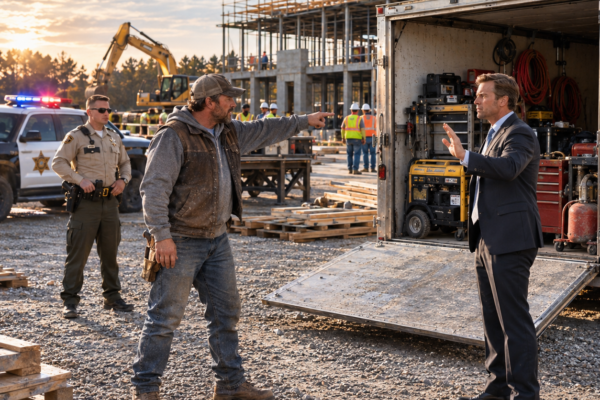
Sheriff’s units arrived.
Lights came on.
Work stopped.
People raised their hands.
Deputies separated everyone.
Dela argued.
Then argued less.
Then stopped arguing.
By the time officers finished sorting the scene, she and several others were being detained while investigators determined exactly what had been attempted and who authorized it.
I stayed on the porch.
Coffee.
Barn coat.
No victory lap.
Sheriff Decker Olmstead eventually came up.
He looked exhausted.
“You’re going to be popular tomorrow.”
“I was hoping to retire quietly.”
“That ship left.”
He took the coffee I offered.
“What was she thinking?”
I looked toward the utility corridor.
“I think she wanted another physical fact on the ground.”
“Meaning?”
“If she could make new infrastructure exist before the hearing, she could point at it later and say everybody had already relied on it.”
Decker shook his head.
“I’m a sheriff, Quinn.”
“Right.”
“Say that without engineer.”
“She thought doing something first might make permission easier later.”
“There.”
He drank coffee.
“That I understand.”
The next morning, the photographs were everywhere.
HOA president found on private ranch during unauthorized utility work.
That was bad enough.
The regulatory timing made it worse.
A formal hearing was already scheduled.
Now regulators had footage showing the HOA president entering the disputed property during an active case and attempting to expand infrastructure again.
Dela’s criminal matter proceeded separately.
I did not control it.
I did not ask deputies to stack charges.
I did not decide what prosecutors could prove.
My issue remained the ranch and the line.
At the utility hearing, Cloud Peak’s attorney argued that the neighborhood had relied on the existing corridor for years.
True.
He argued that moving the line would cost money.
Also true.
He argued residents should not be punished for developer mistakes.
I agreed with that too.
Then Vernon stood.
He did not give a speech.
He presented documents.
The 1958 easement.
The expansion history.
The cooperative’s records.
Alaric’s technical review.
The old development filings.
The midnight footage.
And finally:
an alternate-routing proposal from the cooperative.
That last document mattered most.
We were not asking regulators to strand Cloud Peak.
A replacement route could be constructed outside the Ardmore ranch.
Cloud Peak would fund the work because Cloud Peak needed the capacity.
The existing line could remain temporarily while the new route was designed, permitted, and built.
Once the replacement was energized, the old crossing would be retired.
No dark houses.
No dead refrigerators.
No winter disaster.
Just infrastructure finally placed on land where it had lawful permission to exist.
The presiding commissioner asked me:
“Mr. Ardmore, is that acceptable?”
“Yes.”
“You are willing to leave the current system operating during transition?”
“Yes.”
“Even after the tree clearing?”
“Yes.”
“The litigation?”
“Yes.”
“The unauthorized nighttime work?”
I paused.
“Yes.”
“Why?”
“Because the residents did not cut my trees.”
The room became quiet.
“They didn’t write the old development contracts.”
I looked toward the gallery.
“They bought houses.”
I turned back toward the commission.
“My argument is with unauthorized land use, not with somebody’s grandmother needing heat.”
That ended the emotional part of the case for me.
The commission’s findings were technical.
The line had exceeded the scope reflected in the historical easement and utility records.
Corrective action was required.
The alternate route was approved for further permitting and construction.
Cloud Peak and the cooperative were ordered to move the project forward.
The parties would reconcile outstanding easement compensation and restoration issues.
And the old corridor would end when lawful replacement service was operational.
Dela had spent months telling people I wanted to turn off the subdivision.
Instead, the official solution guaranteed continuity of service.
Cloud Peak residents left the hearing angry.
Not at me.
At their own board.
Within weeks, the HOA reorganized.
Carolyn Pelfrey became involved in the new leadership.
Loel Kirkwood, a retired highway patrol captain I had met at the public meeting, joined her.
The new board’s first letter to me contained three things.
An apology.
A request to coordinate the replacement line.
And an offer to negotiate restoration for the destroyed cottonwoods.
No threats.
No six-figure invented maintenance bill.
No renewal packet.
I called Carolyn.
“This is much easier.”
“What?”
“When people ask.”
She laughed.
“We’re learning.”
The replacement project moved quickly once litigation stopped being the main strategy.
Engineers surveyed another corridor.
Environmental review.
Utility approvals.
Construction planning.
Residents were updated weekly.
That was something else the old board had not done.
Transparency calmed people.
You can tolerate almost any infrastructure project if somebody tells you what is happening, why it is happening, and when the noise will stop.
Ren visited in June.
Orange construction markers were visible on the distant bench.
She stood beside me on the porch.
“So that’s the new route?”
“Yep.”
“And the old one?”
“Temporary.”
She smiled.
“You’re enjoying that word.”
“Immensely.”
We walked to the cottonwoods.
New shoots were already appearing from a few stumps.
Ren crouched beside one.
“Will they come back?”
“Some.”
“How long?”
“Longer than I’ll be impatient enough to watch.”
“Good.”
“What?”
“You could use practice.”
She had Lana’s timing.
The civil case unwound too.
Cloud Peak’s original lawsuit became difficult to maintain once the regulatory findings confirmed the infrastructure mismatch.
Settlement replaced theatrics.
The HOA agreed to recognize the termination of the old easement after transition.
Outstanding fees were resolved.
Tree damage and restoration were addressed.
My legal and professional costs became part of the larger civil negotiation.
The exact numbers mattered less to me than the paper.
I wanted a document saying:
When the new line is operational, the old corridor ends.
No successor HOA gets to rediscover it twenty years later.
No developer gets to call the old poles “historic access.”
No future board president gets to widen it.
End means end.
Vernon drafted the language.
I read it.
Ren read it.
The new HOA counsel read it.
The cooperative read it.
Then everybody signed the same version.
That sounds absurdly basic.
After everything that happened, it felt revolutionary.
Dela’s criminal case moved on another track.
The midnight incident had been documented.
So had her involvement in disputed utility and property filings.
Prosecutors focused on conduct they believed they could prove rather than turning every HOA mistake into a criminal accusation.
That distinction mattered to me.
Some old development decisions predated Dela.
Some cooperative failures were institutional.
Some engineering mistakes belonged to people long gone.
Dela did not create every problem.
What she did do was inherit a questionable situation and repeatedly choose pressure over permission.
Eventually she entered a plea resolving charges tied to false or unauthorized property and utility conduct.
There were financial consequences.
Restitution.
Supervision.
Restrictions on future HOA or property-management activity.
I never celebrated her sentence.
Stony asked why.
We were sitting on the porch.
“You soft?”
“No.”
“Then what?”
“She lost.”
He leaned back.
“That’s not an answer.”
“She lost before court.”
“How?”
“The line moved.”
Stony looked toward the eastern ridge.
Then nodded.
“That’s the right answer.”
Cloud Peak’s developer faced separate civil claims from homeowners who said they had not been adequately informed about the infrastructure risk attached to the subdivision.
I stayed mostly out of that fight.
Residents had lawyers.
The developer had lawyers.
Documents would decide it.
I had my own land to repair.
The settlement related to our ranch was substantial.
Instead of treating it like lottery money, I used a large part of it to create something my grandfather would have understood.
A land-and-utility education fund.
Plain-English easement clinics for rural landowners.
Small legal grants for families facing complicated utility-access disputes.
An engineering scholarship.
Vernon objected to the name we chose.
THE HOLLISTER ARDMORE LAND AND POWER TRUST.
“Too long.”
“It’s my money.”
“That is unfortunately persuasive.”
Ren designed the scholarship application.
The first recipient came from a family electrical business in northern Wyoming.
She wanted to study civil and electrical infrastructure.
At the award dinner, she asked me:
“What made you start this?”
I thought about Dela.
The chainsaws.
Gar’s box.
The old yellow deed.
Then I said:
“My grandfather read the paperwork.”
The girl looked confused.
I smiled.
“You’ll understand someday.”
Construction on the new Cloud Peak feed finished before the old easement clock expired.
That was the outcome I wanted from the beginning.
No race to darkness.
A race to replacement.
The cooperative scheduled the cutover.
Qualified crews handled everything.
The new route energized.
Cloud Peak stayed lit.
Then the old line across my property was de-energized under the transition plan.
Kit, the cooperative manager, invited me to stand near the southern boundary with him.
We stayed well away from the working crew.
He watched his radio.
Then looked toward the old corridor.
“That’s it.”
The old line was quiet.
No explosion.
No neighborhood blackout.
No dramatic switch in my hand.
Just infrastructure that had crossed my family’s property for generations no longer serving as Cloud Peak’s lifeline.
I expected triumph.
What I felt was relief.
Kit held out his hand.
“Your grandfather wrote one hell of an easement.”
“He did.”
“We should have caught the upgrade years ago.”
“Yes.”
He nodded.
“I know.”
That was enough.
I walked the corridor alone that evening.
The poles were still there pending later removal.
But the hum was different.
Or maybe I imagined it.
I reached the old cottonwood bottom.
Some stumps had new green shoots.
Life refusing to understand paperwork.
I found the little wooden marker my grandfather had once used near the original easement.
Weathered.
Barely legible.
I carried it home.
It sits on the mantle now.
Beside Lana’s wedding ring.
Beside Gar’s old field notebook.
Three objects from three people who taught me different versions of the same lesson.
Lana taught me that time is not guaranteed.
Gar taught me that quiet can be stronger than anger.
Hollister taught me that words on paper can outlive the person who wrote them.
Cloud Peak built its new infrastructure.
The ranch became quiet again.
The replacement route is visible from our eastern bench if you know where to look.
I do not mind it.
That surprises people.
“After everything, you’re okay seeing their line?”
“Yes.”
“Why?”
“Because they have permission.”
That is the difference.
Infrastructure is not evil.
Development is not evil.
Neighborhoods are not evil.
Electricity has to cross land somewhere.
The problem begins when necessity becomes entitlement.
Dela believed Cloud Peak needed the line.
She was right.
Then she made the mistake of treating need as ownership.
She assumed that because the development depended on my land, my land was obligated to serve the development forever.
My grandfather had understood that trap sixty-seven years earlier.
That was why he put limits in writing.
One evening, Ren sat beside me on the porch.
She had brought a yellow Labrador puppy from Montana.
The dog had already chewed one leg of Gar’s kitchen chair.
I pointed at the damage.
“That chair survived sixty years.”
Ren drank her coffee.
“Marjorie has ambitious goals.”
“You named the dog after my mother.”
“Yes.”
“She would have encouraged this.”
“Exactly.”
The puppy ran toward the lawn.
Beyond her, evening settled over the ranch.
Ren looked east.
The new Cloud Peak line stood against the fading sky.
“Mom would’ve liked this.”
“The power line?”
She rolled her eyes.
“The porch.”
“Oh.”
“The ranch.”
She paused.
“You being home.”
That one got me.
For a while neither of us spoke.
Then Ren asked:
“Do you ever wish you had just signed Dela’s renewal?”
“No.”
“Not even during the lawsuits?”
“No.”
“The cameras?”
“No.”
“The midnight thing?”
“Absolutely not.”
She smiled.
“Good.”
I looked toward the cottonwoods.
“I do wish I had come home sooner.”
Ren said nothing.
Gar had spent his last years managing the ranch alone.
Lana had spent her last year reminding me not to postpone everything until retirement.
Then retirement came and they were both gone.
Maybe that was why Dela’s first morning made me so angry.
She entered land full of people I had already lost.
She looked at trees planted by my grandfather.
Saw an easement.
Looked at Gar’s silence.
Saw consent.
Looked at my grief.
Saw leverage.
She misread all three.
The ranch was never just acreage.
The trees were never just vegetation.
And silence was never agreement.
Years later, Cloud Peak residents still use their subdivision exactly the way residents should.
Kids ride bicycles.
Retired couples walk dogs.
Families complain about landscaping assessments.
The pool committee argues about furniture.
Normal HOA life.
Carolyn once invited me to a Cloud Peak barbecue.
I went.
Stony came too.
He wore a bolo tie.
That somehow made him look more suspicious.
A resident approached me.
“Quinn?”
“Yeah?”
“You’re the power-line guy.”
Stony whispered:
“Hell of a legacy.”
I ignored him.
The resident pointed north.
“My house lost power for twelve minutes last week.”
“I’m retired.”
He laughed.
“No, I mean from a storm.”
“Oh.”
“I realized something.”
“What?”
“I never thought about where electricity came from before all this.”
“Most people shouldn’t have to.”
“Maybe.”
He looked toward the ranch.
“But I’m glad somebody thought about where the line was allowed to go.”
That was the entire story in one sentence.
Where is it allowed to go?
Not:
Where would it be convenient?
Not:
Where has everyone gotten used to seeing it?
Not:
Where can we build first and negotiate later?
Where is it allowed?
The new Cloud Peak board keeps that question taped inside the utility file cabinet.
Carolyn told me that.
I assumed she was joking.
She mailed me a photograph.
She was not.
Stony thinks that makes me famous.
I told him I prefer retired.
He said:
“Same thing if you live long enough.”
The old corridor is changing.
Some poles have been removed.
Others will come down as restoration continues.
Native grasses are reclaiming disturbed ground.
Cottonwood shoots rise beside the river.
The open strip that once looked like a wound through the ranch is narrowing visually every year.
Someday Ren’s children may walk there without knowing a high-capacity line once crossed the pasture.
I will tell them.
Not the dramatic version.
Not:
Granddad shut down an HOA grid.
Because I didn’t.
I refused to let an HOA turn a limited easement into permanent control.
Regulators did their work.
Engineers built a lawful alternative.
Utility crews transferred service safely.
Then the unauthorized dependency on my ranch ended.
That story is less cinematic.
It is also better.
Nobody’s grandmother froze.
Nobody’s medical equipment lost power because I wanted revenge.
Nobody had to choose between my property rights and keeping children warm.
We solved the real problem.
Then we enforced the boundary.
People sometimes ask what I would have done if Cloud Peak refused to reroute before the easement period expired.
The answer is the same as everything else.
Follow the lawful process.
No amateur electrical work.
No midnight switch.
No confrontation.
Let the utility operators and regulators determine the safe transition.
Landowners enforce rights through documents, courts, regulators, and negotiated access.
Not through energized equipment.
I had spent twenty-seven years around transmission infrastructure.
The first rule is simple.
Respect the energy.
The second should be just as simple.
Respect the land beneath it.
Dela respected neither enough.
That cost her.
It cost Cloud Peak.
It cost the cooperative.
It cost me trees that will take decades to replace.
But eventually the paperwork caught up.
One late summer evening, I walked down to the river.
The biggest stump had produced several shoots.
One was nearly shoulder high.
I touched the leaves.
Gar would have said not to get sentimental over a tree.
Then he would have spent three hours protecting it from cattle.
That was Gar.
Stony’s truck appeared on the county road.
He pulled into the ranch.
Slow.
Dust behind him.
He climbed out.
Looked east toward the new line.
Then west toward the quiet old corridor.
“Well?”
“Well what?”
“You win?”
I thought about it.
“Depends.”
“On?”
“The trees.”
He looked toward the shoots.
“They’re growing.”
“Then maybe.”
Stony nodded.
“Slow Wyoming time.”
“Yeah.”
We sat on the porch.
No lawyers.
No engineers.
No HOA president.
No reporters.
Just two old men and a ranch.
Stony pointed toward the mantle through the window.
“That the old marker?”
“Yep.”
“Your grandfather set that?”
“With his own hands.”
“He’d be pleased.”
“With me?”
“No.”
Stony grinned.
“With himself.”
I laughed.
Probably true.
Hollister Ardmore had written a few paragraphs in 1958 because four neighbors needed electricity.
He could not have imagined luxury houses.
HOA boards.
Modern utility loads.
Lawyers arguing over seventy-year-old language.
State regulatory hearings.
Digital cameras.
His great-granddaughter becoming a dentist in Montana.
He just knew one principle.
Helping someone use your land is not the same as giving it away.
That principle outlived him.
It outlived Gar.
One day it will outlive me.
The line on the eastern route glowed faintly against sunset.
Cloud Peak had power.
The Ardmore ranch had its corridor back.
Nobody had to lose one for the other to exist.
That was the ending Dela never understood.
She thought every conflict required somebody to surrender.
Sign the renewal.
Accept the wider corridor.
Give the HOA what it needs.
Or become the villain who shuts off the neighborhood.
There was always a third option.
Ask properly.
Pay fairly.
Build somewhere you have permission to build.
And respect the word no.
I went inside after dark.
The yellow 1958 easement now lives in a new fireproof safe.
Ren teases me about that.
“You upgraded the sacred box?”
“The old latch was failing.”
“Granddad kept it sixty-seven years.”
“He also used a rotary phone.”
“Tradition.”
“Fire code.”
She shook her head.
But the document is still there.
Original paper.
My grandfather’s signature.
Old ink.
One clause nobody needed for most of a century.
Then, suddenly, the clause that mattered more than everything else.
The HOA thought the power line made my ranch dependent on them.
They had it backward.
Their neighborhood had become dependent on permission my family never gave permanently.
Once everybody finally read the same piece of paper, the fight was over.
The engineers simply had to move the wires.
And on the afternoon the new route came alive, the old line across my 1,700 acres went quiet for the last time.
Cloud Peak kept its power.
I kept my ranch.
And my grandfather’s boundary finally meant exactly what he wrote in 1958.