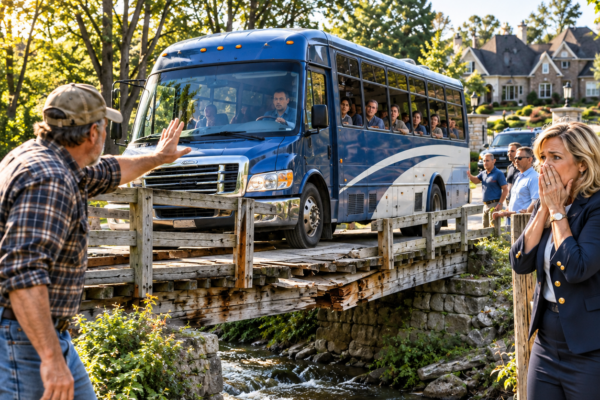
Northgate Development stretched a six-foot chain-link fence across the only road to my property and told me to “find another access point,” because their title team claimed the gravel lane my family had used for more than thirty years carried no recorded easement.
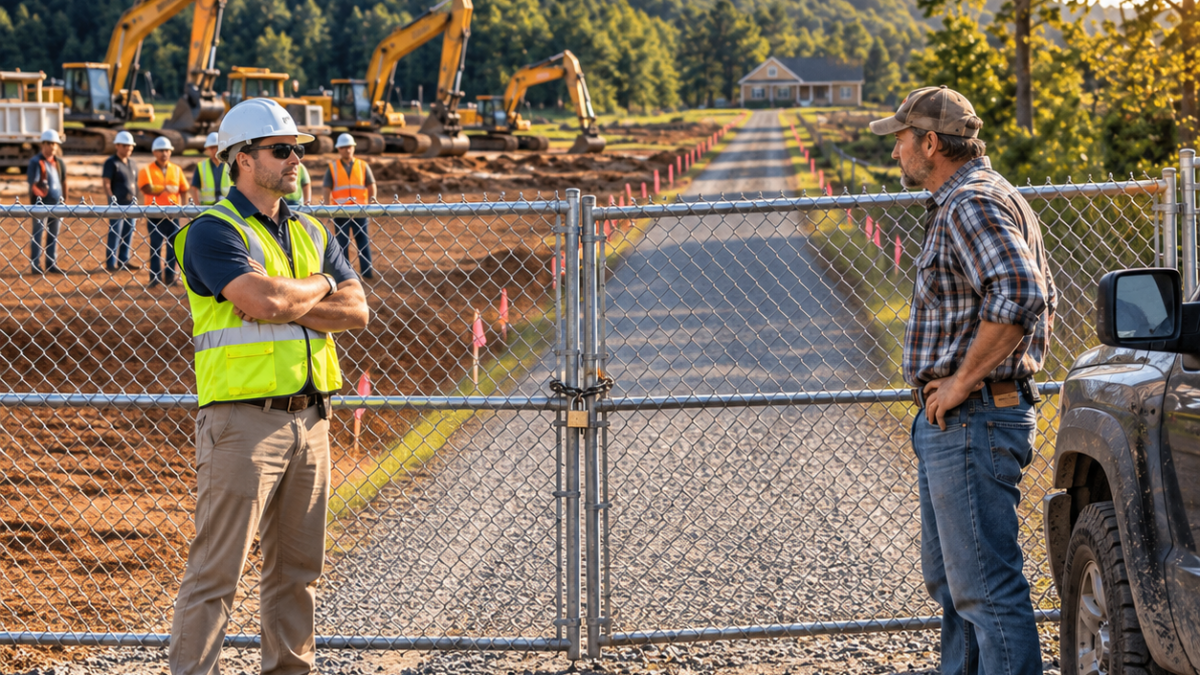
Northgate Development stretched a six-foot chain-link fence across the only road to my property and told me to “find another access point,” because their title team claimed the gravel lane my family had used for more than thirty years carried no recorded easement.
What their site manager Derek Vance did not realize was that my grandfather’s access rights were buried inside an older deed tied to a neighboring tract he had briefly co-owned, and the twenty-two-foot corridor Northgate had just fenced off ran straight through the exact section they had graded for their own permanent entrance loop.
By the time my attorney put that deed in front of a judge and the county froze work affecting the disputed corridor, forty-one workers were standing beside idle equipment while Northgate discovered that blocking my only legal road had also made a critical portion of their fourteen-acre project unusable until they restored mine.
My name is Jake Mercer.
My grandfather bought the property outside Millbrook in the late 1980s, back when the area was mostly trees, scrub grass, and small parcels owned by people who fixed their own fences.
When he died, the land came to me.
For eleven years I drove the same gravel road to a yard where I stored trailers, tools, and small equipment.
Then Northgate bought the fourteen acres surrounding it.
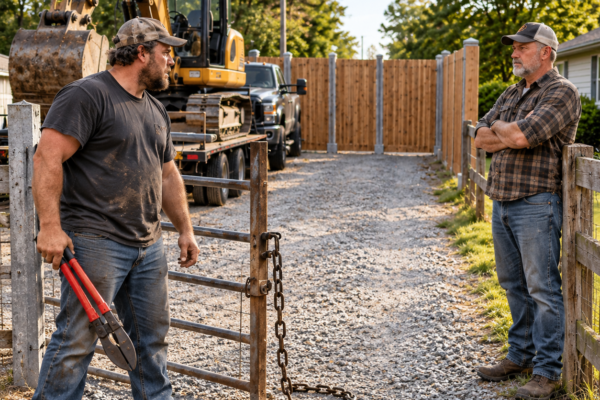
One Tuesday morning I came around the bend carrying coffee and found a fence across the road.
Derek stood on the other side.
Clean boots.
Reflective vest.
Sunglasses.
“You can’t use this access anymore.”
I laughed.
“Excuse me?”
“This road crosses Northgate property.”
“I have an easement.”
“No, you don’t.”
He actually smiled.
“Our attorneys checked.”
That confidence got inside my head.
My grandfather had talked about the easement for years, but suddenly I was wondering whether family memory had confused permission with ownership.
Derek shrugged.
“You’ll need another access point.”
“There isn’t another access point.”
“That’s something you’ll have to figure out.”
I wanted to climb the fence.
Instead I drove home.
Then I called real-estate attorney Claire Donovan.
She told me to send every deed, survey, tax record, and scrap of paper my grandfather had saved.
Forty minutes later she called.
“Jake, I found it.”
The easement was not indexed under the parcel Northgate had searched.
It sat inside an older deed connected to a tract my grandfather had once co-owned.
Separate index.
Older legal description.
But the language was clear.
A permanent twenty-two-foot access corridor to my parcel.
Claire warned me not to race back and wave it in Derek’s face.
She sent certified copies to Northgate’s counsel instead.
They acknowledged receipt.
The fence stayed.
So Claire hired a licensed surveyor.
Thursday morning, bright flags appeared through the development.
Twenty-two feet wide.
Straight through Northgate’s graded access loop.
Derek walked over.
“What is this?”
“Your legal department can explain.”
“You’re interfering with construction.”
“No.”
I pointed at the flags.
“You built construction over my access.”
Northgate still refused to remove the fence.
Claire filed for emergency injunctive relief.
The argument was simple.
I had a recorded easement.
Northgate had physically obstructed it.
My property had no practical alternative access.
And their current site work risked further interfering with the corridor.
The court issued temporary relief preserving the easement while the dispute was resolved, and county officials paused grading and access-related work that depended on the contested strip until Northgate submitted corrected plans.
That was when their mistake became expensive.
Three excavators stopped.
Trucks were redirected.
Forty-one workers were affected by scheduling changes.
Northgate estimated carrying costs and contractor standby at roughly $14,000 per day.
I felt guilty about the workers.
Claire reminded me:
“You didn’t design their project across an easement and then fence the easement shut.”
By day six, Northgate’s lawyers stopped arguing that the easement did not exist.
They started arguing about scope.
By day eight, the fence still stood.
On day nine, Derek called me personally.
His voice sounded completely different.
“Jake, we need to talk about the road.”
I looked out toward the equipment yard my grandfather had reached over that road for decades.
“Claire’s handling it.”
“I’m trying to fix this.”
“Then fix it.”
There was a long silence.
Finally Derek said:
“We’re prepared to remove the fence.”
I answered:
“That gets me back onto my property.”
Then I added the part Northgate had spent nine expensive days discovering.
“But if you want your project access restored too, your engineers are going to have to redesign around the twenty-two feet you tried to pretend didn’t exist.”
[END OF FACEBOOK CAPTION]
[FIRST COMMENT / FULL STORY CONTINUATION]
Derek did not answer immediately.
I could hear machinery somewhere behind him.
Not running.
Metal clanging.
A truck door.
A voice calling to somebody.
Then:
“Jake, nobody is pretending anything.”
I almost laughed.
Nine days earlier, he had stood behind six feet of chain-link and told me I did not have an easement.
Now apparently we were discussing nuance.
I leaned against the workbench.
“Your fence is still across my road.”
“I know.”
“Then start there.”
“We are.”
“Good.”
“We also need to talk about your surveyor’s interpretation of the corridor.”
“No.”
Silence.
“No?”
“My lawyer talks to your lawyer about the easement.”
“I’m calling you because I’m trying to get past the lawyers.”
“That’s exactly why I’m not discussing legal scope with you.”
He exhaled.
I could almost picture him rubbing his forehead.
“Fine.”
Then, quieter:
“I handled the first conversation badly.”
That stopped me.
Not an apology.
Close.
I said:
“You told me access to my own land was my problem.”
“I know what I said.”
“And you laughed.”
“I remember.”
“Good.”
Another silence.
“I’ll have our attorney call Claire.”
“Do that.”
Before hanging up, Derek said:
“For what it’s worth, the fence should start coming down tomorrow.”
I looked toward the gravel road through the trees.
“Good.”
Then the call ended.
I stood there for a while.
Nine days.
That did not sound like much.
A little over a week.
But disputes compress time strangely.
Every morning had started with checking email.
Every evening with asking Claire whether anything changed.
Every phone notification carried the possibility of:
Northgate agreed.
Northgate refused.
Hearing scheduled.
Engineer objected.
County requested something.
Another day of delay.
Meanwhile my equipment yard sat on the far side of a road I had legally used for eleven years.
I had managed around it.
Friends moved a few things.
I postponed work.
One trailer I needed remained trapped inside.
Nothing catastrophic.
Still infuriating.
The next morning I drove out early.
Did not enter Northgate’s active construction area.
I parked where Claire told me I could park safely.
Two laborers were already unbolting chain-link panels.
No ceremony.
No dramatic crane.
A cordless impact driver.
Metal clamps.
Workers who probably did not know my name.
One man lifted the panel while another loosened the base.
Derek stood about fifty yards away with a phone pressed to his ear.
He saw me.
Finished his call.
Then walked over.
This time his boots were muddy.
I enjoyed that more than I should have.
He stopped beside me.
“Well.”
“Well.”
“Looks like you got your road back.”
I looked at him.
“That’s the funny part.”
He waited.
“I never lost it.”
His mouth tightened.
For half a second I thought we were about to restart the entire fight.
Then he nodded.
“Fair enough.”
One of the workers carried the final panel away.
The gravel lane opened.
No cheering.
No neighbors.
No triumphant music.
Just twenty-two feet of road.
I got into my truck.
Derek stepped aside.
I drove through.
When the tires crossed the exact place where the fence had stood, I expected something bigger.
Vindication.
Adrenaline.
Maybe some ridiculous urge to honk.
Instead I felt relief.
The same road.
Gray gravel.
Two muddy tire tracks.
Weeds along one edge.
A shallow ditch.
My grandfather’s world did not care that lawyers had spent nine days arguing about it.
I drove to the equipment yard.
Unlocked the gate.
Walked around.
Everything was exactly where I left it.
Small excavator.
Flatbed trailer.
Tool shed.
Two compact machines I kept meaning to sell but never did.
I sat on the trailer tongue and drank coffee.
Cold by then.
Best coffee I had tasted all week.
Claire called.
“You went through?”
“Yes.”
“Fence removed?”
“Yes.”
“Any interference?”
“No.”
“Good.”
“Derek was there.”
“Jake.”
“I didn’t argue.”
“Define argue.”
“I told him I never lost the road.”
She sighed.
“That is technically true and strategically unnecessary.”
“Worth it.”
“I knew I should have supervised you.”
I laughed.
Then she became serious.
“Access being restored does not end this.”
“I know.”
The temporary injunction had done two things.
First, preserve my access rights while the case was sorted out.
Second, stop Northgate from altering the easement corridor in ways that could make final relief meaningless.
That second piece was what caused them trouble.
Their original site plan used the same strip.
Not because they planned to erase my road entirely.
Their project engineers intended to widen and regrade part of the area into a landscaped internal access loop serving several new lots and construction traffic.
On paper, Northgate believed it controlled the ground free of my rights.
So their design treated my corridor like flexible space.
When the easement appeared, suddenly the project had a twenty-two-foot legal constraint running directly through its planned geometry.
They could not build permanent landscaping islands across it.
Could not narrow it below the easement width.
Could not place utilities or grading that materially interfered with my access.
Could not simply gate it in a way that left me dependent on developer permission.
The engineers had to redesign.
That was why the county permit issue mattered.
People love saying:
The county shut down the whole project.
It did not exactly work that way.
The county placed holds on grading and access work affected by the disputed corridor because the approved site plan no longer matched the title situation.
Other work theoretically could continue if separable and safe.
But construction sequencing is like plumbing.
One blockage creates problems elsewhere.
Material trucks needed routes.
Heavy equipment needed circulation.
Drainage work connected sections.
Utility trenches crossed planned areas.
Subcontractors had schedules.
When access geometry changed, Northgate could not simply tell everyone:
Work around it.
That was how my easement temporarily “landlocked” their project in practical terms.
Not because I erected a gate around fourteen acres.
Because their own design had concentrated too much of their site logistics around land they had not properly cleared.
Claire explained it using dominoes.
“Your easement is not a weapon.”
“I know.”
“It’s a constraint.”
“I know.”
“Their mistake was designing as if the constraint didn’t exist.”
“Exactly.”
“Good.”
She paused.
“You sound disappointed.”
“I liked weapon better.”
“Of course you did.”
The first redesign meeting happened without me.
Northgate engineers.
Surveyor.
County planning staff.
Transportation reviewer.
Their title counsel.
Claire attended remotely for the portion involving my easement.
Then she called me.
“They want a temporary construction crossing agreement.”
“What?”
“They need to cross the easement in several locations while they rebuild the site loop.”
“Can they?”
“Potentially, if it does not unreasonably interfere with your access.”
“Do I have to agree?”
“Depends on what their existing rights are and how temporary work interacts with the easement.”
“What do they want from me?”
“Predictability.”
That word again.
People who ignored your rights suddenly become huge fans of predictability once those rights cost them money.
Northgate proposed maintaining one open twenty-two-foot lane to my property at all times while allowing short scheduled closures, no more than fifteen minutes, for equipment crossings.
They would provide forty-eight-hour notice for larger work.
Emergency access always available.
Construction mats where necessary.
Dust control.
Restore gravel.
Indemnify me for damage caused by their work.
Pay for temporary signage.
Reasonable.
I hated that it was reasonable.
Part of me wanted to say:
Find another access point.
Exactly what Derek had said.
That would have felt incredible.
For about five minutes.
Then I pictured forty-one workers.
Drivers.
Equipment operators.
Concrete crews.
Surveyors.
People who had not fenced me out.
My grandfather would have called revenge expensive stupidity.
I told Claire:
“If it protects my access, I’ll consider it.”
She said:
“That is why you hired me before driving back with bolt cutters.”
“I never said bolt cutters.”
“You thought bolt cutters.”
Maybe.
We reviewed the agreement.
Changed language.
Northgate could not claim that temporary cooperation modified or reduced my permanent easement.
Important.
No waiver.
No expansion of their rights.
No admission that the project had authority beyond what was expressly stated.
Schedule.
Insurance certificate.
Damage responsibility.
Then I signed.
Derek signed for Northgate.
Construction began moving again in sections.
Not fully.
The redesign still required approval.
But the immediate site paralysis eased.
That reduced the $14,000-per-day burn.
I asked Claire whether the number was real.
“Probably an internal estimate.”
“Can we verify?”
“Why?”
“Curious.”
“You don’t need to build your emotional life around Northgate’s carrying costs.”
“Very poetic.”
“Also expensive if you keep calling me.”
Point taken.
Later, during settlement exchange, Northgate produced enough schedule records that the estimate looked plausible.
Equipment standby.
Interest.
Temporary rentals.
Project management.
Subcontractor remobilization.
Forty-one workers affected at different points.
Not forty-one people standing idle every minute.
Important distinction.
Some were reassigned.
Some lost hours.
Some worked elsewhere.
Northgate spread the impact as best it could.
I was glad.
One afternoon a superintendent named Miguel stopped by my yard.
Not Derek.
Older guy.
Fifty maybe.
Gray beard.
He asked:
“You Jake?”
“Depends.”
He smiled.
“I’m Miguel Santos.”
“Northgate?”
“Unfortunately.”
He pointed toward the road.
“I wanted to coordinate concrete trucks Thursday.”
“Claire has the schedule.”
“I know.”
“I wanted to meet the guy at the other end.”
That softened me.
We talked.
He had worked construction thirty years.
Said he had never seen an easement dispute become a site-plan redesign that fast.
“Title guys missed it?”
“Apparently.”
He shook his head.
“Happens.”
I asked:
“Does it?”
“People think dirt is simple.”
He looked toward the project.
“Dirt has more paperwork than hospitals.”
I laughed.
He explained something Claire had not.
Northgate’s original access loop was not simply aesthetic.
Fire apparatus needed turning radius.
Construction traffic needed an internal loop.
Future residents needed circulation.
Drainage grades tied into road elevations.
Moving the loop six feet one direction changed another connection.
Then a retaining wall.
Then a utility sleeve.
Then lot grading.
That was why twenty-two feet mattered so much.
I said:
“So my grandfather accidentally designed their project forty years later.”
Miguel smiled.
“Basically.”
Then:
“Derek shouldn’t have fenced you.”
Direct.
I looked at him.
“You know him?”
“Boss.”
“What does he say?”
“That title told him no easement.”
“Still.”
Miguel nodded.
“Still should’ve called.”
That was the core.
Mistake one:
Missed document.
Understandable.
Mistake two:
Treating a person’s only access as disposable before speaking with him.
Not understandable.
Everything after flowed from that.
Northgate’s legal team eventually admitted the title search had been incomplete.
Not fraudulent.
Not malicious.
Incomplete.
The title company had searched the acquired parcels and visible exceptions in the chain.
The old easement language appeared in a deed connected to an adjacent tract my grandfather briefly co-owned with his brother.
The deed referenced access to my current parcel using an older description that had later been renumbered.
It was easy to miss if you did not chase every cross-reference.
Claire did.
Because I handed her Grandpa’s files.
One paper had a handwritten note:
Road rights in Billy deed.
Billy was my great-uncle.
I had never understood it.
Claire saw “Billy” and asked who.
Then searched the old tract.
There it was.
Grandpa had practically left us a map.
I found the original note later.
Yellow index card.
His handwriting.
ROAD RIGHTS — BILLY DEED — KEEP COPY.
Underlined twice.
I sat at my kitchen table holding that card.
“Okay, Grandpa.”
He had been dead almost fourteen years.
Still saving me.
That became the emotional part I never expected.
The dispute was about access.
But it made me go through boxes I had avoided since he died.
Property papers mixed with receipts.
Photos.
Equipment manuals.
His pocket notebook.
A birthday card I had given him.
He saved everything.
I used to tease him.
“Why do you need a receipt for a chainsaw you sold in 1998?”
“In case.”
“In case what?”
“In case somebody asks.”
Nobody ever asked about the chainsaw.
They asked about the road.
He had the paper.
Northgate’s revised site plan came back three weeks later.
The twenty-two-foot easement was shown clearly.
Not dashed vaguely.
Not buried in notes.
Heavy line.
Label:
MERCER ACCESS EASEMENT — DO NOT OBSTRUCT.
I loved that.
Maybe too much.
Claire said:
“Frame it.”
I thought she was joking.
She wasn’t.
The redesign shifted landscaping.
Moved one utility crossing.
Adjusted the internal road.
Changed one lot’s driveway geometry.
Reduced a decorative entrance island.
No project destruction.
No fourteen acres abandoned.
No houses demolished.
But the ripple cost money.
Engineering.
Survey.
Permits.
Schedule.
Construction sequencing.
That is how real property mistakes hurt.
Not explosions.
Invoices.
Then Northgate made the settlement proposal.
Remove fence already done.
Record a formal acknowledgment of the easement.
Pay my documented legal fees.
$6,200.
Repair any damage to gravel.
Pay survey costs.
Mutual release regarding the obstruction episode after compliance.
No confidentiality.
No purchase of easement.
No modification of its twenty-two-foot width.
Claire reviewed.
“Good.”
I asked:
“Can we make them apologize?”
She looked at me.
“Contractually?”
“Maybe.”
“No.”
“Why?”
“Because forced apologies are stupid.”
Fair.
“What about Derek?”
“What about him?”
“I want him to admit he was wrong.”
“Then ask him personally.”
“That sounds worse.”
“Yes.”
We countered one important point.
The original easement already existed.
The new recorded document could not be written as if Northgate were granting me something.
That mattered enormously.
Their first draft said:
Northgate hereby recognizes and grants continued access.
Claire crossed out:
grants.
Replaced with:
acknowledges the preexisting easement created by deed recorded…
That one word mattered.
They were not giving.
They were acknowledging.
I signed after that change.
Northgate paid $6,200 in legal fees.
Survey costs separately.
The acknowledgement was recorded.
Permanent.
Clear parcel references.
Modern legal description.
Twenty-two feet.
Ingress and egress.
Maintenance responsibilities clarified.
No gates or obstructions without my written consent and without preserving continuous reasonable access.
Temporary construction coordination language expired when project work completed.
I received certified copy.
Put it in fireproof box.
Cloud scan.
Lawyer copy.
Title company copy.
Grandpa would have approved.
Then life became boring.
For a while.
Northgate construction resumed.
I drove through every morning.
Workers waved.
Miguel coordinated crossings.
No conflict.
Derek mostly stayed away.
Then, about a month later, I found him near the easement talking to a survey crew.
He saw me.
I stopped.
This was the first time we had been alone since the fence came down.
He walked over.
“Morning.”
“Morning.”
He looked toward my truck.
“Access okay?”
“Yes.”
“Any issues with crews?”
“No.”
“Good.”
He hesitated.
Then:
“I owe you something.”
I waited.
“An apology.”
There.
“I relied on our title report.”
“I know.”
“I thought you were bluffing.”
“I wasn’t.”
“I know that too.”
He shoved his hands into vest pockets.
“When you said your grandfather had an easement, I should’ve stopped the fence work and checked.”
“Yes.”
“I didn’t.”
“No.”
“I was worried about site security.”
“Then you could have put a temporary gate with access for me.”
He nodded.
“That would’ve been the smart move.”
“Yes.”
“I was too sure.”
That word.
Sure.
Not evil.
Sure.
I said:
“Apology accepted.”
He looked surprised.
“That easy?”
“No.”
“But accepted.”
He nodded.
Then laughed once.
“I still hate that survey flag line.”
“I love it.”
“Of course.”
After that, our interactions became professional.
Not friendly.
Better.
He would text if a large delivery temporarily affected the road.
I would respond.
No drama.
The project changed shape.
One planned lot ended up slightly smaller due to road geometry.
Another driveway moved.
The entrance loop narrowed in landscaping area but remained code-compliant.
Northgate lost some aesthetic flourish.
No one died.
At first I had imagined the ultimate revenge:
Their entire development stopped permanently because of me.
Then I saw the revised plans.
Families would eventually live there.
Kids.
Dogs.
People who had nothing to do with Derek’s fence.
Why would I want fourteen acres to become a legal wasteland just to prove a point?
I didn’t.
I wanted the road.
That was all.
Yet Northgate had, for those first days, effectively landlocked its own project operations.
That irony never stopped being funny.
The only route they treated as disposable turned out to be embedded in the geometry of their own plan.
The county permit hold forced them to face it.
Their access loop could not be finalized.
Construction sequencing jammed.
Heavy equipment movement restricted.
They created the very access crisis they accused me of having.
All because Derek said:
Find another road.
The project eventually finished about six months behind its original public schedule.
I cannot honestly say my easement dispute caused six months.
Northgate had weather delays.
Material issues.
A retaining-wall redesign unrelated to me.
Utility scheduling.
Permit reviews.
Construction projects collect delay like old trucks collect rust.
My dispute caused some.
Not all.
I refused to take credit for the whole thing.
That would turn truth into revenge fantasy.
Claire appreciated that.
“Never testify like an internet storyteller.”
“Meaning?”
“Don’t claim causation you can’t prove.”
Noted.
Northgate sold the first homes the following spring.
I drove past moving trucks.
Young couple.
Two kids.
Woman carrying plant.
Man trying to assemble something in driveway.
Normal.
One of the buyers approached me weeks later.
“Are you Jake?”
“Who’s asking?”
He smiled.
“Everyone says you’re the road guy.”
I hated that.
“What does that mean?”
“That you stopped the development.”
“I didn’t.”
“That’s not what Derek says.”
Interesting.
“What does Derek say?”
“He said they found an old access easement after construction began and had to redesign.”
That was accurate.
The homeowner looked disappointed.
“I heard you sued them for millions.”
“No.”
“You got legal fees.”
“Six thousand two hundred.”
“That’s it?”
“That was what I spent.”
“So no huge settlement?”
“No.”
He laughed.
“Neighborhood stories get better every time.”
Yes.
They do.
He introduced himself as Evan.
Lived on Lot 7.
His backyard backed toward my access strip.
He asked whether he could walk down the road.
I said:
“What does your deed say?”
He looked horrified.
I laughed.
“Ask your HOA.”
Never waste a joke.
The HOA for Northgate eventually formed after enough homes sold.
That made me nervous.
I had no interest in repeating the entire story with new volunteers who had never met me.
So Claire sent the new HOA counsel a courtesy package.
Recorded easement.
Survey.
Acknowledgment.
Maintenance responsibilities.
Northgate’s development documents.
No demands.
Just:
Here is the legal framework governing the Mercer access corridor.
The new board president called.
Her name was Rachel Kim.
She said:
“Mr. Mercer, thank you.”
I almost dropped phone.
“Why?”
“For sending records before there is a problem.”
“That’s new.”
She laughed.
“We have no intention of blocking you.”
“Excellent platform.”
She asked if they could install directional signs near the shared section because residents kept mistaking my road for the subdivision trail.
We discussed placement.
No interference.
Approved.
That was how it should work.
Question.
Response.
Agreement.
No fence appearing overnight.
I told Rachel the story.
Short version.
She said:
“Derek never told us about the chain-link.”
“I’m shocked.”
“He told us there was an early title issue.”
“That’s one way to say it.”
She promised the easement would be in board orientation materials.
It was.
Every year.
I know because she sent a screenshot.
Slide 12:
MERCER PRIVATE ACCESS EASEMENT
22 FT
DO NOT BLOCK
CONTACT OWNER BEFORE MAINTENANCE
Beautiful.
Grandpa would have laughed.
My equipment business improved too.
Not because of lawsuit money.
There wasn’t any.
The disruption forced me to reorganize.
I realized I stored too much useless equipment.
Sold two machines.
Cleared shed.
Added better locks.
Graded the upper yard.
Improved drainage.
I spent some of Northgate’s legal-fee reimbursement? No, that money reimbursed fees already paid.
Important distinction.
I used my own savings for improvements.
The road itself needed gravel the next year.
Maintenance responsibility under old easement had been vague.
The recorded acknowledgment clarified that I maintained the portion primarily serving my parcel, while Northgate maintained sections altered or paved for its development subject to noninterference.
We split one transition area based on use.
No fight.
I paid my share.
Some people think if you win a property dispute, you should never pay anything again.
That is childish.
Rights come with responsibilities.
I wanted the road kept passable.
So did Northgate.
We both paid where agreement said.
One winter storm washed part of the shoulder.
Rachel called.
“Our contractor can fix both sides while he’s there.”
“Cost?”
She gave quote.
Reasonable.
“Send me my portion.”
Done.
That conversation took four minutes.
Compare with nine days of injunctions.
The difference was not nicer people alone.
Clear documents.
The dispute changed Derek too.
At least from what Miguel told me.
Northgate instituted a preconstruction title-review checklist.
Any existing access route used by outside parcels had to be verified before fencing or site security went up.
Field managers could not block longstanding ingress solely on a preliminary title summary without counsel signoff.
Temporary access plans required notice.
Derek apparently presented the policy at a company meeting.
Miguel told me:
“He used your project.”
“Called it what?”
“The Mercer Incident.”
I nearly died.
“Seriously?”
“Yep.”
“Good.”
“Why good?”
“Because I want him saying my name every time someone tries to fence a road.”
Miguel laughed.
That was the best revenge I ever got.
Not money.
Not delay.
Institutional embarrassment converted into procedure.
Years later Northgate bought another parcel near Millbrook.
There was an old farm lane crossing it.
Derek called me.
Not because I had anything to do with land.
He said:
“You’re going to enjoy this.”
“What?”
“We found a guy with access rights before closing.”
“Congratulations.”
“We called him.”
“Revolutionary.”
“We got an agreement.”
“Incredible.”
“You’re annoying.”
“Still cheaper than $14,000 a day?”
Long pause.
“Goodbye, Jake.”
I laughed for five minutes.
Grandpa’s file cabinet became sacred after all this.
Not literally.
Still rusted metal.
But I stopped throwing papers away casually.
I digitized deeds.
Tax maps.
Easements.
Equipment titles.
Insurance.
Receipts that actually mattered.
Not every chainsaw receipt.
I had limits.
I labeled folder:
ROAD.
Inside:
Original old deed copy.
Claire’s title memo.
Survey.
Injunction papers.
Settlement.
Recorded acknowledgment.
Photographs of fence.
One photo shows my truck stopped in front of chain-link.
Derek beyond it.
I took it that first morning without thinking.
Looking now, I remember doubt.
That was the strongest feeling.
Not rage.
Doubt.
He sounded so certain.
“Our attorneys reviewed the title work.”
That sentence almost made me surrender my own memory.
That frightened me more in retrospect.
Authority does not need a badge.
Sometimes it wears reflective vest and says legal reviewed it.
People assume professionals cannot miss things.
They can.
Claire admitted it herself.
Attorneys miss.
Surveyors miss.
Title abstractors miss.
Developers miss.
Owners miss.
The solution is not distrusting everyone.
It is verifying when facts matter.
Especially before blocking someone’s only access.
I once asked Claire:
“What if I hadn’t had Grandpa’s papers?”
She thought.
“Harder.”
“Would we still find the easement?”
“Probably.”
“Why probably?”
“Because we would search title history based on use and descriptions.”
“But slower?”
“Yes.”
“More expensive?”
“Yes.”
That made me think about people without resources.
I could afford attorney.
Survey.
Time.
What if I could not?
A fence and a confident site manager might have become reality simply because fighting cost too much.
That bothered me.
Claire said:
“Property rights are strongest on paper but not self-enforcing.”
That line stuck.
Rights can exist and still require work.
Calls.
Letters.
Money.
Patience.
Sometimes court.
That is why clarity matters before conflict.
The recorded acknowledgment meant future Jake—or whoever owned my property after me—would not need forty minutes of detective work.
The easement now appeared clearly in modern title searches.
Northgate could sell.
Lenders could see it.
Future HOA could see it.
No mystery.
That was worth more than apology.
I also learned what easements are not.
They are not ownership of the underlying land.
I had a right to use the twenty-two-foot corridor for access.
Northgate still owned much of the land beneath sections of that corridor.
My easement burdened it.
That meant I could use it within scope.
They could use their land too, so long as they did not unreasonably interfere with my rights.
Neither side got absolute control.
People online hate that.
They want:
My road.
Their road.
Winner.
Loser.
Property law often says:
Both, differently.
That complexity is exactly why Derek’s fence was reckless.
Even if title showed Northgate owned fee title under the lane, that did not answer whether I had a right across it.
Ownership of dirt and right of passage are separate questions.
He asked only first.
Then built fence.
Expensive lesson.
My grandfather understood easements better than I did.
He had worked farms.
Shared lanes were normal.
One guy owned strip.
Three families drove over it.
Everybody knew.
Handshake plus deed.
He told me once:
“You don’t own every place your tires touch.”
At the time I thought it was just old-man philosophy.
No.
Literal property law.
I hear him now every time I drive through Northgate.
The development became attractive despite my jokes.
Trees planted.
Sidewalks.
Homes.
Small pond.
Kids on bikes.
Trash cans definitely existed.
Renderings lied.
Rachel’s HOA was normal.
They complained about fence colors.
Pool chairs.
Dog waste.
Life.
My access road passed along one side before turning toward my equipment yard.
Residents got used to me.
At first they called it construction road.
Then old road.
Then Jake’s road.
Technically Northgate fee land under portions with Mercer easement.
Not catchy.
One kid asked:
“Why do you get to drive there?”
“Because I have paperwork.”
He looked disappointed.
Fair.
Years after development finished, I decided to build a small workshop on my property.
That required permits.
County planner reviewed access.
Easement acknowledgment made it easy.
No dispute.
Fire department verified width.
Twenty-two feet.
Enough for requirements with improvements near my parcel.
Northgate coordinated.
I widened a small turnaround on my land.
Paid.
Construction started.
Derek heard.
He texted:
NEED US TO FENCE IT OFF?
I replied:
TRY IT.
He sent laughing emoji.
That was our relationship now.
Not friends.
Shared scar tissue.
My workshop contractor asked why easement documentation was so detailed.
I told story.
He shook his head.
“I’d have cut that fence.”
I said:
“And then what?”
“Driven through.”
“And when Northgate claimed criminal damage?”
He paused.
“Still satisfying.”
“Until attorney bill.”
“Fair.”
That became my other lesson.
Physical problems tempt physical solutions.
Fence exists.
Remove fence.
Simple.
But property disputes are rarely only physical.
If I had cut Northgate’s fence before proving easement, I might have complicated my position.
Maybe still justified under some circumstances.
Maybe not.
Why risk it when Claire could get legal relief?
Staying calm did not feel powerful that first morning.
It felt like retreat.
Drive away.
Call lawyer.
Search files.
But restraint preserved options.
Anger narrows.
Documentation expands.
Grandpa would have said something less pretentious.
Probably:
Don’t be stupid before lunch.
Same idea.
The $6,200 reimbursement arrived by wire.
I stared at banking notification.
Did not feel rich.
Because it was reimbursement.
Money already gone.
Claire invoices.
Survey.
Filing.
Some costs separate.
People hearing “they paid his legal fees” imagine profit.
No.
It means you get back what you had to spend to defend something you already possessed.
That is not jackpot.
It is restoration.
Still appreciated.
I bought Grandpa’s favorite whiskey with my own money.
Went to his grave.
Took small plastic cup.
Poured one for myself.
Not on grave.
Wasteful.
I sat.
“Your stupid file saved me six grand.”
Wind.
No answer.
“Also possibly project millions.”
Still no answer.
“Could’ve labeled it better.”
Nothing.
I laughed.
Then cried a little.
Property disputes do weird things.
You think you are fighting about gravel.
Then suddenly you are talking to dead grandfather because his handwriting mattered.
I left.
No dramatic sign from universe.
Good.
Claire later became my friend in the loose sense that I sent her referrals and she overcharged them responsibly.
When I bought an adjacent half-acre years later, I called before closing.
She answered:
“What did you find?”
“Nothing.”
“Then why are you calling?”
“Because I’m traumatized.”
She laughed.
Then reviewed title.
No surprise easements.
Almost disappointing.
At closing she gave me gift.
A small framed sign:
MAYBE CHECK AGAIN.
I hung it in workshop.
That sentence became the summary.
Derek’s mistake was not missing old deed.
That was title team’s mistake.
His was refusing uncertainty.
If he had said:
Jake, our search shows no easement, but you’ve used this road eleven years. Give us what you have and we’ll hold off fencing until counsel reviews.
No story.
No injunction.
No $14,000-per-day estimate.
No forty-one workers disrupted.
No permit hold.
No $6,200 reimbursement.
No redesign under pressure.
Maybe project still needed design changes once easement found.
But they could have discovered before grading so much.
Before fencing.
Before confrontation.
The cheapest sentence on Tuesday morning would have been:
Maybe I should check again.
That is true in nearly every field.
Title.
Medicine.
Engineering.
IT.
Relationships.
Confidence feels efficient.
Verification actually is.
Northgate’s internal review later estimated the access dispute and resulting redesign contributed a significant five-figure direct cost plus schedule impacts.
I never got exact total.
Did not ask.
The $14,000 daily figure was enough legend.
Derek once told me:
“Stop repeating that.”
“You told people?”
“Finance told project team.”
“Miguel told me.”
“Of course he did.”
“Was it wrong?”
He sighed.
“Some days more.”
That delighted me.
Then:
“Some days less.”
Reality ruining fun again.
The project’s six-month delay became neighborhood myth attributed entirely to me.
I corrected people.
Weather.
Utility.
Retaining wall.
Permits.
My dispute one part.
Why correct?
Because exaggeration weakens truth.
The actual truth was already satisfying.
They blocked my access.
Old easement existed.
Their project crossed it.
Court preserved it.
County forced revised plans.
They removed fence.
Paid fees.
Recorded acknowledgment.
I drove through.
Enough.
No need to invent destruction.
One summer, Rachel invited me to Northgate community picnic.
I laughed when email arrived.
“Why?”
She said:
“Because you’re technically our most important nonresident.”
No.
I went anyway.
Burgers.
Kids.
Inflatable slide.
Derek showed up representing developer for final turnover items.
He saw me.
“Who let you in?”
“Permanent easement.”
He rolled eyes.
Miguel nearly choked laughing.
Someone introduced me to newer residents:
“This is Jake.”
One woman:
“Oh, road Jake.”
Again.
I surrendered.
A homeowner asked if I hated Northgate.
“No.”
“Really?”
“I hated fence.”
“Fair.”
That was true.
Companies are collections of people and processes.
Northgate made bad decision.
Then fixed it.
Derek apologized.
Engineers redesigned.
Attorneys formalized.
Workers finished.
Residents moved in.
No lifelong feud necessary.
That did not mean I trusted blindly.
Documents stayed.
Boundaries stayed.
Good fences?
Not across my road.
Years later, Northgate Development sold its remaining interests.
Different company took over warranties.
The transition packet included my easement.
I knew because new company lawyer emailed:
We acknowledge the Mercer Access Easement recorded at Instrument…
I nearly cried from happiness.
No detective work.
No yellowed deed.
No “we can’t find it.”
Just:
We acknowledge.
Institutional memory achieved.
I forwarded to Claire.
Subject:
GRANDPA WINS AGAIN.
She replied:
I DID THE WORK.
Fair.
I drove the road the next morning.
Didn’t think twice until halfway.
Then realized that was the best ending.
Boring.
No fence.
No flags.
No lawyers.
No camera.
No contractor waiting.
Just road doing what road does.
Carry someone from public road to private land.
The easement existed so long before Northgate that it had outlived people who created it.
Then paperwork carried intention forward.
That fascinated me.
A sentence written decades ago had more staying power than Derek’s fence.
Steel looks strong.
Paper looks weak.
But authority is not material.
It is agreement recognized by law.
A chain-link panel can be removed in minutes.
Recorded rights survive owners.
Grandpa knew.
I learned late.
The title says I landlocked their entire project.
Technically, Northgate still owned fourteen acres with other physical edges.
But its approved construction and permanent circulation plan depended so heavily on the corridor that once the court protected my easement and county paused conflicting work, the project functionally lost its planned internal access until engineers corrected the design.
They had tried to make my parcel inaccessible.
By doing so, they exposed the access flaw in their own project.
That is the irony.
I did not build a barricade.
Did not sabotage.
Did not block construction trucks.
Did not chain their gate.
I presented a deed.
Then survey.
Then asked court to preserve existing right.
Everything that happened to their schedule came from design collision with that right.
That distinction mattered ethically.
I could sleep.
Workers delayed because company had to correct legal problem.
Not because I retaliated physically.
Sometimes the strongest move is letting existing rules do exactly what they were designed to do.
I did not need revenge.
I needed access.
The law protected access.
Northgate’s consequences were a side effect of having ignored it.
Grandpa’s index card remains in my fireproof box.
ROAD RIGHTS — BILLY DEED — KEEP COPY.
I scanned it.
Cloud.
External drive.
Claire.
Future owner will have everything.
I even drafted a plain-language memo:
This property is accessed via a twenty-two-foot recorded easement across the former Northgate tract. See instrument numbers. Do not rely solely on parcel summary. Keep copies with deed.
Overkill?
Probably.
Then I remembered fence.
Not overkill.
If I ever sell, buyer will know.
Title company will know.
Lender will know.
HOA will know.
No future Jake standing with coffee before six feet of steel wondering whether grandfather imagined the road.
That is worth paperwork.
Derek retired from Northgate site management before I sold? He didn’t retire fully, just moved into regional operations.
He called once from another project.
“Need recommendation.”
“From me?”
“We have farmer claiming access across parcel.”
“Have you fenced him yet?”
“Very funny.”
“Check title.”
“We did.”
“Check again.”
Pause.
“That’s why I’m calling.”
He sent me old legal description.
I forwarded Claire’s office.
No personal advice.
They found a seasonal farm-access license, not permanent easement.
Northgate negotiated.
No lawsuit.
Derek texted:
HAPPY?
Very.
That might be the real legacy.
A mistake remembered early enough to prevent another.
Not every conflict needs villain.
Sometimes it needs expensive memory.
Northgate paid enough to remember.
So did I.
The road still looks ordinary.
That is what makes it perfect.
Gravel near my property.
Paved section near development.
Twenty-two feet.
Trees.
Drainage ditch.
At sunrise, shadows across.
At night, deer occasionally.
I drive it without thinking.
Then once in a while I see the spot where the chain-link posts stood.
Tiny concrete scar near shoulder remained for years.
Eventually grass covered it.
For a while I kept it visible on purpose.
Then realized I was being ridiculous.
I dug the concrete out.
Reseeded.
No monument.
Bad decisions do not need monuments.
Good documents are enough.
If Grandpa could see the development now, he would complain about houses.
Then secretly admire drainage.
He would hate the HOA signage.
Love that easement still works.
He would definitely say:
“Told you to keep papers.”
I would say:
“You could’ve put them in one folder.”
He would ignore me.
Some arguments survive generations.
The last time I spoke with Miguel, he had moved to another contractor.
We met for lunch.
Tacos.
He said:
“You know what everyone remembers from that job?”
“What?”
“Not the retaining wall failure.”
“There was a retaining wall failure?”
“Minor.”
“Comforting.”
“Not the material delay.”
“What?”
“Your road.”
“Of course.”
“Because it stopped everybody.”
I corrected him.
“The legal uncertainty stopped everybody.”
He rolled eyes.
“Attorney infected you.”
Probably.
Then he said:
“Workers respected you.”
That surprised me.
“Why?”
“You didn’t mess with us.”
I thought back to idle excavators.
Forty-one people.
“I felt terrible.”
“We knew.”
“How?”
“You asked if guys could get reassigned.”
I had forgotten.
During injunction Claire relayed request to Northgate:
Please minimize worker impact if possible.
Not legally necessary.
Human.
Miguel said:
“Some owners would’ve enjoyed it.”
“I enjoyed Derek suffering a little.”
“Fair.”
We laughed.
Then he raised his drink.
“To twenty-two feet.”
I raised mine.
“To checking twice.”
That is how the story sits with me now.
Not anger.
Not even victory.
Lesson.
Northgate thought access belonged to whoever owned the surrounding land.
I thought family memory was enough proof.
Both incomplete.
The deed decided.
Survey made visible.
Court protected.
Engineers adapted.
Project finished.
Road remained.
Confidence had to bow to accuracy.
If you ask what I would do differently, one thing.
I would have pulled the easement records the moment I heard Northgate purchased surrounding property.
Before construction.
Before fence.
Before Derek.
I knew development was coming.
I assumed my rights were obvious because I had used the road eleven years.
Rights should not depend on assumptions from either side.
I should have sent Northgate recorded copy during due diligence if I knew they missed it.
Would that have been my legal duty?
Maybe not.
Would it have saved everyone money?
Yes.
Claire agreed reluctantly.
“That is annoyingly mature.”
“Thank you.”
“Still Northgate’s responsibility to search.”
“I know.”
“Do not overaccept blame.”
“Let me grow.”
“No.”
Lawyers.
That nuance matters.
You can be right and still learn.
I learned proactive documentation.
Northgate learned preconstruction verification.
Derek learned humility.
Claire learned to answer my calls even when number appears at dinner.
Maybe.
Not really.
In the end, the project did not die.
My access did not disappear.
Nobody got rich.
Nobody went to jail.
No bulldozers destroyed homes.
There was no courtroom speech.
A developer made a title mistake.
A site manager compounded it with arrogance.
An old deed corrected both.
Temporary legal relief forced a pause.
Engineers redesigned.
Settlement formalized.
Then life continued.
That is more satisfying to me now than destruction.
Because property rights are not supposed to be revenge tools.
They are supposed to create predictability.
You know what you own.
You know what you may use.
Your neighbor knows.
Developer knows.
Lender knows.
Future owner knows.
Everybody can build around reality instead of confidence.
The day the permanent acknowledgment came back recorded, Claire emailed a PDF.
I printed first page.
Drove to property.
Sat on Grandpa’s old trailer.
Read it.
The language was dry.
WHEREAS.
RECORDED.
INGRESS.
EGRESS.
SUCCESSORS AND ASSIGNS.
TWENTY-TWO FEET.
No emotion anywhere.
I felt plenty.
Then I put copy in folder.
Started truck.
Drove home.
Right through the road Northgate had told me to replace.
No one stopped me.
No one asked permission.
No one even looked up.
That was exactly how it should have been.
And every time I pass the spot where Derek once stood behind that fence telling me I needed to find another access point, I remember the simplest fact in the entire dispute.
I never needed another road.
Northgate needed another plan.