He cut the chain on my fence with bolt cutters and told me the eighteen-foot gravel corridor running along the east side of my property was basically shared access because he had used it for years.
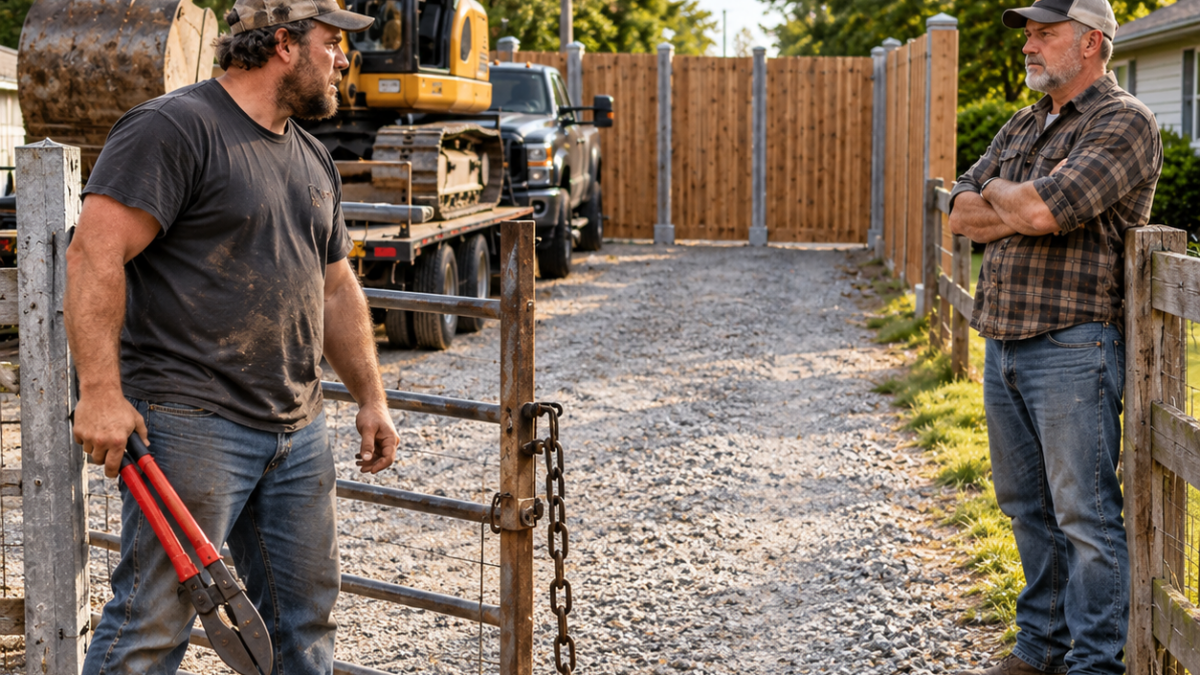
He cut the chain on my fence with bolt cutters and told me the eighteen-foot gravel corridor running along the east side of my property was basically shared access because he had used it for years.
What Greg forgot was that every one of those trips had happened because I allowed them, and when I checked the county records, had a real-estate attorney pull the title, and found no recorded easement at all, his convenient shortcut suddenly became a trespass problem instead of a neighborly arrangement.
So I replaced the flimsy boundary he thought he could ignore with an eight-foot timber fence stretching roughly 340 feet, documented every unauthorized crossing that followed, and thirty-one days after he cut my chain, Greg was signing papers admitting he had no legal right to the route he had treated like his own.
I had owned the property since 2012, after buying it from my uncle, who had run a small landscaping business there before retirement caught up with his knees.
I work industrial pipeline maintenance, so I am away from home for stretches at a time, and Greg knew that.
He owned a small excavation company on the neighboring property.
Years earlier, we had made a simple handshake agreement.
He could use my narrow gravel corridor to reach the back road when he needed it, and in return he would keep the gravel graded and leave the place in decent shape.
No contract.
No permanent right.
Just permission between neighbors who trusted each other.
For years, it worked.
Then one Tuesday morning, I came home and found the chain lying in the middle of my driveway.
Greg stood beside the cut fence holding bolt cutters like he had just finished an ordinary chore.
I asked what he was doing.
His answer was almost worse than the damage.
He said he had used the corridor for years, considered it basically shared access, and believed the fence was simply getting in the way.
I wanted to argue.
Instead, I picked up the chain and decided the records could settle what anger could not.
That afternoon, I pulled parcel information, title documents, easement records, and everything I had from the purchase.
I found nothing giving Greg or his company a recorded right to cross that strip.
Still, I did not trust my own interpretation alone.
I called real-estate attorney Melissa Grant and told her the complete history, including the fact that Greg had used the corridor with my permission for years.
She pulled the title and checked the records.
Clean title.
No recorded easement.
“What matters here,” she told me, “is what rights actually exist and what the records support, not what Greg has gotten used to doing.”
That sentence settled the issue for me.
I hired a licensed contractor.
Instead of replacing one chain, we built a permitted, inspected timber fence with concrete posts along the entire corridor.
Eight feet high.
Roughly 340 feet long.
Greg confronted me while the posts were going in.
“You’re seriously fencing the whole thing?”
“Show me the easement.”
He started talking about how he had always used the route.
“I know I let you use it.”
Then I asked again.
“Show me the document that says I had to.”
He could not.
I told him exactly why the old arrangement was over.
“You didn’t lose access because I woke up angry one morning.”
“You lost permission when you decided permission wasn’t necessary.”
Even after that, his equipment crossed my property three more times.
I photographed every crossing, recorded dates and times, and followed Melissa’s advice to keep everything organized.
Then we filed a civil claim for the fence Greg had destroyed—$2,200 in materials and labor—and sent a formal trespass notice.
The equipment stopped.
The fence was completed.
Then Melissa called.
Greg wanted to settle.
Thirty-one days after I found that cut chain, he agreed to pay the full $2,200, acknowledged in writing that no easement crossed my property, and accepted that his equipment had no legal access through the corridor.
But the part that finally made the whole dispute almost absurd came afterward.
I learned Greg had another perfectly usable road to the back of his property.
The route he had destroyed my fence to protect was not his only access.
It saved him about eight minutes.
And I was standing beside 340 feet of timber and concrete when I realized exactly how expensive those eight minutes had become.
[END OF FACEBOOK CAPTION]
[FIRST COMMENT / FULL STORY CONTINUATION]
Eight minutes.
That was the number that finally took most of the anger out of me.
Not because eight minutes excused anything.
It made the whole thing worse in one sense.
Greg had not cut through my fence because his business would be trapped without the corridor.
He had not been facing some emergency where his equipment had no way to reach the back of his property.
There was another road.
A perfectly usable one.
It was less convenient.
That was all.
Roughly eight extra minutes.
I stood beside the new timber fence and tried to absorb that.
Three hundred forty feet of fence.
Concrete posts.
Eight feet high.
Contractors.
Permits.
Inspection.
Property records.
Attorney calls.
Photographs.
Trespass documentation.
A $2,200 civil claim.
Thirty-one days of a neighbor dispute.
All because Greg apparently valued eight minutes of convenience more than the simple act of asking whether he still had permission to cross somebody else’s property.
When I thought of it that way, the whole situation became almost ridiculous.
Almost.
Then I would remember the chain.
That brought the seriousness back.
The first morning had started normally enough.
I came outside and saw metal lying in the driveway.
For a second, my mind did what minds do when reality looks too obvious.
It searched for a more complicated explanation.
Maybe something had happened.
Maybe there was an emergency.
Maybe somebody had needed to get through and could not reach me.
Then I saw Greg.
Bolt cutters in hand.
Standing beside the opening in my fence.
No emergency.
No apology.
No:
Hey, I tried calling you.
No:
We need to talk about access.
Just a man who had decided the boundary was interfering with him.
That was the moment everything changed.
Years earlier, when we made the arrangement, I never imagined I would need paperwork.
Greg had his excavation outfit next door.
I had the gravel corridor running down the east side of my property.
About eighteen feet wide.
Nothing impressive.
Not some scenic private road.
Not paved.
Just gravel.
Practical.
It connected conveniently toward the back road.
Greg occasionally needed to move equipment through.
The arrangement made sense.
He asked.
I said yes.
In return, he kept the gravel graded.
If his machines tore something up, he left it decent afterward.
That was how neighbors were supposed to work, at least in my mind.
You have something that can make another person’s life easier.
They respect that it belongs to you.
Nobody turns every favor into a legal instrument.
Sometimes a handshake is enough.
For years, ours was.
I think that was why the cut chain bothered me more than if some complete stranger had done it.
A stranger trespassing is simple.
They do not know you.
Maybe they do not know the property.
Maybe they are simply dishonest.
Greg knew exactly how the arrangement began.
He had benefited from it.
He knew the corridor was mine.
The original understanding only existed because I had allowed it.
Somewhere along the way, familiarity had erased that fact for him.
That was the real dispute.
Not gravel.
Not fencing.
Not even eight minutes.
Permission.
The more often I replayed our conversation, the more obvious it became.
He did not say:
I think your deed is wrong.
He did not present a survey.
He did not pull out an easement document.
He said he had used the corridor for years.
Therefore, in his mind, it had become basically shared access.
Basically.
That word was doing an enormous amount of work.
There is a big difference between something being convenient enough to feel shared and actually being legally shared.
That difference can be almost invisible while everyone behaves respectfully.
For years, Greg crossed.
I allowed it.
No conflict.
The moment he decided he could remove my fence to preserve his access, the difference became impossible to ignore.
I remember holding the broken chain and forcing myself not to argue.
I work industrial pipeline maintenance.
That kind of work teaches you one thing very quickly.
When something goes wrong, the worst time to make major decisions is while everyone is angry and standing beside broken equipment.
You secure the situation.
Figure out what actually happened.
Check records.
Then decide.
That habit probably saved me money.
Because as sure as I felt that Greg had no permanent access right, feelings are worthless against recorded property rights.
Maybe my uncle had signed something.
He had owned the place before me.
He had operated a small landscaping business there.
Maybe decades earlier he had granted an easement and simply never mentioned it.
Maybe there was something in the title I had skimmed past when I bought the property in 2012.
Maybe Greg knew about a document I did not.
That possibility irritated me, but ignoring it would have been stupid.
There is a version of this story where I immediately spend thousands building a wall, only to discover Greg actually has a recorded easement and I have built an expensive obstruction across it.
I did not want that version.
So I started with records.
Parcel information.
Title documents.
Recorded easements.
Purchase materials.
Anything tied to that strip.
Property documents have a special talent for making simple ideas sound as if they were written by people being paid by the syllable.
I read.
Then read again.
I kept coming back to the same result.
Nothing.
No recorded access easement for Greg.
Nothing giving his excavation company permanent rights over that corridor.
Nothing identifying my eighteen-foot strip as some shared route.
Still, I was not satisfied.
One of the easiest mistakes people make in property disputes is finding the answer they want and stopping.
I wanted someone who handled this professionally.
That was when Melissa Grant entered the story.
Real-estate attorney.
I told her everything.
Not the flattering version.
The complete version.
Greg had used the corridor for years.
I had knowingly allowed it.
There had been an arrangement.
He kept it graded.
I did not want Melissa hearing only:
My neighbor suddenly trespassed.
Because that was not the whole history.
If years of access created some legal issue, I wanted to know before I made things worse.
Melissa pulled the title.
Checked the relevant records.
Then called me.
Clean.
No recorded easement.
I asked the question that had been bothering me all day.
“So him using it all these years doesn’t automatically make it his road?”
She paused.
Then said the sentence I would keep coming back to.
“What matters here is what rights actually exist and what the records support, not what Greg has gotten used to doing.”
Gotten used to doing.
That was it.
Not what he owned.
Not what he had purchased.
Not what had been granted permanently.
What he had gotten used to doing.
Convenience had hardened into expectation.
Expectation had turned into entitlement.
Entitlement had eventually produced bolt cutters.
Once Melissa confirmed the title, I had another decision.
Repair the original fence.
Replace the chain.
Try to restore things to how they were.
That would have been cheaper.
It also would have required trusting Greg to respect the same kind of boundary he had just cut through.
I did not have that trust anymore.
The ambiguity had become the problem.
A chain and a gate say:
Access may be possible.
Ask.
An eight-foot timber fence says:
This is the line.
Considering Greg had already decided he could physically remove the first boundary, I wanted the second one to be unmistakable.
So I hired a licensed contractor.
I did not want some questionable weekend fence that Greg could later claim crossed the property line or violated something.
Permitted.
Inspected.
Built where it was supposed to be.
The full corridor.
Roughly 340 feet.
Concrete posts.
Heavy timber.
Eight feet high.
The first day the contractor walked the route, he noticed the cut chain.
He looked down.
Then looked at me.
“Neighbor problem?”
“Neighbor geometry problem.”
He laughed.
“Those usually cost more.”
He was right.
The first holes went in.
Then posts.
Concrete.
Timber.
Every evening the property line became more physical.
There is something strange about watching a legal concept turn into lumber.
Before the dispute, the boundary existed whether anyone could see it clearly or not.
The deed created it.
The title supported it.
The absence of an easement mattered.
The new fence did not create ownership.
It translated ownership into something nobody could casually pretend was uncertain.
Greg noticed.
Of course he did.
His business depended on moving equipment.
He had been using that route for years.
The posts changed his daily geography.
The first real conversation we had after construction began happened near the rear of the property.
I was checking the work.
Greg stood on his side.
He looked down the line of posts.
“You’re seriously fencing the whole thing?”
I knew he was angry.
Part of me was still angry too.
“That’s usually what people mean when they hire someone to build a fence.”
Not my most diplomatic sentence.
He did not appreciate it.
He started explaining what the corridor meant to his operation.
His machines had always gone through there.
Routing them around would take longer.
More fuel.
More inconvenience.
I listened.
And for a moment, I felt the old arrangement pulling at me.
This was exactly how we had ended up there.
His inconvenience.
My flexibility.
His business needs.
My property.
For years, that balance had worked because he recognized I was helping him.
Now the same inconvenience was being presented almost like a claim against me.
So I asked:
“Greg, show me the easement.”
His expression changed.
“You know we’ve always used that access.”
“I know I let you use it.”
“That’s what I’m saying.”
“No.”
Then I repeated it.
“Show me the document that says I had to.”
He did not have one.
He returned to history.
The arrangement.
How things had always worked.
How ridiculous it was to change everything.
That conversation made the philosophical difference crystal clear.
Greg was talking about precedent.
I was talking about permission.
He saw years of use as evidence that use should continue.
I saw years of use as evidence that I had been a cooperative neighbor.
Both stories used the exact same history.
Only one treated generosity as permanent surrender.
That was when I told him:
“You didn’t lose access because I woke up angry one morning.”
He stared at me.
“You lost permission when you decided permission wasn’t necessary.”
There was nothing else to explain.
Greg shook his head and walked away.
I wish that had ended it.
It did not.
His equipment crossed my land three more times after the dispute had already become clear.
That mattered.
If he had stopped once construction began, maybe we could still frame the whole thing as one terrible decision with bolt cutters.
Instead, the crossings continued.
By then Melissa had already advised me on documentation.
So I documented.
Photos.
Timestamps.
What equipment crossed.
Where.
When.
No dramatic confrontations.
No blocking heavy machinery with my truck.
No running outside yelling.
I had no interest in turning a property dispute into a physical argument around excavation equipment.
The camera did the work.
That is another lesson I took from pipeline work.
If something matters, record it while it is happening.
Memory becomes political almost instantly once people disagree.
One person says:
I never crossed.
Another:
You did.
Then:
It was only one time.
No, three.
It was Thursday.
No, Tuesday.
Photographs are boring.
Boring is useful.
They do not get embarrassed later.
They do not suddenly remember a more convenient version.
The first crossing after the dispute annoyed me.
The second changed my thinking.
The third removed any doubt that informal conversation was over.
At that point, Melissa and I moved forward.
Civil claim.
The original fence damage came to $2,200 in materials and labor.
That number mattered because I did not want some theatrical demand.
Not:
Pay me $50,000 because you disrespected me.
The actual cost.
$2,200.
Then formal trespass notice.
Written.
Clear.
Continued use was not authorized.
That changed the tone immediately.
No more equipment.
No more casual assumption that the corridor remained part of Greg’s operational routine.
For the first time in years, the gravel strip became quiet.
The contractor finished the timber fence.
I stood there on the final evening and ran my hand along one of the posts.
I remember feeling disappointed more than satisfied.
That surprised me.
I had gotten what I wanted.
Boundary secured.
Title confirmed.
Equipment stopped.
Yet looking down the fence line, all I could think was:
This was unnecessary.
Every post represented a conversation Greg could have had instead.
The old arrangement had cost almost nothing.
A little courtesy.
A little maintenance.
Basic respect.
The new arrangement cost concrete, timber, attorney correspondence, and a relationship with the man next door.
I would have preferred the handshake.
I still believe that.
People sometimes hear a story like this and assume I had been waiting for an excuse to wall Greg out.
No.
The corridor had been useful for him.
Letting him use it had not hurt me when he treated it respectfully.
If he had knocked on the door that Tuesday morning and said:
This chain is making it difficult to get the equipment through.
Can we change the gate?
There is a very good chance we would have changed the gate.
Maybe widened something.
Maybe established times.
Maybe I would have continued letting him cross exactly as before.
That is the frustrating part.
Greg did not lose access because access itself was impossible.
He lost it because he acted as though I no longer had any say.
The bolt cutters communicated something more clearly than words.
Your permission is no longer relevant.
Once somebody says that through action, going back to a handshake becomes difficult.
The relationship underneath the handshake has already changed.
Then Melissa called.
“Greg wants to settle.”
I did not feel relieved immediately.
I felt suspicious.
By then, thirty days of a simple dispute had conditioned me to expect another complication.
“What does he want?”
She explained.
The terms were straightforward.
Thirty-one days after he cut my chain, the matter settled.
He paid the $2,200.
Full amount for the fence he destroyed.
He signed an acknowledgment confirming there was no easement across my property.
He agreed his equipment had no legal access through the corridor.
No courtroom.
No judge.
No dramatic testimony.
No sheriff standing at the property line.
No giant award.
Paperwork.
Payment.
Acknowledgment.
Done.
Honestly, that was better.
A courtroom would have made the story more dramatic.
It would not have made the boundary more real.
Greg signing that acknowledgment did exactly what I needed.
The uncertainty disappeared.
The argument about whether the corridor was “basically shared” ended in writing.
It was not.
What we had was permission.
Permission had ended.
That should have been the end of the emotional story too.
Then I learned about the other road.
Eight minutes.
I had assumed the alternative route must be awful.
Maybe narrow.
Maybe impractical for equipment.
Maybe miles out of the way.
I knew another way existed generally, but I had never paid much attention to his exact routing because it was not my business.
Then I found out the difference.
About eight minutes.
That was what the corridor saved.
I stood beside the fence laughing.
Not a big laugh.
More the kind that comes when frustration crosses over into absurdity.
Greg had destroyed a fence to save eight minutes.
Kept crossing after being told access was not authorized.
Forced a title review.
Brought an attorney into the situation.
Paid $2,200.
Signed away any claimed access.
Lost the shortcut permanently.
Eight minutes.
A few weeks earlier, one conversation might have preserved the whole arrangement.
Now every piece of his equipment took the longer road.
I started seeing them occasionally.
A machine moving along the alternate route.
No wave.
No conversation.
Greg did not wave either.
That became our relationship.
Two men on neighboring properties going about separate days.
There is something sad about that.
Not tragic.
Nobody died.
Nobody lost a home.
Nothing dramatic like that.
Just a functional neighbor relationship reduced to silence.
Sometimes small losses tell you more about conflict than big ones.
Before the fence, Greg and I could wave.
Coordinate.
Help each other.
Afterward, the boundary became not only physical but social.
Maybe that was unavoidable once the chain was cut.
I still think about the original handshake.
People sometimes say handshake agreements are foolish.
Put everything in writing.
Maybe they are right in important situations.
But I do not regret making the agreement.
For years, it worked.
That matters.
Not every informal arrangement eventually becomes a dispute.
Not every neighbor will exploit kindness.
The lesson I learned was more specific.
A handshake survives only while both people remember what the handshake means.
Ours meant:
I own this corridor.
You may use it.
You help maintain it.
The moment Greg mentally changed that to:
This corridor is part of my normal access and therefore cannot be closed,
we were no longer operating under the same agreement.
The words had not changed.
The expectation had.
That is how entitlement grows.
Rarely all at once.
Nobody wakes up thinking:
Today I will steal my neighbor’s property rights.
More often, inconvenience becomes routine.
Routine becomes expectation.
Expectation becomes something that feels deserved.
Then a boundary reappears.
Suddenly the person experiences the boundary as aggression.
Greg looked at my fence as if I had created a new problem for him.
From my perspective, he had created the problem by forgetting the fence marked property he used only with permission.
That difference explains nearly every conversation we had.
I did ask myself whether the years of access should have created some moral obligation, even if Melissa said there was no recorded easement.
He had built business routines around the corridor.
I knew that.
His equipment routes had adapted to my cooperation.
Was I being unfair to shut it down completely?
That question bothered me for a while.
Then I kept returning to the moment with the bolt cutters.
If Greg had relied on my permission and asked to preserve it, that reliance would have mattered to me.
He did not ask.
He cut the boundary.
Then told me the access was basically shared.
Those actions changed the moral equation.
Generosity creates a relationship.
Entitlement destroys one.
I was not willing to keep extending a favor after the person receiving it announced that my consent no longer mattered.
That would not have been generosity anymore.
It would have been submission.
The eight-foot fence prevented that ambiguity from returning.
Some people will say the fence itself was excessive.
Eight feet.
Three hundred forty feet.
Timber.
Concrete posts.
Why not just another chain?
Fair question.
The answer is that the original light barrier had depended on respect.
Once respect failed, I wanted something that did not.
A chain is technically enough to say:
Do not pass.
But Greg had already shown how he viewed chains.
Bolt cutters.
Thirty seconds.
Problem solved.
The timber fence was not revenge architecture.
It was finality.
No one would mistake it for a gate temporarily closed.
No equipment operator would claim they thought access remained open.
No argument about whether somebody believed the corridor was shared.
There was a wall of timber.
Property line.
End of discussion.
I made sure it was permitted and inspected precisely because I did not want Greg having legitimate grounds to challenge it.
That mattered.
Retaliation encourages shortcuts.
You are angry.
You build quickly.
Then your own work creates legal problems.
I did not want revenge badly enough to become careless.
Contractor.
Permit.
Correct location.
Inspection.
Do it once.
Do it right.
That discipline cost more initially.
It also helped end the argument.
When Greg saw those posts, he understood I was not going to keep renegotiating whether the corridor belonged to me.
I think Melissa understood something before I did.
The dispute had stopped being about what Greg believed.
It was about creating a record.
Clean title.
No recorded easement.
Formal notice.
Documented crossings.
Settlement acknowledgment.
That chain of records protected both the property and the future.
Imagine selling the property later with a vague ongoing dispute.
New owner asks:
Does the excavation company have access?
Well, not technically.
But he used it for years.
Then there was a fight.
Maybe.
Maybe not.
That ambiguity would follow the land.
Instead, the settlement clarified it.
No easement.
No legal access.
That is useful beyond my anger.
Property should not inherit unresolved neighbor stories if you can resolve them cleanly.
That was another reason the written acknowledgment mattered more than an apology would have.
Greg never gave me some emotional apology in the source.
I did not get:
I was wrong.
I should never have cut your fence.
I took advantage of you.
Maybe people expect that scene.
Real life does not always provide it.
I did not need it.
He paid the $2,200.
He signed the acknowledgment.
He stopped crossing.
Behavior changed.
That was enough.
Words would have been nice.
Paper was more useful.
The strange thing is that I did not hate Greg afterward.
We just stopped having a relationship.
I would see a machine on the longer route.
For a while I imagined what he thought each time.
Eight more minutes.
Does he regret it?
Does he blame me?
Does he still believe I overreacted?
Eventually I stopped caring.
The source never tells us whether Greg genuinely believed he had acquired some permanent right or simply assumed I would never push back.
I cannot know either.
Maybe he had convinced himself.
Human beings are very good at turning habit into justification.
Maybe he knew the corridor was mine and thought cutting the chain would establish a new normal before I objected.
Both possibilities lead to the same result.
He had no recorded easement.
I withdrew permission.
The fence stayed.
Sometimes motives matter less than boundaries.
I did not need to prove what Greg felt in his heart.
I needed to establish what he could legally do on my land.
That was much simpler.
The dispute also changed how I think about favors generally.
Not in a cynical way.
I still believe neighbors should help each other.
I would hate living somewhere every small act required a contract.
Can I borrow your trailer?
Sign here.
Can I turn around in your driveway?
Please consult counsel.
That would be miserable.
Community depends on informal generosity.
But generosity needs memory.
Both sides need to remember where the favor originates.
If somebody lets you use something, gratitude is not required forever.
Respect is.
Ask before changing the arrangement.
Do not damage what belongs to them.
Do not tell them their permission became irrelevant because they have been generous for too long.
That principle extends far beyond property.
People lend tools.
Share parking.
Let neighbors use trails.
Give employees flexibility.
Help family members.
Allow habits to develop.
Most of those relationships function because everyone understands the difference between:
You may.
And:
You are entitled to.
Greg blurred that line.
The fence made it visible again.
There is a phrase in the source I kept thinking about:
The fence did not create my right to say no.
It just made the answer harder to ignore.
Exactly.
People see fences and think fences create boundaries.
Legally, the boundary existed without the fence.
Socially, the boundary existed in the original handshake.
The fence was physical punctuation.
That is why cutting the first chain had not changed anything legally.
Greg could cut metal.
He could not cut ownership.
He could drive equipment through.
He could not create an easement through motion alone just because he believed the route should remain convenient.
That was the key distinction Melissa helped me confirm.
I am glad I checked before acting.
Had Melissa found an easement, I would have needed to accept that result.
That is important to admit.
It would have been embarrassing.
I would have been angry at my uncle for not making the issue clearer.
Maybe angry at myself for missing it.
But records decide things we may not like.
You cannot demand documentation only when documentation agrees with you.
That is why I started with the answer before satisfaction.
I wanted to know.
Then act.
Not act.
Then search for justification.
That approach made everything afterward much easier to defend.
Clean title.
No easement.
The new fence was not a gamble.
It was a boundary improvement on my own land.
The crossings afterward were not ambiguous permission.
Formal notice ended that.
The $2,200 claim was not punishment.
It matched damage.
Settlement was not surrender.
It confirmed the facts.
That is what a clean dispute resolution looks like.
Not necessarily friendly.
Clear.
I wish Greg and I could have reached clarity without destroying the friendship-like cooperation we had.
Maybe that is the only part I genuinely regret.
Not building the fence.
Not enforcing the boundary.
Regret that he made those things necessary.
People sometimes say:
You could have given him one more chance.
Perhaps.
But what does one more chance look like after someone cuts your fence?
Do I repair it and say:
Please do not do that again?
What if he cuts it again?
At what point does continued accommodation teach the wrong lesson?
There is no universal answer.
For me, the bolt cutters were the line.
Before bolt cutters, we had a neighbor disagreement waiting to happen.
After bolt cutters, we had a property dispute.
I responded accordingly.
The three later crossings reinforced that decision.
Had he immediately stopped and apologized, maybe my feelings would have changed.
He did not.
That matters when people judge the eight-foot fence as overreaction.
The fence was not built after one awkward conversation.
It came after physical removal of the existing barrier and a claim of shared access.
Then the equipment continued crossing even after the issue was disputed.
Context matters.
By the time the formal trespass notice arrived, nobody could reasonably pretend the route remained a casual neighbor favor.
The silence afterward told me Greg understood.
No more equipment.
No more confrontations.
The contractor finished.
Then settlement.
Thirty-one days.
It is remarkable how much can change in a month.
Day one:
Handshake history.
Cut chain.
Bolt cutters.
Day thirty-one:
Eight-foot fence.
Attorney.
Payment.
Written acknowledgment.
Alternate road.
Silence.
A relationship that took years to build changed in weeks because entitlement can destroy trust much faster than generosity creates it.
That is perhaps the saddest lesson.
Trust accumulates slowly.
One wave.
One favor.
One machine passing through and leaving the gravel smooth.
Another.
Years.
Then one morning somebody decides asking is unnecessary.
Cut.
The physical chain took seconds.
The relationship went with it.
I picked that broken chain up on the first morning.
I kept thinking about the clean cut.
It was only metal.
A cheap object relative to everything that followed.
But it represented the entire transition.
Before:
Permission.
After:
Enforcement.
Before:
Handshake.
After:
Attorney.
Before:
Wave.
After:
No wave.
Greg probably thought he was solving a small practical problem.
Fence in the way.
Cut fence.
Access restored.
Instead, he converted a privilege he enjoyed for free into a route he would never use again.
That is the strange logic of entitlement.
It grabs harder and ends up with less.
If he had respected my right to say no, I likely would have continued saying yes.
Because he acted as if I could not say no, I finally did.
Permanently.
That is why I never saw the settlement as victory over him.
It was restoration of choice.
My land.
My decision.
If someday I choose to open another access point for somebody else, that will be my decision too.
The fence is not a declaration that nobody can ever cross.
It is a reminder that crossing requires permission.
That is all boundaries really do.
They define where agreement begins.
I also thought about my uncle during the dispute.
He had run the landscaping operation there for years.
The property had practical character.
Equipment.
Gravel.
Work.
It was not some manicured estate where nobody ever crossed a line.
Maybe that was part of why I had been comfortable giving Greg access.
The corridor felt made for practical use.
But a useful strip of land is still owned land.
Utility does not erase title.
That is another subtle thing people get wrong.
If a route looks like a road, they start treating it like public infrastructure.
If vehicles have traveled it for years, they assume somebody must have a right.
Appearance is not a title search.
That is why Melissa’s work mattered.
The county records did not care that Greg’s excavators had made the route look permanent.
Nothing recorded gave him the access he claimed.
The physical world can create misleading impressions.
Paper clarifies.
My industrial work had taught me something similar with pipeline rights-of-way.
Land can look open and still carry precise rights.
Someone may own the surface.
Another entity may have specific access.
Restrictions may be recorded.
Use is not the same as ownership.
Ownership is not always the same as unrestricted control.
That complexity is exactly why I did not pretend I knew the legal answer before checking.
In my situation, the records were clear enough.
No easement.
That simplicity was a gift.
The emotional part was harder.
Greg’s argument about his business was not fake.
Eight minutes is eight minutes.
Multiply that across trips.
Fuel.
Employee time.
Machine operating cost.
I understood why the shortcut was valuable.
That was precisely why I had allowed it.
A favor is useful because it provides value.
If it provided nothing, it would not be a favor.
The fact that losing the corridor cost Greg time did not prove I owed it to him.
That is the logic I had to reject.
Benefit does not create ownership by itself.
His business had incorporated a benefit I provided.
When he decided he could preserve that benefit by forcefully removing my boundary, the arrangement ended.
Could we have negotiated compensation?
Maybe.
Could he have offered to formalize an easement?
Possibly.
None of that happened in the source.
What happened was bolt cutters first.
That sequence closed doors that a conversation might have opened.
I think about that whenever somebody says legal conflicts are caused by stubborn people.
Sometimes yes.
Sometimes the conflict is caused by skipping the conversation that could have prevented the legal conflict.
Greg skipped it.
By the time Melissa became involved, we were not negotiating whether the route was useful.
We were documenting whether he had a right.
Different conversation.
Much less flexible.
That is why courtesy has economic value.
One respectful conversation might have saved thousands.
Instead, the licensed contractor had a job.
Melissa had a client.
Greg had a settlement bill.
I had a 340-foot fence I had never originally planned to buy.
Nobody came out economically ahead.
The fence did give me certainty.
I value that.
But if someone asked whether I would rather have spent that money or kept the old arrangement with mutual respect, I would choose the old arrangement.
That is another reason I do not call this revenge.
Revenge implies I wanted the expensive outcome because it hurt Greg.
I did not.
I wanted my boundary respected.
Once it was not, the expensive outcome became the reliable way to restore that respect.
There is a difference.
The settlement itself was almost anticlimactic.
Melissa called.
Terms.
Paperwork.
Payment.
Signature.
No dramatic meeting between Greg and me.
No apology speech.
No handshake restoration.
Maybe that was appropriate.
The original handshake could not be restored by another handshake.
The entire dispute had been about Greg treating informal permission as if it had transformed into permanent entitlement.
Ending it formally made sense.
The written acknowledgment replaced ambiguity.
No easement.
No access.
Done.
I imagine some people would have demanded more than $2,200.
Punitive amount.
Lost time.
Attorney aggravation.
Emotional stress.
That is not what the source says happened.
The claim was for the destroyed fence.
$2,200.
That was enough.
Keeping the remedy tied to actual damage helped keep the dispute from becoming something uglier.
I did not need to destroy Greg’s business.
I needed him off my corridor.
Once that happened, the conflict could stop.
That restraint mattered to me.
Neighbors do not disappear after disputes.
Greg’s property still exists next door.
Mine still exists.
We still occupy the same geography.
Scorched-earth legal war would have made every future day more unpleasant.
The fence gave separation.
Settlement gave closure.
Silence gave peace.
Not friendship.
Peace.
There is value in knowing the difference.
Sometimes reconciliation is not the goal.
Sometimes the healthiest ending is:
You stay there.
I stay here.
We know the line.
That is where Greg and I ended.
One of his machines goes the longer route.
I see it occasionally.
He sees me occasionally.
No gestures.
No words.
The route adds eight minutes.
My corridor stays unused by his business.
The timber fence weathers slowly.
Concrete stays where it was poured.
Life moves on.
There is no ongoing courtroom drama because there never was a courtroom drama in the first place.
That matters.
Stories often inflate property disputes into endless lawsuits.
Ours was resolved in thirty-one days.
Attorney involvement, yes.
Civil claim, yes.
Formal notice, yes.
Settlement, yes.
But no gavel.
No jury.
No police standoff.
No judge awarding some fantasy amount.
Just records doing what records are supposed to do.
That outcome is actually more satisfying to me.
I did not need spectacle.
I needed clarity.
Melissa gave me that early when she confirmed the title.
Greg gave me that at the end when he acknowledged the same thing in writing.
Everything between those two points was the cost of getting there.
When I tell people the story now, the eight-minute detail usually gets the biggest reaction.
They laugh.
Or shake their heads.
Eight minutes?
Yes.
Then someone will say:
Surely there was more to it.
Maybe emotionally there was.
Habit.
Pride.
Control.
Nobody likes having a routine changed.
But I will not invent motives Greg never confessed.
The concrete fact is simple.
Another route existed.
It added roughly eight minutes.
That is what the source gives us.
That is enough to show the conflict was never about literal necessity.
It was about convenience becoming expectation.
That is why the corrected title matters too.
I did not wall off Greg’s “only access road.”
That would turn the story into something it was not.
I walled off his shortcut.
He could still reach the back of his property.
The longer road remained.
His business continued.
That makes my decision easier to understand and harder to sensationalize.
The consequences were real without exaggeration.
Sometimes the true version is stronger.
A man risked a neighbor relationship, cut a fence, paid $2,200, and permanently lost a useful shortcut over eight minutes.
You do not need to pretend he was landlocked.
The absurdity already exists.
I think that is one reason my anger faded after I learned about the alternate road.
Before that, Greg’s behavior felt threatening.
Like maybe he truly believed his business depended on my land and would keep fighting indefinitely.
Once I understood the reroute, the threat became smaller.
The entitlement looked larger.
He had options.
He simply preferred mine.
That is a useful distinction.
A person needing help and a person preferring convenience may ask for the same favor.
You can still help both.
But only one can plausibly claim hardship if you stop.
Greg’s hardship was eight minutes.
The fence stayed.
I sometimes think of the contractor’s joke.
“Neighbor geometry problem.”
Those usually cost more.
He was right in ways neither of us probably intended.
Geometry seems objective.
A line is a line.
But humans are remarkably creative about boundaries when a line interferes with something convenient.
For Greg, the corridor had become psychologically part of his route.
For me, it remained part of my parcel.
Both facts coexisted until the day he cut the chain.
Then geometry had to become explicit.
Timber and concrete did the translation.
There are probably people who would have handled it more softly.
One more sit-down.
A written access agreement.
A fee.
A new gate.
Maybe those outcomes could have worked.
I do not judge them.
I only know what the bolt cutters meant to me.
He did not approach me as someone asking to renegotiate a favor.
He approached the boundary as an obstacle he had authority to remove.
That destroyed the trust necessary for another informal solution.
When trust disappears, formal structure takes its place.
That is what the fence was.
Formal structure.
That is what Melissa’s letters were.
Formal structure.
That is what the settlement acknowledgment was.
Formal structure.
It is less warm than a handshake.
It is also less dependent on goodwill.
I wish goodwill had survived.
It did not.
The experience also taught me not to confuse being accommodating with being obligated to remain accommodating forever.
People who are naturally cooperative can fall into that trap.
You say yes five times.
The sixth no feels cruel.
Why?
The other person has built an expectation from your yeses.
Then you start managing their disappointment instead of your own boundaries.
Greg accelerated that process by taking the decision away from me physically.
That made my response easier.
No.
Not because no was fun.
Because yes only means something when no remains possible.
If a person cannot withdraw permission, it is not permission.
It is an obligation.
I had never agreed to one.
The title confirmed that.
The settlement confirmed it again.
I am glad I did not lose that principle simply because preserving it was inconvenient.
Sometimes people call boundaries selfish.
They can be.
Anything can be used selfishly.
But a clear boundary can also preserve relationships by preventing resentment.
Our original arrangement had a clear invisible boundary:
Ask.
Respect.
Maintain.
It worked until Greg stopped honoring it.
The physical fence arrived after the social boundary failed.
That sequence matters.
I did not begin with a wall.
I began with trust.
The wall was the consequence of trust no longer being enough.
There is a broader lesson there that has nothing to do with land.
People often resent visible boundaries without asking what happened before they became necessary.
Why is there a lock now?
Why is everything documented?
Why does this person insist on written approval?
Sometimes because someone previously treated flexibility like weakness.
That was me after Greg.
More careful.
Not meaner.
If another neighbor needed a one-time favor, I would still help.
But long-term access across property?
I would think differently.
Not necessarily say no.
Document the terms.
Clarify that permission remains permission.
Make sure both sides understand.
That is not paranoia.
It is learning.
A handshake worked for years.
The lesson is not that handshakes are worthless.
The lesson is that some arrangements become important enough that memory should not carry the entire load.
If the access matters to somebody’s business, put it in writing.
Define what it is.
What it is not.
Who maintains it.
Whether it can end.
That protects both sides.
Greg would have known exactly what he had.
I would have known exactly what I owed.
No “basically shared” argument.
Clarity early is cheaper than clarity after bolt cutters.
That may be the most expensive lesson eight minutes ever taught either of us.
Sometimes when I stand near the fence now, I remember the original corridor before all this.
Open enough.
Quiet.
Gravel maintained because Greg’s equipment used it.
Nothing hostile about it.
The land itself did not change morally.
Same eighteen feet.
The meaning changed because of how two people treated it.
That is another strange thing about property.
Dirt has no opinion about ownership.
People create relationships around it.
Good ones.
Bad ones.
Generous ones.
Possessive ones.
The boundary exists in records.
Peace exists in behavior.
We had both until Greg decided one could replace the other.
It could not.
My uncle probably would have laughed at the whole situation.
The source does not tell me what he thought, so I cannot claim he predicted anything.
But I can imagine why he valued practical arrangements when he ran the landscaping operation.
Equipment needs room.
Work gets done faster when neighbors cooperate.
That background probably influenced me.
I never saw the corridor as sacred ground.
It was useful land.
That made Greg’s decision even more unnecessary.
I was not someone refusing all access out of principle.
I had already been saying yes for years.
He cut off his own cooperation.
That irony remains.
If somebody asks me whether I regret building the fence, the answer is no.
Do I regret the outcome?
Parts of it.
I regret that a good arrangement ended.
I regret paying for 340 feet of fence because another adult could not ask.
I regret losing a neighborly relationship.
But once the chain was cut and the crossings continued, I do not regret making the boundary permanent.
The fence did what it needed to do.
No more arguments.
No more equipment.
No future assumption.
It stands there quietly.
That is exactly how boundaries should work.
You should not have to defend them every morning.
The settlement let me stop thinking about Greg.
That may have been the greatest benefit.
During the thirty-one days, every engine sound made me look toward the corridor.
Is that his equipment?
Another crossing?
Do I need another photograph?
The dispute occupied more mental space than eighteen feet of gravel deserved.
Once the agreement was signed, that stopped.
I could go back to work.
Leave town for pipeline jobs.
Come home without wondering whether someone had cut another chain.
The timber fence did not require trust.
For someone who is away for stretches, that mattered.
Greg knew my work schedule from the beginning.
I do not claim he deliberately chose a day because I was often gone.
The source does not support that.
What it does tell us is that everybody knew my truck disappeared for periods.
That made reliable boundaries more valuable after trust failed.
I needed to know my property would look the same when I returned.
The new fence gave me that certainty.
There is comfort in a boring fence.
Most days I do not think about it.
It is just timber.
That is progress.
Objects involved in disputes carry emotional weight for a while.
Eventually they become objects again.
The chain was anger.
The posts were determination.
The completed fence was finality.
Now it is fencing.
Weathered.
Functional.
That is how you know a conflict is actually over.
When the symbol stops dominating your thoughts.
Greg’s alternate road became ordinary too.
Equipment takes it.
Nothing happens.
Eight minutes added.
Business continues.
No catastrophe.
That reality reinforces something important.
My decision did not destroy his livelihood.
It removed a convenience.
Again, I do not minimize the operational cost.
Time and fuel matter.
But the alternative existed.
That made the settlement practical.
We could separate permanently without trapping him.
I am glad of that.
I wanted him to respect my boundary.
I did not want to ruin him.
There is a difference between consequence and destruction.
The consequence matched the action.
He cut my fence.
Paid for it.
Claimed access.
Acknowledged no easement.
Continued crossing.
Formal notice ended it.
Shortcut lost.
That proportionality is why I can look back without feeling like revenge consumed the story.
Had I tried to shut down his business entirely, I would have become something else.
I did not.
The route remained.
Just not mine.
I keep returning to one sentence because it summarizes everything.
“You didn’t lose access because I woke up angry one morning.”
That was true.
I had been letting him through for years.
“You lost permission when you decided permission wasn’t necessary.”
That was the turning point.
Permission can survive inconvenience.
It cannot survive being declared irrelevant by the person receiving it.
Once that happened, the arrangement was already dead.
The fence simply marked the burial site.
Maybe that sounds dramatic.
But relationships operate on mutual recognition.
I recognized Greg’s need.
For years, he recognized my ownership.
When he stopped doing that, the exchange became one-sided.
No arrangement can survive one person believing the other’s consent is optional.
That is why the title of this story could never really be about an access road.
It is about the word “allowed.”
Greg was allowed.
Then he began behaving as if he possessed.
The difference cost him.
I was generous.
Then I was told my generosity had become compulsory.
The difference cost me too.
That is the real price of entitlement.
It damages both sides.
If there is one thing I would do differently, it would be documenting the original arrangement from the beginning.
Not because I distrusted Greg then.
Precisely because I did trust him.
Clear agreements protect good relationships.
A one-page document could have said:
Owner permits revocable access through corridor.
Greg maintains gravel.
No easement created.
Permission may be withdrawn.
Maybe nothing would have changed emotionally.
Maybe Greg still cuts the chain years later.
But there would have been less room for the phrase:
Basically shared.
Still, hindsight is cheap.
At the time, two neighbors shook hands.
It worked.
That is not foolish.
It is human.
We only learn which informal agreements needed paperwork after something breaks.
In my case, literally.
A chain.
Twenty-dollar bolt cutters.
A $2,200 settlement.
Three hundred forty feet of timber.
Eight extra minutes.
Those numbers tell the whole story better than anger does.
Sometimes people lose perspective because the physical stakes seem small.
Eighteen feet.
Gravel.
What is the big deal?
The big deal is decision-making.
Who decides what happens on privately owned land?
I did not object because Greg’s tires touched sacred gravel.
I objected because he physically removed my fence to make that decision for me.
If I accepted that, the boundary would mean nothing whenever it became inconvenient to him.
That was not a precedent I was willing to establish.
Ironically, Greg was the one arguing from precedent.
Years of use.
I understood.
But precedent without a right is still just history.
Melissa’s title review gave me the legal certainty I needed.
I did not need to debate philosophy forever.
The record settled the practical issue.
That is one thing I appreciate about property law even when the documents are painful to read.
At some point, philosophy meets a line on paper.
This parcel.
That easement.
This owner.
These rights.
It gives disputes somewhere to stop.
Our dispute stopped there.
No recorded easement.
I could say no.
Greg eventually signed that acknowledgment himself.
The fact that he settled after thirty-one days suggests formal clarity worked better than another month of driveway arguments ever would have.
I do not know what Greg tells people about me.
Maybe:
My crazy neighbor built an eight-foot wall because I used a road I had used forever.
Maybe he tells the complete story.
Probably somewhere in between.
I cannot control that.
That is another kind of boundary.
His story belongs to him.
The record belongs to both of us.
No easement.
$2,200.
No access.
I am comfortable with the record.
You do not need everyone to agree with your version when the issue has been resolved clearly enough that behavior changes.
That is peace.
Not consensus.
The fence taught me that too.
People often chase acknowledgment.
Admit you were wrong.
Say I was right.
Apologize properly.
Sometimes that matters emotionally.
Sometimes it keeps you tied to the conflict longer.
Greg did not need to validate my feelings.
He needed to stay off my land.
He does.
That is enough.
I would still choose cooperation over attorneys if I could rewind.
But cooperation cannot be unilateral.
One person cannot cooperate while the other cuts through the boundary.
That is not cooperation.
So yes, I would build the fence again under the same circumstances.
Maybe some people would offer one final chance.
I understand.
Maybe it would work for them.
I had already given years of chances in the form of trust.
The first explicit challenge to that trust came with bolt cutters.
That was enough for me.
The fence remains exactly where it was built.
Greg uses the other road.
His equipment takes roughly eight extra minutes.
I work my jobs.
Come home.
Life goes on.
Every once in a while, one of his machines passes where I can see it.
We do not wave.
I do not feel triumphant.
I mostly feel the strange distance between how simple things were and how complicated one bad decision made them.
A handshake had managed the corridor for years.
Once respect disappeared, it took lawyers, records, permits, concrete, timber, photographs, and signatures to replace what the handshake used to do for free.
That may be the biggest lesson.
Legal structure can protect a boundary.
It cannot manufacture trust after trust is gone.
That is why the new fence is stronger than the old chain but the old arrangement was better than the new fence.
The arrangement required two people behaving decently.
The fence requires nothing.
It just stands.
Maybe that is why I still look at favors differently.
I do not want to stop giving them.
I just pay closer attention to whether the person receiving one remembers it is a favor.
Generosity is one of the things that makes neighbors worth having.
Entitlement is one of the things that turns neighbors into property disputes.
The difference can be as small as asking before acting.
Greg had one easy option that Tuesday morning.
Knock.
Call.
Wait until I was home.
“Can we talk about the gate?”
That conversation might have lasted ten minutes.
Maybe less.
Instead, he chose bolt cutters to save eight minutes.
Thirty-one days later, he had lost the route forever.
And the timber fence stretching 340 feet along my property still says the same thing the old chain said before he cut it.
This land has a boundary.
The boundary was always there.
My kindness never erased it.
My silence never transferred it.
His convenience never created an easement.
And the right to say yes always included the right to finally say no.