They crossed a bent gate on my forty-acre ranch while I was gone for six days and cleared two full acres of mature white oak and hickory, cutting roughly sixty yards inside my property as if the land had already been approved for somebody else’s project.
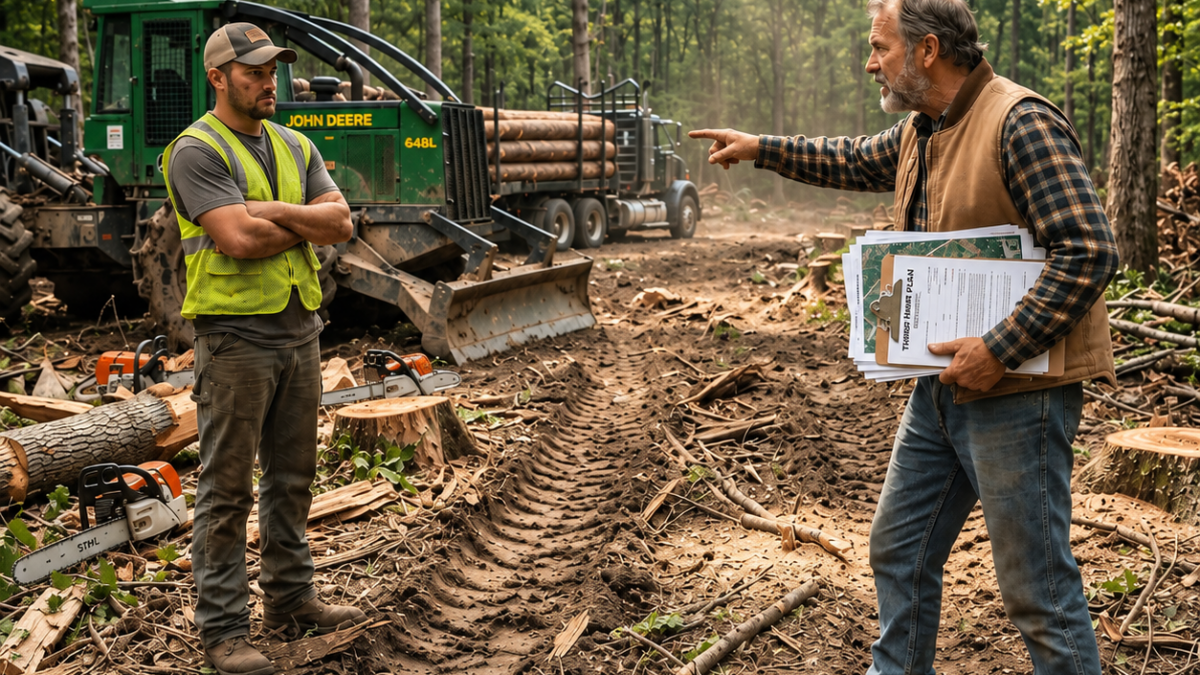
They crossed a bent gate on my forty-acre ranch while I was gone for six days and cleared two full acres of mature white oak and hickory, cutting roughly sixty yards inside my property as if the land had already been approved for somebody else’s project.
The clearing company left behind a business card saying they were “happy to discuss any concerns,” but the timber cruiser I hired the next morning told me the standing value of those seventy- to eighty-year-old trees was already pushing into six figures before restoration, legal damages, or ecological loss were even counted.
So I stopped treating the destruction like a neighborly mistake, documented every stump, brought in the sheriff, the state forestry commission, and attorney Leonard Pike, and demanded that both the clearing company and developer Marcus Webb pay based on the actual mature value of what they had taken, not the price of a few replacement saplings.
I had been gone six days at an agricultural equipment expo in Tennessee.
When I came home to my forty acres on the northern edge of Caldwell Parish, the first thing that felt wrong was the silence.
No birds in the oak canopy.
No wind moving through the trees.
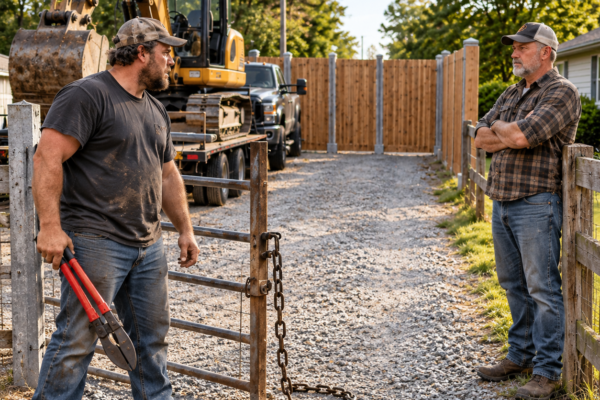
Then I reached the gate.
The latch was bent, and a white card had been wedged into it.
Premier Land Clearing Solutions.
Licensed and insured.
Happy to discuss any concerns.
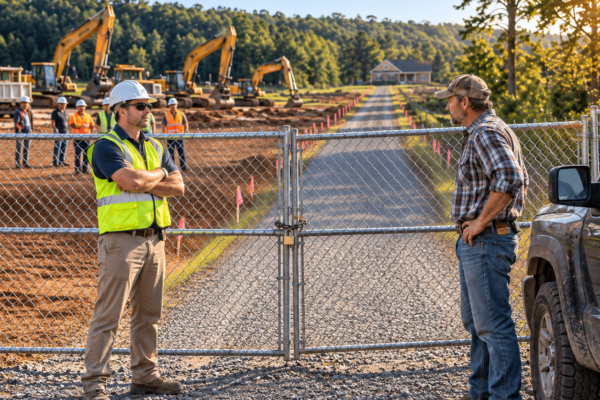
I looked past the fence.
The forest was gone.
Not thinned.
Not selectively harvested.
Gone.
Two acres of mature hardwood had been wiped clean.
White oak.
Hickory.
Trees seventy or eighty years old.
Fresh stumps still pale with sap.
Deep equipment tracks cut through what had been forest floor.
Sawdust lay in piles.
Branches were scattered everywhere.
The clearing continued roughly sixty yards inside my property before stopping along a sharp, deliberate line.
Then I found survey flags.
That was when I understood this was not one crew drifting across a boundary.
Somebody had mapped this.
Somebody believed the cut belonged there.
The next morning, I called a timber cruiser I trusted.
He walked the perimeter, counted, measured, and calculated.
Then he looked at me.
“You didn’t just lose trees.”
“You lost serious value.”
Standing timber alone was pushing into six figures.
That was before reforestation, soil damage, legal loss, or ecological restoration.
I started building a timeline.
Photos.
Timestamps.
Tire tracks.
Fence damage.
Survey flags.
Stump locations.
Then I drove into town and put everything on attorney Leonard Pike’s desk.
He studied the photographs and told me the problem was bigger than trespass.
Someone had entered my land under a chain of supposed authorization.
By the end of that day, three things were moving.
A timber-theft complaint with the county sheriff.
A civil property-destruction suit against both the clearing company and the developer.
And a formal forensic timber appraisal.
I also contacted the state forestry commission because I wanted an official record no one could later reinterpret.
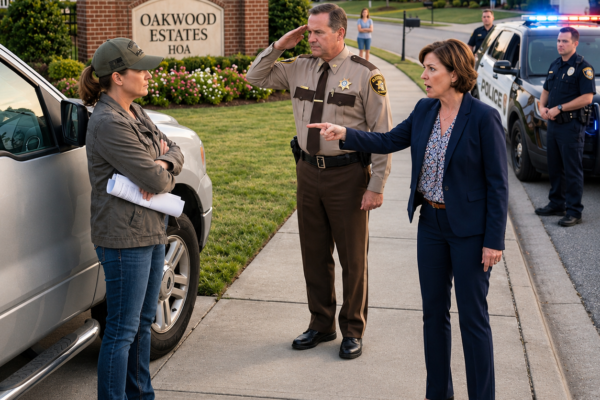
Within forty-eight hours, deputies and a forestry agent were walking the cut line, measuring stump diameters and documenting the destruction.
Then developer Marcus Webb arrived with his attorney.
He called it a misunderstanding involving survey stakes.
“Sixty yards inside a locked fence line isn’t a misunderstanding,” I told him.
“That’s a choice.”
His attorney tried to push responsibility onto the clearing company.
Then Leonard arrived carrying a folder.
Inside were signed documents tying Premier Land Clearing Solutions directly to Marcus Webb’s development plan.
The forestry agent formally recorded the site as a timber-loss incident with confirmed trespass indicators.
Then local news obtained drone footage.
From above, the image was brutal.
My cleared forest on one side.
Marcus’s expanding development on the other.
Once that footage aired, both sides suddenly became much more interested in settlement.
Leonard refused to let either side reduce the case to a surveying mistake, because the authorization chain, the measured encroachment, and the condition of the site were already documented.
I told him I wanted full legal costs covered, real ecological restoration, soil remediation, and mature transplanted stock wherever practical instead of decorative rows of young trees.
But I was not interested in being paid for a few saplings.
I wanted the actual mature value of what had been removed.
And I wanted a boundary strong enough that nobody could ever call the next sixty yards a misunderstanding again.
[END OF FACEBOOK CAPTION]
[FIRST COMMENT / FULL STORY CONTINUATION]
Leonard looked at me for a long moment after I said that.
Then he closed the folder.
“Good.”
That was all.
No speech about revenge.
No dramatic promise that we were going to destroy Marcus Webb.
No fantasy number scribbled onto a legal pad.
Leonard Pike was too experienced for that.
He had already told me what kind of case he believed we were dealing with.
Not merely trespass.
Liability allocation gone wrong.
That phrase had irritated me the first time I heard it because it sounded too clinical for what I had seen.
Two acres of forest were gone.
White oak and hickory that had taken seventy or eighty years to become what they were had been reduced to stumps in less time than I had been away at an equipment expo.
To me, that felt personal.
To Leonard, personal feelings were only one layer.
The legal problem was a chain.
Who planned the clearing?
Who marked the ground?
Who authorized the work?
Who relied on which survey?
Who entered the property?
Who cut the trees?
Who benefited from the land being cleared?
Who had insurance?
Who had documents?
And most importantly, who was going to try to point at somebody else once the value of those trees became real?
That was why Leonard had insisted on the forensic timber appraisal immediately.
He did not want Marcus Webb’s attorney deciding the trees were worth whatever a truckload of young nursery stock happened to cost.
He did not want Premier Land Clearing Solutions reducing mature white oak and hickory to a generic per-acre clearing number.
He wanted the loss measured.
Species.
Age.
Diameter.
Standing value.
Growth cycle.
Condition.
Restoration.
Soil impact.
Everything that could be supported.
That changed the entire way I looked at those stumps.
The morning after I came home, the timber cruiser had already warned me.
“You didn’t just lose trees.”
I can still hear the way he said it.
Not angry.
Matter-of-fact.
That almost made it worse.
He walked through the clearing slowly.
Measured.
Counted.
Stopped at larger stumps.
Looked at growth.
Looked at species.
Looked at the density that had existed before the cutting.
Then he gave me the first broad estimate.
Standing timber alone was already pushing into six figures.
And that did not include restoration.
That did not include what equipment had done to the soil.
It did not include the fact that mature forest cannot simply be replaced by planting small saplings and waiting until everyone involved is dead.
That was when the phrase “every tree” started meaning something different to me.
I did not want a symbolic check.
I wanted the value calculated in a way that recognized what had actually been removed.
Not just wood.
Time.
Seventy years.
Eighty years.
Shade.
Root systems.
Canopy.
Soil stability.
The physical character of those two acres.
I understood that no appraisal could turn time backward.
But if Marcus and the clearing company were going to reduce those trees to numbers after the fact, then the numbers needed to be honest.
That first evening after the officials left, I walked the cleared area alone.
The sheriff’s deputies were gone.
The forestry agent was gone.
Leonard was back in town.
The development equipment on the neighboring side had gone quiet.
For the first time since I returned from Tennessee, nobody was asking me questions.
No one was measuring anything.
No one was taking photographs.
There was just the property.
I stood where the tree line used to begin.
The silence was different now.
The first day, silence had warned me something was wrong before I even saw the damage.
This time, I knew exactly why it was quiet.
There was no canopy above me.
No branches moving against one another.
No birds hidden thirty feet overhead.
No leaves turning the wind into sound.
Only open space.
It is difficult to explain what mature trees do to a piece of land until they disappear.
A forest is not simply a collection of vertical objects.
It creates volume.
Temperature.
Sound.
Shadow.
Scale.
When it vanished, those two acres felt larger.
Exposed.
Almost unfinished.
I walked toward one of the largest stumps.
The fresh pale color had already begun changing.
The sap was not as bright as it had been when I first touched it.
Time was already beginning to normalize the damage.
That bothered me.
I wanted the land to remain visibly injured long enough for everyone responsible to understand what had happened.
Nature does not care about that.
Wood dries.
Soil settles.
Grass eventually comes.
Weather softens tire tracks.
Scars stop looking fresh.
That was exactly why the evidence mattered.
Photographs preserved the first condition.
The forestry measurements preserved the dimensions.
The timber appraisal preserved value.
The sheriff’s report preserved the complaint.
The documents preserved authorization.
Memory alone would not be enough.
The next calls came from lawyers.
Not directly to me at first.
Leonard preferred it that way.
Premier Land Clearing Solutions wanted to describe its role narrowly.
They had been hired.
They had been given a work area.
They had cleared according to direction.
If the wrong land had been identified, that problem existed upstream.
Marcus Webb’s side moved in the opposite direction.
The developer had hired licensed professionals.
The contractor was responsible for field execution.
Any overcut was a contractor issue.
Two sides.
Two stories.
Same missing forest.
Leonard called me after one of those exchanges.
“They’re doing exactly what we expected.”
“Blaming each other?”
“Allocating responsibility.”
“That sounds nicer.”
“It’s the same thing.”
I looked out toward the clearing.
“What happens if they keep doing that?”
“We keep pointing to documents.”
That became Leonard’s approach through everything.
Documents.
Not outrage.
Not television interviews.
Not threats.
Authorization.
The signed papers tying Premier Land Clearing Solutions into Marcus Webb’s development plan mattered because they made it harder for either side to pretend the other had appeared independently.
According to the source, Leonard had placed those documents on the hood of Marcus’s truck the first day both sides were standing at the clearing.
That moment stayed with me.
Marcus had arrived polished.
Clean truck.
Sunglasses.
Attorney behind him.
He looked at the destroyed timber briefly, then told me there had been a misunderstanding with survey stakes.
I remember the laugh that came out of me.
One sharp sound.
Not because anything was funny.
Because “misunderstanding” was too small.
“Sixty yards inside a locked fence line isn’t a misunderstanding.”
I pointed toward the cut.
“That’s a choice.”
His attorney immediately tried to slow things down.
Possible miscommunication.
Site survey versus field execution.
Need to understand contractor instructions.
Reasonable lawyer language.
Then Leonard walked up.
Folder.
Truck hood.
“Before we talk about miscommunication, let’s review authorization.”
Everything changed after that.
Because authorization is where excuses start becoming responsibility.
You can say a machine operator misunderstood a flag.
Maybe.
You can say a crew followed the wrong line.
Possible.
But when a whole clearing operation has plans, signed authorizations, survey markers, equipment, and a developer whose project benefits directly from the land being opened, the story becomes larger than one worker making a wrong turn.
The forestry agent did not debate anybody.
He had been measuring.
Watching.
Recording.
Then he said the site would be documented as a timber-loss incident with confirmed trespass indicators.
Bureaucratic language.
Powerful effect.
The issue was no longer just:
Property owner says developer cut too far.
There was now an official field record.
Distances.
Stumps.
Boundary indicators.
That was the point of bringing in the forestry commission.
I did not want sympathy.
I wanted measurements.
I wanted someone independent standing there before the evidence changed.
A few days later, the drone footage appeared.
I did not arrange it.
The source says a local news crew obtained drone footage of the site.
Someone had flown above the properties.
From ground level, the clearing felt enormous.
From the air, it looked undeniable.
My forest on one side.
Marcus Webb’s development on the other.
Between them, the stripped area cutting through what had previously been mature timber.
The contrast made every legal phrase sound weak.
“Survey misunderstanding” becomes difficult to sell when the public can look down and see a development expanding toward a clean, freshly cleared section of somebody else’s woodland.
Leonard called me that night.
“Have you seen the news?”
“Yes.”
“How do you feel?”
“I don’t know.”
That answer surprised him less than it surprised me.
I expected to feel vindicated.
Visibility should have helped me.
It did.
But seeing my property from above hurt.
The drone showed scale in a way my boots never could.
Those two acres were not the entire forty-acre property.
Most of my land remained intact.
That mattered.
But the missing area looked like somebody had taken a bite out of the edge.
A geometric wound.
Development on one side.
Forest on the other.
The land itself looked like evidence.
After the footage aired, the language changed.
That was one of the strangest parts.
Before visibility, Marcus’s side spoke in absolutes.
Misunderstanding.
Contractor issue.
Survey problem.
Afterward:
Options.
Possible resolutions.
Restoration discussions.
Shared pathways.
The clearing company changed too.
Their lawyer wanted to separate execution from authorization.
They had insurance.
They had followed a job plan.
They were not the developer.
Leonard kept returning to the same word.
Authorization.
He explained it to me one afternoon.
“Everyone wants to be the person downstream from the mistake.”
“What does that mean?”
“They all want to say the error was already there before it reached them.”
I thought about the survey flags.
Bright plastic markers standing inside my land like they belonged there.
Somebody placed them.
Before chainsaws.
Before equipment.
Before stumps.
Somebody had already mentally converted that forest into part of a project.
That was what disturbed me most.
The cutting was physical.
The assumption came first.
My land had been turned into a blank space on somebody else’s plan.
The workers did not hesitate at my fence because, from their perspective, permission had apparently already been solved somewhere upstream.
That was what Leonard meant by a chain.
By then, the formal appraisal was progressing.
I asked questions.
A lot of them.
The timber cruiser and later appraisal process did not simply say:
Two acres equals X.
Species mattered.
White oak.
Hickory.
Age mattered.
Diameter.
Maturity.
Standing timber value.
Growth cycle.
The loss of established material versus newly planted replacement.
Leonard wanted the full forensic figure before serious settlement numbers were accepted.
No rough estimate.
No quick average.
No number invented because it sounded reasonable.
That became the foundation of our demand.
The source is explicit that the settlement was structured around full forensic timber appraisal value based on species, age, diameter, and growth-cycle loss, followed by real restoration rather than cosmetic replacement.
I told Leonard restoration mattered as much as the money.
He understood.
“What do you want?”
“Not saplings in a row.”
He waited.
“I don’t want them planting twenty little trees and taking photographs like they fixed it.”
“What do you want?”
“As close to actual restoration as is practical.”
That meant mature transplanted stock where possible.
Soil remediation.
Recovery work designed around the original function of the land.
Not decoration.
I did not expect anyone to transplant eighty-year-old white oaks and pretend the clock had reversed.
That was impossible.
I wanted a restoration plan that respected the difference between landscaping and woodland.
Those are not the same thing.
Landscaping asks:
Does this look green again?
Restoration asks:
What did this system do before it was destroyed, and how much of that function can reasonably be rebuilt?
The heavy equipment had not only removed trunks.
It had driven across forest floor.
Compressed soil.
Cut tracks.
Disturbed roots.
Changed drainage in small ways that could matter later.
That was why soil work belonged in the settlement.
If all they did was place young trees into damaged ground, the land might look better from a distance while recovering poorly underneath.
I had spent enough time around agricultural and ranch equipment to understand compaction.
Machines leave signatures.
Even after the tire tracks disappear visually, the soil remembers.
Leonard added full legal costs.
I was equally firm there.
No splitting.
No creative deductions.
I had not chosen to create this case.
I had been in Tennessee for six days.
I came home to destruction.
Every dollar spent documenting and resolving the consequences existed because someone else crossed the boundary.
I did not see why I should subsidize that.
Then came the clause Marcus’s side hated most.
One hundred yards.
Permanent.
Recorded.
No clearing.
No development pressure.
No future adjustment because a new developer bought the neighboring project and claimed not to understand the history.
No:
That settlement was with the old company.
No:
We interpreted the line differently.
No:
The property changed hands.
A recorded buffer.
A line attached to the land record itself.
Leonard warned me that this was the part they would resist.
He was right.
Money can be priced.
Insurance can respond.
Developers know how to absorb costs.
A permanent buffer limits future opportunity.
Marcus Webb’s business was development.
Developers think in possibilities.
Road here.
Lot there.
Phase two.
Access.
Expansion.
A fixed no-development zone is not just an expense.
It removes options.
That was exactly why I wanted it.
The entire disaster had begun because somebody treated a boundary as a detail to be resolved after clearing.
I wanted the future boundary to exist before anyone drew another plan.
The one hundred yards were not about punishing Marcus.
They were about removing the possibility that this same argument would happen again in five or ten years with different people.
Leonard explained it during one negotiation call.
“They’re willing to discuss money.”
“What about the buffer?”
“That’s where they keep pushing.”
“Then that’s where we don’t.”
Silence.
“Correct.”
I trusted him.
We did not rush settlement.
That was difficult.
Once both sides began talking money, part of me wanted the case over.
Every call kept me mentally inside the cleared acres.
Every letter made me replay the first afternoon.
There is fatigue in property disputes that has nothing to do with courtrooms.
You wake up.
Look outside.
Remember.
Someone emails.
Remember again.
Attorney calls.
Remember again.
Drive past the stumps.
Again.
A quick settlement promises relief.
Leonard warned me not to buy relief too cheaply.
“You only negotiate this once.”
That became another phrase I held onto.
The trees would not return because I grew tired of paperwork.
The buffer would not appear later if we failed to record it now.
Restoration obligations needed specificity now.
Legal-cost language needed clarity now.
If we settled badly, exhaustion would become permanent.
So we waited.
The appraisal came in stronger than either opposing side wanted.
The source does not provide the exact final amount.
I will not invent one.
We know standing timber alone had already been estimated into six figures before the broader restoration and legal issues.
We know the forensic appraisal increased the seriousness of the settlement.
That is enough.
No fake seven-figure check.
No fantasy punitive award.
No invented courtroom multiplier.
The real story does not need one.
Mature hardwood has real value.
Destroying it across two acres already creates serious financial exposure.
Add restoration and legal costs.
Then add a permanent development restriction.
That is substantial without exaggeration.
Premier Land Clearing Solutions’ side finally moved.
Insurance limits became part of the resolution.
Marcus Webb’s development moved too.
The source says they did not coordinate as one party so much as converge toward settlement from different directions.
That was how Leonard described it.
Pressure reaching the same conclusion.
For the clearing company, litigation risk and insurance exposure.
For Marcus, development risk, public visibility, documentation, and the fact that the authorization chain did not disappear just because his attorney preferred a contractor-error narrative.
I asked Leonard once whether going to trial would produce something more satisfying.
He looked at me.
“Satisfying how?”
“I don’t know.”
“That’s the question.”
He was right.
Did I want somebody publicly declared wrong?
Did I want Marcus embarrassed?
Did I want a judge to say words I already knew?
Did I want more money?
Or did I want the land restored as far as possible, my costs covered, the trees valued properly, and a permanent line protecting the future?
When I separated those things, the answer became obvious.
I wanted the land protected.
A courtroom could become a means.
It was not the goal.
Settlement could do the same work if the terms were strong enough.
So we structured it.
Forensic timber value.
Restoration.
Soil remediation.
Mature transplanted stock where practical.
Legal costs.
One-hundred-yard recorded buffer.
No vague language.
No hidden future permission.
Marcus’s lawyers pushed the buffer again.
Leonard did not move.
Eventually, signatures appeared.
The moment itself was almost disappointing.
Ink.
Pages.
Initials.
Lawyers checking paragraphs.
No shouting.
No Marcus Webb breaking down and apologizing.
No representative from Premier Land Clearing Solutions standing in my field promising never to cut another tree.
The source does not give any of that.
What it gives is better.
A signed settlement.
Real obligations.
Recorded protection.
That is what closure actually looks like most of the time.
Boring paper.
Afterward, I drove home.
I expected to feel lighter immediately.
Instead, I felt exposed.
The legal energy was gone.
For weeks, the clearing had been a site.
Sheriff.
Forestry.
Attorney.
News drone.
Survey.
Appraisal.
Evidence.
Once the settlement was signed, it returned to being land.
Damaged land.
There was something harder about that.
No one needed another photograph that evening.
Nobody needed measurements.
There was no opponent standing beside me.
The stumps did not care that I had won.
That is the word people use.
Won.
I had a settlement.
The clearing company paid through insurance limits.
Marcus Webb’s development absorbed costs under what they called site correction and compliance resolution.
The forestry commission eventually closed its file.
The sheriff’s report was archived.
Legally, finished.
But two acres of eighty-year growth were still not standing.
That was the part no legal agreement could solve.
You can compensate timber.
You can fund restoration.
You can create future protection.
You cannot purchase seventy years and have it delivered next Tuesday.
That changed how I thought about property damages.
Before this happened, I probably would have assumed money made a property owner whole.
Someone damages a fence.
Pay for a new fence.
Someone dents a truck.
Pay for repair.
Someone breaks equipment.
Replace it.
Trees are different when age is part of the asset.
A twenty-year-old object can sometimes be replaced with a new one that is better.
An eighty-year-old tree cannot.
A nursery can sell you another tree.
It cannot sell you eight decades.
That is why I insisted the settlement not pretend restoration meant replacement.
Restoration was recovery.
A different thing.
It would help the land begin again.
The forensic value acknowledged what had been lost.
The buffer protected what remained.
Those pieces together were as close as law could come.
I began walking the property more often after that.
Not because I suddenly distrusted every boundary.
Because I wanted to understand the remaining forest differently.
Before, the timber had been part of the property.
Stable.
Familiar.
I noticed big trees, of course.
Some were landmarks to me.
But permanence makes people lazy.
You assume the view will be there next week because it was there last week.
After two acres disappeared in six days, I noticed everything.
A white oak leaning slightly toward a pasture.
Hickory bark.
Canopy openings.
The way sunlight changed depending on the hour.
Sounds.
Birds.
Understory.
I realized how much value had existed without ever appearing on a balance sheet.
The timber cruiser could calculate standing value.
That mattered.
But there was another value in familiarity.
Certain trees told you where you were.
The ranch had visual anchors.
One large oak near a turn in the fence.
A cluster of hickories where the ground changed.
Those things become part of navigation and memory.
When they are removed, the land becomes unfamiliar even though the deed has not changed.
That is what I meant when I thought the land had lost structure.
Not only physical soil.
Memory structure.
The development on the neighboring side continued under its own constraints.
The source does not say Marcus’s entire project was stopped.
So I will not invent that.
What changed was the relationship between that project and my land.
A recorded one-hundred-yard buffer now existed.
That mattered more to me than whether Marcus finished whatever he was entitled to finish on his own property.
I was not trying to stop all development because I personally preferred trees.
I was stopping development pressure from crossing my line.
That distinction kept the settlement grounded.
Marcus could develop what was legally his within whatever rules applied to him.
He could not turn my forest into extra room for his plan.
That was the entire principle.
Some people who heard about the case focused on the news coverage.
Drone footage.
Developer.
Timber theft.
They liked the conflict.
I understood.
From outside, it had dramatic ingredients.
From inside, most of it was paperwork and waiting.
The first day was dramatic.
The rest was slower.
Measurements.
Calls.
Documents.
Appraisal.
Negotiation.
Restoration terms.
Insurance.
That is why I resist telling it as a revenge story.
Revenge would have been simpler.
Send Marcus some massive made-up invoice.
Threaten to clear his land.
Block his development illegally.
Do something theatrical.
None of that happened.
I wanted legal accountability tied to actual loss.
The title can say I made them pay for every tree because that is essentially what the forensic valuation represented.
But I did not literally walk through the clearing writing a retail price on every stump.
The appraisal did the serious work.
Species.
Age.
Diameter.
Growth-cycle loss.
That is stronger than theatrical billing.
Reality was enough.
The state forestry involvement mattered for the same reason.
I did not want my anger becoming the metric.
A forestry professional could measure.
Record.
Assess.
That protects everyone, including the other side.
If I claimed damage that did not exist, official evidence could expose that too.
Accountability works best when measurement is neutral.
That is what made the forestry agent’s sentence so powerful.
Timber-loss incident.
Confirmed trespass indicators.
Not emotional.
Not dramatic.
Official.
I learned to appreciate bureaucratic language through this.
People mock dry reports.
Until something important happens.
Then dry reports become memory that cannot be bullied.
The sheriff’s complaint also created a timestamp.
The source calls it a timber theft complaint.
I filed it because I wanted the unauthorized removal recorded through the county process.
The final criminal outcome is not given beyond the report eventually being archived.
I will not invent arrests.
I will not claim Marcus was charged.
I will not claim the clearing crew went to jail.
The source does not support any of that.
The legal resolution we have is civil settlement plus official agency documentation.
That is enough.
In fact, that restraint makes the story more useful.
Not every serious property violation ends with someone in handcuffs.
Sometimes the consequence is financial liability, insurance exposure, recorded restrictions, and a permanent change in what a developer can do.
Those consequences matter.
The clearing company’s business card stayed on my kitchen table for a while.
Premier Land Clearing Solutions.
Licensed and insured.
Happy to discuss any concerns.
I kept staring at that last word.
Concerns.
Two acres erased.
Concern.
Sixty yards inside my property.
Concern.
Mature timber gone.
Concern.
There is a certain corporate softness people use after hard actions.
I started noticing it everywhere after that.
Site correction.
Compliance resolution.
Boundary discrepancy.
Operational misunderstanding.
Words designed to reduce temperature.
Some of that is useful.
Lawyers need language that allows people to negotiate without constantly accusing one another.
But sometimes soft language hides scale.
I had to keep translating.
“Site correction” meant restoring land that should never have been cleared.
“Compliance resolution” meant paying for damage and accepting a permanent buffer because the development crossed where it should not.
“Survey misunderstanding” meant equipment traveled sixty yards into a locked parcel and cut mature timber.
Language matters.
So does not allowing language to erase reality.
Leonard was excellent at that.
He rarely used angry words.
He simply brought the conversation back to facts.
Authorization.
Measurements.
Appraisal.
Record.
That kept the negotiations from drifting into stories nobody could prove.
I asked him once why he seemed so calm.
He smiled.
“Because the trees aren’t going to grow back faster if I yell.”
That sounded like Leonard.
Practical.
Annoying.
Correct.
My anger had been useful at first.
It pushed me to act quickly.
Photograph.
Call the timber cruiser.
Hire counsel.
Contact authorities.
But anger is a poor long-term project manager.
Eventually you need structure.
Timeline.
Evidence.
Priorities.
Settlement terms.
That transition happened within about forty-eight hours.
The property stopped feeling like a private emotional space and became, as the source puts it, a site.
I hated that.
Deputies walking.
Forestry markers.
Attorneys.
Measurement tapes.
But turning the place into a site temporarily was how I protected it from becoming somebody else’s project permanently.
That tradeoff was worth it.
The restoration work became the next phase.
The source does not provide every species, contractor, schedule, or planting count, so I will not invent those details.
What matters is what I required.
Not decorative replanting.
Mature transplanted stock where practical.
Soil remediation.
Ecological recovery aimed at function.
That wording mattered because I did not want someone fulfilling the settlement with the cheapest possible visual fix.
Twenty small trees lined up evenly could look respectable in photographs.
They would not recreate woodland.
Forest is irregular.
Layered.
Old.
It develops rather than being installed.
Any restoration would take time.
I understood that.
What I wanted was good-faith recovery rather than landscaping theater.
The one-hundred-yard buffer helped that process too.
Restoration has little meaning if the neighboring project can push up against the same area again immediately.
The buffer gave the recovering land breathing room.
No clearing pressure.
No future road creeping closer.
No new survey crew arriving and asking whether the old line could be “adjusted.”
The line was recorded.
That word became almost comforting.
Recorded.
After watching unauthorized survey flags appear inside my property, I wanted future surveyors to encounter something unmistakable in the legal record.
Not a handshake.
Not a memory.
Not:
The old owner told us.
A recorded restriction.
Someone decades later could pull records and see it.
That was how I defined winning by the end.
Not recovering what could never fully be recovered.
Defining what could not be taken next.
That sentence stayed with me.
Winning a case does not always mean restoring what was lost.
Sometimes it means defining what cannot be taken next time.
I was not sure whether that was enough emotionally.
I am still not sure.
But it is something real.
The first trees had no such protection beyond the ordinary property line.
That should have been enough.
Legally, it was.
Practically, someone crossed it.
The buffer added another layer.
A developer planning future work would not have to wonder whether a tree stood exactly on a disputed edge.
The protected zone would be wider than that.
One hundred yards.
Space.
A margin.
Engineers and ranchers both understand margins.
You do not place every critical system exactly at the point of failure.
You leave room.
The buffer was legal room.
That felt appropriate.
As weeks passed, the cleared land changed color.
Fresh stumps darkened.
Exposed soil began looking less shocking.
That bothered me at first.
Then I realized normalization is part of recovery too.
I did not need to keep the land looking wounded to prove something.
The evidence was preserved elsewhere.
The property was allowed to heal.
That was healthier.
I kept the original photographs.
Not because I wanted to look at them often.
Because history matters.
If someone later questioned why the buffer existed, there would be a record.
If a future owner wondered why certain restoration work had been done, the file could explain it.
I had learned how quickly assumptions become dangerous when history disappears.
Premier’s crew had acted as though permission existed upstream.
Future people should not have to guess.
Documentation prevents guessing.
There was one evening after the settlement when I stood at the old fence line near sunset.
The neighboring development was visible through the open space in a way it had never been before the clearing.
That visual connection felt intrusive.
Before, the mature trees had formed a barrier.
Now I could see more of Marcus’s project.
I wondered whether that had been part of the original development logic.
Clear enough, and the land begins feeling contiguous.
Again, I will not invent motives.
The source does not tell us whether Marcus intended to take my acreage permanently.
What it tells us is that his development plan directly authorized the clearing company’s work and that the cut extended sixty yards into my parcel.
That is enough.
I did not need to prove a secret plan to steal forty acres.
I needed accountability for what actually happened.
That distinction kept me from turning suspicion into fiction.
Leonard was strict about that too.
“Don’t tell me what you think they wanted.”
“Tell me what they did.”
Good advice.
What they did was measurable.
Two acres.
Mature timber.
Sixty-yard encroachment.
Survey flags.
Signed authorization chain.
Those facts carried enough weight.
One of the strange emotional turns came when I realized I no longer cared about an apology.
At first, I thought I wanted Marcus to stand there and say:
I was wrong.
I should have checked.
I am sorry.
Maybe Premier’s owner too.
Later, the words seemed less important.
The land needed restoration money more than I needed remorse.
The property needed the buffer more than I needed embarrassment from somebody else.
That is another difference between revenge and remedy.
Revenge focuses on how the other person feels.
Remedy focuses on what gets fixed.
I chose the second.
That did not make me saintly.
I was angry.
There were moments I wanted them to feel exactly what I felt when I first saw the stumps.
Impossible.
No one else had my relationship to those trees.
Punishment could not duplicate the loss.
So I stopped using emotion as the settlement target.
Value.
Restoration.
Costs.
Future protection.
Those could be accomplished.
That made the process manageable.
The timber cruiser came back into my thoughts often.
He had understood before I did that the word “tree” was too simple for what had been lost.
He read forests as assets and systems.
I had always appreciated the timber.
But I had not assigned dollar figures to individual species and maturity.
When someone takes something without permission, value suddenly becomes unavoidable.
That can feel ugly.
Putting prices on trees you cared about.
Yet value is one language the legal system can use.
If a mature oak has significant standing timber value, document it.
If a hickory has a particular diameter and age, document it.
Not because money equals the tree.
Because money is one enforceable way to make unauthorized destruction costly.
If cutting eighty-year-old timber produced the same consequence as planting a cheap sapling, developers would have little incentive to respect mature woodland.
The valuation had to reflect reality enough to discourage that thinking.
That is why the phrase “every tree” still feels appropriate to me.
Every tree counted.
Every stump became evidence.
Every diameter mattered.
The clearing company had turned a forest into a job quantity.
The appraisal turned each loss back into something specific.
That mattered.
The public attention faded eventually.
News moves on.
Another story.
Another controversy.
That was fine.
I never wanted to become permanently attached to the local news because someone cut my timber.
Visibility had been useful.
It changed leverage.
But the permanent solution was never television.
It was recorded paper.
The drone footage disappears from broadcasts.
A recorded buffer remains.
That difference is important.
Public pressure can force people to negotiate.
Legal structure preserves the result after public attention ends.
Leonard understood that from the beginning.
Maybe that was why he never got excited about the drone footage.
“It helps.”
That was all he said.
I had expected more.
“Just helps?”
“Visibility is pressure.”
“And?”
“Paper is permanence.”
He was right again.
The clearing company’s insurance payments eventually became part of the settlement structure.
Marcus’s development absorbed additional costs.
The exact accounting is not given in the source.
I will not manufacture percentages.
What matters is both sides contributed to resolving the consequences.
That was appropriate because the authorization chain had connected them.
Neither got to disappear entirely behind the other.
That is what Leonard had meant by liability allocation.
At first, I hated the phrase.
By the end, I understood it.
The law does not need one cartoon villain if multiple parties contributed to a harmful result.
Responsibility can be divided.
What matters to the property owner is that the total remedy is complete enough.
Full appraisal.
Restoration.
Costs.
Protection.
That was our target.
I did not care which insurer wrote which check as much as I cared that the obligations were covered.
That helped me detach emotionally from the negotiations.
The other side could fight about allocation among themselves.
My land had one loss.
The remedy needed to address it.
The sheriff’s report eventually being archived felt anticlimactic.
So did the forestry file closing.
For a few weeks, those official processes had felt enormous.
Then they became files.
That is what institutions do.
Incident.
Investigation.
Record.
Closure.
The land remained outside those folders.
That was another lesson.
Paper can establish truth.
It cannot carry grief for you.
I still had to stand there after everyone left.
I still had to get used to a skyline that was different.
I still had to accept that some of those trees had been older than many people involved in the dispute and had disappeared because nobody stopped to verify a line.
No official stamp could make that feel reasonable.
But the official records kept the story from being rewritten.
That was enough.
I occasionally wondered what the crew thought once they learned they had cut sixty yards inside somebody else’s property.
Did they realize at the time?
Did a worker question the flags?
Did everyone assume the survey was correct?
The source does not tell us.
So I do not blame individual workers beyond what is documented.
They executed a clearing operation.
The responsibility question belonged to the organizations and authorization chain we actually had evidence for.
That is another place where anger can outrun facts.
It would have been easy to imagine malicious chainsaw operators knowingly stealing timber.
Maybe not.
Maybe they showed up to a marked job site and did what they were told.
That possibility is exactly why Leonard focused upstream.
Who authorized?
Who controlled the plan?
The workers’ personal beliefs were not necessary to resolve the case.
The same principle applied to the bent gate latch.
Someone had entered.
The business card proved the clearing company had been there.
I did not need to invent a dramatic forced entry if the source did not establish one.
The latch was bent.
That was enough.
Locked boundaries.
Unauthorized work.
Physical evidence.
There is strength in sticking to what you know.
That habit kept our case clean.
I began using the phrase “quiet competence” differently after the incident.
The source describes the dangerous assumption that problems can be “handled later.”
That bothered me more than the saws.
Because it suggests a mindset.
Cross first.
Correct later.
Clear first.
Pay later if necessary.
Develop first.
Negotiate afterward.
That approach treats property rights as a cost rather than a limit.
Maybe not everyone involved consciously thought that way.
Still, the outcome reflected it.
Nobody stopped at my fence line long enough to ask:
Do we actually have authorization sixty yards beyond this point?
That failure happened before any tree fell.
The saws simply made it visible.
That is why the buffer clause mattered so much philosophically.
It changed the future sequence.
Next time, the line would be part of the plan before equipment arrived.
Not something discovered afterward.
Prevention is always less satisfying dramatically than punishment.
It is also better.
No story next time.
That was the goal.
I did not want another settlement.
I wanted no second clearing.
The restoration process itself forced patience.
I am used to working ranch problems that can sometimes be solved with equipment.
Fence down?
Repair it.
Gate bent?
Fix it.
Drainage blocked?
Clear it.
Trees are slower.
Soil is slower.
Ecology is slower.
You cannot bully growth.
That was humbling.
The same heavy machinery that erased woodland quickly could not rebuild mature woodland quickly.
Destruction is fast.
Recovery is slow.
That imbalance made the financial settlement feel more justified.
People sometimes look at a large timber valuation and think:
How can trees cost that much?
Because replacement is not simple.
Because growth took decades.
Because mature systems represent accumulated time.
Once you understand that, six figures for standing timber across two acres stops sounding abstract.
Again, I am not giving an exact final figure because the source does not.
Accuracy matters more than drama.
The appraisal was substantial.
The restoration was substantial.
That is enough.
I also became more careful about who had access to property records and survey information.
Not paranoid.
Aware.
I reviewed boundaries.
Kept documents organized.
Made sure the recorded buffer was where future title work would find it.
This dispute started because other people acted confidently around a boundary.
I did not want my own future confusion contributing to another one.
Property stewardship includes paperwork.
That is not romantic.
Neither are taxes.
Both matter.
The ranch itself did not know anything had changed legally.
That thought made me smile once.
One hundred yards of protected buffer now existed in recorded documents.
The trees remaining inside that zone did not care.
They stood.
Wind moved.
Birds returned to the intact canopy.
Their indifference was comforting.
Humans argue.
Paper gets signed.
Trees continue if left alone.
That was all I had wanted from the beginning.
Leave them alone unless the owner says otherwise.
Simple.
Some of the cleared ground eventually began looking less raw.
The source ends before giving detailed long-term restoration results, so I will not invent a mature new forest.
That would violate the truth of the loss.
Recovery had begun.
That is enough.
I do not know what those two acres will look like when another seventy years have passed.
I will not be there.
That is part of the sadness.
The trees removed had connected generations.
The replacements, whatever form the restoration takes over time, may connect future ones.
That is the best I can ask.
Maybe someday someone will stand in shade there and know nothing about Marcus Webb.
Good.
That would mean the land outlived the dispute.
I do not need the story preserved forever as anger.
I need the boundary preserved.
There is a difference.
Leonard eventually closed his working file.
When he called to tell me the last settlement pieces were complete, his tone was the same calm tone he had used on day one.
“You’re done.”
I looked toward the clearing.
“Doesn’t feel done.”
“No.”
He understood.
“Legal cases end faster than land heals.”
That sentence stayed with me too.
I thanked him.
He reminded me to keep copies of everything.
Of course he did.
Leonard trusted paper the way ranchers trust gates.
I kept it.
Settlement.
Appraisal.
Forestry records.
Sheriff documentation.
Buffer filing.
Photographs.
The business card too.
Maybe especially the business card.
Happy to discuss any concerns.
One day it may make me laugh.
Not yet.
The relationship with Marcus Webb did not become personal afterward.
The source does not give us future confrontations.
I prefer that.
The recorded buffer made future conversation less necessary.
That is one of the benefits of good boundaries.
They reduce the amount of trust required between people who no longer have much.
Marcus could look at records.
I could look at records.
No need to interpret intention.
The line existed.
That was cleaner.
I also stopped thinking of the clearing company as an enemy once the settlement was done.
They had responsibility.
Their insurance paid within its limits.
The case addressed it.
Carrying anger beyond resolution would not regrow anything.
That does not mean forgiveness in some dramatic sense.
It means attention moving back to the land.
That was where it belonged.
For weeks, my thoughts had been dominated by people.
Marcus.
Premier.
Lawyers.
Officials.
News.
Then slowly, attention returned to soil.
Trees.
Fence.
Pasture.
Ranch work.
That felt like recovery for me too.
The equipment expo in Tennessee seemed like another lifetime.
Six days.
That number still amazes me.
Leave.
Return.
Forest gone.
We assume major changes take major time.
They do not always.
A mature landscape can disappear in hours.
That realization changed how I think about stewardship.
You cannot watch forty acres every minute.
You should not have to.
Ownership law exists partly so you can leave for six days without expecting someone to redesign your property.
That is what made the violation feel so deep.
I had done nothing unusual.
Work trip.
Home.
The land should still have been there in the same basic condition.
Instead, somebody else’s project had entered my absence.
That is why the settlement had to communicate something larger than timber price.
Silence is not permission.
Absence is not permission.
A fence line is not optional because the owner is away.
A survey flag does not create ownership.
Authorization has to exist before the first cut.
Those principles are obvious when spoken aloud.
Yet two acres disappeared because the process failed to honor them.
That is why the story matters to me.
Not because I “beat” a developer.
Because it demonstrated how much damage can happen when everyone assumes someone else already checked.
The same chain Leonard identified works in many industries.
Planner assumes surveyor checked.
Surveyor assumes title data is current.
Contractor assumes developer has rights.
Machine operator assumes stakes are valid.
Each person’s assumption may be reasonable individually.
Collectively, they can erase a forest.
Systems need stop points.
Verification.
That is the organizational lesson underneath the property dispute.
I never wanted to become a case study.
But if another clearing company sees a fence and double-checks before crossing because of incidents like mine, good.
If a developer verifies boundaries before authorizing work, better.
If a property owner documents mature timber before nearby construction starts, useful.
Prevention again.
The most satisfying consequence is the one that prevents the next person from needing an attorney.
That is a less dramatic ending than revenge.
I prefer it.
I still stand at the fence sometimes.
The missing canopy no longer shocks me every time.
That is both sad and necessary.
Human beings adapt visually.
The absence becomes part of the map in your head.
I used to resent that.
Now I think adaptation is how we keep living around irreversible things.
Remember without being trapped by remembering.
The old forest existed.
It mattered.
The loss mattered.
The settlement mattered.
The future matters too.
One evening, I realized I could look across the recovering ground without immediately seeing Marcus Webb.
That felt like progress.
I saw my land again.
Changed.
Still mine.
Protected more clearly than before.
That is where the ending settled for me.
People ask whether making them pay was enough.
I do not know if “enough” applies.
Money did not restore eighty-year trees.
The permanent buffer did not resurrect the ones cut.
Official reports did not put birds back in the canopy overnight.
But accountability did three important things.
It recognized value.
It funded recovery.
It protected the next line.
That is real.
Maybe justice after irreversible loss is not about making the past whole.
Maybe it is about refusing to let the loss be treated as cheap and making the future safer because it happened.
That is the closest answer I have.
The first afternoon, I touched a warm stump because I needed proof that what I was seeing was real.
Weeks later, I touched the recorded settlement papers for almost the same reason.
Physical proof.
The first told me something had been taken.
The second told me something had been protected.
Between those two moments were photographs, measurements, lawyers, officials, drone footage, appraisals, insurance, negotiations, and a lot of nights staring across land that no longer looked familiar.
I would trade all of that for the trees.
No hesitation.
But that option never existed.
The only choices were about what came after.
So I chose measurement over exaggeration.
Restoration over cosmetic planting.
Full legal costs instead of quietly absorbing someone else’s mistake.
A one-hundred-yard recorded buffer instead of another handshake.
And a settlement based on the actual mature value of what was removed rather than pretending a seventy-year white oak can be replaced by whatever sapling fits into the back of a landscaping truck.
The clearing company eventually paid through its insurance limits.
Marcus Webb’s development absorbed the remainder of its obligations under language far cleaner than the destruction itself.
The forestry file closed.
The sheriff’s report went into the archive.
The news moved on.
The ranch stayed.
That last part is what matters.
Forty acres.
Two damaged.
The rest still there.
White oak and hickory still standing beyond the cut.
Pasture.
Fence.
Land that had been stable for decades before I owned it and, I hope, will remain stable long after me.
Ownership is temporary.
Consequences are not always.
That is why boundaries matter before somebody crosses them.
I used to think a property line was simply something surveyors drew and landowners respected.
Now I know a line is only as strong as the willingness to enforce what it means.
The legal boundary was always there.
The trees did not need a one-hundred-yard buffer to prove they belonged to me.
The buffer came because somebody acted as though a line could be corrected afterward.
They were wrong.
Some things cannot be corrected afterward.
They can only be compensated, restored imperfectly, and protected more carefully in the future.
That is what the settlement accomplished.
And when I walk those acres now, I still hear the missing trees sometimes in the quiet.
But I also know exactly where the next line is.
It is surveyed.
It is documented.
It is recorded.
It does not depend on Marcus Webb remembering.
It does not depend on Premier Land Clearing Solutions checking with me after the saws arrive.
It does not depend on someone deciding sixty yards is close enough.
One hundred yards.
No clearing.
No development pressure.
No future adjustment.
A line in the land record before a line in the dirt.
That will never replace what stood there for eighty years.
But it makes one thing unmistakable for whoever comes next.
Silence was never permission.