A luxury homeowner built an infinity pool above my family’s fifteen-acre organic apple orchard outside Hood River, Oregon, and when I warned him that his drainage plan would send chlorinated runoff straight into the oldest trees my father had planted, he smiled like I was complaining about grass clippings.
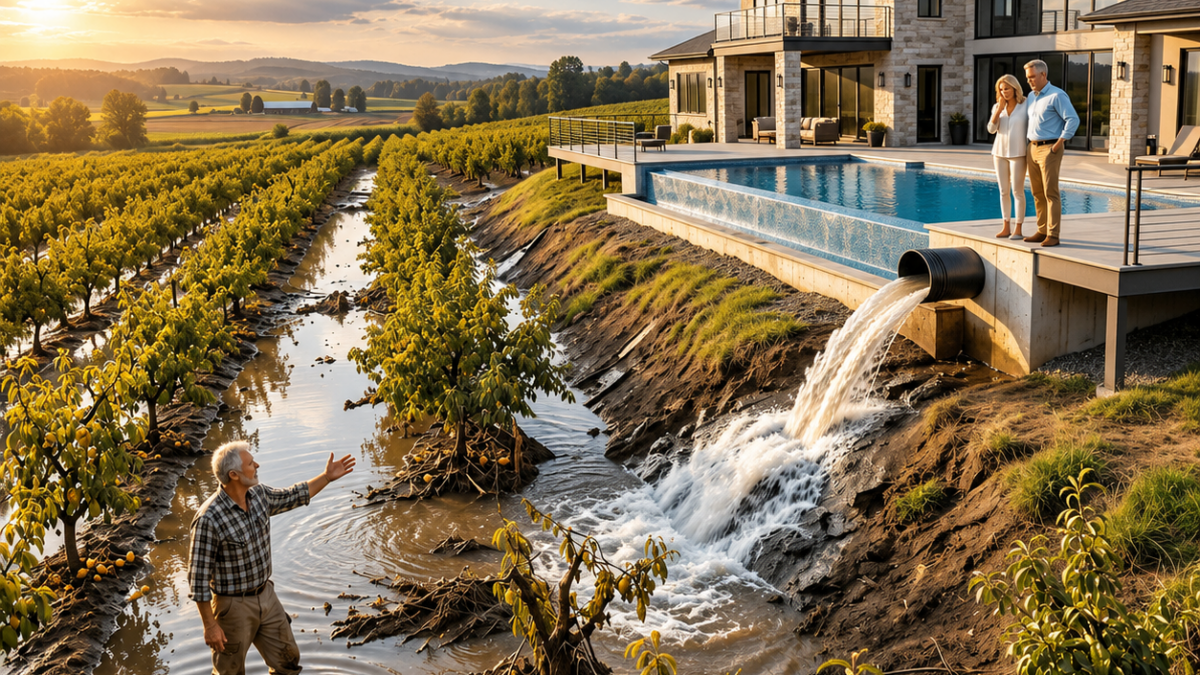
A luxury homeowner built an infinity pool above my family’s fifteen-acre organic apple orchard outside Hood River, Oregon, and when I warned him that his drainage plan would send chlorinated runoff straight into the oldest trees my father had planted, he smiled like I was complaining about grass clippings.
Three days after Gavin Vale filled that pool, I found the first dead patch along my southern tree line, and the lab report came back at 3.1 parts per million chlorine, enough to put more than three decades of organic certification, Portland restaurant contracts, farmers-market sales, and our entire livelihood at risk.
Gavin laughed at the roughly $80,000 cost of fixing the drainage and told me maybe smaller farms should stop trying to exist beside modern development, so when he later invited architects, influencers, journalists, and wealthy guests to showcase his luxury home, I decided they were going to see exactly what his beautiful pool had done downhill.
My name is Caleb Mercer.
My family owns about fifteen acres outside Hood River, and my dad bought the land in the late 1980s after the lumber mill where he worked shut down.
Everybody told him organic farming was foolish back then.
Dad always answered, “Healthy soil pays you back honest.”
By the time I inherited the orchard, we had contracts with Portland restaurants, local farmers markets, and specialty grocery stores.
We were not rich, but we were stable.
Getting certified organic had nearly broken us.
Three years of inspections, soil testing, paperwork, and random audits taught me how quickly one contamination incident could destroy decades of work.
That was why I paid attention when the old Bennett property uphill sold.
Water always moves downhill.
And downhill from that ridge sat my oldest southern orchard.
The buyer was Gavin Vale, a wealthy tech entrepreneur in his early forties who arrived with black SUVs, architects, contractors, drones, and plans for a glass-and-concrete house people around town soon nicknamed the spaceship house.
A week after arriving, Gavin and his girlfriend Sienna stopped at our farm stand.
She bought Honeycrisp apples and cider donuts.
Gavin admired the view and told me that was why they had bought the ridge property.
Months later, my nephew Tyler found the county permit drawings.
Infinity pool.
South-edge overflow.
Gravity-fed drainage.
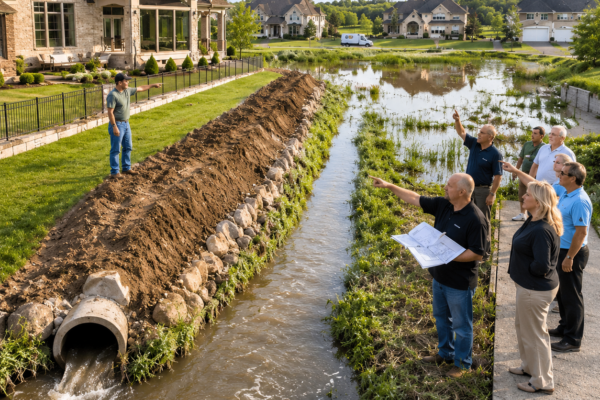
Runoff directed toward the slope facing my orchard.
I drove to the construction site the next morning and showed Gavin the plans.
His architect, Martin Keller, said everything met county code and the environmental impact would be minimal.
I told them chlorinated runoff could cost me my organic certification.
Gavin said they were not redesigning an expensive finished project over “hypothetical water concerns.”
The county told me the design met code.
My certification contact, Denise, gave me the answer I feared.
“If contamination enters the orchard, our hands are tied.”
So I documented everything.
Dates.
Photos.
Weather.
Drainage angles.
Then the pool was filled on a Thursday in August.
Three days later, I found wet soil where water should not have been collecting.
It smelled faintly chemical.
I filled sample jars and drove them into town.
The next morning, the test showed 3.1 parts per million chlorine.
I took the report to Gavin.
He barely looked at it.
“The system’s functioning normally.”
“Your normal is killing my farm.”
Martin estimated roughly $80,000 to redirect the drainage and modify the retaining structures.
Gavin laughed.
“All this over a few puddles?”
Then he told me, “Maybe it’s time smaller farms stop trying to exist next to modern development.”
By September, leaves were yellowing early, fruit growth weakened, and roots along the southern rows showed stress.
Denise inspected personally.
A week later, our organic certification was suspended.
Thirty-two years of work vanished in one decision.
Restaurants paused contracts.
One grocery chain dropped us.
Then Gavin announced a luxury architecture showcase at the house.
Wine tasting.
Private tours.
Architects.
Developers.
Local media.
I stared at the invitation and finally smiled.
Tyler asked what I was thinking.
“Signs.”
“How big?”
“Big enough to read from the pool deck.”
We printed the chlorine report, contamination timeline, and drone photographs showing the runoff path.
Then we mounted weatherproof signs along my property line facing Gavin’s showcase lawn.
ORGANIC ORCHARD CONTAMINATED BY POOL RUNOFF.
SOIL DAMAGE UNDER LEGAL REVIEW.
DOCUMENTATION ACTIVE.
On the evening of Gavin’s perfect showcase, the guests began reading them.
Then they began walking downhill.
And suddenly everyone wanted to know what was happening beneath that infinity pool.
[END OF FACEBOOK CAPTION]
[FIRST COMMENT / FULL STORY CONTINUATION]
The first person who walked down from Gavin’s showcase toward my orchard was a woman wearing a cream-colored hat so wide it looked like it needed its own weather forecast.
She had a wine glass in one hand.
Designer boots on her feet.
And the cautious expression of somebody who had just realized the evening she thought she was attending might not be the evening she was actually attending.
Tyler saw her before I did.
He was carrying a bundle of dead branches toward the burn pile.
“Uncle Caleb.”
I kept working.
“What?”
He nodded uphill.
“Visitor.”
I turned.
Behind the woman, Gavin’s house glowed against the ridge.
The infinity pool reflected the sunset in a strip of blue that looked almost unreal.
Music drifted across the slope.
People stood beside fire pits holding wine glasses.
From a distance, the entire place looked exactly the way Gavin wanted it to look.
Expensive.
Modern.
Controlled.
Then your eyes dropped twenty or thirty yards.
And there were my signs.
ORGANIC ORCHARD CONTAMINATED BY POOL RUNOFF.
SOIL DAMAGE UNDER LEGAL REVIEW.
DOCUMENTATION ACTIVE.
The woman stopped near the property line.
She looked at the first sign.
Then the second.
Then toward the trees behind me.
“Excuse me.”
I set down the branch I was carrying.
“Yes?”
She pointed toward the signs.
“Are those real?”
I wiped sweat from my forehead with the back of my glove.
“Depends which part.”
She looked confused.
“The contamination.”
“Oh.”
I nodded.
“Yeah, that’s real.”
Her eyes went immediately toward the infinity pool.
“From the pool?”
“That’s where the runoff is coming from.”
She stared at me for a second.
Then back at the house.
I could almost see the evening rearranging itself in her mind.
Five minutes earlier, she had probably been standing beside that pool listening to somebody explain imported glass, hillside engineering, sight lines, and the architectural concept of blending luxury into the landscape.
Now she was looking downhill at yellowing apple trees.
“Is this your orchard?”
“My family’s.”
“How long?”
“My dad bought the land in the late eighties.”
She took a small step closer.
“Organic?”
“Was.”
That word made her stop.
“Was?”
“Our certification’s suspended.”
“Because of this?”
I nodded.
She looked again toward the signs.
The wine glass lowered in her hand.
“What happened?”
I could have given her a speech.
I had rehearsed plenty of them in my head over the previous months.
I could have told her Gavin was arrogant.
I could have told her he did not care.
I could have called the house an environmental disaster.
I did none of that.
I pointed toward the southern rows.
“Pool was filled in August.”
Then toward the wet low ground.
“Three days later, runoff showed up down there.”
I pointed toward the sign holding a copy of the lab report.
“Test came back at 3.1 parts per million chlorine.”
She leaned toward the plastic-covered document.
Actually read it.
That was the whole purpose.
Not slogans.
Evidence.
The date.
The number.
The location.
The woman straightened.
“And they knew?”
“I warned them before the pool was filled.”
Her eyebrows lifted.
“How?”
“County plans showed the drainage slope.”
“What did they say?”
“They said the design met code.”
She looked toward the house again.
Then toward me.
“And nobody changed it?”
“No.”
She stayed another minute.
Asked about the certification.
I explained that organic farming was not just a label we printed on apple boxes.
The certification agency cared about what entered the soil.
Contamination could put the whole operation at risk.
That was not something we could simply wash off the fruit and forget.
Healthy soil was the foundation of everything.
My dad had said it for as long as I could remember.
Healthy soil pays you back honest.
The woman looked at the damaged row.
A few leaves were already turning yellow when they should not have been.
Some fruit was smaller.
The ground near the runoff path looked wrong.
Too wet in places.
Weak around roots.
She asked:
“How much did you lose?”
“I don’t know yet.”
That was the truth.
We knew contracts had paused.
One specialty grocery chain had already dropped us.
Restaurants were waiting.
Certification was suspended.
But farming does not give you a clean invoice for damage the day it happens.
Trees take time to show stress.
Soil takes time to recover.
A contaminated area can keep telling you bad news for months.
The woman nodded slowly.
Then said:
“I’m sorry.”
There was that word again.
Sorry.
I did not blame her.
She had not built the pool.
She had not designed the drainage.
Still, by then the word had begun to feel strange.
Everybody was sorry.
Denise was sorry.
People at the county were sympathetic.
Neighbors were sorry.
Nobody’s sympathy had moved the water.
I said:
“Thank you.”
She walked back uphill.
Tyler came over.
“That went well.”
“Didn’t need to go well.”
“What did it need to do?”
“Be true.”
He looked toward the party.
Already, two more guests were staring down the slope.
One was pointing at the signs.
The other was holding up a phone.
Tyler grinned slightly.
“Think Gavin noticed?”
“He’s going to.”
We went back to work.
That was important.
I did not stand there waiting for an audience.
I did not walk into Gavin’s event.
I did not block his driveway.
I did not shout at his guests.
The signs were on my property.
The damaged trees were on my property.
The lab reports were mine.
The photographs were documentation we had collected.
Anyone who wanted to ignore them could.
Anyone who wanted to read them could.
That was the whole point.
Quiet visibility.
For months, Gavin had held the advantage because the damage was downhill and mostly invisible from his polished concrete patio.
Now the people he wanted to impress could see both sides at once.
The pool.
And what happened beneath it.
Within twenty minutes, the first woman came back.
This time she had two people with her.
An older man carrying no wine.
A younger man holding a phone.
They stopped at the property line.
The older man introduced himself as an architect.
I did not catch his name.
That detail did not matter.
He asked whether he could look at the runoff trench without entering farther into the orchard.
I told him where the line was.
He crouched near the edge.
Tyler walked over.
The architect studied the slope.
Then looked uphill.
Then back down.
He followed the natural grade with his eyes.
“You said this is pool overflow?”
“Yes.”
“Gravity-fed?”
“That’s what the plans say.”
Tyler pointed toward the weatherproof copy of the permit drawing.
The architect stood.
Walked over.
Read it.
His mouth tightened.
He looked toward the pool again.
Then muttered:
“Jesus Christ.”
That was not me editorializing.
That was him looking at the same drawing Tyler had shown me months earlier.
Infinity pool.
South-edge overflow.
Gravity-fed drainage.
Slope toward the orchard.
What looked like a clean line on a county plan became more disturbing when you stood between the pool and the trees.
That had been my problem from the beginning.
On paper:
Minimal environmental impact.
In the orchard:
Wet soil that smelled faintly chemical.
The younger man asked if he could photograph the sign.
“Sure.”
The architect asked:
“Has this been tested?”
I handed him a copy of the lab result.
He read the chlorine level.
3.1 parts per million.
He looked at me.
“This was taken here?”
“Southern tree line.”
“How long after the pool filled?”
“Three days.”
He nodded slowly.
That was enough.
They walked back uphill.
More people started coming.
Not a stampede.
Not some theatrical mob.
Small groups.
Two people.
Three.
A couple pretending to walk the property.
Someone with a phone held low.
A woman asking Tyler about the dead branches.
A man reading the timeline twice.
They had come for modern mountain architecture.
Now they were studying chlorinated soil.
There was something almost absurd about it.
The house remained beautiful.
That was the maddening part.
I had never claimed otherwise.
The glass caught the evening light perfectly.
The pool seemed to disappear into the horizon.
The fire pits glowed.
The landscaping had been designed down to the last stone.
Everything about the property said harmony with nature.
Downhill, my orchard showed the part of that harmony nobody had wanted included in the photographs.
One couple asked why organic certification mattered so much.
I explained the three years it took us to earn it originally.
The inspections.
Paperwork.
Soil testing.
Random audits.
Records.
Every input tracked.
Every treatment documented.
One mistake or one contamination event could trigger consequences.
The woman looked surprised.
“So if someone else causes contamination, you can still lose it?”
“That’s what Denise told me.”
“Even if you didn’t do anything?”
“They certify the land and the process.”
She frowned.
“That seems unfair.”
“It’s not the certification agency’s job to decide whose fault it was.”
I had learned that the hard way.
The agency was there to decide whether the orchard met the standard.
Responsibility for contamination was a separate question.
That distinction did not make the suspension easier.
But it mattered.
Denise had not wanted to suspend us.
I could hear that in her voice even before she came to inspect.
Still, when she walked those southern rows in September, she had to look at what was there.
Yellowing leaves.
Weak fruit growth.
Root stress.
Tested contamination.
She knelt beside the soil.
Took notes.
Moved slowly.
When she finally stood, I knew before she said anything.
“Caleb.”
I remember staring at her.
She said:
“I’m so sorry.”
I hated the word then.
Not her.
The word.
Because it meant the answer was already decided.
A week later, certification suspended.
Thirty-two years.
That was how I thought about it.
Thirty-two years gone.
Technically, a certification can be regained.
Land can be tested again.
Processes can restart.
But in that moment, the piece of paper changed everything.
Restaurants paused contracts immediately.
They had their own promises to customers.
One grocery chain dropped us entirely.
Farmers-market customers began asking whether the apples were still organic.
Some asked kindly.
Some looked suspicious.
Tyler hated those conversations.
I could see it.
He would stand behind the farm stand explaining something he had not caused.
“Certification is suspended.”
“So are the apples contaminated?”
“We’re monitoring affected areas.”
“Can we still eat them?”
The questions were fair.
That made them hurt worse.
Trust is part of what farmers sell.
Not just fruit.
People bought from us because they believed they knew how those apples had been grown.
The certification suspension turned every box into a question.
And Gavin had called it a few puddles.
That sentence stayed in me.
All this over a few puddles?
The people walking downhill from his showcase were finally seeing what those puddles had become.
By sunset, the mood uphill had changed.
You could feel it even from the orchard.
Music was still playing.
But fewer people stood near the pool.
Small groups clustered away from it.
People who had been photographing the water were now photographing my signs.
A couple left early.
Then another.
Cars began pulling away from the ridge before the event was supposed to end.
Tyler looked at me.
“This is getting weird.”
“Keep working.”
“You’re not enjoying this?”
I thought about it.
“Ask me tomorrow.”
The truth was complicated.
Part of me felt satisfaction.
I will not lie.
For months, Gavin had dismissed everything because the damage existed where his guests could not see it.
Now he could not control what they were looking at.
That felt good.
But every time someone stared at the damaged trees, I remembered why they were damaged.
This was not a prank.
I did not invent a scandal to embarrass a rich neighbor.
My certification was suspended.
Contracts were gone.
Trees my father had planted were stressed.
Some would not recover.
There was nothing funny about that.
Then Gavin came downhill.
I heard him before I saw him.
“Caleb.”
His voice was sharp.
Tyler stopped beside the burn pile.
I kept stacking branches.
Gavin crossed toward the property line with Martin Keller behind him.
Martin still looked remarkably clean for a man walking near an orchard.
Different shoes from the first time, but the same careful expression.
Gavin stopped several feet away.
“What the hell are you doing?”
I picked up another branch.
“Working.”
“Don’t play games.”
I looked at him.
“What do you mean?”
He pointed toward the signs.
“You’re sabotaging my event.”
I set the branch down.
“No.”
I nodded uphill toward the pool.
“Your drainage system did that.”
His face reddened.
“You’re making this look intentional.”
I stared at him.
“Was it accidental?”
For about two seconds, he had nothing.
That was the question I had been asking myself for months.
I did not believe Gavin woke up one morning and decided to poison an orchard.
The source never supported that.
He had not poured chlorine into my soil by hand.
But once I warned him, once the plans were clear, once I told him the risk to certification, what did continuing unchanged become?
Was it still an accident when the danger had been explained?
Gavin shifted.
Martin stepped in.
“You’re creating reputational damage before litigation concludes.”
I laughed.
Could not help it.
“Reputational damage?”
I pointed toward the southern rows.
“My trees are dying, Martin.”
Several guests were openly watching now.
Phones out.
Wine glasses lowered.
Martin glanced uphill.
Gavin noticed too.
His voice dropped.
“Take the signs down.”
“No.”
“I’m serious.”
“So am I.”
He stepped closer.
Not onto my land.
Just closer.
For a moment, I thought he might completely lose his temper.
Then someone called his name from the house.
He looked over his shoulder.
Saw the people watching.
And everything in him changed.
Not remorse.
Calculation.
He understood that yelling at the orchard owner in front of architects and journalists would make the evening even worse.
So he turned around.
Martin followed.
They walked uphill.
Neither said another word.
Tyler waited until they were far enough away.
Then whispered:
“Well.”
I looked at him.
“Well what?”
“That might be the first time I’ve ever watched a man remember he has an audience.”
I almost smiled.
The guests continued leaving early.
Nobody wanted to stand beside the infinity pool anymore.
That image had changed.
An hour earlier, it was the centerpiece.
A disappearing edge against an Oregon sunset.
Now every person who looked at it saw the slope beneath.
The runoff.
The chlorine report.
The orchard.
That was the nightmare.
Not anything I did to the house.
I never touched Gavin’s property.
I never damaged his pool.
I never blocked his event.
I made sure his guests could see the consequence that had been hidden downhill.
The luxury home remained exactly where he built it.
The story surrounding it changed.
And for a man who had built a house designed to be admired, that mattered.
Two days later, Tyler walked into the barn holding his phone.
He looked almost stunned.
“You need to see this.”
“What?”
“Article.”
He handed me the phone.
An architecture blog had published drone photographs.
One showed Gavin’s house from above.
Glass.
Pool.
Terraces.
Landscape.
Another showed the orchard below.
The damaged southern rows.
The drainage relationship between the properties was obvious from that angle.
The headline read:
“When Luxury Design Ignores the Land Beneath It.”
I read it twice.
Then handed the phone back.
Tyler waited.
“That’s it?”
“What do you want me to do?”
“I don’t know.”
He looked at the screen.
“This is big.”
It became bigger.
Environmental pages shared it.
Local news picked it up.
Then another outlet.
Then a national design magazine questioned what happened when hillside luxury development collided with agricultural communities.
I did not suddenly become a celebrity farmer.
I did not want to.
But Gavin’s house became known for something he had never planned.
People no longer talked only about the architecture.
They talked about runoff.
Land use.
Agriculture.
Organic certification.
Water flowing downhill from private luxury property.
That was the part Gavin could not buy his way out of with better photography.
His house had been designed to make people look.
Now people were looking.
Just not at the things he wanted.
The strange part was that nothing in our signs needed exaggeration.
That protected us.
We did not write:
GAVIN VALE POISONED MY FARM.
We did not accuse him of intentionally dumping chemicals.
We wrote what we could document.
Organic orchard contaminated by pool runoff.
Soil damage under legal review.
Documentation active.
Lab reports.
Dates.
Photographs.
Drainage plans.
Reality was strong enough.
That became important once lawyers were fully involved.
Every public statement could be examined.
Every photograph could be challenged.
Every word could matter.
I had already learned to document because I felt helpless.
Now documentation became the thing that gave me control.
The first notebook had started with simple entries.
Construction progress.
Date.
Weather.
Observed runoff direction.
Photo numbers.
Then the pool filled.
Thursday.
Three days later:
Wet patch, southern tree line.
Chemical odor.
Samples collected.
Test:
3.1 ppm chlorine.
Then spreading stress.
Certification inspection.
Suspension.
Contract pauses.
Grocery chain termination.
By the time mediation approached, the notebooks had become a timeline nobody needed me to dramatize.
Facts lined up on their own.
The pool had a date.
The runoff had a date.
The test had a date.
The damage had a progression.
The warnings had happened before the pool was operational.
That last part mattered.
Gavin could not honestly say nobody had told him.
I had stood at his construction site with the permit drawings.
I had explained the certification risk.
He had said they were not redesigning the property over hypothetical concerns.
After contamination appeared, I brought him the lab report.
He had asked:
“That’s from my pool?”
I said:
“The runoff tested positive beside my orchard.”
He had shrugged.
The system was functioning normally.
That reaction became harder to defend once “normal” meant a suspended organic orchard downhill.
Martin’s $80,000 estimate mattered too.
The fix had been expensive.
But not impossible.
Retaining modifications.
Excavation.
Drainage redirection.
Roughly eighty thousand dollars.
At the time, Gavin laughed.
All this over a few puddles?
That sentence looked different beside a $380,000 settlement months later.
The cheaper decision had been available.
He simply had not wanted to make it.
January arrived.
Cold mornings.
Bare branches.
The orchard looked different in winter even without the damage.
But the southern section bothered me every time I walked it.
Without leaves, you could see the structure of each tree.
The healthy ones had a certain shape.
Strength.
The stressed ones seemed thinner.
Less certain.
My father’s original Southern Rose trees were among the ones I watched most closely.
Some had been there longer than almost anything else on the property.
You cannot rush a tree.
That is one of the cruel things about farming.
A house can be demolished and rebuilt quickly by comparison.
A mature fruit tree represents years.
Sometimes decades.
When soil changes, the tree records that slowly.
By January, mediation finally started.
I had spent enough months angry that I expected seeing Gavin again would bring all of it back.
It did not.
He looked exhausted.
That was the first thing I noticed.
Not defeated.
Not ruined.
Tired.
The kind of tired that comes from living inside a problem that follows you into every room.
His house had become famous for the wrong reason.
The orchard damage was documented.
The legal dispute had not gone away.
Public attention had made every move more visible.
And the drainage still needed fixing.
We sat with lawyers.
Documents on the table.
No architecture models.
No wine.
No polished presentation about modern living.
Just numbers.
Reports.
Photographs.
The contamination test.
The county documents.
Drone footage.
Statements from people who had attended the architecture showcase.
Social media posts.
The certification suspension.
Contract losses.
Soil damage.
The cost of remediation.
The cost of redesigning drainage.
The reality that no settlement could make my original trees young again.
That was the hardest part.
Money gives legal systems a language for damage.
But farms speak time.
How much is a mature tree worth?
Not just replacement cost.
What about years before a new tree produces at the same level?
What about certification recovery?
What about contracts lost while the land is under question?
What about customers who move on?
What about soil biology?
Those questions do not fit cleanly into one number.
But mediation requires numbers.
So we sat there.
Gavin did not repeat the line about small farms and modern development.
He did not call the orchard an industry.
He did not laugh.
Martin’s name appeared in the documents because the drainage design and correction cost mattered.
But the room had moved beyond who sounded smarter during the first confrontation.
The question now was how much it would cost to correct what had happened and what portion of the damage could actually be repaired.
Three weeks later, settlement.
$380,000.
Full drainage reconstruction at Gavin’s expense.
Long-term soil remediation monitoring.
Partial reimbursement for recertification losses.
Those were the terms that mattered.
Not a fantasy payout.
Not ownership of Gavin’s house.
Not some court stripping him of everything.
Three hundred eighty thousand dollars.
Drainage rebuilt.
Soil monitored.
Some of what we lost reimbursed.
Some.
That word mattered.
Because the source of the damage could be corrected.
The past could not.
The drainage reconstruction began after settlement.
That was the part I had asked for before everything went bad.
Fix the drainage.
I remembered standing at Gavin’s door with the first lab report.
“I want you to fix the drainage.”
Martin had said it would require excavation.
Retaining modifications.
Eighty thousand.
Gavin laughed.
Now crews were doing exactly that work anyway.
Only after the orchard had been damaged.
After certification had been suspended.
After contracts had been lost.
After lawyers.
After the showcase.
After articles.
After mediation.
That is what arrogance does.
It turns an expensive correction into a much more expensive consequence.
I watched the work from my side.
Not with pleasure.
With relief.
The new drainage stopped treating the orchard as the place excess water could disappear.
Runoff was redirected.
The system changed.
The thing I had asked for before the pool became operational finally happened.
Too late for some trees.
But not too late for the whole farm.
Soil remediation took longer.
You cannot fix living soil like replacing broken pipe.
Testing.
Monitoring.
Watching.
Waiting.
Trying to understand which areas were recovering and which needed more help.
Denise remained involved because certification was still the issue sitting over everything.
She had handled our account for years.
She knew what the orchard had been before the contamination.
That helped emotionally.
It did not change the standards.
I did not want the standards changed for me.
That would destroy the whole point of certification.
I wanted the orchard to become healthy enough to meet them again.
There is a difference between wanting mercy and wanting recovery.
I wanted recovery.
Tyler helped with the southern rows.
He had always worked hard.
After the suspension, he worked differently.
More carefully.
He photographed more.
Recorded more.
Tested assumptions.
The whole experience had changed both of us.
Before Gavin, I trusted that if something obviously threatened a farm, people would fix it because the threat was obvious.
After Gavin, I learned obvious depends on where you stand.
From my orchard, runoff was a livelihood issue.
From Gavin’s pool deck, it had looked like a few puddles.
The distance between those perspectives was only a slope.
But it might as well have been miles.
That was why documentation mattered.
A photograph carries one side uphill.
A lab report turns a smell into a number.
A certification letter turns anxiety into consequence.
A contract termination turns consequence into loss.
Facts move better than anger.
That was the lesson I wish I had never needed.
The Southern Rose trees were harder.
My father’s original section never fully recovered.
That sentence is still difficult.
Some trees survived.
Some did not.
Some struggled enough that replacing them became the only honest choice.
When I removed the first one, I stood there longer than I should have.
Tyler waited nearby.
He did not tell me it was just a tree.
He knew better.
My father had planted those trees.
I remembered him younger than I was now.
Boots covered in dirt.
Hands rough.
Talking about soil as if it were a living neighbor.
Healthy soil pays you back honest.
He had believed that before organic farming became fashionable enough for restaurants and grocery stores to build marketing around it.
Back when people told him he was crazy.
He had built the orchard slowly.
No black SUVs.
No architecture photographers.
No launch event.
Tree by tree.
Season by season.
Replacing one of his originals felt like erasing a sentence from something he had written.
We replanted.
Of course we did.
Farming does not allow endless mourning.
You remove what will not recover.
Improve the soil.
Plant again.
Water.
Wait.
Technically, the row continued.
Emotionally, it was not the same.
A replacement tree is not a thirty-year-old tree.
That was what the settlement could not understand.
Money could cover labor.
Testing.
Lost contracts.
New stock.
It could help us survive the gap.
It could not create decades.
Farming teaches you the value of time because biology refuses to accept cash as a shortcut.
Gavin’s house had been built quickly by comparison.
Months of excavators.
Concrete.
Glass.
Retaining structures.
Millions of dollars compressed into a schedule.
The orchard operated on another clock.
That difference sat underneath the whole conflict.
He had treated a mature farm as though it could adapt to his construction decision the way a contractor changes a drawing.
It could not.
Some things take as long as they take.
The public attention eventually slowed.
That was good.
I never wanted to become the orchard guy from some endless national argument.
The architecture blog moved on.
News moved on.
People found newer stories.
The signs eventually came down.
Not because Gavin asked again.
Because they had done their job.
Drainage reconstruction was underway.
The dispute had entered mediation and then settlement.
There was no reason to keep turning my property into a billboard.
Tyler helped me remove them.
He held the first one.
ORGANIC ORCHARD CONTAMINATED BY POOL RUNOFF.
He looked at me.
“Keep it?”
“For what?”
“I don’t know.”
I shook my head.
“No.”
We dismantled them.
I kept the lab reports.
The notebooks.
The photographs.
The certification documents.
Evidence belonged in files.
I did not need the anger nailed to a post forever.
That was another thing I learned.
A boundary marker can protect you.
A grievance marker can trap you.
The orchard needed to become an orchard again.
Not a permanent exhibit about Gavin Vale.
He sold the house less than a year later.
I heard before I saw anything.
Small town.
People knew.
The same house that had arrived like a spaceship and become an architecture story was on the market.
I did not ask why.
The source says he could not stand the attention anymore.
That explanation made sense.
His dream house had become linked to the orchard conflict.
Whatever he saw when he looked at the infinity pool, other people saw something else.
Maybe that became unbearable.
I do not know exactly what Gavin felt.
By then, I had stopped trying to understand his interior life.
He sold.
That was enough.
A retired couple from Seattle bought the property.
I noticed them before we formally met.
Different vehicles.
Less traffic.
One morning, landscaping crews arrived.
I felt my stomach tighten automatically.
Old habit.
Then I saw what they were doing.
Native hedges along the runoff slope.
Not decorative walls.
Not more concrete.
Plants.
Later, the couple introduced themselves.
They were polite.
No dramatic apology for the previous owner.
They had not caused anything.
I did not need them to inherit Gavin’s guilt.
They asked about the orchard.
I told them.
They listened.
That alone felt different.
They barely used the pool.
That was their choice.
I never asked them to drain it.
Never asked them to remove it.
With the reconstructed drainage, the pool itself was no longer the enemy.
That mattered.
It had never been the existence of water in a luxury pool.
It was where that water went.
The retired couple understood that distinction without needing a lawsuit.
They became good neighbors.
That part of the ending matters to me.
Because it proved the conflict was not inevitable just because two very different properties sat beside each other.
Luxury house uphill.
Organic orchard downhill.
Those things can coexist.
What cannot coexist safely is one owner deciding the other owner’s land can absorb the consequences.
The new neighbors did not do that.
We had no war.
No signs.
No lab reports waved at doors.
No guests walking downhill from parties asking whether contamination was real.
Just neighbors.
That was what should have happened from the beginning.
Sometimes at night, I still walk the orchard with a flashlight.
My dad used to do it.
I started doing it more during the conflict because stress made sleeping difficult.
The trees calmed me.
Dad was right about that too.
Trees do not care about lawsuits.
They do not care how rich your neighbor is.
They do not care whether an architecture magazine likes a house.
They respond to light.
Water.
Soil.
Disease.
Pruning.
Weather.
Care.
There is something honest about that.
If the soil is healthy, you cannot talk a tree into pretending otherwise.
If the roots are stressed, a good public-relations strategy does not fix them.
Biology has no interest in image.
Maybe that was why Gavin and I collided so hard.
His world seemed built around perception.
The house was designed to be seen.
The pool designed to disappear visually into the horizon.
The showcase designed to invite admiration.
The photographer designed to turn architecture into desire.
My world was built around outcomes you could not fake for long.
Either the apple grew or it did not.
Either the soil tested clean or it did not.
Either certification held or it did not.
Either the restaurant contract stayed or it disappeared.
When those two worlds met, evidence became the only common language.
Gavin could dismiss my fear.
He could dismiss my opinion.
He could call the certification rules weird.
He could call the damage puddles.
He could not make 3.1 ppm chlorine disappear from a lab result by rolling his eyes.
That number still feels burned into my memory.
3.1.
I remember sitting in the truck after receiving it.
Paper in my hands.
Ten minutes maybe.
Not moving.
The test did not tell me every tree would die.
It did not tell me exactly how long recovery would take.
It told me the thing I had feared was not imaginary.
Chlorine was there.
That was the moment the conflict stopped being about what might happen.
It had happened.
Everything afterward followed from that.
The trip to Gavin’s house.
The lab report.
His shrug.
Martin’s eighty-thousand-dollar estimate.
Gavin’s laugh.
The line about smaller farms.
The certification inspection.
Suspension.
Contracts.
Showcase.
Signs.
Mediation.
Settlement.
All of it began with water moving downhill.
That simplicity is what still bothers me.
Not some complicated industrial accident.
Not a hidden pipeline.
Not a disaster nobody could predict.
A pool.
A slope.
An orchard.
I saw the risk in the plans.
I told them.
They chose not to change.
Sometimes people ask whether Gavin was malicious.
I do not know.
The source ends on that question for a reason.
I never saw him pour chlorine into the orchard.
I never heard him say he wanted the farm destroyed.
What I saw was something more ordinary.
He believed his project mattered more than my warning.
He believed code compliance settled the moral question.
He believed eighty thousand dollars was too much to spend fixing something whose cost would fall downhill onto someone else.
That may not be malice.
Sometimes indifference does enough damage without hatred.
That is what scares me more.
A malicious person knows they are hurting you.
An indifferent person may keep hurting you while explaining why it makes sense.
Gavin told me regulations existed for a reason.
He was right.
But regulations are minimums, not magic.
A permit does not guarantee that nothing bad can happen.
A design meeting code does not mean a neighbor has no reason to worry.
That was the gap between Martin and me during the first conversation.
Everything’s engineered to county code.
I’m not talking about code.
I’m talking about chlorine runoff flowing into my orchard.
Both sentences could be true at the same time.
The design could meet the requirement they were checking and still create a real problem for a certified organic farm downstream.
That complexity is exactly why good neighbors listen before the damage.
The county meetings frustrated me because every conversation seemed to end with the same answer.
The design meets code requirements.
I filed complaints.
Talked to environmental offices.
Sat in meetings.
Nobody told me I was imagining the risk.
They told me the approved design met the rules they enforced.
That left a farmer looking uphill at a system he believed could ruin him and being told there was no administrative reason to stop it.
Helpless is the right word.
That was why I started the notebooks.
If I could not stop the construction, I could at least preserve what happened.
Dates.
Photos.
Weather.
Drainage angles.
Tyler called me a detective chasing a serial killer.
I laughed then.
He was trying to lighten the mood.
But the notebooks gave me something anxiety had taken away.
A task.
Every morning, I could record.
Not guess.
Not pace.
Observe.
That helped.
After certification suspension, the notebook entries became harder.
Restaurant contract paused.
Grocery account terminated.
Customer questions.
Tree stress expanding.
There were days I did not want to write any of it.
But I did.
Evidence is most valuable when you record the part you wish were not true.
The architecture showcase became the first time those records left my desk and entered public view.
I thought carefully about that.
I knew Gavin would call it sabotage.
He did.
But the information on the signs was ours.
The damage was ours.
The lab report was ours.
The property line was ours.
I did not trespass.
I did not disrupt the event physically.
I did not shout over his music.
I did not stop guests from entering.
I simply refused to hide the consequence because it was inconvenient for his image.
That distinction made the whole thing work.
If I had stormed uphill yelling, Gavin could have made me the spectacle.
Angry farmer crashes architecture event.
Instead, I stayed in the orchard.
Worked.
Let people come to me.
That was Tyler’s job too.
Stack branches.
Move dead material.
Answer questions honestly if asked.
Nothing more.
The contrast did everything.
Luxury above.
Damage below.
People are smart when given both views.
They did not need me to tell them what to think.
The older architect’s reaction told me that.
He looked at the slope.
Looked at the plan.
Muttered to himself.
He understood something immediately because it was his field.
Another couple understood through certification.
Someone else through the lab report.
Different people saw different parts.
Together, the picture formed.
Gavin had built a house meant to control the view.
That night, he lost control of the frame.
That was the nightmare promised in the title.
Not a flooded living room.
Not broken windows.
Not me physically turning his property into anything.
His luxury home became the backdrop for the damage it had caused.
And once that image escaped, the house itself could not easily escape the story.
The architecture blog’s drone photograph did more than any argument I had ever made.
From above, you could see relationship.
Ridge.
Pool.
Slope.
Orchard.
A design decision and its consequence inside one frame.
“When Luxury Design Ignores the Land Beneath It.”
The headline stayed with me.
Not because I agreed with every opinion people wrote afterward.
Because “beneath” was literal.
My farm sat downhill.
Invisible from certain angles.
Easy to treat as background.
Until water connected us.
That is the thing about land.
Neighbors are linked whether they like it or not.
Water crosses boundaries.
Wind does.
Roots do.
Smoke does.
Noise does.
What happens uphill rarely stays conceptually uphill forever.
That is why property rights alone are not enough to make good neighbors.
You need awareness of consequence.
Gavin learned that too late for my original trees.
The settlement did not feel like revenge.
By January, I was too tired for revenge.
Gavin looked tired too.
Mediation stripped away the public performance.
No audience.
No showcase.
No signs.
No guests.
No comments section.
Just the two sides and the evidence.
That setting was almost a relief.
I did not need Gavin humiliated there.
I needed the drainage fixed.
I needed soil monitoring.
I needed help covering what certification loss had cost us.
The settlement gave us that.
$380,000 sounds like a lot because it is.
But if someone hears that number and thinks I won a lottery, they do not understand farms.
Lost contracts.
Remediation.
Testing.
Replacement.
Time.
Recertification.
Uncertainty.
A mature orchard is not something you reset by depositing money.
The settlement helped keep us alive through the damage.
That is different from being made whole.
Full drainage reconstruction mattered more to me than any symbolic apology.
The water needed another path.
Long-term soil monitoring mattered because contamination was not a one-day event.
Partial reimbursement for recertification losses mattered because the suspension had already changed business relationships.
The agreement addressed those things.
That was legal victory.
The trees still had their own verdict.
Some survived.
Some weakened.
Some were gone.
My father’s original Southern Rose never completely recovered.
That is the line I return to when people ask whether I felt satisfied.
How do you celebrate a settlement beside a tree your father planted that will never be the same?
You do not.
You accept that legal systems can resolve responsibility without reversing biology.
Then you keep farming.
The new trees went in.
Different rootstock.
Fresh starts.
Tyler helped.
I remember one morning we were planting and he said:
“Think your dad would like these?”
I looked at the row.
“He’d complain about how we spaced them.”
Tyler laughed.
“Seriously?”
“He complained about everything.”
That was true.
My father had opinions about pruning angles, soil moisture, picking timing, crate stacking, tractor maintenance, coffee strength.
He would have complained about our spacing.
Then helped anyway.
Remembering that made replanting easier.
The dead trees stopped being only evidence.
They became part of the normal cycle of an orchard again.
Not a normal reason for loss.
But normal work afterward.
Remove.
Prepare.
Plant.
Support.
Wait.
The retired couple uphill eventually became part of that return to normal too.
They planted native hedges along the runoff slope.
They did not use the pool much.
When they did, I did not stare uphill waiting for damage.
The new drainage worked.
That took time to trust.
The first heavy rain after they moved in, I walked the southern edge with a flashlight.
Old habits.
Checked the low point.
Checked the soil.
Watched where the water went.
No chemical smell.
No unusual wet patch pushing into the orchard.
I stood there longer than necessary.
Then went home.
Trust sometimes returns through boring nights when nothing happens.
That is underrated.
After Gavin, I had learned to expect consequence.
The new neighbors slowly taught me not every uphill decision was a threat.
They asked before changing anything near the boundary.
Once, they told me they were adding more native plantings.
Not because they legally needed my permission.
Because they knew drainage mattered to me.
That conversation lasted five minutes.
No lawyers.
No lab reports.
No signs.
Five minutes.
I thought about Martin’s eighty-thousand-dollar estimate.
About the $380,000 settlement.
About months of damage.
About certification.
About media.
About Gavin selling.
How much cheaper simple listening would have been.
That may be the most expensive lesson in the entire story.
Respect is usually cheaper before the damage.
The orchard remains fifteen acres, give or take, just as it was when this started.
Some sections changed.
The southern rows carry scars.
New trees stand where old ones once did.
The soil continues to be monitored.
The business changed too.
Some contracts returned only after confidence improved.
Some relationships never came back the same way.
That is reality.
Customers move.
Restaurants find other suppliers.
Grocery chains make decisions.
A farm can regain certification and still have to rebuild trust one buyer at a time.
That recovery does not fit neatly into a settlement announcement.
The public story ends faster than the farm story.
Online:
Farmer exposes luxury homeowner.
Settlement.
House sold.
Justice.
On the ground:
Test soil.
Watch trees.
Replant.
Call buyers.
Explain.
Wait.
Test again.
Keep records.
Pay bills.
Harvest what remains healthy.
That is the version I lived.
Maybe that is why I still walk at night.
Not because I expect Gavin to come back.
He is gone.
Not because I expect the new owners to cause trouble.
They have been good neighbors.
I walk because my dad did.
Because trees in darkness make everything feel simpler.
A flashlight beam on bark.
Leaves moving.
The sound of wind.
The ground under boots.
You can spend all day talking about property law, certification, reputational damage, media coverage, settlements, and architecture.
At night, an orchard reduces the world.
Is the branch healthy?
Is the soil wet?
Is there damage?
Will this tree make another season?
Simple questions.
Hard answers sometimes.
But honest.
Dad’s saying returns every time.
Healthy soil pays you back honest.
I understand it differently now.
Healthy soil does not only pay in fruit.
It tells the truth.
Contaminate it, and eventually the truth shows.
Care for it, and the truth shows too.
Gavin believed for a while that what happened downhill could remain separate from the life he was building uphill.
The soil disagreed.
Then the trees.
Then the lab.
Then the certification agency.
Then the customers.
Then the guests.
Then the media.
Then the lawyers.
By the time the truth reached his pool deck, it had become too large to dismiss as puddles.
That sequence still amazes me.
Not because I planned it.
I did not.
I planned signs.
That was all.
Everything else happened because people saw what was already there.
The title says I turned his luxury home into a nightmare.
Maybe.
But the real nightmare for Gavin was not anything I created.
It was losing control of how the house was understood.
Before the showcase, the infinity pool meant success.
After the showcase, it became evidence in everyone’s mind of a conflict below.
Before the article, the glass walls meant sophistication.
Afterward, people saw them in photographs paired with damaged trees.
Before, the hillside location meant view.
Afterward, slope meant runoff.
Architecture is partly story.
Gavin had spent millions telling one story.
The orchard introduced another.
He could not make people unsee it.
I think that is why he sold.
Not because the house became physically unlivable.
The source never says that.
It remained a beautiful luxury property.
But attention can make a place feel different to the person who built it as a symbol.
If you wanted admiration and got controversy instead, every room might start reminding you.
Less than a year later, he was gone.
The house stayed.
The orchard stayed.
That contrast matters.
People leave faster than land.
My dad came to the orchard because a lumber mill shut down.
He had to reinvent his life.
He bought land people thought was a bad bet.
Organic farming sounded foolish then.
He kept going.
Decades later, a tech millionaire built a house uphill and assumed modern development was the future while our farm represented something old and inconvenient.
“Maybe it’s time smaller farms stop trying to exist next to modern development.”
I still hear that line.
It said more than Gavin probably intended.
He thought the conflict was about which type of property belonged in the future.
I never saw it that way.
Modern development can exist.
Small farms can exist.
The problem is not coexistence.
The problem is when one is expected to absorb the cost of the other.
If Gavin’s drainage had stayed on his property and protected mine, I would have complained about construction noise maybe.
Then moved on.
I did not object to him building a luxury house.
I objected to his pool water entering my soil after I warned him what it could do.
That difference is everything.
The retired couple proved it.
Same house.
Same hill.
Same orchard.
No nightmare.
Because the drainage was corrected and the neighbors respected what sat downhill.
The conflict was never inevitable.
It was chosen through decisions.
That is both frustrating and hopeful.
Frustrating because so much damage could have been avoided.
Hopeful because better decisions actually work.
Tyler grew quieter about the whole episode after a while.
During the worst months, he carried anger differently than I did.
He was younger.
Less patient.
When Gavin closed the door in my face after telling me smaller farms might not belong beside modern development, Tyler wanted us to do more immediately.
Lawyers.
News.
Pressure.
Anything.
I told him we needed facts first.
He thought I was being too slow.
Later, after the showcase, he understood.
The signs worked because we had evidence behind every line.
If we had gone public before contamination was tested, Gavin could call us paranoid.
If we had accused him of intentional poisoning, he could call us liars.
Instead, we said what we could prove.
Tyler once told me:
“You know what the worst part is?”
“What?”
“If he’d just spent the eighty grand, none of this happens.”
I nodded.
Probably true.
He shook his head.
“Richest guy in the story made the most expensive cheap decision.”
That sounded like something my father would have appreciated.
I wrote it down in my head.
Never told Tyler.
He is proud enough.
Denise remained one of the people I respected most through the whole thing.
She had delivered the worst professional news of my life.
Certification suspended.
Yet I never blamed her.
She had warned me honestly before contamination.
“If contamination enters the orchard, our hands are tied.”
I asked:
“Even if it isn’t my fault?”
“I know.”
“I’m sorry.”
At the time, sorry made me furious.
Later, I understood she was telling me the truth before she had any incentive to soften it.
That is respect too.
Sometimes respect is not fixing something for a person.
Sometimes it is refusing to lie about what the rules mean.
When she came to inspect, she did not look for an excuse to save us.
She looked at the orchard.
That hurt.
It also preserved the value of the certification we had worked so hard to earn.
If agencies could ignore contamination because a farmer did not cause it, the label would stop meaning what customers thought it meant.
Our recourse was against the source of the damage.
Not against the standard.
That distinction helped me accept the process.
Recertification losses were only partially reimbursed in the settlement.
Again, partial.
Not everything gets restored.
I learned to live with incomplete justice.
That phrase sounds bleak.
I do not mean it that way.
Complete reversal is rare.
The goal becomes enough repair that life can continue.
The drainage was fully reconstructed.
That was huge.
Soil monitoring continued.
That was necessary.
Money helped offset loss.
That mattered.
The orchard survived.
That was the biggest thing.
Not unchanged.
Survived.
There is dignity in that word.
A storm-damaged tree can survive.
A farm can survive.
A business can survive.
A person can survive an argument with someone who has more money, more polished professionals, and a louder idea of progress.
Survival is not glamorous.
It is pruning what is dead and waiting for what remains to push new growth.
That is farming.
Maybe that is why the ending never felt like victory.
Victory sounds final.
Orchards are never final.
There is always another season.
Another frost.
Another pest.
Another market problem.
Another branch to cut.
Another tree aging.
Another one coming into production.
Gavin was one difficult season.
A severe one.
Not the whole farm.
That perspective took time.
For months, the pool occupied too much space in my mind.
I checked it before irrigation.
Watched construction before my own rows.
Thought about Gavin during breakfast.
Documentation became another job.
That was how intrusion works.
It does not only take land or money.
It takes attention.
After settlement, I had to take attention back.
One morning, I realized I had not looked uphill until almost noon.
That felt like progress.
Another day, I worked entirely in the north rows and never thought about the pool.
More progress.
Eventually, the house became part of the landscape.
Not the center.
That was healing.
The native hedges the retired couple planted helped.
As they grew, parts of the house disappeared from certain angles.
I appreciated that.
Not because I wanted to hide from them.
Because the orchard regained visual space.
The ridge became trees and sky again, not only glass.
The couple never asked me whether the house had become a nightmare for Gavin.
I never volunteered.
Good neighbors do not need a predecessor’s war as their introduction.
We started clean.
They knew enough to understand the drainage history.
That was enough.
One afternoon, the husband from Seattle stopped near the farm stand.
Bought apples.
I laughed when he did.
“What?”
“Nothing.”
He looked suspicious.
“You’re laughing at me.”
“The last guy from your property came down here and ate a cider donut while admiring the view.”
He smiled.
“How’d that work out?”
“Long story.”
“I’ve heard parts.”
He paid.
Then said:
“We like the orchard.”
I looked at him.
“That makes two of us.”
Simple.
That is how coexistence looks when nobody is trying to dominate the slope.
The damaged Southern Rose section still stops me sometimes.
One old tree survived longer than I expected.
Its production never fully returned.
But it leafed out.
Held some fruit.
I kept it longer than pure economics justified.
Maybe that was sentimental.
Farmers pretend not to be sentimental because sentiment can be expensive.
We are anyway.
That tree connected me to my dad.
Eventually, even sentiment has limits if disease or weakness threatens surrounding trees.
But while it could remain without causing harm, I let it remain.
Not every decision has to maximize efficiency.
That may be another difference between an orchard and a luxury development.
Gavin looked at the world through optimization.
View.
Design.
Experience.
Property value.
I looked at a weak tree and thought:
Dad planted that.
Neither viewpoint makes someone automatically good or bad.
But when optimization runs into memory, the person with more money should not assume memory is irrational and therefore disposable.
That was how Gavin spoke to me at the beginning.
His project was modern.
My certification rules were weird.
My farm was small.
His house expensive.
Therefore my concern should bend.
It did not.
The public story made that hierarchy visible.
That is why people responded so strongly.
Not everyone cares about organic apples.
Not everyone cares about architecture.
But most people understand the feeling of someone with more resources deciding your loss is too small to justify their inconvenience.
“All this over a few puddles?”
That line did more damage to my opinion of Gavin than the original design.
Because after I showed him the lab report, he knew the puddles were not abstract.
He still reduced them.
Maybe he regretted that later.
I never asked.
By mediation, the version of Gavin sitting across from me seemed like a man who no longer thought the problem was small.
That was enough.
I did not need confession.
The settlement spoke.
Full drainage reconstruction spoke louder than any apology.
Three hundred eighty thousand dollars spoke to liability.
Long-term soil monitoring spoke to the seriousness of the contamination.
Partial recertification reimbursement spoke to the business damage.
Reality eventually forced language to catch up.
That is what the entire conflict had been.
Getting language to catch up with what the land already knew.
Minimal impact became contaminated soil.
A few puddles became suspended certification.
Modern development became a national design debate.
An $80,000 fix became a $380,000 settlement plus reconstruction.
The house designed to celebrate landscape became an example people used when discussing ignoring landscape.
The irony was almost too clean.
Real life usually is not.
But sometimes one decision keeps echoing until the lesson becomes impossible to miss.
If I could go back to the day Tyler brought me the permit notice, what would I change?
That question bothers me.
I did go to Gavin.
I warned him.
I tried the county.
I contacted environmental offices.
I called the certification agency.
I documented.
What more could I have done?
Maybe involve lawyers earlier.
Maybe seek some faster legal intervention before the pool filled.
The source of what happened does not show that path.
I can only say what I actually did.
At the time, every official conversation returned to code compliance.
I felt trapped between a legal design uphill and a certification risk downhill.
Then contamination made the theoretical conflict real.
People like simple lessons after the fact.
You should have stopped him.
How?
You should have sued sooner.
Would it have stopped construction in time?
You should have negotiated.
I tried talking.
Hindsight creates doors that were not visible in the room.
I try not to torture myself with them.
The important thing is what we did once evidence existed.
Test.
Document.
Protect the farm.
Use legal channels.
Tell the truth publicly when Gavin chose to showcase the property.
Mediate.
Settle.
Repair.
That sequence carried us through.
No dramatic destruction of his home.
No sabotage.
No revenge flooding.
The nightmare was consequence.
Public, legal, financial, reputational.
All tied back to the same ignored drainage.
That makes the story less explosive than the title sounds.
It makes it more meaningful to me.
Because nothing required becoming like Gavin.
I did not need to decide his property mattered less than mine.
I needed him to stop deciding mine mattered less than his.
There is a difference.
The retired couple can enjoy that house now.
I hope they do.
The pool is not evil.
Glass is not evil.
Wealth is not evil.
Development is not automatically evil.
Indifference is dangerous.
That is the thing.
Money can insulate people from small consequences.
Pay someone to repair.
Replace.
Redesign.
Move.
But some consequences cross property lines into lives that do not have the same insulation.
A farmer cannot replace thirty years with a contractor invoice.
A certification suspension hits income immediately.
A mature tree cannot be delivered next Tuesday.
That mismatch of consequences is why responsibility matters.
If your decision creates risk for someone else, the fact that fixing your side costs money does not make their loss hypothetical.
Gavin eventually learned that.
Expensively.
I learned something too.
Visibility is power when used carefully.
For months, my damage was private.
That let people dismiss it.
At the showcase, I made it visible without crossing the line into fabrication.
People could see.
Ask.
Judge.
That changed the balance.
But public pressure is powerful enough that I do not romanticize it.
If our facts had been wrong, those signs could have damaged someone unfairly.
That is why I keep returning to evidence.
The lab report.
The timeline.
The permit drawing.
The certification suspension.
The photographs.
Never exaggerate when the truth is already strong.
That was the best thing we did.
Tyler understood that by the end.
When reporters called, we kept saying the same things.
What had been tested.
What had happened to certification.
What was under review.
What we could document.
No guessing about Gavin’s motives.
No claims that he wanted to destroy the orchard.
I did not know that.
I knew he refused to spend roughly $80,000 to correct drainage after I showed him contamination.
That was enough.
The media could draw its own conclusions.
People online could argue.
I did not need to add.
That restraint helped us during mediation too.
Our public story and our legal documentation matched.
That is worth more than a clever quote.
The original quote people remembered was still Gavin’s.
Maybe it’s time smaller farms stop trying to exist next to modern development.
I wonder whether he wishes he never said it.
Probably.
That sentence made the conflict easy for people to understand.
Small farm.
Modern development.
Who belongs?
My answer remains:
Both.
If both respect the slope.
If both respect boundaries.
If both accept consequences.
The new owners prove that.
The orchard and the house still exist side by side.
The world did not require one to erase the other.
Only Gavin had framed it that way.
That was his mistake.
The orchard is quieter now.
Some mornings the wind comes down from the ridge carrying nothing but the smell of pine and wet ground.
No construction trucks.
No concrete saws.
No drones.
Tyler still works with me.
He still jokes when I get obsessive about notebooks.
I still tell him to write things down.
He still rolls his eyes.
Some routines survive every crisis.
The farm stand remains.
Honeycrisp apples.
Cider donuts.
People stop.
Some know the story.
Some do not.
Once in a while, a customer looks uphill and asks:
“Is that the house?”
I know what they mean.
“Yes.”
Then they usually ask:
“What happened?”
I keep it short.
“Drainage problem.”
“Did they fix it?”
“Yes.”
“How’s the orchard?”
“Recovering.”
That is enough.
I do not need to relive the whole thing for every bag of apples.
The orchard deserves to be known for fruit again.
Not contamination.
Recovery is partly deciding what story gets most of your attention.
The public story belongs to the past.
The next harvest belongs to now.
Still, late at night, flashlight in hand, I sometimes return to the southern rows.
The beam moves over bark.
Branches.
New growth.
Replacement trees.
Old survivors.
I stop near one of my dad’s originals.
Listen.
Wind moving through branches sounds different in an orchard than in a forest.
More open.
More individual.
You can almost hear each tree separately.
Maybe that is sentiment again.
I am allowed.
Thirty years of farming earns you a few irrational thoughts.
I think about Dad walking the same ground.
About people telling him organic farming was foolish.
About all the paperwork and testing we survived to become stable.
About how close one hillside drainage decision came to undoing it.
Ordinary lives really are fragile when they collide with money and ego.
That was the closing thought of the source because it is true.
But fragility is not the same as helplessness.
The orchard was damaged.
Not erased.
Certification suspended.
Not the end of the farm.
Contracts lost.
Not every customer gone.
Trees died.
Others lived.
Gavin left.
We stayed.
That is not a clean victory.
It is better.
It is survival with memory.
And the new neighbors uphill understand something Gavin did not.
Water moves downhill.
Consequences do too.
So does respect, if you give it somewhere to go.
Sometimes I look up at the infinity pool when the evening light catches it.
It is still beautiful.
I can admit that now.
For a long time, I could not.
Beauty had become associated with damage.
Now the drainage is corrected.
Native hedges grow along the slope.
The retired couple rarely uses the pool.
The orchard below is healing.
The image means something different.
That may be the final irony.
Gavin built a house because he wanted the view.
In the end, the most important thing about living on that ridge was learning to look downhill.